Chapter XXXIII · The Development of the American Navy.
Reading edition
Development in Naval Architecture
In scarcely any department of human industry are the changes produced by the progress of civilization more strikingly seen than in the navy. When America was discovered the galleon and the caravel were the standard warships of the world—clumsy wooden tubs, towering high in the air, propelled by sails and even oars, with a large number of small cannons, and men armed with muskets and cross-bows. Such was the kind of vessels that made up the famous Armada, “that great fleet invincible,” which was vanquished by the smaller and lighter crafts of Britain. Three hundred years have passed, and what is the warship of to-day? A low-lying hulk of iron and steel; armed with a few big guns, each one of which throws a heavier shot than a galleon’s whole broadside; driven resistlessly through the water by mighty steam engines; lighted and steered by electric apparatus, and using an electric search-light that makes midnight as bright as day. All the triumphs of science and mechanic arts have contributed to the perfection of these dreadful sea monsters, a single one of which could have destroyed the whole Armada in an hour, and laughed to scorn the might of Nelson at Trafalgar.
American Sailors and Their Doings
And in the development of this modern warship no other nation on earth has won as much credit as the United States, the whole career of which upon the sea has been one of glory and success, while its inventors and engineers have gained as much renown as its admirals and sailors, in their development of new ideas in naval architecture and warfare. Of all ocean exploits in history that of John Paul Jones in the Bon Homme Richard ranks first. Lord Nelson himself scarcely showed such indomitable pluck and intrepidity. And in the war of 1812 American ships and sailors took from Great Britain the credit of being the mistress of the seas, winning gallantly in every conflict where the forces engaged were at all near equality.
American Marksmanship
This good work of the sailors was aided by that of the shipwrights, the Americans winning battles largely because they had better ships than their opponents. But their success was also in great measure due to the superiority of their ordnance and the better service of their guns. It was to the careful sighting of the pieces that our sailors owed much of their victorious career. While most of the British shot were wasted on the sea and in the air, nearly all the American balls went home, carrying death to the British crews and destruction to their hulls and spars, while the American ships and sailors escaped in great measure unharmed.
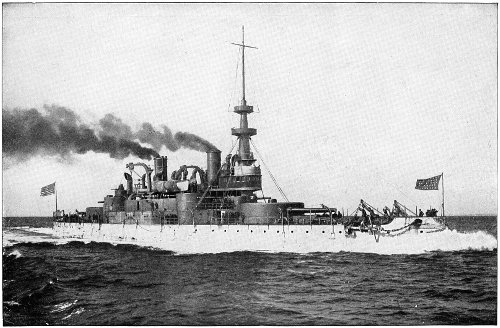
THE OREGON.
One of the most renowned ships of the American Navy is the mighty Battleship Oregon. Her famous run from San Francisco around Cape Horn to take part in the Battle of Santiago has never been equalled by any battleship in the world’s history. After she won fame in the destruction of Cervera’s fleet she was ordered to Manila by Admiral Dewey “for political reasons” and remained there throughout the Philippine War hurling her 13-inch shells into the Insurgent ranks when occasion required.
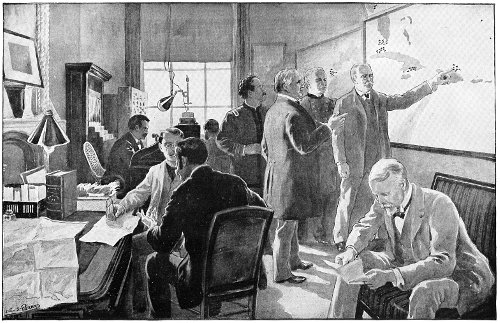
IN THE WAR ROOM AT WASHINGTON.
The above illustration shows President McKinley, Secretary Long, Secretary Alger, and Major-General Miles consulting map during the progress of the Spanish-American War. It is in this room that the plans of conducting the war, by land and sea, are formulated, and the commands for action are wired to the fleet and the army.
As regards the work of our naval inventors, it will suffice to say, that the Americans, while not the first to plate vessels with iron, were the first to do so effectively and to prove the superiority of the ironclad in naval warfare. The memorable contest in Hampton Roads between the Monitor and the Merrimac made useless in a day all the fleets of all the nations of the world, and caused such a revolution in naval architecture and warfare as the world had never known.
The Early American Navy
The Naval War with France
The fleet with which the United States entered the nineteenth century was due to the depredations on American ships and commerce of the war vessels of France and Great Britain. This roused great indignation, particularly against France. While England contented herself with stopping American ships on the high seas and impressing sailors claimed to be of British birth, France seized our ships themselves, under the pretext that they had British goods on board, and if she found an American seaman on a British ship—even if impressed—she treated him as a pirate instead of as a prisoner of war. Protection was felt to be necessary, and preparations for war were made. The small navy of the Revolution had practically disappeared, and a new one was built. In July, 1798, the three famous frigates, the Constellation, the United States, and the Constitution—the renowned Old Ironsides—were completed and sent to sea, and others were ordered to be built. Actual hostilities soon began. French piratical cruisers were captured, and an American squadron sailed for the West Indies to deal with the French privateers that abounded there, in which work it was generally successful. In January, 1799, Congress voted a million dollars, for building six ships of the line and six sloops. The Naval War with France Soon after, on February 9, occurred the first engagement between vessels of the American and French navies. The Constellation, Captain Truxton, overhauled L’Insurgente at St. Kitts, in the West Indies, and after a fight of an hour and a quarter forced her to surrender. The Constellation had three men killed and one wounded; L’Insurgente twenty killed and forty-six wounded.
Again, on February 1, 1800, Truxton with the Constellation came up, at Guadeloupe, with the French Frigate La Vengeance. After chasing her two days he brought on an action. The two ships fought all night. In the morning, La Vengeance, completely silenced and greatly shattered, drew away and escaped to Curaçoa, where she was condemned as unfit for further service. The Constellation was little injured save in her rigging. For his gallantry, Truxton received a gold medal from Congress. Later in that year there were some minor engagements, in which the American vessels were successful.
By the spring of 1801, friendly relations with France were restored. The President was accordingly authorized to dispose of all the navy, save thirteen ships, six of which were to be kept constantly in commission, and to dismiss from the service all officers save nine captains, thirty-six lieutenants, and one hundred and fifty midshipmen. At about this time ground was purchased and navy-yards were established at Portsmouth, Boston, New York, Philadelphia, Washington and Norfolk, and half a million dollars were appropriated for the completion of six seventy-four gun ships.
The Opening up of Japan
Nothing needs to be said here concerning our conflicts with the pirates of the Mediterranean or of the remarkable exploits of the small American navy in the second war with Great Britain. These have already been dealt with in chapters xxv. and xxvi. In the interval between that period and the Civil War there was little demand upon the American navy. The naval operations during the Mexican war were of no great importance. Some vessels were used in scientific exploration, and the dignity of America had to be asserted on some occasions, but the most important service rendered by the navy was the opening up of Japan to the commerce of the world. After some fruitless efforts at intercourse with the island realm, Commodore Perry was sent thither in 1852, and by a resolute show of force he succeeded in obtaining a treaty of commerce from Japan. That treaty opened Japan to the world, and was the first step in its remarkable recent career.
At the beginning of the Civil War the United States was very poorly provided with ships of war. There were only forty-two vessels in commission, nearly all of which were absent in distant parts of the world. Others were destroyed in southern ports, and for a time there was actually only one serviceable warship on the North Atlantic coast. This difficulty was soon overcome by buying and building, and by the end of 1861 there were 264 vessels in commission, and all the ports in the South were under blockade. These vessels were a motley set,—ferry boats, freight steamers, every sort of craft—but they served to tide over the emergency.
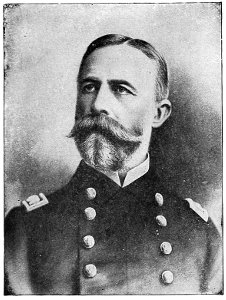
REAR-ADMIRAL WILLIAM T. SAMPSON.
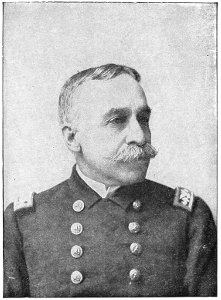
REAR-ADMIRAL GEORGE DEWEY.
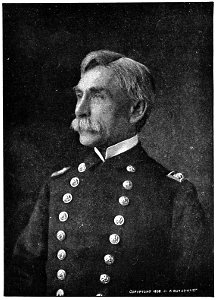
COMMODORE JOHN CRITTENDEN WATSON.
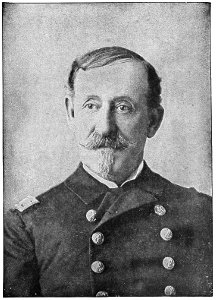
REAR-ADMIRAL WINFIELD SCOTT SCHLEY.
LEADING NAVAL COMMANDERS OF THE SPANISH-AMERICAN WAR.
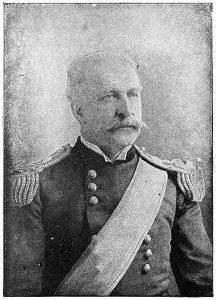
MAJOR-GENERAL NELSON APPLETON MILES.
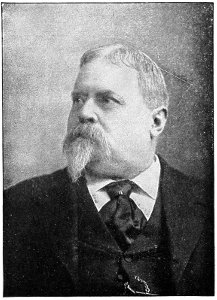
MAJOR-GENERAL FITZHUGH LEE.
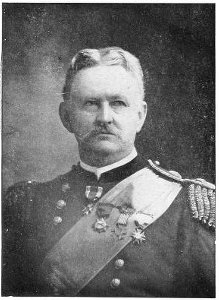
MAJOR-GENERAL WESLEY MERRITT.
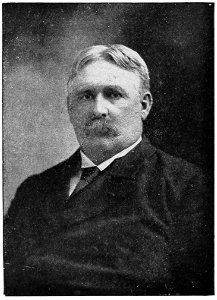
MAJOR-GENERAL WM. R. SHAFTER.
LEADING COMMANDERS OF OUR ARMY IN THE SPANISH-AMERICAN WAR.
With all this we are not particularly concerned, but must turn our attention to the great naval events of the war, those conflicts which served as turning points in nineteenth century warfare. And first and greatest among these was the remarkable naval battle in Hampton Roads on March 9, 1862.
The Idea of Ironplating of American Origin
Early Ironclads of Great Britain and France
The use of iron for plating the hulls of ships was not first adopted in American war. This device was employed by England and France in the Crimean war in attacks on the Turkish forts. The idea, however, was American. As early as 1813 Colonel John Stevens, of New York, made plans for an ironclad ship somewhat resembling the Monitor in type. His son Edwin afterwards performed experiments with cannon balls against iron plate, and in 1844 Robert L. Stevens began the construction of a vessel to be plated with 4–½-inch iron for the government. It was never finished, though in all nearly $2,000,000 were spent upon it. New invention rendered it obsolete before it could be completed, yet to it belongs the credit of inaugurating the era of the ironclad navy. Early Ironclads of Great Britain and FranceAfter the Crimean war France and England both built ironclad ships, the French La Gloire being the first ironclad ever constructed. It was followed by the British Warrior, launched in January, 1861. Yet despite this enterprise, the fact remains that the first conception of an ironclad ship belongs to the United States, and the first hostile meeting of two ironclads took place in American waters.
The Ironclad “Manassas”
At the opening of the American Civil War this idea was in the air, and it was soon made evident that the era of wooden warships was near its end. It is interesting to learn that the Confederates were the first to adopt the new idea, the earliest ironclad of the war being produced by them on the lower Mississippi. A large double-screw tugboat was employed, whose deck was covered with a rounded roof, plated with bar iron one and a half inches thick. This craft—named the Manassas after the first Confederate victory—made its appearance at the mouth of the Mississippi on the night of October 31, 1861, and created a complete panic in the blockading fleet at that point. The Manassas wrecked one of her engines in attempting to ram the flagship Richmond, and crept slowly back, at the same time as the alarmed fleet was hastening away with all speed over the waters of the gulf.
The Plating of the “Merrimac”
While this event was taking place, two ironclads of more formidable description were being built elsewhere, the meeting of which subsequently was the most startling revelation to the nations of the earth ever shown in naval warfare. The United States steam frigate Merrimac had been set on fire at the Gosport Navy Yard, when hastily abandoned by the Federal navy officers at the outbreak of the war. It was burned to the water’s edge and sunk, but soon after the Confederates raised the hull, which was seriously damaged—its engines being in reasonably good condition—and they hurriedly undertook the work of converting it into an ironclad. A powerful prow of cast iron was attached to its stem, a few feet under water and projecting sufficiently to enable it to break in the side of any wooden vessel. A low wooden roof two feet thick was built at an incline of about 36 degrees, and this was plated with double iron armor, making a four-inch iron plating. Under this protection were mounted two broadside batteries of four guns each, and a gun at the stem and stern. The government was soon advised of the raising of the hull of the Merrimac, and without having detailed information on the subject, knew that a powerful ironclad was being constructed. A board of naval officers had been selected by the government to consider the various suggestions for the construction of ironclad vessels, and although, as a rule, naval officers had little faith in the experiment, Congress coerced them into action by the appropriation of half a million dollars for the work. The Naval Board recommended a trial of three of the most acceptable plans presented, and ships on these plans were put under contract.
Ericsson and the “Monitor”
Among those who pressed the adoption of light ironclads, capable of penetrating our shallow harbors, rivers, and bayous, was John Ericsson. He was a Swede by birth, but had long been an American citizen, and exhibited uncommon genius and scientific attainments in engineering. The vessel he proposed to build was to be only 127 feet in length, 27 feet in width, and 12 feet deep, to be covered by a flat deck rising only one or two feet above water. The only armament of the vessel was to be a revolving turret, about 20 feet in diameter and nine feet high, made of plated wrought iron aggregating eight inches in thickness, with two eleven-inch Dahlgren guns. The guns were so constructed that they could be fired as the turret revolved, and the port-hole would be closed immediately after firing. The size of the Merrimac was well known to the government to be quite double the length and breadth of the Monitor, but it had the disadvantage of requiring nearly double the depth of water in which to manœuvre it. Various sensational reports were received from time to time of the progress made on the Merrimac, the name of which was changed by the Confederates to Virginia, and as there were only wooden hulls at Fortress Monroe to resist it, great solicitude was felt for the safety of the fleet and the maintenance of the blockade. While the government hurried the construction of the new ironclads to the utmost, little faith was felt that so fragile a vessel as the Monitor could cope with so powerful an engine of war as the Merrimac. The most formidable vessels of the navy, including the Minnesota, the twin ship of the original Merrimac, the St. Lawrence, the Roanoke, the Congress and the Cumberland, were all in Hampton Roads waiting the advent of the Merrimac.
The Coming of the “Merrimac”
The Fate of the “Congress” and the “Cumberland”
On Saturday, the 8th of March, the Merrimac appeared at the mouth of the Elizabeth River and steamed directly for the Federal fleet. All the vessels slipped cable and started to enter the conflict, but the heavier ships soon ran aground and became helpless. The Merrimac hurried on, and, after firing a broadside at the Congress, crashed into the sides of the Cumberland, whose brave men fired broadside after broadside at their assailant only to see their balls glance from its mailed roof. An immense hole had been broken into the hull by the prow of the Merrimac, and in a very few minutes the Cumberland sank in fifty feet of water, her last gun being fired when the water had reached its muzzle, while the whole gallant crew went to the bottom with their flag still flying from the masthead. The Fate of the “Congress” and the “Cumberland”The Merrimac then turned upon the Congress, which was compelled to flee from such a hopeless struggle, and was finally grounded near the shore; but the Merrimac selected a position where her guns could rake her antagonist, and, after a bloody fight of more than an hour, with the commander killed and the ship on fire, the Congress struck her flag, and was soon blown up by the explosion of her magazine. Most fortunately for the Federal fleet, the Merrimac had not started out on its work of destruction until after midday. Its iron prow was broken in breaching the Cumberland, and, after the fierce broadsides it had received from the Congress and the Cumberland, with the other vessels firing repeatedly during the hand-to-hand conflict, the Merrimac’s captain was content to withdraw for the day, and anchor for the night under the Confederate shore batteries on Sewall’s Point.
The Monitor in Hampton Roads
The night of March 8th was one of the gloomiest periods of the war. The Merrimac was sure to resume its work on the following day, and, with the fleet destroyed and the blockade raised, Washington, and even New York, might be at the mercy of this terrible engine of war. But deliverance was at hand. The building of the Monitor had been hurried with all speed, and this little vessel,—“a cheese box on a raft,” as it was contemptuously termed—was afloat and steaming in all haste to Hampton Roads. It entered there that night, and took up a position near the helpless Minnesota in bold challenge to the Merrimac. On Sunday morning, March 9th, the Confederate ironclad came out to finish its work of destruction, preparatory to a cruise against the northern ports.
The First Battle of Ironclads
The little Monitor steamed boldly out to meet it. The history of that conflict need not be repeated. To the amazement of the commander of the Merrimac, the Monitor was impervious to its terrible broadsides, while its lightness and shallow draft enabled it to out-manœuvre its antagonist at every turn; and while it did not fire one gun to ten from its adversary, its aim was precise and the Merrimac was materially worsted in the conflict. After three hours of desperate battle the defiant and invincible conqueror of the day before found it advisable to give up the contest and retreat to Norfolk.
Fate of the First Ironclads
It was this naval conflict, and the signal triumph of the little Monitor, that revolutionized the whole naval warfare of the world in a single day, and from that time until the present the study of all nations in aggressive or defensive warfare has looked to the perfection of the ironclad. To the people of the present time the ironclad is so familiar, and its discussion so common, that few recall the fact that less than fifty years ago it was almost undreamed of as an important implement of war. It is notable that neither of those vessels which inaugurated ironclad warfare, and made it at once the accepted method for naval combat for the world, ever afterward engaged in battle during the three years of war which continued. The Merrimac was feared as likely to make a new incursion against our fleet, but her commander did not again venture to lock horns with the Monitor. Early in May the capture of Norfolk by General Wool placed the Merrimac in a position of such peril that on the 11th of that month she was fired by her commander and crew and abandoned, and soon after was made a hopeless wreck by the explosion of her magazine. The fate of the Monitor was even more tragic. The following December, when being towed off Cape Hatteras, she foundered in a gale and went to the bottom with part of her officers and men; but she had taught the practicability of ironclads in naval warfare, and when she went down a whole fleet was under construction after her own model, and some vessels already in active service.
While these events were taking place in the waters of the coast, a fleet of ironclad boats was being built for service on the rivers of the West, seven of these being begun in August, 1861, by James B. Eads, the famous engineer of later times. These were light-draught, stern paddle-wheel river steamers, plated with 2–1/2-inch iron on their sloping sides and ends. These, and those that followed them, saw much service in the western rivers, bombarding Forts Henry and Donelson, running through the fire of the forts on Island No. 10, and daring the terrible bombardment from the Vicksburg batteries.
Farragut on the Mississippi
But the most famous event in river warfare during the conflict was the exploit of the daring Farragut in running past Forts St. Philip and Jackson on the Mississippi with his fleet of wooden vessels, breaking their iron chain, dispersing their gun-boats, and driving ashore the ironclad Manassas. The Confederates had also an ironclad battery, the Louisiana, but it proved of little service, and Farragut sailed triumphantly through the hail of fire of the forts, and on the same afternoon reached the wharves of New Orleans.
The most famous exploit of Farragut was the passing of the forts at Mobile. It is worth a brief relation, for in this the resources of ironclad warfare, as then developed, were fully employed, while the bottom of the channel was thickly sown with torpedoes, a mechanism in naval warfare to become of great importance in the following years. Farragut’s main fleet, indeed, was of wooden ships, but he had four monitors; while the Confederates, in addition to their forts and gunboats, had the ironclad ram Tennessee, the most powerful floating battery ever built by them. This formidable craft—for that period—was plated with six inch iron armor in front and five inch elsewhere; and, while carrying only six guns, these were 6- and 8-inch rifled cannon.
Farragut and the Torpedoes
The torpedoes, of which no fewer than 180 were sown in the channel, were not quite ineffective, since one of them exploded under the monitor Tecumseh, and she went down head first with nearly all her crew. The Brooklyn, following in her track, halted as this disaster was seen, her recoil checking all the vessels in her rear. Farragut had taken his famous stand in the shrouds, just under the maintop, and hailed the Brooklyn as he came up in the Hartford. “What is the matter?” he demanded. “Torpedoes,” came back the reply. “Damn the torpedoes!” cried Farragut, in a burst of noble anger. “Follow me.” As the Hartford passed on the percussion caps of the torpedoes were heard snapping under her keel. Fortunately they were badly made, and no other explosion took place.
The story of the battle we may briefly complete. The ships dashed almost unharmed through the fire of the forts, driving the Confederate gunners from their pieces with a shower of grape and canister; and the contest ended with an attack upon the Tennessee, whose stern-port shutters were jammed and her steering gear shot away. Rendered helpless, she was forced to surrender, and the fight was at an end.
Lieutenant Cushing and the “Albemarle”
The Confederates were singularly unfortunate with their ironclads. With the exception of the temporary advantage gained by the Merrimac, all their labor and expense proved of no avail. The last of these war-monsters, the Albemarle, built in Roanoke River, and causing some alarm in the blockading fleet on the coast, was sent to the bottom by a daring young officer, Lieutenant Cushing, in one of the most gallant exploits of the war. He and a few men, in a steam launch carrying a large torpedo, sailed up the stream at night to where the ironclad lay in her dock at Plymouth. A protecting raft of logs guarded the Albemarle, but Cushing daringly drove his launch up on the slimy logs, exploded the torpedo as it touched the sides of the ship, and leaped with his men into the stream. The Albemarle sank to a muddy bed in the river’s bottom, and Cushing escaped to the blockading fleet, after a series of thrilling adventures.
The Type of the New Navies
But the most important thing achieved in this war was the entire transformation effected in naval science. Previously the warship had been of the type of an armed merchantship, propelled by sails or, latterly, by steam, and carrying a large number of small guns. Modern inventiveness made it, after the duel of the Monitor and Merrimac, a floating fortress of iron or steel, carrying a few enormously heavy guns. The glory of the old line-of-battle ship, with three or four tiers of guns on each side and a big cloud of canvas overhead, firing rattling broadsides, and manœuvring to get and hold the weather-gauge of the enemy—all that was relegated to the past forever. In its place came the engine of war, with little pomp and circumstance, but with all the resources of science shut within its ugly, black iron hull.
John Paul Jones, with his Bon Homme Richard, struck the blow that made universal the law of neutrals’ rights. Hull, with the Constitution, sending a British frigate to the bottom, showed what Yankee ingenuity in sighting guns could do. Ericsson and Worden, with the Monitor, sent wooden navies to the hulk-yard and ushered in the era of iron and steel fighting-engines. These were the great naval events of a century.
Beginning of the Modern American Fleet
Yet the American navy was greatly neglected in the years succeeding the Civil War, while foreign nations, quick to learn the lesson taught at Hampton Roads, were straining every nerve to build powerful fleets of iron and steelclad ships, and to develop the breech-loading rifled cannon into an implement of war capable of piercing through many inches of solid steel. It was not until after 1880 that our government awoke to the need of a navy on the new lines, and began to take advantage of the lessons that had been learned abroad. It is not our purpose to speak in detail of the results. The steelclad battleship and cruiser, the armor-piercing breech-loader, the quick-firing gun, the machine gun, the submarine torpedo-boat, the anchored mine, the automobile torpedo, and other devices have come to make the naval warfare of our day a wonderfully different thing from that of the past.
The “Columbia” and the “Minneapolis”
The United States began late to build a modern navy, but has made highly encouraging progress, and while still far in the rear of Great Britain and France in the number of her ships, possesses some of the finest examples of naval architecture now afloat upon the waters. Among commerce-destroyers the Columbia and the Minneapolis, with their respective trial speeds of 22.81 and 23.07 knots, stand beyond any rivals to-day in the navies of Europe, while the inventive naval engineering of the Americans is exemplified in the double turrets of the Kearsarge and Kentucky, two additions to our navy of original formation, and likely to give an excellent account of themselves should any new war occur.
The Powerful Fleet of Great Britain
Of modern fleets, however, far the most powerful one is that of Great Britain, the government of which island shows a fixed determination to keep its naval force beyond rivalry. This stupendous fleet forms the most striking example of naval destructiveness the world has ever seen, and the nations of the world are entering the twentieth century with powers of warfare developed enormously beyond those with which they entered the nineteenth. We can only hope that this vast development both in army and navy may prove to exert a peace-compelling influence, and that every new discovery in the art of killing and destroying may be a nail in the coffin of Mars, the god of war.