HERNANDO CORTÉS: (continued 2)
Reading edition
The Aztecs replied in a manner which was quite unexpected.
“It is quite true that you have destroyed our gods, massacred our countrymen, and broken our temple to pieces. But look out upon our streets and terraces. You see them thronged with warriors as far as your eyes can reach,” said the Indian who had been chosen spokesman. “Our numbers are scarcely diminished by our losses. Yours, on the contrary, are lessened every hour. Your provisions and your water are failing; you are perishing from hunger and from sickness; you must soon fall into our hands. The bridges are broken down and you cannot escape! There will be few of you left to glut the vengeance of our gods.”
With this tart reply, they discharged a volley of arrows, which compelled the Spaniards to beat a speedy retreat.
To retreat was hazardous, indeed, and it was mortifying to abandon the city; but, with his men daily diminishing in strength and in numbers, and with his stock of provisions so nearly exhausted that one small daily ration of bread was all that the soldiers had, there was nothing else for Cortés to do. Montezuma had lingered feebly along, after the day in which he had been struck by a stone, and now passed to another world. “The tidings of this,” says an old historian, “were received with real grief by every cavalier and soldier in the army who had access to his person, for we all loved him as a father.” The Emperor’s death was a misfortune for the Spaniards, because, while he lived, there was a slight possibility of using his influence with the natives. Now that hope had disappeared.
A council was called to decide as speedily as possible the all-important question of the retreat. It was agreed that they should leave at once, and at night, so that darkness would cloak their movements. The safe conveyance of the treasure was quite a problem, but the soldiers had converted their share into gold chains, or collars, which could be easily carried about their persons. The royal fifth, however, was in bars and wedges of solid gold. It could be carried only by horse, and a special guard had to be provided for it. But much treasure had to be abandoned, and it lay in shining heaps upon the floor of the palace.
The soldiers who had come with Cortés, being old campaigners, did not load themselves down with more than they could safely transport. The soldiers of Narváez, however, being keen for the accumulation of treasure, loaded themselves down with all that they could possibly carry off with them.
As the retreat was to be over the causeway and dykes, a portable bridge was constructed which could be laid across the open canals. This was entrusted to the care of an officer named Magarino and forty men. Cortés arranged the order of march. First was to go two hundred Spanish foot soldiers, commanded by a Captain Sandoval, with twenty other cavaliers. The rear guard was formed of infantry under Alvarado and De Leon, while the center was in charge of Cortés, himself, with some heavy guns, the baggage and the treasure. There were also the prisoners, among whom were a son and two daughters of Montezuma, Cacama, and several nobles. The Indian allies, the Tlascalans, were divided up among the three divisions. There were several thousand of these.
Midnight came and all was ready for the journey. A solemn mass was celebrated by Father Almedo, and, keeping as quiet as they possibly could, the Spaniards sallied forth from the ancient palace of the Aztecs, which had been the scene of so much suffering and fighting. The night was a dark one, and a fine, misty rain fell steadily upon the serried columns of Spanish cavaliers and brown-skinned natives.
The vast square before the palace was deserted. Through some superstitious dread, the natives had not frequented the plaza since the death of their Emperor, Montezuma, and the Spaniards crossed it as noiselessly as possible, entering the great street of Tlacopan. They peered anxiously into the gloom, expecting to be attacked at any moment by a swarm of Aztecs, but all went well with them until the first files of soldiers drew near the spot where the street opened upon the causeway, which led by the side of the lake. Here there were Mexican sentinels at their posts, and, as the bridge was being adjusted across the uncovered breach, the Aztecs fled, crying out in loud tones that the hated white men were leaving the city.
Immediately there was a commotion. The priests heard the shouting from the summits of their teocalli and beat upon the peculiar shells which were used for rousing the people. The huge drum upon the temple of the god of war was struck and gave forth a hollow, moaning roar which vibrated through every corner of the capital. The Spaniards were alarmed and worked with desperate fury to place their bridge across the causeway so that the army could escape. But, as the soldiers labored valorously, a sound was heard like a stormy wind as it rises in a forest. Nearer and nearer it came, and, from the dark waters of the lake came the splashing of many paddles. A few stones and arrows fell among the hurrying troops. More and more followed in rapid succession until they became a veritable blinding storm. Yells and shrill war-cries rent the air, and, before the Spaniards well realized their position, they found themselves surrounded by myriads of the enemy, who were swarming over land and lake.
The Aztecs ran their canoes along the sides of the causeway, climbed up, and charged the ranks of the Spaniards, with their Tlascalan allies. The soldiers shook them off as best they could, rode over them with their horses, and, with their pikes and their swords, drove them headlong down the sides of the dike. They halted and waited for the bridge to be brought up; but a terrible calamity had occurred, for the bridge had been so borne down by the weight of the artillery passing over it, that it had jammed firmly into the sides of the dike and was immovable.
The tidings spread rapidly from man to man and a cry of despair arose, for all means of advance were cut off, and the Spaniards were caught in a trap. Those behind pressed forward, trampling the weak and the wounded under foot, and forcing those in front over the gulf. Some of the cavaliers succeeded in swimming their horses across, but many rolled back into the lake when attempting to ascend the opposite bank. The infantry followed in a panic, and many of the men were pierced by the Aztec arrows, or struck down by war clubs. Some were dragged into the canoes to be later sacrificed to the great and awful stone god. Fierce battle cries rose above the tumult of war, and these were mingled with the cries of despair of the drowning Spaniards.
By degrees the opening in the causeway was filled up by the wreck of the wagons, guns, rich bales of stuffs, chests of solid ingots, and bodies of men and horses. Walking on top of this dismal ruin, those in the rear were able to reach the other side.
As the attention of the Aztec warriors now fell upon the rich spoil that strewed the ground, the pursuit of the Spaniards ceased. The troops pressed forward through the village of Popotla, where Cortés dismounted from his weary war-horse, and, sitting down upon the steps of an Indian temple, looked mournfully at his broken army, as the thin and disordered ranks filed past. It was a heartrending spectacle. He knew, however, that this was no time to give away to vain regrets, so he speedily mounted, and led his men through Tlacopan.
The broken army, disorganized and half starved, moved slowly toward the sea coast. On the seventh day it reached the mountain range which overlooks the plains of Otumba, and the scouts, climbing the steep hillside, reported that a mighty host of warriors was in the valley, ready to dispute their passage. Every chief of importance had taken the field, and, as far as the eye could reach, extended a moving mass of glittering shields and spears, mingled with the banners and the bright feather-mail of the caciques.
Cortés disposed his army to the best advantage, and prepared to cut his way through the enemy. He gave his force as broad a front as possible, protecting it on either flank by his cavalry, now reduced to but twenty horsemen. His directions to his infantrymen was that they were to thrust, not strike, with their swords, and were to make for the leaders of the enemy, whom they were to dispatch as soon as met with. After a few brave words of encouragement, the little band began to descend the hill. The enemy set up fierce war cries, as they approached, and met the Spaniards with a storm of stones and arrows.
Now occurred a bitter fight. The Spaniards, at first, beat through the crowd of natives, but, as the battle progressed, they were surrounded on every side by a swarm of warriors. Cortés received a wound in the head and his horse was killed beneath him, so that he was obliged to mount one taken from the baggage train. His men became exhausted beneath the fiery rays of the sun and began to give way. The enemy, on the other hand, was constantly being reënforced from the rear, and pressed on with redoubled fury.
Matters were critical for the Spaniards, when Cortés did a deed of daring which was quite worthy of the Chevalier Bayard, or Murat, the famous Napoleonic leader of horse. With his keen eye he discovered in the distance a chief, who, from his dress and surroundings, he knew to be the leader of the Aztec forces. Turning to his favorite henchmen, the brave Spaniard cried out, while pointing his finger at the chief:
“There is our mark! Follow and support me!”
Then, shouting his war cry, he plunged into the thickest of the press and bore towards the noble Aztec.
The enemy was taken completely by surprise and fell back. Many could not dodge aside and were trampled down by the war-horse, or pierced by the long lance which Cortés wielded with all the skill of a trained fencer. The cavalier companions of the gallant Spaniard followed him closely, and, in a few moments, they had come within striking distance of the Aztec chieftain. Cortés rode speedily at him, and, thrusting with his lance, brought him to earth, where he was stabbed to death by a young Spaniard called Juan de Salamanca. Tearing his banner from his clinched fist, the Castilian presented it to Cortés, who waved it triumphantly above his head. The caciques’ guard, surprised by this sudden onset, fled precipitously, while the panic spread to the other Indians. The Spaniards pursued them for several miles, then returned to secure the rich booty which they had left behind them. Truly the battle had been won by the daring and personal initiative of the brave Spanish leader.
The adventurers were now safely out of their grave peril. They reached Tlascala in a few days, and, with the assistance of their native allies, at once prepared to revenge themselves upon the Aztecs. Several Spaniards were at Vera Cruz and these joined them. But there was much need of gunpowder, and there was no way of getting sulphur for its manufacture, unless it was obtained from one of the many volcanoes in the neighborhood. How was this to be done?
A cavalier, named Francio Montaño, was equal to the emergency and suggested that he be allowed to descend into the terrible volcano of Popocatepetl, where sulphur, in a crude form, hung to the side of the crater. Cortés was only too willing to allow him to make the attempt, so accompanied by several others, he set out. After great hardship, and, after passing through a region of perpetual snow, the explorers reached the mouth of the fierce volcano, and, crawling cautiously to the very edge, they peered down into its gloomy depths. At the bottom of the dark abyss a lurid flame was burning, and, every now and again, arose a sulphurous stream, which, cooling as it came upward, fell again in showers upon the side of the cavity. It was necessary to descend into this crater, with the boiling lava below, in order to scrape some of the sulphur from the sides.
Montaño himself drew the longest stem of grass, when the Spaniards had prepared lots to see who should descend, and, clinging to a basket and rope, was soon four hundred feet within the horrible chasm. As he hung there, he scraped the sulphur from the sides of the crater, descending again and again, until he had procured enough for the wants of the army. Then, with great elation, the adventurous sulphur hunters returned to Tlascala, where their arrival was greeted with shouts of joy.
Cortés was fully prepared to march again to the Mexican capital and to wreak vengeance upon the Aztecs, who were now governed by Guatemozin, a young prince who had married one of Montezuma’s daughters.
The Spanish army consisted of about six hundred men, of which forty were cavalry, and eighty were arquebusiers and cross-bowmen. There were nine cannon. The men were armed with swords and with long copper-headed pikes, which had been specially constructed under the direction of the General. There were, also, the Tlascalan allies, who were still anxious and willing to fight their hated enemies, the Aztecs. Numerous other bands of Indians also flocked to the Spanish standard.
Cortés determined to march to Tezcuco, establish his headquarters upon the side of the great lake which was near the Mexican capital, and to begin a blockade of the city of the Aztecs, until some ships, which he was having constructed, could be brought to him. Then he could transport his troops to the edge of the city and begin a direct assault.
Everything went well with both ships and men. The vessels reached the lake in good order, were launched, and were filled with soldiers. The plan of action against the city was to send the cavalier, Sandoval, with one division, to take possession of Iztapalapan at the southern end of the lake, while Alvarado and Olid were to secure Tlacopan and Chapultepec upon the western shore, destroy the aqueduct, and thus cut off the city’s supply of fresh water. This was successfully done and soon the Spaniards had penetrated into the city as far as the great teocalli. The natives were driven before them, while the Tlascalans in the rear filled up the gaps and brought up the cannon.
As you remember, it was at the great teocalli that the most serious fighting occurred when the Spaniards were previously driven from the city. Now still fiercer battling took place and the Spaniards again captured this temple of the war-god. Some of them rushed to the top and there found a fresh image to Huitzilopochtli. Tearing off the gold and jewels with which it was bedecked, they hurled it, with its attendant priests, over the side, with a mighty yell of defiance. Then they hastened below to the assistance of their comrades, who were being furiously assailed by the Aztecs.
Things were going ill with the Spaniards and they were being driven down the great street of the city in hopeless confusion and panic. Luck was with them, however, for a small force of cavalry now arrived, charged into the mass of yelping Indians, and drove them back again to the teocalli. Here Cortés attacked by the flank and the natives retired in confusion and dismay. Evening was now coming on, so the Spanish troops retreated in good order, their Tlascalan allies pulling down many of the houses as they departed. The palace of Montezuma was set afire, and this sight so maddened the Aztecs, that they redoubled their efforts to head off the disappearing white men. It was of no avail. The attacking Spaniards soon reached Xoloc, where they learned that many of the native tribes, seeing the Mexicans unable to hold the city, would join with the men from Castile.
After months of siege the Aztecs still defied the conquerors and fiercely rejected all overtures of peace, although the banner of Castile floated undisturbed from the smoldering remains of the sanctuary on the teocalli of the war-god. Hundreds of famishing wretches died every day and lay where they fell, with no one to bury them. In the midst of all this brutality and misery, Guatemozin remained calm and courageous, and was as firmly resolved as ever not to capitulate.
An assault was ordered, and, although the Mexicans fought valiantly, they were weakened by starvation and could not struggle as before. After a bloody battle, the Spanish commander withdrew to his quarters, leaving behind him forty thousand corpses and a smoldering ruin. This blow seemed to utterly stun the Aztecs.
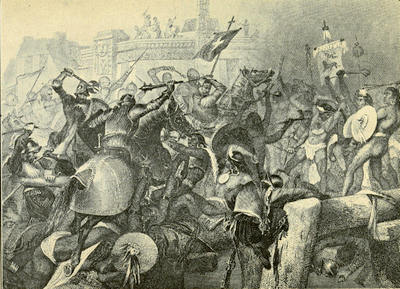
CAPTURE BY CORTÉS OF THE CITY OF MEXICO
Cortés now determined to secure the person of Guatemozin, so, upon the following day, August 13th., 1521, the Spaniards again advanced into the town and were soon battling fiercely with the Aztecs. While this was going on several canoes pushed off across the lake. The Spanish ships gave chase and sunk most of them, but a few succeeded in getting into open water. Two or three large canoes, close together, attracted the attention of a soldier, named Garci Holguin, who instantly gave chase, and, with a favorable wind, soon overtook the fugitives, although they rowed with great energy. The Spaniards leveled their guns at the Indians, when one rose, saying:
“I am Guatemozin. Lead me to Malinche. I am his prisoner. But let no harm come to my wife and to my followers.”
The Emperor was taken on board one of the ships and was ordered to call upon his people to surrender.
“There is no need of this,” he answered sadly, “for they will fight no longer when they see that their Emperor has been captured.”
He had spoken correctly, for, when the news of his capture reached the shore, the Mexicans at once ceased to defend themselves. They had put up a hard battle in order to give their Sovereign an opportunity to escape.
Cortés had been watching the affair from the flat roof of one of the houses and now sent word that Guatemozin should be brought before him. He came, escorted by Sandoval and Holguin, both of whom claimed the honor of having captured him. The Spanish conqueror came forward with dignified courtesy to receive the noble prisoner.
“I have done all that I could to defend myself and my people,” said Guatemozin. “I am now reduced to this awful state. Deal with me, Malinche, as you will.” Then, laying his hand upon a dagger which hung from the belt of the Spanish invader, he added: “Better dispatch me at once with this, and rid me of life.”
Cortés smiled.
“Fear not,” said he. “You will be treated with honor. You have defended your capital like a brave warrior, and a Spaniard knows how to respect valor, even in an enemy.”
In spite of these remarks he treated him with great cruelty, for, when the city was entered and less treasure was found there than had been expected, Cortés caused poor Guatemozin to be tortured. Fire and cord could not, however, wring the secret of the treasure from this illustrious Prince. Later on he was hanged, upon the pretense that he had conspired against the Spaniards.
The Aztec dead were now collected and burned in huge bonfires. Those who were still alive were allowed to leave the city, and for three days a mournful train of men, women, and children straggled feebly across the causeways, sick and wounded, wasted with famine and with misery. Again and again they turned to take one more look at the spot which had once been their home. When they were gone, the Spanish conquerors took possession of the place and purified it as speedily as possible, burying those who were not burned in the bonfires.
The treasures of gold and of jewels which were found fell far short of the expectations of the conquerors, for the Aztecs, no doubt, had buried their hoards, or sunk them in the lake on purpose to disappoint the avarice of their enemies.
Thus, after three months of continued fighting, the renowned capital of the Aztecs fell before Cortés and his men. The Mexicans had put up a courageous fight and had suffered much, but they had been no match for the soldiers from Cuba and from Spain.
The Aztecs would not have thus gone down to ruin, had they not ruthlessly made war upon the neighboring states, which caused them to be hated. Their human sacrifices had angered their weaker neighbors, and thus Cortés had secured the aid of the Tlascalans, without whose assistance he could never have won the fight.
Cortés and his Spaniards were now masters of Mexico. A brave man with equally brave followers had conquered an entire empire!
And what of the future days of this bold-hearted explorer? Alas! These were similar to those which came to Columbus, the Navigator. Poor, forsaken by the King of Spain, surrounded by persons who were jealous of his position and his fame, the once rich and prosperous adventurer died miserably at Castilleja, Spain, on December second, 1547, at the age of sixty-two. With him was his devoted son, Martin, a youth of fifteen.
Cortés was entombed in the land of his birth, but this was not to be his last resting place, for his remains were taken across the sea to the country which he had conquered. He was buried for the second time in the Franciscan monastery at Tezcuco; then, for a third time, in the church of St. Francis in the City of Mexico. On this occasion, which was sixty-seven years after the first entombment, all the dignitaries of Mexico marched in procession through the streets of the city. Still again, in 1794, there was another removal of the General’s moldering dust to the hospital of Jesus, where a monument of bronze was erected to his fame and glory.
In 1823 there was yet another disturbance of what remained of our hero. The previous removals of his ashes had been inspired by regard, but now a revolutionary mob of frenzied Mexicans, in order to show its hatred and detestation of the Spanish conquerors, endeavored to desecrate the tomb. To prevent this, the casket, in the dead of night, was secretly carried away by the Duke of Monteleone, a descendant of Cortés on the female line, and for more than seventy years remained in a place of safety. Monteleone, himself, was killed in one of the many Mexican revolutions, and all knowledge was lost of the spot where he had hidden the ashes of the conqueror. Yet, within a few years, the remains have been discovered and a movement has been started to have them placed in the national pantheon, a temple in the City of Mexico, erected to all those who have made great names in the history of this turbulent republic.
So at last, perhaps, the valiant Cortés will receive the honor that is due him.
FERDINAND MAGELLAN:
EXPERT MARINER, WHOSE FOLLOWERS WERE THE FIRST TO CIRCUMNAVIGATE THE GLOBE
(1480-1521)