Front matter (continued 2)
Reading edition
"You great thief!" he cried. "What do you mean by laughing at me?"
And catching up his accordion he threw it at the animal with such accuracy that, hitting him on the head, it knocked him senseless. A great noise was heard, the monkey disappeared, Rupert's teeth grew shorter, and while the accordion played, of its own accord, the celebrated air "No me matas," a woman appeared in the middle of the room who, for size, looked like a whale, and who would have been beautiful if she had not had a turned-up nose and fixed eyes, one weeping oil and the other vinegar, and who would certainly have had a fine head of hair if she had not been bald, and a fine set of teeth if a single tooth had remained in her head.
"Who are you?" asked Rupert, a trifle startled.
"I am the witch Trompetilla, the daughter of the celebrated Trompeton and grand-daughter of Trompetazo, and am looking for my son Trompetin everywhere, without being able to find him."
"Why do you speak to me about Trompetilla and Trompetin when I never played a trumpet in my life?"
"Ah, unhappy me!" sobbed the witch. "In vain I have offered a pennyworth of toasted chick peas and a measure of tiger nuts to the mortal who discovers the whereabouts of my son. I have wept so much oil and vinegar that I have spoilt all the furniture in my house."
"What a fine salad you could make if you bought some lettuces!"
"You will get a salad made of blows if you don't help me to look for my Trompetin, and if we find him I will invite you to supper, and moreover will give you a penny so that you need never do any more work in your life."
Roused by such a magnificent promise, Rupert offered to look for Trompetin, even if he were under a cruet.
"What is he like?" he asked.
"The size of a pea, a head like that of a pin, and legs like needles."
"Well, then, he must be sticking in a pin cushion or in a needle-case."
"A needle-case would not hold him, for he has a beard two yards long."
"It must trail on the ground!" said Rupert, full of astonishment.
"Well, now," said the witch, "while I go and mend some clothes, begin to look for my pet."
This said, she disappeared.
The boy was confused by so many comings and goings, appearances and disappearances; but as hunger afflicted him, he proposed to find Trompetin, and taking a turn round the room, began to shout:
"Trompetin, where are you?"
"Here!" groaned a tiny voice.
"Where? I can't see you."
"In this crack," replied the voice.
Rupert searched, and at last found the witch's son in a crack between two bricks. The enormous beard was a hair two yards long, which grew out of his nose.
Rupert took him up carefully, and placing him on his hand, asked him:
"Are you Trompetin, the son of Trompetilla?"
"The same."
"Why have you been lost so long?"
"Because my mother is deaf and cannot see well, so that, although I shouted a lot, she did not hear me."
"Well, now, tell me who the monkey is that climbed up on to my teeth?"
"It is a wizard, nastier than medicine, who is angry with us because his grandfather died from a trumpet-blast that my great-great-grandfather sounded in his ear. It was he who made your teeth grow, and didn't allow you to eat. Knock on this wall and he will reappear, then pull out my hair and thrash him with it."
"A fine thrashing to be given with a hair!"
"Try, and you will see!"
Rupert struck the wall, and at once the monkey appeared, sparks flying from his eyes. He was about to throw himself on Rupert, but the boy pulled out Trompetin's hair, which turned itself into a fine cudgel, with which he dealt the monkey a vigorous hiding. The animal leapt high into the air several times, but that was useless, as the stick lengthened as if it were elastic and reached him wherever he was. When the monkey could resist no longer, he took human shape, and going on his knees begged Rupert not to grind his ribs, and in return he offered to give him as much wealth as he might desire.
"Call Trompetilla," exclaimed the lad, "and let us have a talk."
The witch appeared, this time crying with joy at seeing her son, and after kissing him, stuck him in her dress so that he should not be lost again. The wizard gave Rupert a lot of money and the witch gave him a splendid supper of stew and hemp-seed.
When supper was over they affectionately took leave of one another, and the wizard took Rupert out into the fresh air, carrying him carefully to the same spot in which he was when he met the priest. There he left the boy sleeping soundly, dreaming of a sweet awakening—the dream of the person who sees his future assured by reason of not having done anything wrong.
THE QUACK DOCTOR
I do not know whether it was true or not, but as it was told to me so I tell it to you.
There used to pass through the goodly streets, whether of Constantinople or Babylon I am not sure which—however, it makes no difference to my story—a quack doctor who, while beating a drum and clashing a pair of cymbals, announced his medicines and practised his cures.
You must place the action of this story in a place where there are no medical men, for if there were, certainly they would put the quack in prison where he would not see daylight for a long time. And the fact is that, with all his quackery, the man had acquired great fame in the difficult art to which he devoted himself. His adaptability was extraordinary. It was just the same to him to extract a big man's tooth as to pull out a knife and cut off anybody's leg without stopping for a moment.
For shamelessness this man could not be beaten. It is related that in the times when our quack wandered through the streets and towns, the emperor's son fell ill of a great and persistent melancholy. The youth was sad and weak, and even when he felt no pain his depression was alarming. The court doctors, who were important people, held a consultation, and, as always happens in these cases, each one put forward a different opinion from that of his companions.
"It appears to me," said one, putting on his spectacles, "saving the estimable opinion of my fellow-professors, that his highness the hereditary prince is suffering from his liver. Broth of green beans would be a good thing."
"Gently, wise companion," exclaimed another. "I maintain that his highness suffers from his spleen; and as what is good for the liver is bad for the other organ, I do not believe that green beans would be any good; roasted chick peas are wanted."
"Well, gentlemen, may I be hanged if the prince's illness is not in his feet. Ask him if he has chilblains, and, in that case, we all know what to do: wool, plenty of wool, and watercress, plenty of watercress."
The discussion took a threatening turn; each doctor, in support of what he affirmed, cited three or four authorities and even brought books to prove and demonstrate it. The dispute waxed so hot that it ended by the doctors throwing the books at each other's heads. A book broke the spectacles of one of the doctors, and a little more would have knocked out one of his eyes; another fell like a mace on the bald head of the oldest and crashed into his brain, his skull not being of the hardest.
At this moment the emperor entered the room where the three Hippocrates were killing each other, and when informed of the cause of the dispute became cold all over.
"It is a bad sign when you do not agree. My son is in danger of dying."
And the poor father went away, saddened and disheartened, to his apartments.
History says that not a bit of the doctors remained. On seeing the emperor so grief-stricken there was no lack of courtiers who had the courage to speak to him of the advisibility of calling in the quack.
"Impossible," said the monarch. "If those three shining lights of medicine could not save him, how can I possibly expect that the quack can cure him?"
However, the courtiers were so persistent that the emperor consented to call in the quack, but on one condition: before taking up the cure of the prince, he must heal five sick people who had been given up by the doctors.
They looked for the five invalids and had them brought into the palace. The quack, obeying the emperor's orders, arrived shortly after. The latter said to him:
"Do you dare to undertake the prince's cure?"
"Yes, sire."
"Well, in order to convince me of what you know, you will heal five men who are seriously ill and whom I will show you. If you do not cure them I will have your head cut off, but if you make them well I will thenceforward put his highness' health in your charge."
"Can you not make it four instead of five, sire?"
"No, five; and if not, you know what to expect."
"Well, then, I will cure them. Where are they? I must speak to them alone."
With the emperor's permission he went to the room where the hopeless cases were. Even the most healthy of them had only two or three days to live.
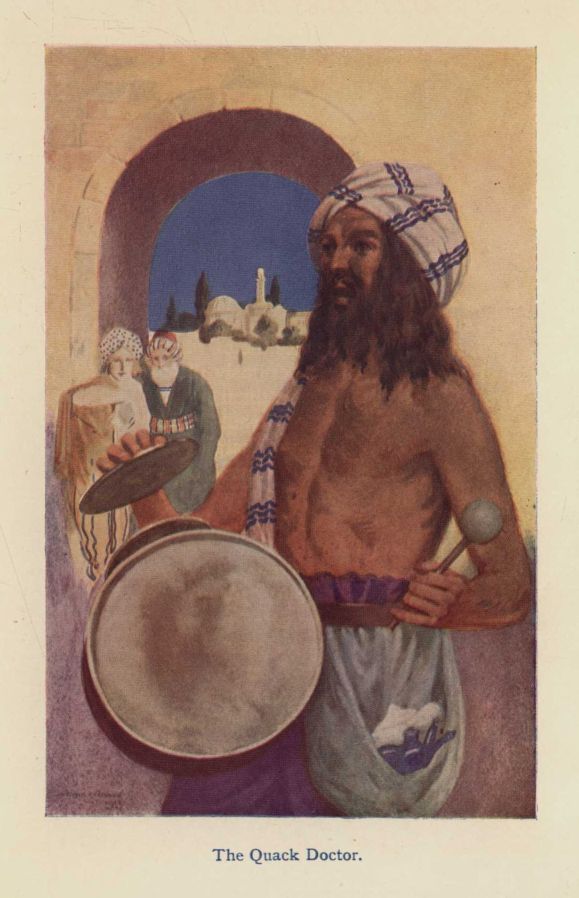
The Quack Doctor.
On seeing them our quack almost fell in a faint.
"Gentlemen," he said, "I am going to cure you in the only possible way. The great magician Faramalla has taught me a wonderful system of curing. There is no invalid who cannot be healed by it. Hear it:
"It is necessary for me to kill one of you and burn his heart. Its ashes serve to make such a pomade that on applying it to any diseased part it heals as if by magic, without any need of medicine. You," he added, facing one of the hopeless ones, "are very ill, what does it matter to you if you die now or within two days? I shall kill you and burn your heart to cinders in order to cure the rest."
"I say, good friend," cried the threatened man, "do you say I am very ill? Why, there is nothing the matter with me. My family persists in saying that I am consumptive, but, thank God, I am as sound as a bell."
"All right, all right," said the quack, "it makes very little difference to me; but you leave on this condition, that you tell the emperor that you are cured."
The consumptive, hardly noticing the half-opened door, dashed madly homewards.
"How are you?" the emperor asked him.
"I am sound and well," exclaimed the consumptive, without ceasing to run.
"This is marvellous," thought the emperor.
"He is a very learned man," said the courtiers.
The other invalids did the same as the first. Provided that they were not killed at once, they swore by all they held sacred that they had never felt stronger and better in their lives. And they darted out of the palace like arrows from a bow, leaving the emperor and the doctors amazed.
The monarch then thought of trusting him with the cure of his son, when a loud burst of laughter interrupted the grave and ceremonious etiquette of the court. Who was the daring man who thus failed in due respect?
The emperor in person, full of ire, went out into the ante-room and there met the disturber. It was the imperial prince himself, who was rolling on a sofa unable to restrain his outbursts of laughter. The emperor was delighted to see the sadness, which had so alarmed him, dissipated so unexpectedly. To what was this extraordinary event due?
The prince told him. "On seeing those unhappy invalids run out so quickly, I asked the quack the cause of their flight, and the latter told me with a wealth of detail."
It had amused him so much that the black melancholy which was undermining his existence was dissipated.
"You will remain with my son," said the emperor to the quack, "not as a doctor but as a friend. You are a witty man and wit deserves to be rewarded."
THE DRAWING SCHOOL
Once there was a boy so fond of spoiling walls, doors, and windows with grotesque drawings that there was no way of stopping him from practising his silly cleverness wherever he was. And I say silly, because from his hand came forth some primitive dolls, with heads as round as a billiard ball, eyes and nose forming a sort of cork, and arms and legs like thin thread, terminating in hands and feet which required an inscription in order not to be taken for scourges.
One afternoon he approached the very wall of the school, and there, with the greatest coolness, commenced to draw with a piece of charcoal some of his strange figures. Perico, for so the boy was called, traced the figure of the head of a puppet, made the eyes and the mouth, and, oh, how strange! the doll began to wink and open its mouth and put its tongue out like anything.
Perico was not timid, and therefore the moving of the eyes and mouth did not startle him, and so without paying attention continued with his sketching the arms and the rest of the body. But he had hardly finished when the doll's hand came out and gave him such a tremendous knock that it made him lose his balance, and he would even have fallen to the ground if another blow with the other hand and on the opposite cheek had not kept him on his feet. And as if this was not enough, the legs sprang out of the wall, and two vigorous kicks that Perico received in the pit of the stomach quite convinced him that there was one too many, and he was the one. Thus convinced he was about to run away when the whole doll came away from the stone, and at a bound leapt on his shoulders and began to bite him in the back of the head.
Perico ran towards his house like a greyhound, feeling on his neck the weight of that unexpected load, when the latter grew heavy, as if, instead of a charcoal picture, he had to deal with a bronze statue.
The poor little boy sank to the ground, and on getting up saw at his side, in the middle of the square, the doll in question, as tall as a giant and changed into a motionless iron statue.
He tried to fly, but the statue caught him with its great hands by the neck and, raising him up, placed him on its shoulders, and this being done commenced to run in the direction of the country. Its footsteps produced a very disagreeable noise of ironmongery, something like a sack of nails being shaken up.
It was night-time and our giant, with Perico on its shoulders, ran as fast as anything to a neighbouring mountain, until he came to a dark grotto into which he penetrated without any need of matches, because intense lights shone from his eyes.
During all this Perico, needless to mention, was more afraid than ashamed, and did not know, nor could even imagine how, it was going to end.
At length, after some minutes' walk in the grotto, the iron man straightened himself, and turning the light of his eyes towards a corner, lighted up by a glance the lamp which hung down from the rocky ceiling, and this being done, took Perico down from his shoulders and sat down.
"You do not know who I am," said the doll, opening his mouth with a horrible smile; "but when you do know, it will make your hair stand on end from fright."
"I am sure it won't," said the lad, "because it is already doing so; and as I cannot be any more afraid than I am now, on account of being so much afraid the fear which I felt is passing away."
"Well, then, I am the magician Adefesio, and I am tired of your drawing me so ugly and so similar to all the boys. The thing which puts me out most is that you draw my eyes without pupils and my nose without nostrils. Moreover, the ears which you sketch look like jug handles, and I am sick of my portrait going about the world so disfigured and so badly done. Could you not have learnt to draw a little before commencing these pictures? Well, the punishment that I reserve for you is to draw your portrait every day."
"What a punishment!" exclaimed Perico.
"The fact is that I do not know how to draw either," answered the man of iron, "and the worst of it all is that while I am drawing you, you will grow like my sketch, so that in a twinkling you will be disfigured. There, does not that seem a severe punishment to you? Well, you will see!"
And seizing Perico by one arm he pulled the lamp which hung down. Then a hole opened in the ceiling and the lamp went up, dragging the doll and Perico through the air.
The light continued to rise through a sort of well which was lighted up, and whose walls were lined with books full of badly-made drawings, spoilt plans, pieces of forms with engravings made with penknives, and table-covers destroyed through having been drawn on. That was the museum of the man of iron, and each time he saw it he was filled with anger towards the young draughtsmen who spoilt everything.
Soon they found themselves in a spacious room decorated in Arabian style and furnished most luxuriously. In the background there was an easel of great size, and on it a blackboard on which were drawn a lot of dolls of the same sort that Perico drew.
"Dear me, how fine!" said the boy looking at the sketches; "it seems that I did them."
"Well, now you will see the consequences," and snapping his fingers he produced a metallic sound, and immediately a multitude of boys of different ages came through a door. But what funny boys! All had round heads, eyes like fishes, flat noses, and mouths like letter boxes, wide open and showing teeth like saws. Their arms were thin as wire, ending in long fingers without joints. Perico was not startled when they came in.
"Well, that is how you will look in a little while," said the iron man.
"He always exaggerates!" exclaimed Perico aside, "but seeing is believing."
The man of iron seized a piece of chalk, and going near to the board began to draw Perico's head; but the latter called the doll's attention, and when he looked the other way rubbed out what he had drawn.
The man could not have seen very well because he went on drawing very tranquilly, and Perico continued rubbing out what the other drew; and when he thought that he had finished he caught up the boy, brought him to the light, and imagine his surprise on seeing him the same as before. He went back, full of rage, to the blackboard; but Perico tripped him up, and did it so well that he fell down. Then he threw the board and easel on him, and climbing on top, began to jump on the doll, and calling to his companions, shouted:
"Come here so that he will not be able to run away!"
The boys drew near and, climbing on the blackboard, by their weight prevented the iron doll from moving.
But things did not rest thus, because Perico was a very daring boy, and taking up a rope, which was close at hand, hung the iron man by the neck to the lamp, and pulling on the other end of the rope, hauled him up with the help of his companions.
As he was made of iron he was not choked, but hanging up he could do nothing except make grimaces like a jack-in-the-box, which was just what he looked like hanging in the air.
"Let me down!" shouted the unhappy man, "and you may draw whatever you like."
"That won't do, my friend," answered Perico, laughing at the doll's movements. "I should not be so stupid as to let you escape."
So that, as the song says:
"Here, sirs, came to an end
The life of Don Crispin."
"Do you think I have forgotten the punch you gave me?"
The other boys tied the rope to a sofa so as not to get tired, and led by Perico began to explore the rooms of the cave. They were all beautiful save that the ornaments on the walls were of dolls as grotesque as the master.
The way out of the grotto could not be seen anywhere. And the reason was simple, as the means of exit was by the lamp to which the doll was hanging; but the boys did not like the idea of going down one by one, with a great risk of breaking their heads.
Perico, now uneasy, recommenced to run about the rooms, and troubled by seeing on the walls what recalled his unfortunate adventure, pulled out his handkerchief and rubbed out all the drawings, seeing, with extraordinary surprise, that the boys recovered their original shapes. On rubbing out the last drawing a formidable noise was heard: the iron man vanished as if he were smoke, the palace disappeared, and they found themselves at the entrance to the cave. From there they marched to the town, where their parents were anxiously waiting for them, and there they related what had occurred.
All returned thanks to God and promised not to draw dolls again anywhere.
Perico became a very honourable man, devoted himself to drawing, and became a great artist, but he never forgot those dolls, which might have cost him so dear.
THE MAN WITH THE NOSE
The King of Persia, Abe-lan-fui, was sitting one day with his august feet in a basin of rose-water, an ingenious method which he employed in order to cause happy ideas to occur to him when he was troubled. Half slumbering by reason of the sublime thoughts which crowded to his brain, he nodded two or three times, rubbed his eyes, and reclining his head on a cushion, fell asleep. The court with silent respect contemplated the gentle sleep of his majesty, when a loud sneeze filled the courtiers with horror and suddenly awakened his majesty.
"Who was it?" asked the monarch.
"Sire!" exclaimed a youth, "it was I. I could not help it."
"Shall I hang him?" asked the grand vizier.
"Not yet; wait. You have just interrupted the sweetest dream of my life. I was just thinking how to marry Princess Chan-ta-lan to a prince of her rank when your tempestuous sneeze caused it all to go out of my head. Your duty now is to guess my dream. If you can remind me of it, I forgive you; but if not, I will have your nose shortened so that you will never sneeze again as long as you live."
"Sire!" answered the unhappy courtier, seizing his nose as if to bid it a last farewell, "my nose and my person belong to your majesty, but no doubt, if you grant me five minutes' reflection, with the help of God I will make you remember your dream."
When the brief respite granted by the king had expired, the courtier daringly approached the steps of the throne and spoke as follows:
"Mighty monarch! here is the only dream worthy of your illustrious talent. You dreamed that twelve princes solicited the white hand of the august Princess Chan-ta-lan; that eleven of them were graceful, but one had a defect; the former were powerful, and the latter of meagre fortune; however, your majesty chose the defective candidate as hereditary prince."
"If you tell me why I chose him," interrupted the monarch, "the nose is yours."
"You chose him, your majesty, for his surpassing genius, and for having vanquished his rivals in tests to which your majesty submitted them."
"Excellent. Now I remember it perfectly. May God preserve your nose for centuries and centuries, and my treasurer shall give you a thousand pieces of gold as a reward for your extraordinary understanding."
The court greeted this act of the monarch with a murmur of approval, and, at once, all those who a few minutes before fled from the young courtier as from a plague approached and felicitated him.
"Well, then," exclaimed the monarch, "I wish to follow the inspirations of the dream, whose description you have heard. From now on, the competition for aspirants to the hand of Chan-ta-lan is open. Proclaim it, grand vizier, to all my ambassadors, and let all courts know what my decision is. A necessary condition for the princes who aspire to be my successor is to send their portraits without delay.
"And now," he added, addressing the minstrels of the palace, "I permit you to sing my praises; and you," he said, facing his courtiers, "I tolerate to applaud me for the great talent that God has given me."
"Bravo! Bravo!" exclaimed the courtiers all together.
"You are half-hearted!" said the king. "Applaud with more enthusiasm, then I promise you not to get angry even when you shock my modesty."
"Hurrah! Splendid! Wonderful!" cried the people of the court, applauding as if they were the claque of a theatre. "What genius! What penetration! What a pity if it should fail us!"
"Don't be afraid, it will continue to be your pride and the rejoicing of this land of fools and brutes."
"Oh, what a good lord! What a delicate compliment!"
The ambassadors announced the wish of their lord in all the capitals of the neighbouring kingdoms, and very soon letters and portraits of princes in all imaginable attitudes began to arrive. Some were twirling their moustaches with a martial air; others scratched their chins as if they were irritated; and others with one hand on the hilt of their swords but wearing a magnanimous air, as if they would spare everybody's life. So the King of Persia gathered a varied collection. But amongst them one excelled for his awful simplicity, that of the Prince of Tokay, who appeared in full profile, showing such a deformed nose as had never been seen, not only in that town, but if you searched for ten leagues around you would not find another to approach it. And saying it is different from seeing it. For that immense, colossal nose measured from the base to the tip nearly a yard in the measure of that country, which is equal to two in Castilian measure. It was as thick as it was large, which almost caused the other features of the countenance to disappear. The painter, who undoubtedly was very clever, had expressed the air of weariness which that badly balanced weight produced in the prince, and which cried aloud for a counter weight at the back of his head.
The king laughed very much to see this phenomenon, and on seeing him laugh the courtiers also dared to laugh at the prince; but the princess, called to see the portrait of that aspirant to marriage, far from laughing, commenced to cry disconsolately and nearly fainted.
"I do not wish to see the man with the nose!" she cried. "What great folly! With this face he dares to ask for my hand! Papa, declare war against him, take him prisoner, and do him the favour of trimming his nose, if only to oblige me!"
The court also laughed at the remarks of the princess; for to some people there is nothing more amusing than to laugh at others.
The king did not dare to disregard the Prince of Tokay, and, moreover, greatly wished to see closely that elephant's trunk; so it was that he authorised his ambassador to invite him to come to Persia to the place arranged for the other aspirants.
All Teheran was burning with desire to know the princes, and especially the big-nosed one: and so on the day of his arrival all the town crowded to the gate by which he was to enter the capital. The Prince of Tokay, accompanied by his inseparable nose and a modest escort, entered the city and proceeded directly to the palace.
"What beauty!" cried the people. "With such a nose, well distributed, there would be an end to all the pug-nosed people in the world."
The king, who came out to receive him, wished to embrace him as etiquette required, but knocked against his nose and nearly tore out his eye. At last a courtier held carefully aside the nose and he was able to accomplish the palatine ceremony.
"His nose is tremendous," said the king, putting wet cloths on his injured eye; "but it does not seem to me so large as the one in the portrait."
"I am of the same opinion," added the princess. "It seems to me three or four inches shorter than that the painter represented. If an artist here had done the same to me as he did to the Prince of Tokay I am sure that I should order him to receive a sound thrashing!"
"Then, to blow his nose how many handkerchiefs are wanted!" said a courtier.
"He blows his nose on a sheet," added another.
The following day all the princes were summoned to give proof of their talents. All went about very thoughtfully except he of Tokay, who arrived with a most natural and quiet demeanour.
"My lord princes," said the sovereign, taking his seat on the throne, "in order to decide who is the son-in-law who suits me best I have arranged to put your knowledge to a test, now that your personal charms are to be seen."
All the spectators looked at the big-nosed prince, who seemed as tranquil as if he were not the object of general curiosity.
"Here are the questions that you have to answer. Which is the most valuable thing in the world? How many baskets full of earth could be taken from the mountain which is to be seen from the palace? And who is the most treacherous companion that we all have?"
He granted them an hour in which to think out the answers, each being shut up separately. He formed a tribunal composed of the wisest men of his kingdom, and afterwards compared the aspirants to his daughter's hand one with the other.
Some stated that these questions were too difficult for such rapid answers; others said what they thought about them in such a stupid way that the tribunal and the court could not refrain from laughter.
At length it came to the turn of the Prince of Tokay, who, bowing respectfully, answered, "The most valuable thing in the world is life, because it is God's most wonderful work. The mountain which is to be seen from the palace has exactly two baskets full of earth, provided a basket is made large enough to hold half the mountain. And the most treacherous companion is time, which is our friend in youth, our companion in middle age, and finally kills us treacherously in old age."
The king smiled, the tribunal approved, and the court applauded. The princess herself appeared enchanted.
"Without any doubt," said the monarch, "you are the the victor in this contest of intelligence; now it remains for you to vanquish in strength and skill."
A stand was erected in the public place for the king, the judges, and the court, and shortly afterwards the princes, bearing their arms and mounted on superb horses, rode into the lists.
Each one was given a lance and the struggle began. The first of the princes fought with the second, the conqueror with the third, and so on.
The Prince of Muscovy, who was a robust man, won the greater part of the contest, wounding his adversaries seriously by lance-thrusts, throwing them from their horses, and making them declare themselves vanquished under the threat of finishing them off like lambs. When the last one appeared, the feeble Prince of Tokay, a murmur of pity went round the spectators. He of Muscovy had nothing even to start on! Moreover, as that nose could not be covered by any known helmet, the prince kept it outside with his visor raised. This was a manifest disadvantage, for the other was cased in armour from top to toe.
He of Muscovy approached the stand where the princess was and said to her:
"Beautiful Chan-ta-lan, I know that you have a whim to have the Prince of Tokay's nose shortened, and I intend to pull it out by the roots and offer it to you as a wedding gift."
And saying this, he attacked his adversary, who was quietly awaiting him. Their lances struck against their shields and broke into splinters; the horses reared, but neither one nor the other moved from the saddle. The lances being broken, they seized their swords and struck at each other furiously until the blades were broken also. The Prince of Tokay approached his adversary, and with only one hand—incredible strength!—took him from the saddle and threw him rolling on the ground.
Tremendous applause followed, and the Prince of Tokay was cheered on all sides. The latter alighted from his horse, and drawing near to his enemy, who was not yet able to rise, made him admit his defeat. The princess looked at him in amazement and confusion, and the king said to her: "So you have got to have the big-nosed one! However, console yourself, we will give him a case for it."
The prince approached the stand, and after receiving the king's congratulations, the princess said to him:
"I confess, Prince of Tokay, that you are not handsome, that you lack something, or rather that you have something too much, but such proofs have you given of your ingenuity and strength that I will be your wife without feeling any repugnance."
"My beautiful princess," exclaimed the knight, "I am so grateful for your kindness that I do not wish to embitter your happiness without making you a present which I think will be very much to your taste. My adversary offered to give you my nose, the cause of your past antipathy, and now that he has not succeeded in his project, may I be permitted to present it to you myself."
So saying, to the great surprise of every one, he gave a sharp tug at his nose, tearing it off at one stroke. The crowd gave a shout, believing that the man was going to die, when to the general astonishment it was seen that under that cardboard nose he wore his own natural nose, which was so delicate and well proportioned that he had no need to envy even the best shaped of noses. The Prince of Tokay was none other than the courtier of the sneeze.
"I appealed to this expedient," he said, "because I wished you to know and love me only for my qualities, and not for my face, for beauty passes away quickly, and talent is a divine gift and much more lasting."
The princess nearly died of joy on seeing her sweetheart so clever, and the rare event formed the conversation of all the city.
The wedding was celebrated with great pomp, and the new couple were very happy, according to what the chronicles of Persia say.
In one of the princess's rooms, under a pretty lantern, was the cardboard nose of the false Prince of Tokay. Under it was the following inscription: "Physical defects count as nothing when the heart is generous and noble and the understanding clear."
THE ISLAND OF BRILLIANTS
The bark Esperanza with all canvas spread was sailing the China Sea, when a violent storm overtook her. The event was so rapid that it gave no time to be foreseen, and the captain, who was an old sea-dog, as sailors are called who have become inured to dangers, did not foresee that the breeze of an instant ago would change so soon into a violent hurricane. The rudder was broken by the force of the waves, and the ship was driven by the cyclone without means of defence—the crew and the bark were lost.
All believed their last moment had come, since without doubt the boat would go to pieces on the rocks which could be seen at a short distance, when the captain gave a shout which calmed the anxiety of all hearts.
"The Island of Brilliants!" he exclaimed, and instantly all appeared in order to contemplate it.
"Good," said a sailor. "That may be the Island of Brilliants, but if striking against it breaks my head, I don't care whether it is against a stone worth twopence or against a diamond worth ten millions."
"You are right," answered the captain, "but the storm has abated a little, and it remains for us to launch the boats and approach the coast in them."
This was done. A few minutes afterwards all the sailors save one embarked in the boats and went to the island, which was visible not far off.
In the bark there remained an Aragonese passenger called Antonio, who had set his heart on getting to Manila, and who said he would continue on the ship even if he arrived alone at the capital of the Magallanico archipelago.
"But," said they to him, "don't be mad. Don't you see that you will certainly perish?"
"That we shall see; for I am going to Manila even if I have to swim there."
And there was no means of convincing him; therefore they left him to his fate. The boats separated from the ship and went off to the Island of Brilliants.
The captain, meanwhile, said to his shipwrecked companions:
"The island is inhabited by ill-tempered dwarfs who kill those who cause them inconvenience, and, on the other hand, to those who appear amiable they grant whatever they are asked. So, gentlemen, I recommend moderation."
This they promised him, and in a little while the boats touched dry land.
They disembarked, running the boats aground so that the surf should not break them up, and penetrated into the island.
They had gone scarcely a mile when they saw some little white houses of brick, white as snow, and of a singular shape. They looked like jars turned upside down. All the houses had very small windows and a small door.
"This must be," said the captain, "the dwarfs' city. Be very careful now, because this is a dangerous moment."
"But where are the brilliants?" asked a sailor.
"They are on that mountain which begins at the side of the town. It is quite inaccessible except by a narrow path whose entrance is carefully and strongly defended by the dwarfs."
At this moment a kind of bugle sounded and an arrow appeared from each little window. They had given the alarm and the dwarfs hastened to the defence.
The captain tied a handkerchief to the end of a stick, and with this improvised flag made signals that his intentions were pacific.
Then a committee of dwarfs came out to talk matters over with them, making themselves understood by signs, and at last agreed to let the shipwrecked men enter the town, but blindfolded.
They submitted to this condition, and immediately were surrounded by a good number of guards, who manacled them and presently imprisoned them in some very small cells, so small that the new-comers were obliged to cower down almost all day because they touched the roof with their heads.
On the following day they were taken into the presence of the chief of the dwarfs, who was the youngest of all, but who must have been the most learned, because, after having asked them in several languages what their nationality was, spoke to them in Spanish as follows:
"What brought you to this island? Do you not know that he who comes to it never returns? Perhaps the desire for wealth has moved you? If so, you were much mistaken, because the riches which exist here are for us. So that now you know what your fate must be—either to die or to be our slaves."
And at this a crowd of dwarfs approached the surprised sailors, and without giving them time to defend themselves, tied them up and led them back again to their prisons.
All this while the bark Esperanza was going along abandoned to the mercy of the elements, and our Aragonese, fearing nothing, sat tranquilly in the bows, saying to the ship:
"I must go to Manila; so now you know what to do."
The wind and the waves were driving the ship forward, until one morning, the tempest now being over, Antonio found himself in a sort of natural harbour where the ship ran on to the sand.
"Well, this must be Manila!" he exclaimed, and throwing himself over the side into the water, he reached dry land in two strides, not without having previously taken, as a measure of precaution, a revolver, a gun, a cutlass, and a pouch full of cartridges.
"They won't throw me out of Manila for want of arms!" he said, and going on and on, our good Antonio with his gun on his shoulder commenced to look for people to ask the way to the capital of the archipelago, now lost to the Spaniards.
After several hours' walk he met two dwarfs who, seated on the ground, were playing marbles with some stones whose brilliance was dazzling.
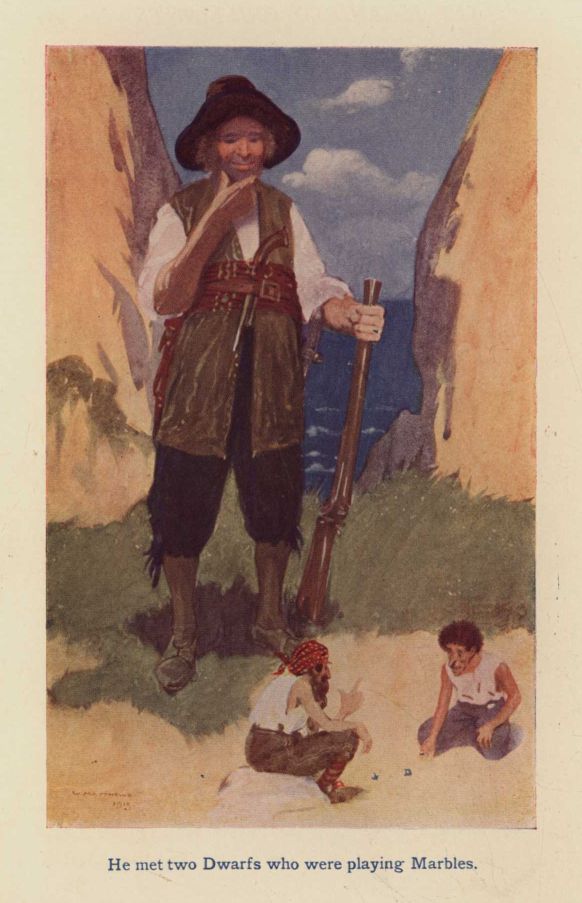
He met two Dwarfs who were playing Marbles.
The Aragonese approached the players and bade them good afternoon; the dwarfs raised their heads and looked at him contemptuously and continued to play.
"Look here, I said 'Good afternoon' to you," shouted the Aragonese, "and in my country when an insult is offered one knows what happens."
The dwarfs turned to look at him without having understood, and then Antonio, with two superb punches, knocked the presumptuous dwarfs to the ground. One remained stunned and could not move himself; but the other began to run away, uttering cries, and disappeared.
The Aragonese brought round the dwarf and detained him.
For several days they went about the mountain, and during this time Antonio succeeded in learning a few phrases of the strange language which the dwarf spoke, and the latter learned several others in Spanish, with which they came to understand each other perfectly. The two friends related their respective histories to one another. That of the dwarf was short; he was called Fu-fei, and he was a captain of the Cuirassiers of the Guard; and as they had no real horses they rode some made of cane so prettily that they attracted attention. He narrated, moreover, that some days before, some giants who had arrived then were made prisoners, and were to be killed or made slaves. As soon as he gave these details of the prisoners Antonio cried, "These are my people. I will not go to Manila until they are out of trouble."
"While you are here," said Fu-fei, "don't run any risks; because my companions never go up the mountains, as it makes them tired, and they are under the care of the doctor who prevents them from tiring themselves; but if you go down to the plain they will attack you, and they are more than three thousand."
"I don't care; I shall know how to defend myself."
"Then let me recommend you to do one thing. When you begin to fight I will signal to you which is the company of archers who use poisoned arrows. Shoot at them, and you can laugh at the rest."
And so it was. At the moment when he went down the mountain, Antonio found himself attacked by the outposts of the dwarfs' army. Fu-fei pointed out the company of the terrible arrows, and the Aragonese destroyed it by shots from his gun and blows with his cutlass.
"There is our king!" cried Fu-fei, pointing to a little dwarf who was scarcely sixteen inches in height.
"Then I will talk things over with your king immediately."
And, gently taking hold of him by the neck so as not to hurt him, he put the king in his pocket. Arriving at an oak-tree which would be about two yards high, and sitting down in the shade, he took the king out of his pocket and said:
"Where are the prisoners? Either give them back to me or this is the moment when you lose your position, your crown, and your life."
The dwarf king answered in Spanish that he would give the prisoners up and whatever they might wish in exchange for his liberty! And so our hero with his two dwarfs under his arm walked on to Dwarftown, as the town was called. Once inside he put the king on the ground in order to recover all his dignity, and the monarch ordered the Spanish prisoners to be set free.
When the latter recognised their liberator, they did not know what to do to show their gratitude.
"Don't you know how?" asked Antonio. "Well, take me to Manila, for I am in a hurry."
"But," answered the captain, "would you go away from this island without carrying off any diamonds?"
"Where are they?" asked the Aragonese.
"There, on the top of that mountain," they said to him.
"Good gracious! Just now I was in the midst of them and didn't notice. The truth is," he added, "that what I wanted was something to eat, and for half a pound of roasted meat I would have given all the diamonds of the earth."
Finally they all went to the mountain, gathered the diamonds in handfuls, and when they could carry no more, they went back towards the spot where the bark was ashore, and there after several months' work they succeeded in fixing a new rudder and some masts, which although small were sufficient to make the boat go. They put out to sea and at last arrived at Manila, to the great satisfaction of the Aragonese, who exclaimed:
"Did I not tell you that the ship would bring me to Manila?"
The dwarf Fu-fei had not wished to part with his friend and accompanied him everywhere, exciting attention by his long beard and tiny stature. The poor fellow was obliged to go about the streets singing, so that people should avoid treading on him.
They all soon returned to Spain, where they sold their diamonds and bought fine farms, founding an agricultural colony, in which they all lived together like brothers.
THE JUDGMENT OF THE FLOWERS
"Is it true that the rose is the queen of the flowers?" asked Richard of his papa.
And the latter said to him jokingly:
"Ask them themselves, they ought to be better informed."
Richard took what his father told him literally, and going down into the garden, approached a plum-tree which gallantly waved to and fro in the wind, and taking off his hat with great respect, asked it:
"Mr. Plum-tree, will you be good enough to tell me if the rose is the queen of the flowers?"
But the plum-tree continued to move to and fro in the wind without answering him.
And drawing near to an almond tree, whose white blossoms had just opened, he repeated his question.
"Mr. Almond-tree, is it true that the rose is the queen of the flowers?"
The almond-tree remained silent, but its blossoms went red with envy.
"The almond-tree is also unprincipled," thought Richard. "All these trees have a discourteous tone. Let us ask the plants."
A splendid double pink, which raised its splendid corolla with a gallantry worthy of its nobility, as soon as he heard the question, graciously bowed upon his stalk and answered:
"Quite so, the rose is our beloved queen, on account of being so beautiful and because her delicate aroma has no rival. But if you wish to know more, come back to-night at twelve o'clock and notice what happens in your garden."
"Thank you, kind pink. I will not miss to-night."
Richard went to bed at the usual time, but he could not sleep. At half-past eleven he dressed himself again, and slipping secretly down stairs arrived in the garden and awaited events. On the last stroke of midnight a bright light appeared from the sky and that ray of light condensed on the earth, taking the figure of a beautiful woman crowned with flowers, who carried in her hand a little golden wand which gave off brilliant reflections. The fairy extended her hand and immediately an unusual movement was produced among the plants. The pinks turned into elegant gentlemen in bright costumes of ruby, pink, and green; the hyacinths and jasmines into gallant little pages with fair hair; the white lilies were pale ladies of singular beauty, dressed in white; the dahlias wore long trains and at the neck a ruffle of delicate lace of colours which recalled the flowers which had preceded; the violet modestly tried to hide her beautiful countenance of velvety skin and her eyes of gentle aspect among a group of poppies, who passed arm-in-arm, attracting attention by their blood red costumes. Finally from amongst a group of mournful evergreens, who were chatting with some beautiful pansies, appeared the queen of the fête, the rose. Her presence produced a murmur of admiration, never had she been so lovely. Her face held the freshness of the flower, and her pink dress with a long train was of very fine silk which rustled as the sovereign walked. An olive-tree turned into a throne and dais, and the rose, without any other ceremony than a general greeting, took her seat on the throne. She raised her arm, imposing silence, and everybody became silent.
"Gentlemen," said the queen, "once again the good magician Spring has re-animated our hearts. We have not met since last year and there are several grave matters to resolve, but the most important is the manner of defending ourselves from the bees, wasps, and butterflies who continually sip our honey, accelerating our end. On this point I have already begged Spring to have the accused appear before me, so that this gathering is really an oral judgment."
At a signal from the magician the accused appeared in costumes of etiquette, the butterfly wearing its finest clothes.
It appeared before the queen with its head modestly bent and its face lighted up by a blush.
"What does your majesty wish?" it asked.
"To inquire the motive why you presume to take away our nectar," said the rose.
"Ah, madam!" replied the butterfly, touched, "little harm I do you, because I never take more than is necessary to feed myself, and I have never abused your hospitality."
"That is well; we will take that into account as an extenuating circumstance for you. Let the wasp approach."
The wasp entered in a black dress-coat and a yellow necktie striped with black.
"I," it said, "gather nectar from you because I have proposed to work like the bee, although I have not yet succeeded in doing so since the beginning of the world, but still not much time has passed and I hope to learn."
"How can you hope to learn," interrupted the queen, "if all that you do is to eat it all without having any to make honeycombs? Your case is a very bad one. As you have not a good lawyer you are lost. Fetch the bee."
The latter appeared, her presence awakening a general murmur. It wore neither a dress-coat nor a frock-coat, nor even a lounge-coat; it was wearing a blouse covered with stains of honey and wax. All drew away from the bee for fear of getting soiled.
"Now I know what I am coming to," it said without keeping quiet. "It is always the same song: that we do take away, that we do not take away the nectar from the flowers. Good, what about it? We do not do so for ourselves, but for our master. All the sweet syrup of your corollas we enclose in the hive, and from there every year it comes out so that Man, our master, rejoices his palate with it and embalms his breath with your aroma. After dying in summer and losing your green leaves in autumn, you still live in us, that we may make your remembrance lasting. And still you complain! You, it is true, give your blood, but it would be worth nothing if we did not gather it in order to store it. The work is ours, and the work is worth as much as your nectar. If you have to condemn me, do so quickly, I beg of you, as I am losing a great deal of work time, and we are somewhat behindhand with the work."
The rose called the pink and the violet, discussed the case with them, and after some minutes' reflection, spoke in this manner:
"The wasp is an unconscientious glutton who, under the pretext of making honeycombs, which she never succeeds in doing, robs us. Give her five hundred hard lashes."
On hearing this a deadly nightshade seized the wasp and carried her away to bestow the correction.
"The butterfly's innocence and moderation favour her," said the queen, "therefore I declare her absolved with all favourable pronouncements."
The butterfly bowed respectfully and kissed the sovereign's hand. Her golden feelers glistened, she shook her wings, filling the ambient air with diamond dust, and took to flight showering cascades of light.
"With regard to the bee," continued the rose, "not only do I find her without any guilt, but wish that henceforth you do not close your petals to her, but leave her at liberty to carry away the honey that she requires. As a reward for her laboriousness, and as a symbol of perpetual friendship between us, I am going to give her a kiss."
The bee, much moved, advanced, and placing her blushing forehead within reach of the queen's lips, received a kiss of peace, which made tears of gratitude gather in her eyes.
A delicious perfume invaded the garden, the fairy raised her wand, and each flower returned to its post, recovering its original form.
The magician flew into space, wrapped in a moonbeam, and Richard remained alone, pensive in the recollection of what he had seen.
"What a beautiful lesson!" he said. "Even in the kingdom of flowers work gains the most precious reward."
THE THREE QUESTIONS
In the history of Spain, King Pedro I. of Castile, son of Alfonso XI. the Just, is known by the surname of the Cruel.
And his fame as a heartless man was such that his subjects, on whom he satisfied his terrible thirst for blood and violence, held him in great terror.
One day while hunting, of which sport he was very fond, King Pedro lost his way in the wood, and came to rest himself—the night being well advanced—in an hospitable convent, where without being known he was offered food, bed, and shelter.
Hardly returning thanks, he passed into the refectory, and on entering was recognised by a lay brother, who knew that the king suffered from a certain illness called synovitis, the principal effect of which was that the malady produced, when he was walking, a strange sound of bones knocking together.
By this noise he was recognised by the lay brother.
Instantly informing the community, due homage was hastily rendered to the monarch; but King Pedro was in a bad temper, and facing one of the reverend fathers, said to him in a disconcerting tone:
"How fat you are, Father Prior! Study makes no hollows in you, from which I gather that you cannot be so wise as the people hereabout say."
The community was so taken aback, that no one dared to say a word to that monster of a king.
"Well, if you wish to please me," he continued, "I summon you to come to my palace within ten days, and to answer satisfactorily the following questions: First, what is the distance between the earth and the sun? Second, how much am I worth? And third, what do I believe which is false? If you do not answer me to my taste I will have you beheaded at once."
And saying this, he went away.
Needless to say the poor friar was frightened, for he knew only too well that King Pedro was quite capable of doing what he threatened.
And he devoted himself to thinking day and night about the questions, without hitting upon any answers.
At the time when King Pedro reigned the distance between the planets had not been discovered, so there were many discussions between the brethren over the questions of the king. They were still disputing when the day arrived on which the prior was summoned to the palace. And even yet he did not know what to answer. In his distress he invoked the Holy Virgin, certain that She would not refuse to help him.
After which he was about to set out for Seville when one of the lay brothers, a sharp and daring lad, said to him:
"Father Prior, your reverence and I are about the same height, and even look somewhat alike. Why not let me go in your place, father, and answer the king?"
On seeing him so resolved he did not doubt for a moment that the lay brother had been inspired by God to save him, and after hearing him, allowed him to go to Seville.
At the moment in which he arrived at the palace and announced himself, the king gave orders for him to be allowed to enter.
"Have you thought out the answers to the questions that I asked you?" asked King Pedro.
"Yes, sire."
"Well, begin then. What is the distance between the earth and the sun?"
"Eight hundred and forty-seven thousand leagues. Not one more, nor one less. And if your majesty does not believe me, have it measured."
As this was impossible, the king was obliged to say that he was satisfied.
"Not bad," he said. "Now the second: How much am I worth?"
"Twenty-nine pieces of silver."
"And why twenty-nine pieces?"
"Because your majesty is not worth so much as our Saviour, Jesus Christ, and He was sold for thirty."
"And what do I think which is not true?" exclaimed King Pedro, somewhat piqued.
"Well, your majesty thinks that I am the prior, and I am not."
The king was surprised at the ingenuity of the lay brother and pardoned the substitution, and heaped both with favours.
This proves that the fiercest men are overcome and appeased by the forces of ingenuity.
headpiece to The Captain's Exploit
THE CAPTAIN'S EXPLOIT
"What ruins are those which are to be seen on the top of that ridge?" asked a genteel captain of the policeman of a village.
"The accursed ruins!" answered the first authority of the village with extreme terror. "Many years ago," he said, "there used to be a fine castle there, inhabited by a feudal lord who was more avaricious than anybody in the world before. There stands his statue amidst the rubbish, and terrible stories are told about it which frighten all the neighbours.
"In the archives of the town several curious documents are kept, and if your worship, Sir Captain, wishes to read them, I will lend them to you with great pleasure."
The soldier smiled disdainfully on hearing the policeman, and begged him to let him see those curious documents, because he had the idea of visiting the ruins and removing for ever the superstitious fear that they inspired.
That night he received a bundle of yellowed papers falling to pieces through age and dampness, and shut up in his room he read them from beginning to end.
The following morning when Captain Pero Gil—for such was his name—went out into the square, the hollows of a night of insomnia and fever were clearly seen in his face. What had happened to him?
Among the papers which formed the bundle, one above all had attracted his attention. It ran more or less as follows:
"It is said by neighbour Nuno Perez that in the castle, at the foot of the tower of Homage, there must be an immense treasure, but it is guarded by one hundred dwarfs with long beards who strike anybody who comes near.
"At twelve o'clock in the night a gap opens in the ground which gives access to enormous riches piled up in the cellar; but exactly at one o'clock the earth closes up until the following night. If, instead of one person, two or three go to the place, then the earth does not open and the treasure remains hidden.
"That is the news which, on the evidence of an eyewitness, has reached me, and which I certify.—Inigo Lopez, the constable."
The captain remained perplexed for a good while, and at last said to himself resolutely: "To-morrow night I will go to the tower of Homage at the foot of the castle."
Indeed, at twelve o'clock in the night he went out of the house where he lodged and went towards the ruins, first making sure that his sword came out of the sheath without difficulty, and that the pistols which he wore in his belt were well loaded.
At eleven o'clock, or a little later, he arrived at the castle. A splendid moon was shining, which gave the landscape a melancholy appearance. The captain hid himself behind some stones close to the big tower, and there waited, twisting his moustache, to see the marvel take place. The village clock struck twelve, and on the last stroke the earth opened and a crowd of dwarfs, with beards down to the ground, came out of the narrow gap. They were armed with thick sticks, and began to dance round the entrance of the vault, singing:
"Let us defend the treasure,
Let us defend our gold
Against every mortal
Not knowing the signal."
The captain advanced quickly, and taking up his place at the side of the circle of little men, saluted the dwarfs with great courtesy.
"Good evening, friends,"
"Daring man!" said the tiny men. "Who are you? What have you come here for?"
And armed with their thick sticks they rushed towards the intruder. But the latter, without being frightened, unsheathed his sword, and said to them very calmly:
"Let us be serious, comrades, and leave off making bad-natured jokes, because I will cut down any one who comes too near me. Are you willing to let me have the treasures?"
"Never!" they exclaimed. "It is necessary for you to give us the signal. If you do not know it, we shall kill you."
"That is easier said than done," said Pero Gil, with great deliberation. "You must grow a little before you can put a man like me in pickle. If your height had grown as much as your beard, it might have been different."
"Let us kill him," shouted the dwarfs. "He does not know the signal!"
And they threw themselves upon the captain. But the latter drew out a pistol, and with one shot the most daring of them fell to the ground, which checked the rest.
"It seems that I came off best," said the captain, laughing. "What I have done to this fellow I will do to the remainder if you come near. Therefore let me pass without hindrance."
"We would let ourselves be killed before permitting you to get to the treasure, unless you gave us the signal."
"And what signal is that?"
"We cannot tell you."
"It seems to me that I shall not require it for grinding up your ribs."
"Away! Away!" said the little men; and armed with their sticks they rushed upon Pero Gil. The latter fired off his second pistol, bowling over another, but they threw themselves upon him, until his back looked like a snake turning round amidst the crowd of those who were attacking him. At last he saw that he was surrounded and defenceless, and therefore was obliged to jump over the wall at the risk of being dashed to pieces, and so left the place, ashamed of his defeat.
"My goodness! what can the signal be?" he asked himself while on his way to the village.
The following morning he returned to the ruins, armed with a lever, and recognised the place where on the previous night he had seen the opening. There was nothing there! However much he poked about he could not find the least sign which showed the entrance to the mysterious vault; and what was still stranger, he could not distinguish the slightest trace of the past fight.
Then he resolved to try if cunning could succeed where strength had failed.
The following night he hid himself in the ruins and watched the place where the marvellous event took place. The dwarfs came out with their accustomed dance and song:
"Let us defend the treasure,
Let us defend our gold
Against every mortal
Not knowing the signal."
The dance over, one of them said:
"The captain will not return, but if he does come back we will kill him."
"It would be better to allow him to enter the vault and there let him die of hunger."
"And if he seizes the bell?"
"Then we are lost."
"But he must first give the statue of the old master of the castle a thrust with his sword."
Pero Gil did not wait to hear any more, and at one bound approached the statue, which was situated in what used to be the armoury of the fortress, and struck it a stout blow with his blade.
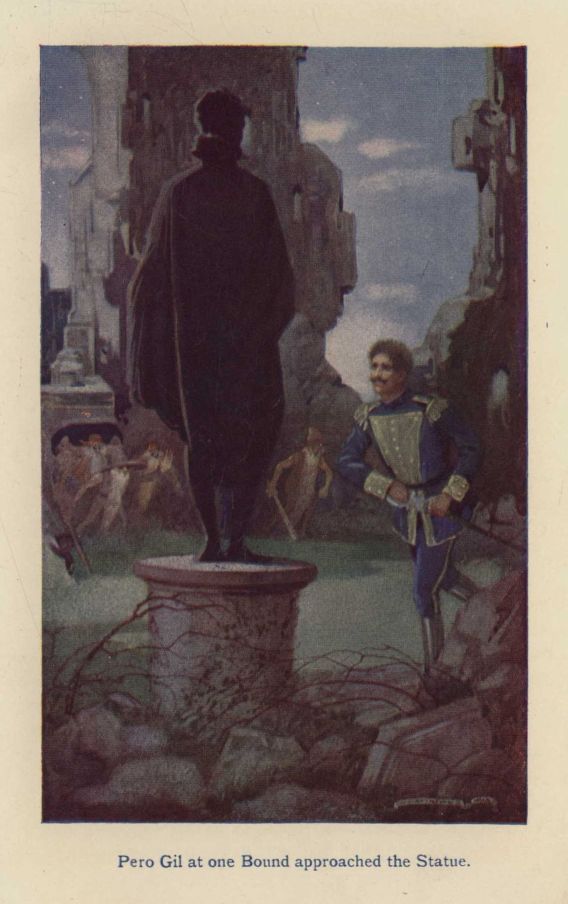
Pero Gil at one Bound approached the Statue.
The statue fell down flat as if struck by lightning, and at once the dwarfs surrounded the captain and forced him down a flight of steps.
Hardly had he entered than the gap closed up and the captain found himself alone in a cave which was lighted by a lamp hanging from the ceiling. On the floor there were great heaps of gold and precious stones, but this was not the thing that claimed the captain's attention. He was looking for the bell which he had heard the dwarfs speak about.
For half an hour his search was fruitless. He turned over the yellow piles of money and the sacks of gems, but the desired object was not to be found.
Weary and perspiring he threw himself down on a pile of gold bars, and there rested before again returning to his task.
The mysterious bell had to be found.
Persuaded that it was not to be come across in a visible spot, he began to strike the walls, until at last one of them sounded hollow. With his sword he made a hole and from it drew out a leaden bell of a very rare shape, which in a good sale might be worth as much as four farthings.
"And now what must I do?" thought the captain. He carefully examined the object he had found, which bore the following inscription, "Do not ring me unless you know how." But the captain was not a man to hesitate, and rang the bell. Immediately the walls closed together, threatening to crush him by their enormous mass. Without being daunted he gave another ring, and then a thousand points of steel came forth from the walls as if they were going to pass through him. Then he gave a third ring, and immediately the vault returned to its original form.
At the fourth the dwarfs humbly presented themselves and said to him:
"What do you want of us? Command us as your slaves."
"In the first place, to dance the saraband in order to amuse me, as a compensation for the unpleasant time you have given me."
And the dwarfs danced like anything for a good while, until Pero Gil told them to stop.
"Now you will take the sacks of money and carry them to my house."
The dwarfs obeyed without making the slightest observation, loading up those precious things.
"Leave us the bell," they said, "since you take away the riches."
Pero Gil was going to leave it, when he suddenly had a presentiment and thought better of it.
"This talisman shall never leave me."
Then the dwarfs carried the riches to his house, singing on the way:
"Don't let us guard the treasure now,
For it is being taken away
By this fortunate mortal
Who knows the signal."
So Captain Pero Gil became master of immense riches, which he distributed among his soldiers, naturally keeping for himself the largest part.
And whenever he thought of that famous adventure, he rightly used to say, "After all, the true talisman to get what we want is cunning and bravery."
THE TOPSY-TURVY WORLD
I don't know why, but it is a fact that Providence one day decreed that everything should turn upside down. The picture that the world presented could not have been more extraordinary: the fishes flew through the air like swarms of butterflies; in place of linnets and nightingales, the sharks and whales sang. The birds swam on the bosom of the waters, like Pedro for his house; it was glorious to see the dives they made. A donkey in the porch of an Inn played on a clarinet the "No me matas, no me matas," while another who was apparently in a good position, came out of a restaurant picking his teeth with a Toledo sword.
It is related that a boy who lived at that time, and whose name was, if I remember right, Manolo, had, among other grave defects, that of ill-treating animals; his parents and masters reprimanded him in vain, and from time to time even gave him a flogging that would have set fire to tinder: but it did not make the boy any better. Whenever he saw an ass tied to a fence he untied it and rode it for a good while, hitting it a whack to make it trot. When he met a dog the least that he did was to fetch it a smack that made it go away at more than a walking pace with its tail between its legs. More than one cat he chased about after having tied a sardine tin to its tail; in short, he was a little demon.
But now it must be remembered that all things were changed, and that on waking up one morning he found, at the head of his bed, one of his dogs, which, giving him a punch, said:
"Little friend, on getting up you have got to clean my boots;" and as the boy hesitated, the dog hit him two punches which made him get up more than quickly. What was his surprise to notice that he could only go on four feet! He wished to speak, but a bark came from his lips; he tried to bite the dog, and the latter rained blows upon him.
He rushed out of the house, and found other boys as mischievous as himself punished in the same way. In Oriente Place, Carlos and Pepe were pulling a little carriage, and in it were riding the two goats that usually drew the vehicle. Several of those water-carriers who carry their water-skins on the loins of a donkey which they almost kill by blows, went about themselves bent down under the load, getting a blow each time they sucked their thumbs. Their former slaves went on two feet behind them, saying: "Gee up, donkey, you are more stupid than a post."
Manolo went on his way, on four feet of course, and even these seemed few enough to run with, when on crossing a street he met a friend and schoolmate, with whom he opened, by barks, the following dialogue:
"Bernardo, as I live! Have you seen what has happened to us?"
"Yes, of course I see it! For am I not changed into a poodle?"
"Here you see me in a fix; I don't know where to hide myself so that the old dogs won't be able to take their revenge for the tricks I used to play on them when I was a person."
At this moment a noise was heard, and on turning round they saw a tramcar drawn by some of those drovers who are always complaining, and on the platform was a mule coquettishly adorned with a cocked hat, driving the car, which was full of all kinds of animals.
"My boy," said Manolo to Bernardo, "do you know that instead of a tramcar that looks more like Noah's Ark!"
He had hardly uttered these words when he felt himself seized and secured, and his shirt was pulled out at the back, and to the tail of it was tied a petrol can. He turned his head, and then saw all the dogs gathered together which formerly he used to hurt, and who now were celebrating with great laughter the happy event of making Manolo run with the can tied to his tail. Two kicks well given rid him of all doubt and made him start running as fast as he could.
On passing close to a tank he saw some fishes which, with a rod under their fins, were angling for boys who were swimming about. At last he stopped half dead from fatigue, being taken up by an old, blind horse, which sported eye-protectors, and which, in exchange for some crusts, made him learn some exercises with which to amuse the appreciative audience of bears, monkeys, dogs, cats, and other distinguished people.
The horse, seated on the ground, with a silk hat which resembled a concertina, played on a little drum "The Paraguay Polka," while Manolo danced to it. So much dancing made him tired, and one day he gave the old horse the slip, leaving him alone with the drum. Naturally the loss was announced in the Gazette, and a reward was even offered to any one who found him, but all was useless, because the latter hid himself in order not to get caught.
One afternoon he saw many people—if we can call cats, dogs, mules, etc., people—gather together and enter a large building.
"Dear me!" said Manolo, "this is the bull-ring! All right, as a dog I can go in and see the fight free."
And slipping between two animals who acted as porters, he went into the ring and took a seat.
Divine Power! What a spectacle! A fat donkey, which acted as master of ceremonies, had at his side in the box another as asinine as himself, and it was the latter who told him when it was necessary to change the programme.
A number of peacocks adorned with airy mantles filled the boxes, and with opera-glasses and lorgnettes looked at each other, criticising and ridiculing each other disparagingly. How many animals there were in all parts of the ring! Round the arena barrier it was crowded with bears carrying leather bottles filled with wine, which they delicately raised. There was great confusion, until a band, or rather an orchestra, of ostriches played a gay double step, the toreadors appearing immediately after. What a fight it was! Twelve bulls from the most celebrated breeding studs came out on two feet with the red cloth airily placed between their horns. Those which acted as spearmen rode on the boys who clean up the ring, and carried very long spears. The trumpet sounded, and the first animal appeared in the arena; it was a German, who attacked the spearmen, overthrowing two boys. The master of ceremonies made a sign that it was now time to use the darts. The audience protested, shouting: "Donkey, donkey! you don't understand!" The donkey M.C. took off his hat, and the audience asked that the darts should be stuck in the toreadors. Cuernosgrandes, who was the first killer, tried to fix his pair, as badly, more or less, as the old toreadors, when a horrible shouting arose in the arena, and such formidable fighting took place that two monkeys, who had been beautiful English girls, seated at Manolo's side, fainted, and the audience rushed to the doors of the bull-ring: the German had jumped over the barrier. Manolo felt two kicks behind, and without even turning his head to see who gave them, rushed into the street like a mad animal.
Then came the worst. Some geese with Roman helmets on their heads, riding upon sardine tins, were pretending to maintain order with their sabres, and playing a number of foolish tricks upon the authorities. They soon knocked down poor little Manolo, who was obliged to seek refuge in a doorway, when a camel stopped him by laying a hand on him, saying:
"Thank goodness, I have a little dog."
The wretched camel put on a lady's veil, took Manolo in its arms as if he were a wee baby, and taking up its place in a corner, began to sing in a falsetto voice:
"I was born in a wood of cocoanut trees
One morning in the month of April."
"Gentlemen," it added, "alms for this poor mother who has a child to support." But Manolo, who did not wish to play the part of an infant in arms, gave the camel a bite in the arm and ran away to the outskirts of the town. In a cottage he found two doves, which, on seeing him so thin and hollow-cheeked, offered him their assistance and gave him something to eat. A sympathetic swallow gently looked after him, and the lullaby of its song made the poor boy sleep soundly. A feeling of sweet well-being pervaded his little body, he saw in his dreams a cloud of rose and gold, and in it the white figure of an angel which, gently moving its wings, arrived at his side and in a melodious voice said to him:
"Manuel, your sufferings have ended; let what you have seen be a warning to you, and try to be good to everybody, including animals."
The boy woke up, looked around him and found himself in his own bed, and soon the servant came in to tell him that it was now time to go to school. Manolo, who had not got over his astonishment, dressed himself quickly, noticing, full of surprise, that he went on two legs—as if he had gone all his life on four.
He never ill-treated an animal again, for this was what he said:
"Besides it being cowardly to ill-treat defenceless beings, is it not dangerous to expose oneself to the risk of the tables being turned and finding oneself in the same disagreeable position?"
headpiece to Don Suero the Proud
DON SUERO THE PROUD
Once there was, in very remote times, a knight named Don Suero de las Navas, feudal lord of a number of Spanish villages, with a quantity of titles sufficient to fill one of the biggest pages, so many and so long were they.
Now, this knight was so proud that he thought it was a great dishonour to learn how to read and write things which he considered not only useless for a man of his accomplishments, but even shameful for a noble so rich as he was, who could indulge in the luxury of a secretary. And so it was indeed, that a poor man, who on account of his humble condition was obliged to learn those trifling necessities, went, like a vagabond, behind his master, pen and ink in satchel, ready to put into good Castilian the thousand and one mistakes that Don Suero frequently made.
On a certain occasion the king summoned the powerful Don Suero to go with his soldiers to the war, and as it could not be otherwise, the poor secretary, carrying a pen instead of a sword and a horn inkstand instead of an arrow, was obliged to place himself at the side of his lord and to march to the war.
At the beginning all went well. The orders and the letters acquainting the king with the results of the struggle were written by the hand of the unfortunate secretary, who earned each month, if my particulars are not wrong, the enormous sum of two silver threepenny pieces. Enough to have a carriage and to build good castles—in the air!
But an arrow shot at hazard in the fury of the fight against the Moors put Don Lesmes, for so the secretary was called, out of action, and Don Suero was under the necessity of seeking a new dependant who knew how to read and write—not an easy matter at that time.
He could not find one, to his great unhappiness; and if he had not had that quantity of pride in his body, he would surely have felt his lack of education, which might place him in an awkward situation, which happened soon afterwards.
He was engaged in a campaign against the Moors, who occupied a great part of Spain, when he received a packet from the king. And here the difficulty began. What did he say in those pot-hooks written on an enclosed parchment? To advance? To retreat? It was difficult to guess. The messenger had confined himself to delivering the packet and, putting spurs to his horse, disappeared in a cloud of dust.
Don Suero, perplexed, found himself with the parchment in his hand, turning it round and round, without knowing what it said. He made a man of a neighbouring village come to him, a man who was an enemy of his because of a certain thrashing which he had ordered him to be given some days before, and said:
"I have been told that you know how to read and write, and as nobody else here knows how to, you will read to me what this document from the king says, and if you do not tell me the truth I will have you skinned alive. Moreover, I require from you absolute secrecy. What is said here only you and I must know."
The offended peasant promised him all, but with the idea of taking complete vengeance. And indeed hardly had he cast a glance at the document than he exclaimed in accents of the greatest surprise:
"The king orders you to give up the command of the troops and to go immediately to the court, where you have been accused of treason."
"I a traitor! Ah, what scoundrels are those who have said that of me! I will cut off their ears with my own hand."
No sooner said than done; he at once left the command of his troops and started on his march to the court.
The journey was long and wearisome, and our Don Suero was obliged to halt in an uninhabited place, to dismount from his horse and to sleep on the blessed ground, neither more nor less than if he had been the poorest of peasants.
So he passed the night, until dawn surprised him. On collecting himself he saw a large board close to a ditch situated at the side of the road. What might that say? It ought to be something important when it was written in such large letters. He went as near as he could to see if any sign, which was not in writing, might indicate something to him of what the board said; but, alas! on going nearer he slipped and fell headlong into the ditch.
The notice said, "Take care in approaching!"
It cost him no little work to get out of it, and still the shock left him so weak that he could hardly move.
As well as he could, he approached the nearest village and got into bed. The first person whom he met was the cunning peasant who had so badly translated his majesty's letter. He was flying from Don Suero and had come face to face with him where he least expected to.
On seeing his good-natured gesture, he knew that his deceit had not been discovered, and, without trembling, he approached the noble knight.
"You can be useful to me," said the latter. "I do not feel disposed to go to the court. Write to the king what has happened to me and tell him that as soon as I am a little better I will come and confound those who have calumniated me."
But the peasant wrote what he liked and sent off the letter.
In it he heaped insults on the king, with the object of causing the latter to have the knight's head cut off.
The effect that the insulting letter produced was so great that the king rose in his anger and commanded Don Suero to be brought dead or alive, and that if he resisted he was to be tied to the tail of a horse.
The knight was imprisoned, but as he was so proud he would not give the king any explanations, and the latter commanded him to be tortured.
Not even the severest tortures could succeed in taming that will of iron. He was innocent, and would not ask grace of the king, who condemned him without any further motive. At length they were going to sentence him to death for his insults to the king, when one of the judges mentioned to the king the possibility of Don Suero having put his seal at the foot of a document he had not signed.
"Because," he said, "it is stated he does not know how to read and write."
"What!" angrily exclaimed the king. "Did I pass five long years in learning how to spell, and that silly Don Suero does not know how to do it? I do not believe it. If you cannot prove to me that the letter in which he calls me a weak and stupid king is unknown to him, I will have him killed to-morrow."
The judge did not neglect to see. He wrote out the sentence of death and took it to the prison, saying to the knight:
"Sign this and you are free!"
"What is this?"
"A writing in which you say to the king that you are innocent of what you are accused."
"If that is so, bring it and I will sign it."
And he put a cross and his seal at the foot of it.
The judge bore to the king that sentence that the prisoner had signed, believing it to be his salvation, and then the king, convinced of his innocence, commanded him to be set free and returned all his honours to him.
After that the knight dedicated himself to learning reading and writing, and made such progress that, after eight years of lessons, he already knew which was the letter O, both capital and small, which indeed showed a progress not too rapid.
And the peasant? He was sought for, being a wicked man, and as soon as he was caught he was put into prison, where he finished his life.
Ignorance is bad, but the wicked are worse than the ignorant.
Made At The Temple Press Letchworth Great Britain