STORY OF SOME WOMEN AND A BABY.
Reading edition
So the king was balked by the Hebrew midwives and the Jews continued to "increase abundantly and multiplied, and waxed exceeding mighty; and the land was filled with them."
And the king, fearing the multitude of the Jews, again pitted himself against the fecundity and rebellion of the women, and issued the cruel but famous command:
"And Pharaoh charged all the people, saying, Every son that is born ye shall cast into the river, and every daughter ye shall save alive."
And shortly after that, one night when all the Egyptians slept, and only the stars, the moon and the winds were awake, in the silence and the silvery gloom, a baby boy came to a daughter of Levi, and "when she saw him that he was a goodly child" she quietly determined that no murderous hand should ever toss him in the rolling river, or check the breath on his sweet lips; "and she hid him three months."
I don't know how she did it, but perhaps when he was crying with all a baby's vigor for his supper the embryo diplomat in his heart shrewdly caught the meaning in his mother's warning "hush, sh!" and, king and tyrant tho' he was, he knew "that there was a greater than he," and stilled his cries. Perhaps when the colic gripped his vitals he bore the pain in unflinching silence, if he heard an Egyptian footstep near the door. Perhaps he stopped his gooing and cooing in his hidden nest, and held his very breath in fear, when he heard an Egyptian voice in the house.
And all these three months he had been growing plump, and strong and healthy, and I suppose he became a little reckless, or perchance he began to think he knew more than his mother did about it, and wouldn't keep still. Anyway, whatever was the matter I don't know, but there came a day when "she could no longer hide him," and then she laid a plot to baffle the king, defeat death and save the child.
Being an ambitious woman as well as a loving mother, she was not content that he should be as other children, forced "to serve with rigor" and his life made "bitter with hard bondage in mortar and brick and in all manner of service of the field." I presume she thought he was a little more beautiful and more clever than any child that ever lived before, for we all do that when a baby comes without an invitation and often against our most urgent wishes, and nestling in our arms says, without uttering a word: "I've come to stay and I want my supper; I'm hungry, for the journey has been long and dark—and why don't you make haste?"
Perhaps she had caught the fire of the future statesman in his dark eye; perhaps she had heard the ring of sublimity in the melodious voice that afterward said "Honor thy father and thy mother." Perhaps she had seen the shrewdness of the future great diplomat in his maneuvers to have his baby way, and being a bright woman she set her wits to work to defy the king, defeat his law and elude the cruel vigilance of the Egyptian spies; and she conceived a plot which for boldness of thought and shrewdness of execution stands unsurpassed. She would not save him to live the toilsome, slavish life of the Jews. She sighed for all the advantages of the Egyptians. She lifted her ambitious eyes to the royal household itself, and in spite of the accident of birth, in spite of king and law and hatred, in spite of the fatal fact that he was a dark-eyed, dark-haired Jew, she vowed he should mingle with royal nabobs, laugh and thrive and prosper under the very eye of his enemy the king, be clothed in purple and fine linen, skilled in all the arts and learned in all the sciences of the Egyptians; and she was clever enough to see at a glance that in this almost hopeless scheme she must have accomplices.
And where did she turn for aid? To her husband, as a meek, submissive and obedient woman naturally would? Not at all. Perhaps she doubted the intelligence of his assistance. Perhaps she had no faith in his courage for the undertaking. Perhaps she did not believe he could keep a secret; at any rate she refused to confide in him. I suppose, as no mention is made of it, she utterly ignored him, scorned to ask his advice, and planned to dispose of his child without telling him of it, much less asking his permission.
But where did she turn for aid? Did she clothe herself in the gayest costume of the Jews, and, conscious of her beauty, try with smiles and coquetry and caressing touch to beguile the King? No. Did she steal into the tent of his greatest general and kneeling at his feet seek to bribe him with her love? No. She simply and utterly ignored the men, and selected the King's own daughter as the instrument to execute her design. She knew the royal girl came down to the river to bathe, and trusting in her baby's great gift of unrivaled beauty and the woman's compassion, she planned a dramatic surprise for her.
"And when she could not longer hide him, she took him an ark of bulrushes, and daubed it with slime and pitch and put the child therein. And she laid it among the flags by the river's brink." But before she put him in it she bathed him in perfumed water to make him sweet, put on his prettiest dress, tied up his short sleeves with something that just matched the color in his cheeks, and borrowed a golden chain of an Egyptian woman to clasp about his milk-white neck. Then she lined the ark with roses, laid a little pillow in the bottom, put the baby softly in, partly closed the top to shield him from too much light and air, and laid it among the flags by the river's brink; and then the cleverness that had designed the scheme and the bravery that had executed it so far, was overwhelmed by a mother's love and she fled, and hid herself among the foliage and the reeds, too frightened to watch the result; "but his sister stood afar off to wit what would be done to him."
And the baby had a nice time while he waited, for the wind with noiseless feet and invisible hands came and softly rocked the cradle to and fro; the sunbeams sent a bright ray and put golden bracelets on his wrists, which with the true instinct of human nature he tried to catch and hold, and the birds coming down to wash in the rippling waters peeped into the cradle, and, enraptured with the pretty sight, forgot to bathe, but stopped to sing.
And the King's daughter and her maidens came laughing and singing down to the river's brink to bathe, as was their custom—a custom which baby's mother knew about and took advantage of.
"PUT UP HIS HANDS IN WELCOME AND SAID 'AH, GOO! AH, GOO!'"
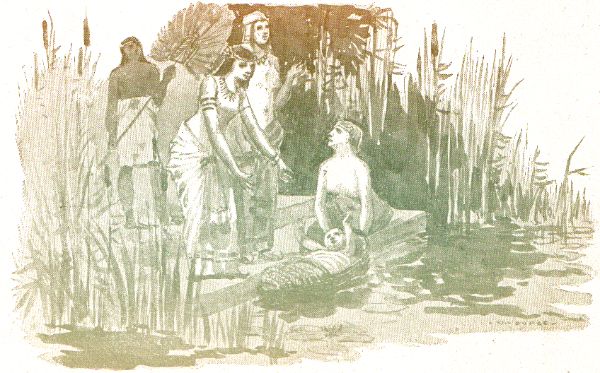
And the girls spied the basket and wondered what it was, and finally the royal damsel "sent her maid to fetch it." And Pharaoh's daughter opened it and "she saw the child," and the girls crowded around and gazed in silent admiration. Then the baby, who never before had seen the purple and fine linen of majesty or the sparkling jewels of wealth, knowing this was the opportunity of his life put up his hands in welcome and said in the universal language of babyhood, "Ah, goo! ah, goo!" He was a worthy child of a great mother, and the minute he was left to himself he came before the footlights and with one word captivated his audience, and a storm of kisses fell upon his lips and neck and arms. And when the girls ceased lest they should kiss him to death, he looked at them a minute, and then he opened his mouth and laughed a little soft, gurgling laugh; a laugh so sweet that I'm sure even the terrible God of the Jews must have smiled had he heard it.
He didn't laugh because he felt particularly funny, but because the little diplomat, bent on conquest, wanted to show a tiny tooth that came into his mouth one day, he didn't know how.
He had never seen it himself, but he knew it was there and was a treasure, for one time in the dead of the night when all his dread enemies, the Egyptians, were fast asleep, and the wind howled and the rain beat upon the roof, his mother brought his father to his hiding place and holding the light high up above his head, she touched him lightly under the chin and said: "Laugh, now, and show papa baby's tooth." Then he did as he was told and his father looked long and carefully and then laughed too, kissed him and went away.
When the girls saw it they all smiled and kissed him too.
About this time he wanted his mother and "the babe wept."
When the king's daughter saw his red lips quivering and the tears hanging on his long, curling lashes, love and compassion filled her heart, and thinking of her father's wicked command: "Every son that is born ye shall cast into the river," she said, sadly, "this is one of the Hebrews' children."
Then his sister—I suppose it was the same one who had "stood afar off to wit what would be done to him" and who had approached—said, "Shall I go and call to thee a nurse of the Hebrew women, that she may nurse the child for thee?"
"And Pharaoh's daughter said to her, 'Go.' And the maid went and called the child's mother."
"And Pharaoh's daughter said unto her, 'Take this child away and nurse it for me and I will give thee thy wages.' And the woman took the child and nursed it." Wasn't that the sublimest conquering of ambition and crime by love ever known?
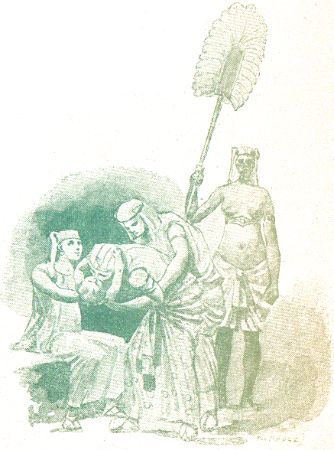
I suppose the King's daughter went every day to see the little black-eyed beauty and kiss his rosy lips, his soft white neck, his dimpled arms; and every kiss strengthened her determination to defy the King, her father and the law, and save this baby for her own.
I don't know how she managed it, but somehow she overcame all obstacles, and they were many and great there is no doubt, and "he became her son," and the future lawgiver of the Jews, and the world was saved.
And so after all we owe the ten commandments to a Jewish woman's wit, strategy and love, and an Egyptian woman's compassion and disobedience, for the stern command that "Every son that is born ye shall cast into the river" was not given to the army, the navy or the church, to one man or woman, to doctors or midwives, but to "all the people," and in this affair there were a number of women, who all connived to foil the "powers that be" and refused to do the King's bidding. First there was the mother of Moses and the sister, the King's daughter, her maid and "her maidens" who came down to the river's brink with her, at least two of them and perhaps twenty.
I fail to find in their example any of the vaunted submission, obedience and docility we have been taught by those who did not read their Bible intelligently, or took some other person's "say-so" for it, and which are the vaunted characteristics of all these women.
They just simply scorned all the men and the laws whenever they did not suit their ideas of right and justice, and proceeded to have their own way in spite of everything.