FAIR MARGARET (continued 5)
Reading edition
'All the better for the beggar who finds it!' cried the Englishman. 'Throw it over the fence!'
'You English are so extravagant,' said the Greek in a tone of polite reproach, but not relinquishing his hold.
'Possibly, but it's my own bicycle, and I prefer to throw it away.'
Margaret had watched the contest in silence. She now stepped out of the car, came up to the two men and laid her hands on the object of contention. Logotheti let go instantly, but Lushington did not.
'This is ridiculous,' said Margaret. 'Give it to me!'
Lushington had no choice, and besides, he needed his right hand for his nose, which was getting the better of him again. He let go, and Margaret lifted the bicycle into the body of the car herself, though Logotheti tried to help her.
'Now, get in,' she said to Lushington. 'We'll take you as far at the Chaville station.'
'Thank you,' he answered. 'I am quite able to walk.'
He presented such a lamentable appearance that he would have hesitated to get into the car with Margaret even if they had been on good terms. He was in that state of mind in which a man wishes that he might vanish into the earth like Korah and his company, or at least take to his heels without ceremony and run away. Logotheti had put up his glasses and shield, over the visor of his cap, and was watching his rival's discomfiture with a polite smile of pity. Lushington mentally compared him to Judas Iscariot.
'Let me point out,' said the Greek, that if you won't accept a seat with us, we, on our part, are much too anxious for your safety to leave you here in the road. You must have been badly shaken, besides being cut. If you insist upon walking, we'll keep beside you in the car. Then if you faint, we can pick you up.'
'Yes,' assented Margaret, with a touch of malice, 'that is very sensible.'
Lushington was almost choking.
'Do let me give you another handkerchief,' said Logotheti, sympathetically. 'I always carry a supply when I'm motoring—they are so useful. Yours is quite spoilt.'
A forcible expression rose to Lushington's lips, but he checked it, and at the same time he wondered whether anybody he knew had ever been caught in such a detestable situation. But Anglo-Saxons generally perform their greatest feats of arms when they are driven into a corner or have launched themselves in some perfectly hopeless undertaking. It takes a Lucknow or a Balaclava to show what they are really made of. Lushington was in a corner now; his temper rose and he turned upon his tormentors. At the same time, perhaps under the influence of his emotion, his nose stopped bleeding. It was scratched and purple from the fall, but he found another handkerchief of his own and did what he could to improve his appearance. His shoulders and his jaw squared themselves as he began to speak and his eyes were rather hard and bright.
'Look here,' he said, facing Logotheti, 'we don't owe each other anything, I think, so this sort of thing had better stop. You've been going about in disguise with Miss Donne, and I have been making myself look like some one else in order to watch you. We've found each other out and I don't fancy that we're likely to be very friendly after this. So the best thing we can do is to part quietly and go in opposite directions. Don't you think so?'
The last question was addressed to Margaret. But instead of answering at once she looked down and pushed some little lumps of dry mud about with the toe of her shoe, as if she were trying to place them in a symmetrical figure. It is a trick some young women have when they are in doubt. Lushington turned to Logotheti again and waited for an answer.
Now Logotheti did not care a straw for Lushington, and cared very little, on the whole, whether the latter watched him or not; but he was extremely anxious to please Margaret and play the part of generosity in her eyes.
'I'm very sorry if anything I've said has offended you,' he said in a smooth tone, answering Lushington. 'The fact is, it's all rather funny, isn't it? Yes, just so! I'm making the best apology I can for having been a little amused. I hope we part good friends, Mr. Lushington? That is, if you still insist on walking.'
Margaret looked up while he was speaking and nodded her approbation of the speech, which was very well conceived and left Lushington no loophole through which to spy offence. But he responded coldly to the advance.
'There is no reason whatever for apologising,' he said. 'It's the instinct of humanity to laugh at a man who tumbles down in the street. The object of our artificial modern civilisation is, however, to cloak that sort of instinct as far as possible. Good morning.'
After delivering this Parthian shot he turned away with the evident intention of going off on foot.
None of the three had noticed the sound of horses' feet and a light carriage approaching from the direction of Versailles. A phaeton came along at a smart pace and drew up beside the motor. Margaret uttered an exclamation of surprise, and the two men stared with something approaching to horror. It was Mrs. Rushmore, who had presumably taken a fancy for an airing as the day had turned out very fine. The coachman and groom had both seen Margaret and supposed that something had happened to the car.
Before the carriage had stopped Mrs. Rushmore had recognised Margaret too, and was leaning out sideways, uttering loud exclamations of anxiety.
'My dear child!' she cried. 'Good heavens! An accident! These dreadful automobiles! I knew it would happen!'
Portly though she was, she was standing beside Margaret in an instant, clasping her in a motherly embrace and panting for breath. It was evidently too late for Logotheti to draw his glasses and shield over his face, or for Lushington to escape. Each stood stock-still, wondering how long it would be before Mrs. Rushmore recognised him, and trying to think what she would say when she did. For one moment, it seemed as if nothing were going to happen, for Mrs. Rushmore was too much preoccupied on Margaret's account to take the slightest notice of either of the others.
'Are you quite sure you're not hurt?' she inquired anxiously, while she scrutinised Margaret's blushing face. 'Get into the carriage with me at once, my dear, and we'll drive home. You must go to bed at once! There's nothing so exhausting as a shock to the nerves! Camomile tea, my dear! Good old-fashioned camomile tea, you know! There's nothing like it! Clotilde makes it to perfection, and she shall rub you thoroughly! Get in, child! Get in!'
Quick to see the advantage of such a sudden escape, Margaret was actually getting into the carriage, when Mrs. Rushmore, who was kindness itself, remembered the two men and turned to Logotheti.
'I will leave you my groom to help,' she said, in her stiff French.
Then her eyes fell on Lushington's blood-stained face, and in the same instant it flashed upon her that the other man was Logotheti. Her jaw dropped in astonishment.
'Why—good gracious—how's this? Why—it's Monsieur Logotheti himself! But you'—she turned to Lushington again 'you can't be Mr. Lushington—good Lord—yes, you are, and in those clothes, too. And—what have you done to your face?'
As her surprise increased she became speechless, while the two men bowed and smiled as pleasantly as they could under the circumstances.
'Yes, I'm Lushington,' said the Englishman. 'I used to wear a beard.'
'My chauffeur was taken ill suddenly,' said the Greek without a blush, 'and as Miss Donne was anxious to get home I thought there would be no great harm if I drove the car out myself. I had hoped to find you in so that I might explain how it had happened, for, of course, Miss Donne was a little—what shall I say?—a little——'
He hesitated, having hoped that Margaret would help him out. After waiting two or three seconds, Mrs. Rushmore turned on her.
'Margaret, what were you?' she asked with severity. 'I insist upon knowing what you were.'
'I'm sure I don't know,' Margaret answered, trying to speak easily, as if it did not matter much. 'It was very kind of Monsieur Logotheti, at all events, and I'm much obliged to him.'
'Oh, and pray, what has happened to Mr. Lushington?' inquired Mrs. Rushmore.
'I was on the wrong side of the road, and the car knocked me off my bicycle,' added Lushington. 'They kindly stopped to pick me up. They thought I was hurt.'
'Well—you are,' said Mrs. Rushmore. 'Why don't you get into the automobile and let Monsieur Logotheti take you home?'
As it was not easy to explain why he preferred walking in his battered condition, Lushington said nothing. Mrs. Rushmore turned to her groom, who was English.
'William,' she said, 'you must have a clothes-brush.'
William had one concealed in some mysterious place under the box.
'Clean Mr. Lushington, William,' said the good lady.
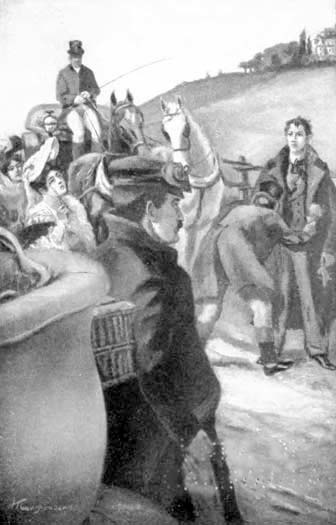
"'Clean Mr. Lushington, William,' said the good lady."
'Oh, thank you—no—thanks very much,' protested Lushington.
But William, having been told to clean him, proceeded to do so, gently and systematically, beginning at his neck and proceeding thence with bold curving strokes of the brush, as if he were grooming a horse.
Instinctively Lushington turned slowly round on his heels, while he submitted to the operation, and the others looked on. They had ample time to note the singular cut of his clothes.
'He used to be always so well dressed!' said Mrs. Rushmore to Margaret in an audible whisper.
Lushington winced visibly, but as he was not supposed to hear the words he said nothing. William had worked down to the knees of his trousers, which he grasped firmly in one hand while he vigorously brushed the cloth with the other.
'That will do, thank you,' said Lushington, trying to draw back one captive leg.
But William was inexorable and there was no escape from his hold. He was an Englishman, and was therefore thorough; he was a servant, and he therefore thoroughly enjoyed the humour of seeing his betters in a pickle.
'And now, my dear,' said Mrs. Rushmore to Margaret, 'get in and I'll take you home. You can explain everything on the way. That's enough, William. Put away your brush.'
Margaret had no choice, since fate had intervened.
'I'm very much obliged to you,' she said, nodding to Logotheti; 'and I hope you'll be none the worse,' she added, smiling at Lushington.
Mrs. Rushmore bent her head with dignified disapproval, first to one and then to the other, and got into the carriage as if she were mounting the steps of a throne. She further manifested her displeasure at the whole affair by looking straight before her at the buttons on the back of the coachman's coat after she had taken her seat. Margaret got in lightly after her and she scarcely glanced at Logotheti as the carriage turned; but her eyes lingered a little with an expression that was almost sad as she met Lushington's. She was conscious of a reaction of feeling; she was sorry that she had helped to make him suffer, that she had been amused by his damaged condition and by his general discomfiture. He had made her respect him in spite of herself, just when she had thought that she could never respect him again; and suddenly the deep sympathy for him welled up, which she had taken for love, and which was as near to love as anything her heart had yet felt for a man.
She knew, too, that it was really her heart, and nothing else, where he was concerned. She was human, she was young, she was more alive than ordinary women, as great singers generally are, and Logotheti's ruthless masculine vitality stirred her and drew her to him in a way she did not quite like. His presence disturbed her oddly and she was a little ashamed of liking the sensation, for she knew quite well that such feelings had nothing to do with what she called her real self. She might have hated him and even despised him, but she could never have been indifferent when he was close to her. Sometimes the mere touch of his hand at meeting or parting thrilled her and made her feel as if she were going to blush. But she was never really in sympathy with him as she was with Lushington.
'And now, Margaret,' said Mrs. Rushmore after a silence that had lasted a full minute, 'I insist on knowing what all this means.'
Margaret inwardly admitted that Mrs. Rushmore had some right to insist, but she was a little doubtful herself about the meaning of what had happened. If it meant anything, it meant that she had been flirting rather rashly and had got into a scrape. She wondered what the two men were saying now that they were alone together, and she turned her head to look over the back of the phaeton, but a turn of the road already hid the motor car from view.
Meanwhile Mrs. Rushmore's face showed that she still insisted, and Margaret had to say something. As she was a truthful person it was not easy to decide what to say, and while she was hesitating Mrs. Rushmore expressed herself again.
'Margaret,' said she, 'I'm surprised at you. It makes no difference what you say. I'm surprised.'
The words were spoken with a slow and melancholy intonation that might have indicated anything but astonishment.
'Yes,' Margaret remarked rather desperately, 'I don't wonder. I suppose I've been flirting outrageously with them both. But I really could not foresee that one would run over the other and that you would appear just at that moment, could I? I'm helpless. I've nothing to say. You must have flirted when you were young. Try to remember what it was like, and make allowance for human weakness!'
She laughed nervously and glanced nervously at her companion, but Mrs. Rushmore's face was like iron.
'Mr. Rushmore,' said the latter, alluding to her departed husband, 'would not have understood such conduct.'
Margaret thought this was very probable, judging from the likenesses of the late Ransom Rushmore which she had seen. There was one in particular, an engraving of him when he had been president of some big company, which had always filled her with a vague uneasiness. In her thoughts she called him the 'commercial missionary,' and was glad for his sake and her own that he was safe in heaven, with no present prospect of getting out.
'I'm sorry,' she said, without much contrition. 'I mean,' she went on, correcting herself, and with more feeling, 'I'm sorry I've done anything that you don't like, for you've been ever so good to me.'
'So have other people,' answered the elder woman with an air of mystery and reproof.
'Oh yes! I know! Everybody has been very kind—especially Madame Bonanni.'
'Should you be surprised to hear that the individual who bought out Mr. Moon and made you independent, did it from purely personal motives?'
Margaret turned to her quickly in great surprise.
'What do you mean? I thought it was a company. You said so.'
'In business, one man can be a company, if he owns all the stock,' said Mrs. Rushmore, sententiously.
'I don't understand those things,' Margaret answered, impatient to know the truth. 'Who was it?'
'I hardly think I ought to tell you, my dear. I promised not to. But I will allow you to guess. That's quite different from telling, and I think you ought to know, because you are under great obligations to him.'
'You don't mean to say——' Margaret stopped, and the blood rose slowly in her face.
'You may ask me if it was one of those two gentlemen we have just left in the road,' said Mrs. Rushmore. 'But mind, I'm not telling you!'
'Monsieur Logotheti!' Margaret leaned back and bit her lip.
'You've made the discovery yourself, Margaret. Remember that I've told you nothing. I promised not to, but I thought you ought to know.'
'It's an outrage!' cried Margaret, breaking out. 'How did you dare to take money from him for me?'
Mrs. Rushmore seemed really surprised now, though she did not say she was.
'My dear!' she exclaimed, 'you would not have had me refuse, would you? Money is money, you know.'
The good lady's inherited respect for the stuff was discernible in her tone.
'Money!' Margaret repeated the word with profound contempt and a good deal of anger.
'Yes, my dear,' retorted Mrs. Rushmore severely. 'Yes, money. It is because your father and mother spoke of it in that silly, contemptuous way that they died so poor. And now that you've got it, take my advice and don't turn up your nose at it.'
'Do you suppose I'll keep it, now that I know where it comes from? I'll give it back to him to-day!'
'No, you won't,' answered Mrs. Rushmore, with the conviction of certainty.
'I tell you I will!' Margaret cried. 'I could not sleep to-night if I knew that I had money in my possession that was given me—given me like a gift—by a man who wants to marry me! Ugh! It's disgusting!'
'Margaret, this is ridiculous. Monsieur Logotheti came to see me and explained the whole matter. He said that he had made a very good bargain and expected to realise a large sum by the transaction. Do you suppose that such a good man of business would think of making any one a present of a hundred thousand pounds? You must be mad! A hundred thousand pounds is a great deal of money, Margaret. Remember that.'
'So much the better for him! I shall give it back to him at once!'
Mrs. Rushmore smiled.
'You can't,' she said. 'You've never even asked me where it is, and while you are out of your mind, I shall certainly not tell you. You seem to forget that when I undertook to bring suit against Alvah Moon you gave me a general power of attorney to manage your affairs. I shall do whatever is best for you.'
'I don't understand business,' Margaret answered, 'but I'm sure you have no power to force Monsieur Logotheti's money upon me. I won't take it.'
'You have taken it and I have given a receipt for it, my dear, so it's of no use to talk nonsense. The best thing you can do is to give up this silly idea of going on the stage, and just live like a lady, on your income.'
'And marry my benefactor, I suppose!' Margaret's eyes flashed. 'That's what he wants—what you all want—to keep me from singing! He thought that if he made me independent, I would give it up, and you encouraged him! I see it now. As for the money itself, until I really have it in my hands it's not mine; but just as soon as it is I'll give it back to him, and I'll tell him so to-day.'
The carriage rolled through the pretty woods of Fausses Reposes, and the sweet spring breeze fanned Margaret's cheeks in the shade. But she felt fever in her blood and her heart beat fast and angrily as if it were a conscious creature imprisoned in a cage. She was angry with herself and with every one else, with Logotheti, with Mrs. Rushmore, with poor Lushington for making such a fool of himself just when she was prepared to like him better than ever. She was sure that she had good cause to hate every one, and she hated accordingly, with a good will. She wished that she might never spend another hour under Mrs. Rushmore's roof, that she might never see Logotheti again, that she were launched in her artistic career, free at last and responsible to no one for her actions, her words or her thoughts.
But Mrs. Rushmore began to think that she had made a mistake in letting her know too soon who had bought out Alvah Moon, and she wondered vaguely why she had betrayed the secret, trying to account for her action on the ground of some reasonably thought-out argument, which was quite impossible, of course. So they both maintained a rather hostile silence during the rest of the homeward drive.
CHAPTER XVI
Until the carriage was out of sight, Logotheti and Lushington stood still where Margaret had left them. Then Lushington looked at his adversary coolly for about four seconds, stuck his hands into his pockets, turned his back and deliberately walked off without a word. Logotheti was so little prepared for such an abrupt closure that he stood looking after the Englishman in surprise till the latter had made a dozen steps.
'I say!' said the Greek, calling after him then and affecting an exceedingly English tone. 'I say, you know! This won't do.'
Lushington stopped, turned on his heel and faced him from a distance.
'What won't do?' he asked coolly.
Seeing that he came no nearer, Logotheti went forward a little.
'You admitted just now that you had been playing the spy,' said the Greek, whose temper was getting beyond his control, now that the women were gone.
'Yes,' said Lushington, 'I've been watching you.'
'I said spying,' answered Logotheti; 'I used the word "spy." Do you understand?'
'Perfectly.'
'You don't seem to. I'm insulting you. I mean to insult you.'
'Oh!' A faint smile crossed the Englishman's face. 'You want me to send you a couple of friends and fight a duel with you? I won't do anything so silly. As I told you before Miss Donne, we don't owe each other anything to speak of, so we may as well part without calling each other bad names.'
'If that is your view of it, you had better keep out of my way in future.' He laid his hand on the car to get in as he spoke.
Lushington's face hardened.
'I shall not take any pains to do that,' he answered. 'On the contrary, if you go on doing what you have been doing of late, you'll find me very much in your way.'
Logotheti turned upon him savagely.
'Do you want to marry Miss Donne yourself?' he asked.
Lushington, who was perfectly cool now that no woman was present, was struck by the words, which contained a fair question, though the tone was angry and aggressive.
'No,' he answered quietly. 'Do you?'
Logotheti stared at him.
'What the devil did you dare to think that I meant?' he asked. 'It would give me the greatest satisfaction to break your bones for asking that!'
Lushington came a step nearer, his hands in his pockets, though his eyes were rather bright.
'You may try if you like,' he said. 'But I've something more to say, and I don't think we need fall to fisticuffs on the highroad like a couple of bargees. I've misunderstood you. If you are going to marry Miss Donne, I shall keep out of your way altogether. I made a mistake, because you haven't the reputation of a saint, and when a man of your fortune runs after a young singer it's not usually with the idea of marrying her. I'm glad I was wrong.'
Logotheti was too good a judge of men to fancy that Lushington was in the least afraid of him, or that he spoke from any motive but a fair and firm conviction; and the Greek himself, with many faults, was too brave not to be generous. He turned again to get into the car.
'I believe you English take it for granted that every foreigner is a born scoundrel,' he said with something like a laugh.
'To tell the truth,' Lushington answered, 'I believe we do. But we are willing to admit that we can be mistaken. Good morning.'
He walked away, and this time Logotheti did not stop him, but got in and started the car in the opposite direction without looking back. He was conscious of wishing that he might kill the cool Englishman, and though his expression betrayed nothing but annoyance a little colour rose and settled on his cheek-bones; and that bodes no good in the faces of dark men when they are naturally pale. He reached home, and it was there still; he changed his clothes, and yet it was not gone; he drank a cup of coffee and smoked a big cigar, and the faint red spots were still there, though he seemed absorbed in the book he was reading.
It was not his short interview with Lushington which had so much moved him, though it had been the first disturbing cause. In men whose nature, physical and moral, harks back to the savage ancestor, to the pirate of northern or southern seas, to the Bedouin of the desert, to the Tartar of Bokhara or the Suliote of Albania, the least bit of a quarrel stirs up all the blood at once, and the mere thought of a fight rouses every masculine passion. The silent Scotchman, the stately Arab, the courtly Turk are far nearer to the fanatic than the quick-tempered Frenchman or the fiery Italian.
For a long time Constantine Logotheti had been playing at civilisation, at civilised living and especially at the more or less gentle diversion of civilised love-making; but he was suddenly tired of it all, because it had never been quite natural to him, and he grew bodily hungry and thirsty for what he wanted. The round flushed spots on his cheeks were the outward signs of something very like a fever which had seized him within the last two hours. Until then he would hardly have believed that his magnificent artificial calm could break down, and that he could wish to get his hands on another man's throat, or take by force the woman he loved, and drag her away to his own lawless East. He wondered now why he had not fallen upon Lushington and tried to kill him in the road. He wondered why, when Margaret had been safe in the motor car, he had not put the machine at full speed for Havre, where his yacht was lying. His artificial civilisation had hindered him of course! It would not check him now, if Lushington were within arm's length, or if Margaret were in his power. It would be very bad for any one to come between him and what he wanted so much, just then, that his throat was dry and he could hear his heart beating as he sat in his chair. He sat there a long time because he was not sure what he might do if he allowed himself the liberty of crossing the room. If he did that, he might write a note, or go to the telephone, or ring for his secretary, or do one of fifty little things whereby the train of the inevitable may be started in the doubtful moments of life.
It did not occur to him that he was not the arbiter of his actions in that moment, free to choose between good and evil, which he, perhaps, called by other names just then. He probably could not have remembered a moment in his whole life at which he had not believed himself the master of his own future, with full power to do this, or that, or to leave it undone. And now he was quite sure that he was choosing the part of wisdom in resisting the strong temptation to do something rash, which made it a physical effort to sit still and keep his eyes on his book. He held the volume firmly with both hands as if he were clinging to something fixed which secured him from being made to move against his will.
One of fate's most amusing tricks is to let us work with might and main to help her on, while she makes us believe that we are straining every nerve and muscle to force her back.
If Logotheti had not insisted on sitting still that afternoon nothing might have happened. If he had gone out, or if he had shut himself up with his statue, beyond the reach of visitors, his destiny might have been changed, and one of the most important events of his life might never have come to pass.
But he sat still with his book, firm as a rock, sure of himself, convinced that he was doing the best thing, proud of his strength of mind and his obstinacy, perfectly pharisaical in his contempt of human weakness, persuaded that no power in earth or heaven could force him to do or say anything against his mature judgment. He sat in his deep chair near a window that was half open, his legs stretched straight out before him, his flashing patent leather feet crossed in a manner which showed off the most fantastically over-embroidered silk socks, tightly drawn over his lean but solid ankles.
From the wall behind him the strange face in the encaustic painting watched him with drooping lids and dewy lips that seemed to quiver; the ancient woman, ever young, looked as if she knew that he was thinking of her and that he would not turn round to see her because she was so like Margaret Donne.
His back was to the picture, but his face was to the door. It opened softly, he looked up from his book and Margaret was before him, coming quickly forward. For an instant he did not move, for he was taken unawares. Behind her, by the door, a man-servant gesticulated apologies—the lady had pushed by him before he had been able to announce her. Then another figure appeared, hurrying after Margaret; it was little Madame De Rosa, out of breath.
Logotheti got up now, and when he was on his feet, Margaret was already close to him. She was pale and her eyes were bright, and when she spoke he felt the warmth of her breath in his face. He held out his hand mechanically, but he hardly noticed that she did not take it.
'I want to speak to you alone,' she said.
Madame De Rosa evidently understood that nothing more was expected of her for the present, and she sat down and made herself comfortable.
'Will you come with me?' Logotheti asked, controlling his voice.
Margaret nodded; he led the way and they left the room together. Just outside the door there was a small lift. He turned up the electric light, and Margaret stepped in; then he followed and worked the lift himself. In the narrow space there was barely room for two; Logotheti felt a throbbing in his temples and the red spots on his cheek-bones grew darker. He could hear and almost feel Margaret's slightest movement as she stood close behind him while he faced the shut door of the machine. He did not know why she had come, he did not guess why she wished to be alone with him, but that was what she had asked, and he was taking her where they would really be alone together; and it was not his fault. Why had she come?
When a terrible accident happens to a man, the memory of all his life may pass before his eyes in the interval of a second or two. I once knew a man who fell from the flying trapeze in a circus in Berlin, struck on one of the ropes to which the safety net was laced and broke most of his bones. He told me that he had never before understood the meaning of eternity, but that ever afterwards, for him, it meant the time that had passed after he had missed his hold and before he struck and was unconscious. He could associate nothing else with the word. Logotheti remembered, as long as he lived, the interminable interval between Margaret's request to see him alone, and the noiseless closing of the sound-proof door when they had entered the upper room, where Aphrodite stood in the midst and the soft light fell from high windows that were half-shaded.
Even then, though her anger was hot and her thoughts were chasing one another furiously, Margaret could not repress an exclamation of surprise when she first saw the statue facing her in its bare beauty, like a living thing.
Logotheti laid one hand very lightly upon her arm, and was going to say something, but she sprang back from his touch as if it burnt her. The colour deepened in his dark cheeks and his eyes seemed brighter and nearer together. When a woman comes to a man's house and asks to be alone with him, she need not play horror because the tips of his fingers rest on her sleeve for a moment. Why did she come?
Margaret spoke first.
'How did you dare to settle money on me?' she asked, standing back from him.
Logotheti understood for the first time that she was angry with him, and that her anger had brought her to his house. The fact did not impress him much, though he wished she were in a better temper. The sound of her voice was sweet to him whatever she said.
'Oh?' he ejaculated with a sort of thoughtful interrogation. 'Has she told you? She had agreed to say nothing about it. How very annoying!'
His sudden calm was exasperating, for Margaret did not know him well enough to see that below the surface his blood was boiling. She tapped the blue tiled floor sharply with the toe of her shoe.
'It's outrageous!' she said with energy.
'I quite agree with you. Won't you sit down?' Logotheti looked at the divan. Margaret half sat upon the arm of a big leathern chair.
'Oh, you agree with me? Will you please explain?'
'I mean, it is outrageous that Mrs. Rushmore should have told you——'
'You're quibbling!' Margaret broke in angrily. 'You know very well what I mean. It's an outrage that a man should put a woman under an enormous obligation in spite of herself, without her even knowing it!'
Logotheti had seated himself where he could watch her; the fashion of dress was close-fitting; his eyes followed the graceful lines of her figure. If she had not come to drive him mad, why did she take an attitude which of all others is becoming to well-made women and fatal to all the rest?
'I'm sorry,' said Logotheti, rather absently and as if her anger did not affect him in the least, if he even noticed it. 'I happened to want the invention for a company in which I am interested. You stood in the way of my having the whole thing, so I was obliged to buy you out. I'm very sorry that it happened to be you, and that Mrs. Rushmore could not keep the fact to herself. I knew you wouldn't be pleased if you ever found it out.'
'I don't believe a word of what you are telling me,' Margaret answered.
'Really not?' Logotheti seemed momentarily interested. 'That's generally the way when one speaks the truth,' he added, more carelessly again. 'Nobody believes it.'
His eyes caressed her as he spoke. He was not thinking much of what he said.
'I've come here to make you take back the money,' Margaret said. 'I won't keep it another day.'
'Have you come all the way from Versailles again to say that?' asked Logotheti, laughing.
Again, as she sat on the arm of the big chair, she tapped the dark blue tiles with the toe of her shoe. The slight movement transmitted itself through her whole figure, and for an instant each beautiful line and curve quivered and was very slightly modified. Logotheti saw and drew his breath sharply between his teeth.
'Yes,' Margaret was saying impatiently. 'When Mrs. Rushmore had told me the truth, I walked to the station and took the first train. I only stopped to get Madame De Rosa.'
'She is not a very powerful ally,' observed Logotheti. 'She is probably asleep in her arm-chair in the drawing-room by this time. Are you still angry with me? Yes, I believe you are. Please forgive me. I had not the least idea of offending you, because I trusted that old—— I mean, because I was so sure that Mrs. Rushmore would never tell.'
'Never mind Mrs. Rushmore,' Margaret said. 'What I will not forgive you is that you made me take your money without my knowing it. I've been flirting with you—yes, I confess it! I'm not perfection, and you're rather amusing sometimes——'
'You are adorable!' Logotheti put in, as a sort of murmuring parenthesis.
'Don't talk nonsense,' Margaret answered. 'I mean that whatever I may have said to you I've never given you the right to make me a present of a hundred thousand pounds. It's the most unparalleled piece of impertinence I ever heard of.'
'But I've not made you a present of anything. I bought what was yours without letting you know, that's all.'
'Then give me back what is mine and take your money again.'
'Hm!' Logotheti smiled. 'That would be very like going into a business partnership with me. Do you wish to do that?'
'What do you mean?'
'You see, I'm the whole company at present. But if you come in with a third of the stock to your credit, we shall be partners, to all intents and purposes. We shall have meetings of the board of directors, just you and I, and we shall decide what to do. It will be rather a queer sort of board, for of course I shall always do exactly what you wish, but it's not impossible that we may make money together. Well—on the whole I have no particular objection to selling you exactly the amount of stock I bought from you the other day. That's the shape the transaction takes. I'll do any thing to please you, but I'm quite willing you should know that I am doing you a favour, as business men would look at it.'
'A favour!' Margaret slipped from the arm of the chair as she spoke and stood upright and made a step towards him. 'Do you think I'm a child to believe such nonsense?'
'In matters of business all women are children. With the possible exception of Mrs. Rushmore,' he added in a tone of reflection. 'Besides, this is not nonsense.'
'It is!' cried Margaret. 'It is absurd to try and make me believe that a mere claim set up on the chance of getting something should have turned out to be worth so much. It has cost Mrs. Rushmore I don't know how much in lawsuits, and no one ever really believed in it. She fought for it out of pure kindness of heart, and even the lawyers said she was very foolish to go on——'
'Will you listen to me?' asked Logotheti, interrupting her. 'I've not much to say, but it's rather convincing. You probably admit that the invention is valuable, and that Alvah Moon has made money by it.'
'I should think he had, the old thief!'
'Very well. I happened to want that invention. I've bought several at different times and have founded companies and sold them. That's a part of finance, which is a form of game. You deal yourself a hand and then play it. I made up my mind to play with this particular invention. I know much more about it than you do; in fact, I understand it thoroughly. I cabled to my agent in America to buy it, if he could, and he succeeded. Now please tell me whether you think Mrs. Rushmore, acting for you, would have withdrawn the suit after the property had changed hands, merely because I've dined in her house.'
'No,' Margaret was forced to admit. 'No, she would have gone on.'
'Precisely. Now I don't want property of that kind, about which there is constant litigation. The credit of such property is injured by the talk there always is about lawsuits. So I went to Mrs. Rushmore and asked her what she thought your claim was worth, and she told me, and I gave her a cheque for the money, and she has given me a full release, as your attorney. If it had been her claim, or Madame De Rosa's or any one else's, I should have done exactly the same thing. Will you tell me how I could have acted otherwise in order to get the property into my hands free of all chance of dispute? Was there any other way?'
Margaret was silent, for she could find no answer.
'There was one other way,' Logotheti continued. 'I could have proposed that you should go into partnership with me, which is what you yourself are proposing now. But in the eyes of the world I confess that might look intimate, to say the least of it. Don't you think so too?'
'You're the most plausible person I ever listened to!' Margaret almost laughed, though her anger had not subsided.
'Will you leave things as they are and forget all about this business? What has been done cannot possibly be undone now. Won't you separate me from it in your thoughts? You can, if you try. You know, I'm two people in one. So are you. I'm Logotheti the financier, and I'm Logotheti the man. You are Margaret Donne, and you are Señorita da Cordova, on the very eve of being famous—and then, I think you are some thing else which I don't quite understand, but which is like my fate, for I cannot escape from you, whether I see you, or only dream of you.'
Margaret was silent, and looked at the Aphrodite while she sat on the arm of the big chair. She might have breathed a little faster if she had known that the two doors through which she had entered, and which had closed so silently and surely after her, were as sound-proof as six feet of earth. She would not have been afraid, for she was fearless and confident, but her heart would have beaten a little more quickly at the thought that she was out of hearing of the world, and in the presence of a man whose eyes looked at her strangely and whose cheeks were darkly flushed, who was a good deal nearer to the primitive human animal than most men are, and in whom the main force of nature was awake and hungry.
'I don't want you to make love to me just now,' she said, swinging her foot a little as she sat. 'You've done something that has hurt me very much, and has made me almost wish that I might never see you again after this time. I wish you could find a way of undoing it—I'm sure there is a way.'
Unconsciously wise, she had checked his pulse for a moment, and she looked at him calmly and shook her head. With a sudden and impatient movement he rose, turned away from her and began to walk up and down at a little distance, his head bent and his hands behind him.
Though the air in the high room was pure, it was still and hot, for the late spring afternoon had turned sultry all at once; the fluid of a near storm was fast condensing to the point of explosion.
The man felt the tension more than the woman just then. It acted on his state, and made it almost unbearable. His hands were locked behind him and his fingers twisted each other till they changed colour. He moved with the short, noiseless steps of a young wild animal measuring its cage, up and down, up and down, without pause.
'It's this,' Margaret continued, much more gently than she had meant to speak, 'I don't quite believe you. I'm almost sure you thought that I would give up the stage if I had enough money to live on without my work.'
'Yes, I did.' He stopped as if in anger and the words came sharply; but he was not angry.
'You see!' Margaret answered triumphantly. 'I knew it! What becomes of your story about the company now?'
She rose also and began to walk. The big leathern arm-chair was between them; he leaned his elbows on the back of it and watched her, and compared her hungrily with the Aphrodite.
'All I have told you is true,' he said. 'The business happened to serve two purposes, that's all. At least, I thought it would, and it was a pleasure to help you without your knowing it. Why should I be sorry? That money might as well come to you through me as through anybody else. You're angry with me. Why? Because I'm too fond of you? It cannot reasonably be about the money any more—the wretched money! If you can't keep the filthy stuff—if it won't prevent you from going on the stage after all—why then, give it away! Throw it away! Lose it, if you can. But don't come to me with it, for it's the price of a thing I bought in the way of business and which I won't give up, nor take as a gift from anybody.'
He spoke in such a harsh tone now that she paused in her short walk and met his eyes, to see what he meant, over and above what he was saying. She stood in front of the chair; he was leaning over the back of it, with his hands together; one hand was slowly kneading the closed fist, and the veins stood out on both. His voice was hoarse but rather low, like that of a man who wants water.
The light in the room had a yellowish tinge now, and the window showed a dull glare where there had been blue sky before. The lurid light got into Logotheti's eyes, and was ready to flash while Margaret looked at him. The marble Aphrodite took a creamy, living tint, and the little shadows that modelled her quivered and deepened.
All at once Margaret knew that there was danger. She could not have told how she knew it, nor just what the danger was, but she raised her fair head suddenly, as the stag does when the scent of the hounds comes down the breeze. Watching her, he saw and understood, and his hands left each other and closed tightly upon the back of the chair.
'Will you take me back to Madame De Rosa, please?' Margaret asked, and her voice did not shake.
Before he could answer, a flash of lightning filled the room, vivid as flame, and almost purple; it flared and danced two or three times before it went out.
If Logotheti spoke at all, his words were drowned in the crash that shook the house and rolled away over the city. His eyes never moved from Margaret's face; she felt that his gaze was fastened on her lips, as if he would have drawn them to meet his own. She was not exactly afraid, but she knew that she must get away from him, for he was stronger than she, and he was like a man going mad. That was what she would have called it. And it seemed to her that one of two things was going to happen. Either she would let his lips reach hers, without resisting, or else she would try to kill him when he came near her. She did not know which she should do. She was in herself two people; the one was a human woman, tempted by the mysterious sympathy of flesh and blood; the other self was a startled maiden caught in a trap and at bay, without escape.
With the great peal of thunder the Aphrodite trembled from head to foot, twice, as the vibration ran down the walls of the house to the very foundations and then came up again and died away, like the second shock of an earthquake. The statue trembled as if it were alive and afraid.
With a glance, Margaret measured the distance which separated her from the door, but it was too far. There were half-a-dozen steps, and Logotheti was much nearer to her than that, even allowing that he must get past the chair to reach her.
Now he moved a little and it was too late to try. He was beside the chair instead of behind it; but then he stopped and came no further yet, while he spoke to her.
'Why did you come?' he asked in a low tone. 'You might have guessed that it wasn't quite safe!'
It was almost as if he were speaking to himself. She kept her eyes on him, and tried to back away towards the door so slowly that he should not notice it. But he smiled and his lids drooped.
'You could not open the door if you reached it,' he said. 'You said that you wanted to speak with me alone. We are alone here—quite alone. No one can hear, even if you scream. No one can get in. Why did you say you wanted to be alone with me, if you were not in earnest? Why do you risk playing with a man who is crazy about you, and has everything in the world except you, and would throw it all away to have you? And now that you are here of your own accord, why should I let you go?'
The speech was rough, but there was a sudden caress in his voice with the last words, and he had scarcely spoken them when another flash of lightning filled the room with a maddening purple light.
Before the peal broke, Logotheti held Margaret by the wrists, and spoke close to her face, very fast.
'I will not let you go. I love you, and I will not let you go.'
The thunder burst, and roared and echoed away, while he drew her nearer, looking for the woman in her eyes, too mad to know that she did not feel what he felt. He touched her now; he could feel her breathings, fast and frightened, and the quiver that ran through her limbs. He held her, but without hurting her in the least—she could turn her wrists loosely in the bonds he made of his fingers. Yet she could not get away from him and he drew her closer.
She threw her head back from his face, and tried to speak.
'Please—please, let me go.'
'No. I love you.'
He drew her till she was pressed against him, and he held her hands in his behind her waist. The air was clearing with a furious rush of rain, and her courage was not all gone yet. She looked up to the high windows, as one about to die might look up from the scaffold, and there was a streak of clear blue sky between the driving clouds. It was as if hope looked through, out of heaven, at the girl driven to bay.
Margaret did not try to use her strength, for she knew it was useless against his. But she held her head back and spoke slowly.
'For your mother's sake,' she said, low and clear, her eyes on his.
For one moment his grasp tightened and his white teeth caught his lower lip; but his look was changing slowly.
'For her sake,' Margaret said, 'as you would have kept harm from her——'
His hold relaxed, and he turned away. There was good in him still; he had loved his mother.
He turned deliberately, till he could see neither Margaret nor the Aphrodite, and he leaned heavily on the table, with bent head, resting the weight of his body on the palms of his hands, and remaining quite motionless for some time.
He heard her go towards the door. Without looking round he slowly shook his head.
'Don't be afraid of me,' he said, in a low voice. 'It's all over, now. I'll let you out in a moment.'
'Yes.'
She waited quietly by the door, which she did not understand how to open. Presently he moved a little, and his head sank lower between his shoulders; then he spoke again, but still without turning towards her.
'I'm sorry,' he said. 'I did not know I could be such a brute. Forgive me, will you?'
As usual, when he was very much in earnest, there was something rudely abrupt about his speech.
'It was my fault,' Margaret answered from the door. 'I should not have come.'
Even after her escape, something about him still pleased her. The maiden that had been brought to bay was scarcely safe, before the human woman began to be drawn to him again by that sympathy of flesh and blood that had nearly cost her more than life.
But Margaret revolted against it now, as soon as she knew what it was that made her speak kindly.
'I'm not afraid of you,' she said, almost coldly, 'but I want you to let me out, please.'
He straightened himself and turned slowly to her. The dark red colour was gone from his cheeks, he was suddenly pale and haggard, and if he had not been really young, he would have looked old; as it was, his face was drawn and pinched as if by sharp physical suffering. He drew two or three quick, deep breaths as he came towards her.
He stood beside her a moment, and then without a word, he unfastened the door. It swung inwards and stood open. Margaret saw that it was thickly padded to prevent any sound from passing, and that there was another padded door beyond it which she had not noticed when she had entered. He understood her look of doubt.
'That one is open now,' he said. 'It locks and unlocks itself as I shut or open the inner door.'
He was willing to let her see how completely she had been cut off from the outer world; and she realised the truth and shuddered.
'Good-bye,' she said, abruptly, as if he were not to go downstairs with her, and she made a step to pass him.
He thrust his arm out across the way, resting his head against the door-post. She started, almost nervously, and then stood still again and looked at him.
'No,' he said, 'I shall not try to keep you, and the door is open. But please don't say good-bye like that, as if we were not going to meet soon.'
'It's not good for us to be alone together,' she said.
The words came by instinct, and acknowledged a weakness in herself. After she had spoken, she was very sorry. His drawn face softened.
'That's why I forgive you,' she said, with sudden frankness, and a blush reddened her cheeks under the fawn-coloured veil she had drawn down again.
He took her hand, against her will and almost violently, but in an instant his own was gentle again.
'Margaret!' His voice had a thrill in it.
'No,' she answered, but not roughly now, and scarcely trying to free herself. 'No. I don't love you in the least. That is why I won't marry you. There's something that draws me to you against my will sometimes—yes, I know that! But I hate it, and I'm afraid of it. It's not what I like in you, it's what I like least. It's something like hypnotism, I'm sure. I'm ashamed of it, because it is what has made me flirt with you. Yes, I have! I've flirted outrageously, except that I've always told you that I never would marry you. I've been truthful in that, at all events.'
'Do you think I reproach you?'
'You might have, this morning. Now we have each something to reproach the other. We will forgive and say good-bye for a while. When we meet again, that something I'm afraid of will be gone—perhaps—then everything will be different. Now, good-bye.'
He had held her hand all the time while she had been speaking. She pressed his now, with an impulse of frank loyalty, and dropped it suddenly.
'Do you mean that I may not even come and see you?' he asked.
'Not till after my début,' answered Margaret in a decided tone, for she felt that she dominated him at last. 'You don't want me to be a singer and I cannot help feeling your opposition. It disturbs me, as the time comes near. Of course I can't hinder you from being there on the first night——'
'No indeed!'
'And when you've heard me, and seen Gilda's head come out of the sack, and when the curtain has gone down on Rigoletto's despair—why, then you may come behind and congratulate me, especially if I've made a failure! Till then I don't want to see you, please!'
'I cannot wait so long. It is nearly three weeks.'
Margaret stood up very straight in the doorway, already past him and free to go out.
'Since I am willing to forgive you for losing your head just now,' she said, 'it's for me to decide whether you may ever see me again, and if so when, and where. I've been very good to you. Now I am going.'
It seemed to him that she had grown all at once in strength and individuality till there was nothing for him to do but to submit. This was an illusion, no doubt; she was just what she had always been, and what he had always judged her, a gifted young woman, rather inclined to flirt and easily guided in any direction, whose exuberant animal vitality might pass for strong character in the eyes of an inexperienced innocent like Lushington, but could not deceive an old hand like Logotheti for a moment. Nevertheless, when she had spoken her last words and was leading the way out of the room, Logotheti felt a little like a small boy who has had his ears boxed for being too cheeky, which is a sensation not at all pleasant or natural to an old hand.
As he took her down in the little lift, he vaguely wondered whether he had ever thought of her till now except as an animated work of art; comparable in beauty with his encaustic painting or his dearly loved Aphrodite; worth more than either of them as a possible possession, as life is worth more than stone, and endowed with a divine voice; but having neither soul, intelligence, nor will to speak of, nor any original power of ruling others, still less of resisting a systematic and prolonged attack.
The change had come quickly. Logotheti thought of beautiful beings of old, disguised as yielding, mortal women, who had visited the men they loved on earth and had by and by revealed themselves as true and puissant goddesses, moving in a sphere of rosy light, and speaking only to command.
Logotheti took her down in the lift and they went back into the big room where they had left Madame De Rosa. They found her looking out of the window. Books did not interest her, nor pictures either, there was no piano in the room and the maraschino was locked up. So there was nothing to do but to look out of the window. As the two came in she turned sharply to them, with her head on one side, as birds do, and her intelligent little eyes sparkled. She was a good little woman herself, and believed in heaven and salvation, but she had no particular belief in man and none at all in woman. On the other hand, she had a very keen scent for the truth in love affairs, and in Logotheti's subdued expression she instantly detected sure signs of discomfiture, which were fully confirmed by Margaret's serene and superior manner. Men sometimes follow women into a room with such an air of submission that one almost looks for the string by which they are led.
Madame De Rosa nodded her approval to Margaret in a rather officious manner, much as if she were congratulating her pupil on having soundly beaten an unruly and dangerous dog.
'Well done,' the nod said. 'Beat him again, the very next time he does it!'
But Margaret either did not understand at all, or did not care for Madame De Rosa's approbation, for she returned no answering glance of intelligence.
'I hope,' she said, 'that I have not kept you too long.'
The former prima donna looked at a tiny watch set in diamonds, the gift of a great tenor whom she had taught.
'Not at all,' she said. 'It's not twenty minutes since we came.'
She put the watch to her ear and listened. Nine women out of ten are generally in doubt as to whether their watches have not just stopped.
'Yes,' she said. 'It is going.'
Logotheti remembered how long the seconds had seemed while he was taking Margaret up in the lift, and it seemed as if hours had passed since then.
'Good-bye,' said Margaret, holding out one hand and passing the other through Madame De Rosa's arm to lead her away.
'Good-bye,' Logotheti answered. 'Of course,' he continued, 'you must please remember that if I can be of any use in making investments for you, you have only to send me your commands. I am at your service for anything connected with the money market.'
'Thank you,' said Margaret, ambiguously, as to the tone in which the words were spoken, but with a quick glance of approval.
He had meant his speech for Madame De Rosa, who had probably been told that Margaret came to see him on a matter of business. But it was quite unnecessary. The little Neapolitan woman could judge of the state of a love affair at any moment with a certainty as unerring as that of a great cook who can tell by a mere glance what stage of development the finest sauce has reached. She supported Logotheti's fiction, however, without a smile.
'Ah, my dear,' she said, 'always consult him, if he will help you! Bonanni owes half her fortune to his judgment, and I could certainly not live as I do if he had not given me his advice and kind assistance.'
'You exaggerate, dear lady,' said Logotheti, opening the door for them, and following them into the hall.
'Not in the least,' laughed Madame De Rosa, 'though I am sure that Cordova is quite able to take care of herself and is much too proud to owe you anything.'
She often called Margaret by her stage name, as artists do among themselves, but it jarred disagreeably on Logotheti's ear.
'You are right in that,' he said, rather coldly, as a footman appeared and opened the outer door. 'Miss Donne'—he emphasised the name a little—'will probably not need any help from me. But if she should, I am her very humble servant.'
'Thank you,' Margaret said, in the same ambiguous tone as before.
Thereupon she and Madame De Rosa nodded to him and left him bowing on his doorstep. They walked away in the direction of the Batignolles station. When they had heard the door of the house shut, Madame De Rosa spoke.
'You are splendid, my dear,' she said with admiration. 'But take care! To play with Logotheti is like balancing a volcano on the tip of your nose while you juggle with the world, the flesh and the devil—you know what I mean—the man who keeps a cannon-ball, an empty bottle and a bit of paper all going at once with one hand. I am afraid Logotheti will do something unexpected, to upset all our plans.'
'He had better not!' answered Margaret, drooping her lids; and her eyes flashed, and her handsome lips pouted a little.
CHAPTER XVII
Margaret, it is sad to relate, was much less concerned about the two men who were in love with her than is considered becoming in a woman of heart. She confessed to herself, without excess of penitence, that she had flirted abominably with them both, she consoled her conscience with the reflection that they were both alive and apparently very well, and she put all her strength, which was great, into preparing for her début.
Men never love so energetically and persuasively as when they are fighting every day for life, honour or fame, and are already on the road to victory; but a woman's passion, though true and lasting, may be momentarily quite overshadowed by the anticipation of a new hat or of a social battle of uncertain issue. How much more, then, by the near approach of such an event as a first appearance on the stage!
Logotheti bribed the doorkeeper at the small theatre where Margaret was rehearsing. Whenever there was a rehearsal he was there before her, quite out of sight in the back of a lower box, and he did not go away until he was quite sure that she had left. He knew women well enough to be certain that if anything could make Margaret wish to see him it would be his own strict observance of her request not to show himself; and in the meantime he enjoyed some moments of keen delight in watching her and listening to her. He felt something of the selfish pleasure which filled that King of Bavaria who had a performance of Lohengrin given for himself alone. But the pleasure was not unmixed, nor was the delight unclouded.
Even Schreiermeyer had given up coming to the rehearsals, for he was now sure of Margaret's success and had passed on to other business. In the dim stalls there appeared only the shabby relations and rather gorgeous friends of the other members of the company. There was the young painter who loved the leading girl of the chorus, there was the wholesale upholsterer who admired the contralto, and a little apart there was the middle-aged great lady who entertained a romantic and expensive passion for the tenor. The tenor was a young Italian, who was something between a third-rate poet and a spoilt child when he was in love and was as cynical as Macchiavelli when he was not, which was the case at present, at least so far as the middle-aged woman of the world was concerned. His friends could always tell the state of his affections by the way he sang in Rigoletto. When he was hopelessly in love himself, he sang 'La donna è mobile' with tears in his voice, as if his heart were breaking; when, on the contrary, he knew that some unhappy female was hopelessly in love with him, he sang it with a sort of laugh that was diabolically irritating. At the present time he seemed to be in an intermediate state, for he sometimes sang it in the one way and sometimes in the other, to the despair of the poor foolish lady in the stalls. The truth was that at irregular intervals he felt that he was in love with Margaret.
Leading singers are very rarely attracted by each other. Perhaps that is because they receive such a vast amount of adulation which pleases them better, and of course there have been famous instances of the contrary, such as Mario and Grisi. As a rule singers do not meet much except at the theatre; it is only during rehearsals that they have a chance of talking, and then, as everybody knows, they show the worst side of themselves and are often in a very bad temper indeed.
Margaret had not reached that stage yet, for she had met with no disappointments and could not complain of her manager, and moreover she was not at all above learning what she could from her fellow-artists. She was therefore popular with them in spite of the fact that she was a lady born. They overlooked that, because she could sing, and the tenor only remembered it when he tried to patronise her a little. He had often sung with Melba, and she did this or that, and he had sung with Bonanni and knew exactly how she sang the difficult passages, and he reeled off the precepts and practice of half-a-dozen other lyric sopranos, giving Margaret to understand that he was willing and able to teach her a good deal. But she only smiled kindly, and did precisely what Madame De Rosa told her to do, seeing that the little Neapolitan had taught most of them what they knew. It was clear that Margaret could not be patronised, and the other members of the company liked her the better for it, because the tenor patronised them all and gave them to understand that they were rather small fry compared with a man who could hold the high C and walk off the stage with it.
From the darkness of his lower box Logotheti looked on and approved of Margaret's behaviour. At the same time he abstracted himself from her life and saw how she lived with respect to other men and women, and a great change began to take place in his feelings, one of those changes which are sometimes salutary because they may hinder an act of folly, but which humiliate a man in his own eyes, in proportion as they are unexpected, and tend to contradict something which he has believed to be beyond all doubt. To many men the loss of a noble illusion feels like a loss of strength in themselves, perhaps because such men can never keep an ideal before them without making an unconscious effort against the material tendency of their natures.
The change in Logotheti during the next three weeks was profound; and it was humiliating because it deprived him all at once of a sort of power over himself which had grown up with his love for Margaret and depended on that for its nourishment and life; a power which had perhaps not been an original force at all, but only a chivalrous willingness to do her will instead of his own. He looked on and did not betray his presence, and she, on her side, began to wonder at his prolonged obedience. More than once she felt a sudden conviction that he must be near, and he saw how she peered into the gloom of the empty house as if looking for some one she expected. It was only natural, and no theory of telepathy was needed to explain it. She had so often seen him there in reality! But he would not show himself now, for he was determined that she should send for him; if she did not, he could wait for her début; and little by little, as he kept to his determination and only saw her from a distance in the frame of the stage, the woman who had dominated him in a moment when he was beside himself with passion, became once more an animated work of art which he unconsciously compared with his Aphrodite and his ancient picture, and which he coveted as a possession.
It did not at first occur to him that Margaret had really changed since he had met her, and not exactly in the way he might have wished. Instead of showing any inclination to give up the stage, as he had hoped that she might, she seemed more and more in love with her future career.
When he had first met her he had made the acquaintance of a strikingly good-looking English girl, born and brought up a lady, full of talent and enthusiasm for her art, but as yet absolutely ignorant of professional artistic life and still in a state of mind in which some sides of it were sure to be disagreeable to her, if not absolutely repulsive.
Hidden in his box, and watching her as well as listening to her, he gradually realised the change, and he remembered many facts which should have prepared him for it. He recollected, for instance, her perfect coolness and self-possession with Madame Bonanni, so absolutely different from the paralysing shyness, the visible fright and the pitiful helplessness at the moment of trial, which he had more than once seen in young girls who came to Madame Bonanni for advice. They had good voices, too, those poor trembling candidates; many of them had talent of a certain order; but it was not the real thing, there was not the real strength behind it, there was not the absolute self-reliance to steady it; above all, there was not the tremendous physical organisation which every great singer possesses.
But Margaret had all that; in other words, she had every gift that makes a first-rate professional on the stage, and as the life became familiar to her, those gifts, suddenly called into play, exerted their influence directly upon her character and manner. She was born to be a professional artist, to face the public and make it applaud her, to believe in her own talent, to help herself, to trust to her nerves and to defend herself with cool courage in moments of danger.
This was assuredly not the girl with whom Logotheti had fallen in love at first sight, whom he, as well as Lushington, had believed far too refined and delicately brought up to be happy in the surroundings of a stage life, and much too sensitive to bear such familiarity as being addressed as 'Cordova,' without any prefix, by an Italian tenor singer whose father had kept a butcher's shop in Turin.
No doubt, the refinement, the sensitiveness, the delicacy of manner were all there still, for such things do not disappear out of a woman in a few days; but they belonged chiefly to one side of a nature that had two very distinct sides. There was the 'lady' side, and there was the 'actress' side; and unfortunately, thought Logotheti, there was now no longer the slightest doubt as to which was the stronger. Margaret Donne was already a memory; the reality was 'Cordova,' who was going to have a fabulous success and would soon be one of the most successful lyric sopranos of her time.
'Cordova' was a splendid creature, she was a good girl, she had a hundred fine qualities not always found together in a great prima donna; but no power in the world could ever make her Margaret Donne again.
Logotheti watched her and once or twice he sighed; for he knew that he no longer wished to marry her. It is not in the nature of Orientals to let their wives exhibit themselves to the public, and in most ways the prejudices of a well-born Greek of Constantinople are just as strong as those of a Mohammedan Turk.
As an artistic possession, 'Cordova' was as desirable as ever in Logotheti's eyes; but she was no longer at all desirable as a wife. The Greek, in spite of the lawless strain in him, was an aristocrat to the marrow of his very solid bones. An aristocrat, doubtless, in the Eastern sense, proud of his own long descent, but perfectly indifferent to any such matter as a noble pedigree in the choice of a wife; quite capable, if he had not chanced to be born a Christian, of taking to himself, even by purchase, the jealously-guarded daughter of a Circassian horse-thief, or of a Georgian cut-throat, a girl brought up in seclusion for sale, like a valuable thoroughbred; but a man who revolted at the thought of marrying a woman who could show herself upon the stage, and for money, who could sing for money, and for the applause of a couple of thousand people, nine-tenths of whom he would never have allowed to enter his house. He was jealous of what he really loved. To him, it would have been a real and keen suffering to see his marble Aphrodite set up in a hall of the Louvre, to be admired in her naked perfection by every passing tourist, criticised and compared with famous living models by loose-talking art students, and furtively examined by prurient and disapproving old maids from distant countries. He prized her, and he had risked his life, not to mention the just anger of a government, to get possession of her. If he could feel so much for a piece of marble, it was not likely that he should feel less keenly where the woman he loved was concerned; and circumstance for circumstance, point for point, it was much worse that Margaret Donne should stand and sing behind the footlights, for money, and disguise herself as a man in the last act of Rigoletto, than that the Aphrodite should go to the Louvre and take her place with the Borghese Gladiator, the Venus of Milo and the Victory of Samothrace. It was true that he would have given much to possess one of those other treasures, too, but even then it would not have been like possessing the Aphrodite. The other statues had been public property and had faced the public gaze for many years; but he had found his treasure for himself, buried safe in the earth since ages ago, and he had brought her thence directly to that upper room where few eyes but his own had ever seen her. Perhaps he was a little mad on this point, for strong natures that hark back to primitive types often seem a little mad to us. But at the root of his madness there was that which no man need be ashamed of, for it has been the very foundation of human society—the right of every husband to keep the mother of his children from the world in his own home. For human society existed before the Ten Commandments, and a large part of it seems tolerably able to survive without them even now; but no nation has ever come to any good or greatness, since the world began, unless its men have kept their wives from other men. Yet nature is not mocked, and woman is a match for man; she first drove him to invent divorce for his self-defence, and see, it is a two-edged sword in her own hands and is turned against him! No strong nation, beginning its life and history, ever questioned the husband's right to kill the unfaithful wife; no old and corrupt race has ever failed to make it easy for a wife to have many husbands—including those of her friends.
Logotheti belonged to the primitives. As he had once laughingly explained to Margaret, his people had dropped out of civilisation during a good many centuries; they had absorbed a good deal of wild blood in that time, and, scientifically speaking, had reverted to their type; and now that he had chosen to mingle in the throng of the moderns, whose fathers had lost no time in the race, while his own had remained stationary, he found himself different from other people, stronger than they, bolder and much more lawless, but also infinitely more responsive to the creations of art and the facts of life, as well as to the finer fictions of his imagination and the simple cravings of his very masculine being.
Men who are especially gifted almost always seem exaggerated to average society, either because, like Logotheti, they feel more, want more and get more than other men, by sheer all-round exuberance of life and energy, or else because, as in many great poets, some one faculty is almost missing, which would have balanced the rest, so that in its absence the others work at incredible speed and tension, wear themselves out in half a lifetime and leave immortal records of their brief activity.
There had been a time when Margaret had appealed only to Logotheti's artistic perceptions; at their second meeting he had asked her to marry him because he felt sure that until he could make her his permanent possession, he could never again know what it was to be satisfied.
There had been a moment when she had risen in his estimation from an artistic treasure to the dignity of an ideal, and had dominated him, even when the human animal in him was most furiously roused.
Again, and lastly, the time had come when, by watching her unseen, instead of spending hours with her every day, by abstracting himself from her life instead of trying to take part in it, he had lost his hold upon his ideal for ever, and had been cruelly robbed of what for a few short days he had held most dear.
Moreover, after the ideal had withered and fallen, there remained something of which the man felt ashamed, though it was what had seemed most natural before the higher thought had sprung up full-grown in a day, and had blossomed, and perished. It was simply this. Margaret was as much as ever the artistic treasure he coveted, and he was tormented by the fear lest some one else should get possession of her before him.
He remembered the sleepless nights he had spent while his marble Aphrodite had lain above ground, before he was ready to carry her off, the unspeakable anxiety lest she should be found and taken from him, the terror of losing her which had driven him to make the attempt in the teeth of weather which his craft had not been fit to face; and he remembered, too, that the short time while she had lain at the bottom of the bay had not passed without real dread lest by a miracle another should find her and steal her.
He felt that same sensation now, as he watched Margaret from a distance; some one would find her, some one would marry her, some one would take her away and own her, body and soul, and cheat him of what had been within his grasp and all but his; and yet he was ashamed, because he no longer wanted her for his wife, but only as a possession—as Achilles wanted Briseis and was wroth when she was taken from him. He felt shame at the thought, because he had already honoured her in his imagination as his wife, and because to dream of her as anything as near, yet less in honour, was a sort of dishonour to himself. Let the subtle analyst make what he can of that; it is the truth. But possibly the truth about a man very unlike his fellow-men is not worth analysing, since it cannot lead to any useful generality; and if analysis is not to be useful, of what use can it possibly be? It would be more to the purpose to analyse the character of Margaret, for instance, who represents a certain class of artists, or of Madame Bonanni who is an arch-type, or of poor Edmund Lushington, a literary Englishman, who was just then very unhappy and very sorry for himself. Margaret and Lushington, and the elderly prima donna, and even Mrs. Rushmore, are all much more like you and me than Constantine Logotheti, the Greek financier of artistic tastes, watching the woman he covets, from the depths of his lower box during rehearsal.
He watched, and he coveted; and presently he fell to thinking of the wonderful things which money can do, when it is skilfully used; and he fell to scheming and plotting, and laying deep plans; and moreover he recalled the days when Margaret had first appeared to him as an animated work of art, and he remembered why he had persuaded Schreiermeyer to change the opera from Faust to Rigoletto. He had regretted the change later, when she had risen to the higher place in his heart, because it required her to wear a man's disguise in the last act; but now that she was again in his eyes what she had been at first, he was glad he had made the suggestion, and that the manager had taken his advice, for there was something in that last act which should serve him when the time came.
CHAPTER XVIII
After the adventure on the Versailles road, Lushington eschewed disguises, changed his lodgings again and appeared in clothes that fitted him. It was a great relief to look like a human being and a gentleman, even at the cost of calling himself an ass for having tried to look like something else. There was but one difficulty in the way of resuming his former appearance, and that lay in the loss of his beard, which would take some time to grow again, while its growth would involve retirement from civilisation during several weeks. But he reflected that it was fashionable to be clean-shaven, and that, in point of appearance, all that is fashionable is right, though Plato would have declared it to be removed in the third degree from truth.
A week after the accident he went out to Versailles in the morning. Mrs. Rushmore had a headache and Margaret received him. She smiled as she took his hand, and she looked hard at his face, as if to be sure that it was he, after all. The absence of the gleaming fair beard made a great difference.
'I think I like you better without it,' she said, at last. 'Your face has more character!'
'It's the inevitable,' answered Lushington, 'so I'm glad you are pleased.'
'Come out,' she said, turning to the door. 'It always seems more natural to talk to you on the lawn, and the bench is still there.'
He felt like an exile come home. Nothing was changed, except that Margaret was gentler and seemed more glad to see him than formerly. He wondered how that could be, seeing that he had made himself so very ridiculous; for he was not experienced enough to know that a woman's sense of humour is very different from that of a man she likes, when she herself has been concerned in the circumstances that have made him an object of ridicule to others. Then her face grows grave, her eyes harden, and her head goes up. 'I cannot see that there is anything to laugh at,' she says very coldly, to the disagreeable people who are poking fun at the poor man. At these signs, the disagreeable people generally desist and retire to whisper in a corner.
Lushington followed Margaret out. As they passed through the hall, she took an old garden hat from the table and fastened it upon her head with the pin that had been left stuck in it. It was done almost with a single motion and without even glancing at the mirror which hung above the hall table. Lushington watched her, but not as Logotheti would have done, in artistic admiration of the graceful movement and perfect balance. The Englishman, who called himself a realist, was admiring the ideal qualities with which he had long ago invested the real woman. As he watched her, his imagination clothed her handsome reality with a semi-divine mantle of glory; for him she could never be anything but Margaret Donne, let her call herself Cordova or anything else, let her sing in Rigoletto or in any other opera.
'It was nice of you to come,' she said, as they reached the bench near the pond. 'I wanted to see you.'
'And I wanted you to see me,' Lushington laughed a little, remembering how she had seen him the last time, after his fall, in very bad clothes and much damaged, particularly as to his nose.
'You certainly look more civilised,' Margaret said.
'Did Logotheti tell you anything about what happened after you left us?' asked Lushington, suddenly.
Margaret's face lost its expression for a moment. It was exactly as if, while sitting in the full sunshine, a little cloud had blown across the sun, taking the golden light out of her face.
'I have not seen Monsieur Logotheti since that day,' she said.
It was not necessary to tell Lushington that she had seen the Greek once again on the same afternoon. Her companion seemed surprised.
'That's strange,' he said. 'I supposed you saw him—no, I beg your pardon, I've no right to suppose anything about you. Please forgive me.'
'What did you suppose?' asked Margaret in a rather imperative tone.
'We are likely to meet so seldom that I may as well tell you what happened,' answered Lushington, with more decision than he had formerly been wont to show. 'I'd just as soon have you know, if you don't mind.'
Margaret leaned back in her seat, and pulled the garden hat over her eyes. It was warm, and she could see the gnats in the strong light reflected from the pond.
'He asked me if I wanted to marry you,' Lushington continued. 'I said that such a thing was impossible. Then he gave me to understand that he did.'
He paused, but as if he had more to say.
'What did you answer?' asked Margaret.
'I said I would keep out of the way, since he was in earnest.'
'Oh!'
Margaret uttered the ejaculation in a tone that might have meant anything, and she watched the gnats darting hither and thither in the sunshine.
'I did right, didn't I?' asked Lushington after a long pause.
'You meant to,' said Margaret almost roughly. 'I suppose it's the same thing. You're always so terribly honourable!'
Her humour changed suddenly, and there was a shade of contempt in her voice. She had been very glad to see him a few moments earlier, but now she wished he would go. She was perhaps just then in the temper to be won, though she did not know it, and she unconsciously wished that Lushington would take hold of her and almost hurt her, as Logotheti had done, instead of being so dreadfully anxious to be told that he had done right a week ago.
'You don't care a straw for Logotheti,' he said, so suddenly that she started a little. 'I don't know why you should,' he added, as she said nothing, 'but I had got the impression that you did.'
'There are days—I mean,' she corrected herself, 'there have been days, when I have liked him very much—more, it seems to me, than I ever liked you, though in quite a different way.'
'There will be more such days,' Lushington answered.
'I hope not.'
Margaret spoke almost as if to herself and very low, turning her head away. Lushington heard the words, however, and was surprised.
'Has anything happened?' he asked quickly, and quite without reflection.
Again she answered in a low tone, unfamiliar to him.
'Yes. Something has happened.'
Then neither spoke for some time. When Margaret broke the silence at last, there was a little defiance in her voice, a touch of recklessness in her manner, as new to Lushington as her low, absent-minded tone had been when she had last spoken.
'It was only natural, I suppose,' she laughed, a little sharply. 'I'm too good for one and not good enough for the other! It would be really interesting to know just how good one ought to be—when one is an artist!'
'What do you mean?' asked Lushington, not understanding at all.
'My dear child!' She laughed again, and both the words and the laugh jarred on Lushington, as being a little unlike her—she had never addressed him in that way before. 'You don't really suppose that I am going to explain, do you? You made up your mind that I was much too fine a lady to marry the son of a singer—much too good for you, in fact—though I would have married you just then!'
'Just then!' Lushington repeated the words sadly.
'Certainly not now,' answered Margaret viciously. 'You would come to your senses in a week with a start, to find your idol in a very shaky and moth-eaten state. I'm horribly human, after all! I admit it!'
'What is the matter with you?' asked Lushington, rather sharply. 'What has become of you?' he asked, as she gave him no answer. 'Where are you, the real you? I saw you when I came, and you brought me out on the lawn, and it was going to be so nice, just as it used to be; and now, on a sudden, you are gone, and there is some one I don't know in your place.'
Margaret laughed, leaned back in her chair and looked at the pond.
'Some one you don't know?' she repeated, with a question.
'Yes.'
'I wonder!' She laughed again. 'It must be that,' she said presently. 'It cannot be anything else.'
'What?'
'It must be "Cordova." Don't you think so? I know just what you mean—I feel it, I hear it in my voice when I speak, I see it in the glass when I look at myself. But not always. It comes and it goes, it has its hours. Sometimes I'm it when I wake up suddenly in the night, and sometimes I'm Margaret Donne, whom you used to like. And I'm sure of something else. Shall I tell you? One of these days Margaret Donne will go away and never come back, and there will be only Cordova left, and then I suppose I shall go to the bad. They all do, you know.'
Lushington did know, and made an odd movement and bent himself, as if something sharp had run into him unawares, and he turned his face away, to hide the look of pain which he could not control. Margaret had hardly spoken the cruel words when she realised what she had done.
'Oh, I'm so sorry!' she cried, in dreadful distress, and the voice came from her heart and was quite her own again.
In her genuine pain for him, she took his hand in both her own, and drew it to her and looked into his eyes.
'It's all right,' he answered. 'You did not mean it. Don't distress yourself.'
There were tears in her eyes now, but they were not going to overflow. She dropped his hands.
'How splendidly good and generous you are!' Margaret cried. 'There's nobody like you, after all!'
Lushington forgot his pain in the pleasure he felt at this outburst.
'But why?' he asked, not very clear as to her reasons for praising him.
'It was the same thing the other day,' she said, 'when we upset you on the Versailles road. You were in a bad way; I don't think I remember ever seeing a man in a worse plight! I couldn't help laughing a little.'
'No,' said Lushington, 'I suppose you couldn't.'
'You had your revenge afterwards, though you did not know it,' Margaret answered.
'What sort of revenge?'
'Monsieur Logotheti was detestable. It would have given me the greatest satisfaction to have stuck hat-pins into him, ever so many of them, as thick as the quills on a porcupine!'
Lushington laughed, in a colourless way.
'As you say, I was revenged,' he answered.
'Oh, that wasn't it!' she laughed, too. 'Not at all! Besides, you knew that! You were perfectly well aware that you had the heroic part, all through.'