Front matter (continued 6)
Reading edition
While Maruae and I rested among the ruins of the ancient settlement the dogs had been more usefully engaged. My musings were disturbed by a sudden burst of squeals, punctuated by excited yelpings. Maruae sprang to his feet, long knife in hand. It was only a small pig, a sixty-pounder, but he was bursting fat, stuffed with Vi apples fallen from the great tree under which he had been feeding. The dogs had him by the ears when we arrived; a thrust of the machete put an end to his short and idyllic life. I hung him from a branch and skinned him while Maruae went off in search of fei. Presently he returned, carrying on his shoulder a stout pole of hibiscus, from either end of which swung a bunch of the mountain plantains, like huge, thick bananas, the size of quart bottles and bright yellowish red. There was a clump of palms near by, another sign, perhaps, of man's former occupation—the relics of unnumbered vegetable generations; we had coconuts to drink, pork and fei were at hand, and plenty of fresh-water crayfish to be had in the river. In the islands, the obtaining of food is always the signal for a meal. Maruae beckoned to me and led the way to the river, where he readjusted his waistcloth to leave a kind of apron hanging in front and plunged up to his armpits in the still water. With the apron spread as a trap for the darting crayfish, he moved slowly along the grassy and overhanging bank of the stream, stopping every moment or so to hand a struggling victim up to me. This little fresh-water lobster is one of the most delicious shellfish in the world—of the same dimensions as the French ecrivisse, and not unlike it in flavor. In fifteen minutes we had enough, and the work of preparing our meal began.
I gathered wood and started a fire against a face of rock. Maruae cut a section of giant bamboo, half filled it with water, threw in the crayfish, and stood it beside the fire to boil. Our meal was genuinely primitive; I had cigarettes, matches, and a paper of salt stowed in the tuck of my pareu—excepting our knives, we had nothing else that the rudest of savages might not have possessed. Turning up the earth with his machete, my companion scraped out a shallow trench—a Maori oven. He set a ring of stones about the edge, lined the inside with pebbles, and filled the whole with coals from our camp-fire. While the coals glowed, heating the earth and stones, he cut off a loin and hindquarter of pork, wrapped the meat carefully in plantain leaves, and selected half a dozen of the riper plantains for our meal. Finally, when the oven was thoroughly hot, he scraped away the coals from the middle, laid in the leaf-wrapped pork, surrounded by a ring of plantains, pushed the hot stones close to the food, and covered the whole with a thick layer of plantain leaves. We ate the crayfish—boiled to a bright scarlet—while the balance of our meal was cooking. I added salt to the boiled-down liquor in the bottom of the bamboo, and dipped in this natural sauce. The first course whetted our appetites for the tender meat and juicy plantains which soon came from the oven.
As we lay smoking after our meal I could see that Maruae had something in his mind and was debating whether or not to speak. Finally he began, cautiously and with an air of skeptical restraint at first, but with more and more assurance as he saw that I listened seriously to his story.
"The old people say," he remarked, pointing to the head of the valley, where the cliffs narrowed to a deep crack through which the river rushed, "that far up in this same valley, beyond the upper gorge you see, a spirit dwells, one of the heathen spirits which are as old as the land. You and I may not believe in these things, but it is good, when the evenings are long, to listen to the stories of the old men. The name of this spirit is Tefatu; some call him varua ino, saying that he dogs the footsteps of the living and preys upon the souls of the newly dead, but that is not true, for many times in the memory of my fathers he has been known to aid those in perplexity or distress. The old men believe that if a traveler, lost in these mountains at nightfall, calls on Tefatu for succor, the spirit will appear before him in the likeness of a pale, moving fire, and lead him in safety down to the sea. Once in sight of the sea, the man must cry out in a loud voice, 'You have aided me, Tefatu, and I am content; stop here and I will go on my way.' It is not good to neglect these words of parting. Sometimes he is seen at night, flying from ridge to ridge of the mountain—a great glowing head, trailing a thin body of fire. Long ago, during the childhood of my grandmother, Tefatu left this land for a space of years; men said that he had flown to Hawaii, but now he is returned beyond a doubt. High up among the cliffs I found the cave in which he sleeps by day.... These eyes of mine have seen the Old Lord lying there among the whitened heads of men—I looked and turned away quickly, for my stomach was cold with fear.
"I cannot tell you clearly," Maruae went on, in answer to my obvious question, "for I was greatly afraid. It seemed to me that he was a figure of wood, longer and thinner than a man, black with age, covered with carved patterns, and bound, in places, with close wrappings of napé—the fine sennit my people have forgotten how to make. The place was full of bones; scores of men had been slain and their bodies offered there, as was the custom of our old kings. Once, not many years ago, a wise man came here from the islands of Hawaii—an old man, bearded and wearing spectacles. It was his work to write down the names of our ancestors, and he spoke our tongue, though haltingly and with a strange twist. He lived with us for a time and we grew fond of him, for he was a simple man, who made us laugh with his jokes and was kind to the children. One evening I told him how I had found the place of Tefatu. As I spoke his eyes grew bright behind their windows of glass, and when I had done he begged me, in great excitement, to lead him to the cave—offering a hundred of your dollars if I could prove that I had spoken true words. I was younger then, and in need of money, for I was courting a girl. We went together into the mountains, but as we drew near the place something within me made me hesitate and I grew afraid. In the end I deceived that man who was my friend, telling him that I could not find the way. He was indeed a wise man; another would have mocked me for a liar and a teller of idle tales, but he only smiled, looking at me kindly—he knew that my words were true and that I feared to betray the sleeping place of the Old Lord."
Maruae rose to his feet with the sigh of a man who has eaten well and is deprived of his rightful siesta. He shouldered his ponderous load of fei—which I could scarcely raise from the ground—and led the way toward the sea, while I followed, bearing the remnants of the pig. It was noon when we reached the flatlands of the coast.
A quarter of a mile above the house of Airima we stopped to watch a large canoe, loaded with a mound of seine, gliding up the river, followed by a fleet of smaller craft. An old woman stood in the bow, directing the proceedings with shrill volubility; she was the proprietor of the net, a village character at once kindly and tyrannical—widow of one chief and mother of another. As her canoe drew abreast of us she gave the command to halt and spread the net. The river at this point is almost without current, very still and clear; Maruae and I sat on the high bank, too tired to do more than play the part of spectators.
They grounded the big canoe just below where we sat, putting one end of the seine ashore and paddling slowly across the river while the net was laid out in a deep, sagging curve downstream. One after another the smaller canoes were beached, and the people, half naked and carrying spears, ran along the bank to take to the water a few hundred yards above. The river was alive with them, splashing and shouting as they drove the fish toward the trap. Next moment the bright shoals began to appear beneath us, the sunlight glinting on burnished sides as they darted this way and that by hundreds, seeking a way of escape. A run of mullet flashed downstream, saw the net, turned, and were headed back toward the sea. A series of cries went up—"Aué! Aué!"—as fifty or sixty of the beautiful silvery fish leaped the line of floats and dashed away to safety. The old headwoman, dressed in a Mother Hubbard of respectable black and a rather handsome hat, was swimming easily in three fathoms of water; nothing escaped her watchful eye.
"E ara!" she shouted, angrily; "the best fish are getting away! Hurry, you lazy ones—splash the water below the net, or we shall not have a mullet left! Remember that when the haul is over he who has not worked shall have no fish."
As the line of beaters drew near, the men in the big canoe paddled upstream and across behind them, throwing out net as they went, until the frightened fish and a score of swimmers were encircled. The two ends of the seine were now close together on the bank, and half a dozen men began to haul in with a will, their efforts causing the circle to narrow slowly and steadily. Looking down from the high bank, one could see children of ten or twelve, stark naked, and carrying tiny spears in their hands, swimming like frogs a fathom deep in the clear water, pursuing the darting fish. Now and then a youngster came to the surface with a shrill cry of triumph, holding aloft the toy spear on which was transfixed a six-inch fish. The people of the islands, as a rule, are neither fast nor showy swimmers; one can see prettier swimming any summer afternoon on the Long Island shore, but the Polynesian is at home in the water in a way the white man can never match. I watched an old woman, all of seventy and wearing a black blouse girded tightly to her waist with a pareu, treading water at the lower end of the net, where the fish were beginning to concentrate. She was as much at her ease as though she had been lying on her veranda exchanging gossip with a neighbor. Each time she thought the headwoman's eyes were turned away she reached over the net, seized a fish, and stuffed it into her blouse, until a flapping bulge hung down over her pareu. But old Tinomana's eyes were sharp. "Enough," she cried, half laughing and half in anger, "aué, tera vahine e! Perhaps she thought to get a string of fish, too, for that worthless son-in-law of hers!"
At length the seine lay in two great piles on the beach, and only a bulging pocket, filled with a pulsating mass of silver, remained in the river. Under the direction of Tinomana the fish were divided into little piles, strung on bits of hibiscus bark, and apportioned among the people, according to the size of their families and the amount of help they had given in the haul. For herself she reserved a considerable share, for her household was large, and as the owner of the net she was entitled to a full half—more than she loaded into the big canoe.
It was early afternoon when we laid down our burdens in the cook house and stripped for a swim. The others were awakening from their siesta; a flock of brown children, all vaguely related to the family of Airima, followed us to the river, carrying miniature surf boards. Next moment they were in the water, splashing and shouting as they paddled downstream toward where the surf broke on the bar. Tehinatu, the pretty sister of Maruae, passed us with a rush and leaped feet first from the high bank. She rose to the surface thirty yards away, shouting a challenge to catch her before she could reach the opposite shore. Her brother and I dove together, raced across the river, and had nearly overtaken the girl when she went under like a grebe. I was no match for her at this game; under water she could swim as fast as I, and was a hundred times more at home. I gave up the pursuit and landed for a sunning among the warm rocks of the point.
Out where the seas reared for the landward rush the black heads of children appeared and disappeared; I could hear the joyous screams of others, flattened on their boards and racing toward me, buried in flying spray. The old woman I had seen helping herself to fish was coming down the river, paddling an incredibly small canoe, laden with an enormous bunch of bananas and four kerosene tins of water. She lived a mile down the coast and, like many of her neighbors, braved the surf daily to supply her house with fresh water from the river. The gunwale of her canoe seemed to clear the water by no more than a couple of inches; I watched with some anxiety, thinking of the feelings of an American grandmother in the same situation.
She ceased to paddle at the river mouth and watched her chance, while the frail dugout rose and fell in the wash of half a dozen big seas. Then in a momentary lull she dug her paddle into the water. I sat up to watch; a boy standing in the shallows near by shouted encouragement. At first I thought that she had chosen her moment well. The canoe passed the white water, topped a little wave without swamping, and was seemingly out of danger; but suddenly a treacherous sea sprang up from nowhere, rearing a tossing crest. It was too late to retreat—certain disaster lay ahead. Stoically, without a sign of dismay, the paddler held her craft bow on; the canoe rose wildly against the foaming wall, seemed to hang for an instant almost vertically, and then canoe, cargo, and old woman disappeared in the froth. The boy screamed in ecstasy as he galloped through the shallows to lend a hand. The other children ceased their play and soon the canoe and its recovered cargo were brought ashore. They emptied the dugout and filled the tins with fresh water; I heard the old woman laugh shrilly as she wrung her clothes on the beach. Presently, coached by a dozen amused spectators, she made a second attempt, and passed the surf without a wetting; when I saw her last she was paddling off steadily to the west.
I was dozing among the rocks when a ringing whistle startled me and I looked up to see a bird like a large sandpiper alight on the beach and begin to feed, running briskly after the receding waves or springing into the air for a short flight when threatened by a rush of water. It was a wandering tattler, and no bird was ever better named. Solitary in its habits, except in the breeding season, when it resorts to northern lands so remote that its nest and eggs are still (I believe) unknown, it travels south at the approach of winter, making lonely passages across some of the widest stretches of ocean in the world ... to Hawaii, to the Galapagos, to the Marquesas, and probably to the remote southern islands of Polynesia. What obscure sense enables the migrating bird to follow its course far out of sight of land? In France, I have flown side by side with wild geese, heading steadily southward above a sea of clouds. It seemed to me that—like the pilot of an airplane—they might guide themselves, in a general way, by the sun, the stars, or the look of the land below—an idea borne out by the fact that geese become lost and confused in a fog. But in considering a bird like the carrier pigeon or the tattler, all such theorizing comes to an end. No general sense of north and south could guide the tattler to the lonely landfalls of the South Pacific; his wanderings—like the migration of the golden plover, or the instinct of the shearwater, which sends him unerringly, on the darkest night of storm, to his individual burrow in the cliff's—must be classed among the inexplicable mysteries of nature.
On the road which passes close to the house of Airima I found Tehinatu in conversation with the driver of a Chinese cart. She was bargaining for a watermelon; the Chinaman stood out for three francs—she offered two. "Enough of talking," she said, firmly; "the melon is the best you have, but it is green. I will give two francs."
"A toru toata," muttered the proprietor of the melon, indifferently. ("Toata" means a franc, but is obviously a corruption of quarter, for the dollar passed current here long before the money of France.)
"Look at my clothes," pleaded the deceitful girl, changing her tactics suddenly. "I am a poor woman who cannot afford to pay the prices you expect from the chief. Come, dear Tinito, give me the melon for two francs."
The Chinaman shrugged his shoulders and glanced at me. The glint in his narrow eye might have meant, "Ah, these women—what's the use!" He sighed; for a moment, while Tehinatu looked at him pleadingly, he was silent.
"Take the melon," he said, "and give me two francs; I must be on my way. But do not think you have deceived me, cunning woman; I know that you are not poor, for only yesterday your brother sold the copra from your land."
Without a sign of embarrassment the girl opened her hand and held up a hundred-franc note. "Ah, you are rich," remarked the Chinaman, as he undid an oilcloth wallet and stripped the change from a substantial roll of bills. "I knew it. Are you not ashamed to practice such deceit?" But Tehinatu only tucked the melon under her arm with a triumphant smile.
It is a curious study to watch the contact of Chinese and Polynesian, races separated by the most profound of gulfs, yet possessing the meeting ground of a common love of bargaining. All through the French islands you will find Chinamen, scattered singly or in little groups—through the windward and leeward Societies; the Marquesas; among the distant atolls of the Paumotu; in the remote Gambiers; in Tupuai, Rurutu, and lonely Rimatara. They are keepers of small stores, for the most part, where you may see them interrupted at their eternal task of copra making to exchange a box of matches for a single coconut or to haggle for a quarter of an hour over a matter of five sous. Patient, painstaking, and unobtrusive—existing in inconceivable squalor, without the common pleasures which enable most of us to tolerate our lives—they seem to be impelled by motives far more profound than the longing for material gam, by a species of idealism equally incomprehensible to the native and to the visitor of European race. It is not beyond possibility that in the course of a few more generations it will be the native islander who lingers here and there, isolated in communities principally Chinese; for the islanders, superb physically, are the least prolific of men, while the weedy little Tinito, who brings his own women with him, or succeeds, with his own peculiar knack, in obtaining women from a population which regards him with amused contempt, surrounds himself with children in as short a time as nature allows. I have sometimes thought that the secret of the Chinaman's dogged and self-denying labors might lie here—traceable to his cult of ancestor worship: to become a revered ancestor one must have children, and in order to bring up properly a large family of children one must spend one's life in unceasing toil.
I doubt that Europeans in large numbers will ever be tempted to make the islands their home; the life is too alien, the change too great. As things are, the relation of Polynesian and Chinese amounts to a subtle contest for the land—a struggle of which both parties are aware. The native, incapable of abstract thought, feels and resents it vaguely; to the Chinaman, whose days are spent in meditation undisturbed by the automatic labors of his body, the issue is no doubt clear cut. The native is by far the more attractive of the two—clean, kindly, selfish, jolly, childish, well bred, and pleasing to the eye; but the Chinaman possesses the less attractive qualities which make for the survival of a race—the industry, the unselfishness, the capacity to live for an idea—and in the end, if only by force of numbers, he will win. Looking into the future, one can see the Eastern islands populated by Chinese, as our own islands of Hawaii have been peopled with immigrants from Japan. "They are dying, anyway, and they won't work," the commercial gentleman will tell you; "here is rich cane land, needing only labor to produce bountifully—and the world needs sugar." Perhaps this view is correct—for myself, I feel that the question is debatable. There are certain parts of the world—like our American mountains, deserts, and lonely stretches of coast—which seem planned for the spiritual refreshment of mankind; places from which one carries away a new serenity and the sense of a yearning for beauty satisfied. Ever since the days of Cook the islands of the South Sea have charmed the white man—explorers, naturalists, traders, and the rough crews of whaling vessels; the strange beauty of these little lands, insignificant so far as commercial exploitation is concerned, seems worthy of preservation. And the native, paddling his outlandish canoe or lounging in picturesque attitudes before his house, is indispensable to the scene. If the day comes when his canoe lies rotting on the beach and his house is tenanted by industrious Chinese—though the same jagged peaks rise against the sky and the same sea thunders lazily along the reef—when the anchor drops and the call comes to go ashore, I, for one, shall hesitate.
In the Cook group, six hundred miles west of Tahiti, the prospect is less depressing, for the British have adopted a policy of exclusion and made it impossible for the native to sell his land. The Cook-Islander, reinforced here and there with a dash of white blood, and undiscouraged by a competition he is not fitted to meet, seems to be holding his own. The reason is clear—the native has been little tampered with, left in possession of his land, and protected rigidly against epidemics like the influenza of 1918, which ravaged the island populations wherever infected vessels were permitted to touch. Imported disease, exploitation of the land, and coolie immigration—these are the destroying forces from which the native must be preserved if a shadow of the old charm is to linger for the enjoyment of future generations of travelers.
Following Tehinatu toward the house, I thought to myself how wonderfully the island charm had been preserved here on the peninsula of Taiarapu. We were within fifty miles of Papeete, where business is carried on, and steamers call, and perspiring tourists walk briskly about the streets; yet here, in this lonely settlement by the lagoon, civilization seemed half a world away. When I walked abroad the sight of a white man brought the people to their doors, and bands of children followed me, staring and bright eyed, with interest.
On the veranda children surrounded us while the girl cut and distributed thin slices of her melon. There is a fascination in watching these youngsters, brought up without clothes and without restraint, in an environment nearly as friendly as that of the original human pair. Once they are weaned from their mothers' breasts—which often does not occur until they have reached an age of two and a half or three—the children of the islands are left practically to shift for themselves; there is food in the house, a place to sleep, and a scrap of clothing if the weather be cool—that is the extent of parental responsibility. The child eats when it pleases, sleeps when and where it will, amuses itself with no other resources than its own. As it grows older certain light duties are expected of it—gathering fruit, lending a hand with fishing, cleaning the ground about the house—but the command to work is casually given and as casually obeyed. Punishment is scarcely known; yet under a system which would ruin forever an American or English child the brown youngster flourishes with astonishingly little friction—sweet tempered, cheerful, never bored, and seldom quarrelsome. The small boy tugs at the net or gathers bait for the fishermen, seemingly without a thought of drudgery; the small girl tends her smaller sister in the spirit of playing with a doll. Perhaps the restless and aggressive spirit which makes discipline necessary in bringing up our own children is the very quality that has made the white race master of the world; perhaps the more hostile surroundings of civilization have made necessary the enforcement of prohibitory laws.
I filled my pipe and lay smoking on a mat, with an eye on the youngsters at their play. For the time being, a little girl, at the most attractive period of childhood, was the center of interest. One of her front teeth was loose; she had tied a bit of bark to it and was summoning up courage for a determined pull. A boy stole up behind her, reached over her shoulder, and gave the merciful jerk; next moment he was dancing around her, waving the strip of bark to which the tooth was still attached. The owner of the tooth began to sob, holding a hand over her mouth, but her lamentations ceased when a larger boy shouted, seriously, "Give her the tooth and let her speak to the rat!" The small girl trotted to the edge of the bush, where I heard her repeat a brief invocation before she flung the tooth into a thicket of hibiscus. I knew what she was saying, for I had made inquiries concerning this children's custom—probably as old as it is quaint. It is a sort of exchange; the baby tooth is thrown among the bushes and the rat is invoked to replace it with one as white and durable as his own. The child says:
"Thy tooth, thy tooth, O rat, give to the man;
The tooth, the tooth of the man, I give to the rat."
No doubt the games of children everywhere are very much the same; in the islands, at any rate, an American child would soon find itself at home. The boys walk on stilts, play tag, blindman's buff, prisoner's base, and a game called Pere Pana, like what we called Pewee when I was a youngster in California—almost exactly as these things are done at home. The girls play cat's cradle, hopscotch, jackstones, and jackstraws—often joining in the rougher games of their brothers. One curious game, evidently modern, and perhaps originated by the children of missionaries, is called Pere Puaa Taehae (the Game of the Wild Beast). The boys and girls, who pretend to be sheep, stand in line one behind the other, clinging together under the protection of the mother ewe at the head of the line. Presently the wild beast appears, demanding a victim to eat. "You are the wild beast?" the sheep ask. "Yes," he replies, "and I want a male sheep." He then waits while the sheep—in whispers inaudible to him—decide on which boy (for the beast has his choice of sexes) shall be sacrificed. When the decision is made the mother at the head of the line says, "You want a male sheep?" At that, all the others chant in unison, "Then take off your hat, and take off your clothes, and strike the hot iron." The last word is the signal for the victim to make a dash for safety; if he can get behind the mother before the wild beast catches him the performance is repeated until the beast succeeds in catching another boy or girl, who then becomes the Puaa Taehae.
The twelve-year-old daughter of Maruae—for Airima was a great-grandmother, not an uncommon thing in this land of rapid generations—had been talking for several days of piercing her ears in order to install a pair of earrings to which she had fallen heir. This evening she had finally mustered courage for the ordeal; I watched her hesitating approach and saw her hand Tehinatu the necessary instruments—a cork, a pair of scissors, and a brace of sharp orange thorns from which the green bark had been carefully stripped. Whatever her color, woman's endurance in the name of vanity is proverbial; the child made no outcry as the thorn passed through the lobe of her ear, sank into the cork, and was snipped off, inside and out, close to the skin—the remaining section to be removed a fortnight later, when the small wound had healed. As Tehinatu smiled at me and flourished the scissors, to which clung a drop of blood, I heard a shrill call from the cook house, "Haere mai tamaa!" It was supper time.
Some of the children, in answer to the call, straggled toward where Airima squatted beside her oven; others, already stuffed with odds and ends of fruit, went on with their play. Maruae beckoned to me as he passed. The meal was a casual affair; one helped oneself without ceremony, squatting to exchange conversation between bites, or walked away, food in hand. There were pork, cold fish, baked taro, and sections of cream-colored breadfruit, ripe and delicately cooked.
The sun had set when we finished, and as the sky gave promise of a clear night I spread a mat on the river bank. Bedtime in these places comes when drowsiness sets in; as I fell asleep the clouds veiling the highlands of Tahiti Nui were still luminous in the afterglow.
It was midnight when I awoke. In the house, faintly illuminated by the light of a turned-down lamp, the family of Airima slept. The air was warm and scented with the perfume of exotic flowers. The river was like a dark mirror reflecting the stars; even the Pacific seemed to sleep, breathing gently in the sigh of little waves, dallying with the bar. Presently I became aware of subdued voices—Airima and Tinomana, the chief's mother, were seated on the rocks below me, fishing with long rods of bamboo for the faia which runs in with the night tide. They were recalling the past, as old ladies will.
"The women of Tahiti," remarked Tinomana, "are not what they were when I was young; nowadays you may travel from morning till night without seeing a really beautiful girl."
"Those are true words," said Airima; "Aué, if you had seen my eldest daughter, who died when she was fifteen! She was lovely as the itatae, the white tern which hovers above the tree tops. Her eyes were brown and laughing, her hair fell in ringlets to her knees, her teeth were small white pearls, and her laughter like the sound of cool water running in a shady place. Alas, my Vahinetua! She was our first-born; my husband loved her as he loved none of the others. A strange, dreamy child.... I used to watch her when she thought herself alone. Sometimes, I know not why, the tears came to my eyes as I saw her gazing into the sky while she chanted under her breath the little old song the children sing to the tern:
"O Itatae, sailing above the still forest, where shall
you fly to-night?
Downwind across the sea to Tetiaroa, the low island ...
"As she grew older a wasting illness fell on her; the doctors could do nothing to stop her coughing; my husband even took her to the white doctor in Papeete—it was on his recommendation that we took her to sea. We were in Mangareva, far off in the Gambier Islands, when I saw that the end was near. My husband was not blind—he headed back for Tahiti at once, giving up the rest of his trip. Vahinetua was never more beautiful than on the last morning of her life—cheeks flushed and eyes shining soft and clear as the first star of evening. We were nearly home—off Maitea, the little island which lies between Tahiti and Anaa; she died in my arms and I covered her with the bright patchwork tifaefae her own hands had sewn. 'Our child is dead,' I told the captain, her father, as I came on deck. He said nothing, but put a hand on my shoulder and pointed toward the masthead, where I saw a small white tern hovering above us. I cannot tell you how, but I knew at once the soul of my daughter was in that pretty bird. It flew with us all day, and at evening, as we entered the harbor of Papeete, it turned back and disappeared in the night. For many years thereafter, each time my husband passed Maitea homeward bound, the white bird was waiting for him at the place where my daughter had died...."
The voices of the old women murmured on, recalling the joys and sorrows of other days. Suddenly, in a mango tree behind the house, a rooster crowed, answered far and near by others of his kind. As the last drawn-out cry died in the silence of the night I yielded to an overpowering drowsiness and fell asleep.
CHAPTER XV
Tahitian Tales
The evening was very warm and still. The sea rumbled faintly on the reef, half a mile offshore, and behind us—above the vague heights of the interior—a full moon was rising. The palms were asleep after their daily tussle with the trade—fronds drooping and motionless in silhouette against the sky. We had spread mats on the grass close to the beach; Tehinatu lay beside me, chin propped in her hands—she had been bathing, and her dark hair, still damp, hung in a cloud about her face. Her grandmother, Airima—the woman of Maupiti—sat facing us, cross-legged in the position of her people. Now and then a fish leaped in the lagoon; once, far down the beach, a ripe nut thudded to the earth.
"If you two like," said old Airima, "I will tell you the story of my ancestor, the Lizard Woman."
The girl smiled and raised her head in the little gesture which corresponds to our nod. "That is a good tale," she declared, "and true, for I am named after that Lizard Woman who died so many years ago."
The woman of Maupiti lit a match to dry a leaf of black tobacco over the flame; when she had twisted it in a strip of pandanus and inhaled deeply of the smoke, she spoke once more. Her voice was flexible and soft with a sweet huskiness—an instrument to render the music of the old island tongue—its cadences measured or rapid, falling or rising with the ebb and flow of the tale.
"In the old days," Airima began, "so long ago that his name is now forgotten, there was a king of Papenoo, a just man, successful in war and beloved by his people. His wife was a daughter of Bora Bora—the most beautiful woman of that island; she was the delight of his heart, and they had many children. When she fell ill and died, a great sadness came over the king; he could do nothing but brood over his loneliness. In his dreams he saw the face of his wife; life was hateful to him; even his children, shouting and playing about the house, grew hateful in his eyes. A day came at last when he could endure the sight of them no longer, and a plan to be rid of them took form in his mind.
"There had been a storm and he knew that the waves would be running high at a place where there was a break in the reef. 'Come,' he said to the women of his household, 'bring my children to swim—it will hearten me to see them sporting in the surf.' But when they came to that beach and the women saw the great waves thundering in through the pass, they were afraid, for even a strong swimmer could not live in such a sea. Then the king, whose hope was that his children might drown, bade them forget their fears. One after another the young boys and girls went into the sea and were swept out by the undertow—fearless and shouting. The waves broke over them and at times they disappeared; the women began to cover their faces, for they thought, 'Those pretty children, so dear to us, are as good as dead.'
"Then the watchers saw a strange thing—a true thing, told me by my grandfather, who had learned it from the lips of his ancestors. Beyond the breaking of the surf, the children began to sport in the water, diving and leaping higher and higher into the air. Their skins grew black and glistened in the sunlight; their arms turned to fins and their feet became like the tails of fish; the gods of those days had taken pity on their innocence and made of them the first dolphins—the playful children of the sea. And the king was glad, for he saw that his children would not die, and he knew that they could no longer come to his house to bring back bitter memories.
"As the years went on, the daughters of many chiefs were brought to the king, but no woman found favor in his eyes; his heart was always heavy and no man saw him laugh. Sometimes he walked alone in the mountains where men do not go even to-day, for he feared nothing—-neither the ravening spirits of the dead, nor the Lizard People, who in those days lived in the interior of the island. Fifty generations of men have lived and died since our ancestors came to this island; they found the Lizard People already in possession of the land. Ta 'a ta Moo, they called them—half human, half lizard; able to climb among the cliffs where no man could follow. The human warriors were more powerful in battle, and as time went on the Lizard Folk were driven into the fastnesses of the mountains. Now the last of them is dead, but if you doubt that they once lived, go into the hills and you will see the remains of their plantain gardens high above cliffs no human creature could scale. My own people are traveling the same path—soon the last of us will also be dead, and the white man will glance at the scattered stones of our maraes to make sure that once upon a time we lived.
"But I was telling you of the king. One day, as he wandered alone in the mountains, a Lizard Woman was lying in the fern beside the trail—a head woman of her people, skilled in magic and able to read the future. This king was a tall man, very strong and handsome; as he passed without looking down, she seized his foot gently. At that he looked down and his heart swelled with love of her. He dwelt with her in the mountains, and when at last he came down to the sea his people had given him up for dead.
"In due time a son was born to that Lizard Woman—a strong and beautiful boy, the image of the king his father; she reared him alone in the mountains and grew to love him better than her life. But when she looked into the future her tears fell. When the child was twelve years old she led him to the mouth of her valley and talked long with him, telling him what he was to do, before she turned away and went back to her own place, weeping. Taking thought of her words, the boy went alone to the village of the king. His dress was the skin of lizards.
"When he came to that Place he said to those about, 'Take me to the king, my father.' But when they repeated his words, the king said, 'It is false; I have no wife and no child.' Then the child sent back word asking the king if he had forgotten walking one day in the mountains many years before. With that the king remembered his love for the Lizard Woman and bade his men bring the boy to him. And when he saw the strong, fearless child and heard his people exclaim at the beauty of the boy and the wondrous likeness to himself his heart softened and he said, 'This is indeed my son!'
"The years passed, and the heart of the Lizard Woman—sad and alone in the mountains—grew ever more hungry for her son, until at length her life became intolerable without sight of him. She stole down from the hills by night and went softly about the village, weeping and lamenting because her son was not to be seen; the people trembled at sight of her in the moonlight and at the sound of her weeping, and the king feared her, for he knew that she was powerful in magic, and thought that she had come to take her son away. In his fear he took canoe with the young man, and they went down the wind to Tetuaroa, the Low Island, where he thought to be safe from her. But the Lizard Woman, by her magic, knew where they had gone; she looked into the future and saw only sadness and death for herself. What must be cannot be avoided. She leaped into the sea and swam first to Raiatea, where she had lands and where the bones of her ancestors lay in the marae. When she came to that shore she knew that her death was near and that she would die by the hand of her own son. Close by the beach she stopped to weep, and the place of her weeping is still called Tai Nuu Iti (the Little Falling of Tears). Farther on her path, she stopped again to weep still more bitterly, and to this day the name of that place is Tai Nuu Rahi (the Great Falling of Tears). When she had been to her marae, she plunged again into the ocean and swam to Tetuaroa—in all the islands there was no swimmer like her; because of his mother, her son was named Au Moana (Swimmer in the Sea).
"The king and the king's son saw Tehinatu coming far off—for Tehinatu was the name of that Lizard Woman—and they felt such fear that they climbed to the top of a tall palm. Then, knowing the manner of her death, she came out of the water—weeping all the while—and began to climb the palm tree. The two men trembled with fear of her; they threw down coconuts, hoping to strike her so that she would fall to the earth. But though she was bruised and her eyes blinded with tears, she climbed on until she was just beneath them, clinging to the trunk where the first fronds begin to branch. She stopped to rest for a moment, and as she clung to the palm, allowing her body to relax, her son hurled a heavy nut which struck her on the breast. She made no outcry, but her hands let go their hold and she fell far down to the earth. But the men still trembled and were afraid to come down out of the tree, for she struck in a swampy place and was long in dying; all afternoon she lay there, weeping and lamenting, until at sunset the spirit left her body. When she was dead, they took her to Raiatea and buried her in her marae. After that the two men returned to Papenoo, and when the king died the son of the Lizard Woman reigned long in his stead, these are true words, for the blood of Swimmer in the Sea, born of the Lizard Woman, flows in my veins."
Old Airima ceased to speak. From the coconut shell at her side she took a lump of black native tobacco and began to tear off a leaf for a fresh cigarette. Her granddaughter turned on one side—head resting on a folded forearm—and looked at me.
"Aye, those are true words," she said; "for is my name not the same as that of the Lizard Woman? During a thousand years, perhaps more—mai tahito mai: since the beginning—the women of our family have been called Tehinatu. You yourself, though we call you Tehari, have a real name among us—Au Moana, after her son. These names belong to us; no other family does well to use them."
The flare of a match illuminated for an instant the wrinkled and aquiline face of Airima. As she tossed the glowing stick aside, the moonlight smoothed away the lines; I was aware only of her black eyes, wonderfully alive and young.
"Tell him of Poia," she suggested, "and the dead ones in robes of flame."
"Aué," said the girl; "that is a strange tale, and it came about because of a name." She sat up, shaking the hair back over her shoulders.
"The woman who saw these things," she went on, "was another of our ancestors. She was called Poia, a name her grandfather had given. She lived at Tai Nuu Iti in Baiatea, where Tehinatu first stopped to weep.
"One day, in midafternoon, Poia was sitting in the house beside her mother, busy with the weaving of a mat. All at once a darkness closed in before her eyes and she felt the spirit struggling to leap from her body. It was like the pangs of death, but at last her spirit was free and with its eyes she saw her body lying as if in sleep, and perceived that there were strangers in the house—two women and a man. The women were very lovely, with flowers in their hair and robes of scarlet which seemed to flicker like fire. They were Vahinetua and Vivitautua, ancestors dead many years before, who loved Poia dearly. The man was likewise dressed in flaming scarlet, and he wore a tall headdress of red feathers. He was Tanetua, another of Poia's ancestors. The three had come from the marae to seek Poia, and they spoke to her kindly, saying, 'Come with us, daughter.' And though she felt shame when she looked down at her dull dress and disordered hair, she followed where they led.
"They took her to the marae of Tai Nuu Rahi, and there Poia saw a huge woman waiting for them. The right side of that woman was white, and the left side black; when she saw them coming she fell on her knees and began to weep for joy. 'Is it you, Poia?' she cried. 'Then welcome!' As Poia stood there, marveling, the stone of the marae opened before her like the door of a great house, and Vahinetua and Vivitautua said to her, 'Go in.' The door gave on a chamber of stone—the floor was of stone, and the ceiling and the walls. They passed through another door into a second empty room of stone, and thence into a third, and there Poia chanced to look down at herself. She had become lovely as the others; her hair was dressed with flowers and her robe was scarlet, seeming to flicker like fire. While she was looking at herself, no longer ashamed, the two women said to her: 'You must stay here, for you belong to us. We are angry with your grandfather because he called you Poia. That is not all of your name—your true name is Tetuanui Poia Terai Mateatea. That name belongs to us, and you must have it, for you are our descendant and we love you.'
"She did not know that this was her name; she thought it was only Poia. In spite of their kindness she was frightened and told them that she wished to go home. They took her to the door of her house and left her there; and she found herself lying with the half-woven mat in her fingers. Her mother, who was sitting beside her, only said, 'You have slept well.' But Poia, in fear and wonder at what she had seen, said nothing to her mother, not even when the two went to bathe.
"The next day, in midafternoon, Poia again felt the darkness close in before her eyes, the pangs of death as her spirit struggled and at last escaped from the body. But this time she found herself gloriously clothed and beautiful at once. All went as before until they came to the third chamber of the marae; there were leaves spread on the floor of that place as if for a feast, but the only food was purple flowers. The others sat down and began to eat, and Poia attempted to do likewise, but the taste of the flowers was bitter in her mouth. Again the two women said, 'You belong to us; you must not be called Poia, but Tetuanui Poia Terai Mateatea.' And they coaxed her to stay with them, but she wept and said that she could not bear to be separated from her husband, whom she loved. As before, they were kind to her and took her to her house, where she awoke as if from sleep, and said nothing.
"It was the same the next day, but this time, when they had come to the third chamber of the marae, Vehinetua and Vivitautua said: 'Now you must no longer think of returning. You are ours and we wish you to stay here with us.' Poia wept at their words, for she began to think of the man she loved. 'I must go,' she said; 'if I had no husband I would gladly remain with you here.' At last, when her tears had fallen for a long time, the three dwellers in the marae took her home; they bade her farewell reluctantly, saying that next day she must come to them for good.
"This time Poia awoke in great fear, and she told the story to her mother when they went to bathe together. Her mother went straight to the grandfather, to tell him what she had seen and ask him if her true name was Poia, as he had said years before. Then the old man said that he had done wrong, for the name was not only Poia, but Tetuanui Poia Terai Mateatea, a name which belonged to Vahinetua and Tanetua and Vivitautua. And these three came no more to get Poia; they were content, for they loved her and wanted her to have their name."
As she finished her story, Tehinatu lay down once more, resting her head on her grandmother's knee. My thoughts were wandering far away—across a great ocean and a continent—to the quiet streets of New Bedford, set with old houses in which the descendants of the whalers live out their ordered lives. In all probability the girl beside me, Polynesian to the core and glorying in a long line of ancestors whose outlandish names fell musically from her lips—had cousins who lived on those quiet streets; for she was the granddaughter of a New Bedford whaling captain, the husband of Airima—a Puritan who ate once too often of the fei, and lingered in the islands to turn trader and rear a family of half-caste children, and finally to die. The story is an old one, repeated over and over again in every group: the white cross; the half-white children at the parting of the ways; their turning aside from the stony path of the father's race to the pleasant ways of the mother. And so in the end the strain of white, further diluted with each succeeding generation, shows itself in nothing more than a name ... seldom used and oftentimes forgotten. It is Nature at work, and she is not always cruel.
"Is it the same with names in your land?" Airima was asking. "Are certain names kept in a family throughout the years?"
"It is somewhat the same," I told her, "though we do not prize names so highly. My father and grandfather and his father were all named Charles, which you call Tehari."
"Among my people," she said, "the possession of a name means much. As far back as our stories go, there has been a man named Maruae in each generation of my father's family. Some of these Maruaes were strange men. There was Maruae Taura Varua Ino, who fished with a bait of coconut for the spirits of men drowned in the sea; and another was Maruae Mata Tofa, who stole a famous shark—the adopted child of a man of Fariipiti. That was a good shark; it lived in the lagoon, harming no one, and every day the man and his wife called it to them with certain secret words. But Maruae coveted the shark, and he prepared an underwater cave in the coral before his house. Then, when the cave was ready, he hid in the bushes on the shore of the lagoon while the man was calling his shark, and in this way Maruae learned the secret words of summons. When the man and his wife had gone, Maruae called out the words; the shark appeared close inshore and followed him to the cave, where it stayed, well content. And that night he taught it new words. Next day the man and his wife called to their shark; and when it did not come they suspected that Maruae had enticed it away. After that they went to the house of Maruae and accused him of the theft; but he said: 'Give the call, if you think I have stolen your shark. I have a shark, but it is not yours.' They called, but the shark did not come, for he had taught it new words. Then Maruae called and the shark came at once, so he said, 'See, it must be my shark, for it obeys me and not you.' As he turned away to return to Fariipiti, the other man said, 'I think it is my shark, but if it will obey you and no other, you may have it.'
"Some days later, a party of fishermen came to Maruae's cave, where the shark lived. They baited a great hook and threw it into the water, and as it sank into the cave they chanted a magic chant. Then the shark seized the bait, and as they hauled him out they laughed with joy and chanted, 'E matau maitai puru maumau e anave maitai maea i te rai.' This chant is something about a good hook and a good line, but the other words are dead—what they mean no man knows to-day. That night there was feasting in the houses of the fishermen, but next morning, when Maruae went down to the sea and called his shark, nothing came, though he stayed by the lagoon, calling, from morning till the sun had set. After that he learned that his shark had been killed and eaten, and from that day none of Maruae's undertakings prospered; finally he pined away and died."
Tehinatu stirred and sat up, eyes shining in the moonlight. The subject of sharks has for these people a fascination we do not understand, a significance tinged with the supernatural.
"They did evil to kill that shark," she said, "for all sharks are not bad. I remember the tale my mother told me of Viritoa, the long-haired Paumotuan woman—wife of Maruae Ouma Ati. Her god was a shark. It was many years ago, when the vessels of the white men were few in these islands; Maruae shipped on a schooner going to New Zealand, taking his wife with him, as was permitted in those days. That woman was not like us; she understood ships and had no fear of the sea; as for swimming, there were few like her. When she came here the women marveled at her hair; it reached to her ankles, and she wore it coiled about her head in two great braids, thick as a man's arm.
"The captain of that schooner was always drinking; most of the time he lay stupefied in his bed. As they sailed to the south the sea grew worse and worse, but the captain was too drunk to take notice. The men of the crew were in great fear; they had no confidence in the mate, and the seas were like mountain ridges all about them. The morning came when Viritoa said to Maruae: 'Before nightfall this schooner will be at the bottom of the sea; let us make ready. Rub yourself well with coconut oil, and I will braid my hair and fasten it tightly about my head.' Toward midday they were standing together by the shrouds when Viritoa said, 'Quick, leap into the rigging!' That woman knew the ways of the sea; next moment a great wave broke over the schooner. The decks gave way, and most of the people—who were below—died the death of rats at once, but Viritoa and her husband leaped into the sea before the vessel went down.
"A day and a night they were swimming; there were times when Maruae would have lost courage if Viritoa had not cheered him. 'Put your hands on my shoulders,' she said, 'and rest; remember that I am a woman of the Low Islands—we are as much at home in the sea as on land.' All the while she was praying to the shark who was her god. The storm had abated soon after the schooner went down; next day the sea was blue and very calm. Presently, when the sun was high, Viritoa said to her husband, 'I think my god will soon come to us; put your head beneath the water and tell me what you see.' With a hand on her shoulder, he did as she had told him, gazing long into the depths below. Finally he raised his head, dripping, and when he had taken breath he spoke. 'I see nothing,' he said; 'naught but the miti hauriuri—the blue salt water.' She prayed a little to her god and told him to look again, and the third time he raised his head, with fear and wonder on his face. 'Something is rising in the sea beneath us,' he said as his breath came fast—'a great shark large as a ship and bright red like the mountain plantain. My stomach is sick with fear.' 'Now I am content,' said the Paumotuan woman, 'for that great red shark is my god. Have no fear—either he will eat us and so end our misery, or he will carry us safely to shore.' Next moment the shark rose beside them, like the hull of a ship floating bottom up; the fin on his back stood tall as a man. Then Viritoa and her husband swam to where he awaited them, and with the last of their strength they clambered up his rough side and seated themselves one on each side of the fin, to which they clung.
"For three days and three nights they sat on the back of the shark while he swam steadily to the north-east. They might have died of thirst, but when there were squalls of rain Viritoa unbound her hair and sucked the water from one long braid, while Maruae drank from the other. At last, in the first gray of dawn, they saw land—Mangaia, I think you call it. The shark took them close to the reef; they sprang into the sea and the little waves carried them ashore without a scratch. As they lay resting on the reef the shark swam to and fro, close in, as though awaiting some word from them. When she saw this, Viritoa stood up and cried out in a loud voice: 'We are content—we owe our lives to thee. Now go, and we shall stay here!' At those words the shark-god turned away and sank into the sea; to the day of her death Viritoa never saw him again. After that she and her husband walked to the village, where the people of Manitia made them welcome; and after a few years they got passage on a schooner back to Maruae's own land."
The soft voice of the girl died away—I heard only the murmur of the reef. Masses of cloud were gathering about the peaks; above our heads, the moon was sailing a clear sky, radiant and serene. The world was all silver and gray and black—the quiet lagoon, the shadowy land, the palms like inky lace against the moonlight. Tehinatu stifled a little yawn and stretched out on the mat with the abrupt and careless manner of a child. Her grandmother tossed away a burnt-down cigarette.
"It is late," said the woman of Maupiti, "and we we must rise at daybreak. Now let us sleep."
Becalmed at Pinaki
Woodcut
CHAPTER XVI
Anchored off the Reef
On the third day of the homeward voyage the wind died away, and in the middle of the afternoon it fell dead calm when we were less than a mile distant from the atoll of Pinaki. With the exception of a small group of Papeete traders, I don't suppose there are a dozen white men who have ever heard of the place; and those who have seen it or set foot upon it must be fewer still. It lies toward the eastern extremity of the Low Archipelago, and is one of four small atolls, all within a radius of thirty miles of one another. On charts of that segment of the eastern Pacific these four islands are barely discernible, and Pinaki, the least of them, appears but little larger than the dot of the "i" in Whitsunday, its English name.
The current carried us slowly along the north-westerly side of the island. It was intensely hot. Teriaa, nephew of Miti, the skipper, was sluicing the blistered deck, but the water steamed out of the scuppers, and in a moment the planking was as dry and as hot to the touch as before. He soon left off and took refuge in the whaleboat, which he covered with a piece of canvas. I crawled in with him, but the suffocating shade was less endurable than the full glare of the sun. Tane, the other sailor, a man of fifty, was below. He had remained there most of the time since our departure from Rutiaro, sleeping on a greasy mat, indifferent to the cockroaches—the place was alive with them by night—or the copra bugs, which were a nuisance at all hours. The stench from the little cabin, filled almost to the ceiling with unsacked copra, was terrible; and it was not much better on deck. I took shelter beside Miti, who was sitting in the meager shade of the mainsail. Presently, pointing casually toward the shore, he said: "You see him? What he do there?"
I saw the man plainly enough, now that he was pointed out to me, standing with his arms folded, leaning lightly against a tree. I was limited to a hasty glance through my binoculars, for he was looking toward us; but I saw that he was unmistakably white, although his skin seemed as dark as that of a native. He was barefoot, naked to the waist, and for a nether garment wore a pair of trousers chopped off at the knee.
I, too, wondered what a white man could be doing on an uninhabited island. Miti knew no more of the atoll than that it was or had formerly been uninhabited. It belonged, he said, to the natives of Nukatavake, which lay nine miles to the northwest. We could see this other atoll as we rode to the light swell, a splotch of blue haze a nail's breadth wide, vanishing and reappearing against the clear line of the horizon. In two hours' time the current had carried us to the lee side of the island. It ran swiftly there, but in a more northerly direction, so that we were forced out of the main stream of it, and drifted gradually into quiet water near the shore. An anchor was carried to the reef and we brought up to within thirty yards of it. With another anchor out forward, the schooner was safely berthed for the night.
I went ashore with the two sailors for a fresh supply of drinking coconuts, but I gave no help in collecting them. A fire was going on the lagoon beach, and there I found the solitary resident frying some fish before a small hut built in the native fashion. He might have been of any age between thirty-five and forty-five; was powerfully built, with a body as finely proportioned as a Polynesian's. His voice was pleasant and his manner cordial as he gave me welcome, but a pair of the coldest blue eyes I have ever seen made me doubt the sincerity of it. I felt the need of making apologies for the intrusion, adding, lamely, "I haven't seen a white man in three months, and our skipper speaks very little English."
"I was about to look you up," he said. "I can't say that I'm lonely here. I manage to get along without much companionship. But to be frank, I'm hungry for tobacco. There's none left at Nukatavake, and I've been sucking an empty pipe since last November. You haven't a fill in your pouch by any chance?"
I would have given something for his relish of the first pipeful, or the fifth, for that matter. Finally he said: "I imagine you are in for several days of Pinaki. You have noticed the sky? Not a sign of wind. I can't offer you much in the way of food; but the fishing is good, and if you care to you are welcome to stop ashore."
I accepted the invitation gladly; but as I walked back to the schooner for a few belongings and some more tobacco I questioned the propriety of my decision. My prospective host was an Englishman by his accent, although, like my friend Crichton at Tanso, he was evidently long away from home. He struck me as being a good deal of the Crichton type, although he differed greatly from him outwardly. I remembered that Crichton, too, had been pleasant and friendly, once the ice was broken between us; but the prospect of an early parting and the certitude of our never meeting again had been the basis for the friendship in so far as he was concerned. This other Englishman was not living on an uninhabited atoll because of a liking for companionship. I was debating the matter of a return to shore when Tane crawled out of the cabin to make preparations for supper, and as he was a sufferer from elephantiasis, the sight of his immense swollen limbs and his greasy, sweating body decided me. Papeete was far distant, and I would have enough of Tane before we reached the end of the journey.
Supper was ready by the time I reached the hut. It consisted of fish deliciously broiled, coconuts, and hard biscuit. Over it I gave my host an account of my stay at Rutiaro and of the unsuccessful experiment in solitude.
"Yes," he said, "they are rather too sociable, these natives. The people of Nukatavake used to bother me a good deal when I first came here. I thought nine miles of open sea would keep them away; but they often came over in sailing canoes—a dozen or two at a time when the wind favored; and they would stay until it shifted back into the southeast. I didn't encourage them. In fact, I made it quite plain that I preferred to be alone. The island is theirs, of course, and I can't prevent them from coming during the copra-making season; but they no longer come at other times. Nine months out of the year I have the place to myself. But they are damnably inquisitive. I don't like Kanakas in the aggregate, although I have one or two good friends among them."
The dying fire lit us to bed about midnight. I lay awake for a long time after my host was sleeping. We had talked for three hours, chiefly about the islands. In fact, all that he told me of himself was that he was fond of fishing.
There was not a hint of a breeze the next day, nor the next, nor the day after that. The sea was almost as calm as the lagoon, and the Potii Ravarava lay motionless at anchor as though frozen in a sheet of clear ice. Miti and the two sailors remained on board most of the time, sleeping during the heat of the day under a piece of canvas rigged over the main beam, and at night fishing over the side in dreamy contentment. If they came ashore at all it was only for a few moments, and they never crossed to the lagoon beach. During these three days I remained the Englishman's guest, and although I was out of patience with myself for my curiosity, it grew in spite of me. What under the sun was the man doing here? Evidently he had not come to an atoll, as my friend Crichton had, to do his writing and thinking undisturbed. Crichton had books, a practical interest in planting, and a cultural interest in Polynesian dialects. He would muse for hours over a word in one dialect which might or might not bear a remote resemblance to some other word in usage a thousand miles away. The study fascinated him. As he once told me, it gave his imagination room to work in. I have no doubt that he made up for himself stories of the early Polynesian migrations vastly better than any romances he might have read. This other Englishman had no books; not so much as a scrap of writing paper. At least I saw none in his house, which was as bare as it was clean. There was a sleeping mat in one corner; a chest and some fishing gear against the wall; picks and shovels in a corner; a few old clothes hanging from nails driven into the supports, and absolutely nothing else. How did he put in his time? Fishing was a healthy interest, but it was not enough to keep a man sane for a period of seven years. He let that bit of information slip in one conversation I had with him.
He was not a taciturn chap. After our first evening he talked quite freely about his earlier adventures. He had spent three years in northern Australia, prospecting for gold, and he gave me an intensely interesting account of the aborigines there—of their marvelous skill at following a trail, no matter over what sort of country. I had heard that these people were biologically different from the rest of humankind and that their blood would not cross with white blood. This was not the case, he said. He had known white men animal enough to take the Australian blacks for wives, and had seen the children which they had by them. From Australia he had gone to New Guinea, still prospecting for gold, although at times he sought relief from the disappointment of it by making expeditions with the natives in search of bird-of-paradise feathers. But "gold" was the word that rang through all his talk. Several times it was on the tip of my tongue to say, "But there's no gold at Pinaki." I was able to resist the temptation, remembering his remark about the damnable inquisitiveness of the people of Nukatavake. Then, on the morning of my third day on the island, an incident occurred which made the situation clear.
Chapter XVI tailpiece
CHAPTER XVII
The Englishman's Story
I rose at dawn, but my host was out before me. He had left two fish cleaned and ready for cooking on a plate outside the door. Having breakfasted, I started on a walk around the atoll, which I estimated I could accomplish in about an hour. I expected to meet the Englishman somewhere on the way, and I did find him on the opposite side of the lagoon. The shore was steep-to there. He had a steel-tipped rod in his hand and was diving off a ledge of rock, remaining below for as long as a full minute. He waved when he saw me, but kept on with his work. In about a quarter of an hour he came over to where I was standing.
"Tiresome work," he said. "I need a blow." Then, "You see, I've been doing a bit of digging here."
I had walked along the lagoon beach and had not noticed before the series of trenches higher up the land. I should think he had been digging! I inspected the ditches under his guidance. There were three at least a quarter of a mile in length each and from three to four feet deep. These ran in parallel lines and were about four paces apart. Fifteen to twenty shorter trenches cut through them at right angles.
The sun was well above the horizon. We lit our pipes and sat down in the shade. After a few moments of silence he said: "I suppose you know what I'm doing here? If you have been in Papeete you must have heard. There is no secret about it—at least not any longer."
I said that I had left Papeete shortly after my arrival. I had spent several idle afternoons on the veranda of the Bougainville Club, but in the talk which went around there I didn't remember having heard of Pinaki.
"So much the better," he said. "Yes, seven years is a long time, and I'm not keen about feeding gossip; but when I first came down here there was a clacking of tongues from one end of the group to the other. I believe I have since earned the reputation of being rather queer. I thought you must know. The fact is I'm looking for treasure. Would you care to hear the story?"
"Very much," I said, "if it won't bore you to tell it."
"On the contrary, it will be something of a relief. Seven years of digging, with nothing to show for it, must strike an outsider as a mad business. Sometimes I'm half persuaded that I am a complete fool to go on with the search. But you can't possibly know the fascination of it. It seems only yesterday that I came here. As you see for yourself, it's not much of an island. And to know that there is a treasure of more than three million pounds buried somewhere in this tiny circle of scrub and palm—"
"But do you know it?" I asked.
"I'm as sure of it as that I am smoking your tobacco. That is, I am sure it was buried here. Whether it has been removed since, I can't say, of course. The natives at Nukatavake remember a white man whom they called Luta, who came here about twenty years ago and remained for something over a month. One of the four men who stole the gold and brought it to Pinaki was a man named Luke Barrett, and it may have been he who came back, although he was supposed to have been killed in Australia forty years ago. It is the uncertainty which makes this such killing work at times. But when I think of giving it up—you would have to live with the thought of treasure for seven years, and to dream at night of finding it, before you could understand." He rose suddenly. "If you don't mind a short walk, I will show you something rather interesting."
We went along the lagoon beach for several hundred yards, then crossed toward the ocean side. Near the center of the island we came upon an immense block of coral broken from the reef and carried there by some great storm of the past. Cut deeply into the face of the rock I saw a curious design:
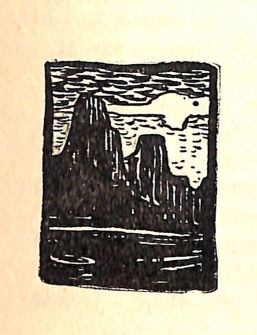
design
I asked what it meant.
"Man, if I knew that! I believe it's the key, and I can't master it! But we may as well sit down and be comfortable. If you would really care to hear the story from the beginning it will take the better part of an hour. I'll not give you all the details; but when I have finished you will be in a position to judge for yourself whether or not I was mad in coming here.
"Have you ever read Walker's book, Undiscovered Treasure? It doesn't matter, except that you have missed a very entertaining volume. It is a pity that old work is out of print. Nothing in it but bare facts about all sorts of treasure supposed to have been buried here and there about the world. You might think it would be dry, but I found it better company than any romance I've ever read. However, that has nothing to do with this story, except in an indirect way. I first read the book as a boy and it started me on my travels.
"To me the facts about this Pinaki treasure are as interesting as any of Walker's. He, of course, knew nothing about it, for it had not been stolen when his book was published. Four men had a hand in the business: a Spaniard named Alvarez; an Irishman named Killorain; and two others of uncertain nationality, Luke Barrett, whom I spoke of a moment ago, and Archer Brown. They were a thieving, murdering lot by all accounts—adventurers of the worst sort; and in hope of plunder, I suppose, had joined the Peruvian army during the war with Chile in eighteen fifty-nine to sixty. Their hopes were realized beyond all expectations. They got wind of some gold buried under the floor of a church, and the strange thing was that the gold was there and they found it. It was in thirty-kilo ingots, contained in seven chests, the whole lot worth in the neighborhood of three and a half million pounds. How they managed to get away with it I don't know; but I have investigated the business pretty thoroughly and I have every reason to believe that they did. They buried it again in the vicinity of Pisco, and then set out in search of a vessel. Alvarez was the only one of the four who had any education. They had all followed the sea at one time or another, but he alone knew how to navigate. The others could hardly write their own names. At Panama they signed on as members of the crew of a small schooner, and as soon as they had put to sea knocked the captain and the two other sailors in the head and chucked them overboard. They returned to Pisco, loaded the gold, and started for Paumotus.
"This was in the autumn of eighteen fifty-nine. In the December following they landed at Pinaki, where they buried the treasure. The island was uninhabited then as now, and they crossed to Nukatavake to learn the name of it. The natives were shy, but they persuaded one man to approach, and when they had the information they wanted, shot him and rowed out to their boat. If you should go to Nukatavake you will find two old men there who still remember the incident.
"Then they went to Australia, scuttled their vessel not far from Cooktown, and went ashore with a story of shipwreck. They had some of the gold with them—not much in proportion to the amount of the treasure, but enough to keep four ordinary men in comfort for the rest of their lives. It soon went, and the four were next heard of at the Palmer gold fields. Alvarez and Barrett were both supposed to have been killed there in a fight with some blacks. Brown and Killorain had not mended their ways to any extent, and both were finally jerked up for manslaughter and sentenced to twenty years' penal servitude. Brown died in prison, but Killorain served out his term, and finally died in Sydney hospital in nineteen twelve.
"Most of these facts—if they are facts—I had from Killorain himself the night before he died. I met him in a curious way; or, better, the meeting came as the result of a curious combination of circumstances. You may have noticed the scar on my side?"
I had noticed it, a broad gash puckered at the edges where the flesh had healed, tapering to a point in the middle of his back.
"It was not much of a wound," he went on, "but it gave me a deal of trouble at the time. I got it in New Guinea in nineteen eleven, when I was prospecting for gold in the back country. I was a long way from a settlement, and one day a nigger took it into his head to stick me with a spear. I suppose he wanted my gun and ammunition, for I had little else excepting my placer outfit. I let him have one bullet from my Colt just as he was about to dive into the bush, and for all I know he may be lying there to this day. I have that little frizzly headed native to thank for my knowledge of the Pinaki treasure. Sometimes I am sorry that I killed him; but at other times I feel that shooting was altogether too easy a death for the man really responsible for bringing me here. I was in a bad way from the wound. Infection set in, and I had to nurse myself somehow and get down to a place where I could have medical attention. I managed it, but the ten days' journey was a nightmare. I was nothing but skin and bone when I left the hospital, and New Guinea not being a likely place for a convalescent, the doctor recommended me to go to Australia.
"I had a small bag of dust, the result of a year and a half of heart-breaking work in the mountains. Most of it went for the hospital bill, and when I reached Sydney I had very little left. I was compelled to put up at the cheapest kind of a boarding house, although the woman who kept it was quite a decent sort. Her house was in a poor quarter of the town and her patrons mostly longshoremen and teamsters. It was a wretched life for her, but she had two children to support and was making the best of a bad job. I admired her pluck and did what I could in a small way to help her out.
"One evening I was waiting for supper in the kitchen when some one rapped. Before I could go to the door, it opened, and an old man came stumbling in, asking for something to eat. I thought he was drunk and was about to hustle him back the way he came when I noticed that he was wet through—it was a cold, rainy night—and really suffering from exposure and lack of food. I made him remove his coat—he had nothing on under it—but not without a great deal of trouble, and he insisted on drying it across his knees. He was a little wizened ape of an Irishman, about five feet three or four in height, with deep-set blue eyes, bushy eyebrows, a heavy, discolored mustache, and a thick shock of white hair—altogether the most frightful-looking little dwarf that ever escaped out of a picture book. He was tatooed all over the arms and chest—Hands Across the Sea, the Union Jack, a naked woman—several other designs common in waterfront tatooing parlors.
"His body was as shriveled as a withered apple, but his little bloodshot eyes blazed like bits of live coal. Except for the fire in them, he might have been a hundred years old and, as a matter of fact, he wasn't a great way from it. Eighty-seven, he told me, and that is about all he did tell me. He gorged some food and was all for getting away at once. But it had set in to rain very hard and I persuaded him to wait until the worst of it was over. He was very suspicious at first. I believe he expected me to call a policeman. Later he thawed a little, and became even talkative in a surly way when I told him, with the landlady's consent, that he might stay the night if he had no place else to go. Wouldn't hear of it, though. He said he had a job as night watchman at Rush-cutters' Bay. That might or might not have been true. At any rate, I went with him to the car line—the boarding house was a good mile from Rush-cutters' Bay—and gave him a couple of shillings, as a loan, I said. He could return it sometime. Just before I left him he asked for my name and address, mumbling something about doing me a bit of good one of these days. He was insistent, so I gave it to him, but not at all willingly. He had frightened Mrs. Sharpe, the landlady, just by the way he looked at her, and I didn't want him coming back.
"He didn't come back. That was in May, nineteen twelve, and I heard nothing more of him until September. I was still at the boarding house, getting slowly better, but not yet good for anything. I kept out of doors as much as possible, took long walks in the country and along the waterfront looking at ships. When I came in one evening Mrs. Sharpe told me that an attendant from the Sydney hospital had called twice during the day. An old man named Killorain, a patient at the hospital, wanted to see me. The name meant nothing to me and I couldn't imagine who the man could be. The attendant called again later in the evening. Killorain was about to die, he said, and wouldn't give them any peace until I was brought to see him.
"It was getting on toward midnight when we reached the hospital. The old man was in one of the public wards. I recognized him at once, although he had shriveled away to nothing at all. It was impossible to forget his eyes, once you had seen them. He was dying—no doubt of it, but I could see that he wasn't going to die until he was ready.
"'Sit down close here,' he said. 'I'm glad you came. You did me a good turn once and I haven't forgot it. Few good turns I've had in my life. Not so many but what I can remember the lot.' The night nurse had approached quietly and was standing on the other side of the bed. All at once he saw her. 'Hey, you!' he said. 'Grease off out of this! Stand over there on the other side of the room where I can watch you!' When she had gone he rose from his pillow and looked cautiously around the room. The beds on either side of him were empty. There was a patient in the one across the aisle, but he was sleeping. Killorain watched him for a moment to make sure of this. Then he motioned me with his finger to come still closer. 'Listen!' he said. 'I've cut more throats in my time than you might think.' Sounds a bit stagey, doesn't it? But these were his exact words. Nothing remarkable about them, of course. Throat-cutting is still a fairly thriving business. I waited for him to go on. He again looked up and down the room, and then asked me to hand him the coat which was lying across the foot of the bed. It was the same coat he had been wearing in May, when he came to the boarding house.
"'When they brought me here,' he said, 'they took my clothes, and I've had some trouble getting this back.' The attendant had told me as much. The old man had raised the very devil of a row until it was found. He asked me to rip open the lining of the right sleeve and to give him the paper I would find there. It was a soiled, greasy sheet of foolscap, pasted on a piece of cloth. 'Once,' he went on, 'you gave me two shillings for car fare to Rush-cutters' Bay. It probably wasn't any hardship on you, but never mind about that. You said I could pay it back if I'd a mind to. Well, I'm going to pay it back with a bit of interest. I'm going to give you this paper, and it's as good as three million pound notes of the Bank of England.'
"I thought, of course, that he was completely off his chump, and the fear that I would think so was uppermost in his mind. He kept repeating that he was old and worn out, but that his mind was clear. 'Don't you think I'm balmy,' he said. 'I know what I'm talking about as well as I know I'm going to die before morning.' He gave me a circumstantial account of the whole affair. I have outlined it briefly. There were many other interesting facts, but it is not worth while to speak of them here. As he talked, the conviction grew upon me that he was perfectly sane and was telling the truth. He went over the chart with me. It had been made by Alvarez, the scholar of the party, he said. There had been a good deal of quarreling and fighting later for the possession of it.
"Before I left him he made me promise that I would go to Pinaki. He wouldn't rest easy in his grave, he said, unless he knew that I was looking for the treasure. 'It's there, and it will always be there if you're bloody fool enough to think I'm queer. It ain't likely I'd lie to you on my deathbed.' Rest easy in his grave! There was an odd glimpse into his mind. He wasn't worrying about his crimes, and there were enough of them, according to his own confession. It was the thought of the gold lying forever forgotten which worried him. He could rest quietly if he knew before he died that some one else was fighting and throat-cutting over it. I asked him why he hadn't gone back for it himself. He told me that of the fifty-three years since it had been buried he had spent forty in prison and the rest of the time he was trying to earn or steal the money to buy a schooner. I told him that I would come back to see him the following day. 'You needn't bother,' he said. 'I'm finished.' And it was true. He died three hours later.
"I tried to forget the incident, but it was one of those things which refuse to be forgotten. It was always in the back of my head. I decided to check up Killorain's story where I could. I made inquiries in Peru, and found that the gold had actually been stolen. The dates and circumstances coincided with his account. A friend in the customs at Cooktown confirmed for me the story of four shipwrecked sailors who landed in February, eighteen sixty, from a ship called the Bosun Bird. I had a small piece of property on the outskirts of Cooktown which I had bought years ago. With the money realized from the sale of it I took passage for Tahiti on my way to Pinaki.
"That voyage was the longest one I have ever made. By that time the thought of those seven chests of gold, all in thirty-kilo ingots, was with me twenty-four hours out of the twenty-four. Yes, even at night. I slept very little, and when I did it was to dream of hunting for the treasure; of finding it. I became suspicious of a villainous-looking old man who was traveling third class. I thought he might be Brown or Luke Barrett. Perhaps they were not dead, after all. At Papeete I told no one of my purpose there, with the exception of one governmental official. If the treasure should be found the French government would have a claim to certain percentage on uncoined gold, and I meant to be aboveboard in my dealings with it. This official was sworn to secrecy, but the business leaked out eventually and created a great deal of excitement. I was immensely annoyed, of course, for I had guarded the secret as well as old Killorain ever had. However, I had in my pocket all the necessary papers, drawn up accurately, witnessed, signed, and sealed. I went on with my preparations, and finally, in February, nineteen thirteen, I was put ashore from a small cutter, not four hundred yards from where we are sitting.
"I started the search before the cutter was two miles on the return voyage. For two months I slept in the open—had no time to build a house—and ate tinned food which I had brought with me. Killorain's chart was of but little use. It made reference to trees which had long since rotted away or had been cut down by the natives of Nukatavake. The marks which I found corresponded precisely with those on the chart, but several of the most important ones were missing."
The treasure hunter rose. "Well," he said, "there's the end of the story. You know the rest of it."
"But I don't know the rest at all!" I said. "You have left out the most interesting part. Tell me something of your life here."
"You have seen three days of it. It has gone on for seven years in the same way."
"You were diving just now in the lagoon. Do you think the gold may have been buried there or that the land has fallen away?"
"My dear fellow, I'll not weary you with an account of what I think. It's rather warm here. Shall we go back to the house?"