Front matter (continued 4)
Reading edition
DINORNITHIDAE.
Skull with a short and wide beak. Pectoral girdle very small or absent, wing absent, only an indication in Dinornis dromioides. Hallux absent or present. An extension bridge to the tibio-tarsus, which is placed near the inner border of the bone. No superior notch to the sternum. Most of the species of very large size. The tarso-metatarsus is either long and slender or short and wide, and its anterior surface may or may not be grooved. The second trochlea is longer than the fourth, the third is not pedunculated, and there is no perforation in the groove between the third and fourth trochlea. In the tibio-tarsus the cnemial crest rises well above the head; the extensor groove is separated by a considerable interval from the inner border of the bone. There is a well-defined intercondylar tubercle; the intercondylar gorge is deep, and there is no deep pit on the lateral surface of the entocondyle. The femur may be either slender or stout, but is not markedly curved forwards. The popliteal depression is deep, and the summit of the great trochanter rises considerably above the level of the head. The pelvis approximates to that of the Apterygidae, but the pectineal process of the pubis is less developed, and the ischium and pubis may be longer and more slender. The coracoid and scapula are aborted and may be absent. The sternum, which may be either long and narrow, or broad and short, differs from that of the Apterygidae by the absence of the superior notch, the divergent lateral processes, and the reduction of the coracoidal grooves to small facets or their total disappearance. The cervical vertebrae are relatively short, an expanded neural platform as far as the sixth.
In Anomalopteryx and Megalapteryx the number of cervical vertebrae is 21, and there are 2 cervico-dorsal and 4 free dorsal vertebrae, so it is fair to assume that this is the correct number throughout the family.
The feathers had after-shafts.
THE GENERA ARE AS FOLLOWS:
Dinornis Owen. Palapteryx Owen, part. Palapteryx Hutton. Tylapteryx Hutton. Megalapteryx Haast. Anomalopteryx Lydekker, part. *Mesopteryx Hutton.
Cela Reichenbach. Dinornis Owen, part. Meionornis Haast. Anomalopteryx Lydekker. Mesopteryx Parker. Emeus Reichenbach. Euryapteryx Haast. Syornis Hutton. Dinornis Owen, part. Pachyornis Lydekker. Palapteryx Haast. Dinornis Owen, part. Euryapteryx Hutton. Palaeocasuarius Forbes. *Megalapteryx Forbes, part. Anomalopteryx Reichenbach. Meionornis Haast. Dinornis Owen, part.
I have adopted Professor Parker's classification in the genera, only substituting Cela Reichenbach for Mesapteryx Hutton, which is a synonym of Megalapteryx Haast. As to the species I have used my own judgment; I felt obliged to name a number of species acknowledged by Parker and Lydekker but not named, because this system of indicating species by the letters A, B, C, &c., which has crept into our nomenclature, will make all understanding impossible, as not always the same species is denoted by the same letter. A few of these species will naturally later have to be sunk, as some have been founded on skulls and others on leg bones, or so, which, when we get perfect individual skeletons may prove to be identical, but I do not think these will be many.
Besides a number of imperfect eggs, particulars of which will be found in Dr. A. B. Meyer's article in the Ibis, 1903, pp. 188-196, there are known two perfect Moa eggs and one almost perfect one.
1. Otago Museum. Molyneux River, 1901. Pachyornis pondorosus.
2. Tring Museum. Molyneux River, 1901. Megalapteryx huttoni.
3. Rowley Collection. South Island, 1859. Dinornis novaezealandiae.
DINORNIS.
The skull is broad and much depressed, with a comparatively wide, somewhat pointed and deflected beak. Breadth at the squamosals twice the height at basi-temporal. It has a flattened frontal region, and a wide median ridge on the upper surface of the praemaxillae. The mandible is in the form of a narrow U, with the angle much inflected, no distinct anticular process, and the symphysis moderately wide, narrowing anteriorly, with a prominent and broad inferior ridge, widest in front. The quadrate is elongated, with a very large pneumatic foramen. The sternum is nearly as long as broad, very convex, with distinct coracoidal facets, 3 costal articulations, very small and reflected costal processes, the lateral processes very broad and widely divergent, and a wide xiphisternal notch. The pelvis is narrow with a high ilium, in which the inferior border of the postacetabular portion is flat, and does not descend as a sharp ridge below the level of the anterior postacetabular vertebrae. The pubis has a small pectineal process; and the ventral aspect of the true and postacetabular vertebrae is very broad and much flattened.
The distal extremity of the tibio-tarsus is not inflected. A hallux is present in some species. The tibio-tarsus and tarso-metatarsus are long and slender, the length of the latter equalling and more often exceeding the length of the femur, and also exceeding half the length of the tibio-tarsus. The femur is comparatively long and slender, with a short neck, the head rising but slightly and projecting only a small distance, the linear aspera in the form of a long irregular line, the outer side of the distal extremity moderately expanded, the popliteal depression small, deep, and sharply defined, the profile of the inner condyle semi-ovoid and narrow, and the interior trochlear surface nearly flat. The phalangeals of the pes are long and comparatively slender, the proximal surface of the terminal segments not being trefoil-shaped. In the vertebral column the middle cervicals are long and narrow, with the postzygapophyses directed much outwardly and separated by a very deep channel, and the posterior face of the centrum low and wide. The dorsals have short transverse processes and neural spine, the anterior and middle ones (those with a haemal spine or carina) having a large anterior pneumatic foramen between the nib-facet, the foramen being triangular in shape. All the species of this genus are of comparatively large size, and include the tallest members of the family.
Type of the genus: Dinornis novaezealandiae (Owen).
Number of species: 7.
DINORNIS MAXIMUS OWEN.
Dinornis maximus Owen, Trans. Zool. Soc. VI. p. 497 (1868).
D. excelsus Hutton, Trans. N.Z. Inst. XXIV. p. 110 (1892).
D. giganteus Haast, Trans. N.Z. Inst. I p. 88, No. 20 part.
This is the largest species of Moa, the tibio-tarsus being from 37.5 to 39.2 inches in length, while that of the largest D. giganteus does not exceed 35 inches, but by far the largest number of the latter are considerably shorter.
The type bones were obtained in Glenmark Swamp, Middle Island of New Zealand, and were sent to Professor Owen by Major J. Michael of the Madras Staff Corps. Casts of these bones are in the British Museum, No. A 161 in the Palaeontological Department.
This bird was the tallest of all known birds, though it must have been considerably exceeded in bulk by Aepyornis ingens and Aepyornis titan of Madagascar.
Locality: Glenmark Swamp, Middle Island, New Zealand.
DINORNIS ALTUS OWEN.
Dinornis maximus Owen, Ext. Birds N.Z. p. 253 (Dr. Lillie's specimen) (1879).
D. altus Owen, Ext. Birds N.Z. (1879) p. 361.
D. giganteus var maximus Owen, Trans. Zool. Soc. VI p. 497 (1868).
Only known by a tarso-metatarsus, femur and tibio-tarsus from the Middle Island, New Zealand. The bones at once noticeable by their great length, and are more slender than the same bones in D. maximus. This form must therefore, till further material comes to hand, be treated as a separate species.
Locality: Middle Island, New Zealand. Collected by Dr. Lillie.
DINORNIS GIGANTEUS OWEN.
Dinornis giganteus Owen, Trans. Zool. Soc. III p. 237 (1843) and p. 307 (1846).
Moa giganteus Reichenbach, Nat. Syst. der Vög. p. XXX (1850).
Dinornis maximus (non D. maximus Owen of 1867!) Trans. Zool. Soc. X p. 147 (1877).
D. validus Hutton, Trans. N.Z. Inst. p. 111 (1892).
This is, as regards size, one of the more variable forms in the tarso-metatarsus, while the tibio-tarsus is remarkably constant. The tibio-tarsus is almost invariably 35 inches in length, while the tarso-metatarsus varies from 17.5 to 19 inches in length.
The type of D. giganteus Owen is from Poverty Bay; the type of D. validus is from Glenmark.
Habitat: North and Middle Islands, New Zealand.
Portion of skeleton in Tring Museum, from Kopua Swamps, Canterbury, New Zealand.
DINORNIS INGENS OWEN.
(Plate 42.)
Dinornis ingens Owen, Trans. Zool. Soc. III p. 237 (1843).
Movia ingens Reichenbach, Nat. Syst. der Vög. p. xxx (1850).
D. ingens var. robustus Owen, Trans. Zool. Soc. III p. 307 (1846).
Palapteryx robustus Owen, Trans. Zool. Soc. III p. 345 (1848).
D. firmus Hutton, Trans. N.Z. Inst. XXIV p. 114 (1892).
D. potens Hutton, l.c. p. 115.
D. ingens shows considerable variation in size, but the inter-gradation is so complete that it seems impossible to retain the four species ingens, firmus, potens and robustus, which Captain Hutton admits. This form was widely distributed over the North and Middle Islands. The type skull of P. robustus came from Timaru, the type of firmus from Wanganui, that of ingens from Poverty Bay, while that of potens is quoted from the East side of Middle Island, without specific type locality.
Habitat: North and Middle Islands.
The plate of this species was reconstructed by Mr. Frohawk from the skeleton and feathers in my museum, and the feathers found with the skeleton now in the York Museum. The only criticism that might be made in connection with this picture is that the feathers are drawn a little too much like those of Apteryx australis, but this is not of any consequence, as the Moa feathers in the Tring Museum and elsewhere vary considerably in appearance, though being more or less coloured like Apteryx feathers.
There is an almost perfect skeleton in the Tring Museum.
DINORNIS GRACILIS OWEN.
Dinornis gracilis Owen, Trans. Zool. Soc. IV (1855) p. 141.
D. torosus Hutton, Trans. N.Z. Inst. XXIV p. 117 (1892).
If we acknowledge that D. novaezealandiae occurs both on the North and Middle Islands, then I feel sure that the distinctness of D. gracilis and D. torosus cannot be maintained, as the measurements intergrade completely.
The type of D. gracilis came from Wanganui, while that of D. torosus is a nearly perfect skeleton found in a cave at Takaka, near Nelson.
Habitat: New Zealand.
There is an imperfect skeleton in the Tring Museum, from a limestone cave at Takaka, near Motueka, Province of Nelson, New Zealand.
DINORNIS DROMIOIDES OWEN.
Dinornis dromioides Owen, Trans. Zool. Soc. III. p. 235 (1843).
Palapteryx dromioides Reichenbach, Nat. Syst. der Vög. p. XXX (1850).
Palapteryx plenus Hutton, Trans. N.Z. Inst. XXIV p. 122 (1892).
This form also inhabited both islands, but was probably one of the rarest. The type of D. dromioides came from Poverty Bay, and that of P. plenus from Glenmark.
Habitat: New Zealand.
DINORNIS NOVAEZEALANDIAE OWEN.
Dinornis novaezealandiae Owen, P.Z.S. (1843) p. 8.
D. struthioides Owen, Trans. Zool. Soc. III p. 244 (1844).
D. strennus Hutton, Trans. N.Z. Inst. XXV p. 8 (1893).
Professor Owen changed the name of this form, but we cannot accept this change, as it is against the laws of nomenclatorial priority, though we all appreciate the motive the Professor had in making this change. The type came from Poverty Bay, but the bird inhabits both islands.
This species had wings.
Habitat: New Zealand.
A nearly perfect skeleton in the Tring Museum from Waitomo district, Auckland, New Zealand.
MEGALAPTERYX HAAST.
Originally distinguished by Haast from the Dinornithidae as an ancient form of the Apterygidae, but afterwards united by Lydekker with the Dinornithidae. Mr. Lydekker's diagnosis of the genus is as follows:—
"Distinguished from Dinornis by the extreme slenderness and length of the femur and tibio-tarsus, and the relatively shorter tarso-metatarsus, of which latter the length is considerably shorter than that of the femur. The pelvis is much narrower than in Dinornis, with the ventral surface of the postacetabular sacrals ridged and narrower, and a more developed pectineal process to the pubis. The femur is markedly curved forwards, with the distal extremity moderately expanded, the popliteal depression larger and less defined, the linea aspera narrower and sharper, and a more distinct anterior intermuscular ridge."
The following additional diagnostic characters are taken from Mr. Charles W. Andrews' description of the complete skeleton of Megalapteryx tenuipes in the Tring Museum (Nov. Zool. IV, pp. 188-194, fig. 1-2 in text and pl. VI):—
Width of cranium at paroccipital processes less than half the length of the basis cranii. Length of premaxilla less than two-and-a-half times that of the basis cranii. Body of the premaxilla pointed and slightly decurved; its length and breadth less than the basis cranii. The occipital plane slightly declined backwards. Occipital condyle projecting slightly beyond the paroccipital processes. Anterior and posterior lambdoidal ridges separated by a very narrow interval in their middle region only. Width at squamosals slightly more than double the length of the basis cranii. Mammillary tuberosities not very prominent. Margin of tympanic cavity evenly curved. Temporal fossae very large. The distance between the temporal ridges about four-fifths the width of the cranium at the fossae. The posterior temporal ridge confluent with the lambdoidal ridge. Post-temporal fossae very large.
The inferior temporal ridge is strongly marked, and there is a pretympanic process. The zygomatic process is well developed. Rostrum dilated towards its anterior end, compressed and carinate beneath the large presphenoid fossae. Mandible very slender. Posterior angular process small. Sternum very convex, and with a very nearly straight anterior border between the tuberosities for the coracoscapular ligaments. Costal processes short but large, with distinct coracoidal facets. The lateral processes are long and distally expanded. The sternum is just as wide as it is long. There are three costal articulations. The most notable character is the enormous length of the toes, the middle one being longer than the tarso-metatarsus. The ungual phalanges are peculiarly long, narrow and curved, instead of being comparatively short and broad, as in most other Moas.
Type of the genus Megalapteryx hectori, Haast.
Number of species 4.
MEGALAPTERYX HECTORI HAAST.
Megalapteryx hectori Haast, Trans. Zool. Soc. XII, p. 161 (1886); Lydekker, Cat. Fossil B. Brit. Mus., p. 252.
This form was described by Sir Julius von Haast as a gigantic Apteryx. This error arose from the absence of the skull. There is, however, no doubt now, since the skulls of Megalapteryx are known, that although sufficiently aberrant to form a distinct sub-family, the birds included in this genus are Dinornithidae and not Apterygidae.
Habitat: Middle Island, New Zealand.
MEGALAPTERYX HAMILTONI SPEC. NOV.
Lydekker, Cat. Fossil Birds in Brit. Mus., p. 252, under M. tenuipes (1891).
The type is a left femur, No. 32145 in the British Museum. It is smaller and relatively narrower than the femur, of either M. hectori or M. tenuipes. This is most noticeable at the distal extremity.
Habitat: North Island, New Zealand. (Type locality Waingongoro.)
Named after Mr. A. Hamilton, who did so much in discovering deposits of extinct New Zealand birds.
MEGALAPTERYX TENUIPES LYD.
Megalapteryx tenuipes Lydekker, Cat. Foss. Birds Brit. Mus. p. 251 (1891).
This species was described from the tibio-tarsus, which is longer and relatively more slender than in M. hectori. Its distal width is about one-ninth of its length, while in M. hectori it is about one-seventh. The length of the tibio-tarsus is approximately 0.405 mm. = 16 inches, and width of distal extremity about 0.044 = 1.74 inches. Type specimens Nos. 49989 and 49990, British Museum.
Habitat: Middle Island, New Zealand, and perhaps North Island. (Type locality Lake Wakatipa, Queenstown, Otago.)
Complete skeleton in the Tring Museum.
Mr. Lydekker mentions also a right femur from the North Island, of the same proportions as those of M. tenuipes and 0.255 m. (= 10.1 inches) long. It may probably belong to a different form, as we know M. tenuipes otherwise only from the Middle Island.
MEGALAPTERYX HUTTONII (OWEN).
(Plate 41.)
Dinornis huttonii Owen, Ext. Birds, N.Z., p. 430 (1879).
Dinornis didinus Owen, Trans. Zool. Soc. XI, p. 257 (1883).
D. didiformis Haast, (non Owen 1844) Trans. N.Z. Inst. I, p. 83, Nos. 5 & 6 (1869).
Mesopteryx didinus Hutton, Trans. N.Z. Inst. XXIV, p. 129 (1892).
The synonymy of this form is somewhat confused, but I think it is clear that huttonii of Owen is its proper name. Professor Owen (Ext. B. p. 430) says:
"In the collection from the Glenmark Swamp, South Island, are bones that scarcely differ, save in size, from the dimensions (? W.R.) of the type bones of Dinornis didiformis from the North Island. They are noted as of a large variety of that species." Captain Hutton remarks: "The bones that I have arranged under the name D. didiformis belong probably to a new species. The tibia is well marked and quite distinct, but the femur and metatarsus, that I have associated with it, pass almost into D. casuarinus, but are rather smaller. D. casuarinus is undoubtedly a good species, easily distinguished by its tibia." Possibly the Dinornis of the South Island, with the tibia characteristic of D. didiformis of the North Island, may need to be noted for the convenience of naming the bones as Dinornis huttonii.
When describing his D. didinus, Professor Owen failed to recognise its identity with his previously named D. huttonii, doubtless owing to the leg bones being hidden by the dry integument. This being the case, it is necessary to reinstate the name huttonii, as it has four years' priority over didinus.
Captain Hutton says that a few bones of this form have been obtained in the North Island at Poverty Bay and Te Aute; but I am convinced he is in error and that these bones are aberrant individual bones of A. didiformis and that M. huttonii is confined to the South or rather Middle Island. The plate of this species has been reconstructed by Mr. Lodge from the mummified remains which form the type specimen of Didornis didinus, and the feathers found in the alluvial sands of the Clutha River. The type of Dinornis didinus was found at Queenstown by Mr. Squires.
Habitat: Middle Island, New Zealand.
Mr. C. W. Andrews, in his description of my complete skeleton of Megalapteryx tenuipes has shown that Owen's type specimens of his Dinornis didinus are certainly of a species of the genus Megalapteryx, and closely allied to M. tenuipes. Mr. Andrews, however, throws some doubt as to whether the pelvis and femora, referred to this species by Hutton, really belong to it.
A complete egg which I consider must be of this species is preserved in the Tring Museum. Its measurements are as follows:—
Large circumference, 21.4 inches = 535 mm.
Small " 17.5 " = 437.5 mm.
This egg was dredged up on the Molyneux River, near Otago, during gold dredging operations in 1901; a second perfect egg was dredged up a few months before in the same river, and was referred by Dr. Benham to Pachyornis ponderosus.
ANOMALOPTERYX REICHENBACH.
The skull is narrow and vaulted, with a long, sharp and slightly deflected beak. Breadth at the squamosals 1½ times the height at basi-temporal, which has a constricted praemaxillary ridge, and the quadrate with a very small pneumatic foramen. The mandible is V-shaped, with a slight inflection of the angle, and a distinct postarticular process. The symphysis is very narrow and pointed, with a long and narrow inferior ridge, not expanding markedly at either extremity. The sternum is longer, flatter and narrower than in Dinornis, having no distinct xiphisternal notch, three costal articulations, long and narrow costal processes, slender lateral processes which are often elongated, and usually no coracoidal facets. The pelvis is wider and lower than in Dinornis, with the lower border of the postacetabular portion of the ilium descending as a sharp ridge much below the level of the sacral ribs, and without any distinct pectineal process. A hallux is present. The tibio-tarsus and tarso-metatarsus are relatively shorter and stouter than in Dinornis, the latter being shorter than the femur, which is usually stouter and relatively shorter than in Megalapteryx. The length of the tarso-metatarsus is less than half that of the tibio-tarsus. The femur, besides being usually relatively shorter is readily distinguished from that of Dinornis by its more expanded extremities, the rather longer neck, and the much larger and ill-defined popliteal depression.
The vertebrae are of the general type of those of Pachyornis, but the anterior pneumatic foramen commences in the third dorsal. The phalangeals are intermediate between those of Dinornis and Pachyornis. Haast considered that the coracoid was aborted and often absent in this genus, in Emeus, and Pachyornis. As additional characters of the skull it may be mentioned that there is a prominent supra-occipital protuberance, and a depression on the squamosal above the quadrate; the par-occipital processes are pointed, and the basi-occipital processes only slightly prominent; so that the posterior profile of the basi-occipital is nearly straight. The quadrate has a very short anterior process.
All the species of the genus are small, in fact parvus is the smallest but one of the family.
Type of the genus: Anomalopteryx didiformis (Owen).
Number of species: 4.
ANOMALOPTERYX DIDIFORMIS (OWEN.)
Dinornis didiformis Owen, Trans. Zool. Soc. III, p. 242 (1844).
Anomalopteryx didiformis Reichenbach, Nat. Syst. der Vög. p. 30 (1850).
A. didiformis Lydekker, Cat. Fossil B. Brit. Mus., p. 275.
The present form is confined to the North Island. Owen's type was collected by the Revd. Wm. Williams, and came from Poverty Bay.
Habitat: North Island, New Zealand.
Portion of skeleton in Tring Museum.
ANOMALOPTERYX PARVUS (OWEN.)
Dinornis parvus Owen, Trans. Zool. Soc. XI, pp. 233-256, pls. LI-LVII (1883).
Anomalopteryx didiformis Hutton, Trans. N.Z. Inst. XXIV, p. 123 (1892), part.
A. parva Lydekker, t.c., p. 278.
This small form is confined to the Middle Island. The type, a skeleton in almost complete condition, was dug up in a cave at Takaka, near Nelson, and is now in the British Museum. A much less perfect skeleton is in my museum at Tring.
Habitat: Middle Island, New Zealand.
ANOMALOPTERYX ANTIQUUS HUTT.
Avian Remains Forbes, Trans. N.Z. Inst. XXIII, p. 369 (1891).
Anomalopteryx antiquus Hutton, Trans. N.Z. Inst. XXIV, p. 124 (1892).
A. antiquus was named by Captain Hutton from the photographs of bones described by Dr. Forbes in the above-quoted article. The evidence is very slight on which to found a species, but I prefer to treat it as one, for the bones were discovered in the Upper Miocene, a much older stratum than most remains of Dinornithidae occur in.
Locality: Timaru, Middle Island, New Zealand.
ANOMALOPTERYX FORTIS HUTT.
Anomalopteryx fortis Hutton, Trans. N.Z. Inst. XXV, p. 9 (1893).
This is the largest of the genus, and the type bones came from Glenmark. I append comparative table of Measurements:
Tarso-metatarsus. Tibio-tarsus. Femur.
A. fortis 8.0 inches. 17.5 inches. 9.8 inches.
A. didiformis 6.3 inc" 13.3 inc" 8.0 inc"
A. parvus 6.3 inc" 13.7 inc" 8.5 inc"
Locality of Type: Glenmark.
Habitat: Middle Island, New Zealand.
CELA REICHENBACH.
Skull convex, the temporal fossae very large. Breadth at the squamosals 1.6-1.7 times the height at the basi-temporal. Length from the supra-occipital to the nasals rather less than the breadth at the squamosals. Occipital condyle hidden by the supra-occipital. Ridge between temporal fossae and supra-occipital narrow. Beak short, slightly compressed and rounded at the tip, though more pointed than in Anomalopteryx. Lower mandible nearly straight and rather slighter than in Anomalopteryx, V-shaped. Sternum with coracoid pits faintly indicated or absent; length less than breadth. Costal processes well developed, lateral processes diverging at different angles.
Pelvis broader in proportion than in Dinornis, the acetabula set more forward. Tarso-metatarsus shorter than the femur, and less than half the length of the tibio-tarsus. Hallux present in some species. The smallest species of Moa is Cela curtus.
Type of the genus: Cela curtus.
Number of species: 5.
CELA CURTUS (OWEN.)
Dinornis curtus Owen, Trans. Zool. Soc. III, p. 325 (1846).
Cela curtus Reichenbach, Nat. Syst. der Vög. p. 30 (1850).
Cela curta Hutton, Trans. N.Z. Inst. XXIX, p. 550, pl. XLVII, Fig. B.
This and the following are the two smallest species of Moa, having been about the size of a large turkey. It also is the most abundant species at Whangarei, and appears to have been most common in the North of the Island. The type is from Poverty Bay.
Habitat: North Island, New Zealand.
CELA OWENI (HAAST).
Dinornis oweni Haast, Trans. Zool. Soc. XII, p. 171, pl. XXXI, XXXII (1886).
Cela curtus Hutton, Trans. N.Z. Inst., XXIV, p. 127 (1892), portion.
Dr. von Haast (Sir Julius von Haast) took as his type of Dinornis oweni the almost complete skeleton collected by Mr. Cheeseman in a cave at Patana, Whangarei, and now in the Auckland Museum. While referring my readers to the original diagnosis for the specific characters, I wish to specially draw attention to the fact that Dr. von Haast says that in the collections he examined, made by Mr. Thorne and Mr. Cheeseman, there are bones belonging to at least 20 skeletons of his D. oweni, and that some were even smaller than the type, and the only difference was the constant average difference due to sex. I draw special notice to this, as Captain Hutton has united this form with curtus, saying Haast's type is only a small individual of that species. The fact of bones of at least 20 different individuals, showing the same characters and the same differences from curtus, is quite sufficient evidence for me to consider Dr. von Haast's D. oweni as a distinct species. I append measurements of the leg bones of the types of Cela curtus and C. oweni:—
Tarso-metatarsus. Tibio-tarsus. Femur.
Cela curtus 5.0 inches 11.25 inches 5.65 inches
Cela oweni 4.4 inc" 09.6 inc" 6.5 0inc"
Locality: Whangarei.
Habitat: North Island, New Zealand.
CELA GERANOIDES (OWEN.)
Palapteryx geranoides Owen, Trans. Zool. Soc. III, p. 345 (1848).
Cela geranoides Hutton, Trans. N.Z. Inst. XXIV, p. 126 (1892).
This species is confined to the North Island. The type came from Waingongoro. It is most commonly found in the South of the Island.
Habitat: North Island, New Zealand.
CELA RHEIDES (OWEN).
Dinornis rheides Owen, Trans. Zool. Soc. IV, p. 8 (1850—partim).
Syornis rheides Hutton, Trans. N.Z. Inst. XXIV, p. 131 (1892).
This is a very difficult form to consider, as the type bones consisted of those of three different forms. Whether Professor Owen, were he now alive, would concur in Captain Hutton's treatment is very questionable, and I doubt if it ought not to be united to Emeus crassus, while Haast united it to P. gravis. I have kept it separate as no bones of a single individual united are known, and it might prove sufficiently distinct if a good skeleton were obtained. The type bones were sent from Waikawaite, Middle Island, by Colonel Wakefield, in 1849.
Habitat: Middle Island, New Zealand.
CELA CASUARINUS (OWEN).
Dinornis casuarinus Owen, Trans. Zool. Soc. III, p. 307 (1846).
Syornis casuarinus Reichenbach, Nat. Syst. der Vög, p. XXX (1850).
Meionornis casuarinus Haast, Trans. N.Z. Inst., VII, pp. 54-91 (1875).
Syornis casuarinus Hutton, Trans. N.Z. Inst., XXIV, p. 133 (1892).
C. casuarinus is found in both Islands, and is abundant in the Middle Island.
The type came from Waikowaiti.
Habitat: New Zealand.
Portions of one skeleton and two almost complete skeletons in Tring Museum; one of the latter from Kapua Swamps.
EMEUS REICHENBACH.
The skull is very short and wide, with a blunt and slightly deflected rostrum, and a very small pneumatic foramen to the quadrate. The mandible is in the shape of a wide U, with a slightly inflected angle, and a large post-articular process. The symphysis is very wide and deeply excavated, with a broad and slightly prominent inferior ridge narrowing in front. The sternum resembles that of Anomalopteryx, but the pelvis is much wider and approaches that of Pachyornis. The tibio-tarsus and tarso-metatarsus are relatively shorter and thicker than in Anomalopteryx, but less stout than in Pachyornis; the distal extremity of the tibio-tarsus is not inflected. A hallux is present. The length of the tarso-metatarsus is considerably less than that of the femur, and than half that of the tibio-tarsus, its width at the middle of the shaft being rather more than one-fourth of its length.
The vertebrae are of the type of Anomalopteryx. The species are larger than most of those of Cela and Anomalopteryx. Additional cranial characters are that the skull usually has very broad and blunt paroccipital processes; there is no distinct supraoccipital prominence, and no well-marked depression upon the frontal aspect of the squamosal above the head of the quadrate. The basi-occipital tubercles are prominent, and give an arched posterior profile to this bone. The quadrate is elongated with a long anterior bar; the cavity of the squamosal for the reception of its head is inclined much more outwardly than in either of the other genera.
Type of genus: Emeus crassus (Owen).
Number of species: 6.
EMEUS CRASSUS (OWEN).
Dinornis crassus Owen, Trans. Zool. Soc. III, p. 307 (1846—partim).
Emeus crassus Reichenbach, Nat. Syst. der Vög., p. XXX (1850).
Syornis crassus Hutton, Trans. N.Z. Inst. XXIV, p. 132 (1892).
This species has led to much confusion, owing to Professor Owen having associated with the real portions of crassus in his possession bones of elephantopus, ponderosus and struthioides. The type came from Waikouaiti.
Habitat: Middle Island, New Zealand.
Imperfect skeleton in Tring Museum.
EMEUS BOOTHI NOM. NOV.
Emeus, Species Α, Parker, Trans. Zool. Soc. XIII, p. 379 (1895), pl. XVI.
Easily distinguished by the shorter and narrower beak. Type specimen—the skull found by Mr. R. S. Booth at Stag Point—now in Otago University Museum, figured as above.
Habitat: Middle Island, New Zealand.
EMEUS GRAVIPES LYD.
Emeus gravipes Lydekker, Cat. Foss. Birds Brit. Mus., p. 298 (1891) Nos. A95, on p. 299, to 47444d, on p. 300.
Dinornis gravis (portion) Owen, Trans. Zool. Soc. VIII, p. 361 (1872).
Euryapteryx gravis Haast, Ibis 1874, p. 213.
The present species is smaller than E. crassus and has the tarso-metatarsus relatively wider. Length, 198 mm. = 7.8 inches; width at middle of shaft, 51 mm. = 2 inches.
Habitat: Middle Island, New Zealand.
EMEUS HAASTI NOM. NOV.
Emeus species Β, Parker, Trans. Zool. Soc. XIII p. 379 (1895).
Emeus gravipes Lydekker, Cat. Foss. Birds Brit. Mus. p. 301 Nos. 32017, 32016, a-e and c to 32044 e on p. 307 (1891).
Sir J. von Haast united this form with Dinornis gravis, and the skull which is the type of E. haasti is put on a skeleton of D. gravis in the Canterbury Museum. The measurements of this species are much smaller than those of the other species.
Habitat: Middle Island, New Zealand.
EMEUS PARKERI NOM. NOV.
Emeus species Γ, Parker, Trans. Zool. Soc. XIII, p. 380 (1895).
This species is at once distinguished from the other species of the genus by having right-angled orbits. The type is a skull from Hamilton Swamp, named Euryapteryx gravis, by Prof. Hutton, in the Otago Museum.
Habitat: Middle Island, New Zealand.
EMEUS EXILIS (HUTT.)
Dinornis didiformis Owen, Trans. Zool. Soc. III, pl. 24 (1846), part.
Euryapteryx exilis Hutton, Trans. N.Z. Inst. XXIX, p. 552, pl. XLVIII, Fig. C (1897).
Differs from E. crassus in the tibia being more convex on the anterior surface. The skull, among other differences, has a very slight frontal rising to the cranial roof, as opposed to the very conspicuous one in the remaining species. The type is a nearly complete skeleton in the Wanganui Museum. For full description see Hutton, l.c.
Habitat: North Island, New Zealand.
PACHYORNIS LYDEKKER.
The skull is either vaulted or flattened, with a sharp and narrow beak. The paroccipital processes are shorter and more rounded, and the basi-occipital tubercles more prominent than in Anomalopteryx, while the quadrate and mandible resemble the same bones in that genus somewhat closely. The sternum is flat and very broad and short, with no coracoidal facets, a very small xiphisternal notch, broad and short costal processes, and widely divergent lateral processes; while there are only two costal articulations. The pelvis is extremely low and wide, with the anterior wall of the acetabulum very deeply concave, the ventral surface of all the vertebrae behind the true sacrals narrow and convex, and from which the very broad sacral ribs ascend to join the ilium, of which the inferior postacetabular border is very sharp, and descends far below the level of the ribs. There is no pectineal process to the pubis. The tibio-tarsus is very short, with the shaft curved outwards, the distal extremity markedly inflected, and the fibular ridge much shorter than in the other genera. The fibular border below the smooth space at the distal extremity of the fibular ridge is extremely rough; and the distal extensor tubercle is very prominent, being situated partly on the line of the upper half of the extensor groove, instead of being altogether external to the same.
The tarso-metatarsus is still shorter and wider than in Emeus, the width at the middle of the shaft being usually rather more than one third of the length. The third trochlea is more prominent than in the other genera, and rises very abruptly from the shaft, the outer border of the anterior surface usually expanding suddenly at the proximal extremity, and the outer ridge of this surface being always more prominent than the inner, whereas in the other genera the opposite condition obtains. The femur, as compared with that of Dinornis, is very much shorter and thicker, with a longer neck, and the head rising and projecting very considerably, the linea aspera mainly forming a rough nodule near the distal end of the shaft, the outer surface of the distal extremity more suddenly expanded, and the popliteal depression larger, more open, and leading to the inner surface of the shaft by a more distinct channel. The profile of the inner condyle is wider antero-posteriorly, and more rounded, the anterior intertrochlear surface being deeply channelled.
The phalangeals of the pes are much shorter and stouter than in Dinornis, the proximal surface of the terminal segments generally presenting a trefoil-shaped contour. The length of the tarso-metatarsus is very much less than half that of the tibio-tarsus. In the vertebral column the cervicals are short with very stout centra, the prezygopophyses in the middle region being nearly horizontal and separated from one another by a wide channel. The posterior face of the centra is tall and narrow, and the neural spines of the last two vertebrae much inclined forward. In the dorsals there is usually no anterior pneumatic foramen till the fourth (or the last with a distinct haemal carina), this foramen being situated on the line of the anterior border of the rib-facet. The third and fourth dorsals are extremely compressed. Throughout the series also the neural spines and transverse processes are comparatively long. Additional characters of the skull are that the sphenoidal rostrum is expanded in a lance-like shape at the anterior extremity, in a manner unlike that of any of the other genera.
Then the supraoccipital never has a very strongly developed median prominence, and the temporal fossae are comparatively short. The mandible may be readily distinguished from that of the other genera by the low position of the inner aperture of the dental canal, which pierces the bone obliquely to join the small lateral vacuity.
Type of the genus: Pachyornis elephantopus (Owen).
Number of species: 8.
PACHYORNIS ELEPHANTOPUS (OWEN.)
Dinornis elephantopus Owen, Trans. Zool. Soc. IV, p. 149 (1853).
Palapteryx elephantopus Haast, Ibis, Ser. 3, vol. IV, p. 212 (1874).
Euryapteryx elephantopus Hutton, Trans. N.Z. Inst. XXIV, p. 135 (1892).
Until Mr. Lydekker described Pachyornis immanis, and Mr. Andrews Aepyornis titan, this was undoubtedly the most bulky and ponderous of all known Ratitae, extinct and living.
Type: Awamoa, near Oamanu.
Habitat: Middle Island, New Zealand.
Two imperfect skeletons in the Tring Museum; one from Kapua Swamps.
PACHYORNIS IMMANIS LYD.
Pachyornis immanis Lydekker, Cat. Foss. Birds Brit. Mus., p. 343 (1891).
This is the most bulky and largest member of the genus, and also of all Dinornithidae. Its living parallel to-day is Casuarius philipi Rothschild, which, though by no means the tallest species of Casuarius, is the most bulky, and has the shortest and stoutest legs—the tarso-metatarsus is specially short and stout.
The type tarso-metatarsus measures 228 mm. = 8.9 inches, and in width (shaft) 84 mm. = 3.3 inches, while the type tarso-metatarsus of elephantopus measures 239 mm. = 9.4 inches and 65 mm. = 2.55 inches.
The skull is much more depressed than in elephantopus and with deeper temporal fossae and a shorter post orbital region.
Type: No. A168 British Museum.
Habitat: Middle Island, New Zealand.
PACHYORNIS ROTHSCHILDI LYD.
Pachyornis rothschildi Lydekker, P.Z.S. 1891, pp. 479-482, pl. XXXVIII.
The bones in the Tring Museum, which form the type of this species, unfortunately have no history and their locality is unknown. It differs from the other species of the genus by the slenderer proportions of the tibio-tarsus, which is 22 inches long by 2.9 inches distal width, as opposed to 24 inches by 4.2 in elephantopus and 20 inches by 3.5 in ponderosus, the two nearest in size. Femur: length 10.6 as opposed to 12.5 inches in elephantopus.
PACHYORNIS PONDEROSUS (HUTT.)
Euryapteryx ponderosus Hutton, Trans. N.Z. Inst., p. 137 (1892).
This species is slightly smaller than P. elephantopus, the tarso-metatarsus varying from 8.25 to 8.0 inches, as opposed to from 9.4 to 9.25 in elephantopus; the tibio-tarsus varies from 18.5 to 18.6, as opposed to 24 to 24.1; femur, 10, as opposed to 13 to 11.8.
The skull can be distinguished by the processes at the hinder angles of the basi-sphenoid, which are higher and rounder in ponderosus, flatter and more elongated in elephantopus. Type: Hamilton.
Habitat: Middle Island, New Zealand.
Cast of egg in Tring Museum, taken from specimen in Otago Museum, dredged up in 1901 in the Molyneux River, also incomplete skeleton from Kapua Swamps.
PACHYORNIS INHABILIS HUTT.
Pachyornis inhabilis Hutton, Trans. N.Z. Inst. XXV, p. 11 (1893).
Differs from ponderosus by having the great inward expansion at the distal end of the tibio-tarsus. This expansion has induced some ornithologists to separate the species of Pachyornis into two genera—Euryapteryx and Pachyornis—but I do not think this expansion of sufficient importance to warrant generic separation.
Habitat: Middle Island, New Zealand.
PACHYORNIS VALGUS (HUTT.)
Euryapteryx valgus Hutton, Trans. N.Z. Inst. XXV, p. 12 (1893).
This species is at once distinguishable from all others by the extraordinary internal expansion of the distal end of the tibio-tarsus. The tarso-metatarsus is 8.5 inches = 216 mm. in length and the proximal width 3.5 inches = 89 mm., and does not differ much from crassus except in the great proximal width, necessary to articulate with the distal internal expansion described above.
The type came from Enfield in New Zealand.
Habitat: Middle Island, New Zealand.
PACHYORNIS PYGMAEUS (HUTT.)
Euryapteryx pygmaeus Hutton, Trans. N.Z. Inst. XXIV, p. 739 (1892).
As implied by its name, this is the smallest species of Pachyornis, the tarso-metatarsus only measuring 6 inches in length. The type came from Takaka.
Habitat: Middle Island, New Zealand.
PACHYORNIS COMPACTA (HUTT.)
Euryapteryx compacta Hutton, Trans. N.Z. Inst. XXV, p. 11 (1893).
Approaches nearest to pygmaeus in size, but can be at once distinguished by the distal extremity of the tibio-tarsus not being expanded inwards. The tarso-metatarsus has the trochleae considerably more expanded than in pygmaeus.
Type from Enfield in New Zealand.
Habitat: Middle Island, New Zealand.
PALAEOCASUARIUS FORBES.
Dr. Forbes founded this genus of Dinornithidae on remains of Moas of three distinct sizes as regards femora collected by him at Manitoto. Dr. Forbes has kindly placed these bones at my disposal, and the following summarises the results of my examination. I find that Dr. Forbes' original idea as to the distinctness of Palaeocasuarius is perfectly justified, as not only are his characters of the tibio-tarsus, as opposed to those in the other genera, correct, but the proportions between femur, tibio-tarsus and tarso-metatarsus are quite different to those of other genera. I give the proportions of the three bones in Palaeocasuarius elegans, Megalapteryx tenuipes, and Pachyornis elephantopus, which are the three most nearly allied genera:
Pal. elegans. M. tenuipes. Pach. elephantopus.
Femur, length 10⅝ inches 110 inches 120 inches
Width over condyles 03½ inc" 03½ nc" 05 ½nc"
Tibio-tarsus, length 16 ½inc" 15½ nc" 33 ½nc"
Width at distal end 02 ½inc" 02¼ nc" 03½ nc"
Tarso-metatarsus, length 07 ½inc" 06 ½nc" 09 ½nc"
Width at centre 01½ inc" 01¼ nc" 02¼ nc"
The original diagnosis was as follows, being founded on the tibio-tarsus: "The tibio-tarsus differs from that of all other genera in being straighter and less twisted on itself, so that the position of the ridge forming the inner wall of the groove for the tendons of the extensor muscles run along the inner side of the bone as in Casuarius. As in the latter genus it takes a marked turn inwards and backwards before joining the epicnemial crest, while a line joining the centre point between the distal condyles and the epicnemial ridge leaves a considerable space between it and the wall of the groove. There is no intercondylar eminence in the intercondylar channel, and the orifice of the extensor foramen opens more longitudinally than in the other genera, and points downwards."
Type of the genus: Palaeocasuarius haasti Forbes.
Number of species: 3.
In the following descriptions of the three species I only rely on the measurements of the femora, as not all the other leg bones of the three species are available.
PALAEOCASUARIUS HAASTI FORBES.
Palaeocasuarius haasti Forbes, Trans. N.Z. Inst. XXIV, p. 189 (1892).
Femur: length approximately 8.5 inches; width across head and great trochanter 2.25 inches. Tarso-metatarsus: length 7 inches; width in centre 1.15 inches, at distal end 2.75 inches.
Type from Manitoto in Liverpool Museum.
This bird exceeded considerably the cassowary in size, is all the author tells us of this bird. It is a pity that Dr. Forbes did not insist on the publication in full of his paper, as proper descriptions of all the twelve new species are wanting.
Habitat: New Zealand.
PALAEOCASUARIUS VELOX FORBES.
Palaeocasuarius velox Forbes, Trans. N.Z. Inst. XXIV, p. 189 (1892).
Femur: length 9.5 inches; width across head and trochanter 2.75 inches, across distal end 2.5 inches. Tarso-metatarsus: length 7 inches; width in centre 1.5 inches, across distal end 3 inches.
Type specimen from Manitoto in Liverpool Museum.
Habitat: New Zealand.
PALAEOCASUARIUS ELEGANS FORBES.
Palaeocasuarius elegans Forbes, Trans. N.Z. Inst. XXIV, p. 189 (1892).
Femur: length 10.75 inches; width across head and trochanter 3.25 inches, across distal end 3.4 inches. Tarso-metatarsus: length 7.8 inches, width over centre 1.75, over distal end about 3.3 inches.
Type specimen from Manitoto in the Liverpool Museum.
Habitat: New Zealand.
AEPYORNITHIDAE.
The first notice we have from a scientific man of the existence on Madagascar of large Struthious birds is the description by Isidore Geoffroy-Saint-Hilaire of two eggs and a few osseous remains, in the Annales des Sciences naturelles III, Zoologie, vol. XIV (1850). These important objects were sent to the describer by a colonist of Réunion, Monsieur de Malavois, but were obtained from the natives in Madagascar by Captain M. Abadie. A third egg arrived smashed. The name given on this evidence was Aepyornis maximus.
Since then some 40 eggs at least and a large number of odd bones have been collected by Monsieur Grandidier, Messrs. Last and others, and Dr. Forsyth Major, but only one practically complete, and one less complete skeleton of a smaller species, named Aepyornis hildebrandti by Dr. Burckhardt.
A large number of species has been diagnosed on the evidence of these bones and eggs by Professor Milne-Edwards, Mr. Dawson Rowley and Mr. Andrews, and a second genus, Mullerornis, established.
The following is the diagnosis of the family
AEPYORNITHIDAE.
Head less flattened than in the Dinornithidae, much longer and narrower. Brain case much greater in volume. Occipital condyle strongly pedunculate. Temporal fossae deep and narrow. The basisphenoid has on each side a well marked pterygoidal apophysis. The lower mandible is straight and stout, recalling somewhat that of Rhea, but the maxillary branches are higher and stouter. The symphysis is long, contracted, and hollowed out in the shape of a ladle. The sternum presents many affinities to that of Apteryx. It is a thin plastron, flattened, and much widened. The coracoidal articular surfaces similar to those of Apteryx. The Coraco-scapulars are feeble, and have so faint an articular surface that the humerus must have been rudimentary. Hallux absent, outer digit has five, the middle digit four, and the inner digit three phalanges.
There are three genera and twelve species.
A striking character is that in the genus Aepyornis the proximal extremity of the tarso-metatarsus is larger than the distal extremity, a feature not found in the majority of other birds.
Monsieur Grandidier has expressly pointed out that Aepyornis had only three toes, I cannot, therefore, understand why Messrs. Lydekker and Evans both state that the hallux is present.
In spite of the researches of Messrs. Grandidier, Last, and Forsyth Major and the large collections sent home by them, the number of Aepyornis bones is infinitesimal compared with the vast masses of bones of the Dinornithidae contained in the museums. This paucity of material quite prohibits us from making a critical study of the described species, so that we are at present unable to say if too many or too few species have been diagnosed. I am inclined, however, to think that if we ever get complete skeletons of the larger forms, Ae. grandidieri and Ae. cursor will prove to be sexes of one species, and also Ae. titan and Ae. maximus. For the present, however, the measurements are too different to allow of their being united without further investigation.
The three genera are as follows:—
AEPYORNIS T. GEOFF.
Aepyornis Geoffroy Saint Hilaire.
Epiornis Geoffroy Saint Hilaire.
Epyornis Auct.
MULLERORNIS MILNE-EDWARDS & GRANDIDIER.
Mullerornis Milne-Edwards and Grandidier.
FLACOURTIA ANDREWS.
Flacourtia Andrews.
Mullerornis Milne-Edwards and Grandidier (part).
AEPYORNIS GEOFF.
Characters same as those of the family; but in opposition to Mullerornis the species are very heavy, ponderous, and clumsy, the bones being both actually and comparatively much stouter. Differs from Flacourtia in not having an ossified boney bridge over lower end of groove for adductor of outer digit.
Type: Aepyornis maximus Geoff.
Number of species: 9.
AEPYORNIS TITAN ANDR.
Aepyornis titan Andrews, Geol. Mag. 1895, p. 303.
This appears to be the largest species of the genus, though Ae. maximus is considerably stouter. In the original description of Ae. ingens, however, the tibio-tarsi referred to that species are really those of Ae. titan:—
Smallest Femur.
Length about 430 mm.
Circumference, narrowest point 280 "
Width, distal end 190 "
Width of shaft at narrowest part 97 "
Largest Femur.
Length 470 mm.
Circumference at narrowest point 280 "
Width, distal end 210 "
Distal part of tibio-tarsus.
Width at distal end 180 mm.
Width of shaft at narrowest point 77 "
Circumference of shaft at narrowest point 210 "
Tarso-metatarsus.
Length 480 mm.
Width at proximal end 190 "
Width at distal end 165 "
Width at narrowest point of shaft 80 "
Circumference at narrowest point of shaft 200 "
The skull, pelvis, and most vertebrae, as well as the sternum of this form are unknown.
Habitat: S. W. Madagascar.
Three Femora, two tarsi-metatarsi, and two incomplete tibia-tarsi are in the Tring Museum, collected by Last in the Antinosy country.
There are two eggs of this species at Tring, the measurements of which are as follows:—
No. 1, Antinosy Country, Last.
Large circumference 862.5 mm.
Small circumference 631.5 "
No. 2 (traded).
Large circumference 883 mm.
Small circumference 763 "
The egg mentioned by Mr. Lydekker in Cat. Foss. Birds B.M., page 214, No. 41847 is, judging from its size, undoubtedly an egg of this species, and I quote the measurements, as they are very large:—
Largest circumference 921 mm.
Smallest circumference 768 "
The egg purchased in 1854 in the Paris Museum measures:—
Large circumference 925 mm.
Small circumference 753 "
In addition to these four eggs which are undoubtedly of Ae. titan, there are the following which I consider to belong to that species:—
1 Paris Museum, Mr. Armange. 1 Hamburg. 1 Messrs. Gilford, Orange, New Jersey. 1 Rowley collection.
These four eggs range from 900 mm. to 863.5 mm. in large circumference, and 770 mm. to 736 mm. in small circumference.
AEPYORNIS MAXIMUS GEOFF.
Aepyornis maximus I. Geoffrey St. Hilaire, Ann. Sci. Nat. sér. 3, vol. XIV, p. 209 (1851).
Aepyornis ingens Milne-Edwards & Grandidier, C.R. CXVIII, pp. 122-127 (1894).
This is the stoutest and bulkiest species, though not so tall as Ae. titan. All the largest eggs next to those of Ae. titan must belong to this species. It will be argued that I have no right to use the name maximus for this form, but the name of maximus is based on one of the eggs in the Paris Museum, and as these evidently belong to this form and not to the form subsequently called maximus, I must apply to that the name of grandidieri, given by Mr. Dawson Rowley in 1867 to a portion of eggshell of the lesser form.
The measurements of the limbs are as follows:—
Femur.
Total length 440 mm.
Width at proximal end 190 "
Width at distal end 200 "
Circumference at narrowest part of shaft 265 "
Tibio-tarsus.
Total length 780 mm.
Width at proximal end 180 "
Width at distal end 160 "
Circumference at narrowest part of shaft 210 "
Tarso-metatarsus.
Total length 420 mm.
Width at proximal end 170 "
Width at distal end 160 "
Circumference at narrowest part of shaft 200 "
The description of the foot in the diagnosis of the family is based on the pes of this species. It is true that the two mounted skeletons in the British and Tring Museums of Aepyornis hildebrandti show a larger number of phalanges; but as neither is composed of the bones of a single individual it is more than likely that the articulator made a mistake.
The dimensions of the type egg are as follows:—
Large diameter 340 mm.
Small diameter 225 "
Large circumference 850 "
Small circumference 710 "
Habitat: S. W. Madagascar.
There are about 16 eggs known of this form, varying from 854 mm. to 816 mm. in large circumference, and from 743 mm. to 715 mm. in small circumference.
AEPYORNIS GRANDIDIERI ROWLEY.
Aepyornis Maximus Auct.
Aepyornis grandidieri Rowley, P.Z.S. 1867, p. 892.
This is the form which nearly all the bones, referred erroneously to Geoffroy's Ae. maximus, belong. The original description of Dawson Rowley was founded on a piece of eggshell, and is as follows:—
"The granulation is in a marked degree different from that of the other pieces. The air pores which in the other specimens appear like a comet with a tail are here only small indentations without any tail; the shell also is only half the thickness, is much finer, and presents an aspect so diverse that the difference is detected by the most careless observer, even when the pieces are all mixed. These fragments belonged to the egg of much smaller birds, the embryo of which required less strength in the shell. Yet the colour, quality and locality of that shell clearly point to a bird of the same family as Aepyornis maximus—in short, a smaller and more delicate Aepyornis. For this species I propose the name of Aepyornis grandidieri."
The measurements of bones of the hind limb are as follows:—
Femur.
Length 0.320 mm.
Width at distal end 0.190 "
Tibio-tarsus.
Length 0.640 mm.
There are at Tring two eggs of this species.
No. 1, traded.
Length 283.0 mm.
Width 215.0 "
Large circumference 777.5 "
Small circumference 670.0 "
No. 2 Ambondo, Ambovombé in the district of Fort Dauphin.
Large circumference 775.0 mm.
Small circumference 662.5 "
There are recorded of these eggs, besides the two mentioned above, eight further specimens, varying from 810 mm. to 771.5 mm. in large circumference, and 686 mm. to 654 mm. in small circumference.
In addition to these there are in various collections about eight or nine eggs whose species is doubtful.
AEPYORNIS CURSOR M.-E. & GRAND.
Aepyornis cursor Milne-Edwards & Grandidier, C.R. CXVIII, p. 124 (1894).
Original description as follows: Ae. cursor is almost as large as Ae. grandidieri = maximus auct., nec. Geoffroy, but is more slender.
Length of tarso-metatarsus 380 mm.
Width at proximal end 140 "
Width at distal end 120 "
Circumference of shaft 155 "
Width of shaft 65 "
Habitat: Madagascar.
AEPYORNIS MEDIUS M.-E. & GRAND.
Aepyornis medius Milne-Edwards & Grandidier, Ann. Sci. Nat. ser. V, vol. XII, p. 179 (1869).
Aepyornis medius Milne-Edwards & Grandidier, Rech. Faune. Orn. Et. Masc. & Mad. (1866-73), p. 97, note 2.
This form was founded on a femur found at Amboulitsate in W. Madagascar, and is described as follows: "It presents the same general characters, and evidently belongs to an Aepyornis, but to a different species, which we will call Aepyornis medius. The femur in question is not only distinguished by its lesser proportions but by the narrower external face of the bone; which variation results in causing the whole area between the trochanter and the base of the femoral neck to be much less depressed. The intermuscular line, which marks the insertion surface of the deep portion of the femoral triceps muscle, is hardly indicated, whereas it is very pronounced in the larger femur. The posterior side is also more rounded, and the distance which separates the popliteal depression from the proximal extremity is larger; the shape of this large depression is, however, the same as in the larger femur, and although the articular surfaces above it do show some differences, we know that these characters are not very reliable as they are subject to individual variations.
Circumference of shaft 215 mm."
Habitat: West Madagascar.
AEPYORNIS HILDEBRANDTI BURCKH.
Aepyornis hildebrandti Burckhardt, Pal. Abh. (VI) II, p. 127 (1893).
I must refer my readers to Dr. Burckhardt's description, as it is too long and too technical to be reproduced here, especially as it is not comparative. I, however, give here some of his measurements:—
Tibio-tarsus.
A. grandidieri. A. hildebrandti.
Length 640 mm. 480 mm.
Breadth at proximal end 190 " 130 "
Breadth at distal end 135 " 82 "
Tarso-metatarsus.
Length circa 375 mm. 275 mm.
Breadth at proximal end 145 " 103 "
Breadth at distal end 145 " 95 "
The locality of the type is Sirabé.
Habitat: Madagascar.
AEPYORNIS LENTUS M.-E. & GRAND.
Aepyornis lentus Milne-Edwards & Grandidier, C.R. CXVIII, p. 124 (1894).
Original description as follows: "Ae. lentus is remarkable from its short and massive feet.
Length of tarso-metatarsus 360 mm.
Width of proximal end 150 "
Circumference of shaft 170 "
Width of shaft 68 " "
Habitat: Madagascar.
AEPYORNIS MULLERI M.-E. & GRAND.
Aepyornis mulleri Milne-Edwards & Grandidier, C.R. CXVII, pp. 124-125 (1894).
The original description commences: "The new species which we owe to the researches of M. G. Muller, and which we shall name Ae. mulleri, is smaller. Nevertheless, it is superior in size to Ae. hildebrandti, described by M. Burckhardt, which also came from Antsirabé. We possess the almost complete skeleton of this bird, the skull, mandible, vertebrae, ribs, sternum, a part of the pelvis, the leg bones, and a few phalanges of the pes; so that we can now exactly define the position and affinities of the genus Aepyornis." Then follows the diagnosis of the family, which I have given before.
Habitat: Central Madagascar.
AEPYORNIS MODESTUS M.-E. & GRAND.
Aepyornis modestus Milne-Edwards & Grandidier, Ann. Sci. Nat. (5) XII, p. 189 (1869).
Messrs. Milne-Edwards & Grandidier state at pages 180-181 that the bone (a portion of a femur) which is the type of the above name, had a shaft-circumference of 120 mm., while in Ae. medius this circumference was 215 mm., and in Ae. grandidieri (= maximus auct. nec. Geoffroy), it was 270 mm.
Type locality: Amboulitsate, in West Madagascar.
MULLERORNIS MILNE-EDWARDS & GRANDIDIER.
Birds of medium size, not having the heavy and massive build of Aepyornis. They appear to resemble more closely the Casuaridae. Known only from leg bones.
Number of species: 2.
MULLERORNIS BETSILEI MILNE-EDW. & GRAND.
Mullerornis betsilei Milne-Edwards and Grandidier, Compt. Rend., CXVIII, p. 125 (1894).
Original description as follows:—"The leg bones are slender, the tarso-metatarsus is not enlarged as in the preceding genus, and the section through the shaft shows almost an isosceles triangle. The bone itself having more the proportion of Dromaius.
"Length of tibio-tarsus 390 mm.
Circumference of tibio-tarsus 90 "
Width of tibio-tarsus 30 "
Width of proximal end 75 "
Width of distal end 60 "
Length of tarso-metatarsus 310 "
Circumference of tarso-metatarsus 80 "
Width of shaft of tarso-metatarsus 27 "
Width of proximal end 70 "
"Mullerornis betsilei inhabited the same area as Ae. mulleri but was much rarer. (Translated.)"
Habitat: Central Madagascar.
MULLERORNIS AGILIS MILNE-EDW. & GRAND.
Mullerornis agilis Milne-Edwards and Grandidier, Compt. Rend., CXVIII, pp. 125-126 (1894).
Original description as follows:—"M. agilis inhabited the South-west Coast; we only possess, of this species, one tibia, which is remarkable for the manner in which the intermuscular bony ridges and the tendon-grooves are marked. The exterior border of the bone above the lower articular surface has developed into a very pronounced crista." (Translated.)
"Length of tibio-tarsus 440 mm.
Circumference of tibio-tarsus 97 "
Width of tibio-tarsus 34 "
Width at proximal end 65 "
Width at distal end 75 " "
Habitat: South-west Madagascar.
FLACOURTIA ANDREWS.
Differs from Mullerornis in having a completely ossified bony bridge over the lower end of the groove for the adductor of the outer digit, in the tarso-metatarsus.
Number of species: 1.
FLACOURTIA RUDIS (MILNE-EDW. & GRAND.)
Mullerornis rudis Milne-Edwards & Grandidier, Compt. Rend. CXVIII, p. 126 (1894).
Flacourtia rudis Andrews, Nov. Zool. II, p. 25 (1895).
Original description as follows:—"The third species M. rudis (= F. rudis) was discovered by M. Grevé in the fossiliferous beds of the West Coast. The tibio-tarsus is of about the same length as in M. betsilei, but is more massive. The tarso-metatarsus is remarkable on account of the great enlargement of the distal extremity, and of which the digital articular attachments are extremely large. Between the middle and outer ones there is a bony opening for the passage of the adductor muscle of the outer digit, which passage is not present in Aepyornis (or Mullerornis, W.R.)." (Translation.)
Length of tibio-tarsus 400 mm.
Circumference of tibio-tarsus 100 "
Width of tibio-tarsus 35 "
Width of distal end 75 "
Habitat: West Madagascar.
DROMAIUS PERONI NOM. NOV.
(Plate 40.)
Casoar de la Nouvelle Hollande Péron, Relat. Voy. Terr. Austr. I p. 467, pl. XXXVI (1807).
Dromoius ater Vieillot, Gal. des Ois, pl. 226 (not text).
Dromaeus ater Blyth, Ibis 1862, p. 93.
It is most unfortunate that the larger number of authors have neglected to go carefully into the synonymy of this bird; if they had done so it would not have been necessary, after 81 years, to reject the very appropriate name of ater, and to rename the Emu of Kangaroo Island. Vieillot, in the Nouveau Dictionnaire D'Histoire Naturelle X, page 212, distinctly states that his Dromaius ater was a name given to Latham's Casuarius novaehollandiae, and makes no mention of Péron or of the Isle Decrès.
The figures in Péron's work of the adult male and female are not good, but those of the young and nestlings appear to me to be very accurate, and the plate in the Galérie des Oiseaux is quite excellent. The latter and my own are taken from the type specimen in the Paris Museum, while the plate in Péron was done by Lessieur from a series of sketches from life made by himself on Decrès Island and in the menagerie of the Jardin des Plantes. The only known specimens of this extinct species are the mounted skin and skeleton in Paris and the skeleton in the Florence Museum. All these are what remain of the three living birds brought to Paris by Péron, and no other authentic specimens exist anywhere. There is in the Museum at Liverpool a full-grown, though immature Emu of the same size as Dromaius peronii, but owing to its proportionally longer legs and very scanty plumage it is not absolutely safe to identify it as a second mounted specimen of D. peronii. I will recur to this lower down.
Description of adult male (ex Cat. Birds Brit. Mus.): Similar to D. novaehollandiae, but much smaller, and with feathers of the neck entirely black; feathers of the body brown fulvous, with the apical half very dark blackish brown; bill and feet blackish, naked skin of the sides of the neck blue. Total length about 55 inches, tarsus 11.40, culmen 2.36.
Immature in first plumage entirely sooty black. Nestling whitish with longitudinal bands of rufous brown. In addition to Decrès or Kangaroo Island, also Flinders, King Islands, and Tasmania had Emus living on them at the time of Péron's visit, and I believe, if authentic specimens from these localities were in existence we should find that each of these islands had had a distinct species or race of Emus. Taking this for granted, and also taking into account that it is slightly different from the type of D. peronii, I have come to the conclusion that the Liverpool specimen is an immature, though full-grown individual from one of these other islands; but it is not possible from this one rather poor specimen to separate it from the Kangaroo Island species, especially as there is absolutely no indication of the origin of this specimen.
Habitat: Island of Decrès or Kangaroo Island.
One stuffed specimen (Type) and one skeleton in Paris, one skeleton in Florence, and one stuffed specimen in Liverpool (an species diversa?). Also some leg-bones in Adelaide, Australia.
Dr. H. O. Forbes, who kindly lent me the last-named specimen, was the first to point out the differences of this bird from D. novaehollandiae. It is certainly totally distinct from birds of similar age of either D. novaehollandiae or D. n. irroratus.
DROMAIUS MINOR (SPENCER).
Dromaeus minor Baldwin Spencer, Vict. Nat. XXIII, p. 140 (1906).
As Mr. Bernard H. Woodward, of Perth, West Australia, was organising an expedition to Kangaroo, Flinders, and King Islands (December, 1906), to hunt for Emu remains on these islands, I had hoped to be the first to describe what I felt sure would be two new species of Dromaius. I have, however, been forestalled by Professor Baldwin Spencer in the case of King Island, whence a collection of 17 femurs, 19 tibio-tarsi, 28 tarso-metatarsi, and portions of 8 pelves, made by Messrs. Alex. Morton and R. M. Johnston, T.S.O., formed the material for the description of a new species.
The diagnosis is as follows: "Smaller than D. ater (= D. peronii mihi). Tibia not or only slightly exceeding 330 mm. in greatest length. Tarso-metatarsus not exceeding 280 mm. in greatest length. Pelvis, length not or only slightly exceeding 280 mm."
D. minor was a smaller but stouter bird than D. peronii. Comparative dimensions:—
D. peronii. D. minor.
Tibio-tarsus 342 mm. 320-332 mm.
Tarso-metatarsus 290 " 277-287 "
Femur 180 " 170-180 "
Pelvis 340 " 274-280 "
Pelvis, front width 75 " 64 "
Pelvis, width behind acetabular cavity 92 " 78-86 "
Habitat: King Island, Bass Strait. Now extinct.
INDEX.
PAGE
Aechmorhynchus, 119
Aepyornis, 223
Aepyornithidae, 221
Aestrelata, 157
agilis (Mullerornis), 232
alba (Notornis), 144
alba (Porphyrio), 143
albicilla (Clitonyx), XI
albifacies (Sceloglaux), XI
albifrons (Miro), XI
Alca, 153
Alectroenas, 163
Alopochen, X
alphonsi (Astur), 83
altus (Dinornis), 192
Amazona, 57
americana (Meleagris), XII
americanus (Siphonorhis), 43
Anas, 103
angustipluma (Chaetoptila), 29
anna (Ciridops), 41
Anomalopteryx, 201
antiquus (Anomalopteryx), 202
antipodum (Palaeocorax), 1
Aphanapteryx, 131
apicalis (Moho), 27
Apterornis, 145
Aptornis, 147
Ara, 51
Ardea, 111
Astur, 83
ater (Dromaeus), 235
Athene, 75
aucklandica (Nesonetta), XI
augusta (Amazona), XII
australis (Mergus), XI
australis (Miro), XI
benedeni (Anas), IX
betsilei (Mullerornis), 231
bifrons (Metapteryx), X
Biziura, 109
bonasia (Aphanapteryx), 131
boothi (Emeus), 210
borbonica (Emberiza), 7
borbonica (Pezophaps), 175
borbonica (Phedina), XI
borbonicus (Fregilupus), 3
borbonicus (Necropsittacus), 62
borbonicus (Palaeornis), 67
borbonicus (Trochocercus), XI
bouqueti (Amazona), XII
Bowdleria, 21
brachyurus (Rhamphocinclus), XI
Branta, X
brewsteri (Tympanuchus), 181
broeckii (Aphanapteryx), 131
bruante (Foudia), 7
Bubo, 71
Cabalus, 127
caeruleus (Anadorhynchus), 54
calcitrans (Cnemiornis), 97
californianus (Pseudogryphus), XII
Camptolaimus, 105
canadensis (Columba), 167
cancellata (Aechmorhynchus), 119
capensis (Upupa), 3
Carbo, 87
carribbaea (Aestrelata), 157
carolinensis (Conurus), XII
Casuarius, X
casuarinus (Cela), 207
Cela, 205
Centrornis, 95
Cereopsis, 99
Chaetoptila, 29
chathamensis (Palaeolimnas), 149
chathamica (Gallinago), 121
Chaunoproctus, 9
Chenalopex, 93
Chenopis, 91
Cinclocerthia, XI
cincta (Pogonornis), XI
Circus, 81
Ciridops, 41
Clitonyx, XI
Cnemiornis, 97
coerulescens (Apterornis), 145
commersoni (Scops), 73
compacta (Pachyornis), 217
Conurus, 59
cooki (Cyanorhamphus), XI
Coturnix, 183
coudoni (Anser), X
crassus (Emeus), 209
cucullatus (Didus), 172
cupido (Tympanuchus), 181
cursor (Aepyornis), 227
curtus (Cela), 205
Cyanorhamphus, 69
defossor (Aptornis), 148
dentirostris (Geospiza), 12
deppei (Psittirostra), 37
diabolica (Aestrelata), 159
Diaphorapteryx, 133
Dididae, 171
didiformis (Anomalopteryx), 202
didiformis (Dinornis), 199
didinus (Dinornis), 199
Didus, 171
dieffenbachii (Nesolimnas), 125
dimidiata (Monarcha), XI
Dinornis, 191
Dinornithidae, 185
Drepanis, 31
Dromaius, X, 235
dromioides (Dinornis), 194
duboisi (Ardea), 114
duboisi (Mascarinus), 64
duboisi (Nesoenas), 166
ecaudata (Pennula), 137
echo (Palaeornis), 68
Ectopistes, 167
effluxus (Microtribonyx), X
elapsa (Anas), IX
elegans (Palaeocasuarius), 220
elephantopus (Pachyornis), 214
ellisi (Prosobonia), 118
ellisianus (Hemignathus), 33
Emeus, 209
eques (Palaeornis), 67
erythrocephala (Ara), 53
Erythromachus, 135
erythronotus (Cyanorhamphus), 69
erythrotis (Cyanorhamphus), XI
erythrura (Ara), 54
excelsus (Dinornis), 192
exilis (Emeus), 211
exsul (Palaeornis), 65
falconeri (Cygnus), X
ferreorostris (Chaunoproctus), 9
finschi (Anas), 103
firmus (Dinornis), 193
Flacourtia, 233
flaviceps (Telespiza), XI
Foudia, XI
forsteri (Cyanorhamphus), 69
fortis (Anomalopteryx), 203
franciae (Columba), 163
francicus (Necropsittacus), 62
Fregilupus, 3
fuscatus (Psittacus), 70
fusco-fulvus (Nesacanthis), 7
gallinacea (Progura), X
Gallinago, 121
gigantea (Leguatia), 151
giganteus (Dinornis), 193
genibarbis (Myadestes), XI
Geospiza, 11, 12
geranoides (Cela), 206
gossei (Ara), 52
gracilipes (Dromaius), X
gracilis (Cnemiornis), 98
gracilis (Dinornis), 194
grandidieri (Aepyornis), 226
gravipes (Emeus), 210
Grus, X
guadaloupensis (Ara), 54
guildingi (Amazona), XII
gutturalis (Cinclocerthia), XI
haasti (Emeus), 210
haasti (Palaeocasuarius), 220
habroptilus (Stringops), XII
haesitata (Aestrelata), 159
hamiltoni (Circus), 81
hamiltoni (Megalapteryx), 197
Harpagornis, 85
harrisi (Phalacrocorax), XII
hasitata (Aestrelata), 159
hawkinsi (Diaphorapteryx), 133
hectori (Megalapteryx), 197
Hemignathus, 33
Hemiphaga, 161
herberti (Didus), 131
Heterorhynchus, 35
hildebrandti (Aepyornis), 228
hochstetteri (Notornis), 142
huttonii (Megalapteryx), 199
Hypotaenidia, 123
hypsibata (Branta), IX
immanis (Pachyornis), 215
impennis (Alca), 153
imperialis (Aphanapteryx), 131
ineptus (Didus), 172
ingens (Dinornis), 193
inhabilis (Pachyornis), 216
insignis (Ocydromus), 129
insularis (Xenicus), 23
Ixocincla, XI
jamaicensis (Aestrelata), 157
labati (Conurus), 59
labradoria (Camptolaimus), 105
lanaiensis (Hemignathus), XII
lautouri (Biziura), 109
leguati (Bubo), 71
leguati (Erythromachus), 135
leguati (Necropsar), 6
Leguatia, 151
lentus (Aepyornis), 228
leucopogon (Strigiceps), 30
leucoptera (Prosobonia), 118
Lithophaps, X
Lophopsittacus, 49
Loxops, 39
lucidus (Heterorhynchus), 35
lyalli (Traversia), 23
lydekkeri (Casuarius), X
lydekkeri (Prociconia), X
mackintoshi (Porphyrio), X
macroura (Ectopistes), 167
madagascariensis (Mascarinus), 64
madagascariensis (Upupa), 3, 4
magnirostris (Geospiza), 11
major (Carbo), 88
majori (Centrornis), 95
mantelli (Notornis), 141
martinicana (Amazona), 57
martinicus (Ara), 53
Mascarinus, 63
mascarinus (Mascarinus), 64
mauritiana (Ardea), 115
mauritianus (Lophopsittacus), 49
mauritianus (Sarcidiornis), 101
maximus (Aepyornis), 225
maximus (Dinornis), 192
mayeri (Nesoenas), 165
medius (Aepyornis), 227
megacephala (Ardea), 111
Megalapteryx, 195
melanocephala (Anthornis), XII
melitensis (Columba), X
melitensis (Grus), X
melitensis (Strix), IX
melitensis (Vultur), IX
Metapteryx, X
meyeri (Columba), 165
Microtribonyx, X
migratoria (Ectopistes), 167
millsi (Pennula), 137
minor (Cnemiornis), 98
minor (Dromaius), 237
minor (Ocydromus), 129
minor (Pezophaps), 177
Miro, XI, 15
modestus (Aepyornis), 229
modestus (Cabalus), 127
Moho, 27
Monarcha, XI
moorei (Harpagornis), 85
moriorum (Palaeocorax), 1
mulleri (Aepyornis), 229
mülleri (Hypotaenidia), XI
Mullerornis, 231
murina (Pyrrhula), XII
murivora (Athene), 75
murivora (Strix), 75
nanus (Plotus), 89
nazarenus (Didus), 177
Necropsar, 5
Necropsittacus, 61
Nesoenas, 165
Nesolimnas, 125
Nestor, 45
newelli (Puffinus), XI
newtoni (Foudia), XI
newtoni (Genyornis), X
newtoni (Palaeolimnas), 149, 150
newtoni (Strix), 79
nigra (Pomarea), 13
nitidissima (Alectroenas), 163
nobilis (Palaeopelargus), X
norfolcensis (Nestor), 47
Notornis, 141
novaezealandiae (Cereopsis), 99
novaezealandiae (Coturnix), 183
novaezealandiae (Dinornis), 194
novaezealandiae (Psittacus), 69
novaezealandiae (Thinornis), XII
oahensis (Phaeornis), 19
Ocydromus, 129
Oestrelata, 157
olivacea (Ixocincla), XI
olivacea (Psittirostra), 37
otidiformis (Aptornis), 147
oweni (Cela), 206
Oxynotus, XI
Pachyornis, 213
pacifica (Drepanis), 31
pacifica (Hypotaenidia), 123
pacificus (Cyanorhamphus), 69
pacificus (Pareudiastes), XII
Palaeocasuarius, 219
Palaeocorax, 1
Palaeolimnas, 149
Pelaeopelargus, X
Palaeornis, 65
papa (Fringilla), 9
parkeri (Emeus), 211
parvus (Anomalopteryx), 202
patricius (Dromaius), X
Pelecanus, X
Pennula, 137
peralata (Gallinula), X
peroni (Dromaius), 235
perspicillatus (Carbo), 87
perspicillatus (Phalacrocorax), 87
Pezophaps, 177
Phaeornis, 19
pisana (Fulica), X
Platibis, X
plenus (Palapteryx), 194
Plotus, 89
Pogonornis, XI
Pomarea, 13
ponderosus (Pachyornis), 216
potens (Dinornis), 193
primigenia (Grus), X
principalis (Campephilus), XII
prior (Fulica), X
prisca (Palaeolimnas), 150
proavus (Grus), X
proavus (Pelecanus), IX
productus (Nestor), 45
propinqua (Branta), IX
Prosobonia, 117
Psittirostra, 37
pugil (Alopochen), IX
purpurascens (Anodorhynchus), 55
pusilla (Gallinago), XII
pygmaeus (Pachyornis), 217
pygmaeus (Ocydromus), 127
pyrrhetraea (Tringa), 118
queenslandiae (Dromaius), X
Rhamphocinclus, XI
rheides (Cela), 207
roberti (Tribonyx), 139
robusta (Aythya), IX
robustus (Dinornis), 193
rodericana (Alectroenas?), 164
rodericana (Drymoeca), XI
rodericanus (Necropsar), 5
rodricanus (Necropsittacus), 61
rothschildi (Pachyornis), 215
rudis (Flacourtia), 233
rufa (Loxops), 39
rufescens (Bowdleria), 21
rufifacies (Sceloglaux), 77
sandviciensis (Nesochen), XII
sandwichensis (Pennula), 138
Sarcidiornis, 101
sauzieri (Strix), 80
scaldii (Anser), IX
Sceloglaux, 77
Scops, 73
sibilans (Myadestes), XI
Siphonorhis, 43
sirabensis (Chenalopex), 93
solitarius (Didus), 175
solitarius (Pezophaps), 177
spadicea (Hemiphaga), 161
subflavescens (Cyanorhamphus), 70
subtenuis (Platibis), X
sumnerensis (Chenopsis), 91
stanleyi (Notornis), 143
strenuipes (Gallinula), X
strenuus (Dinornis), 194
Strigiceps, 30
Strix, 79
struthioides (Dinornis), 194
sylvestris (Ocydromus), XI
tannaensis (Platycercus), 70
tanagra (Turnagra), XI
teauteensis (Circus), 81
tenuipes (Megalapteryx), 198
terrestris (Cichlopasser), 17
terrestris (Geocichla), 17
terrestris (Turdus), 17
theodori (Anas), 103
titan (Aepyornis), 223
torosus (Dinornis), 194
traversi (Miro), 15
Traversia, 23
Tribonyx, 139
tricolor (Ara), 51
trifasciatus (Nesomimus), XII
Turnagra, XI
Turdus, 17
turfa (Grus), X
Tympanuchus, 181
typicus (Oxynotus), XI
valgus (Pachyornis), 216
validipennis (Dendrocygna), IX
validus (Dinornis), 193
varia (Fregilupus), 3
varia (Upupa), 3
velox (Palaeocasuarius), 220
versicolor (Amazona), XII
violaceus (Amazona), 57
ulietanus (Cyanorhamphus), 70
ulnaris (Lithophaps), X
unicolor (Cyanorhamphus), XI
wardi (Palaeornis), 66
wilsoni (Pennula), 138
wolstenholmei (Loxops), 39
zealandicus (Cyanorhamphus), 69
PLATES.
Plate 1
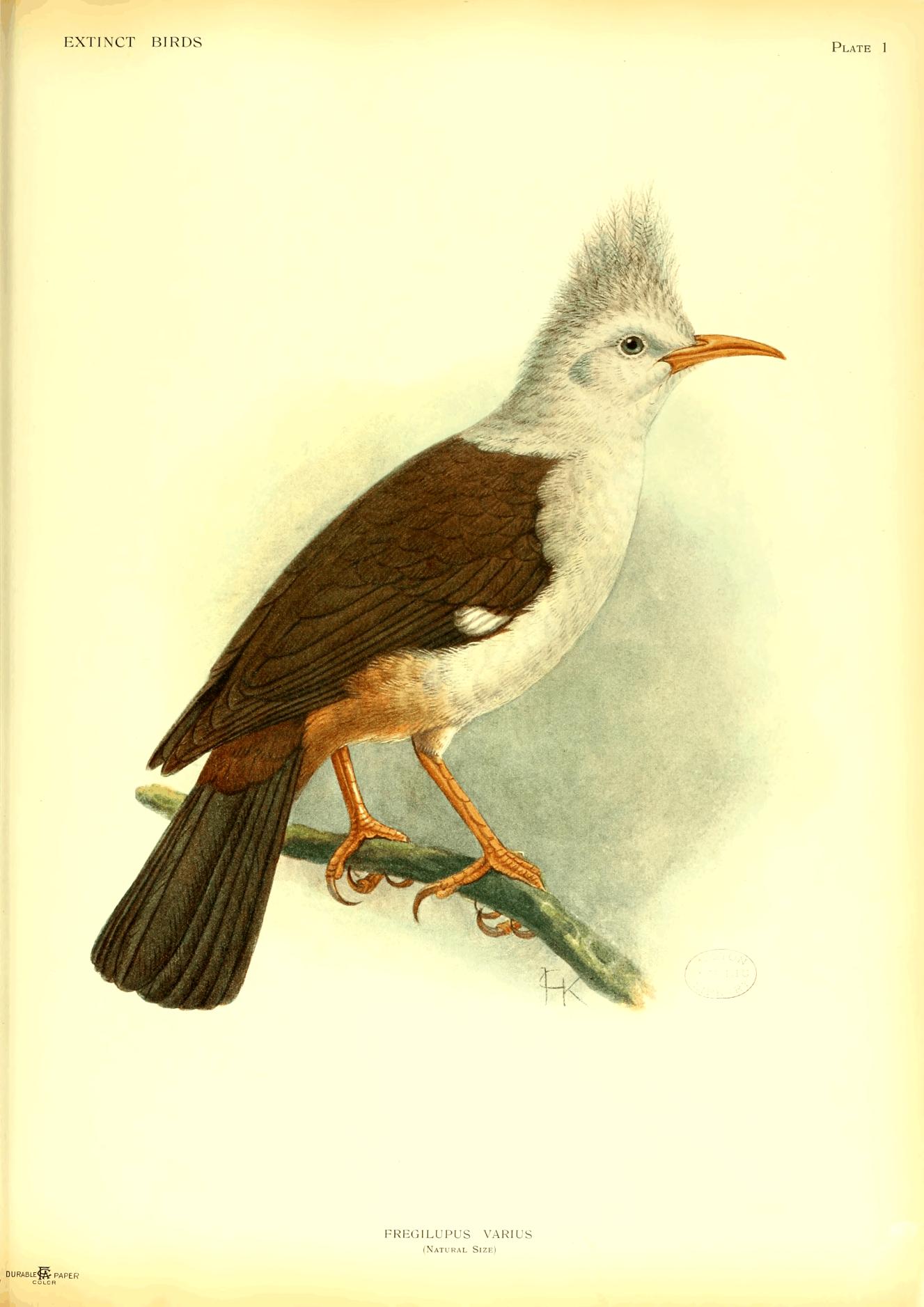
PREGILUPUS VARIUS (Natural Size)
Plate 2
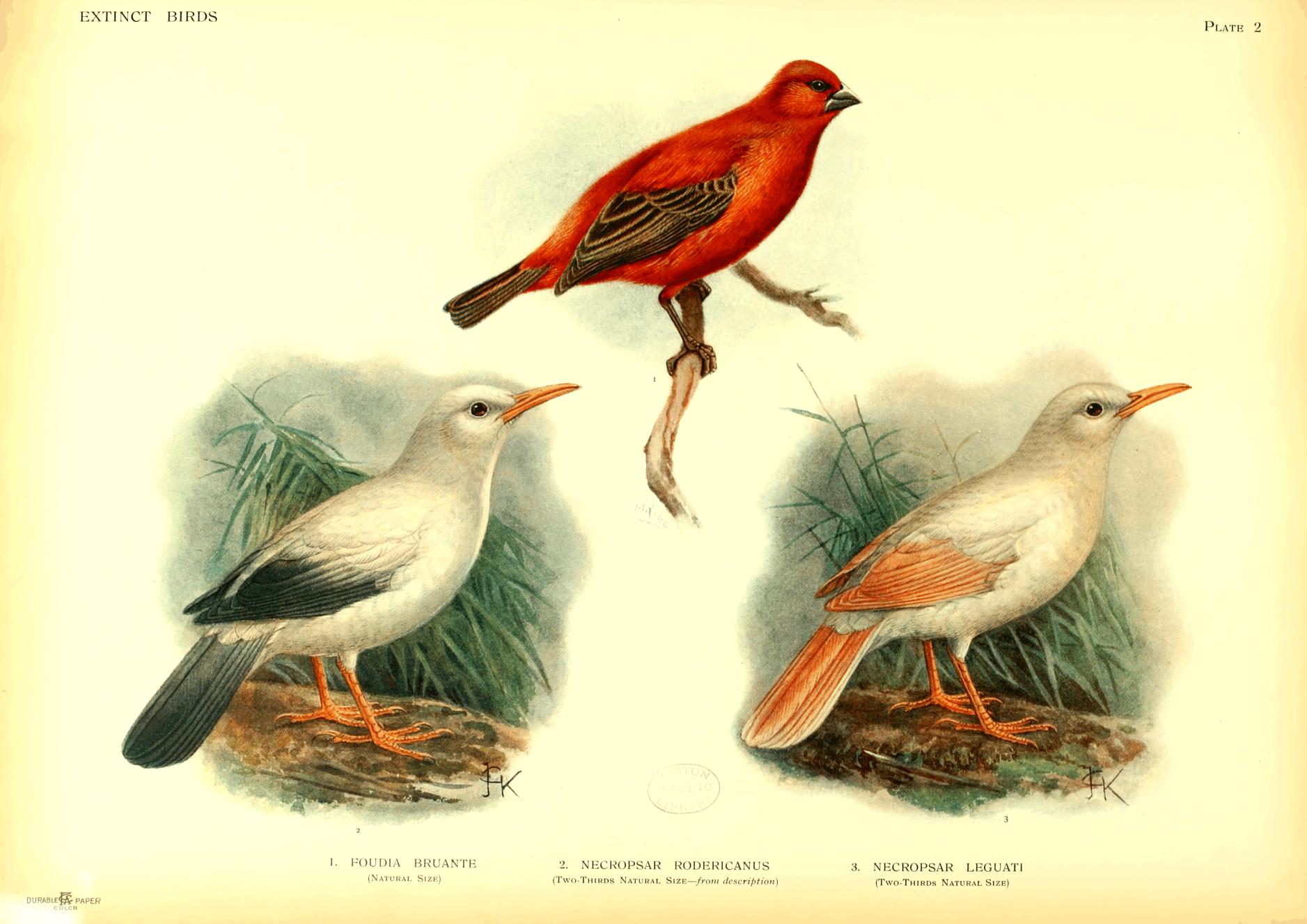
1. FOUDIA BRUANTE (Natural Size) 2. NECROPSAR RODERICANUS (Two-Thirds Natural Size—from description) 3. NECROPSAR LEGUATI (Two-Thirds Natural Size)
Plate 3
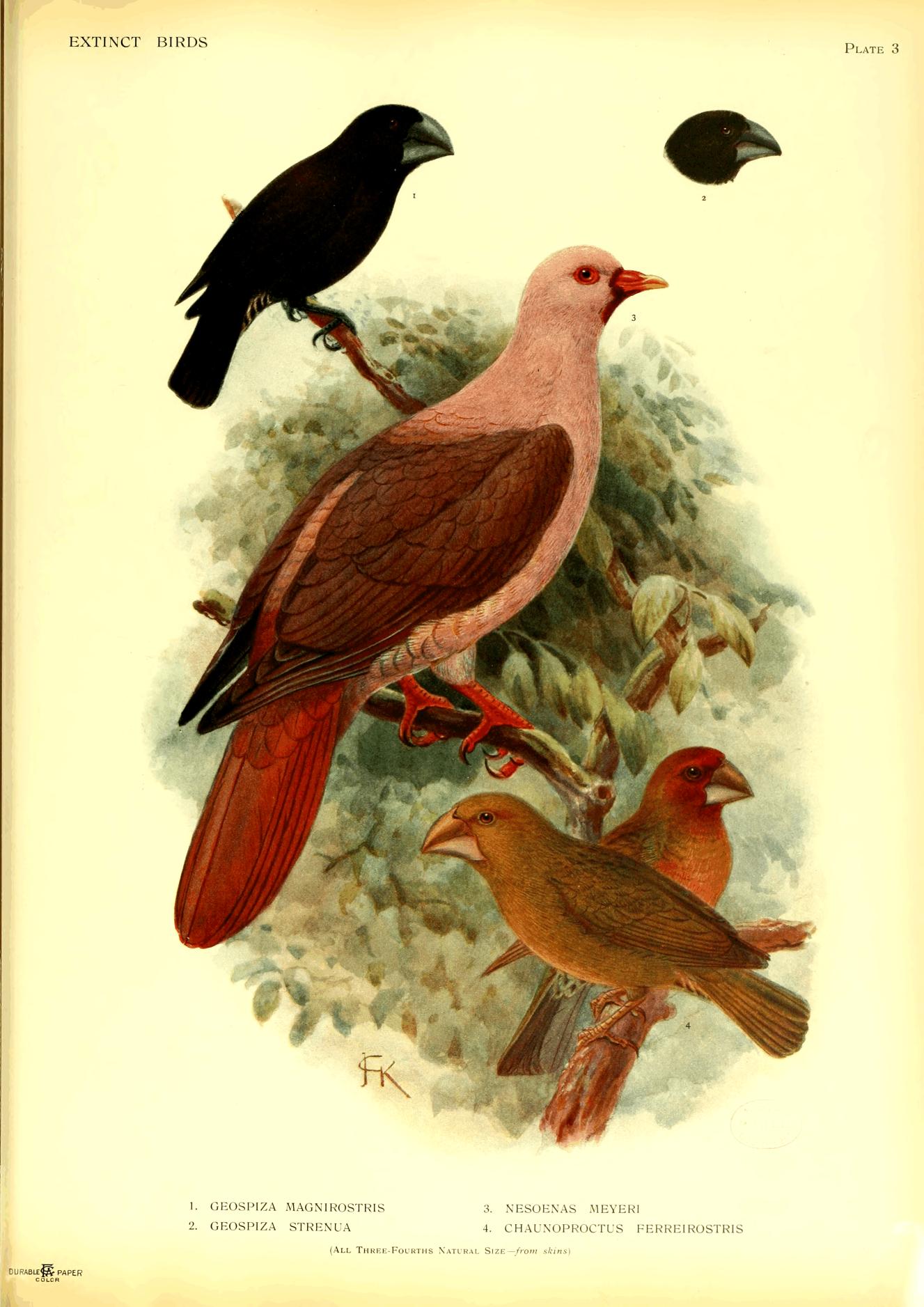
1. GEOSPIZA MAGNIROSTRIS 2. GEOSPIZA STRENUA 3. NESOENAS MEYERI 4. CHAUNOPROCTUS FERREIROSTRIS
(All Three-Fourths Natural Size—from skins)
Plate 4
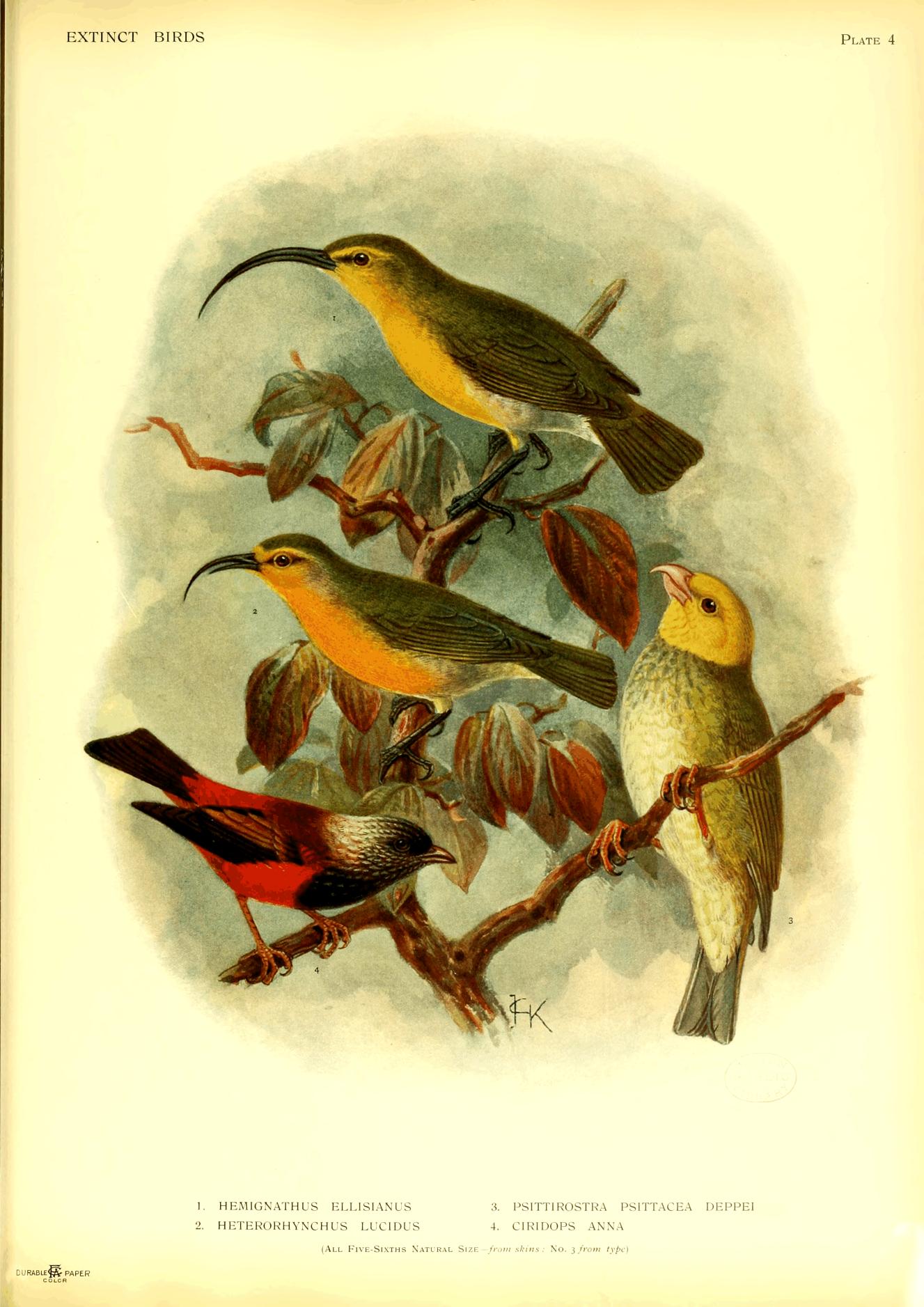
1. HEMIGNATHUS ELLISIANUS 2. HETERORHYNCHUS LUCIDUS 3. PSITTIROSTRA PSITTACEA DEPPEI 4. CIRIDOPS ANNA
(All Three-Fourths Natural Size—from skins)
Plate 4a
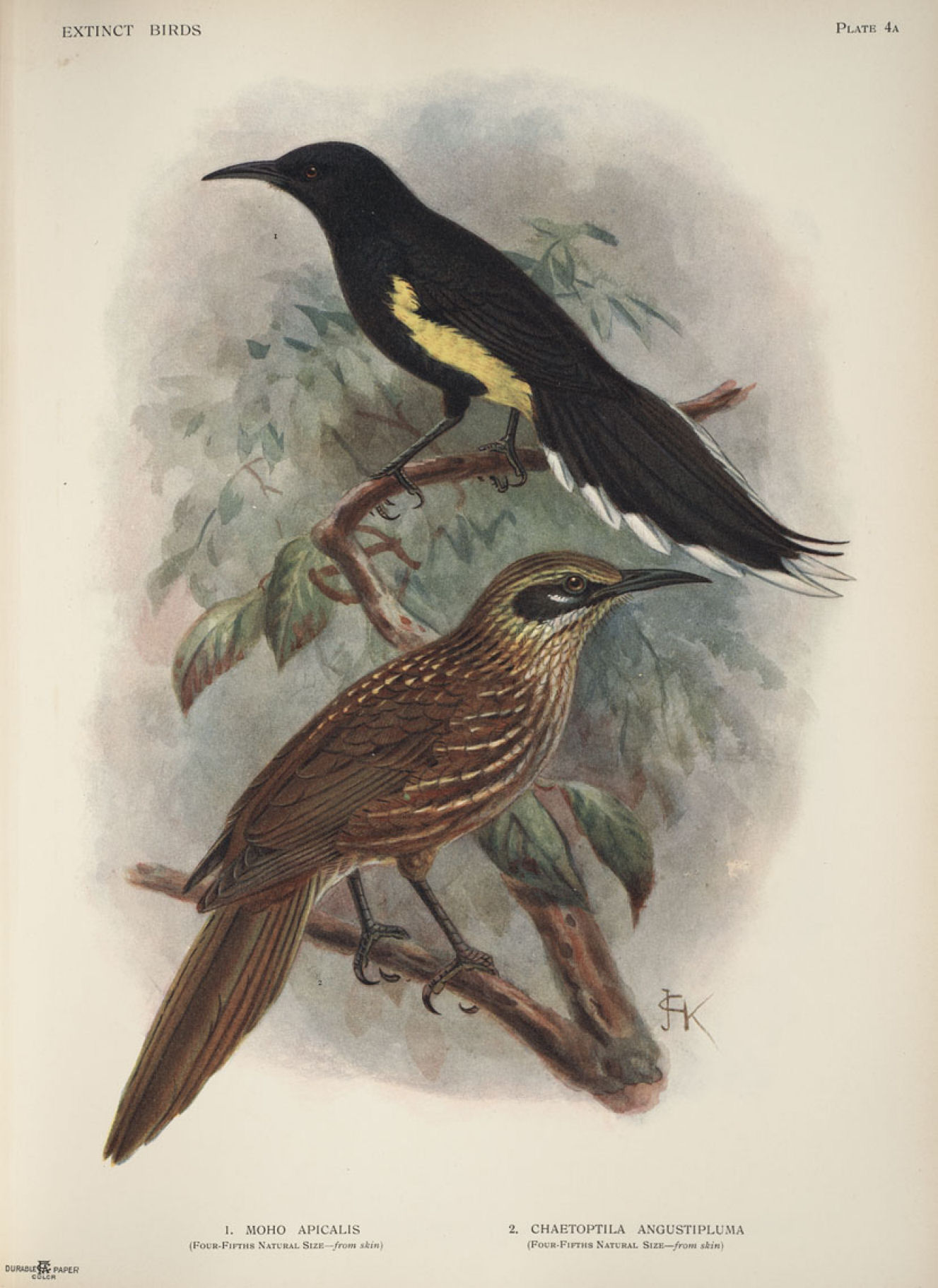
1. MOHO APICALIS (Four-Fifths Natural Size—from skin) 2. CHAETOPTILA ANGUSTIPLUMA (Four-Fifths Natural Size—from skin)
Plate 5
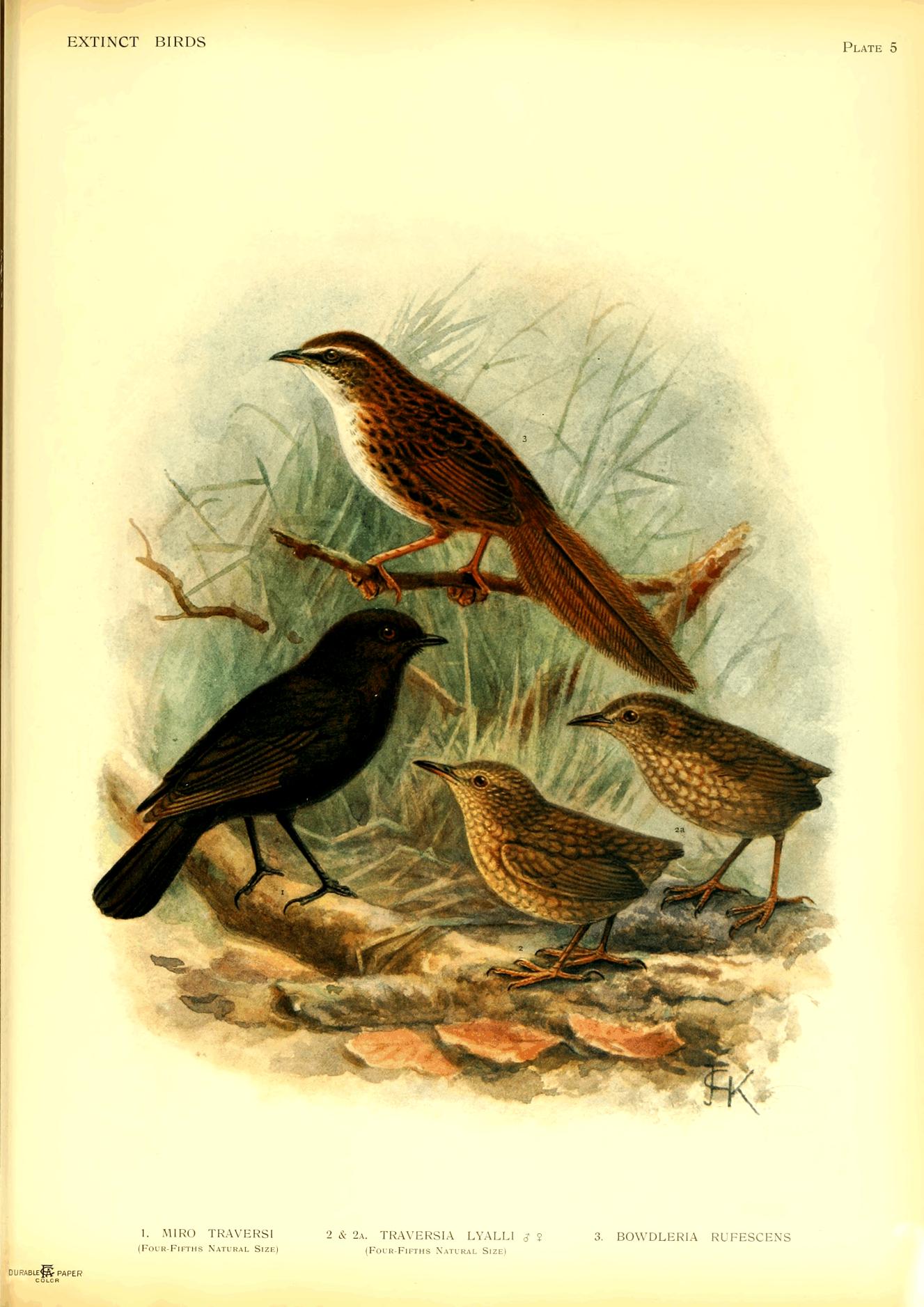
1. MIRO TRAVERSI (Four-Fifths Natural Size) 2 & 2a. TRAVERSIA LYALLI ♂ ♀ (Four-Fifths Natural Size) 3. BOWDLERIA RUFESCENS
Plate 5a
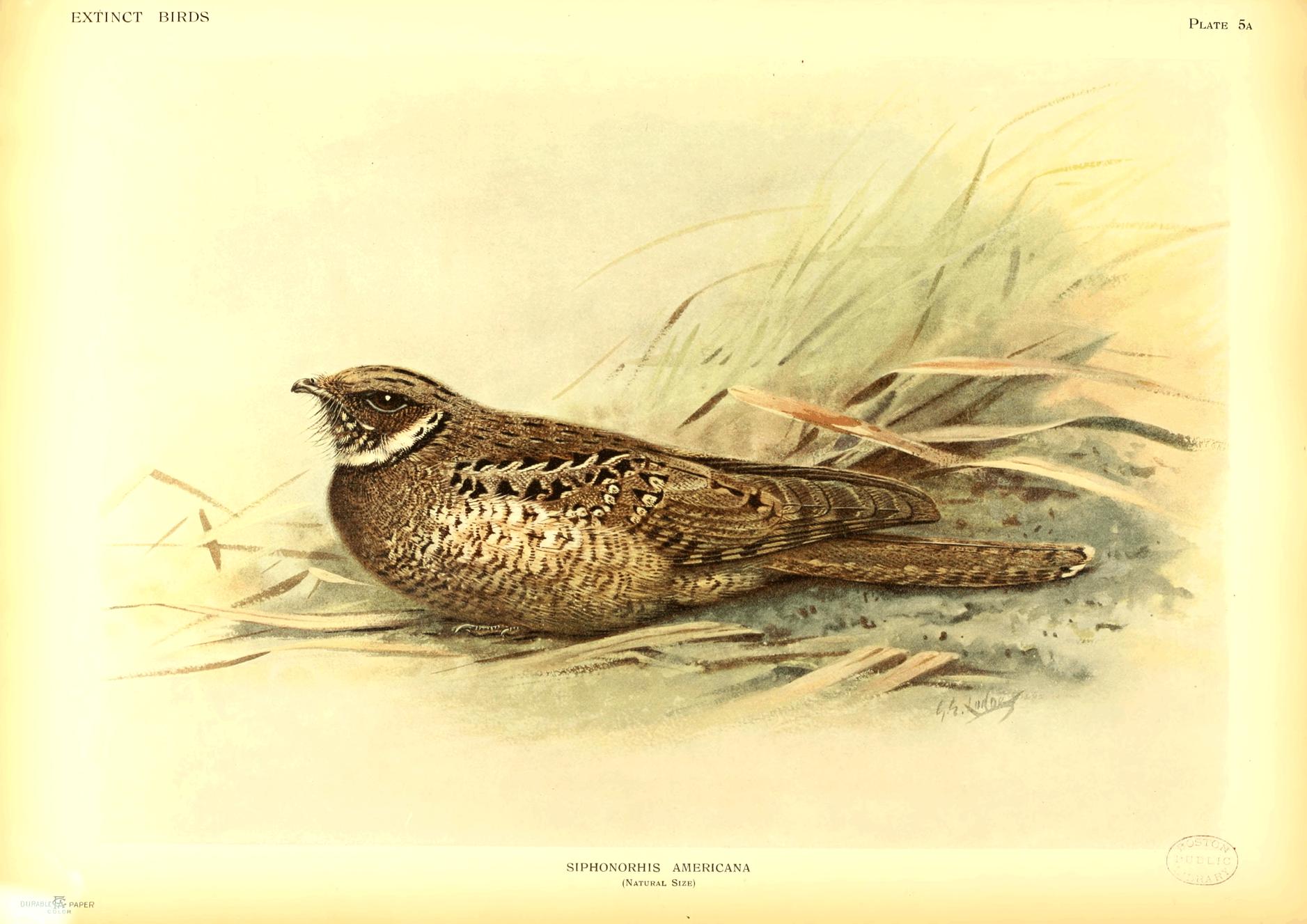
SIPHONORHIS AMERICANA (Natural Size)
Plate 6
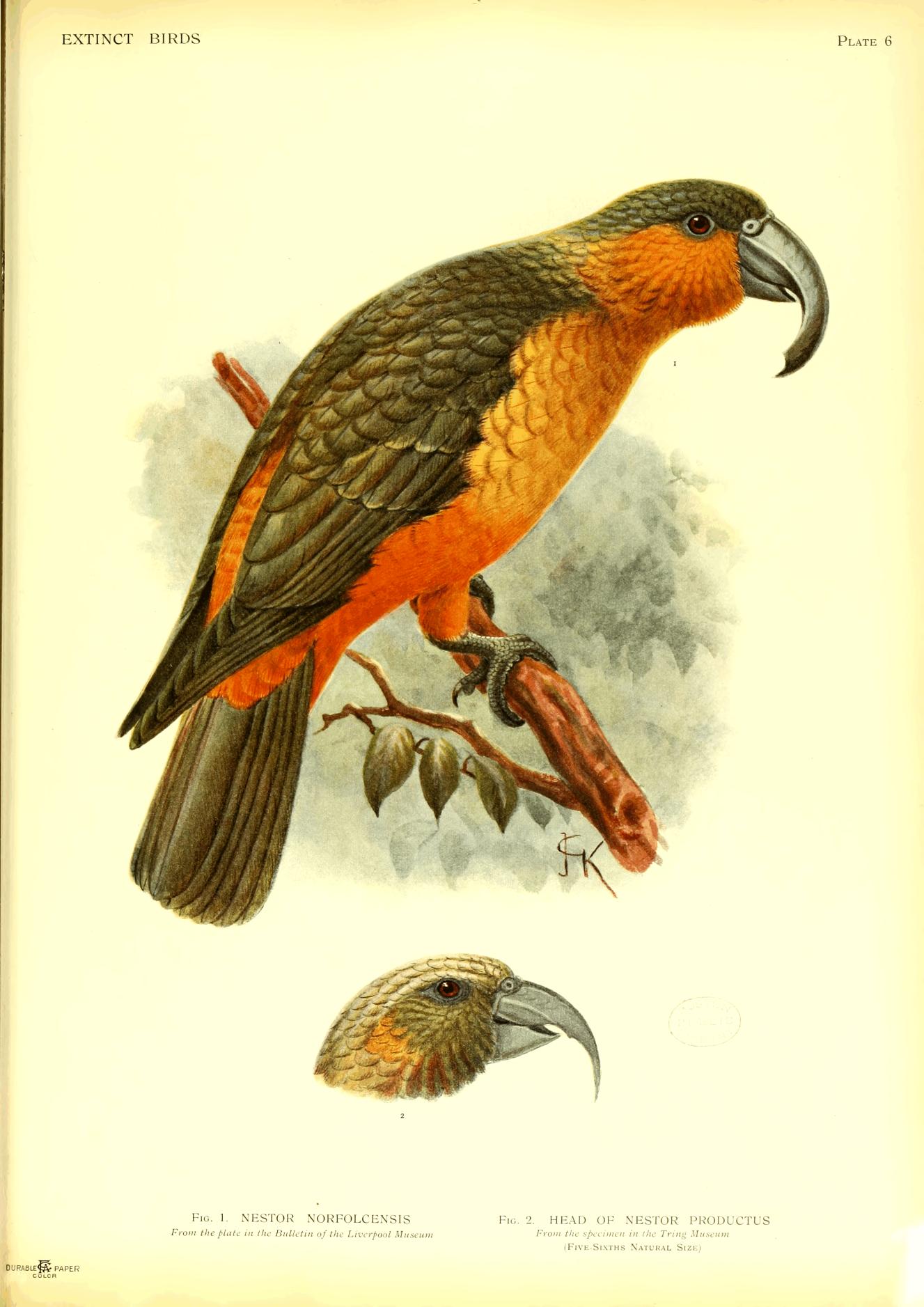
Fig. 1. NESTOR NORFOLCENSIS From the plate in the Bulletin of the Liverpool Museum Fig. 2. HEAD OF NESTOR PRODUCTUS From the specimen in the Tring Museum (Five-Sixths Natural Size)
Plate 7
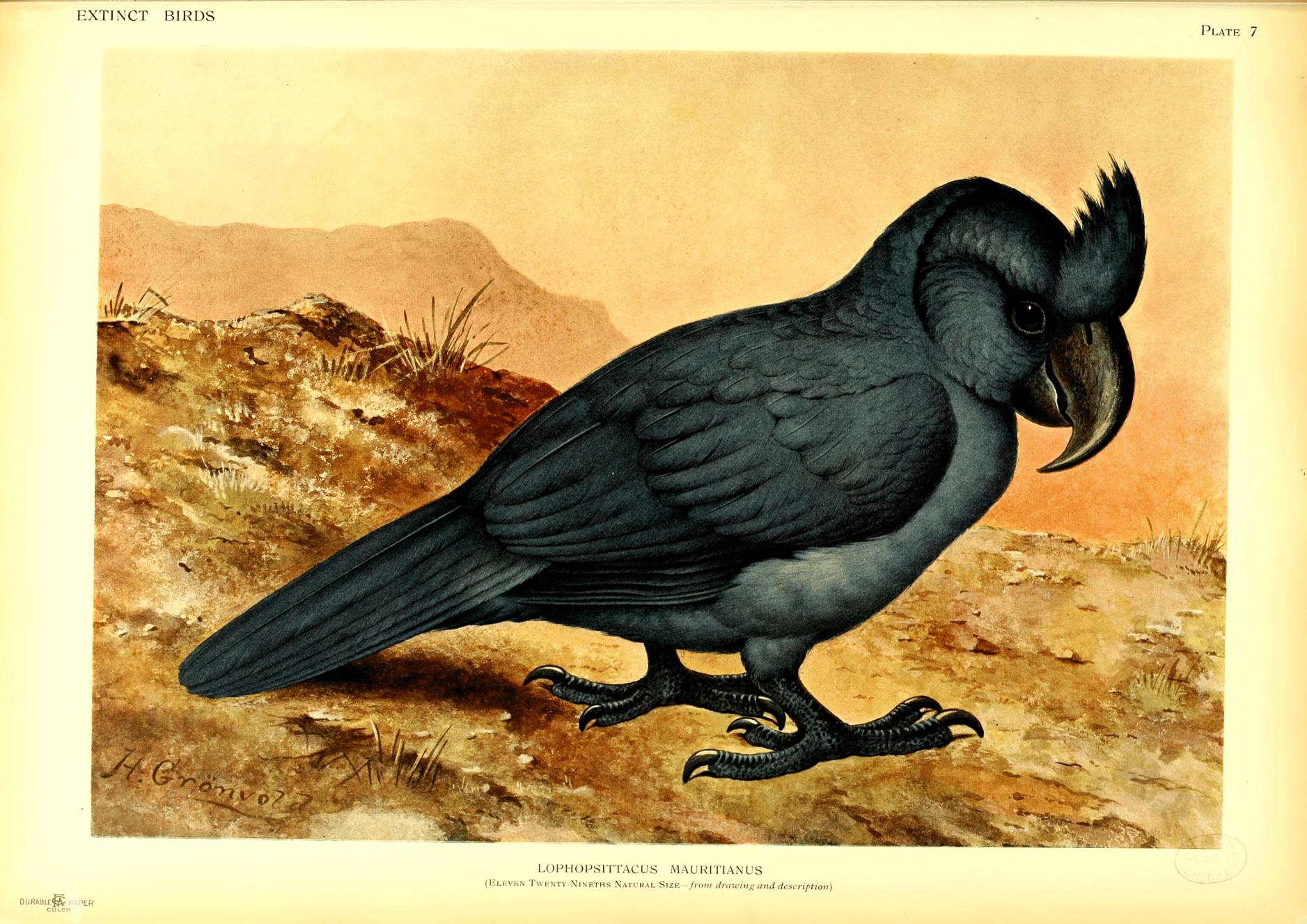
LOPHOPSITTACUS MAURITIANUS (Eleven Twenty-Nineths Natural Size—from drawing and description)
Plate 8
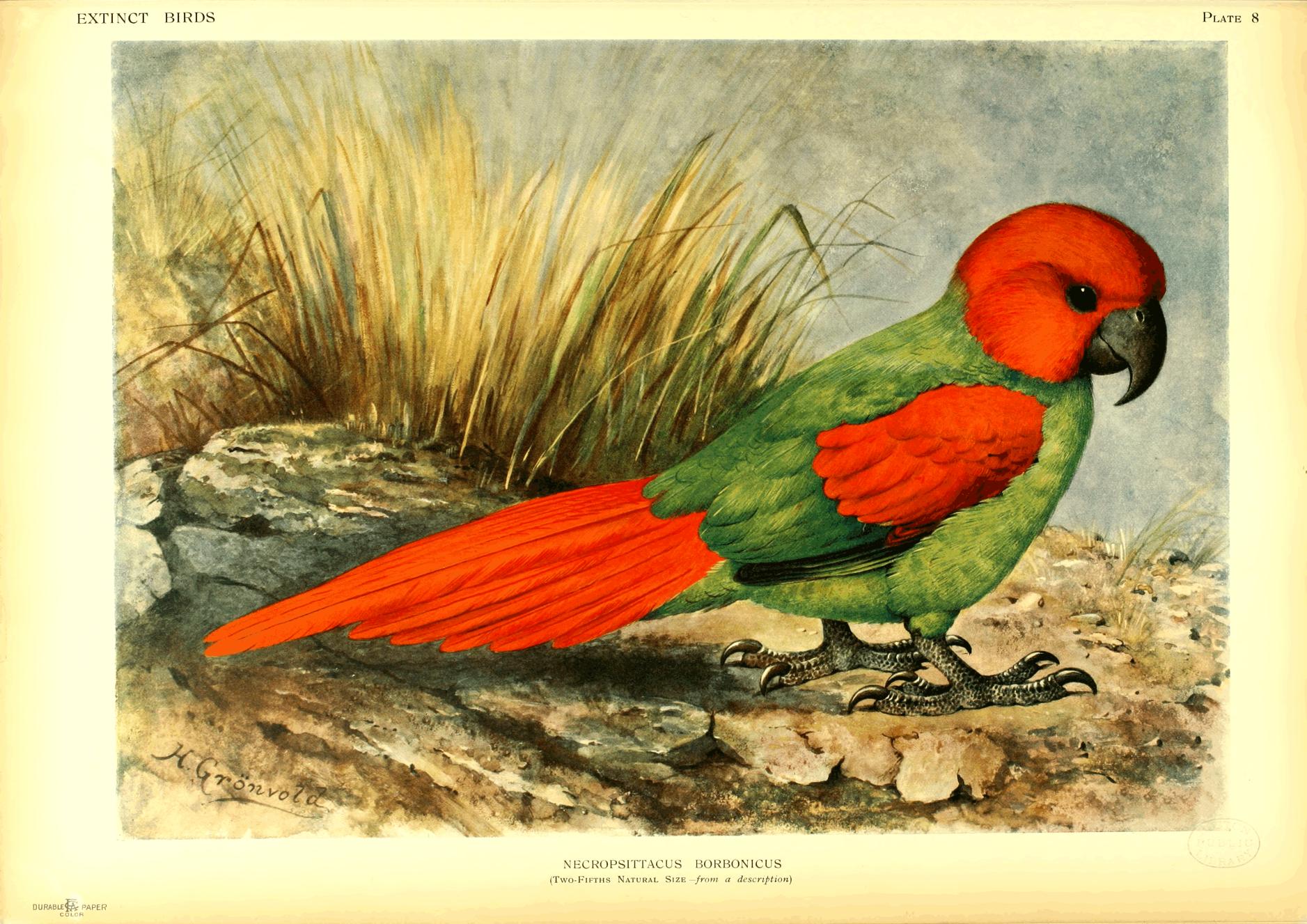
NECROPSITTACUS BORBONICUS (Two-Fifths Natural Size—from a description)
Plate 9
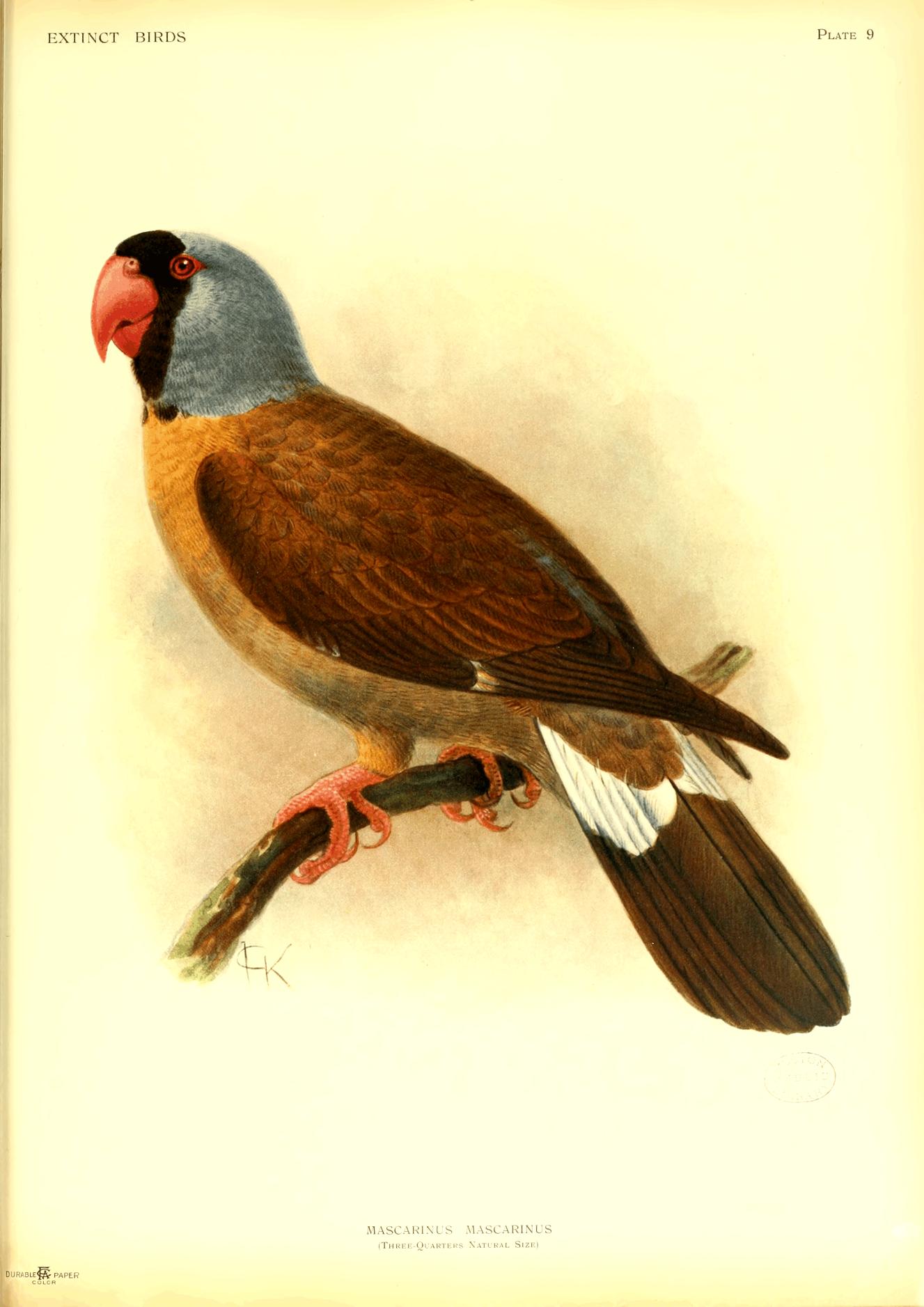
MASCARINUS MASCARINUS (Three-Quarters Natural Size)
Plate 10
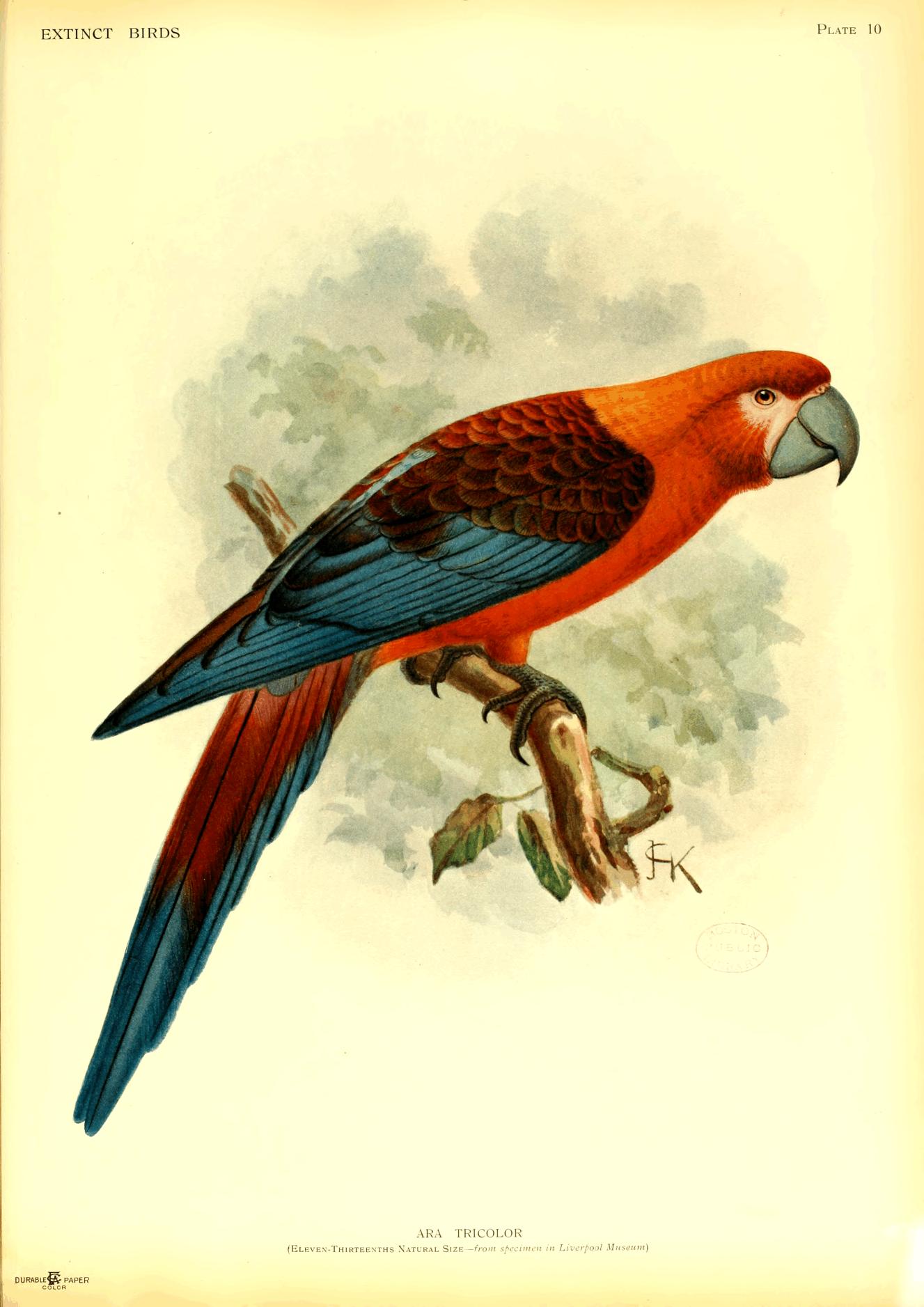
ARA TRICOLOR (Eleven-Thirteenths Natural Size—from specimen in Liverpool Museum)
Plate 11
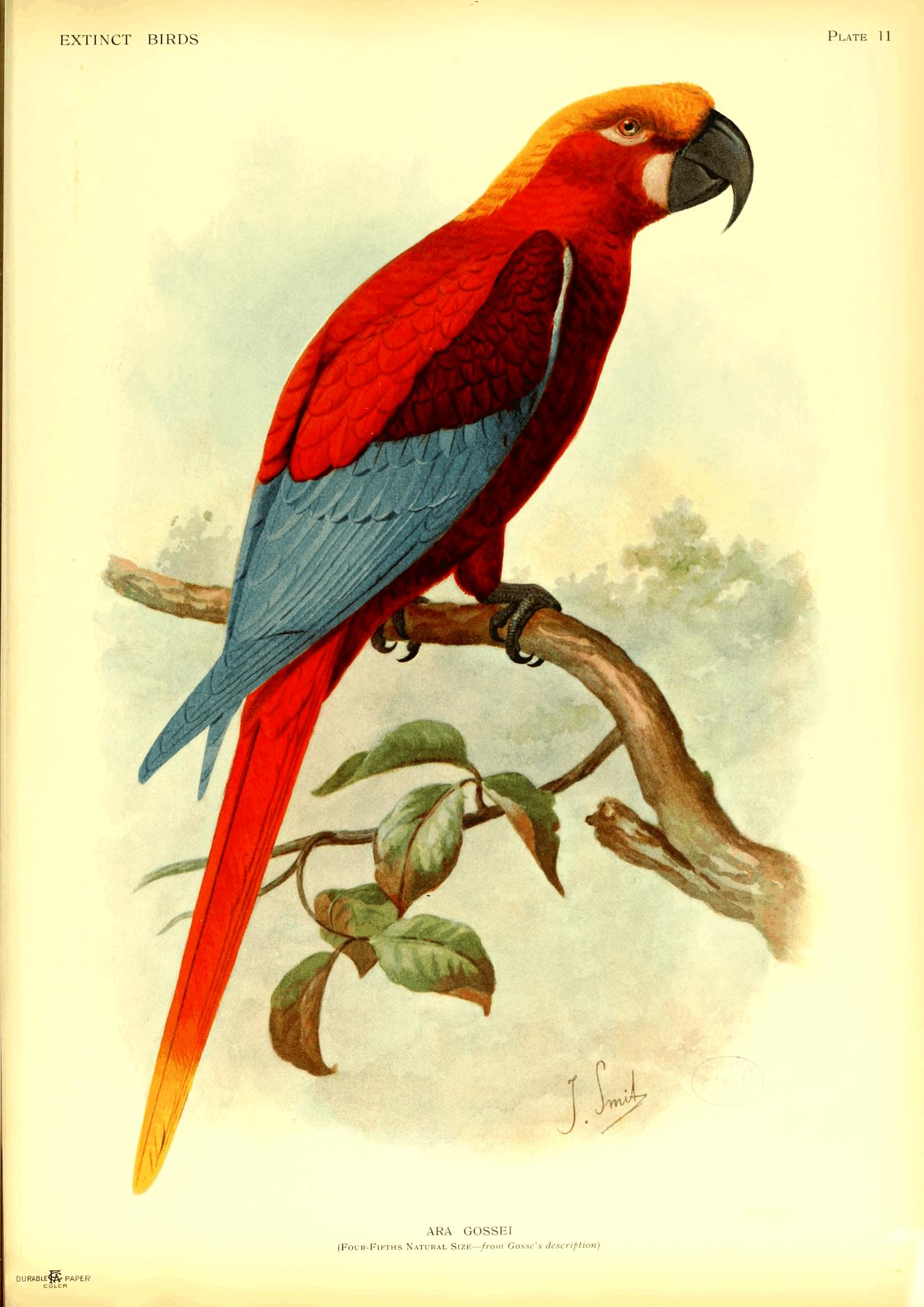
ARA GOSSEI (Four-Fifths Natural Size—from Gosse's description)
Plate 12
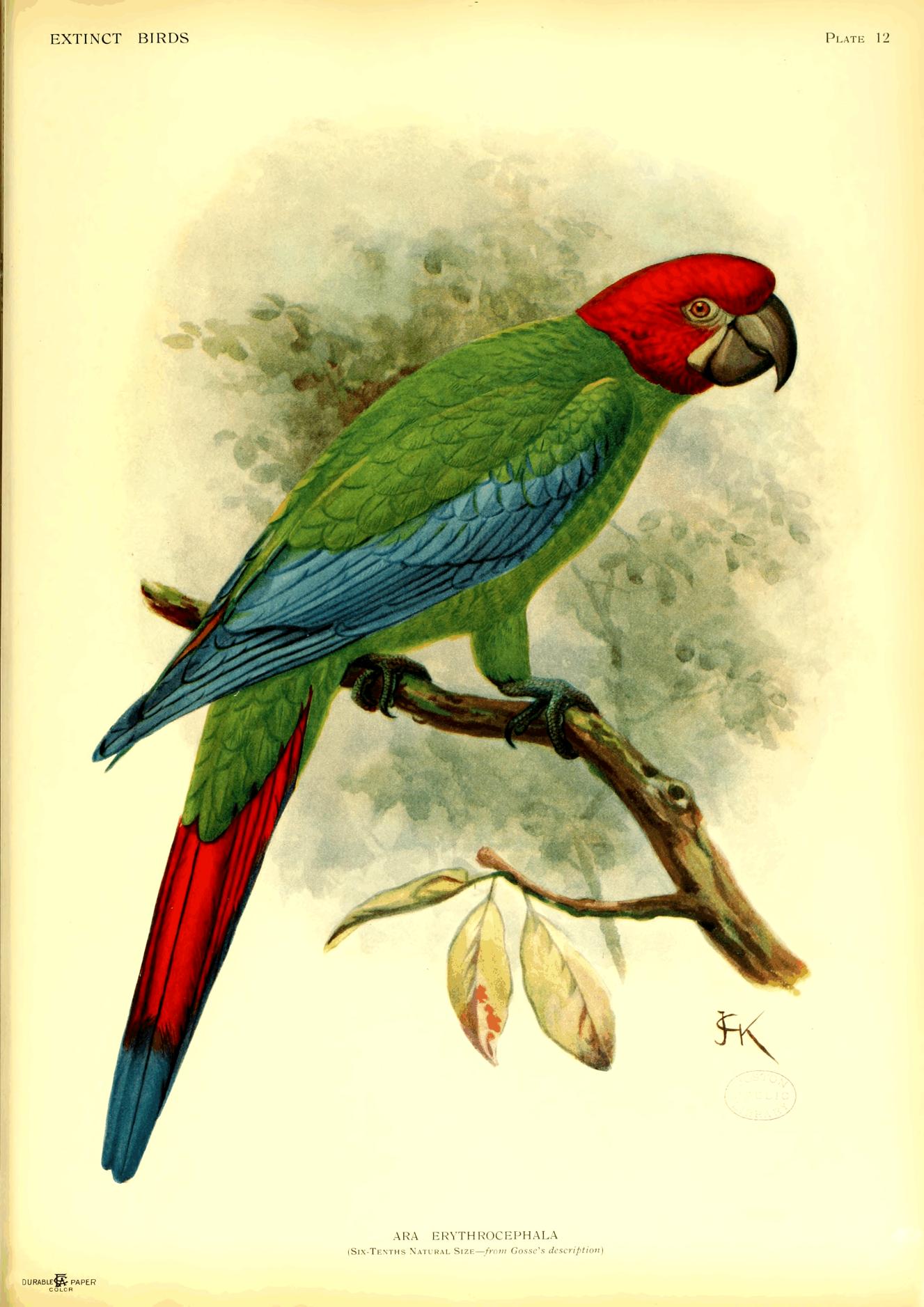
ARA ERYTHROCEPHALA (Six-Tenths Natural Size—from Gosse's description)
Plate 13
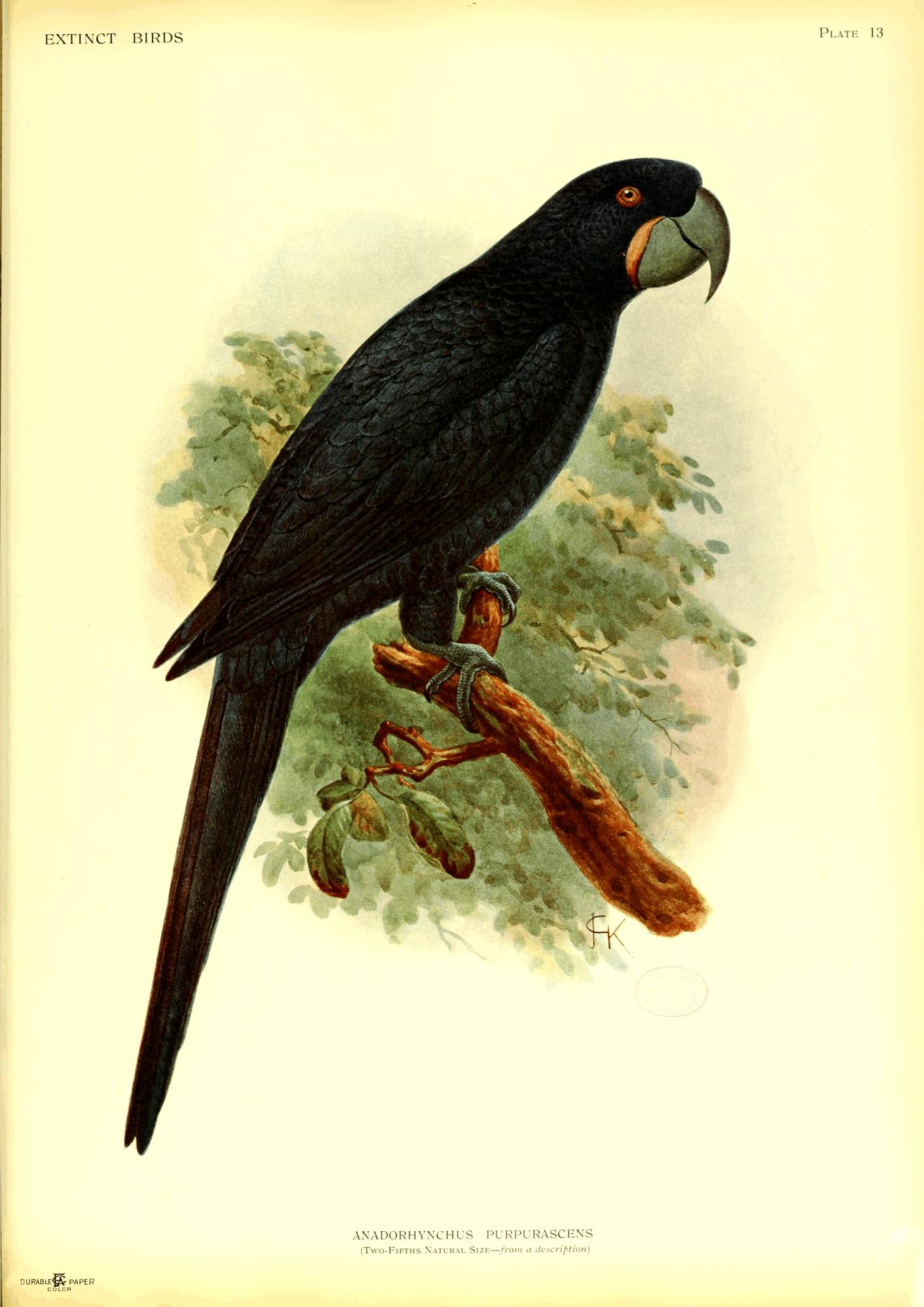
ANADORHYNCHUS PURPURASCENS (Two-Fifths Natural Size—from a description)
Plate 14
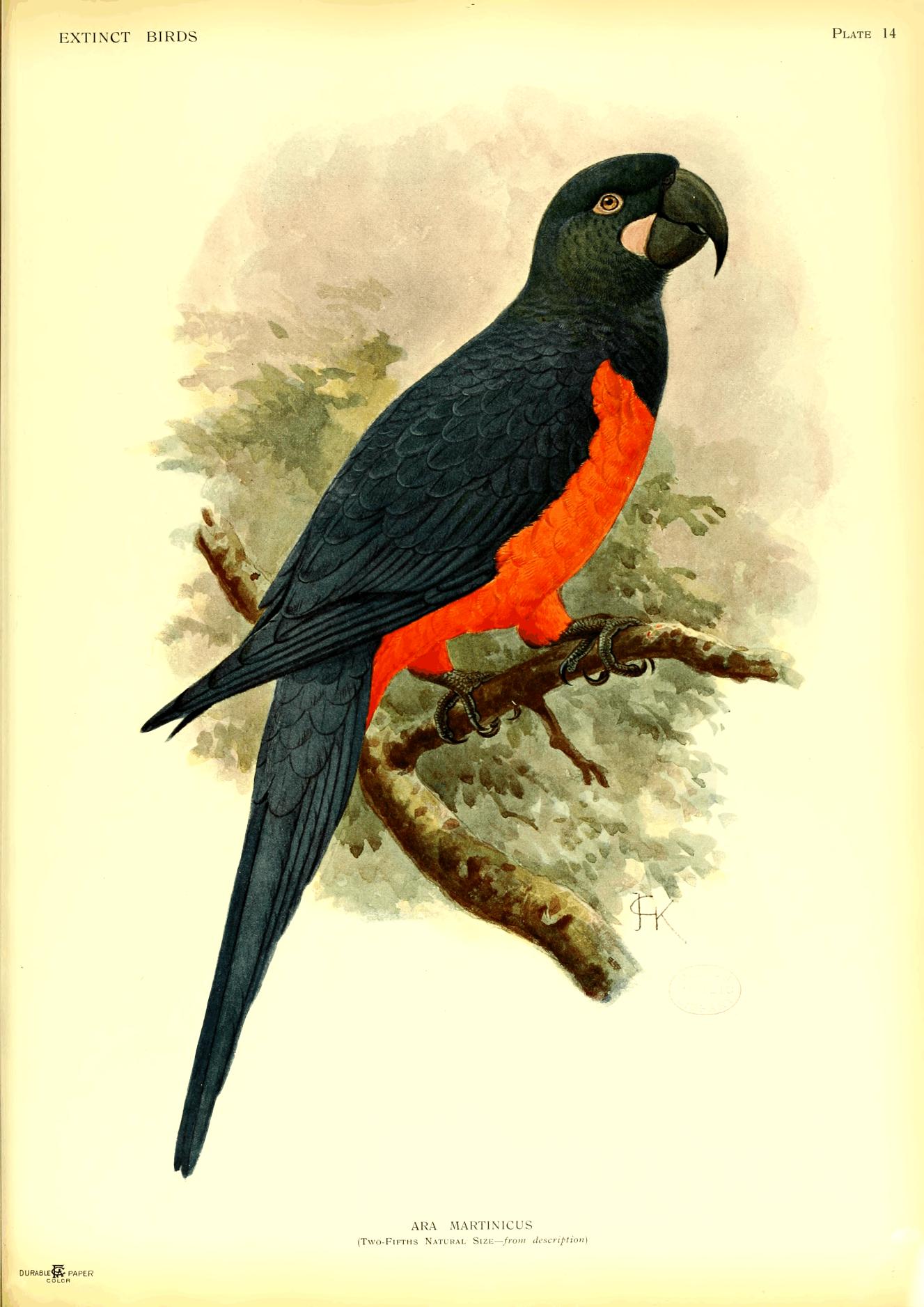
ARA MARTINICUS (Two-Fifths Natural Size—from description)
Plate 15
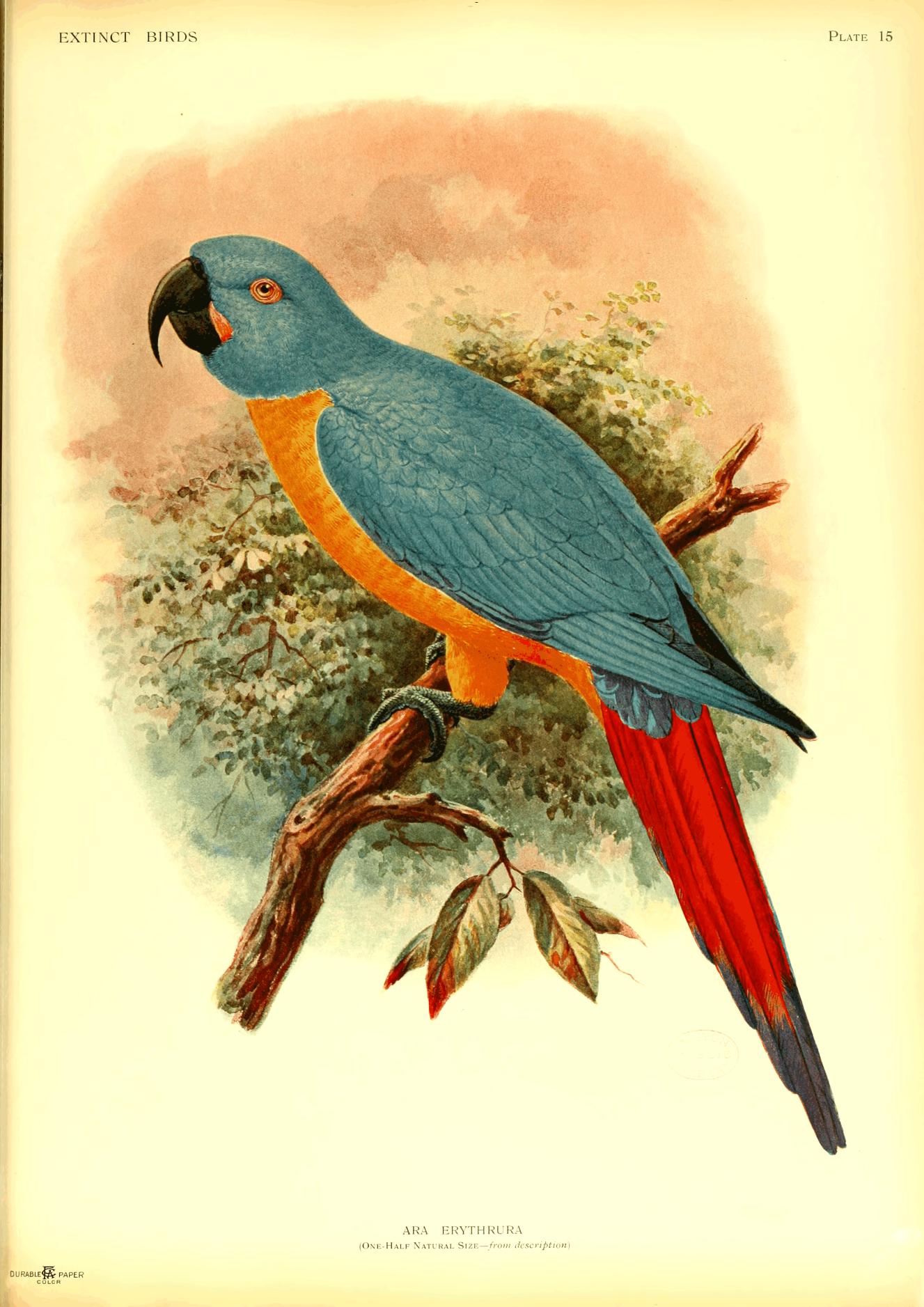
ARA ERYTHRURA (One-Half Natural Size—from description)
Plate 16
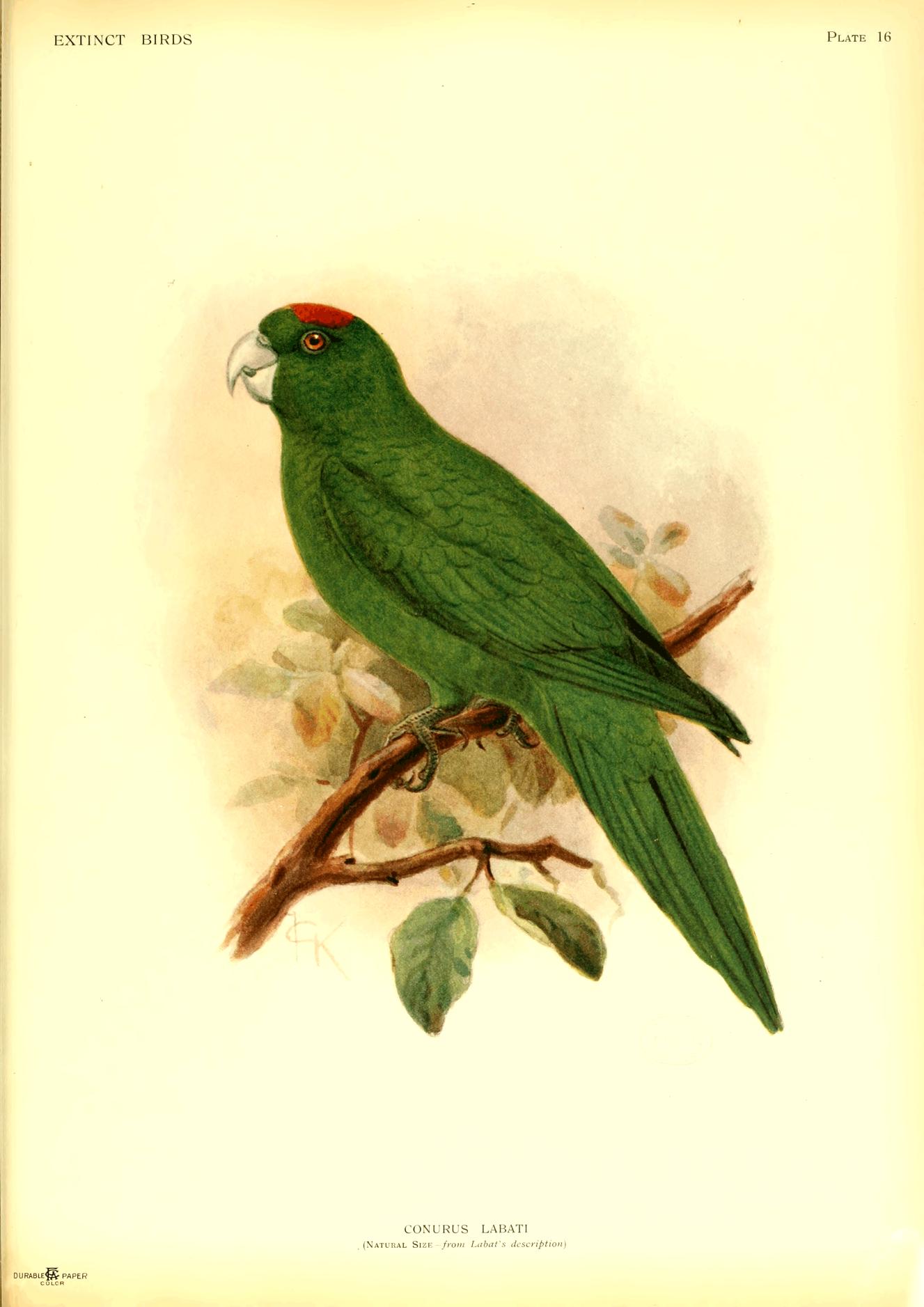
CONURUS LABATI (Natural Size—from Labat's description)
Plate 17
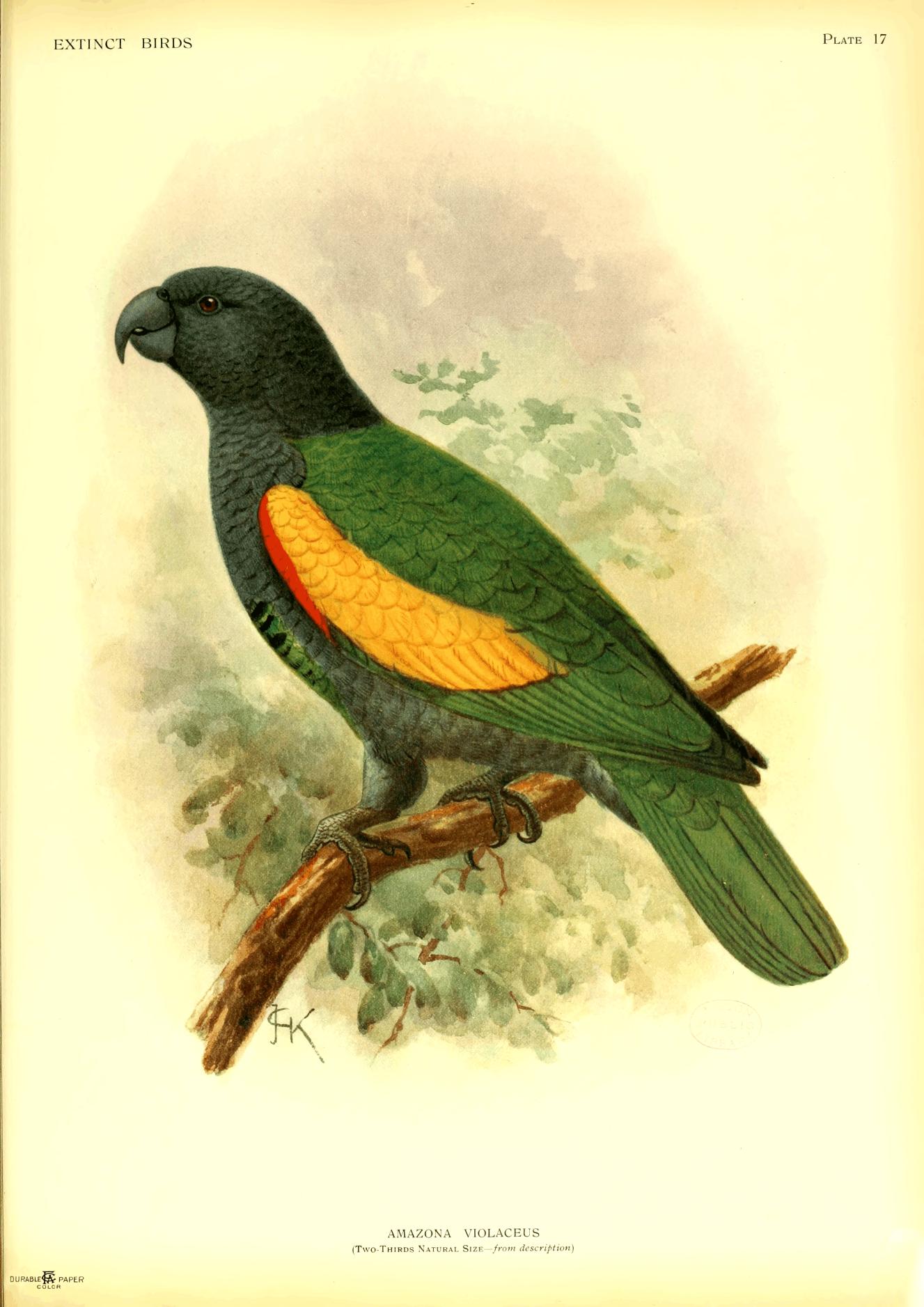
AMAZONA VIOLACEUS (Two-Thirds Natural Size—from description)
Plate 18
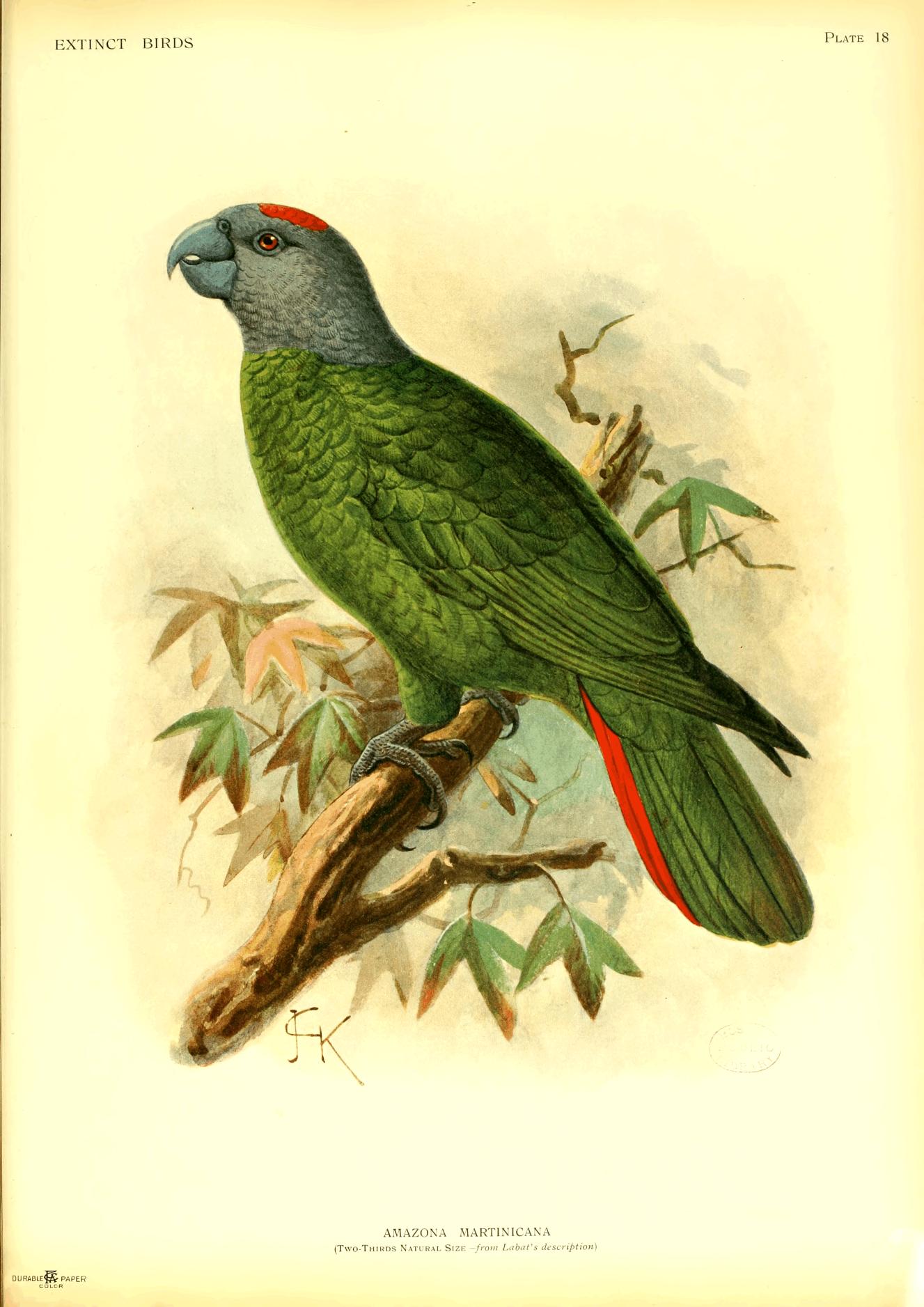
AMAZONA MARTINICANA (Two-Thirds Natural Size—from Labat's description)
Plate 19
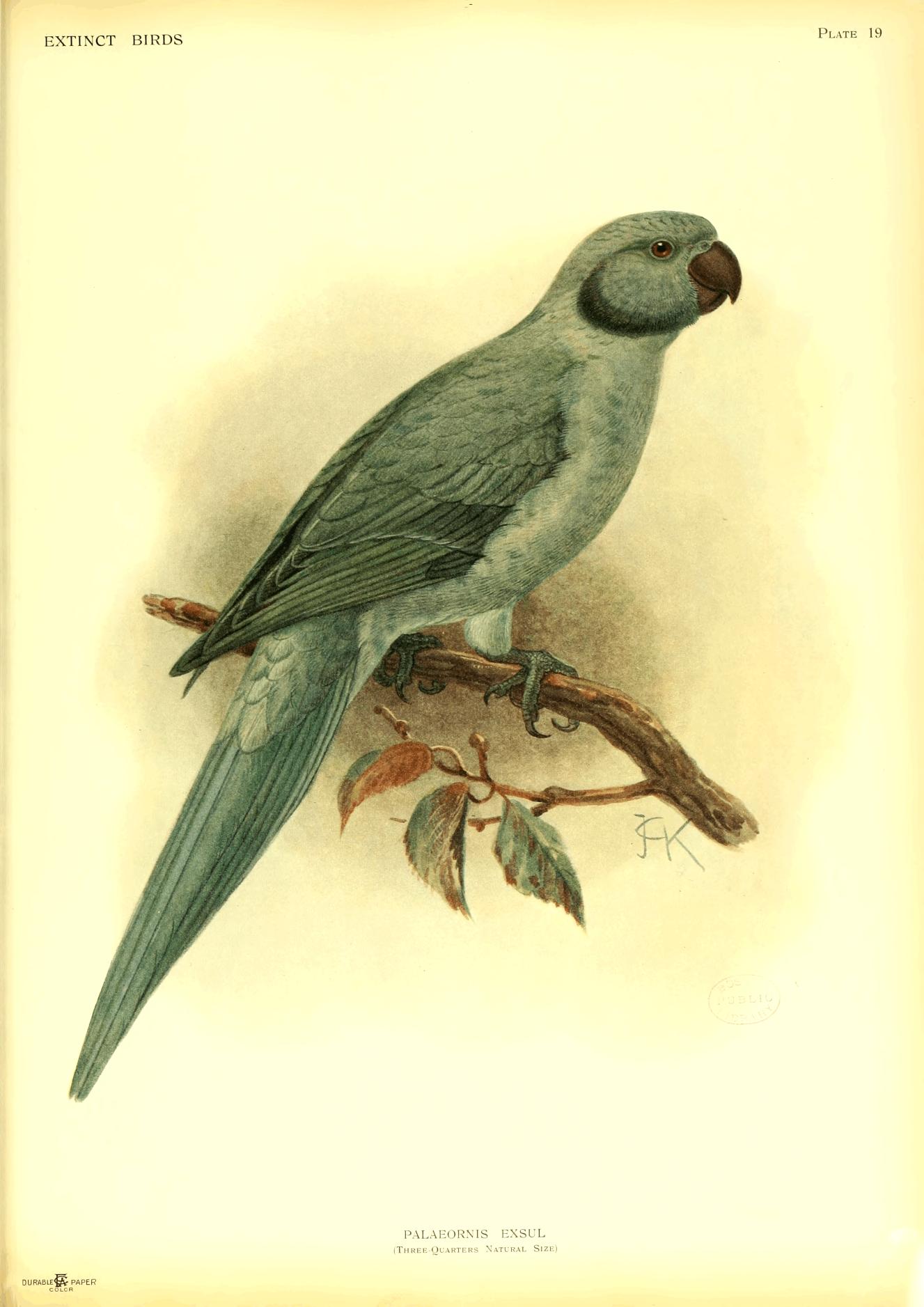
PALAEORNIS EXSUL (Three-Quarters Natural Size)
Plate 20
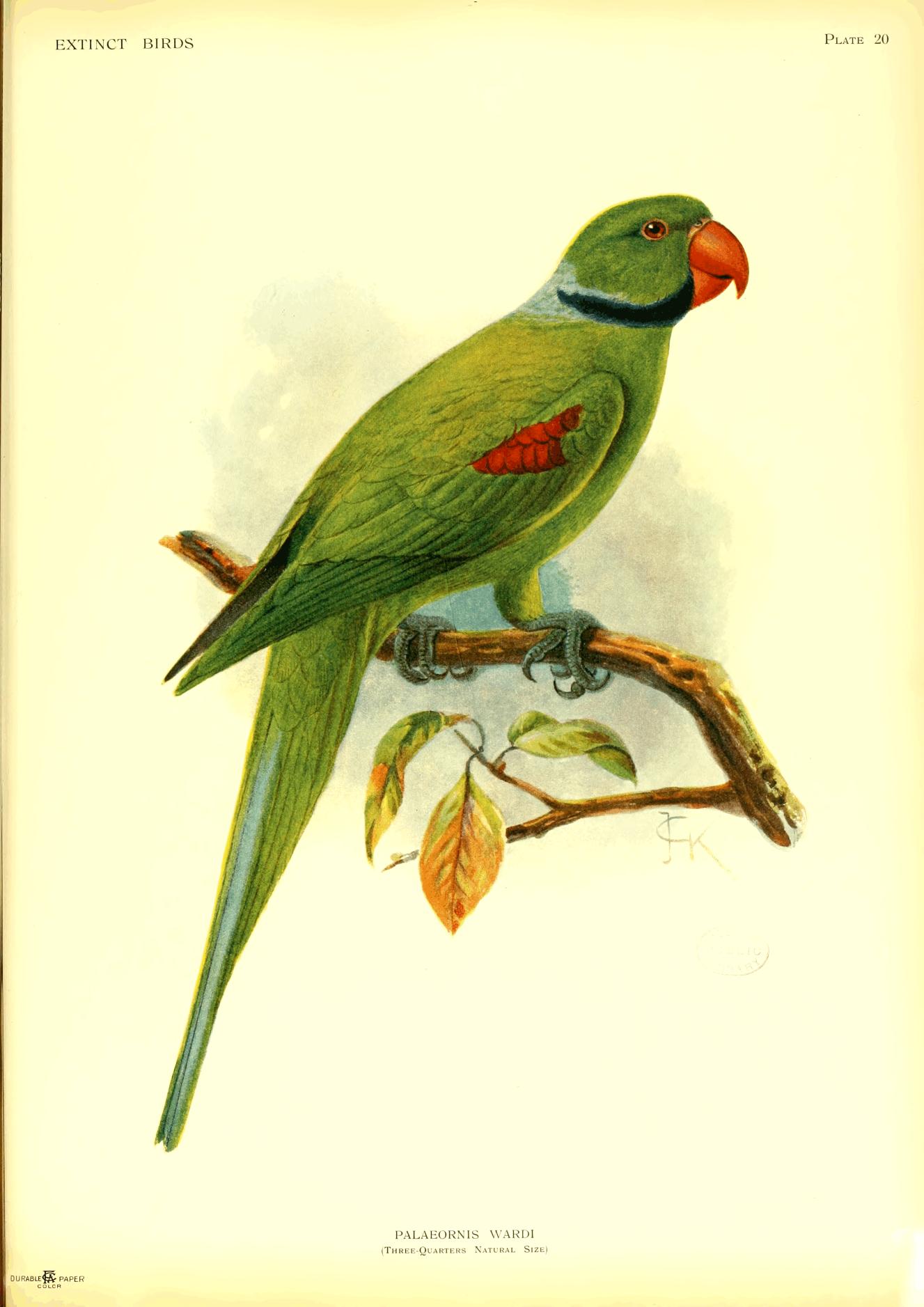
PALAEORNIS WARDI (Three-Quarters Natural Size)
Plate 21
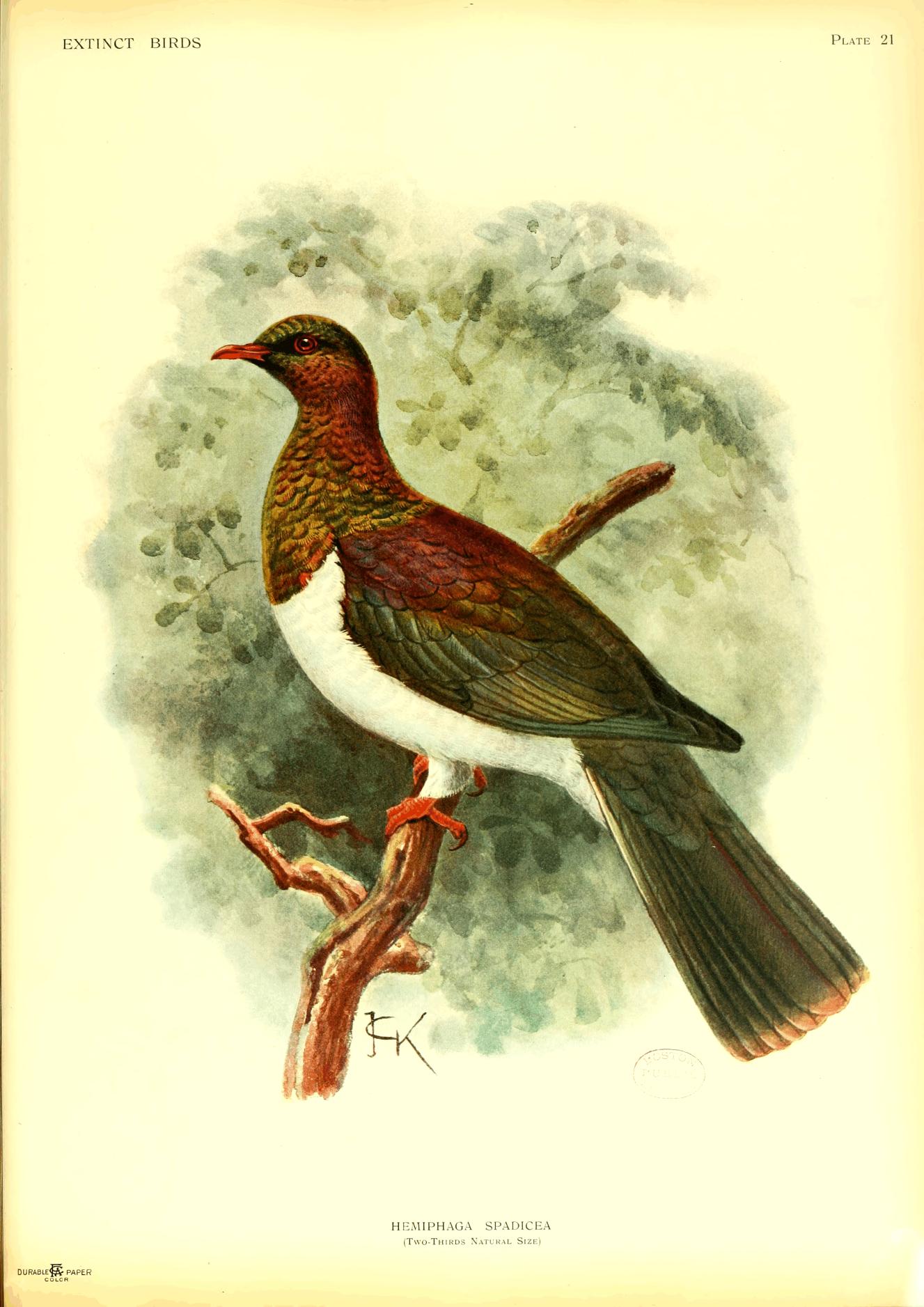
HEMIPHAGA SPADICEA (Two-Thirds Natural Size)
Plate 22
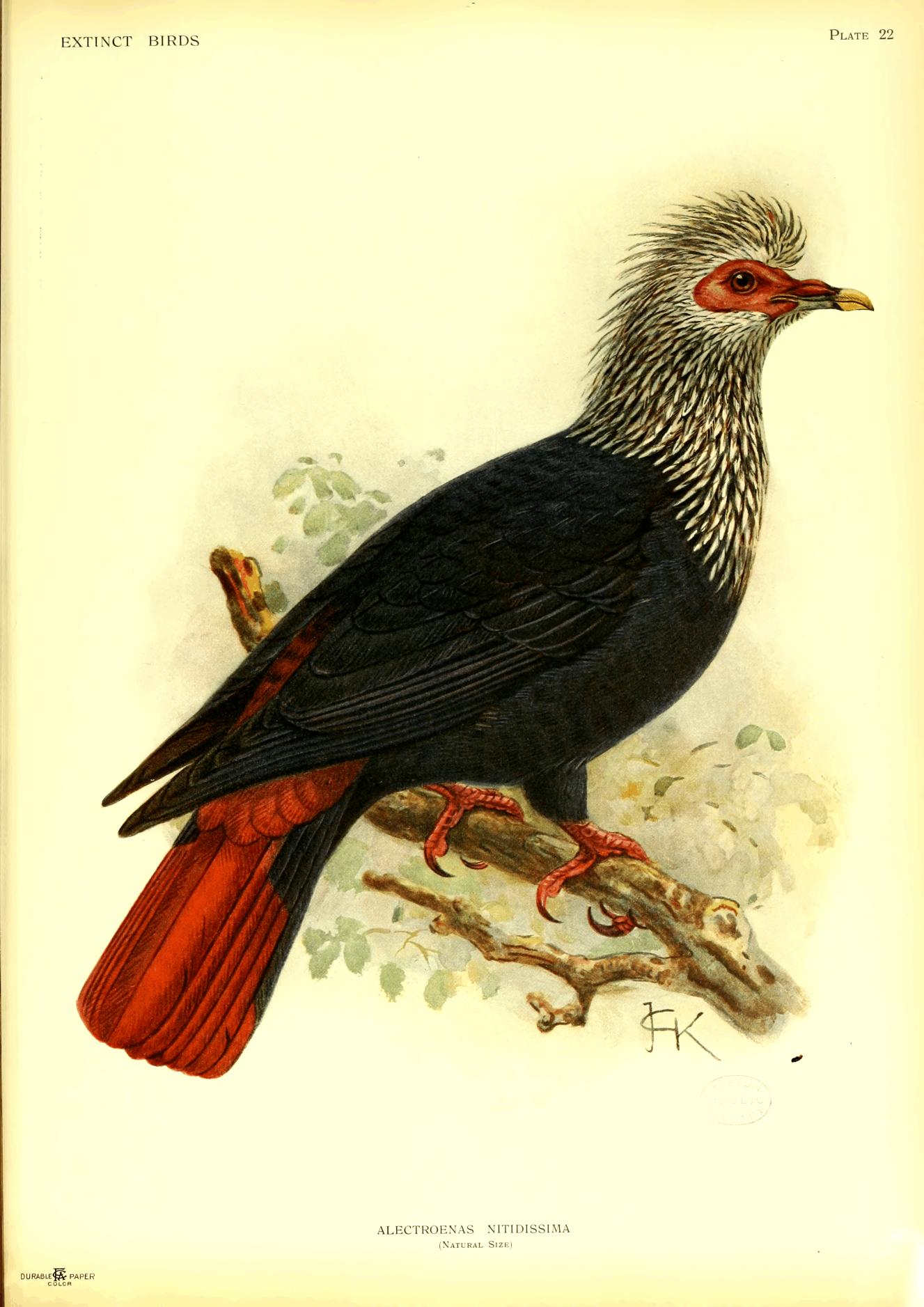
ALECTROENAS NITIDISSIMA (Natural Size)
Plate 23
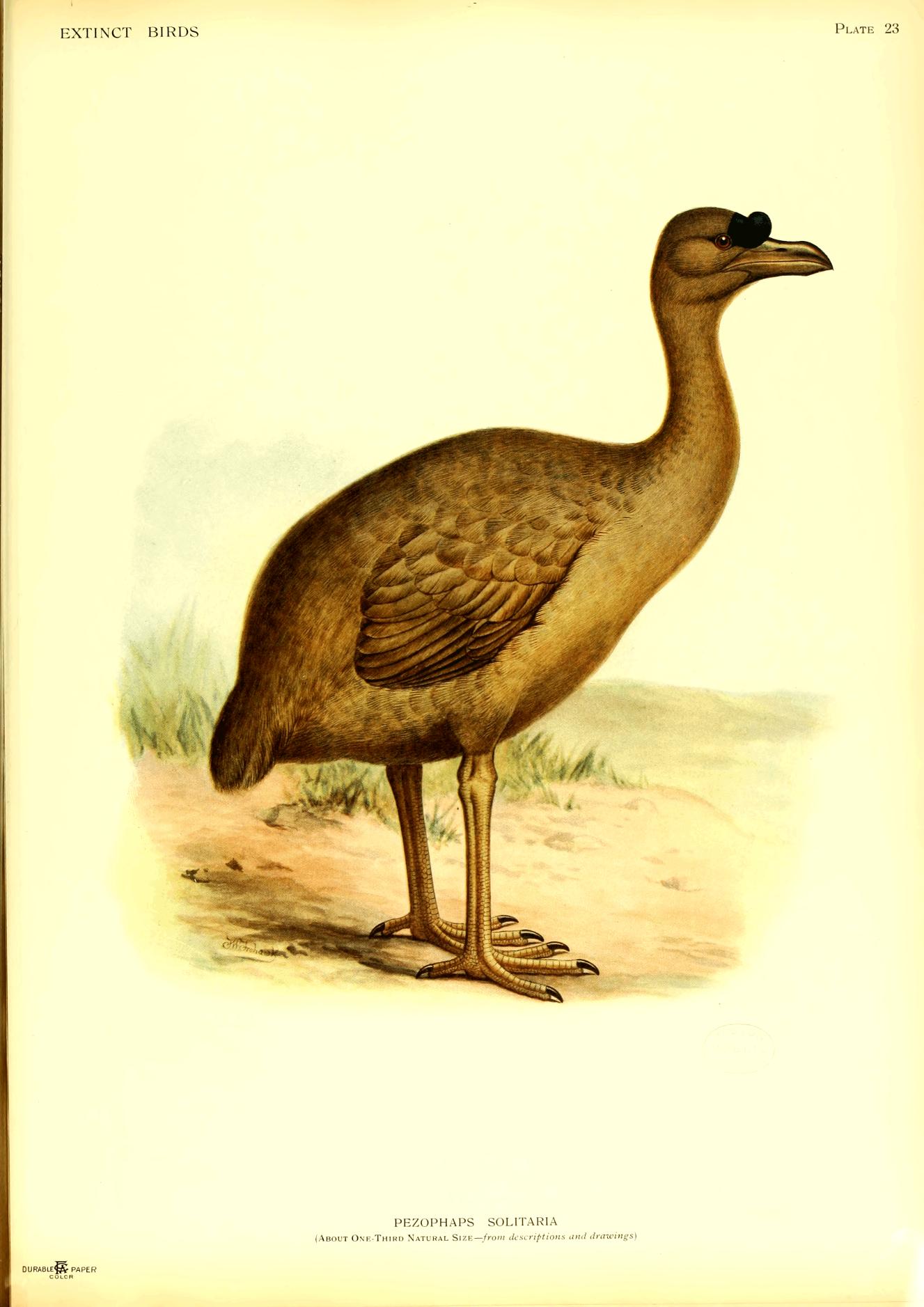
PEZOPHAPS SOLITARIA (About One-Third Natural Size—from descriptions and drawings)
Plate 24
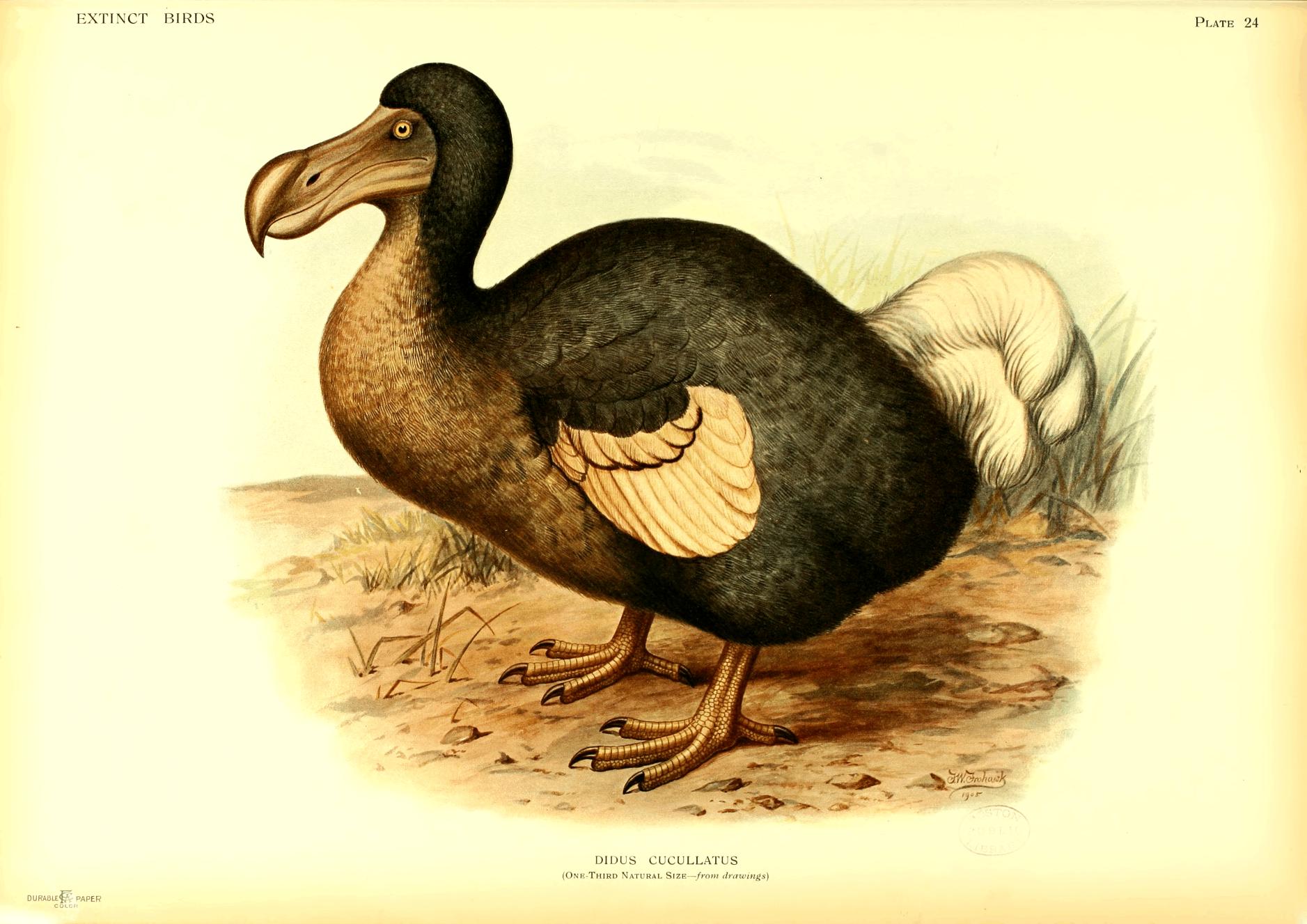
DIDUS CUCULLATUS (One-Third Natural Size—from drawings)
Plate 24a
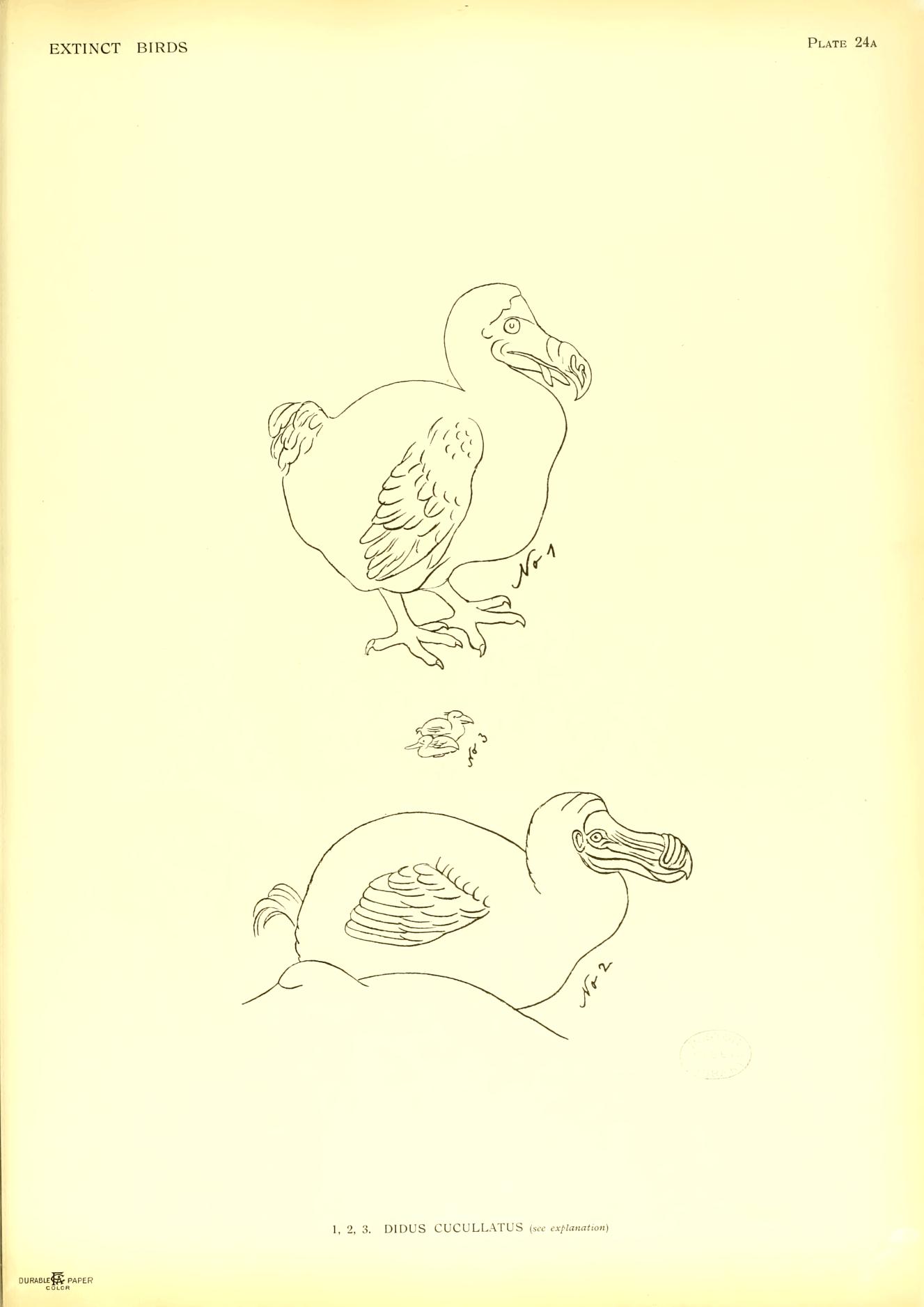
1, 2, 3. DIDUS CUCULLATUS (see explanation)
Plate 24b
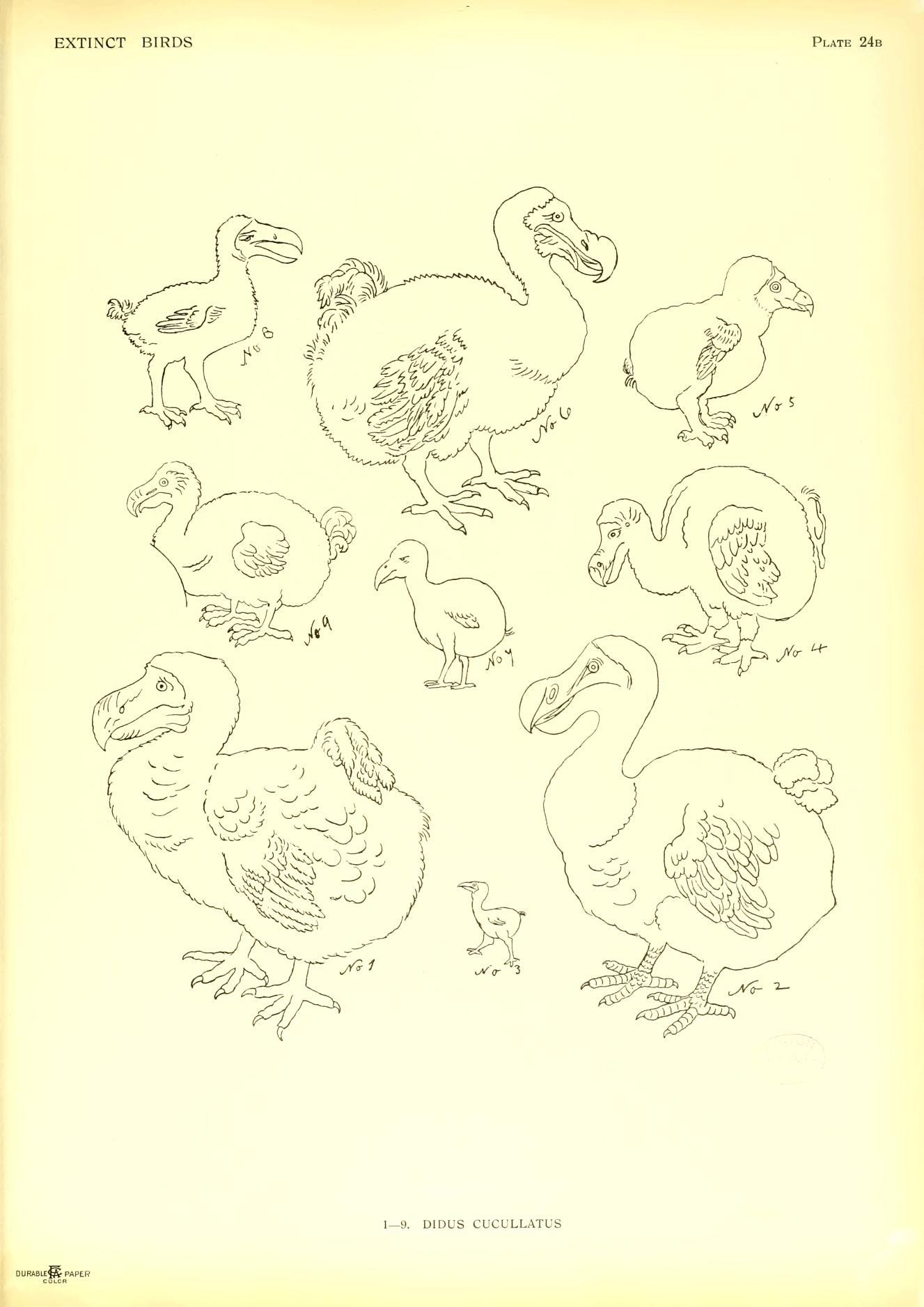
1-9. DIDUS CUCULLATUS
Plate 24c
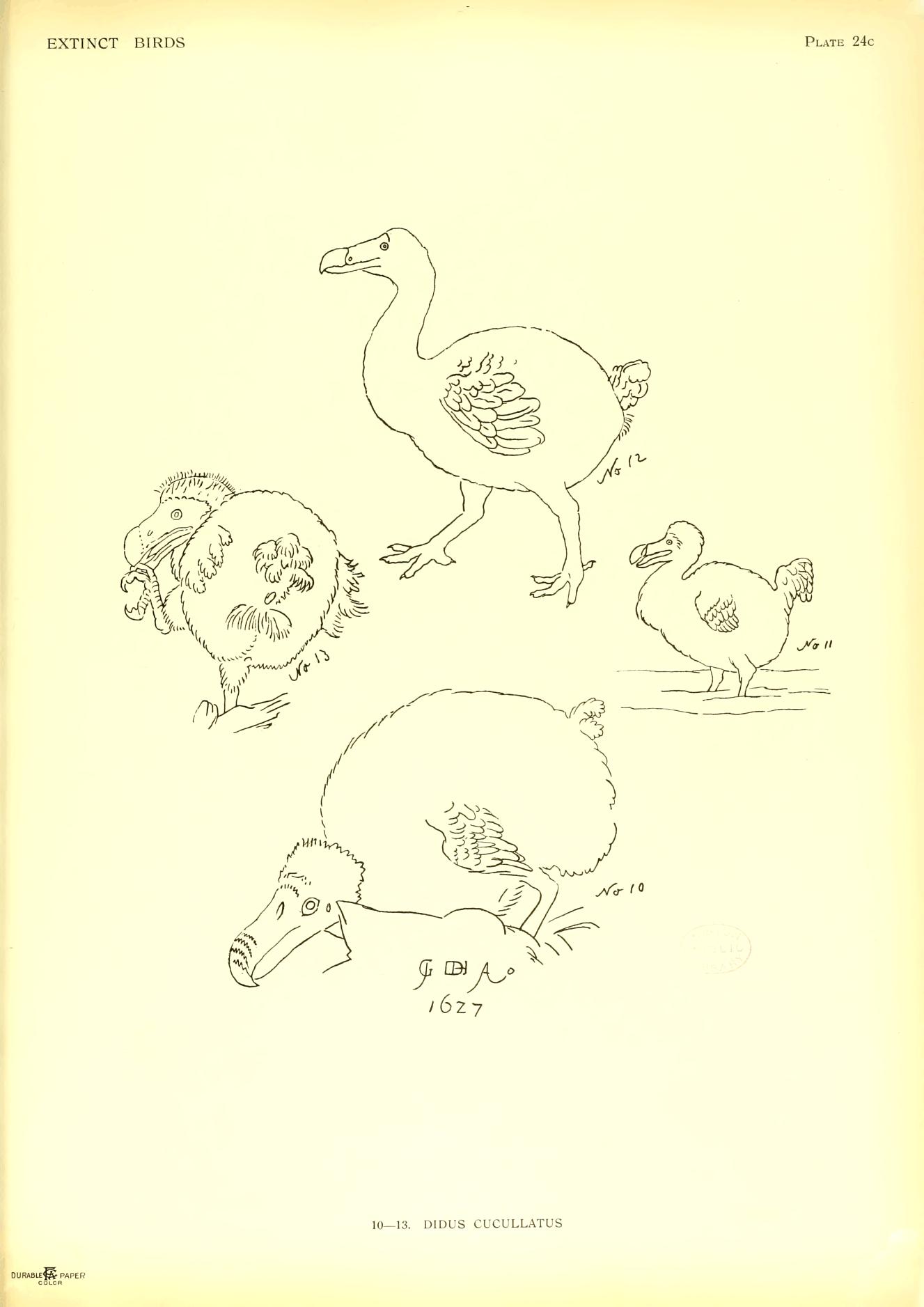
10-13. DIDUS CUCULLATUS
Plate 25
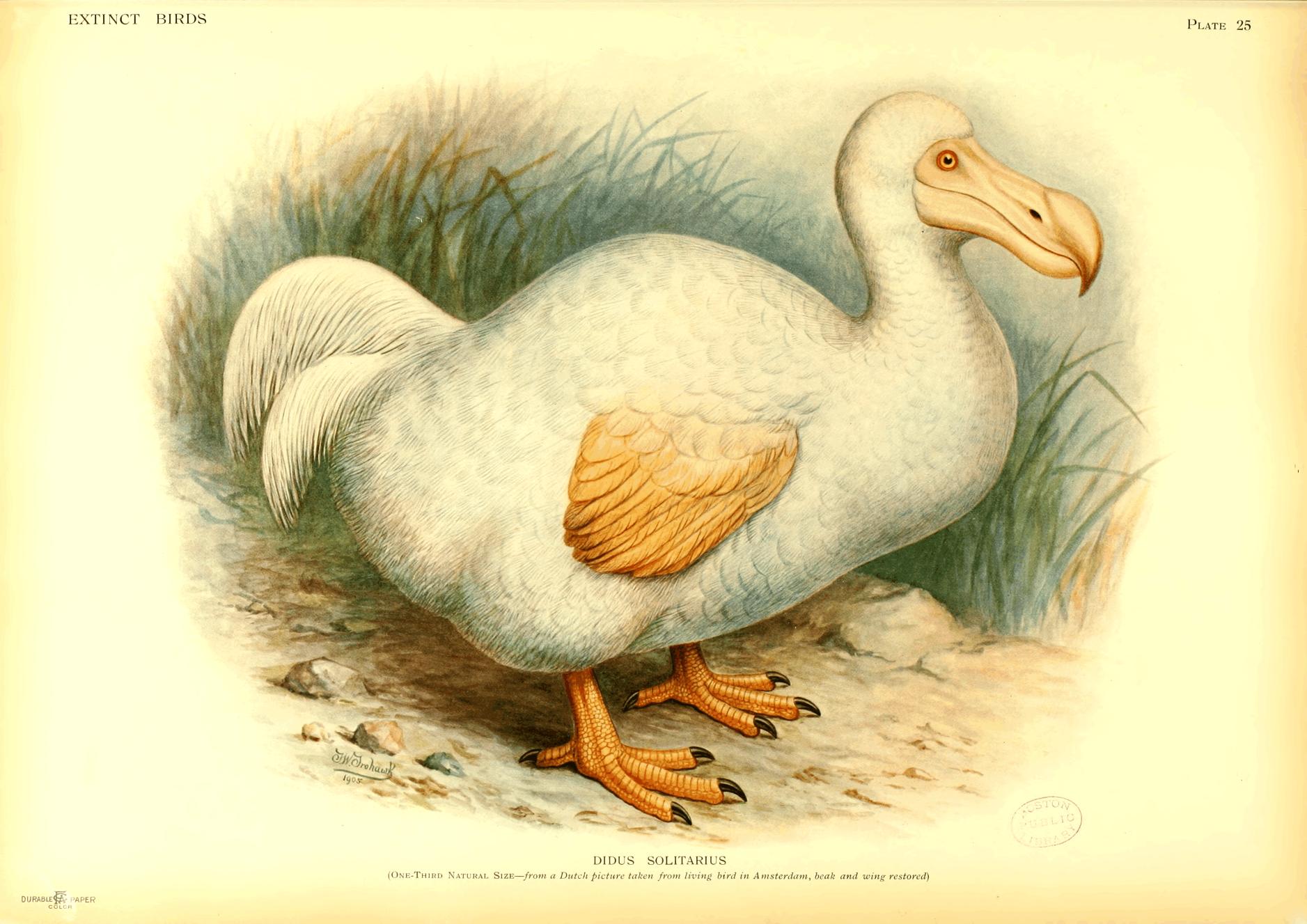
DIDUS SOLITARIUS (One-Third Natural Size—from a Dutch picture taken from living bird in Amsterdam, beak and wing restored)
Plate 25a
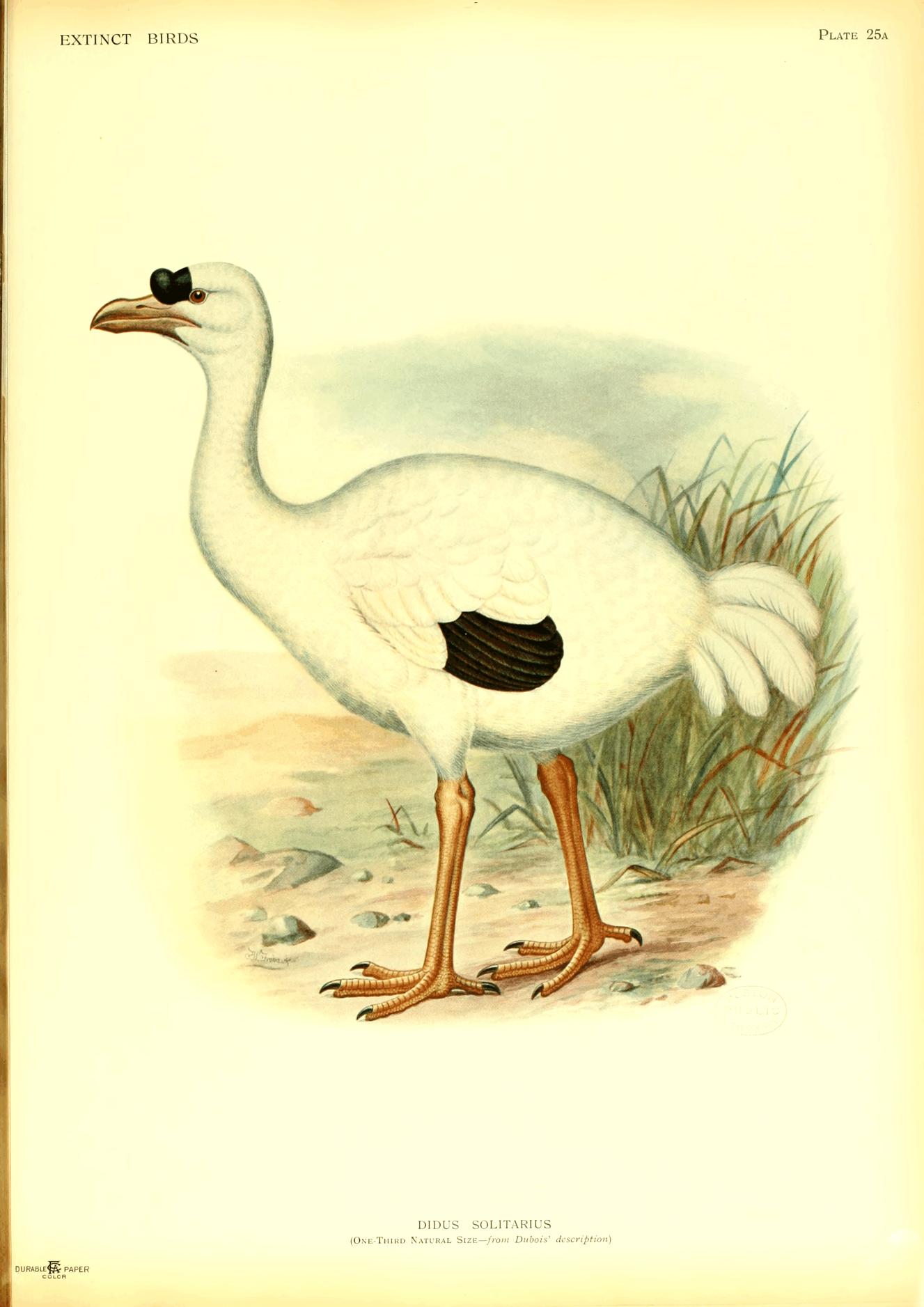
DIDUS SOLITARIUS (One-Third Natural Size—from Dubois' description)
Plate 25b
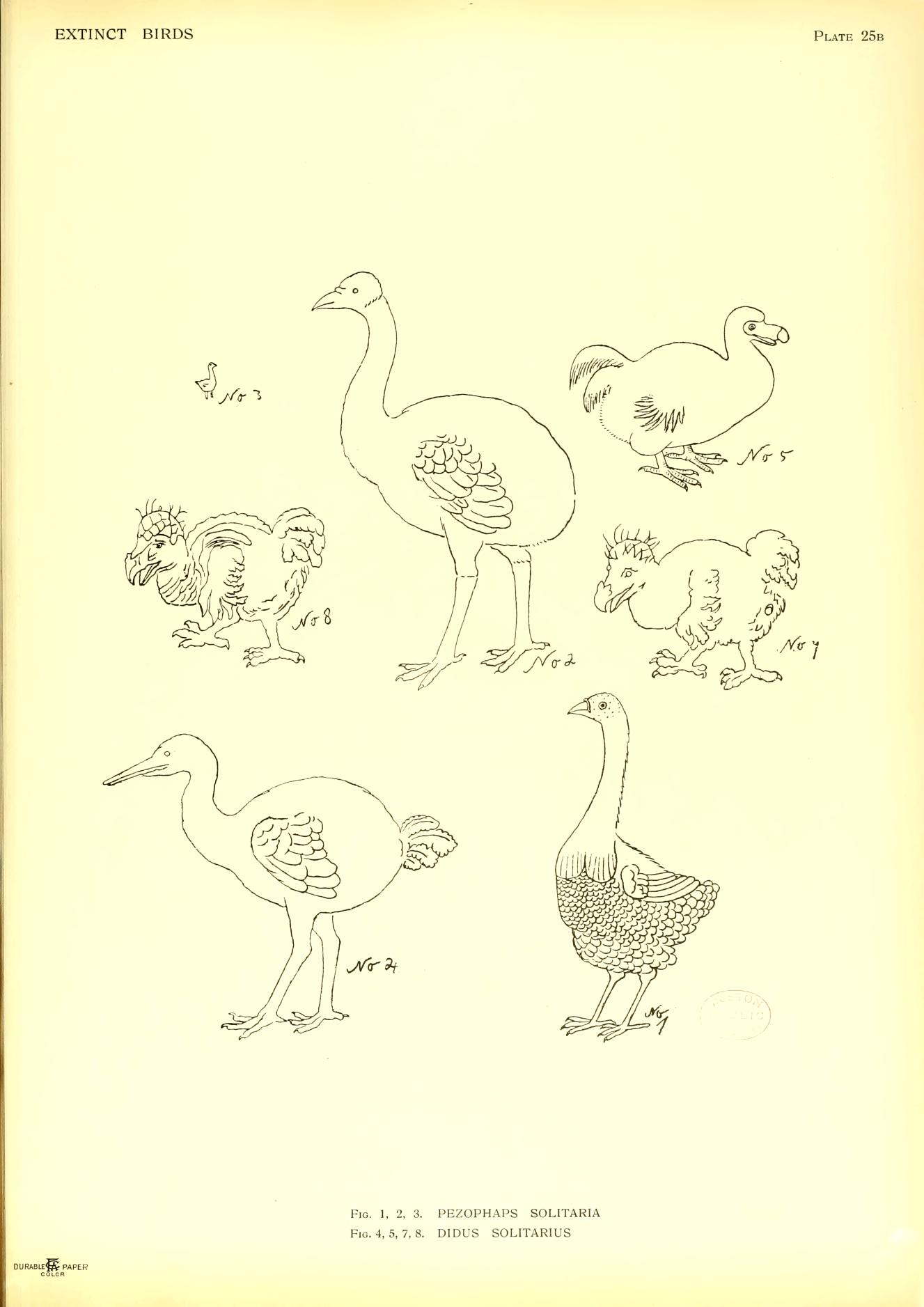
Fig. 1, 2, 3. PEZOPHAPS SOLITARIA Fig. 4, 5, 7, 8. DIDUS SOLITARIUS
Plate 26
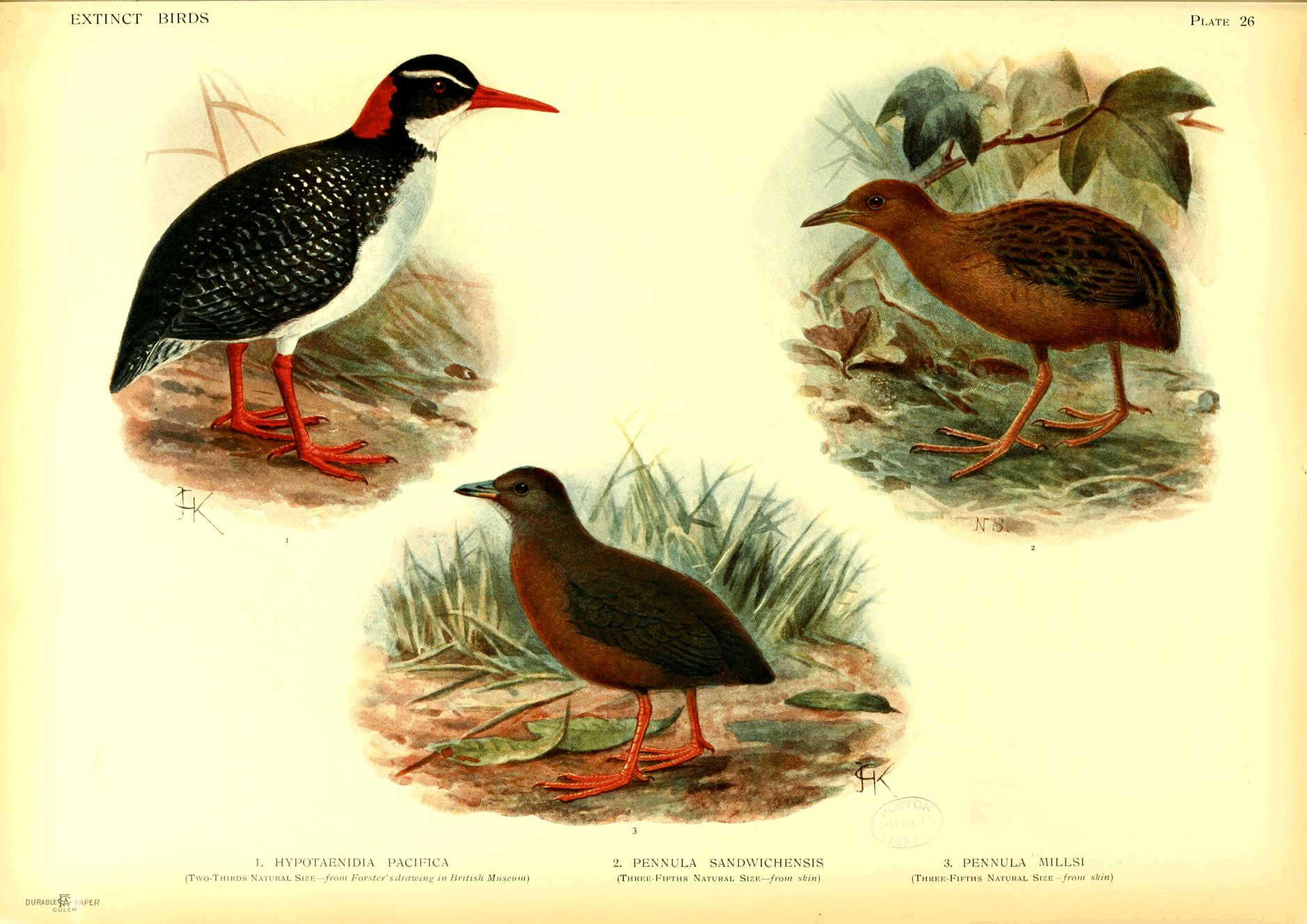
1. HYPOTAENIDIA PACIFICA (Two-Thirds Natural Size—from Forster's drawing in British Museum) 2. PENNULA SANDWICHENSIS (Three-Fifths Natural Size—from skin) 3. PENNULA MILLSI (Three-Fifths Natural Size—from skin)
Plate 27
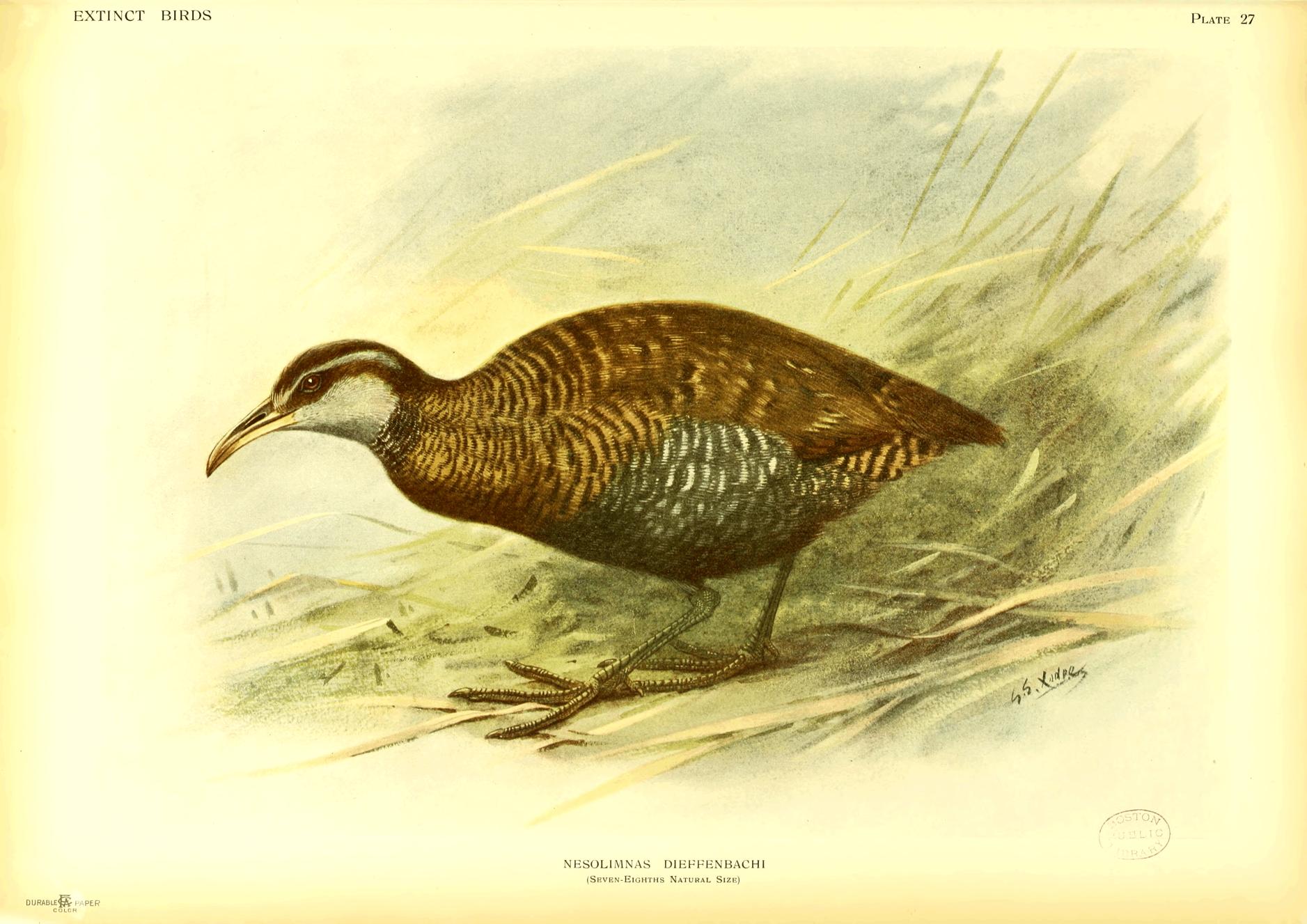
NESOLIMNAS DIEFFENBACHI (Seven-Eighths Natural Size)
Plate 28
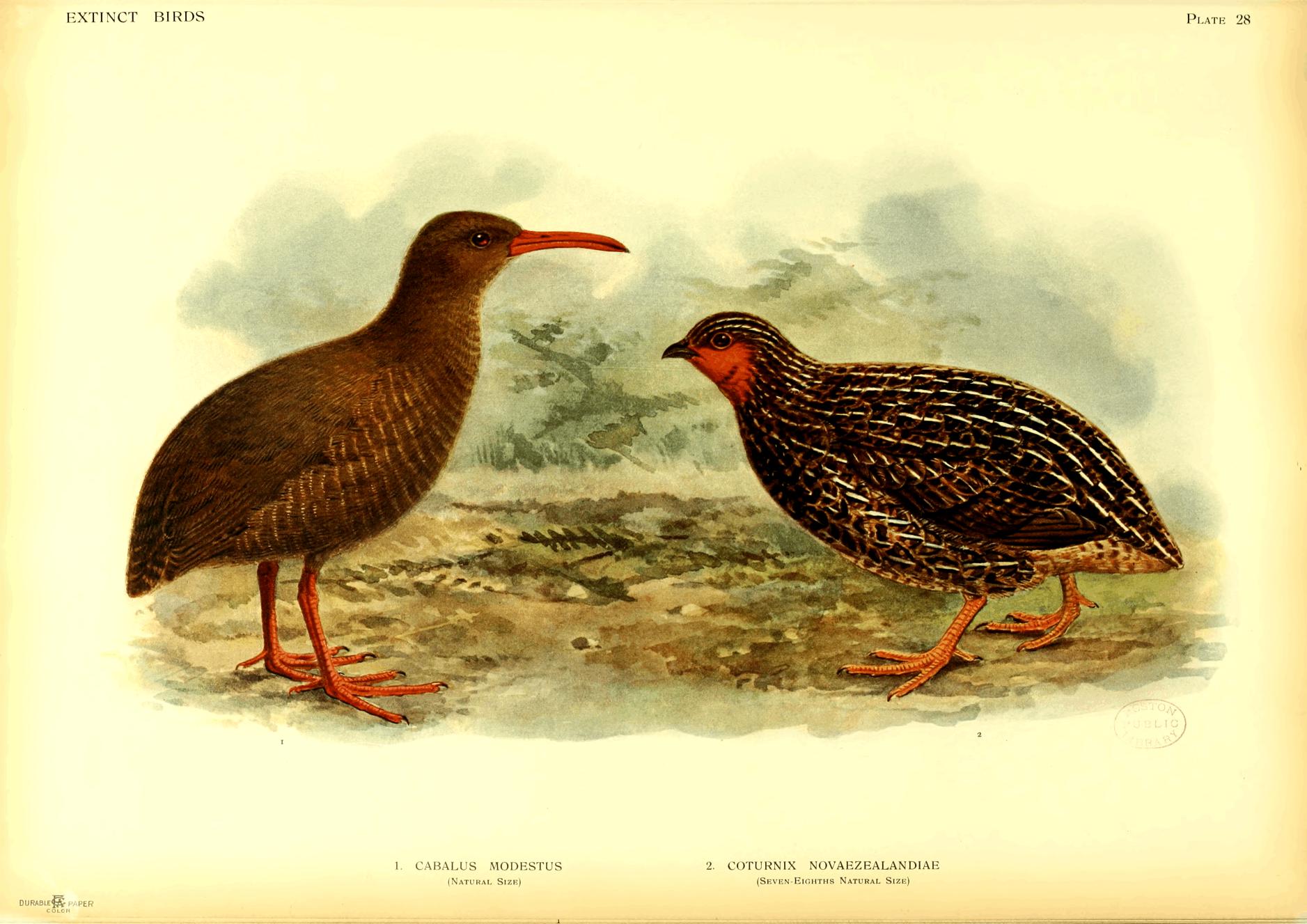
1. CABALUS MODESTUS (Natural Size) 2. COTURNIX NOVAEZEALANDIAE (Seven-Eighths Natural Size)
Plate 29
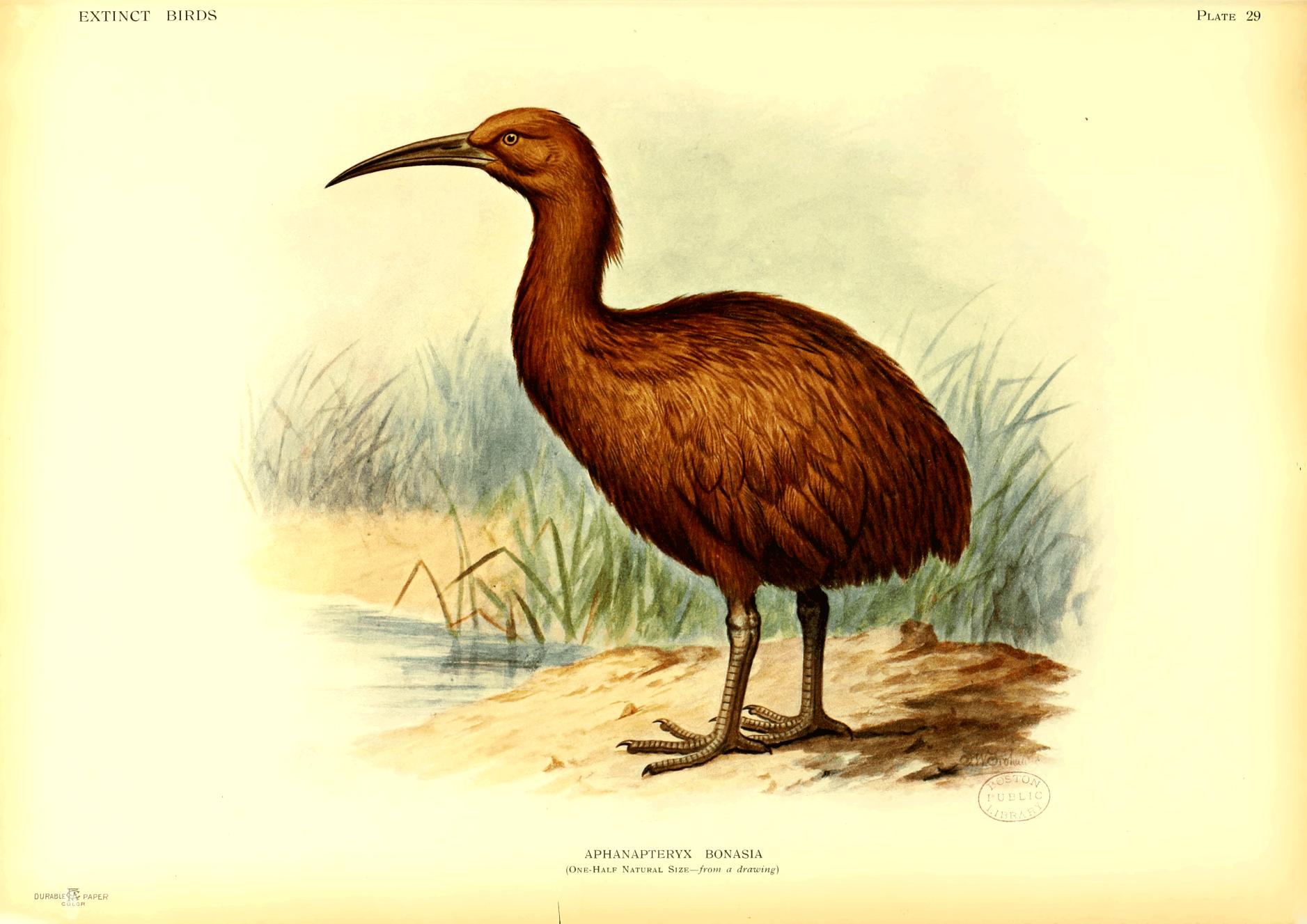
APHANAPTERYX BONASIA (One-Half Natural Size—from a drawing)
Plate 30
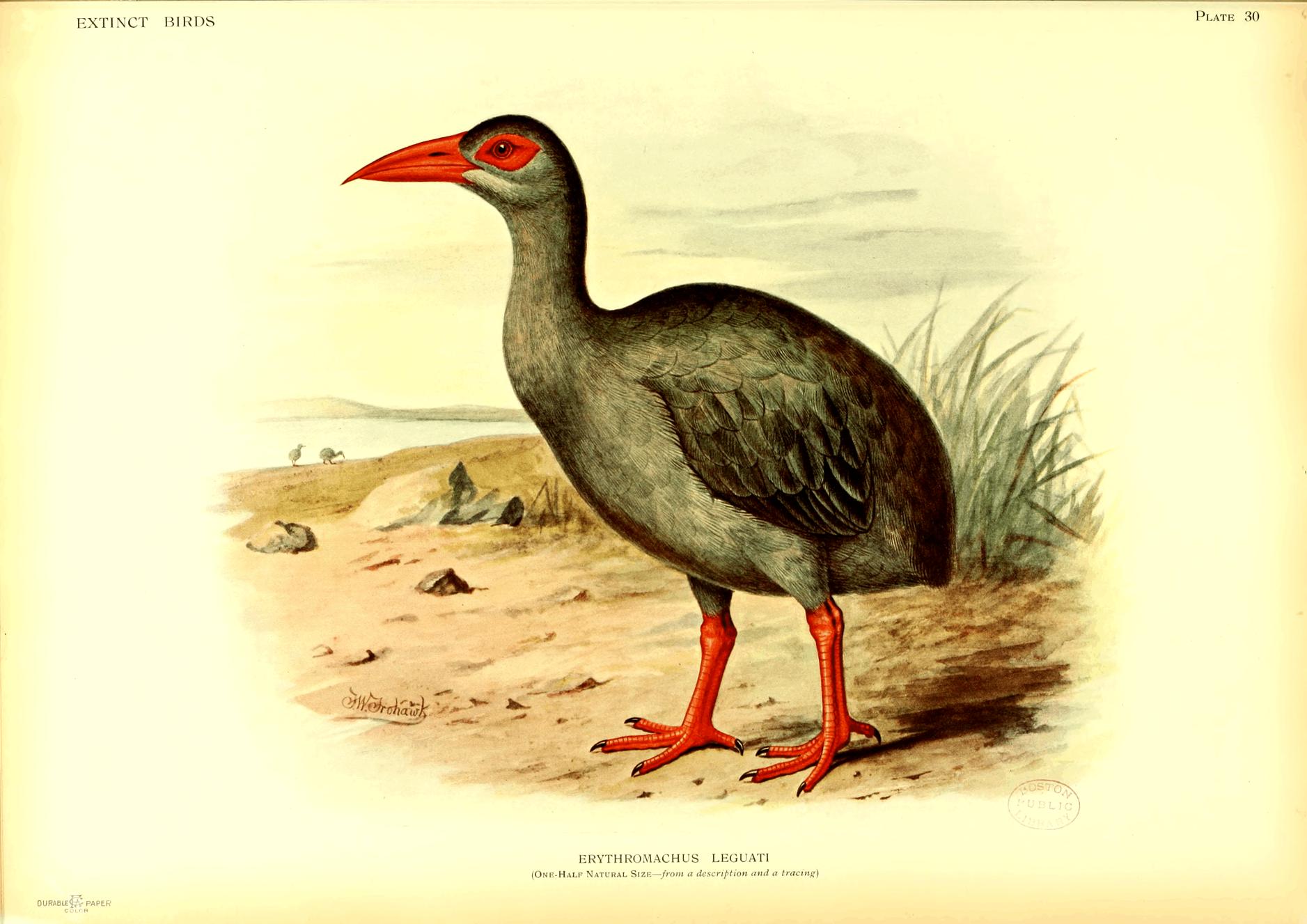
ERYTHROMACHUS LEGUATI (One-Half Natural Size—from a description and a tracing)
Plate 31
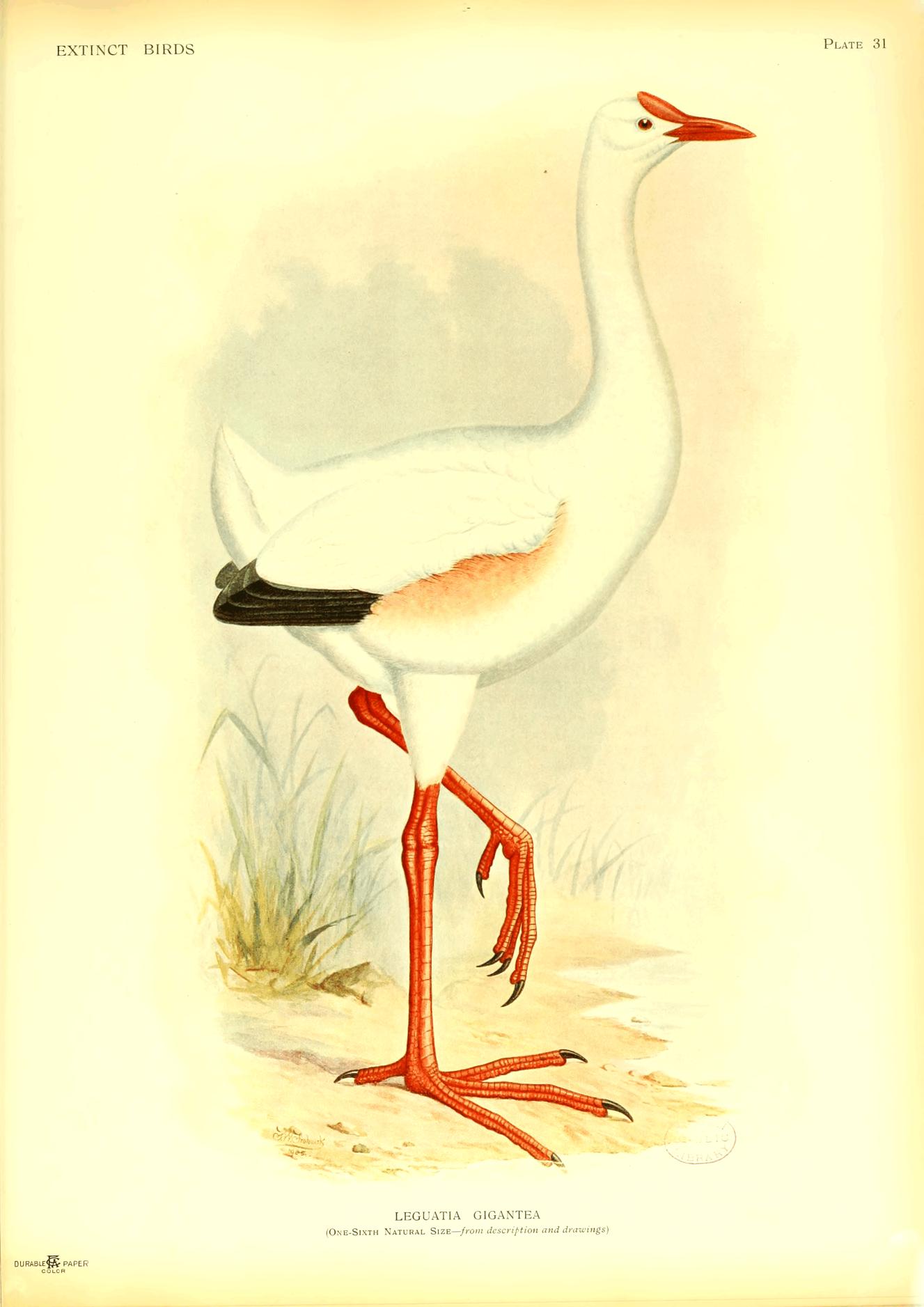
LEGUATIA GIGANTEA (One-Sixth Natural Size—from description and drawings)
Plate 32
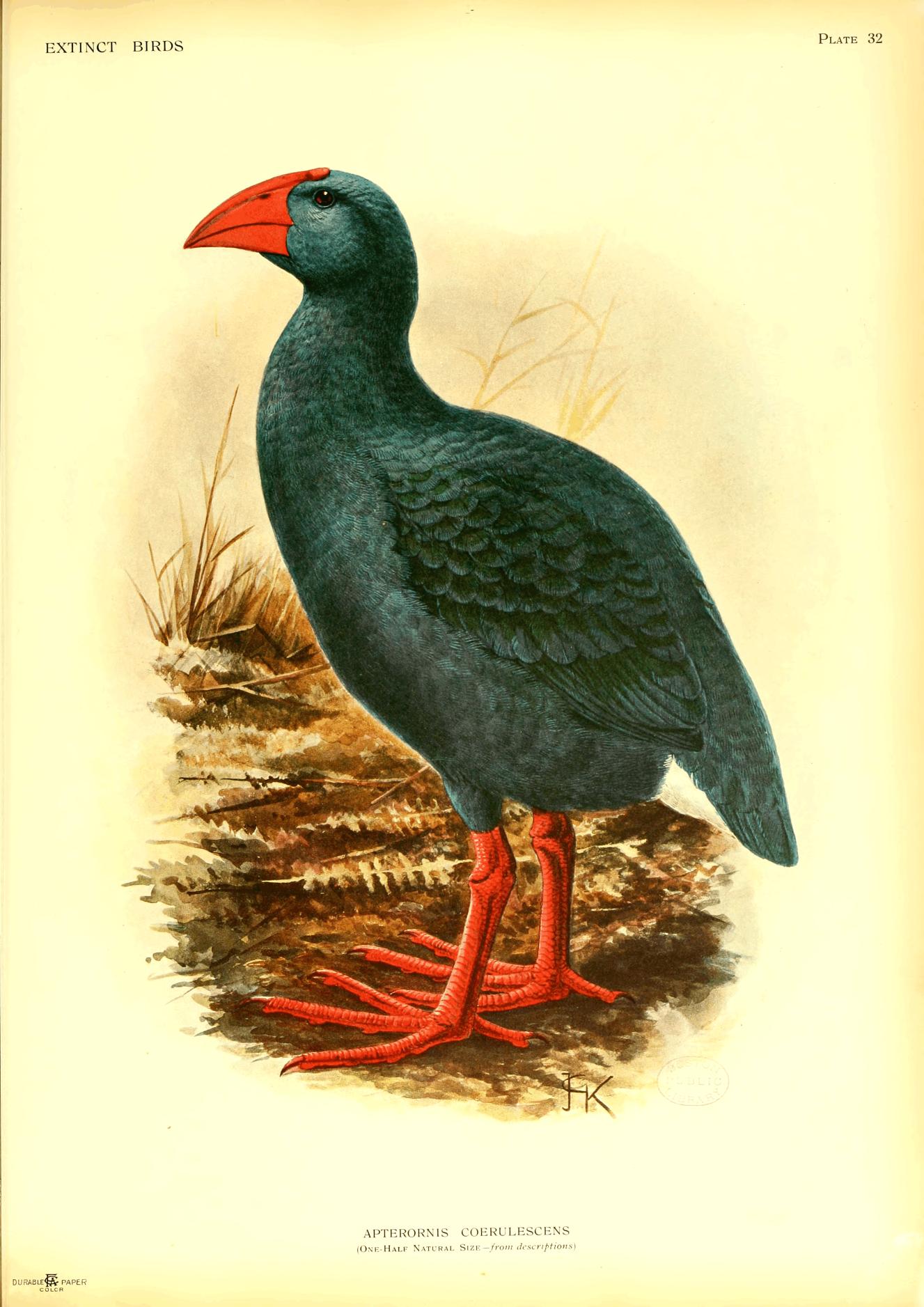
APTERORNIS COERULESCENS (One-Half Natural Size—from descriptions)
Plate 33
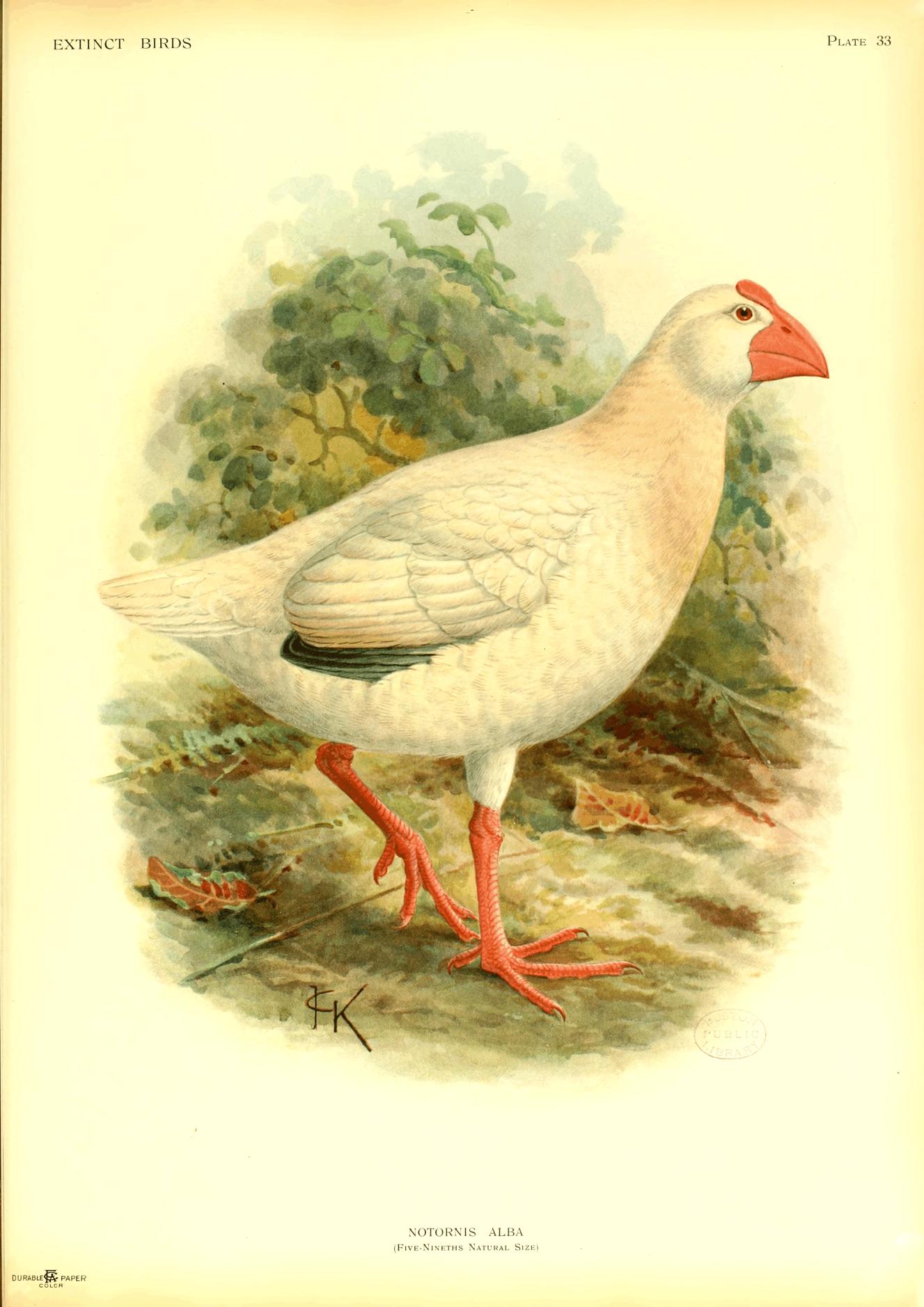
NOTORNIS ALBA (Five-Nineths Natural Size)
Plate 34
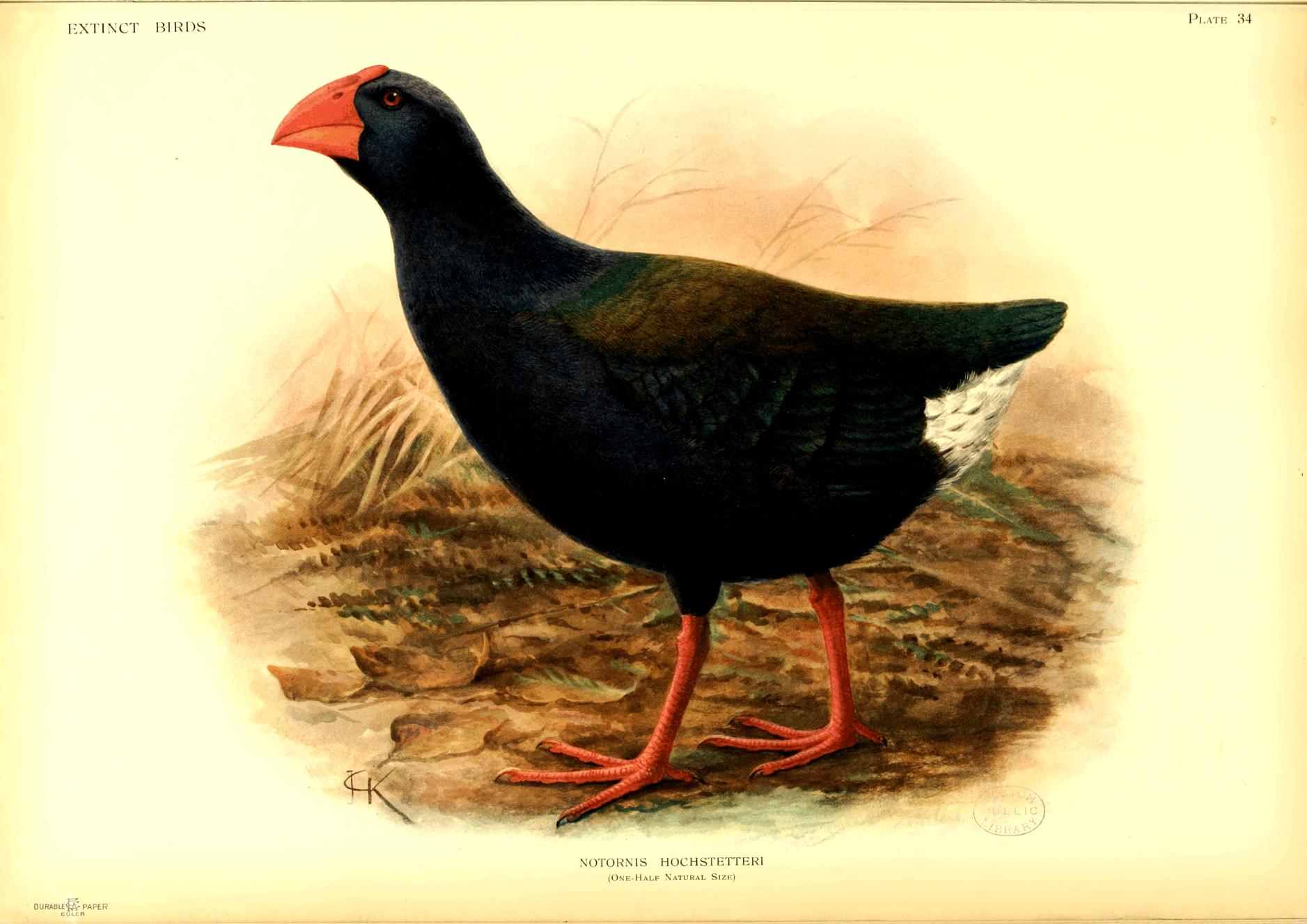
NOTORNIS HOCHSTETTERI (One-Half Natural Size)
Plate 35
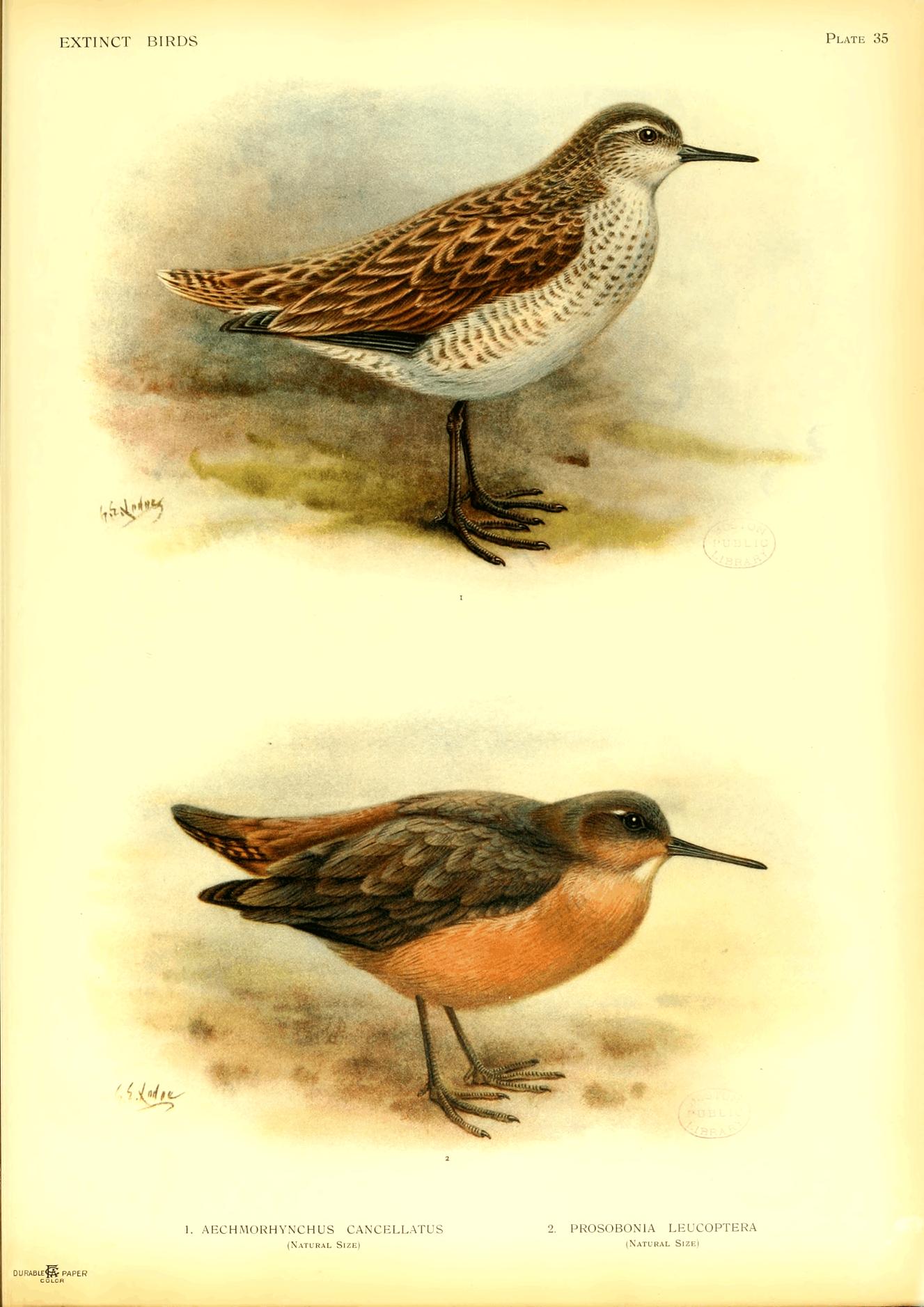
1. AECHMORHYNCHUS CANCELLATUS (Natural Size) 2. PROSOBONIA LEUCOPTERA (Natural Size)
Plate 36
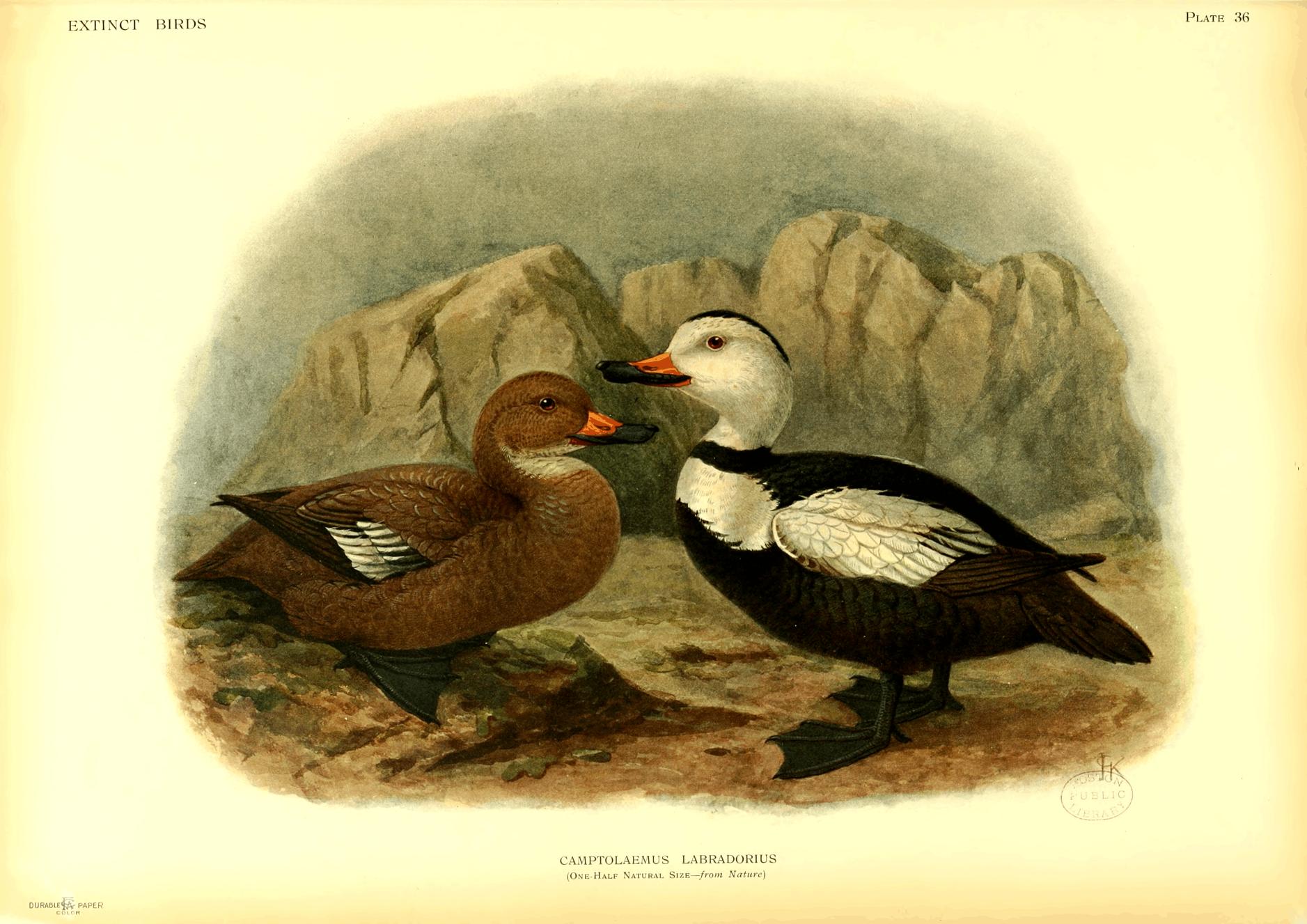
CAMPTOLAEMUS LABRADORIUS (One-Half Natural Size—from Nature)
Plate 37
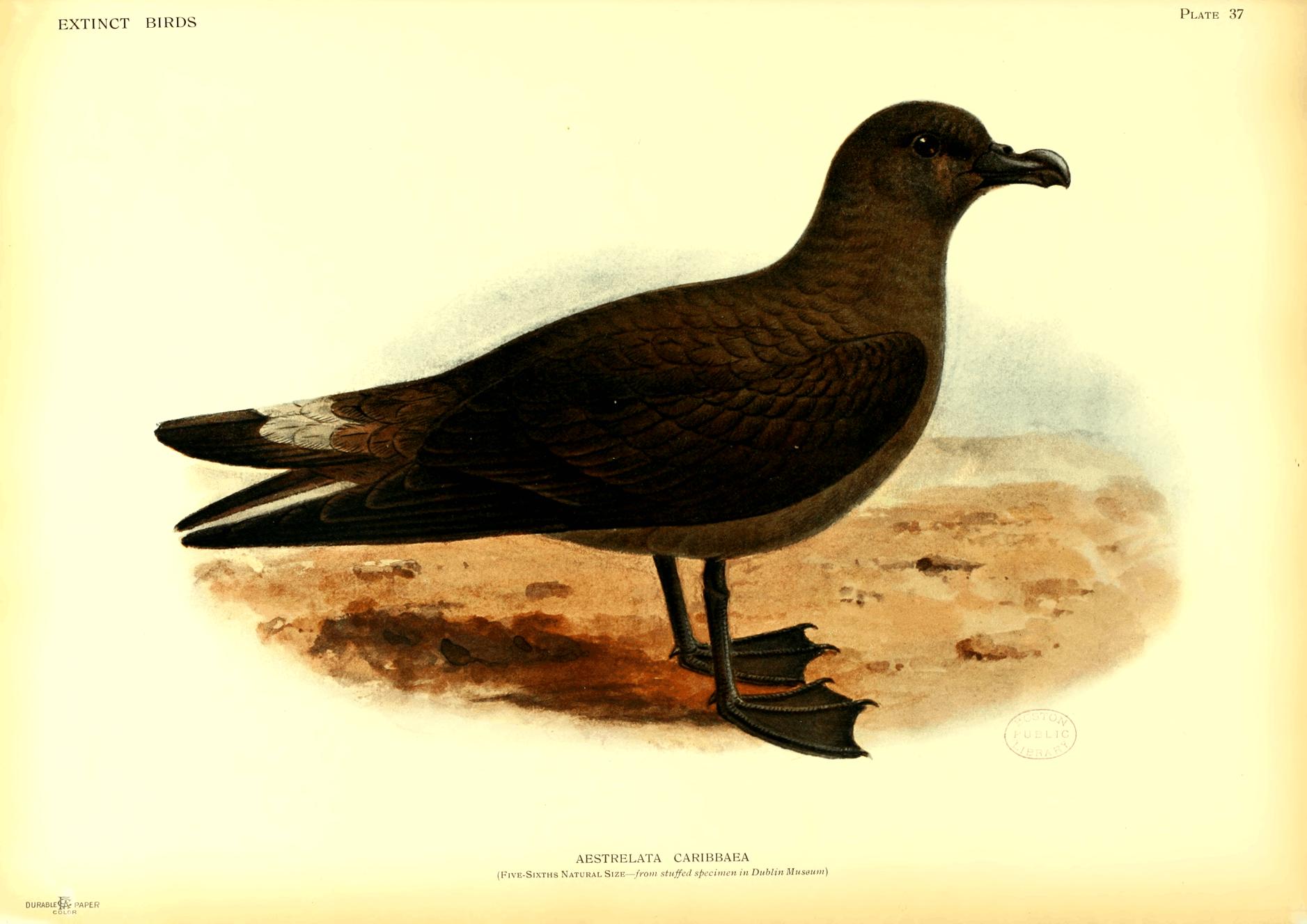
AESTRELATA CARIBBAEA (Five-Sixths Natural Size—from stuffed specimen in Dublin Museum)
Plate 38
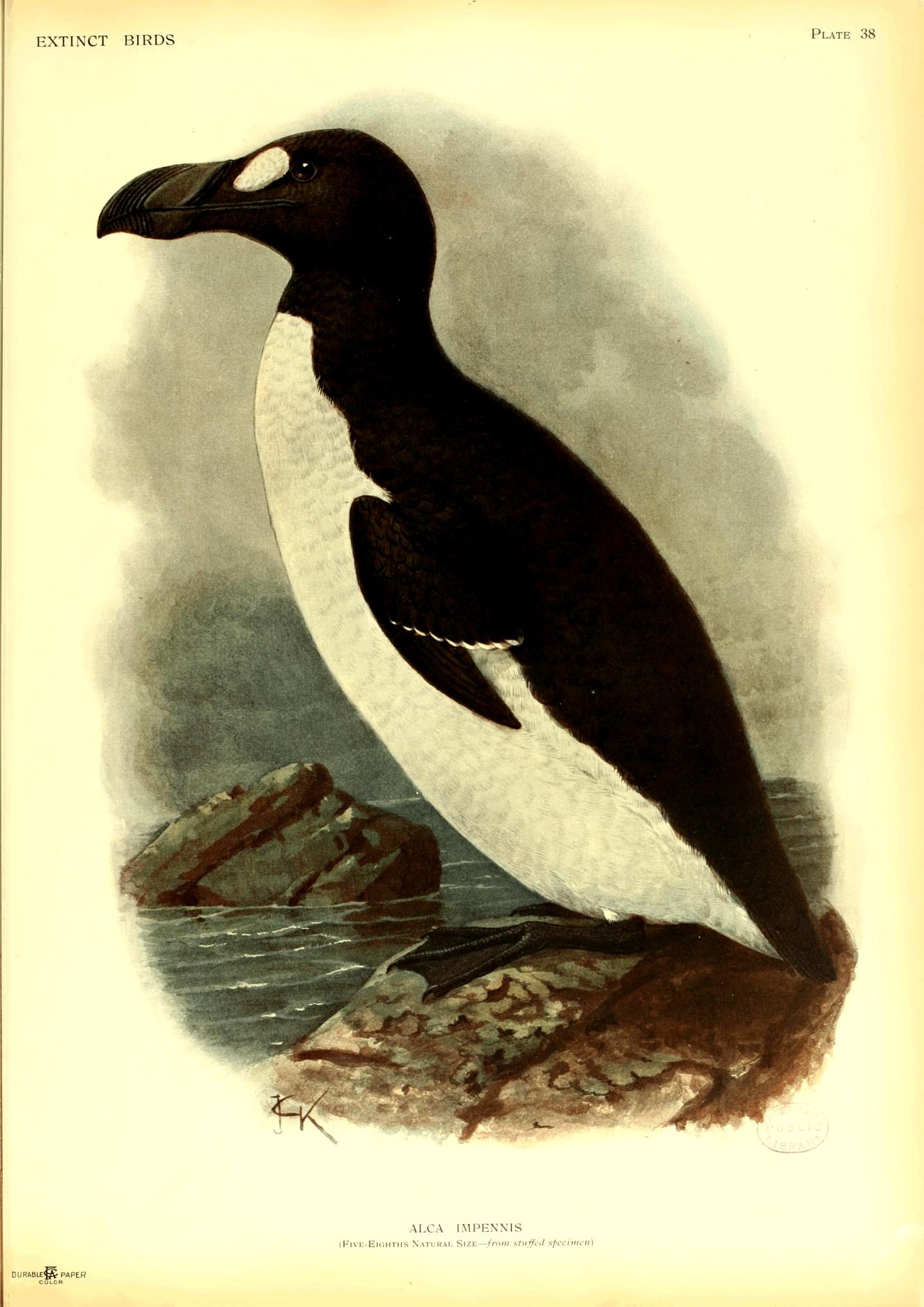
ALCA IMPENNIS (Five-Eighths Natural Size—from stuffed specimen)
Plate 39
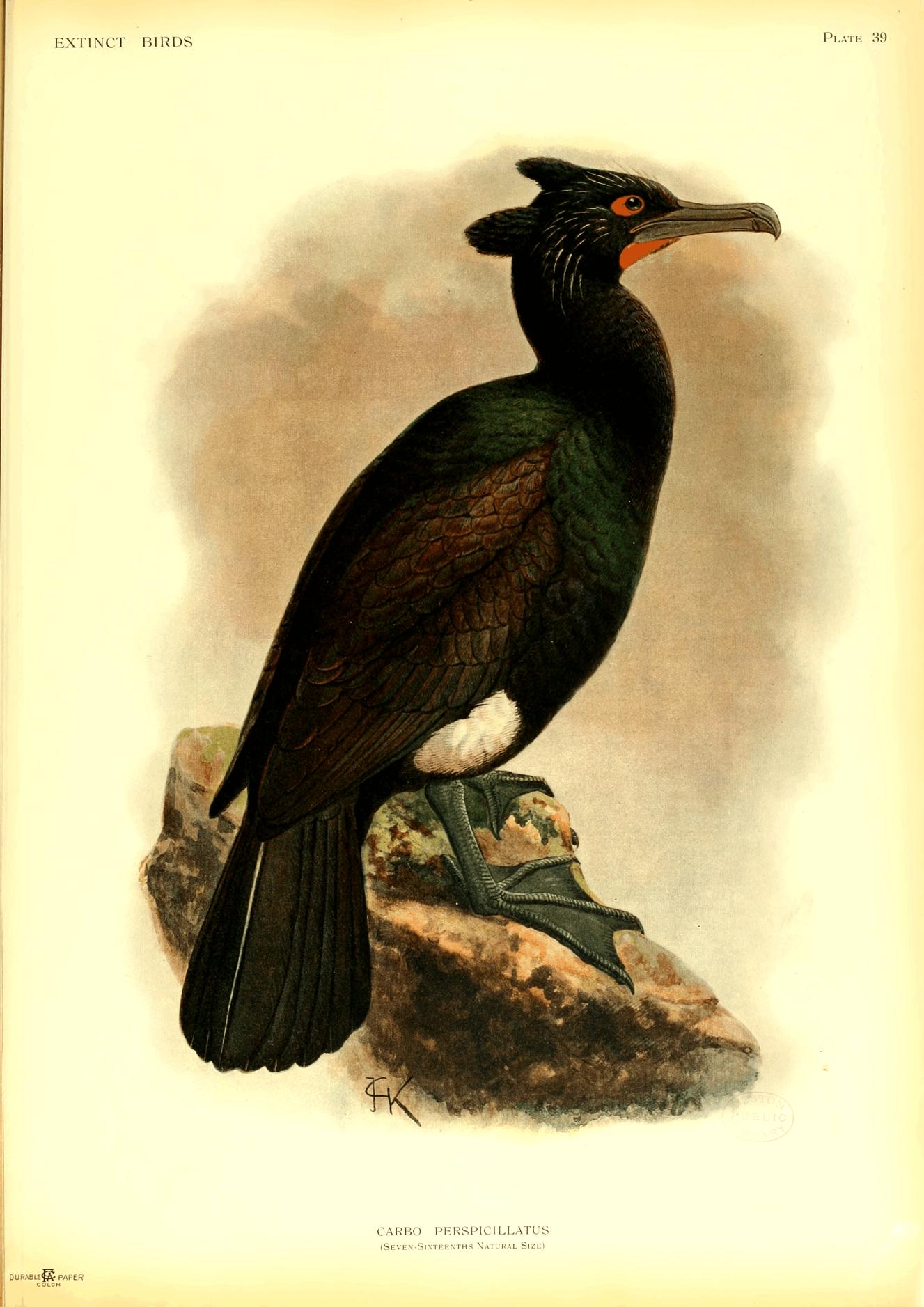
CARBO PERSPICILLATUS (Seven-Sixteenths Natural Size)
Plate 40
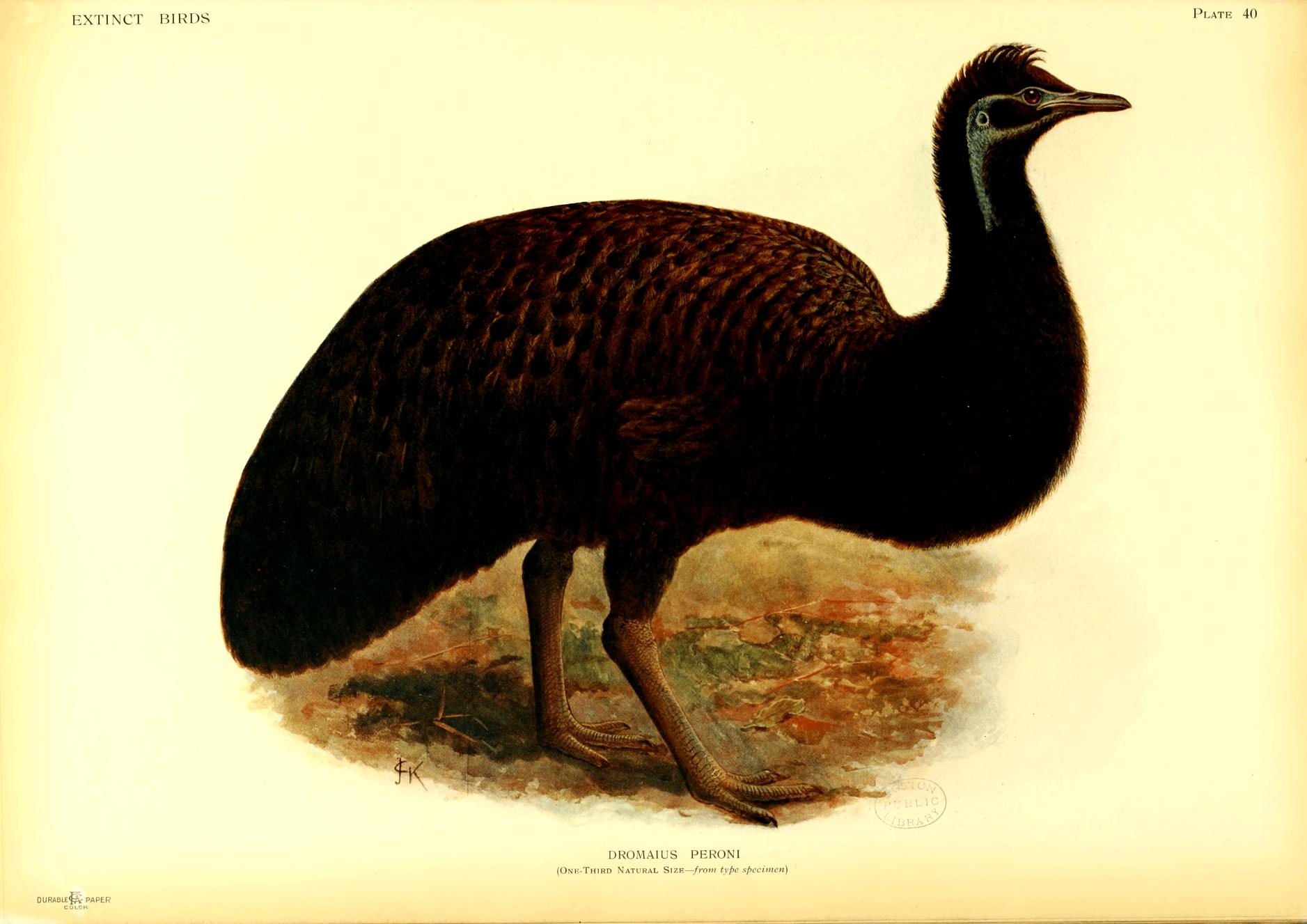
DROMAIUS PERONI (One-Third Natural Size—from type specimen)
Plate 41
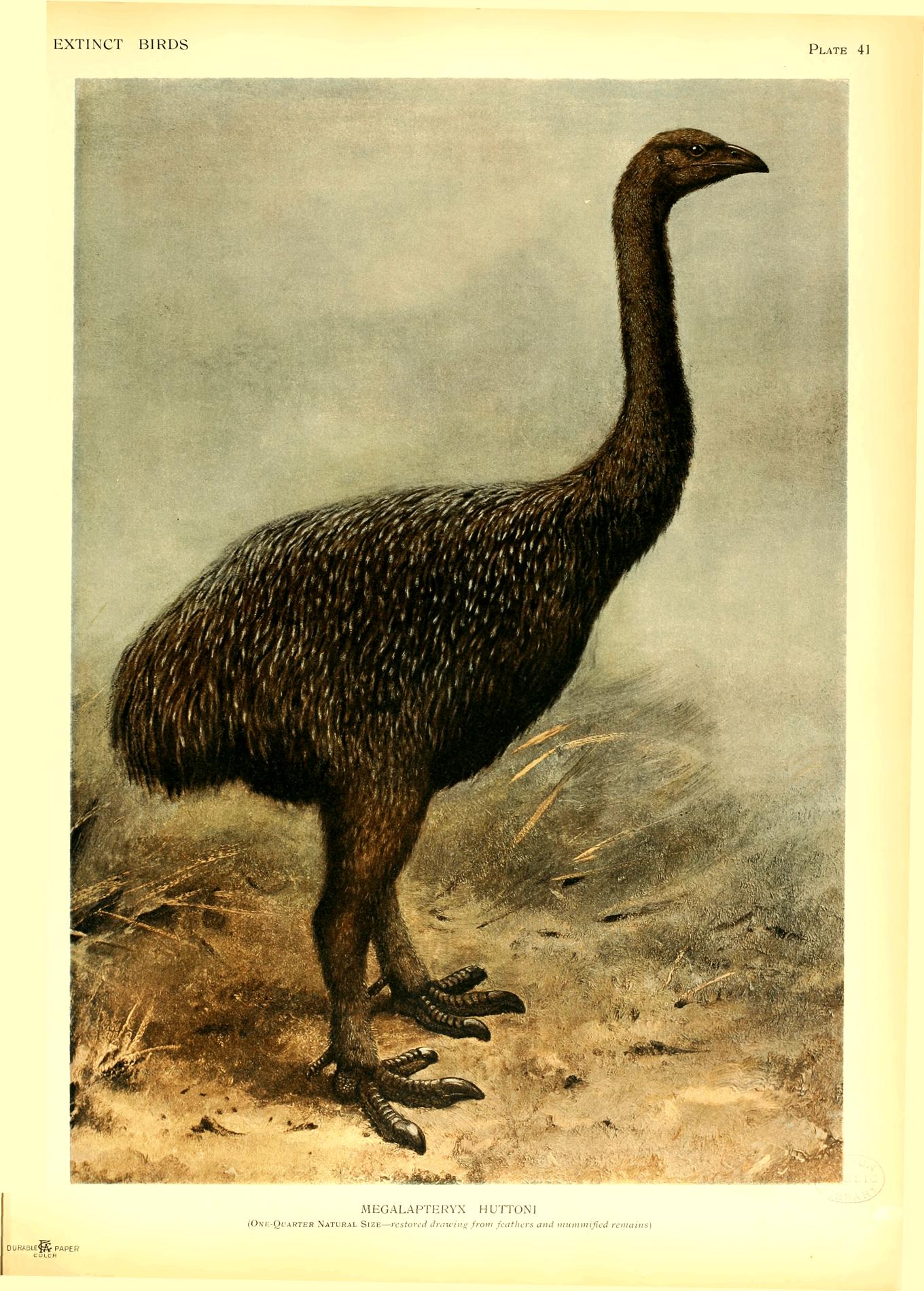
MEGALAPTERYX HUTTONI (One-Quarter Natural Size—restored drawing from feathers and mummified remains)
Plate 42
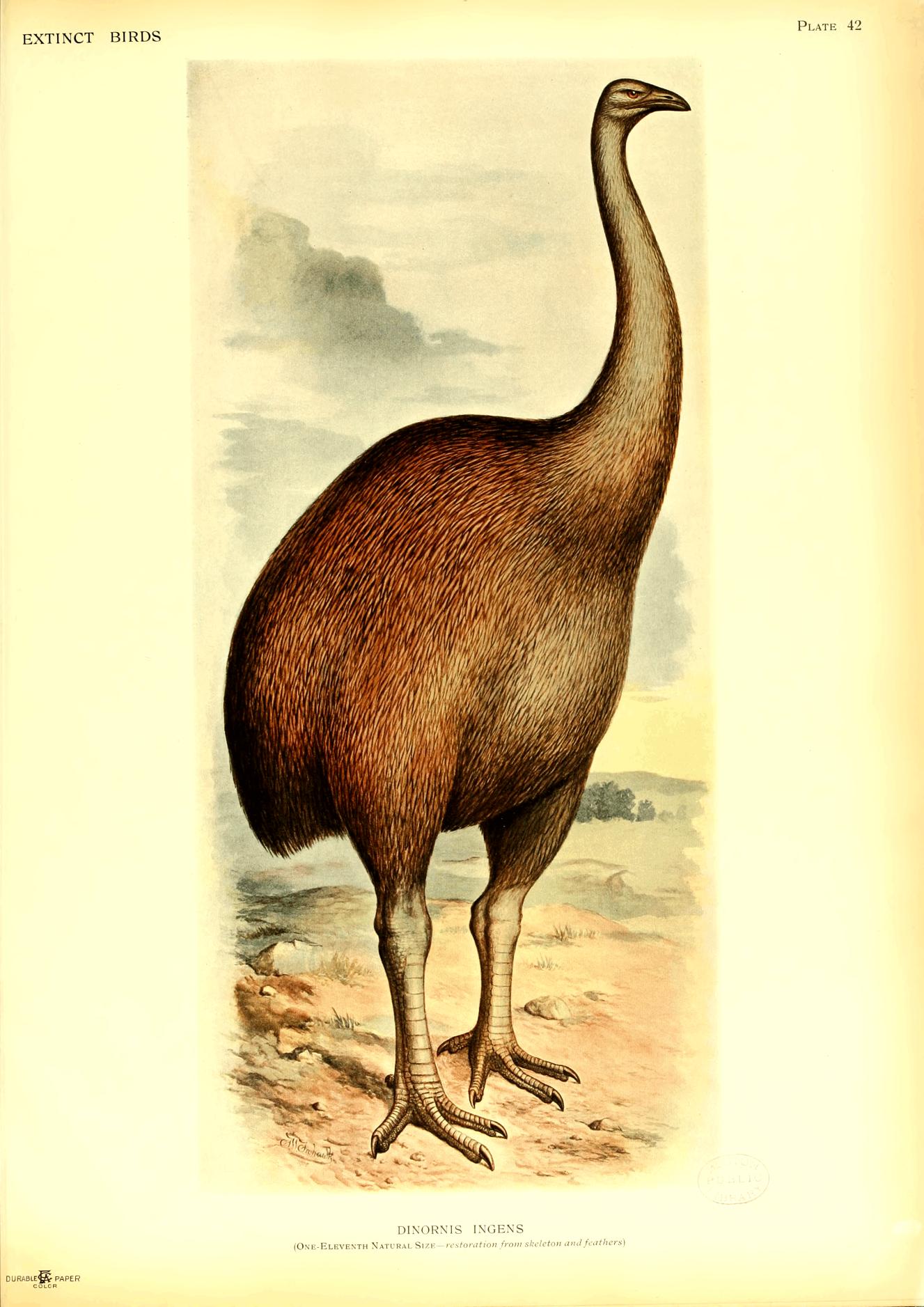
DINORNIS INGENS (One-Eleventh Natural Size—restoration from skeleton and feathers)
NOTES
[1] "Psittacus brachyurus fuscus, facie nigra, cauda albente. Habitat in Mascarina. Rostrum incarnatum. Caput caerulescens."
[2] See Findlay's South Pacific Ocean Directory, p. 642.
[3] Ibis 1862, p. 214.
[4] Proceedings of the Delaware Valley Ornithological Club, II, 1898, 17.
[5] Wintle, Birds of Montreal, 1896, 51.
[6] In collection of Dr. J. Dwight, Jr.
[7] Minot, Birds of New England, 1895, 395.
[8] Auk, XX, 1903, 66.