Chapter V · THE SCENERY OF QUEBEC; AND THE RIVER ST. LAWRENCE (continued 4)
Reading edition
Notwithstanding the red maple is the most intense scarlet of any of our trees, the sugar maple has been the most celebrated, and Michaux in his "Sylva" does not speak of the autumnal color of the former. About the second of October, these trees, both large and small, are most brilliant, though many are still green. In "sprout-lands" they seem to vie with one another, and ever some particular one in the midst of the crowd will be of a peculiarly pure scarlet, and by its more intense color attract our eye even at a distance, and carry off the palm. A large red maple swamp, when at the height of its change, is the most obviously brilliant of all tangible things, where I dwell, so abundant is this tree with us. It varies much both in form and color. A great many are merely yellow; more, scarlet; others, scarlet deepening into crimson, more red than common. Look at yonder swamp of maples mixed with pines, at the base of a pine-clad hill, a quarter of a mile off, so that you get the full effect of the bright colors, without detecting the imperfections of the leaves, and see their yellow, scarlet, and crimson fires, of all tints, mingled and contrasted with the green. Some maples are yet green, only yellow or crimson-tipped on the edges of their flakes, like the edges of a hazelnut bur; some are wholly brilliant scarlet, raying out regularly and finely every way, bilaterally, like the veins of a leaf; others, of more irregular form, when I turn my head slightly, emptying out some of its earthiness and concealing the trunk of the tree, seem to rest heavily flake on flake, like yellow and scarlet clouds, wreath upon wreath, or like snow-drifts driving through the air, stratified by the wind. It adds greatly to the beauty of such a swamp at this season, that, even though there may be no other trees interspersed, it is not seen as a simple mass of color, but, different trees being of different colors and hues, the outline of each crescent treetop is distinct, and where one laps on to another. Yet a painter would hardly venture to make them thus distinct a quarter of a mile off.
As I go across a meadow directly toward a low rising ground this bright afternoon, I see, some fifty rods off toward the sun, the top of a maple swamp just appearing over the sheeny russet edge of the hill, a stripe apparently twenty rods long by ten feet deep, of the most intensely brilliant scarlet, orange, and yellow, equal to any flowers or fruits, or any tints ever painted. As I advance, lowering the edge of the hill which makes the firm foreground or lower frame of the picture, the depth of the brilliant grove revealed steadily increases, suggesting that the whole of the inclosed valley is filled with such color. One wonders that the tithing-men and fathers of the town are not out to see what the trees mean by their high colors and exuberance of spirits, fearing that some mischief is brewing. I do not see what the Puritans did at this season, when the maples blaze out in scarlet. They certainly could not have worshiped in groves then. Perhaps that is what they built meeting-houses and fenced them round with horse-sheds for.
THE ELM
Now too, the first of October, or later, the elms are at the height of their autumnal beauty,—great brownish-yellow masses, warm from their September oven, hanging over the highway. Their leaves are perfectly ripe. I wonder if there is any answering ripeness in the lives of the men who live beneath them. As I look down our street, which is lined with them, they remind me both by their form and color of yellowing sheaves of grain, as if the harvest had indeed come to the village itself, and we might expect to find some maturity and flavor in the thoughts of the villagers at last. Under those bright rustling yellow piles just ready to fall on the heads of the walkers, how can any crudity or greenness of thought or act prevail? When I stand where half a dozen large elms droop over a house, it is as if I stood within a ripe pumpkin-rind, and I feel as mellow as if I were the pulp, though I may be somewhat stringy and seedy withal. What is the late greenness of the English elm, like a cucumber out of season, which does not know when to have done, compared with the early and golden maturity of the American tree? The street is the scene of a great harvest-home. It would be worth the while to set out these trees, if only for their autumnal value. Think of these great yellow canopies or parasols held over our heads and houses by the mile together, making the village all one and compact,—an ulmarium, which is at the same time a nursery of men! And then how gently and unobserved they drop their burden and let in the sun when it is wanted, their leaves not heard when they fall on our roofs and in our streets; and thus the village parasol is shut up and put away! I see the market-man driving into the village, and disappearing under its canopy of elm-tops, with his crop, as into a great granary or barn-yard. I am tempted to go thither as to a husking of thoughts, now dry and ripe, and ready to be separated from their integuments; but, alas! I foresee that it will be chiefly husks and little thought, blasted pig-corn, fit only for cob-meal,—for, as you sow, so shall you reap.
FALLEN LEAVES
By the sixth of October the leaves generally begin to fall, in successive showers, after frost or rain; but the principal leaf-harvest, the acme of the Fall, is commonly about the sixteenth. Some morning at that date there is perhaps a harder frost than we have seen, and ice formed under the pump, and now, when the morning wind rises, the leaves come down in denser showers than ever. They suddenly form thick beds or carpets on the ground, in this gentle air, or even without wind, just the size and form of the tree above. Some trees, as small hickories, appear to have dropped their leaves instantaneously, as a soldier grounds arms at a signal; and those of the hickory, being bright yellow still, though withered, reflect a blaze of light from the ground where they lie. Down they have come on all sides, at the first earnest touch of autumn's wand, making a sound like rain.
Or else it is after moist and rainy weather that we notice how great a fall of leaves there has been in the night, though it may not yet be the touch that loosens the rock maple leaf. The streets are thickly strewn with the trophies, and fallen elm leaves make a dark brown pavement under our feet. After some remarkably warm Indian-summer day or days, I perceive that it is the unusual heat which, more than anything, causes the leaves to fall, there having been, perhaps, no frost nor rain for some time. The intense heat suddenly ripens and wilts them, just as it softens and ripens peaches and other fruits, and causes them to drop.
The leaves of late red maples, still bright, strew the earth, often crimson-spotted on a yellow ground, like some wild apples,—though they preserve these bright colors on the ground but a day or two, especially if it rains. On causeways I go by trees here and there all bare and smoke-like, having lost their brilliant clothing; but there it lies, nearly as bright as ever, on the ground on one side, and making nearly as regular a figure as lately on the tree. I would rather say that I first observe the trees thus flat on the ground like a permanent colored shadow, and they suggest to look for the boughs that bore them. A queen might be proud to walk where these gallant trees have spread their bright cloaks in the mud. I see wagons roll over them as a shadow or a reflection, and the drivers heed them just as little as they did their shadows before.
Birds' nests, in the huckleberry and other shrubs, and in trees, are already being filled with the withered leaves. So many have fallen in the woods that a squirrel cannot run after a falling nut without being heard. Boys are raking them in the streets, if only for the pleasure of dealing with such clean, crisp substances. Some sweep the paths scrupulously neat, and then stand to see the next breath strew them with new trophies. The swamp floor is thickly covered, and the Lycopodium lucidulum looks suddenly greener amid them. In dense woods they half cover pools that are three or four rods long. The other day I could hardly find a well-known spring, and even suspected that it had dried up, for it was completely concealed by freshly fallen leaves; and when I swept them aside and revealed it, it was like striking the earth, with Aaron's rod, for a new spring. Wet grounds about the edges of swamps look dry with them. At one swamp, where I was surveying, thinking to step on a leafy shore from a rail, I got into the water more than a foot deep.
When I go to the river the day after the principal fall of leaves, the sixteenth, I find my boat all covered, bottom and seats, with the leaves of the golden willow under which it is moored, and I set sail with a cargo of them rustling under my feet. If I empty it, it will be full again to-morrow. I do not regard them as litter, to be swept out, but accept them as suitable straw or matting for the bottom of my carriage. When I turn up into the mouth of the Assabet, which is wooded, large fleets of leaves are floating on its surface, as it were getting out to sea, with room to tack; but next the shore, a little farther up, they are thicker than foam, quite concealing the water for a rod in width, under and amid the alders, button-bushes, and maples, still perfectly light and dry, with fibre unrelaxed; and at a rocky bend where they are met and stopped by the morning wind, they sometimes form a broad and dense crescent quite across the river. When I turn my prow that way, and the wave which it makes strikes them, list what a pleasant rustling from these dry substances getting on one another! Often it is their undulation only which reveals the water beneath them. Also every motion of the wood turtle on the shore is betrayed by their rustling there. Or even in mid-channel, when the wind rises, I hear them blown with a rustling sound. Higher up they are slowly moving round and round in some great eddy which the river makes, as that at the "Leaning Hemlocks," where the water is deep, and the current is wearing into the bank.
Perchance, in the afternoon of such a day, when the water is perfectly calm and full of reflections, I paddle gently down the main stream, and, turning up the Assabet, reach a quiet cove, where I unexpectedly find myself surrounded by myriads of leaves, like fellow-voyagers, which seem to have the same purpose, or want of purpose, with myself. See this great fleet of scattered leaf-boats which we paddle amid, in this smooth river-bay, each one curled up on every side by the sun's skill, each nerve a stiff spruce knee,—like boats of hide, and of all patterns,—Charon's boat probably among the rest,—and some with lofty prows and poops, like the stately vessels of the ancients, scarcely moving in the sluggish current,—like the great fleets, the dense Chinese cities of boats, with which you mingle on entering some great mart, some New York or Canton, which we are all steadily approaching together. How gently each has been deposited on the water! No violence has been used towards them yet, though, perchance, palpitating hearts were present at the launching. And painted ducks, too, the splendid wood duck among the rest, often come to sail and float amid the painted leaves,—barks of a nobler model still!
What wholesome herb drinks are to be had in the swamps now! What strong medicinal but rich scents from the decaying leaves! The rain falling on the freshly dried herbs and leaves, and filling the pools and ditches into which they have dropped thus clean and rigid, will soon convert them into tea,—green, black, brown, and yellow teas, of all degrees of strength, enough to set all Nature a-gossiping. Whether we drink them or not, as yet, before their strength is drawn, these leaves, dried on great Nature's coppers, are of such various pure and delicate tints as might make the fame of Oriental teas.
How they are mixed up, of all species, oak and maple and chestnut and birch! But Nature is not cluttered with them; she is a perfect husbandman; she stores them all. Consider what a vast crop is thus annually shed on the earth! This, more than any mere grain or seed, is the great harvest of the year. The trees are now repaying the earth with interest what they have taken from it. They are discounting. They are about to add a leaf's thickness to the depth of the soil. This is the beautiful way in which Nature gets her muck, while I chaffer with this man and that, who talks to me about sulphur and the cost of carting. We are all the richer for their decay. I am more interested in this crop than in the English grass alone or in the corn. It prepares the virgin mould for future corn-fields and forests, on which the earth fattens. It keeps our homestead in good heart.
For beautiful variety no crop can be compared with this. Here is not merely the plain yellow of the grains, but nearly all the colors that we know, the brightest blue not excepted: the early blushing maple, the poison sumach blazing its sins as scarlet, the mulberry ash, the rich chrome yellow of the poplars, the brilliant red huckleberry, with which the hills' backs are painted, like those of sheep. The frost touches them, and, with the slightest breath of returning day or jarring of earth's axle, see in what showers they come floating down! The ground is all parti-colored with them. But they still live in the soil, whose fertility and bulk they increase, and in the forests that spring from it. They stoop to rise, to mount higher in coming years, by subtle chemistry, climbing by the sap in the trees; and the sapling's first fruits thus shed, transmuted at last, may adorn its crown, when, in after years, it has become the monarch of the forest.
It is pleasant to walk over the beds of these fresh, crisp, and rustling leaves. How beautifully they go to their graves! how gently lay themselves down and turn to mould!—painted of a thousand hues, and fit to make the beds of us living. So they troop to their last resting-place, light and frisky. They put on no weeds, but merrily they go scampering over the earth, selecting the spot, choosing a lot, ordering no iron fence, whispering all through the woods about it,—some choosing the spot where the bodies of men are mouldering beneath, and meeting them half-way. How many flutterings before they rest quietly in their graves! They that soared so loftily, how contentedly they return to dust again, and are laid low, resigned to lie and decay at the foot of the tree, and afford nourishment to new generations of their kind, as well as to flutter on high! They teach us how to die. One wonders if the time will ever come when men, with their boasted faith in immortality, will lie down as gracefully and as ripe,—with such an Indian-summer serenity will shed their bodies, as they do their hair and nails.
When the leaves fall, the whole earth is a cemetery pleasant to walk in. I love to wander and muse over them in their graves. Here are no lying nor vain epitaphs. What though you own no lot at Mount Auburn? Your lot is surely cast somewhere in this vast cemetery, which has been consecrated from of old. You need attend no auction to secure a place. There is room enough here. The loosestrife shall bloom and the huckleberry-bird sing over your bones. The woodman and hunter shall be your sextons, and the children shall tread upon the borders as much as they will. Let us walk in the cemetery of the leaves; this is your true Greenwood Cemetery.
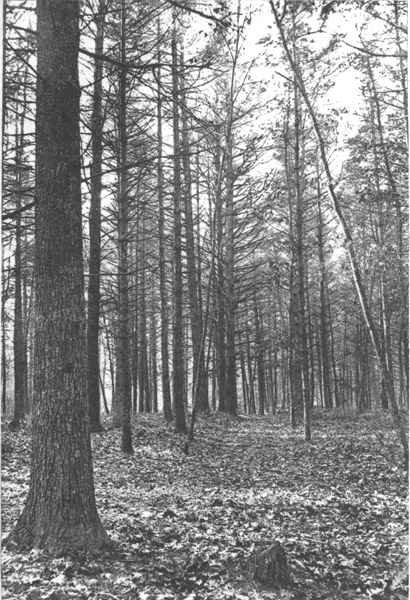
Fallen Leaves
THE SUGAR MAPLE
But think not that the splendor of the year is over; for as one leaf does not make a summer, neither does one falling leaf make an autumn. The smallest sugar maples in our streets make a great show as early as the fifth of October, more than any other trees there. As I look up the main street, they appear like painted screens standing before the houses; yet many are green. But now, or generally by the seventeenth of October, when almost all red maples and some white maples are bare, the large sugar maples also are in their glory, glowing with yellow and red, and show unexpectedly bright and delicate tints. They are remarkable for the contrast they often afford of deep blushing red on one half and green on the other. They become at length dense masses of rich yellow with a deep scarlet blush, or more than blush, on the exposed surfaces. They are the brightest trees now in the street.
The large ones on our Common are particularly beautiful. A delicate but warmer than golden yellow is now the prevailing color, with scarlet cheeks. Yet, standing on the east side of the Common just before sundown, when the western light is transmitted through them, I see that their yellow even, compared with the pale lemon yellow of an elm close by, amounts to a scarlet, without noticing the bright scarlet portions. Generally, they are great regular oval masses of yellow and scarlet. All the sunny warmth of the season, the Indian summer, seems to be absorbed in their leaves. The lowest and inmost leaves next the bole are, as usual, of the most delicate yellow and green, like the complexion of young men brought up in the house. There is an auction on the Common to-day, but its red flag is hard to be discerned amid this blaze of color.
Little did the fathers of the town anticipate this brilliant success, when they caused to be imported from farther in the country some straight poles with their tops cut off, which they called sugar maples; and, as I remember, after they were set out, a neighboring merchant's clerk, by way of jest, planted beans about them. Those which were then jestingly called bean-poles are to-day far the most beautiful objects noticeable in our streets. They are worth all and more than they have cost,—though one of the selectmen, while setting them out, took the cold which occasioned his death,—if only because they have filled the open eyes of children with their rich color unstintedly so many Octobers. We will not ask them to yield us sugar in the spring, while they afford us so fair a prospect in the autumn. Wealth indoors may be the inheritance of few, but it is equally distributed on the Common. All children alike can revel in this golden harvest.
Surely trees should be set in our streets with a view to their October splendor, though I doubt whether this is ever considered by the "Tree Society." Do you not think it will make some odds to these children that they were brought up under the maples? Hundreds of eyes are steadily drinking in this color, and by these teachers even the truants are caught and educated the moment they step abroad. Indeed, neither the truant nor the studious is at present taught color in the schools. These are instead of the bright colors in apothecaries' shops and city windows. It is a pity that we have no more red maples, and some hickories, in our streets as well. Our paint-box is very imperfectly filled. Instead of, or beside, supplying such paint-boxes as we do, we might supply these natural colors to the young. Where else will they study color under greater advantages? What School of Design can vie with this? Think how much the eyes of painters of all kinds, and of manufacturers of cloth and paper, and paper-stainers, and countless others, are to be educated by these autumnal colors. The stationer's envelopes may be of very various tints, yet not so various as those of the leaves of a single tree. If you want a different shade or tint of a particular color, you have only to look farther within or without the tree or the wood. These leaves are not many dipped in one dye, as at the dye-house, but they are dyed in light of infinitely various degrees of strength and left to set and dry there.
Shall the names of so many of our colors continue to be derived from those of obscure foreign localities, as Naples yellow, Prussian blue, raw Sienna, burnt Umber, Gamboge? (surely the Tyrian purple must have faded by this time), or from comparatively trivial articles of commerce,—chocolate, lemon, coffee, cinnamon, claret? (shall we compare our hickory to a lemon, or a lemon to a hickory?) or from ores and oxides which few ever see? Shall we so often, when describing to our neighbors the color of something we have seen, refer them, not to some natural object in our neighborhood, but perchance to a bit of earth fetched from the other side of the planet, which possibly they may find at the apothecary's, but which probably neither they nor we ever saw? Have we not an earth under our feet,—aye, and a sky over our heads? Or is the last all ultramarine? What do we know of sapphire, amethyst, emerald, ruby, amber, and the like,—most of us who take these names in vain? Leave these precious words to cabinet-keepers, virtuosos, and maids-of-honor,—to the Nabobs, Begums, and Chobdars of Hindostan, or wherever else. I do not see why, since America and her autumn woods have been discovered, our leaves should not compete with the precious stones in giving names to colors; and, indeed, I believe that in course of time the names of some of our trees and shrubs, as well as flowers, will get into our popular chromatic nomenclature.
But of much more importance than a knowledge of the names and distinctions of color is the joy and exhilaration which these colored leaves excite. Already these brilliant trees throughout the street, without any more variety, are at least equal to an annual festival and holiday, or a week of such. These are cheap and innocent gala-days, celebrated by one and all without the aid of committees or marshals, such a show as may safely be licensed, not attracting gamblers or rum-sellers, not requiring any special police to keep the peace. And poor indeed must be that New England village's October which has not the maple in its streets. This October festival costs no powder, nor ringing of bells, but every tree is a living liberty-pole on which a thousand bright flags are waving.
No wonder that we must have our annual cattle-show, and fall training, and perhaps cornwallis, our September courts, and the like. Nature herself holds her annual fair in October, not only in the streets, but in every hollow and on every hillside. When lately we looked into that red maple swamp all ablaze, where the trees were clothed in their vestures of most dazzling tints, did it not suggest a thousand gypsies beneath,—a race capable of wild delight,—or even the fabled fauns, satyrs, and wood-nymphs come back to earth? Or was it only a congregation of wearied woodchoppers, or of proprietors come to inspect their lots, that we thought of? Or, earlier still, when we paddled on the river through that fine-grained September air, did there not appear to be something new going on under the sparkling surface of the stream, a shaking of props, at least, so that we made haste in order to be up in time? Did not the rows of yellowing willows and button-bushes on each side seem like rows of booths, under which, perhaps, some fluviatile egg-pop equally yellow was effervescing? Did not all these suggest that man's spirits should rise as high as Nature's,—should hang out their flag, and the routine of his life be interrupted by an analogous expression of joy and hilarity?
No annual training or muster of soldiery, no celebration with its scarfs and banners, could import into the town a hundredth part of the annual splendor of our October. We have only to set the trees, or let them stand, and Nature will find the colored drapery,—flags of all her nations, some of whose private signals hardly the botanist can read,—while we walk under the triumphal arches of the elms. Leave it to Nature to appoint the days, whether the same as in neighboring States or not, and let the clergy read her proclamations, if they can understand them. Behold what a brilliant drapery is her woodbine flag! What public-spirited merchant, think you, has contributed this part of the show? There is no handsomer shingling and paint than this vine, at present covering a whole side of some houses. I do not believe that the ivy never sere is comparable to it. No wonder it has been extensively introduced into London. Let us have a good many maples and hickories and scarlet oaks, then, I say. Blaze away! Shall that dirty roll of bunting in the gun-house be all the colors a village can display? A village is not complete, unless it have these trees to mark the season in it. They are important, like the town clock. A village that has them not will not be found to work well. It has a screw loose, an essential part is wanting. Let us have willows for spring, elms for summer, maples and walnuts and tupeloes for autumn, evergreens for winter, and oaks for all seasons. What is a gallery in a house to a gallery in the streets, which every market-man rides through, whether he will or not? Of course, there is not a picture-gallery in the country which would be worth so much to us as is the western view at sunset under the elms of our main street. They are the frame to a picture which is daily painted behind them. An avenue of elms as large as our largest and three miles long would seem to lead to some admirable place, though only C—— were at the end of it.
A village needs these innocent stimulants of bright and cheering prospects to keep off melancholy and superstition. Show me two villages, one embowered in trees and blazing with all the glories of October, the other a merely trivial and treeless waste, or with only a single tree or two for suicides, and I shall be sure that in the latter will be found the most starved and bigoted religionists and the most desperate drinkers. Every wash-tub and milk-can and gravestone will be exposed. The inhabitants will disappear abruptly behind their barns and houses, like desert Arabs amid their rocks, and I shall look to see spears in their hands. They will be ready to accept the most barren and forlorn doctrine,—as that the world is speedily coming to an end, or has already got to it, or that they themselves are turned wrong side outward. They will perchance crack their dry joints at one another and call it a spiritual communication.
But to confine ourselves to the maples. What if we were to take half as much pains in protecting them as we do in setting them out,—not stupidly tie our horses to our dahlia stems?
What meant the fathers by establishing this perfectly living institution before the church,—this institution which needs no repairing nor repainting, which is continually enlarged and repaired by its growth? Surely they
"Wrought in a sad sincerity; Themselves from God they could not free; They planted better than they knew;— The conscious trees to beauty grew."
Verily these maples are cheap preachers, permanently settled, which preach their half-century, and century, aye, and century-and-a-half sermons, with constantly increasing unction and influence, ministering to many generations of men; and the least we can do is to supply them with suitable colleagues as they grow infirm.
THE SCARLET OAK
Belonging to a genus which is remarkable for the beautiful form of its leaves, I suspect that some scarlet oak leaves surpass those of all other oaks in the rich and wild beauty of their outlines. I judge from an acquaintance with twelve species, and from drawings which I have seen of many others.
Stand under this tree and see how finely its leaves are cut against the sky,—as it were, only a few sharp points extending from a midrib. They look like double, treble, or quadruple crosses. They are far more ethereal than the less deeply scalloped oak leaves. They have so little leafy terra firma that they appear melting away in the light, and scarcely obstruct our view. The leaves of very young plants are, like those of full-grown oaks of other species, more entire, simple, and lumpish in their outlines, but these, raised high on old trees, have solved the leafy problem. Lifted higher and higher, and sublimated more and more, putting off some earthiness and cultivating more intimacy with the light each year, they have at length the least possible amount of earthy matter, and the greatest spread and grasp of skyey influences. There they dance, arm in arm with the light,—tripping it on fantastic points, fit partners in those aerial halls. So intimately mingled are they with it, that, what with their slenderness and their glossy surfaces, you can hardly tell at last what in the dance is leaf and what is light. And when no zephyr stirs, they are at most but a rich tracery to the forest windows.
I am again struck with their beauty, when, a month later, they thickly strew the ground in the woods, piled one upon another under my feet. They are then brown above, but purple beneath. With their narrow lobes and their bold, deep scallops reaching almost to the middle, they suggest that the material must be cheap, or else there has been a lavish expense in their creation, as if so much had been cut out. Or else they seem to us the remnants of the stuff out of which leaves have been cut with a die. Indeed, when they lie thus one upon another, they remind me of a pile of scrap-tin.
Or bring one home, and study it closely at your leisure, by the fireside. It is a type, not from any Oxford font, not in the Basque nor the arrow-headed character, not found on the Rosetta Stone, but destined to be copied in sculpture one day, if they ever get to whittling stone here. What a wild and pleasing outline, a combination of graceful curves and angles! The eye rests with equal delight on what is not leaf and on what is leaf,—on the broad, free, open sinuses, and on the long, sharp, bristle-pointed lobes. A simple oval outline would include it all, if you connected the points of the leaf; but how much richer is it than that, with its half-dozen deep scallops, in which the eye and thought of the beholder are embayed! If I were a drawing-master, I would set my pupils to copying these leaves, that they might learn to draw firmly and gracefully.
Regarded as water, it is like a pond with half a dozen broad rounded promontories extending nearly to its middle, half from each side, while its watery bays extend far inland, like sharp friths, at each of whose heads several fine streams empty in,—almost a leafy archipelago.
But it oftener suggests land, and, as Dionysius and Pliny compared the form of the Morea to that of the leaf of the Oriental plane tree, so this leaf reminds me of some fair wild island in the ocean, whose extensive coast, alternate rounded bays with smooth strands, and sharp-pointed rocky capes, mark it as fitted for the habitation of man, and destined to become a centre of civilization at last. To the sailor's eye, it is a much indented shore. Is it not, in fact, a shore to the aerial ocean, on which the windy surf beats? At sight of this leaf we are all mariners,—if not vikings, buccaneers, and filibusters. Both our love of repose and our spirit of adventure are addressed. In our most casual glance, perchance, we think that if we succeed in doubling those sharp capes we shall find deep, smooth, and secure havens in the ample bays. How different from the white oak leaf, with its rounded headlands, on which no lighthouse need be placed! That is an England, with its long civil history, that may be read. This is some still unsettled New-found Island or Celebes. Shall we go and be rajahs there?
By the twenty-sixth of October the large scarlet oaks are in their prime, when other oaks are usually withered. They have been kindling their fires for a week past, and now generally burst into a blaze. This alone of our indigenous deciduous trees (excepting the dogwood, of which I do not know half a dozen, and they are but large bushes) is now in its glory. The two aspens and the sugar maple come nearest to it in date, but they have lost the greater part of their leaves. Of evergreens, only the pitch pine is still commonly bright.
But it requires a particular alertness, if not devotion to these phenomena, to appreciate the wide-spread, but late and unexpected glory of the scarlet oaks. I do not speak here of the small trees and shrubs, which are commonly observed, and which are now withered, but of the large trees. Most go in and shut their doors, thinking that bleak and colorless November has already come, when some of the most brilliant and memorable colors are not yet lit.
This very perfect and vigorous one, about forty feet high, standing in an open pasture, which was quite glossy green on the twelfth, is now, the twenty-sixth, completely changed to bright dark-scarlet,—every leaf, between you and the sun, as if it had been dipped into a scarlet dye. The whole tree is much like a heart in form, as well as color. Was not this worth waiting for? Little did you think, ten days ago, that that cold green tree would assume such color as this. Its leaves are still firmly attached, while those of other trees are falling around it. It seems to say: "I am the last to blush, but I blush deeper than any of ye. I bring up the rear in my red coat. We scarlet ones, alone of oaks, have not given up the fight."
The sap is now, and even far into November, frequently flowing fast in these trees, as in maples in the spring; and apparently their bright tints, now that most other oaks are withered, are connected with this phenomenon. They are full of life. It has a pleasantly astringent, acorn-like taste, this strong oak wine, as I find on tapping them with my knife.
Looking across this woodland valley, a quarter of a mile wide, how rich those scarlet oaks embosomed in pines, their bright red branches intimately intermingled with them! They have their full effect there. The pine boughs are the green calyx to their red petals. Or, as we go along a road in the woods, the sun striking endwise through it, and lighting up the red tents of the oaks, which on each side are mingled with the liquid green of the pines, makes a very gorgeous scene. Indeed, without the evergreens for contrast, the autumnal tints would lose much of their effect.
The scarlet oak asks a clear sky and the brightness of late October days. These bring out its colors. If the sun goes into a cloud they become comparatively indistinct. As I sit on a cliff in the southwest part of our town, the sun is now getting low, and the woods in Lincoln, south and east of me, are lit up by its more level rays; and in the scarlet oaks, scattered so equally over the forest, there is brought out a more brilliant redness than I had believed was in them. Every tree of this species which is visible in those directions, even to the horizon, now stands out distinctly red. Some great ones lift their red backs high above the woods, in the next town, like huge roses with a myriad of fine petals; and some more slender ones, in a small grove of white pines on Pine Hill in the east, on the very verge of the horizon, alternating with the pines on the edge of the grove, and shouldering them with their red coats, look like soldiers in red amid hunters in green. This time it is Lincoln green, too. Till the sun got low, I did not believe that there were so many redcoats in the forest army. Theirs is an intense, burning red, which would lose some of its strength, methinks, with every step you might take toward them; for the shade that lurks amid their foliage does not report itself at this distance, and they are unanimously red. The focus of their reflected color is in the atmosphere far on this side. Every such tree becomes a nucleus of red, as it were, where, with the declining sun, that color grows and glows. It is partly borrowed fire, gathering strength from the sun on its way to your eye. It has only some comparatively dull red leaves for a rallying-point, or kindling-stuff, to start it, and it becomes an intense scarlet or red mist, or fire, which finds fuel for itself in the very atmosphere. So vivacious is redness. The very rails reflect a rosy light at this hour and season. You see a redder tree than exists.
If you wish to count the scarlet oaks, do it now. In a clear day stand thus on a hilltop in the woods, when the sun is an hour high, and every one within range of your vision, excepting in the west, will be revealed. You might live to the age of Methuselah and never find a tithe of them, otherwise. Yet sometimes even in a dark day I have thought them as bright as I ever saw them. Looking westward, their colors are lost in a blaze of light; but in other directions the whole forest is a flower-garden, in which these late roses burn, alternating with green, while the so-called "gardeners," walking here and there, perchance, beneath, with spade and water-pot, see only a few little asters amid withered leaves.
These are my China-asters, my late garden-flowers. It costs me nothing for a gardener. The falling leaves, all over the forest, are protecting the roots of my plants. Only look at what is to be seen, and you will have garden enough, without deepening the soil in your yard. We have only to elevate our view a little, to see the whole forest as a garden. The blossoming of the scarlet oak,—the forest-flower, surpassing all in splendor (at least since the maple)! I do not know but they interest me more than the maples, they are so widely and equally dispersed throughout the forest; they are so hardy, a nobler tree on the whole; our chief November flower, abiding the approach of winter with us, imparting warmth to early November prospects. It is remarkable that the latest bright color that is general should be this deep, dark scarlet and red, the intensest of colors. The ripest fruit of the year; like the cheek of a hard, glossy red apple, from the cold Isle of Orleans, which will not be mellow for eating till next spring! When I rise to a hilltop, a thousand of these great oak roses, distributed on every side, as far as the horizon! I admire them four or five miles off! This my unfailing prospect for a fortnight past! This late forest-flower surpasses all that spring or summer could do. Their colors were but rare and dainty specks comparatively (created for the near-sighted, who walk amid the humblest herbs and underwoods), and made no impression on a distant eye. Now it is an extended forest or a mountain-side, through or along which we journey from day to day, that bursts into bloom. Comparatively, our gardening is on a petty scale,—the gardener still nursing a few asters amid dead weeds, ignorant of the gigantic asters and roses which, as it were, overshadow him, and ask for none of his care. It is like a little red paint ground on a saucer, and held up against the sunset sky. Why not take more elevated and broader views, walk in the great garden; not skulk in a little "debauched" nook of it? consider the beauty of the forest, and not merely of a few impounded herbs?
Let your walks now be a little more adventurous; ascend the hills. If, about the last of October, you ascend any hill in the outskirts of our town, and probably of yours, and look over the forest, you may see—well, what I have endeavored to describe. All this you surely will see, and much more, if you are prepared to see it,—if you look for it. Otherwise, regular and universal as this phenomenon is, whether you stand on the hilltop or in the hollow, you will think for threescore years and ten that all the wood is, at this season, sere and brown. Objects are concealed from our view, not so much because they are out of the course of our visual ray as because we do not bring our minds and eyes to bear on them; for there is no power to see in the eye itself, any more than in any other jelly. We do not realize how far and widely, or how near and narrowly, we are to look. The greater part of the phenomena of Nature are for this reason concealed from us all our lives. The gardener sees only the gardener's garden. Here, too, as in political economy, the supply answers to the demand. Nature does not cast pearls before swine. There is just as much beauty visible to us in the landscape as we are prepared to appreciate,—not a grain more. The actual objects which one man will see from a particular hilltop are just as different from those which another will see as the beholders are different. The scarlet oak must, in a sense, be in your eye when you go forth. We cannot see anything until we are possessed with the idea of it, take it into our heads,—and then we can hardly see anything else. In my botanical rambles I find that, first, the idea, or image, of a plant occupies my thoughts, though it may seem very foreign to this locality,—no nearer than Hudson's Bay,—and for some weeks or months I go thinking of it, and expecting it, unconsciously, and at length I surely see it. This is the history of my finding a score or more of rare plants which I could name. A man sees only what concerns him. A botanist absorbed in the study of grasses does not distinguish the grandest pasture oaks. He, as it were, tramples down oaks unwittingly in his walk, or at most sees only their shadows. I have found that it required a different intention of the eye, in the same locality, to see different plants, even when they were closely allied, as Juncaceae and Gramineae: when I was looking for the former, I did not see the latter in the midst of them. How much more, then, it requires different intentions of the eye and of the mind to attend to different departments of knowledge! How differently the poet and the naturalist look at objects!
Take a New England selectman, and set him on the highest of our hills, and tell him to look,—sharpening his sight to the utmost, and putting on the glasses that suit him best (aye, using a spy-glass, if he likes),—and make a full report. What, probably, will he spy?—what will he select to look at? Of course, he will see a Brocken spectre of himself. He will see several meeting-houses, at least, and, perhaps, that somebody ought to be assessed higher than he is, since he has so handsome a wood-lot. Now take Julius Cæsar, or Emanuel Swedenborg, or a Fiji-Islander, and set him up there. Or suppose all together, and let them compare notes afterward. Will it appear that they have enjoyed the same prospect? What they will see will be as different as Rome was from heaven or hell, or the last from the Fiji Islands. For aught we know, as strange a man as any of these is always at our elbow.
Why, it takes a sharpshooter to bring down even such trivial game as snipes and woodcocks; he must take very particular aim, and know what he is aiming at. He would stand a very small chance, if he fired at random into the sky, being told that snipes were flying there. And so is it with him that shoots at beauty; though he wait till the sky falls, he will not bag any, if he does not already know its seasons and haunts, and the color of its wing,—if he has not dreamed of it, so that he can anticipate it; then, indeed, he flushes it at every step, shoots double and on the wing, with both barrels, even in corn-fields. The sportsman trains himself, dresses, and watches unweariedly, and loads and primes for his particular game. He prays for it, and offers sacrifices, and so he gets it. After due and long preparation, schooling his eye and hand, dreaming awake and asleep, with gun and paddle and boat, he goes out after meadow-hens, which most of his townsmen never saw nor dreamed of, and paddles for miles against a head wind, and wades in water up to his knees, being out all day without his dinner, and therefore he gets them. He had them half-way into his bag when he started, and has only to shove them down. The true sportsman can shoot you almost any of his game from his windows: what else has he windows or eyes for? It comes and perches at last on the barrel of his gun; but the rest of the world never see it with the feathers on. The geese fly exactly under his zenith, and honk when they get there, and he will keep himself supplied by firing up his chimney; twenty musquash have the refusal of each one of his traps before it is empty. If he lives, and his game spirit increases, heaven and earth shall fail him sooner than game; and when he dies, he will go to more extensive and, perchance, happier hunting-grounds. The fisherman, too, dreams of fish, sees a bobbing cork in his dreams, till he can almost catch them in his sink-spout. I knew a girl who, being sent to pick huckleberries, picked wild gooseberries by the quart, where no one else knew that there were any, because she was accustomed to pick them up-country where she came from. The astronomer knows where to go star-gathering, and sees one clearly in his mind before any have seen it with a glass. The hen scratches and finds her food right under where she stands; but such is not the way with the hawk.
These bright leaves which I have mentioned are not the exception, but the rule; for I believe that all leaves, even grasses and mosses, acquire brighter colors just before their fall. When you come to observe faithfully the changes of each humblest plant, you find that each has, sooner or later, its peculiar autumnal tint; and if you undertake to make a complete list of the bright tints, it will be nearly as long as a catalogue of the plants in your vicinity.
WILD APPLES
THE HISTORY OF THE APPLE TREE
It is remarkable how closely the history of the apple tree is connected with that of man. The geologist tells us that the order of the Rosaceae, which includes the apple, also the true grasses, and the Labiatae, or mints, were introduced only a short time previous to the appearance of man on the globe.
It appears that apples made a part of the food of that unknown primitive people whose traces have lately been found at the bottom of the Swiss lakes, supposed to be older than the foundation of Rome, so old that they had no metallic implements. An entire black and shriveled crab-apple has been recovered from their stores.
Tacitus says of the ancient Germans that they satisfied their hunger with wild apples (agrestia poma), among other things.
Niebuhr observes that "the words for a house, a field, a plow, plowing, wine, oil, milk, sheep, apples, and others relating to agriculture and the gentler way of life, agree in Latin and Greek, while the Latin words for all objects pertaining to war or the chase are utterly alien from the Greek." Thus the apple tree may be considered a symbol of peace no less than the olive.
The apple was early so important, and generally distributed, that its name traced to its root in many languages signifies fruit in general. Μῆλον, in Greek, means an apple, also the fruit of other trees, also a sheep and any cattle, and finally riches in general.
The apple tree has been celebrated by the Hebrews, Greeks, Romans, and Scandinavians. Some have thought that the first human pair were tempted by its fruit. Goddesses are fabled to have contended for it, dragons were set to watch it, and heroes were employed to pluck it.
The tree is mentioned in at least three places in the Old Testament, and its fruit in two or three more. Solomon sings, "As the apple-tree among the trees of the wood, so is my beloved among the sons." And again, "Stay me with flagons, comfort me with apples." The noblest part of man's noblest feature is named from this fruit, "the apple of the eye."
The apple tree is also mentioned by Homer and Herodotus. Ulysses saw in the glorious garden of Alcinoûs "pears and pomegranates, and apple trees bearing beautiful fruit" (καὶ μηλέαι ἀγλαόκαρποι). And according to Homer, apples were among the fruits which Tantalus could not pluck, the wind ever blowing their boughs away from him. Theophrastus knew and described the apple tree as a botanist.
According to the Prose Edda, "Iduna keeps in a box the apples which the gods, when they feel old age approaching, have only to taste of to become young again. It is in this manner that they will be kept in renovated youth until Ragnarôk" (or the destruction of the gods).
I learn from Loudon that "the ancient Welsh bards were rewarded for excelling in song by the token of the apple-spray;" and "in the Highlands of Scotland the apple-tree is the badge of the clan Lamont."
The apple tree (Pyrus malus) belongs chiefly to the northern temperate zone. Loudon says that "it grows spontaneously in every part of Europe except the frigid zone, and throughout Western Asia, China, and Japan." We have also two or three varieties of the apple indigenous in North America. The cultivated apple tree was first introduced into this country by the earliest settlers, and is thought to do as well or better here than anywhere else. Probably some of the varieties which are now cultivated were first introduced into Britain by the Romans.
Pliny, adopting the distinction of Theophrastus, says, "Of trees there are some which are altogether wild (sylvestres), some more civilized (urbaniores)." Theophrastus includes the apple among the last; and, indeed, it is in this sense the most civilized of all trees. It is as harmless as a dove, as beautiful as a rose, and as valuable as flocks and herds. It has been longer cultivated than any other, and so is more humanized; and who knows but, like the dog, it will at length be no longer traceable to its wild original? It migrates with man, like the dog and horse and cow: first, perchance, from Greece to Italy, thence to England, thence to America; and our Western emigrant is still marching steadily toward the setting sun with the seeds of the apple in his pocket, or perhaps a few young trees strapped to his load. At least a million apple trees are thus set farther westward this year than any cultivated ones grew last year. Consider how the Blossom Week, like the Sabbath, is thus annually spreading over the prairies; for when man migrates, he carries with him not only his birds, quadrupeds, insects, vegetables, and his very sward, but his orchard also.
The leaves and tender twigs are an agreeable food to many domestic animals, as the cow, horse, sheep, and goat; and the fruit is sought after by the first, as well as by the hog. Thus there appears to have existed a natural alliance between these animals and this tree from the first. "The fruit of the crab in the forests of France" is said to be "a great resource for the wild boar."
Not only the Indian, but many indigenous insects, birds, and quadrupeds, welcomed the apple tree to these shores. The tent caterpillar saddled her eggs on the very first twig that was formed, and it has since shared her affections with the wild cherry; and the canker-worm also in a measure abandoned the elm to feed on it. As it grew apace, the bluebird, robin, cherry-bird, kingbird, and many more came with haste and built their nests and warbled in its boughs, and so became orchard-birds, and multiplied more than ever. It was an era in the history of their race. The downy woodpecker found such a savory morsel under its bark that he perforated it in a ring quite round the tree, before he left it,—a thing which he had never done before, to my knowledge. It did not take the partridge long to find out how sweet its buds were, and every winter eve she flew, and still flies, from the wood, to pluck them, much to the farmer's sorrow. The rabbit, too, was not slow to learn the taste of its twigs and bark; and when the fruit was ripe, the squirrel half rolled, half carried it to his hole; and even the musquash crept up the bank from the brook at evening, and greedily devoured it, until he had worn a path in the grass there; and when it was frozen and thawed, the crow and the jay were glad to taste it occasionally. The owl crept into the first apple tree that became hollow, and fairly hooted with delight, finding it just the place for him; so, settling down into it, he has remained there ever since.
My theme being the Wild Apple, I will merely glance at some of the seasons in the annual growth of the cultivated apple, and pass on to my special province.
The flowers of the apple are perhaps the most beautiful of any tree's, so copious and so delicious to both sight and scent. The walker is frequently tempted to turn and linger near some more than usually handsome one, whose blossoms are two-thirds expanded. How superior it is in these respects to the pear, whose blossoms are neither colored nor fragrant!
By the middle of July, green apples are so large as to remind us of coddling, and of the autumn. The sward is commonly strewed with little ones which fall stillborn, as it were,—Nature thus thinning them for us. The Roman writer Palladius said, "If apples are inclined to fall before their time, a stone placed in a split root will retain them." Some such notion, still surviving, may account for some of the stones which we see placed, to be overgrown, in the forks of trees. They have a saying in Suffolk, England,—
"At Michaelmas time, or a little before, Half an apple goes to the core."
Early apples begin to be ripe about the first of August; but I think that none of them are so good to eat as some to smell. One is worth more to scent your handkerchief with than any perfume which they sell in the shops. The fragrance of some fruits is not to be forgotten, along with that of flowers. Some gnarly apple which I pick up in the road reminds me by its fragrance of all the wealth of Pomona,—carrying me forward to those days when they will be collected in golden and ruddy heaps in the orchards and about the cider-mills.
A week or two later, as you are going by orchards or gardens, especially in the evenings, you pass through a little region possessed by the fragrance of ripe apples, and thus enjoy them without price, and without robbing anybody.
There is thus about all natural products a certain volatile and ethereal quality which represents their highest value, and which cannot be vulgarized, or bought and sold. No mortal has ever enjoyed the perfect flavor of any fruit, and only the godlike among men begin to taste its ambrosial qualities. For nectar and ambrosia are only those fine flavors of every earthly fruit which our coarse palates fail to perceive,—just as we occupy the heaven of the gods without knowing it. When I see a particularly mean man carrying a load of fair and fragrant early apples to market, I seem to see a contest going on between him and his horse, on the one side, and the apples on the other, and, to my mind, the apples always gain it. Pliny says that apples are the heaviest of all things, and that the oxen begin to sweat at the mere sight of a load of them. Our driver begins to lose his load the moment he tries to transport them to where they do not belong, that is, to any but the most beautiful. Though he gets out from time to time, and feels of them, and thinks they are all there, I see the stream of their evanescent and celestial qualities going to heaven from his cart, while the pulp and skin and core only are going to market. They are not apples, but pomace. Are not these still Iduna's apples, the taste of which keeps the gods forever young? and think you that they will let Loki or Thjassi carry them off to Jötunheim, while they grow wrinkled and gray? No, for Ragnarök, or the destruction of the gods, is not yet.
There is another thinning of the fruit, commonly near the end of August or in September, when the ground is strewn with windfalls; and this happens especially when high winds occur after rain. In some orchards you may see fully three quarters of the whole crop on the ground, lying in a circular form beneath the trees, yet hard and green, or, if it is a hillside, rolled far down the hill. However, it is an ill wind that blows nobody any good. All the country over, people are busy picking up the windfalls, and this will make them cheap for early apple pies.
In October, the leaves falling, the apples are more distinct on the trees. I saw one year in a neighboring town some trees fuller of fruit than I remember to have ever seen before, small yellow apples hanging over the road. The branches were gracefully drooping with their weight, like a barberry bush, so that the whole tree acquired a new character. Even the topmost branches, instead of standing erect, spread and drooped in all directions; and there were so many poles supporting the lower ones that they looked like pictures of banyan trees. As an old English manuscript says, "The mo appelen the tree bereth the more sche boweth to the folk."
Surely the apple is the noblest of fruits. Let the most beautiful or the swiftest have it. That should be the "going" price of apples.
Between the 5th and 20th of October I see the barrels lie under the trees. And perhaps I talk with one who is selecting some choice barrels to fulfill an order. He turns a specked one over many times before he leaves it out. If I were to tell what is passing in my mind, I should say that every one was specked which he had handled; for he rubs off all the bloom, and those fugacious ethereal qualities leave it. Cool evenings prompt the farmers to make haste, and at length I see only the ladders here and there left leaning against the trees.
It would be well, if we accepted these gifts with more joy and gratitude, and did not think it enough simply to put a fresh load of compost about the tree. Some old English customs are suggestive at least. I find them described chiefly in Brand's "Popular Antiquities." It appears that "on Christmas Eve the farmers and their men in Devonshire take a large bowl of cider, with a toast in it, and carrying it in state to the orchard, they salute the apple-trees with much ceremony, in order to make them bear well the next season." This salutation consists in "throwing some of the cider about the roots of the tree, placing bits of the toast on the branches," and then, "encircling one of the best bearing trees in the orchard, they drink the following toast three several times:—
'Here's to thee, old apple tree, Whence thou mayst bud, and whence thou mayst blow, And whence thou mayst bear apples enow! Hats-full! caps-full! Bushel, bushel, sacks-full! And my pockets full, too! Hurra!'"
Also what was called "apple-howling" used to be practiced in various counties of England on New Year's Eve. A troop of boys visited the different orchards, and, encircling the apple trees, repeated the following words:—
"Stand fast, root! bear well, top! Pray God send us a good howling crop: Every twig, apples big; Every bough, apples enow!"
"They then shout in chorus, one of the boys accompanying them on a cow's horn. During this ceremony they rap the trees with their sticks." This is called "wassailing" the trees, and is thought by some to be "a relic of the heathen sacrifice to Pomona."
Herrick sings,—
"Wassaile the trees that they may beare You many a plum and many a peare; For more or less fruits they will bring As you so give them wassailing."
Our poets have as yet a better right to sing of cider than of wine; but it behooves them to sing better than English Phillips did, else they will do no credit to their Muse.
THE WILD APPLE
So much for the more civilized apple trees (urbaniores, as Pliny calls them). I love better to go through the old orchards of ungrafted apple trees, at what ever season of the year,—so irregularly planted: sometimes two trees standing close together; and the rows so devious that you would think that they not only had grown while the owner was sleeping, but had been set out by him in a somnambulic state. The rows of grafted fruit will never tempt me to wander amid them like these. But I now, alas, speak rather from memory than from any recent experience, such ravages have been made!
Some soils, like a rocky tract called the Easterbrooks Country in my neighborhood, are so suited to the apple, that it will grow faster in them without any care, or if only the ground is broken up once a year, than it will in many places with any amount of care. The owners of this tract allow that the soil is excellent for fruit, but they say that it is so rocky that they have not patience to plow it, and that, together with the distance, is the reason why it is not cultivated. There are, or were recently, extensive orchards there standing without order. Nay, they spring up wild and bear well there in the midst of pines, birches, maples, and oaks. I am often surprised to see rising amid these trees the rounded tops of apple trees glowing with red or yellow fruit, in harmony with the autumnal tints of the forest.
Going up the side of a cliff about the first of November, I saw a vigorous young apple tree, which, planted by birds or cows, had shot up amid the rocks and open woods there, and had now much fruit on it, uninjured by the frosts, when all cultivated apples were gathered. It was a rank, wild growth, with many green leaves on it still, and made an impression of thorniness. The fruit was hard and green, but looked as if it would be palatable in the winter. Some was dangling on the twigs, but more half buried in the wet leaves under the tree, or rolled far down the hill amid the rocks. The owner knows nothing of it. The day was not observed when it first blossomed, nor when it first bore fruit, unless by the chickadee. There was no dancing on the green beneath it in its honor, and now there is no hand to pluck its fruit,—which is only gnawed by squirrels, as I perceive. It has done double duty,—not only borne this crop, but each twig has grown a foot into the air. And this is such fruit! bigger than many berries, we must admit, and carried home will be sound and palatable next spring. What care I for Iduna's apples so long as I can get these?
When I go by this shrub thus late and hardy, and see its dangling fruit, I respect the tree, and I am grateful for Nature's bounty, even though I cannot eat it. Here on this rugged and woody hillside has grown an apple tree, not planted by man, no relic of a former orchard, but a natural growth, like the pines and oaks. Most fruits which we prize and use depend entirely on our care. Corn and grain, potatoes, peaches, melons, etc., depend altogether on our planting; but the apple emulates man's independence and enterprise. It is not simply carried, as I have said, but, like him, to some extent, it has migrated to this New World, and is even, here and there, making its way amid the aboriginal trees; just as the ox and dog and horse sometimes run wild and maintain themselves.
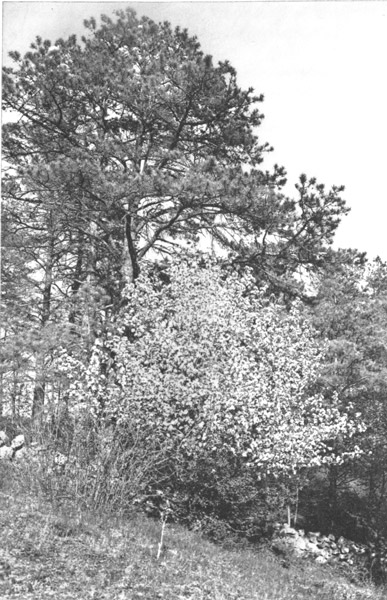
Wild Apple Tree
Even the sourest and crabbedest apple, growing in the most unfavorable position, suggests such thoughts as these, it is so noble a fruit.
THE CRAB
Nevertheless, our wild apple is wild only like myself, perchance, who belong not to the aboriginal race here, but have strayed into the woods from the cultivated stock. Wilder still, as I have said, there grows elsewhere in this country a native and aboriginal crab-apple, Malus coronaria, "whose nature has not yet been modified by cultivation." It is found from western New York to Minnesota, and southward. Michaux says that its ordinary height "is fifteen or eighteen feet, but it is sometimes found twenty-five or thirty feet high," and that the large ones "exactly resemble the common apple tree." "The flowers are white mingled with rose color, and are collected in corymbs." They are remarkable for their delicious odor. The fruit, according to him, is about an inch and a half in diameter, and is intensely acid. Yet they make fine sweetmeats and also cider of them. He concludes that "if, on being cultivated, it does not yield new and palatable varieties, it will at least be celebrated for the beauty of its flowers, and for the sweetness of its perfume."
I never saw the crab-apple till May, 1861. I had heard of it through Michaux, but more modern botanists, so far as I know, have not treated it as of any peculiar importance. Thus it was a half-fabulous tree to me. I contemplated a pilgrimage to the "Glades," a portion of Pennsylvania where it was said to grow to perfection. I thought of sending to a nursery for it, but doubted if they had it, or would distinguish it from European varieties. At last I had occasion to go to Minnesota, and on entering Michigan I began to notice from the cars a tree with handsome rose-colored flowers. At first I thought it some variety of thorn; but it was not long before the truth flashed on me, that this was my long-sought crab-apple. It was the prevailing flowering shrub or tree to be seen from the cars at that season of the year,—about the middle of May. But the cars never stopped before one, and so I was launched on the bosom of the Mississippi without having touched one, experiencing the fate of Tantalus. On arriving at St. Anthony's Falls, I was sorry to be told that I was too far north for the crab-apple. Nevertheless I succeeded in finding it about eight miles west of the Falls; touched it and smelled it, and secured a lingering corymb of flowers for my herbarium. This must have been near its northern limit.
HOW THE WILD APPLE GROWS
But though these are indigenous, like the Indians, I doubt whether they are any hardier than those backwoodsmen among the apple trees, which, though descended from cultivated stocks, plant themselves in distant fields and forests, where the soil is favorable to them. I know of no trees which have more difficulties to contend with, and which more sturdily resist their foes. These are the ones whose story we have to tell. It oftentimes reads thus:—
Near the beginning of May, we notice little thickets of apple trees just springing up in the pastures where cattle have been,—as the rocky ones of our Easterbrooks Country, or the top of Nobscot Hill, in Sudbury. One or two of these, perhaps, survive the drought and other accidents,—their very birthplace defending them against the encroaching grass and some other dangers, at first.
In two years' time 't had thus Reached the level of the rocks, Admired the stretching world, Nor feared the wandering flocks. But at this tender age Its sufferings began: There came a browsing ox And cut it down a span.
This time, perhaps, the ox does not notice it amid the grass; but the next year, when it has grown more stout, he recognizes it for a fellow-emigrant from the old country, the flavor of whose leaves and twigs he well knows; and though at first he pauses to welcome it, and express his surprise, and gets for answer, "The same cause that brought you here brought me," he nevertheless browses it again, reflecting, it may be, that he has some title to it.
Thus cut down annually, it does not despair; but, putting forth two short twigs for every one cut off, it spreads out low along the ground in the hollows or between the rocks, growing more stout and scrubby, until it forms, not a tree as yet, but a little pyramidal, stiff, twiggy mass, almost as solid and impenetrable as a rock. Some of the densest and most impenetrable clumps of bushes that I have ever seen, as well on account of the closeness and stubbornness of their branches as of their thorns, have been these wild apple scrubs. They are more like the scrubby fir and black spruce on which you stand, and sometimes walk, on the tops of mountains, where cold is the demon they contend with, than anything else. No wonder they are prompted to grow thorns at last, to defend themselves against such foes. In their thorniness, however, there is no malice, only some malic acid.
The rocky pastures of the tract I have referred to—for they maintain their ground best in a rocky field—are thickly sprinkled with these little tufts, reminding you often of some rigid gray mosses or lichens, and you see thousands of little trees just springing up between them, with the seed still attached to them.
Being regularly clipped all around each year by the cows, as a hedge with shears, they are often of a perfect conical or pyramidal form, from one to four feet high, and more or less sharp, as if trimmed by the gardener's art. In the pastures on Nobscot Hill and its spurs, they make fine dark shadows when the sun is low. They are also an excellent covert from hawks for many small birds that roost and build in them. Whole flocks perch in them at night, and I have seen three robins' nests in one which was six feet in diameter.
No doubt many of these are already old trees, if you reckon from the day they were planted, but infants still when you consider their development and the long life before them. I counted the annual rings of some which were just one foot high, and as wide as high, and found that they were about twelve years old, but quite sound and thrifty! They were so low that they were unnoticed by the walker, while many of their contemporaries from the nurseries were already bearing considerable crops. But what you gain in time is perhaps in this case, too, lost in power,—that is, in the vigor of the tree. This is their pyramidal state.
The cows continue to browse them thus for twenty years or more, keeping them down and compelling them to spread, until at last they are so broad that they become their own fence, when some interior shoot, which their foes cannot reach, darts upward with joy: for it has not forgotten its high calling, and bears its own peculiar fruit in triumph.
Such are the tactics by which it finally defeats its bovine foes. Now, if you have watched the progress of a particular shrub, you will see that it is no longer a simple pyramid or cone, but that out of its apex there rises a sprig or two, growing more lustily perchance than an orchard-tree, since the plant now devotes the whole of its repressed energy to these upright parts. In a short time these become a small tree, an inverted pyramid resting on the apex of the other, so that the whole has now the form of a vast hour-glass. The spreading bottom, having served its purpose, finally disappears, and the generous tree permits the now harmless cows to come in and stand in its shade, and rub against and redden its trunk, which has grown in spite of them, and even to taste a part of its fruit, and so disperse the seed.
Thus the cows create their own shade and food; and the tree, its hour-glass being inverted, lives a second life, as it were.
It is an important question with some nowadays, whether you should trim young apple trees as high as your nose or as high as your eyes. The ox trims them up as high as he can reach, and that is about the right height, I think.
In spite of wandering kine, and other adverse circumstances, that despised shrub, valued only by small birds as a covert and shelter from hawks, has its blossom week at last, and in course of time its harvest, sincere, though small.
By the end of some October, when its leaves have fallen, I frequently see such a central sprig, whose progress I have watched, when I thought it had forgotten its destiny, as I had, bearing its first crop of small green or yellow or rosy fruit, which the cows cannot get at over the bushy and thorny hedge which surrounds it, and I make haste to taste the new and undescribed variety. We have all heard of the numerous varieties of fruit invented by Van Mons and Knight. This is the system of Van Cow, and she has invented far more and more memorable varieties than both of them.
Through what hardships it may attain to bear a sweet fruit! Though somewhat small, it may prove equal, if not superior, in flavor to that which has grown in a garden,—will perchance be all the sweeter and more palatable for the very difficulties it has had to contend with. Who knows but this chance wild fruit, planted by a cow or a bird on some remote and rocky hillside, where it is as yet unobserved by man, may be the choicest of all its kind, and foreign potentates shall hear of it, and royal societies seek to propagate it, though the virtues of the perhaps truly crabbed owner of the soil may never be heard of,—at least, beyond the limits of his village? It was thus the Porter and the Baldwin grew.
Every wild apple shrub excites our expectation thus, somewhat as every wild child. It is, perhaps, a prince in disguise. What a lesson to man! So are human beings, referred to the highest standard, the celestial fruit which they suggest and aspire to bear, browsed on by fate; and only the most persistent and strongest genius defends itself and prevails, sends a tender scion upward at last, and drops its perfect fruit on the ungrateful earth. Poets and philosophers and statesmen thus spring up in the country pastures, and outlast the hosts of unoriginal men.
Such is always the pursuit of knowledge. The celestial fruits, the golden apples of the Hesperides, are ever guarded by a hundred-headed dragon which never sleeps, so that it is an Herculean labor to pluck them.
This is one, and the most remarkable way in which the wild apple is propagated; but commonly it springs up at wide intervals in woods and swamp, and by the sides of roads, as the soil may suit it, and grows with comparative rapidity. Those which grow in dense woods are very tall and slender. I frequently pluck from these trees a perfectly mild and tamed fruit. As Palladius says, "Et injussu consternitur ubere mali:" And the ground is strewn with the fruit of an unbidden apple tree.
It is an old notion that, if these wild trees do not bear a valuable fruit of their own, they are the best stocks by which to transmit to posterity the most highly prized qualities of others. However, I am not in search of stocks, but the wild fruit itself, whose fierce gust has suffered no "inteneration." It is not my
"highest plot To plant the Bergamot."
THE FRUIT, AND ITS FLAVOR
The time for wild apples is the last of October and the first of November. They then get to be palatable, for they ripen late, and they are still perhaps as beautiful as ever. I make a great account of these fruits, which the farmers do not think it worth the while to gather,—wild flavors of the Muse, vivacious and inspiriting. The farmer thinks that he has better in his barrels, but he is mistaken, unless he has a walker's appetite and imagination, neither of which can he have.
Such as grow quite wild, and are left out till the first of November, I presume that the owner does not mean to gather. They belong to children as wild as themselves,—to certain active boys that I know,—to the wild-eyed woman of the fields, to whom nothing comes amiss, who gleans after all the world, and, moreover, to us walkers. We have met with them, and they are ours. These rights, long enough insisted upon, have come to be an institution in some old countries, where they have learned how to live. I hear that "the custom of grippling, which may be called apple-gleaning, is, or was formerly, practiced in Herefordshire. It consists in leaving a few apples, which are called the gripples, on every tree, after the general gathering, for the boys, who go with climbing-poles and bags to collect them."
As for those I speak of, I pluck them as a wild fruit, native to this quarter of the earth,—fruit of old trees that have been dying ever since I was a boy and are not yet dead, frequented only by the woodpecker and the squirrel, deserted now by the owner, who has not faith enough to look under their boughs. From the appearance of the tree-top, at a little distance, you would expect nothing but lichens to drop from it, but your faith is rewarded by finding the ground strewn with spirited fruit,—some of it, perhaps, collected at squirrel-holes, with the marks of their teeth by which they carried them,—some containing a cricket or two silently feeding within, and some, especially in damp days, a shell-less snail. The very sticks and stones lodged in the tree-top might have convinced you of the savoriness of the fruit which has been so eagerly sought after in past years.
I have seen no account of these among the "Fruits and Fruit-Trees of America," though they are more memorable to my taste than the grafted kinds; more racy and wild American flavors do they possess when October and November, when December and January, and perhaps February and March even, have assuaged them somewhat. An old farmer in my neighborhood, who always selects the right word, says that "they have a kind of bow-arrow tang."
Apples for grafting appear to have been selected commonly, not so much for their spirited flavor, as for their mildness, their size, and bearing qualities,—not so much for their beauty, as for their fairness and soundness. Indeed, I have no faith in the selected lists of pomological gentlemen. Their "Favorites" and "None-suches" and "Seek-no-farthers," when I have fruited them, commonly turn out very tame and forgettable. They are eaten with comparatively little zest, and have no real tang nor smack to them.
What if some of these wildings are acrid and puckery, genuine verjuice, do they not still belong to the Pomaceæ, which are uniformly innocent and kind to our race? I still begrudge them to the cider-mill. Perhaps they are not fairly ripe yet.
No wonder that these small and high-colored apples are thought to make the best cider. Loudon quotes from the "Herefordshire Report," that "apples of a small size are always, if equal in quality, to be preferred to those of a larger size, in order that the rind and kernel may bear the greatest proportion to the pulp, which affords the weakest and most watery juice." And he says that, "to prove this, Dr. Symonds, of Hereford, about the year 1800, made one hogshead of cider entirely from the rinds and cores of apples, and another from the pulp only, when the first was found of extraordinary strength and flavor, while the latter was sweet and insipid."
Evelyn says that the "Red-strake" was the favorite cider-apple in his day; and he quotes one Dr. Newburg as saying, "In Jersey 'tis a general observation, as I hear, that the more of red any apple has in its rind, the more proper it is for this use. Pale-faced apples they exclude as much as may be from their cider-vat." This opinion still prevails.
All apples are good in November. Those which the farmer leaves out as unsalable and unpalatable to those who frequent the markets are choicest fruit to the walker. But it is remarkable that the wild apple, which I praise as so spirited and racy when eaten in the fields or woods, being brought into the house has frequently a harsh and crabbed taste. The Saunterer's Apple not even the saunterer can eat in the house. The palate rejects it there, as it does haws and acorns, and demands a tamed one; for there you miss the November air, which is the sauce it is to be eaten with. Accordingly, when Tityrus, seeing the lengthening shadows, invites Melibœus to go home and pass the night with him, he promises him mild apples and soft chestnuts,—mitia poma, castaneæ molles. I frequently pluck wild apples of so rich and spicy a flavor that I wonder all orchardists do not get a scion from that tree, and I fail not to bring home my pockets full. But perchance, when I take one out of my desk and taste it in my chamber, I find it unexpectedly crude,—sour enough to set a squirrel's teeth on edge and make a jay scream.
These apples have hung in the wind and frost and rain till they have absorbed the qualities of the weather or season, and thus are highly seasoned, and they pierce and sting and permeate us with their spirit. They must be eaten in season, accordingly,—that is, out-of-doors.
To appreciate the wild and sharp flavors of these October fruits, it is necessary that you be breathing the sharp October or November air. The outdoor air and exercise which the walker gets give a different tone to his palate, and he craves a fruit which the sedentary would call harsh and crabbed. They must be eaten in the fields, when your system is all aglow with exercise, when the frosty weather nips your fingers, the wind rattles the bare boughs or rustles the few remaining leaves, and the jay is heard screaming around. What is sour in the house a bracing walk makes sweet. Some of these apples might be labeled, "To be eaten in the wind."
Of course no flavors are thrown away; they are intended for the taste that is up to them. Some apples have two distinct flavors, and perhaps one half of them must be eaten in the house, the other outdoors. One Peter Whitney wrote from Northborough in 1782, for the Proceedings of the Boston Academy, describing an apple tree in that town "producing fruit of opposite qualities, part of the same apple being frequently sour and the other sweet;" also some all sour, and others all sweet, and this diversity on all parts of the tree.
There is a wild apple on Nawshawtuct Hill in my town which has to me a peculiarly pleasant bitter tang, not perceived till it is three-quarters tasted. It remains on the tongue. As you eat it, it smells exactly like a squash-bug. It is a sort of triumph to eat and relish it.
I hear that the fruit of a kind of plum tree in Provence is "called Prunes sibarelles, because it is impossible to whistle after having eaten them, from their sourness." But perhaps they were only eaten in the house and in summer, and if tried out-of-doors in a stinging atmosphere, who knows but you could whistle an octave higher and clearer?
In the fields only are the sours and bitters of Nature appreciated; just as the woodchopper eats his meal in a sunny glade, in the middle of a winter day, with content, basks in a sunny ray there, and dreams of summer in a degree of cold which, experienced in a chamber, would make a student miserable. They who are at work abroad are not cold, but rather it is they who sit shivering in houses. As with temperatures, so with flavors; as with cold and heat, so with sour and sweet. This natural raciness, the sours and bitters which the diseased palate refuses, are the true condiments.
Let your condiments be in the condition of your senses. To appreciate the flavor of these wild apples requires vigorous and healthy senses, papillæ firm and erect on the tongue and palate, not easily flattened and tamed.
From my experience with wild apples, I can understand that there may be reason for a savage's preferring many kinds of food which the civilized man rejects. The former has the palate of an outdoor man. It takes a savage or wild taste to appreciate a wild fruit.
What a healthy out-of-door appetite it takes to relish the apple of life, the apple of the world, then!
"Nor is it every apple I desire, Nor that which pleases every palate best; 'Tis not the lasting Deuxan I require, Nor yet the red-cheeked Greening I request, Nor that which first beshrewed the name of wife, Nor that whose beauty caused the golden strife: No, no! bring me an apple from the tree of life."
So there is one thought for the field, another for the house. I would have my thoughts, like wild apples, to be food for walkers, and will not warrant them to be palatable if tasted in the house.
THEIR BEAUTY
Almost all wild apples are handsome. They cannot be too gnarly and crabbed and rusty to look at. The gnarliest will have some redeeming traits even to the eye. You will discover some evening redness dashed or sprinkled on some protuberance or in some cavity. It is rare that the summer lets an apple go without streaking or spotting it on some part of its sphere. It will have some red stains, commemorating the mornings and evenings it has witnessed; some dark and rusty blotches, in memory of the clouds and foggy, mildewy days that have passed over it; and a spacious field of green reflecting the general face of nature,—green even as the fields; or a yellow ground, which implies a milder flavor,—yellow as the harvest, or russet as the hills.
Apples, these I mean, unspeakably fair,—apples not of Discord, but of Concord! Yet not so rare but that the homeliest may have a share. Painted by the frosts, some a uniform clear bright yellow, or red, or crimson, as if their spheres had regularly revolved, and enjoyed the influence of the sun on all sides alike,—some with the faintest pink blush imaginable,—some brindled with deep red streaks like a cow, or with hundreds of fine blood-red rays running regularly from the stem-dimple to the blossom end, like meridional lines, on a straw-colored ground,—some touched with a greenish rust, like a fine lichen, here and there, with crimson blotches or eyes more or less confluent and fiery when wet,—and others gnarly, and freckled or peppered all over on the stem side with fine crimson spots on a white ground, as if accidentally sprinkled from the brush of Him who paints the autumn leaves. Others, again, are sometimes red inside, perfused with a beautiful blush, fairy food, too beautiful to eat,—apple of the Hesperides, apple of the evening sky! But like shells and pebbles on the seashore, they must be seen as they sparkle amid the withering leaves in some dell in the woods, in the autumnal air, or as they lie in the wet grass, and not when they have wilted and faded in the house.
THE NAMING OF THEM
It would be a pleasant pastime to find suitable names for the hundred varieties which go to a single heap at the cider-mill. Would it not tax a man's invention,—no one to be named after a man, and all in the lingua vernacula? Who shall stand godfather at the christening of the wild apples? It would exhaust the Latin and Greek languages, if they were used, and make the lingua vernacula flag. We should have to call in the sunrise and the sunset, the rainbow and the autumn woods and the wild-flowers, and the woodpecker and the purple finch and the squirrel and the jay and the butterfly, the November traveler and the truant boy, to our aid.
In 1836 there were in the garden of the London Horticultural Society more than fourteen hundred distinct sorts. But here are species which they have not in their catalogue, not to mention the varieties which our crab might yield to cultivation.
Let us enumerate a few of these. I find myself compelled, after all, to give the Latin names of some for the benefit of those who live where English is not spoken,—for they are likely to have a world-wide reputation.
There is, first of all, the Wood Apple (Malus sylvatica); the Blue-Jay Apple; the Apple which grows in Dells in the Woods (sylvestrivallis), also in Hollows in Pastures (campestrivallis); the Apple that grows in an old Cellar-Hole (Malus cellaris); the Meadow Apple; the Partridge Apple; the Truant's Apple (cessatoris), which no boy will ever go by without knocking off some, however late it may be; the Saunterer's Apple,—you must lose yourself before you can find the way to that; the Beauty of the Air (decus aëris); December-Eating; the Frozen-Thawed (gelato-soluta), good only in that state; the Concord Apple, possibly the same with the Musketaquidensis; the Assabet Apple; the Brindled Apple; Wine of New England; the Chickaree Apple; the Green Apple (Malus viridis),—this has many synonyms: in an imperfect state, it is the choleramorbifera aut dysenterifera, puerulis dilectissima; the Apple which Atalanta stopped to pick up; the Hedge Apple (Malus sepium); the Slug Apple (limacea); the Railroad Apple, which perhaps came from a core thrown out of the cars; the Apple whose Fruit we tasted in our Youth; our Particular Apple, not to be found in any catalogue; pedestrium solatium; also the Apple where hangs the Forgotten Scythe; Iduna's Apples, and the Apples which Loki found in the Wood; and a great many more I have on my list, too numerous to mention,—all of them good. As Bodæus exclaims, referring to the cultivated kinds, and adapting Virgil to his case, so I, adapting Bodæus,—
"Not if I had a hundred tongues, a hundred mouths, An iron voice, could I describe all the forms And reckon up all the names of these wild apples."
THE LAST GLEANING
By the middle of November the wild apples have lost some of their brilliancy, and have chiefly fallen. A great part are decayed on the ground, and the sound ones are more palatable than before. The note of the chickadee sounds now more distinct, as you wander amid the old trees, and the autumnal dandelion is half closed and tearful. But still, if you are a skillful gleaner, you may get many a pocketful even of grafted fruit, long after apples are supposed to be gone out-of-doors. I know a Blue Pearmain tree, growing within the edge of a swamp, almost as good as wild. You would not suppose that there was any fruit left there, on the first survey, but you must look according to system. Those which lie exposed are quite brown and rotten now, or perchance a few still show one blooming cheek here and there amid the wet leaves. Nevertheless, with experienced eyes, I explore amid the bare alders and the huckleberry bushes and the withered sedge, and in the crevices of the rocks, which are full of leaves, and pry under the fallen and decaying ferns, which, with apple and alder leaves, thickly strew the ground. For I know that they lie concealed, fallen into hollows long since and covered up by the leaves of the tree itself,—a proper kind of packing. From these lurking-places, anywhere within the circumference of the tree, I draw forth the fruit, all wet and glossy, maybe nibbled by rabbits and hollowed out by crickets, and perhaps with a leaf or two cemented to it (as Curzon an old manuscript from a monastery's mouldy cellar), but still with a rich bloom on it, and at least as ripe and well-kept, if not better than those in barrels, more crisp and lively than they. If these resources fail to yield anything, I have learned to look between the bases of the suckers which spring thickly from some horizontal limb, for now and then one lodges there, or in the very midst of an alder-clump, where they are covered by leaves, safe from cows which may have smelled them out. If I am sharp-set, for I do not refuse the Blue Pearmain, I fill my pockets on each side; and as I retrace my steps in the frosty eve, being perhaps four or five miles from home, I eat one first from this side, and then from that, to keep my balance.