INDEX
Reading edition
Aargau, 120.
Aben-Aboo, King of Moriscoes, 290.
Aben-Farax, a leader of the Moriscoes, 288.
Aben-Humeya, King of Moriscoes, 288, 290.
Abruzzi, the, 40.
Adrian VI., tutor to Charles V., appointed Regent of Castile, 139;
Pope, 161;
policy of, 162;
death and character of, 164.
Aerschot, Duke of, 348, 354.
Africa, Portuguese conquests in, 85;
Spanish possessions in, 97, 206, 208.
Agnadello, battle of, 63.
Albert, and Albert Alcibiades. See Brandenburg.
Albert, Cardinal-Archduke of Austria, Governor of Netherlands, 383;
invades France, 440;
retreats, 442.
Albret, Alan d’, in command against Spain, 46.
—— Charlotte d’, 35.
—— John d’, King of Navarre, 46.
Albuquerque, Portuguese Commander in India, 87.
Alençon, Hercules Francis, Duc d’, offered sovereignty of Netherlands, 347;
marriage negotiations with Elizabeth, 413;
sides with Huguenots, 418;
deserts them, 423. See Anjou.
Alessandria pillaged, 37.
Alessandro. See Medici.
Alexander of Parma. See Parma.
Alexander VI., Pope, 17;
makes terms with Charles, 20;
flies to Perugia, 22;
suspends and excommunicates Savonarola, 27, 28;
family policy, 35;
ratifies treaty of Granada, 41;
death, 46;
policy of, 49–53.
—— Alfonso the Magnanimous, 15.
—— II., 15;
succeeds Ferrante, 12;
marriage with Ippolita of Milan, 15;
abandons alliance with Milan, 16;
abdicates, 20;
escapes from San Germano, 21.
Alfonso of Este, 51.
Algiers, taking of, 97.
Allègre, Ives d’, 50.
Almeyda, Portuguese Commander in India, 86.
Alost, revolt at, 349.
Alva, Duke of, success in Italy, 253 ff.;
takes Lisbon, 298;
minister, 304 ff.;
sent to Netherlands, 327;
success in Netherlands, 331 ff.;
system of taxation, 337 ff.;
asks for recall, 339;
attempts to subdue revolt, 341 ff.;
leaves Netherlands, 343;
at Conference of Bayonne, 406.
—— Frederick, son of Duke, defeats Genlis before Mons, 341;
takes Haarlem, 342.
Alviano, Bartolomeo d’, 64.
Amboise, George, Cardinal of, 35, 46.
—— Castle of, 25;
‘Tumult’ of, 396;
‘Pacification’ of, 406.
Amiens, Conference of, 181;
seizure of, 441.
Amsterdam, rise of, 365.
Ancona, 49.
Angoulême, Francis of. See Francis I.
Anjou, Hercules Francis, Duke of (cf. Alençon), in Netherlands, 355 ff., 360;
death of, 426.
—— Henry, Duke of (cf. Henry III.), made Lieutenant-Governor of France, 407;
defeats Coligny, 409;
marriage negotiations, 412 and foll.;
plots massacre of St. Bartholomew, 414–416. See Henry III.
Anne. See Austria, Brittany, Saxony, and Beaujeu.
Annona, assault of, 57.
Andrada, Fernando de, 45.
Anspach, George Frederick of, succeeds Albert Alcibiades of Brandenburg, 246.
Antonio, Don, claims crown of Portugal, 297, 378.
Antony. See Navarre.
Antwerp, rise of, 87, 319;
sack of, 350;
capitulation, commercial decline, 365.
Apulia, 42, 44.
Aragon, Ferdinand of, reclaims Roussillon, 6;
Treaty of Barcelona, 7;
Lord of Sicily and Sardinia, 11;
aids Ferrante, 24;
Treaty of Granada, 40;
war with Louis XII., 42, 48;
character of, second marriage, and death, 104 ff.
—— Catherine of, marriage, 92.
—— Isabella of, marriage, 92.
—— Joanna of, marriage, 92.
—— John of, death, 92.
—— Constitutional rights of, 92;
policy of Ferdinand, 94;
Cortes of, extracts confirmation of liberties from Charles V., 138;
not fulfilled, 144;
under Philip, 300.
Armada, 375 ff.
Arques, battle of, 433.
Arezzo, department of Florence, 52.
Arras, Union of, 357.
Asti, 37;
acquired by Savoy, 194.
Atella, fall of, 24.
Aubigny, Stuart d’, Governor of Calabria, 22;
invades Italy, 37;
enters Rome, 41;
gains Calabria, 43.
Augsburg, Diets of (1530), 111, 198, 230, 234, 247;
‘Confession’ of, 198;
(1555) Compromise on religious question, 247 ff.
Augustus. See Saxony.
Aumont, Marshal d’, 433.
Austria, Anne of, marriage, 285.
—— Don John of. See John of Austria.
Aversa, battle of, 191.
Avila, Sancho de, 334;
aids mutiny of Spanish soldiery, 349.
Axel, surprise of, 370.
Backerzell, 336.
Bailiwicks, the Swiss, 120.
Bajazet II., intrigues with Alexander VI., 17, 36.
Baglione, Gian Paolo, of Perugia, 53.
Barbarossa, Hayraddin, and Huroc, 206, 208.
Barberigo, Venetian admiral at Le panto, 294.
Barcelona, Treaty of, 7, 192.
Barletta, 44.
Basel, Peace of, 124.
Basilicata, the, 42.
Barneveld, John Van Olden, 368, 371.
Bavaria, Duke William of, supports election of Charles, at head of Suabian League, drives out Duke Ulrich, 131;
approves of his restoration, 210;
won over by Charles, 222.
—— Albert III., Duke of, 446.
Bayard, 43, 172.
Bayonne, Conference of, 406.
Beaujeu, Anne of, 5.
—— Susanna of, 33.
Bentivoglio, Giovanni, of Bologna, 50, 52, 53.
Bergen, Marquis of, 327, 336.
Bergerac, Treaty of, 424.
Berlaymont, Count, 321, 333.
Berquin, Louis de, 388.
Béza, Théodore, successor of Calvin, 274.
Bicocca, battle of, 163.
Bienne, 121.
Birago, successor of L’Hôpital as Chancellor, 414.
Biron, Marshal de, 425, 435, 439.
Biseglia, Duke of, second husband of Lucrezia Borgia, 52.
Blois, Treaty of, 36;
second Treaty of, 61.
Boisot, Admiral, relieves Leyden, 345.
Bologna in hands of Giovanni Bentivoglio, 50;
under French protection, 51;
threatened by Borgia, 52;
gained by Pope Julius II., 56;
Concordat of, 81.
Bonnivet, Admiral, 173.
Borgia, Cæsar, 47, 49–56;
released from ordination vows, 35;
conquests in Romagna, 50;
subdues revolt of his captains, 53;
death, 55.
—— Lucrezia, marriages, 52.
—— Rodrigo. See Alexander VI.
Borromeo, Carlo, Archbishop of Milan, 268, 302.
Bouillon, Robert de la Marek, Lord of, 147.
Bourbon, family of, 392.
—— Charles, Cardinal of, 392;
candidate of League for Crown, 428, 433;
reproaches to Catherine, 432;
death, 435.
Bourbon, Duc de, quarrels with Francis, commands Italian army with success, 172;
wins battle of Pavia, 175;
takes Rome, death, 186.
Bourg, Anne de, 391;
death, 396.
Bourges, Pragmatic Sanction of, 81;
surrender of, 405.
Bragadino, 294.
Brandenburg, Albert of, 125;
secularises Prussia, 197.
—— Albert Alcibiades (of Brandenburg-Culmbach) joins Charles, 222;
joins Maurice against Charles, 241;
rejoins Charles, defeated by Maurice, 245;
driven from Germany, 246.
—— Joachim I. of, 131.
—— John Cicero of, 108.
—— John of Brandenburg-Küstrin, 222.
Breda, Conference of, 346.
Brederode, Henry, Viscount of, 326, 330.
Brescia, assault of, 67.
Bresse ceded to France, 445.
Briçonnet, Bishop of Meaux, 307.
Brille seized by ‘Beggars of the Sea,’ 339, 413;
handed over to Elizabeth, 366.
Brindisi occupied by Venice, 24.
Brissac yields Paris to Henry IV., 437.
Brisson, death, 434.
Brittany, Anne of, betrothed to Maximilian, marries (1) Charles VIII., 6;
(2) Louis XII., 34.
Brouage, fall of, 423.
Brunswick, House of, in Luneburg and Wolfenbüttel, 167.
Brussels, Union of, 351.
Buchhurst, Lord, 372.
Buda, battle of, 214.
Bugey ceded to France, 445.
Bundschuh, the, 116, 176.
Buoncompagno, Cardinal. See Gregory XIII.
Burgrave, Daniel de, secretary to Leicester, 368.
Burgundy, Mary, heiress of, 126.
Burleigh, Lord, 414.
Buys, Paul, 368.
Cadiz, Sack of, 383.
Cajetan, Cardinal, Papal Legate, 156.
Calabria, 40.
Calais taken by Duke of Guise, 255;
taken by Archduke Albert, 440.
Calvin, John, early life, 272;
at Geneva, 273 ff.
Cambray, Capitulation of, 439;
League of, 63;
Peace of, 193.
Camerino in hands of Giulio Cæsare Varano, 50;
occupied by Cæsar Borgia, 52.
Campeggio, Legate of Clement VII., 170.
Cappel, battle of, 203;
second Treaty of, 203.
Capitanata, the, 42.
Capitulations signed by Charles V., 134.
Capponi, Nicolo, re-establishes Florentine republic, 189.
Capua, fall of, 41.
Caraffa and the Counter-Reformation, 262. See Paul IV.
Caravaggio, 37.
Carberry Hill, battle of, 339.
Cardona, Raymond de, commands army of Holy League, 67;
loses battle of Ravenna, 68.
Carlos, Don, mystery of, 281 ff.;
proposal for marriage of, 407.
Carlotta of Naples, 35.
Carranza, Archbishop of Toledo, 280.
Castellaneta, 44.
Castile, constitutional privileges of, 92, 299;
centralising policy of Ferdinand and Isabella, 93;
social cleavages in, 137;
protests of Cortes to Charles V., 138;
unsuccessful revolt, 140 ff.;
loss of liberties, 144.
—— Isabella of. See Isabella.
Catalonia, 46.
Cateau Cambrésis, Treaty of, 257.
Caterina Sforza. See Sforza.
Catherine. See Medici and Navarre.
Cecil, Sir Thomas, Governor of Brille, 366.
—— Lord Burleigh, 414.
Cerdagne, cession of, 7.
Cerignola, battle of, 45.
Cerisoles, battle of, 216.
Cesena, surprise of, 56.
‘Chambres mi-parties,’ 421, 424, 443.
Champagny, brother of Granvella, 357.
Chandieu, a Swiss leader, 45.
Charles III., Duke of Savoy. See Savoy.
—— V., betrothal, 42, 61;
Governor of Netherlands, alliance with Francis I., 78;
King of Spain, 82;
Peace of Noyon, 82;
character of, 130;
early difficulties in Spain, 137 ff.;
disputes with Diet of Worms, 145 ff.;
attitude to Luther, 159;
leagued with Henry VIII. and
Leo X., 160;
with Adrian VI., Milan, Genoa, Florence, and Venice, 164;
Spanish sympathies, 165;
attitude towards Luther, 171 ff.;
success in Italy; alliance with Henry VIII., 172 ff.;
makes Treaty of Madrid, 183;
opposed by League of Cognac, 184;
his success over Clement, 186;
makes Treaty of Barcelona, 192;
makes Treaty of Cambray, 193;
conciliatory policy in Italy, 194;
crowned by Pope at Bologna, 195;
forced to procrastinate in Germany, makes peace of Nuremberg; repulses Solyman; leaves Germany, 204;
his difficulties, 205;
negotiations and quarrel with Francis, 207;
tries to win over the Protestants, 213;
alliance with Henry VIII., 215;
holds Diet of Spires, 216;
Treaty of Crespi, 217;
secures various princes, 222;
issues ban against recalcitrants, 224;
arrangement with Ferdinand as to succession, 235;
failure of ecclesiastical policy, and of political schemes, 236 ff.;
agrees to Treaty of Passau, 243;
ill-success against France, 244;
Diet of Augsburg, 247;
policy in Netherlands, 317 ff.;
abdication, 250;
death, character of, 251 ff.
Charles VIII., Accession of, 5;
betrothed to Margaret of Hapsburg, but marries Anne of Brittany, 6;
makes treaties of Naples, Senlis, and Barcelona, 7;
claims on Naples, 15;
invades Italy, 17, 22;
retreats, 22, 24;
death, 25.
—— IX., Accession, 398;
declared of age, 406;
jealous of Anjou, 410;
supports Coligny, 411 ff.;
massacre of St. Bartholomew, 414 ff.;
death, 420.
—— of Guise. See Guise.
Charron joins in massacre of St. Bartholomew, 414.
Châtillon, Odet, Cardinal of, 393.
Chaves, Fray Diego de, 307, 309.
Chièvres, 138;
attitude towards Luther, 158;
death of, 164.
Chimay, son of Duke of Aerschot, surrenders Bruges, 362.
Chinchon, Archbishop of Saragossa, 301.
—— Count de, 309.
Circles of German Empire, 114.
Città di Castello, 53.
Claude, daughter of Louis XII., 34, 42, 61, 78.
—— of Guise. See Guise.
Clement VII. tries to enforce Edict of Worms, 170 ff.;
vacillation of, 172, 174;
concludes Holy League of Cognac with Francis, Sforza, Venice, and Florence, 184;
obliged to submit to Monçada, but breaks terms, 185;
sack of Rome by Germans, 186;
captivity, 187;
selfish policy, final reconciliation with Charles, 192;
cites Henry’s cause to Rome, 193;
defensive alliance against Charles, 194;
crowns Charles at Bologna, 195;
refuses a General Council, 199;
death, 207.
—— VIII., 440.
Cleves, Duke of, claims Gueldres, 214;
forced to resign pretensions, 216.
Cœworden, capitulation of, 381.
Cognac ceded to Huguenots, 410;
Holy League of, 184.
Coligny, Gaspard de, Admiral, defence of St. Quentin, 255;
in power, 340;
connected with Bourbons, 393;
deprived of governorship of Picardy, 395;
joins Condé, 402;
retires on Orleans, 405;
opposes pacification of Amboise, 406;
in supreme command, 408;
defeated at Moncontour, 409;
expedition, Peace of St. Germain, 410;
his foreign policy adopted by court, 411;
attempted assassination, 414;
death of, 415.
Cologne, Hermann von der Wied, Archbishop of, 132;
becomes protestant, 211;
resigns, 227.
—— Diet of, 114.
Colonna, Prospero, Milanese commander, 79.
Columbus, Bartholomew, 100.
—— Christopher, difficulties in obtaining assistance, 99;
his discoveries and rule in Hispaniola, 100 ff.
Comuneros, revolt of, 137–144.
Condé, Louis of (a Bourbon), 392;
tried for conspiracy, 397;
appeals to arms, 402;
taken prisoner, 405;
pacification of Amboise, 406;
defeat at Jarnac, death, 408.
—— Henry of, in hands of Catherine, 415;
connected with ‘Politiques,’ 418;
escape of, 420;
comes to terms with Catherine, 421.
Condottieri, their influence, 7–13.
Constance, Diet of, 62, 114.
Contarini, 212.
Coqueville, 335.
Corbeil, occupation of, 434.
Cordova, Gonzalvo de, Spanish general in Italian war, 24, 43–48;
character of, 48.
Cortona, department of Florence, 9.
—— Cardinal of, 172.
Cosimo. See Medici.
Cossé, Marshal de, 420.
Courtras, battle of, 431.
Creil, occupation of, 434.
Cremona, 36.
Crespy, Treaty of, 217.
Cruzada, a, 294.
Culmbach, Albert Alcibiades of, See Brandenburg.
Custrin, John of, Margrave of the Neumark, joins Charles, 222.
Damville. See Montmorenci.
D’Andelot connected with Bourbons, 393;
joins Condé, 402;
death, 409.
Del Nero, Bernardo, enemy of Savonarola, 29;
executed, 30.
Del Rio, 333.
Deventer made burgomaster of Utrecht by Leicester, 368.
—— surrender of, 371;
reduction of, 380.
Deza, Diego, 288.
Dieci, the, 26, 459.
Diet of Empire, construction of, 107;
chief Diets in period—Worms (1495), 109;
Augsburg (1500), 111;
Constance (1507), 114;
Trèves and Cologne (1512), 114;
Worms (1521), 145;
Nuremberg (1523), 167;
Spires (1526), 196;
second (1529), 197;
Augsburg (1530), 198;
Ratisbon (1532), 204;
second (1541), 212;
Worms (1545), 221;
Augsburg (1547), 230;
second session (1550), 234;
Augsburg (1555), 247.
Diois given to Cæsar Borgia, 35.
Diu, battle of, 87.
Djem, brother of Bajazet II., 20.
D’O, 425, 435.
Doesburg, reduction of, 370.
Doria, Andrea, carries over Genoa to Francis; affronted with Francis, makes terms with Prince of Orange, 190;
establishes independent republic in Genoa, commands fleet against Barbarossa, 206.
—— John Andrew, at Lepanto, 294.
Doullens, battle of, fall of, 439.
Dragut, 285.
Drake, Sir Francis, 374.
Dreux, battle of, 405.
Duplessis-Mornay, 418.
Eboli, Ruy Gomez de Silva, Prince of, 304 ff.;
advises clemency towards Flemings, 331.
—— Princess of, 306, 308.
Egmont, Lamoral, Count of, wins battle of Gravelines, 256;
his reputation, 320;
joins in opposition to Philip, 324;
rallies to government, 328;
declines to support William of Orange in arms, 330;
arrested, 333;
executed, 335.
—— Egmont, Count, son of former, 357.
Eleanora of Portugal, sister of Charles V., second marriage arranged with Francis, 183, 193.
Elizabeth of England, Treaty of Cateau Cambrésis, 257;
foreign policy of, 339 ff.;
offer of sovereignty of Netherlands, 347;
marriage negotiations with Anjou, 360;
sends Leicester to Netherlands, 366 ff.;
orders execution of Mary Queen of Scots; altercations with Dutch, 371 ff.;
policy of, 373 ff.;
Armada, 373 ff.;
leagued with Henry IV. against Spain, 383;
alliance with Huguenots, 405;
gives up claim to Calais, 406;
negotiations with France and Netherlands, 412 ff.;
marriage negotiations, 426;
attempts to obtain Calais from Philip in exchange for Brille and Flushing, 445.
—— of France, marriage of, 279;
death of, 412.
Enghien, Count of, 216.
Épernon, a favourite of Henry III., 425, 438, 440.
Erasmus, Desiderius, 151 ff.
Ernest, Archduke, in Netherlands, 382;
proposed as King of France, 435;
death, 383.
—— Duke of Luneburg, 167.
Escovedo, Secretary to Don John, murdered, 306, 353.
Espinosa, Bishop of Siguença, Cardinal and Secretary, Grand Inquisitor, 281, 288;
influence with Philip, 305 ff.
Essek, battle of, 208.
Estampes, Madame d’, 217.
Estates-General of France at Tours (1506), 62;
at Orleans and Pointoise (1560–1), 397, 398;
at Blois (1577), 423;
at Blois (1588), 431;
of 1593, 435. See Appendix I., 453.
Este, House of, 9.
—— Ercole I., Marquis of Ferrara, 50.
—— Alfonso, marries Lucrecia Borgia, 51.
—— Ercole II., 259.
Estrées, Gabrielle d’, 440.
Étaples, Treaty of, 7.
Excusado, an, 294.
Faber, Peter, 263.
Faenza, 50, 56, 64.
Famagusta, fall of, 294.
Farel, William, of Dauphiné, 273.
Farnese, Alexander. See Parma.
—— Paul. See Paul III.
—— Ottavio, his grandson, 215;
Charles promises him Parma and Piacenza, 221;
refuses to appoint him Stadtholder of Milan, 227;
in possession of Parma, 237, 259.
—— Pierluigi, granted Parma and Piacenza by Paul, anti-imperialist, death, 231.
Federigo. See Naples.
Ferdinand of Aragon makes second Treaty of Blois, 61;
on Joanna’s madness secures Castile, 62;
Holy League, 67;
Treaty of Mechlin, 75;
peace with France, 76;
a member of counter-league, 78;
death, 82;
policy, 92;
Church reform, 94.
—— of Austria obtains Austria, marriage of, 145;
assists in Italian campaign, 177;
sends Frundsberg to help Charles, 186;
elected King of the Romans, 203;
defeated at Essek, 208;
at Laufen, 210;
at Buda, 214;
arrangement with Charles as to succession; dissatisfaction of, 235;
neutral position of, 242 ff.;
manages affairs at Augsburg, 247;
becomes Emperor, 250.
Federigo of Naples, 24;
capitulates, 41.
Feria, Duke of, 435.
Fermo, Oliveretto da, 53.
—— occupation of, 52.
Ferrante I. of Naples, his cruelty and abdication, 12.
—— II. of Naples, driven from Naples, returns, but dies, 21, 24.
—— Duke of Calabria, 41.
Ferrara, House of Este in, 9;
birthplace of Savonarola, 25.
—— ceded to the Pope, 259.
Fivizzano, sack of, 19.
Fleix, Peace of, 424.
Florence, constitution of, 9 (and see Appendix II.);
leagued against France, 15, 78;
submits to Charles VIII., expels Piero, 19;
refuses to join League of Venice, 22;
reforms constitution, 26;
Medici restored to, 71;
Medici driven out and a republic re-established, 189;
siege of, Alessandro reinstated, 194;
under Cosimo, 259.
Flushing held by Dutch, commercial results of, 365;
handed over to Elizabeth, 366.
Foix, Germaine de, betrothal of, 62;
heiress to Gaston, 73.
—— Gaston de, 46;
commands in Italian wars, 67;
death in battle of Ravenna, 68, 69.
—— Catherine de, Queen of Navarre, 73.
Fontaine-Française, 439.
Fontarabia, 46.
Forest Cantons, the, 118. See Swiss Confederation.
Fornovo, battle of, 23.
Fossombrone, engagement of, 53.
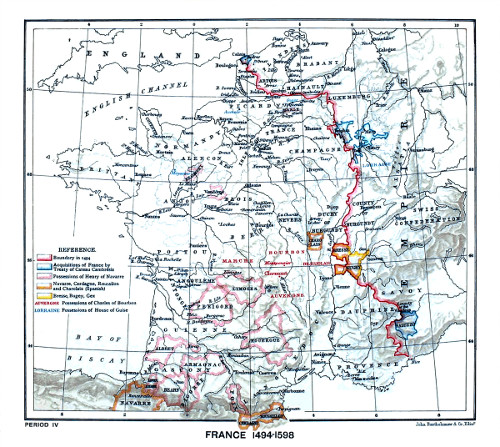
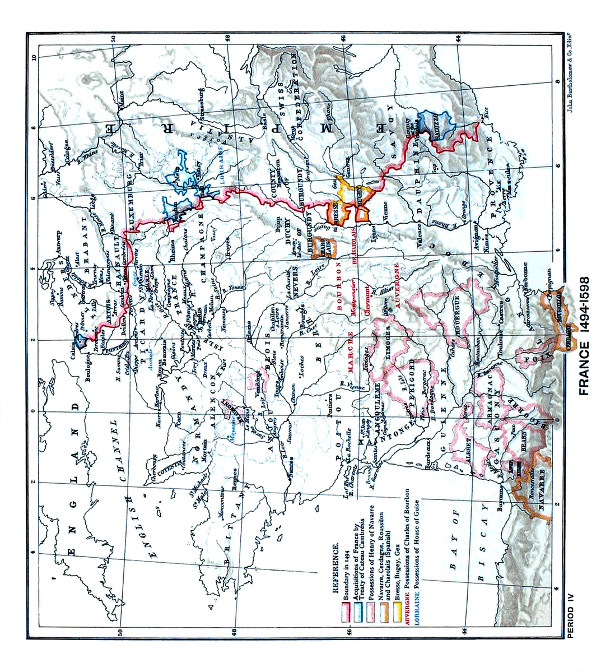
France, under Louis XII., 90;
under Francis I., 219;
after civil wars, 447;
constitution of, 5. And see Appendix I.
Francesco and Francesco Maria Sforza. See Sforza.
Francis I. of Angoulême, King of France, 71;
Treaties with Venice, England, and Charles, 78;
Italian expedition of, 78;
makes Peace of Noyon, 82, and Treaty of London, 83;
character of, 129;
taken prisoner at Pavia, 175;
signs Treaty of Madrid, 183;
joins Holy League of Cognac, 184;
allies himself with Henry VIII., 187;
sends army to Italy, 188;
makes Treaty of Cambrai, 193;
commercial Treaty with Solyman, 207;
invades Italy, 208;
truce of Nice, 209;
war with Charles, Treaty of Crespi, 216;
death, character, 218 ff.
—— II., marriage, position of affairs at accession of, 258, 391;
death, 397.
—— See Guise and Montmorenci.
Franco-Gallia, the, 418.
Frederick I., Elector-Palatine, 113.
—— II., 167, 227.
Frederick the Wise. See Saxony.
Fresneda, Fray Bernardo de, 309.
Friedwald, Treaty of, 330.
Friuli, 36, 65.
Frundsberg, an imperialist leader, 186.
Fuentes, Governor in Netherlands, 383;
defeats Turenne, 439.
Gaëta, siege of, 47.
Galeazzo Maria Sforza. See Sforza.
Gandia, Duke of, a Borgia, 35.
Garigliano, battle of, 47.
Gaston. See Foix.
Gattinara, 220, 221.
Gelnhausen, compact of, 112.
Gemblours, battle of, 355.
Genazzano, Fra Mariano da, 30.
Geneva, position of, 273;
Calvin at, 274 ff.
Genlis, Count of, defeated before Mons, 341, 414.
George of Saxony. See Saxony.
Gérard, Balthazar, 362.
Germaine. See Foix.
Gertruydenberg, siege of, 383.
Gex, ceded to France, 445.
Ghent, revolt and submission of, 209.
Gian Galeazzo Sforza. See Sforza.
Giovanni. See Medici and Sforza.
Giulio. See Medici.
Goletta, storming of, 206.
Gonzaga, House of, 9.
—— Imperial Stadtholder at Milan, 231.
Granada, Treaty of, 40.
Granvelle, Cardinal, influence with Philip, 308 ff.;
in Netherlands, 321, 323.
Gravamina, the hundred, 168.
Grave, surrender of, 370.
Gravelines, battle of, 256.
Gravina, Duke of (Orsini), 53.
Gregory XIII., 270;
attempts to mediate between Philip II. and Antonio, 298.
Gröningen, betrayal of, 358;
fall of, 383.
Gruet, executed at Geneva, 274.
Guasto, Marquis de, 216, 237.
Guerrero, Pedro, Archbishop of Granada, 288.
Guidobaldo, Duke of Urbino, 56.
Guinnegate, battle of, 76.
Guise, family of, 393.
—— Claude, Duke of, 393.
—— John, Cardinal, brother of Claude, 267, 392.
Guise, Mary, sister of Claude, Regent of Scotland, 215.
—— Francis, Duke of, success at Metz, 244;
advises war, 252;
defeated in Italy, 254;
takes Calais, 256;
falls from power, 397;
enters Paris and secures person of king, 401;
death, 406.
—— Charles, Cardinal of Lorraine, brother of Francis, 393, 407, 422.
—— Louis, Cardinal of Lorraine, brother of Francis, 393.
—— Henry, Duke of, holds Poictiers, 409;
joins in plot for murder of Coligny, and in massacre of St. Bartholomew, 414;
position of, 422;
heads Catholic League, 427;
enters Paris, death, 431.
—— Charles, Duke of, 435;
reconciled to Henry IV., 438;
takes Marseilles, 440.
—— Louis, Cardinal of, brother of Duke Henry, executed, 431.
Guisnes, scene of ‘Field of Cloth of Gold,’ 136.
Güns, repulse of Solyman at, 204.
Haarlem, sack of, 342.
Hapsburg, House of, Sigismund of Tyrol, 123.
—— Maximilian, betrothed to Anne of Brittany, 6;
war with Charles VIII., makes treaty of Senlis, 7;
Italian expedition, 28;
wishes to maintain Treaty of Lyons, 61;
a member of League of Cambray, 63;
signs Treaty of Mechlin, 76;
leagued against France, 79;
accepts Peace of Noyon, 83;
election of, 106;
attitude to reforms of Empire, 110;
position abroad, 113;
defeated by Swiss, 123;
dynastic policy of, 124;
character of, 126;
death of, 127.
—— Philip, Archduke, son of Maximilian, marriage of, 42.
—— Charles, son of Archduke. See Charles V.
—— Ferdinand, brother of Charles V., 145. See Ferdinand of Austria.
—— Joanna, daughter of Charles V., regent of Castile, 251.
—— Margaret, daughter of Maximilian, governess of Netherlands, 92. See Margaret.
Hapsburg, Albert, Cardinal Archduke. See Albert.
—— Ernest, Archduke, brother of Emperor Rudolf. See Ernest.
—— Maximilian II., son of Ferdinand, 446.
—— Rudolf II., son of Maximilian II., 446.
Havre ceded to Elizabeth, 405;
fall of, 406.
Hayraddin, Huroc. See Barbarossa.
Heiligerlee, battle of, 335.
Henry II. of France, war in Italy, 237;
alliance with Maurice and Protestants, 239;
campaign in France, 254;
Peace of Cateau Cambrésis, 257;
persecution of Huguenots, 389;
death, 257, 391.
Henry III. (see Anjou) succeeds his brother, 420;
refuses sovereignty of Netherlands, 366, 427;
yields to League, 429;
has Duke of Guise murdered;
on revolt of League turns to Navarre;
death, 431.
Henry IV. succeeds Antony of Navarre, 405;
his possessions, 412;
in hands of Catherine, 415;
connected with ‘Politiques,’ 417;
escapes, 420;
heir-presumptive, 426;
supported by ‘Politiques,’ 429;
his success, 429 ff.;
reconciliation with Henry III., 432;
struggle for the crown, 433;
‘conversion,’ 436;
war with Spain, 438 ff.;
leagued with Elizabeth and Netherlands, 383;
negotiations with Philip, 384, 442;
treatment of Huguenots, 442 ff.;
Peace of Vervins, 444;
rule and death of, 447 ff.
—— IV. of Brunswick-Wolfenbüttel, 167.
—— of Guise. See Guise.
—— of Montmorenci. See Montmorenci.
—— of Saxony. See Saxony.
—— VII. makes Treaty of Étaples, 7.
—— VIII. supports Holy League, 67;
Treaty of Mechlin, 75;
victory of Guinnegate, 76;
peace, 77;
Treaty of London, 83;
leagued with Charles V. and Leo X., 160;
with Charles and Adrian VI., 164;
alliance with Charles V., 173;
allies himself with France after Pavia, 181;
anxious for divorce, 187;
Clement cites the cause to Rome, 193;
change of policy and alliance with Charles, 214 ff.;
war with France, Treaty of Ardres, 216 ff.
Henry (the Navigator), 85.
—— of Portugal, 297.
Hermandad, the, 93.
Hesse, Philip, Landgrave of, puts down the Knights’ War, 169;
defeats Münzer, 176;
establishes Lutheranism, 197;
signs protest, 198;
commands forces of League of Schmalkalde, 200;
battle of Laufen; restores Duke Ulrich; opposes John of Leyden, 210;
leader in Schmalkaldic War, 226 ff.;
submission and imprisonment, 229;
freed by Treaty of Passau, 243.
Hessels, 333.
Hohenlo, 364, 371.
Hohenzollern, House of, 166. See Brandenburg.
Holy League, the, 67, 70;
forces Venice to restore Medici, 71;
breaks up, 73.
Hoogstraten, 335.
Hoorne, Count, an opponent of Philip’s policy in Netherlands, 324;
rallies to government, 328;
arrested, 333;
executed, 335.
Hotman, author of Franco-Gallia, 418.
Howard, Lord, of Effingham, in command against Armada, 377.
Huguenots, early history of, 389 ff.;
origin of name, 391;
condition of, in 1561, 398;
Edict of January, 399;
massacre of Vassy, 401;
geographical distribution of, 403;
peace of St. Germain, 410;
massacre of, on St. Bartholomew, 414;
change in party; writings, 418;
federative republics, 419;
peace of Monsieur, 421;
altered position of, 429;
obtain Edict of Nantes, 442.
Hulst, reduction of, 380.
Humières organises League Péronne, 422.
Hutten, Ulrich von, 169.
Idiaquez, Juan de, 308.
Imbercourt, Chevalier d’, 43.
Imbize, a demagogue, 357.
Imola, in hands of Caterina Sforza, 50.
Inquisition in Italy, 269 ff.;
in Spain 278 ff.;
in Netherlands, 323 ff.
Interim, 232.
Ippolita Sforza. See Sforza.
Isabella of Castile, 91;
policy of, 92;
Church reform, 94;
death, character of, 103;
importance of reign, 105.
—— of Portugal, 277.
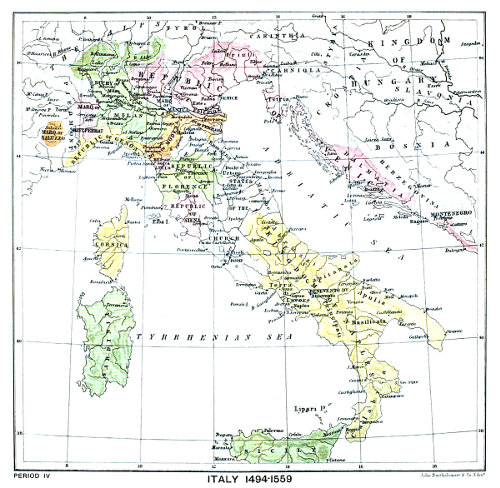
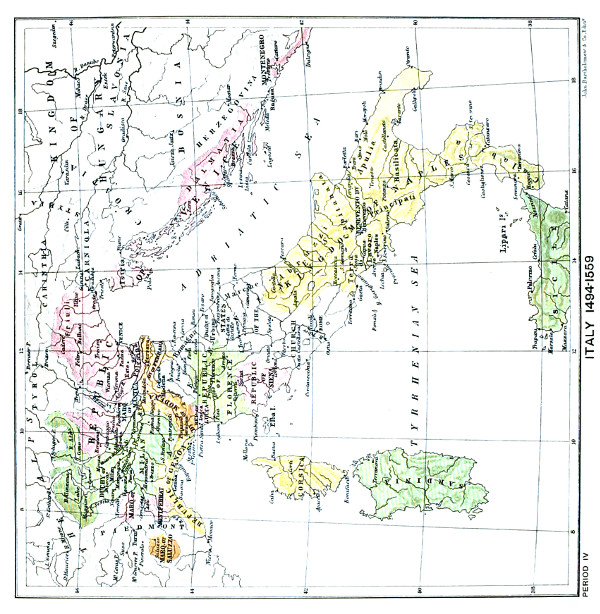
Italy, the chief states of, in 1494, 7 ff.;
in 1559, 259.
Ivry, battle of, 433.
Jeanne, daughter of Louis XI., wife of Louis XII., 34.
Jarnac, battle of, 408.
Jemmingen, battle of, 337.
Joanna II. of Naples, 14.
—— of Castile, 42, 60;
succeeds her mother as Queen, 113;
madness of, 62, 104.
—— Regent of Castile, 251.
Joachim I. and II. of Brandenburg. See Brandenburg.
John Casimir of the Palatinate, 357, 359, 431.
—— Cicero of Brandenburg. See Brandenburg.
—— Don, of Austria, 290 ff.;
wins Lepanto, 294;
commands a second expedition against the Turks, 296;
Governor of Netherlands, 351 ff.;
excites jealousy of Philip, 353;
victory of Gemblours, 355;
death, 356.
—— of Saxony. See Saxony.
—— Frederick of Saxony. See Saxony.
Joinville, Treaty of, 428.
Joyeuse, Duke of, 425, 431.
Julius II., policy of, 54, 56;
makes terms with Venice, 66;
forms Holy League, 67;
death of, 74.
—— III., imperialist policy of, 234, 236, 247.
Justin, son of William of Orange, 364.
‘Justiza,’ the, of Aragon, 94, 300.
Knights’ War, the, 169.
La Charité, 410;
fall of, 423.
Ladislas, King of Bohemia and Hungary, 40.
—— of Poland, 125.
La Fère, reduction of, 439, 440.
Lagny, occupation of, 434.
La Marck, William, Comte de, seizes Brille and Flushing, 339, 413. See Bouillon.
Landshut, George the Rich, Duke of, 113.
Landriano, battle of, 191.
Languet, 418.
Lainez, Iago, 263.
Lannoy in command under Bourbon, 173;
death of, 190.
La Noue, 414, 424.
Laon, reduction of, 438.
La Palice, 43, 44, 70.
La Renaudie, 396.
La Rochefoucauld, 415.
La Rochelle, 408, 410, 416;
Treaty of, 417.
Laso Pedro, leader of the Junta, 139, 141, 142.
La Trémouille, 46.
La Torre, 333.
Lautrec, French commander in Italy, 160, 163, 188, 190.
Laufen, battle of, 210.
Lavoro, district of, 40.
Lefévre, Jacques, influence on Calvin, 273;
position and doctrine of, 387.
Leghorn, dependency of Florence, 9;
French garrison in, 22;
given back to Florence, 24.
Leicester, Earl of, commander of forces in Netherlands, 366 ff.
Leipheim, battle of, 179.
Leith, Treaty of, 397.
Leo X., election of, makes Treaty of Mechlin, 75;
peace with France, 76;
joins Counter-League, 78;
makes peace with France and signs the Concordat of Bologna, 80;
policy towards Luther, 157;
leagued with Charles V. and Henry VIII., 160;
character of, 16.
Lepanto, battle of, 294 ff., 411.
Lewis V., Elector-Palatine, 167, 179, 211.
—— of Poland, 125.
—— Duke of Beja, 297.
Leyden, investment of, 344.
—— John of, 210.
Leyva, Antonio de, 173;
holds Milan for Emperor, 188;
wins battle of Landriano, 191;
granted Monza by Charles, 194;
death, 208.
L’Hôpital, Michel, Chancellor, 397, 407, 408.
Ligny, Count of, 37.
Limeuil, Mdlle. de, 406.
Linz, Conference of, 242.
Lisbon, capitulation of, 298.
Lodi, 37.
London, Treaty of, 83.
Longjumeau, Edict of, 407.
Longueville, Duke of, 433, 439.
Lorenzo. See Medici.
Lorraine, Charles II., Duke of, reconciled to Henry IV., 438.
—— Cardinal of. See Guises.
Louis. See Nassau.
Louis of Orleans (the XIIth), leader of opposition to Anne of Beaujeu, 5;
claims on Milan, 15;
at Rapallo, 18;
surrenders Novara, 23;
succeeds Charles VIII., 25;
policy, 33–34;
makes Treaty of Granada, 40;
war with Ferdinand, 42–8;
death of, 78.
Louise of Savoy, mother of Francis I., negotiates peace of Cambray, 193, 388.
Loyola, Ignatius, early life, foundation of Order of Jesus, 262 ff.
Los Veles, Marquis of, cruelty to Moors, 289;
inefficiency as general, 291;
in power, 306.
Lucca, enemy of Florence, 9;
joins league against France, 22.
Ludovico il Moro. See Sforza.
Luneburg, Ernest I. of, 167.
Luther, Martin, early difficulties and visit to Rome, 153;
the Theses, 155;
break with the Church, 157;
at Diet of Worms, 168;
attitude to peasants’ revolt, 178;
supports League of Schmalkalde, 200;
death, character, 225.
Lyons, Treaties of, 45, 61.
Machiavelli, views on Cæsar Borgia, 55;
devotes himself to letters, 72;
his militia, 194.
Madrid, Treaty of, 183.
Maestricht, fall of, 358.
Magdeburg, surrender of, 239.
Magellan, discoveries of, 102.
Magione, 53.
Mahomet Sirocco, Turkish Admiral, 294.
Mansfeld, Count Peter Ernest, 348, 382.
Mantes, Declaration of, 435.
Malatesta, Pandolfo, 50.
Manfredi, Astorre, 50, 51.
Mantua, the Gonzagas of, 9.
—— Marquis of, 23, 28.
Marcellus II., Pope, 247.
Margaret, Duchess of Parma, Governess of Netherlands, appointed to Netherlands, 320;
policy, 324, 325, 328, 329, 331, 332.
—— of Savoy, aunt of Charles V., 92;
Governess of the Netherlands, 317;
negotiates Peace of Cambray, 193.
—— sister of Henry II., marriage of, 257.
Margaret of Valois, marriage of, 412, 440.
Mary of Burgundy, 126.
Mary Queen of Scots, marriage, 258;
Carberry Hill, 339;
plots against Elizabeth, 339; death of, 371.
—— sister of Henry VIII., marries Louis XII., 77.
—— of Hungary, Governess of Netherlands, 320.
Marignano, battle of, 79.
Mathias, Archduke, brother to Emperor Rudolf, elected Governor-General of Netherlands, 354;
defeated at Gemblours, 355;
his inefficiency, 359.
Matricula, the, 114.
Maurice. See Orange.
—— of Orange. See Orange.
—— of Saxony. See Saxony.
Maximilian I. and II. See Hapsburg.
—— Sforza. See Sforza.
Mayence, Berthold, Archbishop of, 108, 113.
—— Archbishop of, a Hohenzollern, 131, 132, 133.
Mayenne, Duke of, made Lieutenant-General, rules Paris, 432;
defeated at Arques, 433;
selfish aims, 437;
comes to terms with Henry IV., 440.
Mazarquiver, fall of, 97;
relief of, 286.
Meaux, Briçonnet, Bishop of, 387;
Protestants at, 387, 389;
conspiracy of, 407.
Mechlin, Treaty of, 75;
sack of, 342;
surrender of, 358.
Montigny, Baron of, execution, 336.
Medici in Florence, 9;
Lorenzo, 9, 15;
Piero, joins Alfonso of Naples against Ludovico of Milan, 16;
submits to Charles VIII.;
flies from Florence, 19.
—— Giovanni, Cardinal, restored to Florence, 71. See Leo X.
—— Giulio de. See Clement VII.
—— Alessandro, Governor of Florence, 172;
driven from Florence, 189;
reinstated, 194.
—— Cosimo, Duke of Florence, 250;
Grand Duke of Tuscany, 259.
—— Catherine de, 394 ff.;
regent, 398;
adopts policy of Guises, 402, 406–408;
joins Coligny, 411;
becomes alarmed, 413;
her share in massacre of St. Bartholomew, 414;
subsequent policy, 415 ff.;
death of, 432.
Medina Celi, Duke of, sent to Netherlands, 336;
returns to Spain, 343.
—— Sidonia, Duke of, 285;
in command of Armada, 375.
Mendoza, imperial Ambassador to Rome, severe rule at Siena, 244;
Ambassador to Elizabeth, 374;
envoy to France, 431.
Mercœur, Duke of, 438;
selfish aims, 424, 437;
submission to Henry IV., 442.
Messina, 24.
Miguel, Don, 92.
Milan, claims of House of Orleans to, 14;
leagued with Naples and Florence against France, 15;
Maximilian grants investiture to Sforza, 16;
joins League of Venice, 21, 22;
Treaty of Vercelli (1495), 23;
surrenders to French, 37;
lost by French, 70;
leagued against France, 79;
in French hands, 80;
French driven out, given to Francesco Sforza, 160;
taken by imperialists from Francesco Maria Sforza, 185;
held by Leyva, 188;
granted by Charles to Sforza, 194;
on his death annexed by Charles, 207;
given by Charles to his son Philip, 212;
Philip’s government of, 301.
See Sforza.
Mirandola, conquest of, 66.
Mitylene, French attack on, 40.
Modena taken by Julius II., 66.
—— Cardinal of, 53.
Modon taken by Turks, 40.
Mohacs, battle of, 184.
Monçada, Hugo de, succeeds Pescara; takes Milan; treacherous seizure of Rome, 185.
Moncontour, battle of, 409.
Mondragon, success of, 348.
Mondejar, Marquis de, 289.
Monopoli, occupation of, 24.
Mons, fall of, 340, 413;
defeat of Genlis before, capitulation of, 341.
Monsieur, Peace of, 421.
Montauban, 410, 416.
Monte, Cardinal. See Julius III.
Montefeltro, Guidobaldo di, Duke of Urbino, 50.
Montigny, Baron of, brother of Count Hoorne, 327, 336.
Montmorenci, Anne de, Marshal and Constable, his policy, 209;
disgraced, 213;
defeated at St. Quentin, advises peace, 255;
policy, 392;
reconciled with Guises, 401;
taken prisoner, 405
of, 407.
Montmorenci, Francis of, Marshal of France and Governor of Paris, leader of the ‘Politiques,’ 410, 417, 420, 423.
—— Henry, (Damville), Governor of Languedoc, a leader of the ‘Politiques,’ 417;
becomes Duke and Marshal, and makes peace with court, 423, 441.
—— William (Thoré), Charles (Méru), 417.
Montpensier, Count of, Viceroy in Italy, 22;
capitulates, 24.
—— Duke of, 410.
Mooker Heyde, battle of, 344.
Morone, Bishop of Modena, 212.
—— Cardinal and Papal Legate, 247.
Moura, Christoval de, 308.
Mühlberg, battle of, 229.
Muley-Hassan, 206.
Munster, Anabaptist revolution at, 210.
Münzer, Thomas, 177.
Mustapha in command against Malta, 286.
Naarden, razing of, 342.
Nantes, Edict of, 442.
Naples, condition of, 11;
French claims on, 14, 15;
government of, by Philip, 301.
Nassau, John of, brother of William, 355, 358.
—— Louis of, 326, 335;
defeated at Jemmingen, 337;
invades France, 337, 409; negotiations with France, takes Mons, 337, 409;
capitulates, 341;
defeated at Mooker Heyde, death, 344.
—— Maurice of. See Orange.
—— William of. See Orange.
Navarra, Pedro, 46, 69, 191.
Navarre, Spanish, conquered by Ferdinand, 73.
—— Antony of (see Albret), position of, 392;
submissiveness to Catherine, 398;
death, 405.
—— Henry of. See Henry IV.
Navarino, battle of, 40.
Nemours, Conference of, 429.
—— Duke of, 5, 44, 45, 438.
Netherlands, condition of, at accession of Philip II., 316;
at his death, 385;
Philip’s ecclesiastical policy, 322;
plan of reform of nobles, 325;
Alva in, 331;
revolt of, 335 ff.;
independence of, 384.
Nicosia, fall of, 293.
Nice, truce of, 209.
Nîmes, 416.
Noircarmes, 333.
Norris, Sir John, 370.
—— Edward, 370, 371.
Novara, battle of, 76.
Noyon, Peace of, 82.
Nuremberg, Diet of, the religious struggle at; the hundred Gravamina, 167 ff.;
peace of, 204.
Nymwegen, reduction of, 381.
Oliverotto, 53.
Oran, fall of, 97.
Orange, Philibert, Prince of, commands imperial army in Italy, 190;
killed in siege of Florence, 194.
—— William (of Nassau), Prince of, 320;
leader of malcontents, 324 ff.;
leaves Netherlands, 328;
ill-success, 337;
French campaign, 337, 409;
negotiations with England and France, 340, 412;
forced to retire, 341;
increased authority, 347;
pacification of Ghent, 350;
opposition to Don John, 353 ff.;
ban and Apologia, 359;
death, character, 362;
marriages and children, 363.
—— Maurice, Prince of, second son of William, Captain-General, 364;
reappointed Governor-General, 371;
again appointed, 377 ff.;
early life, 379;
military reforms, 380;
success, 380 ff.
Orleans, siege of, 406.
—— Louis, Duke of. See Louis XII.
Orsini, the, 35, 48.
—— Cardinal, 53.
—— Paolo, 53.
Otranto, occupation of, 24.
Pacheco, Donna Maria, widow of Padilla, 143.
Padilla, Don Juan de, heads revolt at Toledo; defeated at Villalar and executed, 139 ff.
Padua, 64.
Palatinate, Family of Wittelsbach in, 167.
—— John Casimir of, 357, 359, 431.
Palatine, Frederick I., Elector, defeat of, 113.
—— Rupert, second son of Frederick, death of, 113.
—— Lewis V., Elector, 167;
puts down peasants, turns Protestant, 179, 211.
Palatine, Frederick II., Elector, brother of Lewis, submits to Charles, 227.
‘Pancarte,’ 441.
Paolo, Gian, 52.
Papal States, the, origin of, 10;
extension of, 49–56.
Parlement of Paris, 5;
(Appendix, 449–450);
weakness of, 5;
policy towards Huguenots, 390, 396, 400, 404, 408, 421, 430, 443.
—— Provincial (Appendix I., 451);
policy of, 408, 421, 424, 443.
Parma, Alexander Farnese of, at Lepanto, 294;
son of Margaret, successor of Don John, 356;
successes, 358, 361, 364, 370;
takes Sluys, 372;
negotiates with Elizabeth, 374;
success of, 378;
jealousy of Philip, 379;
ill-success and death, character, 380, 434.
—— Margaret, Duchess of, birth, education, and marriage, 320. See Margaret of Parma.
Paredes, Diego de, 43.
Passau, Treaty of, 242.
Paul III., allies himself with Charles V., 206;
mediates to bring about Truce of Nice, neutral policy, 209, 214;
re-summons Council to Trent, 221;
refuses to support Charles;
intrigues with Francis, 228;
refuses to recall Council from Bologna to Trent, negotiates with Henry II., 231 ff.;
death, 234.
—— IV., Pope, 247;
anti-Spanish policy, 252;
terms with Alva, 254.
Paz, Pedro de, 43.
Peasants’ war, 176–180.
Perez, Antonio, accused by Inquisition, 281;
accuses Philip of murder of Don Carlos, 283;
quarrel with Philip, 300;
rise, quarrel with Philip, exile, 306 ff.
Perpetual Edict, 352.
Perpignan, 215.
Perugia, 53, 56.
Pesaro, 50.
Pescara, Marquis of, 173;
advises Treaty of Madrid, death, 183.
Peschiera, 64.
Pescia, Domenico da, 31, 32.
Philibert of Orange, 190, 194.
—— Emanuel, Duke of Savoy. See Savoy.
Philip, Archduke of Austria, 42;
marriage, 316.
Philip II., granted Milan by his father, 212;
governor in Spain, etc., 234 ff.;
King of Spain, 250;
Treaty of Cateau Cambrésis, marriage with Elizabeth of France, 257;
position of affairs, 259;
ecclesiastical policy, 268, 271, 278;
marriages, 277, 282, 284;
treatment of the Moriscoes, 287 ff.;
internal policy and government, 299 ff.;
character of, 310;
commercial policy, 311 ff.;
policy in Netherlands, 319 ff.;
ecclesiastical scheme, 322 ff.;
opposition to plan of reform, 325;
policy to Elizabeth of England, 374;
to Catherine of France, 407, 410;
to Guises, 427, 431;
designs on France, 435;
method of filling exchequer, 441;
negotiations with Henry IV., 442;
peace of Vervins, 444;
death and policy, 445 ff.
—— of Hesse. See Hesse.
Piali, 285, 286, 293;
death at Lepanto, 295.
Piero. See Medici.
Piccolomini, Cardinal, Pope Pius III., 47.
Pietra-Santa, dependency of Florence, 9;
French garrison, 22;
sold to Lucca, regained by Florence, 24.
Piombino, surrender of, 51.
Pisa, dependency of Florence, 9;
joins Charles VIII., 19, 22;
regained by Florence, 24;
Council of, 66.
Pistoja, dependency of Florence, 9.
Pitigliano, Count of, 64.
Pius III., 47, 54.
—— IV., 266, 270.
—— V., 270, 295.
Poictiers, taking of, 405;
siege of, 409.
—— Diana of, 217.
Pointoise, States-general at, 398.
Poissy, colloquy of, 399.
Pol, Count de St., defeated at Landriano, 191.
Poland, Ladislas of, 125.
—— Lewis of, 125.
—— Sigismund of, restores Catholicism, 446.
Pole, Reginald, 212.
Polesine, the, 64.
Poltrot assassinates Duke of Guise, 406.
Pompeio, Cardinal, leader of the Colonnesi, takes Rome, 185.
Porto Carrero, Governor of Doullens, 441.
Portugal, Isabella of, 277.
—— Kings of—Antonio, Prior of Crato; Henry; Lewis, Duc de Beja; Sebastian, 297 ff., 378.
Portuguese, discoveries and conquests of, 85.
Prato, sack of, 71.
Principati, the district of the, 42.
Puglia, Francesco da, 31.
Quiroga, Archbishop of Toledo, Grand Inquisitor, 281.
Rapallo, battle of, 18.
Ratisbon, Congress at, 171;
Diets of (1532), 204;
(1541), 212.
Ravenna, occupied by Julius II., 64;
battle of, 68.
Regency, Council of, ill-success of, 169, 179.
Regnault, head of Finance Chamber in Netherlands, 368.
Requesens, Don Louis de, grand commander of Santiago, at Lepanto, 294;
succeeds Alva, 343;
change of policy, 344;
attempt at reconciliation, 345 ff.;
death, 348.
Reuchlin, John, 150.
Rhætian Leagues, 122.
Rhodes, fall of, 164.
Rimini, 49, 56, 64.
Roda, Jerome de, 348, 349.
Romagna, papal claims over, 49;
Cæsar Borgia’s conquests in, 50 ff.
Roromantin, Edict of, 396.
Rosny, Baron de. See Sully.
Rouen taken by Catholics, 405;
secured by Henry IV., 437.
Rousillon, 6, 46, 215.
Rovere, Francesco Maria della, lord of Sinigaglia, 50.
—— Giuliano della. See Julius II.
—— Francesco, Duke of Urbino, 56.
Rudolf II., Emperor, 446.
Rupert, son of Frederick I., Elector-Palatine, 113.
Ruvo, 44.
St. André, Marshal, 405.
St. Denis, battle of, 407.
St. Gall, 121.
St. Germains, Treaty of, 340, 410.
St. Quentin, battle of, 254.
Saint Jean d’Angély, fall of, 409.
Sainte Aldegonde, Philip van Marnix, Lord of, 326.
Santa Cruz, Marquis de, 426.
—— Severina, 45.
Sapienza, battle of, 40.
Saluzzo, Marquis of, 48;
succeeds Lautrec in command, defeated at Aversa, death, 191.
—— Marquisate of, ceded to France, 257;
exchanged for Bresse, Bugey, Gex, 445.
Sancerre, siege of, 416.
San Severino, Galeazzo di, 37.
Santa Cruz, Marquis of, 294, 298, 299.
Sarzana, dependency of Florence, 9;
French garrison in, 22;
sold to Genoa, 24.
Savonarola, 25–33.
Savoy, Charles III., Duke of, quarrel with Francis, 207;
Treaty of Crespi, 217;
Emanuel Philibert, son of Charles III., commands Philip’s forces against France with success, 255;
restored by Treaty of Cateau Cambrésis, 257.
—— Philibert Emanuel, 257, 320.
—— Louise of, 193; persecutes the Huguenots, 388.
Saxony, Frederick the Wise, Elector of, his family, 166;
one of party of reform, 108;
refuses to be a candidate for the Empire, 133;
founds University of Wittenberg, 154;
protects Luther, 159.
—— George, Duke of, 166–168, 170.
—— Henry, 166.
—— John the Steadfast, Elector of, character of, 204;
establishes Lutheranism after Diet of Spires, 197;
signs protest against Second Diet, 198;
commands forces of League of Schmalkalde, 200;
protests against election of Ferdinand as King of the Romans, 203;
death, policy of, 204.
—— John Frederick, 222 ff.;
Schmalkaldic War, 224 ff.;
capture, 229;
freed by Treaty of Passau, 243.
—— Maurice, secured by Charles’ promises, 223;
overruns Saxony, repulsed, reinstated, 226 ff.;
conspires and takes arms, 238 ff.;
death, character, 244 ff.
—— Augustus, succeeds Maurice as Elector, 246.
—— Anne of, daughter of Maurice, marriage of, 324.
Schinner, Mathias, Bishop of the Valais, Cardinal of Sion, 70, 132.
Schmalkalde, meeting of, 198; League formed, 200;
joined by Southern Germany, 203.
Sebastian of Portugal, 297.
Selim II., Sultan, 288, 293.
Seminara, battle of, 24, 45.
Senlis, Treaty of, 7.
Servetus burnt at Geneva, 274.
Sesa, Duke of, 291.
Sforza, Francesco, seizes Milan, 7;
allies himself with Naples and Florence, 15.
—— Ippolita, daughter of Francesco, wife of Alfonso of Calabria, 15.
—— Galeazzo Maria, son of Francesco, 7.
—— Gian Galeazzo, son of Galeazzo, 7;
marries Isabella of Naples, 16;
death of, 18.
—— Ludovico il Moro, uncle of Gian Galeazzo, seizes power, 8;
calls on Charles VIII., 16;
joins League of Venice, 22;
makes Treaty of Vercelli, 23;
flies to Maximilian, 37;
returns but is taken prisoner, 38;
death, 39;
family of, 39.
—— Caterina, niece of Ludovico, at Imola and Forli, 50.
—— Giovanni, Lord of Pesaro, cousin of, 50.
—— Maximilian, son of Ludovico, 39;
restored to Milan, 72;
surrenders to Francis, 80.
—— Francesco Maria, granted Milan, 160;
joins League of Cognac, 184;
capitulates to imperialists, 185;
commands troops of Holy League, 191;
restored by Charles V., 194;
death, 207.
Sicily, government of, by Philip, 301.
Sickingen, Franz von, 132;
organises League of Knights, defeat and death, 169.
Sidney, Sir Philip, Governor of Flushing, 366;
death, 370.
Siena, enemy of Florence, 9;
accepts a French garrison, 20;
joins league against Florence, 22;
turns to Emperor,then to France, 244;
regained for Imperialists by Cosimo, Duke of Florence, 250.
Sievershausen, battle of, 245.
Sigismund of Tyrol, cousin of Maximilian, 123.
—— of Poland, 446.
Signory, Florentine executive, 26, 458.
Silvestro, Fra, executed with Savonarola, 32.
Simonetta, counsellor of Bona of Savoy, murdered by Ludovico ‘Il Moro,’ 8.
Sinigaglia, massacre of, 53.
Sixtus V., 270;
disapproval of League, 428;
excommunicates Henry of Navarre, 429.
Sluys, fall of, 365, 372.
Soderini, Piero, Gonfalonier of Florence, 71.
Solyman wins battle of Mohacs, 184;
forced to retreat from Vienna, 196;
treaty with Francis, defeats Ferdinand at Essek, 208;
and at Buda, 214;
nearly completes conquest of Hungary, 216;
supports the French, 244;
sends fleet against Malta, 286;
death, 293.
Spires, Diets of, 196, 197, 216.
Stanley, Sir William, 371.
Steenwyck, fall of, 381.
Stralen, Burgomaster of Antwerp, 333, 336.
Suabian League, formation of, 108;
defeat at Bruderholz and Dornach, 123;
favours election of Charles, 131;
wins battle of Leipheim; with Elector of Trèves and Elector-Palatine suppresses revolt of peasants, 179.
Sully, 440, 448.
Swiss Confederation, origin of, 117 ff.;
constitution of, 120 ff.;
war with Maximilian, 123;
makes Peace of Basel, 124.
Taillie, the, 34, 456.
Tassis, 371.
Teligny, 415.
Terouenne, 76, 244.
Termes, Marshal de, defeated at Gravelines, 256.
Terranova, battle of, 43.
Theatins, the, 262.
Thurgau, the, 120.
Toledo, revolt of, 139.
—— Garcia de, 286, 287.
Torrelobaton, sack of, 142.
Tours, Estates-General of, 62.
Trade routes, 84, 87.
Trani occupied by Venice, 24.
Trent, 62;
Council of, first and second session, 221;
at Bologna, 230;
reassembles at Trent; failure, 235;
third session, 266 ff.
Trèves, John of Baden, Archbishop of, 108;
death, 113.
Trèves, Richard Greifenklau, Archbishop of, his policy at the imperial election, 131–133;
joins in suppressing peasants’ revolt, 179;
attacked by Sickingen, 169;
opposes Council of Regency, 170.
—— Diet of, organisation of Empire, 114.
Tripoli, 97.
Trivulzio, General in French service, 36;
Governor of Milan, 38;
in Italian Wars, 70;
surrenders Genoa, 191.
Tübingen, University of, 210.
Turnhout, battle of, 383.
Turenne, Duke of Bouillon, 439.
Ulrich. See Wurtemberg.
Uluch Ali, Dey of Algiers, 295;
retakes Tunis and reduces Goletta, 296.
Urbino, 50;
occupied by Cæsar Borgia, 52, 53, 56.
—— Duke of, leads army of Holy League, 186 ff.
Utrecht, Adrian of. See Pope Adrian VI.
—— Union of, 358.
Valdès, Don Fernando, Archbishop of Seville, Grand Inquisitor, 281.
—— a Spanish Commander, 345.
Vaila, battle of, 63.
Valencia, social war in, 140.
Valenciennes, fall of, 414.
Valette, Jean de la, Grand Master of Knights of Malta, 286.
Valentina, Visconti, 14.
Valentinois given to Cæsar Borgia, 35.
Valla, Laurentius, 150.
Valois, Margaret of, 412, 440.
Valori supports Savonarola, 27;
slain, 31.
Varano, Giulio Cæsare, Lord of Camerino, 50.
Vargas, Juan de, 333.
Vassy, Massacre of, 401.
Vega, Don Pedro Laso de la, 139.
Velasco, Don Fernan de, 439.
Venice, constitution of, Appendix III.;
position of, 8;
joins League against Charles VIII., 22;
growth of, 57;
losses of, 64;
recovery of, 65;
agrees to peace of Noyon, 83;
causes of decline, 84;
though an ally, seizes Ravenna and Cervia from Clement, 189;
forms defensive alliance with Charles, 194.
Venloo, capitulation of, 370.
Venosa, 45.
Vercelli, Treaty of, 23.
Verona, 64.
Vers, Stephen de, Duke of Nola, 22.
Vervins, Peace of, 384, 442.
Vespucci, Amerigo, 102.
Vicenza, 64, 65.
Vielleville, Marshal, 411.
Viglius, 321.
Villalar, battle of, 143.
Villequier, 425.
Vitellozzo, Vitelli, a captain of Cæsar Borgia’s, 52, 53.
Vindiciæ contra Tyrannos, 418 ff.
Volterra, a dependency of Florence, 9.
Walsingham, 413, 414.
Welf, House of, 167.
Wettin, House of, 166. See Saxony.
Wilkes, 370.
William I. of Bavaria, 167.
—— of Orange. See Orange.
Willoughby, Lord, in command in Holland, 378.
Wingfield, Sir Robert, Ambassador of Henry VIII., 78.
Wittelsbach (see Palatinate and Bavaria);
House of, 167.
Wolfenbüttel, Henry IV. of, 167.
Wolfgang of Zweibrücken, 409.
Wolsey, Cardinal, 75, 77;
opposition to France, 82;
policy of, 135 ff.;
joins Charles V. and Leo X., 10;
induces Henry to ally himself with France after Pavia, 181;
persuades Henry not to promise ‘protection’ to Holy League of Cognac; divorce question on foot, 184 ff.;
therefore alliance with France necessary, conference at Amiens with Francis, 188;
Clement revokes powers of Wolsey and Campeggio to try Henry’s cause, 193.
Worms, Diet of (1495), reforms demanded, 109;
second Diet of, chief questions for settlement, 145 ff.;
practical failure of, 148, 221.
Würtemberg, Ulrich, Duke of, driven out by Suabian League, 131;
recovers Duchy, 178;
ousted again by Suabian League, 179;
restored by Philip of Hesse, establishes Protestantism, 210;
Schmalkaldic war, 226.
Xavier, Frencesco, 263.
Ximenes, Francisco, de Cisneros, Cardinal, 62;
Archbishop of Toledo, 95;
rise, reforms, 95;
persecution, 96;
death of, 138.
York, Rowland, 371.
Zamora, Acuña, Bishop of, 142.
Zapolya, John, Waivode of Transylvania, allied with Solyman, holds Hungary, 195 ff.
—— Isabella, secures Transylvania, 244.
Zierickzee, fall of, 348.
Zutphen, engagement of, 370;
reduction of, 380.
Zweibrücken, Wolfgang, Duke of, 409.
Zwingle, position as a reformer, reaction against him in Switzerland, death in battle of Cappel, 201 ff.
Transcriber’s Note
Footnotes have been moved to the end of the respective chapter or appendix. The summary of chapter IX has been moved to precede the heading of the first section, consistent with all other chapters.
Where historical names have been anglicized, e.g. Nicolo Capponi for Niccolò Capponi (page 189), the author’s version has been retained. Other spelling variations including but not limited to comuneros—communeros, Custrin—Küstrin, Bèza—Beza, Granvelle—Granvella, Groningen—Gröningen are as in the original.
Pages 183, 193, 298, 474, 475, 481, “Eleanor”, “Eleanora”, “Eleonora” all refer to Eleanor of Austria, the widowed sister of Charles V and later wife of Francis I.
The following corrections have been made to the printed original:
Page ix, “treaty” amended to “Treaty” (Treaty of Cateau Cambrésis).
Page x, “Süd Europa” corrected to “Süd-Europa” (Fürsten und Völker von Süd-Europa).
Page xi, “Ponjoulat” corrected to “Poujoulat” (Pétitot, Michaud et Poujoulat).
Page xiii, “republica” corrected to “repubblica” (Storia della repubblica).
Page xiii, “Alberi” amended to “Albèri” (Albèri, La relazione degli Ambasciatori).
Page xiii, “Niccolo” amended to “Niccolò” (Niccolò Machiavelli).
Page xiv, “Harisse” corrected to “Harrisse” (Harrisse, Christophe Colomb).
Page xiv, “Gashard” corrected to “Gachard” (Ed. Gachard.)
Page xv, “Mexica” corrected to “Mexico” (Conquest of Mexico).
Page 26, “Liberta” corrected to “Libertà” (Dieci di Libertà e Pace).
Page 34, footnote 11, “Appendix I.” changed to “Appendix i.” for consistency’s sake (Appendix i., p. 456.)
Page 60, “Sep.” corrected to “Sept.” (Blois, Sept. 22, 1504.)
Page 72, “Liberta” corrected to “Libertà” (Dieci di Libertà e Pace).
Page 102, “Balbao” corrected to “Balboa” (Vasco Nuñez de Balboa).
Page 113, “brilliantmatch” corrected to “brilliant match” (promised a brilliant match).
Page 114, “Meckle burg” corrected to “Mecklenburg” (Mecklenburg, the Archbishoprics of Magdeburg).
Page 142, “digusted” corrected to “disgusted” (disgusted at the turn).
Page 166, footnote 44, “Wurtemburg” corrected to “Wurtemberg” (Wurtemberg, Ulrich I., 1503–1550).
Page 170, “Guilio” corrected to “Giulio” (Cardinal Giulio de’ Medici).
Page 185, “Moncada” corrected to “Monçada (Monçada and the Cardinal).
Page 189, “Ippollito” corrected to “Ippolito” (Alessandro and Ippolito).
Page 208, “Sep.” corrected to “Sept.” (July–Sept. 1536.)
Page 208, footnote 51, the missing footnote marker was supplied.
Page 220, “Cambresis” corrected to “Cambrésis” (Treaty of Cateau Cambrésis).
Page 280, “cause” corrected to “case” (case being transferred).
Page 387, “Etaples” amended to “Étaples” (Jacques Lefèvre of Étaples).
Page 414, “Prévot” amended to “Prévôt” (Prévôt des Marchands).
Page 449, “chief” corrected to “Chief” (the Chief Military Officer).
Page 454, “d’État” to “État” (deputies of Tiers État).
Page 464, “Podesta” corrected to “Podestà” (Courts of the Podestà).
Page 480, “Chatillon” corrected to “Châtillon” (Châtillon, Odet).
Page 481, “Epernon” corrected to “Épernon” (Épernon, a favourite of Henry).
Page 482, “Etaples” amended to “Étaples” (Étaples, Treaty of).
Page 484, “Etaples” amended to “Étaples” (makes Treaty of Étaples).
Page 484, “Albret” corrected to “Albert” (Hapsburg, Albert, Cardinal)
Page 484, “Peronne” corrected to “Péronne” (League Péronne).
Page 486, “Carpinal” corrected to “Cardinal” (Giovanni, Cardinal, restored).
Page 487, “Meru” corrected to “Méru (Charles (Méru)).
Page 487, “Moncada” corrected to “Monçada” (Monçada, Hugo de).
Page 487, “Naussa” corrected to “Nassau” (Nassau, John of).