Chapter XIV · (continued 2)
Reading edition
"Sally" being in this way brought awake, is obliged to pay attention to Mr. Smith, and Professor Bugge, little as he may feel inclined, must turn his attention to the other side. To persist in carrying on their own conversation at the expense of others, would be inexcusably rude, not only to their hostess but to every one present.
At a dinner not long ago, Mr. Kindhart sitting next to Mrs. Wellborn and left to himself because of the assiduity of the lady's farther partner, slid his own name-card across and in front of her, to bring her attention to the fact that it was "his turn."
Enemies Must Bury Hatchets
One inexorable rule of etiquette is that you must talk to your next door neighbor at a dinner table. You must, that is all there is about it!
Even if you are placed next to some one with whom you have had a bitter quarrel, consideration for your hostess, who would be distressed if she knew you had been put in a disagreeable place, and further consideration for the rest of the table which is otherwise "blocked," exacts that you give no outward sign of your repugnance and that you make a pretence at least for a little while, of talking together.
At dinner once, Mrs. Toplofty, finding herself next to a man she quite openly despised, said to him with apparent placidity, "I shall not talk to you—because I don't care to. But for the sake of my hostess I shall say my multiplication tables. Twice one are two, twice two are four——" and she continued on through the tables, making him alternate them with her. As soon as she politely could she turned again to her other companion.
Manners At Table
It used to be an offense, and it still is considered impolite, to refuse dishes at the table, because your refusal implies that you do not like what is offered you. If this is true, you should be doubly careful to take at least a little on your plate and make a pretence of eating some of it, since to refuse course after course can not fail to distress your hostess. If you are "on a diet" and accepted the invitation with that stipulation, your not eating is excusable; but even then to sit with an empty plate in front of you throughout a meal makes you a seemingly reproachful table companion for those of good appetite sitting next to you.
Attacking A Complicated Dish
When a dinner has been prepared by a chef who prides himself on being a decorative artist, the guest of honor and whoever else may be the first to be served have quite a problem to know which part of an intricate structure is to be eaten, and which part is scenic effect!
The main portion is generally clear enough; the uncertainty is in whether the flowers are eatable vegetables and whether the things that look like ducks are potatoes, or trimming. If there are six or more, the chances are they are edible, and that one or two of a kind are embellishments only. Rings around food are nearly always to be eaten; platforms under food seldom, if ever, are. Anything that looks like pastry is to be eaten; and anything divided into separate units should be taken on your plate complete. You should not try to cut a section from anything that has already been divided into portions in the kitchen. Aspics and desserts are, it must be said, occasionally Chinese puzzles, but if you do help yourself to part of the decoration, no great harm is done.
Dishes are never passed from hand to hand at a dinner, not even at the smallest and most informal one. Sometimes people pass salted nuts to each other, or an extra sweet from a dish near by, but not circling the table.
Leaving The Table
At the end of dinner, when the last dish of chocolates has been passed and the hostess sees that no one is any longer eating, she looks across the table, and catching the eye of one of the ladies, slowly stands up. The one who happens to be observing also stands up, and in a moment everyone is standing. The gentlemen offer their arms to their partners and conduct them back to the drawing-room or the library or wherever they are to sit during the rest of the evening.
Each gentleman then slightly bows, takes leave of his partner, and adjourns with the other gentlemen to the smoking-room, where after-dinner coffee, liqueurs, cigars and cigarettes are passed, and they all sit where they like and with whom they like, and talk.
It is perfectly correct for a gentleman to talk to any other who happens to be sitting near him, whether he knows him or not. The host on occasions—but it is rarely necessary—starts the conversation if most of the guests are inclined to keep silent, by drawing this one or that into discussion of a general topic that everyone is likely to take part in. At the end of twenty minutes or so, he must take the opportunity of the first lull in the conversation to suggest that they join the ladies in the drawing-room.
In a house where there is no smoking-room, the gentlemen do not conduct the ladies to the drawing-room, but stay where they are (the ladies leaving alone) and have their coffee, cigars, liqueurs and conversation sitting around the table.
In the drawing-room, meanwhile, the ladies are having coffee, cigarettes, and liqueurs passed to them. There is not a modern New York hostess, scarcely even an old-fashioned one, who does not have cigarettes passed after dinner.
At a dinner of ten or twelve, the five or six ladies are apt to sit in one group, or possibly two sit by themselves, and three of four together, but at a very large dinner they inevitably fall into groups of four or five or so each. In any case, the hostess must see that no one is left to sit alone. If one of her guests is a stranger to the others, the hostess draws a chair near one of the groups and offering it to her single guest sits beside her. After a while when this particular guest has at least joined the outskirts of the conversation of the group, the hostess leaves her and joins another group where perhaps she sits beside some one else who has been somewhat left out. When there is no one who needs any especial attention, the hostess nevertheless sits for a time with each of the different groups in order to spend at least a part of the evening with all of her guests.
When The Gentlemen Return To The Drawing-room
When the gentlemen return to the drawing-room, if there is a particular lady that one of them wants to talk to, he naturally goes directly to where she is, and sits down beside her. If, however, she is securely wedged in between two other ladies, he must ask her to join him elsewhere. Supposing Mr. Jones, for instance, wants to talk to Mrs. Bobo Gilding, who is sitting between Mrs. Stranger and Miss Stiffleigh: Mr. Jones saunters up to Mrs. Gilding— he must not look too eager or seem too directly to prefer her to the two who are flanking her position, so he says rather casually, "Will you come and talk to me?" Whereupon she leaves her sandwiched position and goes over to another part of the room, and sits down where there is a vacant seat beside her. Usually, however, the ladies on the ends, being accessible, are more apt to be joined by the first gentleman entering than is the one in the center, whom it is impossible to reach. Etiquette has always decreed that gentlemen should not continue to talk together after leaving the smoking-room, as it is not courteous to those of the ladies who are necessarily left without partners.
At informal dinners, and even at many formal ones, bridge tables are set up in an adjoining room, if not in the drawing-room. Those few who do not play bridge spend a half hour (or less) in conversation and then go home, unless there is some special diversion.
Music Or Other Entertainment After Dinner
Very large dinners of fifty or over are almost invariably followed by some sort of entertainment. Either the dinner is given before a ball or a musicale or amateur theatricals, or professionals are brought in to dance or sing.
In this day when conversation is not so much a "lost" as a "wilfully abandoned" art, people in numbers can not be left to spend an evening on nothing but conversation. Grouped together by the hundred and with bridge tables absent, the modern fashionables in America, and in England, too, are as helpless as children at a party without something for them to do, listen to, or look at!
Very Big Dinners
A dinner of sixty, for instance, is always served at separate tables; a center one of twenty people, and four corner tables of ten each. Or if less, a center table of twelve and four smaller tables of eight. A dinner of thirty-six or less is seated at a single table.
But whether there are eighteen, eighty, or one or two hundred, the setting of each individual table and the service is precisely the same. Each one is set with centerpiece, candles, compotiers, and evenly spaced plates, with the addition of a number by which to identify it; or else each table is decorated with different colored flowers, pink, yellow, orchid, white. Whatever the manner of identification, the number or the color is written in the corner of the ladies' name cards that go in the envelopes handed to each arriving gentleman at the door: "pink," "yellow," "orchid," "white," or "center table."
In arranging for the service of dinner the butler details three footmen, usually, to each table of ten, and six footmen to the center table of twenty. There are several houses (palaces really) in New York that have dining-rooms big enough to seat a hundred or more easily. But sixty is a very big dinner, and even thirty does not "go" well without an entertainment following it.
Otherwise the details are the same in every particular as well as in table setting: the hostess receives at the door; guests stand until dinner is announced; the host leads the way with the guest of honor. The hostess goes to table last. The host and hostess always sit at the big center table and the others at that table are invariably the oldest present. No one resents being grouped according to "age," but many do resent a segregation of ultra fashionables. You must never put all the prominent ones at one table, unless you want forever to lose the acquaintance of those at every other.
After dinner, the gentlemen go to the smoking-room and the ladies sit in the ballroom, where, if there is to be a theatrical performance, the stage is probably arranged. The gentlemen return, the guests take their places, and the performance begins. After the performance the leave-taking is the same as at all dinners or parties.
Taking Leave
That the guest of honor must be first to take leave was in former times so fixed a rule that everyone used to sit on and on, no matter how late it became, waiting for her whose duty it was, to go! More often than not, the guest of honor was an absent-minded old lady, or celebrity, who very likely was vaguely saying to herself, "Oh, my! are these people never going home?" until by and by it dawned upon her that the obligation was her own!
But to-day, although it is still the obligation of the guest who sat on the host's right to make the move to go, it is not considered ill-mannered, if the hour is growing late, for another lady to rise first. In fact, unless the guest of honor is one really, meaning a stranger or an elderly lady of distinction, there is no actual precedence in being the one first to go. If the hour is very early when the first lady rises, the hostess, who always rises too, very likely says: "I hope you are not thinking of going!"
The guest answers, "We don't want to in the least, but Dick has to be at the office so early!" or "I'm sorry, but I must. Thank you so much for asking us."
Usually, however, each one merely says, "Good night, thank you so much." The hostess answers, "I am so glad you could come!" and she then presses a bell (not one that any guest can hear!) for the servants to be in the dressing-rooms and hall. When one guest leaves, they all leave—except those at the bridge tables. They all say, "Good night" to whomever they were talking with and shake hands, and then going up to their hostess, they shake hands and say, "Thank you for asking us," or "Thank you so much."
"Thank you so much; good night," is the usual expression. And the hostess answers, "It was so nice to see you again," or "I'm glad you could come." But most usually of all she says merely, "Good night!" and suggests friendliness by the tone in which she says it—an accent slightly more on the "good" perhaps than on the "night."
In the dressing-room, or in the hall, the maid is waiting to help the ladies on with their wraps, and the butler is at the door. When Mr. and Mrs. Jones are ready to leave, he goes out on the front steps and calls, "Mr. Jones' car!" The Jones' chauffeur answers, "Here," the butler says to either Mr. or Mrs. Jones, "Your car is at the door!" and they go out.
The bridge people leave as they finish their games; sometimes a table at a time or most likely two together. (Husbands and wives are never, if it can be avoided, put at the same table.) Young people in saying good night say, "Good night, it has been too wonderful!" or "Good night, and thank you so much." And the hostess smiles and says, "So glad you could come!" or just "Good night!"
The Little Dinner
The little dinner is thought by most people to be the very pleasantest social function there is. It is always informal, of course, and intimate conversation is possible, since strangers are seldom, or at least very carefully, included. For younger people, or others who do not find great satisfaction in conversation, the dinner of eight and two tables of bridge afterwards has no rival in popularity. The formal dinner is liked by most people now and then (and for those who don't especially like it, it is at least salutary as a spine stiffening exercise), but for night after night, season after season, the little dinner is to social activity what the roast course is to the meal.
The service of a "little" dinner is the same as that of a big one. As has been said, proper service in properly run houses is never relaxed, whether dinner is for eighteen or for two alone. The table appointments are equally fine and beautiful, though possibly not quite so rare. Really priceless old glass and china can't be replaced because duplicates do not exist and to use it three times a day would be to court destruction; replicas, however, are scarcely less beautiful and can be replaced if chipped. The silver is identical; the food is equally well prepared, though a course or two is eliminated; the service is precisely the same. The clothes that fashionable people wear every evening they are home alone, are, if not the same, at least as beautiful of their kind. Young Gilding's lounge suit is quite as "handsome" as his dinner clothes, and he tubs and shaves and changes his linen when he puts it on. His wife wears a tea gown, which is classified as a negligé rather in irony, since it is apt to be more elaborate and gorgeous (to say nothing of dignified) than half of the garments that masquerade these days as evening dresses! They wear these informal clothes only if very intimate friends are coming to dinner alone. "Alone" may include as many as eight!—but never includes a stranger.
ToC
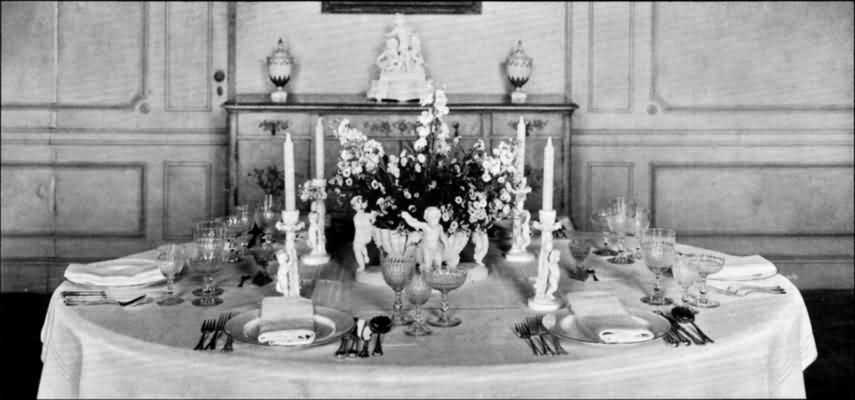
A dinner service without silver—"the little dinner is thought by most people to be the very pleasantest social function there is." [Page 228.]
Otherwise, at informal dinners, the host wears a dinner coat and the hostess a simple evening dress, or perhaps an elaborate one that has been seen by everyone and which goes on at little dinners for the sake of getting some "wear out of it." She never, however, receives formally standing, though she rises when a guest comes into the room, shakes hands and sits down again. When dinner is announced, gentlemen do not offer their arms to the ladies. The hostess and the other ladies go into the dining-room together, not in a procession, but just as they happen to come. If one of them is much older than the others, the younger ones wait for her to go ahead of them, or one who is much younger goes last. The men stroll in the rear. The hostess on reaching the dining-room goes to her own place where she stands and tells everyone where she or he is to sit. "Mary, will you sit next to Jim, and Lucy on his other side; Kate, over there, Bobo, next to me," etc.
Carving On The Table
Carving is sometimes seen at "home" dinner tables. A certain type of man always likes to carve, and such a one does. But in forty-nine houses out of fifty, in New York at least, the carving is done by the cook in the kitchen—a roast while it is still in the roasting pan, and close to the range at that, so that nothing can possibly get cooled off in the carving. After which the pieces are carefully put together again, and transferred to an intensely hot platter. This method has two advantages over table carving; quicker service, and hotter food. Unless a change takes place in the present fashion, none except cooks will know anything about carving, which was once considered an art necessary to every gentleman. The boast of the high-born Southerner, that he could carve a canvas-back holding it on his fork, will be as unknown as the driving of a four-in-hand.
Old-fashioned butlers sometimes carve in the pantry, but in the most modern service all carving is done by the cook. Cold meats are, in the English service, put whole on the sideboard and the family and guests cut off what they choose themselves. In America cold meat is more often sliced and laid on a platter garnished with finely chopped meat jelly and water cress or parsley.
The "Stag" Or "Bachelor" Dinner
A man's dinner is sometimes called a "stag" or a "bachelor" dinner; and as its name implies, is a dinner given by a man and for men only. A man's dinner is usually given to celebrate an occasion of welcome or farewell. The best-known bachelor dinner is the one given by the groom just before his wedding. Other dinners are more apt to be given by one man (or a group of men) in honor of a noted citizen who has returned from a long absence, or who is about to embark on an expedition or a foreign mission. Or a young man may give a dinner in honor of a friend's twenty-first birthday; or an older man may give a dinner merely because he has a quantity of game which he has shot and wants to share with his especial friends.
Nearly always a man's dinner is given at the host's club or his bachelor quarters or in a private room in a hotel. But if a man chooses to give a stag dinner in his own house, his wife (or his mother) should not appear. For a wife to come downstairs and receive the guests for him, can not be too strongly condemned as out of place. Such a maneuver on her part, instead of impressing his guests with her own grace and beauty, is far more likely to make them think what a "poor worm" her husband must be, to allow himself to be hen-pecked. And for a mother to appear at a son's dinner is, if anything, worse. An essential piece of advice to every woman is: No matter how much you may want to say "How do you do" to your husband's or your son's friends—don't!