INTRODUCTION (continued 2)
Reading edition
Had, then, the reconquest of Barbary fallen naturally to the three sisters—to Spain, to Italy, and to France, the long attempt of Europe might have reached its end. The Spaniard would have crushed and dominated in Morocco where the Mohammedan was most 105strongly entrenched; the Italian, with his subtle admixture, would have kneaded Tunis and the eastern march into a firm barrier; the French would have developed their active commerce upon the many small towns of the Central Tell, would have pierced, as they are fitted to pierce, the high Central Plateaux with admirable roads, and would have garrisoned, as their taste for a risk well fits them to garrison, the outposts of the Central Atlas against the desert. Then the task would be over, and Europe would be resettled within its original boundaries.
|The March|
On their long route marches, on the marches of their manœuvres and their wars, the French, along their roads which are direct and august, (and at evening, when one is weary, sombre,) seek a place of reunion and of repose: upon this the corps converges, and there at last a man may lie a long night under shelter and content to sleep: a town lies 106before the pioneers and is their goal. It stands, tiny with spires, above the horizon of their hedgeless plains, and as they go they sing of the halt, or, for long spaces, are silent, bent trudging under the pack: for they abhor parade. Very often they do not reach their goal. They then lie out in bivouac under the sky and light very many fires, five to a company or more, and sleep out unsatisfied. Such a strain and such an attempt: such a march, such a disappointment, and such a goal are the symbols of their history; for they are perpetually seeking, under arms, a Europe that shall endure. In this search they must continue here in Africa, as they continue in their own country, that march of theirs which sees the city ever before it and yet cannot come near to salute the guard at the gates and to enter in. It is their business to re-create the Empire in this province of Africa. It may be that here also they will come to no completion; but if they fail, Europe will fail 107with them, and it will be a sign that our tradition has ended.
|The French Genius|
They have done the Latin thing. First they have designed, then organised, then built, then ploughed, and their wealth has come last. The mind is present to excess in the stamp they have laid upon Africa. Their utter regularity and the sense of will envelop the whole province; and their genius, inflexible and yet alert, alert and yet monotonous, is to be seen everywhere in similar roads, similar bridges of careful and even ornamented stone, similar barracks and loop-holed walls.
|The Straight Railway|
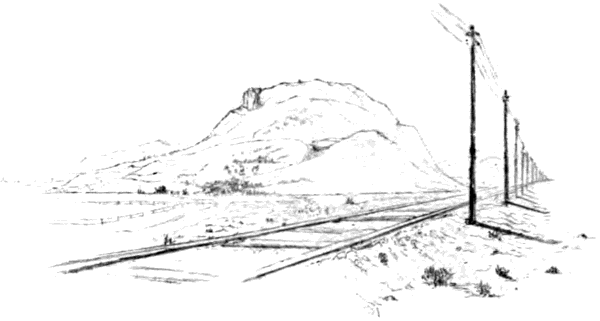
There is a perspective upon the High Plateaux which though it is exceptional is typical of their spirit. It is on the salt plain just before the gate of the desert is reached and the fall on to the desert begun. Here the flat and unfruitful level glares white and red: it is of little use to men or none. Some few adventurers, like their peers in the Rockies, have 108attempted to enclose a patch or two of ground, but the whole landscape is parched and dead. Through this, right on like a gesture of command, like the dart of a spear, goes the rail, urging towards the Sahara, as though the Sahara were not a boundary but a goal. The odd, single hills, as high as the Wrekin or higher, upon which not even the goats can live, look down upon the straight line thus traced: these hills and the track beneath them afford a stupendous contrast. Nowhere is the determination of man more defiant against the sullen refusal of the earth.
|The French Afforestation|
There is another effort of the French 109which may be watched with more anxiety and more comprehension by northern men than their admirable roads or their railways or their wires above the sand, and that is their afforestation.
It is a debate which will not be decided (for the material of full decision is lacking) whether, since the Romans crowded their millions into this Africa, the rainfall has or has not changed. It is certain that they husbanded water upon every side and built great barricades to hold the streams; yet it is certain, also, that their cities stood where no such great groups of men could live to-day. There are those who believe that under Atlas, towards the desert, a shallow sea spread westward from the Mediterranean and from Syrtis: there are others who believe that the dry water-courses of the Sahara were recently alive with streams, and that the tombs and inscriptions of the waste places, now half buried in the sand, prove a great lake upon 110whose shores a whole province could cultivate and live. Both hypotheses are doubtful for this reason—that no good legend preserves the record. Changes far less momentous have left whole cycles of ballads and stories behind them. The Sahara has been the Sahara since men have sung or spoken of it. Moreover, the Romans did certainly push out, as the French have done, towards certain limits, beyond which no effort was worth the while of armies. They felt a boundary to the south. They could bear the summer of Biskra, but not that of Touggourt: their posts upon the edge of the desert were ultimate posts as are the European garrisons to-day.
But in one thing the sense of change is justified, and that is the fall of the woods. Here Islam worked itself out fully: its ignorance of consequence, its absolute and insufficient assertion, its lack of harmony with the process and modulation of time, its Arabian origin, are all apparent in the destruction of trees. 111If the rainfall is as abundant as ever, it is not held, for the roots of trees are lacking, and if it be true that trees in summer bring rain of themselves by their leaves, then that benefit is also gone. There are many deep channels, called secchias, traversing the soft dust of the uplands, with no trace of bridges where the Roman roads cross them: they are new. They are carved by the sudden spates that follow the cloudbursts in the hills. Here, perhaps, in the Roman time were regular and even streams, and perhaps, upon their banks, where now are stretches of ugly earth quite bare, the legionaries saw meadows. At any rate, the trees have gone.
Up in the higher hills, in Aurès and the Djurdjura, upon the flanks of the mountains where the Berbers remain unconquered, and where the melting of the snows give a copious moisture, forests still remain. They are commonly of great cedars as dark as the pine woods of the Vosges or the noble chesnut groves by 112which the Alps lead a man down into Italy. But these forests are rare and isolated as the aboriginal languages and tribes which haunt them. You may camp under the deep boughs within a march of Batna and then go northward and eastward for days and days of walking before you come again to the woods and their scent and their good floor of needles in the heights from which you see again the welcome of the Mediterranean.
|Story of the Determinist|
This lack of trees the French very laboriously 113attempt to correct. Their chief obstacle is the nature of that religion which is also the hard barrier raised against every other European thing which may attempt to influence Africa to-day.
There was a new grove planted some ten years since in a chosen place. It was surrounded with a wall, and the little trees were chosen delicately and bought at a great price, and planted by men particularly skilled. Also, there was an edict posted up in those wilds (it was within fifty miles of the desert, just on the hither side of Atlas) saying that a grove had been planted in such and such a place and that no one was to hurt the trees, under dreadful penalties. The French also, as is the laudable custom of Republicans, gave a reason for what they did, pointing out that trees had such and such an effect on climate—the whole in plain clear terms and printed in the Arabic script.
114There was, however, a Mohammedan who, on reading this, immediately saw in it an advertisement of wealth and pasture. He drove his goats for nearly fifteen miles, camped outside the wall, and next day lifted each animal carefully one by one into the enclosure that they might browse upon the tender shoots of the young trees. “Better,” he thought, “that my goats should fatten than that the mad Christians should enjoy this tree-fad of theirs which is of no advantage to God or man.”
When his last goat was over two rangers came, and, in extreme anger, brought him before the magistrate, where he was asked what reason he could give for the wrong thing he had done. He answered, “R’aho, it was the will of God. Mektoub, it was written”—or words to that effect.
|Cirta or Constantine|
The platform of the Rock of Cirta is the place from which the effort of the French 115over all this land can best be judged, for it is the centre round which nature and history have grouped the four changes of Barbary.
|Constantine|
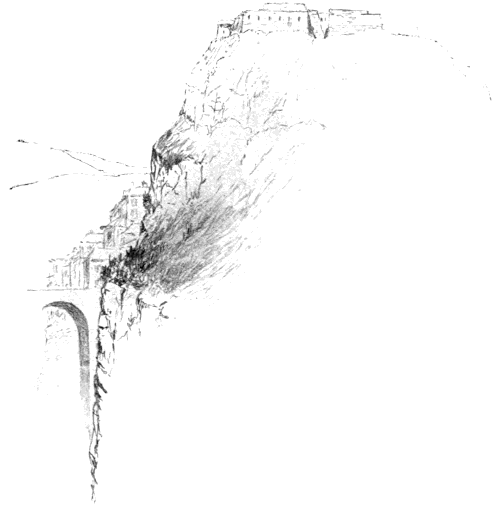
The rock is like those headlands which jut out from inland ranges and dominate deep harbours; it is as bold as are such capes, and is united, as they are, with the mass of land behind it by a neck of even surface—the only passage by which the rock itself can be approached. On every side but this, very sharp slopes of 116grass, broken by precipices, plunge down in a mountainous way to the valleys, and at the foot of the most sheer of these there tumbles noisily in a profound gorge the torrent called Rummel, that is, “The Tawny,” for it is as yellow as a lion or as sea-sand.
The trench is so deep and dark that one may stand above it towards evening and hear the noise of the water and yet see no gleam of light reflected from it, it runs so far below. It is this stream which has made on the Rock of Cirta (though it is out of the true Tell and far into the Tableland) a habitable fortress and a town; the town called Constantine.
Such sites are very rare. Luxemburg is one, a stronghold cut off by similar precipitous valleys. Jerusalem is another. Wherever they are found the origin of their fortress goes back beyond the beginning of history, they are tribal, and their record is principally of war. So it is with Cirta. The legends of the nomads say 117that they descended from some enormous dusky figure, a God of the Atlas and of Spain—a giant God marching along the shores of the ocean followed perpetually by armies. Even this first of African names was mixed up with Cirta, for the title of the rock was that of his loves, and the name Cirta given it by these horsemen of Numidia was the name of their universal mother. A man can be certain, as he walks along the edges of the place to-day and looks down into the gulfs below it, that men have so moved here amid buildings and in a fixed town with altars and a name ever since first they knew how to mortar stones together and to obey laws. The close pack of houses standing thus apart upon a peak has in it, therefore, something consistently sacred. Permanence and continuity are to be discovered here only among the cities of Africa; and its landscape and character of themselves impress the traveller with a certitude that here will be planted on into time the capital of 118the native blood: too far removed from the sea for colonisation or piracy to destroy it: too well cut off by those trenches of defence to be sacked and overrun: too peopled and well watered to decay.
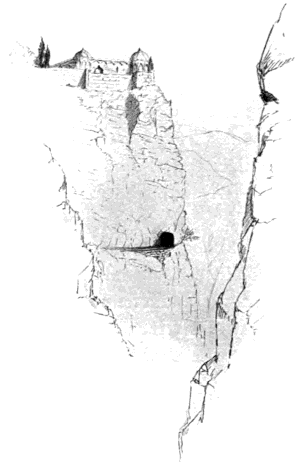
The town has been taken in every conquest, and every conqueror has boasted himself to have overcome the walls of rock, the hundreds of feet of sheer climbing. The boast is manifestly absurd, though the temptation to make it was irresistible. When Cirta has 119been stormed only one gate admitted the invaders, and that was the isthmus which leads from the platform of the summit to the tableland beyond. It was here that Massinissa and here that the Romans entered. By this entry came the French soldiers, and the market which stands there is called to-day “The Place of the Breach.”
|The Inscriptions|
There is a place in Constantine where the full history of the town is best felt, and that is in the new Town Hall, which stands upon the edge of the rock upon the side furthest from the river and looks at the storms blowing over the uplands from Atlas and driving low clouds right at the crest of the walls. In this building are preserved (in no great number) the antiquities of the place and its neighbourhood. Here is a little silver victory which once fluttered, it is thought, in the hand of that great statue which adorned the Capitol, and here are long rows of tombs 120from the beginning of the Italian influence till the time of the martyrs: you see carved upon them the slow change of the mind until the last of the pagans boast of such virtues and have already that sort of content which the acceptation of the creed was to bequeath to succeeding time. This record of the epitaphs, though brief, is perfect; you watch at work in them the spirit that made St. Cyprian transforming the African soil; but their chief interest is in this, that they are, as it were, a rediscovery of ourselves. You dig through centuries of alien rubbish overlying the Roman dead, and, when you have dug deeply enough you come suddenly upon Europe. For twelve hundred years an idiom quite unfamiliar to us has alone been spoken here: beneath it you find the august and reasonable Latin, and as you read you feel about you the air of home. For all those generations the manifold aspect of the divine was forgotten: there were 121no shrines nor priests to rear them. Then, deep down, you discover a tablet upon a tomb, and, reading it, you find it was carved in memory of a priestess of Isis who was so gracious and who so served the divinities of the woods that when she died ingemuerunt Dryades: twice I read those delicate words, delicately chiselled in hard stone, and I saw her going in black, with her head bent, through groves. A trace of colouring remains upon the lettering of the verse and a powerful affection lingers in it, so that the past is preserved. Islam destroyed with fanaticism the figures of animals and of men: here in these European carvings they are everywhere. The barbarian creed conceived or implanted a barbaric fear of vines: here you see Bacchus, young, on the corner of a frieze, and gentle old Silenus carried heavily along.
|Cæsarea or Cherchel|
If it is from the Rock of Cirta, from Constantine, that the recovery of the province 122and its re-entry into Europe is best perceived—for there stands the unchanging centre of Africa, and there can all the threads of her destiny be grasped—yet there is another place far westward and down upon the shore, where the wound that Europe suffered by the Mohammedan invasion is more marked and long eclipse of our race more apparent. It is the Bay of Cæsarea.
Constantine is so necessary to Africa that its very name (and it is alone in this among all the cities) has been preserved. Cæsarea has lost its name and its dignity too. The Barbarians have come to call her “Cherchel”: as for her rank, it has been forgotten altogether; yet this port was for a hundred years peculiar among all others in the Mediterranean—it was more remote, more splendid, and more new. The accident which created it lent a great story to its dynasty, and its situation here, along the steeper shores that lead on to the Straits and to the outer ocean, 123lent some western mystery to it and some appeal.
|Cherchel|
Cleopatra, the Queen of Egypt, was famous throughout the Mediterranean for her beauty. The last of her lovers—it is well known—was Anthony the Triumvir, who had desired (until he saw her) to inherit from Cæsar and to rule the whole world. This ambition he abandoned after one battle, lost, it is said, through her folly; and soon after that defeat they chose to die. But a fruit of their loves, and a picture, perhaps, of his courage and of her magnificence, survived in a daughter whom her mother had dedicated to the Moon and had called Selene. This child was married out into Barbary, to the king of the nomads, and here, in Cherchel, she held with her husband for many years a court which gathered round it the handicraft of Corinth, the letters of Athens, and some reflected splendour from the town of Rome.
He was of those horsemen who had now 124for two centuries served Carthage as mercenaries or Rome as allies. To the cities of the sea coast, which were Italian or Asiatic in blood, these riders of the uplands had been outer men. They appeared barbaric to the end, and, at the very end, it was their blood, perhaps, that rebelled against the tradition of order and that joined first the Vandal and then the Arab. The king was dark and a barbarian. This wife who was sent to him inherited the broad forehead of Rome and the silence of Egypt, and was also an heiress to the generals of Alexander. There met in her, therefore, all those high sources from whose unison Christendom has proceeded. She came west to a new land that did not know cut stone and hardly roads: in a little time she had built a city.
By some economic power which no one has explained, but which may be compared to the wealth of our smaller independent States to-day and their merchants, to Antwerp 125or to The Hague, this city of Mauretania rose to be a marvel. The porticos stretched along that rise of land, and a mile of new work, columns and pedestalled statues and arcades, looked down from the slope and saw, making for the shore, perpetual sails from the eastward. Great libraries dignified the city: a complete security and a humane consideration for the arts continually increased its glory. The passion for scholarship, which was at that time excessive, may have touched the palace here with something of the ridiculous. The king wrote, dictated, or commanded a whole shelf of books and was eager for the pride of authorship. But no other note of indignity entered their State, and all around them, looking out to sea, was a resurrection of Greece.
This queen and her husband lived on into old age thus, untroubled in their isolation and their content, and destined (as they thought) to leave a dynasty which even the 126domination of Rome would protect and spare.
Nothing is left. Rome seized their town at last. Their descendants perished. All Mauretania was compelled to follow the common line of unity. For four hundred years it has no history save that under the Roman order it endured and increased. The Vandals passed it by: it might still stand had there not fallen upon it the Mohammedan invasion which everywhere destroyed, or rather abandoned, a Roman endeavour. The neglect which was native to the Arab, the sharp breach which he made in tradition, ended Cæsarea. To-day, a little market town, a tenth of the old capital, barrenly preserves a memory of those two thousand years. A few fragments which the plough recovers or which the builders have spared are gathered in one place: the rest is parched fields and trees.
|The Aqueduct|
One conspicuous monument survives to emphasise the retreat of the empire. It is 127something the Arab could not waste because it did not lie within the circuit of the walls: its great stones were too remote from his buildings to be removed, and its mass too threatening to be undermined. It was the Aqueduct. This, for the most part, still stands, and carries an aspect of endurance which is the more awful in that nothing else of the city 128has endured. It spans a lonely valley in which the bay and the old harbour are forgotten, and it is as enormous as the name of Rome.
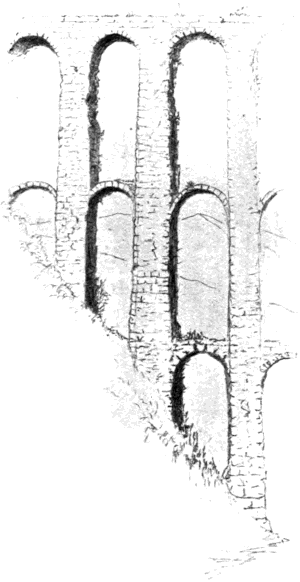
It is more like a wall for height and completeness than are any of the huge Roman arches I know. Its height is such that it catches the mind more strongly than does the Pont du Gard, and its completeness such that it arrests the eye more than do the long trails of arches that stretch like rays across the Campagna. It appalls one because it is quite alone, and because the multitude that gave it a meaning has disappeared. One could wish to have seen this thing before the French came, when the brushwood of the valley was quite deserted and when one might have thought it fixed for ever in an intangible isolation which no European would come again to reoccupy and to disturb.
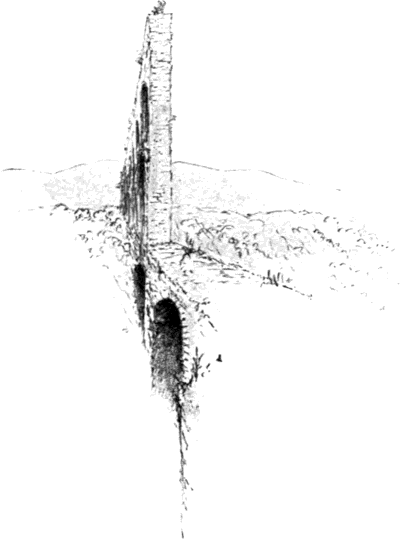
Even to-day one may climb to the further, inland, side and look down the perspective 129of its arches with some illusion of loneliness, and live for an hour in the fifteen centuries of its abandonment. Its height, its fineness, and the ruin of its use are so best seen, and its long line of purpose, pointing on to a city that no longer remembers baths or fountains. It is the ceaseless refrain of Africa. Italy, Gaul, and Spain have ruins like these, but these ruins are right against a life which has always been vigorous and to-day is especially renewed: only in this one province of Africa do you find Rome arrested, as it were—its spirit caught away and its body turned into stone.
|The Beginning of the Journey to the Desert|
There was last to be seen, before I could leave this province, the desert and those 130dead towns which stand along the hither fringe of it: the deserted homes of the Romans, and chief among them Timgad.
The Atlas, I had heard, is there at its highest, and the knot of mountains into which it rises is called the Aurès. Upon its southern side it fell steeply (I was told) upon the Sahara, and its northern supported, on the last of the High Tableland, those ruined cities. Here the frontier legionaries had been posted, and here the Arab invasion had so wasted the forests and dried up the run of water that the towns had died at once. This Timgad in particular is famous for its perfection and for the complete survival of its form, but especially for this, that you walk along paved streets and between standing columns and look, from the seats of a theatre, towards a great arch or gate not yet fallen, and yet never hear the voice of a living man.
I took my way to this place, the last 131of the towns I desired to see—the tombstone, as it were, of the empire, the symbol or promise of the reconquest. I went partly by day and partly by night, partly by the railroad and partly on foot across the High Plateau southward till I should come to it. Upon my way I met many men who should, perhaps, have no part in such a little historical essay as is this, but for fear I should altogether forget them I will write them down.
The first was an ill-dressed fellow, young, and with very sad eyes such as men keep sometimes in early life but lose at last as they learn in time to prey upon others. He had been unfortunate. We went along together across a plain peculiarly lonely, and towards a large, bare, isolated rock as high as a Welsh mountain and, as it seemed, quite uninhabited. We were already in sight of the main range of Atlas, and in the far ravines was a darkness that might, perhaps, be made by cedar-trees, but all around us was nothing but bare land 132and now and then a glint from salt marshes far away.
|Story of the Lions|
I asked him from what part of France he had come. He answered that he was born in the colony. Then I asked him whether the colonists thought themselves prosperous or no. He said, as do all sad people, that luck was the difference. Those whom fortune loved, prospered; those whom she hated, failed. He was right; but when he came to examples he was startling. He showed me, high upon the rock before us, which I had thought quite lonely, a considerable building, made of the stones of the place and in colour similar to the mountain itself. “Beyond this hill,” he said, “is Batna, and beyond Batna is Lambèse. Since you are walking to Timgad you will pass both these places, and everywhere you will hear of the House of the Lions. Then you will learn, if ever you needed proof, that it is luck which governs all our efforts in this colony.” I looked 133curiously at the great house, and asked him to tell me the story. This he did; and I write here, as exactly as I can from memory, the story he told.
“In that very place upon the hillside where now stands so huge a house stood, when we were yet children, a little hut of stone such as the settlers build, with two rooms in it only, a bed, three chairs, a table, and a cooking-pot. And to this poverty nothing was added, for ill-luck pursued that roof.
“There lived under it a man and his wife who had two children. They had come here to rise with the country (as it is said), but, instead of so rising, first one evil and then another fell upon them till their little horde was eaten up and the field also, and the man had to work for others—a most miserable fate. He got work in the building of the prison of Lambèse, but, as he was not created by God to be a merchant or a mortar-mixer, 134nor even a carrier of stone, he earned very little and was always in dread of being sent away; and his companions jeered at him, for the unfortunate are ridiculous not only among the rich, but in every rank; and not only the rich jeer at poverty and shun it, but the poor also—indeed, all men.
“In a word, this man was in so miserable a way that at last he took to following his wife to church and to having recourse to shrines, as do many men when their afflictions are unendurable, and among other shrines he went to that called ‘St. Anthony of the Lion.’ Now, though it is ridiculous to believe that the Lion there helped him, (for it is not a saint,) yet good came to him through Lions.
“One day, when he had gone off to work with a heavy heart, leaving in the house but one five-franc piece, his wife, who was now all soured by misfortune and was wearied out with ceaseless work, heard a single knock at the door, and when she went to it she found 135a nomad boy of the desert from beyond Aurès, who held in his arms two little cubs with soft feet and peering eyes who were mewing for their mother: they were the cubs of Lions.
“The Arab boy, who was dark, erect, and strong, said, ‘God sends you these. They are five francs.’ She answered, ‘God be with you. I cannot pay.’ When, however, he made to go away silently, without bargaining, she said, ‘God forgive me, but I will buy them’; for she thought to herself, ‘perhaps I can sell them again for more,’ for Lions are rare and wonderful beasts. So she took her five-franc piece from beneath a leaden statue of St. Anthony in the window, and she paid the Arab boy from beyond Aurès, from the Sahara, and she said, ‘God save you, the lioness will follow the scent’; and he said, ‘God will overshadow me,’ and went gravely away, biting the five-franc piece to see if it was good.
136“Now, when her husband came home they decided to go into Batna and sell the cubs, but their children, for whom they could afford no sort of toy, were already so fond of the little beasts that they had not the heart to sell them: they skimped and starved and ran into debt, but as the love of these Lions increased in their hearts the more determined were they to keep them; and they used to say, ‘God will provide,’ and other things of that sort.
“The cubs, then, grew to be the size of spaniels, and then they became grown and were the size of hounds, and soon manes grew on them and they were the size of St. Bernards, and their eyes grew bright and shone at evening; and at last they were perfect Lions. But from a long association with Christian men they were genial, decorous, and loving, and ate nothing but cooked meat, bread, and now and then a sweetmeat. Also, they could stand up and beg. They could roar at command. 137They could jump over each other’s backs; they could play as many tricks as a dog. It was in this way that good came from them.
“For one day, when this man and his wife were in a better mood and had forgotten their poverty for an hour, there came to them in the carrier’s cart a parcel of wine sent them by a relative who had a vineyard. This may have been the turning of their luck: one cannot tell. Luck is above mankind. But, anyhow, they asked the carrier in and gave him wine. Now the carrier was a Mohammedan, and Mohammedans are treacherous, so when he saw two Lions walking about in a lonely house he did not call it witchcraft, as would a Christian man, but at once he offered a price for them; but the man and his wife had hearts so good they would not sell. Then the carrier changed his tune, and offered to hire them for one week and to pay for this fifty francs: this they gladly 138accepted. For the carrier and men like him are incapable of honour except in one small thing, which is the keeping of words and dates: in this they are most exact. So at the end of the week he brought back the Lions, and gave the man and his wife fifty francs.
“But more was to come. For the carrier (and men like him) see profit where a Christian man would not see it, and he made a proposition to these people. He said: ‘Your Lions jump through hoops, they beg for sugar, and do other entertaining things: now I will travel with you and them, and half of all we earn shall go to you.’ The man and his wife were so simple and so necessitous that they accepted, and the tour began. But That Which Watches Over Us at last rewarded the man and his wife, for within a week the carrier died, and they went on up and down the country by themselves with their children, showing the Lions, till they began to earn 139incredible sums. They went to the great towns and to the sea coast. At last they became so rich that they went to Algiers, and there it is, as you may imagine, large rents but larger earnings. They lived in Algiers for one year, and became at last so rich that they crossed the sea and showed their Lions in Provence, in Lyons, and would have shown them in Paris but that, by the time they reached Tournus, they came to their own people and found themselves rich enough. There the man and his wife remained, but their children, who had been born in Africa, came back, and here they are now. They have friends to dinner every day, and all on account of Lions.”
When he had done this story he added, “It is true.” Then we went on to Batna together without a word, but when we reached Batna we had dinner together and spoke of many other things, but I have space for 140nothing except this story of his about the lions.
|The Bargaining at Batna|
Having arrived at Batna, which is the starting-place for Timgad and also for the desert beyond, I found that there was a good road which the French had built going along a valley under Aurès, but that the distance was over twenty miles. I wasted the daylight bargaining, for no one would drive me twenty miles for less than sixteen shillings. It was late, and in my eagerness to bargain I missed the chance of a daylight march, for it was within an hour of sunset when the night driver who was to start on the Tebessa road (which runs near Timgad) a little later refused me. The poorer people whom I asked told me that no one else was going eastward along that lonely valley, but that, if I were to reach Timgad, I must make a night march of it or wait a night over in Batna itself at an inn.
|Lamboesis|
Adventure is never to be refused, so I 141went out eastward alone under the evening, and I was well rewarded, though I went hungry for hours and was afoot nearly all the way, for I saw a great sight under the sunset, and I met a man I shall never meet again.
The sight I saw was Lambèse, which was called Lamboesis by the Romans, and this is what stamps it upon the mind of a lonely man before nightfall: not what remains, for hardly anything remains, but that the fragments which remain of it should be so far apart.
|The Praetorian Tower|
There is a sort of long cup or hollow here pointing at a spur of the Atlas—that high mountain which holds up the sky. The big lift of Aurès is on one side of this hollow, mixing into the clouds, and on the other are isolated and uninhabited high hills. The very floor of this valley is as high as the top of Cader Idris is in Wales; the heights beyond are as high as the Pyrenees; and an air of 142desertion haunts the place. It is impossible to forget that the Sahara is near by, down beyond the crest of the range. For though the land is muddy and the sky full of rough clouds and rain, yet the rain seems to make no grass and the land is bare. In such a world there stands up before one a square and hardly ruined tower.
|The Vastness of Lambèse|
A man of northern Europe looking at this thing from the high road cannot but think it Jacobean (if he is English) or (if he is German or French) a thing of the Thirty Years’ War. It might be later perhaps, the freak of some Highland landlord or the relic of some local rebellion. It is older than our language by far, and almost older than the Faith. As one looks at it one cannot feel but only know its age, and one watches it up an avenue of stones wondering why it stands so lonely. But one’s wonder has no stuff in it till one goes on half a mile and more: by the roadside is a pile of Roman 143stones. These also stood in Lamboesis. Then, feeling himself yet within the walls of an unseen city, a man looks back over the stretch he has come and is appalled. In such a gaze you look westward towards the light beyond the mountains. The valley is already dark. The high road which the French have made glistens as hard as stone under the last light. Trees are still visible, especially the few mournful and hard pyramids of the cypress, but the little village, the modern prison (for there is a prison), and the rare labourers here and there are muffled up in twilight; and there lies before one a mere emptiness, beyond which, a long way off, dwindled to quite little, is the Praetorian Tower. A sharp memory of childhood from beyond years of common experience so strikes the mind.
The spread plain with its one central tower seems infinite; it is now without hedges or trees or roofs or men; but once the Legion had filled up everything.
144|The Driver Passes|
It was all quite bare as I surveyed it—more bare than a heath or a down, and as large as any landscape you may know.
While I was watching this empty space, and surmising what contrast it would make with the famous and crowded ruins of Timgad to which this Lamboesis had been a neighbouring city, as Chichester is to Arundel—or, better still, as Portsmouth and its armament is to Southampton and its trade—I heard the rumble of heavy and fast wheels, and a man driving a coach passed me and then pulled up at my hail. He was the same man who had refused my bargain an hour and more before. He was driving the night coach to Tebessa. Not understanding men, he raised his price. I told him that I would pay him only what I had offered at Batna, less the price of the miles I had gone. He would not yield, but he did these three things: first, he promised to send word, as he passed, to an old Soldier who kept a house near 145Timgad that a traveller was on the road; secondly, he gave me advice, telling me that I should freeze to death by night in that valley (for it was growing cold and the weather would not hold under such a sky); thirdly, he informed me of the exact distance, which was at the thirty-second stone, where there is a branch road to the right, leading in half an hour up the slopes of the range to Timgad. Then he drove on, and I spent what was left of a doubtful light in pressing onwards.
|The Cold|
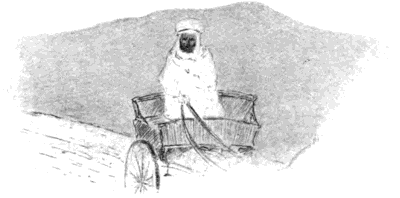
A great mass of snow had recently covered the peaks, and in the valley up which I was trudging freezing gusts and very sharp scurries of cold rain disturbed the traveller. I had already passed the last ruins of the Romans and had seen, far off in the dusk, the last arch of the Legions standing all alone with one big tree beside it. The west was wild-red under the storm, and it was cut like a fret 146with the jagged edge of the Sierras, quite black, when I saw against the purple of a nearer hill the white cloak of an Arab.
|The Arab|
He drove a little cart—a light cart with two wheels. His horse was of such a sort as you may buy any day in Africa for ten pounds, that is, it was gentle, strong, swift, and small, and looked in the half-light as though it did not weigh upon the earth but as though it were accustomed to running over the tops of the sea. I said to the Arab: “Will you not give me a lift?” He answered: “If it is the will of God.” Hearing so excellent an answer, and finding myself a 147part of universal fate, I leapt into his cart and he drove along through the gloaming, and as he went he sang a little song which had but three notes in it, and each of these notes was divided from the next by only a quarter of a note. So he sang, and so I sat by his side.
At last he saw that it was only right to break into talk, if for no other reason than that I was his guest; so he said quite suddenly, looking straight before him:
“I am very rich.”
“I,” said I, “am moderately poor.”
At this he shook his head and said: “I am more fortunate than you; I am very, very rich.” He then wagged his head again slowly from side to side and was silent for a good minute or more.
He next said slyly, with a mixture of curiosity and politeness: “My Lord, when you say you are poor you mean poor after the manner of the Romans, that is, with no 148money in your pocket but always the power to obtain it.”
“No,” said I, “I have no land, and not even the power of which you speak. I am really, though moderately, poor. All that I get I earn by talking in public places in the cold weather, and in spring time and summer by writing and by other tricks.” He looked solemn for a moment, and then said: “Have you, indeed, no land?” I said “No” again; for at that moment I had none. Then he replied: “I have sixteen hundred acres of land.”
When he had said this he tossed back his head in that lion-like way they have, for they are as theatrical as children or animals, and he went on: “Yes, and of these one-fourth is in good fruit-trees ... they bear ... they bear ... I cannot contain myself for well-being.” “God give you increase,” said I. “A good word,” said he, “and I would say the same to you but that you have nothing 149to increase with. However, it is the will of God. ‘To one man it comes, from another it goes,’ said the Berber, and again it is said, ‘Which of you can be certain?’”
These last phrases he rattled off like a lesson with no sort of unction: it was evidently a form. He then continued:
“I have little rivulets running by my trees. He-from-whom-I-bought had let them go dry; I nurtured them till they sparkled. They feed the roots of my orchard. I am very rich. Some let their walls fall down; I prop them up; nay, sometimes I rebuild. All my roofs are tiled with tiles from Marseilles.... I am very rich.” Then I took up the psalm in my turn, and I said:
“What is it to be rich if you are not also famous? Can you sing or dance or make men laugh or cry by your recitals? I will not ask if you can draw or sculpture, for your religion forbids it, but do you play 150the instrument or the flute? Can you put together wise phrases which are repeated by others?”
To this he answered quite readily: “I have not yet attempted to do any of these things you mention: doubtless were I to try them I should succeed, for I have become very rich, and a man who is rich in money from his own labour could have made himself rich in any other thing.”
When he said this I appreciated from whence such a doctrine had invaded England. It had come from the Orientals. I listened to him as he went on: “But it is no matter; my farm is enough for me. If there were no men with farms, who would pay for the flute and the instrument and the wise beggar and the rest? Ah! who would feed them?”
“None,” said I, “you are quite right.” So we went quickly forward for a long time under the darkness, saying nothing more 151until a thought moved him. “My father was rich,” he said, “but I am far richer than my father.”
It was cold, and I remembered what a terrible way I had to go that night—twenty miles or more through this empty land of Africa. So I was shivering as I answered: “Your father did well in his day, and through him you are rich. It says, ‘Revere your father: God is not more to you.’” He answered: “You speak sensibly; I have sons.” Then for some time more we rode along upon the high wheels.
But in a few minutes the lights of a low steading appeared far off under poplar-trees, and as he waved his hand towards it he said: “That is my farm.” “Blessed be your farm,” said I, “and all who dwell in it.” To this he made the astonishing reply: “God will give it to you; I have none.” “What is that you say?” I asked him in amazement. He repeated the phrase, and then I saw that it 152was a form, and that it was of no importance whether I understood it or not. But I understood the next thing which he said as he stopped at his gates, which was: “Here, then, you get out.” I asked him what I should pay for the service, and he replied: “What you will. Nothing at all.” So I gave him a franc, which was all I had in silver. He took it with a magnificent salutation, saying as he did so: “I can accept nothing from you,” which, I take it, was again a form. Then the night swallowed him up, and I shall never see him again till that Great Day in which we both believed but of which neither of us could know anything at all.
We were born, I cannot tell how many leagues apart, in different climates and for different destinies, but we were two men together in the night, and, for a short time, we were very near each other compared with 153the distance of the stars, or with the distance that separates any two philosophers.
|The Goat-Story Again|
Many who read this will say they know the Mohammedan better than I. They will be right: then let them explain the story of the goats, for I cannot. I will repeat it to save them the trouble of turning back.
A young man of Ain-Yagout, hearing that the Government had carefully planted little cedars on a distant hill, drove his goats fifteen miles to browse upon the same. “Better,” said he, “that I should flourish than the Government, and that my goats should give milk than that these silly little trees should fatten.”
They caught him and brought him before the magistrate, where he confessed what he had done, and even that he had lifted the goats laboriously, one by one, over a high wall to get at the Government trees. But when they asked him what good reason he could give for his conduct, he replied:
154“R’aho! It was the will of God. Mektoub, it was written.”
Or words to that effect.
I will admit that when the full lips, the long uncertain eye and the tall forehead of the true Arab met me in these short travels I was always half silenced and half moved to question and to learn. But I saw such Oriental features rarely, for, in spite of the turban and the bernous, they are very rare.
|The Moor|
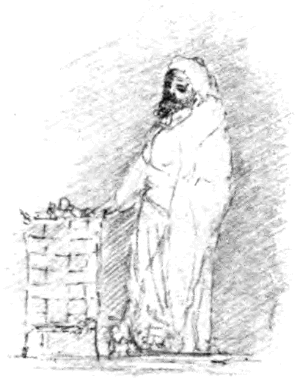
Indeed, of all the men I came across in this country, only two were of the purely Oriental kind the books make out to be so common. One was a fierce Moor of gigantic stature and incredible girth. He was dressed in bright green, and drank the cordial called crême de menthe in a little bower. The other was a poor Arab and old, who sold fruits upon a stall in Setif. In his face there was a deep contempt of Christendom.
|The Little Old Semite|
The snow fell all around him swiftly, mixed with sleet and sharp needles of cold 155rain. It was evening and the people were passing down the street hurriedly to find their homes: so passed I, when I saw him standing like a little stunted ghost in the rain. He knew me at once for some one to whom Africa was strange, and therefore might have hoped to make me stop even upon such a night to buy of him. Yet he did not say a word, but only looked at me as much as to say: “Fool! will you buy?” And I looked back at him as I passed, and put my answer into my eyes as much as to say: “No! Barbarian, I will not buy.” In this way we met and parted, and we shall never see each other again till that Great Day....
Remembering him and this last one who had given me a ride, I went on through the night towards Timgad.
156It was a very lonely road.
|The Lonely Night March|
Loneliness, when it is absolute, is very difficult to depict, for it is a negation and lacks quality, and therefore words fail it. But one may express the loneliness of that valley best by saying that it felt, not as though men had deserted it, but as though men had perpetually tried to return to it and, as perpetually, had despaired and left the sullen earth. The impression was false. The Romans had once thoroughly possessed and tilled this land: the scrub had once been forests, the shifting soil ordered and bounded fields; but the Mohammedan sterility had sunk in so deeply that one could not believe that our people had ever been here. Even the sharp and recent memory of those ruins of Lamboesis faded in the stillness. Europe came back into my mind. The full rivers and the fields which are to us a natural landscape are but a made garden and are due to continuous tradition, and I wondered whether, 157if that tradition were finally lost, our sons would come to see, in England as I saw here in the night in Africa, vague hills without trees and drifts of mould and sand through which the rain-bursts would dig deep channels at random.
There was a moon risen by this time, but it lay behind a level flow of clouds. All along the way, to my right, made smaller by the darkness, lay Aurès—one could still just discern the snow upon his summits. The road went on—French, exact, and, if I may say so, alien—bridging this barbaric void which already smelt of the desert where it lay beyond those mountains down under the southern wall of Atlas. For the desert, when I had seen Timgad, I determined to strike.
|The Columns of Timgad|
So the road went on, and I with it till I came to the thirty-second stone, and recognised its number by holding a match close by. Then I knew that I had covered twenty miles and was close to Timgad. A branch road 158opened out on the right, and there was a sign-post pointing along it. I followed the new road across a careful girder bridge such as might cross a brook in Normandy. I saw a light up on the rise of the foot-hills, and beyond it, suddenly and yet dimly, a very mob of columns. They stood up against the vague glimmer of the sky of every size and in thousands, as though they were marching. A little rift in the clouds let in the moon upon them palely. Her light was soon extinguished, but in that moment I had seen a large city, unroofed and dead, in the middle of this wasted land.
|The Old Soldier|
However men may act who see a vision but see it in extreme fatigue, so did I. I suffered the violent impression of that ghost, but my curiosity was no longer of the body. I took no step to see the wonder which this gleam had hinted at, but I turned and struck at the door of the house which was now quite near me, and which was still lit within. An 159old man, small, bent, and full of energy, opened the door to me. He was that soldier of whom they had told me at Lambèse.
“I was expecting you,” he said.
I remembered that the driver had promised to warn him, and I was grateful.
“I have prepared you a meal,” he went on. Then, after a little hesitation, “It is mutton: it is neither hot nor cold.”
A man who has been on guard as often as had this old sergeant need not mind awakening in the small hours, and a man who has marched twenty miles and more in the dark must eat what he is given, though it be sheep and tepid. So I sat down. He brought me their very rough African wine and a loaf, and sat down opposite me, looking at me fixedly under the candle. Then he said:
“To-morrow you will see Timgad, which is the most wonderful town in the world.”
“Certainly not to-night,” I answered; to which he said, “No!”
160|The Strange Food|
I took a bite of the food, and he at once continued rapidly: “Timgad is a marvel. We call it ‘the marvel.’ I had thought of calling this house ‘Timgad the Marvel,’ or, again, ‘Timgad the——’”
“Is this sheep?” I said.
“Certainly,” he answered. “What else could it be but sheep?”
“Good Lord!” I said, “it might be anything. There is no lack of beasts on God’s earth.” I took another bite and found it horrible.
“I desire you to tell me frankly,” said I, “whether this is goat. There are many Italians in Africa, and I shall not blame any man for giving me goat’s flesh. The Hebrew prophets ate it and the Romans; only tell me the truth, for goat is bad for me.”
He said it was not goat. Indeed, I believed him, for it was of a large and terrible sort, as though it had roamed the hills and towered above all goats and sheep. I thought 161of lions, but remembered that their value would forbid their being killed for the table. I again attempted the meal, and he again began:
“Timgad is a place——”
At this moment a god inspired me, and I shouted, “Camel!” He did not turn a hair. I put down my knife and fork, and pushed the plate away. I said:
“You are not to be blamed for giving me the food of the country, but for passing it under another name.”
He was a good host, and did not answer. He went out, and came back with cheese. Then he said, as he put it down before me:
“I do assure you it is sheep,” and we discussed the point no more.
|Timgad|
But in the hour that followed we spoke of many things—of the army (which he remembered), of active service (which he regretted, for he had lost half a hand), of money (which he loved), and of the Church—which he hated. He was good to the bottom 162of his soul. His face was sad. He had most evidently helped the poor, he had fought hard and gained his independence, and there he was under Aurès, in a neglected place a thousand miles away from his own people, talking French talk of disestablishment and of the equality of all opinion before the law. So we talked till the camel (or sheep) was stiff in its plate and cold, and the first glimmer of dawn had begun to sadden the bare room and to oppress the yellow light of the candle. Then he took me to a room, and as I went I saw from a window, beyond a garden he had planted, the awful sight of Timgad, utterly silent and ruined, stretching a mile under the dull morning; and with that sight still controlling me I fell heavily asleep.
When the morning came I looked out again from my window and I saw the last of the storm still hurrying overhead, and beneath and before me, of one even grey colour and quite silent, the city of Timgad. There 163was no one in it alive. There were no roofs and no criers. It was all ruins standing up everywhere: broken walls and broken columns absolutely still, except in one place where some pious care had led the water back to its old channels. There a little fountain ran from an urn that a Cupid held.
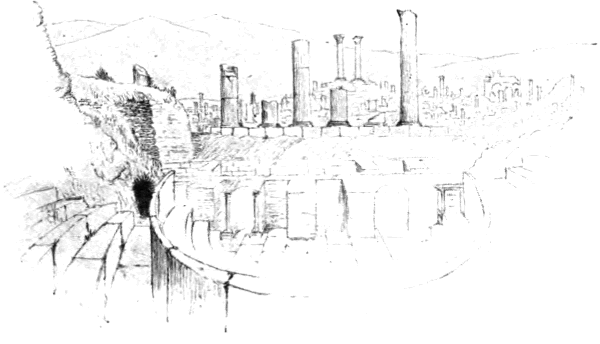
I passed at once through the gates and walked for perhaps an hour, noting curiously a hundred things: the shop-stalls and the lines of pedestals; the flag-stones of the Forum and the courses of brick—even, small, Roman and abandoned. I walked so, gazing 164sometimes beyond the distant limits of the city to the distant slopes of Atlas, till I came to a high place where the Theatre had once stood, dug out of a hillside and built in with rows of stone seats. Here I sat down to draw the stretch of silence before me, and then I recognised for the first time that I was very tired.
I said to myself: “This comes of my long march through the night”; but when I had finished my drawing and had got up to walk again (for one might walk in Timgad for many days, or for a lifetime if one chose) I found a better reason for my fatigue, which was this: that, try as I would I could not walk firmly and strongly upon those deserted streets or across the flags of that Forum, but I was compelled by something in the town to tread uncertainly and gently. When I recollected myself I would force my feet to a natural and ready step; but in a moment, as my thoughts were taken by some new 165aspect of the place, I found myself walking again with strain and care, noiselessly, as one does in shrines, or in the room of a sleeper or of the dead. It was not I that did it, but the town.
I saw, some hundred yards away, a man going to his field along a street of Timgad: he showed plainly for the houses had sunk to rubble upon either side of his way. This was the first life I had seen under that stormy mountain morning, and in that lonely place which had been lonely for so very long. He also walked doubtfully and with careful feet; he looked downward and made no sound.
I went up and down Timgad all that morning. The sun was not high before I felt that by long wandering between the columns and peering round many corners and finding nothing, one at last became free of the city. An ease and a familiarity, a sort of friendship with abandoned but 166once human walls, took the traveller as he grew used to the silence; but whether in such companionship he did not suffer some evil influence, I cannot say.
I came to one place and to another and to another, each quite without men, and each casting such an increasing spell upon the mind as is cast by voices heard in the night, when one does not know whether they are of the world, or not of the world.
I came to a triumphal arch which had once guarded the main entry to the city from Lamboesis and the west. It was ornate, four-sided, built, one would think, in the centuries of the decline. Beyond it, the suburbs into which the city expanded just before it fell stretched far out into the plain. Not far from it a very careful inscription recalled a man who has thus survived as he wished to survive; the sacred tablet testified to the spirit which unites the religion of antiquity with our own—for it was chiselled in 167fulfilment of a vow. In another place was the statue of the gods’ mother, crowned with a wall and towers. This also was of the decline, but still full of that serenity which faces wore before the Barbarian march and the sack of cities.
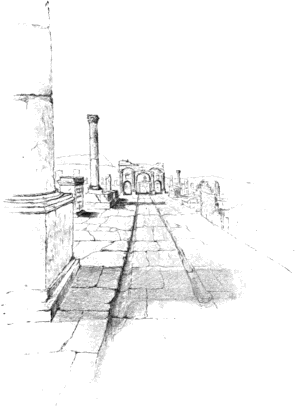
There is a crossing of the streets in Timgad where one may sit a long time and consider her desolation upon every side. The seclusion is absolute, and the presence of so many made things with none to use them gradually invades the mind. The sun gives life to you as you look down this Decumanian way, and see the runnels 168where the wheels ran once noisily to the market; it warms you but it nourishes for you no companions. The town stares at you and is blind.
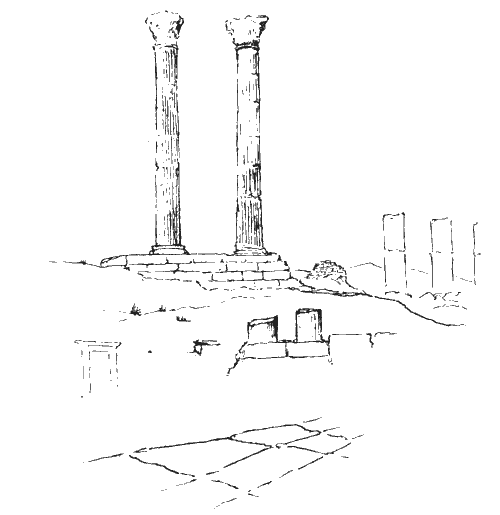
Against the sky, upon a little mound, stand 169two tall columns, much taller than the rest. They shine under the low winter sun from every part of Timgad and are white over the plain of grey stones. They may have been raised for the Temple of Capitoline Jove.
These will detain the traveller for as long as he may choose to regard them, so violently do they impress him with the negation of time. It is said that in certain abnormal moods things infinitely great and infinitely little are present together in the mind: that vast spaces of the imagination and minute contacts of the finger-tips are each figured in the brain, the one not driving out the other. In such moods (it is said) proportion and reality grow faint, and the unity and poise of our limited human powers are in peril. Into such a mood is a man thrown by Timgad, and especially by these two pillars of white stone. They proceed so plainly from the high conceptions of man: so much were their sculptors what we are in every 170western character: so fully do they satisfy us: so recent and clean is the mark of the tool upon them that they fill a man with society and leave him ready to meet at once a living city full of his fellows. It only needs a spoken word or the clack of a sandal to be back into the moment when all these things were alive. And meanwhile, with that impression overpowering one’s sense, there, physically present, is a desolation so complete that measure fails it. No oxen moving: no smoke: no roof among the rare trees of the horizon: no gleam of water and no sound. It is as though not certain centuries but an incalculable space of days coexisted with the present, and as though, for one eternal moment, a vision of the absolute in which time is not were permitted—for no good—to the yet embodied soul.
|The Stranger|
I do not know what was the hour in which I turned and left this sight, and leaving by the southern gate made for the mountain 171range of Aurès. But it was yet early afternoon, and the track had risen but little into the hills when I saw, some little way off, seated upon a great squared stone which had lain there since the departure of our people, a man of a kind I had not met in Africa before.
By his dress he was rather a colonist than a native, for he wore no turban—indeed his head was bare; but his long cloak was cut in an unusual shape, covering him almost entirely; it was dark and made of some stuff that had certainly not been woven in a modern loom. He saluted me as I came.
When I approached him and saluted him in return, his face could be seen inspired with a peculiar power, which, at a distance, his attitude alone had discovered. It was not easy to be sure whether its lines were drawn from Italy or from those rare exceptions wherein the east seems sometimes to surpass our own race in force and dignity. His 172forehead was low and very broad, his hair short, crisp, strong, and of the colour of steel; his lips, which were thin and controlled, had in their firm outline something of a high sadness, and his whole features recalled those which tradition gives to the makers and destroyers of religions. But it was his eyes that gave him so singular and (as I can still believe though the adventure is now long past) so magical an influence. These were in colour like the sea in March, grey-green and full of light, or like some mountain stones which when they are polished show the same translucent and natural hue, shining from within with vivid changes; but, much more than their luminous colour, their expression arrested me, for it had in it an experience of immense horizons, and resembled that which may sometimes be caught in the eyes of birds who have seen the earth from the heights of the sky.
I first spoke and asked him whether I 173was well upon the path that would lead me under Aurès, through the pass, to the sandstone hills from whose summits one could see the desert for which I was bound.
Whether Timgad had disturbed me, or his speech had in it that something which at the time I feared, I cannot tell; but the very short dialogue we had together influenced me in my loneliness for a whole day, as a vivid dream will do. I will therefore write it down.
He rose and answered me that I was on a good path all the way, and that there was plenty of lodging: that the road was safe, and that my map would be an ample guide.
“From the other side of Aurès,” he said, “you will see one ridge of red rocks beyond another. Even the furthest has some scrub upon it upon this side, but from its summit you will see the desert, and on this side it is easy to climb.”
174Myself: “And how is the southern side towards the Sahara?”
He: “It is all precipice, but from the northern side you can cast about and find a path which creeps down the end of the ridge to an oasis of palm-trees. These are very numerous and evident from the height. When you reach them you will find a large river flowing towards the desert, a great road and a railway. It is easy to return.”
All this I knew already from my reading, and from my map, but I listened to him for the sake of the tones of his voice: these had a sort of laugh in them when he added that I should be glad to get back to water, to trees and to men.
Myself: “But there is, as you say and know, no danger on this road from the tribes or from beasts.”
He: “No. Very little.”
Myself: “What other danger can there be?”
175He answered that many who saw the desert learnt more than they desired to learn.
I knew very well what he meant for I had heard many men maintain that what was eternal must be changeless, and that what was changeless must be dead. And I had noted how men who had travelled widely were more simple in the Faith if they had chiefly known the sea; but if they had chiefly known the desert, more subtle and often emptied of the Faith at last: the Faith dried up out of them as the dews are dried up out of the sand on the edges of the Sahara in the brazen mornings. But these men, speaking in Christendom, had affected me little; here, so near the waste places where men cannot live, alone with such a companion, I felt afraid.
We walked along together slowly for a few paces; his sentences were shorter than my replies, and were spoken low, and full of what he and his call wisdom, but I, despair. 176We discussed together in these brief moments the chief business of mankind. It was a power much greater than his words that put my mind into a turmoil, though his words were careful and heavy.... He told me that the day was better than the night. The daylight was a curtain and a cheat, but when it was gone you could see the dreadful hollow.
Myself: “In Sussex, which is my home, if a man were asked which was the more beneficent, he would say ‘the night.’”
“In Sussex,” he answered gently (as though he knew the Downs) “mists and kind airs continue the veil of the day.” He said that in the desert the stars were terrible to man, and as he spoke of the endless distances I remembered the old knowledge (but this time alive with conviction) how great nations, as they advance with unbroken records and heap up experience, and test life by their own past, and grow to judge exactly the enlarging actions of men, see at last that 177there is no Person in destiny, and that purpose is only in themselves. Their Faiths turn to legend, and at last they enter that shrine whose God has departed and whose Idol is quite blind.
We had not talked thus for twenty minutes when we stopped at the edge of a little wood, and, as his way was not mine, he made to return. We both turned back to look at the plain below us, and the salt dull valley and the dead town: the broken columns and the long streets of Timgad, made small by the distance and all in one group together. I looked at him as he stood there and the fantastic thought half took me that he had known the city while it was yet loud with men. When he had left me the oppression of his awful intensity and of his fixed unnatural reason began to fade. I saw him go into a secchia; I saw him again upon the further side swinging powerfully down the slope. He crossed another fold of land, 178he showed upon the crest beyond, and after that I did not see him again.
|The Walk to the Desert|
Then I turned and went up into Atlas, and as I went I was in two minds, but at last tradition conquered and I was safe in my own steadfast instincts, settling back as settles back with shorter and shorter oscillations some balanced rock which violence has disturbed. The vast shoulder of Aurès seemed worthy indeed of awe, but not of terror. I made a companion of the snow, and I was glad to remember how many living things moved under the forest trees.
So I continued for three days seeing many things, and drawing them till I came to the south side where the streams go down to be lost at last in the sand, and till I saw before me the sandstone ridge red and bare, and from its summit looked out upon a changing landscape, which dried and flattened and became the true desert where miles and miles away a line quite hard and level marked the 179extreme horizon. On this summit I lay in the shelter of a rock (for it was bitterly cold and a violent wind blew off the snows of Aurès) and looked a long time southward upon the country which is the prison-wall of our race.
|The Sight of the Desert|
The man near Timgad had said truly that the end of the Empire, the division and the boundary, was abrupt.
A precipice falls sharply right against the midday sun; it is built up of those red rocks whose colour adds so much to the evil silence of the Sahara, and the ridge-top of this precipice is here a sharp dividing-line between living and desert land. Africa the province, the Maghreb full of towns and men, ends in a coast, as it were, against this blinding ocean of sand. You look down from its cliffs over a vast space much more inhuman than the sea. Behind the traveller stretches all the tableland he has traversed, bare indeed and strange to a northerner, but very habitable 180and sown with large cities, living and dead. There are behind him trees, many animals and rain: all the diversity of a true climate and a long-cultivated soil. Before him are sharp reefs of stone, unweathered, without moss, and with harsh unrounded corners split by the furnace-days and the dreadful frosts of the desert. The rocks emphasise the wild desert as reefs do the wild of the sea: they rise out of sand that blows and shifts under the wind.
|The View of the Desert|
On this day, as I took my first long look at the Sahara, Aurès and the plateau beyond were all piled up with dark clouds, and one could see showers sweeping like shadowy curtains over the distant forests to the northward; but southward over the desert there was a sky like a cup of blue steel, and a dazzling sunlight that made more desperate the desperate iciness of the gale. When I could tolerate the cold no longer I began to pick my way carefully downward.
181|The Oasis|
I could not find any path such as the man at Timgad had told me of, and such as my map showed, but what I had to do was clear, for down in the plain below me a long line of palms marked an oasis and the passage of that clear river which, as I knew, comes tumbling down from the Atlas to be lost at last in the Sahara. No feature in the unusual view below me was more characteristic than this: that green leaves were thus bunched together, rare, isolated and exceptional, as with us are waste rocks or heaths, while the wide sweep of the land, which with us is all fields and trees and boundaries, here is abandoned altogether. It was not the least part of my wonder in this new place to find myself walking as I chose over an earth that was quite barren, with no history, no obstacles, and no owner, towards a patch of human land whose grove looked as an island looks from the sea. As I neared those palms I found first the railway, and then the 182strong high road which the astonishing French have driven right out here into nothingness.
|The Arab Riding|
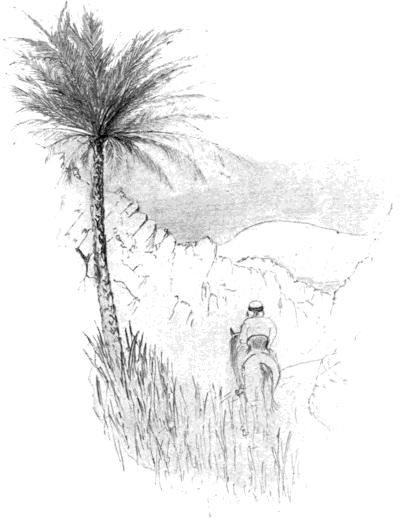
I did not turn to enter the native village. I had no appetite to see more of the desert than I had seen in my view from the hill. I had then seen a limit beyond which men of my sort cannot go, and I was content to leave it to those others who will remain for ever the enemies of our Europe. I saw one on the road: a true Arab, what the French call “An Arab of the Great Tent,” not what we and the Algerians are, but a rider of that race which makes one family from the Persian Gulf to the Atlantic. He was on a horse going up before me into the hills, with the snow of Aurès above him, and between us a tall palm. As I watched him and admired his stately riding, I said to myself: “This is how it will end: they shall leave us to our vineyards, our statues, and our harbour-towns, and we will leave them to their desert 183here beyond the hills, for it is their native place.... |The Ksar| Then we shall have reached our goal, for we shall be back where the Romans 184were, and the empire will be fully restored. For all things return at last to their origins, and Europe must return to hers. They must forget our cities which they ruined, and which we are so painfully rebuilding, and we will not covet their little glaring ksours which they build upon crags above the desert, and which are quite white in the sun.... This is how it will end.”
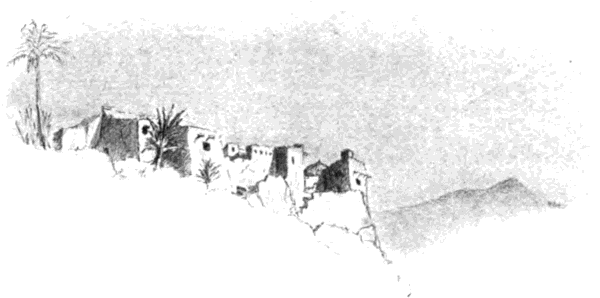
When I came to that curious cleft or gorge through which the river, the road and the railway all make their way together, one above the other, from the plateau down into the desert plain, I saw a Christian house after 185so many miles and days. I went in at once, drank wine, and asked the hour of the train, for I was tired of this land. I was hurrying to get back to reasonable shrines, and to smell the sea.
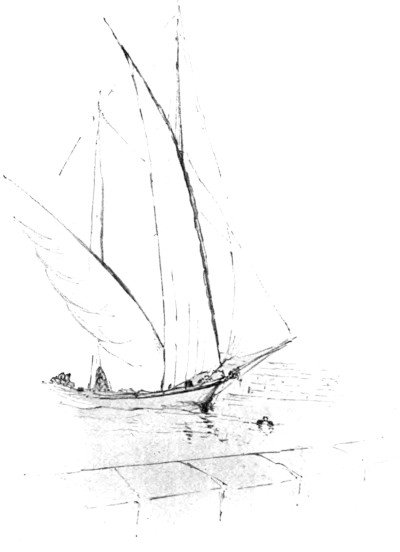
|The Return|
“Very soon,” I said to myself, “I shall come back to the coast-harbours, and I shall see again all the business of the shipping and the waves; and I shall see, rounding the pier-heads, those happy boats which seem 186to be part of the mist and of the very early morning.” So it was; for I came at the close of a bright day through the hills of the Tell to the sea: here was the Mediterranean, and here were all the sails. I saw again the little harbour by which I had entered Africa, and I was glad to find such a choice of ships at the quays, ready, as it seemed, to go to all parts of the world. So I chose one that was a Spaniard, bound for Palma in Majorca and I drove a bargain by which I was to go for next to nothing, provided I stayed on deck, and ate none of their food.
|The Last Bargain|
When I had driven this bargain, I bought wine, bread and meat ashore, and came back and took a place right up in the bows from 187which to watch the sea. It was the afternoon when we cast off and left the harbour, and before it was quite dark we had lost the land. I lay there for many hours in the bows, and thought about my home. And as I went across the sea I recalled those roofs built for true winters, and those great fireplaces of my own land. I also thought of the thick, damp woods which begin by Tay and go on to Roncesvalles, but which north or south of these are never seen; I remembered Europe well. There were women there (to whom I was sailing) whose eyes were clear and simple, and whose foreheads low; I remembered that all their gestures were easy. I remembered that in the harbours men would meet me kindly; I was to meet my own people again, and their ritual would not seem to be ritual because it would be my own, and the air would be full of bells. The ship also, going eagerly onwards dead north under the stars; she carried me towards 188my native things, herself reaching her own country, for nothing alien to Europe could make or preserve the science that had constructed such engines and such a hull.
|The Memory of Europe And her Toast|
“In Europe, in the river-valleys,” I thought, “I will rest and look back, as upon an adventure, towards my journey in this African land. I shall be free of travel. I shall be back home. I shall come again to inns and little towns. I shall see railways (of which I am very fond), and I shall hear and see nothing that the Latin Order has not made.” I thought about all these things as the ship drove on.
Europe filled me as I looked out over the bows, and I saluted her though she could not see me nor I her. I considered how she had made us all, how she was our mother and our author, and how in that authority of hers and of her religion a man was free. On this account, although I had no wine (for I had drunk it long before and thrown 189the bottle overboard), I drank in my soul to her destiny. I had just come back from the land which Europe had reconquered, and which, please God, she shall continually hold, and I said to myself, “Remain for ever.”
“We pass. There is nothing in ourselves that remains. But do you remain for ever. What happens to this life of ours, which we had from you, Salvâ Fide, I cannot tell: save that it changes and is not taken away. They say that nations perish and that at last the race itself shall decline; it is better for us of the faith to believe that you are preserved, and that your preservation is the standing grace of this world.”
It was in this watch of the early morning that I called out to her “Esto perpetua!” which means in her undying language: “You shall not die”; and remembering this I have determined to give my rambling book that title.
190|It Dawns|
In a little while it began to be dawn; but as yet I saw no land. I saw before me a boundary of waters tumbling all about, but I did not feel alone upon that sea. I felt rather as a man feels on some lake inland, knowing well that there is governed country upon every side.
This is the way in which a man leaves Africa and comes back to the shore which Christendom has never lost.
But all the while as he goes from Africa northwards, steering for the Balearics and the harbours of Spain, he remembers that other iron boundary of the Sahara which shuts us in, and the barrier against which his journey struck and turned. The silence permits him to recall most vividly the last of the oases under Atlas upon the edge of the wild.
|The End|
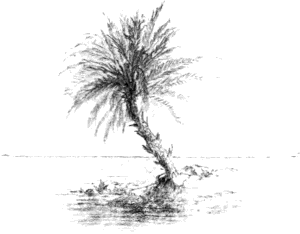
There, where the fresh torrent that has nourished the grove is already sinking, stagnant 191and brackish, to its end, a little palm-tree lives all alone and cherishes its life. Beyond it there is nothing whatsoever but the line of the sand.
FINIS
Printed by Ballantyne & Co., Limited
Tavistock Street, London
Transcriber’s Notes
Standardized hyphenated words when the same word appeared in the text as both hyphenated and non-hyphenated.
Silently corrected palpable typographical errors; retained non-standard spellings and dialect.