PART II. MYTHOLOGY AND FOLK-LORE.
Reading edition
INTRODUCTORY.
Fashions in the study of mythology come and go with something like the rapidity of change in costume feminine, subject to the autocracy of a Parisian man-modiste. Myths have been held in turn to be of some deep historical, or moral, or physical purport, and their content has been sought through psychologic or philologic analysis. Just now, all these methods are out of fashion. The newest theory is that myths generally mean nothing at all; that they are merely funny or fearsome stories and never were much more; and that at first they were not told of anybody in particular nor about anything in particular.
As for philologic analysis, it is accused of failures and contradictory results; the names which it makes its material are alleged not to have belonged to the original story; and their etymology casts no more light on the meaning or the source of the myth than if they were Smith or Brown.
According to this facile method, the secret of all mythology 102is an open one, because there is no secret at all. No painful preliminary study of language is necessary to the science, no laborious tracing of names through their various dialectic forms and phonetic changes to their first and original sense, for neither their earlier nor later sense is to the purpose.
This new method goes still further. Some former mythologists had supposed that even in the savage state man feels a sense of awe before the mighty forces of nature and the terrible mysteries of life; that joy in light and existence, dread of death and darkness, love of family and country, are emotions so intimate, so native to the soul, as nowhere to be absent—so potent as to find expressions in the highest imaginative forms of thought and speech. Not so the latest teachers. They sneer at the possibility of such inspiration even in the divine legends of cultivated nations, and are ready to brand them all as but the later growths of “myths, cruel, puerile and obscene, like the fancies of the savage myth-makers from which they sprang.”[125]
Like other fashions, this latest will also pass away, because it is a fashion only, and not grounded on the permanent, the verifiable facts of human nature. Etymology is as yet far from an exact science, and comparative mythologists in applying it have made many blunders: they have often erred in asserting historical connections where none existed; they have been slow in recognizing that primitive man works with very limited materials, both physical and mental, and as everywhere he has the same problems to solve, his physical and mental productions are necessarily 103very similar. These are objections, not against the method, but against the manner of its application.
Those who have studied savage races most intimately and with most unbiased minds have never found their religious fancies merely “puerile and obscene,” as some writers suppose, but significant and didactic. Savage symbolism is rich and is expressed both in object and word; and what appears cruelty, puerility or obscenity assumes a very different aspect when regarded from the correct, the native, point of view, with a full knowledge of the surroundings and the intentions of the myth-makers themselves.
In the sections which follow I have endeavored to illustrate these opinions by some studies from American mythology. I have chosen a series of unpromising names from the sacred books of the Quiches of Guatemala, and endeavored to ascertain their exact definition and original purport. I have taken up the most unfavorable aspect of the Algonkin hero-god, and shown how parallel it is to the tendencies of the human mind everywhere; in the Journey of the Soul, the striking analogies of Egyptian, Aryan and Aztec myth have been brought together and an explanation offered, which I believe will not be gainsaid by any competent student of Egyptian symbolism. The Sacred Symbols found in all continents are explained by a similar train of reasoning; while the modern folk-lore of two tribes of semi-Christianized Indians of to-day reveals some relics of the ancient usages.
104
THE SACRED NAMES IN QUICHE MYTHOLOGY.[126]
Contents.—The Quiches of Guatemala, and their relationship—Their Sacred Book, the Popol Vuh—Its opening words—The name Hun-Ahpu-Vuch—Hun-Ahpu-Utiu—Nim-ak—Nim-tzyiz—Tepeu—Gucumatz—Qux-cho and Qux-palo—Ah-raxa-lak and Ah-raxa-sel—Xpiyacoc and Xmucane—Cakulha—Huracan—Chirakan—Xbalanque and his Journey to Xibalba.
Of the ancient races of America, those which approached the nearest to a civilized condition spoke related dialects of a tongue, which from its principal members has been called the “Maya-Quiche” linguistic stock. Even to-day, it is estimated that about half a million persons use these dialects. They are scattered over Yucatan, Guatemala and the adjacent territory, and one branch formerly occupied the hot lowlands on the Gulf of Mexico, north of Vera Cruz.
The so-called “metropolitan” dialects are those spoken relatively near the city of Guatemala, and include the Cakchiquel, the Quiche, the Pokonchi and the Tzutuhil. They are quite closely allied, and are mutually intelligible, resembling each other about as much as did in ancient Greece 105the Attic, Ionic and Doric dialects. These closely related members of the Maya-Quiche family will be referred to under the sub-title of the Quiche-Cakchiquel dialects.
The civilization of these people was such that they used various mnemonic signs, approaching our alphabet, to record and recall their mythology and history. Fragments, more or less complete, of these traditions have been preserved. The most notable of them is the National Legend of the Quiches of Guatemala, the so-called Popol Vuh. It was written at an unknown date in the Quiche dialect, by a native who was familiar with the ancient records. A Spanish translation of it was made early in the last century by a Spanish priest, Father Francisco Ximenez, and was first published at Vienna, 1857.[127] In 1861 the original text was printed in Paris, with a French translation by the Abbé Brasseur (de Bourbourg). This original covers about 175 octavo pages, and is therefore highly important as a linguistic as well as an archæologic monument.
Both these translations are open to censure. It needs but little study to see that they are both strongly colored by the views which the respective translators entertained of the purpose of the original. Ximenez thought it was principally a satire of the devil on Christianity, and a snare spread by him to entrap souls; Brasseur believed it to be a history of the ancient wars of the Quiches, and frequently carries his euhemerism so far as to distort the sense of the original.
What has added to the difficulty of correcting these erroneous impressions is the extreme paucity of material for 106studying the Quiche. A grammar written by Ximenez has indeed been published, but no dictionary is available, if we except a brief “Vocabulary of the Principal Roots” of these dialects by the same author, which is almost useless for critical purposes.
It is not surprising, therefore, that some writers have regarded this legend with suspicion, and have spoken of it as but little better than a late romance concocted by a shrewd native, who borrowed many of his incidents from Christian teachings. Such an opinion will pass away when the original is accurately translated. To one familiar with native American myths, this one bears undeniable marks of its aboriginal origin. Its frequent obscurities and inanities, its generally low and narrow range of thought and expression, its occasional loftiness of both, its strange metaphors, and the prominence of strictly heathen names and potencies, bring it into unmistakable relationship to the true native myth. This especially holds good of the first two-thirds of it, which are entirely mythological.
As a contribution to the study of this interesting monument, I shall undertake to analyze some of the proper names of the divinities which appear in its pages. The especial facilities that I have for doing so are furnished by two MS. Vocabularies of the Cakchiquel dialect, presented to the library of the American Philosophical Society by the Governor of Guatemala in 1836. One of these was written in 1651, by Father Thomas Coto, and was based on the previous work of Father Francisco Varea. It is Spanish-Cakchiquel only, and the final pages, together with a grammar and an essay on the native calendar, promised in a body of 107the work, are unfortunately missing. What remains, however, makes a folio volume of 972 double columned pages, and contains a mass of information about the language. The second MS. is a copy of the Cakchiquel-Spanish Vocabulary of Varea, made by Fray Francisco Ceron in 1699. It is a quarto of 493 pages. I have also in my possession copies of the Compendio de Nombres en Lengua Cakchiquel, by P. F. Pantaleon de Guzman (1704), and of the Arte y Vocabulario de la Lengua Cakchiquel, by the R. P. F. Benito de Villacañas, composed about 1580.
Father Coto observes that the natives loved to tell long stories, and to repeat chants, keeping time to them in their dances. These chants were called nugum tzih, garlands of words, from tzih, word, and nug, to fasten flowers into wreaths, to set in order a dance, to arrange the heads of a discourse, etc. As preserved to us in the Popol Vuh, the rhythmical form is mostly lost, but here and there one finds passages, retained intact by memory no doubt, where a distinct balance in diction, and an effort at harmony are noted.
The name Popol Vuh given to this work is that applied by the natives themselves. It is translated by Ximenez “libro del comun,” by Brasseur “livre national.” The word popol is applied to something held in common ownership by a number; thus food belonging to a number is popol naim; a task to be worked out by many, popol zamah; the native council where the elders met to discuss public affairs was popol tzih, the common speech or talk. The word pop means the mat or rug of woven rushes or bark on which the family or company sat, and from the community of interests thus typified, the word came to mean anything in common.
108Vuh or uuh is in Quiche and Cakchiquel the word for paper and book. It is an original term in these and connected dialects, the Maya having nooh, a letter, writing; uoch, to write.
There is a school of writers who deprecate such researches as I am about to make. They are of opinion that the appellations of the native gods were derived from trivial or accidental circumstances, and had no recondite or symbolic meaning. In fact, this assertion has been made with reference to the very names which I am about to discuss.
I do not share this opinion. Many of the sacred names among the American tribes I feel sure had occult and metaphorical significance. This is proved by the profound researches of Cushing among the Zuñis; of Dorsey among the Dakotas; and others. But to reach this hidden purport, one must study all the ideas which the name connotes, especially those which are archaic.
I begin with the mysterious opening words of the Popol Vuh. They introduce us at once to the mighty and manifold divinity who is the source and cause of all things, and to the original couple, male and female, who in their persons and their powers typify the sexual and reproductive principles of organic life. These words are as follows:
“Here begins the record of what happened in old times in the land of the Quiches.
“Here will we begin and set forth the story of past time, the outset and starting point of all that took place in the city of Quiche, in the dwelling of the Quiche people.
“Here we shall bring to knowledge the explanation and the disclosure of the Disappearance and the Reappearance through the might 109of the builders and creators, the bearers of children and the begetters of children, whose names are Hun-ahpu-vuch, Hun-ahpu-utiu, Zaki-nima-tzyiz, Tepeu, Gucumatz, u Qux-cho, u Qux-palo, Ah-raxa-lak, Ah-raxa-tzel.
“And along with these it is sung and related of the grandmother-grandfather, whose name is Xpiyacoc and Xmucane, the Concealer and Protector; two-fold grandmother and two-fold grandfather are they called in the legends of the Quiches.”[128]
It will be here observed that the declaration of the attributes of the highest divinity sets forth distinctly sexual ideas, and, as was often the case in Grecian, Egyptian and Oriental mythology, this divinity is represented as embracing the powers and functions of both sexes in his own person; and it is curious that both here and in the second paragraph, the female attributes are named first.
First in the specific names of divinity given is Hun-ahpu-vuch. To derive any appropriate signification for this has baffled students of this mythology. Hun is the numeral one, but which also, as in most tongues, has the other meanings of first, foremost, self, unique, most prominent, “the one,” etc. Ah pu is derived both by Ximenez and Brasseur from the prefix ah, which is used to signify knowledge or possession of, or control over, mastership or skill in, origin from or practice in that to which it is prefixed; and ub, or pub, the sarbacana or blowpipe, which these Indians used to employ as a weapon in war and the chase. Ah pu, therefore, they take to mean, He who uses the sarbacane, a 110hunter. Vuch, the last member of this compound name, is understood by both to mean the opossum.
In accordance with these derivations the name is translated “an opossum hunter.”
Such a name bears little meaning in this relation; little relevancy to the nature and functions of deity; and if a more appropriate and not less plausible composition could be suggested, it would have intrinsic claims for adoption. There is such a composition, and it is this: The derivation of Ahpu from ah-pub is not only unnecessary but hardly defensible. In Cakchiquel the sarbacane is pub, but in Quiche the initial p is dropped, as can be seen in many passages of the Popol Vuh. The true composition of this word I take to be ah-puz, for puz has a signification associated with the mysteries of religion; it expressed the divine power which the native priests and prophets claimed to have received from the gods, and the essentially supernatural attributes of divinity itself. It was the word which at first the natives applied to the power of forgiving sins claimed by the Catholic missionaries; but as it was associated with so many heathen notions, the clergy decided to drop it altogether from religious language, and to leave it the meaning of necromancy and unholy power. Thus Coto gives it as the Cakchiquel word for magic or necromancy.[129]
111The word puz is used in various passages of the Popol Vuh to express the supernatural power of the gods and priests; but probably by the time that Ximenez wrote, it had, in the current dialect of his parish, lost its highest signification, and hence it did not suggest itself to him as the true derivation of the name I am discussing.
The third term, Vuch or Vugh, was chosen according to Ximenez because this animal is notoriously cunning, “por su astucia.” This may be correct, and we may have here a reminiscence of an animal myth. But the word has several other significations which should be considered. It was the name of a sacred dance; it expressed the trembling in the ague chill; the warmth of water; and the darkness which comes before the dawn.[130]
Of these various meanings one is tempted to take the last, and connect Hun-ahpu-vuch with the auroral gods, the forerunners of the light, like the “Kichigouai, those who make the day,” of Algonkin mythology.
There is a curious passage in the Popol Vuh which is in support of such an opinion. It occurs at a certain period of the history of the mythical hero Hunahpu. The text reads:
“Are cut ta chi r’ah zakiric, “And now it was about to become white,
“Chi zaktarin, And the dawn came,
“U xecah ca xaquinuchic. The day opened.
“Ama x-u ch’ux ri Vuch? ‘Is the Vuch about to be?’
112“Ve, x-cha ri mama. Yes, answered the old man.
“Ta chi xaquinic; Then he spread apart his legs;
“Quate ta chi gekumar chic; Again the darkness appeared;
“Cahmul xaquin ri mama. Four times the old man spread his legs.
“Ca xaquin-Vuch,” ca cha vinak vacamic. “Now the opossum (Vuch) spreads his legs,” say the people yet (meaning that the day approaches).
As the same word Vuch meant both the opossum and the atmospheric change which in that climate precedes the dawn, the text may be translated either way, and the homophony would give rise to a double meaning of the name. This homophony contains, indeed, rich material for the development of an animal myth, identifying the Vuch with the God of Light, just as the similarity of the Algonkin waubisch, the dawn, and waubos, the rabbit, gave occasion to a whole cycle of curious myths in which the Great Hare or the Mighty Rabbit figures as the Creator of the world, the Day Maker, and the chief God of the widely spread Algonkin tribes.[131]
In the second name, Hun-ahpu-utiu, the last member utiu means the coyote, the native wolf, an animal which plays an important symbolic part in the cosmogonical myths of Californian, Mexican and Central American tribes. It appears 113generally to represent the night, and I would render the esoteric sense of the two names by “Master of the Night,” and “Master of the Approaching Dawn.”
The same concealed sense seems to lurk in the next name, Zaki-nima-tzyiz, literally, “The Great White Pisote,” the pisote being the proboscidian known as Nasua narica, L.
These names are repeated in a later passage of the Popol Vuh (p. 20).
“Make known your name, Hun-ahpu-vuch, Hun-ahpu-utiu, twofold bearer of children, twofold begetter of children, Nim-ak, Nim-tzyiz, master of the emerald, etc.”
The name Nim-ak is elsewhere given Zaki-nim-ak. The former means “Great Hog,” the latter “White, Great Hog.” Brasseur translates ak as wild boar (sanglier), but it is the common name for the native hog, without distinction of sex. In a later passage,[132] we are informed that it was the name of an old man with white hair, and that Zaki-nima-tzyiz was the name of an old woman, his wife, all bent and doubled up with age, but both beings of marvelous magic power. Thus we find here an almost unique example of the deification of the hog; for once, this useful animal, generally despised in mythology and anathematized in religion, is given the highest pedestal in the Pantheon.
Perhaps we should understand these and nearly all similar brute gods to be relics of a primitive form of totemic worship, such as was found in vigor among some of the northern tribes. Various other indications of this can be discovered among the branches of the Maya family. The 114Cakchiquels were called “the people of the bat” (zoq’), that animal being their national sign or token, and also the symbol of their god.[133] The tucur owl, chan or cumatz serpent, balam tiger, and geh deer, are other animals whose names are applied to prominent families or tribes in these nearly related myths.
The priests and rulers also assumed frequently the names of animals, and some pretended to be able to transform themselves into them at will. Thus it is said of Gucumatz Cotuha, fifth king of the Quiches, that he transformed himself into an eagle, into a tiger, into a serpent, and into coagulated blood.[134] In their dances and other sacred ceremonies they used hideous masks, carved, painted and ornamented to represent the heads of eagles, tigers, etc. These were called coh, as cohbal ruvi cot, the mask of an eagle; cohbal ruvi balam, the mask of a tiger, etc. In Maya the same word is found, koh, and in the Codex Troano, one of few original Maya manuscripts we have left, these masks are easily distinguished on the heads of many of the persons represented. Recent observers tell us that in the more remote parishes in Central America these brute-faced masks are still worn by the Indians who dance in accompanying the processions of the Church![135] Even yet, every new-born child among the Quiches is solemnly named after some beast by the native “medicine man” before he is baptized by the padre.[136]
115This brings me to a name which has very curious meanings, to wit, Tepeu. It is the ordinary word in these dialects for lord, ruler, chief or king. Its form in Cakchiquel is Tepex, in Maya Tepal, and it is probably from the adjective root tep, filled up, supplied in abundance, satisfied. In Quiche and Cakchiquel it is used synonymously with galel or gagal and ahau, as a translation of Señor or Cacique. But it has another definite meaning, and that is, the disease syphilis; and what is not less curious, this meaning extends also in a measure to gagal and ahau.
This extraordinary collocation of ideas did not escape the notice of Ximenez, and he undertakes to explain it by suggestion that as syphilis arises from cohabitation with many different women, and this is a privilege only of the great and powerful, so the name came to be applied to the chiefs and nobles, and to their god.[137]
Of course, syphilis has no such origin; but if the Indians thought it had, and considered it a proof of extraordinary genetic power, it would be a plausible supposition that they applied this term to their divinity as being the type of the fecundating principle. But the original sense of the adjective tep does not seem to bear this out, and it would rather appear that the employment of the word as the name of the disease was a later and secondary sense. Such is the opinion of Father Coto, who says that the term was applied jestingly to those suffering from syphilitic sores, because, like a chieftain or a noble, they did no work, but had to sit still with their hands in their laps, as it were, waiting to get well.[138]
116The same strange connection occurs in other American mythologies. Thus in the Aztec tongue nanahuatl means a person suffering from syphilis; it is also, in a myth preserved by Sahagun, the name of the Sun-God, and it is related of him that as a sacrifice, before becoming the sun, he threw into the sacrificial flames, not precious gifts, as the custom was, but the scabs from his sores.[139] So also Caracaracol, a prominent figure in Haytian mythology, is represented as suffering from sores or buboes.
The name Gucumatz is correctly stated by Ximenez to be capable of two derivations. The first takes it from gugum, a feather; tin gugumah, I embroider or cover with feathers. The second derivation is from gug, feather, and cumatz, the generic name for serpent. The first of these is that which the writer of the Popol Vuh preferred, as appears from his expression; “They are folded in the feathers (gug), the green ones; therefore their name is Gugumatz; very wise indeed are they” (p. 6). The brilliant plumage of the tropical birds was constantly used by these tribes as an ornament for their clothing and their idols, and the possession of many of these exquisite feathers was a matter of pride.
The names u Qux cho, Qux palo, mean “the Heart of the Lake, the Heart of the Sea.” To them may be added u Qux 117cah, “the Heart of the Sky,” and u Qux uleu, “the Heart of the Earth,” found elsewhere in the Popol Vuh, and applied to divinity. The literal sense of the word heart was, however, not that which was intended; in those dialects this word had a much richer metaphorical meaning than in our tongue; in them it stood for all the psychical powers, the memory, will and reasoning faculties, the life, the spirit, the soul.[140]
It would be more correct, therefore, to render these names the “spirit” or “soul” of the lake, etc., than the “heart.” They represent broadly the doctrine of “animism” as held by these people, and generally by man in his early stages of religious development. They indicate also a dimly understood sense of the unity of spirit or energy in the different manifestations of organic and inorganic existence.
This was not peculiar to the tribes under consideration. The heart was very generally looked upon, not only as the seat of life, but as the source of the feelings, intellect and passions, the very soul itself.[141] Hence, in sacrificing victims it was torn out and offered to the god as representing the immaterial part of the individual, that which survived the death of the body.
The two names Ah-raxa-lak and Ah-raxa-sel literally 118mean, “He of the green dish,” “He of the green cup.” Thus Ximenez gives them, and adds that forms of speech with rax signify things of beauty, fit for kings and lords, as are brightly colored cups and dishes.
Rax is the name of the colors blue and green, which it is said by many writers cannot be distinguished apart by these Indians; or at least that they have no word to express the difference. Rax, by extension, means new, strong, rough, violent, etc.[142] Coming immediately after the names “Soul of the Lake,” “Soul of the Sea,” it is possible that the “blue plate” is the azure surface of the tropical sea.
In the second paragraph I have quoted, the narrator introduces us to “the ancestress (iyom), the ancestor (mamom), by name Xpiyacoc, Xmucane.” These were prominent figures in Quiche mythology; they were the embodiments of the paternal and maternal powers of organic life; they were invoked elsewhere in the Popol Vuh to favor the germination of seeds, and the creation of mankind; they are addressed as “ancestress of the sun, ancestress of the light.” The old man, Xpiyacoc, is spoken of as the master of divination by the tzite, or sacred beans; the old woman, Xmucane, as she who could forecast days and seasons (ahgih); they were the parents of those mighty ones “whose name was Ahpu,” masters of magic.[143] From this ancient couple, Ximenez tells us the native magicians and medicine men of his day claimed to draw their inspiration, and they were especially consulted touching the birth of infants, in which they were still called upon to assist in spite of the efforts of 119the padres. It is clear throughout that they represented mainly the peculiar functions of the two sexes.
Their names perhaps belonged to an archaic dialect, and the Quiches either could not or would not explain them. All that Ximenez says is that Xmucane means tomb or grave, deriving it from the verb tin muk, I bury.
In most or all of the languages of this stock the root muk or muc means to cover or cover up. In Maya the passive form of the verbal noun is mucaan, of which the Diccionario de Motul[144] gives the translation “something covered or buried,” the second meaning arising naturally from the custom of covering the dead body with earth, and indicated that the mortuary rites among them were by means of interment; as, indeed, we are definitely informed by Bishop Landa.[145] The feminine prefix and the terminal euphonic e give precisely X-mucaan-e, meaning “She who is covered up,” or buried.
But while etymologically satisfactory, the appropriateness of this derivation is not at once apparent. Can it have reference to the seed covered by the soil, the child buried in the womb, the egg hidden in the nest, etc., and thus typify one of the principles or phases of reproduction? For there is no doubt, but that it is in the category of divinities presiding over reproduction this deity belongs. Not only is she called “primal mother of the sun and the light,”[146] 120but it is she who cooks the pounded maize from which the first of men were formed.
Both names may be interpreted with appropriateness to the sphere and functions of their supposed powers, from radicals common to the Maya and Quiche dialects. Xmucane may be composed of the feminine prefix x (the same in sound and meaning as the English pronominal adjective she in such terms as she-bear, she-cat): and mukanil, vigor, force, power.
Xpiyacoc is not so easy of solution, but I believe it to be a derivative from the root xib, the male, whence xipbil, masculinity,[147] and oc or ococ, to enter, to accouple in the act of generation.[148]
We can readily see, with these meanings hidden in them, the subtler sense of which the natives had probably lost, that these names would be difficult of satisfactory explanation to the missionaries, and that they would be left by them as of undetermined origin.
The second fragment of Quiche mythology which I shall analyze is one that relates to the Gods of the Storm. These are introduced as the three manifestations of Qux-cha, the Soul of the Sky, and collectively “their name is Hurakan:”
“Cakulha Hurakan is the first; Chipi-cakulha is the second; the third is Raxa-cakulha; and these three are the Soul of the Sky.”
Elsewhere we read:
121“Speak therefore our name, honor your mother, your father; call ye upon Hurakan, Chipi-cakulha, Raxa-cakulha, Soul of the Earth, Soul of the Sky, Creator, Maker, Her who brings forth, Him who begets; speak, call upon us, salute us.”[149]
Cakulha (Cakchiquel, cokolhay) is the ordinary word for the lightning; Raxa-cakulha, is rendered by Coto as “the flash of the lightning” (el resplandor del rayo); Chipi-cakulha is stated by Brasseur to mean “le sillonnement de l’eclair;” chip is used to designate the latest, youngest or least of children, or fingers, etc., and the expression therefore is “the track of the lightning.”
There remains the name Hurakan, and it is confessedly difficult. Brasseur says that no explanation of it can be found in the Quiche or Cakchiqùel dictionaries, and that it must have been brought from the Antilles, where it was the name applied to the terrible tornado of the West Indian latitudes, and, borrowed from the Haytians by early navigators, has under the forms ouragan, huracan, hurricane, passed into European languages. I am convinced, however, that the word Hurakan belongs in its etymology to the Maya group of dialects, and must be analyzed by them.
One such etymology is indeed offered by Ximenez, but an absurd one. He supposed the word was compounded of hun, one; ru his; and rakan, foot, and translates it “of one foot.” This has very properly been rejected.
On collating the proper names in the Popol Vuh there are several of them which are evidently allied to Hurakan. Thus we have Cabrakan, who is represented as the god of the earthquake, he who shakes the solid earth in his might 122and topples over the lofty mountains. His name is the common word for earthquake in these dialects. Again, one of the titles of Xmucane is Chirakan Xmucane.
The terminal rakan in these names is a word used to express greatness in size, height or bigness. Many examples are found in Coto’s Vocabulario.[150]
For a person tall in stature he gives the expression togam rakan: for large in body, the Cakchiqùel is naht rakan, and for gigantic, or a giant, hu rakan.
This idea of strength and might is of course very appropriate to the deity who presides over the appalling forces of the tropical thunderstorm, who flashes the lightning and hurls the thunderbolt.
It is also germane to the conception of the earthquake god. The first syllable, cab, means twice, or two, or second; and apparently has reference to hun, one or first, in hurakan. As the thunderstorm was the most terrifying display of power, so next in order came the earthquake.
The name Chirakan as applied to Xmucane may have many meanings; chi in all these dialects means primarily mouth; but it has a vast number of secondary meanings, as in all languages. Thus, according to Coto, it is currently 123used to designate the mouth of a jar, the crater of a volcano, the eye of a needle, the door of a house, a window, a gate to a field, in fact, almost any opening whatever. I suspect that as here used as part of the name of the mythical mother of the race and the representation of the female principle, it is to be understood as referring to the ostium vaginæ, from which, as from an immeasurable vagina gentium, all animate life was believed to have drawn its existence.
If the derivation of Hurakan here presented is correct, we can hardly refuse to explain the word as it occurs elsewhere with the same meaning as an evidence of the early influence of the Maya race on other tribes. It would appear to have been through the Caribs that it was carried to the West India islands, where it was first heard by the European navigators. Thus the Dictionaire Galibi (Paris, 1743,) gives for “diable,” iroucan, jeroucan, hyorokan, precisely as Coto gives the Cakchiquel equivalent of “diablo” as hurakan. This god was said by the Caribs to have torn the islands of the West Indian archipelago from the mainland, and to have heaped up the sand hills and bluffs along the shores.[151] As an associate or “captain” of the hurricane, they spoke of a huge bird who makes the winds, by name Savacon, in the middle syllable of which it is possible we may recognize the bird vaku, which the Quiches spoke of as the messenger of Hurakan.
I now pass to the myth of the descent of the hero-god, Xbalanque, into the underworld, Xibalba, his victory over 124the inhabitants, and triumphant return to the realm of light. The exploits of this demigod are the principal theme of the earlier portion of the Popol Vuh.
It was the vague similarity of this myth to the narrative of the descent of Christ into hell, and his ascent into heaven, to which we owe the earliest reference to these religious beliefs of the Guatemalan tribes; and it is a gratifying proof of their genuine antiquity that we have this reference. Our authority is the Bishop of Chiapas, Bartolome de las Casas, with other contemporary writers. The Bishop writes that the natives of Guatemala alleged that Xbalanque was born at Utlatlan, the ancient Quiche capital, and having governed it a certain time with success, went down to hell to fight the devils. Having conquered them, he returned to the upper world, but the Quiches refused to receive him, so he passed on into another province.[152]
As related in the Popol Vuh, the myth runs thus:
The divine pair, Xpiyacoc and Xmucane had as sons Hunhun-Ahpu and Vukub-Hun-Ahpu (Each-one-a-Magician and Seven-times-a-Magician). They were invited to visit Xibalba, the Underworld, by its lords, Hun-Came and Vukub-Came (One-Death and Seven-Deaths), and accepting the invitation, were treacherously murdered. The head of Hunhun-Ahpu was cut off and suspended on a tree. A maiden, by name Xquiq, (Blood,) passed that way, and looking at the tree, longed for its fruit; then the head of Hunhun-Ahpu cast forth spittle into the outstretched palm of 125the maiden, and forthwith she became pregnant. Angered at her condition, her father set about to slay her, but she escaped to the upper world and there brought forth the twins Hun-Ahpu and Xbalanque. They grew in strength, and performed various deeds of prowess, which are related at length in the Popol Vuh, and were at last invited by the lords of the Underworld to visit them. It was the intention of the rulers of this dark land that the youths should meet the same fate as their father and uncle. But, prepared by warnings, and skilled in magic power, Xbalanque and his brother foiled the murderous designs of the lords of Xibalba; pretending to be burned, and their ashes cast into the river, they rose from its waves unharmed, and by a stratagem slew Hun-Came and Vukub-Came. Then the inhabitants of the Underworld were terrified and fled, and Hun-Ahpu and Xbalanque released the prisoners and restored to life those who had been slain. The latter rose to the sky to become its countless stars, while Hunhun-Ahpu and Vukub-Hun-Ahpu ascended to dwell the one in the sun, the other in the moon.
The portion of the legend which narrates the return of Xbalanque to the upper world, and what befell him there, as referred to in the myth preserved by Las Casas, is not preserved in the Popol Vuh.
The faint resemblance which the early missionaries noticed in this religious tradition to that of Christ would not lead any one who has at all closely studied mythology to assume that this is an echo of Christian teachings. Both in America and the Orient the myths of the hero god, born of a virgin, and that of the descent into Hades, are among the most 126common. Their explanation rests on the universality and prominence of the processes of nature which are typified under these narratives. It is unscientific to attempt to derive one from the other, and it is not less so to endeavor to invest them with the character of history, as has been done in this instance by the Abbé Brasseur and various other writers.
The Abbé maintained that Xibalba was the name of an ancient State in the valley of the Usumasinta in Tabasco, the capital of which was Palenque.[153] He inclined to the belief that the original form was tzibalba, which would mean painted mole, in the Tzendal dialect and might have reference to a custom of painting the face. This far-fetched derivation is unnecessary. The word Xibalba, (Cakchiquel Xibalbay, Maya Xibalba, Xabalba, or Xubalba) was the common term throughout the Maya stock of languages to denote the abode of the spirits of the dead, or Hades, which with them was held to be under the surface of the earth, and not, as the Mexicans often supposed, in the far north. Hence the Cakchiquels used as synonymous with it the expression “the centre or heart of the earth.”[154]
After the conquest the word was and is in common use in Guatemalan dialects to mean hell, and in Maya for the devil. Cogolludo states that it was the original Maya term for the 127Evil Spirit, and that it means “He who disappears, or vanishes.”[155] He evidently derived it from the Maya verb, xibil, and I believe this derivation is correct; but the signification he gives is incomplete. The original sense of the word was “to melt,” hence “to disappear.”[156] This became connected with the idea of disappearance in death, and of ghosts and specters.
It is interesting to note how the mental processes of these secluded and semi-barbarous tribes led them to the same association of ideas which our greatest dramatist expresses in Hamlet’s soliloquy:
“O, that this too, too solid flesh would melt,
Thaw, and resolve itself into a dew;”
and which Cicero records in the phrase dissolutio naturæ, in the sense of death.[157]
The natural terror and fright with which death and ghosts are everywhere regarded, and especially, as Landa remarks, by this people, explain how this secondary meaning became predominant in the word. The termination ba means in the Guatemalan dialects, where, whence, whither, bey, a path or road; Xibilbay thus signifies, in the locative sense, “the place where they (i. e. the dead) disappear,” the 128Hades, the Invisible Realm, which was supposed to be under the ground.
It was a common belief among many tribes in America, that their earliest ancestors emerged from a world which underlies this one on which we live, and in ancient Cakchiquel legend, the same or a similar notion seems to have prevailed.
The name of the hero-god Xbalanque is explained by the Abbé Brasseur as a compound of the diminutive prefix x, balam, a tiger, and the plural termination que.[158] Like so many of his derivations, this is quite incorrect. There is no plural termination que, either in the Quiche or in any related dialect; and the signification “tiger” (jaguar, Felix unca Lin. in Mexican ocelotl), which he assigns to the word balam, is only one of several which belong to it.
The name is compounded of the prefix, either feminine or diminutive, x; balam, or, as given by Guzman, balan;[159] and queh, deer. This is the composition given by Ximenez, who translates it literally as “a diminutive form of tiger and deer.”[160]
The name balam, was also that of a class of warriors: of a congregation of priests or diviners; and of one of the inferior orders of deities. In composition it was applied to a spotted butterfly, as it is in our tongue to the “tiger-lily;” to the king-bee; to certain rapacious birds of prey, etc.
None of the significations concerns us here; but we do see our way when we learn that both balam and queh are names 129of days in the Quiche-Cakchiquel calendar. The former stood for the twelfth, the latter for the seventh in their week of twenty days.[161] Each of the days was sacred to a particular divinity, but owing to the inadequate material preserved for the study of the ancient calendars of Guatemala, we are much in the dark as to the relationship of these divinities.
Suffice it to say that the hero-god whose name is thus compounded of two signs in the calendar, who is born of a virgin, who performs many surprising feats of prowess on the earth, who descends into the world of darkness and sets free the sun, moon and stars to perform their daily and nightly journeys through the heavens, presents in these and other traits such numerous resemblances to the Divinity of Light, reappearing in so many American myths, the Day-maker of the northern hunting tribes, that I do not hesitate to identify the narrative of Xbalanque and his deeds as one of the presentations of this widespread, this well-nigh universal myth—guarding my words by the distinct statement, however, that the identity may be solely a psychological, not a historical one.
130
THE HERO-GOD OF THE ALGONKINS AS A CHEAT AND LIAR.[162]
In the pleasant volume which Mr. Charles G. Leland has written on the surviving aboriginal folk-lore of New England,[163] the chief divinity of the Micmacs and Penobscots appears under what seems at first the outrageously incongruous name of Gluskap, the Liar! This is the translation of the name as given by the Rev. S. T. Rand, late missionary among the Micmacs, and the best authority on that language. From a comparison of the radicals of the name in related dialects of the Algonkin stock, I should say that a more strictly literal rendering would be “word-breaker,” or “deceiver with words.” In the Penobscot dialect the word is divided thus,—Glus-Gahbé, where the component parts are more distinctly visible.[164]
The explanation of this epithet, as quoted from native sources by Mr. Leland, is that he was called the liar because “when he left earth, like King Arthur, for fairy land, he promised to return, and has never done so.”
It is true that the Algonkian Hero-God, like all the American culture-heroes, Ioskeha, Quetzalcoatl, Zamna, Bochica, 131Viracocha, and the rest, disappeared in some mysterious way, promising again to visit his people, and has long delayed his coming. But it was not for that reason that he was called the “deceiver in words.” Had Mr. Leland made himself acquainted with Algonkin mythology in general, he would have found that this is but one of several, to our thinking, opprobrious names they applied to their highest divinity, their national hero, and the reputed saviour and benefactor of their race.
The Crees, living northwest of the Micmacs, call this divine personage, whom, as Father Lacombe tells us, they regard as “The principal deity and the founder of these nations,” by the name Wisakketjâk, which means “the trickster,” “the deceiver.”[165] The Chipeways apply to him a similar term, Nenaboj, or as it is usually written, Nanabojoo, and Nanaboshoo, “the Cheat,” perhaps allied to Nanabanisi, he is cheated.[166]
This is the same deity that reappears under the names Manabozho, Michabo, and Messou, among the Chipeway tribes; as Napiw among the Blackfeet; and as Wetucks among the New England Indians where he is mentioned by Roger Williams as “A man that wrought great miracles among them, with some kind of broken resemblance to the Sonne of God.”[167]
132These appellations have various significations. The last mentioned is apparently from ock or ogh, father, with the prefix wit, which conveys the sense “in common” or “general.” Hence it would be “the common father.”
Michabo, constantly translated by writers “the Great Hare,” as if derived from michi, great, and wabos, hare, is really a verbal form from michi and wabi, white, and should be translated, “the Great White One.” The reference is to the white light of the dawn, he, like most of the other American hero-gods, being an impersonation of the light.
The name Wisakketjâk, though entirely Algonkin in aspect, offers serious etymological difficulties, so unmanageable indeed that one of the best authorities, M. Cuoq, abandons the attempt.[168] Its most apparent root is wisak, which conveys the sense of annoyance, hurt or bitterness, and the name would thus seem to be applied to one who causes these disagreeable sensations.
In all the pure and ancient Algonkin cosmogonical legends, this divinity creates the world by his magic powers, peoples it with game and animals, places man upon it, teaches his favorite people the arts of the chase, and gives them the corn and beans. His work is disturbed by enemies of various kinds, sometimes his own brothers, sometimes by a formidable serpent and his minions.
These myths, when analyzed through the proper names they contain, and compared with those of the better known mythologies of the old world, show plainly that their original purport was to recount, under metaphorical language, on the 133one hand the unceasing struggle of day with night, light with darkness, and on the other, that no less important conflict which is ever waging between the storm and sunshine, the winter and summer, the rain and the clear sky.
Writers whose knowledge of religions was confined to that of the Semitic race, as represented in our Bible, have maintained that the story of Michabo’s battles with the serpent, who is certainly represented as a master of magic and subtlety, and hence dangerous to the human race, must have come from contact with the missionaries. A careful study of the myth will dispel all doubts on this point. Years ago, Mr. E. G. Squier showed that this legend was unquestionably of aboriginal source; but he failed to perceive its significance.[169] The serpent, typical of the sinuous lightning, symbolizes the storm, the rains and the water.
But to return to the class of names with which we began. The struggles of Michabo with these various powerful enemies I have just named, constitute the principal theme of the countless tales which are told of him by the native story-tellers, only a small part of which, and those much disfigured, came under the notice of Mr. Leland, among the long civilized eastern tribes. Mr. Schoolcraft frequently refers to these “innumerable tales of personal achievement, sagacity, endurance, miracle and trick which place him in almost every scene of deep interest which can be imagined.”[170] These words express the spirit of the greater number of these legends. Michabo does not conquer his enemies by brute 134force, nor by superior strength, but by craft and ruses, by transforming himself into unsuspected shapes, by cunning and strategy. He thus comes to be represented as the arch-deceiver; but in a good sense, as his enemies on whom he practices these wiles are also those of the human race, and he exercises his powers with a benevolent intention.
Thus it comes to pass that this highest divinity of these nations, their chief god and culture-hero, bears in familiar narrative the surprising titles, “the liar,” “the cheat,” and “the deceiver.”
It would be an interesting literary and psychological study to compare this form of the Michabo myth with some in the old world, which closely resemble it in what artists call motive. I would name particularly the story of the “wily Ulysses” of the Greeks, the “transformations of Ebu Seid of Serug” and the like in Arabic, and the famous tale of Reynard the Fox in medieval literature. The same spirit breathes in all of them; all minister to the delight with which the mind contemplates mere physical strength beaten in the struggle with intelligence. They are all peans sung for the victory of mind over matter. In none of them is there much nicety about the means used to accomplish the ends. Deceit by word and action is the general resource of the heroes. They all act on the Italian maxim:
“O per fortuna, o per ingano,
Il vencer sempre e laudabil cosa.”
135
THE JOURNEY OF THE SOUL.[171]
I am about to invite your attention to one of the many curious results of comparative mythology. This science, which is still in its infancy, may be regarded by some of you, as it is by the world at large, as one of little practical importance, and quite remote from the interests of daily life and thought. But some of the results it attains are so startling, and throw such a singular light on various familiar customs and popular beliefs, that the time is not far off when it will be recognized as one of the most potent solvents in the crucible of intelligence.
The point to which I shall address myself to-night is the opinion entertained by three ancient nations, very wide apart in space, time and blood, concerning the journey of the soul when it leaves the body.
These nations are the ancient Egyptians, the ancient Aryans, and the Aztecs or Nahua of Central Mexico.
All these people believed, with equal faith, in the existence of a soul or spirit in man, and in its continuing life after the death of the body. How they came by this belief does not concern my present thesis; that they held it in unquestioning faith none can deny who has studied even superficially their surviving monuments. They supposed 136this assumed after-life was continued under varying conditions in some other locality than this present world, and that it required a journey of some length for the disembodied spirit to reach its destined abode. It is the events which were supposed to take place on this journey, and the goals to which it led, that I am about to narrate. It will be seen that there are several curious similarities in the opinions of these widely diverse peoples, which can only be explained by the supposition that they based their theories of the soul’s journey and goal on some analogy familiar to them all.
I begin with the Egyptian theory. It appears in its most complete form in the sepulchral records of the New Kingdom, after the long period of anarchy of the Shepherd Kings had passed, and when under the 18th, 19th and 20th dynasties, Egypt may be said to have risen to the very pinnacle of her greatness.
The collection of the sacred funerary texts into the famous ritual known as “The Book of the Dead,” dates from this time. Many of its chapters are, indeed, very much older; but Egyptian religion, which was not stationary, but constantly progressive toward higher intellectual forms and purer ethical standards, can best be judged as it was in this period, that of the Theban dynasties of the New Kingdom. To assign a date, we may say in round numbers, two thousand years before the Christian era.
From that invaluable document, therefore, the “Book of the Dead,” we learn what this ancient people expected to happen to the soul when it left the body. Of the millions of mummies which were zealously prepared in those ages, none was complete unless it had folded with it one or a 137number of chapters of this holy book, the formulas in which were safeguards and passwords to the spirit on its perilous journey.
The general statement is that the soul on leaving the corpse passes toward the West, where it descends into the divine inferior region called Amenti, over which presides Osiris, “chief of chiefs divine,” who represents the Sun-god in his absence, in other words the sun at night, the sun which has sunk in the west and stays somewhere all night.
In this place of darkness the soul undergoes its various tests. The deeds done in the flesh, the words spoken in life, the thoughts of the heart, are brought up against it by different accusers, who appear in the form of monsters of the deep. As the sun has to combat the darkness of the night and to overcome it before it can again rise, so the soul has to combat the record of its sins, and conquer the frightful images which represent them. This was to be done in the Egyptian, as in almost all religions, by the power of magic formulas, in other words by prayers, and the invocation of holy names.
Having succeeded, the soul saw the nightly constellations and the heavenly stars, and reached the great celestial river, whose name was Nun. This was the self-created, primordial element. From its green depths all created things, even the gods themselves, took their origin. It is called in the texts, “father of all gods.” From it rose Ra, the Sun-god, in his brightness. In its dark depths lies bound in chains of iron the serpent Refref, the symbol of evil, otherwise called Apap. But, though bound, this monster endeavors to seize each soul that crosses the river. 138The fortunate soul repels the serpent by blows and incantations which destroy its power, but the unfortunate one is swallowed up and annihilated.
This danger passed, the soul reaches the farther strand, and rises from the waters, as Horus, who represents the sun at dawn, rises from the eastern waves. This is the purpose of all the rites and prayers—to have the soul, as the expression is, “rise at day” or “rise in the daytime.” In other words, to rise as the sun and with the sun, or, to use again the constant formula of the “Book of the Dead,” to “enter the boat of the Sun;” for the Sun was supposed to sail through celestial and translucent waters on its grand journey from horizon to zenith and zenith to horizon. Starting at dawn as the child Horus, son of the slain and lost Osiris, the orb of light became at midday the mighty Ra, and as evening approached, was transformed into Khep-Ra or Harmachis, again to become Osiris when it had sunk beneath the western verge.
So strict and absolute was the analogy supposed by the Egyptians to exist between the course of the sun and the destiny of the soul, that every soul was said to become Osiris at the moment of death, and in the copies of the “Book of the Dead,” enclosed in a mummy, the proper name of the defunct is always preceded by the name “Osiris,” as we might say “Osiris Rameses” or “Osiris Sesostris.”
To illustrate further what I have said, I will translate a few passages from the most recent and correct version of the “Book of the Dead,” that published at Paris a few months ago, and made by Prof. Paul Pierret, of the Egyptian Museum of the Louvre.
139The following is an extract from the first chapter of this Ritual:
“O ye who open the roads! O ye who make smooth the paths to the souls in the abode of Osiris! Make smooth the paths, open the roads to Osiris Such-a-one that he may enter, by the aid of this chapter, into the abode of Osiris; that he may enter with zeal and emerge with joy; that this Osiris Such-a-one be not repulsed, nor miss his way, that he may enter as he wishes and leave when he wills. Let his words be made true and his orders executed in the abode of Osiris.
“This Osiris Such-a-one is journeying toward the west with good fortune. When weighed in the balance he is found to be without sin; of numerous mouths, none has condemned him; his soul stands erect before Osiris; out of his mouth when on earth no impurity proceeded.”
(Here the soul speaks:)
“I place myself before the master of the gods; I reach the divine abode; I raise myself as a living god; I shine among the gods of heaven; I am become as one of you, O ye gods. I witness the progress of the holy stars. I cross the river Nun. I am not far removed from the fellowship of the gods. I eat of the food of the gods. I sit among them. I am invoked as a divine being; I hear the prayers offered to me; I enter the boat of the sun; my soul is not far from its lord. Hail to thee, Osiris! Grant that I sail joyously to the west, that I be received by the lords of the west; that they say to me, ‘Adoration, adoration and peace be thine;’ and that they prepare a place for me near to the chief of chiefs divine.”
Through the rhetoric of this mystic rhapsody we see that 140the soul goes to the abode of Osiris, is judged and tested as to its merits, and if approved crosses in safety the river Nun and becomes as one of the gods themselves; a companion of Osiris and Ra.
Such, in broad outline, was the orthodox Egyptian doctrine. There was a vast amount of accessory matter and mysticism added to this simple statement, but the foundation is always the same.
To one or two points I will call attention for later reference in this paper.
In the 13th Chapter of the “Book of the Dead,” the defunct is supposed to repeat the following formula:
“I arrive as a hawk, I depart as a phenix. I am the God of the morning. I have finished the journey and worshipped the sun in the lower world. Heavily braided is the hair of Osiris. I am one of the dogs of Horus. I have finished the journey and worshipped Osiris.”
The reference to the hair of Osiris and the transformation of the soul into a dog, are incidents to which I shall refer in another connection.
Another interesting fact is the frequent recurrence of the numbers four and eight in the Egyptian theories of the spiritual world. In the 16th Chapter of the “Book of the Dead,” it is prescribed that four pictures as set forth should be painted on the sarcophagus, in order that the soul may pass through the four apertures of the sky. The chapter identifies these with the cardinal points from which blow the four winds. In chapter 17, which is one of the oldest texts in the book, reference is made to the eight gods of Hermapolis; elsewhere the number is mentioned. This 141illustrates the easy transfer of the plan of terrestrial geography to that of the spiritual world.
Passing now to the mythology of the Aryan nations, we find that the three great cycles of its poetry, the Indian, the Greek, and the Norse, agree closely in their opinions of the destination of the soul.
After death, according to their belief, the soul descended into a world below the surface of the earth. The Greeks called it the realm of Hades, from the name of its ruler, otherwise known as Pluto. The latter name signifies the wealthy, because sooner or later all the children of men and all their possessions come under his power. The meaning of Hades is unknown, as its derivation from æidos, unseen, is now generally doubted by the best Greek scholars.
The entrance to this realm was supposed to be guarded by two dogs, the more famous of which, Cerberus in Greek, is in the Vedas spoken of by the same name, Carvara. The soul must pacify these dogs and pass them without injury if it would enjoy the delights that lay beyond. Within the gates stretched a broad desert through which flowed the river Acheron, which in later myths came to have various branches, the Styx, Lethe, Polyphegmon, etc. This was to be crossed in the boat of Charon, the silent ferryman, who spake no word but exacted of each ghost a toll.
The dark river crossed, the spirit appeared before the judges, and by them its future fate was decided. An adverse decision condemned it to wander lonely in the darkness, but a favorable verdict authorized its entrance into the happy fields of Elysium. This joyous abode was in the far west, in that land beyond the shining waters and the purple 142sunset sea, where the orb of light goes to rest himself at night. Its light is eternal, its joys perennial, its happiness perfect.
With little difference, this faith was shared by ancient Indians and ancient Norsemen. The latter often buried with the dead a canoe or boat, destined to convey the soul across the waves to the happy land beyond.
Even the ancient Kelt of Cornwall or Brittany had this same myth of the Islands of the Blessed, lying somewhere far out in the Western Sea. What to the Greek was the Garden of the Hesperides with its fruit of golden quinces, was to the Kelt the Isle of Avalon, with its orchards of apples.
Thither was conveyed the noble Arthur when slain on the field of Lyoness. He was borne away in a royal boat by the fairy women of the strand. There Ogier the Dane, worn by the wars of a hundred years, was carried by his divine godmother to be restored to youth and strength, and to return again to wield his battle-axe under the Oriflamme of France.
Wherever we turn, whether in the most ancient chants of the Vedas, in the graceful forms of the Greek religious fancy, in the gaunt and weird imaginings of the Norse poets, or in the complex but brilliant pictures of mediæval romance, we find the same distinct plan of this journey of the soul.
I pass now to the New World, almost to the antipodes of India, and take up the doctrines of the Aztecs. We have sufficiently ample accounts of their notions, preserved by various early writers, especially by Father Sahagun, who took down the words of the priests in their own tongue, and at a date when their knowledge was not dimmed or distorted 143by Christian teaching. Something may also be learned from Tezozomoc, a native chronicler, and others.
From these it appear that the Aztecs held that after death the souls of all people pass downward into the under-world, to the place called Mictlan. This is translated by the missionaries as “hell” or “inferno,” but by derivation it means simply “the place of the slain,” from an active verb meaning “to kill.”
To explain this further, I add that in all primitive American tribes, there is no notion of natural death. No man “dies,” he is always “killed.” Death as a necessary incident in the course of nature is entirely unknown to them. When a person dies by disease, they suppose he has been killed by some sorcery, or some unknown venomous creature.
The journey to Mictlan was long and perilous. The soul first passed through a narrow defile between two mountains which touched each other, where it was liable to be crushed; it then reached a path by which lay in wait a serpent; next was a spot where a huge green lizard whose name was “The Flower of Heat,” was concealed. After this, eight deserts stretched their wild wastes, and beyond these, eight steep hills reared their toilsome sides into the region of snow. Over their summits blew a wind so keen that it was called “The Wind of Knives.” Much did the poor soul suffer, exposed to this bitter cold, unless many coats of cotton and other clothing were burnt upon his tomb for use at this lofty pass.
These hills descended, the shivering ghost reached the river called “By the Nine Waters.” It was broad, and deep, and swift. Little chance had the soul of crossing its dark 144current, was the aid for this purpose forgotten during life, or by the mourners. This aid was a dog, of the species trained by the Aztecs and held in high esteem by them.
But the dog must be of a particular color; white would not answer, else he would say, when brought to the brink, “As for me, I am already washed.” Black would fail as much, for the animal would say, “I am too black myself to help another wash.” The only color was red, and for this reason great numbers of reddish curs were fostered by the Aztecs, and one was sacrificed at each funeral. Clinging to it, the soul crossed the river and reached the further brink in safety, being purged and cleansed in the transit of all that would make it unfit for the worlds beyond.
These worlds were threefold. One was called “The nine Abodes of the Dead,” where the ordinary mass of mankind were said to go and forever abide. The second was paradise, Tlalocan, the dwelling-place of the Tlalocs, the gods of fertility and rain. It was full of roses and fruits. No pain was there, and no sorrow. Scorching heat and cold were alike unknown. Green fields, rippling brooks, balmy airs and perpetual joy, filled the immortal days of the happy souls in Tlalocan. Those who were destined for its Elysian years were divinely designated by the diseases or accidents of which they died. These were of singular variety. All struck by lightning or wounded, the leprous, the gouty, the dropsical, and what at first sight seems curious, all those who died of the forms of venereal diseases, were believed to pass directly to this Paradise.
The third and highest reward was reserved for the brave who died upon the field of battle, or, as captives, perished by 145the malice of public enemies, and for women who died in childbirth. These went to the sun in the sky, and dwelt up in the bright heavens. After four years they returned to earth, and under the form of bright-plumaged singing birds rejoiced the hearts of men, and were again spectators of human life.
In this Aztec doctrine the ruler of the underworld is spoken of as Mictlantecutli, which the obtuse missionaries persistently render as the devil.
The name means simply “Lord of the Abode of the Slain,” or of the dead. In several of myths he is brought into close relation with the Aztec national hero-god, Quetzalcoatl.
Like Osiris, Quetzalcoatl was said to be absent, to have gone away to the home of the sun, that home where the sun rests at night. More specifically, this was said to be under the earth, and it was spoken of as a place of delights, like Tlalocan. Its name was Cincalco, which means the House of Abundance; for no want, no dearth, no hunger and no suffering, were known there. With him dwelt the souls of his disciples and the Toltecs, his people, and at some day or other he and they would return to claim the land and to restore it to its pristine state of perfection.
The thoughts in these faiths which I have described are the same. In each of them the supposed history of the destiny of the soul follows that of the sun and the stars. In all of them the spirits are believed to descend into or under the surface of the earth, and then, after a certain lapse of time, some fortunate ones are released to rise like the orbs of light into the heavens above.
146Striking analogies exist among them all. The river which in each flows through the underworld, is nothing else than the great world-stream which in the primitive geography of every nation is believed to surround the habitable land, and beyond which the sun sinks at night. To reach the abode of the sun in the west this river must be crossed.
The numbers 4 and 8 which occur in the Egyptian and Aztec geography of the underworld, are relics of the sacredness attached to the cardinal points.
The ruler of the realm of shadows is not a malevolent being. Osiris, Hades or Pluto, Mictlantecutli, Quetzalcoatl, all originally represented the sun in its absence, and none of them in any way corresponds to the mediæval or modern notion of the devil. As Osiris, who is unquestionably the departed Sun-god, was represented with heavy and braided hair, so his Aztec correlative was also named Tzontemoc, which means, he of the abundant falling hair. In each case the analogy was to the long slanting rays of the setting sun.
The role of the dog in these myths is a curious one. He appears as a guardian and preserver. Even Cerberus is good to the good soul. It has been argued by the eminent Sanscrit antiquary Rajendalala, in his late volume on the Indo-Aryans, that this is a reminiscence of an ancient custom of throwing the dead bodies to the dogs to be consumed, rather than have them decay. This to me is not a very satisfactory explanation, but I have none other to offer in its place, and I therefore merely call attention to this singular similarity of notions.
Though I have confined my comparison to these three 147ancient nations, you would err widely if you imagine that it is for lack of material to extend it. I could easily summon numberless other analogies from classic, from Persian, from Turanian, from Semitic sources, to show that these notions were almost universal to the race of man.
They carried themselves into early Christian teachings, and to-day the wording of this ancient Sun-myth is repeated in most of the churches of Christendom. We have but to mention the “river of death” which is supposed to limit human life; we have but to look at the phraseology of the Nicene Symbol, where it is said that Christ “descended into hell (Hades),” and after three days rose from the dead and ascended into heaven, to see how persistently the old ideas have retained their sway over the religious sentiments and expressions of man.
148
THE SACRED SYMBOLS IN AMERICA.[172]
What I am about to say is, to a certain degree, polemical. My intention is to combat the opinions of those writers who, like Dr. Hamy, M. Beauvois and many others,[173] assert that because certain well-known Oriental symbols, as the Ta Ki, the Triskeles, the Svastika and the Cross, are found among the American aborigines, they are evidence of Mongolian, Buddhistic, Christian or Aryan immigrations, previous to the discovery by Columbus; and I shall also try to show that the position is erroneous of those who, like William H. Holmes, of the Bureau of Ethnology, maintain that “it is impossible to give a satisfactory explanation of the religious significance of the cross as a religious symbol in America.”[174]
In opposition to both these views I propose to show that the primary significance of all these widely extended symbols 149is quite clear; and that they can be shown to have arisen from certain fixed relations of man to his environment, the same everywhere, and hence suggesting the same graphic representations among tribes most divergent in location and race; and, therefore, that such symbols are of little value in tracing ethnic affinities or the currents of civilization; but of much import in investigating the expressions of the religious feelings.
Their wide prevalence in the Old World is familiar to all students. The three legs diverging from one centre, which is now the well-known arms of the Isle of Man, is the ancient Triquetrum, or, as Olshausen more properly terms it, the Triskeles,[175] seen on the oldest Sicilian coins and on those of Lycia, in Asia Minor, struck more than five hundred years before the beginning of our era. Yet, such is the persistence of symbolic forms, the traveler in the latter region still finds it recurring on the modern felt wraps used by the native inhabitants.[176] As a decorative motive, or perhaps with a deeper significance, it is repeatedly found on ancient Slavic and Teutonic vases, disinterred from mounds of the bronze age, or earlier, in Central and Northern Europe. Frequently the figure is simply that of three straight or curved lines springing from a central point and surrounded by a circle, as:
150

Fig. 1.

Fig. 2.
In the latter we have the precise form of the Chinese Ta Ki, a symbolic figure which plays a prominent part in the mystical writing, the divination and the decorative art of China.[177]
As it is this symbol which, according to Dr. Hamy, the distinguished ethnologist and Director of the Museum of the Trocadero, Paris, indicates the preaching of Buddhistic doctrines in America, it merits close attention.
The Ta Ki, expressed by the signs:
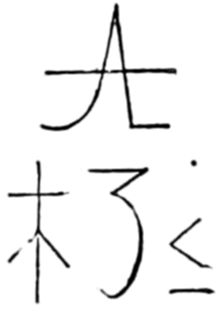
Fig. 3.
is properly translated, “The Great Uniter” (ta, great; ki, to join together, to make one, to unite); as in modern Chinese philosophy, expressed in Platonic language, the One is distinguished from the Many, and is regarded as the basis of the numerical system. But as the Chinese believe in the 151mystic powers of numbers, and as that which reduces all multiplicity to unity naturally controls or is the summit of all things, therefore the Ta Ki expresses the completest and highest creative force.
In Chinese philosophy, the Universe is made up of opposites, heaven and earth, light and darkness, day and night, land and water, concave and convex, male and female, etc., the highest terms for which are Yin and Yang. These are held to be brought into fructifying union by Ta Ki. Abstractly, the latter would be regarded as the synthesis of the two universal antitheses which make up all phenomena.[178]
The symbolic representation of Yin and Yang is a circle divided by two arcs with opposite centres, while the symbol of Ta Ki adds a third arc from above uniting these two.

Fig. 4.

Fig. 5.
It is possible that these symbols are of late origin, devised to express the ideas above named. One Chinese scholar (Mr. S. Culin) tells me that it is doubtful if they occur earlier than the twelfth century, A. D., and that they were probably introduced for purposes of divination. In this case, I believe that they were introduced from the South, and that they originally had another and concrete significance, as I shall explain later.
152Others consider these symbols as essentially Mongolian. The Ta Ki or Triskeles is to them the Mongolian, while the Svastika is the ethnic Aryan symbol. Such writers suspect Indo-European immigration where they discover the latter, Chinese immigration were they find the former emblem.
The Svastika, I need hardly say, is the hooked cross or gammated cross, usually represented as follows:
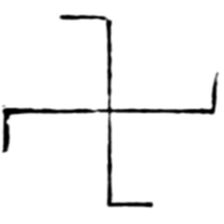
Fig. 6.
the four arms of equal length, the hook usually pointing from left to right. In this form it occurs in India and on very early (neolithic) Greco-Italic and Iberian remains. So much has been written upon the Svastika, however, that I need not enter upon its archæological distribution.
Its primary significance has been variously explained. Some have regarded it as a graphic representation of the lightning, others as of the two fire-sticks used in obtaining fire by friction, and so on.
Whatever its significance, we are safe in considering it a form of the Cross, and in its special form obtaining its symbolic or sacred association from this origin.
The widely-spread mystic purport of the Cross symbol has long been matter of comment. Undoubtedly in many parts of America the natives regarded it with reverence anterior to the arrival of Europeans; as in the Old World it was long a sacred symbol before it became the distinctive emblem of Christianity.
153As in previous writings I have brought together the evidence of the veneration in which it was held in America, I shall not repeat the references here.
I believe we may go a step further and regard all three of these symbols, the Ta Ki or Triskeles, the Svastika, and the Cross as originally the same in signification, or, at least, closely allied in meaning. I believe, further, that this can be shown from the relics of ancient American art so clearly that no one, free from prejudice, and whose mind is open to conviction, will deny its correctness.
My theory is that all of the symbols are graphic representations of the movements of the sun with reference to the figure of the earth, as understood by primitive man everywhere, and hence that these symbols are found in various parts of the globe without necessarily implying any historic connections of the peoples using them.
This explanation of them is not entirely new. It has previously been partly suggested by Professors Worsaae and Virchow; but the demonstration I shall offer has not heretofore been submitted to the scientific world, and its material is novel.
Beginning with the Ta Ki, we find its primary elements in the symbolic picture-writing of the North American Indians. In that of the Ojibways, for example, we have the following three characters:
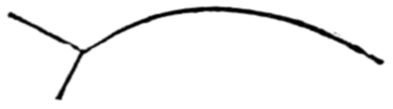
Fig. 7.

Fig. 8.
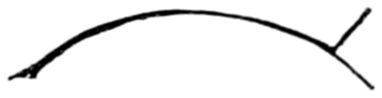
Fig. 9.
Of these, the Fig. 7 represents the sunrise; Fig. 9, sunset; 154Fig. 8, noonday. The last-mentioned is the full day at its height.[179] Where, in rock-writing or scratching on wood, the curve could not conveniently be used, straight lines would be adopted:

Fig. 10.
thus giving the ordinary form of the Triskeles. But the identical form of the Ta Ki is found in the calendar scroll attached to the Codex-Poinsett, an unpublished original Mexican MS., on agave paper, in the library of the American Philosophical Society. A line from this scroll is as follows:

Fig. 11.
Here each circle means a day, and those with the Triskeles, culminating days.[180]
155Another form of representing days is seen in the Vatican Mexican Codex, published in Kingsborough’s Mexico, Vol. iii:

Fig. 12.
This is not far from the figure on the stone at Copan, described in Dr. Hamy’s paper, where the design is as follows:
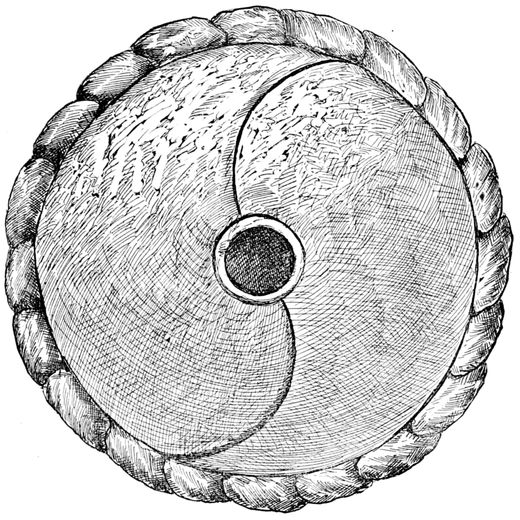
Fig. 13.
156This does not resemble the Ta Ki, as Dr. Hamy supposes, but rather the Yin-Yang; yet differs from this in having a central circle (apparently a cup-shaped depression). This central circular figure, whether a boss or nave, or a cup-shaped pit, has been explained by Worsaae as a conventionalized form of the sun, and in this he is borne out by primitive American art, as we shall see. The twenty elevations which surround the stone, corresponding in number to the twenty days of the Maya month, indicate at once that we have here to do with a monument relating to the calendar.
Turning now to the development of this class of figures in primitive American art, I give first the simplest representations of the sun, such as those painted on buffalo skins by the Indians of the Plains, and scratched on the surface of rocks. The examples are selected from many of the kind published by Col. Garrick Mallery.[181]
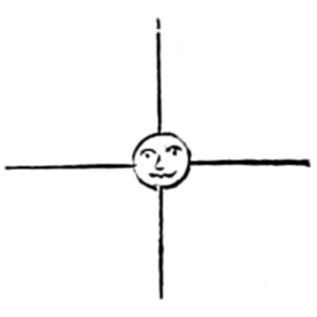
Fig. 14.
The design is merely a rude device of the human face, with four rays proceeding from it at right angles. These four rays represent, according to the unanimous interpretation of the Indians, the four directions defined by the apparent 157motions of the sun, the East and West, the North and South. By these directions all travel and all alignments of buildings, corpses, etc., were defined; and hence the earth was regarded as four-sided or four-cornered; or, when it was expressed as a circle, in accordance with the appearance of the visible horizon, the four radia were drawn as impinging on its four sides:
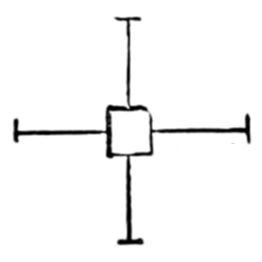
Fig. 15.
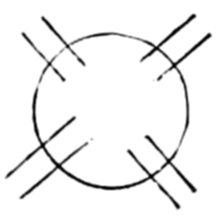
Fig. 16.
Fig. 15 is a design on a vase from Maraja, Brazil, and is of common occurrence on the pottery of that region.[182] Fig. 16 represents the circle of the visible horizon, or the earth-plain, with the four winds rushing into it when summoned by a magician. It is a figure from the Meday Magic of the Ojibways.[183] Dr. Ferraz de Macedo has claimed that such devices as Fig. 16 “show Chinese or Egyptian inspiration.”[184] It is certainly unnecessary to accept this alternative when both the origin and significance of the symbol are so plain in native American art.
When the symbol of the sun and the four directions was inscribed within the circle of the visible horizon, we obtain the figure representing the motions pf the sun with reference to the earth, as in:
158

Fig. 17.
This is what German archæologists call the wheel-cross, Radkreuz, distinguished, as Worsaae pointed out, by the presence of the central boss, cup or nave, from the ring-cross, Ringkreuz, Fig. 18:

Fig. 18.
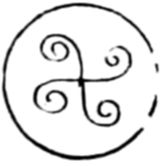
Fig. 19.
in which, also, the arms of the cross do not reach to the circumference of the wheel. Worsaae very justly laid much stress on the presence of the central boss or cup, and correctly explained it as indicative of the sun; but both he and Virchow, who followed him in this explanation, are, I think, in error in supposing that the circle or wheel represents the rolling sun, die rollende Sonne. My proof of this is that this same figure was a familiar symbol, with the signification stated, in tribes who did not know the mechanical device of the wheel, and could have had, therefore, no notion of such an analogy as the rolling wheel of the sun.[185]
159When applied to time, the symbol of the circle in primitive art referred to the return of the seasons, not to an idea of motion in space. This is very plainly seen both in art and language. In the year-counts or winter-counts of the American tribes, the years were very generally signified by circles arranged in rows or spirals. Fig. 20 shows the Dakota winter-count, as depicted on their buffalo robes.[186]

Fig. 20.
This count is to be read from right to left, because it is written from left to right, and hence the year last recorded is at the end of the line.
Precisely similar series of circles occur on the Aztec and Maya codices, with the same signification. Moreover, the year-cycles of both these nations were represented by a circle on the border of which the years were inscribed. In Maya this was called uazlazon katun, the turning about again, or revolution of the katuns.[187]
The Aztec figure of the year-cycle is so instructive that I give a sketch of its principal elements (Fig. 21), as portrayed in the atlas to Duran’s History of Mexico.[188]
160
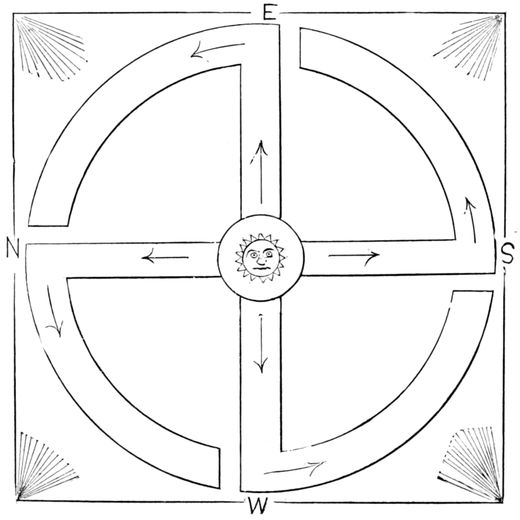
Fig. 21.
In this remarkable figure we observe the development and primary signification of those world-wide symbols, the square, the cross, the wheel, the circle, and the svastika. The last-mentioned is seen in the elements of the broken circle, which are:
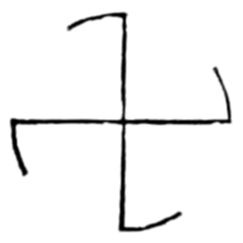
Fig. 22.
161These, conventionalized into rectilinear figures for scratching on stone or wood, became:
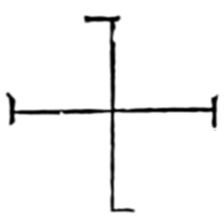
Fig. 23.
In the Mexican time-wheel, the years are to be read from right to left, as in the Dakota winter-counts; each of the quarter circles represents thirteen years; and these, also, are to be read from right to left, beginning with the top of the figure, which is the East, and proceeding to the North, South and West, as indicated.
The full analysis of this suggestive and authentic astronomical figure will reveal the secret of most of the rich symbolism and mythology of the American nations. It is easy to see how from it was derived the Nahuatl doctrine of the nahua ollin, or Four Motions of the Sun, with its accessories of the Four Ages of the world. The Tree of Life, so constantly recurring as a design in Maya and Mexican art, is but another outgrowth of the same symbolic expression for the same ideas.
That we find the same figurative symbolism in China, India, Lycia, Assyria and the valley of the Nile, and on ancient urns from Etruria, Iberia, Gallia, Sicilia and Scythia, needs not surprise us, and ought not to prompt us to assert any historic connection on this account between the early development of man in the New and Old World. The 162path of culture is narrow, especially in its early stages, and men everywhere have trodden unconsciously in each other’s footsteps in advancing from the darkness of barbarism to the light of civilization.
163
THE FOLK-LORE OF YUCATAN.[189]
Yucatan presents a strange spectacle to the ethnologist. The native race, which in nearly every other part of the American continent has disappeared before the white invaders or else become their acknowledged inferior, has there gained the upper hand. The native language has ousted the Spanish to that extent that whole villages of whites speak Maya only, and the fortunes of war in the last generation have sided so much with the native braves that they have regained undisputed possession of by far the larger part of the peninsula.
Is there to be recognized in this a revival of that inherent energy which prompted their ancestors to the construction of the most remarkable specimens of native architecture on the continent, and to the development of a ripe social and political fabric?
It can scarcely be doubted; but, however that may be, such considerations cannot fail to excite our interest in all that relates to a race of such plucky persistence.
As throwing a side-light on their mental constitution, their superstitions and folk-lore merit attention. I happen 164to have some material on this which has never been published, and some more which has only appeared in mediums quite inaccessible even to diligent students. Of the former are a manuscript by the Licentiate Zetina of Tabasco, a native of Tihosuco, and some notes on the subject by Don Jose Maria Lopez, of Merida, and the late Dr. Carl Hermann Berendt; while of the latter a report by Don Bartholomé Granado de Baeza, cura of Yaxcabá, written in 1813, and an article of later date by the learned cura, Estanislao Carrillo, are particularly noteworthy.[190] From these sources I have gathered what I here present, arranging and studying the facts they give with the aid of several dictionaries of the tongue in my possession.
These Mayas, as the natives called themselves, were converted at the epoch of the conquest (about 1550) to Christianity in that summary way which the Spaniards delighted in. If they would not be baptized they were hanged or drowned; and, once baptized, they were flogged if they did not attend mass, and burned if they slid back to idol-worship. They were kept in the densest ignorance, for fear they should learn enough to doubt. Their alleged Christianity was therefore their ancient heathenism under a new name, and brought neither spiritual enlightenment nor intellectual progress. As a recent and able historian of 165Yucatan has said, “the only difference was that the natives were changed from pagan idolaters to Christian idolaters.”[191]
To this day the belief in sorcerers, witchcraft and magic is as strong as it ever was, and in various instances the very same rites are observed as those which we know from early authors obtained before the conquest.
The diviner is called h’men, a male personal form of the verb men, to understand, to do. He is one who knows, and who accomplishes. His main instrument is the zaztun, “the clear stone” (zaz, clear, transparent; tun, stone). This is a quartz crystal or other translucent stone, which has been duly sanctified by burning before it gum copal as an incense, and by the solemn recital of certain magic formulas in an archaic dialect passed down from the wise ancients. It is thus endowed with the power of reflecting the past and future, and the soothsayer gazes into its clear depths and sees where lost articles may be recovered, learns what is happening to the absent, and by whose witchery sickness and disaster have come upon those who call in his skill. There is scarcely a village in Yucatan without one of these wondrous stones.
The wise men have also great influence over the growing crops, and in this direction their chiefest power is exercised. By a strange mixture of Christian and pagan superstition, they are called in to celebrate the misa milpera, the “field mass” (misa, Spanish, “mass”; milpera, a word of Aztec derivation, from milpa, “cornfield”). In the native tongue 166this is called the tich, which means the offering or sacrifice. It is a distinct survival of a rite mentioned by Diego de Landa, one of the earliest bishops of the diocese of Yucatan.[192]
The ceremony is as follows: On a sort of altar constructed of sticks of equal length the native priest places a fowl, and, having thrown on its beak some of the fermented liquor of the country, the pitarrilla, he kills it, and his assistants cook and serve it with certain maize cakes of large size and special preparation. When the feast is ready, the priest approaches the table, dips a branch of green leaves into a jar of pitarrilla, and asperges the four cardinal points, at the same time calling on the three persons of the Christian Trinity, and the sacred four of his own ancient religion, the Pah ah tun. These mysterious beings were before the conquest and to this day remain in the native belief the gods of rain, and hence of fertility. They are identical with the winds, and the four cardinal points from which they blow. To each is sacred a particular color, and in modern times each has been identified with a saint in the Catholic calendar. Thus Father Baeza tells us that the red Pahahtun is placed at the East, and is known as Saint Dominic; to the North the white one, who is Saint Gabriel; the black, toward the West, is Saint James; the yellow is toward the South, and is a female, called in the Maya tongue X’Kanleox, “the yellow goddess,” and bears the Christian name of Mary Magdalen.
The name Pahahtun is of difficult derivation, but it probably means “stone, or pillar, set up or erected,” and this 167tallies quite exactly with a long description of the ancient rites connected with the worship of these important divinities in the old times. There are some discrepancies in the colors assigned the different points of the compass, but this appears to have varied considerably among the Central American nations, though many of them united in having some such symbolism. A curious study of it has been made by the well-known archæologist, the Count de Charencey.[193]
The invocation to these four points of the compass in its modern form was fortunately obtained and preserved in the original tongue by that indefatigable student, the late Abbé Brasseur de Bourbourg, while on a visit to the plantation of Xcanchakan, in the interior of Yucatan.[194] The translation of it runs as follows:—
“At the rising of the Sun, Lord of the East, my word goes forth to the four corners of the heaven, to the four corners of the earth, in the name of God the Father, God the Son, and God the Holy Ghost.
“When the clouds rise in the east, when he comes who sets in order the thirteen forms of the clouds, the yellow lord of the hurricane, the hope of the lords to come, he who rules the preparation of the divine liquor, he who loves the guardian spirits of the fields, then I pray to him for his precious favor; for I trust all in the hands of God the Father, God the Son, and God the Holy Ghost.”
Such is an example of the strange mixture of heathen and 168Christian superstition which has been the outcome of three centuries of so-called Christian instruction!
There still continue to be relics of an ancient form of fire-worship which once prevailed commonly throughout the peninsula. The missionaries refer to it as “the festival of fire,”[195] but the exact rites performed were so carefully concealed that we have no description of them. That they are not yet out of date is apparent from a copy of a native calendar for 1841–2, obtained by Mr. Stephens when in Yucatan. In it the days are marked as lucky or unlucky, and against certain ones such entries are made as “now the burner lights his fire,” “the burner gives his fire scope,” “the burner takes his fire,” “the burner puts out his fire.” This burner, ah toc, is the modern representative of the ancient priest of the fire, and we find a few obscure references to an important rite, the tupp kak, extinction of the fire, which was kept up long after the conquest, and probably is still celebrated in the remoter villages. The sacred fire in ancient Maya land is said to have been guarded by chosen virgins, and it appears in some way to have been identified with the force which gives life to the animal and vegetable world.
Another of the modern ceremonies which is imbued with the old notion, common to them as to all primitive people, of a soul with material wants, is that called “the feast of the food of the soul.” Small cakes are made of the flesh of hens and pounded maize, and are baked in an underground oven. Of these as many are placed on the altar of the church as the person making the offering has deceased relatives for whose 169well-being he is solicitous. These cakes are called hanal pixan, “the food of the soul.” Evidently they are intended to represent the nourishment destined for the soul on its journey through the shadowy lands of death.
Along with these there are many minor superstitions connected especially with the growth of crops and fruits. Thus it is widely believed that the fruit known as the white zapote (Sapota achras, in Maya, choch) will not ripen of itself. One must tap it lightly several times as it approaches maturity, repeating the formula:
Hoken, chechè; ocen, takan:
Depart, greenness: enter, ripeness.
The owl is looked upon as an uncanny bird, presaging death or disease, if it alights on or even flies over a house. Another bird, the cox, a species of pheasant, is said to predict the approach of high northerly winds, when it calls loudly and frequently in the woods; though this, according to one writer, is not so much a superstition as an observation of nature, and is usually correct.
A singular ceremony is at times performed to prevent the death of those who are sick. The dread being who in mediæval symbolism was represented by a skeleton, is known to the Mayas as Yum Cimil, Lord of Death. He is supposed to lurk around a house where a person is ill, ready to enter and carry off his life when opportunity offers. He is, however, willing to accept something in lieu thereof, and to bring about this result the natives perform the rite called kex, or “barter.” They hang jars and nets containing food and drink on the trees around the house, repeating certain 170invocations, and they believe that often the Lord of Death will be satisfied with these, and thus allow the invalid to recover.
Those diviners to whom I have alluded are familiarly known as Tat Ich, Daddy Face, and Tata Polin, Daddy Head, a reference, I suspect, to a once familiar name of a chief divinity, Kin ich, the face (or eye) of the day, i. e. the Sun.
A power universally ascribed to these magicians is that of transforming themselves into beasts. Were it not for so many examples of delusions in enlightened lands, it would be difficult to explain the unquestioning belief which prevails on this subject throughout Central America. Father Baeza relates that one of these old sorcerers declared in a dying confession that he had repeatedly changed himself into various wild beasts. The English priest, Thomas Gage, who had a cure in Guatemala about 1630, tells with all seriousness a number of such instances. Even in our own days the learned Abbé Brasseur de Bourbourg is not entirely satisfied that animal magnetism, ventriloquism, and such trickery, can explain the mysteries of nagualism, as the Central American system of the black arts is termed. He is not certain that we ought to exclude the assistance of the invisible diabolic agencies![196]