SOME TYPES OF REMARKABLE GEMS.
Reading edition
My entire collection in the Free Museum of Science and Art of the University of Pennsylvania must be examined to see types of all these epochs. It may be well to notice here three or four very remarkable gems of which monographs have also been published.
Bacchus and Ariadne.
Ariadne is seated on the rocks of Dia, where Bacchus found her; at her feet is her panther. Bacchus bears in his hand a thrysus; his javelin with its point in the form of a pine cone; his head wreathed with ivy and grape leaves; his hand lovingly placed on sad Ariadne’s shoulder, who has just been deserted by Theseus. Bacchus, deeply in love (which is indicated by the figure of Cupid), says to her, “I shall care for thee.” The panther at the feet of Ariadne is emblematic of the principal and most important incident in her life, her love for Theseus.
Ariadne was the daughter of Minos, King of Crete. She fell in love with Theseus when he went as one of the seven youths whom the Athenians were obliged to send every year with seven maidens to Crete to be devoured by the Minotaur.
Ariadne provided Theseus with a sword with which he slew the Minotaur, and with a thread which enabled him to find his way out of the labyrinth; they then fled to the island of Naxos (Dia), where Theseus, warned by a god in a dream, deserted her. Bacchus arrived opportunely from India, finding Ariadne in a state of grief and consternation, which even added to her charming beauty; he quenched her tears, consoled her, and took her to himself. This exquisite gem is a fine representation of Renaissance work (see plate on p. 81).
Jupiter Ægiochus.
Among examples of antique glyptic art, by referring to my late work on “Engraved Gems: Their Place in the History of Art,” you will find an extended notice of the superb ancient cameo on chrysoprase of Jupiter Ægiochus. It is the eighth of importance in the remarkable antique cameos that have been preserved from the early centuries after Christ. It is of remarkable dimensions, being 167 millimetres in height by 130 millimetres in breadth.
It is of the close of the epoch of Marcus Aurelius or the earlier years of the reign of Commodus. The style is that of the Græco-Roman art. The work is very beautiful for that epoch, and there rests in this head of the master of the gods an accent of grandeur in which one feels the reflection of the original Greek of the better centuries, imitated here by the engraver of the Græco-Roman age.
SOMMERVILLE COLLECTION.
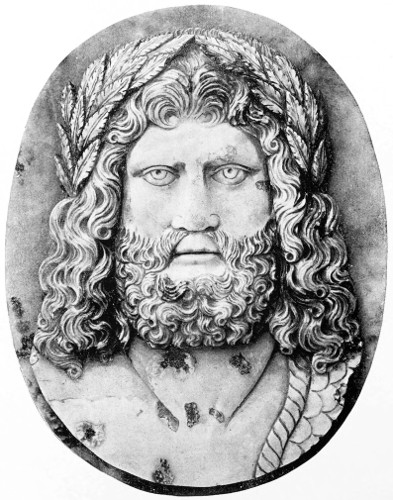
JUPITER ÆGIOCHUS.
It is an interesting circumstance, which merits particular attention, that the cameo Zulian coming from Ephesus and this Jupiter Ægiochus are certainly of the workmanship of Asia Minor.
Early in this century this cameo made part of the celebrated Northwick Collection of England. Afterwards it was acquired by a wealthy connoisseur in France, and later passed into the possession of M. Feuardent, Paris, when, with his permission, an engraving of it appeared, with five quarto pages of text and notes, in the Gazette Archæologique, Paris, 1877, edited by Baron J. De Witte, Membre de l’Institut and François Lenormant.
M. Adrien Longperier, the distinguished glyptologist and savant of the Institut de France, some thirty years ago made a study of this gem, and seriously contemplated its acquisition for France; he urged the French Government to authorize its purchase for the collection in the Salle des Pierres gravées in the Bibliothèque Nationale, Paris, or for the Museum of the Louvre. Several other museums also negotiated for its purchase, but the late owner being firm in his demand, the price caused them to delay, and now it belongs to America, being part of my collection.
The Triumph of Constantine.
Among the most important and interesting antique gems in my collection is one engraved when Constantine held the Roman Empire in Byzantia, which came into the possession of the Court of Russia.
The Empress Catherine II., wishing to confer a great favor and special reward on an ambassador to her court from her remarkable collection in the Museum of the Hermitage at St. Petersburg, presented this antique gem to him in 1785. Twenty-five years afterwards, at his death in Greece, it was sold, and was piously guarded during thirty years by a collector in the Hellenic peninsula. After that it became the property of Bieler in Styria.
I came into possession of this remarkable gem after more than five years’ negotiations with its owner, and subsequently with his heirs.
It is a cameo of great importance in itself. Prof. C. W. King, of Trinity College, Cambridge, England, said, “It is by far the most important of all similar works of the Lower Empire hitherto published.”
It is of very considerable dimensions (6 × 4 inches), being the eleventh in point of magnitude of those already existing in any cabinet. It is a maculated sard, dark-reddish amber color, with slight white, dark sepia, and burnt sienna spots or maculation.
The subject is a Triumph of Constantine. This portrait of that Byzantine Emperor is considered very faithful. As I have often remarked in connection with the numismatic phase of my subject, we can in this case establish the likeness of Constantine by confronting it with the fine gold coins of his realm and reign.
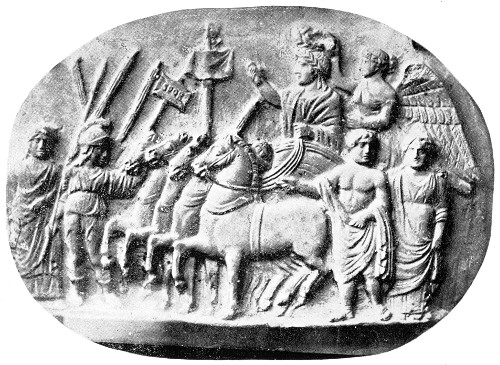
Among the auxiliary figures on the gem is Constantine’s mother Helena, she who found the true cross; also Crispus his son, and his wife Fausta.
The Emperor is being crowned by a Victory, who stands behind him borne in a triumphal car, the four horses walking and led by a soldier in front. Constantine holds the reins in his left hand, but in his right a roll of paper (volumen), instead of the customary eagle-tipped sceptre.
In the front of the group is a standard inscribed “S. P. Q. R.,” the bearer of the staff being concealed by the horses of the car; as are also the lictors, whose fasces are seen elevated in the air above the horses’ backs, in the upper field of the composition. Behind the car stands Crispus and Fausta, both in front face; Crispus is pointing to the labarum, and evidently relating to Fausta all the circumstances of its introduction into the scene. At the opposite end of the gem stands Helena, who, with the soldier leading the quadriga, forms a balance to the other pair.
Much labor and skill have been expended by the artist upon the face of the triumphing Cæsar, in order to leave no doubt as to his identity, and with such success that the well-known Augustus-like profile of Constantine may be recognized at the first glance.