Chapter X · HISTORIC PAINTERS.
Reading edition
MANY of our painters who aspired to high art in the field of history were forced to abandon these ambitious designs, and confine themselves to the more lucrative branches of their calling. It was not so with
WILLIAM HILTON (1786—1839), who, although chilled and saddened by neglect, and generally unable to sell his pictures, maintained his position as a history painter, and suffered neither poverty nor the coldness of the public to turn him aside. Few details are known of his life; he was a gentle, silent, and retiring man, who knew much sorrow and shunned publicity. Rescued from a trade to which he was destined, Hilton was allowed to learn drawing, and became a pupil of J. Raphael Smith, the mezzotint engraver. He entered the Academy schools, and paid special attention to the anatomy of the figure. His earliest known productions were a series of designs in oil to illustrate "The Mirror," and "The Citizen of the World." Hilton's early exhibited works had classic subjects, such as Cephalus and Procris, Venus carrying the wounded Achilles, and Ulysses and Calypso. In 1810, he produced a large historic painting, called Citizens of Calais delivering the Keys to Edward III., for which the British Institution awarded him a premium of fifty guineas. For the Entombment of Christ he received a second premium, and for Edith discovering the Dead Body of Harold a third of one hundred guineas. Nevertheless, the public did not appreciate his works, and they were unsold. The Directors of the British Institution, who had already marked their sense of this painter's ability, purchased two of his sacred pieces, Mary anointing the Feet of Jesus, which was presented to the Church of St. Michael, in the City, and Christ crowned with Thorns, which was given to that of St. Peter's, Eaton Square, but which has since been sold. In 1819 Hilton became a full member of the Academy, and was appointed Keeper in 1827, a position for which he was specially fitted, and where he gained the affection of the students. In the next year he married. The death of his wife, in 1835, crushed his energy and hope. He saw himself painting for a public which did not value his art.
The Rape of Europa. By HILTON. A.D 1818. In the possession of the Earl of Egremont.
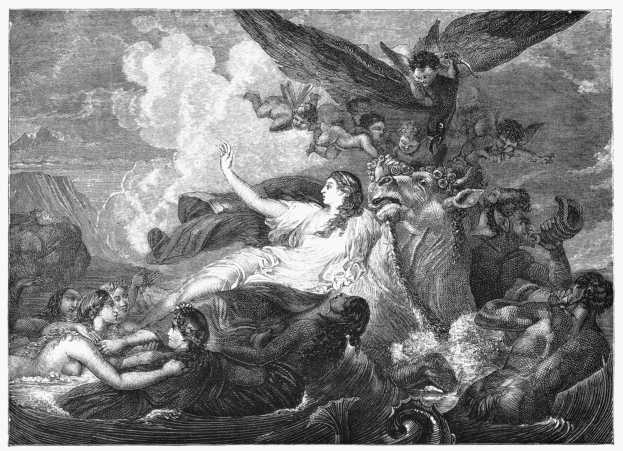
In addition to the above examples, we may mention Hilton's Serena rescued by the Red Cross Knight, Sir Calepine, and The Meeting of Abraham's Servant with Rebekah (National Gallery), and a triptych of The Crucifixion, which is at Liverpool. Most of Hilton's works are falling to decay through the use of asphaltum.
BENJAMIN ROBERT HAYDON (1786—1846) was the son of a bookseller at Plymouth, and his "fitful life"—marked by "restless and importunate vanity"—was ended by his own act. Haydon refused to follow his father's business, and insisted on becoming a painter. Of his thoughts, hopes, and dreams, we have been well informed. He was in the habit of writing in an elaborate diary all that concerned himself. He came to London in 1804 with £20 in his pocket, entered the Academy schools, and worked there with vigour and self-reliance. Northcote did not encourage his enthusiastic countryman when he told him that as an historic painter "he would starve with a bundle of straw under his head." We admire the courage of Haydon in holding fast to the branch of art he had embraced, but his egotism fulfilled the prophecy of Northcote. When twenty-one, Haydon ordered a canvas for Joseph and Mary resting on the Road to Egypt, and he prayed over the blank canvas that God would bless his career, and enable him to create a new era in art. Lord Mulgrave became his patron, and this may have added to the painter's hopes. He painted Dentatus, and, intoxicated by flattery, believed the production of this his second work would mark "an epoch in English art." Dentatus, however, was hung in the ante-room of the Royal Academy, and coldly received. In 1810, he began Lady Macbeth for Sir George Beaumont; quarrelling with his patron, he lost the commission, but worked on at the picture. Although deeply in debt, he quarrelled with those who would have been his friends. His Judgment of Solomon, a very fine picture, was painted under great difficulties and privations. West, the President, whom the painter accused of hostility to him, is said to have shed tears of admiration at the sight of this work, and sent Haydon a gift of £15. Solomon was sold for 600 guineas, and the British Institution awarded another hundred guineas as a premium to its author. In 1820 Haydon produced Christ's Entry into Jerusalem, and during its progress he, as he recorded, "held intercourse only with his art and his Creator." This picture was exhibited at the Egyptian Hall, Piccadilly, and brought a large sum of money to the painter. Unsold in England, the work of which Haydon had expected much was purchased for £240, and sent to America. He established an Art school, where several able painters were trained, but the master was constantly in great pecuniary difficulties. In 1823, he exhibited the The Raising of Lazarus, containing twenty figures, each nine feet high, which is now in the National Gallery. Of this work Mr. Redgrave says: "The first impression of the picture is imposing; the general effect powerful, and well suited to the subject; the incidents and grouping well conceived; the colouring good, and in parts brilliant. The Christ is weak, probably the weakest, though the chief figure in the picture." Misfortune still dogged the painter. He was thrown into prison for debt; released, he worked in poverty, afraid of his "wicked-eyed, wrinkled, waddling, gin-drinking, dirty-ruffled landlady." The closing scenes of his life grew darker and darker. In 1826, he painted Venus and Anchises, on commission, began Alexander taming Bucephalus, and Euclus, and was once more in prison. An appeal in the newspapers produced money enough to set him again at liberty. Then appeared the Mock Election, and Chairing the Member, the former being purchased by the King. No success, however, seemed to stem the tide of Haydon's misfortunes. He lectured on Art with great ability in 1840, continued painting for bread, and finally, disgusted by the cold reception of Aristides, and Nero watching the Burning of Rome, the over-wrought mind of the unfortunate man gave way, and he committed suicide, leaving this brief entry in his journal—"God forgive me! Amen. Finis. B. R. Haydon. 'Stretch me no longer on the rack of this sad world.'—Lear." A sad finish to his ambitious hopes! Of Haydon's art generally Mr. Redgrave says: "He was a good anatomist and draughtsman, his colour was effective, the treatment of his subject and conception were original and powerful; but his works have a hurried and incomplete look, his finish is coarse, sometimes woolly, and not free from vulgarity."
The Dangerous Playmate. By ETTY. A.D 1833. In the National Gallery.
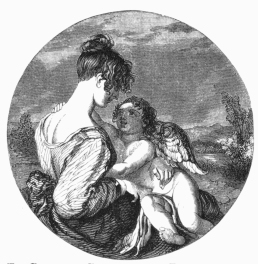
WILLIAM ETTY (1787—1849), the son of a miller at York, had few advantages to help him on the road to fame. His education was slight, and his early years were spent as a printer's apprentice in Hull. But he had determined to be a painter; and his motto was, as he tells us, "Perseverance." In 1806, he visited an uncle, in Lombard Street, and became a student at the Academy, though his earliest art-school was a plaster-cast shop in Cock Lane. Through his uncle's generosity, he became a pupil of Lawrence, who had little time to attend to him. Though overwhelmed with difficulties Etty persevered bravely. He laboured diligently in the "Life School," tried in vain for all the medals, sent his pictures to the Academy only to see them rejected; unlike Haydon, he never lost heart. In 1820 The Coral Finders was exhibited at the Academy, and in the following year Cleopatra. His patience and diligence were rewarded; henceforth his career was one of success. In 1822, he visited Italy, and in 1828 became a full member of the Academy. His art was very unequal. He chiefly devoted himself, however, to painting women, as being the embodiments of beauty. As a colourist few English painters have rivalled him, and as a painter of flesh he stands high. As showing the different forms of his many-sided art, we may mention Judith and Holofernes, Benaiah, The Eve of the Deluge, Youth on the prow and Pleasure at the Helm, The Imprudence of Candaules, The dangerous Playmate, and The Magdalen (all in the National Gallery). Etty died unmarried, and the possessor of a considerable fortune.
HENRY PERRONET BRIGGS (1792—1844), distinguished as an historic and portrait painter, began his art studies at the Academy in 1811, and was made a full member of that body in 1832. His best-known works are Othello relating his Adventures, The first Conference between the Spaniards and Peruvians, and Juliet and her Nurse; the two latter are in the National Gallery. This master in his later years forsook historical painting for portraiture.
Greek Fugitives. By EASTLAKE. Painted for Sir Matthew White Ridley, Bart. Exhibited at the Royal Academy in A.D. 1833.
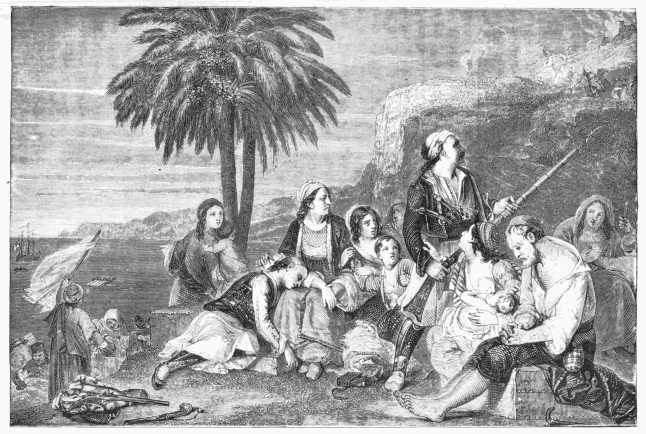
CHARLES LOCK EASTLAKE (1793—1865), son of the Solicitor to the Admiralty in that town, was born at Plymouth, and educated first in Plympton Grammar School, where Reynolds had studied, and afterwards at the Charterhouse, London. Choosing the profession of a painter, he was encouraged, doubtless, by his fellow-townsman, Haydon, who had just exhibited Dentatus. Eastlake became the pupil of that erratic master, and attended the Academy schools. In 1813, he exhibited at the British Institution a large and ambitious picture, Christ raising the Daughter of the Ruler. In the following year the young painter was sent by Mr. Harman to Paris, to copy some of the famous works collected by Napoleon in the Louvre. The Emperor's escape from Elba, and the consequent excitement in Europe, caused Eastlake to quit Paris, and he returned to Plymouth, where he practised successfully as a portrait painter. A portrait of Napoleon, which Eastlake enlarged from his sketch of the Emperor on board the Bellerophon when bound for St. Helena, appeared in 1815. This picture now belongs to Lord Clinton. In the same year he exhibited Brutus exhorting the Romans to avenge the Death of Lucretia. In 1819 Eastlake visited Greece and Italy, and spent fourteen years abroad, chiefly at Ferrara and Rome. The picturesque dress of the Italian and Greek peasantry so fascinated him that for a long period he forsook history for small genre works, of which brigands and peasants were the chief subjects. A large historical painting, Mercury bringing the Golden Apple to Paris, appeared in 1820. Seven years later, The Spartan Isidas, now in the possession of the Duke of Devonshire, was exhibited at the Academy, and procured for the painter the Associateship. It illustrates the story told by Plutarch, in his "Life of Agesilaus," of the young warrior called suddenly in his bath to oppose the Thebans. Rushing forth naked with his sword and spear, he drove back the Thebans and escaped unhurt. In 1828, Eastlake produced Italian Scene in the Anno Santo, Pilgrims arriving in sight of St. Peter's, which he twice repeated. In 1829 Lord Byron's Dream, a poetic landscape (National Gallery), was exhibited, and Eastlake becoming an Academician, returned to England. Then followed Greek Fugitives, Escape of the Carrara Family from the Duke of Milan (a repetition is in the National Gallery), Haidee (National Gallery), Gaston de Foix before the Battle of Ravenna, Christ blessing Little Children, Christ weeping over Jerusalem (a repetition is in the National Gallery), and Hagar and Ishmael. To his labours as a painter Eastlake added the duties of several important offices, and much valuable literary work. He was Secretary to the Royal Commission for Decorating the New Palace of Westminster, Librarian of the Royal Academy, and Keeper, and afterwards Director of the National Gallery. In 1850, he succeeded Sir Martin Shee as President of the Royal Academy, and was knighted. From that time till his death, at Pisa, in 1865, he was chiefly engaged in selecting pictures to be purchased by the British Government. He was editor of Kugler's "Handbook of the Italian Schools of Painting," and author of "Materials for a History of Oil Painting."
Joash shooting the Arrows of Deliverance. By DYCE. A.D. 1844. In the possession of Mr. Bicknell.
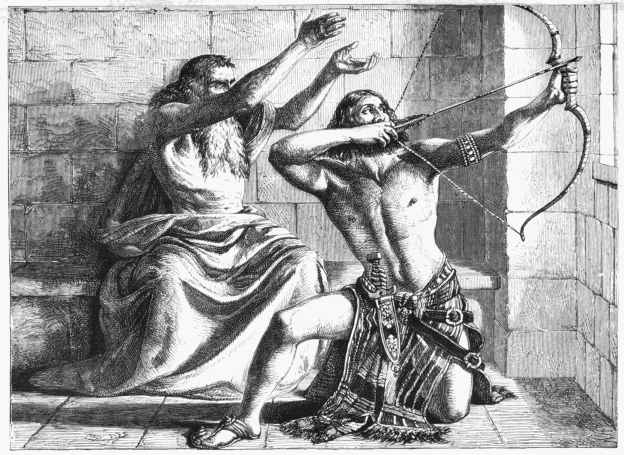
WILLIAM DYCE (1806—1864), a native of Aberdeen, commenced his art studies at the Royal Scottish Academy. Visiting Italy he studied the old masters, and their influence had a lasting effect upon his style. In 1827 Dyce exhibited at the Royal Academy Bacchus nursed by the Nymphs. In 1830, he settled in Edinburgh, and achieved marked success. The Descent of Venus appeared at the Academy in 1836. Having removed to London, Dyce exhibited, in 1844, Joash shooting the Arrows of Deliverance, and was elected an Associate. In 1847, he produced the sketch of a fresco executed at Osborne House, Neptune assigning to Britannia the Empire of the Sea. Dyce was chosen, in 1848, to decorate the Queen's Robing-Room in the Houses of Parliament, and commenced, but did not quite finish, a large series of frescoes illustrating The Legend of King Arthur. He produced other historic works, chiefly of Biblical subjects, and of great merit.
GEORGE HARVEY (1805—1876) was born at St. Ninian's, Fifeshire, and apprenticed to a bookseller at Stirling. He quitted this craft at the age of eighteen, and commenced his art career at Edinburgh. In Scotland he gained a wide popularity. He took an active part in the establishment of the Royal Scottish Academy, and was knighted in 1867. His favourite subjects were Puritan episodes, such as Covenanters' Communion, Bunyan imagining his Pilgrim's Progress in Bedford Gaol, and The Battle of Drumclog.
THOMAS DUNCAN (1807—1845), a native of Perthshire, first attracted notice by his pictures of a Milkmaid, and Sir John Falstaff. In 1840, he exhibited at the Royal Academy his historical painting, Entrance of Prince Charlie into Edinburgh after Preston Pans, and next year produced Waefu' Heart, from the ballad of "Auld Robin Gray," which is now at South Kensington.
Harold, returned from Normandy, presents himself to Edward the Confessor. By MACLISE. A.D. 1866. From the "Story of the Norman Conquest."
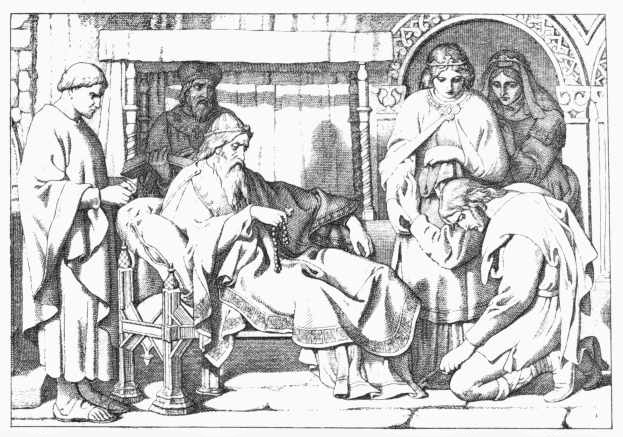
DANIEL MACLISE (1811—1870) was born at Cork, and was intended for the unromantic calling of a banker's clerk. Fortunately for the world he soon left the bank stool for the studio of the Cork Society of Arts. In 1828, he transferred his attention to the Academy schools in London, and soon obtained the gold medal for the best historic composition, representing The Choice of Hercules. He had previously exhibited Malvolio affecting the Count. In due course appeared, at the British Institution, Mokanna unveiling his features to Zelica, and Snap-Apple Night, which found a place at the Royal Academy. Maclise became a full Academician in 1840. His latter years were chiefly occupied with the famous water-glass pictures in the Houses of Parliament, The Interview of Wellington and Blucher after Waterloo, and The Death of Nelson at Trafalgar. The noble cartoon (bought by subscriptions of artists, who likewise presented the designer with a gold port-crayon) of the former is now the property of the Royal Academy. Maclise executed many book illustrations, including those for "Moore's Melodies," and "The Pilgrims of the Rhine." He executed a noble series of designs delineating The Story of the Norman Conquest. A collection of his drawings has been bequeathed to the South Kensington Museum by Mr. John Forster. Maclise painted a few portraits, among them that of Charles Dickens, who spoke thus of the dead painter, "Of his prodigious fertility of mind and wonderful wealth of intellect, I may confidently assert that they would have made him, if he had been so minded, at least as great a writer as he was a painter. The gentlest, and most modest of men; the freest as to his generous appreciation of young aspirants; and the frankest and largest-hearted as to his peers. No artist ever went to his rest leaving a golden memory more free from dross, or having devoted himself with a truer chivalry to the goddess whom he worshipped." The most remarkable works of Maclise are Macbeth and the Witches; Olivia and Sophia fitting out Moses for the Fair; The Banquet Scene in Macbeth; Ordeal by Touch; Robin Hood and Cœur de Lion; The Play Scene in Hamlet (National Gallery); Malvolio and the Countess (National Gallery).
CHARLES LANDSEER (1799—1879), the elder brother of the more famous Sir Edwin Landseer, was a pupil of Haydon and the Royal Academy Schools. In 1836 appeared his Sacking of Basing House (now in the National Gallery). He was elected an A.R.A. in the following year, became a full member in 1845, and Keeper in 1851. Amongst other good works by him are Clarissa Harlowe in the Spunging House (National Gallery), Charles II. escaping in disguise from Colonel Lane's House, and The Eve of the Battle of Edgehill.
CHARLES LUCY (1814—1873) began life as a chemist's apprentice in his native town of Hereford. He soon forsook the counter, and went to Paris to study painting. Coming to London, he exhibited Caractacus and his Family before the Emperor Claudius, a work which formed the introduction to a long series of historic pictures, noteworthy among which are The Parting of Charles I. with his Children, The Parting of Lord and Lady Russell, and Buonaparte in discussion with the Savants, all of which were exhibited at the Academy. Lucy established a great reputation in Europe and America.
JOHN PHILLIP (1817—1867) was one of the best colourists of the English school. He was a native of Aberdeen, began life as an errand boy to what the Scotch call a "tin smith," and afterwards became an apprentice to a painter and glazier, and seems to have had instruction in his early pursuit of art from a portrait painter of his native town, named Forbes, who was very generous to him. A picture by Phillip secured him the patronage of Lord Panmure, who sent him to London. In 1837 the young painter entered the Academy Schools. He exhibited two portraits in 1838, and two years later returned to Aberdeen, exhibiting in the Royal Academy Tasso in Disguise relating his Persecutions to his Sister. Once more returning to London, Phillip exhibited The Catechism, and several pictures of Scottish life, as The Baptism, The Spae Wife, The Free Kirk. Illness compelled him to visit Spain in 1851, and here he produced many excellent pictures of Spanish life, which greatly added to his reputation, and gained for him the sobriquet of "Don Phillip of Spain." A Visit to Gipsy Quarters, The Letter-writer of Seville, and El Paseo are examples of his Spanish pictures. In 1857 Phillip was elected Associate of the Royal Academy, and exhibited the Prison Window in Seville. Elected a full member in 1859, he painted next year The Marriage of the Princess Royal, by command of the Queen. La Gloria, one of his most celebrated works, appeared in 1864. His pictures combine correctness of drawing with boldness, if not refinement, of colouring—which is seldom met with in the works of our best painters.
ALFRED ELMORE (1815—1881), an Irishman by birth, won for himself fame as a painter of historic scenes and genre subjects. Among his works are Rienzi in the Forum; The Invention of the Stocking Loom and The Invention of the Combing Machine; Marie Antoinette in the Tuileries; Marie Antoinette in the Temple; Ophelia; and Mary Queen of Scots and Darnley. He was elected a R.A. in 1857.
