Chapter VI
Reading edition
THE DAILY LIFE IN A MONASTERY
1. MATINS
The night Office in most monasteries began at midnight, although in some places the time varied according to the seasons of the year, from that hour till half-past two or three o’clock. Midnight, however, was so generally the time, that, in considering the daily life of a monastery, it may be assumed that the night vigils began with the first hour of each day. At some short time before the hour appointed for the commencement of the night Office the signal for rising was given in the common dormitory. Sometimes the sub-sacrist was charged with the ringing of a small bell, as he passed rapidly down the passage between the monks’ beds or cubicles. In other places it was the duty of the abbot himself, or his prior, to awaken the monks from their slumbers and invite them to come and keep their night watch in the church. In any case the sacrist and his assistant had to be up betimes and before the others, for, as has been already said, they had to see that the lights were lit on the stairs and in “le standards” in the church. It was the duty of one of the novices, however, to light candles for his fellows, and set them about the places they occupied in the choir, since they did not as yet know the psalmody by heart.
Meanwhile the monks when roused from their sleep were taught to begin the day by signing themselves with the cross and commending themselves to God’s protection. As they rose from their beds they put on those parts of their monastic habit which had been laid aside during the hours of sleep, and shod themselves with their “night-boots.” These were probably fur-lined, cloth protectors for the feet, which served the double purpose of keeping them warm during the winter nights spent in the cold church, and of rendering their footfall inaudible, during the hours of the greater silence which lasted from Compline till Prime. Each monk as he finished his simple preparation, seated himself in front of his bed and there waited in silence, with his hood drawn well over his head, till the bell began to toll. Then, preceded by a junior carrying a lighted lantern, the religious went out of the dormitory in companies of six at a time, and took their places in the choir. The juniors occupied as their normal position the stalls nearest to the altar, the youngest being next to the chancel step, the seniors being furthest away, and the superiors next to the entrance. The abbot or prior waited outside the church in the cloister, or at the entrance to the choir, until all had passed in before him and had taken their places, when he gave the signal for the tolling of the bell to cease, and then himself entered and took up his position in the stall next to the gate of the choir.
Larger Image
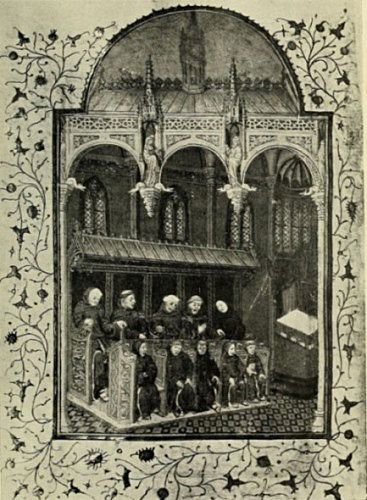
FRANCISCANS IN CHOIR
At the coming of the superior all rose from their knees, returned his salutation, and at once bowed down for what was known as the “Triple-prayer”—the Pater, Ave, and Creed—with which the night Office always commenced. Then the weekly antiphoner at a sign from the superior gave out the first of the “Fifteen,” or “Gradual” psalms. Great importance was always attached to the recitation of these psalms, and all the obedientiaries were bound to be present, except the guest-master when his duty to any stranger took him away, or the cantor on a day when any proper Lessons had to be read at Matins, and he was occupied officially in finding the places in the great chained book at the choir lectern. At the end of these psalms, by which, on all but the great feasts, the night Office was commenced, those officials who had duties to perform departed from the choir during the interval between the Psalms and the second ringing of the bells for the beginning of Matins proper.
When the second night-tolling ceased, at a sign from the superior, the hebdomadarian of the week, who had to sing the daily High Mass, began the Office with the usual Deus in adjutorium. This weekly official was bound always to be present at Matins during the time of his office when he sang the Mass; and so strict indeed was the law of connection between Matins and the Mass, that should the hebdomadarian be unable for any reason to be present at the former, he had to obtain the services of some priest who could assist at Matins, to sing the Mass for him.
After the Invitatory, which was said or sung by the weekly antiphoner, either alone or with a companion, or on the great feasts by the cantor and his assistant, the superior, or hebdomadarian priest, gave out the first antiphon, and the rest of the antiphons were taken in turns by the seniors on either side. At the conclusion of the psalms of each Nocturn, the reader appointed for the first Lesson fetched the lighted candle, bowed to either choir and to the abbot if he were present, and then ascending the steps of the reading-place, so held the candle that its light fell as he desired on the book which had been prepared by the cantor. Before beginning his reading he asked the usual blessing, bowing down from the place where he stood towards the abbot or superior, who gave it sitting in his stall. The Lesson was followed by the Responsorium, during which the reader of the Lesson made way for another, who had been appointed on the cantor’s official list for the second Lesson, and so on, till after the last Lesson had been read, when the reader carried back the light to the place whence the first reader had brought it, that it might be found ready for the Lessons of the next Nocturn. In some places the readers of the fourth, eighth, and twelfth Lessons were told to extinguish the candle, taking care that it did not smoke so as to annoy the brethren. It was to be lighted again by one of the novices appointed for the purpose during the last psalm of each Nocturn.
If the abbot was to sing the twelfth Lesson, or to take part in a Responsory, or other portion of the service, as he did on the great festivals, the cantor had to come with the abbot’s chaplain and others to his stall, bringing the necessary books with lights carried by servers, and the cantor in a low voice was to assist him in the singing. On feasts with twelve Lessons, whilst the Te Deum was being chanted, preparations were made for the solemn singing of the portion of the Gospel selected for the Office of the day. The church servants brought into the choir a portable reading-desk, which they placed at the steps leading to the presbytery. Others brought a cope of the colour of the day, with an amice, stole, and maniple. Meanwhile the sacrist had fetched the book of the Gospels with some solemnity from the altar, and had placed it on the desk, where the cantor was waiting to find the proper place. Having done so, at the indicated verse in the Te Deum, the cantor went to the stall of the hebdomadarian of the Mass, and bowing to him conducted him to the desk, assisted him to vest, and pointed out to him the place in the Holy Gospels that had to be sung or read. Meanwhile the servers had come into the choir from the sacristy with incense and lights, and when the Te Deum was concluded all turned towards the priest whilst he chanted the appointed Gospel, and finished Matins with the prayer of the day.
Immediately the bells began to ring for Lauds, and during the brief interval the priest unvested, and with the usual bow to each choir, which was slightly acknowledged by the monks on either side, he returned to his stall to wait till the cessation of the ringing gave the signal for the beginning of the next canonical Hour. Meantime the incense and lights had been taken back into the vestry, and the sacrist, having carried the Gospel-book back to the altar, the servants removed the desk out of the choir. The cantor busied himself during the interval at the great chained Antiphonary on the lectern, in order to see that all the places of Lauds were marked, and that the hanging lantern in front of the book was burning brightly enough to light up the great parchment page with its large square notes and big letters. In this interval the monks either remained sitting in their stalls with their hoods covering their heads, or they could take the opportunity of leaving the choir, to restore their circulation by a brisk turn in the cloister, or for any other purpose.
2. LAUDS
In ancient days the Office of Lauds was called Matutinæ Laudes—“the morning praises”—because they were supposed to be always celebrated at dawn of day. In mediæval monasteries, however, this canonical Hour was generally said or sung, with only a short interval between it and Matins. It would, therefore, have been probably somewhere about one o’clock in the morning that Lauds usually began.
If the feast was of sufficient rank for the hebdomadarian to be vested in a cope, he then occupied the stall next to the abbot; if not, he remained in his own place, and, when the tolling of the bell ceased and gave notice of the conclusion of the interval, he at once intoned the Deus in adjutorium for the beginning of Lauds. It was his place to give out the first antiphon, the second being taken by the abbot, or by the first religious in choir. The rest of the antiphons were given out as at Matins, by one on each side in turn. The Chapter—called the “Little Chapter”—was supposed to be known by heart, and no book or light was allowed to be used in saying it.
The hebdomadarian gave out the antiphon of the Benedictus, and if he were vested in cope he would have to incense the altar or altars during the singing of that canticle. For this purpose two thurifers, and acolytes bearing candles, came from the sacristy before the antiphon was begun, and the thurifers, after the incense had been blessed by the abbot, accompanied the hebdomadarian to the High Altar, returning whence they had come after the ceremony had been performed. On Sundays, at the conclusion of Lauds, the hebdomadarian gave the blessing to the outgoing and incoming weekly servers.
Directly the Office was over the community retired once more to the dormitory and to bed. The juniors led the way with a lighted lantern, as when they had come down to Matins. The prior, however, waited in his stall until he had seen that all had passed out of the church except the sacrist, who had to remain behind to see that the lights were safely put out, and that the Collectarium, or book of Collects, and other choir books were carefully replaced in the aumbry. Then he too retired again to his bed in the room near the church. It would have been probably some time about half-past one or two in the morning before the monks found themselves once more in bed for their second period of repose.
3. PRIME AND THE EARLY MASS
It is somewhat difficult to say exactly at what time the Hour of Prime was generally said in a mediæval monastery. It is possible, however, to assume that it was not earlier than six or later than seven o’clock in the morning. One Consuetudinary, that of St. Mary’s, York, says that the bell was to ring for that Hour at seven, “unless for some reason the time was changed; but that Prime must never be said before daybreak.”
At seven o’clock, then, or thereabouts, after the monks had been allowed five hours for the term of their second repose—making with the rest they had had previous to the midnight Office, about eight hours in all—the prior, or whoever was appointed for the duty, roused the brethren. This was done by sounding a bell for the space of a Miserere psalm, and before the ringing was finished the religious were expected to be already out of bed. They were now, at their second rising, to dress themselves in their day clothes and shoes, and to betake themselves to the church, where they were to be in their places before the bell had ceased to toll. Prime with its hymn, three psalms, and the beautiful morning prayer: “O Lord God Almighty, Who hast brought us to the beginning of this day, so assist us by Thy grace, that we may not fall this day into sin, but that our words may be spoken and our thoughts and deeds directed according to Thy just commands,” did not take very long, and concluded with the usual Benedicamus Domino. Immediately after this the great bell was rung for the Missa familiaris, or early Mass, chiefly intended for the servants and workpeople of the establishment. At this the community were not bound to be present; and so, whilst the bell was tolling, they passed into the cloister to begin their washing and complete their dressing, etc. The seniors and priests first occupied the lavatories, since they had now to say their own private Masses as soon as they were ready. Whilst the seniors were dressing, the juniors waited in their places reading or praying till their turn came. When the sign was made that the lavatories were free, the novice-master ceased his instructions, and the novices put down their psalters in their places in the cloister; the juniors returned their books to the shelves of the aumbry in the cloister, and then they went in turns to wash, going afterwards to the corner near the door of the refectory to smooth their hair.
It was during this hour after Prime that those who desired to approach the Sacrament of Penance could always be sure of finding a confessor in the chapter-room, where alone, be it remarked, the confessions of the brethren were heard. On all Sundays and feast days the early Mass was delayed until the washing was finished, when the religious who were not priests went in procession to the church to hear this Mass and to receive the Holy Eucharist. On these occasions they were sprinkled with holy water at the door of the church, and a crucifix was offered to them to kiss.
On other days during this time, except the priests who, as has already been pointed out, now said their private Masses, the monks either took their books and studied in the cloister; or, if they were obedientiaries, busied themselves in the necessary duties of their various offices.
The early Mass had to be taken in turn by all the priests, except by the infirmarian, who always celebrated for the sick in the infirmary, and by some of the other officials whose duties prevented their celebrating at this time. The priest, whose name was on the tabula to take this Mass, had to see that the altar had been prepared, and that the places were marked in the missal beforehand, so as not to cause unnecessary delays. At the same time those about to celebrate their private Masses prepared their chalices and cruets in the sacristy; and, assisted by the junior monks not in priest’s orders, went to the altars assigned to them. When two priests had their names entered on the tabula for the same altar, the senior took the first turn and the junior followed. If the former did not come, the latter was to wait till the priest saying the early Mass had got to the Epistle, and then he could himself take the altar, presuming that his senior had for some reason been unable to come.
4. THE MIXTUM
Before the next public duty, which was the morning Mass—celebrated it would seem about half-past eight, or thereabouts—on all days but fasting days, the community were called to the refectory for what was variously called the mixtum, or breakfast. Three strokes of the bell at the church door was the signal for this slight refection which the young members, who were not priests, could take at an earlier hour, if the superior so wished or thought good. This meal—if meal it could be called—was very slight, and consisted, according to one set of directions, of a quarter of a pound of bread, and a third of a pint of wine or beer. There was, however, even in this slight refection a religious decorum and a certain amount of ceremony. The weekly reader asked a blessing, and the first religious present in the refectory gave it, saying: “May the Giver of all good gifts bless the food and drink of his servants.” Then the small portion was served out and consumed by each in silence, and standing. At the end, each monk said to himself when he had finished: “Grant, we beseech Thee, O Lord, for Thy name’s sake eternal life to all our benefactors. Amen.”
In Lent the mixtum was not taken except on Sundays. It was also omitted on the three Rogation days, on the Ember days, and on certain vigils of feasts, which by ecclesiastical law were days of fasting.