Chapter XII · : SOME ILLUSTRATORS OF THE SIXTIES
Reading edition
Although space forbids biographical notice, even in the briefest form, of all the artists mentioned in the preceding pages, and it would be folly to summarise in a few hasty sentences the complete life-work of Sir J. E. Millais, P.R.A., Sir John Gilbert, R.A., Mr. Birket Foster, or Mr. G. Du Maurier, to take but a few instances; yet in the case of Mr. Arthur Hughes, the late M. J. Lawless, and others, to give more exact references to their published illustrations is perhaps easier in this way than any other, especially as a complete iconography of all the chief artists in the movement had perforce to be abandoned for want of space. Many illustrators—Ford Madox Brown, Charles Keene, A. Boyd Houghton, Dante Gabriel Rossetti, W. B. Scott, Fred Walker, and J. Wolf—have already been commemorated in monographs; not confined, it is true, in every instance to the subject of this book, but naturally taking it as part of the life-work of the hero, even when, as in Rossetti's case, the illustrations form but an infinitesimally small percentage of the works he produced. The artists hereafter noticed have been chosen entirely from the collector's standpoint, and with the intention of assisting those who wish to make representative or complete collections of the work of each particular man.
* * * * *
George Housman Thomas (1824–1868) was born in London, December 4, 1824. When only fourteen he became apprenticed to G. Bonner, a wood-engraver, and at fifteen obtained the prize of a silver palette from the Society of Arts, for an original drawing, Please to remember the Grotto. After he had served his apprenticeship, in conjunction with Henry Harrison he set up in Paris as a wood-engraver. The firm became so successful that they employed six or seven assistants. He was then tempted to go to New York to establish an illustrated paper, which was also a success, although losses on other ventures forced the proprietors to give it up. This led the artist to turn his attention to another field of engraving for bank notes, which are estimated among the most beautiful of their kind. A few years later he returned to England, and became attached to the Illustrated London News. In 1848 a special expedition to Italy, which resulted in a long series of illustrations of Garibaldi's defence of Rome against the French, not merely established his lasting reputation, but incidentally extended his taste and knowledge by the opportunity it gave him for studying the works of the old masters. In 1854 a sketch of sailors belonging to the Baltic Fleet, which was published in the Illustrated London News, attracted the attention of the Queen, who caused inquiries to be made, which led to the artist being employed by Her Majesty to paint for her the principal events of her reign. Besides a series of important paintings in oil, he executed a large number of drawings and sketches which form an album of great interest.
'As an illustrator of books he was remarkable,' says his anonymous biographer,8 'for facility of execution and aptness of character.' His illustrations of Hiawatha (Kent and Co.), Armadale (Wilkie Collins), and The Last Chronicle of Barset (Anthony Trollope), are perhaps the most important; but London Society, Mrs. Gatty's Parables, Cassell's Magazine, The Quiver, Illustrated Readings, and many other volumes of the period, contain numerous examples of his work in this department. In the person of his brother, Mr. W. Luson Thomas, the managing director of the Graphic and the Daily Graphic, and his nephew, Carmichael Thomas, Art Director of the Graphic, the family name is still associated with the most notable movement in illustration during the period which immediately followed that to which this book is devoted.
* * * * *
FORD MADOX BROWN
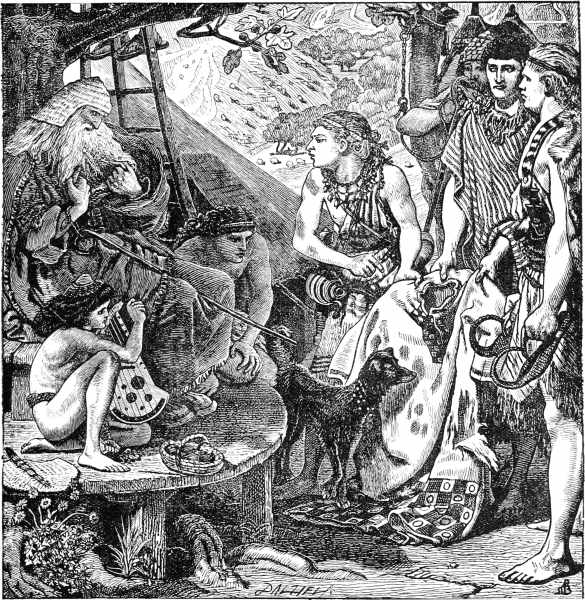
DALZIELS' 'BIBLE GALLERY' 1880
JOSEPH'S COAT
Sir John Everett Millais, Bart., P.R.A. (born June 8, 1829, died August 13, 1896).—As these proofs were being sent to press, the greatest illustrator of all (having regard to his place as the pioneer of the school which immediately succeeded the pre-Raphaelites, the number of his designs, and their superlative excellence), has joined the majority of his fellow-workers in the sixties. It would be impossible in a few lines to summarise his contributions to the 'black-and-white' of English art; that task will doubtless be undertaken adequately. But, if all the rest of the work of the period were lost, his contributions alone might justly support every word that has been or will be said in praise of 'the golden decade.' From the 1857 Tennyson to his latest illustration he added masterpiece to masterpiece, and, were his triumphant career as a painter completely ignored, might yet be ranked as a great master on the strength of these alone.
* * * * *
Paul Gray (1848–1868).—A most promising young illustrator, whose early death was most keenly regretted by those who knew him best, Paul Gray was born in Dublin, May 17, 1848. He died November 14, 1868. In the progress of this work mention has been made of all illustrations which it has been possible to identify; many of the cartoons for Fun, being unsigned, could not be attributed to him with certainty. The Savage Club Papers, First Series (Tinsley, 1863), contain his last drawing, Sweethearting. In the preface we read: 'When this work was undertaken, that clever young artist [Paul Gray] was foremost in offering his co-operation; for he whom we mourned, and whose legacy of sorrow one had accepted, was his dear friend. The shock which his system, already weakened by the saddest of all maladies, received by the sudden death of that friend was more than his gentle spirit could sustain. He lived just long enough to finish his drawing, and then he left us to join his friend.' In the record of the periodicals of the sixties will be found many references to his work, which is, perhaps, most familiar in connection with Charles Kingsley's Hereward the Wake.
* * * * *
Dante Gabriel Rossetti (b. 1828, d. 1882). The comparatively few illustrations by Rossetti have been described and reproduced so often, that it would seem superfluous to add a word more here. Yet, recognising their influence to-day, we must also remember that many people who are attracted by this side of Rossetti's art may not be familiar with the oft-told story of his career. He, more than any modern painter, would seem to be responsible for the present decorative school of illustrators, whose work has attracted unusual interest from many continental critics of late, and is recognised by them as peculiarly 'English.' While the man in the street would no doubt choose 'Phiz,' Cruikshank, Leech, Tenniel, Gilbert, Fred Walker, or Pinwell as typically 'English,' the foreigner prefers to regard the illustrations by Rossetti, his immediate followers, and his later disciples as representing that English movement, which the native is apt to look upon as something exotic and bizarre.
Yet it is not necessary to discuss Rossetti's position as founder of the pre-Raphaelite school, nor to weigh his claims to the leadership against those of Ford Madox Brown and Holman Hunt. But, without ignoring the black-and-white work of the two last named, there can be no doubt that it is Rossetti who has most influenced subsequent draughtsmen.
Nor at the time was his position as an illustrator misunderstood. When we find that he received £30 each for the small Tennyson drawings on wood, the fact proves at the outset that the market value of his work was not ignored by his publishers. At the present day when any writer on men of the sixties is accused of an attempt to 'discover' them, and the appreciation he bestows is regarded as an attempt to glorify the appreciator at the expense of the appreciated, it is well to insist upon the fact that hardly one of the men in favour to-day failed to meet with substantial recognition at the time. It was not their fate to do drawings for love, or to publish engravings at their own cost, or sell as cheap curios works which now realise a thousand times their first cost.
Drawings paid for at the highest market rate, or, to speak more accurately, at 'star' prices, published in popular volumes that ran through large editions, received favourably by contemporary critics, and frequently alluded to as masterpieces by writers in current periodicals, cannot be said to have been neglected, nor have they even been out of favour with artists.
That work, which has afforded so much lasting pleasure, was not achieved without an undue amount of pain, is easily proved in the case of Rossetti. So pertinent is a description by his brother, published lately, that it may be quoted in full, to remind the illustrators of to-day, who draw on paper and card-board at their ease to any scale that pleases them, how much less exacting are the conditions under which they work than those encountered by the artists who were forced to draw upon an unpleasant surface of white pigment spread upon a shining wooden block:—
'The Tennyson designs, which were engraved on wood and published in the Illustrated Tennyson, in which Millais, Hunt, Mulready, and others co-operated,' says Mr. William Michael Rossetti, 'have in the long run done not a little to sustain my brother's reputation with the public. At the time they gave him endless trouble and small satisfaction. Not indeed that the invention or the mere designing of these works was troublesome to him. He took great pains with them, but, as what he wrought at was always something which informed and glowed in his mind, he was not more tribulated by these than by other drawings. It must be said, also, that himself only, and not Tennyson, was his guide. He drew just what he chose, taking from his author's text nothing more than a hint and an opportunity. The trouble came in with the engraver and the publisher. With some of the doings of the engraver, Dalziel (not Linton, whom he found much more conformable to his notion), he was grievously disappointed. He probably exasperated Dalziel, and Dalziel certainly exasperated him. Blocks were re-worked upon and proofs sent back with vigour. The publisher, Mr. Moxon, was a still severer affliction. He called and he wrote. Rossetti was not always up to time, though he tried his best to be so. In other instances he was up to time, but his engraver was not up to his mark. I believe that poor Moxon suffered much, and that soon afterwards he died; but I do not lay any real blame on my brother, who worked strenuously and well. As to our great poet Tennyson, who also ought to have counted for something in the whole affair, I gather that he really liked Rossetti's designs when he saw them, and he was not without a perceptible liking and regard for Rossetti himself, so far as he knew him (they had first met at Mr. Patmore's house in December 1849); but the illustration to St. Cecilia puzzled him not a little, and he had to give up the problem of what it had to do with his work.'9
Later on, in the same volume, we find an extract from a letter dated February 1857, which Dante Gabriel Rossetti wrote to W. Bell Scott:—
'I have designed five blocks for Tennyson, save seven which are still cutting and maiming. It is a thankless task. After a fortnight's work my block goes to the engraver, like Agag delicately, and is hewn in pieces before the Lord Harry.
'ADDRESS TO DALZIEL BROTHERS
'O woodman spare that block, O gash not anyhow! It took ten days by clock, I'd fain protect it now. Chorus—Wild laughter from Dalziels' Workshop.'
Several versions of this incident are current, but Mr. Arthur Hughes's account has not, I think, been published. It chanced that one day, during the time he was working in Rossetti's studio, the engraver called, and finding Rossetti was out, poured forth his trouble and stated his own view of the matter with spirit. For his defence, as he put it, much sympathy may be awarded to him. The curious drawings executed in pencil, ink, and red chalk, crammed with highly-wrought detail, that were to be translated into clean black and white, were, he declared, beyond the power of any engraver to translate successfully. How Mr. Hughes pacified him is a matter of no importance; but it is but fair to recollect that, even had the elaborate designs been executed with perfection of technique, any engraver must have needs encountered a task of no ordinary difficulty. When, however, the white coating had been rubbed away in parts, and all sorts of strokes in pen, pencil, and pigment added, it is not surprising that the paraphrase failed to please the designer. Although the drawings naturally perished in the cutting, and cannot be brought forward as decisive evidence, we may believe that the engraver spoilt them, and yet also believe that no craftsman who ever lived would have been absolutely successful.
The number of Rossetti's book-illustrations is but ten in all, according to the list given in Mr. William Sharp's admirable monograph. To these one might perhaps add the frontispiece to that volume; as although the pen-drawing, A sonnet is a moment's monument, was never intended for reproduction, it forms a most decorative page. There is also a design for a frontispiece to the Early Italian Poets, which was first reproduced in the English Illustrated Magazine, No. 1. The actual frontispiece was etched but never used, and the exquisitely dainty version survives only in two impressions from the plate, both owned by Mr. Fairfax Murray. Another frontispiece, to The Risen Life,10 a poem by R. C. Jackson, in a cover designed by D. G. R. (R. Elkins and Co., 10 Castle St., East Oxford St., W., 1884), belongs to the same category, in which may be placed The Queen's Page, drawn in 1854, and reproduced in Flower Pieces by Allingham (Reeves & Turner, 1888). The ten which were all (I believe) drawn upon the wood include: Elfen-mere, published first in William Allingham's The Music-master, 1855, and afterwards reprinted in a later volume, Life and Phantasy, and again in Flower Pieces (1888), by the same author. This design 'revealed to young Burne-Jones' (so his biographer, Mr. Malcolm Bell, has recorded) that there existed a strange enchanting world beyond the hum-drum of this daily life—a world of radiant, many-coloured lights, of dim mysterious shadows, of harmonies of form and line, wherein to enter is to walk among the blest—that far-off world of Art into which many a time since he has made his way and brought back visions of delight to show his fellow-men. The first suspicion of that land of faëry came to him when, in a small volume of poems by William Allingham, he found a little wood-cut, 'Elfen-mere,' signed with a curious entwinement of the initials D. G. R. The slumbering spirit of fancy awoke to life within him and cast her spells upon him never to be shaken off.'
In the Oxford and Cambridge Magazine, 1856, Mr. Burne-Jones wrote of this very design: 'There is one more I cannot help noticing, a drawing of higher finish and pretension than the last, from the pencil of Rossetti, in Allingham's Day and Night Songs, just published. It is, I think, the most beautiful drawing for an illustration I have ever seen: the weird faces of the maids of Elfen-mere, the musical, timed movement of their arms together as they sing, the face of the man, above all, are such as only a great artist could conceive.'
This picture, 'three damsels clothed in white,' who came
'With their spindles every night; Two and one, and three fair maidens, Spinning to a pulsing cadence, Singing songs of Elfen-mere,'
reproduced here, is still issued in William Allingham's volume of poems entitled Flower Pieces (Reeves and Turner, 1888).
Five illustrations to Moxon's edition of Tennyson's Poems, 1857, two in Christina Rossetti's The Goblin Market and other Poems, 1862, and two in The Princes Progress and other Poems, 1866, by the same author, complete the ten in question. As the Tennyson has been republished lately, and a monograph, Tennyson and his pre-Raphaelite Illustrators, by G. Somes Layard (Elliot Stock, 1894), has brought together every available scrap of material connected with the famous quintette of designs, it would be superfluous to describe them here in detail. Any distinctly recognised 'movement' is very rarely a crescendo, but nearly always a waning force that owes what energy it retains to the original impetus of its founder. Should this statement be true of any fashion in art, it might be most easily supported, if applied to Rossetti's ten drawings on wood, set side by side with the whole mass of modern 'decorative' illustration. Even a great artist like Howard Pyle has hardly added a new motive to those crowded into these wood-engravings. The lady by the casement, 'The long hours come and go,' upon the title-page of The Princes Progress, is an epitome of a thousand later attempts. Mr. Fairfax Murray has collected over a dozen studies and preliminary drawings for this little block, that would appal some of the younger men as evidence of the intense care with which a masterpiece was wrought of old. Highly-finished drawings were done over and over again until their author was satisfied. The frontispieces to Goblin Market and to The Prince's Progress, no less than the Tennyson designs, form, obviously enough, the treasure-trove whence later men have borrowed; too often exchanging the gold for very inferior currency. Without attempting to give undue credit to Rossetti, or denying that collateral influences—notably that of Walter Crane—had their share in the revival of the nineties, there can be no doubt that the strongest of the younger 'decorative' artists to-day are still fascinated by Rossetti—no less irresistibly than 'the young Burne-Jones' was influenced in 1855.
Therefore the importance of these ten designs cannot be exaggerated. Whether you regard their influence as unwholesome, and regret the morbidity of the school that founded itself on them, or prefer to see in them the germ of a style entirely English in its renaissance, which has already spread over that Continent which one had deemed inoculated against any British epidemic, the fact remains that Rossetti is the golden milestone wherefrom all later work must needs be measured. No doubt the superb work of Frederick Sandys, had it been more accessible to the younger artists when the new impetus to decorative black-and-white began to attract a popular audience, would have found hardly as ardent disciples.
DANTE GABRIEL ROSSETTI
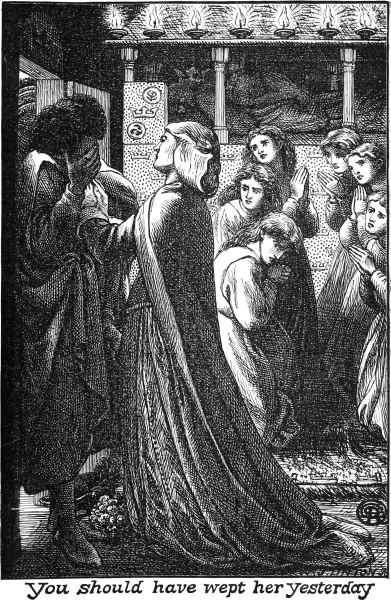
You should have wept her yesterday
'THE PRINCE'S PROGRESS' 1866
* * * * *
M. J. Lawless (born 1837, died 1864).—This artist, faithful to the best tradition of the pre-Raphaelite illustrators, seems to have left few personal memories. Born in 1837, a son of Barry Lawless, a Dublin solicitor, he was educated at Prior Park School, Bath, and afterwards attended several drawing schools, and was for a time a pupil of Henry O'Neil, R.A. He died August 6, 1864. Mr. Edward Walford, who contributes a short notice of Matthew James Lawless to the Dictionary of National Biography, has only the barest details to record. Nor do others, who knew him intimately, remember anything more than the ordinary routine of a short and uneventful life. But his artistic record is not meagre. In contemporary criticism we find him ranked with Millais and Sandys; not as equal to either, but as a worthy third. A fine picture of his, The Sick Call (from the Leathart Collection), was exhibited again in 1895 at the Guildhall.
But it is by his work as an illustrator he will be remembered, and, despite the few years he practised, for his first published drawing was in Once a Week, December 15, 1859 (vol. i. p. 505), he has left an honourable and not inconsiderable amount of work behind him. No search has lighted upon any work of his outside the pages of the popular magazines, except a few etchings (in the publications of the Junior Etching Club), three designs of no great importance in Lyra Germanica (Longmans, 1861), and a pamphlet, the Life of St. Patrick, with some shocking engravings, said by his biographer to be from Lawless's designs. In the chapters upon Once a Week, London Society, Good Words, etc., every drawing I have been able to identify is duly noted. It is not easy to refrain from eulogy upon the work of a draughtsman with no little individuality and distinction, who has so far been almost completely forgotten by artists of the present day. The selection of his work reproduced here by the courtesy of the owners of the copyright will, perhaps, send many fresh admirers to hunt up the rest of it for themselves.
* * * * *
Arthur Boyd Houghton (1836–1875) was born in 1836, the fourth son of his father, who was a captain in the Royal Navy. He visited India, according to some of his biographers; others say that he was never in the East, but that it was a brother who supplied him with the oriental details that appear in so many of his drawings. Be that as it may, his fellow-workers on the Arabian Nights pretended to be jealous of his Egyptian experience, and declared that it was no good trying to rival from their imaginings the scenes that he knew by heart. At present, when all men unite to praise him, it would almost lend colour to a belief that he was unappreciated by his fellows to read in a contemporary criticism: 'His designs were often striking in their effects of black and white, but were wanting in tone and gradation—a defect partly due to the loss of one eye.' This is only quoted by way of encouragement to living illustrators, who forget that their hero, despite sympathy and commissions, suffered also much the same misunderstanding that is often their lot. Against this may be set a criticism of yesterday, which runs:—
'As regards "the school of the sixties," now that it has moved away, we can rightly range the heads of that movement, and allowing for side impulses from the technique of Menzel, and still more from the magnetism of Rossetti's personality, we see, broadly speaking, that with Millais it arrived, with Houghton it ceased. Under these two leaders it gathered others, but within ten years its essential work was done. It has all gone now nobly into the past from the hands of men, some still living, some dead but yesterday.
'In Houghton's work, two things strike us especially, when we see it adequately to-day: its mastery of technique and style, and its temperament: the mastery so swift and spontaneous, so lavish of its audacities, so noble in its economies; the temperament so dramatic, so passionate, so satiric, and so witty. In many of his qualities, in vitality and movement, Houghton tops Millais. What is missing from his temperament, if it be a lack and not a quality, is the power to look at things coolly; he has not, as Millais, the deep mood of stoical statement, of tragedy grown calm. His tragic note is vindictive, a little shrill: when he sets himself to depict contemporary life, as in the Graphic America series, he is sardonic, impatient, at times morose: his humour carries an edge of bitterness. But in whatever mood he looks at things, the mastery of his aim is certain.'11
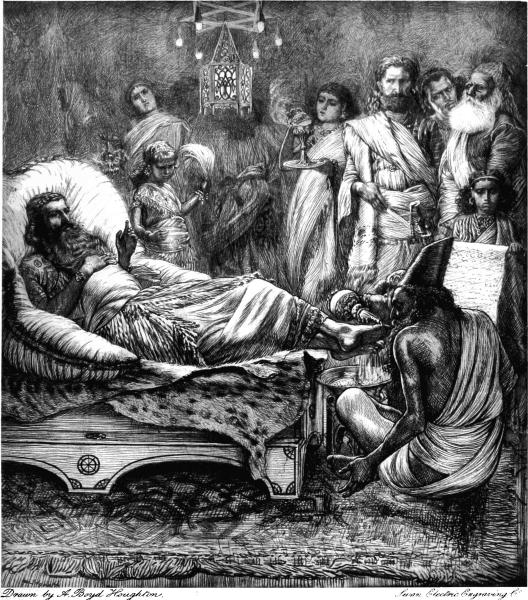
Drawn by A. Boyd Houghton.
Swan Electro-Engraving Co.
READING THE CHRONICLES
The mass of work accomplished in illustration alone, between his first appearance and his death in 1875, is amazing. There is scarce a periodical of any rank which has not at least one example from his pen. The curt attention given here to the man must be pardoned, as reference to his work is made on almost every page of this book. For an appreciative essay, that is a model of its class, one has but to turn to Mr. Laurence Housman's volume12 which contains also five original drawings on wood (reproduced in photogravure) and eighty-three others from Dalziel's Arabian Nights (Ward, Lock & Co., 1863-65 and Warne, 1866), Don Quixote, the two volumes of Mr. Robert Buchanan's Poems—Ballad Stories of the Affections (1866), and North Coast (1868), Home Thoughts (1865), National Nursery Rhymes (1871), and The Graphic (1870).
* * * * *
Frederick Walker13 (1840–1875), who was born in Marylebone on the 26th of May 1840, has been the subject of so many appreciations, and at least one admirable monograph, that a most brief notice of his career as an illustrator will suffice here. His father was a designer of jewelry and his grandfather had some skill in portrait-painting. How he began drawing from the Elgin marbles in the British Museum at the age of sixteen has been told often enough. Many boys of sixteen have done the same, but it is open to doubt if any one of them has absorbed the spirit of their models so completely as Fred Walker did. It would be hardly asserting too much to say for him that they replaced humanity, and that his male figures seem nearly always youths from the Parthenon in peasant costume. At seventeen or eighteen he was working at Leigh's life-class in Newman Street, and at the same time was employed in Mr. Whymper's wood-engraving establishment. His first appearance in Everybody's Journal is duly noted elsewhere, also his first drawing in Once a Week; but the peculiar affection he had inspired by his work has kept most of his critics from saying that some of his earliest designs, as we know them after engraving, appear distinctly poor. But, from the time he ceased to act as 'ghost' for Thackeray, and signed his work with the familiar F. W., his career shows a distinct and sustained advance until the ill-fated 1875, in which George Mason, G. J. Pinwell, and A. Boyd Houghton also died.
It is unnecessary to recapitulate in brief the various contributions to the Cornhill Magazine, Good Words, Once a Week, etc., which have already been noted in detail. Nor would it be in place here to dwell upon the personality of the artist; sufficient matter has been printed already to enable lovers of his works to construct a faithful portrait of their author—lovable and irritable, with innate genius and hereditary disease both provoking him to petulant outbursts that still live in his friends' memories. One anecdote will suffice. A group of well-known painters were strolling across a bridge on the Upper Thames. Walker, who was passionately fond of music, had been playing on a tin whistle, which one of the party, half in joke, half weary of the fluting, struck from his mouth, so that it fell into the stream below. In a moment Walker had thrown off his clothes, and, 'looking like a statue come to life, so exquisitely was he built,' plunged from the wall of the bridge, and, diving, rescued his tin whistle, which he bore to land in triumph. The trifling incident is an epitome of the character of the wayward boy, who kept his friends nevertheless. 'He did not seek beauty,' wrote an ardent student of his work, 'but it came, while Pinwell thought of and strove for beauty always, yet often failed to secure it.' That he knew Menzel, and was influenced by him, is an open secret; but he also owes much to the pre-Raphaelites—Millais especially. Yet when all he learned from contemporary artists is fully credited, what is left, and it is by far the largest portion, is his own absolutely—owing nothing to any predecessor, except possibly to the sculptors of Greece. He died in Scotland in June 1875, and was buried at the Marlow he painted so delightfully, leaving behind him the peculiar immortality that is awarded more readily to a half-fulfilled life than to one which has accomplished all it set out to do, and has outlived its own reputation.
* * * * *
George John Pinwell (1842–1875).—This notable illustrator, whose work bulks so largely in the latter half of the sixties, was born December 26, 1842, and died September 8, 1875. He studied at the Newman Street Academy, entering in 1862. At first his illustrations show little promise; some of the earliest, in Lilliput Levée, a book of delightful rhymes for children, by Matthew Browne, are singularly devoid of interest. No engraver's name appears on them, nor is it quite clear by what process they were reproduced. They are inserted plates, and, under a strong magnifying glass, the lines suggest lithography. The unfamiliar medium, supposing they were drawn in lithographic ink, or by graphotype, or some similar process, would account for the entire absence of the qualities that might have been expected. Some others, in Hacco the Dwarf and in The Happy Home, the latter in crude colours, are hardly more interesting.
A. BOYD HOUGHTON
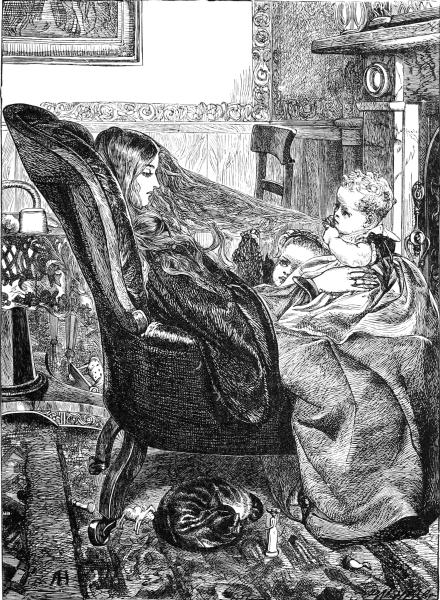
'GOOD WORDS' 1862, p. 504
MY TREASURE
According to Mr. Harry Quilter,14 Pinwell began life as a butterman's boy in the City Road, whose duty, among other things, was to 'stand outside the shop on Saturday nights shouting Buy! Buy! Buy!' Later on he seems to have been a 'carpet-planner.' If one might read the words as 'carpet-designer,' the fact of turning up about this time at Leigh's night-school, where he met Fred Walker, would not be quite so surprising.
Between Walker and Pinwell a friendship sprang up, but it seems to have been Thomas White who introduced the former to Once a Week, wherein his first contribution, The Saturnalia, was published, January 31, 1863. In 1864 he began to work for Messrs. Dalziel on the Arabian Nights and the Illustrated Goldsmith, which latter is his most important volume. In 1869 he became a member of the Old Water Colour Society, but his work as a colourist does not concern us here. Nor is it necessary to recapitulate the enormous quantity of his designs which in magazines and books are noticed elsewhere in these pages. Some illustrations to Jean Ingelow's Poems, notably seven to The High Tide, represent his best period. But he suffered terribly by translation at the engravers' hands. The immobility, which characterises so many of his figures, does not appear in the few drawings which survive. Mr. Pennell is the fortunate possessor of several of the designs for The High Tide; but the pleasure of studying these originals is changed to pain when one remembers how many others were cut away by the engraver. It is curious that three men, so intimately associated as Walker, Pinwell, and Houghton, should have preserved their individuality so entirely. It is impossible to confuse the work of any of them. Walker infused a grace into the commonplace which, so far as the engravings are concerned, sometimes escaped Pinwell's far more imaginative creations; while Houghton lived in a world of his own, wherein all animate and inanimate objects obeyed the lines, the swirling curves, he delighted in. If, as has been well said, Walker was a Greek—but a dull Greek—then Pinwell may be called a Naturalist with a touch of realism in his technique, while Houghton was romantic to the core in essence and manipulation alike.
* * * * *
Arthur Hughes.—In 1855 appeared The Music-master, the second enlarged and illustrated edition of Day and Night Songs, a book of poems by William Allingham, to which reference has been made several times in this chronicle. Of its ten illustrations, seven and a vignette are from the hand of Arthur Hughes. The artist thus early associated with the leaders of the pre-Raphaelite movement, and still actively at work, was never, technically, a member of the Brotherhood. In 1858, however, we find him one of the enthusiastic young artists Rossetti had gathered round him with a view to the production of the so-called frescoes in the Oxford Union. The oft-told tale of this noble failure need not be repeated here. Those who were responsible for the paintings in question appear more or less relieved to find that the work has ceased to exist. True, the majority of picture-lovers who have never seen them regard them, sentimentally, as the fine flower of pre-Raphaelite art, which faded before it was fully open. Judging from the restored fragments which remain, had they been permanent, they would not have been more than interesting curiosities; examples of the 'prentice efforts' of men who afterwards shaped the course of British art, not merely for their own generation, but, as we can see to-day, for a much longer time. The great difficulties of the task these ardent novices undertook so light-heartedly may or may not have checked the practice of wall-painting in England, if, indeed, one can speak of a check to a movement that never existed. To trace in detail the course of Mr. Hughes's work, from this date to the present, would be a pleasant and somewhat lengthy task. Yet, although greater men are less fully dealt with, a running narrative showing where the illustrations appeared will be more valuable than any attempt to estimate the intrinsic value of the work, or explain its attractive quality. That the work is singularly lovable, and has found staunch and ardent admirers amid varying schools of artists, is unquestionable. Without claiming that it equals the best work of the 'Brotherhood,' it has a charm all its own. The sense of delight in lovely things is present throughout, nor does its elegance often degenerate to mere prettiness. The naïve expression of a child's ideal of lovely forms, with a curiously well-sustained type of beauty, neither Greek nor Gothic, yet having a touch of paganism in its mysticism, is always present in it. With a peculiarly individual manner—so that the signature, which is usually to be found in some unobtrusive corner, is needless,—a student of illustration can 'spot' an Arthur Hughes at the most rapid glance as surely as he could identify a Du Maurier.
There are painters and draughtsmen of all periods, before whose work you are well content to cease from criticism, and to enjoy simply, with all their imperfections, the qualities that attract you. Passionate intensity, the perfection of academic draughtsmanship, dramatic composition as it is usually understood, may, or may not, be always evident. Whether they are or not is in this case of entirely secondary importance. Certain indefinable qualities, lovable and lasting, are sure to be the most noticeable, whether you light on a print that has escaped you hitherto, or turn up one that you have known since the day it was published. Like caters for the like, and this love which the work provokes from those to whom it appeals seems also its chief characteristic. In the whole mass of pictorial art you can hardly find its equal in this particular respect. The care and sorrow of life, its disillusions and injustice, are not so much forgotten, or set aside thoughtlessly, as recognised at their relative unimportance when contrasted with the widespread, yet absolutely indefinable thing, which it is convenient to term Love. Not, be it explained, Love in its carnal sense, but, in an abstract spiritual way, which seeks the quiet happiness in adding to the joy of others, and trusts that somehow, somewhere, good is the final end of ill.
It may be that this attempt to explain the impression of Mr. Hughes's work is a purely personal one, but it is one that intimate study for many years strengthens and raises to the unassailable position of a positive fact. At the risk of appearing mawkishly sentimental, even with the greater risk of reflecting sentimentality upon artistic work which it has not, this impression of Mr. Arthur Hughes's art must be set down unmistakably. Looking upon it from a purely technical aspect, you might find much to praise, and perhaps a little to criticise; but, taking it as an art addressed often enough to the purpose of forming artistic ideals in the minds of the young, you cannot but regret that the boys and girls of to-day, despite the army of artists of all ranks catering for them, cannot know the peculiar delight that the children of the sixties and early seventies enjoyed.
Arthur Hughes was born in London in 1832, and became a pupil of Soames of the Royal Academy Schools, exhibiting for the first time at the annual exhibition in 1854. In 1855 appeared, as we have just seen, The Music-master. The artist seems to have worked fitfully at illustrations, but his honourable labours in painting dispose of any charge of indolence, and, did but the scope of this work permit it, a still more interesting record of his artistic career could be made by including a list of pictures exhibited at the Royal Academy, the Institute, the Grosvenor, the New Gallery, and elsewhere. Between 1855 and 1861 I have found no illustrations, nor does he himself recall any. In the latter year there are two designs in The Queen to poems by George Mac Donald and F. Greenwood. The next magazine illustration in order is At the Sepulchre in Good Words, 1864. In 1866 appeared an edition of Tennyson's Enoch Arden, with twenty-five illustrations by Arthur Hughes.' This noteworthy book is one of the essential volumes to those who make ever so small a collection of the books of the sixties. Although the work is unequal, it contains some of his most delightful drawings. In the same year London Society contained The Farewell Salutation. In 1867 George Mac Donald's Dealings with the Fairies was published. This dainty little book, which contains some very typical work, is exceptionally scarce. Another book which was published in 1868 is now very difficult to run across in its first edition, Five Days' Entertainment at Wentworth Grange, by F. T. Palgrave, illustrated with seventeen designs, the woodcuts (sic) being by J. Cooper, and a vignette engraved on steel by C. H. Jeens.
ARTHUR HUGHES
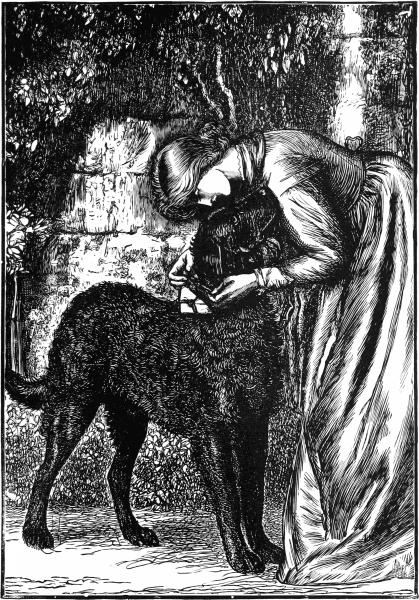
'GOOD WORDS' 1871, p. 33
THE LETTER
ARTHUR HUGHES
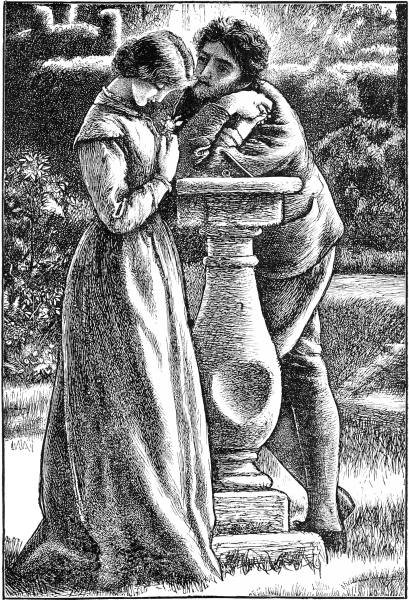
'GOOD WORDS' 1871, p. 183
THE DIAL—'SUN COMES, MOON COMES'
To 1869 belongs the book with which the artist is most frequently associated, Tom Brown's School Days, by Tom Hughes, not a relative of the illustrator as the name might suggest. To descant on the merits of this edition to-day were foolish. When one hears of a new illustrated edition being contemplated, it seems sacrilege, and one realises how distinctly a newly illustrated Tom Brown would separate the generation that knew the book through Mr. Arthur Hughes's imagination from those who will make friends with it in company with another artist. Incidents like these bring home the inevitable change of taste with passing time more vividly than far weightier matters enforce it.
Good Words in 1869 contains two drawings to Carmina Nuptialia, and The Sunday Magazine the same year has a very beautiful composition, Blessings in Disguise. In 1870–1871 Good Words for the Young includes, in the first two volumes, no less than seventy-six illustrations by Mr. Hughes to At the Back of the North Wind, fourteen to The Boy in Grey, thirty to Ranald Bannerman's Boyhood, thirty to The Princess and Goblin, ten to Lilliput Revels, six to Lilliput Lectures, and two to King Arthur, besides one each to Fancy, The Mariner's Cave, and a notable design to The Wind and the Moon. In 1871 also belongs My Lady Wind (p. 38), Little Tommy Tucker (p. 46), in Novello's National Nursery Rhymes.
In 1870 Good Words contains four: The Mother and the Angel and three full-page designs, which rank among the most important of the artist's work in illustration, to Tennyson's Loves of the Wrens. This song-cycle, which the late Poet Laureate wrote expressly for Sullivan to set to music, was issued in 1870 in a sumptuous quarto. The publisher, Strahan, who at that time issued all Tennyson's work, had intended to include illustrations, and three were finished before the poet vetoed the project. These were cut down and issued with the accompanying lyrics in Good Words. Although the artist, vexed no doubt at their curtailment, and by no means satisfied with their engraving, does not rank them among his best things, few who collect his work will share his view. Despite the trespass beyond the limit of this book, it would be better to continue the list to date, and it is all too brief. In 1872 Good Words contains five of his designs, and Good Words for the Young twenty-four to Innocent's Island, and eight to Gutta-Percha Willie.
1872 saw two remarkably good volumes decorated by this artist, T. Gordon Hake's Parables and Tales (Chapman and Hall) and Sing Song, a book of nursery rhymes by Christina Rossetti (Routledge).
In 1873 ten to Sindbad the Sailor, and six or seven others appeared in Good Words for the Young, now entitled Good Things. To this year belongs also Speaking Likenesses by Christina Rossetti, with its dozen fanciful and charming designs; and a frontispiece and full page (p. 331), in Mr. George Mac Donald's England's Antiphon (Macmillan). In 1889 or 1890 The Graphic Christmas number contained two full-page illustrations by this artist. To 1892 belongs a delightful vignette upon the title-page of Mrs. George Mac Donald's Chamber Dramas. With a bare mention of seven drawings, inadequately reproduced in The London Home Monthly, 1895, the record of Mr. Arthur Hughes's work must close; Several designs to a poem by Jean Ingelow, The Shepherd's Lady, the artist has lost sight of, and the date of the first edition of Five Old Friends and a Young Prince, by Miss Thackeray, with a vignette, I have failed to trace at the British Museum or elsewhere. As Mr. Arthur Hughes, in the Music-master (1855), heads the list, so it seemed fit to mark his position by a fuller record than could be awarded to other of his contemporaries still living; partly because the comparatively small number of illustrations made a fairly complete record possible.
* * * * *
Frederick Sandys.—This most admirable illustrator 'was born in Norwich in 1832, the son of a painter of the place, from whom he received his earliest art-instruction. Among his first drawings was a series of illustrations of the birds of Norfolk, and another dealing with the antiquities of his native city. Probably he first exhibited in 1851, with a portrait (in crayons) of "Henry, Lord Loftus" which appears as the work of "F. Sands" in the catalogue of the Royal Academy to whose exhibitions he has contributed in all forty-seven pictures and drawings.'15
The above, extracted from Mr. J. M. Gray's article, 'Frederick Sandys and the woodcut designers of thirty years ago,' gives the facts which concern us here. A most interesting study of the same artist by the same critic, in the Art Journal,16 supplies more description and analysed appreciation. The eulogy by Mr. Joseph Pennell in The Quarto17 must not be forgotten. Further references to Mr. Sandys appear in a lecture delivered by Professor Herkomer at the Royal Institution, printed in the Art Journal, 1883, and in a review of Thornbury's Ballads by Mr. Edmund Gosse in The Academy.18
FREDERICK SANDYS
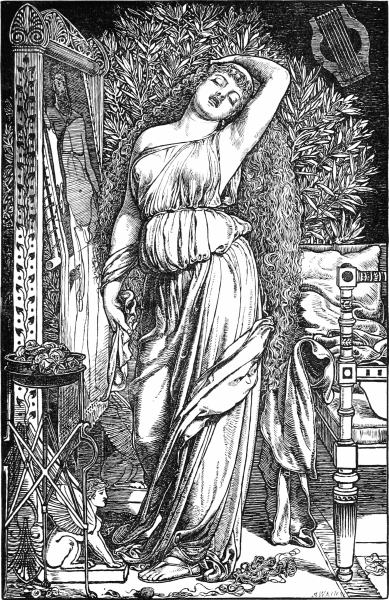
'CENTURY GUILD HOBBY-HORSE' VOL. III. p. 147
DANAE IN THE BRAZEN CHAMBER
FREDERICK SANDYS
DALZIELS' 'BIBLE GALLERY,' 1880
JACOB HEARS THE VOICE OF THE LORD
It is quite possible, although only thirteen of the thirty or so of illustrations by Frederick Sandys appeared in Once a Week, that these thirteen have been the most potent factor in giving the magazine its peculiar place in the hearts of artists. The general public may have forgotten its early volumes, but at no time since they were published have painters and pen-draughtsmen failed to prize them. During the years that saw them appear there are frequent laudatory references in contemporary journals, with now and again the spiteful attack which is only awarded to work that is unlike the average. Elsewhere mention is made of articles upon them which have appeared from time to time by Messrs. Edmund Gosse, J. M. Gray, Joseph Pennell, and others. During the 'seventies,' no less than in the 'eighties' or 'nineties,' men cut out the pages and kept them in their portfolios; so that to-day, in buying volumes of the magazine, a wise person is careful to see that the 'Sandys' are all there before completing the purchase. Therefore, should the larger public admit them formally into the limited group of its acknowledged masterpieces, it will only imitate the attitude which from the first fellow-artists have maintained towards them.
The original drawings, 'If,' Life's Journey, The Little Mourner, and Jacques de Caumont, were exhibited at the 'Arts and Crafts,' 1893. That a companion volume to Millais's Parables, with illustrations of The Story of Joseph, was actually projected, and the first drawings completed, is true, and one's regret that circumstances—those hideous circumstances, which need not be explained fully, of an artist's ideas rejected by a too prudish publisher—prevented its completion, is perhaps the most depressing item recorded in the pages of this volume.
That some thirty designs all told should have established the lasting reputation of an artist would be somewhat surprising, did not one realise that almost every one is a masterpiece of its kind. Owing to the courtesy of all concerned, so large a number of these are reproduced herewith that a detailed description of each would be superfluous. But, at the risk of repeating a list already printed and reprinted, it is well to condense the scattered references in the foregoing pages in a convenient paragraph, wherein those republished in Thornbury's Legendary Ballads (Chatto, 1876) are noted with an asterisk:—
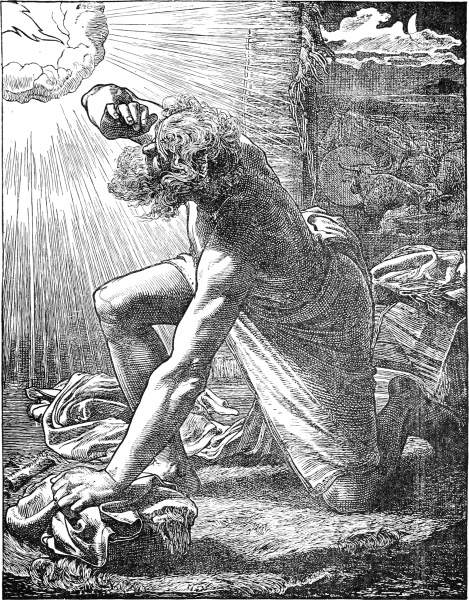
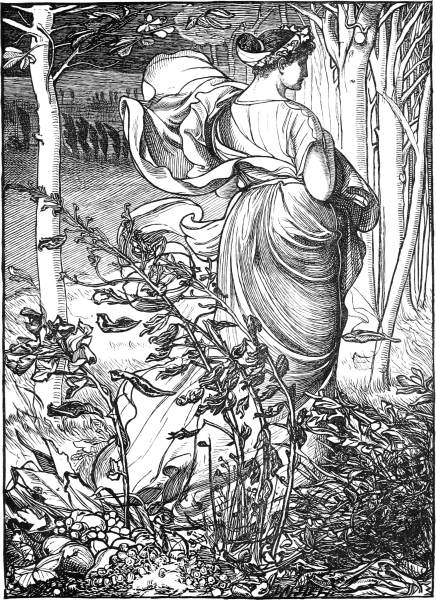
The Cornhill Magazine: The Portent ('60), Manoli ('62), Cleopatra ('66); Once a Week: *Yet once more on the organ play, The Sailor's Bride, From my Window, *Three Statues of Ægina, Rosamund Queen of the Lombards (all 1861), *The Old Chartist, *The King at the Gate, *Jacques de Caumont, *King Warwolf, *The Boy Martyr, *Harold Harfagr (all '62), and Helen and Cassandra ('66); Good Words: Until her Death ('62), Sleep ('63); Churchman's Family Magazine: *The Waiting Time ('63); Shilling Magazine: Amor Mundi ('65); The Quiver: Advent of Winter ('66); The Argosy: 'If' ('65); The Century Guild Hobby Horse: Danae ('88); Wilmot's Sacred Poetry: Life's Journey, The Little Mourner; Cassell's Family Magazine: Proud Maisie ('81); and Dalziels' Bible Gallery: Jacob hears the voice of the Lord.
FREDERICK SANDYS
'THE QUIVER'
OCTOBER
In addition, it may be interesting to add notes of other drawings:—The Nightmare (1857)19, a parody of Sir Isumbras at the Ford, by Millais, which shows a braying ass marked 'J. R.' (for John Ruskin), with Millais, Rossetti, and Holman Hunt on his back; Morgan le Fay, reproduced as a double-page supplement in The British Architect, October 31, 1879; a frontispiece, engraved on steel by J. Saddler, for Miss Muloch's Christian's Mistake (Hurst and Blackett), and another for The Shaving of Shagpat (Chapman and Hall, 1865); a portrait of Matthew Arnold, engraved by O. Lacour, published in The English Illustrated Magazine, January 1884; another of Professor J. R. Green, engraved by G. J. Stodardt, in The Conquest of England, 1883; and one of Robert Browning, published in The Magazine of Art shortly after the poet's death; Miranda, a drawing reproduced in The Century Guild Hobby Horse, vol. iii. p. 41; Medea, reproduced (as a silver-print photograph) in Col. Richard's poem of that name (Chapman and Hall, 1869); a reproduction of the original drawing for Amor Mundi, and studies for the same, in the two editions of Mr. Pennell's Pen-Drawing and Pen-Draughtsmen (Macmillan); a reproduction of an unfinished drawing on wood, The Spirit of the Storm, in The Quarto (No. 1, 1896); Proud Maisie in Pan (1881), reissued in Songs of the North, and engraved by W. Spielmayer (from the original in possession of Dr. John Todhunter) in the English Illustrated Magazine, May 1891, and the original drawing for the Advent of Winter and one of Two Heads, reproduced in J. M. Gray's article in the Art Journal (March 1884). Whether the Judith here reproduced was originally drawn for engraving I cannot say.
To add another eulogy of these works is hardly necessary at this moment, when their superb quality has provoked a still wider recognition than ever. Concerning the engraving of some Mr. Sandys complained bitterly, but of others, notably the Danae, he wrote in October 1880: 'My drawing was most perfectly cut by Swain, from my point of view, the best piece of wood-cutting of our time—mind I am not speaking of my work, but Swain's.' To see that the artist's complaint was at times not unfounded one has but to compare the Advent of Winter as it appears in a reproduction of the drawing (Art Journal, March 1884) and in The Quiver. 'It was my best drawing entirely spoilt by the cutter,' he said; but this was perhaps a rather hasty criticism that is hardly proved up to the hilt by the published evidence.
As a few contemporary criticisms quoted elsewhere go to prove, Sandys was never ignored by artists nor by people of taste. To-day there are dozens of men in Europe without popular appreciation at home or abroad, but surely if his fellows recognise the master-hand, it is of little moment whether the cheap periodicals ignore him, or publish more or less adequately illustrated articles on the man and his work. Frederick Sandys is and has been a name to conjure with for the last thirty years. Though still alive, he has gained (I believe) no official recognition. But that is of little consequence. There are laureates uncrowned and presidents unelected still living among us whose lasting fame is more secure than that of many who have worn the empty titles without enjoying the unstinted approval of fellow-craftsmen which alone makes any honour worthy an artist's acceptance.
* * * * *
Sir Edward Burne-Jones.—The illustrations of this artist are so few that it is a matter of regret that they could not all be reproduced here. But the artist, without withholding permission, expressed a strong wish that they should not be reprinted. The two in Good Words have been already named. Others to a quite forgotten book must not be mentioned; but it is safe to say that no human being, who did not know by whom they were produced, would recognise them. A beautiful design20 for a frontispiece to Mr. William Morris's Love is Enough was never engraved. The Nativity in Gatty's Parables from Nature, and the one design in the Dalziel Bible have already been named. Many drawings for Cupid and Psyche, the first portion of a proposed illustrated folio edition of The Earthly Paradise, were actually engraved, some of the blocks being cut by Mr. Morris himself. Several sets of impressions exist, and rumour for a long time babbled of a future Kelmscott Press edition. Of his more recent designs nothing can be said here; besides being a quarter of a century later than the prescribed limits of the volume, they are as familiar as any modern work could be.
* * * * *
Walter Crane.—This popular artist was born in Liverpool, August 15, 1845, his father being sometime secretary and treasurer of the (then) Liverpool Academy. After a boyhood spent mostly at Torquay the family came to London in 1857. In 1859 he became a pupil of Mr. W. J. Linton, the well-known engraver, and remained with him for three years. About 1865 he first saw the work of Burne-Jones at the Society of Painters in Water Colours. These drawings, and some Japanese toy-books which fell in his way, have no doubt strongly influenced his style; but the earlier pre-Raphaelites and the Once a Week school had been eagerly studied before. Although Mr. Crane, with his distinctly individual manner, is not a typical artist of the sixties any more than of the seventies, or of to-day, and although his style had hardly found its full expression at that time, except in the toy-books, yet no record of the period could be complete without a notice of one whose loyalty to a particular style has done much to found the modern 'decorative school.'
WALTER CRANE
'GOOD WORDS' 1863, p. 795
TREASURE-TROVE
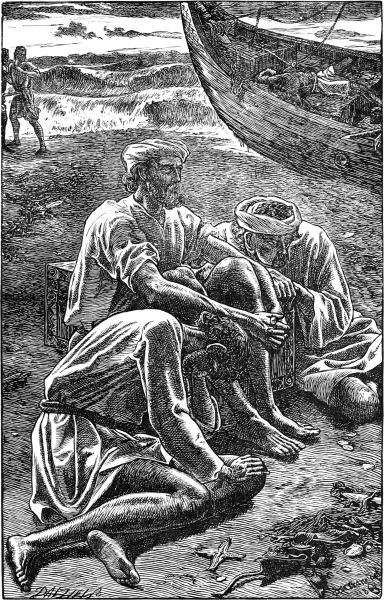
His first published drawing, A man in the coils of a serpent, appears in a quite forgotten magazine called Entertaining Things, vol. i. 1861, p. 327 (Virtue); others, immature, and spoilt by the engraver, are in The Talking Fire-irons and similar tracts by the Rev. H. B. Power. In many of the magazines, of which the contents are duly noted,—Good Words, Once a Week, The Argosy, London Society, etc.—reference has been already made to each of his drawings as it appeared therein. A bibliography of his work, to be exhaustive, would take up more room than space permitted here. As it will be the task of the one, whoever he may be, who undertakes to chronicle English illustrations of the seventies, it may be left without further notice. For, with the exception of the New Forest (1862), all the other books which may be called masterpieces of their order, Grimms' Household Stories, The Necklace of Princess Fiorimonde, The Baby's Bouquet, Baby's Opera, Æsop's Fables, Flora's Feast, Queen Summer, the long series of Mrs. Molesworth's children's books, many 'coloured boards' for novels, and the rest, belong to a later period.
To find that a large paper copy of Grimms' Household Stories fetched thirty-six pounds at Lord Leighton's sale is a proof that collectors of 'Cranes' are already in full cry. Two hundred and fifty copies of this book were issued in large paper; the copy in question, although handsomely bound, did not derive its value solely from that fact. Modern readers rubbed their eyes to find a recent édition de luxe fetching a record price; but, if certain signs are not misleading, the market value of many books of the sixties will show a rapid increase that will surprise the apathetic collector, who now regards them as commonplace. To believe that the worth of anything is just as much as it will bring is a most foolish test of intrinsic value; but, should the auctioneer's marked catalogue of a few years hence show that 'the sixties' produced works which coax the reluctant guineas out of the pockets of those who a short time before would not expend shillings, it will but reflect the well-seasoned verdict of artists for years past. In matters of science and of commerce the man in the street acts on the opinion of the expert, but in matters of art he usually prefers his own. If, when he wakens to the intrinsic value of objects about which artists know no difference of opinion, he has to pay heavily for his conceited belief in his own judgment, it is at once poetic justice and good common sense.
Space forbids, unfortunately, detailed notices of Fred Barnard, C. H. Bennett, T. Morten, George Du Maurier, John Pettie, R.A., and many other deceased artists whose works have been frequently referred to in previous chapters.
Fairly complete iconographies had been prepared of the works of Mr. Birket Foster, Sir John Gilbert, and Ernest Griset. These, and other no less important lists, have also been omitted for the same reason.
Nor is it necessary to include here notices of artists whose fame has been established in another realm of art—such as Mr. Whistler, Mr. Luke Fildes, R.A., Professor Herkomer, R.A., Messrs. W. Q. Orchardson, R.A., H. S. Marks, R.A., H. H. Armstead, R.A., Edmund J. Poynter, R.A., G. H. Boughton, J. W. North, R.A., and George Frederick Watts, R.A.
Others, including W. Small, Charles Green, Sir John Tenniel, would each require a volume, instead of a few paragraphs, to do even bare justice to the amazing quantity of notable illustrations they have produced. Fortunately most of them are still alive and active, so that a more worthy excuse remains for omitting to give a complete iconography of each one here, for they belong to a far more extended period than is covered by this book.
DALZIEL BROTHERS
The firm of Dalziel Brothers deserves more notice than it has received in the many incidental references throughout this book. To Mr. Thomas Dalziel (still alive though past fourscore) and to his brother Edward may be awarded the credit of exercising keen critical judgment in the discovery of latent talent among the art students of their day, and of acting as liberal patrons of the art of illustration. In a most courteous letter, written in reply to my request for some details of the establishment of the firm, the youngest brother of the four (Mr. Thomas Dalziel) writes: 'We were constant and untiring workers with our own hands, untiring because it was truly a labour of love. The extension and development of our transactions and the carrying out of many of the fine art works which we published, is unquestionably due to my brother Edward Dalziel, and to this I am at all times ready to bear unhesitating testimony.'
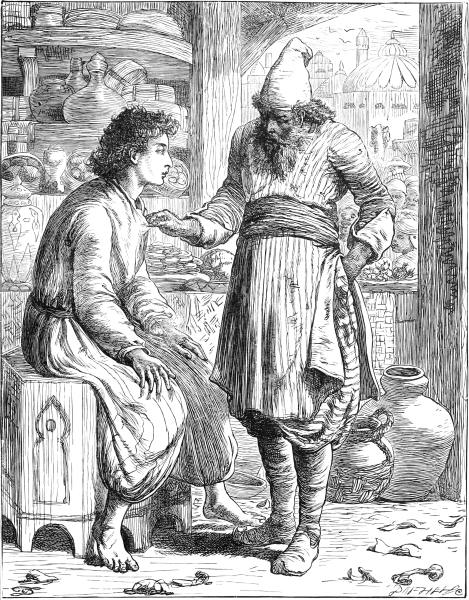
That these talented engravers were draughtsmen of no mean order might be proved in a hundred instances; one or two blocks here reprinted will suffice to establish their right to an honourable position as illustrators.
T. DALZIEL
DALZIELS' 'ARABIAN NIGHTS,' p. 161
BEDREDDIN HASSAN AND THE PASTRYCOOK
T. DALZIEL
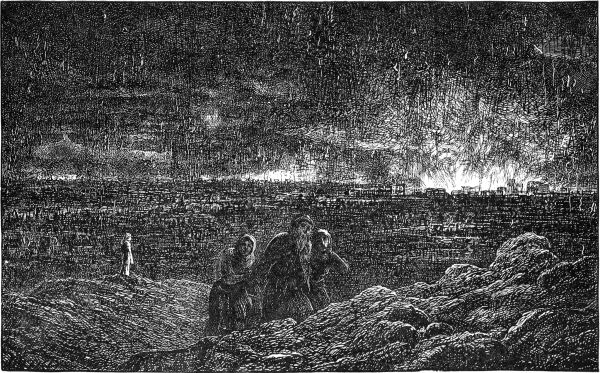
DALZIELS' 'BIBLE GALLERY,' 1880
THE DESTRUCTION OF SODOM
Among the young artists to whom they gave commissions, at the time in a student's career when encouragement of that description is so vital, we find:—Fred Walker, G. J. Pinwell, A. Boyd Houghton, J. D. Watson, John Pettie, R.A., Professor Herkomer, R.A., J. W. North, A.R.A., and Fred Barnard. Artists of eminence, who in all human probability would never have experimented in drawing upon wood but for Messrs. Dalziels' suggestion, include the late Lord Leighton, P.R.A., Mr. G. F. Watts, R.A., and Mr. H. Stacy Marks, R.A. Other illustrators who owe much to the enterprise of this firm, and who in turn helped to make its reputation, include Mr. Birket Foster, Sir John Gilbert, R.A., Mr. George Du Maurier, Sir John Tenniel, and Mr. Harrison Weir.
It has been impossible to credit these engravers with their due share in every work mentioned in our pages, because to do this would have necessitated, in common justice, a complete record of the other engravers also; in itself enough to double the length of the chronicle already far too verbose. The engravings in Punch in its early years, and the Cornhill through its finest period, were intrusted to Messrs. Dalziel, while of Good Words and The Sunday Magazine the choice of pictures and their reproduction alike were entirely under their control.
The Dalziel Brothers were born at Wooler, Northumberland, but spent most of their early days in Newcastle-on-Tyne. Their craft was learned from pupils of Thomas Bewick. In 1835 George Dalziel came to London, followed soon after by Edward, and later by John and Thomas. They were all draughtsmen as well as engravers. Thomas devoted himself entirely to drawing. There was also a sister, 'Margaret' (who died in 1894), who practised the art of wood-engraving for many years, with results distinguished for their minute elaboration and fine feeling.
Soon after settling in London, George was associated with Ebenezer Landells (who died in 1869); and the brothers later became intimate with Bewick's favourite pupil, William Harvey, for whom they engraved many of his drawings for Lane's Arabian Nights, Charles Knight's Shakespeare and Bunyan, and many other works. Still later they became acquainted with [Sir] John Gilbert, and were 'the first who endeavoured to render his drawings throughout according to his own style of lining and suggested manipulation.'
Their effort was to translate the draughtsman's line, not to paraphrase it by tint-cutting. As a former apologist has written: 'This has been called "facsimile work"; but it is not so, strictly speaking. Certainly, whatever it may be called, it required as much artistic knowledge and taste to produce a good result as the so-called tint-work against which they [Dalziel Brothers] have no word to say, having practised that branch of art to a considerable extent, as may be seen in hundreds of instances, but perhaps most notably in the Rev. J. G. Wood's Natural History and The History of Man.'
The Dalziels had clever pupils to whom they attribute most readily no little of their success; of these Harry Fenn and C. Kingdon, who both went to America, may be specially mentioned. But a record of so notable an enterprise cannot be adequately treated here; yet a few authorised facts must needs find place. Did space permit, the eulogies of many artists who were entirely satisfied with Messrs. Dalziels' engraving could be quoted as a set-off to the few, Rossetti included, who were querulous. It would be invidious to pick out their best work, but Millais's Parables, Birket Foster's Beauties of English Landscape, and the illustrated editions of classics: Don Quixote, Arabian Nights, Goldsmith's Works, The Bible Gallery, etc. etc., which bear their imprint, may be numbered among their highest achievements.
The share of Mr. Edmund Evans in many notable volumes that owe at least a moiety of their interest to his engraving, and of Messrs. Swain, must needs be left without comment. Mr. Joseph Swain contributed to Good Words in 1888 some very interesting articles on Fred Walker, C. H. Bennett, and G. J. Pinwell. These have since been issued in a volume,21 with essays, by various hands, on Frederick Shields, [Sir] John Tenniel, and others. It contains ninety illustrations, including the rare early 'Fred Walker' from Everybody's Journal, and specimens of Mr. Shields's illustrations to an edition of The Pilgrim's Progress, published (apparently) by the Manchester Examiner. But so far as I know, neither Mr. Evans nor Messrs. Swain (in the sixties at all events) projected works as Messrs. Dalziel did; and the appreciation which they merit, in their own field, would be unfairly recorded in a few hasty lines.