ENGLISH COINS. FROM THE CONQUEST DOWN TO THE REIGN OF QUEEN VICTORIA.
Reading edition

WILLIAM I. and WILLIAM II. (1066 to 1087, and 1087 to 1100.)
The coins of William the Conqueror and his son William Rufus cannot, with any degree of certainty, be distinguished the one from the other; their appropriation is therefore purely conjectural.
Denominations.—Silver. Pennies only.
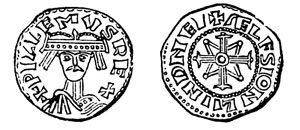
Obverse.—Type. Crowned bust, sometimes full-faced, at others in dexter or sinister profile; on some the shoulders and arm extending to the edge of the coin, on others the whole confined within the inner circle; sometimes with tassel, or pendant, hanging from the crown on either side (“bonnet” type), or with a canopy over the head (“canopy” type). On one or both sides of the bust is generally a sceptre, or star; or sceptre on one side and star on the other; or sword. Those usually ascribed to the first William are those with the sceptres only; the others are attributed to William II. But this is entirely supposititious.
Legend. PILEM. [1] PILELM. PILLEM. PILLELM. PILEMV. PILLEMV.PILLEMVS, etc.— R. or REX.— A. AN. ANG. ANGL. ANGLO. ANGLOR., etc.
Reverse.—Type. Crosses in considerable variety, including fleury, battonée, annulæ, voided, etc.; others terminating in pellets, knots, etc.; cross and saltire; cross and lozenge; cross and annulets, etc. One type of common occurrence has, in circles between the limbs of the cross, the letters P A X S. In all cases the device is confined within the inner circle.
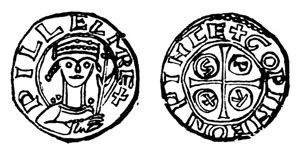
Legend. Mint master’s and town names, as GODPINE ON LIN, which signifies that it was struck by Godwine of Lincoln; SIPORD ON PINC, by Siward of Winchester; ESBRN ON SERBR, by Osbern of Salisbury; SIBODE ON LVNDEN; and so on. About sixty or seventy different places of mintage are known.
Rarity. Some scarce; those with the canopy over the head exceedingly so. Those with P A X S are common.
HENRY I. (1100 to 1135.)
Denominations.—Silver. Pennies only.
Obverse.—Type. Crowned bust, sometimes full-faced, at others three-quarter faced, or in dexter or sinister profile; generally with a sceptre in the right hand, sometimes one, two, or three stars, or a rose before the face. In some instances the figure is half length and full robed, showing right hand holding sceptre, and left extended. There are many varieties.
Legend. H. HNRI. HNRE. HENRI. HENRIE. HENRIC. HNRICVS. or HENRICVS.—R. RE. or REX.—A. AN. ANG. or ANGL.
Reverse.—Type. Crosses of the same general character as those of previous monarchs; quatrefoils with crosses, pellets, bezants, roses, etc., in them; others the letters P A X, bars and annulets.
Legend. Mint master’s and town names. About eighty moneyers’ names are known. One example has the legend in two circles.
Rarity. All rare; some types extremely so.
STEPHEN. (1135 to 1154.)
Denominations.—Silver. Pennies only.
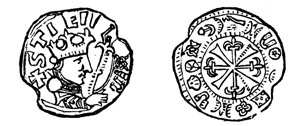
Obverse.—Type. Crowned bust, sometimes almost full-faced, but generally in dexter profile; sceptre, mace, lance, or flag in the right hand. On one are two figures, variously surmised to be Stephen and Henry, and Stephen and Matilda, represented standing side by side, hand clasped in hand, and between them a sceptre.
Legend. S. STE. STEF. STEFN. STIFN. STIEN. STEFNE. STEIFNE. STIEFEN. STIEFNEI. STIFNE. STEFENERE. STEP. STEPHENI. STEFANVS, or STEPHANVS.—R. or REX.
Reverse.—Type. Crosses, etc., in great variety, all within the inner circle; some have the space usually allotted to the legend filled with various little devices, as roses, escallops, etc.; the Stephen and Henry (or Matilda) is of this kind. One example, struck at Derby, has within the inner circle a double cross, between the limbs of which are four martlets.
Legend. Mint master’s and town names, of which there are many varieties.
Rarity. All very rare. The Stephen and Henry (or Matilda) at Tyssen’s sale, in 1802, brought ten guineas, and at Dimsdale’s, in 1824, thirteen pounds two shillings and sixpence, and later, much higher prices.
Other coins bear the name of Eustace, son of Stephen (EVSTACIVS. EISTCHIVS, etc.); Matilda (MA[T]ILD[A] IM[PERATRIX], etc.); William, second son of Stephen (WILLELMVS. LVI—LLEM DVD); Earl of Warwick; Robert Earl of Gloucester; and Henry Bishop of Winchester (HENRICVS EPC.); all rare.
HENRY II. (1154 to 1189.)
Denominations.—Silver. Pennies only.
Obverse.—Type. Crowned bust, full-faced or profile; sceptre in his right hand, generally held upright, but on some leaned on the shoulder. In one instance, with three stars before the face.
Legend. HENRI.—R. RE. or REX.—A. AN. ANG. or ANGL.
Reverse.—Type. Cross patée, with four small ones, one in each quarter; all within the inner circle.
Legend. Mint master’s and town names; as, WALTER ON LV. (Walter of London), IOHAN ON LUNDEN (John of London), and so on.
Rarity. All rare.
RICHARD I. (1189 to 1199.)
Denominations.—Silver. Pennies and Halfpennies.
Obverse.—Type. The only coins known of this monarch are those struck at Poictou and Aquitaine; they have no bust, merely a plain cross patée. No English examples have as yet been discovered; the Evesham ones, etc., were forged by White.
Legend. RICARDVS.—RE. or REX.
Reverse.—In three lines across the coin—
PIC
TAVIE
NSIS.
or ACVITAINE. No device.
Rarity. Extremely rare.
JOHN. (1199 to 1216.)
Denominations.—Silver. Pennies, Halfpennies, and Farthings.
Obverse.—Type. No English coins of John are known, but there are abundant proofs that coins were during his reign struck to a considerable extent in England. The supposition, amounting almost to a certainty, is that the “short cross” pennies of Henry II. continued to be struck and issued during this reign as well as in the early part of the next. The Irish coins of John have—Penny, full-faced, crowned bust, within a triangle, sceptre in the right hand; on the left of the head a rose. Halfpenny and Farthing, head in triangle, on either side a star; one variety of halfpenny, called the “full moon halfpenny,” has the face filling up the whole field of the coin, the inner circle forming the outline of the face.
Legend. IOHAN. or IOHANNES.—REX or DOM. or DO.—the latter has IOHANNES DOM.; Farthing, WILLEM ON.
Reverse.—Type. Penny and Halfpenny, within a triangle a crescent, above which is a star or cross. Penny, a star at each point and side of triangle; Halfpenny, star on either side the crescent; Farthing, within a triangle a star; “full moon” halfpenny, a voided cross between four annulets, within inner circle.
Legend. Mint master’s and town names; as ROBERD ON DIVE., for Robert of Dublin; WILLEM ON LI, or WILLEM ON LIME, for William of Limerick; or WILLEM ON WA, for William, of Waterford. The Farthing has IOHANNES and DW (Dublin) in continuation of obverse.
Rarity. All very rare, the Farthing more particularly so.
HENRY III. (1216 to 1272.)
Denominations.—Gold, Penny. Silver, Pennies only.
Obverse.—Type. Silver Penny. Full face, crowned in some, without neck or shoulders; on some, on the right of the head (in the legend), a hand holding a sceptre over the head; in some, a mullet or star, in others a crescent and mullet.
Legend. HERICVS. or HENRICVS.—REX. or REX ANG.—III. TER. or TERCI. The legends of these coins are remarkable for the letters in many instances being conjoined.
Reverse.—Type. There are two mintages. The early one (called “short cross pennies”) has a voided cross within the inner circle, and four pellets conjoined in each compartment; but the practice of clipping and filing the moneys had been carried to such an extent, that about 1248 Henry issued a new coinage, called “long cross pennies,” with the same cross, but extending through to the outer edge, thereby rendering any mutilation visible. The cross is a voided or double one, each end terminating in a pellet, and one in the centre; three pellets were now inserted in each compartment instead of four, and not conjoined.
Legend. Mint master’s and town names; some have TER. or TERCI. added; as, TER. RI ON LVND. in continuation of obverse. One variety reads LIE TERCI LON, being a continuation of HENRICVS REX ANG. of the obverse; this, in full, would be “HENRICVS REX ANGLIE TERCI. LON.”
Rarity. Not uncommon; those with TERCI. and REX ANG. rare.
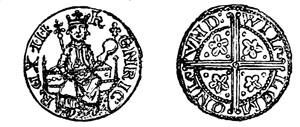
Gold. The Gold Penny of Henry III. was the first gold coin struck by any English monarch; it is therefore important as marking a new era in numismatics. The weight is forty-five grains, and it is of pure, unalloyed gold. On the obverse is a full length robed and crowned figure of the king seated on a throne or chair of state, with sceptre in right hand, and orb and cross in the left. Legend HENRIC REX III. Reverse, a long double or voided cross and pellets, a rose between the pellets in each compartment. This coin has fetched at sales as much as £140.
From this time till Edward III., no other gold coins were struck by English monarchs.
EDWARD I. (1272 to 1307.)
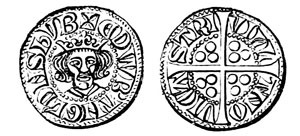
Denominations.—Silver. Penny, Halfpenny, and Farthing.
Obverse.—Type. Crowned full-faced bust of the king, with neck and part of the shoulders draped; crown, consisting of three fleurs-de-lis, and two lozenges, balls, or points; beneath the rim of the crown, on the forehead, is a row of from one to five pearls; the hair, which is very abundant, stands out a considerable distance on either side the face, and curled; the whole within the inner circle. The Irish mintages are distinguished by having the head in a triangle, the legend running on its three sides; there are one or two specimens of English coins with the triangle, but they are very rare.
Legend. E. EDW. [EDWA. EDWAR. EDWARD. EDWARDVS.]—R. REX. or D.G.R.—A. AN. ANG or ANGL.—D.H. or DNS HYB. There are many opinions respecting the Pennies of the first three Edwards. The one most generally received is, that those with the name contracted to EDW. belong to Edward I.; those with the name in full EDWARD, to Edward III.; and the intermediate varieties to Edward II. It remains still, however, a vexed question, and one not easy of solution.
Reverse.—Type. A plain cross, with its terminations enlarged, extending through to the outer edge of the coin and dividing the legend into four parts; three pellets in each compartment within the inner circle.
Legend. In every instance except one, which has a moneyer’s name, ROBERTVS DE HADL., or ROBERT DE HADELIE, consists of the name of the city or town where struck; as, CIVITAS LONDON. VILL BEREWICI. VILLA BRISTOLLIE. CIVITAS EBORACI. CIVITAS CANTOR. CIVITAS DVREME. CIVITAS LINCOL. VILL SCI EDMVNDI. CIVITAS CESTRIE. CIVITAS EXONIE. VIL NOVI CASTRI. VILL KYNGESTON, etc.
Rarity. Pennies common, with the exception of a few mintages. The Halfpenny and Farthing very rare, the Farthing particularly so.
EDWARD II. (1307 to 1327.)
Denominations.—Silver. Pennies, Halfpennies, and Farthings.
As I have just remarked, the coins bearing intermediate abbreviations of the king’s name, between EDW. and EDWARD, are, more for convenience than by right, appropriated to this monarch. The description just given will therefore apply to the coins of this reign.
EDWARD III. (1327 to 1377.)
Denominations.—Silver. Groat, Half-groat, Penny, Halfpenny and Farthing. Gold.—Florin, Half-florin, Quarter-florin; Noble, Half-noble, and Quarter-noble.
Obverse.—Type. Groat and Half-groat, head same as Edward I.’s, within a circle formed of nine arches, fleury; Pennies, Halfpennies, and Farthings, as Edward I.’s.
Legend. Groat, EDWARD. DEI G. REX. ANGL. DNS. HY. Z. AQT.; or EDWAR. or EDWARD D. G. REX. ANGL. Z. FRANC. D.H.Y., or HYB. or HIBE. Half-groat, EDWARDVS. REX. ANGL. (or ANGLI) DNS. HYB., or Z. FRANCI or FRANCIE.; or ANGL. FRA. Z. HI. Penny, EDWARD or EDWARDVS.—D. G. or DI. GRA.—R. or REX.—ANGL. ANGLI. or ANGLIE.—D. or DNS. HYB. Z. FRA. FRANC. or FRANCI.
Reverse.—Type. Cross and pellets as his predecessor; one limb of the cross of the Durham coins terminating in a crozier.
Legend. Groat and Half-groat. In the outer circle, POSVI DEVM ADIVTOREM MEVM, or MEV. Inner circle, town name where struck; as, CIVITAS LONDON or CIVITAS EBORACI. Pennies, etc., town, etc., names.
Rarity. Calais Groat very rare; Halfpence and Farthings rare; all others not uncommon.
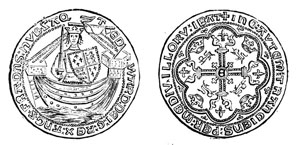
Gold. Florins (six shillings), Half-florins (three shillings), and Quarter-florins (eighteenpence); Nobles (six and eightpence), Half-nobles, or Maille-nobles (three and fourpence), and Quarter or Ferling-nobles (twenty pence). Florin: obverse, the king crowned and robed, seated under a canopy, with sceptre in right hand and orb and cross in the left; on the robe a fleur-de-lis; two lions, one on each side the throne: reverse, within a quatrefoil a short beaded cross with foliated ends; in each of the angles between the four limbs a lion, or leopard, surmounted with a crown. Half-florin: a lion, crowned; a mantle, or banner, charged with the royal arms, hung from his neck: reverse, within a quatrefoil a foliated cross having a lion in each angle; legend, DOMINE NE IN FVRORE TVO ARGVAS ME, and variations. Quarter-florin: helmet, with lamberquins and crest of lion, field semé-de-lis; reverse, richly foliated cross; legend, EXALTABITVR IN GLORIA. Noble and Half-noble, king in armour, crowned, standing in a ship, with sword in his right hand, and in his left a shield of England and France quarterly; reverse, in a tressure of eight arches a rich foliated cross, in each angle a lion surmounted by a crown, a fleur-de-lis at the end of each limb of the cross; legend, IHC TRANSIENS PER MEDIVM ILLORVM IBAT, with variations. Quarter-noble: an escutcheon with the arms of France and England, quarterly, within a tressure of eight foils. All more or less rare. A Florin has sold for £113; a Quarter-florin for £170.
RICHARD II. (1377 to 1399.)
Denominations.—Silver. Groat, Half-groat, Penny, Halfpenny, and Farthing. Gold. Noble, Half-noble, and Quarter-noble.
Obverse.—Type. Groat and Half-groat, crowned bust within a tressure of nine arches, as his predecessor; the Penny, Halfpenny, and Farthing similar to the last reigns.
Legend. RICARD. RICARDVS.—D. G. DI. G. or DI. GRA.—R. REX.—ANG. ANGL. or ANGLIE.—Z. FRA. FRANC. or FRANCIE.
Reverse.—Type and Legend. Similar to the preceding reign; on some, a rose in the centre of the cross.
Rarity. All rare.
Gold. Nobles, Half-nobles, and Quarter nobles; same types as before, with only the necessary change in the legend. All rare; the Half-noble particularly so.
HENRY IV. (1399 to 1413.)
Denominations.—Silver. Groat, Half-groat, Penny, Halfpenny, and Farthing. Gold. Noble, Half-noble, and Quarter-noble.
Obverse.—Type. All his coins like his predecessor’s; (the head within the circle of arches on the Groat and Half-groat;) and are only to be distinguished from those of his successors Henry V. and VI. by weight. The Groat weighs seventy-two grains, the others of course of proportionate weights.
Legend. HENRIC. or HENRICVS.—D. G. or DI. GRA.—REX. ANGL. or ANGLIE.—Z. FRAN. or FRANC.—D. or DNS. HI. HIB. or HYB.—Z. AQ. or AQE., etc.
Reverse.—Type. As his predecessor’s; the pellets in two of the quarters are joined together by an annulet.
Legend. Groat and Half-groat; POSVI DEVM ADIVTOREM MEV or MEVM in outer circle, and name of town, as CIVITAS LONDON, in inner one. Pennies, etc., names of towns, as CIVITAS EBORACI, etc.
Rarity. Not uncommon; Groat rarest.
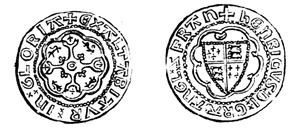
Gold. Noble, Half-noble, and Quarter-noble, same as Richard II., with only alteration of name. All rare; first coinage particularly so.
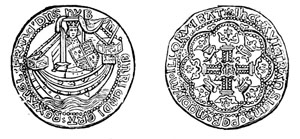
HENRY V. (1413 to 1422.)
His coins are precisely like Henry IV.; no distinguishing mark has as yet been discovered, so that what is said of the one will equally apply to the other.
HENRY VI. (1422 to 1461.)
Denominations.—Silver. Groat, Half-groat, Penny, Halfpenny, and Farthing. Gold. Noble, Half-noble, Quarter-noble, and, later, Angel, and Half-angel or Angelet.
Silver. Same in every respect with the preceding ones, the only distinction being by weight, and minor differences, which are not to be taken as certain indications for appropriation; the weight of the earlier Groat being 60 grains, and the later, or “light coinage,” 48, and the other coins in proportion; the 48 grains Groat very rare.
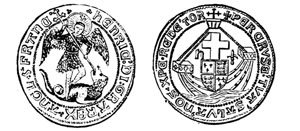
Gold. Noble, Half-noble, and Quarter-noble, as before. The Angel, and Angelet or Half-angel, bear on the obverse a winged and nimbed figure of the Archangel Michael standing upon a dragon, which he is transfixing through the mouth with a spear, the upper end of which terminates in a cross crosslet.
Legend. HENRIC DI GRA REX ANGL Z FRANC.; or HENRIC DEI GRA REX ANGL Z FR.
Reverse.—A ship with a large plain cross in place of mast, on which is a shield of the royal arms. On the dexter side of the cross a letter H, on the sinister a fleur-de-lis.
Legend. PER CRVSE TVA SALVA NOS XPE REDETOR.; or IHC AVTE TRANSIENS PER MEDIV ILORV.; or O CRVX AVE SPES VNICA.
Rarity. All rare.
EDWARD IV. (1461 to 1483.)
Denominations.—Silver. Groat, Half-groat, Penny, Halfpenny, and Farthing. Gold. Noble, Rose-noble Royal or Rial, Half-noble or Half-rial, Quarter-noble or Quarter-rial, Angel, an Angelet or Half-angel.
Obverse.—Type. The general types of his silver coins are same as those of his predecessors. The Groat and Half-groat have the bust within the circle of arches; Penny, Halfpenny, and Farthing, the same as before. Some have the royal badge of the House of York, the rose, on either side the neck of the bust, and others an annulet and rose, or four pellets, etc., on the breast; others with the initial letter of the town.
Legend. Edward. With titles as before. On the Farthing EDWARD REX ANGL. Reverse.—Type. Similar to the others.
Legend. On Groat and Half-groat. POSVI DEVM ADIVTORE MEVM in the outer circle, and name of town in the inner. On the lesser coins the names of towns only, as CIVITAS LONDON, etc.
Gold. Noble. Same type as his predecessor. Rial or Rose-noble, and its Half, much the same general type, but with a rose on the side of the ship, beneath the king and letter E on the flag.
Reverse.—Within a tressure as before a sun of sixteen rays in place of limbs of the cross, the lions and crowns and the terminations of the limbs remaining.
Legend. As before. Quarter-rial: arms as before within a quatrefoil; there are several minor varieties. Angel and angelet as before. The sun and the rose were badges of the House of York.
EDWARD V. (1483.)
There are some gold and silver coins exactly similar to those of Edward IV., but bearing as mint marks a boar’s head, a rose-en-soleil, or a rose-en-soleil on one side and boar’s head on the other, that are conjectured to have been issued by this youthful king by authority and order of his uncle the “Protector,” afterwards Richard III., whose badges they bear. They are extremely rare.
RICHARD III. (1483 to 1485.)
Denominations.—Silver. Groat, Half-groat, Penny, and Halfpenny. Gold. Angel, and Angelet or Half-angel.
Obverse.—Type. As his predecessors’; the only difference being the alteration of name in the legend; on some he has a cross on the breast; mint marks, a boar’s head, and rose-en-soleil.
Legend. Ricard.—D. G. or GRA.—REX.—AN. ANG. or ANGL.—Z. FRANC.
Reverse.—Type. As before, but with the different mint marks and badges.
Legend. As before, Groat and Half-groat, POSVI DEVM ADIVTORE MEVM, in outer, and name of town in inner circle. Penny and Halfpenny, name of town only, as CIVITAS LONDON. Angel, PER CRVSEM (or CRVCE) TVA SALVA NOS XPE REDEMPT. Half-angel, O CRVX AVE SPES VNICA.
Rarity. All rare, those with M. M., a boar’s head, especially so.
HENRY VII. (1485 to 1509.)
Denominations.—Silver. Testoon or Shilling, Groat, Half-groat, Penny, Halfpenny, and Farthing. Gold. Rose-noble or Rial, Angel, Angelet or Half-angel, Sovereign or Double-rial, and Double-sovereign.
Obverse.—Type. To this monarch we owe the great change which has been, since his reign, gradually improving in coins. In the first issue, his coins very closely resemble those of Henry VI. Bust crowned with an open double-arched crown, now first used; some have a key on either side the Bust. In the 18th year of his reign his coins assumed a very different character. The circle of arches was discarded; the head (which, for the first time, may be considered as a portrait) is represented in dexter profile, crowned with a double or single arched crown, with the ball and cross on top. The Penny of his later issue has the king sitting in a chair of state, crowned, sceptre in his right, and globe in his left hand.
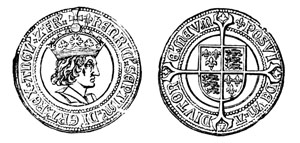
Legend. H. HENRIC or HENRICVS.--VII. or SEPTIM.--D. G. DI. or DEI.--G. or GRA REX.--A. AN. ANG. ANGL. AGL. or ANGLIE.--Z.--F. FR. FRAN. FRANC.--DNS. HIBN. IBAR. or IBARNC.
Reverse.—Type. In his first coinage are the cross and pellets, but in his subsequent one the cross (fleury) is retained, but in the place of the pellets is a shield, France and England quarterly. The cross dividing the shield.
Legend. POSVI DEVM ADIVTOREM MEVM and its usual abbreviations. On the Groats and Half-groats the inner circle of legend bearing name of town is dismissed, its place being filled with the shield. In this reign the Testoon or Shilling makes its first appearance.
Rarity. Penny of first coinage extremely rare; Halfpenny rare; others common. Second coinage, Shilling with VII., Groat with SEPTIM., and Penny, rare; others far from uncommon.
Gold. The Sovereign and Double-sovereign now make their appearance; they have on the obverse the king, fully robed, sitting on a richly canopied throne, crowned, sceptre in his right, and orb and cross in his left, hand; reverse within a tressure of ten arches a large double rose, in the centre of which is a shield bearing the arms of France and England quarterly. In the space between the arches of the tressure and the outer petals of the rose are, alternately throughout, a lion and a fleur-de-lis. There are several varieties of this coin. The Rial has the king in a ship, on the obverse as before; on the reverse a rose with royal shield in the centre as first described. Angel and angelet much the same as those of his predecessors. Rial, Double-sovereign, and Sovereign, rare; others, common.
HENRY VIII. (1509 to 1547.)
Denominations.—Silver. Testoon or Shilling, Groat, Half-groat, Penny, Halfpenny, Farthing. Gold. Double-sovereign, Sovereign, Pound-sovereign, Half-sovereign, Rose-noble or Rial, George-noble, Angel, Angelet or Half-angel, Quarter-angel, Crown, Half-crown.
Obverse.—Type. His first coinage very closely resembles Henry VII. In his 15th year the Farthing has a portcullis. In his 34th year the head is almost full-faced, in a robe crowned with an open-arched crown. In his 36th and 37th years, full-faced portrait, on some with the cap.
Legend. H. HE. HERIC. HENRIC. or HENRICVS. VIII. or 8.—D. DI. or DEI.—G. GR. or GRA.—A. ANG. ANGL. or ANGLIE.—FR. FRA. FRAN. or FRANC.—Z. HIB. or HYB.—R. RE. or REX. Testoon, HERIC. VIII. DI. GRA. AGL. FRA. Z. HIB. REX. Penny, H. D. G. ROSA SINE SPINA; Halfpenny the same, or abbreviated.
Reverse.—Type. First coinage, like Henry VII., with only the numeral changed from VII. to VIII.; Farthing has a rose and cross or portcullis. The Testoon or Shilling has the royal rose, crowned with an open-arched crown, between the royal initials H and R also each crowned. The others with the cross and shield. There are many varieties with different marks of towns and prelates, where and by whom they were struck.
Legend. POSVI DEVM ADIVTOREM MEVM, and its abbreviations on the Shilling and Groat. Half-groat, occasionally the same, or with name of town. Penny and Halfpenny, name of town. Farthing, CIVITAS LONDON or RVTILANS ROSA.
Rarity. Groat struck at Tournay, CIVITAS TORNACI. etc., very rare. Henry VIII. debased his silver so much that his later coins have more the appearance of brass than silver. The shillings and halfpenny rare, the rest are not.
Gold. Double-sovereign, Sovereign, Half-sovereign, Rial, Half and Quarter-rials, similar in general type to those of Henry VII.: George-noble, with an equestrian figure of St. George riding over and transfixing with a spear a dragon, on the obverse; and on the reverse a ship, a cross, between H R, for a mast, and upon it a double rose. Angel and Angelet as before. Crown and Half-crown obverse a double rose, etc., crowned, between the crowned or uncrowned letters H. K. (Henry and Katherine), H. A. (Henry and Ann Boleyn), H. I. (Henry and Jane Seymour), or H. R.; reverse, royal arms crowned between same initials. RVTILANS ROSA SINE SPINA. Half-george, Noble, Crown, and Half-crown, George-noble, rare; Rial extremely so.
EDWARD VI. (1547 to 1553.)
Denominations.—Silver. Crown, Half-crown, Testoon or Shilling, Sixpence, Groat, Threepence, Half-groat, Penny, Halfpenny, Farthing. Gold. Treble-sovereign, Double-sovereign, Sovereign or Double-rial, Half-sovereign, Quarter-sovereign or Crown, Half-crown, Six-angel, Angel, Angelet.
Obverse.—Type. First coinage, which is base in the same degree as Henry VIII.’s last coinage. Testoon, etc., profile, crowned with an open arched crown; Penny and Halfpenny, some with crowned profile, others with the royal rose. Farthing, portcullis.
Later coinages. Crown, the king in armour, crowned, sword drawn, on horseback; to the right, under the horse, the date. Half-crown, the same, sometimes with the addition of a plume on the horse’s head. Shilling, Sixpence, and Threepence, fullfaced bust of king in robes, with the chain of the Order of the Garter round his neck, crowned, a rose on the left, and the value on the right side of the head. Penny, king enthroned, crowned ball and sceptre in his hands, or royal rose.
Legend. E. ED. EDWAR. EDWARD. EDOARD. EDOVARD. or EDWARDVS. VI. or 6.—D. DEI.—G. GRA.—AGL. ANGL.—FRA. FRANCIE. Z.—HIB. HIBE. HIBER.—REX. etc. Testoon, TIMOR DOMINI FONS VITE. MDXLIX. or MDXL.[2]—likewise on reverse, INIMICOS EIVS INDVAM CONFVSIONE. Penny, E. D. G. ROSA SINE SPINA. Crown, SCVTUM FIDEI PROTEGET EVM; or RVTILANS ROSA SINE SPINA. Half-sovereign, SCVTVM FIDEI PROTEGET EVM MDXLVIII[3]; or LVCERNA PEDIBVS MEIS VERBVM TVVM.
Reverse.—Type. One Testoon has the arms of France and England in an oval shield mantled; all others have the cross fleury, and plain shield of France and England quarterly. Farthing, cross and pellets.
Legend. POSVI DEVM ADIVTOREM MEVM and its abbreviations, and town names. Other legends are E. R. INIMICOS EIVS INDVAM CONFVSIONE; TIMOR DOMINE FONS VITE; IHS. AVTE TRANSIE PER MED ILLOR IBAT; SCVTVM FIDEI PROTEGET EVM; PER CRVCEM TVAM SALVA NOS XPE. RED.; IHESV. AVTEM TRANSIENS PER MEDIVM ILLORVM IBAT; and on some the titles appear.
Rarity. Gold coins rare, some extremely so. Silver, first coinage, the Testoon, Groat, Half-groat, and Penny, rare; all his last are tolerably common, with the exception of the Crown, Half-crown, and Penny. Halfpenny and Farthing rare.
Gold.Treble-sovereigns, with the king in robes, and crowned, seated on the throne, drawn sword in right, and orb in left, hand; reverse, royal arms, with supporters, a lion and a dragon. Double-sovereigns, similar figure, but with sceptre instead of sword; a portcullis at his feet. Sovereign, same as Double-sovereign, or a half-length figure of the king in profile, in armour, crowned, sword in right hand, orb in left; reverse, arms of France and England, crowned, with or without lion and dragon supporters; beneath, on the mantling, E. R.; others have the same type as the foregoing. Half-sovereigns, king in chair of state; half-length figure, and bust crowned, etc.
MARY I. AND PHILIP AND MARY. (1553 to 1558.) Married Philip of Spain, 1554.
Denominations.—Silver. Half-crown, Shilling, Sixpence, Groat, Half-groat, Penny. Gold. Sovereign or Double-rial, Rial, Angel, Angelet.
Obverse.—Type. Before her marriage, Mary’s coins have a sinister bust profile, crowned, arched crown, hair long and flowing, draped. One Penny, a rose instead of head. After her marriage with Philip of Spain, the Shilling and Half-shilling have their busts face to face, with a crown above between them: here she appears with her dress up to her chin, and a head dress; he has the stiff ruffle about his neck. This arrangement of the profile heads facing each other gave rise to the couplet,
“... cooing and billing Like Philip and Mary on a shilling.” The Half-crown, which appears to be merely a pattern-piece, but never issued, has on one side her bust, over which is the crown between the date 1554, with the legend MARIA D. G. R. ANG. FR. NEAP. PR. HISP.; and on the other a similar bust of Philip, beneath a crown, and the legend PHILIPVS D. G. R. ANG. FR. NEAP. PR. HISP. Some of the coins have no date, others the date above, others below the heads. Legend. M. or MARIA.—D. G. ANG.—FR. FRA. Z. HIB. REG. or REGI. Shilling and Sixpence, PHILIP. ET. or Z.; or MARIA. D. G. R. ANG. FR. NEAP. PR. HISP.; or PHILIP ET MARIA D. G. REX ET REGINA ANG. or ANGL. Some have the date as 1553 either beneath the heads or by the crown. Penny, M. D. G. ROSA SINE SPINA; or P. Z. [ET] M. D. G. ROSA SINE SPINA. Reverse.—Type. Before the marriage, cross fleury and shield, as on her predecessor’s coins. After the marriage, Shilling and Sixpence bear the Spanish and Neapolitan royal arms, impaling those of England, in an oval shield, mantled; surmounted by a crown, between numerals for value. Legend. Groat and Half-groat of Mary, VERITAS TEMPORIS FILIA, and also abbreviated; of Philip and Mary, POSVIMVS DEVM ADIVTO NOS. Shilling and Sixpence, POSVIMVS DEVM ADIVTOREM NOSTRVM, and abbreviated. Penny, CIVITAS LONDON; or VERITAS TEMP FILIA. Rarity. Rose-penny rare; Half-crown, Half-groat, and Penny, extremely so. Gold. Sovereign or Double-rial, the queen full-robed and crowned seated on the throne, in her right hand a sceptre, in the left the orb and cross; at her feet a portcullis; reverse, within a tressure of ten arches a double rose, with shield of royal arms in centre. Legend, A. DNO. FACTV. EST ISTV. Z. EST MIRA IN. OCVL. NRIS. (“It is the work of the Lord, and is wonderful in our eyes.”) Rial, the queen crowned standing in a ship, in her right hand a drawn sword, in her left a shield of arms; in front, a rose. Same legend. Angel and Angelet, with St. Michael and the Dragon as on those of preceding monarchs.
ELIZABETH. (1558 to 1603.)
Denominations.—Silver. Crown, Half-crown, Shilling, Sixpence, Groat, Threepence, Half-groat, Three-halfpence, Penny, Three-farthing, Halfpenny. Gold. Sovereign or Double-rial, Rial, Pound-sovereign, Half-sovereign, Crown, Half-crown, Angel, Angelet, Quarter-angel.
Obverse.—Type. Silver. Crown and Half-crown, sinister bust profile, crowned, open double-arched crown, hair turned back, draped, robe with wide puffed sleeves, stiff frill round the neck; in the right hand the sceptre, the orb as if held in the left. The Shilling, Sixpence, Groat, Threepence, Half-groat, Three-halfpence, Penny, Three-farthing, Halfpenny, and Farthing have also the bust profile, crowned with a single-arched crown, hair long and flowing down the back, draped robe, much plainer than before, and having no sceptre or orb.[4] The Sixpence, Threepence, Three-halfpence, and Three-farthing pieces are distinguished from the others by having the Tudor rose behind the head. It was in reference to this distinguishing mark of a rose behind the head that the satirist on costumes wrote:—
“... Behind her head a rose That people cry, ‘Lo! there Three-farthings goes!’”
The commonest Halfpenny has a portcullis instead of the bust; the one with the bust is extremely rare. The “milled” money is neater in execution than the earlier “hammered” pieces. The “portcullis” money, struck in 1601 for foreign use, has on the obverse the royal arms, surmounted by a crown, between the initials E. and R., each crowned, and the usual name and titles of the queen; reverse, a portcullis crowned, and the POSVI, etc., legend.
Legend. E. ELIZ. ELIZAB. or ELIZABETH.—D. G. ANG. FR. (or FRA.) ET. HIB. (or HIBER.) REG. (REGI or REGINA). Three-halfpence, Penny, etc., E. R.,—E. D. G. ROSA SINE SPINA.
Reverse.—Type. Cross fleury, or plain cross, and shield of France and England; the shield on the crown mantled. Halfpenny, cross and pellets. Farthing, crowned monogram of name.
Legend. POSVI DEVM ADIVTOREM MEVM, or its abbreviations; or name of town.
Gold. Sovereign, or Double-rial, same general type as the Sovereign of Mary. Pound-sovereign, Half-sovereign, Crown and Half-crown, sinister bust fully robed, crowned with an open crown of two, four, or five arches. Rial, with the queen in a large ruff, standing in a ship, crowned, etc. Angels, Angelets, and Quarter-angels, St. Michael and the Dragon; reverse, a ship, royal shield in front, surmounted by a cross, with E. and a rose. Some of the legends on the reverses of gold coins are, A DNO. FACTV. EST ISTVD ET EST MIRAB. IN OCVL. NRS; IHS. AVT TRANSIENS PER MEDIV. ILLORVM IBAT; SCVTVM FIDEI PROTEGET EAM; and one Rial, referring to the taking of Virginia by Sir Walter Raleigh, has on its obverse ELIZAB [ETHA] D [EI] G [RATIA] ANG [LIÆ] FR[ANCIÆ]ETM[AGNÆ]PR[OVINCIÆ]C[APTÆ]A[VSPICIIS]I[LLIVS] REGINA (“Elizabeth, by the Grace of God, Queen of England, France, and the Great Province captured under her auspices”).
In this reign pattern copper coins were struck, but never issued. The Penny bore on the obverse a full-face portrait of the queen, and the words THE PLEDGE OF; and on the reverse the crowned monogram, and the continuation of the legend, A PENNY, and date 1601. Other pattern pieces were also struck of copper, lead, pewter, and leather, but are all extremely rare.
JAMES I. (1603 to 1625.)
Denominations.—Silver. Crown, Half-crown, Shilling, Sixpence, Half-groat, Penny, and Halfpenny. Gold. First issue. Sovereign or Thirty-shilling-piece, Half-sovereign or Double-crown (15s.), Quarter-sovereign or Crown (7s. 6d.), Eighth-of-Sovereign or Half-crown (3s. 9d.). Second issue. Unit (20s.), Double-crown (10s.), British-crown (5s.), Half-British-crown (2s. 6d.), Thistle-crown (4s.). Third issue. Rose-rial or Sovereign (30s.), Spur-rial (15s.), Angel (10s.), Angelet or Half-angel (5s.). Last issue. Rose-rial or Sovereign (Thirty-shilling-piece), Spur Rial (Fifteen-shilling-piece), Angel, Laurel or Unit, Double-crown or Half-laurel, British-crown or Quarter-laurel. The current values were from time to time raised.
Obverse.—Type. Crown and Half-crown, king on horseback, in armour, crowned, drawn sword in his right hand; on the caparison the royal rose or the thistle crowned.
On some IACOBVS D G MA (or MAG) BRI (or BRIT) FRA (or FRAN) ET HI (or HIB or HIBER) REX.
Shilling, Half-shilling, etc., dexter bust profile, robed, crowned; long pointed beard and mustachios, hair short, numerals at back of head for value. Twopence, the bust as before on some, on others the royal rose crowned. Penny, bust as before, or I. R. crowned; a rose on one side the letters, and a thistle on the other: others, a rose. Halfpenny, a portcullis, or rose.
Legend. I. IA. IACOBV. or IACOBVS. D. G. ANG. SCO. FRAN. ET. HIB. REX., and other abbreviations. Half-groat, etc., I. D. G. ROSA SINE SPINA. Penny with I. R.; and Halfpenny, no legend.
Reverse..—Type. Crown, etc., royal arms, quarterly, 1 and 4, France and England quarterly; 2, Scotland; 3, Ireland. The shield of the Crown and Half-crown mantled, the others plain; Twopence, on some the same arms, on others a thistle, crowned. The Penny, with I. R. has a portcullis crowned; the others, a thistle; others have the arms. Halfpenny, cross moline with three pellets in each quarter; or a thistle.
Legend. Crown, Shilling, etc., EXVRGAT DEVS. DISSIPENTVR INIMICI; or QUÆ DEVS CONIVNXIT NEMO SEPARET. Half-groat, Penny, TVETVR VNITA DEVS. Penny same as Half-groat; other pennies and halfpennies without legend. Rarity. All common, except Half-crown.
Gold. Thirty-shilling, Unit, and other pieces, king enthroned, in full regalia, his feet upon a portcullis, the field diapered; or half-length or shorter portrait of king in armour, crowned, sceptre in right and orb in left hand: reverse, shield of arms. Rose-rial, king enthroned as before; reverse, a large double rose with shield of arms. Spur-rial, king in armour, standing in a ship with sword and shield; or, the Scottish lion, sejant, crowned, holding a sceptre in his right paw and supporting with his left a shield of the royal arms; reverse, within a tressure a Spur-rowel, or star of 16 points centred with a rose, four points terminated with lions, and four with fleurs-de-lis. Angel, etc., usual type. Thistle crown, a double rose on its stem, crowned, between the initials I. R.; reverse, a thistle crowned in like manner. Some of the legends or reverses are EXVRGAT DEVS DISSIPENTVR INIMICI; TVEATVR VNITA DEVS; FACIAM EOS IN GENTEM VNAM; HENRICVS ROSAS, REGNA IACOBVS; A DNO. FACTVM EST ISTVD ET EST MIRAB. IN OCVLIS NRIS; A DNO. FACTVM EST ISTVD, etc.
Copper. Farthing, crown and two sceptres in saltire, IACO. D. G. BRIT. Reverse, Irish harp, crowned, FRA. ET. HIB. REX. For Scotland a brass Twopence, called “Hardhead” was struck: obverse three thistles on one stem, IACOBVS D. G. MAG BRIT; reverse, lion rampant, FRAN and HIB REX.
CHARLES I. (1625 to 1649).
Denominations.—Silver. Twenty-shilling-piece or Pound, Ten-shilling-piece or Half-pound, Crown, Half-crown, Shilling, Sixpence, Groat, Threepence, Half-groat, Penny, and Halfpenny.
Gold. Tower Mint. Unit, Broad, or Twenty-shilling-piece; Double-crown or Half-broad or Ten-shilling-piece; crown, Britain-crown, or Five-shilling-piece, Angel. Oxford Mint, Treble-Unit, or Three-Pound-piece; Unit or Twenty-shilling-piece; Half-unit, Double-crown, or Ten-shilling-piece. Briot’s Mint. Unit, Double-crown, or Half Unit, Angel.
Obverse.—Type. Twenty-shilling and Ten-shilling-piece, king on horseback with or without artillery, armour, arms, etc., under horse’s feet. Crowns and Half-crowns, king in armour on horseback, but with very many variations in detail. One description is as much as our limits will allow. The Oxford Crown, the rarest in the series, has the king on horseback, in armour, to the left, crowned, double-arched crown, drawn sword in his right hand, a sash round his neck, coming under his left arm, the ends flying behind; the horse not caparisoned, having only a saddle cloth. On the field of the coin, beneath the horse, is a view of the city of Oxford, with the word OXON above it. This coin is beautifully executed. Shilling, Half-shilling, Quarter-shilling, Groat, Half-groat, and Penny, sinister bust profile, in robes, crowned, hair long and flowing, beard long. Some Groats and Half-groats have a rose crowned as also have Pennies. Halfpenny, a rose, no legend, or a rose crowned between C. R. The variations in the coins, consequent on the number of mints set up—London, Exeter, Aberystwith, Oxford, Bristol, Chester, Worcester, Weymouth, York, and other places—is very great; the differences being more or less important both as to mint marks and other features.
Legend. C. CAR. or CAROLVS. D. G. MAGNA BRITAN. FRAN. ET HIBER. REX, variously abbreviated. Oxford Crown, CAROLVS. D. G. MAG. BRIT. FRAN. ET. HIBER. REX.
Reverse.—Type. Generally the royal shield. The Oxford Crown and some other coins have no device, except an ornament to divide the legends; and the Prince of Wales’ feathers three times repeated, or single, above. On some, the shield (which is as James I.’s) is oval, and mantled, sometimes crowned; others have shields, the quarterings terminating in a cross moline, etc. The smaller coins have sometimes a rose crowned, sceptres, or sceptre and trident in saltire, etc., or the declaration EXVRGAT, etc., in lines across. One Half-groat has two Cs interlinked, crowned.
Legend. Oxford Crown, EXVRGAT DEVS DISSIPENTVR INIMICI. In the field of the coin, in two parallel lines, is RELIG. PROT. LEG. ANG. LIBER. PARL., beneath which is 1644, OXON, and above v. for value. A branch of leaves and flowers between the words of the first. Others have CHRISTO AVSPICE REGNO. Others IVSTITIA THRONVM FIRMAT, or TVEATVR VNITA DEVS. The groat has RELIG., etc., within a scroll on the field, EXURGAT, etc.
Rarity. For the most part common. The Oxford crown is of the most extreme rarity, and most of the Oxford mintages are rare, as are those of Aberystwith and other places.
Gold. Three-pound-piece, crowned profile bust to the waist, with or without sword and olive branch; feathers behind the head; reverse, declaration in three lines. Unit or Broad-piece, bust profile, crowned, much varied on some with drawn sword and olive branch; behind the head XX for value. Reverse: On field, RELIG., etc., on a ribband. Double-crown and Crown, bust profile crowned. Reverse. Shield crowned, CVLTORES. SVI. DEVS. PROTEGIT. Angel same type as its predecessors.
Copper.—Halfpence and Farthings, David playing the harp, looking upward; above, a crown, FLOREAT REX. Reverse: Halfpenny, St. Patrick in full robes, mitered, with crosier, etc., holding to figures around him the shamrock leaf; behind him the arms of Dublin. Farthing, St. Patrick as before, stretching his hand over reptiles; behind him a cathedral; legend, QVIESCAT PLEBS. Other Halfpence, Farthings and Half-farthings have on obverse two sceptres in saltire, behind, a crown, or C. R. crowned. Reverse: Some, the royal rose crowned; others, the Irish harp crowned; and others, again, the Scotch thistle; others, a small pellet of brass inserted in the centre of the rose. Legend. Obverse: CAR. CARO. or CAROLVS.—D. G. MAG. BRIT. Reverse: On some, the Scotch motto, NEMO., etc.; others, continuation of titles.
Obsidional or Siege Pieces. These rude coins, if coins they can be called, were struck by the king, and those favourable to his cause, to supply that monarch with the necessary funds for carrying on his wars. They are extremely interesting, as showing the various inconveniences and shifts the king was subject to. The nobility and gentry, his partisans, were applied to for the use of all their plate, as were also wardens and fellows of the different colleges in the universities of Oxford, etc., the mayors and corporations, of cities and towns, etc. The plate thus collected was chopped up, for the greatest part, in unmeaning shapes, and struck or engraved with different devices, and the value. The Scarborough Half-crown is a piece of thin plate doubled, the corners turned over to hold together. On one side is engraven in a very rude manner the castle, with the value in numerals; and on the other, OBS. SCARBOROUGH, 1645. The Newark Shilling, which is one of the commonest, is lozenge shaped. Obverse, crown between C. R.; beneath, XII. Reverse, OBS. NEWARK, 1646. Pontefract, sometimes an octagonal, and sometimes a round piece. Obverse, C. R. under a crown; DVM SPIRO SPERO. Reverse, Pontefract Castle, with name or letters. Other places where these were struck were Colchester, Carlisle, Dublin, Cork, etc. At Colchester a gold siege piece of the value of 10s. was struck. A history of the coinage in this reign alone would fill a folio volume.
COMMONWEALTH. (1649 to 1660.)
Denominations.—Silver. Crown, Half-crown, Shilling, Sixpence, Half-groat, Penny, Halfpenny. Gold. Broad, or Twenty-shilling-piece; Half-broad, or Ten-shilling-piece; Quarter-broad, or Five-shilling-piece.
Obverse.—Type. Crown, Half-crown, Shilling, Half-shilling, Half-groat, and Penny, a plain shield charged with the cross of St. George, encircled by a branch of palm, and an olive branch. Halfpenny, same shield, without branches or numerals. Numerals to denote value (as V for 5s.; II VI for 2s. 6d.; XII for 12d.; VI for 6d.; II for 2d.) on all except the Halfpennies.
Legend. THE COMMONWEALTH OF ENGLAND. Half-groat, Penny, and Halfpenny, no legend or numerals. Half-shilling, one type has TRVTH AND PEACE.
Reverse.—Type. Shield of St. George’s cross, and shield of Irish harp conjoined, above which is the value, in numerals. Halfpenny, single shield of the Irish harp.
Legend. GOD WITH US, and date. Half-groat and Penny, without legend. Halfpenny without legend or value.
Rarity. All comparatively common; the coins of 1658 and 1660 are rarest.
Gold. Twenty-shilling, Ten-shilling, and Five-shilling pieces, same type and legend as the silver; numerals to denote value.
Copper. Farthings. On the obverse a shield of St. George’s cross as before; reverse, shield of Irish harp; legend, FARTHING TOKENS OF ENGLAND. ENGLAND’S FARTHING. THE FARTHIN TOKENS FOR. FOR NECESSITY OF CHANGE, 1649. RELEFE OF THE PORE, etc. Pewter Farthing, shield with voided cross, surmounted by the letters, T.K., in an oval; legend, ¼ OVNCE OF FINE PEWTR. Reverse: shield of Irish harp, upon rays, surmounted by a palm and laurel wreath; legend, FOR NECESSARY CHANGE. These are all pattern pieces, and are all rare. Several pattern pieces for other coins are also known. One of these has the two shields on the reverse held by a winged angel, and the words GVARDED WITH ANGELS, 1651.
PROTECTORATE.—OLIVER CROMWELL. (1653 to 1658.)
Denominations.—Silver. Crown, Half-crown, Shilling, Nine-pence, and Sixpence. Gold. Fifty-shilling-piece, Broad or Twenty-shilling-piece, Half-broad or Ten-shilling-piece. Copper. Farthings.
Obverse. Type. Sinister bust profile of the Protector, draped, loose drapery, head laureated, hair long.
Legend. OLIVAR. D.G. RP. ANG. SCO. ET HIB. and PRO. or otherwise abbreviated.
Reverse.—Type. Shield surmounted by an open arched crown, bearing quarterly, 1 and 4, cross of St. George; 2, cross of St. Andrew; 3, Irish harp, upon an escutcheon of pretence, the arms of Cromwell, a lion rampant.
Legend. PAX QVÆRITVR BELLO. and date.
Edge. HAS NISI PERITVRVS MIHI ADIMAT NEMO.
Gold. Same type and legend as silver. On the edge of the fifty-shilling-piece, PROTECTOR LITERIS LITERÆ NVMMIS CORONA ET SALVS.
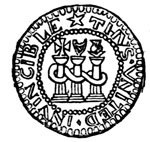
Copper. Farthing. Obverse, head as before, OLIVAR PRO ENG SC IRL. Reverse, shield as before, and legend CHARITIE AND CHANGE; another, three columns tied together, having on top of the first a cross, the second a harp, and the third a thistle, and the legend THVS VNITED INVINCIBLE; another, a ship under sail, and legend, AND GOD DIRECT OVR COVRS; another, CONVENIENT CHANGE.
CHARLES II. (1660 to 1685.)
Denominations.—Silver. First issue, Half-crown, Shilling, Sixpence, Half-groat, Penny. Second, same. Third, Half-crown, Shilling, Sixpence, Fourpence or Groat, Threepence, Half-groat, Penny. Fourth, Crown, Half-crown, Shilling, Sixpence. Gold. Broad or Twenty-shilling-piece, Half-broad or Ten-shilling-piece, Quarter-broad or Five-shilling-piece. Five-Guinea-piece, Two-guinea-piece, Guinea, Half-guinea. Copper. Halfpenny and Farthing. Tin. Farthing.
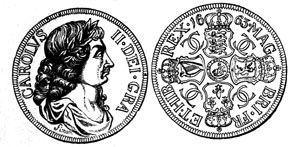
Obverse.—Type. Sinister laureated bust profile, crowned, loose drapery, hair long and flowing.
Legend. CAROLVS. II. D.G. (or DEI. GRA. or GRATIA). MAG. BRI. FRA. ET HIB. REX, or otherwise abbreviated. Reverse.—Type. The first three issues of coins bore a plain shield of arms, quarterly, 1 and 4 France and England quarterly, 2 Scotland, 3 Ireland, over a cross fleury. Those of the fourth and last issue bear four shields, with the bottoms joined, forming a cross; the shields being England, Scotland, France, and Ireland, each crowned; in the centre, within a star, St. George’s cross. Between the shields, in the four compartments, are two Cs interlinked. One Shilling has one shield of France and England, quarterly, two shields of Scotland, and one of Ireland, not crowned; between the shields are the interlinked Cs crowned. The Fourpence has a monogram of four Cs interlinked, in form of a cross, crowned; and in the compartments are severally a rose, a thistle, a fleur-de-lis, and a harp. The Threepence has three Cs interlinked; the Twopence two Cs interlinked; and the Penny a single C, all crowned; these denote the value; others have numerals crowned.
Legend. MAG. BR. FRA. ET HIB. REX., or otherwise abbreviated, and date. CHRISTO AVSPICE REGNO.
Edge. DECVS ET TVTAMEN ANNO XV or VICESIMO, or other year of reign.
Gold. Same type, sceptres between shields. Obverse: Bust, laureated and draped, with long hair. Reverse: First issue, arms, etc., as on silver; later issue, Five-guinea, Guinea, etc., four shields arranged as a cross, and each crowned; in the centre four Cs interlinked, from which issue four sceptres, terminating respectively in orb and cross, thistle, fleur-de-lis, and harp. Legend on reverses, FLORENT CONCORDIA REGNA, or titles. Edge, DECVS ET TVTAMEN, and year of reign as on the silver.
Copper. Halfpence and Farthings, sinister bust profile, laureated, in armour. English, CAROLVS A CAROLO. Scotch, CAR. II. D. G. SCO. AN. FR. ET HIB. R. Irish, CAROLVS II DEI GRATIA. Reverse, English, figure of Britannia, which now first appears; Irish, a harp crowned, date on field; Scotch, a thistle crowned. English, BRITANNIA, date in exergue; Irish, MAG. BR. FRA. ET. HIB. REX.; Scotch, NEMO ME IMPVNE LACESSET. and date; all common. Farthing with Britannia particularly so.
Tin or Pewter. Halfpence and Farthings, some with a plug of copper in the centre. On the edge, NVMMORVM FAMVLVS and date.
Siege pieces of Charles II., CAROLVS SECVNDVS, or CAROL. II. D.G. MAG. B. F. ET H. REX.; and on the reverse, C. R. under a crown; DVM SPIRO SPERO, or POST MORTEM PATRIS PRO FILIO were struck at Pontefract.
I may here mention a most splendid specimen of the die-sinker’s art, produced by Simon, the celebrated die-sinker, as a trial piece against an artist who was employed by Charles. The obverse has a bust of the king of most exquisite workmanship, and round the edge of the coin, in place of DECVS., etc., was this simple petition in two lines: “THOMAS. SIMON. most humbly prays your MAJESTY to compare this, his tryal piece, with the Dutch, and, if more truly drawn, and embossed, more gracefully ordered, and more accurately engraven, to relieve him.” At Trattle’s sale, in 1832, a very fine specimen sold for £225. It is said that only twenty copies were struck with the petition on the edge, and a few others with a different edge, REDDITE QVAE CAESARES CAESARI & POST; and one is recorded to be known bearing, RENDER TO CÆSAR THE THINGS WHICH ARE CÆSAR’S.
JAMES II. (1685 to 1689.)
Denominations.—Silver. Crown, Half-crown, Shilling, Sixpence, Fourpence, Threepence, Twopence, Penny. Gold. Five-guinea, Two-guinea, Guinea, Half-guinea. Tin or Pewter. Halfpenny, Farthing. Gun Money. As silver.
Obverse.—Type. Sinister bust profile, laureated, on some draped, on others undraped; hair long. The Crown has the king in armour on horseback, with drawn sword.
Legend. IACOBVS. II. DEI. GRATIA.
Reverse.—Type. Shields in cross, etc. The Fourpence, Threepence, Twopence, and Penny have the value, IIII., III., II., I., crowned.
Legend. MAG. BR. FRA. ET. HIB. REX. and date.
Edge. DECVS ET TVTAMEN REX, and year of reign.
Gun Money. Silver being scarce in this reign, an issue of base money was resorted to, some of which, being struck from the old cannon and domestic utensils melted down, is called “Gun Money.” The Crown, which is scarce, has the king in armour, laureated, on horseback, with a drawn sword, a long sash flying behind; reverse, four shields in cross, with the crown in the centre; the Half-crowns, Shillings, and Sixpences have two sceptres in saltire, behind a crown, between I. R.; above the crown are numerals for value, and beneath, the month in which it was struck. Gold. The Five-guinea-piece is rare, the others common. They are of the same general type as the silver.
Tin or Pewter. Halfpence and Farthings: obverse, bust profile, as before; reverse, English, figure of Britannia, BRITANNIA; Irish, figure of Hibernia with the harp, HIBERNIA, or Irish harp crowned. Half-farthings: obverse, sceptres in saltire, and crown; reverse, harp or rose, crowned. There is also a kind called plug-money; this was struck owing to a scarcity of copper; it is of pewter, and in the middle is inserted a very small square plug of copper, to show that it is intended to pass for copper money. One tin Halfpenny has the king on horseback with drawn sword, on the obverse, and on the reverse the harp surmounted by a crown with lion crest, and two sceptres in saltire; in this two or more plugs of brass are inserted. Other varieties need not be particularized. White metal coins were also issued.
WILLIAM III. AND MARY II. (1689 to 1702. 1689 to 1694.)
Denominations. Silver. Crown, Half-crown, Shilling, Sixpence, Fourpence, Threepence, Twopence, Penny. Gold. Five-guinea, Two-guinea, Guinea, Half-Guinea. Tin. Halfpenny, Farthing. Copper. Halfpenny, Farthing.
Obverse.—Type. Dexter busts profile of king and queen, (William and Mary) side by side, that of the king laureated, partly in armour. Queen draped, hair curled; some have the bust of Mary only; Fourpence, Threepence, Twopence, and Penny, busts undraped. After Mary’s death, the bust of William, profile and laureated, appears alone.
Legend. First, GVLIELMVS ET MARIA or GVLIELMVS ET MARIA DEI GRATIA. Later, GVLIELMVS TERTIVS. or GVLIELMVS III. DEI GRATIA.
Reverse.—Type. Four crowned shields in cross, as before; in the centre, the shield of Nassau; between the shields, W. and M. conjoined; the four figures of the date, as 1693, one under each monograph. Some Half-crowns have a plain shield of the royal arms, crowned; Fourpence, Threepence, Twopence, and Penny, values crowned. After the death of Mary, feathers on some, and on others roses, take the place of the monogram of W and M between the shields; on others the space is left blank.
Legend. MAG BR FRA ET HIB REX ET REGINA, or the same, leaving off “et regina.”
Edge. DECVS ET TVTAMEN and year of reign.
Gold. Busts as before; reverse, royal arms in large shield, crowned. After Mary’s death, reverse, shields in cross, with sceptres, as on the silver.
Copper. Halfpence and Farthings. Obverse, busts as before, GVLIELMVS ET MARIA, or GVLIELMVS TERTIVS. Reverse, figure of Britannia, BRITANNIA, date in exergue; Irish, GVLIELMVS ET MARIA DEI GRATIA; reverse, Irish harp crowned, MAG BR FR ET HIB REX ET REGINA, date on field. There are coins also, of Mary’s only, one of which has, on obverse, bust profile of queen, draped, hair turned up behind, MARIA II DEI GRATIA; reverse, full blown rose on a branch, EX CANDORE DECVS. After the queen’s death, the coins have the bust of William, as before, with GVLIELMVS TERTIVS; reverse, same as before. Scotch have, on obverse, a sword and sceptre in saltire, with a crown above: reverse, thistle, crowned; another has a monogram.
ANNE. (1702 to 1714.)
Denominations.—Silver. Crown, Half-crown, Shilling, Sixpence, Fourpence, Threepence, Twopence, Penny. Gold. Five-guinea, Two-guinea, Guinea, Half-guinea. Copper. Farthing.
Obverse.—Type. Sinister bust profile, draped, hair thrown back, and tied at back of head with a ribband, which passes round the head.
Legend. ANNA DEI GRATIA.
Reverse.—Type. Four crowned shields in cross. Before the union these shields were, 1 England, 2 Scotland, 3 France, 4 Ireland. After the union they were altered to two shields of England and Scotland impaled, one of France, and one of Ireland. In the centre, the cross of St. George, in a star of the garter; between the shields, feathers or roses, or feathers and roses alternately; Fourpence, Threepence, Twopence, and Penny, values, crowned.
Legend. MAG BRI FR ET HIB REG and date.
Edge. DECVS ET TVTAMEN, and year of reign.
Rarity. All common. The smaller denominations scarcer than the others.
Gold. Same type and legend and edge. Reverse, sceptres between the shields.
Copper. As there is so much popular error concerning the farthings, it may be well to remark at length upon them, in order to clear away the absurd idea generally entertained, of there being only three in existence. Instead of this being the case, there are absolutely six distinct varieties. The first, which is the only one which was ever in general circulation, has, on the obverse, sinister bust profile, of queen, draped, hair thrown back, encircled with a string of pearls, ANNA DEI GRATIA; reverse, figure of Britannia, olive branch in her right, and spear in her left hand, BRITANNIA, date, 1714, in exergue: this, although scarce, is by far the commonest of the whole: there is one with the same type, but broad rim, which is rare. Second, bust as before, ANNA REGINA; reverse, as last. Third, same bust, ANNA DEI GRATIA; reverse, figure of Britannia, right leg bare; BRITANNIA, 1713, round. Fourth, obverse as before; reverse, Britannia, as last, under an arch; BRITANNIA in exergue, 1713. Fifth, bust as before, with band instead of pearls, within an inner circle (the busts on the others are on the field); reverse, figure of Britannia standing, helmeted, in the right hand the olive branch, and in her left the spear, within inner circle; BELLO ET PACE; date 1715, in exergue. Sixth, bust as one, ANNA AVGVSTA; reverse, same figure as last, standing in a car, drawn by two horses; in her right hand she holds the olive branch, in her left the reins and a spear; PAX MISSA PER ORBEM; in exergue, 1713. The prices depend upon the state of preservation of the coins, but, for FINE ones, the following are about the values: 1, from six shillings to fourteen shillings; 2 and 3, from fifteen shillings to thirty shillings; 3, 4, and 6, from two to three pounds: 5, the rarest, from five to ten, or twelve pounds. There is a small medal, or counter, which is very frequently mistaken by the generality of persons for one of her farthings. It has on the obverse the bust, with ANNA DEI GRATIA; reverse, the four shields in cross, sometimes plain, and sometimes with roses between the shields, MAG BR FRA ET HIB REG 1711; frequently RIG instead of REG. Some of these are of beautiful workmanship, and others very rude: they are far from being scarce; they were not struck as current coins. Halfpenny, bust, ANNA D G MAG BR FR ET HIB REG; reverse, sitting figure of Britannia, leaning on a shield, in her left hand a spear, in her right a rose and thistle emanating from the same branch; the whole beneath a crown.
GEORGE I. (1714 to 1727.)
Denominations.—Silver. Crown, Half-crown, Shilling, Sixpence, Fourpence, Threepence, Twopence, Penny. Gold. Five-guinea, Two-guinea, Guinea, Half-guinea, Quarter-guinea. Copper. Halfpenny, Farthing.
Obverse.—Type. Dexter laureated bust profile, in armour and draped, hair long and curled.
Legend. GEORGIVS D. G. M. BR. FR. ET. HIB. REX. F. D.
Reverse.—Type. Four crowned shields in cross. 1, England and Scotland impaled; 2, France; 3, Ireland; 4, Brunswick, and Lunenberg with Hanoverian escutcheon. Between the shields, on some, are a rose and thistle or feathers alternately; on others, S. S. C. (South Sea Company, silver), etc., indicative of the kind of silver of which they are minted; in the centre is the star and cross of St. George. Fourpence, Threepence, Twopence, and Penny, values crowned.
Legend. BRVN. ET. L. DVX. S. R. I. A. TH. ET. EL., reading on from the obverse; thus, in full, “Georgius, Dei gratia, Magnæ Britanniæ Franciæ et Hiberniæ Rex, Fidei Defensor, Brunsvicensis et Lunenbergensis Dux, Sacri Romani Imperii Thesaurarius et Princeps Elector” (or Elector only), and date.
Edge. DECVS ET TVTAMEN, and year of reign.
Gold. Same general type and legend as the silver.
Copper. Halfpence and Farthings. Obverse, dexter bust profile, draped, laureated, GEORGIVS REX. Reverse, figure of Britannia, BRITANNIA, date in exergue. The Farthing has a broad rim. Obverse, Irish Halfpence, bust as before, undraped, GEORGIVS DEI GRATIA REX; reverse, figure of Hibernia, with harp, HIBERNIA; date in same line.
GEORGE II. (1727 to 1760.)
Denominations.—Silver. Crown, Half-crown, Shilling, Sixpence, Fourpence, Threepence, Twopence, Penny. Gold. Five-guinea, Two-guinea, Guinea, Half-guinea. Copper. Halfpenny, Farthing.
Obverse.—Type. Sinister laureated bust profile, in armour, hair long and curled; under the head of some is LIMA.
Legend. GEORGIVS II DEI GRATIA.
Reverse.—Type. Four crowned shields in cross as on those of George I. In the centre of some is the motto, HONI SOIT, etc., on the garter round the cross, as George I. On some, plain between the shields; on others, a rose and Welsh feathers alternately, four roses or four feathers, to denote the silver from which they are minted. Fourpence, Threepence, Twopence, and Penny, values, crowned.
Legend. M. B. F. ET. H. REX. F. D. B. ET. L. D. S. R. I. A. T. ET. E., as explained under George I., and date. Penny, MAG. BRI. FR. ET. HIB. REX., and date.
Gold. Bust, undraped, laureated; reverse, royal arms in an ornamented shield, crowned.
Copper. Halfpence and Farthings. Bust as before, laureated and in armour, GEORGIVS II REX.; reverse, figure of Britannia, BRITANNIA, date in exergue. Irish Halfpence and Farthings, same bust, undraped; reverse, Irish harp, crowned, HIBERNIA, and date.
GEORGE III. (1760 to 1820.)
Denominations.—Silver. Crown, Half-crown, Shilling, Sixpence, Fourpence, Threepence, Twopence, Penny. Gold. Guinea (21s.), Half-guinea (10s. 6d.), Third-of-guinea or Seven-shilling-piece (7s.), Quarter-of-guinea (5s. 3d.), Sovereign (20s.), Half-sovereign (10s.). Copper. Twopence, Penny, Halfpenny, Farthing.
Obverse.—Type. Early issues: dexter bust profile of king, in armour, laureated, hair long; on his later coinage, bust undraped, laureated, hair short.
Legend. Early: GEORGIVS III DEI GRATIA. Late: GEOR. (or GEORGIVS) III. D. G. BRITT. (or BRITANNIARVM) REX. F. D. (or FID. DEF.), etc. Later coinage has the date beneath the head.
Reverse.—Type. Early coinage: Four crowned or uncrowned shields in cross, as on coins of George I. and II.; the crowns in those instances where they do not surmount the shields, being placed in the angles between them. Later coinage: Crown, St. George and the Dragon within the mottoed garter, Half-crown, crowned shield of royal arms, within the garter, on which is the motto, HONI SOIT, etc.; quarterly, 1 and 4, England, 2, Scotland, 3, Ireland, Brunswick, etc., on an escutcheon surmounted by the electorate crown; the shield crowned; on another, round the garter, is the collar and badge of the order. Shillings, royal shield encircled by the garter, no legend; Fourpence, Threepence, Twopence, and Penny, values, either IIII. III. II. I., or in figures; one mintage, called wire-money, has the value in writing figures, all the lines of the same strength.
Legend. Early: M. B. F. ET. H. REX. F. D. B. ET. L. D. S. R. I. A. T. ET. E. and date. Late: BRITANNIARVM REX FID DEF or FIDEI DEFENSOR.
During great scarcity of silver money in 1797 Spanish dollars and half-dollars were countermarked with a small punch of the king’s head and put into circulation as current coin of the value of 4s. 9d. This stamp having been counterfeited to a considerable extent, a different one was adopted in 1804, but it in turn being much counterfeited, the whole dollar was re-stamped with a fresh octagonal device, the king’s head, etc., on the obverse, and on the reverse a figure of Britannia within an oval, crowned with a mural crown, and having the words BANK OF ENGLAND FIVE SHILLINGS DOLLAR, 1804. Bank of England tokens, value Six-shillings, Three-shillings, and other amounts, were also issued. Of these, and the Irish and Madras and other issues, I must forego particulars.
Gold. Obverse, bust laureated; reverse, Guinea, and Half-guinea, royal arms in a “spade ace” shield, crowned; Sovereign, George and Dragon within the garter; Half-sovereign, royal shield; Seven-shillings, a crown.
Copper. Early coinage: Halfpennies and Farthings, bust laureated and in armour, GEORGIVS III REX.; reverse, figure of Britannia, BRITANNIA and date; Irish, bust undraped; reverse, Irish harp crowned. 1797 and 1799, Twopence and Penny, with raised broad rim, on which is the legend, indented, bust profile, laureated, hair long, draped, GEORGIVS III DEI GRATIA REX; Farthing, date under head; reverse, Britannia, bareheaded, in the right hand an olive branch, in the left a trident; seated on a rock, shield under her left hand, BRITANNIA, in the distance a ship (the water cut up to the curve of the coin), date under figure. Halfpence and Farthings, same figure of Britannia, but without the broad rim; halfpenny, BRITANNIA, date under figure; Farthing, BRITANNIA, under figure, 1 FARTHING. In 1806-7, Pence, Halfpence, and Farthings, bust laureated and draped, hair short, GEORGIVS III. D. G. REX. and date. Britannia as before, water in a line across, BRITANNIA. Irish, harp, crowned, HIBERNIA, and date. A large variety of copper coins for the East India Company, Isle of Man, Prince of Wales Island, Sierra Leone, Barbadoes, Ceylon, etc., were struck, which need not be particularized.
GEORGE IV. (1820 to 1830.)
Denominations.—Silver. Crown, Half-crown, Shilling, Sixpence, Fourpence, Threepence, Twopence, Penny. Gold. Five-sovereign, Double-sovereign, Sovereign, Half-sovereign. Copper. Penny, Halfpenny, Farthing.
Obverse.—Type. Sinister large bust profile, laureated, undraped. In 1826 the bust differs, the neck and head are much narrower in proportion, and it is not laureated. These latter coins are the productions of Mr. Wyon, from the bust by Chantrey; the former ones are Pistrucci’s.
Legend. On the former, GEORGIVS IIII D. G. BRITANNIAR. F. D. Latter, GEORGIVS IV DEI GRATIA.
Reverse.—Type. Crown, St. George on horseback, undraped, helmeted, loose vest flying behind, in his right hand a dagger, his left holding the reins; under the horse, a dragon, a broken lance lying beside, no legend, date in exergue, edge, DECUS, etc. This coin is of most beautiful workmanship. Half-crown, early, royal arms; on some in plain square shield, crowned, encircled by the garter, with motto, HONI, etc., or ornamented shield, crowned, a rose beneath, and a thistle on one side, and on the other a shamrock, no legend; date on the former, with ANNO.; later, royal shield, beautifully mantled.
Early, Shilling and Sixpence as the Half-crowns; later, royal crown and crest, a lion passant-guardant, crowned; beneath is the rose, thistle and shamrock. This is commonly known as the “lion shilling.”
Legend. Later, BRITANNIARVM REX FIDEI DEFENSOR.
Gold. Five-pound-piece, Double-sovereign, Sovereign, and Half-sovereign, bust as before; reverse, George and dragon; or royal shield.
Copper. Pennies, Halfpennies, and Farthings; early, bust profile, laureated, draped or undraped; Pence and Halfpence, GEORGIVS IV DG REX.; Farthings, GEORGIVS IIII DEI GRATIA; Pence and Halfpence; Irish, harp, crowned, HIBERNIA. and date; Farthing, Britannia seated on a rock, facing the right, helmeted, in her left hand the trident, in her right, which rests on the shield, an olive branch, lion at her feet, no water in distance, date in exergue; later, Pence, Halfpence, and Farthings, Britannia seated helmeted, left hand the trident, right resting on shield, no olive branch, nor lion, beneath the figure, the rose, thistle, and shamrock, BRITANNIAR REX FID. DEF. A Half-farthing for Ceylon, and a one third of a Farthing, for Malta, were struck in 1827-8, and are rare.
WILLIAM IV. (1830 to 1837.)
Denominations.—Silver. Crown, Half-crown, Shilling, Sixpence, Groat or Fourpence, Threepence, Twopence, Penny, Three-halfpence. Gold. Double-sovereign, Sovereign, Half-sovereign. Copper. Penny, Halfpenny, Farthing.
Obverse.—Type. Dexter bust profile, undraped, hair short.
Legend. GVLIELMVS IIII D. G. BRITANNIAR. REX F. D.
Reverse.—Type. Half-crown, ermine robe surmounted by the crown, tied at the corners with cord and tassels, on the robe are the royal arms in a plain square shield, beneath which is the collar and badge of the Order of the Garter; dated with the word ANNO.; Shilling and Sixpence, within a wreath formed by branches of olive and oak is the value, ONE SHILLING.—SIXPENCE. in two lines, a crown above, beneath the wreath the date; Fourpence, figure of Britannia, FOUR PENCE, date in exergue. Maundy money, value, crowned, within a wreath of oak branches.
Gold. All the same bust as on the silver. Five-pound-piece, a pattern piece only; Double-sovereign, with arms, with mantle, garter, and crown; Sovereign, Half-sovereign, bust as before; reverse, royal arms in ornamental shield.
Copper. Pence, Halfpence, and Farthings, bust as before, date under the head, GULIELMUS IIII DEI GRATIA; reverse, Britannia, as last coinage of George IV.; beneath the figure, rose, thistle, and shamrock, BRITANNIAR REX. FID. DEF. Several colonial and other coins were also struck in silver and copper.
VICTORIA. (1837.)
Denominations.—Silver. Crown, Half-crown, Florin or Two-shilling piece, Shilling, Sixpence, Groat or Fourpence, Threepence, Twopence, Penny. Gold. Five-pound-piece, Double-sovereign or Two-pound-piece, Sovereign, Half-sovereign. Copper. Penny, Halfpenny, Farthing, Half-farthing. Bronze. Penny, Halfpenny, and Farthing.
Obverse.—Type. Crown and Half-crown. Sinister bust profile of the queen, undraped, round the head two plain bands, hair parted on the forehead, carried over the top of the ear, and all gathered together at the back of the head. The Half-crown has the fore hair plaited immediately before it joins the back hair. None of these have been issued for home currency since 1851. Florin. Sinister bust profile of the queen, crowned with an open arched crown, elegantly draped over the shoulders. Shilling, Sixpence, etc., bust same as Half-crown.
Legend. Crown and Half-crown, VICTORIA DEI GRATIA. Date under the head. Florin, first issue, VICTORIA REGINA, 1849; later issue, Victoria: d: g: britt: reg: f: d: and date as mdccclxviii. Shilling and sixpence, VICTORIA DEI GRATIA BRITANNIAR REG. F. D. Fourpence and Maundy money, VICTORIA D. G. BRITANNIAR. REGINA F. D.
Reverse.—Type. Crown and Half-crown, royal arms quarterly, 1 and 4, England, 2, Scotland, 3, Ireland, shield plain, crowned, within a wreath formed of two olive branches tied together at the bottom by a ribband; beneath the shield, the rose, thistle, and shamrock. Florin, first issue, in a tressure of eight arches, whose cusps have trefoil terminations, within the inner circle, four crowned shields arranged as a cross, first and third England, second Scotland, fourth Ireland. In the centre a rose; the crowns extending through the legend to the outside edge of the coin. In the four angles are, respectively, two roses, a thistle and a shamrock. Later issues, similar to the other, with a trefoiled quatrefoil instead of rose in the centre. Shilling and Sixpence; value in two lines, within a wreath formed of a branch of olive and an oak branch tied together with a ribband, above the value the royal crown, beneath the wreath the date. Fourpence, figure of Britannia seated, helmeted, in her left hand the trident, her right resting on the shield, date in exergue. Maundy money, value, crowned, within a wreath of oak branches and date.
Legend. Crown and Half-crown, BRITANNIARVM REGINA FID. DEF. Florin, first issue, ONE FLORIN ONE TENTH OF A POUND; later issues, One florin one tenth of a pound. Shilling and Sixpence, the words ONE SHILLING, and SIXPENCE, within the wreath of laurel and oak, beneath which is the date. Fourpence, FOUR PENCE. Threepence, figure 3 crowned.
The most beautiful of our modern coins is a Crown-piece struck in 1847, from dies engraved by Wyon. It is in somewhat low relief, and bears on the obverse an exquisite profile portrait of the queen, to the left, filling up the entire diameter of the coin. Her Majesty wears an open four-arched crown; the hair, being plaited, is brought down below the ear, and fastened at the back of the head; shoulders and bosom draped with delicate and elaborately ornamented lace, pearls, and jewels, the portion of the robe visible being diapered with roses, thistles, and shamrocks in lozenges. Legend. Victoria dei gratia britanniar. reg: f: d. Reverse: within the inner circle four shields (two England, one Scotland, one Ireland), arranged as a cross, within a tressure of eight arches; each shield crowned, the crowns extending through the legend and to extremity of the coin. In the centre the star of the Order of the Garter, and in the angles between the shields, which are diapered, a rose twice repeated, a thistle, and a shamrock; the spandrils and the cusps trefoiled. Legend, tueatur unita deus anno dom. mdcccxlvii. Round the edge decus· et· tutamen· anno· regni· undecim. This, usually known as the “gothic crown,” was not put in circulation.
Gold. Sovereign, and Half-sovereign; obverse, same bust as the silver, VICTORIA DEI GRATIA, and date; reverse, Sovereign, royal arms, as the Half-crown; later issues, St. George and the Dragon as on those of George IV., and date; Half-sovereign, royal shield as before, without the wreath, mantled, crowned, BRITANNIARVM REGINA FID. DEF.
Copper. Farthings; obverse, same as Sovereign; reverse, figure of Britannia, as before, with the rose, thistle, and shamrock beneath, BRITANNIAR REG. FID. DEF.; Half and Quarter-farthings have also been struck for the colonies to supersede the use of cowries.
Bronze. Obverse: beautifully laureated profile bust of the queen, hair tied behind, draped over the shoulders; the portrait filling up the diameter of the coin; legend, VICTORIA D: G: BRITT: REG: F: D: Reverse: figure of Britannia, helmeted and draped, holding a trident in her left hand, and her right resting on a shield of the union; in the distance, on one side, the Eddystone Lighthouse, on the other a ship in full sail. Legend: ONE PENNY, date in exergue, 1860, et seq. A large number of pattern pieces for coins of various values, and in all the metals, have at one time or other during this reign been prepared and struck, and are of the highest interest for the cabinets of collectors.