Volume 1 — CHAPTER I. THE ENGLAND OF HENRY I. 1100–1135.
Reading edition
“When the green tree, cut asunder in the midst and severed by the space of three furlongs, shall be grafted in again and shall bring forth flowers and fruit,—then at last may England hope to see the end of her sorrows.”[1]
So closed the prophecy in which the dying king Eadward the Confessor foretold the destiny in store for his country after his departure. His words, mocked at by one of the listeners, incomprehensible to all, found an easy interpretation a hundred years later. The green tree of the West-Saxon monarchy had fallen beneath Duke William’s battle-axe; three alien reigns had parted its surviving branch from the stem; the marriage of Henry I. with a princess of the old English blood-royal had grafted it in again.[2] One flower sprung from that union had indeed bloomed only to die ere it reached its prime,[3] but another had brought forth the promised fruit; and the dim ideal of national prosperity and union which English and Normans alike associated with the revered name of the Confessor was growing at last into a real and living thing beneath the sceptre of Henry Fitz-Empress.
There are, at first glance, few stranger things in history than the revival thus prefigured:—a national revival growing up, as it seems, in the most adverse circumstances, under the pressure of an alien government, of a race of kings who were strangers alike to the men of old English blood and to the descendants of those who had come over with the Conqueror: at a time when, in a merely political point of view, England seemed to be not only conquered but altogether swallowed up in the vast and varied dominions of the house of Anjou. It was indeed not the first time that the island had become an appendage to a foreign empire compared with which she was but a speck in the ocean. Cnut the Dane was, like Henry of Anjou, not only king of England but also ruler of a great continental monarchy far exceeding England in extent, and forming together with her a dominion only to be equalled, if equalled at all, by that of the Emperor. But the parallel goes no farther. Cnut’s first kingdom, the prize of his youthful valour, was his centre and his home, of which his Scandinavian realms, even his native Denmark, were mere dependencies. Whatever he might be when he revisited them, in his island-kingdom he was an Englishman among Englishmen. The heir of Geoffrey of Anjou and Matilda of Normandy, on the other hand, was virtually of no nationality, no country; but if he could be said to have a home at all, it was certainly not on this side of the sea—it was the little marchland of his fathers. In the case of his sons, the southern blood of their mother Eleanor added a yet more un-English element; and of Richard, indeed, it might almost be said that the home of his choice was not in Europe at all, but in Holy Land. Alike to him and to his father, England was simply the possession which gave them their highest title, furnished them with resources for prosecuting their schemes of continental policy, and secured to them a safe refuge on which to fall back in moments of difficulty or danger. It was not till the work of revival was completed, till it had resulted in the creation of the new England which comes to light with Edward I., that it could find a representative and a leader in the king himself. The sovereign in whose reign the chief part of the work was done stood utterly aloof from it in sympathy; yet he is in fact its central figure and its most important actor. The story of England’s developement from the break-down of the Norman system under Stephen to the consolidation of a national monarchy under Edward I. is the story of Henry of Anjou, of his work and of its results. But as the story does not end with Henry, so neither does it begin with him. It is impossible to understand Henry himself without knowing something of the race from which he sprang; of those wonderful Angevin counts who, beginning as rulers of a tiny under-fief of the duchy of France, grew into a sovereign house extending its sway from one end of Christendom to the other. It is impossible to understand his work without knowing something of what England was, and how she came to be what she was, when the young count of Anjou was called to wear her crown.
The project of an empire such as that which Henry II. actually wielded had been the last dream of William Rufus. In the summer of 1100 the duke of Aquitaine, about to join the Crusaders in Holy Land, offered his dominions in pledge to the king of England. Rufus clutched at the offer “like a lion at his prey.”[4] Five years before he had received the Norman duchy on the same terms from his brother Robert; he had bridled its restless people and brought them under control; he had won back its southern dependency, his father’s first conquest, the county of Maine. Had this new scheme been realized, nothing but the little Angevin march would have broken the continuity of a Norman dominion stretching from the Forth to the Pyrenees, and in all likelihood the story of the Angevin kings would never have had to be told. Jesting after his wont with his hunting-companions, William—so the story goes—declared that he would keep his next Christmas feast at Poitiers, if he should live so long.[5] But that same evening the Red King lay dead in the New Forest, and his territories fell asunder at once. Robert of Normandy came back from Palestine in triumph to resume possession of his duchy; while the barons of England, without waiting for his return, chose his English-born brother Henry for their king.
Thirteen years before, at his father’s death, Henry, the only child of William and Matilda who was actually born in the purple—the child of a crowned king and queen, born on English soil, and thus by birth, though not by descent, entitled to rank as an English Ætheling—had been launched into the world at the age of nineteen without a foot of land that he could call his own. The story went that he had complained bitterly to the dying Conqueror of his exclusion from all share in the family heritage. “Have patience, boy,” was William’s answer, “let thine elder brothers go before thee; the day will come when thou shalt be greater than either of them.” Henry was, however, not left a penniless adventurer dependent on the bounty of his brothers; the Conqueror gave him a legacy of ten thousand pounds as a solid provision wherewith to begin his career. A year had scarcely passed before Duke Robert, overwhelmed with troubles in Normandy, found himself at his wits’ end with an empty treasury, and besought Henry to lend him some money. The Ætheling, as cool and calculating as his brothers were impetuous, refused; the duke in desperation offered to sell him any territory he chose, and a bargain was struck whereby Henry received, for the sum of three thousand pounds, the investiture of the Cotentin, the Avranchin, and the Mont-St.-Michel—in a word, the whole western end of the Norman duchy.[6] Next summer, while the duke was planning an attempt on the English crown and vainly awaiting a fair wind to enable him to cross the Channel, the count of the Cotentin managed to get across without one, to claim the estates in Gloucestershire formerly held by his mother and destined for him by his father’s will. He was received by William Rufus only too graciously, for the consequence was that some mischief-makers, always specially plentiful at the Norman court, persuaded Duke Robert that his youngest brother was plotting against him with the second, and when Henry returned in the autumn he had no sooner landed than he was seized and cast into prison.[7] Within a year he was free again, reinstated, if not in the Cotentin, at least in the Avranchin and the Mont-St.-Michel, and entrusted with the keeping of Rouen itself against the traitors stirred up by the Red King. William, while his young brother was safe in prison, had resumed the Gloucestershire estates and made them over to his favourite Robert Fitz-Hamon. Henry in his natural resentment threw himself with all his energies into the cause of the duke of Normandy, acted as his trustiest and bravest supporter throughout the war with Rufus which followed, and at the close of the year crowned his services by the promptitude and valour with which he defeated a conspiracy for betraying the Norman capital to the king of England.[8] The struggle ended in a treaty between the elder brothers, in which neither of them forgot the youngest. Their remembrance of him took the shape of an agreement to drive him out of all his territories and divide the spoil between themselves. Their joint attack soon brought him to bay in his mightiest stronghold, the rock crowned by the abbey of S. Michael-in-Peril-of-the-Sea, commonly called Mont-Saint-Michel. Henry threw himself into the place with as many knights as were willing to share the adventure; the brethren of the abbey did their utmost to help, and for fifteen days the little garrison, perched on their inaccessible rock, held out against their besiegers.[9] Then hunger began to thin their ranks; nothing but the inconsistent generosity of Robert saved them from the worse agonies of thirst;[10] one by one they dropped away, till Henry saw that he must yield to fate, abide by his father’s counsel, and wait patiently for better days. He surrendered; he came down from the Mount, once again a landless and homeless man; and save for one strange momentary appearance in England as a guest at the Red King’s court,[11] he spent the greater part of the next two years in France and the Vexin, wandering from one refuge to another with a lowly train of one knight, three squires, and one chaplain.[12] He was at length recalled by the townsmen of Domfront, who, goaded to desperation by the oppressions of their lord Robert of Bellême, threw off his yoke and besought Henry to come and take upon himself the duty of defending them, their town and castle, against their former tyrant. “By the help of God and the suffrages of his friends,” as his admiring historian says,[13] Henry was thus placed in command of his father’s earliest conquest, the key of Normandy and Maine, a fortress scarcely less mighty and of far greater political importance than that from which he had been driven. He naturally used his opportunity for reprisals, not only upon Robert of Bellême, but also upon his own brothers;[14] and by the end of two years he had made himself of so much consequence in the duchy that William Rufus, again at war with the duke, thought it time to secure his alliance. The two younger brothers met in England, and when Henry returned in the spring of 1095 he came as the liegeman of the English king, sworn to fight his battles and further his interests in Normandy by every means in his power.[15]
William and Henry had both learned by experience that to work with Robert for any political purpose was hopeless, and that their true interest was to support each other—William’s, to enlist for his own service Henry’s clear cool head and steady hand; Henry’s, to secure for himself some kind of footing in the land where his ultimate ambitions could not fail to be centred. He had learned in his wanderings to adapt himself to all circumstances and all kinds of society; personally, he and Rufus can have had little in common except their passion for the chase. Lanfranc’s teaching, moral and intellectual, had been all alike thrown away upon his pupil William the Red. Henry, carefully educated according to his father’s special desire, had early shown a remarkable aptitude for study, was a scholar of very fair attainments as scholarship went among laymen in his day, and retained his literary tastes not only through all his youthful trials but also through the crowd of political and domestic cares which pressed upon his later life. Yet such tastes seem almost as strange in Henry as they would in William Rufus. The one prosaic element in the story of Henry’s youth is the personality of its hero. No man had ever less of the romantic or poetic temperament; if he had none of the follies or the faults of chivalry, he had just as little of its nobler idealism. From his first bargain with Robert for the purchase of the Cotentin to his last bargain with Fulk of Anjou for the marriage of his heir, life was to him simply a matter of business. The strongest points in his character were precisely the two qualities which both his brothers utterly lacked—self-control, and that “capacity for taking trouble” which is sometimes said to be the chief element of genius. But of the higher kind of genius, of the fire which kindles in the soul rather than merely in the brain, Henry had not a spark. He was essentially a man of business, in the widest and loftiest sense of the words. His self-control was not, like his father’s, the curb forcibly put by a noble mind upon its own natural impetuosity; it was the more easily-practised calmness of a perfectly cold nature which could always be reasonable because it had to fight with no impulse of passion, which was never tempted to “follow wandering fires” because they lit in it no responsive flame; a nature in which the head had complete mastery over the heart, and that head was one which no misfortunes could disturb, no successes turn, and no perplexities confuse.
The sudden vacancy of the English throne found every one else quite unprepared for such an emergency. Henry was never unprepared. His quickness and decision secured him the keys of the treasury and the formal election of those barons and prelates who had been members of the fatal hunting-party, or who hurried to Winchester at the tidings of its tragic issue; and before opposition had time to come to a head, it was checked by the coronation and unction which turned the king-elect into full king.[16] Henry knew well, however, that opposition there was certain to be. Robert of Normandy, just returned from the Crusade and covered with glory, was sure to assert his claim, and as sure to be upheld by a strong party among the barons, to whom a fresh severance of England and Normandy was clearly not desirable. In anticipation of the coming struggle, Henry threw himself at once on the support of his subjects. In addition to the pledges of his coronation-oath—taken almost in the words of Æthelred to Dunstan[17]—he issued on the same day a charter in which he solemnly and specifically promised the abolition of his brother’s evil customs in Church and state, and a return to just government according to the law of the land. The details were drawn up so as to touch all classes. The Church, as including them all, of course stood first; its freedom was restored and all sale or farming of benefices renounced by the king. The next clause appealed specially to the feudal vassals: those who held their lands “by the hauberk”—the tenants by knight-service—were exempted from all other imposts on their demesne lands, that they might be the better able to fulfil their own particular obligation. The tenants-in-chief were exempted from all the unjust exactions with regard to wardships, marriages, reliefs and forfeitures, which had been practised in the last reign; but the redress was not confined to them; they were distinctly required to exercise the same justice towards their own under-tenants. The last clause covered all the rest: by it Henry gave back to his people “the laws of King Eadward as amended by King William.”[18] Like Cnut’s renewal of the law of Eadgar—like Eadward’s own renewal of the law of Cnut—the charter was a proclamation of general reunion and goodwill. As a pledge of its sincerity, the Red King’s minister, Ralf Flambard, in popular estimation the author of all the late misdoings, was at once cast into the Tower;[19] the exiled primate was fetched home as speedily as possible; and in November the king identified himself still more closely with the land of his birth by taking to wife a maiden of the old English blood-royal, Eadgyth of Scotland, great-granddaughter of Eadmund Ironside.[20]
His precautions were soon justified. Robert had refused the thorny crown of Jerusalem, but the crown of England had far other charms; and his movements were quickened by Ralf Flambard, who early in the spring made his escape to Normandy.[21] It was probably through Ralf’s management that the duke won over some of the sailors who guarded the English coast and thus got ashore unexpectedly at Portsmouth while the king was keeping watch for him at the old landing-place, Pevensey.[22] At the first tidings of the intended invasion Henry, like Rufus in the same case thirteen years before, had appealed to Witan and people, and by a renewal of his charter gained a renewal of their fealty. No sooner, however, was Robert actually in England than the great majority of the barons prepared to go over to him in a body. But the king born on English soil, married to a lady of the old kingly house, had a stronger hold than ever Rufus could have had upon the English people; and they, headed by their natural leader and representative, the restored archbishop of Canterbury, clave to him with unswerving loyalty.[23] The two armies met near Alton;[24] at the last moment, the wisdom either of Anselm, of the few loyal barons, or of Henry himself, turned the meeting into a peaceful one. The brothers came to terms: Robert renounced his claim to the crown in consideration of a yearly pension from England; Henry gave up all his Norman possessions except Domfront, whose people he refused to forsake;[25] and, as in the treaty made at Caen ten years before between Robert and William, it was arranged that whichever brother lived longest should inherit the other’s dominions, if the deceased left no lawful heirs.[26]
The treaty was ratified at Winchester in the first days of August;[27] and thus, almost on the anniversary of the Red King’s death, ended the last Norman invasion of England. But the treaty of Winchester, like that of Caen, failed to settle the real difficulty. That difficulty was, how to control the barons. According to one version of the treaty, it was stipulated that those who had incurred forfeiture in England by their adherence to Robert and those who had done the same in Normandy in Henry’s behalf should alike go unpunished;[28] according to another, perhaps a more probable account, the brothers agreed to co-operate in punishing traitors on both sides.[29] Henry set to work to do his part methodically. One after another, at different times, in various ways, by regular process of law, the offenders were brought to justice in England: some heavily fined, some deprived of their honours and exiled. It was treason not so much against himself as against the peace and order of the realm that Henry was bent upon avenging; Ivo of Grantmesnil was fined to the verge of ruin for the crime of making war not upon the king in behalf of the duke, but upon his own neighbours for his own personal gratification—a crime which was part of the daily life of every baron in Normandy, but which had never been seen in England before,[30] and never was seen there again as long as King Henry lived. The most formidable of all the troublers of the land was Henry’s old enemy at Domfront—Robert, lord of Bellême in the border-land of Perche, earl of Shrewsbury and Arundel in England, count of Alençon and lord of Montgomery in Normandy, and now by his marriage count of Ponthieu. Robert was actually fortifying his castles of Bridgenorth and Arundel in preparation for open revolt when he was summoned to take his trial on forty-five charges of treason against the king of England and the duke of Normandy. As he failed to answer, Henry led his troops to the siege of Bridgenorth. In three weeks it surrendered; Shrewsbury and Arundel did the same, and Robert of Bellême was glad to purchase safety for life and limb at the cost of all his English possessions.[31]
From that moment Henry’s position in England was secured; but all his remonstrances failed to make his indolent elder brother fulfil his part of their compact. The traitors whom Henry expelled from England only carried their treason over sea to a more congenial climate, and the helpless, heedless duke looked passively on while Robert of Bellême, William of Mortain the banished earl of Cornwall, and their fellows slaked their thirst for vengeance upon King Henry by ravaging the Norman lands of those who were faithful to him in England.[32] Their victims, as well as Henry himself, began to see that his personal intervention alone could re-establish order in the duchy. On his appearance there in 1104 he was joined by all the more reasonable among the barons. For the moment he was pacified by fresh promises of amendment on Robert’s part, and by the cession of the county of Evreux; but he knew that all compromise had become vain; and in the last week of Lent 1105 he landed again at Barfleur in the full determination of making himself master of Normandy. His Norman partisans rallied round him at once,[33] and he was soon joined by two valuable allies, Elias count of Maine and his intended son-in-law, the young count Geoffrey of Anjou.[34] It was they who won for Henry his first success, the capture of Bayeux.[35] Warned by the fate of this unhappy city, which was burnt down, churches and all, Caen surrendered at once, and Henry thus came into possession of the Norman treasury. A siege of Falaise failed through the unexplained departure of Count Elias,[36] and the war dragged slowly on till Henry, now busy in another quarter with negotiations for the return of S. Anselm, went back at Michaelmas to England. Thither he was followed first by Robert of Bellême, then by Robert of Normandy,[37] both seeking for peace; but peace had become impossible now. Next summer Henry was again in Normandy, reconciled to S. Anselm, released from anxieties at home, free to concentrate all his energies upon the final struggle. It was decided with one blow. As he was besieging the castle of Tinchebray on Michaelmas Eve Duke Robert at the head of all his forces approached and summoned him to raise the siege. He refused, “preferring,” as he said, “to take the blame of a more than civil war for the sake of future peace.” But when the two hosts were drawn up face to face, the prospect of a battle seemed too horrible to be endured, composed as they were of kinsmen and brothers, fathers and sons, arrayed against each other. The clergy besought Henry to stay his hand; he listened, pondered, and at length sent a final message to his brother. He came, he said, not wishing to deprive Robert of his duchy or to win territories for himself, but to answer the cry of the distressed and deliver Normandy from the misrule of one who was duke only in name. Here then was his last proposition: “Give up to me half the land of Normandy, the castles and the administration of justice and government throughout the whole, and receive the value of the other half annually from my treasury in England. Thus you may enjoy pleasure and feasting to your heart’s content, while I will take upon me the labours of government, and guarantee the fulfilment of my pledge, if you will but keep quiet.” Foolish to the last, Robert declined the offer; and the two armies made themselves ready for battle.[38] In point of numbers they seem to have been not unequally matched, but they differed greatly in character. Robert was stronger in footsoldiers, Henry in knights; the flower of the Norman nobility was on his side now, besides his Angevin, Cenomannian and Breton allies;[39] while of those who followed Robert some, as the issue proved, were only half-hearted. Of Henry’s genuine English troops there is no account, but the men of his own day looked upon his whole host as English in contradistinction to Robert’s Normans, and the tactics adopted in the battle were thoroughly English. The king of England fought on foot with his whole army, and it seems that the duke of Normandy followed his example.[40]
The first line of the Norman or ducal host under William of Mortain charged the English front under Ralf of Bayeux, and by the fury of their onset compelled them to fall back, though without breaking their ranks. The issue was still doubtful, when the only mounted division of Henry’s troops, the Bretons and Cenomannians under Count Elias, came up to the rescue, took the duke’s army in flank, and cut down two hundred men in a single charge. Those Cenomannian swords which William the Conqueror was so proud to have overcome now carried the day for his youngest son. Robert of Bellême, as soon as he saw how matters were going, fled with all his followers, and the duke’s army at once dissolved.[41] In Henry’s own words, “the Divine Mercy gave into my hands, without much slaughter on our side, the duke of Normandy, the count of Mortain, William Crispin, William Ferrers, Robert of Estouteville, some four hundred knights, ten thousand foot—and the duchy of Normandy.”[42]
Forty years before, on the very same day, William the Conqueror had landed at Pevensey to bring the English kingdom under the Norman yoke. The work of Michaelmas Eve, 1066, was reversed on Michaelmas Eve, 1106; the victory of Tinchebray made Normandy a dependency of England.[43] Such was the view taken by one of the most clear-sighted and unprejudiced historians of the time, a man of mingled Norman and English blood. Such was evidently the view instinctively taken by all parties, and the instinct was a true one, although at first glance it seems somewhat hard to account for. The reign of Henry I., if judged merely by the facts which strike the eye in the chronicles of the time, looks like one continued course of foreign policy and foreign warfare pursued by the king for his own personal ends at the expense of his English subjects. But the real meaning of the facts lies deeper. The comment of the archbishop of Rouen upon Henry’s death—“Peace be to his soul, for he ever loved peace”[44]—was neither sarcasm nor flattery. Henry did love peace, so well that he spent his life in fighting for it. His early Norman campaigns are enough to prove that without being a master of the art of war like his father, he was yet a brave soldier and a skilful commander; and the complicated wars of his later years, when over and over again he had to struggle almost single-handed against France, Flanders and Anjou, amid the endless treasons of his own barons, show still more clearly his superiority to nearly all the other generals of his time. But his ambitions were not those of the warrior. Some gleam of the old northman’s joy of battle may have flashed across the wandering knight as he defied his besiegers from the summit of his rock “in Peril of the Sea,” or swooped down upon the turbulent lords of the Cenomannian border, like an eagle upon lesser birds of prey, from his eyrie on the crest of Domfront; but the victor of Tinchebray looked at his campaigns in another light. To him they were simply a part of his general business as a king; they were means to an end, and that end was not glory, nor even gain, but the establishment of peace and order. In his thirteen years of wandering to and fro between England, Normandy and France he had probably studied all the phases of tyranny and anarchy which the three countries amply displayed, and matured his own theory of government, which he practised steadily to the end of his reign. That theory was not a very lofty or noble one; the principle from which it started and the end at which it aimed was the interest of the ruler rather than of the ruled; but the form in which Henry conceived that end and the means whereby he sought to compass it were at any rate more enlightened than those of his predecessor. The Red King had reigned wholly by terror; Henry did not aspire to rule by love; but he saw that, in a merely selfish point of view, a sovereign gains nothing by making himself a terror to any except evil-doers, that the surest basis for his authority is the preservation of order, justice and peace, and that so far at least the interests of king and people must be one. It is difficult to get rid of a feeling that Henry enforced justice and order from motives of expediency rather than of abstract righteousness. But, as a matter of fact, he did enforce them all round, on earl and churl, clerk and layman, Norman and Englishman, without distinction. And this steady, equal government was rendered possible only by the determined struggle which he waged with the Norman barons and their French allies. His home policy and his foreign policy were inseparably connected; and the lifelong battle which he fought with his continental foes was really the battle of England’s freedom.
From the year 1103 onward the battle was fought wholly on the other side of the Channel. In England Henry, as his English subjects joyfully told him, became a free king on the day when he drove out Robert of Bellême.[45] One great hindrance indeed still remained, hanging upon him like a dead weight throughout his early struggles in Normandy; the controversy concerning ecclesiastical investitures, with which the rest of Europe had been aflame for a quarter of a century before it touched England at all. The decree of the Lateran Council of 1075 forbidding lay sovereigns to grant the investiture of any spiritual office with ring and staff was completely ignored in practice by William the Conqueror and Lanfranc. Their position on this and all other matters of Church policy was summed up in their reply to Pope Gregory’s demand of fealty: William would do what the English kings who went before him had done, neither more nor less.[46] But the king and the primate were not without perceiving that, as a necessary consequence of their own acts, the English Church had entered upon a new and more complicated relation both to the state and to the Apostolic see, and that the day must shortly come when she would be dragged from her quiet anchorage into the whirlpool of European controversies and strifes. Their forebodings found expression in the three famous rules of ecclesiastical policy which William laid down for the guidance of his successors rather than himself:—that no Pope should be acknowledged in England and no letter from him received there by any one without the king’s consent;—that no Church council should put forth decrees without his permission and approval;—and that no baron or servant of the crown should be laid under ecclesiastical censure save at the king’s own command.[47] These rules, famous in the two succeeding reigns under the name of “paternal customs,” were never put to the test of practice as long as William and Lanfranc lived. The Red King’s abuse of the two first, by precipitating the crisis and driving S. Anselm to throw himself into the arms of Rome, showed not so much their inadequacy as the justice of the misgivings from which they had sprung. Henry at his accession took his stand upon them in the true spirit of their author; but the time was gone by; Anselm too had taken his stand upon ground whence in honour and conscience he could not recede, and the very first interview between king and primate threw open the whole question of the investitures. But in England and in the Empire the question wore two very different aspects. In England it never became a matter of active interest or violent partisanship in the Church and the nation at large. Only a few deep thinkers on either side—men such as Count Robert of Meulan among the advisers of the king, perhaps such as the devoted English secretary Eadmer among the intimate associates of Anselm—ever understood or considered the principles involved in the case, or its bearing upon the general system of Church and state. Anselm himself stood throughout not upon the abstract wrongfulness of lay investiture, but upon his own duty of obedience to the decree of the Lateran Council; he strove not for the privileges of his order, but for the duties of his conscience. The bishops who refused investiture at Henry’s hands clearly acted in the same spirit; what held them back was not so much loyalty to the Pope as loyalty to their own metropolitan. The great mass of both clergy and laity cared nothing at all how the investitures were given, and very little for papal decrees; all they cared about was that they should not be again deprived of their archbishop, and left, as they had already been left too long, like sheep without a shepherd. In their eyes the dispute was a personal one between king and primate, stirred up by Satan to keep the English Church in misery.
In the manner in which it was conducted on both sides, the case compares no less favourably with its continental parallel and with the later contest in England of which it was the forerunner, and for which, in some respects, it unquestionably furnished a model, though that model was very ill followed. For two years the dispute made absolutely no difference in the general working of the Church; Anselm was in full enjoyment of his canonical and constitutional rights as primate of all Britain; he ruled his suffragans, held his councils, superintended the restoration of his cathedral church, and laboured at the reform of discipline, with Henry’s full concurrence; and the clergy, with the archbishop at their head, were the life and soul of the party whose loyalty saved the king in his struggle with the barons. Even when Anselm’s position in England had become untenable, he went over sea in full possession of his property, as the king’s honoured friend and spiritual father. Not till Henry was provoked by a papal excommunication of all the upholders of the obnoxious “paternal customs” except himself, did he seize the temporalities of the archbishopric; and even then Anselm, from his Burgundian retreat, continued in active and unrestrained correspondence with his chapter and suffragans, and in friendly communication not only with Queen Matilda, but even with the king himself. And when at last the archbishop who had gone down on his knees to the Pope to save William Rufus from excommunication threatened to put forth that very sentence against William’s far less guilty brother, he was only, like Henry himself in Normandy at the same moment, preparing his most terrible weapon of war as the surest means of obtaining peace. Henry’s tact warned him, too, that the time for a settlement was come, and the sincerity of his motives enabled him to strike out a line of compromise which both parties could accept without sacrificing their own dignity or the principles for which they were contending. The English king and primate managed to attain in seven years of quiet decorous negotiation, without disturbing the peace or tarnishing the honour of either Church or crown, the end to which Pope and Emperor only came after half a century of tumult, bloodshed and disgrace; the island-pontiff who “loved righteousness and hated iniquity,” instead of “dying in exile” like his Roman brother, came home to end his days in triumph on the chair of S. Augustine. The settlement made little or no practical difference as far as its immediate object was concerned. Henry ceased to confer the spiritual insignia; but the elections, held as of old in the royal court, were as much under his control as before. He yielded the form and kept the substance; the definite concession of the bishops’ homage for their temporalities fully compensated for the renunciation of the ceremonial investiture. But the other side, too, had gained something more than a mere form. It had won a great victory for freedom by bringing Henry to admit that there were departments of national life which lay beyond the sphere of his kingly despotism. It had, moreover, gained a distinct practical acknowledgement of the right of the Apostolic Curia to act as the supreme court of appeal in ecclesiastical causes, like the Curia Regis in secular matters. In a word, the settlement indicated plainly that the system of William and Lanfranc was doomed to break down before long. It broke down utterly when Anselm and Henry were gone; the complications of legatine intervention, avoided only by careful management in Henry’s later years, led to the most important results in the next reign; and when the slumbering feud of sceptre and crozier broke out again, the difference between the cool Norman temper and the fiery blood of Anjou, between the saintly self-effacement of Anselm and the lofty self-assertion of Thomas, was only one of the causes which gave it such an increase of virulence as brought to nought the endeavours of king and primate to tread in the steps of those whom they professed to have taken for their examples.
Of more direct and wide-reaching importance, but less easy to trace, is the working of Henry’s policy in the temporal government of England. Like his Church policy, with which it was in strict accord, it was grounded upon definite and consistent principles. At the outset of his reign circumstances had at once compelled the king to throw himself upon the support of his English subjects and enabled him to find in them his surest source of strength. Personally, his sympathies were not a whit more English or less despotic than those of his predecessor; but, unlike Rufus, he fairly accepted his position with all its consequences so far as he understood them, and throughout his reign he never altogether forsook the standpoint which he had taken at its beginning. That standpoint, as expressed in his coronation-charter, was “the law of King Eadward as amended by King William.” In other words, Henry pledged himself to carry out his father’s system of compromise and amalgamation, to take up and continue his father’s work; and as soon as his hands were free he set himself to fulfil the pledge. But the scheme whose first outlines had been sketched by the Conqueror’s master-hand had to be wrought out under conditions which had changed considerably since his death and were changing yet farther every day. The great ecclesiastical question was only the first and most prominent among a crowd of social and political problems whose shadows William had at the utmost only seen dimly looming in the future, but which confronted Henry as present facts that he must grapple with as best he could. At their theoretical, systematic solution he made little or no attempt; the time was not yet ripe, nor was he the man for such work. He was neither a great legislator nor an original political thinker, but a clear-headed, sagacious, practical man of business. Such a man was precisely the ruler needed at the moment. His reign is not one of the marked eras of English history; compared with the age which had gone before and that which came after it, the age of Henry I. looks almost like a “day of small things.” That very phrase, which seems so aptly to describe its outward aspect, warns us not to despise or pass it over lightly. It is just one of those periods of transition without which the marked eras would never be. Henry’s mission was to prepare the way for the work of his grandson by completing that of his father.
The work was no longer where his father had left it. When the secular side of the Norman government in England, somewhat obscured for a while by the ecclesiastical conflict, comes into distinct view again after the settlement of 1107, one is almost startled at the amount of developement which has taken place in the twenty years since the Conqueror’s death—a developement whose steps lie hidden beneath the shadows of the Red King’s tyranny and of Henry’s early struggles. The power of the crown had outgrown even the nominal restraints preserved from the older system: the king’s authority was almost unlimited, even in theory; the Great Council, the successor and representative of the Witenagemot, had lost all share in the real work of legislation and government; of the old formula—“counsel and consent”—the first half had become an empty phrase and the second a mere matter of course. The assembly was a court rather than a council, the qualification of its members, whether earls, barons, or knights, being all alike dependent on their position as tenants-in-chief of the crown; the bishops alone kept their unaltered dignity as lineal successors of the older spiritual Witan; but even the bishops had been compelled by the compromise of 1107 to hold their temporalities on the baronial tenure of homage and fealty to the king, a step which involved the strict application of the same rule to the lay members of the assembly. Moreover, the Witenagemot was being gradually supplanted in all its more important functions by an inner circle of counsellors, forming a permanent ministerial body which gathered into its own hands the entire management of the financial and judicial administration of the state. In one aspect it was the “Curia Regis” or King’s Court, the supreme court of judicature which appropriated alike the judicial powers of the Witenagemot, of the old court of the king’s thegns or theningmanna-gemot, and of the feudal court of the Norman tenants-in-chief. In another aspect it was the Exchequer, the court which received the royal revenues from the sheriffs of the counties, arranged and reviewed the taxation, transacted the whole fiscal business of the crown, and in short had the supreme control and management of the “ways and means” of the realm. The judicial, military and social organization under the Norman kings rests so completely on a fiscal basis that the working of the Exchequer furnishes the principal means of studying that of the whole system; while the connexion between the functions of the Exchequer and those of the Curia Regis is so close that it is often difficult to draw a line accurately between them, and all the more so, that they were made up of nearly the same constituent elements. These were the great officers of the royal household:—the justiciar, the treasurer, the chancellor, the constable, the marshal, and their subordinates:—titles of various origin, some, as for example the chancellor, being of comparatively recent origin, while others seem to have existed almost from time immemorial;—but all titles whose holders, from being mere personal attendants upon the sovereign, had now become important officials of the state. Like a crowd of other matters which first come distinctly to light under Henry, the system seems to have grown up as it were in the dark during the reign of William Rufus, no doubt under the hands of Ralf Flambard. At its head stood the justiciar;—second in authority to the king in his presence, his representative and vicegerent in his absence, officially as well as actually his chief minister and the unquestioned executor of his will. This office, of which the germs may perhaps be traced as far back as the time of Ælfred, who acted as “secundarius” under his brother Æthelred I., was directly derived from that which Æthelred II. had instituted under the title of high-thegn or high-reeve, and which grew into a permanent vice-royalty in the persons of Godwine and Harold under Cnut and Eadward, and of Ralf Flambard under William Rufus. Ralf himself, a clerk from Bayeux, who from the position of an obscure dependent in the Conqueror’s household had made his way by the intriguing, pushing, unscrupulous temper which had earned him his nickname of the “Firebrand,” was an upstart whom the barons of the Conquest may well have despised as much as the native English feared and hated him. After an interval during which his office was held by Robert Bloet, bishop of Lincoln—a former chancellor of the Red King—it passed to a man who from beginnings almost as lowly as those of Ralf rose to yet loftier and, it is but fair to add, purer fame. Henry in his wandering youth, as he rode out from Caen one morning with a few young companions, stopped to hear mass at a little wayside chapel. The poor priest who served it, guessing by their looks the temper of his unexpected congregation, rattled through the office with a speed which delighted them; they all pronounced him just the man for a soldier’s chaplain; Henry enlisted him as such, and soon found that he had picked up a treasure. Roger became his steward, and discharged his functions with such care, fidelity and good management as earned him the entire confidence of his master.[48] Soon after Henry’s accession he was appointed chancellor, a post whose duties involved, besides the official custody of the royal seal, the superintendence of the clerks of the king’s chapel or chancery, who were charged with the keeping of the royal accounts, the conducting of the royal correspondence, the drawing up of writs and other legal documents and records, and who were now formed into a trained and organized body serving as secretaries for all departments of state business. From 1101 to 1106 this office seems to have been held successively by Roger, William Giffard, and Waldric; Roger probably resumed it in 1106 on Waldric’s elevation to the bishopric of Laon, but if so he resigned it again next year, to become bishop of Salisbury and justiciar.[49]
Henry’s justiciar-bishop was the type of a class. The impossibility of governing England securely by means of feudal machinery, even with all the checks and safeguards which could be drawn from the old English administrative system, had by this time become self-evident. The conduct of the barons had at once proved to Henry the necessity and given him the justification for superseding them in all the more important functions of government, by carrying out, with a free and strong hand, the scheme which Æthelred II. had originated under less favourable circumstances—the organization of a distinct ministerial body, directly dependent upon the crown. Of this body the model, as well as the head, was the bishop of Salisbury. Under his direction there grew up a trained body of administrators, most of them clerks like himself, several being his own near relatives, and almost all upstarts—novi homines, “new men” in the phrase of the time—compared with the nobles whose fathers had come over with the Conqueror; forming a sort of official caste, separate alike from the feudal nobility and from the mass of the people, and no doubt equally obnoxious to both, but very much better fitted than any instruments which either could have furnished for managing the business of the state at that particular crisis. Over and above the obloquy which naturally fell upon them as the instruments of royal justice or royal extortion, there was, however, another cause for the jealousy with which they were generally regarded. Henry is charged with showing, more especially in his later years, a preference for foreigners which was equally galling to all his native subjects, whatever their descent might be.[50] It was not that he set Normans over Englishmen, but that he set men of continental birth over both alike. The words “Norman” and “English” had in fact acquired a new meaning since the days of the Conquest. The sons and grandsons of the men who had come over with Duke William never lost one spark of their Norman pride of race; but the land of their fathers was no longer their home; most of them were born in England, some had English wives, and even English mothers; to nearly all, the chief territorial, political and personal interests of their lives were centred in the island. The constant wars between the Conqueror’s successors tended still further to sever the Normans of the duchy from those of the kingdom, and to drive the latter to unite themselves, at least politically, with their English fellow-subjects. Already in the wars of Rufus and Robert the change of feeling shows itself in the altered use of names; the appellations “Norman” and “French” are reserved exclusively for the duke and his allies, and the supporters of the king of England are all counted together indiscriminately as English. Tinchebray is distinctly reckoned as an English victory. From that moment Normandy was regarded, both by its conquerors and by its French neighbours, as a foreign dependency of the English crown. Historians on both sides of the sea, as they narrate the wars between Henry and Louis of France which arose out of that conquest, unconsciously shadow forth the truth that the reunion of England and Normandy really tended to widen the gulf between them. The greatest French statesman of the day, Suger, abbot of S. Denis, sets the relation between the two nationalities in the most striking light when he justifies the efforts of his own sovereign Louis to drive Henry out of the duchy on the express ground that “Englishmen ought not to rule over Frenchmen, nor French over English.”[51] One of our best authorities on the other side, the son of a Frenchman from Orléans who had come in the train of Roger of Montgomery and married an English wife—though he spent his whole life, from the age of ten years, in the Norman monastery of Saint-Evroul, never ceased to regard his mother’s country as his own, showed his love for it in the most touching expressions of remembrance, and took care to send forth his history to the world under the name of Orderic the Englishman. This last was no doubt a somewhat extreme case. Still the fusion between the two races had clearly begun; it was helped on directly by Henry’s whole policy, by the impartial character of his internal administration, by the nature and circumstances of his relations with his chief continental neighbours, France and Anjou; indirectly it was helped on by the sense of a common grievance in the promotion of “strangers”—men born beyond sea—over the heads of both alike. Slight as were the bonds between them at present, they were the first links of a chain which grew stronger year by year; and the king’s last and grandest stroke of policy, the marriage of his daughter and destined successor with the count of Anjou, did more than anything else to quicken the fusion of the two races by driving them to unite against sovereigns who were equally aliens from both.
Roger’s great work as justiciar was the organization of the Exchequer. Twice every year the barons of the Exchequer met under his presidency around the chequered table whence they derived their name, and settled accounts with the sheriffs of the counties. As the sheriffs were answerable for the entire revenue due to the crown from their respective shires, the settlement amounted to a thorough review of the financial condition of the realm. The profits of the demesne lands and of the judicial proceedings in the shire-court, now commuted at a fixed sum under the title of “ferm of the shire”; the land-tax, or as it was still called, the Danegeld, also compounded for at a definite rate; the so-called “aids” which in the case of the towns seem to have corresponded to the Danegeld in the rural districts; the feudal sources of income, reliefs, wardships, marriage-dues, escheats; the profits arising out of the strict and cruel forest-law, the one grievance of his predecessor’s rule which Henry had from the beginning refused to redress; all these and many other items found their places in the exhaustive proceedings of King Henry’s court of Exchequer. Hand in hand with its financial work went the judicial work of the Curia Regis: a court in theory comprehending the whole body of tenants-in-chief, but in practice limited to the great officers of the household and others specially appointed by the king, and acting under him, or under the chief justiciar as his representative, as a supreme tribunal of appeal, and also of first resort in suits between tenants-in-chief and in a variety of other cases called up by special writ for its immediate cognisance. It had moreover the power of acting directly upon the lower courts in another way. The assessment of taxes was still based upon the Domesday survey; but transfers of land, changes in cultivation, the reclaiming of wastes on the one hand and the creation of new forests on the other, necessarily raised questions which called for an occasional revision and readjustment of taxation. This was effected by sending the judges of the King’s Court—who were only the barons of the Exchequer in another capacity—on judicial circuits throughout the country, to hold the pleas of the crown and settle disputed points of assessment and tenure in the several shires. As the justices thus employed held their sittings in the shire-moot, the local and the central judicature were thus brought into immediate connexion with each other, and the first stepping-stone was laid towards bridging over the gap which severed the lower from the higher organization.
By the establishment of a careful and elaborate administrative routine Henry and Roger thus succeeded in binding together all branches of public business and all classes of society in intimate connexion with and entire dependence on the crown, through the medium of the Curia Regis and the Exchequer. The system stands portrayed at full length in the Dialogue in which Bishop Roger’s great-nephew expounded the constitution and functions of the fully developed Court of Exchequer; its working in Roger’s own day is vividly illustrated in the one surviving record which has come down to us from that time, the earliest extant of the “Pipe Rolls” (so called from their shape) in which the annual statement of accounts was embodied by the treasurer. The value of this solitary roll of Henry I.—that of the year 1130—lies less in the dry bones of the actual financial statement than in the mass of personal detail with which they are clothed, and through which we get such an insight as nothing else can afford into the social condition of the time. The first impression likely to be produced by the document is that under Henry I. and Roger of Salisbury—“the Lion of Justice” and “the Sword of Righteousness”—every possible contingency of human life was somehow turned into a matter of money for the benefit of the royal treasury. It must, however, be remembered that except the Danegeld, there was no direct taxation; the only means, therefore, of making up a budget at all was by the feudal levies and miscellaneous incidents; and these were no longer, as in the Red King’s days, instruments of unlimited extortion, but were calculated according to a regular and fairly equitable scale, subject to frequent modification under special circumstances. Still the items look strange enough. We see men paying to get into office and paying to get out of it; heirs paying for the right to enter upon their inheritance; would-be guardians paying that they may administer the estates of minors; suitors paying for leave to marry heiresses or dowered widows; heiresses and widows paying for freedom to wed the man of their own choice. The remittances are not always in money; several of the king’s debtors sent coursing-dogs or destriers; one has promised a number of falcons, and there are some amusingly minute stipulations as to their colour.[52] There is an endless string of land-owners, great and small, paying for all sorts of privileges connected with their property; some for leave to make an exchange of land with a neighbour, some to cancel an exchange already made; some to procure the speedy determination of a suit with a rival claimant of their estates, some on the contrary to delay or avoid answering such a claim, and some for having themselves put forth claims which they were unable to prove; the winner pays for his success, the loser for failing to make good his case; the treasury gains both ways. Jewish usurers pay for the king’s help in recovering their debts from his Christian subjects.[53] The citizens of Gloucester promise thirty marks of silver if the king’s justice can get back for them a sum of money “which was taken away from them in Ireland.”[54] This last-quoted entry brings us at once to another class of items, perhaps the most interesting of all; those which relate to the growing liberties of the towns.
The English towns differed completely in their origin and history from those of the states which had arisen out of the ruins of the Roman Empire. The great cities of Italy and Gaul were daughters of Rome; they were the abiding depositaries of her social, municipal and political traditions; as such, they had a vitality and a character which, like their great mistress and model, they were able to preserve through all the changes of barbarian conquest and feudal reorganization. The English towns had no such imperial past; in their origin and earliest constitution they were absolutely undistinguishable from the general crowd of little rural settlements throughout the country. Here and there, for one reason or another, some particular spot attracted an unusually large concourse of inhabitants; but whether sheltered within the walls of a Roman military encampment like Winchester and York, or planted on the top of an almost immemorial hill-fort like Old Sarum, or gathered in later days round some fortress raised for defence against the Welsh or the Danes like Taunton or Warwick, or round some venerated shrine like Beverley or Malmesbury or Oxford, still the settlement differed in nothing but its size from the most insignificant little group of rustic homesteads which sent its reeve and four men to the court of the hundred and the shire. The borough was nothing more than an unusually large township, generally provided with a dyke and palisade, or sometimes even a wall, instead of the ordinary quickset hedge; or it was a cluster of townships which had somehow coalesced, but without in any way forming an organic whole. Each unit of the group had its own parish church and parochial machinery for both spiritual and temporal purposes, its own assembly for transacting its own internal affairs; while the general borough-moot, in a town of this kind, answered roughly to the hundred-court of the rural districts, and the character of the borough-constitution itself resembled that of the hundred rather than that of the single township. The earlier and greater towns must have been originally free; a few still retain in their common lands a vestige of their early freedom. But the later towns which grew up around the hall of a powerful noble, or a great and wealthy monastery, were dependent from the first upon the lord of the soil on which they stood; their inhabitants owed suit and service to the earl, the bishop, or the abbot, whichever he might chance to be, and their reeve was appointed by him. On the other hand, when it became a recognized principle that everybody must have a lord, and that all folkland belonged to the king, it followed as a natural inference that all towns which had no other lord were counted as royal demesnes, and their chief magistrate was an officer of the crown. In the great cities he usually bore the title of port-reeve, a word whose first syllable, though here used to represent the town in general, refers in strict etymology to the porta, or place where the market was held, and thus at once points to the element in the life of the towns which gave them their chief consequence and their most distinctive character. The Norman conquest had led to a great increase of their trading importance; a sense of corporate life and unity grew up within them; their political position became more clearly defined; they began to recognize themselves, and to win their recognition at the hands of the ruling powers, as a separate element in the state. The distinction was definitely marked by the severance of their financial interests from those of the shires in which they stood; a fixed “aid,” varying according to their size and wealth, was substituted in their case for the theoretically even, but practically very unfair pressure of the Danegeld; and to avoid all risk of extortion on the part of the sheriff, their contribution to the ferm of the shire was settled at a fixed round sum deducted from the total and accounted for as a separate item, under the name of firma burgi, either by the sheriff or, in some cases where the privilege had been specially conferred, by the towns themselves. At the same time the voluntary institution of the gilds, which had long acted as a supplement to the loose territorial and legal constitution of the boroughs, forced its way into greater prominence; the merchant-gilds made their appearance no longer as mere private associations, but as legally organized bodies endowed with authority over all matters connected with trade in the great mercantile cities; the recognition of their legal status—generally expressed by the confirmation of the right to possess a “gild-hall” (or, as it was called in the north, a “hans-house”)—became a main point in the struggles of the towns for privileges and charters. The handicraftsmen, fired with the same spirit of association, banded themselves together in like manner; the weavers of London, Huntingdon and Lincoln, the leather-sellers and weavers of Oxford, bought of the crown in 1130 a formal confirmation of the customs of their respective gilds.[55] The lesser towns followed, as well as they could, the example of the great cities; they too won from their lords a formal assurance of their privileges; Archbishop Thurstan’s charter to Beverley was expressly modelled on that granted by King Henry to York.[56]
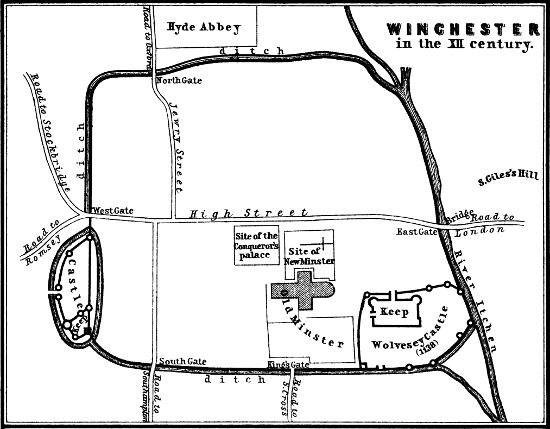
Plan I.
Wagner & Debes’ Geogˡ. Estabᵗ. Leipsic.
London, Macmillan & Co.
We may glance at some of the towns of southern England in company with some travellers from Gaul who visited them in the later years of Henry’s reign. The cathedral church of Laon had been burnt down and its bishop Waldric slain in a civic tumult in 1112. Waldric had once been chancellor to King Henry,[57] and the reports which he and others had brought to Laon of the wealth and prosperity of the island[58] led some of the canons, after perambulating northern Gaul to collect donations for the restoration of their church, to venture beyond sea for the same object. They set sail from Wissant—seemingly in an English ship, for its captain bore the English-sounding name of Coldistan—in company with some Flemish merchants who were going to buy wool in England, and they landed at Dover after a narrow escape from some pirates who chased their vessel in the hope of seizing the money which it was known to contain.[59] They naturally made their way to Canterbury first, to enlist the sympathies of the archbishop and his chapter, as well as those of the scarcely less wealthy and powerful abbey of S. Augustine.[60] Thence they apparently proceeded to Winchester.[61] The old West-Saxon capital had lost its ancient rank; London, which had long surpassed it in commercial and political importance, had now superseded it as the crowning-place and abode of kings. But its connexion with the crown was far from being broken. Its proximity to the New Forest made it a favourite residence of the Conqueror and his sons; William himself had built not only a castle on the high ground at the western end of the city, just below the west gate of the Roman enclosure, but also a palace in its south-eastern quarter, hard by the cathedral and the New Minster; it was here that he usually held his Easter court, and his successors continued the practice. One very important department of the royal administration, moreover, was still permanently centred at Winchester—the Treasury, which under its English title of the “Hoard” had been settled there by Eadward the Confessor, and which seems not to have been finally transferred to Westminster till late in the reign of Henry II.[62] Of the two great religious foundations, one, the “Old Minster,” or cathedral church of S. Swithun, the crowning-place and burial-place of our native kings, assumed under the hands of its first Norman bishop the aspect which, outwardly at least, it still retains. The other, the “New Minster,” so strangely placed by Ælfred close beside the old one, had incurred William’s wrath by the deeds of its abbot and some of its monks who fought and fell at Senlac; to punish the brotherhood, he planted his palace close against the west front of their church; and they found their position so intolerable that in 1111, by Henry’s leave, they migrated outside the northern boundary of Winchester to a new abode which grew into a wealthy and flourishing house under the name of Hyde Abbey, leaving their old home to fall into decay and to be represented in modern days by a quiet graveyard.[63] As a trading centre Winchester ranked in Henry’s day, and long after, second to London alone; the yearly fair which within living memory was held on S. Giles’s day upon the great hill to the east of the city[64] preserved a faint reminiscence of the vast crowds of buyers and sellers who flocked thither from all parts of the country throughout the middle ages.
At the opposite end of the New Forest the little town of Twinham, or Christchurch as it was beginning to be called from its great ecclesiastical establishment, whose church had been rebuilt on a grand scale by Ralf Flambard, had, on the octave of Pentecost, a fair which the travellers took care to attend, much to the disgust of the dean, who was anxious to secure all the offerings of the assembled crowd for the improvement of his own church, and had no mind to share them with our Lady of Laon.[65] They met with a warmer welcome at Exeter at the hands of its archdeacon and future bishop Robert.[66] In the next reign Exeter was counted as the fourth city in the kingdom.[67] Natural wealth of its own it had none; the bare rocky soil of the south coast of Devon produced nothing but a few oats, and those of the poorest quality;[68] but the mouth of the Exe furnished a safe and convenient anchorage for small merchant vessels either from Gaul or from Ireland, and though Bristol was fast drawing away this latter branch of her trade, Exeter could still boast of “such an abundance of merchandise that nothing required for the use of man could ever be asked for there in vain.”[69] It was far otherwise with Salisbury, to which the travellers were probably drawn chiefly by the fame of its bishop;[70] the Salisbury of those days was not the city in the plain which now spreads itself around the most perfect of English Gothic minsters, but the city whose traces, in a very dry summer, may still now and then be seen in the fields which cover the hill of Old Sarum. Crowded as it was into that narrow circle—narrow, and without possibility of enlargement—Bishop Roger’s Salisbury was an excellent post for military security, but it had no chance of attaining industrial or commercial importance, although he did not disdain to accept the grant of its market tolls, which till 1130 formed part of the ferm of Wilton.[71] Wilton was apparently still the chief town of the shire to which it had originally given its name; like Christchurch it had its fair, but, like Christchurch too, its importance was mainly derived from its abbey, where the memory of S. Eadgyth or Edith, a daughter of Eadgar, was venerated by English and Normans alike, by none more than the queen who shared Eadgyth’s royal blood and had once borne her name.[72] The visitors from Laon, however, seem to have been more impressed by another name which one is somewhat startled to meet in this southern region—that of Bæda, whose tomb was shown them in the abbey church of Wilton, and was believed to be the scene of miraculous cures.[73] They retraced their steps into Devonshire, where they found the legends of Arthur as rife among the people as they were among the Bretons of Gaul; they were shown the chair and oven of the “blameless king,” and a tumult nearly arose at Bodmin out of a dispute between one of their party and a man who persisted in asserting that Arthur was still alive.[74] After visiting Barnstaple and Totnes[75] they turned northward towards the greatest seaport of the west, and indeed, with one exception, of all England: Bristol.
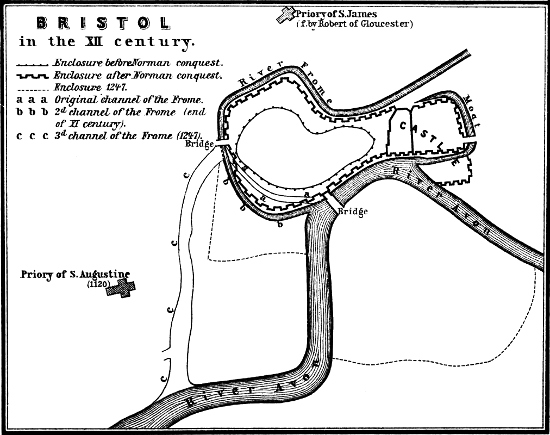
Plan II.
Wagner & Debes’ Geogˡ. Estabᵗ. Leipsic.
London, Macmillan & Co.
To trace out the Bristol of the twelfth century in the Bristol of to-day is a matter of difficulty not only from the enormous growth of the town, but from the changes which have taken place in the physical conformation of its site. Nominally, it still stands on the peninsula formed by the junction of the Frome and the Avon; but the courses of both rivers have been so altered and disguised that the earlier aspect of the place is very hard to realize. The original Bristol stood wholly upon the high ground which now forms the neck of the peninsula, then a small tongue of land surrounded on the south-east by the Avon, on the north, west and south by the Frome, which flowed round it almost in the form of a horse-shoe and fell into the Avon on the southern side of the town, just below the present Bristol Bridge.[76] Before the Norman conquest, it seems, the lower course of the Frome had already been diverted from its natural bed;[77] its present channel was not dug till the middle of the thirteenth century, across a wide expanse of marsh stretching all along the right bank of both rivers, and flooded every day by the tide which came rushing up the estuary of Severn almost to the walls of the town, and made it seem like an island in the sea.[78] Within its comparatively narrow limits Bristol must have been in general character and aspect not unlike what it is to-day—a busy, bustling, closely-packed city, full of the eager, active, surging life of commercial enterprise. Ostmen from Waterford and Dublin, Northmen from the Western Isles and the more distant Orkneys, and even from Norway itself, had long ago learnt to avoid the shock of the “Higra,” the mighty current which still kept its heathen name derived from the sea-god of their forefathers,[79] and make it serve to float them into the safe and commodious harbour of Bristol, where a thousand ships could ride at anchor.[80] As the great trading centre of the west Bristol ranked as the third city in the kingdom,[81] surpassed in importance only by Winchester and London. The most lucrative branch of its trade, however, reflects no credit on its burghers. All the eloquence of S. Wulfstan and all the sternness of the Conqueror had barely availed to check for a while their practice of kidnapping men for the Irish slave-market; and that the traffic was again in full career in the latter years of Henry I. we learn from the experiences of the canons of Laon. They eagerly went on board some of the vessels in the harbour to buy some clothes, and to inspect the strange wares brought from lands which can have had little or no intercourse with the inland cities of Gaul. On their return they were solemnly implored by their friends in the city not to run such a risk again, as they would most likely find the ships suddenly put to sea and themselves sold into bondage in a foreign land.[82]
No such dangers awaited them at Bath. With their reception there by the bishop[83]—whom the healing virtues of its waters had induced first to remove his bishopstool thither from its lowlier seat at Wells, and then to buy the whole city of King Henry for the sum of five hundred pounds[84]—their itinerary comes to an abrupt end. If they penetrated no further up the Severn valley than Bristol they turned back from the gates of a region which was then reckoned the fairest and wealthiest in England. The vale of Gloucester is described as a sort of earthly paradise, where the soil brought forth of its own accord the most abundant and choicest fruits, where from one year’s end to another the trees were never bare, where the apples hung within reach of the traveller’s hand as he walked along the roads;—above all, where the fruit of the vine, which in other parts of England was mostly sour, yielded a juice scarcely inferior to the wines of Gaul. Another source of wealth was supplied by the fisheries of the great river, the fertilizer as well as the highway of this favoured district. Religion and industry, abbeys and towns, grew and flourished by Severn-side.[85] Worcester was still the head of the diocese; but in political rank it had had to give way to Gloucester. Standing lower down the river, Gloucester was more accessible for trade, while its special importance as the key of the South-Welsh border had made it one of the recognized places for assemblies of the court from the time of the Danish kings. The chief town of the neighbouring valley of the Wye, Hereford, had once been a border-post of yet greater importance; but despite its castle and its bishop’s see, it was now a city “of no great size,” whose broken-down ramparts told the story of a greatness which had passed away.[86]
Far different was the case of Chester. What the estuary of the Severn was to the southern part of western England, that of the Dee was to its northern part; Chester was at once the Bristol and the Gloucester of the north-west coast—the centre of its trade and its bulwark against the Welsh. Beyond the Dee there was as yet little sign of industrial life. Cultivation had made little or no progress among the moorland and forest-tracts of western Yorkshire, and its eastern half had not yet recovered from the harrying with which the Conqueror had avenged its revolt in 1068. For more than sixty miles around York the ground still lay perfectly bare. “Cities whose walls once rose up to heaven—tracts that were once well watered, smiling meadows—if a stranger sees them now, he groans; if a former inhabitant could see them, he would not recognize his home.” The one thing which had survived this ruin was, as ever, the work of the Roman.[87] York still kept its unbroken life, its ecclesiastical primacy, its commercial greatness; the privileges of its merchants were secured by a charter from the king; they had their gild with its “alderman” at its head,[88] their “hans-house” for the making of bye-laws and the transaction of all gild business; and they were freed from all tolls throughout the shire.[89] Far to the north-west, on the Scottish border, Carlisle, after more than two centuries of ruin, had been restored and repeopled by William Rufus. The city had been destroyed by the Danes in 875, and its site remained utterly desolate till in 1092 the Red King drove out an English thegn who occupied it under the protection of Malcolm of Scotland, and reunited it to the English realm.[90] The place still kept some material relics of its earlier past; fragments of its Roman walls were still there, to be used up again in the new fortifications with which the Red King encircled his conquest; and some years later the triclinium of one of its Roman houses called forth the admiring wonder of a southern visitor, William of Malmesbury.[91] But the city and the surrounding country lay almost void of inhabitants, and only the expedient of a colony sent by Rufus from southern England, “to dwell in the land and till it,”[92] brought the beginnings of a new life. Yet before the end of Henry’s reign, that life had grown so vigorous that the archbishop of York found himself unable to make adequate provision for its spiritual needs, and was glad to sanction the formation of Carlisle and its district into a separate diocese.
The chief importance of Carlisle was in its military character, as an outpost of defence against the Scots. On the opposite coast we see springing up, around a fortress originally built for the same purpose, the beginning of an industrial community at Newcastle-upon-Tyne. The “customs” of the town contain provisions for the regulation of both inland and outland trade; if a merchant vessel put in at the mouth of the Tyne, the burghers may buy what they will; if a dispute arise between one of them and a foreign merchant, it must be settled before the tide has ebbed thrice; the foreign trader may carry his wares ashore for sale, except salt and herrings, which must be sold on board the ship. No merchant, save a burgher, may buy wool, hides, or any other merchandise outside the town, nor within it, except from burghers; and no one but a burgher may buy, make, or cut cloth for dyeing.[93] Round the minster of S. John of Beverley, on the marshy flats of Holderness, there had grown up a town of sufficient consequence to win from the lord of the soil, Archbishop Thurstan of York, a charter whose privileges were copied from those of the metropolitan city itself. As a whole, however, the north was still a wild region, speaking a tongue of which, as William of Malmesbury complained, “we southrons could make nothing,” and living a life so unconnected with that of southern England that even King Henry still thought it needful to reinforce his ordinary body-guard with a troop of auxiliaries whenever he crossed the Humber.[94]
This isolation was in great part due to physical causes. What is now the busy West Riding was then mainly a vast tract of moor and woodland, stretching from Wakefield to the Peak and from the Westmoreland hills to the sources of the Don; while further east, the district between the lower course of the Don and that of the Trent was one wide morass. Such obstacles were still strong enough to hinder, though not to bar, the intercourse of Yorkshire with mid-England. The only safe line of communication was the Foss Way, which struck across the central plain and along the eastern side of the Trent valley to Lincoln, and thence turned north-westward to cross the Trent and wind round between forest and fen to York. Lincoln was thus the chief station on the highway between York and the south. Under the Norman rule the city had risen to a new importance. Two of its quarters had been entirely transformed; the south-western was now covered by a castle, and the south-eastern by a cathedral church. Neither building was the first of its kind which had occupied the spot. Few sites in England could have been more attractive to a soldier’s eye than the crest of the limestone ridge descending abruptly to the south into a shallow sort of basin, watered by the little river Witham, and on the west sloping gradually down to a broad alluvial swamp extending as far as the bank of the Trent. The hundred and sixty-six houses which the Conqueror swept away to make room for his castle[95] were but encroachments on an earlier fortification, a “work” of mounds and earthen ramparts of the usual old English type, which now served as a foundation for his walls of stone.[96] To the ardent imagination of the medieval Church, on the other hand, the rocky brow of Lincoln might well seem to cry out for a holier crown, and a church of S. Mary was already in existence[97] on the site where Bishop Remigius of Dorchester, forsaking his lowly home in the valley of the Thames, reared his bishopstool amid the foundations of that great minster of our Lady whose noble group of towers now rises on the crest of the hill as a beacon to all the country round.[98] But there were other reasons for the translation of the bishopric than those of sentiment or of personal taste. Of the vast Mid-Anglian diocese, which stretched from the Thames to the Humber, Lincoln was beyond all comparison the most important town. Even in Roman times the original quadrangular enclosure of Lindum Colonia had been found too small, and a fortified suburb had spread down to the left bank of the Witham. During the years of peace which lasted from the accession of Cnut to that of William, the needs of an increasing population, as we have seen, covered the site of the older fortress with dwellings: when these were cleared away at William’s bidding, their exiled inhabitants found a new home on a plot of hitherto waste ground beyond the river; and a new town, untrammelled by the physical obstacles which had cramped the growth of the city on the hill, sprang up around the two churches of S. Mary-le-Wigford and S. Peter-at-Gowts.[99] Some fifty years later Lincoln was counted one of the most populous and flourishing cities in England.[100] The roads which met on the crest of its hill to branch off again in all directions formed only one of the ways by which trade poured into its market. Not only had the now dirty little stream of Witham a tide strong enough to bring the small merchant vessels of the day quite up to the bridge: it was connected with the Trent at Torksey by a canal, probably of Roman origin, known as the Foss Dyke; this after centuries of neglect was cleared out and again made navigable by order of Henry I.,[101] and through it there flowed into Lincoln a still more extensive trade from the lower Trent Valley and the Humber. The “men of the city and the merchants of the shire” were already banded together in a merchant-gild;[102] and it is doubtless this gild which is represented by the “citizens of Lincoln” who in 1130 paid two hundred marks of silver and four marks of gold for the privilege of holding their city in chief of the king.[103]
Plan III.
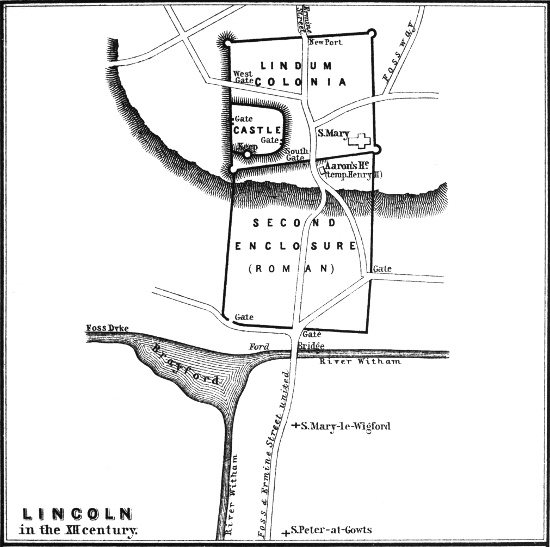
Wagner & Debes’ Geogˡ. Estabᵗ. Leipsic.
London, Macmillan & Co.
The removal of Bishop Remigius from Dorchester to Lincoln was in accordance with a new practice, which had come in since the Norman conquest, of placing the episcopal see in the chief town of the diocese. The same motive had prompted a translation of the old Mercian bishopric from Lichfield, now described as “a little town in the woodland, with a rivulet flowing by it, far away from the throng of cities,”[104] to Chester, whence, however, it was soon removed again to the great abbey of Coventry.[105] The same reason, too, caused Norwich to succeed Thetford as the seat of the bishopric of East-Anglia. It was but very recently that Lincoln had outstripped Norwich as the chief city of eastern England. The mouth of the Yare, which had a tideway navigation quite up to the point where the Wensum falls into it, was no less conveniently placed than that of the Witham for intercourse with northern Europe; and the Scandinavian traders and settlers in the first half of the eleventh century had raised Norwich to such a pitch of prosperity that at the coming of the Norman it contained twenty-four churches, and its burghers seem to have been more numerous than those of any town in the realm except London and York.[106] Twenty years later their number was indeed greatly diminished; the consequences of Earl Ralf’s rebellion had wrought havoc in the city. But if its native population had decreased, a colony of Norman burghers was growing up and flourishing in a “new borough,” now represented by the parishes of S. Peter Mancroft and S. Giles; the number of churches and chapels had risen to forty-four,[107] and in the Red King’s last years the foundations of the cathedral were laid by Bishop Herbert Lozinga, whose grave may still be seen before its high altar.[108] Once in the next reign Norwich supplanted Gloucester as the scene of the Midwinter Council; King Henry kept Christmas there in 1121.[109] It may have been on this occasion that the citizens won from him their first charter; but the charter itself is lost, and we only learn the bare fact of its existence from the words of Henry II., confirming to the burghers of Norwich “all the customs, liberties and acquittances which they had in the time of my grandfather.”[110]
Plan IV.
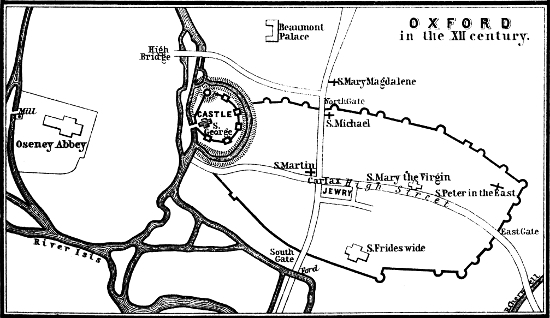
Wagner & Debes’ Geogˡ. Estabᵗ. Leipsic.
London, Macmillan & Co.
It was, however, in the valley of the Thames that English town-life was growing up most vigorously. Tried by the test of statistics, indeed, Oxford was still but a small place; in the time of the Confessor it had only contained about a thousand dwellings, and before the Domesday survey was made the town had, through some unexplained cause, suffered such decay that more than half of these were waste.[111] But the “waste” was quickly repaired under the wise government of Robert of Oilly, to whom the chief command at Oxford was entrusted by the Conqueror, and of his nephew and namesake who succeeded to his office. Before the close of Henry’s reign every side of that marvellously varied life of Oxford which makes its history seem like an epitome of the history of all England was already in existence, though only in germ. The military capabilities of the site, recognized long ago by Eadward the Elder, had been carefully strengthened; within the natural protection of its encircling rivers, the town was “closely girt about with rampart and ditch,”[112] and the mound, raised probably by Eadward himself, at its western end had been made the nucleus of a mighty fortress which was soon to become famous in the struggle of Stephen and Matilda.[113] Nor was fortification the sole care of the D’Oillys; within and without the city, works of piety and of public utility sprang up under their direction. The ancient ford which had given the town a name was no longer the sole means of crossing the network of streams which fenced it in on every side save one; the High Bridge of our own day represents one built by the first Robert of Oilly.[114] Of the sixteen churches and chapels which Oxford now contained,[115] S. George’s-in-the-Castle was certainly and S. Peter’s-in-the-East probably founded by him;[116] several of the older parish churches which had fallen into decay were restored at his expense;[117] and those of S. Michael and S. Mary the Virgin, as well as that of S. Mary Magdalene without the walls, were all founded in his time or in that of his nephew, if not actually by their munificence.[118] One of these, S. Mary the Virgin, was to become famous in after-days as the University church. As yet, the centre of intellectual life at Oxford was the ancient monastery of S. Fritheswith or Frideswide, which after many vicissitudes had finally passed into the hands of the Austin canons,[119] and entered upon a new career of prosperity under its learned prior Guimund, the builder of the beautiful church which now stands hidden away beneath the later splendours of Christ Church, like a buried and yet living relic of an earlier and simpler age. Even S. Frideswide’s, however, had a formidable rival in the priory of Oseney which the younger Robert of Oilly founded, also for Austin canons, in the island-meadow overlooked by his castle-tower.[120] The Augustinians were a new order whose rise was closely associated with the revival of intellectual and social culture; their houses were the best schools of the time—schools in which the scholars were trained for secular no less than for clerical careers—and their presence at Oseney and S. Frideswide’s was already preparing the intellectual soil of Oxford to receive, at the close of Henry’s reign, the seeds of the first English University in the divinity lectures of Robert Pulein.[121] The burgher-life of the city had long gathered round the church of S. Martin; in its churchyard was held the portmannimot or general assembly of the citizens; they had their merchant-gild and their gild-hall;[122] they had their common pasture-land,[123] the wide green “Port-meadow” beyond the Isis; and we see the growth of a local industry in the appearance of the leather-sellers’ and weavers’ gilds. Shortly before Henry’s death, there were indications that Oxford was soon to regain the political position which it had held under the old English and Danish kings, but had entirely lost since their time. A strange legacy of awe had been left to the city by its virgin patroness. The story went that Fritheswith, flying from the pursuit of her royal lover, sank down exhausted at the gate, and, despairing of further escape, called upon Heaven itself to check him; as he entered the town he was struck blind, and though her prayers afterwards restored his sight, no king after him dared set foot within the boundaries of Oxford for fear of incurring some similar punishment.[124] It must be supposed that the councils held at Oxford under Æthelred and Cnut met outside the walls; we cannot tell whether any countenance was given to the legend by the circumstances of Harald Harefoot’s death; but from that time forth we hear of no more royal visits to Oxford till 1133—the very year of Robert Pulein’s lectures. Then we find that Henry I., whose favourite country residence was at Woodstock, had been so drawn to the neighbouring town as to build himself a “new hall” there,[125] just outside the northern wall, on the ground afterwards known as Beaumont-fields. He held but one festival there, the last Easter which he ever spent in England; but each in turn of the rival candidates for the throne left vacant by his death found Oxford ready to become a political as well as a military centre of scarcely less importance than London itself.
Plan V.
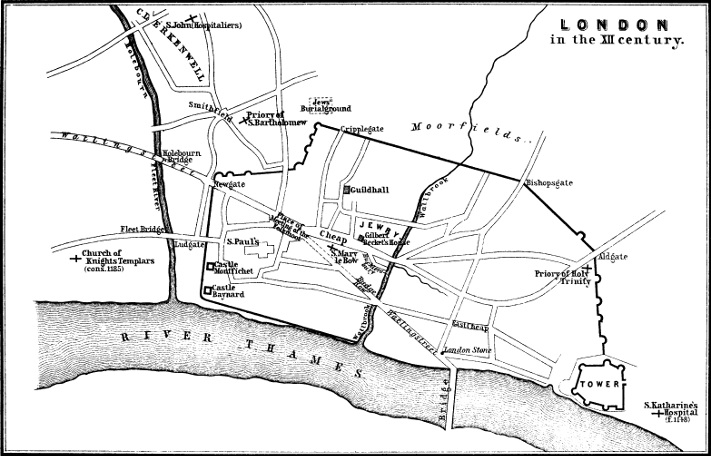
Wagner & Debes’ Geogˡ. Estabᵗ. Leipsic.
London, Macmillan & Co.
Our great picture of medieval London belongs in all its completeness to a somewhat later date; it was painted in the closing years of the twelfth century. But, as in the case of so many other things which only come out into full light under Henry II., although the colouring and the details may belong more especially to his time, the main features were already there in the time of his grandfather. The outline of the city was a sort of irregular half-ellipse, fenced in upon the northern or land side by a girdle of massive walls pierced with gates and fortified with lofty towers; the wall on the south side, being built close upon the river bank, was gradually washed away by the ebb and flow of the tide constantly beating upon its foundations. On this side the river itself was an all-sufficient protection. The eastern extremity of the city, where the wall came down towards the water’s edge, was guarded by a mighty fortress, founded by King William in the earliest days of his conquest to hold his newly-won capital in check, and always known by the emphatic name of “the Tower.” The western end was protected by two lesser fortresses,[126]—Castle Baynard and Montfichet, whose sokes filled up the space between the cathedral precincts and the city wall. Another, which must have stood in the same neighbourhood, seems to have been partly destroyed by the fire which ravaged London a few months before the Conqueror’s death, and in which the cathedral of S. Paul entirely perished.[127] Part of the ditch of this fortress was surrendered by King Henry to make room for a wall with which Bishop Richard was now enclosing his precincts;[128] while within this enclosure a new church, gorgeous with all the latest developements of Norman architectural skill, was now fast approaching completion.[129] S. Paul’s was the rallying-point, as it had been the nucleus, of municipal life in London. In time of peace the folkmoot assembled at the eastern end of its churchyard at the summons of its great bell; in time of war the armed burghers gathered at its west door and beneath its banner, with the lord of Baynard’s castle as their standard-bearer.[130] The internal constitution of London, however, was scarcely a town-constitution of any kind; it was more like an epitome of the organization of all England. The ordinary system of the parish and the township, the special franchises and jurisdictions of the great individual landowners, of the churches, of the gilds—all these were loosely bundled together under the general headship of the bishop and the port-reeve, to whom King William addressed his one surviving English writ, just as he would have addressed the bishop and sheriff of a county. The writ itself merely confirmed to the citizens “all the law whereof they had been worthy in King Eadward’s day”;[131] but by the end of Henry I.’s reign the Londoners had got far beyond this. By virtue of a royal charter, they had exchanged their regally-appointed port-reeve for a sheriff of their own choice, and this officer served at once for the city and for the shire of Middlesex, which was granted in ferm to the citizens for ever, as the other shires were granted year by year to their respective sheriffs; they were exempted from all tolls and mercantile dues throughout the realm, and from suit and service to all courts outside their own walls, even the pleas of the crown being intrusted to a special justiciar elected by themselves. Yet there was no complete civic organization; the charter confirmed all the old separate jurisdictions and franchises, the various “sokens” and “customs” of churches, barons and burghers, the wardmoots or assemblies of the different parishes or townships, as well as the husting or folkmoot in which all were gathered together,[132]—and left London as it found it, not a compact, symmetrical municipality, but, as it has been truly called, simply “a shire covered with houses.”
This mass of growing life lay chiefly north-east of S. Paul’s, where a crowd of lesser churches, conventual and parochial, rose out of a network of close-packed streets and alleys thronged with busy craftsmen and noisy, chaffering traders. Through the heart of it flowed the “Wall-brook,” on whose bank there lingered, long after the stream itself was buried and built over, a tradition of the barges laden with merchandise which were towed up from the Thames to a landing-place at the eastern end of the Cheap.[133] Beyond the Walbrook lay the East-Cheap, almost busier and more crowded still; while to the north, along the upper course of the Walbrook, was a thriving Jewish quarter.[134] Population was spreading, too, beyond the walls. Many of the wealthier citizens dwelt in pleasant suburban houses, surrounded with bright gardens and shady trees.[135] Some two miles higher up the river, the populous suburb of Westminster clustered round the famous abbey built in honour of S. Peter by the last Old-English king, and the palace of William Rufus, a splendid edifice with a breast-work and bastion stretching down to the water’s edge.[136] North-west of the city, just outside the wall, lay the plain of Smithfield, where a great horse-fair was held every Friday.[137] Beyond was an expanse of fruitful tillage-lands and rich pastures, watered by running streams and made merry with the rush of countless watermills;[138] and this tract was sheltered by a wide belt of woodland stretching away across the northern part of Middlesex to the foot of the Chiltern Hills. Here the stag and the fallow-deer, the boar and the wild bull, had their coverts, beside a multitude of lesser game; all of which the citizens were by a special privilege entitled to hunt at their pleasure.[139] Such quasi-regal sport was doubtless only enjoyed by the greater and wealthier among them; the mass of the young burghers were content, in the summer evenings when their day’s work was done, with a saunter among the shady gardens and fresh springs which enlivened the northern suburbs; while in winter their favourite resort was a tract of low-lying moor or marsh—the Moorfields of later times—on whose frozen surface they could enjoy to their heart’s content the exercises of sliding, sledging and skating.[140] Business, pleasure, piety, intellectual culture, all had their places in the vigorous life of the great city. Each of the two great minsters, S. Paul’s and S. Peter’s, had a school attached to it, and so had the abbey of our Lady at Bermondsey, just over the water.[141] Money-getting did not absorb all the energies of the burghers; “they were respected and noted above all other citizens for their manners, dress, table and discourse.”[142] “Moreover, almost all the bishops, abbots and great men of England are, in a manner, citizens and freemen of London; as they have magnificent houses there, to which they resort, spending large sums of money, whenever they are summoned thither to councils and assemblies by the king or their metropolitan, or are compelled to go there by their own business.”[143] And between these visitors and the resident citizens there was no hard and fast line of demarcation. Neither the knight-errant’s blind contempt for practical industry nor the still blinder contempt of the merely practical man for everything which has not its value in hard cash had as yet come into existence. Under the old English system the merchant who had made three long voyages over sea on his own account was entitled to rank as a thegn, and to take his place among the nobles of the land. Under the Norman system a link between the two classes was supplied by the citizens of Norman origin, to whom London in no small measure owed the marked importance which it attained under Henry I. The Norman knights had no monopoly of the enterprizing spirit of their race; the victorious host had scarcely settled down upon the conquered soil when it was followed by a second invasion of a very different character. Merchants, traders, craftsmen of all sorts, came flocking to seek their fortunes in their sovereign’s newly-acquired dominions, not by forcible spoliation of the native people, but by fair traffic and honest labour in their midst. The fusion of races in this class, the class of which the town population chiefly consisted, began almost from the first years of the conquest. The process was very likely more helped than hindered by the grinding tyranny which united all the Red King’s victims in a community of suffering; but its great working-out was in the reign of Henry I. His restoration of law and order, his administrative and judicial reforms, gave scope for a great outburst of industrial and commercial energy. England under him had her heavy burthens and her cruel grievances; they stand out plainly enough in the complaints of her native chronicler. But to men who lived amidst the endless strife of the French kingdom or the Flemish border-land, or of the Norman duchy under the nominal government of Robert Curthose, a country where “no man durst misdo with other,” and where the sovereign “made peace for man and deer,”[144] may well have looked like a sort of earthly paradise. It is no wonder that peaceable citizens who only wanted to be quiet and get an honest living came across the sea to find shelter and security in the rich and prosperous island. For settlers of this kind it was easy enough to make a home. No gulf of hatred and suspicion, no ever-present sense of wrong suffered and wrong done, stood fixed between them and their English fellow-burghers. Even before the Conqueror’s reign had closed, English and Normans were living contentedly side by side in all the chief cities of England: sometimes, as we have noticed in the case of Norwich, the new-comers dwelt apart in a suburb or quarter of their own, but the distinction was one of locality only; the intercourse was perfectly free and perfectly amicable; Norman refinement, Norman taste, Norman fashions, especially in dress, made their way rapidly among the English burghers; and intermarriages soon became frequent.[145] In the great cities, where the sight of foreign traders was nothing new or strange, and the barriers of prejudice and ignorance of each other’s languages had been worn away by years of commercial intercourse, the fusion was naturally more easy; in London, whither the “men of Rouen” had come in their “great ships,” with their cargoes of wine or sturgeons,[146] long before their countrymen came with bow and spear and sword, it was easiest of all. The great commercial centre to which the Norman merchants had long been attracted as visitors attracted them as settlers now that it had become the capital of their own sovereign; and the attraction grew still stronger during the unquiet times in Normandy which followed the Conqueror’s death. “Many natives of the chief Norman cities, Rouen and Caen, removed to London, and chose them out a dwelling there, because it was a fitter place for their trade, and better stored with the goods in which they were wont to deal.”[147]