Chapter XXVI · (continued 2)
Reading edition
There was no one in the cellar but a boy firing the boilers. I asked him if he knew who put that pipe there. He knew nothing about it, but supposed our men put it there when they set up the engine. I hunted up the engineer and asked him the same question, and got the same answer. I went to the people who did the engineering work for the Post Office and who had put in the pipes; they knew nothing about it. I could find out nothing, but had to content myself with telling the engineer that I had closed the valve and relied upon him to keep it closed. I asked him what he thought caused the thump in the engine; he said he had not the slightest idea, but he would try to cure it. I contented myself with writing to the Postmaster that I had removed the cause of the waste of steam and hoped he would now find the engine satisfactory. Soon after Mr. Merrick was in New York for two or three days. When he came home he said: “I have cured the thump in that Post Office engine.” “How did you do it?” I asked. He replied: “I gave the engineer a twenty-dollar gold piece, and when I went to see it the next morning the thump was gone.” I should add that when the old engine was taken down I had the back cylinder head removed, which was done without difficulty, and found the diameter fourteen inches. “For ways that are dark and tricks that are vain” this engineer was “peculiar” in my experience.
I had brought with me from Newark an order from the Willimantic Linen Company, who were manufacturers of cotton thread, for two engines for quite an interesting application. They were building a new mill entirely unique in its design, which has never been repeated, being an ignorant freak. It was a one-story mill 800 feet long and 250 or 300 feet wide, intended to contain five lines of shafting. Each line was independent and drove the machinery for all the successive operations from opening the cotton bales to packing the spools of thread. These lines of shafting 800 feet long were to be in the basement and to drive these machines by belts through the floor, the engine to be in the middle of each line. For this purpose I supplied a pair of condensing engines, 11 inches diameter of cylinder and 16 inches stroke, making 350 revolutions per minute, with their cranks set at right angles with each other in the line of shafting. These required no fly-wheel and would start from any position. I had a great deal of trouble with this order on account of the delay in its execution, so much so that before the first engine was finished the order for the second one was countermanded, and this order was placed with the Hartford Engineering Company, a new concern which was foolish enough to undertake the same speed. However, after my first engine was started they found themselves face to face with an impossibility and had to throw up their contract, whereupon the president of the company became very civil and asked me to be kind enough to make the second engine for them, which I was quite happy to do, as I had on hand the peculiar bed for these engines, which I did not break up after the order was countermanded, but had it set up against the wall of the shop in readiness for what might happen. These two engines were both in successful operation when my own operations ceased; the remaining three engines were to be added as their business required.
The engineer of that company was an original investigator. He had a battery of return-tubular boilers, each one crammed full of tubes according to the usual methods of boiler-makers. He provided himself with pieces of lath one inch wide, one eighth of an inch thick, and four inches long, and laid one in the front end of each tube in one of his boilers and left them there for twenty-four hours. He had made a diagram of his boiler on which he numbered every tube and put a corresponding number on every piece of lath. In taking them out they presented an astonishing revelation, which he showed me. Some of the pieces were burned almost to a coal and some were scarcely discolored, while the great body of them presented various effects of heat between these extremes. These showed distinctly the enormous differences in the temperature of the gases passing through the different tubes, and that fully one half of the tubes did little or no work in evaporating the water. They taught a lesson which boiler-makers, who count every additional tube they can get into a boiler as so much added heating surface and rate their boilers accordingly, have no anxiety to learn, but which I afterwards turned to good account, as will be seen.
About the last and the most interesting engine that I built while in Philadelphia was one for the firm of Cheney Brothers, silk-manufacturers, of South Manchester, Conn. This was a cross-compound, the first and the last compound engine that I ever built, and it is the only engine in this country to which I applied my condenser. The cylinders were 12 and 21 inches in diameter, the stroke 24 inches, and the shaft made 180 revolutions per minute. The condenser presented a new design in one respect; the air-pump was double-acting and made only 45 double strokes per minute, being driven by a belt from the engine shaft and the motion reduced by gears 1 to 4. This engine ran perfectly from the start, and I looked forward with confidence to a demand for many more of the same type. The diagrams made by it are here reproduced.
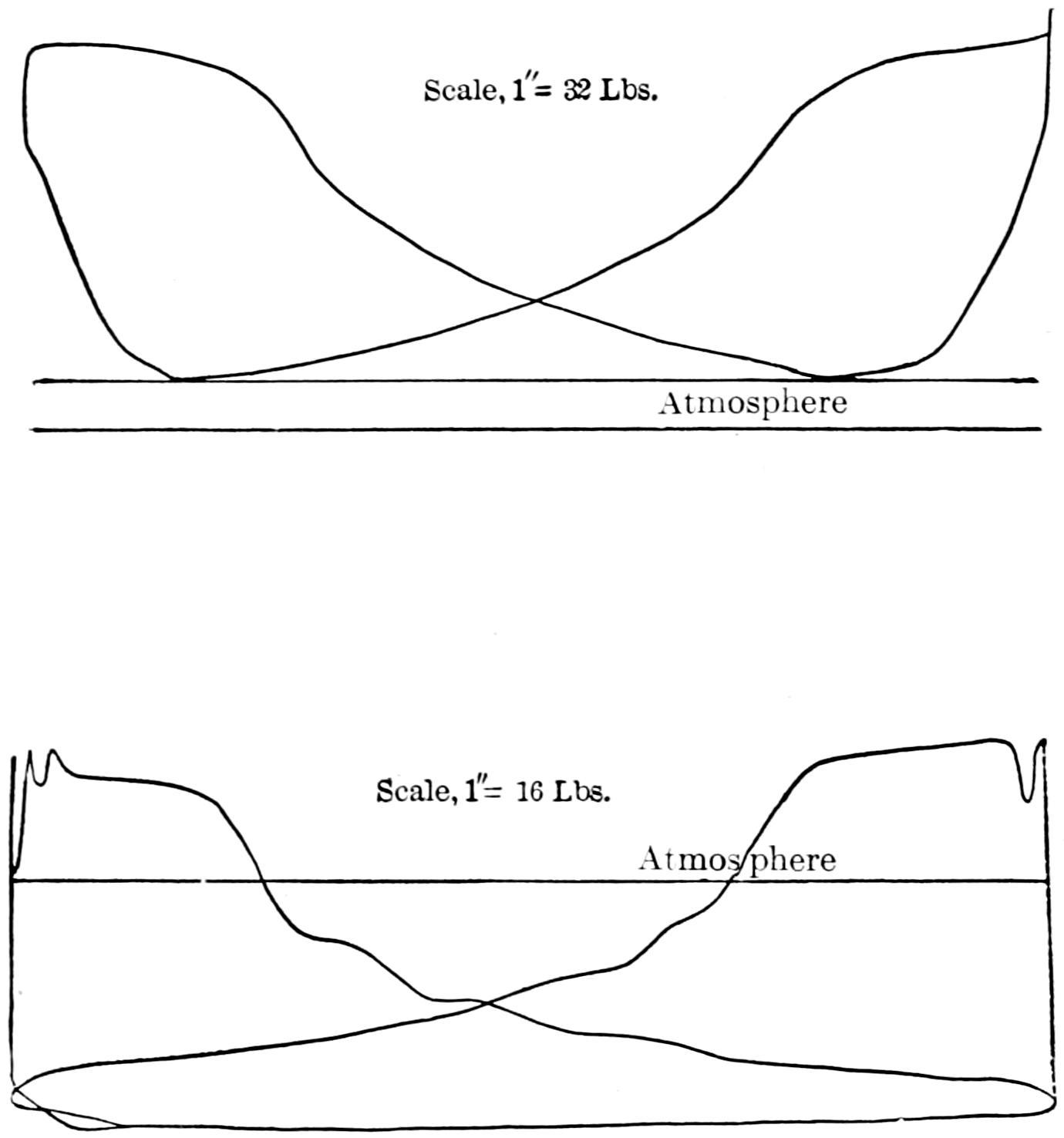
Scale, 1″ = 32 Lbs.
Atmosphere
Scale, 1″ = 16 Lbs.
Atmosphere
Diagrams from my First and Only Compound Engine.
I have a pleasant memory connected with this engine. The silk-mill is located in a very large park, scattered about which are the residences of different members of the family. About twelve years after the engine was built, in company with my wife, I was visiting relatives in Hartford, from which South Manchester is about twelve miles distant. One day we were driven over there with our friends to make a social call. On our arrival I left the party to make a visit to my old engine. The mill seemed to have been changed very much, and I lost my way. Finally I recognized, as I thought, the old engine-room and went in. My engine was not there, but in its place stood another engine, a pair of tandem compounds of much larger dimensions. These had evidently just been erected, as they stood idle. “Oh, dear,” said I to myself, “my engines have been superseded for some reason or other.” While I was indulging in that reflection the engineer came in. I introduced myself and said to him: “I see that my old engines have been supplanted.” “Oh, no,” said he, “your engines are all right; they are running just where they always have been. They have built a new mill twice as large as the old one, and your engines have been giving such satisfaction they have ordered another pair of compounds from the Southwark Foundry, and these are the engines; they have not been started yet, as the mill is not ready for them and won’t be for a month.”
He directed me to the old engine-room, where I found my engines gliding away as though they had been erected yesterday. At that time I regarded these engines as only a stepping-stone to far higher things. I was engaged on a plan for a great development of the high speed system, but which has not materialized. I still consider it as on the whole superior to the turbine, a superiority, however, which may never be established.
In the spring of 1881, in our anxiety to revive the manufacture of the engine, we were foolish enough to send one to the Atlanta exhibition. We eagerly believed the promises of the agent that we should find all the machinery that we wanted to drive, and sent an engine finished with great care, and a skillful man to erect and run it. We also printed the heading of a lot of diagrams, to be given to visitors. The facts were found to be that we had nothing to drive but an idle line of shafting and one Clark’s spool-winder, while the exhaust main was so small and choked with the exhausts from other engines that we had a back pressure of ten pounds above the atmosphere; so we could take no diagrams; and the fact that we did not take any was used as a conclusive argument against high-speed engines; so the exhibition did us harm instead of good.
I pass over other distressing experiences at the works, and come at once to the final catastrophy in the late fall of 1882.
Another exhibition opened in the fall of 1882, for which I made great preparations, and from which I anticipated important results. This was the exhibition of the New England Manufacturers’ and Mechanics’ Institute, held in Boston. I obtained an important allotment of space with plenty of machinery to drive, and, besides a fine engine, sent a large exhibit of our finished work, in the parts of several sizes of engines, expecting to attract the attention of all New England manufacturers. I prepared for a regular campaign. I rented an office and engaged a young man to represent us in Boston as our agent, and another, Mr. Edwin F. Williams, to travel and solicit orders and take the charge of erecting engines. Our engine arrived without a piston. Mr. Merrick had thought he had found a defect in the piston, and ordered another one to be made. When we came to put the engine together in the exhibition, this piston would not enter the cylinder. On examination it was found to have been turned conical, the bases of the two cones meeting in the middle, so the middle was one eighth of an inch larger in diameter than the faces. We had to get a coarse file and file down the middle of the piston all around until it would enter the cylinder. Then I had a great disappointment—the greatest I ever experienced—the engine thumped badly on both centers. The only way in which we could stop the thumping was by shutting off the steam until the initial pressure was brought down to the height reached by the compression of the exhaust. In this plight we had to run through the exhibition. We could not take a diagram and had to watch the engine constantly, for whenever the pressure rose ever so little too high in the cylinder it would begin to thump. I attributed this to the shocking condition of the surface of the piston. I could not comprehend how this should cause the thump, but it must be that, for I could conceive of nothing else that could produce it. This thump made my exhibition a total failure, and necessitated the abandonment of all my plans.
At the close of the exhibition I went home utterly discouraged. When I went into the shop the first person I met was the foreman of the lower floor, where the engine had been built. I told him of the plight in which I found myself placed and to which I attributed my failure. The fellow gave me the lie direct, saying with a conceited smirk: “It is impossible, Mr. Porter, that any such work as you have described can have gone out of this establishment.” I turned on my heel and left him, and in less than half a minute I saw at a distance of fifty feet a 22-inch piston being finished for an engine we were building for the Tremont and Suffolk Mill. The workman had finished turning the piston and was then cutting the grooves for the rings. The reflection from the surface showed me the same two cones meeting in the middle. I went up to the lathe, the back side of which was toward me, and told the workman to stop his lathe and bring me a straight-edge. This rocked on the edge in the middle of the piston, opening nearly one eighth of an inch on each face alternately. I sent a boy to find the foreman and asked him what he thought of that and left him. I had influence enough to have both the foreman and the workman discharged that night. Think of it; superintendent, general foreman, the foreman of the floor, and workman, altogether, never saw what I detected at a glance from the opposite side of the shop.
I want to stop here to express my disgust with the American system of making the tailstock of a lathe adjustable, which enables either an ignorant, careless or malicious workman to ruin his work after this fashion. To their credit, English tools have no such feature.
The very next day we received a call from Mr. Bishop, the engineer of the works of Russell & Irwin at New Britain, Conn., to tell us that their engine just put in by us had a very bad thump which he was afraid could not be cured as it was evidently caused by the piston projecting over the admission ports when at the end of its stroke. “Impossible,” I exclaimed; “I never made such an engine in my life.” I should here state that in experimenting with the first little engine that I made before I went to England, I at first made the piston project over the port one quarter of an inch, and the engine thumped. I satisfied myself that this was caused by the impact of the entering steam against the projecting surface of the piston, driving it against the opposite side of the cylinder; this was aggravated in high-speed engines. In this case the engine made 160 revolutions per minute and the steam was admitted through four simultaneous openings, so it entered the cylinder with great velocity. I turned a quarter of an inch off from each face of the piston, and the thump disappeared. I then made it a law from which I never varied, that the piston should come to the admission port and not project over it at all, and this feature was shown in every drawing.
Mr. Bishop replied to me: “It does project, Mr. Porter; it projects seven eighths of an inch over the port at each end of its stroke, for I have measured it.” I rushed up to the drawing-office and called for the horizontal sectional drawing of that cylinder, and there I saw the piston not only drawn, but figured—projecting seven eighths of an inch over the port. I felt as though I were sinking through the floor. That was what had ruined my Boston exhibition and sent me home disgraced and broken-hearted and the badly fitting piston, shameful as that was, had nothing to do with it. The first question that occurred to me was: “How came this drawing to exist and I to know nothing about it?” The answer to this question was simple.
When the first pair of Willimantic engines was started I was disappointed in their economy, and made up my mind that the excessive waste room was accountable for it. The proportion of cross-section area to the stroke being fifty per cent. greater than in my table of sizes increased in the same degree the proportion of waste room to the piston displacement. I felt that there was need here for improvement. By far the greatest amount of waste room was in the exhaust ports. I accepted a modification of the exhaust valves by which this item of the waste room was reduced fully one half and made a new pair of cylinders for this engine. The improvement in the economy was so marked that I determined to change the exhaust valves of all the engines. Only the exhaust valves and ports needed to be changed. These were drawn anew in pencil and carefully studied and approved of by me. It was necessary that the entire combined cylinder drawing should be retraced, but this, except only the exhaust ports and valves, was to be copied over the existing tracings. This did not require my attention, and I gave no thought to it. Here was the superintendent’s opportunity. In copying these tracings he had only to move the straight line representing each face of the piston on the longitudinal section of the cylinder seven eighths of an inch, thus adding this amount to the piston at each end, and shorten the cylinder heads to correspond, and the job was done; and there did not exist among the large number of persons in the drawing-office and shop who must have been aware of this change, loyalty enough to let me know anything about it.
We had also recently finished two engines for the Cocheco Mill at Dover, N. H., and about this time we received a letter from the superintendent of that mill expressing his admiration of the engines in every other respect, but complaining of a bad thump in the cylinders. He said he would be glad to invite the superintendents of other mills to see them, but he could not show the engines to anybody until that thump was cured.
I went directly to the president and demanded authority to change the pistons and heads of these engines. To my astonishment he refused point-blank, saying he had spent money enough on these alterations, and he would not spend another cent. I replied to him that there was one other alternative and that was to abandon the business, to which he made no reply. But why did I need to go to the president; why not make these changes myself? The answer to this question is very humiliating to me. An account had been made up of the cost of the alterations here described and presented to the board of directors, showing this to amount to $20,000. I was aghast at this statement; I had never seen a figure pertaining to the business, except the single bill already mentioned. I told the directors that any good pattern-maker would have taken the contract to alter those exhaust valves and ports on our twenty sizes of cylinders for an average price of fifty dollars each, and made a profit of fifty per cent. in doing it. The cost of the new drawings and the price of cylinders for the Willimantic engine could not more than double this sum, and by some hocus-pocus this $2000 had been changed to $20,000; probably by transfer from other losing accounts. The president replied that was the cost of the alterations as it appeared on the books, and the directors, without making any investigation, adopted a resolution that no further alterations should be made unless expressly ordered by the president.
I did not believe that in making this addition to the length of the piston the superintendent had any intention to wreck the business. He could have had no idea of its fatal nature; his only thought was to make a considerable further reduction of waste room and gratify his itching to change my drawings. But of course doing this without my knowledge was criminal, and should have caused his instant discharge; but his whole conduct from the beginning had been the same and the president had sustained him. I had no opportunity to pursue this matter further.
On receiving the president’s refusal I determined to appeal to the directors, but first I thought I would lay the matter before Mr. Henry Lewis, whom I regarded as the most open-minded of all. What was my amazement when, after listening to my statement, he replied: “We shall sustain the president, Mr. Porter.” Then I knew the end had come. It was idle for me to butt against the Philadelphia phalanx. A day or two after a committee of the directors headed by Mr. Shortridge, called at the office and asked to see our order book. This showed that in more than a month preceding we had not received a single order. On this state of affairs it was evident to the directors that a change must be made in the management. I had long realized that the great gulf that I had dug between the stockholders and myself, as already described, had never been filled. Neither the directors as a body, except on the single occasion already mentioned, nor any director individually, had ever conferred with me on any subject whatever. They knew nothing, except what they might have learned from the president; he had no mechanical knowledge or ability to form a mechanical judgment, and the superintendent influenced him in a degree which to me was unaccountable. His want of comprehension of the business was shown in his answer to the life-or-death question which I had presented to him. The next day I received a communication from the directors requesting me to send in my resignation, which I promptly did. Mr. Merrick was also requested to resign. This was evidently a put up job, to let me down easy. Mr. Merrick had for some time expressed a wish to be relieved from his position which he found very uncomfortable.
The directors elected as president one of their own number, who had nothing else to do, to sit in the president’s chair and draw his salary, and committed the practical management of the business to an oily-tongued man who had never seen a high-speed engine, and whose qualifications for the position were that he was a friend of one of the directors and was a Philadelphian, and who I learned received a large bonus for leaving his own business and accepting the position vacated by me.
Benjamin F. Avery