AMUSEMENTS WITH CARDS. (continued 2)
Reading edition
To make beautiful Transparent coloured Water.
The following liquors, which are coloured, being mixed, produce colours very different from their own. The yellow tincture of saffron, and the red tincture of roses, when mixed, produce a green. Blue tincture of violets, and brown spirit of sulphur, produce a crimson. Red tincture of roses, and brown spirits of hartshorn, make a blue. Blue tincture of violets, and blue solution of copper, give a violet colour. Blue tincture of cyanus, and blue spirit of sal-ammoniac coloured, make green. Blue solution of Hungarian vitriol, and brown ley of potash, make yellow. Blue solution of Hungarian vitriol, and red tincture of roses, make black; and blue tincture of cyanus, and green solution of copper, produce red.
Curious Experiment on Rays of Light.
That the rays of light flow in all directions from different bodies, without interrupting one another, is plain from the following experiment:—Make a little hole in a thin plate of metal, and set the plate upright on a table, facing a row of lighted candles standing near together; then place a sheet of paper or pasteboard at a little distance from the other side of the plate; and the rays of all the candles, flowing through the hole, will form as many specks of light on the paper as there are candles before the plate; each speck as distinct and large as if there were only one candle to cast one speck; which shows that the rays do not obstruct each other in their motions, although they all cross in the same hole.
The Power of Water.
Let a strong small iron tube of twenty feet in height be inserted into the bung-hole of a cask, and the aperture round so strongly closed, that it shall be water-tight; pour water into the cask till it is full, through the pipe; also continue filling the pipe till the cask bursts, which will be when the water is within a foot of the top of the tube. In this experiment the water, on bursting the vessel, will fly about with considerable violence.
The Pressure of Water.
The pressure of water may be known to every one who will only take the trouble to look at the cock of a water-butt when turned: if the tub or cistern be full, the water runs with much greater velocity through the cock, and a vessel will be filled from it in a shorter time than when it is only half-full, although the cock, in both cases, is equally replete with the fluid during the time the vessel is filling. From this also is understood, how a hole or leak, near the keel of a ship, admits the water much quicker, and with greater violence, than one of the same size near what the mariners call the water's edge.
Refraction of Light.
In the middle of an empty basin put a piece of money, and then retire from it till the edge of the basin hides the piece from your sight: then keep your head steady, let another person fill the basin gently with water; as the water rises in the basin the money will come in view; and when of a sufficient height in the basin, the whole of the piece will be in sight.
Wonderful Nature of Lightning.
If two persons, standing in a room, looking different ways, and a loud clap of thunder, accompanied with zigzag lightning, happen, they will both distinctly see the flash at the same time; not only the illumination, but the very form of the lightning itself, and every angle it makes in its course will be as distinctly perceptible, as though they had both looked directly at the cloud from whence it proceeded. If a person happened at that time to be looking on a book, or other object, which he held in his hand, he would distinctly see the form of the lightning between him and the object at which he looked. This property seems peculiar to lightning, as it does not apply to any other kind of fire whatever.
To show that the White of Eggs contains an Alkali.
Add to a wine-glass half full of tincture of red cabbage a small quantity of the white of an egg, either in a liquid state or rendered concrete by boiling. The tincture will lose its blue colour and become changed to green, because the white of the egg contains soda.
Two Inodorous Bodies become very Pungent and Odorous by Mixture.
When equal parts of muriate of ammonia and unslaked lime, both substances destitute of odour, are intimately blended together in a mortar, a very pungent gas (ammonia) becomes evolved.
Interesting Experiment for the Microscope.
The embryo grain of wheat, at the time of blossoming, being carefully taken out of the husk, will be found to have a small downy tuft at its extremity, which, when viewed in a microscope, greatly resembles the branches of thorn, spreading archwise, in opposite directions. By expanding a few of the grains, and selecting the most perfect, a very pretty microscopic object will be obtained for preservation.
The Travelling of Light.
Light travels at the rate of a hundred and fifty thousand miles in a single second; and it is seven minutes in passing from the sun to the earth, which is nearly a distance of seventy millions of miles. Such is the rapidity with which these rays dart themselves forward that a journey they thus perform in less than eight minutes, a ball from the mouth of a cannon would not complete in several weeks! But the minuteness of the particles of light are still several degrees beyond their velocity; and they are therefore harmless, because so very small. A ray of light is nothing more than a constant stream of minute parts, still flowing from the luminary, so inconceivably little, that a candle in a single second of time, has been said to diffuse several hundreds of millions more particles of light, than there could be grains in the whole earth, if it were entirely one heap of sand. The sun furnishes them, and the stars also, without appearing in the least to consume, by granting us the supply. Its light is diffused in a wide sphere, and seems inexhaustible.
Calculation of the Mass of Water contained in the Sea.
If we would have an idea of the enormous quantity of water which the sea contains, let us suppose a common and general depth of the ocean; by computing it at only 200 fathoms, or the tenth part of a mile, we shall see that there is sufficient water to cover the whole globe to the height of 503 feet of water; and if we were to reduce this water into one mass, we should find that it forms a globe of more than sixty thousand miles diameter.
Different Degrees of Heat imbibed from the Sun's Rays by Cloths of different Colours.
Walk but a quarter of an hour in your garden, when the sun shines, with a part of your dress white, and a part black; then apply your hand to them alternately, and you will find a very great difference in their warmth. The black will be quite hot to the touch, and the white still cool.
Try to fire paper with a burning-glass; if it be white, you will not easily burn it; but if you bring the focus to a black spot, or upon letters, written or printed, the paper will immediately be on fire under the letters.
Thus, fullers and dyers find black cloths, of equal thickness with white ones, and hung out equally wet, dry in the sun much sooner than the white, being more readily heated by the sun's rays. It is the same before a fire, the heat of which sooner penetrates black stockings than white ones, and so is apt sooner to burn a man's shins. Also beer much sooner warms in a black mug set before the fire than a white one, or in a bright silver tankard. Take a number of little square pieces of cloth from a tailor's pattern card, of various colours; say black, deep blue, lighter blue, green, purple, red, yellow, white, and other colours, or shades of colours; lay them all out upon the snow in a bright sun-shiny morning; in a few hours, the black being warmed most by the sun will be sunk so low as to be below the stroke of the sun's rays; the dark blue almost as low; the lighter blue not quite so much as the dark; the other colours less, as they are lighter; and the quite white remain on the surface of the snow, as it will not have entered it at all.
Alternate Illusion.
With a convex lens of about an inch focus, look attentively at a silver seal, on which a cipher is engraved. It will at first appear cut in, as to the naked eye; but if you continue to observe it some time, without changing your situation, it will seem to be in relief, and the lights and shades will appear the same as they did before. If you regard it with the same attention still longer, it will again appear to be engraved: and so on alternately.
If you look off the seal for a few moments, when you view it again, instead of seeing it, as at first, engraved, it will appear in relief.
If, while you are turned towards the light, you suddenly incline the seal, while you continue to regard it, those parts that seemed to be engraved will immediately appear in relief: and if, when you are regarding these seemingly prominent parts, you turn yourself so that the light may fall on the right hand, you will see the shadows on the same side from whence the light comes, which will appear not a little extraordinary. In like manner the shadows will appear on the left, if the light fall on that side. If instead of a seal you look at a piece of money, these alterations will not be visible, in whatever situation you place yourself.
Alarum.
Against the wall of a room, near the ceiling, fix a wheel of twelve or eighteen inches diameter; on the rim of which place a number of bells in tune, and, if you please, of different sizes. To the axis of this wheel there should be fixed a fly to regulate its motion; and round the circumference there must be wound a rope, to the end of which is hung a weight.
Near to the wheel let a stand be fixed, on which is an upright piece that holds a balance or moveable lever, on one end of which rests the weight just mentioned; and to the other end must hang an inverted hollow cone, or funnel, the aperture of which is very small. This cone must be graduated on the inside, that the sand put in may answer to the number of hours it is to run. Against the upright piece, on the side next the cone, there must be fixed a check, to prevent it from descending. This stand, together with the wheel, may be enclosed in a case, and so contrived, as to be moved from one room to another with very little trouble.
It is evident, from the construction of this machine, that when a certain quantity of the sand is run out, the weight will descend, and put the wheel in motion, which motion will continue till the weight comes to the ground. If the wheel be required to continue longer in motion, two or more pulleys may be added, over which the rope may run.
Musical Cascade.
Where there is a natural cascade, near the lower stream, but not in it, let there be placed a large wheel, equal to the breadth of the cascade: the diameter of this wheel, for about a foot from each end, must be much less than that of the middle part; and all the water from the cascade must be made to fall on the ends. The water that falls on the wheel may pass through pipes, so that part of it may be made occasionally to pass over or fall short of the wheel, as you would have the time of the music quicker or slower. The remaining part of the wheel, which is to be kept free from the water, must consist of bars, on which are placed stops that strike against the bells: these stops must likewise be moveable. It is evident from the construction of this machine, that the water falling on the floats at the end of the wheel, will make the stops, which are adapted to different tunes, strike the notes of those tunes on the respective bells. Two or three sets of bells may here be placed on the same line, when the cascade is sufficiently wide.
Where there is not a natural cascade, one may be artificially constructed, by raising part of the ground, wherever there is a descent of water; whether it be a stream that supplies a reservoir or fountain, or serves domestic uses; or if it be refuse water that has already served some other purpose.
Writing on Glass by the Rays of the Sun.
Dissolve chalk in aqua fortis, to the consistence of milk, and add to that a strong solution of silver. Keep this liquor in a glass decanter well stopped. Then cut out from a paper the letters you would have appear, and paste the paper on the decanter, which you are to place in the sun, in such a manner that its rays may pass through the spaces cut out of the paper, and fall on the surface of the liquor. The part of the glass through which the rays pass will turn black, and that under the paper will remain white. You must observe not to move the bottle during the time of the operation.
To produce the Appearance of a Flower from its Ashes.
Make a tin box, with a cover that takes off. Let this box be supported by a pedestal of the same metal, and on which there is a little door. In the front of this box is to be a glass.
In a groove, at a small distance from this glass, place a double glass, made in the same manner as described in p. 13, (Magic Picture.) Between the front and back glasses place a small upright tin tube, supported by a cross piece. Let there be also a small chafing-dish placed in the pedestal. The box is to be opened behind. You privately place a flower in the tin tube, but not so near the front glass as to be in the least degree visible, and presenting one that resembles it to any person, desire him to burn it on the coals in a chafing-dish.
You then strew some powder over the coals, which may be supposed to aid the ashes in producing the flower; and put the chafing-dish in the pedestal under the box. As the heat by degrees melts the composition between the glasses, the flower will gradually appear, but when the chafing-dish is taken away, and the powder of the ashes is supposed to be removed, the flower soon disappears.
You may present several flowers, and let the person choose any one of them. In this case, while he is burning the flower, you fetch the box from another apartment, and at the same time put in a corresponding flower, which will make the experiment still more surprising.
Imitative Fire-works.
Take a paper that is blacked on both sides, or instead of black, the paper may be coloured on each side with a deep blue, which will be still better for such as are to be seen through transparent papers. It must be of a proper size for the figure you intend to exhibit. In this paper cut out with a penknife several spaces, and with a piercer make a number of holes, rather long than round, and at no regular distance from each other.
To represent revolving pyramids and globes, the paper must be cut through with a penknife, and the space cut out between each spiral should be three or four times as wide as the spirals themselves. You must observe to cut them so that the pyramid or globe may appear to turn on its axis. The columns that are represented in pieces of architecture, or in jets of fire, must be cut in the same manner, if they are to be represented as turning on their axis.
In like manner may be exhibited a great variety of ornaments, ciphers, and medallions, which, when properly coloured, cannot fail of producing the most pleasing effect. There should not be a very great diversity of colours, as they would not produce the most agreeable appearance.
When these pieces are drawn on a large scale, the architecture or ornaments may be shaded; and, to represent different shades, pieces of coloured paper must be pasted over each other, which will produce an effect that would not be expected from transparent paintings. Five or six pieces of paper pasted over each other will be sufficient to represent the strongest shades.
To give these pieces the different motions they require, you must first consider the nature of each piece; if, for example, you have cut out the figure of the sun, or of a star, you must construct a wire wheel of the same diameter with these pieces; over this wheel you paste a very thin paper, on which is drawn, with black ink, the spiral figure. The wheel thus prepared, is to be placed behind the sun or star, in such a manner that its axis may be exactly opposite the centre of either of these figures. This wheel may be turned by any method you think proper.
Now, the wheel being placed directly behind the sun, for example, and very near to it, is to be turned regularly round, and strongly illuminated by candles placed behind it. The lines that form the spiral will then appear, through the spaces cut out from the sun, to proceed from its centre to its circumference, and will resemble sparks of fire that incessantly succeed each other. The same effect will be produced by the star or by any other figure where the fire is not to appear as proceeding from the circumference of the centre.
These two pieces, as well as those that follow, may be of any size, provided you observe the proportion between the parts of the figure and the spiral, which must be wider in larger figures than in small. If the sun, for example, have from six to twelve inches diameter, the width of the strokes that form the spiral need not be more than one-twentieth part of an inch, and the spaces between them, that form transparent parts, about two-tenths of an inch. If the sun be two feet diameter, the strokes should be one-eighth of an inch, and the space between, one quarter of an inch; and if the figure be six feet diameter, the strokes should be one quarter of an inch and the spaces five-twelfths of an inch. These pieces have a pleasing effect, when represented of a small size, but the deception is more striking when they are of large dimensions.
It will be proper to place those pieces, when of a small size, in a box quite closed on every side, that none of the light may be diffused in the chamber: for which purpose it will be convenient to have a tin door behind the box, to which the candlesticks may be soldered, and the candles more easily lighted.
The several figures cut out should be placed in frames, that they may be put, alternately, in a groove in the forepart of the box; or there may be two grooves, that the second piece may be put in before the first is taken out.
The wheel must be carefully concealed from the eye of the spectator.
Where there is an opportunity of representing these artificial fires by a hole in the partition, they will doubtless have a much more striking effect, as the spectator cannot then conjecture by what means they are produced.
It is easy to conceive that by extending this method, wheels may be constructed with three or four spirals, to which may be given different directions. It is manifest also that, on the same principle, a great variety of transparent figures may be contrived, and which may be all placed before the spiral lines.
To represent Cascades of Fire.
In cutting out cascades, you must take care to preserve a natural inequality in the parts cut out; for if, to save time, you should make all the holes with the same pointed tool, the uniformity of the parts will not fail to produce a disagreeable effect. As these cascades are very pleasing when well executed, so they are highly disgusting when imperfect. These are the most difficult pieces to cut out.
To produce the apparent motion of these cascades, instead of drawing a spiral, you must have a slip of strong paper, of such length as you judge convenient. In this paper there must be a greater number of holes near each other, and made with pointed tools of different dimensions.
At each end of the paper, a part of the same size with the cascade must be left uncut; and towards those parts the holes must be made at a greater distance from each other.
When the cascade that is cut out is placed before the scroll of paper just mentioned, and it is entirely wound upon the roller, the part of the paper that is then between being quite opaque, no part of the cascade will be visible; but as the winch is gently turned, and regularly round, the transparent part of the paper will give to the cascade the appearance of fire that descends in the same direction; and the illusion will be so strong, that the spectators will think they see a cascade of fire; especially if the figure be judiciously cut out.
The Oracular Mirror.
Provide a round mirror of about three inches in diameter and whose frame is an inch wide. Line the under part of the frame, in which holes are to be cut, with very thin glass; behind this glass let a mirror of about two inches diameter be placed, which is to be moveable, so that by inclining the frame to either side, part of the mirror will be visible behind the glass on that side.
Then take Spanish chalk, or cypress vitriol, of which you make a pencil, and with this you may write on a glass, and rub it off with a cloth, and by breathing on the glass, the writing will appear and disappear several times. With this pencil write on one side of the mirror, before it is put in the frame, the word yes, and on the other side, no; and wipe them off with a cloth.
You propose to a person to ask any question of this mirror that can be answered by the words yes or no. Then turning the glass to one side, and putting your mouth close to it, as if to repeat the question softly, you breathe on it, and the word yes or no will immediately appear. This mirror will serve for many other agreeable amusements.
The Hour of the Day or Night told by a suspended Shilling.
However improbable the following experiment may appear, it has been proved by repeated trials:
Sling a shilling or sixpence at the end of a piece of thread by means of a loop. Then resting your elbow on a table, hold the other end of the thread betwixt your fore-finger and thumb, observing to let it pass across the ball of the thumb, and thus suspend the shilling into an empty goblet. Observe, your hand must be perfectly steady; and if you find it difficult to keep it in an immoveable posture, it is useless to attempt the experiment. Premising, however, that the shilling is properly suspended, you will observe, that when it has recovered its equilibrium, it will for a moment be stationary: it will then of its own accord, and without the least agency from the person holding it, assume the action of a pendulum, vibrating from side to side of the glass, and, after a few seconds, will strike the hour nearest to the time of day; for instance, if the time be twenty-five minutes past six, it will strike six; if thirty-five minutes past six, it will strike seven; and so on of any other hour.
It is necessary to observe, that the thread should lie over the pulse of the thumb, and this may in some measure account for the vibration of the shilling; but to what cause its striking the precise hour is to be traced, remains unexplained; for it is no less astonishing than true, that when it has struck the proper number, its vibration ceases, it acquires a kind of rotatory motion, and at last becomes stationary, as before.
Of Lightning, and the best Method of guarding against its mischievous Effects.
Experiments made in electricity first gave philosophers a suspicion, that the matter of lightning was the same with the electric matter. Experiments afterwards made on lightning obtained from the clouds by pointed rods, received into bottles, and subjected to every trial, have since proved this suspicion to be perfectly well founded; and that, whatever properties we find in electricity, are also the properties of lightning.
This matter of lightning, or of electricity, is an extreme subtle fluid, penetrating other bodies, and subsisting in them, equally diffused.
When, by any operation of art or nature, there happens to be a greater proportion of this fluid in one body than in another, the body which has most will communicate to that which has least, till the proportion becomes equal, provided the distance between them be not too great; or, if it be too great, till there be proper conductors to convey it from one to the other.
If the communication be through the air, without any conductor, a bright light is seen between the bodies, and a sound is heard. In small experiments, we call this light and sound the electric spark and snap; but in the great operations of nature, the light is what we call lightning, and the sound (produced at the same time, though generally arriving later at our ears than the light does in our eyes) is, with its echoes, called thunder.
If the communication of this fluid be by a conductor, it may be without either light or sound, the subtle fluid passing in the substance of the conductor.
If the conductor be good, and of sufficient bigness, the fluid passes through it without hurting it. If otherwise, it is damaged or destroyed.
All metals, and water, are good conductors. Other bodies may become conductors by having some quantity of water in them, as wood and other materials used in building, but not having much water in them, are not good conductors, and therefore are often damaged in the operation.
Glass, wax, silk, wool, hair, feathers, and even wood perfectly dry, are non-conductors: that is, they resist instead of facilitating the passage of this subtle fluid.
When this fluid has an opportunity of passing through two conductors, one good and sufficient, as of metal, the other not so good, it passes in the best, and will follow in any direction.
The distance at which a body charged with this fluid will discharge itself suddenly, striking through the air into another body that is not charged, or not so highly charged, is different according to the quantity of the fluid, the dimensions and form of the bodies themselves, and the state of the air between them. This distance, whatever it happens to be between any two bodies, is called their striking distance, as, till they come within that distance of each other, no stroke will be made.
The clouds have often more of this fluid in proportion than the earth: in which case, as soon as they come near enough, (that is, within the striking distance,) or meet with a conductor, the fluid quits them and strikes into the earth. A cloud fully charged with this fluid, if so high as to be beyond the striking distance from the earth, passes quietly without making noise or giving light, unless it meet with other clouds that have less.
Tall trees and lofty buildings, as the towers and spires of churches, become sometimes conductors between the clouds and the earth; but, not being good ones, that is, not conveying the fluid freely, they are often damaged.
Buildings that have their roofs covered with lead, or other metal, and spouts of metal continued from the roof into the ground to carry off the water, are never hurt by lightning, as, whenever it falls on such a building, it passes in the metals and not in the walls.
When other buildings happen to be within the striking distance from such clouds, the fluid passes in the walls, whether of wood, brick, or stone, quitting the wall only when it can find better conductors near them, as metal rods, bolts, and hinges of windows or doors, gilding on wainscot, or frames of pictures, the silvering on the backs of looking-glasses, the wires for bells, and the bodies of animals, so containing watery fluids. And in passing through the house it follows the direction of these conductors, taking as many in its way as can assist in its passage, whether in a straight or crooked line, leaping from one to the other, if not far distant from each other, only rending the wall in the spaces where these partial good conductors are too distant from each other.
An iron rod being placed on the outside of a building, from the highest part continued down into the moist earth, in any direction, straight or crooked, following the form of the roof or other parts of the building, will receive the lightning at its upper end, attracting it so as to prevent its striking any other part; and, affording it a good conveyance into the earth, will prevent its damaging any part of the building.
A small quantity of metal is found able to conduct a quantity of this fluid. A wire no higher than a goose-quill has been known to conduct (with safety to the building, as far as the wire was continued) a quantity of lightning that did prodigious damage both above and below it; and probably larger rods are not necessary, though it is common in America to make them of half an inch, some three-quarters, or an inch, diameter.
The rod may be fastened to the wall, chimney, &c., with staples of iron. The lightning will not leave the rod (a good conductor) to pass into the wall (a bad conductor) through those staples. It would rather, if any were in the wall, pass out of it into the rod, to get more readily by that conductor into the earth.
If the building be very large and extensive, two or more rods may be placed in different parts, for greater security.
Small ragged parts of clouds, suspended in the air between the great body of clouds and the earth, (like leaf gold in electrical experiments,) often serve as partial conductors for the lightning, which proceeds from one of them to another, and by their help comes within the striking distance to the earth or a building. It therefore strikes, through those conductors, a building that would otherwise be out of the striking distance.
Long sharp points communicating with the earth, and presented to such parts of clouds, drawing silently from them the fluid they are charged with, they are then attracted to the cloud, and may leave the distance so great as to be beyond the reach of striking.
It is therefore that we elevate the upper end of the rod, six or eight feet above the highest part of the building, tapering it gradually to a fine sharp point, which is gilt, to prevent its rusting.
Thus the pointed rod either presents a stroke from the cloud, or if a stroke be made, conducts it to the earth, with safety to the building.
The lower end of the rod should enter the earth so deep as to come at the moist part, perhaps two or three feet; and if bent when under the surface, so as to go in a horizontal line six or eight feet from the wall, and then bent again downwards three or four feet, it will prevent damage to any of the stones of the foundation.
A person apprehensive of danger from lightning, happening during the time of thunder to be in a house not so secured, will do well to avoid sitting near the chimney, near a looking-glass, or any gilt pictures or wainscot; the safest place is in the middle of the room, (so it be not under a metal lustre suspended by a chain,) sitting in one chair and laying the feet up in another. It is still safer to bring two or three mattresses or beds into the middle of the room, and, folding them up double, place the chair upon them; for they, not being so good conductors as the walls, the lightning will not choose an interrupted course through the air of the room and the bedding, when it can go through a continued better conductor, the wall. But where it can be had, a hammock or swinging-bed, suspended by silk cords equally distant from the walls on every side, and from the ceiling and floor above and below, affords the safest situation a person can have in any room whatever; and what, indeed, may be deemed quite free from danger of any stroke by lightning.
The Leech, a Prognosticator of the Weather.
Confine a leech in a large phial, three parts filled with rain water, regularly changed twice a week, and placed on a window frame, fronting the north. In fair and frosty weather it lies motionless, and rolled up in a spiral form, at the bottom of the glass: but prior to rain or snow, it creeps up to the top, where if the rain will be heavy and of some continuance, it remains a considerable time; if trifling, it quickly descends. Should the rain or snow be accompanied with wind, it darts about its habitation with amazing celerity, and seldom ceases until it begins to blow hard. If a storm of thunder or lightning be approaching, it is exceedingly agitated, and expresses its feelings in violent convulsive starts, at the top of the glass. It is remarkable that however fine and serene the weather may be, and not the least indication to change, either from the sky, the barometer, or any other cause whatsoever, yet, if the animal ever shift its position, or move in a desultory manner, so certain will the coincident results occur, within thirty-six hours, frequently within twenty-four, and sometimes in twelve; though its motions chiefly depend on the fall and duration of the wet, and the strength of the wind.
The Awn of Barley an Hydrometer.
The awn of barley is furnished with stiff points, which, like the teeth of a saw, are all turned towards the point of it; as this long awn lies upon the ground, it extends itself in the moist air of night, and pushes forward the barley-corn, which it adheres to in the day; it shortens as it dries; and, as these points prevent it from receding, it draws up its pointed end, and thus, creeping like a worm, will travel many feet from the parent stem. That very ingenious mechanic philosopher, Mr. Edgworth, once made on this principle a wooden automaton: its back consisted of soft fir-wood, about an inch square, and four feet long, made of pieces cut the cross-way in respect to the fibres of the wood, and glued together; it had two feet before, and two behind, which supported the back horizontally, but were placed with their extremities, which were armed with sharp points of iron, bending backwards. Hence, in moist weather, the back lengthened, and the two foremost feet were pushed forwards; in dry weather the hinder feet were drawn after, as the obliquity of the points of the feet prevented it from receding.
The Power of Water when reduced to Vapour by Heat.
Whatever force water may have while its parts remain together, is nothing, if compared to the almost incredible power with which its parts are endued, when they are reduced to vapour by heat. Those steams which we see rising from the surface of boiling water, and which to us appear feeble, yet, if properly conducted, acquire immense force. In the same manner as gunpowder has but small effect, if suffered to expand at large, so the steam issuing from water is impotent, where it is permitted to evaporate into the air; but where confined in a narrow compass, as, for instance, where it rises in an iron tube shut up on every side, it there exerts all the wonders of its strength. Muschenbrook has proved by experiment, that the force of gunpowder is feeble when compared to that of rising steam. A hundred and forty pounds of gunpowder blew up a weight of thirty thousand pounds: but, on the other hand, a hundred and forty pounds of water, converted by heat into steam, lifted a weight of seventy-seven thousand pounds; and would lift a much greater, if there were means of giving the steam more heat with safety; for the hotter the steam the greater is its force.
Artificial Memory.
In travelling along a road, the sight of the more remarkable scenes we meet with, frequently puts us in mind of the subjects we were thinking or talking of when we last saw them. Such facts, which were perfectly familiar, even to the vulgar, might very naturally suggest the possibility of assisting the memory, by establishing a connexion between the ideas we wish to remember, and certain sensible objects, which have been found from experience to make a permanent impression on the mind. It was said, that a person contrived a method of committing to memory the sermons which he was accustomed to hear, by fixing his attention, during the different heads of the discourse, on different compartments of the roof of the church, in such a manner as, that when he afterwards saw the roof, or remembered the order in which its compartments were disposed, he recollected the method which the preacher had observed in treating his subject. This contrivance was perfectly analogous to the topical memory of the ancients; an art which, whatever be the opinion we entertain of its use, is certainly entitled, in a high degree, to the praise of ingenuity.
Suppose you fix in your memory the different apartments in some very large building, and that you had accustomed yourself to think of these apartments always in the same invariable order. Suppose further, that, in preparing yourself for a public discourse, in which you had occasion to treat of a great variety of particulars, you were anxious to fix in your memory the order you proposed to observe in the communication of your ideas. It is evident, that by a proper division of your subject into heads, and by connecting each head with a particular apartment, (which you could easily do, by conceiving yourself to be sitting in the apartment while you were studying the part of your discourse you mean to connect with it,) the habitual order in which these apartments occurred to your thoughts, would present to you in the proper arrangement, and without any effort on your part, the ideas of which you were to treat. It is also obvious, that very little practice would enable you to avail yourself of this contrivance, without any embarrassment or distraction of your attention.
To procure Hydrogen Gas.
Provide a phial with a cork stopper, through which is thrust a piece of tobacco-pipe. Into the phial put a few pieces of zinc, or small iron nails; on this pour a mixture, of equal parts of sulphuric acid (oil of vitriol) and water, previously mixed in a tea-cup, to prevent accidents. Replace the cork stopper, with a piece of tobacco-pipe in it; the hydrogen gas will then be liberated through the pipe into a small steam. Apply the flame of a candle or taper to this steam, and it will immediately take fire, and burn with a clear flame until all the hydrogen in the phial be exhausted. In this experiment the zinc or iron, by the action of the acid, becomes oxygenized, and is dissolved, thus taking the oxygen from the sulphuric acid and water; the hydrogen (the other constituent part of the water) is thereby liberated, and ascends.
To fill a Bladder with Hydrogen Gas.
Apply a bladder, previously wetted and compressed, in order to squeeze out all the common air, to the piece of tobacco-pipe inserted in the cork stopper of the phial, (as described in the experiment above.) The bladder will thus be filled with hydrogen gas.
Exploding Gas Bubbles.
Adapt the end of a common tobacco-pipe to a bladder filled with hydrogen gas, and dip the bowl of the pipe into soap-suds, prepared as if for blowing up soap bubbles; squeeze out small portions of gas from the bladder into the soap-suds, and the bubbles will ascend into the air with very great rapidity, until they are out of sight. If a lighted taper or candle be applied to the bubbles as they ascend from the bowl of the pipe, they will explode with a loud noise.
Another Method.
Put a small quantity of phosphorus and some potash, dissolved in water, into a retort; apply the flame of a candle or lamp to the bottom of the retort, until the contents boil. The phosphuretted hydrogen gas will then rise, and may be collected in receivers. But it, instead of receiving the gas into a jar, you let it simply ascend into water, the bubbles of gas will then explode in succession, as they reach the surface of the water, and a beautiful white smoke will be formed, which rises slowly and majestically to the ceiling. If bits of phosphorus are kept some hours in hydrogen gas, phosphorized hydrogen gas is produced: and if bubbles of this gas are thrown up into the receiver of an air-pump, previously filled with oxygen gas, a brilliant bluish flame will immediately fill the jar.
Singular Impression on the visual Nerves by a Luminous Object.
If, while sitting in a room, you look earnestly at the middle of a window, a little while, when the day is bright, and then shut your eyes, the figure of the window will still remain in your eye, and so distinct that you may count the panes. A remarkable circumstance attending this experiment is, that the impression of forms is better retained than that of colours; for, after the eyes are shut, when you first discern the image of the window, the panes appear dark, and the cross-bars of the sashes, with the window frames and walls, appear white and bright; but if you still add to the darkness of the eyes, by covering them with your hand, the reverse instantly takes place—the panes appear luminous, and the cross-bars dark; and by removing the hand, they are again reversed.
Curious Effects of Oil upon Water, and Water upon Oil.
Fasten a piece of pack-thread round a tumbler, with strings of the same from each side, meeting above it in a knot at about a foot distance from the top of the tumbler. Then putting in as much water as will fill about one-third part of the tumbler, lift it up by the knot, and swing it to and fro in the air; the water will keep its place as steadily in the glass as if it were ice. But pour gently in upon the water about as much oil, and then again swing it in the air as before, the tranquillity before possessed by the water will be transferred to the surface of the oil, and the water under it will be violently agitated.
Another curious Experiment with Oil and Water.
Drop a small quantity of oil into water agitated by the wind; it will immediately spread itself with surprising swiftness upon the surface, and the oil, though scarcely more than a tea-spoonful, will produce an instant calm over a space several yards square. It should be done on the windward side of the pond or river, and you will observe it extend to the size of nearly half an acre, making it appear as smooth as a looking-glass. One remarkable circumstance in this experiment is the sudden, wide, and forcible spreading of a drop of oil on the surface of the water; for if a drop of oil be put upon a highly polished marble table, or a looking-glass, laid horizontally, the drop remains in its place, spreading very little, but when dropped on water it spreads instantly many feet round, becoming so thin as to produce the prismatic colours for a considerable space, and beyond them so much thinner as to be invisible, except in its effect in smoothing the waves at a much greater distance. It seems as if a repulsion of its particles took place as soon as it touched the water, and so strong as to act on other bodies swimming on the surface, as straw, leaves, chips, &c., forcing them to recede every way from the drop, as from a centre, leaving a large clear space.
Remarkable Effects on the visual Nerves, by looking through differently-coloured Glasses.
After looking through green spectacles, the white paper of a book will, on first taking them off, appear to have a blush of red; and after looking through red glasses, a greenish cast. This seems to intimate a relation between green and red, not yet explained.
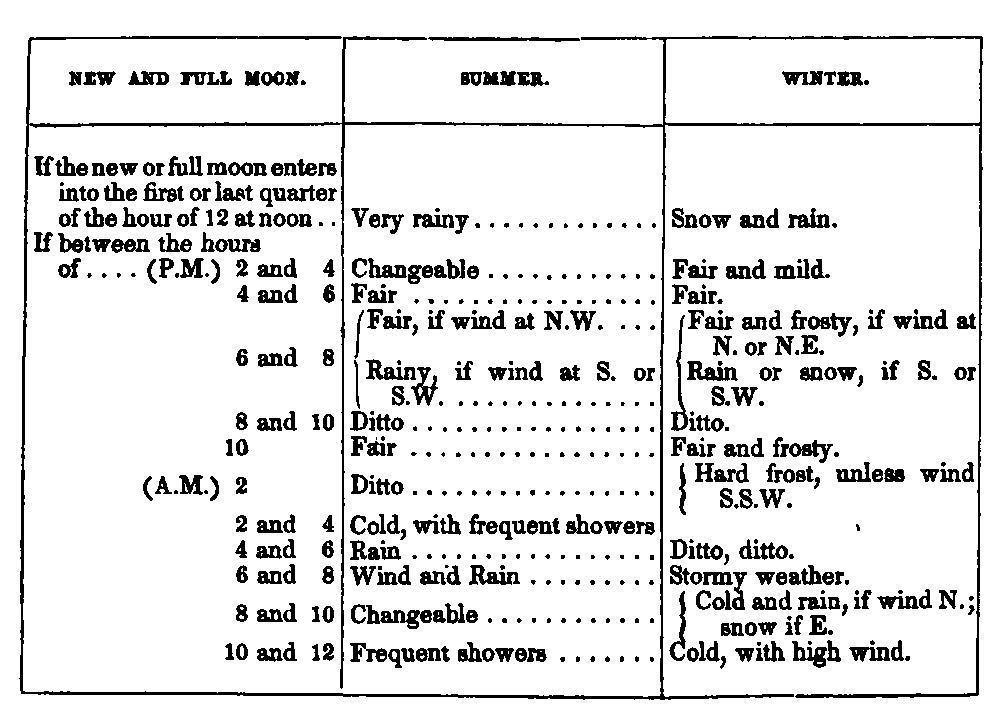
Weather Table.