VOLUME XIV SLICE VIII Isabnormal Lines to Italic (continued 3)
Reading edition
No lost work of Isocrates is known from a definite quotation, except an “Art of Rhetoric,” from which some scattered precepts are cited. Quintilian, indeed, and Photius, who had seen this “Art,” felt a doubt as to whether it was genuine. Only twenty-five discourses—out of an ascriptive total of some sixty—were admitted as authentic by Dionysius; Photius (circ. A.D. 850) knew only the number now extant—twenty-one.
With the exception of defects at the end of Or. xiii., at the beginning of Or. xvi., and probably at the end of Letters i., vi., ix., the existing text is free from serious mutilations. It is also unusually pure. The smooth and clear style of Isocrates gave few opportunities for the mistakes of copyists. On the other hand, he was a favourite author of the schools. Numerous glosses crept into his text through the comments or conjectures of rhetoricians. This was already the case before the 6th century, as is attested by the citations of Priscian and Stobaeus. Jerome Wolf and Koraes successively accomplished much for the text. But a more decided advance was made by Immanuel Bekker. He used five MSS., viz. (1) Codex Urbinas III., Γ (this, the best, was his principal guide); (2) Vaticanus 936, Δ; (3) Laurentianus 87, 14, Θ (13th century); (4) Vaticanus 65, Λ; and (5) Marcianus 415, Ξ. The first three, of the same family, have Or. xv. entire; the last two are from the same original, and have Or. xv. incomplete.
J. G. Baiter and H. Sauppe in their edition (1850) follow Γ “even more constantly than Bekker.” Their apparatus is enriched, however, by a MS. to which he had not access—Ambrosianus O. 144, Ε, which in some cases, as they recognize, has alone preserved the true reading. The readings of this MS. were given in full by G. E. Benseler in his second edition (1854-1855). The distinctive characteristic of Benseler’s textual criticism was a tendency to correct the text against even the best MS., where the MS. conflicted with the usage of Isocrates as inferred from his recorded precepts or from the statements of ancient writers. Thus, on the strength of the rule ascribed to Isocrates—φωνήεντα μὴ συμπίπτειν—Benseler would remove from the text every example of hiatus (on the MSS. of Isocrates, see H. Bürmann, Die handschriftliche Überlieferung des Isocrates, Berlin, 1885-1886, and E. Drerup, in Leipziger Studien, xvii., 1895).
(R. C. J.)
Editions.—In Oratores Attici, ed. Imm. Bekker (1823, 1828); W. S. Dobson (1828); J. G. Baiter and Hermann Sauppe (1850). Separately Ausgewählte Reden, Panegyrikos und Areopagitikos, by Rudolf Rauchenstein, 6th ed., Karl Münscher (1908); in Teubner’s series, by G. E. Benseler (new ed., by F. Blass, 1886-1895) and by E. Drerup (1906- ); Ad Demonicum et Panegyricus, ed. J. E. Sandys (1868); Evagoras, ed. H. Clarke (1885). Extracts from Orations iii., iv., vi., vii., viii., ix., xiii., xiv., xv., xix., and Letters iii., v., edited with revised text and commentary, in Selections from the Attic Orators, by R. C. Jebb (1880); vol. i. of an English prose translation, with introduction and notes by J. H. Freese, has been published in Bohn’s Classical Library (1894). See generally Jebb’s Attic Orators (where a list of authorities is given) and F. Blass, Die attische Beredsamkeit (2nd ed., 1887-1898), and the latter’s Die Rhythmen der attischen Kunstprosa (1901). There is a special lexicon by S. Preuss (1904). On the philosophy of Isocrates and his relation to the Socratic schools, see Thompson’s ed. of Plato’s Phaedrus, Appendix 2.
1 Ἀταλάντη, fr. 1, Meineke, Poëtarum comicorum Graecorum frag. (1855), p. 292.
2 [Plut.] Vita Isocr., and the anonymous biographer. Dionysius does not mention the story, though he makes Isocrates a pupil of Theramenes.
3 Some would refer the sojourn of Isocrates at Chios to the years 398-395 B.C., others to 393-388 B.C. The reasons which support the view given in the text will be found in Jebb’s Attic Orators, vol. ii. (1893), p. 6, note 2.
4 Partim in pompa, partim in acie illustres (De orat. ii. 24).
5 P. Sanneg, De schola Isocratea (Halle, 1867).
6 De falsa legat. p. 426 οὐχ ὅπως ὠργίζοντο ἢ κολάζειν τοὺς ταῦτα ποιοῦντας, ἀλλ᾽ ἀπέβλεπον, ἐζήλουν, ἐτίμων, ἅνδρας ἡγοῦντο.
7 ἐκείνους γὰρ ὁμολογεῖται ... ἤδη ἐγκρατεῖς δοκοῦντας εἶναι τῶν πραγμάτων διὰ τὴν Κύρου προπέτειαν ἀτυχῆσαι (Philippus, 90; cp. Panegyr. 149).
8 Philippus, 346 B.C.; Epist. ii. end of 342 B.C. (?).
9 The views of several modern critics on the tradition of the suicide are brought together in the Attic Orators, ii. (1893) p. 31, note 1.
10 Isocrates, a loyal and genuine Hellene, can yet conceive of Hellenic culture as shared by men not of Hellenic blood (Panegyr. 50). He is thus, as Ernst Curtius has ably shown, a forerunner of Hellenism—analogous, in the literary province, to Epameinondas and Timotheus in the political (History of Greece, v. 116, 204, tr. Ward).
11 τὸ τῶν Ἑλλήνων γένος ... δυνάμενον ἄρχειν, μιᾶς τυγχάνον πολιτείας (Polit. iv. [vii.] 6, 7).
12 De Alex. virt. i. 6.
13 The word φιλοσοφία seems to have come into Athenian use not much before the time of Socrates; and, till long after the time of Isocrates, it was commonly used, not in the sense of “philosophy,” but in that of “literary taste and study—culture generally” (see Thompson on Phaedrus, 278 D). Aristeides, ii. 407 φιλοκαλία τις καὶ διατριβὴ περὶ λόγους, καὶ οὐχ ὁ νῦν τρόπος οὗτος, ἀλλὰ παιδεία κοινῶς. And so writers of the 4th century B.C. use φιλοσοφεῖν as simply = “to study”; as e.g. an invalid “studies” the means of relief from pain, Lys. Or. xxiv. 10; cf. Isocr. Or. iv. 6, &c.
14 Plato, Gorg. p. 463; Euthyd. 304-306.
15 These allusions are discussed in the Attic Orators, vol. ii. ch. 13.
16 Isocr. Or. xv. 271.
17 A. Cartelier, Le Discours d’Isocrate sur lui-même, p. lxii. (1862).
18 Totum Isocratis μυροθήκιον atque omnes ejus discipulorum arculas (Ad Att. ii. 1).
19 Idque princeps Isocrates instituisse fertur, ... ut inconditam antiquorum dicendi consuetudinem ... numeris astringeret (De or. iii. 44, 173).
20 The dates here given differ to some extent from those in F. Blass, Die attische Beredsamkeit (2nd ed., 1887-1898).
21 Some authorities consider the Ad Demonicum spurious.
22 This was shown by R. C. Jebb in a paper on “The Sixth Letter of Isocrates,” Journal of Philology, v. 266 (1874). The fact that Thebe, widow of Alexander of Pherae, was the daughter of Jason is incidentally noticed by Plutarch in his life of Pelopidas, c. 28. It is this fact which gives the clue to the occasion of the letter; cf. Diod. Sic. xvi. 14.
ISODYNAMIC LINES (Gr. ἰσοδύναμος, equal in power), lines connecting those parts of the earth’s surface where the magnetic force has the same intensity (see Magnetism, Terrestrial).
ISOGONIC LINES (Gr. ἰσογώνιος, equiangular), lines connecting those parts of the earth’s surface where the magnetic declination is the same in amount (see Magnetism, Terrestrial).
ISOLA DEL LIRI, a town of Campania, in the province of Caserta, Italy, 15 m. by rail N.N.W. of Roccasecca, which is on the main line from Rome to Naples, 10 m. N.W. of Cassino. Pop. (1901), town, 2384; commune, 8244. The town consists of two parts, Isola Superiore and Isola Inferiore; as its name implies it is situated between two arms of the Liri. The many waterfalls of this river and of the Fibreno afford motive power for several important paper-mills. Two of the falls, 80 ft. in height, are especially fine. About 1 m. to the N. is the church of San Domenico, erected in the 12th century, which probably marks the site of the villa of Cicero (see Arpino).
ISOMERISM, in chemistry. When Wöhler, in 1825, analysed his cyanic acid, and Liebig his quite different fulminic acid in 1824, the composition of both compounds proved to be absolutely the same, containing each in round numbers 28% of carbon, 33% of nitrogen, 37% of oxygen and 2% of hydrogen. This fact, inconsistent with the then dominating conception that difference in qualities was due to difference in chemical composition, was soon corroborated by others of analogous nature, and so Berzelius introduced the term isomerism (Gr. ἰσομερής, composed of equal parts) to denominate the existence of the property of substances having different qualities, in chemical behaviour as well as physical, notwithstanding identity in chemical composition. These phenomena were quite in accordance with the atomic conception of matter, since a compound containing the same number of atoms of carbon, nitrogen, oxygen and hydrogen as another in the same weight might differ in internal structure by different arrangements of those atoms. Even in the time of Berzelius the newly introduced conception proved to include two different groups of facts. The one group included those isomers where the identity in composition was accompanied by identity in molecular weight, i.e. the vapour densities of the isomers were the same, as in butylene and isobutylene, to take the most simple case; here the molecular conception admits that the isolated groups in which the atoms are united, i.e. the molecules, are identical, and so the molecule of both butylene and isobutylene is indicated by the same chemical symbol C4H8, expressing that each molecule contains, in both cases, four atoms of carbon (C) and eight of hydrogen (H). This group of isomers was denominated metamers by Berzelius, and now often “isomers” (in the restricted sense), whereas the term polymerism (Gr. πολύς, many) was chosen for compounds like butylene, C4H8, and ethylene, C2H4, corresponding to the same composition in weight but differing in molecular formula, and having different densities in gas or vapour, a litre of butylene and isobutylene weighing, for instance, under ordinary temperature and pressure, about 2.5 gr., ethylene only one-half as much, since density is proportional to molecular weight.
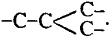
A further distinction is necessary to a survey of the subdivisions of isomerism regarded in its widest sense. There are subtle and more subtle differences causing isomerism. In the case of metamerism we can imagine that the atoms are differently linked, say in the case of butylene that the atoms of carbon are joined together as a continuous chain, expressed by —C—C—C—C—, normally as it is called, whereas in isobutylene the fourth atom of carbon is not attached to the third but to the second carbon atom, i.e. Now there are cases in which analogy of internal structure goes so far as to exclude even that difference in linking, the only remaining possibility then being the difference in relative position. This kind of isomerism has been denominated stereoisomerism (q.v.) often stereomerism. But there is a last group belonging here in which identity of structure goes farthest. There are substances such as sulphur, showing difference of modification in crystalline state—the ordinary rhombic form in which sulphur occurs as a mineral, while, after melting and cooling, long needles appear which belong to the monosymmetric system. These differences, which go hand in hand with those in other properties, e.g. specific heat and specific gravity, are absolutely confined to the crystalline state, disappearing with it when both modifications of sulphur are melted, or dissolved in carbon disulphide or evaporated. So it is natural to admit that here we have to deal with identical molecules, but that only the internal arrangement differs from case to case as identical balls may be grouped in different ways. This case of difference in properties combined with identical composition is therefore called polymorphism.
To summarize, we have to deal with polymerism, metamerism, stereoisomerism, polymorphism; whereas phenomena denominated tautomerism, pseudomerism and desmotropism form different particular features of metamerism, as well as the phenomena of allotropy, which is merely the difference of properties which an element may show, and can be due to polymerism, as in oxygen, where by the side of the ordinary form with molecules O2 we have the more active ozone with O3. Polymorphism in the case of an element is illustrated in the case of sulphur, whereas metamerism in the case of elements has so far as yet not been observed; and is hardly probable, as most elements are built up, like the metals, from molecules containing only one atom per molecule; here metamerism is absolutely excluded, and a considerable number of the rest, having diatomic molecules, are about in the same condition. It is only in cases like sulphur with octatomic molecules, where a difference of internal structure might play a part.
Before entering into detail it may be useful to consider the nature of isomerism from a general standpoint. It is probable that the whole phenomenon of isomerism is due to the possibility that compounds or systems which in reality are unstable yet persist, or so slowly change that practically one can speak of their stability; for instance, such systems as explosives and a mixture of hydrogen and oxygen, where the stable form is water, and in which, according to some, a slow but until now undetected change takes place even at ordinary temperatures. Consequently, of each pair of isomers we may establish beforehand which is the more stable; either in particular circumstances, a direct change taking place, as, for instance, with maleic acid, which when exposed to sunlight in presence of a trace of bromine, yields the isomeric fumaric acid almost at once, or, indirectly, one may conclude that the isomer which forms under greater heat-development is the more stable, at least at lower temperatures. Now, whether a real, though undetected, change occurs is a question to be determined from case to case; it is certain, however, that a substance like aragonite (a mineral form of calcium carbonate) has sensibly persisted in geological periods, though the polymorphous calcite is the more stable form. Nevertheless, the theoretical possibility, and its realization in many cases, has brought considerations to the front which have recently become of predominant interest; consequently the possible transformations of isomers and polymers will be considered later under the denomination of reversible or dynamical isomerisms.
Especially prominent is the fact that polymerism and metamerism are mainly reserved to the domain of organic chemistry, or the chemistry of carbon, both being discovered there; and, more especially, the phenomenon of metamerism in organic chemistry has largely developed our notions concerning the structure of matter. That this particular feature belongs to carbon compounds is due to a property of carbon which characterizes the whole of organic chemistry, i.e. that atoms attached to carbon, to express it in the atomic style, cling more intensely to it than, for instance, when combined with oxygen. This explains a good deal of the possible instability; and, from a practical point of view, it coincides with the fact that such a large amount of energy can be stored in our most intense explosives such as dynamite, the explanation being that hydrogen is attached to carbon distant from oxygen in the same molecule, and that only the characteristic resistance of the carbon linkage prevents the hydrogen from burning, which is the main occurrence in the explosion of dynamite. The possession of this peculiar property by carbon seems to be related to its high valency, amounting to four; and, generally, when we consider the most primitive expression of isomerism, viz. the allotropy of elements, we meet this increasing resistance with increasing valency. The monovalent iodine, for instance, is transformed by heating into an allotropic form, corresponding to the formula I, whereas ordinary iodine answers to I2. Now these modifications show hardly any tendency to persist, the one stable at high temperatures being formed at elevated temperatures, but changing in the reverse sense on cooling. In the divalent oxygen we meet with the modification called ozone, which, although unstable, changes but slowly into oxygen. Similarly the trivalent phosphorus in the ordinary white form shows such resistance as if it were practically stable; on the other hand the red modification is in reality also stable, being formed, for instance, under the influence of light. In the case of the quadrivalent carbon, diamond seems to be the stable form at ordinary temperatures, but one may wait long before it is formed from graphite.
This connexion of isomerism with resistant linking, and of this with high valency, explains, in considerable measure, why inorganic compounds afforded, as a rule, no phenomena of this kind until the systematic investigation of metallic compounds by Werner brought to light many instances of isomerism in inorganic compounds. Whereas carbon renders isomerism possible in organic compounds, cobalt and platinum are the determining elements in inorganic chemistry, the phenomena being exhibited especially by complex ammoniacal derivatives. The constitution of these inorganic isomers is still somewhat questionable; and in addition it seems that polymerism, metamerism and stereoisomerism play a part here, but the general feature is that cobalt and platinum act in them with high valency, probably exceeding four. The most simple case is presented by the two platinum compounds PtCl2(NH3)2, the platosemidiammine chloride of Peyrone, and the platosammine chloride of Jules Reiset, the first formed according to the equation PtCl4K2 + 2NH3 = PtCl2(NH3)2 + 2KCl, the second according to Pt(NH3)4Cl2 = PtCl2(NH3)2 + 2NH3, these compounds differing in solubility, the one dissolving in 33, the other in 160 parts of boiling water. With cobalt the most simple case was discovered in 1892 by S. Jörgensen in the second dinitrotetramminecobalt chloride, [Co(NO2)2(NH3)4]Cl, designated as flavo—whereas the older isomer of Gibbs was distinguished as croceo-salt. An interesting lecture on the subject was delivered by A. Werner before the German chemical society (Ber., 1907, 40, p. 15). (See Cobalt; Platinum.)
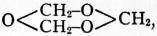
Dealing with organic compounds, it is metamerism that deserves chief attention, as it has largely developed our notions as to molecular structure. Polymerism required no particular explanation, since this was given by the difference in molecular magnitude. One general remark, however, may be made here. There are polymers which have hardly any inter-relations other than identity in composition; on the other hand, there are others which are related by the possibility of mutual transformation; examples of this kind are cyanic acid (CNOH) and cyanuric acid (CNOH)3, the latter being a solid which readily transforms into the former on heating as an easily condensable vapour; the reverse transformation may also be realized; and the polymers methylene oxide (CH2O) and trioxymethylene (CH2O)3. In the first group we may mention the homologous series of hydrocarbons derived from ethylene, given by the general formula CnH2n, and the two compounds methylene-oxide and honey-sugar C6H12O6. The cases of mutual transformation are generally characterized by the fact that in the compound of higher molecular weight no new links of carbon with carbon are introduced, the trioxymethylene being probably whereas honey-sugar corresponds to CH2OH·CHOH·CHOH·CHOH·CHOH·CHO, each point representing a linking of the carbon atom to the next. This observation is closely related to the above-mentioned resistivity of the carbon-link, and corroborates it in a special case. As carbon tends to hold the atom attached to it, one may presume that this property expresses itself in a predominant way where the other element is carbon also, and so the linkage represented by —C—C— is one of the most difficult to loosen.
The conception of metamerism, or isomerism in restricted sense, has been of the highest value for the development of our notions concerning molecular structure, i.e. the conception as to the order in which the atoms composing a molecule are linked together. In this article we shall confine ourselves to the fatty compounds, from which the fundamental notions were first obtained; reference may be made to the article Chemistry: Organic, for the general structural relations of organic compounds, both fatty and aromatic.
A general philosophical interest is attached to the phenomena of isomerism. By Wilhelm Ostwald especially, attempts have been made to substitute the notion of atoms and molecular structure by less hypothetical conceptions; these ideas may some day receive thorough confirmation, and when this occurs science will receive a striking impetus. The phenomenon of isomerism will probably supply the crucial test, at least for the chemist, and the question will be whether the Ostwaldian conception, while substituting the Daltonian hypothesis, will also explain isomerism. An early step accomplished by Ostwald in this direction is to define ozone in its relation to oxygen, considering the former as differing from the latter by an excess of energy, measurable as heat of transformation, instead of defining the difference as diatomic molecules in oxygen, and triatomic in ozone. Now, in this case, the first definition expresses much better the whole chemical behaviour of ozone, which is that of “energetic” oxygen, while the second only includes the fact of higher vapour-density; but in applying the first definition to organic compounds and calling isobutylene “butylene with somewhat more energy” hardly anything is indicated, and all the advantages of the atomic conception—the possibility of exactly predicting how many isomers a given formula includes and how you may get them—are lost.
To Kekulé is due the credit of taking the decisive step in introducing the notion of tetravalent carbon in a clear way, i.e. in the property of carbon to combine with four different monatomic elements at once, whereas nitrogen can only hold three (or in some cases five), oxygen two (in some cases four), hydrogen one. This conception has rendered possible a clear idea of the linking or internal structure of the molecule, for example, in the most simple case, methane, CH4, is expressed by

It is by this conception that possible and impossible compounds are at once fixed. Considering the hydrocarbons given by the general formula CxHy, the internal linkages of the carbon atoms need at least x − 1 bonds, using up 2(x − 1) valencies of the 4x to be accounted for, and thus leaving no more than 2(x + 1) for binding hydrogen: a compound C3H9 is therefore impossible, and indeed has never been met. The second prediction is the possibility of metamerism, and the number of metamers, in a given case among compounds, which are realizable. Considering the predicted series of compounds CnH2n+2, which is the well-known homologous series of methane, the first member, the possible of isomerism lies in that of a different linking of the carbon atoms. This first presents itself when four are present, i.e. in the difference between C—C—C—C and With this compound C4H10, named butane, isomerism is actually observed, being limited to a pair, whereas the former members ethane, C2H6, and propane, C3H8, showed no isomerism. Similarly, pentane, C5H12, and hexane, C6H14, may exist in three and five theoretically isomeric forms respectively; confirmation of this theory is supplied by the fact that all these compounds have been obtained, but no more. The third most valuable indication which molecular structure gives about these isomers is how to prepare them, for instance, that normal hexane, represented by CH3·CH2·CH2·CH2·CH2·CH3, may be obtained by action of sodium on propyl iodide, CH3·CH2·CH2I, the atoms of iodine being removed from two molecules of propyl iodide, with the resulting fusion of the two systems of three carbon atoms into a chain of six carbon atoms. But it is not only the formation of different isomers which is included in their constitution, but also the different ways in which they will decompose or give other products. As an example another series of organic compounds may be taken, viz. that of the alcohols, which only differ from the hydrocarbons by having a group OH, called hydroxyl, instead of H, hydrogen; these compounds, when derived from the above methane series of hydrocarbons, are expressed by the general formula CnH2n+1OH. In this case it is readily seen that isomerism introduces itself in the three carbon atom derivative: the propyl alcohols, expressed by the formulae CH3·CH2·CH2OH and CH3·CHOH·CH3, are known as propyl and isopropyl alcohol respectively. Now in oxidizing, or introducing more oxygen, for instance, by means of a mixture of sulphuric acid and potassium bichromate, and admitting that oxygen acts on both compounds in analogous ways, the two alcohols may give (as they lose two atoms of hydrogen) CH3·CH2·COH and CH3CO·CH3. The first compound, containing a group COH, or more explicitly O = C—H, is an aldehyde, having a pronounced reducing power, producing silver from the oxide, and is therefore called propylaldehyde; the second compound containing the group —C·CO·C— behaves differently but just as characteristically, and is a ketone, it is therefore denominated propylketone (also acetone or dimethyl ketone). And so, as a rule, from isomeric alcohols, those containing a group —CH2·OH, yield by oxidation aldehydes and are distinguished by the name primary; whereas those containing CH·OH, called secondary, produce ketones. (Compare Chemistry: Organic.)

The above examples may illustrate how, in a general way, chemical properties of isomers, their formation as well as transformation, may be read in the structure formula. It is different, however, with physical properties, density, &c.; at present we have no fixed rules which enable us to predict quantitatively the differences in physical properties corresponding to a given difference in structure, the only general rule being that those differences are not large.
Perhaps a satisfactory point of view may be here obtained by applying the van der Waals’ equation A(P + a/V²)(V − b) = 2T, which connects volume V, pressure P and temperature T (see Condensation of Gases). In this equation a relates to molecular attraction; and it is not improbable that in isomeric molecules, containing in sum the same amount of the same atoms, those mutual attractions are approximately the same, whereas the chief difference lies in the value of b, that is, the volume occupied by the molecule itself. For what reason this volume may differ from case to case lies close at hand; in connexion with the notion of negative and positive atoms, like chlorine and hydrogen, experience tends to show that the former, as well as the latter, have a mutual repulsive power, but the former acts on the latter in the opposite sense; the necessary consequence is that, when those negative and positive groups are distributed in the molecule, its volume will be smaller than if the negative elements are heaped together. An example may prove this, but before quoting it, the question of determining b must be decided; this results immediately from the above quotation, b being the volume V at the absolute zero (T = 0); so the volume of isomers ought to be compared at the absolute zero. Since this has not been done we must adopt the approximate rule that the volume at absolute zero is proportional to that at the boiling-point. Now taking the isomers H3C·CCl3(Mv = 108) and ClH2·CHCl2(Mv = 103), we see the negative chlorine atoms heaped up in the left hand formula, but distributed in the second; the former therefore may be presumed to occupy a larger space, the molecular volume, that is, the volume in cubic centimetres occupied by the molecular weight in grams, actually being 108 in the former, and 103 in the latter case (compare Chemistry: Physical). An analogous remark applies to the boiling-point of isomers. According to the above formula the critical temperature is given by 8aA/54b, and as the critical temperature is approximately proportional to the boiling-point, both being estimated on the absolute scale of temperature, we may conclude that the larger value of b corresponds to the lower boiling-point, and indeed the isomer corresponding to the left-hand formula boils at 74°, the other at 114°. Other physical properties might be considered; as a general rule they depend upon the distribution of negative and positive elements in the molecule.
Reversible (dynamical) Isomerism.—Certain investigations on isomerism which have become especially prominent in recent times bear on the possibility of the mutual transformation of isomers. As soon as this reversibility is introduced, general laws related to thermodynamics are applicable (see Chemical Action; Energetics). These laws have the advantage of being applicable to the mutual transformations of isomers, whatever be the nature of the deeper origin, and so bring polymerism, metamerism and polymorphism together. As they are pursued furthest in the last case, this may be used as an example. The study of polymorphism has been especially pursued by Otto Lehmann, who proved that it is an almost general property; the variety of forms which a given substance may show is often great, ammonium nitrate, for instance, showing at least four of them before melting. The general rule which correlates this polymorphic change is that its direction changes at a given temperature. For example, sulphur is stable in the rhombic form till 95.4°, from then upwards it tends to change over into the prismatic form. The phenomenon absolutely corresponds to that of fusion and solidification, only that it generally takes place less quickly; consequently we may have prismatic sulphur at ordinary temperature for some time, as well as rhombic sulphur at 100°. This may be expressed in the chosen case by a symbol; “rhombic sulphur 95.4° ⇄ prismatic sulphur,” indicating that there is equilibrium at the so-called “transition-point,” 95.4°, and opposite change below and above.
This comparison with fusion introduces a second notion, that of the “triple-point,” this being in the melting-phenomenon the only temperature at which solid, liquid and vapour are in equilibrium, in other words, where three phases of one substance are co-existent. This temperature is somewhat different from the ordinary melting-point, the latter corresponding to atmospheric pressure, the former to the maximum vapour-pressure; and so we come to a third relation for polymorphism. Just as the melting-point changes with pressure, the transition-point also changes; even the same quantitative relation holds for both, as L. J. Reicher proved with sulphur: aT/aP = AvT/q, v being the change in volume which accompanies the change from rhombic to prismatic sulphur, and q the heat absorbed. Both formula and experiment proved that an increase of pressure of one atmosphere elevated the transition point for about 0.04°. The same laws apply to cases of more complicated nature, and one of them, which deserves to be pursued further, is the mutual transformation of cyanuric acid, C3H3N3O3, cyanic acid, CHNO, and cyamelide (CHNO)x; the first corresponding to prismatic sulphur, stable at higher temperatures, the last to rhombic, the equilibrium-symbol being: cyamelide 150° ⇄ cyanuric acid; the cyanic acid corresponds to sulphur vapour, being in equilibrium with either cyamelide or cyanuric acid at a maximum pressure, definite for each temperature.
A second law for these mutual transformations is that when they take place without loss of homogeneity, for example, in the liquid state, the definite transition point disappears and the change is gradual. This seems to be the case with molten sulphur, which, when heated, becomes dark-coloured and plastic; and also in the case of metals, which obtain or lose magnetic properties without loss of continuous structure. At the same time, however, the transition point sometimes reappears even in the liquid state; in such cases two layers are formed, as has been recently observed with sulphur, and by F. M. Jäger in complicated organic compounds. Thus the introduction of heterogeneity, or the appearance of a new phase, demands the existence of a fixed temperature of transformation.
On the basis of the relation between physical phenomena and thermodynamical laws, properties of the polymorphous compounds may be predicted. The chief consideration here is that the stable form must have the lower vapour pressure, otherwise, by distillation, it would transform in opposite sense. From this it follows that the stable form must have the higher melting-point, since at the melting-point the vapour of the solid and of the liquid have the same pressure. Thus prismatic sulphur has a higher melting-point (120°) than the rhombic form (116°), and it is even possible to calculate the difference theoretically from the thermodynamic relations. A third consequence is that the stable form must have the smaller solubility: J. Meyer and J. N. Brönstedt found that at 25°, 10 c.c. of benzene dissolved 0.25 and 0.18 gr. of prismatic and rhombic sulphur respectively. It can be easily seen that this ratio, according to Henry’s law, must correspond to that of vapour-pressures, and so be independent of the solvent; in fact, in alcohol the figures are 0.0066 and 0.0052. Recently Hermann Walther Nernst has been able to deduce the transition-point in the case of sulphur from the specific heat and the heat developed in the transition only. This best studied case shows that a number of mutual relations are to be found between the properties of two modifications when once the phenomenon of mutual transformation is accessible.
In ordinary isomers indications of mutual transformation often occur; and among these the predominant fact is that denoted as tautomerism or pseudomerism. It exhibits itself in the peculiar behaviour of some organic compounds containing the group —C·CO·C—, e.g. CH3CO·CHX·CO2C2H5, derivatives of acetoacetic ester. These compounds generally behave as ketones; but at the same time they may act as alcohols, i.e. as if containing the OH group; this leads to the formula H3C·C(OH):CX·CO2C2H5. In reality such tautomeric compounds are apparently a mixture of two isomers in equilibrium, and indeed in some cases both forms have been isolated; then one speaks of desmotropy (Gr. δεσμός, a bond or link, and τροπή, a turn or change). Nevertheless, the relations obtained in reversible cases such as sulphur have not yet found application in the highly interesting cases of ordinary irreversible isomerism.
A further step in this direction has been effected by the introduction of reversibility into a non-reversible case by means of a catalytic agent. The substance investigated was acetaldehyde, C2H4O, in its relation to paraldehyde, a polymeric modification. The phenomena were first observed without mutual transformation, aldehyde melting at −118°, paraldehyde at 13°, the only mutual influence being a lowering of melting-point, with a minimum at -120° in the eutectic point. When a catalytic agent, such as sulphurous acid, is added, which produces a mutual change, the whole behaviour is different; only one melting-point, viz. 7°, is observed for all mixtures; this has been called the “natural melting-point.” It corresponds to one of the melting-points in the series without catalytic agents, viz. in that mixture which contains 88% of paraldehyde and 12% of acetaldehyde, which the catalytic agent leaves unaffected. Such an introduction of reversibility is also possible by allowing sufficient time to permit the transformation to be produced by itself. By R. Rothe and Alexander Smith’s interesting observations on sulphur, results have been obtained which tend to prove that the melting-point, as well as the appearance of two layers in the liquid state, correspond to unstable conditions.
(J. H. van’t H.)
ISOTHERM (Gr. ἴσος, equal, and θέρμη, heat), a line upon a map connecting places where the temperature is the same at sea-level on the earth’s surface. These isothermal lines will be found to vary from month to month over the two hemispheres, or over local areas, during summer and winter, and their position is modified by continental or oceanic conditions.
ISOXAZOLES, monazole chemical compounds corresponding to furfurane, in which the ≡CH group adjacent to the oxygen atom is replaced by a nitrogen atom, and therefore they contain the ring system They may be prepared by the elimination of water from the monoximes of β-diketones, β-ketone aldehydes or oxymethylene ketones (L. Claisen, Ber., 1891, 24, p. 3906), the general reaction proceeding according to the equation
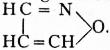

W. Dunstan and T. S. Dymond (Jour. Chem. Soc., 1891, 49, p. 410) have also prepared isoxazoles by the action of alkalis on nitroparaffins, but have not been able to obtain the parent substance. Those isoxazoles in which the carbon atom adjacent to nitrogen is substituted are stable compounds, but if this is not the case, rearrangement of the molecule takes place and nitriles are formed. The isoxazoles are feebly basic.
The isoxazolones are the keto derivatives of the as yet unknown dihydroisoxazole, and are compounds of strongly acid nature, decomposing the carbonates of the alkaline earth metals and forming salts with metals and with ammonia. Their constitution is not yet definitely fixed and they may be regarded as derived from one of the three types

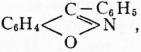
By the action of nitrous acid on the oxime of o-aminobenzophenone as α-phenyl indoxazene, is obtained; this is a derivative of benzisoxazole.
ISRAEL (Hebrew for “God strives” or “rules”; see Gen. xxxii. 28; and the allusion in Hosea xii. 4), the national designation of the Jews. Israel was a name borne by their ancestor Jacob the father of the twelve tribes. For some centuries the term was applied to the northern kingdom, as distinct from Judah, although the feeling of national unity extended it so as to include both. It emphasizes more particularly the position of the Hebrews as a religious community, bound together by common aims and by their covenant-relation with the national God, Yahweh.
See further Jacob, Hebrew Language, Hebrew Religion, Jews: History and Palestine.
ISRAELI, ISAAC BEN SOLOMON (9th-10th centuries), Jewish physician and philosopher. A contemporary of Seadiah (q.v.), he was born and passed his life in North Africa. He died c. 950. At Kairawan, Israeli was court physician; he wrote several medical works in Arabic, and these were afterwards translated into Latin. Similarly his philosophical writings were translated, but his chief renown was in the circle of Moslem authors.
ISRAËLS, JOSEF (1824- ), Dutch painter, was born at Groningen, of Hebrew parents, on the 27th of January 1824. His father intended him to be a man of business, and it was only after a determined struggle that he was allowed to enter on an artistic career. However, the attempts he made under the guidance of two second-rate painters in his native town—Buÿs and van Wicheren—while still working under his father as a stockbroker’s clerk, led to his being sent to Amsterdam, where he became a pupil of Jan Kruseman and attended the drawing class at the academy. He then spent two years in Paris, working in Picot’s studio, and returned to Amsterdam. There he remained till 1870, when he moved to The Hague for good. Israëls is justly regarded as one of the greatest of Dutch painters. He has often been compared to J. F. Millet. As artists, even more than as painters in the strict sense of the word, they both, in fact, saw in the life of the poor and humble a motive for expressing with peculiar intensity their wide human sympathy; but Millet was the poet of placid rural life, while in almost all Israëls’ pictures we find some piercing note of woe. Duranty said of them that “they were painted with gloom and suffering.” He began with historical and dramatic subjects in the romantic style of the day. By chance, after an illness, he went to recruit his strength at the fishing-town of Zandvoort near Haarlem, and there he was struck by the daily tragedy of life. Thenceforth he was possessed by a new vein of artistic expression, sincerely realistic, full of emotion and pity. Among his more important subsequent works are “The Zandvoort Fisherman” (in the Amsterdam gallery), “The Silent House” (which gained a gold medal at the Brussels Salon, 1858) and “Village Poor” (a prize at Manchester). In 1862 he achieved great success in London with his “Shipwrecked,” purchased by Mr Young, and “The Cradle,” two pictures of which the Athenaeum spoke as “the most touching pictures of the exhibition.” We may also mention among his maturer works “The Widower” (in the Mesdag collection), “When we grow Old” and “Alone in the World” (Amsterdam gallery), “An Interior” (Dordrecht gallery), “A Frugal Meal” (Glasgow museum), “Toilers of the Sea,” “A Speechless Dialogue,” “Between the Fields and the Seashore,” “The Bric-à-brac Seller” (which gained medals of honour at the great Paris Exhibition of 1900). “David Singing before Saul,” one of his latest works, seems to hint at a return on the part of the venerable artist to the Rembrandtesque note of his youth. As a water-colour painter and etcher he produced a vast number of works, which, like his oil paintings, are full of deep feeling. They are generally treated in broad masses of light and shade, which give prominence to the principal subject without any neglect of detail.
See Jan Veth, Mannen of Beteckenis: Jozef Israëls; Chesneau, Peintres français et étrangers; Ph. Zilcken, Peintres hollandais modernes (1893); Dumas, Illustrated Biographies of Modern Artists (1882-1884); J. de Meester, in Max Rooses’ Dutch Painters of the Nineteenth Century (1898); Jozef Israëls, Spain: the Story of a Journey (1900).
ISSACHAR (a Hebrew name meaning apparently “there is a hire,” or “reward”), Jacob’s ninth “son,” his fifth by Leah; also the name of a tribe of Israel. Slightly differing explanations of the reference in the name are given in Gen. xxx. 16 (J) and v. 18 (E).1 The territory of the tribe (Joshua xix. 17-23) lay to the south of that allotted to Zebulun, Naphtali, Asher and Dan, and included the whole of the great plain of Esdraelon, and the hills to the east of it, the boundary in that direction extending from Tabor to the Jordan, apparently along the deep gorge of Wadi el Bīreh. In the rich territory of Issachar, traversed by the great commercial highway from the Mediterranean and Egypt to Bethshean and the Jordan, were several important towns which remained in the hands of the Canaanites for some time (Judges i. 27), separating the tribe from Manasseh. Although Issachar is mentioned as having taken some part in the war of freedom under Deborah (Judges v. 15), it is impossible to misunderstand the reference to its tributary condition in the blessing of Jacob (Gen. xlix. 14 seq.), or the fact that the name of this tribe is omitted from the list given in Judges i. of those who bestirred themselves against the earlier inhabitants of the country. In the “blessing upon Zebulun and Issachar” in Deut. xxxiii. 18 seq., reference is made to its agricultural life in terms suggesting that along with its younger, but more successful “brother,” it was the guardian of a sacred mountain (Carmel, Tabor?) visited periodically for sacrificial feasts.
1 On the origin of the name, see the article by H. W. Hogg, Ency. Bib. col. 2290; E. Meyer, Israeliten, p. 536 seq.
ISSEDONES, an ancient people of Central Asia at the end of the trade route leading north-east from Scythia (q.v.), described by Herodotus (iv. 26). The position of their country is fixed as the Tarym basin by the more precise indications of Ptolemy, who tells how a Syrian merchant penetrated as far as Issedon. They had their wives in common and were accustomed to slay the old people, eat their flesh and make cups of their skulls. Such usages survived among Tibetan tribes and make it likely that the Issedones were of Tibetan race. Some of the Issedones seem to have invaded the country of the Massagetae to the west, and similar customs are assigned to a section of these.
(E. H. M.)
ISSERLEIN, ISRAEL (d. 1460), German Talmudist. His fame attracted many students to Neustadt, and his profound learning did much to revive the study of the original Rabbinic authorities. After the publication of the Code of Joseph Qaro (q.v.) the decisions of Isserlein in legal matters were added in notes to that code by Moses Isserles. His chief works were Terumath ha-Deshēn (354 decisions) and Peasqim u-kethaḥim (267 decisions) largely on points of the marriage law.
ISSERLES, MOSES BEN ISRAEL (c. 1520-1572), known as Remā, was born at Cracow and died there in 1572. He wrote commentaries on the Zohar, the “Bible of the Kabbalists,” but is best known as the critic and expander of the Shulḥan Aruch of Joseph Qaro (Caro)(q.v.). His chief halakhic (legal) works were Darke Moshē and Mappāh. Qaro, a Sephardic (Spanish) Jew, in his Code neglected Ashkenazic (German) customs. These deficiencies Isserles supplied, and the notes of Remā are now included in all editions of Qaro’s Code.
ISSOIRE, a town of central France, capital of an arrondissement in the department of Puy-de-Dôme, on the Couze, near its junction with the Allier, 22 m. S.S.E. of Clermont-Ferrand on the Paris-Lyon-Méditerranée railway to Nîmes. Pop. (1906) 5274. Issoire is situated in the fertile plain of Limagne. The streets in the older part of the town are narrow and crooked, but in the newer part there are several fine tree-shaded promenades, while a handsome boulevard encircles the town. The church of St Paul or St Austremoine built on the site of an older chapel raised over the tomb of St Austremoine (Stremonius) affords an excellent specimen of the Romanesque architecture of Auvergne. Issoire is the seat of a sub-prefect; its public institutions include tribunals of first instance and commerce and a communal college. Brewing, wool-carding and the manufacture of passementerie, candles, straw hats and woollen goods are carried on. There is trade in lentils and other agricultural products, in fruit and in wine.
Issoire (Iciodurum) is said to have been founded by the Arverni, and in Roman times rose to some reputation for its schools. In the 5th century the Christian community established there by Stremonius in the 3rd century was overthrown by the fury of the Vandals. During the religious wars of the Reformation, Issoire suffered very severely. Merle, the leader of the Protestants, captured the town in 1574, and treated the inhabitants with great cruelty. The Roman Catholics retook it in 1577, and the ferocity of their retaliation may be inferred from the inscription “Ici fut Issoire” carved on a pillar which was raised on the site of the town. In the contest between the Leaguers and Henry IV., Issoire sustained further sieges, and never wholly regained its early prosperity.
ISSOUDUN, a town of central France, capital of an arrondissement in the department of Indre, on the right bank of the Théols, 17 m. N.E. of Châteauroux by rail. Pop. (1906) 10,566. Among the interesting buildings are the church of St Cyr, combining various architectural styles, with a fine porch and window, and the chapel of the Hôtel Dieu of the early 16th century. Of the fortifications with which the town was formerly surrounded, a town-gate of the 16th century and the White Tower, a lofty cylindrical building of the reign of Philip Augustus, survive. Issoudun is the seat of a sub-prefecture, and has tribunals of first instance and of commerce, a chamber of arts and manufactures and a communal college. The industries, of which the most important is leather-dressing, also include malting and brewing and the manufacture of bristles for brushes and parchment. Trade is in grain, live-stock, leather and wine.
Issoudun, in Latin Exoldunum or Uxellodunum, existed in and before Roman times. In 1195 it was stoutly and successfully defended by the partizans of Richard Cœur-de-Lion against Philip Augustus, king of France. It has suffered severely from fires. A very destructive one in 1651 was the result of an attack on the town in the war of Fronde; Louis XIV. rewarded its fidelity to him during that struggle by the grant of several privileges.
ISSYK-KUL, also called Tuz-Kul, and by the Mongols Temurtu-nor, a lake of Central Asia, lying in a deep basin (5400 ft. above sea-level), between the Kunghei Ala-tau and the Terskei Ala-tau, westward continuations of the Tian-shan mountains, and extending from 76° 10′ to 78° 20′ E. The length from W.S.W. to E.N.E. is 115 m. and the breadth 38 m., the area being estimated at 2230 sq. m. The name is Kirghiz for “warm lake,” and, like the Chinese synonym She-hai, has reference to the fact that the lake is never entirely frozen over. On the south the Terskei Ala-tau do not come down so close to the shore as the mountains on the north, but leave a strip 5 to 13 m. broad. The margins of the lake are overgrown with reeds. The water is brackish. Fish are remarkably abundant, the principal species being carp.
It was by the route beside this lake that the tribes (e.g. Yue-chi) driven from China by the Huns found their way into the Aralo-Caspian basin in the end of the 2nd century. The Ussuns or Uzuns settled on the lake and built the town of Chi-gu, which still existed in the 5th century. It is to Hsüan-tsang, the Chinese Buddhist pilgrim, that we are indebted for the first account of Issyk-kul based on personal observation. In the beginning of the 14th century Nestorian Christians reached the lake and founded a monastery on the northern shore, indicated on the Catalan map of 1374. It was not till 1856 that the Russians made acquaintance with the district.
ISTAHBANÁT, a town and district of Persia in the province of Fars. The district, which is very fertile, extends for nearly 50 m. east and west along the southern shore of the Bakhtegán lake and produces much grain, cotton, good tobacco and excellent fruit, particularly pomegranates and grapes, walnuts and figs. The town is situated in the midst of a plain 12 m. from the eastern corner of the lake and about 100 m. S.E. of Shiraz, and has a population of about 10,000. It occupies the site of the ancient city of Ij, the capital of the old province of Shabánkáreh, which was captured and partly destroyed by Mubariz ed-din, the founder of the Muzaffarid dynasty, in 1355. When rebuilt it became known by its present name. Of the old period a ruined mosque and two colleges remain; other mosques and colleges are of recent construction. At the entrance of the town stands a noble chinar (oriental plane), measuring 45 ft. in circumference at 2 ft. from the ground.
ISTHMUS (Gr. ἰσθμός, neck), a narrow neck of land connecting two larger portions of land that are otherwise separated by the sea.
ISTRIA (Ger. Istrien), a margraviate and crownland of Austria, bounded N. by the Triestine territory, Görz and Gradisca, and Carniola, E. by Croatia and S. and W. by the Adriatic; area 1908 sq. m. It comprises the peninsula of the same name (area 1545 sq. m.), which stretches into the Adriatic Sea between the Gulf of Trieste and the Gulf of Quarnero, and the islands of Veglia, Cherso, Lussino and others. The coast line of Istria extends for 267 m., including Trieste, and presents many good bays and harbours. Besides the great Gulf of Trieste, the coast is indented on the W. by the bays of Muggia, Capodistria, Pirano, Porto Quieto and Pola, and on the E. by those of Medolino, Arsa, Fianona and Volosca. A great portion of Istria belongs to the Karst region, and is occupied by the so-called Istrian plateau, flanked on the north and east by high mountains, which attain in the Monte Maggiore an altitude of 4573 ft. In the south and west the surface gradually slopes down in undulating terraces towards the Adriatic. The Quieto in the west and the Arsa in the east, neither navigable, are the principal streams. The climate of Istria, although it varies with the varieties of surface, is on the whole warm and dry. The coasts are exposed to the prevailing winds, namely the Sirocco from the south-south-east, and the Bora from the north-east. Of the total area 33.21% is occupied by forests, 32.09% by pastures, 11.2% by arable land, 9.5% by vineyards, 7.21% by meadows and 3.26% by gardens. The principal agricultural products are wheat, maize, rye, oats and fruit, namely olives, figs and melons. Viticulture is well developed, and the best sorts of wine are produced near Capodistria, Muggia, Isola, Parenzo and Dignano, while well-known red wines are made near Refosco and Terrano. The oil of Istria was already famous in Roman times. Cattle-breeding is another great source of revenue, and the exploitation of the forests gives beech and oak timber (good for shipbuilding), gall-nuts, oak-bark and cork. Fishing, the recovery of salt from the sea-water, and shipbuilding constitute the other principal occupations of the population. Istria had in 1900 a population of 344,173, equivalent to 180 inhabitants per square mile. Two-thirds of the population were Slavs and the remainder Italians, while nearly the whole of the inhabitants (99.6%) were Roman Catholics, under the ecclesiastical jurisdiction of three bishops. The local Diet, which meets at Parenzo, and of which the three bishops are members ex-officio, is composed of 33 members, and Istria sends 5 deputies to the Reichsrat at Vienna. For administrative purposes the province is divided into 6 districts and an autonomous municipality, Rovigno (pop. 10,205). Other important places are Pola (45,052), Capodistria (10,711), Pinguente (15,827), Albona (10,968), Isola (7500), Parenzo (9962), Dignano (9684), Castua (17,988), Pirano (13,339) and Mitterburg (16,056).
The modern Istria occupies the same position as the ancient Istria or Histria, known to the Romans as the abode of a fierce tribe of Illyrian pirates. It owed its name to an old belief that the Danube (Ister, in Greek) discharged some of its water by an arm entering the Adriatic in that region. The Istrians, protected by the difficult navigation of their rocky coasts, were only subdued by the Romans in 177 B.C. after two wars. Under Augustus the greater part of the peninsula was added to Italy, and, when the seat of empire was removed to Ravenna, Istria reaped many benefits from the proximity of the capital. After the fall of the Western empire it was pillaged by the Longobardi and the Goths; it was annexed to the Frankish kingdom by Pippin in 789; and about the middle of the 10th century it fell into the hands of the dukes of Carinthia. Fortune after that, however, led it successively through the hands of the dukes of Meran, the duke of Bavaria and the patriarch of Aquileia, to the republic of Venice. Under this rule it remained till the peace of Campo Formio in 1797, when Austria acquired it, and added it to the north-eastern part which had fallen to her share so early as 1374. By the peace of Pressburg, Austria was in 1805 compelled to cede Istria to France, and the department of Istria was formed; but in 1813 Austria again seized it, and has retained it ever since.
See T. G. Jackson, Dalmatia, the Quarnero and Istria (Oxford, 1887).
ISYLLUS, a Greek poet, whose name was rediscovered in the course of excavations on the site of the temple of Asclepius at Epidaurus. An inscription was found engraved on stone, consisting of 72 lines of verse (trochaic tetrameters, hexameters, ionics), mainly in the Doric dialect. It is preceded by two lines of prose stating that the author was Isyllus, an Epidaurian, and that it was dedicated to Asclepius and Apollo of Malea. It contains a few political remarks, showing general sympathy with an aristocratic form of government; a self-congratulatory notice of the resolution, passed at the poet’s instigation, to arrange a solemn procession in honour of the two gods; a paean (no doubt for use in the procession), chiefly occupied with the genealogical relations of Apollo and Asclepius; a poem of thanks for the assistance rendered to Sparta by Asclepius against Philip, when he led an army against Sparta to put down the monarchy. The offer of assistance was made by the god himself to the youthful poet, who had entered the Asclepieum to pray for recovery from illness, and communicated the good news to the Spartans. The Philip referred to is identified with (a) Philip II. of Macedon, who invaded Peloponnesus after the battle of Chaeronea in 338, or (b) with Philip III., who undertook a similar campaign in 218.
Wilamowitz-Möllendorff, who characterizes Isyllus as a “poetaster without talent and a farcical politician,” has written an elaborate treatise on him (Kiessling and Möllendorff, Philosophische Untersuchungen, Heft 9, 1886), containing the text with notes, and essays on the political condition of Peloponnesus and the cult of Asclepius. The inscription was first edited by P. Kavvadias (1885), and by J. F. Baunack in Studien auf dem Gebiete der griechischen und der arischen Sprachen (1886).
ITACOLUMITE, the name given to a variety of porous yellow sandstone or quartzose schist, which occurs at Itacolumi, in the southern portion of Minas Geraes, Brazil. This rock is of interest for two reasons; it is believed to be the source of the diamonds which are found in great numbers in the district, and it is the best and most widely known example of a flexible sandstone. Itacolumite is yellow or pale-brown, and splits readily into thin flat slabs. It is a member of a metamorphic series, being accompanied by clay-slate, mica schist, hornblende schist and various types of ferriferous schists. In many places itacolumite is really a coarse grit or fine conglomerate. Other quartzites occur in the district, and there is some doubt whether the diamantiferous sandstones are always itacolumites and also as to the exact manner in which the presence of diamond in these rocks is to be accounted for. Some authorities hold that the diamond has been formed in certain quartz veins which traverse the itacolumite. It is clear, however, that the diamonds are found only in those streams which contain the detritus of this rock.
On the split faces of the slabs, scales of greenish mica are visible, but in other respects the rock seems to be remarkably pure. If a piece which is a foot or two long and half an inch thick be supported at its ends it will gradually bend by its own weight. If it then be turned over it will straighten and bend in the opposite direction. Flakes a millimetre or two thick can be bent between the fingers and are said to give out a creaking sound. It should be noted that specimens showing this property form only a small part of the whole mass of the rock. Flexible rocks have also been reported and described from North and South Carolina, Georgia, Delhi, and from the north of England (Durham). They are mostly sandstones or quartzites, but the Durham rock is a variety of the magnesian limestone of that district.
Some discussion has taken place regarding the cause of the flexibility. At one time it was ascribed to the presence of thin scales of mica which were believed to permit a certain amount of motion between adjacent grains of quartz. More probably, however it is due to the porous character of the rock together with the interlocking junctions between the sand grains. The porosity allows interstitial movement, while the hinge-like joints by which the particles are connected hold them together in spite of the displacement. These features are dependent to some extent on weathering, as the rocks contain perishable constituents which are removed and leave open cavities in their place, while at the same time additional silica may have been deposited on the quartz grains fitting their irregular surfaces more perfectly together. Most of the known flexible rocks are also fine-grained; in some cases they are said to lose their flexibility after being dried for some time, probably because of the hardening of some interstitial substance, but many specimens kept in a dry atmosphere for years retain this property in a high degree.
(J. S. F.)
ITAGAKI, TAISUKE, Count (1837- ), Japanese statesman, was born in Tosa in 1837. He distinguished himself originally as one of the soldier politicians who contributed so much to the overthrow of feudalism and the restoration of the administrative power to the throne. After taking a prominent part in subduing the resistance offered by a section of the shogun’s feudatories to those changes, he received cabinet rank in the newly organized system. But in 1873 he resigned his portfolio as a protest against the ministry’s resolve to refrain from warlike action against Korea. This incident inspired Itagaki with an apprehension that the country was about to pass under the yoke of a bureaucratic government. He became thenceforth a warm advocate of constitutional systems, though at the outset he does not seem to have contemplated anything like a popular assembly in the English sense of the term, his ideas being limited to the enfranchisement of the samurai class. Failing to obtain currency for his radical propaganda, he retired to his native province, and there established a school (the Risshi-sha) for teaching the principles of government by the people, thus earning for himself the epithet of “the Rousseau of Japan.” His example found imitators. Not only did pupils flock to Tosa from many quarters, attracted alike by the novelty of Itagaki’s doctrines, by his eloquence and by his transparent sincerity, but also similar schools sprang up among the former vassals of other fiefs, who saw themselves excluded from the government. In 1875 no less than seven of these schools sent deputies to hold a convention in Osaka, and for a moment an appeal to force seemed possible. But the statesmen in power were not less favourable to constitutional institutions than the members of the Aikoku Kō-tō (public party of patriots), as Itagaki and his followers called themselves. A conference attended by Kido, Okubo, Inouye, Ito, Itagaki and others entered into an agreement by which they pledged themselves to the principle of a constitutional monarchy and a legislative assembly. Itagaki now accepted office once more. Finding, however, that his colleagues in the administration favoured a much more leisurely rate of progress than he himself advocated, he once more retired into private life (1876) and renewed his liberal propagandism. It is in the nature of such movements to develop violent phases, and the leaders of the Aikoku-sha (patriotic association), as the agitators now called themselves, not infrequently showed disregard for the preservation of peace and order. Itagaki made the mistake of memorializing the government at the moment when its very existence was imperilled by the Satsuma rebellion (1877), and this evident disposition to take advantage of a great public peril went far to alienate the sympathies of the cabinet. Recourse was had to legislation in restraint of free speech and public meeting. But repression served only to provoke opposition. Throughout 1879 and 1880 Itagaki’s followers evinced no little skill in employing the weapons of local association, public meetings and platform tours, and in November 1881 the first genuine political party was formed in Japan under the name of Jiyū-tō, with Itagaki for declared leader. A year later the emperor announced that a parliamentary system should be inaugurated in 1891, and Itagaki’s task might be said to have been accomplished. Thenceforth he devoted himself to consolidating his party. In the spring of 1882, he was stabbed by a fanatic during the reception given in the public park at Gifu. The words he addressed to his would-be assassin were: “Itagaki may perish, but liberty will survive.” Once afterwards (1898) he held office as minister of home affairs, and in 1900 he stepped down from the leadership of the Jiyū-tō in order that the latter might form the nucleus of the Seiyū-kai organized by Count Ito. Itagaki was raised to the nobility with the title of “count” in 1887. From the year 1900 he retired into private life, devoting himself to the solution of socialistic problems. His countrymen justly ascribe to him the fame of having been the first to organize and lead a political party in Japan.
ITALIAN LANGUAGE.1 The Italian language is the language of culture in the whole of the present kingdom of Italy, in some parts of Switzerland (the canton of Ticino and part of the Grisons), in some parts of the Austrian territory (the districts of Trent and Görz, Istria along with Trieste, and the Dalmatian coast), and in the islands of Corsica2 and Malta. In the Ionian Islands, likewise, in the maritime cities of the Levant, in Egypt, and more particularly in Tunis, this literary language is extensively maintained through the numerous Italian colonies and the ancient traditions of trade.
The Italian language has its native seat and living source in Middle Italy, or more precisely Tuscany and indeed Florence. For real linguistic unity is far from existing in Italy; in some respects the variety is less, in others more observable than in other countries which equally boast a political and literary unity. Thus, for example, Italy affords no linguistic contrast so violent as that presented by Great Britain with its English dialects alongside of the Celtic dialects of Ireland, Scotland and Wales, or by France with the French dialects alongside of the Celtic dialects of Brittany, not to speak of the Basque of the Pyrenees and other heterogeneous elements. The presence of not a few Slavs stretching into the district of Udine (Friuli), of Albanian, Greek and Slav settlers in the southern provinces, with the Catalans of Alghero (Sardinia, v. Arch. glott. ix. 261 et seq.), a few Germans at Monte Rosa and in some corners of Venetia, and a remnant or two of other comparatively modern immigrations is not sufficient to produce any such strong contrast in the conditions of the national speech. But, on the other hand, the Neo-Latin dialects which live on side by side in Italy differ from each other much more markedly than, for example, the English dialects or the Spanish; and it must be added that, in Upper Italy especially, the familiar use of the dialects is tenaciously retained even by the most cultivated classes of the population.
In the present rapid sketch of the forms of speech which occur in modern Italy, before considering the Tuscan or Italian par excellence, the language which has come to be the noble organ of modern national culture, it will be convenient to discuss (A) dialects connected in a greater or less degree with Neo-Latin systems that are not peculiar to Italy;3 (B) dialects which are detached from the true and proper Italian system, but form no integral part of any foreign Neo-Latin system; and (C) dialects which diverge more or less from the true Italian and Tuscan type, but which at the same time can be conjoined with the Tuscan as forming part of a special system of Neo-Latin dialects.
A. Dialects which depend in a greater or less degree on Neo-Latin systems not peculiar to Italy.
1. Franco-Provençal and Provençal Dialects.—(a) Franco-Provençal (see Ascoli, Arch. glott. iii. 61-120; Suchier, in Grundriss der romanischen Philologie, 2nd ed., i. 755, &c.; Nigra, Arch. glott. iii. 1 sqq.; Salvioni, Rendic. istit. lomb., s. ii. vol. xxxvii. 1043 sqq.; Cerlogne, Dictionnaire du patois valdôtain (Aosta, 1907). These occupy at the present time very limited areas at the extreme north-west of the kingdom of Italy. The system stretches from the borders of Savoy and Valais into the upper basin of the Dora Baltea and into the head-valleys of the Orco, of the northern Stura, and of the Dora Riparia. As this portion is cut off by the Alps from the rest of the system, the type is badly preserved; in the valleys of the Stura and the Dora Riparia, indeed, it is passing away and everywhere yielding to the Piedmontese. The most salient characteristic of the Franco-Provençal is the phonetic phenomenon by which the Latin a, whether as an accented or as an unaccented final, is reduced to a thin vowel (ḛ, i) when it follows a sound which is or has been palatal, but on the contrary is kept intact when it follows a sound of another sort. The following are examples from the Italian side of these Alps: Aosta: travaljí, Fr. travailler; zarźí, Fr. charger; enteruźí, Fr. interroger; zḛvra, Fr. chèvre; zir, Fr. cher; gljáçḛ, Fr. glace; vázze, Fr. vache; alongside of sa, Fr. sel; maṅ, Fr. main; epóusa, Fr. épouse; erba, Fr. herbe. Val. Soana: taljér, Fr. tailler; coćí-sse, Fr. se coucher; ćiṅ, Fr. chien; ćívra, Fr. chèvre; vaćći, Fr. vache; mánģi, Fr. manche; alongside of alár, Fr. aller; porta, Fr. porté; amára, Fr. amère; néva, Fr. neuve. Chiamorio (Val di Lanzo): la spranssi dla vendeta, sperantia de illa vindicta. Viù: pansci, pancia. Usseglio: la müragli, muraille. A morphological characteristic is the preservation of that paradigm which is legitimately traced back to the Latin pluperfect indicative, although possibly it may arise from a fusion of this pluperfect with the imperfect subjunctive (amaram, amarem, alongside of habueram, haberem), having in Franco-Provençal as well as in Provençal and in the continental Italian dialects in which it will be met with further on (C. 3, b; cf. B. 2) the function of the conditional. Val Soana: portáro, portáre, portáret; portáront; Aosta: ávre = Prov. agra, haberet (see Arch. iii. 31 n). The final t in the third persons of this paradigm in the Val Soana dialect is, or was, constant in the whole conjugation, and becomes in its turn a particular characteristic in this section of the Franco-Provençal. Val Soana: éret, Lat. erat; sejt, sit; pórtet, portávet; portǫnt, portávǫnt; Chiamorio: jéret, erat; ant dit, habent dictum; èjssount fêt, habuissent factum; Viu: che s’mínget, Ital. che si mangi: Gravere (Val di Susa): at pensá, ha pensato; avát, habebat; Giaglione (sources of the Dora Riparia); maciávont, mangiavano.—From the valleys, where, as has just been said, the type is disappearing, a few examples of what is still genuine Franco-Provençal may be subjoined: Ćivreri (the name of a mountain between the Stura and the Dora Riparia), which, according to the regular course of evolution, presupposes a Latin Capraria (cf. maneri, maniera, even in the Chiamorio dialect); ćarastí (ciarastì), carestia, in the Viu dialect; and ćintá, cantare, in that of Usseglio. From Chiamorio, li téns, i tempi, and chejches birbes, alcune (qualche) birbe, are worthy of mention on account of the final s. [In this connexion should also be mentioned the Franco-Provençal colonies of Transalpine origin, Faeto and Celle, in Apulia (v. Morosi, Archivio glottologico, xii. 33-75), the linguistic relations of which are clearly shown by such examples as talíj, Ital. tagliare; bañíj, Ital. bagnare; side by side with ćantǡ, Ital. cantare; luǡ, Ital. levare.]
(b) Provençal (see La Lettura i. 716-717, Romanische Forschungen xxiii. 525-539).—Farther south, but still in the same western extremity of Piedmont, phenomena continuous with those of the Maritime Alps supply the means of passing from the Franco-Provençal to the Provençal proper, precisely as the same transition takes place beyond the Cottian Alps in Dauphiné almost in the same latitude. On the Italian side of the Cottian and the Maritime Alps the Franco-Provençal and the Provençal are connected with each other by the continuity of the phenomenon ć (a pure explosive) from the Latin c before a. At Oulx (sources of the Dora Riparia), which seems, however, to have a rather mixed dialect, there also occurs the important Franco-Provençal phenomenon of the surd interdental (English th in thief) instead of the surd sibilant (for example ithí = Fr. ici). At the same time agü = avuto, takes us to the Provençal. [If, in addition to the Provençal characteristic of which agǘ is an example, we consider those characteristics also Provençal, such as the o for a final unaccented, the preservation of the Latin diphthong au, p between vowels preserved as b, we shall find that they occur, together or separately, in all the Alpine varieties of Piedmont, from the upper valleys of the Dora Riparia and Clusone to the Colle di Tenda. Thus at Fenestrelle (upper valley of the Clusone): agü, vengü, Ital. venuto; pauc, Lat. paucu, Ital. poco; aribá (Lat. rīpa), Ital. arrivare; trubá, Ital. trovare; ciabrin, Ital. capretto; at Oulx (source of the Dora Riparia): agü, vengü; üno gran famino è venüo, Ital. una gran fame è venuta; at Giaglione: auvou, Ital. odo (Lat. audio); arribá, resebü, Ital. ricevuto (Lat. recipere); at Oncino (source of the Po): agü, vengü; ero en campagno, Ital. “era in campagna”; donavo, Ital. dava; paure, Lat. pauper, Ital. povero; trubá, ciabrí; at Sanpeyre (valley of the Varaita): agü, volgü, Ital. voluto; pressioso, Ital. preziosa; fasio, Ital. faceva; trobar; at Acceglio (valley of the Macra): venghess, Ital. venisse; virro, Ital. ghiera; chesto allegrio, Ital. questa allegria; ero, Ital. era; trobá; at Castelmagno (valley of the Grana): gü, vengü; rabbio, Ital. rabbia; trubar; at Vinadio (valley of the southern Stura); agü, beigü, Ital. bevuto; cadëno, Ital. catena; mangģo, Ital. manica; ćanto, Ital. canta; pau, auvì, Ital. udito; šabe, Ital. sapete; trobar; at Valdieri and Roaschia (valley of the Gesso): purgü, Ital. potuto; pjagü, Ital. piaciuto; corrogǘ, Ital. corso; pau; arribá, ciabri; at Limone (Colle di Tenda): agü, vengü; saber, Ital. sapere; arübá, trubava. Provençal also, though of a character rather Transalpine (like that of Dauphiné) than native, are the dialects of the Vaudois population above Pinerolo (v. Morosi, Arch. glott. xi. 309-416), and their colonies of Guardia in Calabria (ib. xi. 381-393) and of Neu-Hengstett and Pinache-Serres in Württemberg (ib. xi. 393-398). The Vaudois literary language, in which is written the Nobla Leyczon, has, however, no direct connexion with any of the spoken dialects; it is a literary language, and is connected with literary Provençal, the language of the troubadours; see W. Foerster, Göttingische gelehrte Anzeigen (1888) Nos. 20-21.]
2. Ladin Dialects (Ascoli, Arch. glott. i., iv. 342 sqq., vii. 406 sqq.; Gartner, Rätoromanische Grammatik (Heilbronn, 1883), and in Grundriss der romanischen Philologie, 2nd ed., i. 608 sqq.; Salvioni, Arch. glott. xvi. 219 sqq.).—The purest of the Ladin dialects occur on the northern versant of the Alps in the Grisons (Switzerland), and they form the western section of the system. To this section also belongs both politically and in the matter of dialect the valley of Münster (Monastero); it sends its waters to the Adige, and might indeed consequently be geographically considered Italian, but it slopes towards the north. In the central section of the Ladin zone there are two other valleys which likewise drain into tributaries of the Adige, but are also turned towards the north,—the valleys of the Gardena and Gadera, in which occurs the purest Ladin now extant in the central section. The valleys of Münster, the Gardena and the Gadera may thus be regarded as inter-Alpine, and the question may be left open whether or not they should be included even geographically in Italy. There remain, however, within what are strictly Italian limits, the valleys of the Noce, the Avisio, the Cordevole, and the Boite, and the upper basin of the Piave (Comelico), in which are preserved Ladin dialects, more or less pure, belonging to the central section of the Ladin zone or belt. To Italy belongs, further, the whole eastern section of the zone composed of the Friulian territories. It is by far the most populous, containing about 500,000 inhabitants. The Friulian region is bounded on the north by the Carnic Alps, south by the Adriatic, and west by the eastern rim of the upper basin of the Piave and the Livenza; while on the east it stretches into the eastern versant of the basin of the Isonzo, and, further the ancient dialect of Trieste was itself Ladin (Arch. glott. x. 447 et seq.). The Ladin element is further found in greater or less degree throughout an altogether Cis-Alpine “amphizone,” which begins at the western slopes of Monte Rosa, and is to be noticed more particularly in the upper valley of the Ticino and the upper valley of the Liro and of the Mera on the Lombardy versant, and in the Val Fiorentina and central Cadore on the Venetian versant. The Ladin element is clearly observable in the most ancient examples of the dialects of the Venetian estuary (Arch. i. 448-473). The main characteristics by which the Ladin type is determined may be summarized as follows: (1) the guttural of the formulae c + a and g + a passes into a palatal; (2) the l of the formulae pl, cl, &c., is preserved; (3) the s of the ancient terminations is preserved; (4) the accented e in position breaks into a diphthong; (5) the accented o in position breaks into a diphthong; (6) the form of the diphthong which comes from short accented o or from the o of position is ue (whence üe, ö); (7) long accented e and short accented i break into a diphthong, the purest form of which is sounded ei; (8) the accented a tends, within certain limits, to change into e, especially if preceded by a palatal sound; (9) the long accented u is represented by ü. These characteristics are all foreign to true and genuine Italian. Ćárn, carne; spelunća, spelunca; clefs, claves; fuormas, formae; infiern, infernu; ördi, hordeu; möd, modu; plain, plenu; pail, pilu; quael, quale; pür, puru—may be taken as examples from the Upper Engadine (western section of the zone). The following are examples from the central and eastern sections on the Italian versant:—
a. Central Section.—Basin of the Noce: examples of the dialect of Fondo: ćavél, capillu; pesćadór, piscatore; pluévia, pluvia (plovia); pluma (dial. of Val de Rumo: plövia, plümo); vécla, vetula; ćántes, cantas. The dialects of this basin are disappearing.—Basin of the Avisio: examples of the dialect of the Val di Fassa: ćarn, carne; ćéžer, cadere (cad-jere); váća, vacca; fórća, furca; gléžia (géžia), ecclesia; oeglje (oeje), oculi; ćans, canes; rámes, rami; teila, tela; néif, nive; coessa, coxa. The dialects of this basin which are farther west than Fassa are gradually being merged in the Veneto-Tridentine dialects.—Basin of the Cordevole: here the district of Livinal-Lungo (Buchenstein) is Austrian politically, and that of Rocca d’ Agordo and Laste is Italian. Examples of the dialect of Livinal-Lungo: ćarié, Ital. caricare; ćanté, cantatus; ógle, oculu; ćans, canes; ćavéis, capilli; viérm, verme; fŭóc, focu; avéĭ, habere; néi, nive.—Basin of the Boite: here the district of Ampezzo (Heiden) is politically Austrian, that of Oltrechiusa Italian. Examples of the dialect of Ampezzo are ćasa, casa; ćandéra, candela; fórćes, furcae, pl.; séntes, sentis. It is a decadent form.—Upper Basin of the Piave: dialect of the Comelico: ćésa, casa; ćen (can), cane; ćaljé, caligariu; bos, boves; noevo, novu; loego, locu.
b. Eastern Section or Friulian Region.—Here there still exists a flourishing “Ladinity,” but at the same time it tends towards Italian, particularly in the want both of the e from á and of the ü (and consequently of the ö). Examples of the Udine variety: ćarr, carro; ćavál, caballu; ćastiél, castellu; fórće, furca; clar, claru; glaç, glacie; plan, planu; colors, colores; lungs, longi, pl.; dévis, debes; vidiél, vitello; fiéste, festa; puéss, possum; cuétt, coctu; uárdi, hordeu.—The most ancient specimens of the Friulian dialect belong to the 14th century (see Arch. iv. 188 sqq.).
B. Dialects which are detached from the true and proper Italian system, but form no integral part of any foreign Neo-Latin system.
1. Here first of all is the extensive system of the dialects usually called Gallo-Italian, although that designation cannot be considered sufficiently distinctive, since it would be equally applicable to the Franco-Provençal (A. 1) and the Ladin (A. 2). The system is subdivided into four great groups—(a) the Ligurian, (b) the Piedmontese, (c) the Lombard and (d) the Emilian—the name furnishing on the whole sufficient indication of the localization and limits.—These groups, considered more particularly in their more pronounced varieties, differ greatly from each other; and, in regard to the Ligurian, it was even denied that it belongs to this system at all (see Arch. ii. III sqq.).—Characteristic of the Piedmontese, the Lombard and the Emilian is the continual elision of the unaccented final vowels except a (e.g. Turinese öj, oculu; Milanese vǫç, voce; Bolognese vîd, Ital. vite), but the Ligurian does not keep them company (e.g. Genoese öģģu, oculu; vǫže, voce). In the Piedmontese and Emilian there is further a tendency to eliminate the protonic vowels—a tendency much more pronounced in the second of these groups than in the first (e.g. Pied, dné, danaro; vśin, vicino; fnôć, finocchio; Bolognese ćprà, disperato). This phenomenon involves in large measure that of the prothesis of a; as, e.g. in Piedmontese and Emilian armor, rumore; Emilian alvär, levare, &c. U for the long accented Latin u and ö for the short accented Latin o (and even within certain limits the short Latin ó of position) are common to the Piedmontese, the Ligurian, the Lombard and the northernmost section of the Emilian: e.g., Turinese, Milanese and Piacentine dür, and Genoese düu, duro; Turinese and Genoese möve, Parmigiane möver, and Milanese möf, muovere; Piedmontese dörm, dorme; Milanese völta, volta. Ei for the long accented Latin e and for the short accented Latin i is common to the Piedmontese and the Ligurian, and even extends over a large part of Emilia: e.g. Turinese and Genoese avéi, habere, Bolognese avéir; Turinese and Genoese beive, bibere, Bolognese neiv, neve. In Emilia and part of Piedmont ei occurs also in the formulae ĕn, ent, emp; e.g. Bolognese and Modenese beiṅ, solaméint. In connexion with these examples, there is also the Bolognese feiṅ, Ital. fine, representing the series in which e is derived from an í followed by n, a phenomenon which occurs, to a greater or less extent throughout the Emilian dialects; in them also is found, parallel with the ḛi from ḛ, the ou from ǫ: Bolognese udóur, Ital. odore; famóus, Ital. famoso; lóuv, lŭpu. The system shows a repugnance throughout to ie for the short accented Latin e (as it occurs in Italian piede, &c.); in other words, this diphthong has died out, but in various fashions; Piedmontese and Lombard deç, dieci; Genoese dēže (in some corners of Liguria, however, occurs dieže); Bolognese diç, old Bolognese, diese. The greater part of the phenomena indicated above have “Gallic” counterparts too evident to require to be specially pointed out. One of the most important traces of Gallic or Celtic reaction is the reduction of the Latin accented a into e (ä, &c.), of which phenomenon, however, no certain indications have as yet been found in the Ligurian group. On the other hand it remains, in the case of very many of the Piedmontese dialects, in the é of the infinitives of the first conjugation: porté, portare, &c.; and numerous vestiges of it are still found in Lombardy (e.g. in Bassa Brianza: andae, andato; guardae, guardato; sae, sale; see Arch. i. 296-298, 536). Emilia also preserves it in very extensive use: Modenese andér, andare; arivéda, arrivata; peç, pace; Faenzan parlé, parlare and parlato; parléda, parlata; ches, caso; &c. The phenomenon, in company with other Gallo-Italian and more specially Emilian characteristics extends to the valley of the Metauro, and even passes to the opposite side of the Apennines, spreading on both banks of the head stream of the Tiber and through the valley of the Chiane: hence the types artrovér, ritrovare, portéto, portato, &c., of the Perugian and Aretine dialects (see infra C. 3, b). In the phenomenon of á passing into e (as indeed, the Gallo-Italic evolution of other Latin vowels) special distinctions would require to be drawn between bases in which a (not standing in position) precedes a non-nasal consonant (e.g. amáto), and those which have a before a nasal: and in the latter case there would be a non-positional subdivision (e.g. fáme, páne) and a positional one (e.g. quánto, amándo, cámpo); see Arch. i. 293 sqq. This leads us to the nasals, a category of sounds comprising other Gallo-Italic characteristics. There occurs more or less widely, throughout all the sections of the system, and in different gradations, that “velar” nasal in the end of a syllable (paṅ, maṅ; ćáṅta, moṅt)4 which may be weakened into a simple nasalizing of a vowel (pā, &c.) or even grow completely inaudible (Bergamese pa, pane; padrú, padrone; tep, tempo; met, mente; mut, monte; pût, ponte; púća, punta, i.e. “puncta”), where Celtic and especially Irish analogies and even the frequent use of t for nt, &c., in ancient Umbrian orthography occur to the mind. Then we have the faucal n by which the Ligurian and the Piedmontese (laṅa lüṅa, &c.) are connected with the group which we call Franco-Provençal (A. 1).—We pass on to the “Gallic” resolution of the nexus ct (e.g. facto, fajto, fajtjo. fait, fać; tecto, tejto, tejtjo, teit, teć) which invariably occurs in the Piedmontese, the Ligurian and the Lombard: Pied, fáit, Lig. fajtu, faetu, Lombard fac; Pied. téit, Lig. téitu, Lom. tec; &c. Here it is to be observed that besides the Celtic analogy the Umbrian also helps us (adveitu = ad-vecto; &c.). The Piedmontese and Ligurian come close to each other, more especially by a curious resolution of the secondary hiatus (Gen. réiže, Piedm. réjs = *ra-íce, Ital. radice) by the regular dropping of the d both primary and secondary, a phenomenon common in French (as Piedmontese and Ligurian ríe, ridere; Piedmontese pué, potare; Genoese naeghe = náighe. nátiche, &c.). The Lombard type, or more correctly the type which has become the dominant one in Lombardy (Arch. i. 305-306, 310-311), is more sparing in this respect; and still more so is the Emilian. In the Piedmontese and in the Alpine dialects of Lombardy is also found that other purely Gallic resolution of the guttural between two vowels by which we have the types brája, mánia, over against the Ligurian brága, mánega, braca, manica. Among the phonetic phenomena peculiar to the Ligurian is a continual reduction (as also in Lombardy and part of Piedmont) of l between vowels into r and the subsequent dropping of this r at the end of words in the modern Genoese; just as happens also with the primary r: thus dū = durúr = dolore, &c. Characteristic of the Ligurian, but not without analogies in Upper Italy even (Arch., ii. 157-158, ix. 209, 255), is the resolution of pj, bj, fj into ć, ģ, š: ćü, più, plus; raģģa, rabbia, rabies; šû, fiore. Finally, the sounds š and ž have a very wide range in Ligurian (Arch. ii. 158-159), but are, however, etymologically, of different origin from the sounds š and ž in Lombard. The reduction of s into h occurs in the Bergamo dialects: hira, sera; groh, grosso; cahtél, castello (see also B.2).—A general phenomenon in Gallo-Italic phonetics which also comes to have an inflexional importance is that by which the unaccented final i has an influence on the accented vowel. This enters into a series of phenomena which even extends into southern Italy; but in the Gallo-Italic there are particular resolutions which agree well with the general connexions of this system. [We may briefly recall the following forms in the plural and 2nd person singular: old Piedmontese drayp pl. of drap, Ital. drappo; man, meyn, Ital. mano, -i; long, loyng, Ital. lungo, -ghi; Genoese, káṅ, kḛṅ, Ital. cane, -i; buṅ, buíṅ, Ital. buono, -i; Bolognese, fär, fîr, Ital. ferro, -i; peir, pîr, Ital. pero, -i. zôp, zûp, Ital. zoppo, -i; louv, lûv, Ital. lupo, -i; vedd, vî, Ital. io vedo, tu vedi; vojj, vû, Ital. io voglio, tu vuoi; Milanese quȩst, quist, Ital. questo, -i, and, in the Alps of Lombardy, pal, pȩl, Ital. palo, -i; rȩd, rid, Ital. rete, -i; cor, cör, Ital. cuore, -i; ǫrs, ürs, Ital. orso, -i; law, lȩw, Ital. io lavo, tu lavi; mȩt, mit, Ital. io metto, tu metti; mow möw, Ital. io muovo, tu muovi; cǫr, cür, Ital. io corro, tu corri. [Vicentine pomo, pumi, Ital. pomo, -i; pero, piéri = *píri, Ital. pero, -i; v. Arch. i. 540-541; ix. 235 et seq., xiv. 329-330].—Among morphological peculiarities the first place may be given to the Bolognese sipa (seppa), because, thanks to Dante and others, it has acquired great literary celebrity. It really signifies “sia” (sim, sit), and is an analogical form fashioned on aepa, a legitimate continuation of the corresponding forms of the other auxiliary (habeam, habeat), which is still heard in ch’me aepa purtae, ch’lu aepa purtae, ch’io abbia portato, ch’egli abbia portato. Next may be noted the 3rd person singular in -p of the perfect of esse and of the first conjugation in the Forlì dialect (fop, fu; mandép, mandò; &c.). This also must be analogical, and due to a legitimate ep, ebbe (see Arch. ii. 401; and compare fobbe, fu, in the dialect of Camerino, in the province of Macerata, as well as the Spanish analogy of tuve estuve formed after hube). Characteristic of the Lombard dialect is the ending -i in the 1st person sing. pres. indic. (mi a porti, Ital. io porto); and of Piedmontese, the -éjça, as indicating the subjunctive imperfect (portȩjça, Ital. portassi) the origin of which is to be sought in imperfects of the type staésse, faésse reduced normally to stéjç-, féjç-. Lastly, in the domain of syntax, may be added the tendency to repeat the pronoun (e.g. ti te cántet of the Milanese, which really is tu tu cántas-tu, equivalent merely to “cantas”), a tendency at work in the Emilian and Lombard, but more particularly pronounced in the Piedmontese. With this the corresponding tendency of the Celtic languages has been more than once and with justice compared; here it may be added that the Milanese nün, apparently a single form for “noi,” is really a compound or reduplication in the manner of the ni-ni, its exact counterpart in the Celtic tongues. [From Lombardy, or more precisely, from the Lombardo-Alpine region extending from the western slopes of Monte Rosa to the St Gotthard, are derived the Gallo-Italian dialects, now largely, though not all to the same extent, Sicilianized, from the Sicilian communes of Sanfratello, Piazza-Armerina, Nicosia, Aidone, Novara and Sperlinga (v. Arch. glott. viii. 304-316, 406-422, xiv. 436-452; Romania, xxviii. 409-420; Memorie dell’ Istituto lombardo, xxi. 255 et seq.). The dialects of Gombitelli and Sillano in the Tuscan Apennines are connected with Emilia (Arch. glott. xii. 309-354). And from Liguria come those of Carloforte in Sardinia, as also those of Monaco, and of Mons, Escragnolles and Biot in the French departments of Var and Alpes Maritimes (Revue de linguistique, xiii. 308)]. The literary records for this group go back as far as the 12th century, if we are right in considering as Piedmontese the Gallo-Italian Sermons published and annotated by Foerster (Romanische Studien, iv. 1-92). But the documents published by A. Gaudenzi (Dial. di Bologna, 168-172) are certainly Piedmontese, or more precisely Canavese, and seem to belong to the 13th century. The Chieri texts date from 1321 (Miscellanea di filol. e linguistica, 345-355), and to the 14th century also belongs the Grisostomo (Arch. glott. vii. 1-120), which represents the old Piedmontese dialect of Pavia (Bollett. della Soc. pav. di Storia Patria, ii. 193 et seq.). The oldest Ligurian texts, if we except the “contrasto” in two languages of Rambaud de Vaqueiras (12th century v. Crescini, Manualetto provenzale, 2nd ed., 287-291), belong to the first decades of the 14th century (Arch. glott. xiv. 22 et seq., ii. 161-312, x. 109-140, viii. 1-97). Emilia has manuscripts going back to the first or second half of the 13th century, the Parlamenti of Guido Fava (see Gaudenzi, op. cit. 127-160) and the Regola dei servi published by G. Ferraro (Leghorn, 1875). An important Emilian text, published only in part, is the Mantuan version of the De proprietatibus rerum of Bartol. Anglico, made by Vivaldo Belcalzer in the early years of the 14th century (v. Cian. Giorn. stor. della letteratura italiana, supplement, No. 5, and cf. Rendiconti Istituto Lombardo, series ii. vol. xxxv. p. 957 et seq.). For Modena also there are numerous documents, starting from 1327. For western Lombardy the most ancient texts (13th century, second half) are the poetical compositions of Bonvesin de la Riva and Pietro da Bescapè, which have reached us only in the 14th-century copies. For eastern Lombardy we have, preserved in Venetian or Tuscan versions, and in MSS. of a later date, the works of Gerardo Patecchio, who lived at Cremona in the first half of the 13th century. Bergamasc literature is plentiful, but not before the 14th century (v. Studi medievali, i. 281-292; Giorn. stor. della lett. ital. xlvi. 351 et seq.).
2. Sardinian Dialects.5—These are three—the Logudorese or central, the Campidanese or southern and the Gallurese or northern. The third certainly indicates a Sardinian basis, but is strangely disturbed by the intrusion of other elements, among which the Southern Corsican (Sartene) is by far the most copious. The other two are homogeneous, and have great affinity with each other; the Logudorese comes more particularly under consideration here.—The pure Sardinian vocalism has this peculiarity that each accented vowel of the Latin appears to be retained without alteration. Consequently there are no diphthongs representing simple Latin vowels; nor does the rule hold good which is true for so great a proportion of the Romance languages, that the representatives of the ḗ and the í on the one hand and those of the ṓ and the ṹ on the other are normally coincident. Hence plenu (ē); deghe, decem (ĕ); binu, vino (ī); pilu (ĭ); flore (ō); roda, rota (ŏ); duru (ū); nughe, nuce (ŭ). The unaccented vowels keep their ground well, as has already been seen in the case of the finals by the examples adduced.—The s and t of the ancient termination are preserved, though not constantly: tres, onus, passados annos, plantas, faghes, facis, tenemus; mulghet, mulghent.—The formulae ce, ci, ge, gi may be represented by che (ke), &c.; but this appearance of special antiquity is really illusory (see Arch. ii. 143-144). The nexus cl, &c., may be maintained in the beginning of words (claru, plus); but if they are in the body of the word they usually undergo resolutions which, closely related though they be to those of Italian, sometimes bring about very singular results (e.g. ušare, which by the intermediate forms uscare, usjare leads back to usclare = ustlare = ustulare). Nź is the representative of nj (testimónźu, &c.); and lj is reduced to ź alone (e.g. méźus, melius; Campidanese mellus). For ll a frequent substitute is ḍḍ: massīḍḍa, maxilla, &c. Quite characteristic is the continual labialization of the formulae qua, gua, cu, gu, &c.; e.g. ebba, equa; sambene, sanguine (see Arch. ii. 143). The dropping of the primary d (roere, rodere, &c.) but not of the secondary (finidu, sanidade, maduru) is frequent. Characteristic also is the Logudorese prothesis of i before the initial s followed by a consonant (iscamnu, istella, ispada), like the prothesis of e in Spain and in France (see Arch. iii. 447 sqq.).—In the order of the present discussion it is in connexion with this territory that we are for the first time led to consider those phonetic changes in words of which the cause is merely syntactical of transitory, and chiefly those passing accidents which occur to the initial consonant through the historically legitimate or the merely analogical action of the final sound that precedes it. The general explanation of such phenomena reduces itself to this, that, given the intimate syntactic relation of two words, the initial consonant of the second retains or modifies its character as it would retain or modify it if the two words were one. The Celtic languages are especially distinguished by this peculiarity; and among the dialects of Upper Italy the Bergamasc offers a clear example. This dialect is accustomed to drop the v, whether primary or secondary, between vowels in the individual vocables (caá, cavare; fáa, fava, &c.), but to preserve it if it is preceded by a consonant (serva, &c.).—And similarly in syntactic combination we have, for example, de i, di vino; but ol vi, il vino. Insular, southern and central Italy furnish a large number of such phenomena; for Sardinia we shall simply cite a single class, which is at once obvious and easily explained, viz. that represented by su oe, il bove, alongside of sos boes, i. buoi (cf. bíere, bibere; erba).—The article is derived from ipse instead of from ille: su sos, sa sas,—again a geographical anticipation of Spain, which in the Catalan of the Balearic islands still preserves the article from ipse.—A special connexion with Spain exists besides in the nomine type of inflexion, which is constant among the Sardinians (Span. nomne, &c., whence nombre, &c.), nomen, nomene, rámine, aeramine, legumene, &c. (see Arch. ii. 429 sqq.).—Especially noteworthy in the conjugation of the verb is the paradigm cantére, cantéres, &c., timére, timéres, &c., precisely in the sense of the imperfect subjunctive (cf. A. 1; cf. C. 3 b). Next comes the analogical and almost corrupt diffusion of the -si of the ancient strong perfects (such as posi, rosi) by which cantesi, timesi (cantavi, timui), dolfesi, dolui, are reached. Proof of the use and even the abuse of the strong perfects is afforded, however, by the participles and the infinitives of the category to which belong the following examples: ténnidu, tenuto; párfidu, parso; bálfidu, valso; ténnere, bálere, &c. (Arch. ii. 432-433). The future, finally, shows the unagglutinated periphrasis: hapo a mandigare (ho a mangiare = manger-ó); as indeed the unagglutinated forms of the future and the conditional occur in ancient vernacular texts of other Italian districts. [The Campidanese manuscript, in Greek characters, published by Blancard and Wescher (Bibliothèque de l’École des Chartes, xxxv. 256-257), goes back as far as the last years of the 11th century. Next come the Cagliari MSS. published by Solmi (Le Carte volgari dell’ Archivio arcivescovile di Cagliari, Florence, 1905; cf. Guarnerio in Studi romanzi, fascicolo iv. 189 et seq.), the most ancient of which in its original form dates from 1114-1120. For Logoduro, the Condaghe di S. Pietro di Silchi (§§ xii.-xiii.), published by G. Bonazzi (Sassari-Cagliari, 1900; cf. Meyer-Lübke, Zur Kenntnis des Altlogudoresischen, Vienna, 1902), is of the highest importance.]