VOLUME XII SLICE V Greek Law to Ground-Squirrel (continued 6)
Reading edition
The effects on the host are confined to the parasitized cells. These generally undergo at first marked hypertrophy and alteration in character; this condition is succeeded by one of atrophy, when the substance of the cell becomes in one way or another practically absorbed by the growing parasite (cf. also Coccidia). Since, however, the Gregarines never overrun their hosts in the way that many other Sporozoa do (because of their lack, in general, of the power of endogenous multiplication), the number of cells of any tissue attacked, even in the case of a strong infection, is only a very small percentage of the whole. In short the hosts do not, as a rule, suffer any appreciable inconvenience from the presence of the parasites.
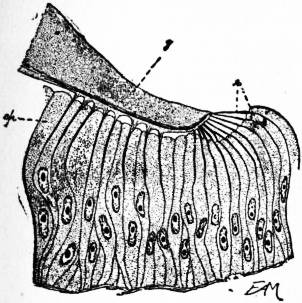
After Siedlecki, from Lankester’s Treatise on Zoology.
Fig. 5.—Part of a section through the apparatus of fixation of a Pterocephalus, showing root-like processes extending from the Gregarine between the epithelial cells. g, Head of Gregarine; r, Root-like processes; ep, Epithelial cells.
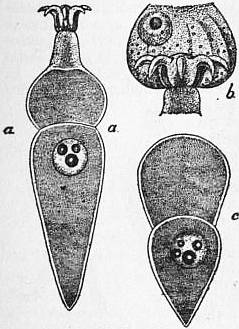
From Wasielewski, after Léger.
Fig. 6.—Corycella armata, Léger. a, Cephalont; b, Epimerite in host-cell; c, Sporont.
The body of a Gregarine is always of a definite shape, usually oval or elongated; in one or two instances (e.g. Diplodina) it is spherical, and, on the other hand, in Porospora (fig. 3) it is greatly drawn out and vermiform. In many adult Gregarines, Morphology. the body is divided into two distinct but unequal regions or halves, the anterior part being known as the protomerite, the hinder, generally the larger, as the deutomerite. This feature is closely associated with another important morphological character, one which is observable, however, only during the earlier stages of growth and development, namely, the presence of a definite organ, the epimerite, which serves for the attachment of the parasite to the host-cell (fig. 6).
In those Gregarines (most intestinal forms) which become attached to an epithelial cell, the attachment occurs by means of a minute projection or beak (rostrum) at the anterior end of the sporozoite, which pushes its way into the cell, followed by the first part of the growing germ. This portion of the body increases in size much quicker at first than the rest (the extracellular part), more or less fills up the host-cell, and forms the well-developed epimerite or secondary attaching organella. The extracellular part of the Gregarine next grows rapidly, and a transverse septum is formed at a short distance away from (outside) the point where the body penetrates into the cell (fig. 6); this marks off the large deutomerite posteriorly (distally). Léger thinks that this partition most likely owes its origin to trophic considerations, i.e. to the slightly different manner in which the two halves of the young parasite (the proximal, largely intracellular part, and the distal, extracellular one) may be supposed to obtain their nutriment. In the case of the one half, the host-cell supplies the nutriment, in that of the other, the intestinal liquid; and the septum is, as it were, the expression of the conflicting limit between these two methods. Nevertheless, the present writer does not think that mechanical considerations should be altogether left out of account. The septum may also be, to some extent, an adaption for strengthening the body of the fixed parasite against lateral thrusts or strains, due to the impact of foreign bodies (food, &c.) in the intestine.
At the point where the body becomes actually intracellular, it is constricted, and this constriction marks off the epimerite (internally) from the middle portion (between this point and the septum), which is the protomerite. Further growth is restricted, practically, to the extracellular regions, and the epimerite often comes to appear ultimately as a small appendage at the anterior end of the protomerite. A Gregarine at this stage is known as a cephalont. Later on, the parasite breaks loose from the host-cell and becomes free in the lumen, the separation taking place at the constriction between the protomerite and the epimerite; the latter is left behind in the remains of the host-cell, the former becomes the anterior part of the free trophozoite.
In other Gregarines, however, those, namely, which pass inwards, ultimately becoming “coelomic,” as well as those which become entirely intracellular, no epimerite is ever developed, and, further, the body remains single or unseptate. These forms, which include, for instance, Monocystis (fig. 4), Lankesteria, Diplocystis, are distinguished, as Acephalina or Aseptata (Haplocyta, Monocystida), according to which character is referred to, from the others, termed Cephalina or Septata (Polycystida).
The two sets of terms are not, however, completely identical or interchangeable, for there are a few forms which possess an epimerite, but which lack the division into protomerite and deutomerite, and are hence known as Pseudomonocystida; this condition may be primitive (Doliocystis) or (possibly) secondary, the partition having in course of time disappeared. Again, Stenophora is a septate form which has become, secondarily, completely intracellular during the young stages, and, doubtless correlated with this, shows no sign of an epimerite.
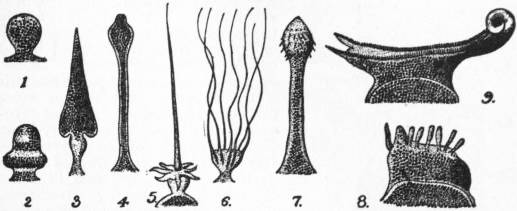
From Wasielewski, after Léger.
Fig. 7.—Forms of Epimerites.
1, Gregarina longa. 2, Sycia inopinata. 3, Pileocephalus heerii. 4, Stylorhynchus longicollis. 5, Beloides firmus. 6, Cometoides crinitus. 7, Geneiorhynchus monnieri. 8, Echinomera hispida. 9, Pterocephalus nobilis.
With regard to the epimerites themselves, they are of all variety of form and shape and need not be described in detail (fig. 7). In one or two cases, however, another variety of attaching organella is met with. Thus in Pterocephalus, only the rostrum of the sporozoite penetrates into the host-cell, and no epimerite is formed. Instead, a number of fine root-like processes are developed from near the anterior end, which pass in between the host-cells (fig. 5) and thus anchor the parasite firmly. Similarly, in the curious Schizogregarinae, the anterior end of the (unseptate) body forms a number of stiff, irregular processes, which perform the same function (fig. 8). It is to be noted that these processes are non-motile, and not in any way comparable to pseudopodia, to which they were formerly likened.
A very interesting and remarkable morphological peculiarity has been recently described by Léger (18) in the case of a new Gregarine, Taeniocystis. In this form the body is elongated and metamerically segmented, recalling that of a segmented worm, the adult trophozoites possessing numerous partitions or segments (each corresponding to the septum between the proto- and deuto-merite in an ordinary Polycystid), which divide up the cytoplasm into roughly equal compartments. Léger thinks only the deutomerite becomes thus segmented, the protomerite remaining small and undivided. The nucleus remains single, so that there is no question as to the unicellular or individual nature of the entire animal.
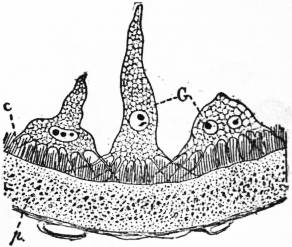
After Léger and Hagenmüller, from Lankester’s Treatise on Zoology.
Fig. 8.—Three Individuals (G) of Ophryocystis schneideri, attached to wall of Malpighian tubule of Blaps sp. p, Syncytial protoplasm of the tubule; c, Cilia lining the lumen.
The general cytoplasm usually consists of distinct ectoplasm and endoplasm, and is limited by a membrane or cuticle (epicyte), secreted by the former. The cuticle varies considerably in thickness, being well developed in active, intestinal Minute structure. forms, but very thin and delicate in non-motile coelomic forms (e.g. Diplodina). In the former case it may show longitudinal striations. The cuticle also forms the hooks or spines of many epimerites. The ectoplasm usually shows (fig. 9A) a differentiation into two layers, an outer, firmer layer, clear and hyaline, the sarcocyte, and an inner layer, the myocyte, which is formed of a network of muscle-fibrillae (mainly longitudinal and transverse, fig. 9B). The sarcocyte alone constitutes the septum, traversing the endoplasm, in septate Gregarines. The myonemes are undoubtedly the agents responsible for the active “gregarinoid” movements (of flexion and contraction) to be observed in many forms. The peculiar gliding movements were formerly thought to be produced by the extrusion of a gelatinous thread posteriorly, but Crawley (8) has recently ascribed them to a complicated succession of wave-like contractions of the myocyte layer. This view is supported by the fact that certain coelomic forms, like Diplodina and others, which either lack muscle-fibrils or else show no ectoplasmic differentiation at all, are non-motile. The endoplasm, or nutritive plasm, consists of a semi-fluid matrix in which are embedded vast numbers of grains and spherules of various kinds and of all sizes, representing an accumulation of food-material which is being stored up prior to reproduction. The largest and most abundant grains are of a substance termed para-glycogen, a carbohydrate; in addition, flattened lenticular platelets, of an albuminoid character, and highly-refringent granules often occur.
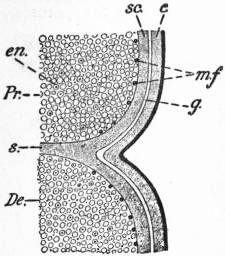
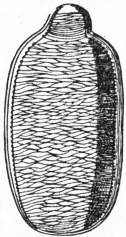
After Schewiakoff, from Lankester’s Treatise on Zoology.
Fig. 9a.—Longitudinal section of a Gregarine in the region of the septum between protomerite and deutomerite. Pr, Protomerite. De, Deutomerite. s, Septum. en, Endoplasm. sc, Sarcocyte. c, Cuticle. m, f, Myocyte fibrils (cut across). g, Gelatinous layer. Fig. 9b.—Gregarina munieri, showing the network of myocyte fibrillae.
The nucleus is always lodged in the endoplasm, and, in the septate forms, in the deutomeritic half of the body. It is normally spherical and always limited by a distinct nuclear membrane, which itself often contains chromatin. The most characteristic feature of the nucleus is the deeply-staining, more or less vacuolated spherical karyosome (consisting of chromatin intimately bound up with a plastinoid basis) which is invariably present. In one or two instances (e.g. Diplocystis schneideri) the nucleus has more than one karyosome. All the chromatin of the nucleus is not, however, confined to the karyosome, some being in the form of grains in the nuclear sap; and in some cases at any rate (e.g. Diplodina, Lankesteria) there is a well-marked nuclear reticulum which is impregnated with granules and dots of chromatin.
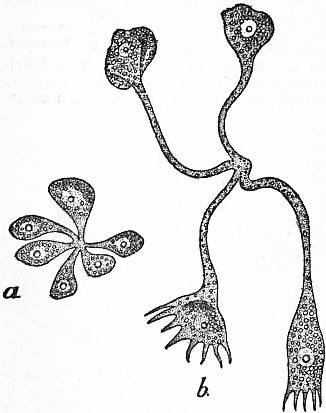
From Wasielewski, after A. Schneider.
Fig. 10.—Schizogony in Ophryocystis francisci. a, Rosette of small individuals, produced from a schizont which has just divided; b, A later stage, the daughter-individuals about to separate and assuming the characters of the adult.
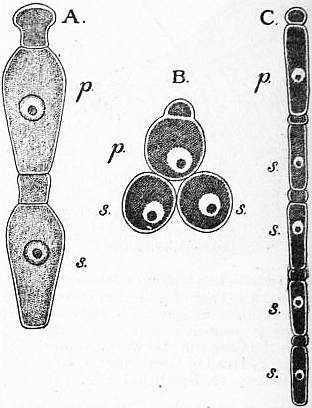
From Wasielewski, after Léger.
Fig. 11.—Eirmocystis spp. a, b, Associations of two and three Gregarines; c, Chain of five parasites; p, Primite; s, Satellites.
A sexual multiplication (schizogony) is only known certainly to occur in a few cases, one being in a Monocystid form, a species of Gonospora, which is for a long time intracellular (Caullery and Mesnil [4]), the rest among the Schizogregarinae, so Life-history. named for this reason, in which schizogonous fission takes place regularly during the free, trophic condition. Usually, the body divides up, by a process of multiple fission (fig. 10), into a few (up to eight) daughter-individuals; but in a new genus (Eleutheroschizon), Brasil (3) finds that a great number of little merozoites are formed, and a large amount of vacuolated cytoplasm is left over unused.
In the vast majority of Gregarines, however, the life-cycle is limited to gametogony and sporogony. A very general, if not indeed universal, prelude to gametogony is the characteristic and important feature of the order, known as association, the biological significance of which has only lately been fully brought out (see H. M. Woodcock [31]). In normal association, two individuals which are to be regarded as of opposite sex, come into close contact with each other and remain thus attached. The manner in which the parasites join varies in different forms; the association may be end-to-end (terminal), either by like or by unlike poles, or it may be side-to-side (lateral) (fig. 12). The couple (syzygy) thus formed may proceed forthwith to encystment and sporoblast-formation (Lankesteria, Monocystis), or may continue in the trophic phase for some time longer (Gregarina). In one or two instances (Zygocystis), association occurs as soon as the trophozoites become adult. This leads on to the interesting phenomenon of precocious association (neogamy), found in non-motile, coelomic Gregarines (e.g. Cystobia, Diplodina and Diplocystis), in which the parasitism is most advanced. Woodcock (loc. cit.) has described and compared the different methods adopted to ensure a permanent union, and the degree of neogamy attained, in these forms. Here it must suffice to say that, in the extreme condition (seen, for instance, in Diplodina minchinii) the union takes place very early in the life-history, between individuals which are little more than sporozoites, and is of a most intimate character, the actual cytoplasm of the two associates joining. In such cases, there is absolutely nothing to indicate the “double” nature of the growing trophozoite, but the presence of the two nuclei which remain quite distinct.
There can be little doubt that, in the great majority, if not in all Gregarines, association is necessary for subsequent sporulation to take place; i.e. that the cytotactic attraction imparts a developmental stimulus to both partners, which is requisite for the formation of primary sporoblasts (gametes). This association is usually permanent; but in one or two cases (perhaps Gonospora sp.) temporary association may suffice. While association has fundamentally a reproductive (sexual) significance, in some cases, this function may be delayed or, as it were, temporarily suspended, the cytotactic attraction serving meanwhile a subsidiary purpose in trophic life. Thus, probably, are to be explained the curious multiple associations and long chains of Gregarines (fig. 11) sometimes met with (e.g. Eirmocystis, Clepsydrina).
Encystment is nearly always double, i.e. of an associated couple. Solitary encystment has been described, but whether successful independent sporulation results, is uncertain; if it does, the encystment in such cases is, in all probability, only after prior (temporary) association. In the case of free parasites, a well-developed cyst is secreted by the syzygy, which rotates and gradually becomes spherical. A thick, at first gelatinous, outer cyst-membrane (ectocyst) is laid down, and then a thin, but firm internal one (endocyst). The cyst once formed, further development is quite independent of the host, and, in fact, often proceeds outside it. In certain coelomic Gregarines, on the other hand, which remain in very close relation with the host’s tissues, little or nothing of an encystment-process on the part of the parasites is recognizable, the cyst-wall being formed by an enclosing layer of the host (Diplodina).
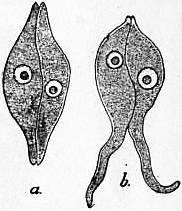
From Wasielewski, after Léger.
Fig. 12.—Associations of Gonospora sparsa.
The nuclear changes and multiplication which precede sporoblast-formation vary greatly in different Gregarines and can only be outlined here. In the formation of both sets of sexual elements (gametes) there is always a comprehensive nuclear purification or maturation. This elimination of a part of the nuclear material (to be distinguished as trophic or somatic, from the functional or germinal portion, which forms the sexual nuclei) may occur at widely-different periods. In some cases (Lankesteria, Monocystis), a large part of the original (sporont-) nucleus of each associate is at once got rid of, and the resulting (segmentation-) nucleus, which is highly-specialized, represents the sexual part. In other cases, again, the entire sporont-nucleus proceeds to division, and the distinction between somatic and germinal portions does not become manifest until after nuclear multiplication has continued for some little time, when certain of the daughter-nuclei become altered in character, and ultimately degenerate, the remainder giving rise to the sporoblast-nuclei (Diplodina, Stylorhynchus). Even after the actual sporoblasts (sex-cells) themselves are constituted, their nuclei may yet undergo a final maturation (e.g. Clepsydrina ovata); and in Monocystis, indeed, Brasil (2) finds that what is apparently a similar process is delayed until after conjugation and formation of the zygote (definitive sporoblast).
Nuclear multiplication is usually indirect, the mitosis being, as a rule, more elaborate in the earlier than in the later divisions. The attraction-spheres are generally large and conspicuous, sometimes consisting of a well-developed centrosphere, with or without centrosomic granules, at other times of very large centrosomes with a few astral rays. In those cases where the karyosome is retained, and the sporont-nucleus divides up as a whole, however, the earliest nuclear divisions are direct; the daughter-nuclei being formed either by a process of simple constriction (e.g. Diplodina), or by a kind of multiple fission or fragmentation (Gregarina and Selenidium spp.). Nevertheless, the later divisions, at any rate in Diplodina, are indirect.
By the time nuclear multiplication is well advanced or completed, the bodies of the two parent-Gregarines (associates) have usually become very irregular in shape, and produced into numerous lobes and processes. While in some forms (e.g. Monocystis, Urospora, Stylorhynchus) the two individuals remain fairly separate and independent of each other, in others (Lankesteria) they become intertwined and interlocked, often to a remarkable extent (Diplodina). The sexual nuclei next pass to the surface of the processes and segments, where they take up a position of uniform distribution. Around each, a small area of cytoplasm becomes segregated, the whole often projecting as a little bud or hillock from the general surface. These uninuclear protuberances are at length cut off as the sporoblasts or gametes. Frequently a large amount of the general protoplasm of each parent-individual is left over unused, constituting two cystal residua, which may subsequently fuse; in Diplodina, however, practically the whole cytoplasm is used up in the formation of the gametes.
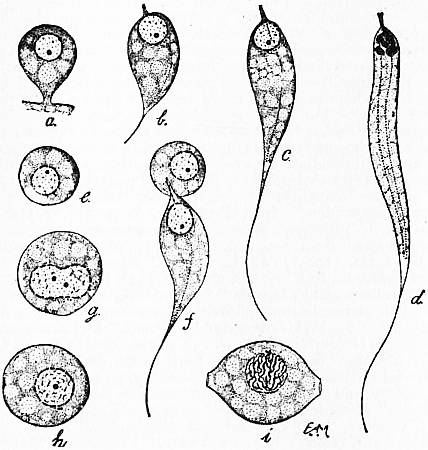
After Léger, from Lankester’s Treatise on Zoology.
Fig. 13.—Development of the Gametes and Conjugation in Stylorhynchus longicollis.
a, Undifferentiated gamete, attached to body of parent-individual. b-d, Stages in development of motile male gamete. e, Mature female gamete. f, g, Stages in conjugation and nuclear union of the two elements. h, Zygote (copula). i, Spore, still with single nucleus and undivided sporoplasm.
The sporoblasts themselves show all gradations from a condition of marked differentiation into male and female (anisogamy), to one of complete equality (isogamy). Anisogamy is most highly developed in Pterocephalus. Here, the male elements (microgametes) are minute, elongated and spindle-like in shape, with a minute rostrum anteriorly and a long flagellum posteriorly, and very active; the female elements (megagametes) are much larger, oblong to ovoid, and quite passive. In Stylorhynchus the difference between the conjugating gametes is not quite so pronounced (fig. 13), the male elements being of about the same bulk as the females, but pyriform instead of round, and possessing a distinct flagellum; a most interesting point about this parasite is that certain highly motile and spermatozoon-like male gametes are formed (fig. 13), which are, however, quite sterile and have acquired a subsidiary function. In other cases, again, the two kinds of element exhibit either very slight differences (Monocystis) or none (Urospora, Gonospora), in size and appearance, the chief distinction being in the nuclei, those of the male elements being smaller and chromatically denser than those of the females.
Lastly, in Lankesteria, Gregarina, Clepsydrina, Diplocystis and Diplodina complete isogamy is found, there being no apparent difference whatever between the conjugating elements. Nevertheless, these forms are also to be regarded as instances of binary sexuality and not merely of exogamy; for it is practically certain that this condition of isogamy is derived from one of typical anisogamy, through a stage such as is seen in Gonospora, &c. And, similarly, just as in all instances where the formation of differentiated gametes has been observed, the origin of the two conjugates is from different associates (parent-sporonts), and all the elements arising from the same parent are of the same sex, so it is doubtless the case here.
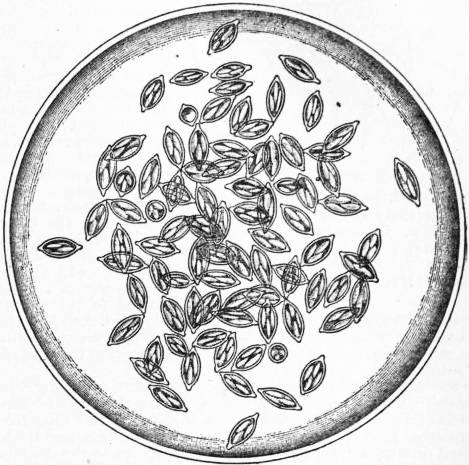
Fig. 14.—Cyst of Monocystis agilis, the common Gregarine of the Earthworm, showing ripe spores and absence of any residual protoplasm in the cyst. (From Lankester.)
The actual union is brought about or facilitated by the well-known phenomenon termed the danse des sporoblastes, which is due to various causes. In the case of highly-differentiated gametes (Pterocephalus), the actively motile microgametes rush about here and there, and seek out the female elements. In Stylorhynchus, Léger has shown that the function of the sterile male gametes is to bring about, by their vigorous movements, the mêlée sexuelle. In the forms where the gametes are isogamous or only slightly differentiated and (probably) not of themselves motile, other factors aid in producing the necessary commingling. Thus in Gregarina sp. from the mealworm, the unused somata or cystal residua become amoeboid and send out processes which drive the peripherally-situated gametes round in the cyst; in some cases where the residual soma becomes liquefied (Urospora) the movements of the host are considered to be sufficient; and lastly, in Diplodina, owing to the extent to which the intertwining process is carried, if each gamete is not actually contiguous to a suitable fellow-conjugant, a very slight movement or mutual attraction will bring two such, when liberated, into contact.
An unusual modification of the process of sporoblast-formation and conjugation, which occurs in Ophryocystis, must be mentioned. Here encystment of two associates takes place as usual; the sporont-nucleus of each, however, only divides twice, and one of the daughter-nuclei resulting from each division degenerates. Hence only one sporoblast-nucleus, representing a quarter of the original nuclear-material, persists in each half. Around this some of the cytoplasm condenses, the rest forming a residuum. The sporoblast or gamete thus formed is completely isogamous and normally conjugates with the like one from the other associate, when a single zygote results which becomes a spore containing eight sporozoites, in the ordinary manner. Sometimes, however, the septum between the two halves of the cyst does not break down, in which case parthenogenesis occurs, each sporoblast developing by itself into a small spore.
The two conjugating elements unite completely, cytoplasm with cytoplasm and nucleus with nucleus, to form the definitive sporoblast or zygote. The protoplasm assumes a definite outline, generally that of an ovoid or barrel, and secretes a delicate membrane, the ectospore. This subsequently becomes thickened, and often produced into rims, spines or processes, giving rise to the characteristic appearance of the Gregarine spore. Internal to the ectocyst, another, thinner membrane, the endocyst, is also laid down. These two membranes form the spore-wall (sporocyst). Meanwhile the contents of the spore have been undergoing division. By successive divisions, usually mitotic, the zygote-nucleus gives rise to eight daughter-nuclei, each of which becomes the nucleus of a sporozoite. Next, the sporoplasm becomes split longitudinally, around each nucleus, and thus eight sickle-shaped (falciform) sporozoites are formed. There is usually a certain amount of unused sporoplasm left over in the centre of the spore, constituting the sporal residuum. It is important to note that in all known Gregarines, with one exception, the number of sporozoites in the spore is eight; the exception is Selenidium, in many ways far from typical, where the number is half, viz. four.
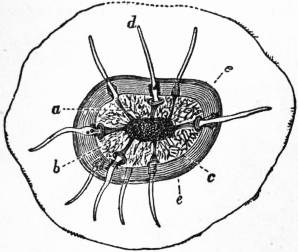
Fig. 15.—Ripe Cyst of Gregarina blattarum, partially emptied. (From Lankester.) a, Channels leading to the sporoducts; b, Mass of spores still left in the cyst; c, Endocyst; d, The everted sporoducts; e, Gelatinous ectocyst.
Hitherto a variation from the general mode of spore-formation has been considered to occur in certain Crustacean Gregarines, the Aggregatidae and the Porosporidae. The spores of these forms have been regarded as gymnospores (naked), lacking the enveloping membranes (sporocyst) of the ordinary spores, and the sporozoites, consequently, as developed freely in the cyst. In the case of the first-named parasites, however, what was taken for sporogony has been proved to be really schizogony, and on other grounds these forms are, in the present writer’s opinion, preferably associated with the Coccidia (q.v.). With regard to the Porosporidae, also, it is quite likely that the gymnosporous cysts considered to belong to the Gregarine Porospora (as known in the trophic condition) have really no connexion with it, but represent the schizogonous generation of some other form, similar to Aggregata; in which case the true spores of Porospora have yet to be identified.
In the intestine of a fresh host the cysts rupture and the spores are liberated. This is usually largely brought about by the swelling of the residual protoplasm. Sometimes (e.g. Gregarina) long tubular outgrowths, known as sporoducts (fig. 15), are developed from the residual protoplasm, for the passage of the spores to the exterior.
The Gregarines are extremely numerous, and include several Classification. families, characterized, for the most part, by the form of the spores (fig. 16). The specialized Schizogregarinae are usually separated off from the rest as a distinct sub-order.
Sub-order I.—Schizogregarinae.
Forms in which schizogonic reproduction is of general occurrence during the extra-cellular, trophic phase. Three genera, Ophryocystis, Schizocystis and Eleutheroschizon, different peculiarities of which have been referred to above. Mostly parasitic in the intestine or Malpighian tubules of insects. (In this type of parasite, as exemplified by Ophryocystis, the body was formerly wrongly considered as amoeboid, and hence this genus was placed in a special order, the Amoebosporidia.)
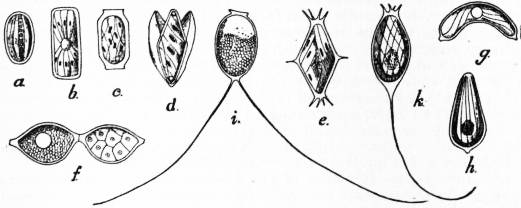
From Wasielewski, after Léger.
Fig. 16.—Spores of various Gregarines.
a, Eirmocystis, Sphaerocystis, &c. b, Echinomera, Pterocephalus, &c. c, Gregarina, &c. d, Beloides. e, Ancyrophora. f, Stylorhynchidae (type of). g, Menosporidae. h, Gonospora terebellae. i, Ceratospora. k, Urospora synaptae.
Sub-order II.—Eugregarinae.
Schizogony very exceptional, only occurring during the intracellular phase, if at all. Gregarines fall naturally into two tribes, described as cephalont and septate, or as acephalont and aseptate (haplocytic), respectively. In strictness, however, as already mentioned, these two sets of terms do not agree absolutely, and whichever set is adopted, the other must be taken into account in estimating the proper position of certain parasites. Here the cephalont or acephalont condition is regarded as the more primary and fundamental.
Tribe A.—Cephalina (practically equivalent to Septata).
Save exceptionally, the body possesses an epimerite, at any rate during the early stages of growth, and is typically septate. Mostly intestinal parasites of Arthropods.
The chief families, with representative genera, are as follows: Porosporidae, with Porospora gigantea, at present thought to be gymnosporous; Gregarinidae (Clepsydrinidae), with Gregarina, Clepsydrina, Eirmocystis, Hyalospora, Cmenidospora, Stenophora; Didymophyidae, with Didymophyes; Dactylophoridae, with Dactylophorus, Pterocephalus, Echinomera, Rhopalonia; Actinocephalidae with Actinocephalus, Pyxinia, Coleorhynchus, Stephanophora, Legeria, Stictospora, Pileocephalus, Sciadophora; Acanthosporidae with Acanthospora, Corycella, Cometoides; Menosporidae with Menospora, Hoplorhynchus; Stylorhynchidae, with Stylorhynchus, Lophocephalus; Doliocystidae with Doliocystis; and Taeniocystidae, with Taeniocystis. The curious genus Selenidium is somewhat apart.
Tribe B.—Acephalina (practically equivalent to Aseptata, Haplocyta).
The body never possesses an epimerite and is non-septate. Chiefly coelomic parasites of “worms,” Holothurians and insects.
The Aseptata have not been so completely arranged in families as the Septata. Léger has distinguished two well-marked ones, but the remaining genera still want classifying more in detail. Fam. Gonosporidae, with Gonospora, Diplodina; and Urosporidae, with Urosopora, Cystobia, Lithocystis, Ceratospora; the genera Monocystis, Diplocystis Lankesteria and Zygocystis probably constitute another; Pterospora and, again, Syncystis are distinct; lastly, certain forms, e.g. Zygosoma, Anchora (Anchorina), are incompletely known.
There remains for mention the remarkable parasite, recently described by J. Nusbaum (24) under the appropriate name of Schaudinnella henleae, which inhabits the intestine of Henlea leptodera. Briefly enumerated, the principal features in the life-cycle are as follows. The young trophozoites (aseptate) are attached to the intestinal cells, but practically entirely extracellular. Association is very primitive in character and indiscriminate; it takes place indifferently between individuals which will give rise to gametes of the same or opposite sex. Often it is only temporary; at other times it is multiple, several adults becoming more or less enclosed in a gelatinous investment. Nevertheless, in no case does true encystment occur, the sex-cells being developed practically free. The female gametes are large and egg-like; the males, minute and sickle-like, but with no flagellum and apparently non-motile. While many of the zygotes (“amphionts”) resulting from copulation pass out to the exterior, to infect a new host, others, possessing a more delicate investing-membrane, penetrate in between the intestinal cells, producing a further infection (auto-infection). Numerous sporozoites are formed in each zygote. It will be seen that Schaudinnella is a practically unique form. While, on the one hand, it recalls the Gregarines in many ways, on the other hand it differs widely from them in several characteristic features, being primitive in some respects, but highly specialized in others, so that it cannot be properly included in the order. Schaudinnella rather represents a primitive Ectosporan parasite, which has proceeded upon a line of its own, intermediate between the Gregarines and Coccidia.
Bibliography.—Among the important papers relating to Gregarines are the following: 1. A. Berndt, “Beitrag zur Kenntnis der ... Gregarinen,” Arch. Protistenk. I, p. 375, 3 pls. (1902); 2. L. Brasil, “Recherches sur la reproduction des Grégarines monocystidées,” Arch. zool. exp. (4) 3, p. 17, pl. 2 (1905), and op. cit. 4, p. 69, 2 pls. (1905); 3. L. Brazil, “Eleutheroschizon duboscqi, parasite nouveau, &c.,” op. cit. (N. et R.) (4), p. xvii., 5 figs. (1906); 4. M. Caullery and F. Mesnil, “Sur une Grégarine ... présentant ... une phase de multiplication asporulée,” C.R. Ac. Sci. 126, p. 262 (1898); 5. M. Caullery and F. Mesnil, “Le Parasitisme intracellulaire des Grégarines,” op. cit. 132, p. 220 (1901); 6. M. Caullery and F. Mesnil, “Sur une mode particulière de division nucléaire chez les Grégarines,” Arch. anat. microsc. 3, p. 146, 1 pl. (1900); 7. M. Caullery and F. Mesnil, “Sur quelques parasites internes des Annélides,” Misc. biol. (Trav. Stat. Wimereux), 9, p. 80, 1 pl. (1899); 7a. J. Cecconi, “Sur l’Anchorina sagittata, &c.,” Arch. Protistenk. 6, p. 230, 2 pls. (1905); 8. H. Crawley, “Progressive Movement of Gregarines,” P. Ac. Philad. 54, p. 4, 2 pls. (1902), also op. cit. 57, p. 89 (1905); 9. H. Crawley, “List of the Polycystid Gregarines of the U.S.,” op. cit. 55, pp. 41, 632, 4 pls. (1903); 10. L. Cuénot, “Recherches sur l’évolution et la conjugaison des Grégarines,” Arch. biol. 17, p. 581, 4 pls. (1901); 11. A. Laveran and F. Mesnil, “Sur quelques particularités de l’évolution d’une Grégarine et la réaction de la cellule-hôte,” C.R. Soc. Biol. 52, p. 554, 9 figs. (1900); 12. L. Léger, “Recherches sur les Grégarines,” Tabl. zool. 3, p. i., 22 pls. (1892); 13. L. Léger, “Contribution à la connaissance des Sporozoaires, &c.,” Bull. Sci. France, 30, p. 240, 3 pls. (1897); 14. L. Léger, “Sur un nouveau Sporozoaire (Schizocystis), &c.,” C.R. Ac. Sci. 131, p. 722 (1900); 15. L. Léger, “La Reproduction sexuée chez les Ophryocystis,” t. c. p. 761 (1900); 16. L. Léger, “Sur une nouvelle Grégarine (Aggregata coelomica,), &c.” op. cit. 132, p. 1343 (1901); 17. L. Léger, “La Reproduction sexuée chez les Stylorhynchus,” Arch. Protistenk. 3, p. 304, 2 pls. (1904); 18. L. Léger, “Etude sur Taeniocystis mira (Léger), &c.,” op. cit. 7, p. 307, 2 pls. (1906); 19. L. Léger and O. Duboscq, “La Reproduction sexuée chez Pterocephalus,” Arch. zool. exp. (N. et R.) (4) 1, p. 141, 11 figs. (1903); 20. L. Léger and O. Duboscq, “Aggregata vagans, n. sp., &c.” t. c. p. 147, 6 figs. (1903); 21. L. Léger and O. Duboscq, “Les Grégarines et l’épithélium intestinal, &c.,” Arch. parasitol. 6, p. 377, 4 pls. (1902); 22. L. Léger and O. Duboscq, “Nouvelles Recherches sur les Grégarines, &c.,” Arch. Protistenk. 4, p. 335, 2 pls. (1904); 23. M. Lühe, “Bau und Entwickelung der Gregarinen,” t. c. p. 88, several figs. (1904); 24. J. Nusbaum, “Über die ... Fortpflanzung einer ... Gregarine, Schaudinnella henleae,” Zeit. wiss. Zool. 75, p. 281, pl. 22 (1903); 25. F. Paehler, “Über die Morphologie, Fortpflanzung ... von Gregarina ovata,” Arch. Protistenk. 4, p. 64, 2 pls. (1904); 26. S. Prowazek, “Zur Entwickelung der Gregarinen,” op. cit., 1, p. 297, pl. 9 (1902); 27. A. Schneider (Various memoirs on Gregarines), Tabl. zool. 1 and 2 (1886-1892); 28. H. Schnitzler, “Über die Fortpflanzung von Clepsydrina ovata,” Arch. Protistenk. 6, p. 309, 2 pls. (1905); 29. M. Siedlecki, “Über die geschlechtliche Vermehrung der Monocystis ascidiae,” Bull. Ac. Cracovie, p. 515, 2 pls. (1900); 30. M. Siedlecki, “Contribution à l’étude des changements cellulaires provoquées par les Grégarines,” Arch. anat. microsc. 4, p. 87, 9 figs. (1901); 31. H. M. Woodcock, “The Life-Cycle of Cystobia irregularis, &c.,” Q.J.M. Sci. 50, p. 1. 6 pls. (1906).
(H. M. Wo.)
1 Figures 1, 2, 6, 7, 10, 11, 12 and 16 are redrawn from Wasielewski’s Sporozoenkunde, by permission of the author and of the publisher, Gustav Fischer, Jena.
GRÉGOIRE, HENRI (1750-1831), French revolutionist and constitutional bishop of Blois, was born at Vého near Lunéville, on the 4th of December 1750, the son of a peasant. Educated at the Jesuit college at Nancy, he became curé of Emberménil and a teacher at the Jesuit school at Pont-à-Mousson. In 1783 he was crowned by the academy of Nancy for his Éloge de la poésie, and in 1788 by that of Metz for an Essai sur la régénération physique et morale des Juifs. He was elected in 1789 by the clergy of the bailliage of Nancy to the states-general, where he soon became conspicuous in the group of clerical and lay deputies of Jansenist or Gallican sympathies who supported the Revolution. He was among the first of the clergy to join the third estate, and contributed largely to the union of the three orders; he presided at the permanent sitting of sixty-two hours while the Bastille was being attacked by the people, and made a vehement speech against the enemies of the nation. He subsequently took a leading share in the abolition of the privileges of the nobles and the Church. Under the new civil constitution of the clergy, to which he was the first priest to take the oath (December 27, 1790), he was elected bishop by two departments. He selected that of Loire-et-Cher, taking the old title of bishop of Blois, and for ten years (1791-1801) ruled his diocese with exemplary zeal. An ardent republican, it was he who in the first session of the National Convention (September 21, 1792) proposed the motion for the abolition of the kingship, in a speech in which occurred the memorable phrase that “kings are in the moral order what monsters are in the natural.” On the 15th of November he delivered a speech in which he demanded that the king should be brought to trial, and immediately afterwards was elected president of the Convention, over which he presided in his episcopal dress. During the trial of Louis XVI., being absent with other three colleagues on a mission for the union of Savoy to France, he along with them wrote a letter urging the condemnation of the king, but omitting the words à mort; and he endeavoured to save the life of the king by proposing in the Convention that the penalty of death should be suspended.
When on the 7th of November 1793 Gobel, bishop of Paris, was intimidated into resigning his episcopal office at the bar of the Convention, Grégoire, who was temporarily absent from the sitting, hearing what had happened, hurried to the hall, and in the face of a howling mob of deputies refused to abjure either his religion or his office. He was prepared to face the death which he expected; but his courage, a rare quality at that time, won the day, and the hubbub subsided in cries of “Let Grégoire have his way!” Throughout the Terror, in spite of attacks in the Convention, in the press, and on placards posted at the street corners, he appeared in the streets in his episcopal dress and daily read mass in his house. After Robespierre’s fall he was the first to advocate the reopening of the churches (speech of December 21, 1794). He also exerted himself to get measures put in execution for restraining the vandalistic fury against the monuments of art, extended his protection to artists and men of letters, and devoted much of his attention to the reorganization of the public libraries, the establishment of botanic gardens, and the improvement of technical education. He had taken during the Constituent Assembly a great interest in Negro emancipation, and it was on his motion that men of colour in the French colonies were admitted to the same rights as whites. On the establishment of the new constitution, Grégoire was elected to the Council of 500, and after the 18th Brumaire he became a member of the Corps Législatif, then of the Senate (1801). He took the lead in the national church councils of 1797 and 1801; but he was strenuously opposed to Napoleon’s policy of reconciliation with the Holy See, and after the signature of the concordat he resigned his bishopric (October 8, 1801). He was one of the minority of five in the Senate who voted against the proclamation of the empire, and he opposed the creation of the new nobility and the divorce of Napoleon from Josephine; but notwithstanding this he was subsequently created a count of the empire and officer of the Legion of Honour. During the later years of Napoleon’s reign he travelled in England and Germany, but in 1814 he had returned to France and was one of the chief instigators of the action that was taken against the empire.
To the clerical and ultra-royalist faction which was supreme in the Lower Chamber and in the circles of the court after the second Restoration, Grégoire, as a revolutionist and a schismatic bishop, was an object of double loathing. He was expelled from the Institute and forced into retirement. But even in this period of headlong reaction his influence was felt and feared. In 1814 he had published a work, De la constitution française de l’an 1814, in which he commented on the Charter from a Liberal point of view, and this reached its fourth edition in 1819. In this latter year he was elected to the Lower Chamber by the department of Isère. By the powers of the Quadruple Alliance this event was regarded as of the most sinister omen, and the question was even raised of a fresh armed intervention in France under the terms of the secret treaty of Aix-la-Chapelle. To prevent such a catastrophe Louis XVIII. decided on a modification of the franchise; the Dessolle ministry resigned; and the first act of Decazes, the new premier, was to carry a vote in the chamber annulling the election of Grégoire. From this time onward the ex-bishop lived in retirement, occupying himself in literary pursuits and in correspondence with most of the eminent savants of Europe; but as he had been deprived of his pension as a senator he was compelled to sell his library to obtain means of support. He died on the 20th of May 1831.
To the last Grégoire remained a devout Catholic, exactly fulfilling all his obligations as a Christian and a priest; but he refused to budge an inch from his revolutionary principles. During his last illness he confessed to his parish curé, a priest of Jansenist sympathies, and expressed his desire for the last sacraments of the Church. These the archbishop of Paris would only concede on condition that he would retract his oath to the civil constitution of the clergy, which he peremptorily refused to do. Thereupon, in defiance of the archbishop, the abbé Baradère gave him the viaticum, while the rite of extreme unction was administered by the abbé Guillon, an opponent of the civil constitution, without consulting the archbishop or the parish curé. The attitude of the archbishop roused great excitement in Paris, and the government had to take precautions to avoid a repetition of the riots which in the preceding February had led to the sacking of the church of St Germain l’Auxerrois and the archiepiscopal palace. On the day after his death Grégoire’s funeral was celebrated at the church of the Abbaye-aux-Bois; the clergy of the church had absented themselves in obedience to the archbishop’s orders, but mass was sung by the abbé Grieu assisted by two clergy, the catafalque being decorated with the episcopal insignia. After the hearse set out from the church the horses were unyoked, and it was dragged by students to the cemetery of Montparnasse, the cortège being followed by a sympathetic crowd of some 20,000 people.
Whatever his merits as a writer or as a philanthropist, Grégoire’s name lives in history mainly by reason of his wholehearted effort to prove that Catholic Christianity is not irreconcilable with modern conceptions of political liberty. In this effort he was defeated, mainly because the Revolution, for lack of experience in the right use of liberty, changed into a military despotism which allied itself with the spiritual despotism of Rome; partly because, when the Revolution was overthrown, the parties of reaction sought salvation in the “union of altar and throne.” Possibly Grégoire’s Gallicanism was fundamentally irreconcilable with the Catholic idea of authority. At least it made their traditional religion possible for those many French Catholics who clung passionately to the benefits the Revolution had brought them; and had it prevailed, it might have spared France and the world that fatal gulf between Liberalism and Catholicism which Pius IX.’s Syllabus of 1864 sought to make impassable.
Besides several political pamphlets, Grégoire was the author of Histoire des sectes religieuses, depuis le commencement du siècle dernier jusqu’à l’époque actuelle (2 vols., 1810); Essai historique sur les libertés de l’église gallicane (1818); De l’influence du Christianisme sur la condition des femmes (1821); Histoire des confesseurs des empereurs, des rois, et d’autres princes (1824); Histoire du mariage des prêtres en France (1826). Grégoireana, ou résumé général de la conduite, des actions, et des écrits de M. le comte Henri Grégoire, preceded by a biographical notice by Cousin d’Avalon, was published in 1821; and the Mémoires ... de Grégoire, with a biographical notice by H. Carnot, appeared in 1837 (2 vols.). See also A. Debidour, L’Abbé Grégoire (1881); A. Gazier, Études sur l’histoire religieuse de la Révolution Française (1883); L. Maggiolo, La Vie et les œuvres de l’abbé Grégoire (Nancy, 1884), and numerous articles in La Révolution Française; E. Meaume, Étude hist. et biog. sur les Lorrains révolutionnaires (Nancy, 1882); and A. Gazier, Études sur l’histoire religieuse de la Révolution Française (1887).
GREGORAS, NICEPHORUS (c. 1295-1360), Byzantine historian, man of learning and religious controversialist, was born at Heraclea in Pontus. At an early age he settled at Constantinople, where his reputation for learning brought him under the notice of Andronicus II., by whom he was appointed Chartophylax (keeper of the archives). In 1326 Gregoras proposed (in a still extant treatise) certain reforms in the calendar, which the emperor refused to carry out for fear of disturbances; nearly two hundred years later they were introduced by Gregory XIII. on almost the same lines. When Andronicus was dethroned (1328) by his grandson Andronicus III., Gregoras shared his downfall and retired into private life. Attacked by Barlaam, the famous monk of Calabria, he was with difficulty persuaded to come forward and meet him in a war of words, in which Barlaam was worsted. This greatly enhanced his reputation and brought him a large number of pupils. Gregoras remained loyal to the elder Andronicus to the last, but after his death he succeeded in gaining the favour of his grandson, by whom he was appointed to conduct the unsuccessful negotiations (for a union of the Greek and Latin churches) with the ambassadors of Pope John XXII. (1333). Gregoras subsequently took an important part in the Hesychast controversy, in which he violently opposed Gregorius Palamas, the chief supporter of the sect. After the doctrines of Palamas had been recognized at the synod of 1351, Gregoras, who refused to acquiesce, was practically imprisoned in a monastery for two years. Nothing is known of the end of his life. His chief work is his Roman History, in 37 books, of the years 1204 to 1359. It thus partly supplements and partly continues the work of George Pachymeres. Gregoras shows considerable industry, but his style is pompous and affected. Far too much space is devoted to religious matters and dogmatic quarrels. This work and that of John Cantacuzene supplement and correct each other, and should be read together. The other writings of Gregoras, which (with a few exceptions) still remain unpublished, attest his great versatility. Amongst them may be mentioned a history of the dispute with Palamas; biographies of his uncle and early instructor John, metropolitan of Heraclea, and of the martyr Codratus of Antioch; funeral orations for Theodore Metochita, and the two emperors Andronicus; commentaries on the wanderings of Odysseus and on Synesius’s treatise on dreams; tracts on orthography and on words of doubtful meaning; a philosophical dialogue called Florentius or Concerning Wisdom; astronomical treatises on the date of Easter and the preparation of the astrolabe; and an extensive correspondence.
Editions: in Bonn Corpus scriptorum hist. Byz., by L. Schopen and I. Bekker, with life and list of works by J. Boivin (1829-1855); J. P. Migne, Patrologia graeca, cxlviii., cxlix.; see also C. Krumbacher, Geschichte der byzantinischen Litteratur (1897).
GREGOROVIUS, FERDINAND (1821-1891), German historian, was born at Neidenburg on the 19th of January 1821, and studied at the university of Königsberg. After spending some years in teaching he took up his residence in Italy in 1852, remaining in that country for over twenty years. He was made a citizen of Rome, and he died at Munich on the 1st of May 1891. Gregorovius’s interest in and acquaintance with Italy and Italian history is mainly responsible for his great book, Geschichte der Stadt Rom im Mittelalter (Stuttgart, 1859-1872, and other editions), a work of much erudition and interest, which has been translated into English by A. Hamilton (13 vols., 1894-1900), and also into Italian at the expense of the Romans (Venice, 1874-1876). It deals with the history of Rome from about A.D. 400 to the death of Pope Clement VII. in 1534, and in the words of its author it describes “how, from the time of Charles the Great to that of Charles V., the historic system of the papacy remained inseparable from that of the Empire.” The other works of Gregorovius include: Geschichte des Kaisers Hadrian und seiner Zeit (Königsberg, 1851), English translation by M. E. Robinson (1898); Corsica (Stuttgart, 1854), English translation by R. Martineau (1855); Lucrezia Borgia (Stuttgart, 1874), English translation by J. L. Garner (1904); Die Grabdenkmäler der Päpste (Leipzig, 1881), English translation by R. W. Seton-Watson (1903); Wanderjahre in Italien (5 vols., Leipzig, 1888-1892); Geschichte der Stadt Athen im Mittelalter (1889); Kleine Schriften zur Geschichte der Kultur (Leipzig, 1887-1892); and Urban VIII. im Widerspruch zu Spanien und dem Kaiser (Stuttgart, 1879). This last work was translated into Italian by the author himself (Rome, 1879). Gregorovius was also something of a poet; he wrote a drama, Der Tod des Tiberius (1851), and some Gedichte (Leipzig, 1891).
His Römische Tagebücher were edited by F. Althaus (Stuttgart, 1892), and were translated into English as the Roman Journals of F. Gregorovius, by A. Hamilton (1907).
GREGORY, ST (c. 213-c. 270), surnamed in later ecclesiastical tradition Thaumaturgus (the miracle-worker), was born of noble and wealthy pagan parents at Neocaesarea in Pontus, about A.D. 213. His original name was Theodorus. He took up the study of civil law, and, with his brother Athenodorus, was on his way to Berytus to complete his training when at Caesarea he met Origen, and became his pupil and then his convert (A.D. 233). In returning to Cappadocia some five years after his conversion, it had been his original intention to live a retired ascetic life (Eus. H.E. vi. 30), but, urged by Origen, and at last almost compelled by Phaedimus of Amasia, his metropolitan, neither of whom was willing to see so much learning, piety and masculine energy practically lost to the church, he, after many attempts to evade the dignity, was consecrated bishop of his native town (about 240). His episcopate, which lasted some thirty years, was characterized by great missionary zeal, and by so much success that, according to the (doubtless somewhat rhetorical) statement of Gregory of Nyssa, whereas at the outset of his labours there were only seventeen Christians in the city, there were at his death only seventeen persons in all who had not embraced Christianity. This result he achieved in spite of the Decian persecution (250-251), during which he had felt it to be his duty to absent himself from his diocese, and notwithstanding the demoralizing effects of an irruption of barbarians (Goths and Boranians) who laid waste the diocese in A.D. 253-254. Gregory, although he has not always escaped the charge of Sabellianism, now holds an undisputed place among the fathers of the church; and although the turn of his mind was practical rather than speculative, he is known to have taken an energetic part in most of the doctrinal controversies of his time. He was active at the first synod of Antioch (A.D. 264-265), which investigated and condemned the heresies of Paul of Samosata; and the rapid spread in Pontus of a Trinitarianism approaching the Nicene type is attributed in large measure to the weight of his influence. Gregory is believed to have died in the reign of Aurelian, about the year 270, though perhaps an earlier date is more probable. His festival (semiduplex) is observed by the Roman Catholic Church on the 17th of November.
For the facts of his biography we have an outline of his early years in his eulogy on Origen, and incidental notices in the writings of Eusebius, of Basil of Caesarea and Jerome. Gregory of Nyssa’s untrustworthy panegyric represents him as having wrought miracles of a very startling description; but nothing related by him comes near the astounding narratives given in the Martyrologies, or even in the Breviarium Romanum, in connexion with his name.
The principal works of Gregory Thaumaturgus are the Panegyricus in Origenem (Εἰς Ὠριγένην πανηγυρικὸς λόγος), which he wrote when on the point of leaving the school of that great master (it contains a valuable minute description of Origen’s mode of instruction), a Metaphrasis in Ecclesiasten, characterized by Jerome as “short but useful”; and an Epistola canonica, which treats of the discipline to be undergone by those Christians who under pressure of persecution had relapsed into paganism, but desired to be restored to the privileges of the Church. It gives a good picture of the conditions of the time, and shows Gregory to be a true shepherd (cf. art Penance). The Ἔκθεσις πίστεως (Expositio fidei), a short creed usually attributed to Gregory, and traditionally alleged to have been received by him immediately in vision from the apostle John himself, is probably authentic. A sort of Platonic dialogue of doubtful authenticity “on the impassivity and the passivity of God” in Syriac is in the British Museum.
Editions: Gerhard Voss (Mainz, 1604), Fronto Ducäus (Paris, 1622), Migne, Patr. Graec. x. 963.
Translations: S. D. F. Salmond in Ante-Nicene Fathers, vi.; Lives, by Pallavicini (Rome, 1644); J. L. Boye (Jena, 1709); H. R. Reynolds (Dict. Chr. Biog. ii.); G. Krüger, Early Chr. Lit. 226; Herzog-Hauck, Realencyk. vii. (where full bibliographies are given).
GREGORY, ST, OF NAZIANZUS (329-389), surnamed Theologus, one of the four great fathers of the Eastern Church, was born about the year A.D. 329, at or near Nazianzus, Cappadocia. His father, also named Gregory, had lately become bishop of the diocese; his mother, Nonna, exercised a powerful influence over the religious convictions of both father and son. Gregory visited successively the two Caesareas, Alexandria and Athens, as a student of grammar, mathematics, rhetoric and philosophy; at Athens he had for fellow-students Basil (q.v.), who afterwards became bishop of Caesarea, and Julian, afterwards emperor. Shortly after his return to his father’s house at Nazianzus (about the year 360) Gregory received baptism. He resolved to give himself to the service of religion; but for some time, and indeed more or less throughout his whole life, was in a state of hesitation as to the form which that service ought to take. Strongly inclined by nature and education to a contemplative life spent among books and in the society of congenial friends, he was continually urged by outward circumstances, as well as by an inward call, to active pastoral labour. The spirit of refined intellectual monasticism, which clung to him through life and never ceased to struggle for the ascendancy, was about this time strongly encouraged by his intercourse with Basil, who induced him to share the exalted pleasures of his retirement in Pontus. To this period belongs the preparation of the Φιλοκαλία, a sort of chrestomathy compiled by the two friends from the writings of Origen. But the events which were stirring the political and ecclesiastical life of Cappadocia, and indeed of the whole Roman world, made a career of learned leisure difficult if not impossible to a man of Gregory’s position and temperament. The emperor Constantius, having by intrigue and intimidation succeeded in thrusting a semi-Arian formula upon the Western bishops assembled at Ariminum in Italy, had next attempted to follow the same course with the Eastern episcopate. The aged bishop of Nazianzus having yielded to the imperial threats, a great storm arose among the monks of the diocese, which was only quelled by the influence of the younger Gregory, who shortly afterwards (about 361) was ordained to the priesthood. After a vain attempt to evade his new duties and responsibilities by flight, he appears to have continued to act as a presbyter in his father’s diocese without interruption for some considerable time; and it is probable that his two Invectives against Julian are to be assigned to this period. Subsequently (about 372), under a pressure which he somewhat resented, he allowed himself to be nominated by Basil as bishop of Sasima, a miserable little village some 32 m. from Tyana; but he seems hardly, if at all, to have assumed the duties of this diocese, for after another interval of “flight” we find him once more (about 372-373) at Nazianzus, assisting his aged father, on whose death (374) he retired to Seleucia in Isauria for a period of some years. Meanwhile a more important field for his activities was opening up. Towards 378-379 the small and depressed remnant of the orthodox party in Constantinople sent him an urgent summons to undertake the task of resuscitating their cause, so long persecuted and borne down by the Arians of the capital. With the accession of Theodosius to the imperial throne, the prospect of success to the Nicene doctrine had dawned, if only it could find some courageous and devoted champion. The fame of Gregory as a learned and eloquent disciple of Origen, and still more of Athanasius, pointed him out as such a defender; nor could he resist the appeal made to him, although he took the step reluctantly. Once arrived in Constantinople, he laboured so zealously and well that the orthodox party speedily gathered strength; and the small apartment in which they had been accustomed to meet was soon exchanged for a vast and celebrated church which received the significant name of Anastasia, the Church of the Resurrection. Among the hearers of Gregory were to be found, not only churchmen like Jerome and Evagrius, but also heretics and pagans; and it says much for the sound wisdom and practical tact of the preacher that he set himself less to build up and defend a doctrinal position than to urge his flock to the cultivation of the loving Christian spirit which cherishes higher aims than mere heresy hunting or endless disputation. Doctrinal, nevertheless, he was, as is abundantly shown by the famous five discourses on the Trinity, which earned for him the distinctive appellation of θεολόγος. These orations are the finest exposition of the Catholic doctrine of the Trinity as conceived by the orthodox teachers of the East, and they were directed especially against the Eunomians and Macedonians. “There is perhaps no single book in Greek patristic literature to which the student who desires to gain an exact and comprehensive view of Greek theology can be more confidently referred.” With the arrival of Theodosius in 380 came the visible triumph of the orthodox cause; the metropolitan see was then conferred upon Gregory, and after the assembling of the second ecumenical council in 381 he received consecration from Meletius. In consequence, however, of a spirit of discord and envy which had manifested itself in connexion with this promotion, he soon afterwards resigned his dignity and withdrew into comparative retirement. The rest of his days were spent partly at Nazianzus in ecclesiastical affairs, and partly on his neighbouring patrimonial estate at Arianzus, where he followed his favourite literary pursuits, especially poetical composition, until his death, which occurred in 389 or 390. His festival is celebrated in the Eastern Church on the 25th and 30th of January, in the Western on the 9th of May (duplex).
His extant works consist of poems, epistles and orations. The poems, which include epigrams, elegies and an autobiographical sketch, have been frequently printed, the editio princeps being the Aldine (1504). Other editions are those of Tollius (1696) and Muratori (1709); a volume of Carmina selecta also has been edited by Dronke (1840). The tragedy entitled Χριστὸς πἀσχων usually included is certainly not genuine. Gregory’s poetry did not absorb his best energies; it was adopted in his later years as a recreation rather than as a serious pursuit; thus it is occasionally delicate, graphic, beautiful, but it is not sustained. Of the hymns none have passed into ecclesiastical use. The letters are entitled to a higher place in literature. They are always easy and natural; and there is nothing forced in the manner in which their acute, witty and profound sayings are introduced. Those to Basil introduce us to the story of a most romantic friendship, those to Cledonius have theological value for their bearing on the Apollinarian controversy. As an orator he was so facile, vigorous and persuasive, that men forgot his small stature and emaciated countenance. Forty-five orations are extant. Gregory was less an independent theologian than an interpreter. He was influenced by Athanasius in his Christology, by Origen in his anthropology, for, though teaching original sin and deriving human mortality from the Fall, he insists on the ability of the human will to choose the good and to co-operate in the work of salvation with the will of God. Though possessed neither of Basil’s gift of government nor of Gregory of Nyssa’s power of speculative thought, he worthily takes a place in that triumvirate of Cappadocians whom the Catholic Church gratefully recognizes as having been, during the critical struggles in the latter half of the 4th century, the best defenders of its faith. The Opera omnia were first published by Hervagius (Basel, 1550); the subsequent editions have been those of Billius (Paris, 1609, 1611; aucta ex interpretatione Morelli, 1630), of the Benedictines (begun in 1778, but interrupted by the French Revolution and not completed until 1840, Caillau being the final editor) and of Migne. The Theological Orations (edited by A. J. Mason) were published separately at Cambridge in 1899.
Scattered notices of the life of Gregory Nazianzen are to be found in the writings of Socrates, Sozomen, Theodoret and Rufinus, as well as in his own letters and poems. The data derived from these sources do not always harmonize with the account of Suidas. The earlier modern authorities, such as Tillemont (Mem. Eccl. t. ix.) and Leclerc (Bib. Univ. t. xviii.), were used by Gibbon. See also C. Ullmann, Gregorius von Nazianz, der Theologe (1825; Eng. trans. by G. F. Coxe, M.A., 1857); A. Bénoit, St Grégoire de Nazianze; sa vie, ses œuvres, et son époque (1877); Montaut, Revue critique de quelques questions historiques se rapportant à St Grégoire de Nazianze (1879); F. W. Farrar, Lives of the Fathers, i. 491-582, and F. Loofs in Hauck-Herzog’s Realencyk. für prot. Theologie, vii. 138.
GREGORY, ST, OF NYSSA (c. 331-c. 396), one of the four great fathers of the Eastern Church, designated by one of the later ecumenical councils as “a father of fathers,” was a younger brother of Basil (the Great), bishop of Caesarea, and was born (probably) at Neocaesarea about A.D. 331. For his education he was chiefly indebted to his elder brother. At a comparatively early age he entered the church, and held for some time the office of anagnost or reader; subsequently he manifested a desire to devote himself to the secular life as a rhetorician, an impulse which was checked by the earnest remonstrances of Gregory of Nazianzus. Finally, in 371 or 372 he was ordained by his brother Basil to the bishopric of Nyssa, a small town in Cappadocia. Here he is usually said (but on inadequate data) to have adopted the opinion then gaining ground in favour of the celibacy of the clergy, and to have separated from his wife Theosebia, who became a deaconess in the church. His strict orthodoxy on the subject of the Trinity and the Incarnation, together with his vigorous eloquence, combined to make him peculiarly obnoxious to the Arian faction, which was at that time in the ascendant through the protection of the emperor Valens; and in 375, the synod of Ancyra, convened by Demetrius the Arian governor of Pontus, condemned him for alleged irregularities in his election and in the administration of the finances of his diocese. In 376 he was deprived of his see, and Valens sent him into exile, whence he did not return till the publication of the edict of Gratian in 378. Shortly afterwards he took part in the proceedings of the synod which met at Antioch in Caria, principally in connexion with the Meletian schism. At the great ecumenical council held at Constantinople in 381, he was a conspicuous champion of the orthodox faith; according to Nicephorus, indeed, the additions made to the Nicene creed were entirely due to his suggestion, but this statement is of doubtful authority. That his eloquence was highly appreciated is shown by the facts that he pronounced the discourse at the consecration of Gregory of Nazianzus, and that he was chosen to deliver the funeral oration on the death of Meletius the first president of the council. In the following year, moreover (382), he was commissioned by the council to inspect and set in order the churches of Arabia, in connexion with which mission he also visited Jerusalem. The impressions he gathered from this journey may, in part at least, be gathered from his famous letter De euntibus Hierosolyma, in which an opinion strongly unfavourable to pilgrimages is expressed. In 383 he was probably again in Constantinople; where in 385 he pronounced the funeral orations of the princess Pulcheria and afterwards of the empress Placilla. Once more we read of him in 394 as having been present in that metropolis at the synod held under the presidency of Nectarius to settle a controversy which had arisen among the bishops of Arabia; in the same year he assisted at the consecration of the new church of the apostles at Chalcedon, on which occasion there is reason to believe that his discourse commonly but wrongly known as that Εἰς τὴν ἑαυτοῦ χειροτονίαν was delivered. The exact date of his death is unknown; some authorities refer it to 396, others to 400. His festival is observed by the Greek Church on the 10th of January; in the Western martyrologies he is commemorated on the 9th of March.
Gregory of Nyssa was not so firm and able an administrator as his brother Basil, nor so magnificent an orator as Gregory of Nazianzus, but he excelled them both, alike as a speculative and constructive theologian, and in the wide extent of his acquirements. His teaching, though strictly trinitarian, shows considerable freedom and originality of thought; in many points his mental and spiritual affinities with Origen show themselves with advantage, as in his doctrine of ἀποκατάστασις or final restoration. There are marked pantheistic tendencies, e.g. the inclusion of sin as a necessary part of the cosmical process, which make him akin to the pantheistic monophysites and to some modern thinkers.
His style has been frequently praised by competent authorities for sweetness, richness and elegance. His numerous works may be classified under five heads: (1) Treatises in doctrinal and polemical theology. Of these the most important is that Against Eunomius in twelve books. Its doctrinal thesis (which is supported with great philosophic acumen and rhetorical power) is the divinity and consubstantiality of the Word; incidentally the character of Basil, which Eunomius had aspersed, is vindicated, and the heretic himself is held up to scorn and contempt. This is the work which, most probably in a shorter draft, was read by its author when at Constantinople before Gregory Nazianzen and Jerome in 381 (Jerome, De vir. ill. 128). To the same class belong the treatise To Ablavius, against the tritheists; On Faith, against the Arians; On Common Notions, in explanation of the terms in current employment with regard to the Trinity; Ten Syllogisms, against the Manichaeans; To Theophilus, against the Apollinarians; an Antirrhetic against the same; Against Fate, a disputation with a heathen philosopher; De anima et resurrectione, a dialogue with his dying sister Macrina; and the Oratio catechetica magna, an argument for the incarnation as the best possible form of redemption, intended to convince educated pagans and Jews. (2) Practical treatises. To this category belong the tracts On Virginity and On Pilgrimages; as also the Canonical Epistle upon the rules of penance. (3) Expository and homiletical works, including the Hexaëmeron, and several series of discourses On the Workmanship of Man, On the Inscriptions of the Psalms, On the Sixth Psalm, On the first three Chapters of Ecclesiastes, On Canticles, On the Lord’s Prayer and On the Eight Beatitudes. (4) Biographical, consisting chiefly of funeral orations. (5) Letters.
The only complete editions of the whole works are those by Fronton le Duc (Fronto Ducäus, Paris, 1615; with additions, 1618 and 1638) and by Migne. G. H. Forbes began an excellent critical edition, but only two parts of the first volume appeared (Burntisland, 1855 and 1861) containing the Explicatio apologetica in hexaëmeron and the De opificio hominis. Of the new edition projected by F. Oehler only the first volume, containing the Opera dogmatica, has appeared (1865). There have been numerous editions of several single treatises, as for example of the Oratio catechetica (J. G. Krabinger, Munich, 1838; J. H. Crawley, Cambridge, 1903), De precatione and De anima et resurrectione.
See F. W. Farrar, Lives of the Fathers, ii. 56-83, the monograph by J. Rupp (Gregors, des Bischofs von Nyssa, Leben und Meinungen, Leipzig, 1834), and compare P. Heyns (Disputatio historico-theologica de Greg. Nyss., 1835), C. W. Möller (Gregorii Nyss. doctrinam de hominis natura et illustravit et cum Origeniana comparavit, 1854) and J. N. Stigler, Die Psychologie des h. Gregors von Nyssa (Regensburg, 1857), and many smaller monographs cited in Hauck-Herzog’s Realencyk. für prot. Theol. vii. 149.
GREGORY, ST, OF TOURS (538-594), historian of the Franks, was born in the chief city of the Arverni (the modern Clermont-Ferrand) on the 30th of November 538. His real name was Georgius Florentius, Georgius being his grandfather’s name and Florentius his father’s. He was called Gregory after his maternal great-grandfather, the bishop of Langres. Gregory belonged to an illustrious senatorial family, many of whose members held high office in the church and bear honoured names in the history of Christianity. He was descended, it is said, from Vettius Epagathus, who was martyred at Lyons in 177 with St Pothinus; his paternal uncle, Gallus, was bishop of Clermont; his maternal grand-uncle, Nicetius (St Nizier), occupied the see of Lyons; and he was a kinsman of Euphronius, bishop of Tours.
Gregory lost his father early, and his mother Armentaria settled in the kingdom of Burgundy on an estate belonging to her near Cavaillon, where her son often visited her. Gregory was brought up at Clermont-Ferrand by his uncle Gallus and by his successor, Avitus, and there he received his education. Among profane authors he read the first six books of the Aeneid and Sallust’s history of the Catiline conspiracy, but his education was mainly religious. The principles of religion he learnt from the Bible, Sulpicius Severus and some lives of saints, but to patristic literature and the subtleties of theology he remained a stranger. In 563, at the age of twenty-five, he was ordained deacon. Falling seriously ill, he went to Tours to seek a cure at the tomb of St Martin. At Tours he lived with Euphronius, and so great was the young man’s popularity that, on the death of Euphronius in 573, the people unanimously designated him bishop.
At that time Tours belonged to Austrasia, and King Sigebert hastened to confirm Gregory’s election. After the assassination of Sigebert (575), the province was ruled by Chilperic for nine years, during which period Gregory displayed the greatest energy in protecting his town and church from the Frankish king. He had to contend with Count Leudast, the governor of Tours; despite all the king’s threats, he refused to give up Chilperic’s son Meroving, who had sought refuge from his father’s wrath at the sanctuary of St Martin; and he defended Bishop Pretextatus against Chilperic, by whom he had been condemned for celebrating the marriage of Merovech and Queen Brunhilda. In 580 Gregory was himself accused before a council at Berny of using abusive language against Queen Fredegond, but he cleared himself of the charge by an oath and was acquitted. On the death of Chilperic, Tours remained for two years (584-585) in the hands of Guntram, but when Guntram adopted his nephew Childebert, Sigebert’s son, it again became Austrasian. This change was welcome to Gregory, who often visited the court. In 586 he was at Coblenz, and on his return to Yvois (the modern Carignan) visited the stylite Wulfilaic; in 588 we hear of him at Metz and also at Chalon-sur-Saône, whither he was sent to obtain from King Guntram the ratification of the pact of Andelot; in 593 he was at Orleans, where Childebert had just succeeded his uncle Guntram. In the intervals of these journeys he governed Tours with great firmness, repressing disorders and reducing the monks and nuns to obedience. He died on the 17th of November 594.
Gregory left many writings, of which he himself gives an enumeration at the end of his Historia Francorum: “Decem libros Historiarum, septem Miraculorum, unum de Vita Patrum scripsi; in Psalterii tractatu librum unum commentatus sum; de Cursibus etiam ecclesiasticis unum librum condidi.” The ten books of history are discussed below. The seven books of miracles are divided into the De gloria martyrum, the De virtutibus sancti Juliani, four books of Miracula sancti Martini, and the De gloria confessorum, the last dealing mainly with confessors who had dwelt in the cities of Tours and Clermont. The Vitae patrum consists of twenty biographies of bishops, abbots and hermits belonging to Gaul. The commentary on the Psalms is lost, the preface and the titles of the chapters alone being extant. The treatise De cursibus ecclesiasticis, discovered in 1853, is a liturgical manual for determining the hour of divers nocturnal offices by the position of the stars. Gregory also left a life of St Andrew, translated from the Greek, and a history of the Seven Sleepers of Ephesus, translated from Syriac.
His most important work, however, is the Historia Francorum, which is divided into three parts. The first four books, which were composed at one time, cover the period from the creation of the world to the death of Sigebert in 575. The first book, which is a mere compilation from the chronicles of St Jerome and Orosius, is of no value. The second book, from 397 to 511, deals with the invasions of the Franks, and is based on the histories of Sulpicius Alexander and Renatus Profuturus Frigeridus, now lost; on the catalogues of the bishops of Clermont and Tours; on some lives of saints, e.g. Remigius and Maxentius, now lost; on the annals of Arles and Angers, now lost; and on legends, either collected by Gregory himself from oral tradition, or cantilenes or epics written in the Latin and Germanic languages. In the third and fourth books the earlier part is based on materials collected from men older than himself; of the later events he was himself an eye-witness. The fifth and sixth books, up to the death of Chilperic (584), deal with matters within his own experience. The first six books are often separate in the MSS., and it was these alone that were used by the chronicler Fredegarius in his abridgment of Gregory’s history. To the first six books Gregory subsequently added chapters on the bishops Salonius and Sagittarius, and on his quarrels with Felix of Nantes. The authenticity of these chapters has been undeservedly attacked by Catholic writers. Books vii. to x., from 584 to 591, were written in the form of a diary; of each important event, as it occurred, he inserted an account in his book. The last six books are of great historical value.
Gregory had an intimate knowledge of contemporary events. He was frequently at court, and he found Tours an excellent place for collecting information. The shrine of St Martin attracted the sick from all quarters, and the basilica of the saint was a favourite sanctuary for political refugees. Moreover, Tours was on the high road between the north and south of France, and was a convenient stage for travellers, the ambassadors going to and from Spain frequently halting there. Gregory plied every one with questions, and in this way gathered a great mass of detailed information. He was, besides, at great pains to be an impartial writer, but was not always successful. His devotion to Austrasia made him very bitter against, and perhaps unjust to, the sovereigns of Neustria, Chilperic and Fredegond. As an orthodox Christian, he had no good word for the Arians. He excuses the crimes of kings who protected the church, such as Clovis, Clotaire I. and Guntram, but had no mercy for those who violated ecclesiastical privileges. This attitude, no doubt, explains his hatred for Chilperic. But if Gregory’s historical judgments are suspect, he at least concealed nothing and invented nothing; and we can correct his judgments by his own narrative. His history is a curious compound of artlessness and shrewdness. He was ignorant of the rules of grammar, confused genders and cases, and wrote in the vernacular Latin of his time, apart from certain passages which are especially elaborated and filled with poetical and elegant expressions. But in spite of his shortcomings he is an exceedingly attractive writer, and his mastery of the art of narrative has earned for him the name of the Herodotus of the barbarians.
T. Ruinart brought out a complete edition of Gregory’s works at Paris in 1699. The best modern complete edition is that of W. Arndt and B. Krusch in Mon. Germ. hist. script. rer. Merov. (vol. i., 1885). Of the many editions of the Historia Francorum may be mentioned those of Guadet and Taranne in the Soc. de l’hist. de France (4 vols., with French translation, 1836-1838), of Omont (the first six books; a reproduction of the Corvey MS.) and of G. Collon (the last four books; a reproduction of the Brussels MS. No. 9, 403). Gregory’s hagiographic works were published by H. Bordier in the Soc. de l’hist. de France (4 vols., with French translation, 1857-1864). Cf. J. W. Löbell, Gregor von Tours und seine Zeit (2nd ed., Leipzig, 1868); G. Monod, “Études critiques sur les sources de l’histoire mérovingienne” in the Bibl. de l’École des Hautes Études (1872); G. Kurth, “Grégoire de Tours et les études classiques au VIe siècle” in the Revue des questions historiques (xxiv. 586 seq., 1878); Max Bonnet, Le Latin de Grégoire de Tours (Paris, 1890). For details, see Ulysse Chevalier, Biobibliographie (2nd ed.).
(C. Pf.)
GREGORY THE ILLUMINATOR, the reputed founder of the Armenian Church. His legend is briefly as follows. His father Anak, head of the Parthian clan of Suren, was bribed about the time of his birth (c. 257) by the Sassanid king of Persia to assassinate the Armenian king, Chosroes, who was of the old Arsacid dynasty, and father of Tiridates or Trdat, first Christian king of Armenia. Anak was slain by his victim’s soldiers; Gregory was rescued by his Christian nurse, carried to Caesarea in Cappadocia, and brought up a Christian. Grown to manhood he took service under Tiridates, now king of Armenia, in order by his own fidelity to atone for his father’s treachery. Presently at a feast of Anahite Gregory refused to assist his sovereign in offering pagan sacrifice, and his parentage being now revealed, was thrown into a deep pit at Artashat, where he languished for fourteen years, during which persecution raged in Armenia.
The scene of the legend now shifts to Rome, where Diocletian falls in love with a lovely nun named Ripsimé; she, rather than gratify his passion, flees with her abbess Gaiana and several priests to Armenia. Diocletian asks her back of Tiridates, who meanwhile has fallen in love with her himself. He too is flouted, and in his rage tortures and slays her and her companions. The traditional date of this massacre is the 5th of October, A.D. 301. Providence, incensed at such cruelty, turns Tiridates into a wild boar, and afflicts his subjects with madness; but his sister, Chosrowidukht, has a revelation to bring Gregory back out of his pit. The king consents, the saint is acclaimed, the bodies of the thirty-seven martyrs solemnly interred, and the king, after fasting five, and listening to Gregory’s homilies for sixty days, is healed. This all took place at Valarshapat, where Gregory, anxious to fix a site on which to build shrines for the relics of Ripsimé and Gaiana, saw the Son of God come down in a sheen of light, the stars of heaven attending, and smite the earth with a golden hammer till the nether world resounded to his blows. Three chapels were built on the spot, and Gregory raised his cross there and elsewhere for the people to worship, just as St Nino was doing about the same time in Georgia. There followed a campaign against the idols whose temples and books were destroyed. The time had now come for Gregory, who was still a layman and father of two sons, to receive ordination; so he went to Caesarea, where Leontius ordained and consecrated him catholicos or vicar-general of Armenia. This was sometime about 290, when Leontius may have acceded, though we first hear of him as bishop in 314.
Gregory’s ordination at Caesarea is historical. The vision at Valarshapat was invented later by the Armenians when they broke with the Greeks, in order to give to their church the semblance, if not of apostolic, at least of divine origin.
According to Agathangelus, Tiridates went to Rome with Gregory, Aristaces, son of Gregory, and Albianos, head of the other priestly family, to make a pact with Constantine, newly converted to the faith, and receive a pallium from Silvester. The better sources make Sardica the scene of meeting and name Eusebius (of Nicomedia) as the prelate who attended Constantine. There is no reason to doubt that some such visit was made about the year 315, when the death of Maximin Daza left Constantine supreme. Eusebius testifies (H.E. ix. 8) that the Armenians were ardent Christians, and ancient friends and allies of the Roman empire when Maximin attacked them about the year 308. The conversion of Tiridates was probably a matter of policy. His kingdom was honeycombed with Christianity, and he wished to draw closer to the West, where he foresaw the victory of the new faith, in order to fortify his realm against the Sassanids of Persia. Following the same policy he sent Aristaces in 325 to the council of Nice. Gregory is related to have added a clause to the creed which Aristaces brought back; he became a hermit on Mount Sebuh about the year 332, and died there.
Is the Ripsimé episode mere legend? The story of the conversion of Georgia by St Nino in the same age is so full of local colour, and coheres so closely with the story of Ripsimé and Gaiana, that it seems over-sceptical to explain the latter away as a mere doublet of the legend of Prisca and Valeria. The historians Faustus of Byzant and Lazar of Pharp in the 5th century already attest the reverence with which their memory was invested. We know from many sources the prominence assigned to women prophets in the Phrygian church. Nino’s story reads like that of such a female missionary, and something similar must underlie the story of her Armenian companions.
The history of Gregory by Agathangelus is a compilation of about 450, which was rendered into Greek 550. Professor Marr has lately published an Arabic text from a MS. in Sinai which seems to contain an older tradition. A letter of Bishop George of Arabia to Jeshu, a priest of the town Anab, dated 714 (edited by Dashian, Vienna, 1891), contains an independent tradition of Gregory, and styles him a Roman by birth.
In spite of legendary accretions we can still discern the true outlines and significance of his life. He did not really illumine or convert great Armenia, for the people were in the main already converted by Syrian missionaries to the Adoptionist or Ebionite type of faith which was dominant in the far East, and was afterwards known as Nestorianism. Marcionites and Montanists had also worked in the field. Gregory persuaded Tiridates to destroy the last relics of the old paganism, and carried out in the religious sphere his sovereign’s policy of detaching Great Armenia from the Sassanid realm and allying it with the Graeco-Roman empire and civilization. He set himself to Hellenize or Catholicize Armenian Christianity, and in furtherance of this aim set up a hierarchy officially dependent on the Cappadocian. He in effect turned his country into a province of the Greek see of Cappadocia. This hierarchical tie was soon snapped, but the Hellenizing influence continued to work, and bore its most abundant fruit in the 5th century. His career was thus analogous to that of St Patrick in Ireland.
Authorities.—S. Weber, Die Catholische Kirche in Armenien (Freiburg, 1903, with bibliography); Bollandii, Acta sanctorum sept. tom. 8; A. Carrière, Les Huit Sanctuaires de l’Arménie (Paris, 1899); “Chrysostom” in Migne, P. Gr. tom. 63, col. 943 foll.; C. Fortescue, The Armenian Church (London, 1872); H. Gelzer, Die Anfänge der armenischen Kirche (Leipzig, 1895) (Sächs. Gesells. der Wissensch.); and s.v. “Armenien” in Herzog-Hauck (Leipzig, 1897); v. Gutschmid, Kleine Schriften (Leipzig, 1892); Himpel, Gregor der Erleuchter, Kl. v.; Issaverdenz, Hist. of Arm. Church (Venice, 1875); de Lagarde, Agathangelos (Göttingen, 1888); Arshak Ter Mikelian, Die arm. Kirche (Leipzig, 1892); Palmieri, “La Conversione ufficiale degli Iberi,” Oriens Christ. (Rome, 1902); Ryssel, Ein Brief Gregors, übersetzt, Studien und Kritiken, 56, Bd. (1883); Samuelian, Bekehrung Armeniens (Vienna, 1844); Vetter, “Die arm. Väter,” in Nischl’s Lehrbuch der Patrol. iii. 215-262, (Mainz, 1881-1885); Malan, S. Gregory the Illuminator (Rivingtons, 1868).
(F. C. C.)
GREGORY (Gregorius), the name of sixteen popes and one anti-pope.
Saint Gregory, surnamed the Great (c. 540-604), the first pope of that name, and the last of the four doctors of the Latin Church, was born in Rome about the year 540. His father was Gordianus “the regionary,” a wealthy man of senatorial rank, owner of large estates in Sicily and of a palace on the Caelian Hill in Rome; his mother was Silvia, who is commemorated as a saint on the 3rd of November. Of Gregory’s early period we know few details, and almost all the dates are conjectural. He received the best education to be had at the time, and was noted for his proficiency in the arts of grammar, rhetoric and dialectic. Entering on a public career he held, about 573, the high office of prefect of the city of Rome; but about 574, feeling irresistibly attracted to the “religious” life, he resigned his post, founded six monasteries in Sicily and one in Rome, and in the last—the famous monastery of St Andrew—became himself a monk. This grateful seclusion, however, he was not permitted long to enjoy. About 578 he was ordained “seventh deacon” (or possibly archdeacon) of the Roman Church, and in the following spring Pope Pelagius II. appointed him “apocrisiarius,” or resident ambassador, at the imperial court in Constantinople. Here he represented the interests of his church till about 586, when he returned to Rome and was made abbot of St Andrew’s monastery. His rule, though popular, was characterized by great severity, as may be inferred from the story of the monk Justus, who was denied Christian burial because he had secreted a small sum of money. About this time Gregory completed and published his well-known exposition of the book of Job, commenced in Constantinople: he also delivered lectures on the Heptateuch, the books of Kings, the Prophets, the book of Proverbs and the Song of Songs. To this period, moreover, Bede’s incident of the English slave-boys (if indeed it be accepted as historical) ought to be assigned. Passing one day through the Forum, Gregory saw some handsome slaves offered for sale, and inquired their nation. “Angles,” was the reply. “Good,” said the abbot, “they have the faces of angels, and should be coheirs with the angels in heaven. From what province do they come?” “From Deira.” “Deira. Yea, verily, they shall be saved from God’s ire (de ira) and called to the mercy of Christ. How is the king of that country named?” “Ælla.” “Then must Allelulia be sung in Ælla’s land.” Gregory determined personally to undertake the conversion of Britain, and with the pope’s consent actually set out upon the mission, but on the third day of his journey he was overtaken by messengers recalling him to Rome. In the year 590 Pelagius II. died of the plague that was raging in the city; whereupon the clergy and people unanimously chose Gregory as his successor. The abbot did his best to avoid the dignity, petitioned the emperor Maurice not to ratify his election, and even meditated going into hiding; but, “while he was preparing for flight and concealment, he was seized and carried off and dragged to the basilica of St Peter,” and there consecrated bishop, on the 3rd of September 590.
The fourteen years of Gregory’s pontificate were marked by extraordinary vigour and activity. “He never rested,” writes a biographer, “he was always engaged in providing for the interests of his people, or in writing some composition worthy of the church, or in searching out the secrets of heaven by the grace of contemplation.” His mode of life was simple and ascetic in the extreme. Having banished all lay attendants from his palace, he surrounded himself with clerics and monks, with whom he lived as though he were still in a monastery. To the spiritual needs of his people he ministered with pastoral zeal, frequently appointing “stations” and delivering sermons; nor was he less solicitous in providing for their physical necessities. Deaconries (offices of alms) and guest-houses were liberally endowed, and free distributions of food were made to the poor in the convents and basilicas. The funds for these and similar purposes were supplied from the Patrimony of St Peter—the papal estates in Italy, the adjacent islands, Gaul, Dalmatia and Africa. These extensive domains were usually administered by specially appointed agents,—rectors and defensors,—who resided on the spot; but the general superintendence devolved upon the pope. In this sphere Gregory manifested rare capacity. He was one of the best of the papal landlords. During his pontificate the estates increased in value, while at the same time the real grievances of the tenants were redressed and their general position was materially improved. Gregory’s principal fault as a man of business was that he was inclined to be too lavish of his revenues. It is said that he even impoverished the treasury of the Roman Church by his unlimited charities.
Within the strict bounds of his patriarchate, i.e. the churches of the suburbicarian provinces and the islands, it was Gregory’s policy to watch with particular care over the election and discipline of the bishops. With wise toleration he was willing to recognize local deviations from Roman usage (e.g. in the ritual of baptism and confirmation), yet he was resolute to withstand any unauthorized usurpation of rights and privileges. The following rules he took pains to enforce: that clerics in holy orders should not cohabit with their wives or permit any women, except those allowed by the canons, to live in their houses; that clerics accused on ecclesiastical or lesser criminal charges should be tried only in the ecclesiastical courts; that clerics in holy orders who had lapsed should “utterly forfeit their orders and never again approach the ministry of the altar”; that the revenues of each church should be divided by its bishop into four equal parts, to be assigned to the bishop, the clergy, the poor and the repair of the fabric of the church.
In his relations with the churches which lay outside the strict limits of his patriarchate, in northern Italy, Spain, Gaul, Africa and Illyricum and also in the East, Gregory consistently used his influence to increase the prestige and authority of the Roman See. In his view Rome, as the see of the Prince of the Apostles, was by divine right “the head of all the churches.” The decrees of councils would have no binding force “without the authority and consent of the apostolic see”: appeals might be made to Rome against the decisions even of the patriarch of Constantinople: all bishops, including the patriarchs, if guilty of heresy or uncanonical proceedings, were subject to correction by the pope. “If any fault is discovered in a bishop,” Gregory wrote, “I know of no one who is not subject to the apostolic see.” It is true that Gregory respected the rights of metropolitans and disapproved of unnecessary interference within the sphere of their jurisdiction canonically exercised; also that in his relations with certain churches (e.g. those in Africa) he found it expedient to abstain from any obtrusive assertion of Roman claims. But of his general principle there can be no doubt. His sincere belief in the apostolic authority of the see of St Peter, his outspoken assertion of it, the consistency and firmness with which in practice he maintained it (e.g. in his controversies with the bishops of Ravenna concerning the use of the pallium, with Maximus the “usurping” bishop of Salona, and with the patriarchs of Constantinople in respect of the title “ecumenical bishops”), contributed greatly to build up the system of papal absolutism. Moreover this consolidation of spiritual authority coincided with a remarkable development of the temporal power of the papacy. In Italy Gregory occupied an almost regal position. Taking advantage of the opportunity which circumstances offered, he boldly stepped into the place which the emperors had left vacant and the Lombard kings had not the strength to seize. For the first time in history the pope appeared as a political power, a temporal prince. He appointed governors to cities, issued orders to generals, provided munitions of war, sent his ambassadors to negotiate with the Lombard king and actually dared to conclude a private peace. In this direction Gregory went farther than any of his predecessors: he laid the foundation of a political influence which endured for centuries. “Of the medieval papacy,” says Milman, “the real father is Gregory the Great.”
The first monk to become pope, Gregory was naturally a strong supporter of monasticism. He laid himself out to diffuse the system, and also to carry out a reform of its abuses by enforcing a strict observance of the Rule of St Benedict (of whom, it may be noted, he was the earliest biographer). Two slight innovations were introduced: the minimum age of an abbess was fixed at sixty, and the period of novitiate was prolonged from one year to two. Gregory sought to protect the monks from episcopal oppression by issuing privilegia, or charters in restraint of abuses, in accordance with which the jurisdiction of the bishops over the monasteries was confined to spiritual matters, all illegal aggressions being strictly prohibited. The documents are interesting as marking the beginning of a revolution which eventually emancipated the monks altogether from the control of their diocesans and brought them under the direct authority of the Holy See. Moreover Gregory strictly forbade monks to minister in parish churches, ordaining that any monk who was promoted to such ecclesiastical cure should lose all rights in his monastery and should no longer reside there. “The duties of each office separately are so weighty that no one can rightly discharge them. It is therefore very improper that one man should be considered fit to discharge the duties of both, and that by this means the ecclesiastical order should interfere with the monastic life, and the rule of the monastic life in turn interfere with the interests of the churches.”
Once more, Gregory is remembered as a great organizer of missionary enterprise for the conversion of heathens and heretics. Most important was the two-fold mission to Britain—of St Augustine in 596, of Mellitus, Paulinus and others in 601; but Gregory also made strenuous efforts to uproot paganism in Gaul, Italy, Sicily, Sardinia and Corsica, Arianism in Spain, Donatism in Africa, Manichaeism in Sicily, the heresy of the Three Chapters in Istria and northern Italy. In respect of the methods of conversion which he advocated he was not less intolerant than his contemporaries. Towards the Jews, however, he acted with exceptional lenity, protecting them from persecution and securing them the enjoyment of their legal privileges. The so-called “simoniacal heresy,” particularly prevalent in Gaul, Illyricum and the East, be repeatedly attacked; and against the Gallican abuse of promoting laymen to bishoprics he protested with vigour.
The extent and character of Gregory’s works in connexion with the liturgy and the music of the church is a subject of dispute. If we are to credit a 9th century biographer, Gregory abbreviated and otherwise simplified the Sacramentary of Gelasius, producing a revised edition with which his own name has become associated, and which represents the groundwork of the modern Roman Missal. But though it is certain that he introduced three changes in the liturgy itself (viz. the addition of some words in the prayer Hanc igitur, the recitation of the Pater Noster at the end of the Canon immediately before the fraction of the bread, and the chanting of the Allelulia after the Gradual at other times besides the season of Easter) and two others in the ceremonial connected therewith (forbidding deacons to perform any musical portion of the service except the chanting of the gospel, and subdeacons to wear chasubles), neither the external nor the internal evidence appears to warrant belief that the Gregorian Sacramentary is his work. Ecclesiastical tradition further ascribes to Gregory the compilation of an Antiphonary, the revision and rearrangement of the system of church music, and the foundation of the Roman schola cantorum. It is highly doubtful, however, whether he had anything to do either with the Antiphonary or with the invention or revival of the cantus planus; it is certain that he was not the founder of the Roman singing-school, though he may have interested himself in its endowment and extension.
Finally, as Fourth Doctor of the Latin Church, Gregory claims the attention of theologians. He is the link between two epochs. The last of the great Latin Fathers and the first representative of medieval Catholicism he brings the dogmatic theology of Tertullian, Ambrose and Augustine into relation with the Scholastic speculation of later ages. “He connects the Graeco-Roman with the Romano-Germanic type of Christianity.” His teaching, indeed, is neither philosophical, systematic nor truly original. Its importance lies mainly in its simple, popular summarization of the doctrine of Augustine (whose works Gregory had studied with infinite care, but not always with insight), and in its detailed exposition of various religious conceptions which were current in the Western Church, but had not hitherto been defined with precision (e.g. the views on angelology and demonology, on purgatory, the Eucharistic Sacrifice, and the efficacy of relics). In his exposition of such ideas Gregory made a distinct advance upon the older theology and influenced profoundly the dogmatic development of the future. He imparted a life and impulse to prevailing tendencies, helping on the construction of the system hereafter to be completed in Scholasticism. He gave to theology a tone and emphasis which could not be disregarded. From his time to that of Anselm no teacher of equal eminence arose in the Church.
Gregory died on the 12th of March 604, and was buried the same day in the portico of the basilica of St Peter, in front of the sacristy. Translations took place in the 9th, 15th and 17th centuries, and the remains now rest beneath the altar in the chapel of Clement VIII. In respect of his character, while most historians agree that he was a really great man, some deny that he was also a great saint. The worst blot on his fair fame is his adulatory congratulation of the murderous usurper Phocas; though his correspondence with the Frankish queen Brunhilda, and the series of letters to and concerning the renegade monk Venantius also present problems which his admirers find difficult of solution. But while it may be admitted that Gregory was inclined to be unduly subservient to the great, so that at times he was willing to shut his eyes to the vices and even the crimes of persons of rank; yet it cannot fairly be denied that his character as a whole was singularly noble and unselfish. His life was entirely dominated by the religious motive. His sole desire was to promote the glory of God and of his church. At all times he strove honestly to live up to the light that was in him. “His goal,” says Lau, “was always that which he acknowledged as the best.” Physically, Gregory was of medium height and good figure. His head was large and bald, surrounded with a fringe of dark hair. His face was well-proportioned, with brown eyes, aquiline nose, thick and red lips, high-coloured cheeks, and prominent chin sparsely covered with a tawny beard. His hands, with tapering fingers, were remarkable for their beauty.