VOLUME X SLICE VII Fox, George to France (continued 2)
Reading edition
Rivers.—The greater part of the surface of France is divided between four principal and several secondary basins.
The basin of the Rhône, with an area (in France) of about 35,000 sq. m., covers eastern France from the Mediterranean to the Vosges, from the Cévennes and the Plateau de Langres to the crests of the Jura and the Alps. Alone among French rivers, the Rhône, itself Alpine in character in its upper course, is partly fed by Alpine rivers (the Arve, the Isère and the Durance) which have their floods in spring at the melting of the snow, and are maintained by glacier-water in summer. The Rhône, the source of which is in Mont St Gothard, in Switzerland, enters France by the narrow defile of L’Écluse, and has a somewhat meandering course, first flowing south, then north-west, and then west as far as Lyons, whence it runs straight south till it reaches the Mediterranean, into which it discharges itself by two principal branches, which form the delta or island of the Camargue. The Ain, the Saône (which rises in the Faucilles and in the lower part of its course skirting the regions of Bresse and Dombes, receives the Doubs and joins the Rhône at Lyons), the Ardèche and the Gard are the affluents on the right; on the left it is joined by the Arve, the Isère, the Drôme and the Durance. The small independent river, the Var, drains that portion of the Alps which fringes the Mediterranean.
The basin of the Garonne occupies south-western France with the exception of the tracts covered by the secondary basins of the Adour, the Aude, the Hérault, the Orb and other smaller rivers, and the low-lying plain of the Landes, which is watered by numerous coast rivers, notably by the Leyre. Its area is nearly 33,000 sq. m., and extends from the Pyrenees to the uplands of Saintonge, Périgord and Limousin. The Garonne rises in the valley of Aran (Spanish Pyrenees), enters France near Bagnères-de-Luchon, has first a north-west course, then bends to the north-east, and soon resumes its first direction. Joining the Atlantic between Royan and the Pointe de Grave, opposite the tower of Cordouan. In the lower part of its course, from the Bec-d’Ambez, where it receives the Dordogne, it becomes considerably wider, and takes the name of Gironde. The principal affluents are the Ariège, the Tarn with the Aveyron and the Agout, the Lot and the Dordogne, which descends from Mont Dore-les-Bains, and joins the Garonne at Bec-d’Ambez, to form the Gironde. All these affluents are on the right, and with the exception of the Ariège, which descends from the eastern Pyrenees, rise in the mountains of Auvergne and the southern Cévennes, their sources often lying close to those of the rivers of the Loire and Rhône basins. The Neste, a Pyrenean torrent, and the Save, the Gers and the Baïse, rising on the plateau of Lannemezan, are the principal left-hand tributaries of the Garonne. North of the basin of the Garonne an area of over 3800 sq. m. is watered by the secondary system of the Charente, which descends from Chéronnac (Haute-Vienne), traverses Angoulême and falls into the Atlantic near Rochefort. Farther to the north a number of small rivers, the chief of which is the Sèvre Niortaise, drain the coast region to the south of the plateau of Gâtine.
The basin of the Loire, with an area of about 47,000 sq. m., includes a great part of central and western France or nearly a quarter of the whole country. The Loire rises in Mont Gerbier de Jonc, in the range of the Vivarais mountains, flows due north to Nevers, then turns to the north-west as far as Orléans, in the neighbourhood of which it separates the marshy region of the Sologne (q.v.) on the south from the wheat-growing region of Beauce and the Gâtinais on the north. Below Orléans it takes its course towards the south-west, and lastly from Saumur runs west, till it reaches the Atlantic between Paimbœuf and St Nazaire. On the right the Loire receives the waters of the Furens, the Arroux, the Nièvre, the Maine (formed by the Mayenne and the Sarthe with its affluent the Loir), and the Erdre, which joins the Loire at Nantes; on the left, the Allier (which receives the Dore and the Sioule), the Loiret, the Cher, the Indre, the Vienne with its affluent the Creuse, the Thouet, and the Sèvre-Nantaise. The peninsula of Brittany and the coasts of Normandy on both sides of the Seine estuary are watered by numerous independent streams. Amongst these the Vilaine, which passes Rennes and Redon, waters, with its tributaries, an area of 4200 sq. m. The Orne, which rises in the hills of Normandy and falls into the Channel below Caen, is of considerably less importance.
The basin of the Seine, though its area of a little over 30,000 sq. m. is smaller than that of any of the other main systems, comprises the finest network of navigable rivers in the country. It is by far the most important basin of northern France, those of the Somme and Scheldt in the north-west together covering less than 5000 sq. m., those of the Meuse and the Rhine in the north-east less than 7000 sq. m. The Seine descends from the Langres plateau, flows north-west down to Méry, turns to the west, resumes its north-westerly direction at Montereau, passes through Paris and Rouen and discharges itself into the Channel between Le Havre and Honfleur. Its affluents are, on the right, the Aube; the Marne, which joins the Seine at Charenton near Paris; the Oise, which has its source in Belgium and is enlarged by the Aisne; and the Epte; on the left the Yonne, the Loing, the Essonne, the Eure and the Rille.
Lakes.—France has very few lakes. The Lake of Geneva, which forms 32 m. of the frontier, belongs to Switzerland. The most important French lake is that of Grand-Lieu, between Nantes and Paimbœuf (Loire-Inférieure), which presents a surface of 17,300 acres. There may also be mentioned the lakes of Bourget and Annecy (both in Savoy), St Point (Jura), Paladru (Isère) and Nantua (Ain). The marshy districts of Sologne, Brenne, Landes and Dombes still contain large undrained tracts. The coasts present a number of maritime inlets, forming inland bays, which communicate with the sea by channels of greater or less width. Some of these are on the south-west coast, in the Landes, as Carcans, Lacanau, Biscarosse, Cazau, Sanguinet; but more are to be found in the south and south-east, in Languedoc and Provence, as Leucate, Sigean, Thau, Vaccarès, Berre, &c. Their want of depth prevents them from serving as roadsteads for shipping, and they are useful chiefly for fishing or for the manufacture of bay-salt.
Climate.—The north and north-west of France bear a great resemblance, both in temperature and produce, to the south of England, rain occurring frequently, and the country being consequently suited for pasture. In the interior the rains are less frequent, but when they occur are far more heavy, so that there is much less difference in the annual rainfall there as compared with the rest of the country than in the number of rainy days. The annual rainfall for the whole of France averages about 32 in. The precipitation is greatest on the Atlantic seaboard and in the elevated regions of the interior. It attains over 60 in. in the basin of the Adour (71 in. at the western extremity of the Pyrenees), and nearly as much in the Vosges, Morvan, Cévennes and parts of the central plateau. The zone of level country extending from Reims and Troyes to Angers and Poitiers, with the exception of the Loire valley and the Brie, receives less than 24 in. of rain annually (Paris about 23 in.), as also does the Mediterranean coast west of Marseilles. The prevailing winds, mild and humid, are west winds from the Atlantic; continental climatic influence makes itself felt in the east wind, which is frequent in winter and in the east of France, while the mistral, a violent wind from the north-west, is characteristic of the Mediterranean region. The local climates of France may be grouped under the following seven designations: (1) Sequan climate, characterizing the Seine basin and northern France, with a mean temperature of 50° F., the winters being cold, the summers mild; (2) Breton climate, with a mean temperature of 51.8° F., the winters being mild, the summers temperate, it is characterized by west and south-west winds and frequent fine rains; (3) Girondin climate (characterizing Bordeaux, Agen, Pau, &c.), having a mean of 53.6° F., with mild winters and hot summers, the prevailing wind is from the north-west, the average rainfall about 28 in.; (4) Auvergne climate, comprising the Cévennes, central plateau, Clermont, Limoges and Rodez, mean temperature 51.8° F., with cold winters and hot summers; (5) Vosges climate (comprehending Epinal, Mézières and Nancy), having a mean of 48.2° F., with long and severe winters and hot and rainy summers; (6) Rhône climate (experienced by Lyons, Chalon, Mâcon, Grenoble) mean temperature 51.8° F., with cold and wet winters and hot summers, the prevailing winds are north and south; (7) Mediterranean climate, ruling at Valence, Nîmes, Nice and Marseilles, mean temperature, 57.5° F., with mild winters and hot and almost rainless summers.
Flora and Fauna.—The flora of southern France and the Mediterranean is distinct from that of the rest of the country, which does not differ in vegetation from western Europe generally. Evergreens predominate in the south, where grow subtropical plants such as the myrtle, arbutus, laurel, holm-oak, olive and fig; varieties of the same kind are also found on the Atlantic coast (as far north as the Cotentin), where the humidity and mildness of the climate favour their growth. The orange, date-palm and eucalyptus have been acclimatized on the coast of Provence and the Riviera. Other trees of southern France are the cork-oak and the Aleppo and maritime pines. In north and central France the chief trees are the oak, the beech, rare south of the Loire, and the hornbeam; less important varieties are the birch, poplar, ash, elm and walnut. The chestnut covers considerable areas in Périgord, Limousin and Béarn; resinous trees (firs, pines, larches, &c.) form fine forests in the Vosges and Jura.
The indigenous fauna include the bear, now very rare but still found in the Alps and Pyrenees, the wolf, harbouring chiefly in the Cévennes and Vosges, but in continually decreasing areas; the fox, marten, badger, weasel, otter, the beaver in the extreme south of the Rhône valley, and in the Alps the marmot; the red deer and roe deer are preserved in many of the forests, and the wild boar is found in several districts; the chamois and wild goat survive in the Pyrenees and Alps. Hares, rabbits and squirrels are common. Among birds of prey may be mentioned the eagle and various species of hawk, and among game-birds the partridge and pheasant. The reptiles include the ringed-snake, slow-worm, viper and lizard.
(R. Tr.)
Geology.—Many years ago it was pointed out by Élíe de Beaumont and Dufrénoy that the Jurassic rocks of France form upon the map an incomplete figure of 8. Within the northern circle of the 8 lie the Mesozoic and Tertiary beds of the Paris basin, dipping inwards; within the southern circle lie the ancient rocks of the Central Plateau, from which the later beds dip outwards. Outside the northern circle lie on the west the folded Palaeozoic rocks of Brittany, and on the north the Palaeozoic massif of the Ardennes. Outside the southern circle lie on the west the Mesozoic and Tertiary beds of the basin of the Garonne, with the Pyrenees beyond, and on the east the Mesozoic and Tertiary beds of the valley of the Rhône, with the Alps beyond.
In the geological history of France there have been two great periods of folding since Archean times. The first of these occurred towards the close of the Palaeozoic era, when a great mountain system was raised in the north running approximately from E. to W., and another chain arose in the south, running from S.W. to N.E. Of the former the remnants are now seen in Brittany and the Ardennes; of the latter the Cévennes and the Montagne Noire are the last traces visible on the surface. The second great folding took place in Tertiary times, and to it was due the final elevation of the Jura and the Western Alps and of the Pyrenees. No great mountain chain was ever raised by a single effort, and folding went on to some extent in other periods besides those mentioned. There were, moreover, other and broader oscillations which raised or lowered extensive areas without much crumpling of the strata, and to these are due some of the most important breaks in the geological series.
The oldest rocks, the gneisses and schists of the Archean period, form nearly the whole of the Central Plateau, and are also exposed in the axes of the folds in Brittany. The Central Plateau has probably been a land mass ever since this period, but the rest of the country was flooded by the Palaeozoic sea. The earlier deposits of that sea now rise to the surface in Brittany, the Ardennes, the Montagne Noire and the Cévennes, and in all these regions they are intensely folded. Towards the close of the Palaeozoic era France had become a part of a great continent; in the north the Coal Measures of the Boulonnais and the Nord were laid down in direct connexion with those of Belgium and England, while in the Central Plateau the Coal Measures were deposited in isolated and scattered basins. The Permian and Triassic deposits were also, for the most part, of continental origin; but with the formation of the Rhaetic beds the sea again began to spread, and throughout the greater part of the Jurassic period it covered nearly the whole of the country except the Central Plateau, Brittany and the Ardennes. Towards the end of the period, however, during the deposition of the Portlandian beds, the sea again retreated, and in the early part of the Cretaceous period was limited (in France) to the catchment basins of the Saône and Rhône—in the Paris basin the contemporaneous deposits were chiefly estuarine and were confined to the northern and eastern rim. Beginning with the Aptian and Albian the sea again gradually spread over the country and attained its maximum in the early part of the Senonian epoch, when once more the ancient massifs of the Central Plateau, Brittany and the Ardennes, alone rose above the waves. There was still, however, a well-marked difference between the deposits of the northern and the southern parts of France, the former consisting of chalk, as in England, and the latter of sandstones and limestones with Hippurites. During the later part of the Cretaceous period the sea gradually retreated and left the whole country dry.
During the Tertiary period arms of the sea spread into France—in the Paris basin from the north, in the basins of the Loire and the Garonne from the west, and in the Rhône area from the south. The changes, however, were too numerous and complex to be dealt with here.
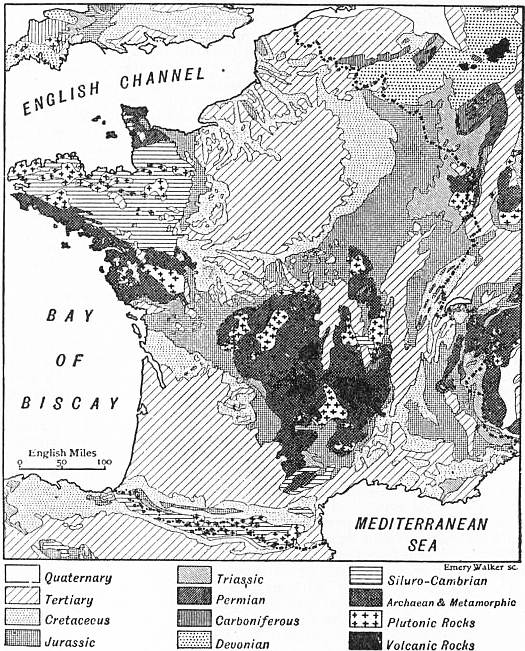
In France, as in Great Britain, volcanic eruptions occurred during several of the Palaeozoic periods, but during the Mesozoic era the country was free from outbursts, except in the regions of the Alps and Pyrenees. In Tertiary times the Central Plateau was the theatre of great volcanic activity from the Miocene to the Pleistocene periods, and many of the volcanoes remain as nearly perfect cones to the present day. The rocks are mainly basalts and andesites, together with trachytes and phonolites, and some of the basaltic flows are of enormous extent.
On the geology of France see the classic Explication de la carte géologique de la France (Paris, vol. i. 1841, vol. ii. 1848), by Dufrénoy and Élie de Beaumont; a more modern account, with full references, is given by A. de Lapparent, Traité de géologie (Paris, 1906).
(J. A. H.)
Population.
The French nation is formed of many different elements. Iberian influence in the south-west, Ligurian on the shores of the Mediterranean, Germanic immigrations from east of the Rhine and Scandinavian immigrations in the north-west have tended to produce ethnographical diversities which ease of intercommunication and other modern conditions have failed to obliterate. The so-called Celtic type, exemplified by individuals of rather less than average height, brown-haired and brachycephalic, is the fundamental element in the nation and peoples the region between the Seine and the Garonne; in southern France a different type, dolichocephalic, short and with black hair and eyes, predominates. The tall, fair and blue-eyed individuals who are found to the north-east of the Seine and in Normandy appear to be nearer in race to the Scandinavian and Germanic invaders; a tall and darker type with long faces and aquiline noses occurs in some parts of Franche-Comté and Champagne, the Vosges and the Perche. From the Celts has been derived the gay, brilliant and adventurous temperament easily moved to extremes of enthusiasm and depression, which combined with logical and organizing faculties of a high order, the heritage from the Latin domination, and with the industry, frugality and love of the soil natural in an agricultural people go to make up the national character. The Bretons, who most nearly represent the Celts, and the Basques, who inhabit parts of the western versant of the Pyrenees, have preserved their distinctive languages and customs, and are ethnically the most interesting sections of the nation; the Flemings of French Flanders where Flemish is still spoken are also racially distinct. The immigration of Belgians into the northern departments and of Italians into those of the south-east exercise a constant modifying influence on the local populations.
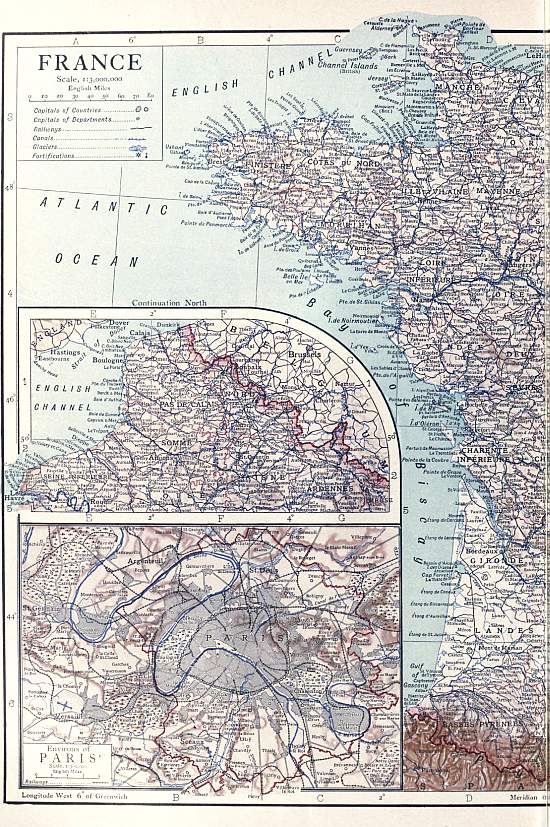
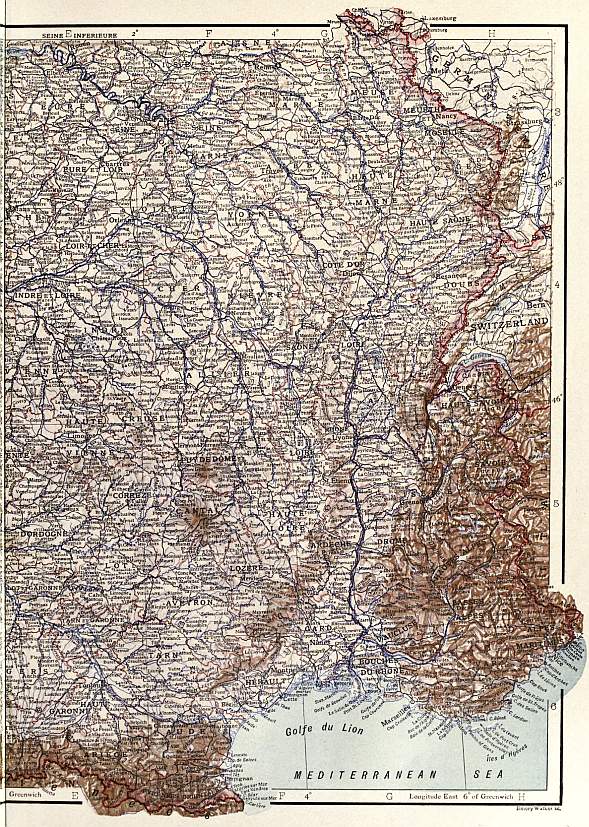
(Click to enlarge left side.) (Click to enlarge right side.)
During the 19th century the population of France increased to a less extent than that of any other country (except Ireland) for which definite data exist, and during the last twenty years of that period it was little more than stationary. The following table exhibits the rate of increase as indicated by the censuses from 1876 to 1906.
Population.
1876 36,905,788
1881 37,672,048
1886 38,218,903
1891 38,342,948
1896 38,517,975
1901 38,961,945
1906 39,252,245
Thus the rate of increase during the decade 1891-1901 was .16%, whereas during the same period the population of England increased 1.08%. The birth-rate markedly decreased during the 19th century; despite an increase of population between 1801 and 1901 amounting to 40%, the number of births in the former was 904,000, as against 857,000 in the latter year, the diminution being accompanied by a decrease in the annual number of deaths.3 In the following table the decrease in births and deaths for the decennial periods during the thirty years ending 1900 are compared.
Births.
1871-1880 935,000 or 25.4 per 1000
1881-1890 909,000 ” 23.9 ”
1891-1900 853,000 ” 22.2 ”
Deaths.
1871-1880 870,900 or 23.7 per 1000
1881-1890 841,700 ” 22.1 ”
1891-1900 829,000 ” 21.5 ”
About two-thirds of the French departments, comprising a large proportion of those situated in mountainous districts and in the basin of the Garonne, where the birth-rate is especially feeble, show a decrease in population. Those which show an increase usually possess large centres of industry and are already thickly populated, e.g. Seine and Pas-de-Calais. In most departments the principal cause of decrease of population is the attraction of great centres. The average density of population in France is about 190 to the square mile, the tendency being for the large towns to increase at the expense of the small towns as well as the rural communities. In 1901 37% of the population lived in centres containing more than 2000 inhabitants, whereas in 1861 the proportion was 28%. Besides the industrial districts the most thickly populated regions include the coast of the department of Seine-Inférieure and Brittany, the wine-growing region of the Bordelais and the Riviera.4
In the quinquennial period 1901-1905, out of the total number of births the number of illegitimate births to every 1000 inhabitants was 2.0, as compared with 2.1 in the four preceding periods of like duration.
In 1906 the number of foreigners in France was 1,009,415 as compared with 1,027,491 in 1896 and 1,115,214 in 1886. The departments with the largest population of foreigners were Nord (191,678), in which there is a large proportion of Belgians; Bouches-du-Rhône (123,497), Alpes-Maritimes (93,554), Var (47,475), Italians being numerous in these three departments; Seine (153,647), Meurthe-et-Moselle (44,595), Pas-de-Calais (21,436) and Ardennes (21,401).
The following table gives the area in square miles of each of the eighty-seven departments with its population according to the census returns of 1886, 1896 and 1906:
Departments. Area sq. m. Population.
1886. 1896. 1906.
Ain 2,249 364,408 351,569 345,856
Aisne 2,867 555,925 541,613 534,495
Allier 2,849 424,582 424,378 417,961
Alpes-Maritimes 1,442 238,057 265,155 334,007
Ardèche 2,145 375,472 363,501 347,140
Ardennes 2,028 332,759 318,865 317,505
Ariège 1,893 237,619 219,641 205,684
Aube 2,326 257,374 251,435 243,670
Aude 2,448 332,080 310,513 308,327
Aveyron 3,386 415,826 389,464 377,299
Basses-Alpes 2,698 129,494 118,142 113,126
Basses-Pyrénées 2,977 432,999 423,572 426,817
Belfort, Territoire de 235 79,758 88,047 95,421
Bouches-du-Rhône 2,026 604,857 673,820 765,918
Calvados 2,197 437,267 417,176 403,431
Cantal 2,231 241,742 234,382 228,690
Charente 2,305 366,408 356,236 351,733
Charente-Inférieure 2,791 462,803 453,455 453,793
Cher 2,819 355,349 347,725 343,484
Corrèze 2,273 326,494 322,393 317,430
Corse (Corsica) 3,367 278,501 290,168 291,160
Côte-d’Or 3,392 381,574 368,168 357,959
Côtes-du-Nord 2,786 628,256 616,074 611,506
Creuse 2,164 284,942 279,366 274,094
Deux-Sèvres 2,337 353,766 346,694 339,466
Dordogne 3,561 492,205 464,822 447,052
Doubs 2,030 310,963 302,046 298,438
Drôme 2,533 314,615 303,491 297,270
Eure 2,330 358,829 340,652 330,140
Eure-et-Loir 2,293 283,719 280,469 273,823
Finistère 2,713 707,820 739,648 795,103
Gard 2,270 417,099 416,036 421,166
Gers 2,428 274,391 250,472 231,088
Gironde 4,140 775,845 809,902 823,925
Haute-Garonne 2,458 481,169 459,377 442,065
Haute-Loire 1,931 320,063 316,699 314,770
Haute-Marne 2,415 247,781 232,057 221,724
Hautes-Alpes 2,178 122,924 113,229 107,498
Haute-Saône 2,075 290,954 272,891 263,890
Haute-Savoie 1,775 275,018 265,872 260,617
Hautes-Pyrénées 1,750 234,825 218,973 209,397
Haute-Vienne 2,144 363,182 375,724 385,732
Hérault 2,403 439,044 469,684 482,799
Ille-et-Vilaine 2,699 621,384 622,039 611,805
Indre 2,666 296,147 289,206 290,216
Indre-et-Loire 2,377 340,921 337,064 337,916
Isère 3,179 581,680 568,933 562,315
Jura 1,951 281,292 266,143 257,725
Landes 3,615 302,266 292,884 293,397
Loir-et-Cher 2,479 279,214 278,153 276,019
Loire 1,853 603,384 625,336 643,943
Loire-Inférieure 2,694 643,884 646,172 666,748
Loiret 2,629 374,875 371,019 364,999
Lot 2,017 271,514 240,403 216,611
Lot-et-Garonne 2,079 307,437 286,377 274,610
Lozère 1,999 141,264 132,151 128,016
Maine-et-Loire 2,706 527,680 514,870 513,490
Manche 2,475 520,865 500,052 487,443
Marne 3,167 429,494 439,577 434,157
Mayenne 2,012 340,063 321,187 305,457
Meurthe-et-Moselle 2,038 431,693 466,417 517,508
Meuse 2,409 291,971 290,384 280,220
Morbihan 2,738 535,256 552,028 573,152
Nièvre 2,659 347,645 333,899 313,972
Nord 2,229 1,670,184 1,811,868 1,895,861
Oise 2,272 403,146 404,511 410,049
Orne 2,372 367,248 339,162 315,993
Pas-de-Calais 2,606 853,526 906,249 1,012,466
Puy-de-Dôme 3,094 570,964 555,078 535,419
Pyrénées-Orientales 1,599 211,187 208,387 213,171
Rhône 1,104 772,912 839,329 858,907
Saône-et-Loire 3,330 625,885 621,237 613,377
Sarthe 2,410 436,111 425,077 421,470
Savoie 2,389 267,428 259,790 253,297
Seine 185 2,961,089 3,340,514 3,848,618
Seine-Inférieure 2,448 833,386 837,824 863,879
Seine-et-Marne 2,289 355,136 359,044 361,939
Seine-et-Oise 2,184 618,089 669,098 749,753
Somme 2,423 548,982 543,279 532,567
Tarn 2,231 358,757 339,827 330,533
Tarn-et-Garonne 1,440 214,046 200,390 188,553
Var 2,325 283,689 309,191 324,638
Vaucluse 1,381 241,787 236,313 239,178
Vendée 2,708 434,808 441,735 442,777
Vienne 2,719 342,785 338,114 333,621
Vosges 2,279 413,707 421,412 429,812
Yonne 2,880 355,364 332,656 315,199
Total 207,076 38,218,903 38,517,975 39,252,245
The French census uses the commune as the basis of its returns, and employs the following classifications in respect to communal population: (1) Total communal population. (2) Population comptée à part, which includes soldiers and sailors, inmates of prisons, asylums, schools, members of religious communities, and workmen temporarily engaged in public works. (3) Total municipal population, i.e. communal population minus the population comptée à part. (4) Population municipale agglomérée au chef-lieu de la commune, which embraces the urban population as opposed to the rural population. The following tables, showing the growth of the largest towns in France, are drawn up on the basis of the fourth classification, which is used throughout this work in the articles on French towns, except where otherwise stated.
In 1906 there were in France twelve towns with a population of over 100,000 inhabitants. Their growth or decrease from 1886 to 1906 is shown in the following table:
1886. 1896. 1906.
Paris 2,294,108 2,481,223 2,711,931
Lyons 344,124 398,867 430,186
Marseilles 249,938 332,515 421,116
Bordeaux 225,281 239,806 237,707
Lille 143,135 160,723 196,624
St Etienne 103,229 120,300 130,940
Le Havre 109,199 117,009 129,403
Toulouse 123,040 124,187 125,856
Roubaix 89,781 113,899 119,955
Nantes 110,638 107,137 118,244
Rouen 100,043 106,825 111,402
Reims 91,130 99,001 102,800
In the same years the following eighteen towns, now numbering from 50,000 to 100,000 inhabitants, each had:
1886. 1896. 1906.
Nice 61,464 69,140 99,556
Nancy 69,463 83,668 98,302
Toulon 53,941 70,843 87,997
Amiens 68,177 74,808 78,407
Limoges 56,699 64,718 75,906
Angers 65,152 69,484 73,585
Brest 59,352 64,144 71,163
Nîmes 62,198 66,905 70,708
Montpellier 45,930 62,717 65,983
Dijon 50,684 58,355 65,516
Tourcoing 41,183 55,705 62,694
Rennes 52,614 57,249 62,024
Tours 51,467 56,706 61,507
Calais 52,839 50,818 59,623
Grenoble 43,260 50,084 58,641
Orléans 51,208 56,915 57,544
Le Mans 46,991 49,665 54,907
Troyes 44,864 50,676 51,228
Of the population in 1901, 18,916,889 were males and 19,533,899 females, an excess of females over males of 617,010, i.e. 1.6% or about 508 females to every 492 males. In 1881 the proportion was 501 females to every 499 males, since when the disparity has been slightly more marked at every census. Below is a list of the departments in which the number of women to every thousand men was (1) greatest and (2) least.
(1) (2)
Creuse 1131 Belfort 886
Côtes-du-Nord 1117 Basses-Alpes 893
Seine 1103 Var 894
Calvados 1100 Meuse 905
Cantal 1098 Hautes-Alpes 908
Seine-Inférieure 1084 Meurthe-et-Moselle 918
Basses-Pyrénées 1080 Haute-Savoie 947
Departments from which the adult males emigrate regularly either to sea or to seek employment in towns tend to fall under the first head, those in which large bodies of troops are stationed under the second.
The annual number of emigrants from France is small. The Basques of Basses-Pyrénées go in considerable numbers to the Argentine Republic, the inhabitants of Basses Alpes to Mexico and the United States, and there are important French colonies in Algeria and Tunisia.
The following table shows the distribution of the active population of France according to their occupations in 1901.
Occupation. Males. Females. Total.
Forestry and agriculture 5,517,617 2,658,952 8,176,569
Manufacturing industries 3,695,213 2,124,642 5,819,855
Trade 1,132,621 689,999 1,822,620
Domestic service 223,861 791,176 1,015,037
Transport 617,849 212,794 830,643
Public service 1,157,835 139,734 1,297,569
Liberal professions 226,561 173,278 399,839
Mining, quarries 261,320 5,031 266,351
Fishing 63,372 4,400 67,772
Unclassed 14,316 4,504 18,820
Grand Total 12,910,565 6,804,510 19,715,075
Religion.
Great alterations were made with regard to religious matters in France by a law of December 1905, supplemented by a law of January 1907 (see below, Law and Institutions). Before that time three religions (cultes) were recognized and supported by the state—the Roman Catholic, the Protestant (subdivided into the Reformed and Lutheran) and the Hebrew. In Algeria the Mahommedan religion received similar recognition. By the law of 1905 all the churches ceased to be recognized or supported by the state and became entirely separated therefrom, while the adherents of all creeds were permitted to form associations for public worship (associations cultuelles), upon which the expenses of maintenance were from that time to devolve. The state, the departments, and the communes were thus relieved from the payment of salaries and grants to religious bodies, an item of expenditure which amounted in the last year of the old system to £1,101,000 paid by the state and £302,200 contributed by the departments and communes. Before these alterations the relations between the state and the Roman Catholic communion, by far the largest and most important in France, were chiefly regulated by the provisions of the Concordat of 1801, concluded between the first consul, Bonaparte, and Pope Pius VII. and by other measures passed in 1802.
France is divided into provinces and dioceses as follows:
Archbishoprics. Bishoprics.
Paris Chartres, Meaux, Orléans, Blois, Versailles.
Aix Marseilles, Fréjus, Digne, Gap, Nice, Ajaccio.
Albi Rodez, Cahors, Mende, Perpignan.
Auch Aire, Tarbes, Bayonne.
Avignon Nîmes, Valence, Viviers, Montpellier.
Besançon Verdun, Bellay, St Dié, Nancy.
Bordeaux Agen, Angoulême, Poitiers, Périgueux, La Rochelle, Luçon.
Bourges Clermont, Limoges, Le Puy, Tulle, St Flour.
Cambrai Arras.
Chambéry Annecy, Tarentaise, St Jean-de-Maurienne.
Lyons Autun, Langres, Dijon, St Claude, Grenoble.
Reims Soissons, Châlons-sur-Marne, Beauvais, Amiens.
Rennes Quimper, Vannes, St Brieuc.
Rouen Bayeux, Evreux, Sées, Coutances.
Sens Troyes, Nevers, Moulins.
Toulouse Montauban, Pamiers, Carcassonne.
Tours Le Mans, Angers, Nantes, Laval.
The dioceses are divided into parishes each under a parish priest known as a curé or desservant (incumbent). The bishops and archbishops, formerly nominated by the government and canonically confirmed by the pope, are now chosen by the latter. The appointment of curés rested with the bishops and had to be confirmed by the government, but this confirmation is now dispensed with. The archbishops used to receive an annual salary of £600 each and the bishops £400.
The archbishops and bishops are assisted by vicars-general (at salaries previously ranging from £100 to £180), and to each cathedral is attached a chapter of canons. A cure, in addition to his regular salary, received fees for baptisms, marriages, funerals and special masses, and had the benefit of a free house called a presbytère. The total personnel of state-paid Roman Catholic clergy amounted in 1903 to 36,169. The Roman priests are drawn from the seminaries, established by the church for the education of young men intending to join its ranks, and divided into lower and higher seminaries (grands et petits séminaires), the latter giving the same class of instruction as the lycées.
The number of Protestants may be estimated at about 600,000 and the Jews at about 70,000. The greatest number of Jews is to be found at Paris, Lyons and Bordeaux, while the departments of the centre and of the south along the range of the Cévennes, where Calvinism flourishes, are the principal Protestant localities, Nîmes being the most important centre. Considerable sprinklings of Protestants are also to be found in the two Charentes, in Dauphiné, in Paris and in Franche-Comté. The two Protestant bodies used to cost the state about £60,000 a year and the Jewish Church about £6000.
Both Protestant churches have a parochial organization and a presbyterian form of church government. In the Reformed Church (far the more numerous of the two bodies) each parish has a council of presbyters, consisting of the pastor and lay-members elected by the congregation. Several parishes form a consistorial circumscription, which has a consistorial council consisting of the council of presbyters of the chief town of the circumscription, the pastor and one delegate of the council of presbyters from each parish and other elected members. There are 103 circumscriptions (including Algeria), which are grouped into 21 provincial synods composed of a pastor and lay delegate from each consistory. All the more important questions of church discipline and all decisions regulating the doctrine and practice of the church are dealt with by the synods. At the head of the whole organization is a General Synod, sitting at Paris. The organization of the Lutheran Church (Église de la confession d’Augsburg) is broadly similar. Its consistories are grouped into two special synods, one at Paris and one at Montbéliard (for the department of Doubs and Haute-Saône and the territory of Belfort, where the churches of this denomination are principally situated). It also has a general synod—composed of 2 inspectors,5 5 pastors elected by the synod of Paris, and 6 by that of Montbéliard, 22 laymen and a delegate of the theological faculty at Paris—which holds periodical meetings and is represented in its relations with the government by a permanent executive commission.
The Jewish parishes, called synagogues, are grouped into departmental consistories (Paris, Bordeaux, Nancy, Marseilles, Bayonne, Lille, Vesoul, Besançon and three in Algeria). Each synagogue is served by a rabbi assisted by an officiating minister, and in each consistory is a grand rabbi. At Paris is the central consistory, controlled by the government and presided over by the supreme grand rabbi.
Agriculture.
Of the population of France some 17,000,000 depend upon agriculture for their livelihood, though only about 6,500,000 are engaged in work on the land. The cultivable land of the country occupies some 195,000 sq. m. or about 94% of the total area; of this 171,000 sq. m. are cultivated. There are besides 12,300 sq. m. of uncultivable area covered by lakes, rivers, towns, &c. Only the roughest estimate is possible as to the sizes of holdings, but in general terms it may be said that about 3 million persons are proprietors of holdings under 25 acres in extent amounting to between 15 and 20% of the cultivated area, the rest being owned by some 750,000 proprietors, of whom 150,000 possess half the area in holdings averaging 400 acres in extent. About 80% of holdings (amounting to about 60% of the cultivated area) are cultivated by the proprietor; of the rest approximately 13% are let on lease and 7% are worked on the system known as métayage (q.v.).
The capital value of land, which greatly decreased during the last twenty years of the 19th century, is estimated at £3,120,000,000, and that of stock, buildings, implements, &c., at £340,000,000. The value per acre of land, which exceeds £48 in the departments of Seine, Rhône and those fringing the north-west coast from Nord to Manche inclusive, is on the average about £29, though it drops to £16 and less in Morbihan, Landes, Basses-Pyrénées, and parts of the Alps and the central plateau.
While wheat and wine constitute the staples of French agriculture, its distinguishing characteristic is the variety of its products. Cereals occupy about one-third of the cultivated area. For the production of wheat, in respect of which France is self-supporting, French Flanders, the Seine basin, notably the Beauce and the Brie, and the regions bordering on the lower course of the Loire and the upper course of the Garonne, are the chief areas. Rye, on the other hand, one of the least valuable of the cereals, is grown chiefly in the poor agricultural territories of the central plateau and western Brittany. Buckwheat is cultivated mainly in Brittany. Oats and barley are generally cultivated, the former more especially in the Parisian region, the latter in Mayenne and one or two of the neighbouring departments. Meslin, a mixture of wheat and rye, is produced in the great majority of French departments, but to a marked extent in the basin of the Sarthe. Maize covers considerable areas in Landes, Basses-Pyrénées and other south-western departments.
Average Acreage (Thousands of Acres). Average Production (Thousands of Bushels). Average Yield per Acre (Bushels).
1886-1895. 1896-1905. 1886-1895. 1896-1905. 1886-1895. 1896-1905.
Wheat 17,004 16,580 294,564 317,707 17.3 19.1
Meslin 720 491 12,193 8,826 16.9 17.0
Rye 3,888 3,439 64,651 56,612 16.6 16.4
Barley 2,303 1,887 47,197 41,066 20.4 21.0
Oats 9,507 9,601 240,082 253,799 25.2 26.4
Buckwheat 1,484 1,392 26,345 23,136 17.7 16.6
Maize 1,391 1,330 25,723 24,459 18.4 18.4
Forage Crops.—The mangold-wurzel, occupying four times the acreage of swedes and turnips, is by far the chief root-crop in France. It is grown largely in the departments of Nord and Pas-de-Calais and in those of the Seine basin, the southern limit of its cultivation being roughly a line drawn from Bordeaux to Lyons. The average area occupied by it in the years from 1896 to 1905 was 1,043,000 acres, the total average production being 262,364,000 cwt. and the average production per acre 10½ tons. Clover, lucerne and sainfoin make up the bulk of artificial pasturage, while vetches, crimson clover and cabbage are the other chief forage crops.
Vegetables.—Potatoes are not a special product of any region, though grown in great quantities in the Bresse and the Vosges. Early potatoes and other vegetables (primeurs) are largely cultivated in the districts bordering the English Channel. Market-gardening is an important industry in the regions round Paris, Amiens and Angers, as it is round Toulouse, Montauban, Avignon and in southern France generally. The market-gardeners of Paris and its vicinity have a high reputation for skill in the forcing of early vegetables under glass.
Potatoes: Decennial Averages.
Acreage. Total Yield (Tons). Average Yield per Acre (Tons).
1886-1895 3,690,000 11,150,000 3.02
1896-1905 3,735,000 11,594,000 3.1
Industrial Plants.6—The manufacture of sugar from beetroot, owing to the increased use of sugar, became highly important during the latter half of the 19th century, the industry both of cultivation and manufacture being concentrated in the northern departments of Aisne, Nord, Pas-de-Calais, Somme and Oise, the first named supplying nearly a quarter of the whole amount produced in France.
Flax and hemp showed a decreasing acreage from 1881 onwards. Flax is cultivated chiefly in the northern departments of Nord, Seine-Inférieure, Pas-de-Calais, Côtes-du-Nord, hemp in Sarthe, Morbihan and Maine-et-Loire.
Colza, grown chiefly in the lower basin of the Seine (Seine-Inférieure and Eure), is the most important of the oil-producing plants, all of which show a diminishing acreage. The three principal regions for the production of tobacco are the basin of the Garonne (Lot-et-Garonne, Dordogne, Lot and Gironde), the basin of the Isère (Isère and Savoie) and the department of Pas-de-Calais. The state controls its cultivation, which is allowed only in a limited number of departments. Hops cover only about 7000 acres, being almost confined to the departments of Nord, Côte d’Or and Meurthe-et-Moselle.
Decennial Averages 1896-1905.
Acreage. Production (Tons). Average Yield per Acre (Tons).
Sugar beet 672,000 6,868,000 10.2
Hemp 64,856 18,4517 .287
Flax 57,893 17,8577 .307
Colza 102,454 47,697 .46
Tobacco 41,564 22,453 .54
Vineyards (see Wine).—The vine grows generally in France, except in the extreme north and in Normandy and Brittany. The great wine-producing regions are:
1. The country fringing the Mediterranean coast and including Hérault (240,822,000 gals. in 1905), and Aude (117,483,000 gals. in 1905), the most productive departments in France in this respect.
2. The department of Gironde (95,559,000 gals. in 1905), whence come Médoc and the other wines for which Bordeaux is the market.
3. The lower valley of the Loire, including Touraine and Anjou, and the district of Saumur.
4. The valley of the Rhône.
5. The Burgundian region, including Côte d’Or and the valley of the Saône (Beaujolais, Mâconnais).
6. The Champagne.
7. The Charente region, the grapes of which furnish brandy, as do those of Armagnac (department of Gers).
The decennial averages for the years 1896-1905 were as follows:
Acreage of productive vines 4,056,725
Total production in gallons 1,072,622,000
Average production in gallons per acre 260
Fruit.—Fruit-growing is general all over France, which, apart from bananas and pine-apples, produces in the open air all the ordinary species of fruit which its inhabitants consume. Some of these may be specially mentioned. The cider apple, which ranks first in importance, is produced in those districts where cider is the habitual drink, that is to say, chiefly in the region north-west of a line drawn from Paris to the mouth of the Loire. The average annual production of cider during the years 1896 to 1905 was 304,884,000 gallons. Dessert apples and pears are grown there and in the country on both banks of the lower Loire, the valley of which abounds in orchards wherein many varieties of fruit flourish and in nursery-gardens. The hilly regions of Limousin, Périgord and the Cévennes are the home of the chestnut, which in some places is still a staple food; walnuts grow on the lower levels of the central plateau and in lower Dauphiné and Provence, figs and almonds in Provence, oranges and citrons on the Mediterranean coast, apricots in central France, the olive in Provence and the lower valleys of the Rhône and Durance. Truffles are found under the oaks of Périgord, Comtat-Venaissin and lower Dauphiné. The mulberry grows in the valleys of the Rhône and its tributaries, the Isère, the Drôme, the Ardèche, the Gard and the Durance, and also along the coast of the Mediterranean. Silk-worm rearing, which is encouraged by state grants, is carried on in the valleys mentioned and on the Mediterranean coast east of Marseilles. The numbers of growers decreased from 139,000 in 1891 to 124,000 in 1905. The decrease in the annual average production of cocoons is shown in the preceding table.
Silk Cocoons. 1891-1895. 1896-1900. 1901-1905.
Annual average production over quinquennial periods in ℔. 19,587,000 17,696,000 16,566,000
Snails are reared in some parts of the country as an article of food, those of Burgundy being specially esteemed.
Stock-raising.—From this point of view the soil of France may be divided into four categories:
1. The rich pastoral regions where dairy-farming and the fattening of cattle are carried on with most success, viz. (a) Normandy, Perche, Cotentin and maritime Flanders, where horses are bred in great numbers; (b) the strip of coast between the Gironde and the mouth of the Loire; (c) the Morvan including the Nivernais and the Charolais, from which the famous Charolais breed of oxen takes its name; (d) the central region of the central plateau including the districts of Cantal and Aubrac, the home of the famous beef-breeds of Salers and Aubrac.8 The famous pré-salé sheep are also reared in the Vendée and Cotentin.
2. The poorer grazing lands on the upper levels of the Alps, Pyrenees, Jura and Vosges, the Landes, the more outlying regions of the central plateau, southern Brittany, Sologne, Berry, Champagne-Pouilleuse, the Crau and the Camargue, these districts being given over for the most part to sheep-raising.
3. The plain of Toulouse, which with the rest of south-western France produces good draught oxen, the Parisian basin, the plains of the north to the east of the maritime region, the lower valley of the Rhône and the Bresse, where there is little or no natural pasturage, and forage is grown from seed.
4. West, west-central and eastern France outside these areas, where meadows are predominant and both dairying and fattening are general. Included therein are the dairying and horse-raising district of northern Brittany and the dairying regions of Jura and Savoy.
In the industrial regions of northern France cattle are stall-fed with the waste products of the beet-sugar factories, oil-works and distilleries. Swine, bred all over France, are more numerous in Brittany, Anjou (whence comes the well-known breed of Craon), Poitou, Burgundy, the west and north of the central plateau and Béarn. Upper Poitou and the zone of south-western France to the north of the Pyrenees are the chief regions for the breeding of mules. Asses are reared in Béarn, Corsica, Upper Poitou, the Limousin, Berry and other central regions. Goats are kept in the mountainous regions (Auvergne, Provence, Corsica). The best poultry come from the Bresse, the district of Houdan (Seine-et-Oise), the district of Le Mans and Crèvecœur (Calvados).
The prés naturels (meadows) and herbages (unmown pastures) of France, i.e. the grass-land of superior quality as distinguished from paturages et pacages, which signifies pasture of poorer quality, increased in area between 1895 and 1905 as is shown below:
1895 (Acres). 1905 (Acres).
Prés naturels 10,852,000 11,715,000
Herbages 2,822,000 3,022,000
The following table shows the number of live stock in the country at intervals of ten years since 1885.
Cattle. Sheep and Lambs. Pigs. Horses. Mules. Asses.
Cows. Other Kinds. Total.
1885 6,414,487 6,690,483 13,104,970 22,616,547 5,881,088 2,911,392 238,620 387,227
1895 6,359,795 6,874,033 13,233,828 21,163,767 6,306,019 2,812,447 211,479 357,778
1905 7,515,564 6,799,988 14,315,552 17,783,209 7,558,779 3,169,224 198,865 365,181
Agricultural Organization.—In France the interests of agriculture are entrusted to a special ministry, comprising the following divisions: (1) forests, (2) breeding-studs (haras); (3) agriculture, a department which supervises agricultural instruction and the distribution of grants and premiums; (4) agricultural improvements, draining, irrigation, &c.; (5) an intelligence department which prepares statistics, issues information as to prices and markets, &c. The minister is assisted by a superior council of agriculture, the members of which, numbering a hundred, include senators, deputies and prominent agriculturists. The ministry employs inspectors, whose duty it is to visit the different parts of the country and to report on their respective position and wants. The reports which they furnish help to determine the distribution of the moneys dispensed by the state in the form of subventions to agricultural societies and in many other ways. The chief type of agricultural society is the comice agricole, an association for the discussion of agricultural problems and the organization of provincial shows. There are besides several thousands of local syndicates, engaged in the purchase of materials and sale of produce on the most advantageous terms for their members, credit banks and mutual insurance societies (see Co-operation). Three societies demand special mention: the Union centrale des agriculteurs de France, to which the above syndicates are affiliated; the Société nationale d’agriculture, whose mission is to further agricultural progress and to supply the government with information on everything appertaining thereto and the Société des agriculteurs de France.
Among a variety of premiums awarded by the state are those for the best cultivated estates and for irrigation works, and to the owners of the best stallions and brood-mares. Haras or stallion stables containing in all over 3000 horses are established in twenty-two central towns, and annually send stallions, which are at the disposal of private individuals in return for a small fee, to various stations throughout the country. Other institutions belonging to the state are the national sheep-fold of Rambouillet (Seine-et-Oise) and the cow-house of Vieux-Pin (Orne) for the breeding of Durham cows. Four different grades of institution for agricultural instruction are under state direction: (1) farm-schools and schools of apprenticeship in dairying, &c., to which the age of admission is from 14 to 16 years; (2) practical schools, to which boys of from 13 to 18 years of age are admitted. These number forty-eight, and are intended for sons of farmers of good position; (3) national schools, which are established at Grignon (Seine-et-Oise), Rennes and Montpellier, candidates for which must be 17 years of age; (4) the National Agronomic Institute at Paris, which is intended for the training of estate agents, professors, &c. There are also departmental chairs of agriculture, the holders of which give instruction in training-colleges and elsewhere and advise farmers.
Forests.—In relation to its total extent, France presents but a very limited area of forest land, amounting to only 36,700 sq. m. or about 18% of the entire surface of the country. Included under the denomination of “forest” are lands—surfaces boisées—which are bush rather than forest. The most wooded parts of France are the mountains and plateaus of the east and of the north-east, comprising the pine-forests of the Vosges and Jura (including the beautiful Forest of Chaux), the Forest of Haye, the Forest of Ardennes, the Forest of Argonne, &c.; the Landes, where replanting with maritime pines has transformed large areas of marsh into forest; and the departments of Var and Ariège. The Central Mountains and the Morvan also have considerable belts of wood. In the Parisian region there are the Forests of Fontainebleau (66 sq. m.), of Compiègne (56 sq. m.), of Rambouillet, of Villers-Cotterets, &c. The Forest of Orléans, the largest in France, covers about 145 sq. m. The Alps and Pyrenees are in large part deforested, but reafforestation with a view to minimizing the effects of avalanches and sudden floods is continually in progress.
Of the forests of the country approximately one-third belongs to the state, communes and public institutions. The rest belongs to private owners who are, however, subject to certain restrictions. The Department of Waters9 and Forests (Administration des Eaux et Forêts) forms a branch of the ministry of agriculture. It is administered by a director-general, who has his headquarters at Paris, assisted by three administrators who are charged with the working of the forests, questions of rights and law, finance and plantation works. The establishment consists of 32 conservators, each at the head of a district comprising one or more departments, 200 inspectors, 215 sub-inspectors and about 300 gardes généraux. These officials form the higher grade of the service (agents). There are besides several thousand forest-rangers and other employés (préposés). The department is supplied with officials of the higher class from the National School of Waters and Forests at Nancy, founded in 1824.
Industries.
In France, as in other countries, the development of machinery, whether run by steam, water-power or other motive forces, has played a great part in the promotion of industry; the increase in the amount of steam horse-power employed in industrial establishments is, to a certain degree, an index to the activity of the country as regards manufactures.
The appended table shows the progress made since 1850 with regard to steam power. Railway and marine locomotives are not included.
Years. No. of Establishments. No. of Steam-Engines. Total Horse-Power.
1852 6,543 6,080 76,000
1861 14,153 15,805 191,000
1871 22,192 26,146 316,000
1881 35,712 44,010 576,000
1891 46,828 58,967 916,000
1901 58,151 75,866 1,907,730
1905 61,112 79,203 2,232,263
With the exception of Loire, Bouches-du-Rhône and Rhône, the chief industrial departments of France are to be found in the north and north-east of the country. In 1901 and 1896 those in which the working inhabitants of both sexes were engaged in industry as opposed to agriculture to the extent of 50% (approximately) or over, numbered eleven, viz.:—
Departments. Total Working Population (1901). Industrial Population (1901). Percentage engaged in Industry.
1901. 1896.
Nord 848,306 544,177 64.15 63.45
Territoire de Belfort 40,703 24,470 60.10 58.77
Loire 292,808 167,693 57.27 54.73
Seine 2,071,344 1,143,809 55.22 53.54
Bouches-du-Rhône 341,823 187,801 54.94 51.00
Rhône 449,121 243,571 54.23 54.78
Meurthe-et-Moselle 215,501 115,214 53.46 50.19
Ardennes 139,270 73,250 52.60 52.42
Vosges 208,142 107,547 51.67 51.05
Pas-de-Calais 404,153 200,402 49.58 46.55
Seine-Inférieure 428,591 206,612 48.21 49.85
Groups. Basins. Departments. Average Production (Thousands of Metric Tons) 1901-1905.
Nord and Pas-de-Calais Valenciennes Le Boulonnais Nord, Pas-de-Calais Pas-de-Calais 20,965
Loire St Étienne and Rive-de-Gier Communay Ste Foy l’Argentière Roannais Loire Isère Rhône Loire 3,601
Gard Alais Aubenas Le Vigan Gard, Ardèche Ardèche Gard 1,954
Bourgogne and Nivernais Decize La Chapelle-sous-Dun Bert Sincey Nièvre Saône-et-Loire Allier Côte-d’Or 1,881
Tarn and Aveyron Aubin Carmaux and Albi Rodez St Perdoux Aveyron Tarn Aveyron Lot 1,770
Bourbonnais Commentry and Doyet St Eloi L’Aumance La Queune Allier Puy-de-Dôme Allier Allier 994
The department of Seine, comprising Paris and its suburbs, which has the largest manufacturing population, is largely occupied with the manufacture of dress, millinery and articles of luxury (perfumery, &c.), but it plays the leading part in almost every great branch of industry with the exception of spinning and weaving. The typically industrial region of France is the department of Nord, the seat of the woollen industry, but also prominently concerned in other textile industries, in metal working, and in a variety of other manufactures, fuel for which is supplied by its coal-fields. The following sketch of the manufacturing industry of France takes account chiefly of those of its branches which are capable in some degree of localization. Many of the great industries of the country, e.g. tanning, brick-making, the manufacture of garments, &c., are evenly distributed throughout it, and are to be found in or near all larger centres of population.
Coal.—The principal mines of France are coal and iron mines. The production of coal and lignite averaging 33,465,000 metric tons10 in the years 1901-1905 represents about 73% of the total consumption of the country; the surplus is supplied from Great Britain, Belgium and Germany. The preceding table shows the average output of the chief coal-groups for the years 1901-1905 inclusive. The Flemish coal-basin, employing over 100,000 hands, produces 60% of the coal mined in France.
French lignite comes for the most part from the department of Bouches-du-Rhône (near Fuveau).
The development of French coal and lignite mining in the 19th century, together with records of prices, which rose considerably at the end of the period, is set forth in the table below:
Years. Average Yearly Production (Thousands of Metric Tons). Average Price per Ton at Pit Mouth (Francs).
1821-1830 1,495 10.23
1831-1840 2,571 9.83
1841-1850 4,078.5 9.69
1851-1860 6,857 11.45
1861-1870 11,831 11.61
1871-1880 16,774 14.34
1881-1890 21,542 11.55
1891-1900 29,190 11.96
1901-1905 33,465 14.18
Iron.—The iron-mines of France are more numerous than its coal-mines, but they do not yield a sufficient quantity of ore for the needs of the metallurgical industries of the country; as will be seen in the table below the production of iron in France gradually increased during the 19th century; on the other hand, a decline in prices operated against a correspondingly marked increase in its annual value.
Years. Average Annual Production (Thousands of Metric Tons). Price per Metric Ton (Francs).
1841-1850 1247 6.76
1851-1860 2414.5 5.51
1861-1870 3035 4.87
1871-1880 2514 5.39
1881-1890 2934 3.99
1891-1900 4206 3.37
1901-1905 6072 3.72
The department of Meurthe-et-Moselle (basins of Nancy and Longwy-Briey) furnished 84% of the total output during the quinquennial period 1901-1905, may be reckoned as one of the principal iron-producing regions of the world. The other chief producers were Pyrénées-Orientales, Calvados, Haute-Marne (Vassy) and Saône-et-Loire (Mazenay and Change).
Other Ores.—The mining of zinc, the chief deposits of which are at Malines (Gard), Les Bormettes (Var) and Planioles (Lot), and of lead, produced especially at Chaliac (Ardèche), ranks next in importance to that of iron. Iron-pyrites come almost entirely from Sain-Bel (Rhône), manganese chiefly from Ariège and Saône-et-Loire, antimony from the departments of Mayenne, Haute-Loire and Cantal. Copper and mispickel are mined only in small quantities. The table below gives the average production of zinc, argentiferous lead, iron-pyrites and other ores during the quinquennial period 1901-1905.
Production (Thousands of Metric Tons). Value £.
Zinc 60.3 206,912
Lead 18.5 100,424
Iron-pyrites 297.2 170,312
Other ores 36.0 68,376
Salt, &c.—Rock-salt is worked chiefly in the department of Meurthe-et-Moselle, which produces more than half the average annual product of salt. For the years 1896-1905, this was 1,010,000 tons, including both rock- and sea-salt. The salt-marshes of the Mediterranean coast, especially the Étang de Berre and those of Loire-Inférieure, are the principal sources of sea-salt. Sulphur is obtained near Apt (Vaucluse) and in a few other localities of south-eastern France; bituminous schist near Autun (Saône-et-Loire) and Buxières (Allier). The most extensive peat-workings are in the valleys of the Somme; asphalt comes from Seyssel (Ain) and Puy-de-Dôme.
The mineral springs of France are numerous, of varied character and much frequented. Leading resorts are: in the Pyrenean region, Amélie-les-Bains, Bagnères-de-Luchon, Bagnères-de-Bigorre, Barèges, Cauterets, Eaux-Bonnes, Eaux-Chaudes and Dax; in the Central Plateau, Mont-Dore, La Bourboule, Bourbon l’Archambault, Vichy, Royat, Chaudes-Aigues, Vais, Lamalon; in the Alps, Aix-les-Bains and Evian; in the Vosges and Faucilles, Plombières, Luxeuil, Contrexéville, Vittel, Martigny and Bourbonne-les-Bains. Outside these main groups St Amand-les-Eaux and Foyes-les-Eaux may be mentioned.
Quarry-Products.—Quarries of various descriptions are numerous all over France. Slate is obtained in large quantities from the departments of Maine-et-Loire (Angers), Ardennes (Fumay) and Mayenne (Renazé). Stone-quarrying is specially active in the departments round Paris, Seine-et-Oise employing more persons in this occupation than any other department. The environs of Creil (Oise) and Château-Landon (Seine-et-Marne) are noted for their freestone (pierre de taille), which is also abundant at Euville and Lérouville in Meuse; the production of plaster is particularly important in the environs of Paris, of kaolin of fine quality at Yrieix (Haute-Vienne), of hydraulic lime in Ardèche (Le Teil), of lime phosphates in the department of Somme, of marble in the departments of Haute-Garonne (St Béat), Hautes-Pyrénées (Campan, Sarrancolin), Isère and Pas-de-Calais, and of cement in Pas-de-Calais (vicinity of Boulogne) and Isère (Grenoble). Paving-stone is supplied in large quantities by Seine-et-Oise, and brick-clay is worked chiefly in Nord, Seine and Pas-de-Calais. The products of the quarries of France for the five years 1901-1905 averaged £9,311,000 per annum in value, of which building material brought in over two-thirds.
Metallurgy.—The average production and value of iron and steel manufactured in France in the last four decades of the 19th century is shown below:
Years. Cast Iron. Wrought Iron and Steel.
Product (Thousands of Metric Tons). Value (Thousands of £). Product (Thousands of Metric Tons). Value (Thousands of £).
1861-1870 1191.5 5012 844 8,654
1871-1880 1391 5783 1058.5 11,776
1881-1890 1796 5119 1376 11,488
1891-1900 2267 5762 1686 14,540
1903 2841 7334 1896 15,389
Taking the number of hands engaged in the industry as a basis of comparison, the most important departments as regards iron and steel working in 1901 were:
Department. Chief Centres. Hands engaged in Production of Pig-Iron and Steel. Hands engaged in Production of Engineering Material and Manufactured Goods.
Seine ...... 600 102,500
Nord Lille, Anzin, Denain, Douai, Hautmont, Maubeuge 14,000 45,000
Loire Rive-de-Gier, Firminy, St Étienne, St Chamond 9,500 17,500
Meurthe-et-Moselle Pont-à-Mousson, Frouard, Longwy, Nancy 16,500 6,500
Ardennes Charleville, Nouzon 800 23,000
Rhône (Lyons), Saône-et-Loire (Le Creusot, Chalon-sur-Saône) and Loire-Inférieure (Basse-Indre, Indret, Couëron, Trignac) also play a considerable part in this industry.
The chief centres for the manufacture of cutlery are Châttelerault (Vienne), Langres (Haute-Marne) and Thiers (Puy-de-Dôme); for that of arms St Etienne, Tulle and Châttelerault; for that of watches and clocks, Besançon (Doubs) and Montbéliard (Doubs); for that of optical and mathematical instruments Paris, Morez (Jura) and St Claude (Jura); for that of locksmiths’ ware the region of Vimeu (Pas-de-Calais).
There are important zinc works at Auby and St Amand (Nord) and Viviez (Aveyron) and Noyelles-Godault (Pas-de-Calais); there are lead works at the latter place, and others of greater importance at Couëron (Loire-Inférieure). Copper is smelted in Ardennes and Pas-de-Calais. The production of these metals, which are by far the most important after iron and steel, increased steadily during the period 1890-1905, and reached its highest point in 1905, details for which year are given below:
Zinc. Lead. Copper.
Production (in metric tons) 43,200 24,100 7,600
Value £1,083,000 £386,000 £526,000
Wool.—In 1901, 161,000 persons were engaged in the spinning and other preparatory processes and in the weaving of wool. The woollen industry is carried on most extensively in the department of Nord (Roubaix, Tourcoing, Fourmies). Of second rank are Reims and Sedan in the Champagne group; Elbeuf, Louviers and Rouen in Normandy; and Mazamet (Tarn).
Cotton.—In 1901, 166,000 persons were employed in the spinning and weaving of cotton, French cotton goods being distinguished chiefly for the originality of their design. The cotton industry is distributed in three principal groups. The longest established is that of Normandy, having its centres at Rouen, Havre, Evreux, Falaise and Flers. Another group in the north of France has its centres at Lille, Tourcoing, Roubaix, St Quentin and Amiens. That of the Vosges, which has experienced a great extension since the loss of Alsace-Lorraine, comprises Epinal, St Dié, Remiremont and Belfort. Other groups of less importance are situated in the Lyonnais (Roanne and Tarare) and Mayenne (Laval and Mayenne).
Silk.—The silk industry occupied 134,000 hands in 1901. The silk fabrics of France hold the first place, particularly the more expensive kinds. The industry is concentrated in the departments bordering the river Rhône, the chief centres being Lyons (Rhône), Voiron (Isère), St Étienne and St Chamond (Loire) (the two latter being especially noted for their ribbons and trimmings) and Annonay (Ardèche) and other places in the departments of Ain, Gard and Drôme.
Flax, Hemp, Jute, &c.—The preparation and spinning of these materials and the manufacture of nets and rope, together with the weaving of linen and other fabrics, give occupation to 112,000 persons chiefly in the departments of Nord (Lille, Armentières, Dunkirk), Somme (Amiens) and Maine-et-Loire (Angers, Cholet).
Hosiery, the manufacture of which employs 55,000 hands, has its chief centre in Aube (Troyes). The production of lace and guipure, occupying 112,000 persons, is carried on mainly in the towns and villages of Haute-Loire and in Vosges (Mirecourt), Rhône (Lyons), Pas-de-Calais (Calais) and Paris.
Leather.—Tanning and leather-dressing are widely spread industries, and the same may be said of the manufacture of boots and shoes, though these trades employ more hands in the department of Seine than elsewhere; in the manufacture of gloves Isère (Grenoble) and Aveyron (Millau) hold the first place amongst French departments.
Sugar.—The manufacture of sugar is carried on in the departments of the north, in which the cultivation of beetroot is general—Aisne, Nord, Somme, Pas-de-Calais, Oise and Seine-et-Marne, the three first being by far the largest producers. The increase in production in the last twenty years of the 19th century is indicated in the following table:—
Years. Annual Average of Men employed Average Annual Production in Metric Tons.
1881-1891 43,108 415,786
1891-1901 42,841 696,038
1901-1906 43,061 820,553
Alcohol.—The distillation of alcohol is in the hands of three classes of persons. (1) Professional distillers (bouilleurs et distillateurs de profession); (2) private distillers (bouilleurs de cru) under state control; (3) small private distillers, not under state control, but giving notice to the state that they distil. The two last classes number over 400,000 (1903), but the quantity of alcohol distilled by them is small. Beetroot, molasses and grain are the chief sources of spirit. The department of Nord produces by far the greatest quantity, its average annual output in the decade 1895-1904 being 13,117,000 gallons, or about 26% of the average annual production of France during the same period (49,945,000 gallons). Aisne, Pas-de-Calais and Somme rank next to Nord.
Glass is manufactured in the departments of Nord (Aniche, &c.), Seine, Loire (Rive-de-Gier) and Meurthe-et-Moselle, Baccarat in the latter department being famous for its table-glass. Limoges is the chief centre for the manufacture of porcelain, and the artistic products of the national porcelain factory of Sèvres have a world-wide reputation.
The manufacture of paper and cardboard is largely carried on in Isère (Voiron), Seine-et-Oise (Essonnes), Vosges (Epinal) and of the finer sorts of paper in Charente (Angoulême). That of oil, candles and soap has its chief centre at Marseilles. Brewing and malting are localized chiefly in Nord. There are well-known chemical works at Dombasle (close to Nancy) and Chauny (Aisne) and in Rhône.
Occupations.—The following table, which shows the approximate numbers of persons engaged in the various manufacturing industries of France, who number in all about 5,820,000, indicates their relative importance from the point of view of employment:
Occupation. 1901. 1866.
Baking 163,500 . .
Milling 99,400 . .
Charcuterie 39,600 . .
Other alimentary industries 161,500 . .
Alimentary industries: total 464,000 308,000
Gas-works 26,000 . .
Tobacco factories 16,000 . .
Oil-works 10,000 . .
Other “chemical”11 industries 58,000 . .
Chemical industries: total 110,000 49,000
Rubber factories 9,000 25,000
Paper factories 61,000
Typographic and lithographic printing 76,000 . .
Other branches of book production 23,000 . .
Book production: total 99,000 38,000
Spinning and weaving 892,000 1,072,000
Clothing, millinery and making up of 1,484,000 761,000
fabrics generally.
Basket work, straw goods, feathers 39,000
Leather and skin 338,000 286,000
Joinery 153,000 . .
Builder’s carpentering 94,900 . .
Wheelwright’s work 82,700 . .
Cooperage 46,600 . .
Wooden shoes 52,400 . .
Other wood industries 280,400 . .
Wood industries: total 710,000 671,000
Metallurgy and metal working 783,000 345,000
Goldsmiths’ and jewellers’ work 35,000 55,000
Stone-working 56,000 12,000
Construction, building, decorating 572,000 443,000
Glass manufacture 43,000 . .
Tiles 29,000 . .
Porcelain and faïence 27,000 . .
Bricks 17,000 . .
Other kiln industries 45,000 . .
Kiln industries: total 161,000 110,000
Some 9000 individuals were engaged in unclassified industries.
Fisheries.—The fishing population of France is most numerous in the Breton departments of Finistère, Côtes-du-Nord and Morbihan and in Pas-de-Calais. Dunkirk, Gravelines, Boulogne and Paimpol send considerable fleets to the Icelandic cod-fisheries, and St Malo, Fécamp, Granville and Cancale to those of Newfoundland. The Dogger Bank is frequented by numbers of French fishing-boats. Besides the above, Boulogne, the most important fishing port in the country, Calais, Dieppe, Concarneau, Douarnenez, Les Sables d’Olonne, La Rochelle, Marennes and Arcachon are leading ports for the herring, sardine, mackerel and other coast-fisheries of the ocean, while Cette, Agde and other Mediterranean ports are engaged in the tunny and anchovy fisheries. Sardine preserving is an important industry at Nantes and other places on the west coast. Oysters are reared chiefly at Marennes, which is the chief French market for them, and at Arcachon, Vannes, Oléron, Auray, Cancale and Courseulles. The total value of the produce of fisheries increased from £4,537,000 in 1892 to £5,259,000 in 1902. In 1902 the number of men employed in the home fisheries was 144,000 and the number of vessels 25,481 (tonnage 127,000); in the deep-sea fisheries 10,500 men and 450 vessels (tonnage 51,000) were employed.
Communications.
Roads.—Admirable highways known as routes nationales and kept up at the expense of the state radiate from Paris to the great towns of France. Averaging 52½ ft. in breadth, they covered in 1905 a distance of nearly 24,000 m. The École des Ponts et Chaussées at Paris is maintained by the government for the training of the engineers for the construction and upkeep of roads and bridges. Each department controls and maintains the routes départementales, usually good macadamized roads connecting the chief places within its limits and extending in 1903 over 9700 m. The routes nationales and the routes départementales come under the category of la grande voirie and are under the supervision of the Ministry of Public Works. The urban and rural district roads, covering a much greater mileage and classed as la petite voirie, are maintained chiefly by the communes under the supervision of the Minister of the Interior.
Waterways.12—The waterways of France, 7543 m. in length, of which canals cover 3031 m., are also classed under la grande voirie; they are the property of the state, and for the most part are free of tolls. They are divided into two classes. Those of the first class, which comprise rather less than half the entire system, have a minimum depth of 6½ ft., with locks 126 ft. long and 17 ft. wide; those of the second class are of smaller dimensions. Water traffic, which is chiefly in heavy merchandise, as coal, building materials, and agriculture and food produce, more than doubled in volume between 1881 and 1905. The canal and river system attains its greatest utility in the north, north-east and north-centre of the country; traffic is thickest along the Seine below Paris; along the rivers and small canals of the rich departments of Nord and Pas-de-Calais and along the Oise and the canal of St Quentin whereby they communicate with Paris; along the canal from the Marne to the Rhine and the succession of waterways which unite it with the Oise; along the Canal de l’Est (departments of Meuse and Ardennes); and along the waterways uniting Paris with the Saône at Chalon (Seine, Canal du Loing, Canal de Briare, Lateral canal of the Loire and Canal du Centre) and along the Saône between Chalon and Lyons.
In point of length the following are the principal canals:
Miles.
Est (uniting Meuse with Moselle and Saône) 270
From Nates to Brest 225
Berry (uniting Montluçon with the canalized Cher and the Loire canal) 163
Midi (Toulouse to Mediterranean via Béziers); see Canal 175
Burgundy (uniting the Yonne and Saône) 151
Lateral canal of Loire 137
From Marne to Rhine (on French territory) 131
Lateral canal of Garonne 133
Rhône to Rhine (on French territory) 119
Nivernais (uniting Loire and Yonne) 111
Canal de la Somme 97
Centre (uniting Saône and Loire) 81
Canal de l’Ourcq 67
Ardennes (uniting Aisne and Canal de l’Est) 62
From Rhône to Cette 77
Canal de la Haute Marne 60
St Quentin (uniting Scheldt with Somme and Oise) 58
The chief navigable rivers are:
Total navigated Length. First Class Navigability.
Miles. Miles.
Seine 339 293
Aisne 37 37
Marne 114 114
Oise 99 65
Yonne 67 53
Rhône 309 30
Saône 234 234
Adour 72 21
Garonne 289 96
Dordogne 167 26
Loire 452 35
Charente 106 16
Vilaine 91 31
Escaut (in France) 39 39
Scarpe 41 41
Lys 45 45
Aa 18 18
Railways.—The first important line in France, from Paris to Rouen, was constructed through the instrumentality of Sir Edward Blount (1809-1905), an English banker in Paris, who was afterwards for thirty years chairman of the Ouest railway. After the rejection in 1838 of the government’s proposals for the construction of seven trunk lines to be worked by the state, he obtained a concession for that piece of line on the terms that the French treasury would advance one-third of the capital at 3% if he would raise the remaining two-thirds, half in France and half in England. The contract for building the railway was put in the hands of Thomas Brassey; English navvies were largely employed on the work, and a number of English engine-drivers were employed when traffic was begun in 1843. A law passed in 1842 laid the foundation of the plan under which the railways have since been developed, and mapped out nine main lines, running from Paris to the frontiers and from the Mediterranean to the Rhine and to the Atlantic coast. Under it the cost of the necessary land was to be found as to one-third by the state and as to the residue locally, but this arrangement proved unworkable and was abandoned in 1845, when it was settled that the state should provide the land and construct the earthworks and stations, the various companies which obtained concessions being left to make the permanent way, provide rolling stock and work the lines for certain periods. Construction proceeded under this law, but not with very satisfactory results, and new arrangements had to be made between 1852 and 1857, when the railways were concentrated in the hands of six great companies, the Nord, the Est, the Ouest, the Paris-Lyon-Méditerranée, the Orléans and the Midi. Each of these companies was allotted a definite sphere of influence, and was granted a concession for ninety-nine years from its date of formation, the concessions thus terminating at various dates between 1950 and 1960. In return for the privileges granted them the companies undertook the construction out of their own unaided resources of 1500 m. of subsidiary lines, but the railway expenditure of the country at this period was so large that in a few years they found it impossible to raise the capital they required. In these circumstances the state agreed to guarantee the interest on the capital, the sums it paid in this way being regarded as advances to be reimbursed in the future with interest at 4%. This measure proved successful and the projected lines were completed. But demands for more lines were constantly arising, and the existing companies, in view of their financial position, were disinclined to undertake their construction. The government therefore found itself obliged to inaugurate a system of direct subventions, not only to the old large companies, but also to new small ones, to encourage the development of branch and local lines, and local authorities were also empowered to contribute a portion of the required capital. The result came to be that many small lines were begun by companies that had not the means to complete them, and again the state had to come to the rescue. In 1878 it agreed to spend £20,000,000 in purchasing and completing a number of these lines, some of which were handed over to the great companies, while others were retained in the hands of the government, forming the system known as the Chemins de Fer de l’État. Next year a large programme of railway expansion was adopted, at an estimated cost to the state of £140,000,000, and from 1880 to 1882 nearly £40,000,000 was expended and some 1800 m. of line constructed. Then there was a change in the financial situation, and it became difficult to find the money required. In these circumstances the conventions of 1883 were concluded, and the great companies partially relieved the government of its obligations by agreeing to contribute a certain proportion of the cost of the new lines and to provide the rolling stock for working them. In former cases when the railways had had recourse to state aid, it was the state whose contributions were fixed, while the railways were left to find the residue; but on this occasion the position was reversed. The state further guaranteed a minimum rate of interest on the capital invested, and this guarantee, which by the convention of 1859 had applied to “new” lines only, was now extended to cover both “old” and “new” lines, the receipts and expenditure from both kinds being lumped together. As before, the sums paid out in respect of guaranteed dividend were to be regarded as advances which were to be paid back to the state out of the profits made, when these permitted, and when the advances were wiped out, the profits, after payment of a certain dividend, were to be divided between the state and the railway, two-thirds going to the former and one-third to the latter. All the companies, except the Nord, have at one time or another had to take advantage of the guarantee, and the fact that the Ouest had been one of the most persistent and heavy borrowers in this respect was one of the reasons that induced the government to take it over as from the 1st of January 1909. By the 1859 conventions the state railway system obtained an entry into Paris by means of running powers over the Ouest from Chartres, and its position was further improved by the exchange of certain lines with the Orléans company.
The great railway systems of France are as follows:
1. The Nord, which serves the rich mining, industrial and farming districts of Nord, Pas-de-Calais, Aisne and Somme, connecting with the Belgian railways at several points. Its main lines run from Paris to Calais, via Creil, Amiens and Boulogne, from Paris to Lille, via Creil and Arras, and from Paris to Maubeuge via Creil, Tergnier and St Quentin.
2. The Ouest-État, a combination of the West and state systems. The former traversed Normandy in every direction and connected Paris with the towns of Brittany. Its chief lines ran from Paris to Le Havre via Mantes and Rouen, to Dieppe via Rouen, to Cherbourg, to Granville and to Brest. The state railways served a large portion of western France, their chief lines being from Nantes via La Rochelle to Bordeaux, and from Bordeaux via Saintes, Niort and Saumur to Chartres.
3. The Est, running from Paris via Châlons and Nancy to Avricourt (for Strassburg), via Troyes and Langres to Belfort and on via Basel to the Saint Gotthard, and via Reims and Mezières to Longwy.
4. The Orléans, running from Paris to Orléans, and thence serving Bordeaux via Tours, Poitiers and Angoulême, Nantes via Tours and Angers, and Montauban and Toulouse via Vierzon and Limoges.
5. The Paris-Lyon-Méditerranée, connecting Paris with Marseilles via Moret, Laroche, Dijon, Mâcon and Lyons, and with Nîmes via Moret, Nevers and Clermont-Ferrand. It establishes communication between France and Switzerland and Italy via Mâcon and Culoz (for the Mt. Cenis Tunnel) and via Dijon and Pontarlier (for the Simplon), and also has a direct line along the Mediterranean coast from Marseilles to Genoa via Toulon and Nice.
6. The Midi (Southern) has lines radiating from Toulouse to Bordeaux via Agen, to Bayonne via Tarbes and Pau, and to Cette via Carcassonne, Narbonne and Béziers. From Bordeaux there is also a direct line to Bayonne and Irun (for Madrid), and at the other end of the Pyrenees a line leads from Narbonne to Perpignan and Barcelona.
The following table, referring to lines “of general interest,” indicates the development of railways after 1885:
Year. Mileage. Receipts in Thousands of £. Expenses Thousands of £. Passengers carried (1000’s Goods carried (1000 Metric Tons
1885 18,650 42,324 23,508 214,451 75,192
1890 20,800 46,145 24,239 41,119 92,506
1895 22,650 50,542 27,363 348,852 100,834
1900 23,818 60,674 32,966 453,193 126,830
1904 24,755 60,589 31,477 433,913 130,144
Narrow gauge and normal gauge railways “of local interest” covered 3905 m. in 1904.
Commerce.
After entering on a régime of free trade in 1860 France gradually reverted towards protection; this system triumphed in the Customs Law of 1892, which imposed more or less considerable duties on imports—a law associated with the name of M. Méline. While raising the taxes both on agricultural products and manufactured goods, this law introduced, between France and all the powers trading with her, relations different from those in the past. It left the government free either to apply to foreign countries the general tariff or to enter into negotiations with them for the application, under certain conditions, of a minimum tariff. The policy of protection was further accentuated by raising the impost on corn from 5 to 7 francs per hectolitre (2¾ bushels). This system, however, which is opposed by a powerful party, has at various times undergone modifications. On the one hand it became necessary, in face of an inadequate harvest, to suspend in 1898 the application of the law on the import of corn. On the other hand, in order to check the decline of exports and neutralize the harmful effects of a prolonged customs war, a commercial treaty was in 1896 concluded with Switzerland, carrying with it a reduction, in respect of certain articles, of the imposts which had been fixed by the law of 1892. An accord was likewise in 1898 effected with Italy, which since 1886 had been in a state of economic rupture with France, and in July 1899 an accord was concluded with the United States of America. Almost all other countries, moreover, share in the benefit of the minimum tariff, and profit by the modifications it may successively undergo.
Commerce, in Millions of Pounds Sterling.
General Special
Imports. Exports. Total. Imports. Exports. Total.
1876-1880 210.1 175.3 385.4 171.7 135.1 306.8
1881-1885 224.1 177.8 401.9 183.4 135.3 318.7
1886-1890 208.2 179.4 387.6 168.8 137.6 306.4
1891-1895 205.9 178.6 384.5 163.0 133.8 296.8
1896-1900 237.8 201.0 438.8 171.9 150.8 322.7
1901-1905 233.3 227.5 460.8 182.8 174.7 357.5
Imports. Exports.
Value (Thousands of £). Per cent of Total Value. Value (Thousands of £). Per cent of Total Value.
Articles of Food—
1886-1890 58,856 34.9 30,830 22.4
1891-1895 50,774 30.9 28,287 21.1
1896-1900 42,488 24.9 27,838 18.6
1901-1905 33,631 18.4 28,716 16.5
Raw Materials13
1886-1890 85,778 50.8 33,848 24.6
1891-1895 88,211 54.3 32,557 24.4
1896-1900 101,727 59.2 40,060 26.6
1901-1905 116,580 63.8 47,385 27.1
Articles Manufactured14
1886-1890 24,125 14.3 72,917 53.0
1891-1895 24,054 14.8 72,906 54.5
1896-1900 27,330 15.9 82,270 54.8
1901-1905 32,554 17.8 98,582 56.4
Being in the main a self-supporting country France carries on most of her trade within her own borders, and ranks below Great Britain, Germany and the United States in volume of exterior trade. The latter is subdivided into general commerce, which includes all goods entering or leaving the country, and special commerce which includes imports for home use and exports of home produce. The above table shows the developments of French trade during the years from 1876 to 1905 by means of quinquennial averages. A permanent body (the commission permanente des valeurs) fixes the average prices of the articles in the customs list; this value is estimated at the end of the year in accordance with the variations that have taken place and is applied provisionally to the following year.
Amongst imports raw materials (wool, cotton and silk, coal, oil-seeds, timber, &c.) hold the first place, articles of food (cereals, wine, coffee, &c.) and manufactured goods (especially machinery) ranking next. Amongst exports manufactured goods (silk, cotton and woollen goods, fancy wares, apparel, &c.) come before raw materials and articles of food (wine and dairy products bought chiefly by England).
Divided into these classes the imports and exports (special trade) for quinquennial periods from 1886 to 1905 averaged as shown in the preceding table.
The decline both in imports and in exports of articles of food, which is the most noteworthy fact exhibited in the preceding table, was due to the almost prohibitive tax in the Customs Law of 1892, upon agricultural products.
The average value of the principal articles of import and export (special trade) over quinquennial periods following 1890 is shown in the two tables below.
Principal Imports (Thousands of £).
1891-1895. 1896-1900. 1901-1905.
Coal, coke, &c 7,018 9,883 10,539
Coffee 6,106 4,553 3,717
Cotton, raw 7,446 7,722 11,987
Flax 2,346 2,435 3,173
Fruit and seeds (oleaginous) 7,175 6,207 8,464
Hides and skins, raw 6,141 5,261 6,369
Machinery 2,181 3,632 4,614
Silk, raw 9,488 10,391 11,765
Timber 6,054 6,284 6,760
Wheat 10,352 5,276 1,995
Wine 9,972 10,454 5,167
Wool, raw 13,372 16,750 16,395
Principal Exports (Thousands of £).
1891-1895. 1896-1900. 1901-1905.
Apparel 4,726 4,513 5,079
Brandy and other spirits 2,402 1,931 1,678
Butter 2,789 2,783 2,618
Cotton manufactures 4,233 5,874 7,965
Haberdashery15 5,830 6,039 6,599
Hides, raw 2,839 3,494 4,813
Hides, tanned or curried 4,037 4,321 4,753
Iron and steel, manufactures of . . 2,849 4,201
Millinery 1,957 3,308 4,951
Motor cars and vehicles . . 160 2,147
Paper and manufactures of 2,095 2,145 2,551
Silk, raw, thrown, waste and cocoons 4,738 4,807 6,090
Silk and waste silk, manufactured of 9,769 10,443 11,463
Wine 8,824 9,050 9,139
Wool, raw 5,003 7,813 9,159
Wool, manufactures of 11,998 10,190 8,459
The following were the countries sending the largest quantities of goods (special trade) to France (during the same periods as in previous table).
Trade with Principal Countries. Imports (Thousands of £).
1891-1895. 1896-1900. 1901-1905.
Germany 13,178 13,904 17,363
Belgium 15,438 13,113 13,057
United Kingdom 20,697 22,132 22,725
Spain 10,294 10,560 6,52516
United States 15,577 18,491 19,334
Argentine Republic 7,119 10,009 10,094
Other countries importing largely into France are Russia, Algeria and British India, whose imports in each case averaged over £9,000,000 in value in the period 1901-1905; China (average value £7,000,000); and Italy (average value £6,000,000).
The following are the principal countries receiving the exports of France (special trade), with values for the same periods.
Trade with Principal Countries. Exports (Thousands of £).
1891-1895. 1896-1900. 1901-1905.
Germany 13,712 16,285 21,021
Belgium 19,857 22,135 24,542
United Kingdom 39,310 45,203 49,156
United States 9,337 9,497 10,411
Algeria 7,872 9,434 11,652
The other chief customers of France were Switzerland and Italy, whose imports from France averaged in 1901-1905 nearly £10,000,000 and over £7,200,000 respectively in value. In the same period Spain received exports from France averaging £4,700,000.
The trade of France was divided between foreign countries and her colonies in the following proportions (imports and exports combined).
General Trade. Special Trade.
Foreign Countries. Colonies. Foreign Countries. Colonies.
1891-1895 92.00 8.00 90.89 9.11
1896-1900 91.18 8.82 89.86 10.14
1901-1905 90.41 9.59 88.78 11.22
The respective shares of the leading customs in the trade of the country is approximately shown in the following table, which gives the value of their exports and imports (general trade) in 1905 in millions sterling.
£ £
Marseilles 88.8 Boulogne. 17.5
Le Havre 79.5 Calais 14.1
Paris 42.8 Dieppe 13.5
Dunkirk 34.8 Rouen 11.3
Bordeaux 27.4 Belfort-Petit-Croix 10.7
In the same year the other chief customs in order of importance were Tourcoing, Jeumont, Cette, St Nazaire and Avricourt.
The chief local bodies concerned with commerce and industry are the chambres de commerce and the chambres consultatives d’arts et manufactures, the members of which are elected from their own number by the traders and industrialists of a certain standing. They are established in the chief towns, and their principal function is to advise the government on measures for improving and facilitating commerce and industry within their circumscription. See also Banks and Banking; Savings Banks; Post and Postal Service.
Shipping.—The following table shows the increase in tonnage of sailing and steam shipping engaged in foreign trade entered and cleared at the ports of France over quinquennial periods from 1890.
Entered. Cleared.
French. Foreign. French. Foreign.
1891-1895 4,277,967 9,947,893 4,521,928 10,091,000
1896-1900 4,665,268 12,037,571 5,005,563 12,103,358
1901-1905 4,782,101 14,744,626 5,503,463 14,823,217
The increase of the French mercantile marine (which is fifth in importance in the world) over the same period is traced in the following table. Vessels of 2 net tons and upwards are enumerated.
Sailing. Steam. Total.
Number of Vessels. Tonnage. Number of Vessels. Tonnage. Number of Vessels. Tonnage.
1891-1895 14,183 402,982 1182 502,363 15,365 905,345
1896-1900 14,327 437,468 1231 504,674 15,558 942,142
1901-1905 14,867 642,562 1388 617,536 16,255 1,260,098
At the beginning of 1908 the total was 17,193 (tonnage, 1,402,647); of these 13,601 (tonnage, 81,833) were vessels of less than 20 tons, while 502 (tonnage, 1,014,506) were over 800 tons.
The increase in the tonnage of sailing vessels, which in other countries tends to decline, was due to the bounties voted by parliament to its merchant sailing fleet with the view of increasing the number of skilled seamen. The prosperity of the French shipping trade is hampered by the costliness of shipbuilding and by the scarcity of outward-bound cargo. Shipping has been fostered by paying bounties for vessels constructed in France and sailing under the French flag, and by reserving the coasting trade, traffic between France and Algeria, &c., to French vessels. Despite these monopolies, three-fourths of the shipping in French ports is foreign, and France is without shipping companies comparable in importance to those of other great maritime nations. The three chief companies are the Messageries Maritimes (Marseilles and Bordeaux), the Compagnie Générale Transatlantique (Le Havre, St Nazaire and Marseilles) and the Chargeurs Réunis (Le Havre).
Government and Administration.
Central Government.—The principles upon which the French constitution is based are representative government (by two chambers), manhood suffrage, responsibility of ministers and irresponsibility of the head of the state. Alterations or modifications of the constitution can only be effected by the National Assembly, consisting of both chambers sitting together ad hoc. The legislative power resides in these two chambers—the Senate and the Chamber of Deputies; the executive is vested in the president of the republic and the ministers. The members of both chambers owe their election to universal suffrage; but the Senate is not elected directly by the people and the Chamber of Deputies is.
The Chamber of Deputies, consisting of 584 members, is elected by the scrutin d’arrondissement (each elector voting for one deputy) for a term of four years, the conditions of election being as follows: Each arrondissement sends one deputy if its population does not exceed 100,000, and an additional deputy for every additional 100,000 inhabitants or fraction of that number. Every citizen of twenty-one years of age, unless subject to some legal disability, such as actual engagement in military service, bankruptcy or condemnation to certain punishments, has a vote, provided that he can prove a residence of six months’ duration in any one town or commune. A deputy must be a French citizen, not under twenty-five years old. Each candidate must make, at least five days before the elections, a declaration setting forth in what constituency he intends to stand. He may only stand for one, and all votes given for him in any other than that specified in the declaration are void. To secure election a candidate must at the first voting poll an absolute majority and a number of votes equal to one-fourth of the number of electors. If a second poll is necessary a relative majority is sufficient.
The Senate (see below, Law and Institutions) is composed of 300 members who must be French citizens at least forty years of age. They are elected by the “scrutin de liste” for a period of nine years, and one-third of the body retires every three years. The department which is to elect a senator when a vacancy occurs is settled by lot.
Both senators and deputies receive a salary of £600 per annum. No member of a family that has reigned in France is eligible for either chamber.
Bills may be proposed either by ministers (in the name of the president of the republic), or by private members, and may be initiated in either chamber, but money-bills must be submitted in the first place to the Chamber of Deputies. Every bill is first examined by a committee, a member of which is chosen to “report” on it to the chamber, after which it must go through two readings (délibérations), before it is presented to the other chamber. Either house may pass a vote of no confidence in the government, and in practice the government resigns in face of the passing of such a vote by the deputies, but not if it is passed by the Senate only. The chambers usually assemble in January each year, and the ordinary session lasts not less than five months; usually it continues till July. There is an extraordinary session from October till Christmas.
The president (see below, Law and Institutions) is elected for seven years, by a majority of votes, by the Senate and Chamber of Deputies sitting together as the National Assembly. Any French citizen may be chosen president, no fixed age being required. The only exception to this rule is that no member of a royal family which has once reigned in France can be elected. The president receives 1,200,000 francs (£48,000) a year, half as salary, half for travelling expenses and the charges incumbent upon the official representative of the country. Both the chambers are summoned by the president, who has the power of dissolving the Chamber of Deputies with the assent of the Senate. When a change of Government occurs the president chooses a prominent parliamentarian as premier and president of the council. This personage, who himself holds a portfolio, nominates the other ministers, his choice being subject to the ratification of the chief of the state. The ministerial council (conseil des ministres) is presided over by the president of the republic; less formal meetings (conseils de cabinet) under the presidency of the premier, or even of some other minister, are also held.
The ministers, whether members of parliament or not, have the right to sit in both chambers and can address the house whenever they choose, though a minister may only vote in the chamber of which he happens to be a member. There are twelve ministries17 comprising those of justice; finance; war; the interior; marine; colonies; public instruction and fine arts; foreign affairs; commerce and industry; agriculture; public works; and labour and public thrift. Individual ministers are responsible for all acts done in connexion with their own departments, and the body of ministers collectively is responsible for the general policy of the government.
The council of state (conseil d’état) is the principal council of the head of the state and his ministers, who consult it on various legislative problems, more particularly on questions of administration. It is divided for despatch of business into four sections, each of which corresponds to a group of two or three ministerial departments, and is composed of (1) 32 councillors “en service ordinaire” (comprising a vice-president and sectional presidents), and 19 councillors “en service extraordinaire,” i.e. government officials who are deputed to watch the interests of the ministerial departments to which they belong, and in matters not concerned with those departments have a merely consultative position; (2) 32 maîtres des requêtes; (3) 40 auditors.
The presidency of the council of state belongs ex officio to the minister of justice.
The theory of “droit administratif” lays down the principle that an agent of the government cannot be prosecuted or sued for acts relating to his administrative functions before the ordinary tribunals. Consequently there is a special system of administrative jurisdiction for the trial of “le contentieux administratif” or disputes in which the administration is concerned. The council of state is the highest administrative tribunal, and includes a special “Section du contentieux” to deal with judicial work of this nature.
Local Government.—France is divided into 86 administrative departments (including Corsica) or 87 if the Territory of Belfort, a remnant of the Haut Rhin department, be included. These departments are subdivided into 362 arrondissements, 2911 cantons and 36,222 communes.
Departments. Capital Towns. Ancient Provinces.18
Ain Bourg Bourgogne (Bresse, Bugey, Valromey, Dombes).
Aisne Laon Île-de-France; Picardie.
Allier Moulins Bourbonnais.
Alpes-Maritimes Nice
Ardèche Privas Languedoc (Vivarais).
Ardennes Mézières Champagne.
Ariège Foix Foix; Gascogne (Cousérans).
Aube Troyes Champagne; Bourgogne.
Aude Carcassonne Languedoc.
Aveyron Rodez Guienne (Rouergue).
Basses-Alpes Digne Provence.
Basses-Pyrénées Pau Béarn; Gascogne (Basse-Navarre, Soule, Labourd).
Belfort, Territoire de Belfort Alsace.
Bouches-du-Rhône Marseilles Provence.
Calvados Caen Normandie (Bessin, Bocage).
Cantal Aurillac Auvergne.
Charente Angoulême Angoumois; Saintonge.
Charente-Inférieure La Rochelle Aunis; Saintonge.
Cher Bourges Berry; Bourbonnais.
Corrèze Tulle Limousin.
Côte-d’Or Dijon Bourgogne (Dijonnais, Auxois).
Côtes-du-Nord St Brieuc Bretagne.
Creuse Guéret Marche.
Deux-Sèvres Niort Poitou.
Dordogne Périgueux Guienne (Périgord).
Doubs Besançon Franche-Comté; Montbéliard.
Drôme Valence Dauphiné.
Eure Évreux Normandie; Perche.
Eure-et-Loir Chartres Orléanais; Normandie.
Finistère Quimper Bretagne.
Gard Nîmes Languedoc.
Gers Auch Gascogne (Astarac, Armagnac).
Gironde Bordeaux Guienne (Bordelais, Bazadais).
Haute-Garonne Toulouse Languedoc; Gascogne (Comminges).
Haute-Loire Le Puy Languedoc (Velay); Auvergne; Lyonnais.
Haute-Marne Chaumont Champagne (Bassigny, Vallage).
Hautes-Alpes Gap Dauphiné.
Haute-Saône Vesoul Franche-Comté.
Haute-Savoie Annecy
Hautes-Pyrénées Tarbes Gascogne.
Haute-Vienne Limoges Limousin; Marche.
Hérault Montpellier Languedoc.
Ille-et-Vilaine Rennes Bretagne.
Indre Châteauroux Berry.
Indre-et-Loire Tours Touraine.
Isère Grenoble Dauphiné.
Jura Lons-le-Saunier Franche-Comté.
Landes Mont-de-Marsan Gascogne (Landes, Chalosse).
Loire St-Étienne Lyonnais.
Loire-Inférieure Nantes Bretagne.
Loiret Orléans Orléanais (Orléanais proper, Gâtinais, Dunois).
Loir-et-Cher Blois Orléanais.
Lot Cahors Guienne (Quercy).
Lot-et-Garonne Agen Guienne; Gascogne.
Lozère Mende Languedoc (Gévaudan).
Maine-et-Loire Angers Anjou.
Manche St-Lô Normandie (Cotentin).
Marne Châlons-sur-Marne Champagne.
Mayenne Laval Maine; Anjou.
Meurthe-et-Moselle Nancy Lorraine; Trois-Évêchés.
Meuse Bar-le-Duc Lorraine (Barrois, Verdunois).
Morbihan Vannes Bretagne.
Nièvre Nevers Nivernais; Orléanais.
Nord Lille Flandre; Hainaut.
Oise Beauvais Île-de-France.
Orne Alençon Normandie; Perche.
Pas-de-Calais Arras Artois; Picardie.
Puy-de-Dôme Clermont-Ferrand Auvergne.
Pyrénées-Orientales Perpignan Roussillon; Languedoc.
Rhône Lyon Lyonnais; Beaujolais.
Saône-et-Loire Mâcon Bourgogne.
Sarthe Le Mans Maine; Anjou.
Savoie Chambéry
Seine Paris Île-de-France.
Seine-et-Marne Melun Île-de-France; Champagne.
Seine-et-Oise Versailles Île-de-France.
Seine-Inférieure Rouen Normandie.
Somme Amiens Picardie.
Tarn Albi Languedoc (Albigeois).
Tarn-et-Garonne Montauban Guienne; Gascogne; Languedoc.
Var Draguignan Provence.
Vaucluse Avignon Comtat; Venaissin; Provence; Principauté d’Orange.
Vendée La Roche-sur-Yon Poitou.
Vienne Poitiers Poitou; Touraine.
Vosges Épinal Lorraine.
Yonne Auxerre Bourgogne; Champagne.
Corse (Corsica) Ajaccio Corse.
Before 1790 France was divided into thirty-three great and seven small military governments, often called provinces, which are, however, to be distinguished from the provinces formed under the feudal system. The great governments were: Alsace, Saintonge and Angournois, Anjou, Artois, Aunis, Auvergne, Béarn and Navarre, Berry, Bourbonnais; Bourgogne (Burgundy), Bretagne (Brittany), Champagne, Dauphiné, Flandre, Foix, Franche-Comté, Guienne and Gascogne (Gascony), Île-de-France, Languedoc, Limousin, Lorraine, Lyonnais, Maine, Marche, Nivernais, Normandie, Orléanais, Picardie, Poitou, Provence, Roussillon, Touraine and Corse. The eight small governments were: Paris, Boulogne and Boulonnais, Le Havre, Sedan, Toulois, Pays Messin and Verdunois and Saumurois.
At the head of each department is a prefect, a political official nominated by the minister of the interior and appointed by the president, who acts as general agent of the government and representative of the central authority. To aid him the prefect has a general secretary and an advisory body (conseil de préfecture), the members of which are appointed by the president, which has jurisdiction in certain classes of disputes arising out of administration and must, in certain cases, be consulted, though the prefect is not compelled to follow its advice. The prefect supervises the execution of the laws; has wide authority in regard to policing, public hygiene and relief of pauper children; has the nomination of various subordinate officials; and is in correspondence with the subordinate functionaries in his department, to whom he transmits the orders and instructions of the government. Although the management of local affairs is in the hands of the prefect his power with regard to these is checked by a deliberative body known as the general council (conseil général). This council, which consists for the most part of business and professional men, is elected by universal suffrage, each canton in the department contributing one member. The general council controls the departmental administration of the prefect, and its decisions on points of local government are usually final. It assigns its quota of taxes (contingent) to each arrondissement, authorizes the sale, purchase or exchange of departmental property, superintends the management thereof, authorizes the construction of new roads, railways or canals, and advises on matters of local interest. Political questions are rigorously excluded from its deliberations. The general council, when not sitting, is represented by a permanent delegation (commission départementale).