VOLUME VIII slice II Demijohn to Destructor (continued 5)
Reading edition
Practical Determination of Densities

Fig. 1.—Say’s Stereometer.
The methods for determining densities may be divided into two groups according as hydrostatic principles are employed or not. In the group where the principles of hydrostatics are not employed the method consists in determining the weight and volume of a certain quantity of the substance, or the weights of equal volumes of the substance and of the standard. In the case of solids we may determine the volume in some cases by direct measurement—this gives at the best a very rough and ready value; a better method is to immerse the body in a fluid (in which it must sink and be insoluble) contained in a graduated glass, and to deduce its volume from the height to which the liquid rises. The weight may be directly determined by the balance. The ratio “weight to volume” is the absolute density. The separate determination of the volume and mass of such substances as gunpowder, cotton-wool, soluble substances, &c., supplies the only means of determining their densities. The stereometer of Say, which was greatly improved by Regnault and further modified by Kopp, permits an accurate determination of the volume of a given mass of any such substance. In its simplest form the instrument consists of a glass tube PC (fig. 1), of uniform bore, terminating in a cup PE, the mouth of which can be rendered airtight by the plate of glass E. The substance whose volume is to be determined is placed in the cup PE, and the tube PC is immersed in the vessel of mercury D, until the mercury reaches the mark P. The plate E is then placed on the cup, and the tube PC raised until the surface of the mercury in the tube stands at M, that in the vessel D being at C, and the height MC is measured. Let k denote this height, and let PM be denoted by l. Let u represent the volume of air in the cup before the body was inserted, v the volume of the body, a the area of the horizontal section of the tube PC, and h the height of the mercurial barometer. Then, by Boyle’s law (u - v + al)(h - k) = (u - v)h, and therefore v = u - al(h - k)/k.
The volume u may be determined by repeating the experiment when only air is in the cup. In this case v = 0, and the equation becomes (u + al1)(h - k1) = uh, whence u = al1(h - k1)/k1. Substituting this value in the expression for v, the volume of the body inserted in the cup becomes known. The chief errors to which the stereometer is liable are (1) variation of temperature and atmospheric pressure during the experiment, and (2) the presence of moisture which disturbs Boyle’s law.
The method of weighing equal volumes is particularly applicable to the determination of the relative densities of liquids. It consists in weighing a glass vessel (1) empty, (2) filled with the liquid, (3) filled with the standard substance. Calling the weight of the empty vessel w, when filled with the liquid W, and when filled with the standard substance W1, it is obvious that W - w, and W1 - w, are the weights of equal volumes of the liquid and standard, and hence the relative density is (W - w)/(W1 - w).
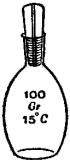
Fig. 2.
Many forms of vessels have been devised. The commoner type of “specific gravity bottle” consists of a thin glass bottle (fig. 2) of a capacity varying from 10 to 100 cc., fitted with an accurately ground stopper, which is vertically perforated by a fine hole. The bottle is carefully cleansed by washing with soda, hydrochloric acid and distilled water, and then dried by heating in an air bath or by blowing in warm air. It is allowed to cool and then weighed. The bottle is then filled with distilled water, and brought to a definite temperature by immersion in a thermostat, and the stopper inserted. It is removed from the thermostat, and carefully wiped. After cooling it is weighed. The bottle is again cleaned and dried, and the operations repeated with the liquid under examination instead of water. Numerous modifications of this bottle are in use. For volatile liquids, a flask provided with a long neck which carries a graduation and is fitted with a well-ground stopper is recommended. The bringing of the liquid to the mark is effected by removing the excess by means of a capillary. In many forms a thermometer forms part of the apparatus.
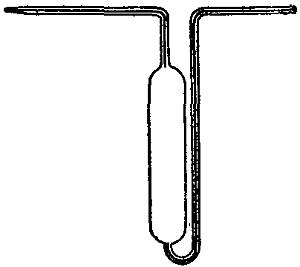
Fig. 3.
Another type of vessel, named the Sprengel tube or pycnometer (Gr. πυκυός, dense), is shown in fig. 3. It consists of a cylindrical tube of a capacity ranging from 10 to 50 cc., provided at the upper end with a thick-walled capillary bent as shown on the left of the figure. From the bottom there leads another fine tube, bent upwards, and then at right angles so as to be at the same level as the capillary branch. This tube bears a graduation. A loop of platinum wire passed under these tubes serves to suspend the vessel from the balance arm. The manner of cleansing, &c., is the same as in the ordinary form. The vessel is filled by placing the capillary in a vessel containing the liquid and gently aspirating. Care must be taken that no air bubbles are enclosed. The liquid is adjusted to the mark by withdrawing any excess from the capillary end by a strip of bibulous paper or by a capillary tube. Many variations of this apparatus are in use; in one of the commonest there are two cylindrical chambers, joined at the bottom, and each provided at the top with fine tubes bent at right angles; sometimes the inlet and outlet tubes are provided with caps.
The specific gravity bottle may be used to determine the relative density of a solid which is available in small fragments, and is insoluble in the standard liquid. The method involves three operations:—(1) weighing the solid in air (W), (2) weighing the specific gravity bottle full of liquid (W1), (3) weighing the bottle containing the solid and filled up with liquid (W2). It is readily seen that W + W1 - W2 is the weight of the liquid displaced by the solid, and therefore is the weight of an equal volume of liquid; hence the relative density is W/(W + W1 - W2).
The determination of the absolute densities of gases can only be effected with any high degree of accuracy by a development of this method. As originated by Regnault, it consisted in filling a large glass globe with the gas by alternately exhausting with an air-pump and admitting the pure and dry gas. The flask was then brought to 0° by immersion in melting ice, the pressure of the gas taken, and the stop-cock closed. The flask is removed from the ice, allowed to attain the temperature of the room, and then weighed. The flask is now partially exhausted, transferred to the cooling bath, and after standing the pressure of the residual gas is taken by a manometer. The flask is again brought to room-temperature, and re-weighed. The difference in the weights corresponds to the volume of gas at a pressure equal to the difference of the recorded pressures. The volume of the flask is determined by weighing empty and filled with water. This method has been refined by many experimenters, among whom we may notice Morley and Lord Rayleigh. Morley determined the densities of hydrogen and oxygen in the course of his classical investigation of the composition of water. The method differed from Regnault’s inasmuch as the flask was exhausted to an almost complete vacuum, a performance rendered possible by the high efficiency of the modern air-pump. The actual experiment necessitates the most elaborate precautions, for which reference must be made to Morley’s original papers in the Smithsonian Contributions to Knowledge (1895), or to M. Travers, The Study of Gases. Lord Rayleigh has made many investigations of the absolute densities of gases, one of which, namely on atmospheric and artificial nitrogen, undertaken in conjunction with Sir William Ramsay, culminated in the discovery of argon (q.v.). He pointed out in 1888 (Proc. Roy. Soc. 43, p. 361) an important correction which had been overlooked by previous experimenters with Regnault’s method, viz. the change in volume of the experimental globe due to shrinkage under diminished pressure; this may be experimentally determined and amounts to between 0.04 and 0.16% of the volume of the globe.
Related to the determination of the density of a gas is the determination of the density of a vapour, i.e. matter which at ordinary temperatures exists as a solid or liquid. This subject owes its importance in modern chemistry to the fact that the vapour density, when hydrogen is taken as the standard, gives perfectly definite information as to the molecular condition of the compound, since twice the vapour density equals the molecular weight of the compound. Many methods have been devised. In historical order we may briefly enumerate the following:—in 1811, Gay-Lussac volatilized a weighed quantity of liquid, which must be readily volatile, by letting it rise up a short tube containing mercury and standing inverted in a vessel holding the same metal. This method was developed by Hofmann in 1868, who replaced the short tube of Gay-Lussac by an ordinary barometer tube, thus effecting the volatilization in a Torricellian vacuum. In 1826 Dumas devised a method suitable for substances of high boiling-point; this consisted in its essential point in vaporizing the substance in a flask made of suitable material, sealing it when full of vapour, and weighing. This method is very tedious in detail. H. Sainte-Claire Deville and L. Troost made it available for specially high temperatures by employing porcelain vessels, sealing them with the oxyhydrogen blow-pipe, and maintaining a constant temperature by a vapour bath of mercury (350°), sulphur (440°), cadmium (860°) and zinc (1040°). In 1878 Victor Meyer devised his air-expulsion method.
Before discussing the methods now used in detail, a summary of the conclusions reached by Victor Meyer in his classical investigations in this field as to the applicability of the different methods will be given:
(1) For substances which do not boil higher than 260° and have vapours stable for 30° above the boiling-point and which do not react on mercury, use Victor Meyer’s “mercury expulsion method.”
(2) For substances boiling between 260° and 420°, and which do not react on metals, use Meyer’s “Wood’s alloy expulsion method.”
(3) For substances boiling at higher temperatures, or for any substance which reacts on mercury, Meyer’s “air expulsion method” must be used. It is to be noted, however, that this method is applicable to substances of any boiling-point (see below).
(4) For substances which can be vaporized only under diminished pressure, several methods may be used. (a) Hofmann’s is the best if the substance volatilizes at below 310°, and does not react on mercury; otherwise (b) Demuth and Meyer’s, Eykman’s, Schall’s, or other methods may be used.
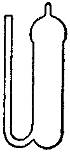
Fig. 4.
1. Meyer’s “Mercury Expulsion” Method.—A small quantity of the substance is weighed into a tube, of the form shown in fig. 4, which has a capacity of about 35 cc., provided with a capillary tube at the top, and a bent tube about 6 mm. in diameter at the bottom. The vessel is completely filled with mercury, the capillary sealed, and the vessel weighed. The vessel is then lowered into a jacket containing vapour at a known temperature which is sufficient to volatilize the substance. Mercury is expelled, and when this expulsion ceases, the vessel is removed, allowed to cool, and weighed. It is necessary to determine the pressure exerted on the vapour by the mercury in the narrow limb; this is effected by opening the capillary and inclining the tube until the mercury just reaches the top of the narrow tube; the difference between the height of the mercury in the wide tube and the top of the narrow tube represents the pressure due to the mercury column, and this must be added to the barometric pressure in order to deduce the total pressure on the vapour.
The result is calculated by means of the formula:
D = W(1 + αt) × 7,980,000 ,
(p + p1 - s)[m{1 + β(t - t0)} - m1{1 + γ(t - t0)}](1 + γt)
in which W = weight of substance taken; t = temperature of vapour bath; α = 0.00366 = temperature coefficient of gases; p = barometric pressure; p1 = height of mercury column in vessel; s = vapour tension of mercury at t°; m = weight of mercury contained in the vessel; m1 = weight of mercury left in vessel after heating; β = coefficient of expansion of glass = .0000303; γ = coefficient of expansion of mercury = 0.00018 (0.00019 above 240°) (see Ber. 1877, 10, p. 2068; 1886, 19, p. 1862).
2. Meyer’s Wood’s Alloy Expulsion Method.—This method is a modification of the one just described. The alloy used is composed of 15 parts of bismuth, 8 of lead, 4 of tin and 3 of cadmium; it melts at 70°, and can be experimented with as readily as mercury. The cylindrical vessel is replaced by a globular one, and the pressure on the vapour due to the column of alloy in the side tube is readily reduced to millimetres of mercury since the specific gravity of the alloy at the temperature of boiling sulphur, 444° (at which the apparatus is most frequently used), is two-thirds of that of mercury (see Ber. 1876, 9, p. 1220).
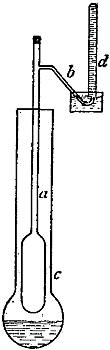
Fig. 5.
3. Meyer’s Air Expulsion Method.—The simplicity, moderate accuracy, and adaptability of this method to every class of substance which can be vaporized entitles it to rank as one of the most potent methods in analytical chemistry; its invention is indissolubly connected with the name of Victor Meyer, being termed “Meyer’s method” to the exclusion of his other original methods. It consists in determining the air expelled from a vessel by the vapour of a given quantity of the substance. The apparatus is shown in fig. 5. A long tube (a) terminates at the bottom in a cylindrical chamber of about 100-150 cc. capacity. The top is fitted with a rubber stopper, or in some forms with a stop-cock, while a little way down there is a bent delivery tube (b). To use the apparatus, the long tube is placed in a vapour bath (c) of the requisite temperature, and after the air within the tube is in equilibrium, the delivery tube is placed beneath the surface of the water in a pneumatic trough, the rubber stopper pushed home, and observation made as to whether any more air is being expelled. If this be not so, a graduated tube (d) is filled with water, and inverted over the delivery tube. The rubber stopper is removed and the experimental substance introduced, and the stopper quickly replaced to the same extent as before. Bubbles are quickly disengaged and collect in the graduated tube. Solids may be directly admitted to the tube from a weighing bottle, while liquids are conveniently introduced by means of small stoppered bottles, or, in the case of exceptionally volatile liquids, by means of a bulb blown on a piece of thin capillary tube, the tube being sealed during the weighing operation, and the capillary broken just before transference to the apparatus. To prevent the bottom of the apparatus being knocked out by the impact of the substance, a layer of sand, asbestos or sometimes mercury is placed in the tube. To complete the experiment, the graduated tube containing the expelled air is brought to a constant and determinate temperature and pressure, and this volume is the volume which the given weight of the substance would occupy if it were a gas under the same temperature and pressure. The vapour density is calculated by the following formula:
D = W(1 + αt) × 587,780 ,
(p - s)V
in which W = weight of substance taken, V = volume of air expelled, α = 1/273 = .003665, t and p = temperature and pressure at which expelled air is measured, and s = vapour pressure of water at t°.
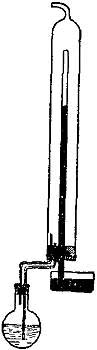
Fig. 6.
By varying the material of the bulb, this apparatus is rendered available for exceptionally high temperatures. Vapour baths of iron are used in connexion with boiling anthracene (335°), anthraquinone (368°), sulphur (444°), phosphoruspentasulphide (518°); molten lead may also be used. For higher temperatures the bulb of the vapour density tube is made of porcelain or platinum, and is heated in a gas furnace.
(4a) Hofmann’s Method.—Both the modus operandi and apparatus employed in this method particularly recommend its use for substances which do not react on mercury and which boil in a vacuum at below 310°. The apparatus (fig. 6) consists of a barometer tube, containing mercury and standing in a bath of the same metal, surrounded by a vapour jacket. The vapour is circulated through the jacket, and the height of the mercury read by a cathetometer or otherwise. The substance is weighed into a small stoppered bottle, which is then placed beneath the mouth of the barometer tube. It ascends the tube, the substance is rapidly volatilized, and the mercury column is depressed; this depression is read off. It is necessary to know the volume of the tube above the second level; this may most efficiently be determined by calibrating the tube prior to its use. Sir T. E. Thorpe employed a barometer tube 96 cm. long, and determined the volume from the closed end for a distance of about 35 mm. by weighing in mercury; below this mark it was calibrated in the ordinary way so that a scale reading gave the volume at once. The calculation is effected by the following formulae:—
D = 760w(1 + 0.003665t) ;
0.0012934 × V × B
B = h - ( h1 - h2 + s ) ,
1 + 0.00018t1 1 + 0.00018t2 1 + 0.00018t
in which w = weight of substance taken; t = temperature of vapour jacket; V = volume of vapour at t; h = height of barometer reduced to 0°; t1 = temperature of air; h1 = height of mercury column below vapour jacket; t2 = temperature of mercury column not heated by vapour; h2 = height of mercury column within vapour jacket; s = vapour tension of mercury at t°. The vapour tension of mercury need not be taken into account when water is used in the jacket.
(4b) Demuth and Meyer’s Method.—The principle of this method is as follows:—In the ordinary air expulsion method, the vapour always mixes to some extent with the air in the tube, and this involves a reduction of the pressure of the vapour. It is obvious that this reduction may be increased by accelerating the diffusion of the vapour. This may be accomplished by using a vessel with a somewhat wide bottom, and inserting the substance so that it may be volatilized very rapidly, as, for example, in tubes of Wood’s alloy, and by filling the tube with hydrogen. (For further details see Ber. 23, p. 311.)
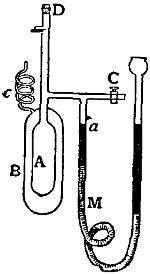
Fig. 7.
We may here notice a modification of Meyer’s process in which the increase of pressure due to the volatilization of the substance, and not the volume of the expelled air, is measured. This method has been developed by J. S. Lumsden (Journ. Chem. Soc. 1903, 83, p. 342), whose apparatus is shown diagrammatically in fig. 7. The vaporizing bulb A has fused about it a jacket B, provided with a condenser c. Two side tubes are fused on to the neck of A: the lower one leads to a mercury manometer M, and to the air by means of a cock C; the upper tube is provided with a rubber stopper through which a glass rod passes—this rod serves to support the tube containing the substance to be experimented upon, and so avoids the objection to the practice of withdrawing the stopper of the tube, dropping the substance in, and reinserting the stopper. To use the apparatus, a liquid of suitable boiling-point is placed in the jacket and brought to the boiling-point. All parts of the apparatus are open to the air, and the mercury in the manometer is adjusted so as to come to a fixed mark a. The substance is now placed on the support already mentioned, and the apparatus closed to the air by inserting the cork at D and turning the cock C. By turning or withdrawing the support the substance enters the bulb; and during its vaporization the free limb of the manometer is raised so as to maintain the mercury at a. When the volatilization is quite complete, the level is accurately adjusted, and the difference of the levels of the mercury gives the pressure exerted by the vapour. To calculate the result it is necessary to know the capacity of the apparatus to the mark a, and the temperature of the jacket.
Methods depending on the Principles of Hydrostatics.—Hydrostatical principles can be applied to density determinations in four typical ways: (1) depending upon the fact that the heights of liquid columns supported by the same pressure vary inversely as the densities of the liquids; (2) depending upon the fact that a body which sinks in a liquid loses a weight equal to the weight of liquid which it displaces; (3) depending on the fact that a body remains suspended, neither floating nor sinking, in a liquid of exactly the same density; (4) depending on the fact that a floating body is immersed to such an extent that the weight of the fluid displaced equals the weight of the body.
1. The method of balancing columns is of limited use. Two forms are recognized. In one, applicable only to liquids which do not mix, the two liquids are poured into the limbs of a U tube. The heights of the columns above the surface of junction of the liquids are inversely proportional to the densities of the liquids. In the second form, named after Robert Hare (1781-1858), professor of chemistry at the university of Pennsylvania, the liquids are drawn or aspirated up vertical tubes which have their lower ends placed in reservoirs containing the different liquids, and their upper ends connected to a common tube which is in communication with an aspirator for decreasing the pressure within the vertical tubes. The heights to which the liquids rise, measured in each case by the distance between the surfaces in the reservoirs and in the tubes, are inversely proportional to the densities.
2. The method of “hydrostatic weighing” is one of the most important. The principle may be thus stated: the solid is weighed in air, and then in water. If W be the weight in air, and W1 the weight in water, then W1 is always less than W, the difference W - W11 representing the weight of the water displaced, i.e. the weight of a volume of water equal to that of the solid. Hence W/(W - W1) is the relative density or specific gravity of the body. The principle is readily adapted to the determination of the relative densities of two liquids, for it is obvious that if W be the weight of a solid body in air, W1 and W2 its weights when immersed in the liquids, then W - W1 and W - W2 are the weights of equal volumes of the liquids, and therefore the relative density is the quotient (W - W1)/(W - W2). The determination in the case of solids lighter than water is effected by the introduction of a sinker, i.e. a body which when affixed to the light solid causes it to sink. If W be the weight of the experimental solid in air, w the weight of the sinker in water, and W1 the weight of the solid plus sinker in water, then the relative density is given by W/(W + w - W1). In practice the solid or plummet is suspended from the balance arm by a fibre—silk, platinum, &c.—and carefully weighed. A small stool is then placed over the balance pan, and on this is placed a beaker of distilled water so that the solid is totally immersed. Some balances are provided with a “specific gravity pan,” i.e. a pan with short suspending arms, provided with a hook at the bottom to which the fibre may be attached; when this is so, the stool is unnecessary. Any air bubbles are removed from the surface of the body by brushing with a camel-hair brush; if the solid be of a porous nature it is desirable to boil it for some time in water, thus expelling the air from its interstices. The weighing is conducted in the usual way by vibrations, except when the weight be small; it is then advisable to bring the pointer to zero, an operation rendered necessary by the damping due to the adhesion of water to the fibre. The temperature and pressure of the air and water must also be taken.
There are several corrections of the formula Δ = W/(W - W1) necessary to the accurate expression of the density. Here we can only summarize the points of the investigation. It may be assumed that the weighing is made with brass weights in air at t° and p mm. pressure. To determine the true weight in vacuo at 0°, account must be taken of the different buoyancies, or losses of true weight, due to the different volumes of the solids and weights. Similarly in the case of the weighing in water, account must be taken of the buoyancy of the weights, and also, if absolute densities be required, of the density of water at the temperature of the experiment. In a form of great accuracy the absolute density Δ(0°/4°) is given by
Δ(0°/4°) = (ραW - δW1)/(W - W1),
in which W is the weight of the body in air at t° and p mm. pressure, W1 the weight in water, atmospheric conditions remaining very nearly the same; ρ is the density of the water in which the body is weighed, α is (1 + αt°) in which a is the coefficient of cubical expansion of the body, and δ is the density of the air at t°, p mm. Less accurate formulae are Δ = ρ W/(W - W1), the factor involving the density of the air, and the coefficient of the expansion of the solid being disregarded, and Δ = W/(W - W1), in which the density of water is taken as unity. Reference may be made to J. Wade and R. W. Merriman, Journ. Chem. Soc. 1909, 95, p. 2174.
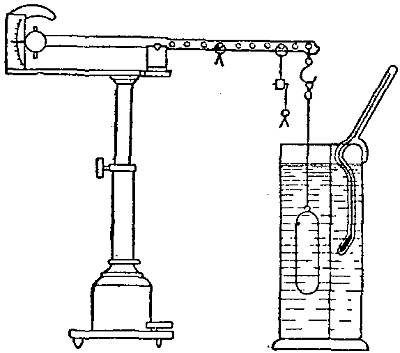
Fig. 8.
The determination of the density of a liquid by weighing a plummet in air, and in the standard and experimental liquids, has been put into a very convenient laboratory form by means of the apparatus known as a Westphal balance (fig. 8). It consists of a steelyard mounted on a fulcrum; one arm carries at its extremity a heavy bob and pointer, the latter moving along a scale affixed to the stand and serving to indicate when the beam is in its standard position. The other arm is graduated in ten divisions and carries riders—bent pieces of wire of determined weights—and at its extremity a hook from which the glass plummet is suspended. To complete the apparatus there is a glass jar which serves to hold the liquid experimented with. The apparatus is so designed that when the plummet is suspended in air, the index of the beam is at the zero of the scale; if this be not so, then it is adjusted by a levelling screw. The plummet is now placed in distilled water at 15°, and the beam brought to equilibrium by means of a rider, which we shall call 1, hung on a hook; other riders are provided, 1⁄10th and 1⁄100th respectively of 1. To determine the density of any liquid it is only necessary to suspend the plummet in the liquid, and to bring the beam to its normal position by means of the riders; the relative density is read off directly from the riders.
3. Methods depending on the free suspension of the solid in a liquid of the same density have been especially studied by Retgers and Gossner in view of their applicability to density determinations of crystals. Two typical forms are in use; in one a liquid is prepared in which the crystal freely swims, the density of the liquid being ascertained by the pycnometer or other methods; in the other a liquid of variable density, the so-called “diffusion column,” is prepared, and observation is made of the level at which the particle comes to rest. The first type is in commonest use; since both necessitate the use of dense liquids, a summary of the media of most value, with their essential properties, will be given.
Acetylene tetrabromide, C2H2Br4, which is very conveniently prepared by passing acetylene into cooled bromine, has a density of 3.001 at 6° C. It is highly convenient, since it is colourless, odourless, very stable and easily mobile. It may be diluted with benzene or toluene.
Methylene iodide, CH2I2, has a density of 3.33, and may be diluted with benzene. Introduced by Brauns in 1886, it was recommended by Retgers. Its advantages rest on its high density and mobility; its main disadvantages are its liability to decomposition, the originally colourless liquid becoming dark owing to the separation of iodine, and its high coefficient of expansion. Its density may be raised to 3.65 by dissolving iodoform and iodine in it.
Thoulet’s solution, an aqueous solution of potassium and mercuric iodides (potassium iodo-mercurate), introduced by Thoulet and subsequently investigated by V. Goldschmidt, has a density of 3.196 at 22.9°. It is almost colourless and has a small coefficient of expansion; its hygroscopic properties, its viscous character, and its action on the skin, however, militate against its use. A. Duboin (Compt. rend., 1905, p. 141) has investigated the solutions of mercuric iodide in other alkaline iodides; sodium iodo-mercurate solution has a density of 3.46 at 26°, and gives with an excess of water a dense precipitate of mercuric iodide, which dissolves without decomposition in alcohol; lithium iodo-mercurate solution has a density of 3.28 at 25.6°; and ammonium iodo-mercurate solution a density of 2.98 at 26°.
Rohrbach’s solution, an aqueous solution of barium and mercuric iodides, introduced by Carl Rohrbach, has a density of 3.588.
Klein’s solution, an aqueous solution of cadmium borotungstate, 2Cd(OH)2·B2O3·9WO3·16H2O, introduced by D. Klein, has a density up to 3.28. The salt melts in its water of crystallization at 75°, and the liquid thus obtained goes up to a density of 3.6.
Silver-thallium nitrate, TIAg(NO3)2, introduced by Retgers, melts at 75° to form a clear liquid of density 4.8; it may be diluted with water.
The method of using these liquids is in all cases the same; a particle is dropped in; if it floats a diluent is added and the mixture well stirred. This is continued until the particle freely swims, and then the density of the mixture is determined by the ordinary methods (see Mineralogy).
In the “diffusion column” method, a liquid column uniformly varying in density from about 3.3 to 1 is prepared by pouring a little methylene iodide into a long test tube and adding five times as much benzene. The tube is tightly corked to prevent evaporation, and allowed to stand for some hours. The density of the column at any level is determined by means of the areometrical beads proposed by Alexander Wilson (1714-1786), professor of astronomy at Glasgow University. These are hollow glass beads of variable density; they may be prepared by melting off pieces of very thin capillary tubing, and determining the density in each case by the method just previously described. To use the column, the experimental fragment is introduced, when it takes up a definite position. By successive trials two beads, of known density, say d1, d2, are obtained, one of which floats above, and the other below, the test crystal; the distances separating the beads from the crystal are determined by means of a scale placed behind the tube. If the bead of density d1 be at the distance l1 above the crystal, and that of d2 at l2 below, it is obvious that if the density of the column varies uniformly, then the density of the test crystal is (d1l2 + d2l1)/(l1 + l2).
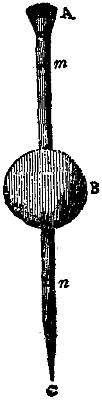
Fig. 9. Brewster’s Staktometer
Acting on a principle quite different from any previously discussed is the capillary hydrometer or staktometer of Brewster, which is based upon the difference in the surface tension and density of pure water, and of mixtures of alcohol and water in varying proportions.
If a drop of water be allowed to form at the extremity of a fine tube, it will go on increasing until its weight overcomes the surface tension by which it clings to the tube, and then it will fall. Hence any impurity which diminishes the surface tension of the water will diminish the size of the drop (unless the density is proportionately diminished). According to Quincke, the surface tension of pure water in contact with air at 20° C. is 81 dynes per linear centimetre, while that of alcohol is only 25.5 dynes; and a small percentage of alcohol produces much more than a proportional decrease in the surface tension when added to pure water. The capillary hydrometer consists simply of a small pipette with a bulb in the middle of the stem, the pipette terminating in a very fine capillary point. The instrument being filled with distilled water, the number of drops required to empty the bulb and portions of the stem between two marks m and n (fig. 9) on the latter is carefully counted, and the experiments repeated at different temperatures. The pipette having been carefully dried, the process is repeated with pure alcohol or with proof spirits, and the strength of any admixture of water and spirits is determined from the corresponding number of drops, but the formula generally given is not based upon sound data. Sir David Brewster found with one of these instruments that the number of drops of pure water was 734, while of proof spirit, sp. gr. 920, the number was 2117.
References.—Density and density determinations are discussed in all works on practical physics; reference may be made to B. Stewart and W. W. Haldane Gee, Practical Physics, vol. i. (1901); Kohlrausch, Practical Physics; Ostwald, Physico-Chemical Measurements. The density of gases is treated in M. W. Travers, The Experimental Study of Gases (1901); and vapour density determinations in Lassar-Cohn’s Arbeitsmethoden für organisch-chemische Laboratorien (1901), and Manual of Organic Chemistry (1896), and in H. Biltz, Practical Methods for determining Molecular Weights (1899).
(C. E.*)
DENTATUS, MANIUS CURIUS, Roman general, conqueror of the Samnites and Pyrrhus, king of Epirus, was born of humble parents, and was possibly of Sabine origin. He is said to have been called Dentatus because he was born with his teeth already grown (Pliny, Nat. Hist. vii. 15). Except that he was tribune of the people, nothing certain is known of him until his first consulship in 290 B.C. when, in conjunction with his colleague P. Cornelius Rufinus, he gained a decisive victory over the Samnites, which put an end to a war that had lasted fifty years. He also reduced the revolted Sabines to submission; a large portion of their territory was distributed among the Roman citizens, and the most important towns received the citizenship without the right of voting for magistrates (civitas sine suffragio). With the proceeds of the spoils of the war Dentatus cut an artificial channel to carry off the waters of Lake Velinus, so as to drain the valley of Reate. In 275, after Pyrrhus had returned from Sicily to Italy, Dentatus (again consul) took the field against him. The decisive engagement took place near Beneventum in the Campi Arusini, and resulted in the total defeat of Pyrrhus. Dentatus celebrated a magnificent triumph, in which for the first time a number of captured elephants were exhibited. Dentatus was consul for the third time in 274, when he finally crushed the Lucanians and Samnites, and censor in 272. In the latter capacity he began to build an aqueduct to carry the waters of the Anio into the city, but died (270) before its completion. Dentatus was looked upon as a model of old Roman simplicity and frugality. According to the well-known anecdote, when the Samnites sent ambassadors with costly presents to induce him to exercise his influence on their behalf in the senate, they found him sitting on the hearth and preparing his simple meal of roasted turnips. He refused their gifts, saying that earthen dishes were good enough for him, adding that he preferred ruling those who possessed gold to possessing it himself. It is also said that he died so poor that the state was obliged to provide dowries for his daughters. But these and similar anecdotes must be received with caution, and it should be remembered that what was a competence in his day would have been considered poverty by the Romans of later times.
Livy, epitome, 11-14; Polybius ii. 19; Eutropius ii. 9, 14; Florus i. 18; Val. Max. iv. 3, 5, vi. 3, 4; Cicero, De senectute, 16; Juvenal xi. 78; Plutarch, Pyrrhus, 25.
DENTIL (from Lat. dens, a tooth), in architecture, a small tooth-shaped block used as a repeating ornament in the bed-mould of a cornice. Vitruvius (iv. 2) states that the dentil represents the end of a rafter (asser); and since it occurs in its most pronounced form in the Ionic temples of Asia Minor, the Lycian tombs and the porticoes and tombs of Persia, where it represents distinctly the reproduction in stone of timber construction, there is but little doubt as to its origin. The earliest example is that found on the tomb of Darius, c. 500 B.C., cut in the rock in which the portico of his palace is reproduced. Its first employment in Athens is in the cornice of the caryatid portico or tribune of the Erechtheum (480 B.C.). When subsequently introduced into the bed-mould of the cornice of the choragic monument of Lysicrates it is much smaller in its dimensions. In the later temples of Ionia, as in the temple of Priene, the larger scale of the dentil is still retained. As a general rule the projection of the dentil is equal to its width, and the intervals between to half the width. In some cases the projecting band has never had the sinkings cut into it to divide up the dentils, as in the Pantheon at Rome, and it is then called a dentil-band. The dentil was the chief decorative feature employed in the bed-mould by the Romans and the Italian Revivalists. In the porch of the church of St John Studius at Constantinople, the dentil and the interval between are equal in width, and the interval is splayed back from top to bottom; this is the form it takes in what is known as the “Venetian dentil,” which was copied from the Byzantine dentil in Santa Sophia, Constantinople. There, however, it no longer formed part of a bed-mould: its use at Santa Sophia was to decorate the projecting moulding enclosing the encrusted marbles, and the dentils were cut alternately on both sides of the moulding. The Venetian dentil was also introduced as a label round arches and as a string course.
DENTISTRY (from Lat. dens, a tooth), a special department of medical science, embracing the structure, function and therapeutics of the mouth and its contained organs, Historical sketch. specifically the teeth, together with their surgical and prosthetic treatment. (For the anatomy of the teeth see Teeth.) As a distinct vocation it is first alluded to by Herodotus (500 B.C.). There are evidences that at an earlier date the Egyptians and Hindus attempted to replace lost teeth by attaching wood or ivory substitutes to adjacent sound teeth by means of threads or wires, but the gold fillings reputed to have been found in the teeth of Egyptian mummies have upon investigation been shown to be superficial applications of gold leaf for ornamental purposes. The impetus given to medical study in the Grecian schools by the followers of Aesculapius and especially Hippocrates (500 to 400 B.C.) developed among the practitioners of medicine and surgery considerable knowledge of dentistry. Galen (A.D. 131) taught that the teeth were true bones existing before birth, and to him is credited the belief that the upper canine teeth receive branches from the nerve which supplies the eye, and hence should be called “eye-teeth.” Abulcasis (10th cent. A.D.) describes the operation by which artificial crowns are attached to adjacent sound teeth. Vesalius (1514), Ambroise Paré, J. J. Scaliger, T. Kerckring, M. Malpighi, and lesser anatomists of the same period contributed dissertations which threw some small amount of light upon the structure and functions of the teeth. The operation of transplanting teeth is usually attributed to John Hunter (1728-1793), who practised it extensively, and gave to it additional prominence by transplanting a human tooth to the comb of a cock, but the operation was alluded to by Ambroise Paré (1509-1590), and there is evidence to show that it was practised even earlier. A. von Leeuwenhoek in 1678 described with much accuracy the tubular structure of the dentine, thus making the most important contribution to the subject which had appeared up to that time. Until the latter part of the 18th century extraction was practically the only operation for the cure of toothache.
The early contributions of France exerted a controlling influence upon the development of dental practice. Urbain Hémard, surgeon to the cardinal Georges of Armagnac, whom Dr Blake (1801) calls an ingenious surgeon and a great man, published in 1582 his Researches upon the Anatomy of the Teeth, their Nature and Properties. Of Hémard, M. Fauchard says: “This surgeon had read Greek and Latin authors, whose writings he has judiciously incorporated in his own works.” In 1728 Fauchard, who has been called the father of modern dentistry, published his celebrated work, entitled Le Chirurgien Dentiste ou traité des dents. The preface contains the following statement as to the existing status of dental art and science in France, which might have been applied with equal truth to any other European country:—“The most celebrated surgeons having abandoned this branch of surgery, or having but little cultivated it, their negligence gave rise to a class of persons who, without theoretic knowledge or experience, and without being qualified, practised it at hazard, having neither principles nor system. It was only since the year 1700 that the intelligent in Paris opened their eyes to these abuses, when it was provided that those who intended practising dental surgery should submit to an examination by men learned in all the branches of medical science, who should decide upon their merits.” After the publication of Fauchard’s work the practice of dentistry became more specialized and distinctly separated from medical practice, the best exponents of the art being trained as apprentices by practitioners of ability, who had acquired their training in the same way from their predecessors. Fauchard suggested porcelain as an improvement upon bone and ivory for the manufacture of artificial teeth, a suggestion which he obtained from R. A. F. de Réaumur, the French savant and physicist, who was a contributor to the royal porcelain manufactory at Sévres. Later, Duchateau, an apothecary of St Germain, made porcelain teeth, and communicated his discovery to the Academy of Surgery in 1776, but kept the process secret. Du Bois Chémant carried the art to England, and the process was finally made public by M. Du Bois Foucou. M. Fonzi improved the art to such an extent that the Athenaeum of Arts in Paris awarded him a medal and crown (March 14, 1808).
In Great Britain the 19th century brought the dawning of dental science. The work of Dr Blake in 1801 on the anatomy of the teeth was distinctly in advance of anything previously written on the subject. Joseph Fox was one of the first members of the medical profession to devote himself exclusively to dentistry, and his work is a repository of the best practice of his time. The processes described, though comparatively crude, involve principles in use at the present time. Thomas Bell, the successor of Fox as lecturer on the structure and disease of the teeth at Guy’s Hospital, published his well-known work in 1829. About this period numerous publications on dentistry made their appearance, notably those of Koecker, Johnson and Waite, followed somewhat later by the admirable work of Alexander Nasmyth (1839). By this time Cuvier, Serres, Rousseau, Bertin, Herissant and others in France had added to the knowledge of human and comparative dental anatomy, while M. G. Retzius, of Sweden, and E. H. Weber, J. C. Rosenmüller, Schreger, J. E. von Purkinje, B. Fraenkel and J. Müller in Germany were carrying forward the same lines of research. The sympathetic nervous relationships of the teeth with other parts of the body, and the interaction of diseases of the teeth with general pathological conditions, were clearly established. Thus a scientific foundation was laid, and dentistry came to be practised as a specialty of medicine. Certain minor operations, however, such as the extraction of teeth and the stopping of caries in an imperfect way, were still practised by barbers, and the empirical practice of dentistry, especially of those operations which were almost wholly mechanical, had developed a considerable body of dental artisans who, though without medical education in many cases, possessed a high degree of manipulative skill. Thus there came to be two classes of practitioners, the first regarding dentistry as a specialty of medicine, the latter as a distinct and separate calling.
In America representatives of both classes of dentists began to arrive from England and France about the time of the Revolution. Among these were John Wooffendale (1766), a student of Robert Berdmore of Liverpool, surgeon-dentist to George III.; James Gardette (1778), a French physician and surgeon; and Joseph Lemaire (1781), a French dentist who went out with the army of Count Rochambeau. During the winter of 1781-1782, while the Continental army was in winter quarters at Providence, Rhode Island, Lemaire found time and opportunity to practise his calling, and also to instruct one or two persons, notably Josiah Flagg, probably the first American dentist. Dental practice was thus established upon American soil, where it has produced such fertile results.
Until well into the 19th century apprenticeship afforded the only means of acquiring a knowledge of dentistry. The profits derived from the apprenticeship system fostered secrecy and quackery among many of the early practitioners; but the more liberal minded and better educated of the craft developed an increasing opposition to these narrow methods. In 1837 a local Course of training. association of dentists was formed in New York, and in 1840 a national association, The American Society of Dental Surgeons, the object of which was “to advance the science by free communication and interchange of sentiments.” The first dental periodical in the world, The American Journal of Dental Science, was issued in June 1839, and in November 1840 was established the Baltimore College of Dental Surgery, the first college in the world for the systematic education of dentists. Thus the year 1839-1840 marks the birth of the three factors essential to professional growth in dentistry. All this, combined with the refusal of the medical schools to furnish the desired facilities for dental instruction, placed dentistry for the time being upon a footing entirely separate from general medicine. Since then the curriculum of study preparatory to dental practice has been systematically increased both as to its content and length, until in all fundamental principles it is practically equal to that required for the training of medical specialists, and in addition includes the technical subjects peculiar to dentistry. In England, and to some extent upon the continent, the old apprenticeship system is retained as an adjunct to the college course, but it is rapidly dying out, as it has already done in America. Owing to the regulation by law of the educational requirements, the increase of institutions devoted to the professional training of dentists has been rapid in all civilized countries, and during the past twenty years especially so in the United States. Great Britain possesses upwards of twelve institutions for dental instruction, France two, Germany and Switzerland six, all being based upon the conception that dentistry is a department of general medicine. In the United States there were in 1878 twelve dental schools, with about 700 students; in 1907 there were fifty-seven schools, with 6919 students. Of these fifty-seven schools, thirty-seven are departments of universities or of medical institutions, and there is a growing tendency to regard dentistry from its educational aspect as a special department of the general medical and surgical practice.
Recent studies have shown that besides being an important part of the digestive system, the mouth sustains intimate relationship with the general nervous system, and is important as the portal of entrance for the majority of the bacteria that cause specific diseases. This fact has rendered more intimate the relations between dentistry and the general practice of medicine, and has given a powerful impetus to scientific studies in dentistry. Research. Through the researches of Sir J. Tomes, Mummery, Hopewell Smith, Williams and others in England, O. Hertwig, Weil and Röse in Germany, Andrews, Sudduth and Black in America, the minute anatomy and embryology of the dental tissues have been worked out with great fulness and precision. In particular, it has been demonstrated that certain general systemic diseases have a distinct oral expression. Through their extensive nervous connexions with the largest of the cranial nerves and with the sympathetic nervous system, the teeth frequently cause irritation resulting in profound reflex nervous phenomena, which are curable only by removal of the local tooth disorder. Gout, lithaemia, scurvy, rickets, lead and mercurial poisoning, and certain forms of chronic nephritis, produce dental and oral lesions which are either pathognomonic or strongly indicative of their several constitutional causes, and are thus of great importance in diagnosis. The most important dental research of modern times is that which was carried out by Professor W. D. Miller of Berlin (1884) upon the cause of caries of the teeth, a disease said to affect the human race more extensively than any other. Miller demonstrated that, as previous observers had suspected, caries is of bacterial origin, and that acids play an important rôle in the process. The disease is brought about by a group of bacteria which develop in the mouth, growing naturally upon the débris of starchy or carbohydrate food, producing fermentation of the mass, with lactic acid as the end product. The lactic acid dissolves the mineral constituent of the tooth structure, calcium phosphate, leaving the organic matrix of the tooth exposed. Another class of germs, the peptonising and putrefactive bacteria, then convert the organic matter into liquid or gaseous end products. The accuracy of the conclusions obtained from his analytic research was synthetically proved, after the manner of Koch, by producing the disease artificially. Caries of the teeth has been shown to bear highly important relation to more remote or systemic diseases. Exposure and death of the dental pulp furnishes an avenue of entrance for disease-producing bacteria, by which invasion of the deeper tissues may readily take place, causing necrosis, tuberculosis, actinomycosis, phlegmon and other destructive inflammations, certain of which, affecting the various sinuses of the head, have been found to cause meningitis, chronic empyema, metastatic abscesses in remote parts of the body, paralysis, epilepsy and insanity.
Operative Dentistry.—The art of dentistry is usually divided arbitrarily into operative dentistry, the purpose of which is to preserve as far as possible the teeth and associated tissues, and prosthetic dentistry, the purpose of which is to supply the loss of Filling or stopping. teeth by artificial substitutes. The filling of carious cavities was probably first performed with lead, suggested apparently by an operation recorded by Celsus (100 B.C.), who recommended that frail or decayed teeth be stuffed with lead previous to extraction, in order that they might not break under the forceps. The use of lead as a filling was sufficiently prevalent in France during the 17th century to bring into use the word plombage, which is still occasionally applied in that country to the operation of filling. Gold as a filling material came into general use about the beginning of the 19th century.1 The earlier preparations of gold were so impure as to be virtually without cohesion, so that they were of use only in cavities which had sound walls for its retention. In the form of rolls or tape it was forced into the previously cleaned and prepared cavity, condensed with instruments under heavy hand pressure, smoothed with files, and finally burnished. Tin foil was also used to a limited extent and by the same method. Improvements in the refining of gold for dental use brought the product to a fair degree of purity, and, about 1855, led to the invention by Dr Robert Arthur of Baltimore of a method by which it could be welded firmly within the cavity. The cohesive properties of the foil were developed by passing it through an alcohol flame, which dispelled its surface contaminations. The gold was then welded piece by piece into a homogeneous mass by plugging instruments with serrated points. In this process of cold-welding, the mallet, hitherto in only limited use, was found more efficient than hand pressure, and was rapidly developed. The primitive mallet of wood, ivory, lead or steel, was supplanted by a mallet in which a hammer was released automatically by a spring condensed by pressure of the operator’s hand. Then followed mallets operated by pneumatic pressure, by the dental engine, and finally by the electro-magnet, as utilized in 1867 by Bonwill. These devices greatly facilitated the operation, and made possible a partial or entire restoration of the tooth-crown in conformity with anatomical lines.
The dental engine in its several forms is the outgrowth of the simple drill worked by the hand of the operator. It is used in removing decayed structure and for shaping the cavity for inserting the filling. From time to time its usefulness has been extended, so that it is now used for finishing fillings and polishing them, for polishing the teeth, removing deposits from them and changing their shapes. Its latest development, the dento-surgical engine, is of heavier construction and is adapted to operations upon all of the bones, a recent addition to its equipment being the spiral osteotome of Cryer, by which, with a minimum shock to the patient, fenestrae of any size or shape in the brain-case may be made, from a simple trepanning operation to the more extensive openings required in intra-cranial operations. The rotary power may be supplied by the foot of the operator, or by hydraulic or electric motors. The rubber dam invented by S. C. Barnum of New York (1864) provided a means for protecting the field of operations from the oral fluids, and extended the scope of operations even to the entire restoration of tooth-crowns with cohesive gold foil. Its value has been found to be even greater than was at first anticipated. In all operations involving the exposed dental pulp or the pulp-chamber and root-canals, it is the only efficient method of mechanically protecting the field of operation from invasion by disease-producing bacteria.
The difficulty and annoyance attending the insertion of gold, its high thermal conductivity, and its objectionable colour have led to an increasing use of amalgam, guttapercha, and cements of zinc oxide mixed with zinc chloride or phosphoric acid. Recently much attention has been devoted to restorations with porcelain. A piece of platinum foil of .001 inch thickness is burnished and pressed into the cavity, so that a matrix is produced exactly fitting the cavity. Into this matrix is placed a mixture of powdered porcelain and water or alcohol, of the colour to match the tooth. The mass is carefully dried and then fused until homogeneous. Shrinkage is counteracted by additions of porcelain powder, which are repeatedly fused until the whole exactly fills the matrix. After cooling, the matrix is stripped away and the porcelain is cemented into the cavity. When the cement has hardened, the surface of the porcelain is ground and polished to proper contour. If successfully made, porcelain fillings are scarcely noticeable. Their durability remains to be tested.
Until recent times the exposure of the dental pulp inevitably led to its death and disintegration, and, by invasion of bacteria via the pulp canal, set up an inflammatory process Dental therapeutics. which eventually caused the loss of the entire tooth. A rational system of therapeutics, in conjunction with proper antiseptic measures, has made possible both the conservative treatment of the dental pulp when exposed, and the successful treatment of pulp-canals when the pulp has been devitalized either by design or disease. The conservation of the exposed pulp is affected by the operation of capping. In capping a pulp, irritation is allayed by antiseptic and sedative treatment, and a metallic cap, lined with a non-irritant sedative paste, is applied under aseptic conditions immediately over the point of pulp exposure. A filling of cement is superimposed, and this, after it has hardened, is covered with a metallic or other suitable filling. The utility of arsenious acid for devitalizing the dental pulp was discovered by J. R. Spooner of Montreal, and first published in 1836 by his brother Shearjashub in his Guide to Sound Teeth. The painful action of arsenic upon the pulp was avoided by the addition of various sedative drugs,—morphia, atropia, iodoform, &c.,—and its use soon became universal. Of late years it is being gradually supplanted by immediate surgical extirpation under the benumbing effect of cocaine salts. By the use of cocaine also the pain incident to excavating and shaping of cavities in tooth structure may be controlled, especially when the cocaine is driven into the dentine by means of an electric current. To fill the pulp-chamber and canals of teeth after loss of the pulp, all organic remains of pulp tissue should be removed by sterilization, and then, in order to prevent the entrance of bacteria, and consequent infection, the canals should be perfectly filled. Upon the exclusion of infection depends the future integrity and comfort of the tooth. Numberless methods have been invented for the operation. Pulpless teeth are thus preserved through long periods of usefulness, and even those remains of teeth in which the crowns have been lost are rendered comfortable and useful as supports for artificial crowns, and as abutments for assemblages of crowns, known as bridge-work.
The discoloration of the pulpless tooth through putrefactive changes in its organic matter were first overcome by bleaching it with chlorine. Small quantities of calcium hypochlorite are packed into the pulp-chamber and moistened with dilute acetic acid; the decomposition of the calcium salt liberates chlorine in situ, which restores the tooth to normal colour in a short time. The cavity is afterwards washed out, carefully dried, lined with a light-coloured cement and filled. More efficient bleaching agents of recent introduction are hydrogen dioxide in a 25% solution or a saturated solution of sodium peroxide; they are less irritating and much more convenient in application. Unlike chlorine, these do not form soluble metallic salts which may subsequently discolour the tooth. Hydrogen dioxide may be carried into the tooth structure by the electric current. In which case a current of not less than forty volts controlled by a suitable graduated resistance is applied with the patient in circuit, the anode being a platinum-pointed electrode in contact with the dioxide solution in the tooth cavity, and the cathode a sponge or plate electrode in contact with the hand or arm of the patient. The current is gradually turned on until two or three milliamperes are indicated by a suitable ammeter. The operation requires usually twenty to thirty minutes.
Malposed teeth are not only unsightly but prone to disease, and may be the cause of disease in other teeth, or of the associated tissues. The impairment of function which their abnormal position causes has been found to be the primary cause of disturbances of the general bodily health; for example, enlarged tonsils, chronic pharyngitis and nasal catarrh, indigestion and malnutrition. By the use of springs, screws, vulcanized caoutchouc bands, elastic ligatures, &c., as the case may require, practically all forms of dental irregularity may be corrected, even such protrusions and retrusions of the front teeth as cause great disfigurement of the facial contour.
The extraction of teeth, an operation which until quite recent times was one of the crudest procedures in minor surgery, has been reduced to exactitude by improved instruments, Extraction. designed with reference to the anatomical relations of the teeth and their alveoli, and therefore adapted to the several classes of teeth. The operation has been rendered painless by the use of anaesthetics. The anaesthetic generally employed is nitrous oxide, or laughing-gas, the use of which was discovered in 1844 by Horace Wells, a dentist of Hartford, Conn., U.S.A. Chloroform and ether, as well as other general anaesthetics, have been employed in extensive operations because of their more prolonged effect; but chloroform, especially, is dangerous, owing to its effect upon the heart, which in many instances has suddenly failed during the operation. Ether, while less manageable than nitrous oxide, has been found to be practically devoid of danger. The local injection of solutions of cocaine and allied anaesthetics into the gum-tissue is extensively practised; but is attended with danger, from the toxic effects of an overdose upon the heart, and the local poisonous effect upon the tissues, which lead in numerous cases to necrosis and extensive sloughing.
Dental Prosthesis.—The fastening of natural teeth or carved substitutes to adjoining sound teeth by means of thread or wire preceded their attachment to base-plates of carved Artificial teeth. wood, bone or ivory, which latter method was practised until the introduction of swaged metallic plates. Where the crown only of a tooth or those of several teeth were lost, the restoration was effected by engrafting upon the prepared root a suitable crown by means of a wooden or metallic pivot. When possible, the new crown was that of a corresponding sound tooth taken from the mouth of another individual; otherwise an artificial crown carved from bone or ivory, or sometimes from the tooth of an ox, was used. To replace entire dentures a base-plate of carved hippopotamus ivory was constructed, upon which were mounted the crowns of natural teeth, or later those of porcelain. The manufacture of a denture of this character was tedious and uncertain, and required much skill. The denture was kept in place by spiral springs attached to the buccal sides of the appliance above and below, which caused pressure upon both jaws, necessitating a constant effort upon the part of the unfortunate wearer to keep it in place. Metallic swaged plates were introduced in the latter part of the 18th century. An impression of the gums was taken in wax, from which a cast was made in plaster of Paris. With this as a model, a metallic die of brass or zinc was prepared, upon which the plate of gold or silver was formed, and then swaged into contact with the die by means of a female die or counter-die of lead. The process is essentially the same to-day, with the addition of numerous improvements in detail, which have brought it to a high degree of perfection. The discovery, by Gardette of Philadelphia in 1800, of the utility of atmospheric pressure in keeping artificial dentures in place led to the abandonment of spiral springs. A later device for enhancing the stability is the vacuum chamber, a central depression in the upper surface of the plate, which, when exhausted of air by the wearer, materially increases the adhesion. The metallic base-plate is used also for supporting one or more artificial teeth, being kept in place by metallic clasps fitting to, and partially surrounding, adjacent sound natural teeth, the plate merely covering the edentulous portion of the alveolar ridge. It may also be kept in place by atmospheric adhesion, in which case the palatal vault is included, and the vacuum chamber is utilized in the palatal portion to increase the adhesion.
In the construction usually practised, porcelain teeth are attached to a gold base-plate by means of stay-pieces of gold, perforated to receive the platinum pins baked in the body of the tooth. The stay-pieces or backings are then soldered to the pins and to the plate by means of high-fusing gold solder. The teeth used may be single or in sections, and may be with or without an extension designed in form and colour to imitate the gum of the alveolar border. Even when skillfully executed, the process is imperfect in that the jointing of the teeth to each other, and their adaptation to the base-plate, leaves crevices and recesses, in which food débris and oral secretions accumulate. To obviate these defects the enamelled platinum denture was devised. Porcelain teeth are first attached to a swaged base-plate of pure platinum by a stay-piece of the same metal soldered with pure gold, after which the interstices between the teeth are filled, and the entire surface of the plate, excepting that in contact with the palate and alveolar border, is covered with a porcelain paste called the body, which is modelled to the normal contour of the gums, and baked in a muffle furnace until vitrified. It is then enamelled with a vitreous enamel coloured in imitation of the colour of the natural gum, which is applied and fired as before, the result being the most artistic and hygienic denture known. This is commonly known as the continuous gum method. Originating in France in the early part of the 19th century, and variously improved by several experimenters, it was brought to its present perfection by Dr John Allen of New York about 1846-1847. Dentures supported upon cast bases of metallic alloys and of aluminium have been employed as substitutes for the more expensive dentures of gold and platinum, but have had only a limited use, and are less satisfactory.
Metallic bases were used exclusively as supports for artificial dentures until in 1855-1856 Charles Goodyear, jun., patented in England a process for constructing a denture upon vulcanized caoutchouc as a base. Several modifications followed, each the subject of patented improvements. Though the cheapness and simplicity of the vulcanite base has led to its abuse in incompetent hands, it has on the whole been productive of much benefit. It has been used with great success as a means of attaching porcelain teeth to metallic bases of gold, silver and aluminium. It is extensively used also in correcting irregular positions of the teeth, and for making interdental splints in the treatment of fractures of the jaws. For the mechanical correction of palatal defects causing imperfection of deglutition and speech, which comes distinctly within the province of the prosthetic dentist, the vulcanite base produces the best-known apparatus. Two classes of palatal mechanism are recognized—the obturator, a palatal plate, the function of which is to close perforations or clefts in the hard palate, and the artificial velum, a movable attachment to the obturator or palatal plate, which closes the opening in the divided natural velum and, moving with it, enables the wearer to close off the nasopharynx from the oral cavity in the production of the guttural sounds. Vulcanite is also used for extensive restorations of the jaws after surgical operations or loss by disease, and in the majority of instances wholly corrects the deformity.
For a time vulcanite almost supplanted gold and silver as a base for artificial denture, and developed a generation of practitioners deficient in that high degree of skill necessary to the construction of dentures upon metallic bases. Modern methods. The recent development of crown-and-bridge work has brought about a renaissance, so that a thorough training is more than ever necessary to successful practice in mechanical dentistry. The simplest crown is of porcelain, and is engrafted upon a sound natural tooth-root by means of a metallic pin of gold or platinum, extending into the previously enlarged root-canal and cemented in place. In another type of crown the point between the root-end and the abutting crown-surface is encircled with a metallic collar or band, which gives additional security to the attachment and protects the joints from fluids or bacteria. Crowns of this character are constructed with a porcelain facing attached by a stay-piece or backing of gold to a plate and collar, which has been previously fitted to the root-end like a ferrule, and soldered to a pin which projects through the ferrule into the root-canal. The contour of the lingual surface of the crown is made of gold, which is shaped to conform to the anatomical lines of the tooth. The shell-crown consists of a reproduction of the crown entirely of gold plate, filled with cement, and driven over the root-end, which it closely encircles. The two latter kinds of crowns may be used as abutments for the support of intervening crowns in constructing bridge-work. When artificial crowns are supported not by natural tooth-roots but by soldering them to abutments, they are termed dummies. The number of dummies which may be supported upon a given number of roots depends upon the position and character of the abutments, the character of the alveolar tissues, the age, sex and health of the patient, the character of the occlusion or bite, and the force exerted in mastication. In some cases a root will not properly support more than one additional crown; in others an entire bridge denture has been successfully supported upon four well-placed roots. Two general classes of bridge-work are recognized, namely, the fixed and the removable. Removable bridge-work, though more difficult to construct, is preferable, as it can be more thoroughly and easily cleansed. When properly made and applied to judiciously selected cases, the bridge denture is the most artistic and functionally perfect restoration of prosthetic dentistry.
The entire development of modern dentistry dates from the 19th century, and mainly from its latter half. Beginning with a few practitioners and no organized professional basis, educational system or literature, its practitioners are to be found in all civilized communities, those in Great Britain numbering about 5000; in the United States, 27,000; France, 1600, of whom 376 are graduates; German Empire, qualified practitioners (Zahnärzte), 1400; practitioners without official qualification, 4100. Its educational institutions are numerous and well equipped. It possesses a large periodical and standard literature in all languages. Its practice is regulated by legislative enactment in all countries the same as is medical practice. The business of manufacturing and selling dentists’ supplies represents an enormous industry, in which millions of capital are invested.
Authorities.—W. F. Litch, American System of Dentistry; Julius Scheff, jun., Handbuch der Zahnheilkunde; Charles J. Essig, American Text-Book of Prosthetic Dentistry; Tomes, Dental Anatomy and Dental Surgery; W. D. Miller, Microörganisms of the Human Mouth; Hopewell Smith, Dental Microscopy; H. H. Burchard, Dental Pathology, Therapeutics and Pharmacology; F. J. S. Gorgas, Dental Medicine; E. H. Angle, Treatment of Malocclusion of the Teeth and Fractures of the Maxillae; G. Evans, A Practical Treatise on Artificial Crown-and-Bridge Work and Porcelain Dental Art; C. N. Johnson, Principles and Practice of Filling Teeth, American Text-Book of Operative Dentistry (3rd ed., 1905); Edward C. Kirk, Principles and Practice of Operative Dentistry (2nd ed., 1905); J. S. Marshall, American Text-Book of Prosthetic Dentistry (edited by C. R. Turner; 3rd ed., 1907).
(E. C. K.)
DENTON, an urban district in the Gorton parliamentary division of Lancashire, England, 4½ m. N.E. from Stockport, on the London & North-Western railway. Pop. (1901) 14,934. In the township are reservoirs for the water supply of Manchester, with a capacity of 1,860,000,000 gallons. The manufacture of felt hats is the leading industry. Coal is extensively mined in the district.
DENVER, the capital of Colorado, U.S.A., the county-seat of Denver county, and the largest city between Kansas City, Missouri, and the Pacific coast, sometimes called the “Queen City of the Plains.” Pop. (1870) 4759; (1880) 35,629; (1890) 106,713; (1900), 133,859, of whom 25,301 were foreign-born and 3923 were negroes; (1910 census) 213,381. Of the 25,301 foreign-born in 1900, 5114 were Germans; 3485, Irish; 3376, Swedes; 3344, English; 2623, English-Canadian; 1338, Russians; and 1033, Scots. Denver is an important railway centre, being served by nine railways, of which the chief are the Atchison, Topeka & Santa Fé; the Chicago, Burlington & Quincy; the Chicago, Rock Island & Pacific; the Denver & Rio Grande; the Union Pacific; and the Denver, North-Western & Pacific.
Denver lies on the South Platte river, at an altitude exactly 1 m. above the sea, about 15 m. from the E. base of the Rocky mountains, which stretch along the W. horizon from N. to S. in an unbroken chain of some 175 m. Excursions may be made in all directions into the mountains, affording beautiful scenery and interesting views of the mining camps. Various peaks are readily accessible from Denver: Long’s Peak (14,271 ft.), Gray’s Peak (14,341 ft.), Torrey Peak (14,336 ft.), Mt. Evans (14,330 ft.), Pike’s Peak (14,108 ft.), and many others of only slightly less altitudes. The streets are excellent, broad and regular. The parks are a fine feature of the city; by its charter a fixed percentage of all expenditures for public improvements must be used to purchase park land. Architectural variety and solidity are favoured in the buildings of the city by a wealth of beautiful building stones of varied colours (limestones, sandstones, lavas, granites and marbles), in addition to which bricks and Roman tiles are employed. The State Capitol, built of native granite and marble (1887-1895, cost $2,500,000), is an imposing building. Noteworthy also are the Denver county court house; the handsome East Denver high school; the Federal building, containing the United States custom house and post office; the United States mint; the large Auditorium, in which the Democratic National convention met in 1908; a Carnegie library (1908) and the Mining Exchange; and there are various excellent business blocks, theatres, clubs and churches. Denver has an art museum and a zoological museum. The libraries of the city contain an aggregate of some 300,000 volumes. Denver is the seat of the Jesuit college of the Sacred Heart (1888; in the suburbs); and the university of Denver (Methodist, 1889), a co-educational institution, succeeding the Colorado Seminary (founded in 1864 by John Evans), and consisting of a college of liberal arts, a graduate school, Chamberlin astronomical observatory and a preparatory school—these have buildings in University Park—and (near the centre of the city) the Denver and Gross College of Medicine, the Denver law school, a college of music in the building of the old Colorado Seminary, and a Saturday college (with classes specially for professional men).
The prosperity of the city depends on that of the rich mining country about it, on a very extensive wholesale trade, for which its situation and railway facilities admirably fit it, and on its large manufacturing and farming interests. The value of manufactures produced in 1900 was $41,368,698 (increase 1890-1900, 41.5%). The value of the factory product for 1905, however, was 3.3% less than that for 1900, though it represented 36.6% of the product of the state as a whole. The principal industry is the smelting and refining of lead, and the smelting works are among the most interesting sights of the city. The value of the ore reduced annually is about $10,000,000. Denver has also large foundries and machine shops, flour and grist mills, and slaughtering and meat-packing establishments. Denver is the central live-stock market of the Rocky Mountain states. The beet sugar, fruit and other agricultural products of the surrounding and tributary section were valued in 1906 at about $20,000,000. The assessed valuation of property in the city in 1905 was $115,338,920 (about the true value), and the bonded debt $1,079,595.
At Denver the South Platte is joined by Cherry Creek, and here in October 1858 were established on opposite sides of the creek two bitterly rival settlements, St Charles and Auraria; the former was renamed almost immediately Denver, after General J. W. Denver (1818-1892), ex-governor of Kansas (which then included Colorado), and Auraria was absorbed. Denver had already been incorporated by a provisional local (extra legal) “legislature,” and the Kansas legislature gave a charter to a rival company which the Denver people bought out. A city government was organized in December 1859; and continued under a reincorporation effected by the first territorial legislature of 1861. This body adjourned from Colorado City, nominally the capital, to Denver, and in 1862 Golden was made the seat of government. In 1868 Denver became the capital, but feeling in the southern counties was then so strong against Denver that provision was made for a popular vote on the situation of the capital five years after Colorado should become a state. This popular vote confirmed Denver in 1881. Until 1870, when it secured a branch railway from the Union Pacific line at Cheyenne (Wyoming), the city was on one side of the transcontinental travel-routes. The first road was quickly followed by the Kansas Pacific from Kansas City (1870, now also part of the Union Pacific), the Denver & Rio Grande (1871), the Burlington system (1882), the Atchison, Topeka & Santa Fé (1887), and other roads which have made Denver’s fortune. In April 1859 appeared the first number of The Rocky Mountain News. The same year a postal express to Leavenworth, Kansas (10 days, letters 25 cents an ounce) was established; and telegraph connexion with Boston and New York ($9 for 10 words) in 1863. A private mint was established in 1860. In the ’seventies all the facilities of a modern city—gas, street-cars, water-works, telephones—were introduced. Much the same might be said of a score of cities in the new West, but none is a more striking example than Denver of marvellous growth. The city throve on the freighting trade of the mines. In 1864 a tremendous flood almost ruined it, and another flood in 1878, and a famous strike in Denver and Leadville in 1879-1880 were further, but only momentary, checks to its prosperity. As in every western city, particularly those in mining regions whose sites attained speculative values, Denver had grave problems with “squatters” or “land-jumpers” in her early years; and there was the usual gambling and outlawry, sometimes extra-legally repressed by vigilantes. Settled social conditions, however, soon established themselves. In 1880 there was a memorable election riot under the guise of an anti-Chinese demonstration. In the decade 1870-1880 the population increased 648.7%. The ’eighties were notable for great real estate activity, and the population of the city increased 199.5% from 1880 to 1890. In 1882-1884 three successive annual exhibits of a National Mining and Industrial Exposition were held. After 1890 growth was slower but continuous. In 1902 a city-and-county of Denver was created with extensive powers of framing its own charter, and in 1904 a charter was adopted. The constitution of the state was framed by a convention that sat at Denver from December 1875 to March 1876; various territorial conventions met here; and here W. J. Bryan was nominated in 1908 for the presidency.
DEODAND (Lat. Deo dandum, that which is to be given to God), in English law, was a personal chattel (any animal or thing) which, on account of its having caused the death of a human being, was forfeited to the king for pious uses. Blackstone, while tracing in the custom an expiatory design, alludes to analogous Jewish and Greek laws,1 which required that what occasions a man’s death should be destroyed. In such usages the notion of the punishment of an animal or thing, or of its being morally affected from having caused the death of a man, seems to be implied. The forfeiture of the offending instrument in no way depends on the guilt of the owner. This imputation of guilt to inanimate objects or to the lower animals is not inconsistent with what we know of the ideas of uncivilized races. In English law, deodands came to be regarded as mere forfeitures to the king, and the rules on which they depended were not easily explained by any key in the possession of the old commentators. The law distinguished, for instance, between a thing in motion and a thing standing still. If a horse or other animal in motion killed a person, whether infant or adult, or if a cart ran over him, it was forfeited as a deodand. On the other hand, if death were caused by falling from a cart or a horse at rest, the law made the chattel a deodand if the person killed were an adult, but not if he were below the years of discretion. Blackstone accounts for the greater severity against things in motion by saying that in such cases the owner is more usually at fault, an explanation which is doubtful in point of fact, and would certainly not account for other instances of the same tendency. Thus, where a man’s death is caused by a thing not in motion, that part only which is the immediate cause is forfeited, as “if a man be climbing up the wheel of a cart, and is killed by falling from it, the wheel alone is a deodand”; whereas, if the cart were in motion, not only the wheel but all that moves along with it (as the cart and the loading) are forfeited. A similar distinction is to be found in Britton. Where a man is killed by a vessel at rest the cargo is not deodand; where the vessel is under sail, hull and cargo are both deodand. For the distinction between the death of a child and the death of an adult Blackstone accounts by suggesting that the child “was presumed incapable of actual sin, and therefore needed no deodand to purchase propitiatory masses; but every adult who died in actual sin stood in need of such atonement, according to the humane superstition of the founders of the English law.” Sir Matthew Hale’s explanation was that the child could not take care of himself, whereon Blackstone asks why the owner should save his forfeiture on account of the imbecility of the child, which ought to have been an additional reason for caution. The finding of a jury was necessary to constitute a deodand, and the investigation of the value of the instrument by which death was caused occupied an important place among the provisions of early English criminal law. It became a necessary part of an indictment to state the nature and value of the weapon employed—as, that the stroke was given by a certain penknife, of the value of sixpence—so that the king might have his deodand. Accidents on the high seas did not cause forfeiture, being beyond the domain of the common law; but it would appear that in the case of ships in fresh water the law held good. The king might grant his right to deodands to another. In later times these forfeitures became extremely unpopular; and juries, with the connivance of judges, found deodands of trifling value, so as to defeat the inequitable claim. At last, by an act of 1846 they were abolished, the date noticeably coinciding with the introduction of railways and modern steam-engines.
DEOGARH, the name of several towns of British India. (1) A town in the Santal Parganas district of Bengal. Pop. (1901) 8838. It is famous for a group of twenty-two temples dedicated to Siva, the resort of numerous pilgrims. It is connected with the East Indian railway by a steam tramway, 5 m. in length. (2) The headquarters of the Bamra feudatory state in Bengal; 58 m. by road from the Bamra Road station on the Bengal-Nagpur railway. Pop. (1901) 5702. The town, which is well laid out, with parks and gardens, and pleasantly situated in a hollow among hills, rapidly increased in population under the enlightened administration of the raja, Sir Sudhal Rao, K.C.I.E. (b. 1860). It has a state-supported high school affiliated to Calcutta University, with a chemical and physical laboratory. (3) The chief town of the Deogarh estate in the state of Udaipur, Rajputana, about 68 m. N.N.E. of the city of Udaipur. It is walled, and contains a fine palace. Pop. (1901) 5384. The holder of the estate is styled rawat, and is one of the first-class nobles of Mewar. (4) Deogarh Fort, the ancient Devagiri or Deogiri (see Daulatabad).
DÉOLS, a suburb of the French town of Châteauroux, in the department of Indre. Pop. (1906) 2337. Déols lies to the north of Châteauroux, from which it is separated by the Indre. It preserves a fine Romanesque tower and other remains of the church of a famous Benedictine abbey, the most important in Berry, founded in 917 by Ebbes the Noble, lord of Déols. A gateway flanked by towers survives from the old ramparts of the town. The parish church of St Stephen (15th and 16th centuries) has a Romanesque façade and a crypt containing the ancient Christian tomb of St Ludre and his father St Leocade, who according to tradition were lords of the town in the 4th century. There are also interesting old paintings of the 10th century representing the ancient abbey. The pilgrimage to the tomb of St Ludre gave importance to Déols, which under the name of Vicus Dolensis was in existence in the Roman period. In 468 the Visigoths defeated the Gauls there, the victory carrying with it the supremacy over the district of Berry. In the middle ages the head of the family of Déols enjoyed the title of prince and held sway over nearly all Lower Berry, of which the town itself was the capital. In the 10th century Raoul of Déols gave his castle to the monks of the abbey and transferred his residence to Châteauroux. For centuries this change did not affect the prosperity of the place, which was maintained by the prestige of its abbey. But the burning of the abbey church by the Protestants during the religious wars and in 1622 the suppression of the abbey by the agency of Henry II., prince of Condé and of Déols, owing to the corruption of the monks, led to its decadence.
DEPARTMENT (Fr. département, from départir, to separate into parts), a division. The word is used of the branches of the administration in a state or municipality; in Great Britain it is applied to the subordinate divisions only of the great offices and boards of state, such as the bankruptcy department of the Board of Trade, but in the United States these subordinate divisions are known as “bureaus,” while “department” is used of the eight chief branches of the executive.
A particular use of the word is that for a territorial division of France, corresponding loosely to an English county. Previous to the French Revolution, the local unit in France was the province, but this division was too closely bound up with the administrative mismanagement of the old régime. Accordingly, at the suggestion of Mirabeau, France was redivided on entirely new lines, the thirty-four provinces being broken up into eighty-three departments (see French Revolution). The idea was to render them as nearly as possible equal to a certain average of size and population, though this was not always adhered to. They derived their names principally from rivers, mountains or other prominent geographical features. Under Napoleon the number was increased to one hundred and thirty, but in 1815 it was reduced to eighty-six. In 1860 three new departments were created out of the newly annexed territory of Savoy and Nice. In 1871 three departments (Bas-Rhin, Haut-Rhin and Moselle) were lost after the German war. Of the remains of the Haut-Rhin was formed the territory of Belfort, and the fragments of the Moselle were incorporated in the department of Meurthe, which was renamed Meurthe-et-Moselle, making the number at present eighty-seven. For a complete list of the departments see France. Each department is presided over by an officer called a prefect, appointed by the government, and assisted by a prefectorial council (conseil de préfecture). The departments are subdivided into arrondissements, each in charge of a sub-prefect. Arrondissements are again subdivided into cantons, and these into communes, somewhat equivalent to the English parish (see France: Local Government).
DE PERE, a city of Brown county, Wisconsin, U.S.A., on both sides of the Fox river, 6 m. above its mouth, and 109 m. N. of Milwaukee. Pop. (1890) 3625; (1900) 4038, of whom 1025 were foreign-born; (1905, state census) 4523. It is served by the Chicago & North-Western and Chicago, Milwaukee & St Paul railways, by interurban electric lines and by lake and river steamboat lines, it being the head of lake navigation on the Fox river. Two bridges here span the Fox, which is from 1⁄3 m. to ½ m. in width. It is a shipping and transfer point and has paper mills, machine shops, flour mills, sash, door and blind factories, a launch and pleasure-boat factory, and knitting works, cheese factories and dairies, brick yards and grain elevators. There is an excellent water-power. De Pere is the seat of St Norbert’s college (Roman Catholic, 1902) and has a public library. North of the city is located the state reformatory. On the coming of the first European, Jean Nicolet, who visited the place in 1634-1635, De Pere was the site of a polyglot Indian settlement of several thousand attracted by the fishing at the first rapids of the Fox river. Here in 1670 Father Claude Allouez established the mission of St Francis Xavier, the second in what is now Wisconsin. From the name Rapides des Peres, which the French applied to the place, was derived the name De Pere. Here Nicolas Perrot, the first French commandant in the North-West, established his headquarters, and Father Jacques Marquette wrote the journal of his journey to the Mississippi. A few miles south of the city lived for many years Eleazer Williams (c. 1787-1857), the alleged “lost dauphin” Louis XVII. of France and an authority on Indians, especially Iroquois. De Pere was incorporated as a village in 1857, and was chartered as a city in 1883.
DEPEW, CHAUNCEY MITCHELL (1834- ), American lawyer and politician, was born in Peekskill, New York, on the 23rd of April 1834, of a Huguenot family (originally Du Puis or De Puy). He graduated at Yale in 1856, entered politics as a Whig—his father had been a Democrat—was admitted to the bar in 1858, was a member of the New York Assembly in 1861-1862, and was secretary of state of New York state in 1864-1865. He refused a nomination to be United States minister to Japan, and through his friendship with Cornelius and William H. Vanderbilt in 1866 became attorney for the New York & Harlem railway, in 1869 was appointed attorney of the newly consolidated New York Central & Hudson river railway, of which he soon became a director, and in 1875 was made general counsel for the entire Vanderbilt system of railways. He became second vice-president of the New York Central & Hudson river in 1869 and was its president in 1885-1898, and in 1898 was made chairman of the board of directors of the Vanderbilt system. In 1872 he joined the Liberal-Republican movement, and was nominated and defeated for the office of lieutenant-governor of New York. In 1888 in the National Republican convention he was a candidate for the presidential nomination, but withdrew his name in favour of Benjamin Harrison, whose offer to him in 1889 of the portfolio of state he refused. In 1899 he was elected United States senator from New York state, and in 1904 was re-elected for the term ending in 1911. His great personal popularity, augmented by his ability as an orator, suffered considerably after 1905, the inquiry into life insurance company methods by a committee of the state legislature resulting in acute criticism of his actions as a director of the Equitable Life Assurance Society and as counsel to Henry B. Hyde and his son. Among his best-known orations are that delivered at the unveiling of the Bartholdi statue of Liberty enlightening the World (1886), an address at the Washington Centennial in New York (1889), and the Columbian oration at the dedication ceremonies of the Chicago World’s Fair (1892).
DEPILATORY (from Lat. depilare, to pull out the pilus or hair), any substance, preparation or process which will remove superfluous hair. For this purpose caustic alkalis, alkaline earths and also orpiment (trisulphide of arsenic) are used, the last being somewhat dangerous. No application is permanent in its effect, as the hair always grows again. The only permanent method, which is, however, painful, slow in operation and likely to leave small scars, is by the use of an electric current for the destruction of the follicles by electrolysis.
DEPORTATION, or Transportation, a system of punishment for crime, of which the essential factor is the removal of the criminal to a penal settlement outside his own country. It is to be distinguished from mere expulsion (q.v.) from a country, though the term “deportation” is now used in that sense in English law under the Aliens Act 1905 (see Alien). Strictly, the deportation or transportation system has ceased to exist in England, though the removal or exclusion of undesirable persons from British territory, under various Orders in Council, is possible in places subject to the Foreign Jurisdiction Acts, and in the case of criminals under the Extradition Acts.
Earlier British Transportation System.—At a time when the British statute-book bristled with capital felonies, when the pick-pocket or sheep-stealer was hanged out of hand, when Sir Samuel Romilly, to whose strenuous exertions the amelioration of the penal code is in a great measure due, declared that the laws of England were written in blood, another and less sanguinary penalty came into great favour. The deportation of criminals beyond the seas grew naturally out of the laws which prescribed banishment for certain offences. The Vagrancy Act of Elizabeth’s reign contained in it the germ of transportation, by empowering justices in quarter sessions to banish offenders and order them to be conveyed into such parts beyond the seas as should be assigned by the privy council. Full effect was given to this statute in the next reign, as is proved by a letter of James I. American plantations. dated 1619, in which the king directs “a hundred dissolute persons” to be sent to Virginia. Another act of similar tenor was passed in the reign of Charles II., in which the term “transportation” appears to have been first used. A further and more systematic development of the system of transportation took place in 1617, when an act was passed by which offenders who had escaped the death penalty were handed over to contractors, who engaged to transport them to the American colonies. These contractors were vested with a property in the labour of the convicts for a certain term, generally from seven to fourteen years, and this right they frequently sold. Labour in those early days was scarce in the new settlements; and before the general adoption of negro slavery there was a keen competition for felon hands. An organized system of kidnapping prevailed along the British coasts; young lads were seized and sold into what was practically white slavery in the American plantations. These malpractices were checked, but the legitimate traffic in convict labour continued, until it was ended peremptorily by the revolt of the American colonies and the achievement of their independence in 1776.1