Volume 2 / Part 1 — [Note: Listing adjusted to E-Text Edition of Volume II, Part 01. The full list of contributors appear in the complete E-text Edition of Volume II. A complete list of all contributors to the encyclopædia, appears in the final volume.] (continued 5)
Reading edition
WILLIAM DOUGLAS, 10th earl (c. 1554-1611), was the son of William, the 9th earl (1533-1591). He studied at St. Andrews University and joined the household of the earl of Morton. Subsequently, while visiting the French court, he became a Roman Catholic, and was in consequence, on his return, disinherited and placed under restraint. Nevertheless he succeeded to his father's titles and estates in 1591, and though in 1592 he was disgraced for his complicity in Lord Bothwell's plot, he was soon liberated and performed useful services as the king's lieutenant in the north of Scotland. In July 1592, however, he was asking for help from Elizabeth in a plot with Erroll and other lords against Sir John Maitland, the chancellor, and protesting his absolute rejection of Spanish offers, while in October he signed the Spanish Blanks (see ERROLL, FRANCIS HAY, 9th EARL OF) and was imprisoned (on the discovery of the treason) in Edinburgh Castle on his return in January 1593. He succeeded on the 13th in escaping by the help of his countess, joining the earls of Huntly and Erroll in the north. They were offered an act of "oblivion" or "abolition" provided they renounced their religion or quitted Scotland. Declining these conditions they were declared traitors and "forfeited." They remained in rebellion, and in July 1594 an attack made by them on Aberdeen roused James's anger. Huntly and Erroll were subdued by James himself in the north, and Angus failed in an attempt upon Edinburgh in concert with the earl of Bothwell. Subsequently in 1597 they all renounced their religion, declared themselves Presbyterians, and were restored to their estates and honours. Angus was again included in the privy council, and in June 1598 was appointed the king's lieutenant in southern Scotland, in which capacity he showed great zeal and conducted the "Raid of Dumfries," as the campaign against the Johnstones was called. Not long afterwards, Angus, offended at the advancement of Huntly to a marquisate, recanted, resisted all the arguments of the ministers to bring him to a "better mind," and was again excommunicated in 1608. In 1609 he withdrew to France, and died in Paris on the 3rd of March 1611. He was succeeded by his son William, as 11th earl of Angus, afterwards 1st marquis of Douglas (1580-1660). The title is now held by the dukes of Hamilton.
AUTHORITIES.—The Douglas Book, by Sir W. Fraser (1885); History of the House of Douglas and Angus, by D. Hume of Godscroft (1748, legendary in some respects); History of the House of Douglas, by Sir H. Maxwell (1902).
[1] Lindsay of Pitscottie (1814), ii. 314.
ANGUSSOLA or ANGUSSCIOLA, SOPHONISBA, Italian portrait painter of the latter half of the 16th century, was born at Cremona about 1535, and died at Palermo in 1626. In 1560, at the invitation of Philip II., she visited the court of Madrid, where her portraits elicited great commendation. Vandyck is said to have declared that he had derived more knowledge of the true principles of his art from her conversation than from any other source. She painted several fine portraits of herself, one of which is at Althorp. A few specimens of her painting are to be seen at Florence and Madrid. She had three sisters, who were also celebrated artists.
ANHALT, a duchy of Germany, and a constituent state of the German empire, formed, in 1863, by the amalgamation of the two duchies Anhalt-Dessau-Cöthen and Anhalt-Bernburg, and comprising all the various Anhalt territories which were sundered apart in 1603. The country now known as Anhalt consists of two larger portions—Eastern and Western Anhalt, separated by the interposition of a part of Prussian Saxony—and of five enclaves surrounded by Prussian territory, viz. Alsleben, Mühlingen, Dornburg, Gödnitz and Tilkerode-Abberode. The eastern and larger portion of the duchy is enclosed by the Prussian government district of Potsdam (in the Prussian province of Brandenburg), and Magdeburg and Merseburg (belonging to the Prussian province of Saxony). The western or smaller portion (the so-called Upper Duchy or Ballenstedt) is also enclosed by the two latter districts and, for a distance of 5 m. on the west, by the duchy of Brunswick. The western portion of the territory is undulating and in the extreme south-west, where it forms part of the Harz range, mountainous, the Ramberg peak attaining a height of 1900 ft. From the Harz the country gently shelves down to the Saale; and between this river and the Elbe there lies a fine tract of fertile country. The portion of the duchy lying east of the Elbe is mostly a flat sandy plain, with extensive pine forests, though interspersed, at intervals, by bog-land and rich pastures. The Elbe is the chief river, and intersecting the eastern portion of the duchy, from east to west, receives at Rosslau the waters of the Mulde. The navigable Saale takes a northerly direction through the western portion of the eastern part of the territory and receives, on the right, the Fuhne and, on the left, the Wipper and the Bode. The climate is on the whole mild, though somewhat inclement in the higher regions to the south-west. The area of the duchy is 906 sq. m., and the population in 1905 amounted to 328,007, a ratio of about 351 to the square mile. The country is divided into the districts of Dessau, Cöthen, Zerbst, Bernburg and Ballenstedt, of which that of Bernburg is the most, and that of Ballenstedt the least, populated. Of the towns, four, viz. Dessau, Bernburg, Cöthen and Zerbst, have populations exceeding 20,000. The inhabitants of the duchy, who mainly belong to the upper Saxon race, are, with the exception of about 12,000 Roman Catholics and 1700 Jews, members of the Evangelical (Union) Church. The supreme ecclesiastical authority is the consistory in Dessau; while a synod of 39 members, elected for six years, assembles at periods to deliberate on internal matters touching the organization of the church. The Roman Catholics are under the bishop of Paderborn. There are within the duchy four grammar schools (gymnasia), five semi-classical and modern schools, a teachers' seminary and four high-grade girls' schools. Of the whole surface, land under tillage amounts to about 60, meadowland to 7 and forest to 25%. The chief crops are corn (especially wheat), fruit, vegetables, potatoes, beet, tobacco, flax, linseed and hops. The land is well cultivated, and the husbandry on the royal domains and the large estates especially so. The pastures on the banks of the Elbe yield cattle of excellent quality. The forests are well stocked with game, such as deer and wild boar, and the open country is well supplied with partridges. The rivers yield abundant fish, salmon (in the Elbe), sturgeon and lampreys. The country is rich in lignite, and salt works are abundant. Of the manufactures of Anhalt, the chief are its sugar factories, distilleries, breweries and chemical works. Commerce is brisk, especially in raw products—corn, cattle, timber or wool. Coal (lignite), guano, oil and bricks are also articles of export. The trade of the country is furthered by its excellent roads, its navigable rivers and its railways (165 m.), which are worked in connexion with the Prussian system. There is a chamber of commerce in Dessau.
Constitution.—The duchy, by virtue of a fundamental law, proclaimed on the 17th of September 1859 and subsequently modified by various decrees, is a constitutional monarchy. The duke, who bears the title of "Highness," wields the executive power while sharing the legislation with the estates. The diet (Landtag) is composed of thirty-six members, of whom two are appointed by the duke, eight are representatives of landowners paying the highest taxes, two of the highest assessed members of the commercial and manufacturing classes, fourteen of the other electors of the towns and ten of the rural districts. The representatives are chosen for six years by indirect vote and must have completed their twenty-fifth year. The duke governs through a minister of state, who is the praeses of all the departments—finance, home affairs, education, public worship and statistics. The budget estimates for the financial year 1905-1906 placed the expenditure of the estate at £1,323,437. The public debt amounted on the 30th of June 1904 to £226,300. By convention with Prussia of 1867 the Anhalt troops form a contingent of the Prussian army. Appeal from the lower courts of the duchy lies to the appeal court at Naumburg in Prussian Saxony.
History.—During the 11th century the greater part of Anhalt was included in the duchy of Saxony, and in the 12th century it came under the rule of Albert the Bear, margrave of Brandenburg. Albert was descended from Albert, count of Ballenstedt, whose son Esico (d. 1059 or 1060) appears to have been the first to bear the title of count of Anhalt. Esico's grandson, Otto the Rich, count of Ballenstedt, was the father of Albert the Bear, by whom Anhalt was united with the mark of Brandenburg. When Albert died in 1170, his son Bernard, who received the title of duke of Saxony in 1180, became count of Anhalt. Bernard died in 1212, and Anhalt, separated from Saxony, passed to his son Henry, who in 1218 took the title of prince and was the real founder of the house of Anhalt. On Henry's death in 1252 his three sons partitioned the principality and founded respectively the lines of Aschersleben, Bernburg and Zerbst. The family ruling in Aschersleben became extinct in 1315, and this district was subsequently incorporated with the neighbouring bishopric of Halberstadt. The last prince of the line of Anhalt-Bernburg died in 1468 and his lands were inherited by the princes of the sole remaining line, that of Anhalt-Zerbst. The territory belonging to this branch of the family had been divided in 1396, and after the acquisition of Bernburg Prince George I. made a further partition of Zerbst. Early in the 16th century, however, owing to the death or abdication of several princes, the family had become narrowed down to the two branches of Anhalt-Cöthen and Anhalt-Dessau. Wolfgang, who became prince of Anhalt-Cöthen in 1508, was a stalwart adherent of the Reformation, and after the battle of Mühlberg in 1547 was placed under the ban and deprived of his lands by the emperor Charles V. After the peace of Passau in 1552 he bought back his principality, but as he was childless he surrendered it in 1562 to his kinsmen the princes of Anhalt-Dessau. Ernest I. of Anhalt-Dessau (d. 1516) left three sons, John II., George III., and Joachim, who ruled their lands together for many years, and who, like Prince Wolfgang, favoured the reformed doctrines, which thus became dominant in Anhalt. About 1546 the three brothers divided their principality and founded the lines of Zerbst, Plötzkau and Dessau. This division, however, was only temporary, as the acquisition of Cöthen, and a series of deaths among the ruling princes, enabled Joachim Ernest, a son of John II., to unite the whole of Anhalt under his rule in 1570.
Joachim Ernest died in 1586 and his five sons ruled the land in common until 1603, when Anhalt was again divided, and the lines of Dessau, Bernburg, Plötzkau, Zerbst and Cöthen were refounded. The principality was ravaged during the Thirty Years' War, and in the earlier part of this struggle Christian I. of Anhalt-Bernburg took an important part. In 1635 an arrangement was made by the various princes of Anhalt, which gave a certain authority to the eldest member of the family, who was thus able to represent the principality as a whole. This proceeding was probably due to the necessity of maintaining an appearance of unity in view of the disturbed state of European politics. In 1665 the branch of Anhalt-Cöthen became extinct, and according to a family compact this district was inherited by Lebrecht of Anhalt-Plötzkau, who surrendered Plötzkau to Bernburg, and took the title of prince of Anhalt-Cöthen. In the same year the princes of Anhalt decided that if any branch of the family became extinct its lands should be equally divided between the remaining branches. This arrangement was carried out after the death of Frederick Augustus of Anhalt-Zerbst in 1793, and Zerbst was divided between the three remaining princes. During these years the policy of the different princes was marked, perhaps intentionally, by considerable uniformity. Once or twice Calvinism was favoured by a prince, but in general the house was loyal to the doctrines of Luther. The growth of Prussia provided Anhalt with a formidable neighbour, and the establishment and practice of primogeniture by all branches of the family prevented further divisions of the principality. In 1806 Alexius of Anhalt-Bernburg was created a duke by the emperor Francis II., and after the dissolution of the Empire each of the three princes took this title. Joining the Confederation of the Rhine in 1807, they supported Napoleon until 1813, when they transferred their allegiance to the allies; in 1815 they became members of the Germanic Confederation, and in 1828 joined, somewhat reluctantly, the Prussian Zollverein.
Anhalt-Cöthen was ruled without division by a succession of princes, prominent among whom was Louis (d. 1650), who was both a soldier and a scholar; and after the death of Prince Charles at the battle of Semlin in 1789 it passed to his son Augustus II. This prince sought to emulate the changes which had recently been made in France by dividing Cöthen into two departments and introducing the Code Napoléon. Owing to his extravagance he left a large amount of debt to his nephew and successor, Louis II., and on this account the control of the finances was transferred from the prince to the estates. Under Louis's successor Ferdinand, who was a Roman Catholic and brought the Jesuits into Anhalt, the state of the finances grew worse and led to the interference of the king of Prussia and to the appointment of a Prussian official. When the succeeding prince, Henry, died in 1847, this family became extinct, and according to an arrangement between the lines of Anhalt-Dessau and Anhalt-Bernburg, Cöthen was added to Dessau.
Anhalt-Bernburg had been weakened by partitions, but its princes had added several districts to their lands; and in 1812, on the extinction of a cadet branch, it was again united under a single ruler. The feeble rule of Alexander Charles, who became duke in 1834, and the disturbed state of Europe in the following decade, led to considerable unrest, and in 1849 Bernburg was occupied by Prussian troops. A number of abortive attempts were made to change the government, and as Alexander Charles was unlikely to leave any children, Leopold of Anhalt-Dessau took some part in the affairs of Bernburg. Eventually in 1859 a new constitution was established for Bernburg and Dessau jointly, and when Alexander Charles died in 1863 both were united under the rule of Leopold.
Anhalt-Dessau had been divided in 1632, but was quickly reunited; and in 1693 it came under the rule of Leopold I. (see ANHALT-DESSAU, LEOPOLD I., PRINCE OF), the famous soldier who was generally known as the "Old Dessauer." The sons of Leopold's eldest son were excluded from the succession on account of the marriage of their father being morganatic, and the principality passed in 1747 to his second son, Leopold II. The unrest of 1848 spread to Dessau, and led to the interference of the Prussians and to the establishment of the new constitution in 1859. Leopold IV., who reigned from 1817 to 1871, had the satisfaction in 1863 of reuniting the whole of Anhalt under his rule. He took the title of duke of Anhalt, summoned one Landtag for the whole of the duchy, and in 1866 fought for Prussia against Austria. Subsequently a quarrel over the possession of the ducal estates between the duke and the Landtag broke the peace of the duchy, but this was settled in 1872. In 1871 Anhalt became a state of the German Empire. Leopold IV. was followed by his son Frederick I., and on the death of this prince in 1904 his son Frederick II. became duke of Anhalt.
AUTHORITIES.—F. Knoke, Anhaltische Geschichte (Dessau, 1893); G. Krause, Urkunden, Aktenstucke und Briefe zur Geschichte der anhaltischen Lande und ihrer Fürsten unter dem Drucke des 30 jahrigen Krieges (Leipzig, 1861-1866); O. von Heinemann, Codex diplomaticus Anhaltinus (Dessau, 1867-1883); Siebigk, Das Herzogthum Anhalt historisch, geographisch und statistisch dargestellt (Dessau, 1867).
ANHALT-DESSAU, LEOPOLD I., PRINCE OF (1676-1747), called the "Old Dessauer" (Alter Dessauer), general field marshal in the Prussian army, was the only surviving son of John George II., prince of Anhalt-Dessau, and was born on the 3rd of July 1676 at Dessau. From his earliest youth he was devoted to the profession of arms, for which he educated himself physically and mentally. He became colonel of a Prussian regiment in 1693, and in the same year his father's death placed him at the head of his own principality; thereafter, during the whole of his long life, he performed the duties of a sovereign prince and a Prussian officer. His first campaign was that of 1695 in the Netherlands, in which he was present at the siege of Namur. He remained in the field to the end of the war of 1697, the affairs of the principality being managed chiefly by his mother, Princess Henriette Catherine of Orange. In 1698 he married Anna Luise Föse, an apothecary's daughter of Dessau, in spite of his mother's long and earnest opposition, and subsequently he procured for her the rank of a princess from the emperor (1701). Their married life was long and happy, and the princess acquired an influence over the stern nature of her husband which she never ceased to exert on behalf of his subjects, and after the death of Leopold's mother she performed the duties of regent when he was absent on campaign. Often, too, she accompanied him into the field. Leopold's career as a soldier in important commands begins with the outbreak of the War of the Spanish Succession. He had made many improvements in the Prussian army, notably the introduction of the iron ramrod about 1700, and he now took the field at the head of a Prussian corps on the Rhine, serving at the sieges of Kaiserswerth and Venlo. In the following year (1703), having obtained the rank of lieutenant-general, Leopold took part in the siege of Bonn and distinguished himself very greatly in the battle of Höchstädt, in which the Austrians and their allies were defeated by the French under Marshal Villars (September 20, 1703). In the campaign of 1704 the Prussian contingent served under Prince Louis of Baden and subsequently under Eugene, and Leopold himself won great glory by his conduct at Blenheim. In 1705 he was sent with a Prussian corps to join Prince Eugene in Italy, and on the 16th of August he displayed his bravery at the hard-fought battle of Cassano. In the following year he added to his reputation in the battle of Turin, where he was the first to enter the hostile entrenchments (September 7, 1706). He served in one more campaign in Italy, and then went with Eugene to join Marlborough in the Netherlands, being present in 1709 at the siege of Tournay and the battle of Malplaquet. In 1710 he succeeded to the command of the whole Prussian contingent at the front, and in 1712, at the particular desire of the crown prince, Frederick William, who had served with him as a volunteer, he was made a general field marshal. Shortly before this he had executed a coup de main on the castle of Mörs, which was held by the Dutch in defiance of the claims of the king of Prussia to the possession. The operation was effected with absolute precision and the castle was seized without a shot being fired. In the earlier part of the reign of Frederick William I., the prince of Dessau was one of the most influential members of the Prussian governing circle. In the war with Sweden (1715) he accompanied the king to the front, commanded an army of 40,000 men, and met and defeated Charles XII. in a severe battle on the island of Rügen (November 16). His conduct of the siege of Stralsund which followed was equally skilful, and the great results of the war to Prussia were largely to be attributed to his leadership in the campaign. In the years of peace, and especially after a court quarrel (1725) and duel with General von Grumbkow, he devoted himself to the training of the Prussian army. The reputation it had gained in the wars of 1675 to 1715, though good, gave no hint of its coming glory, and it was even in 1740 accounted one of the minor armies of Europe. That it proved, when put to the test, to be by far the best military force existing, may be taken as the summary result of Leopold's work. The "Old Dessauer" was one of the sternest disciplinarians in an age of stern discipline, and the technical training of the infantry, under his hand, made them superior to all others in the proportion of five to three (see AUSTRIAN SUCCESSION, WAR OF THE). He was essentially an infantry soldier; in his time artillery did not decide battles, but he suffered the cavalry service, in which he felt little interest, to be comparatively neglected, with results which appeared at Mollwitz. Frederick the Great formed the cavalry of Hohenfriedberg and Leuthen himself, but had it not been for the incomparable infantry trained by the "Old Dessauer" he would never have had the opportunity of doing so. Thus Leopold, heartily supported by Frederick William, who was himself called the great drill-master of Europe, turned to good account the twenty years following the peace with Sweden. During this time two incidents in his career call for special mention: first, his intervention in the case of the crown prince Frederick, who was condemned to death for desertion, and his continued and finally successful efforts to secure Frederick's reinstatement in the Prussian army; and secondly, his part in the War of the Polish Succession on the Rhine, where he served under his old chief Eugene and held the office of field marshal of the Empire.
With the death of Frederick William in 1740, Frederick succeeded to the Prussian throne, and a few months later took place the invasion and conquest of Silesia, the first act in the long Silesian wars and the test of the work of the "Old Dessauer's" lifetime. The prince himself was not often employed in the king's own army, though his sons held high commands under Frederick. The king, indeed, found Leopold, who was reputed, since the death of Eugene, the greatest of living soldiers, somewhat difficult to manage, and the prince spent most of the campaigning years up to 1745 in command of an army of observation on the Saxon frontier. Early in that year his wife died. He was now over seventy, but his last campaign was destined to be the most brilliant of his long career. A combined effort of the Austrians and Saxons to retrieve the disasters of the summer by a winter campaign towards Berlin itself led to a hurried concentration of the Prussians. Frederick from Silesia checked the Austrian main army and hastened towards Dresden. But before he had arrived, Leopold, no longer in observation, had decided the war by his overwhelming victory of Kesselsdorf (December 14, 1745). It was his habit to pray before battle, for he was a devout Lutheran. On this last field his words were, "O Lord God, let me not be disgraced in my old days. Or if Thou wilt not help me, do not help these scoundrels, but leave us to try it ourselves." With this great victory Leopold's career ended. He retired from active service, and the short remainder of his life was spent at Dessau, where he died on the 7th of April 1747.
He was succeeded by his son, LEOPOLD II., MAXIMILIAN, PRINCE OF ANHALT-DESSAU (1700-1751), who was one of the best of Frederick's subordinate generals, and especially distinguished himself by the capture of Glogau in 1741, and his generalship at Mollwitz, Chotusitz (where he was made general field marshal on the field of battle), Hohenfriedberg and Soor.
Another son, PRINCE DIETRICH OF ANHALT-DESSAU (d. 1769), was also a distinguished Prussian general.
But the most famous of the sons was PRINCE MORITZ OF ANHALT-DESSAU (1712-1760), who entered the Prussian army in 1725, saw his first service as a volunteer in the War of the Polish Succession (1734-35), and in the latter years of the reign of Frederick William held important commands. In the Silesian wars of Frederick II., Moritz, the ablest of the old Leopold's sons, greatly distinguished himself, especially at the battle of Hohenfriedberg (Striegau), 1745. At Kesselsdorf it was the wing led by the young Prince Moritz that carried the Austrian lines and won the "Old Dessauer's" last fight. In the years of peace preceding the Seven Years' War, Moritz was employed by Frederick the Great in the colonizing of the waste lands of Pomerania and the Oder Valley. When the king took the field again in 1756, Moritz was in command of one of the columns which hemmed in the Saxon army in the lines of Pirna, and he received the surrender of Rutowski's force after the failure of the Austrian attempts at relief. Next year Moritz underwent changes of fortune. At the battle of Kolin he led the left wing, which, through a misunderstanding with the king, was prematurely drawn into action and failed hopelessly. In the disastrous days which followed, Moritz was under the cloud of Frederick's displeasure. But the glorious victory of Leuthen (December 5, 1757) put an end to this. At the close of that day, Frederick rode down the lines and called out to General Prince Moritz, "I congratulate you, Herr Feldmarschall!" At Zorndorf he again distinguished himself, but at the surprise of Hochkirch fell wounded into the hands of the Austrians. Two years later, soon after his release, his wound proved mortal.
AUTHORITIES.—Varnhagen von Ense, Preuss. biographische Denkmale, vol. ii. (3rd ed., 1872); Militar Konversations-Lexikon, vol. ii. (Leipzig, 1833); Anon., Fürst Leopold I. von Anhalt und seine Sohne (Dessau, 1852); G. Pauli, Leben grosser Helden, vol. vi.; von Orlich, Prinz Moritz von Anhalt-Dessau (Berlin, 1842); Crousatz, Militarische Denkwurdigkeiten des Fürsten Leopold von Anhalt-Dessau (1875); supplements to Militär Wochenblatt (1878 and 1889); Siebigk, Selbstbiographie des Fürsten Leopold von Anhalt-Dessau (Dessau, 1860 and 1876); Hosäus, Zur Biographie des Fürsten Leopold von Anhalt-Dessau (Dessau, 1876); Würdig, Des Alten Dessauers Leben und Taten (3rd ed., Dessau, 1903); Briefe Konig Friedrich Wilhelms I. an den Fürsten L. (Berlin, 1905).
ANHYDRITE, a mineral, differing chemically from the more commonly occurring gypsum in containing no water of crystallization, being anhydrous calcium sulphate, CaSO4. It crystallizes in the orthorhombic system, and has three directions of perfect cleavage parallel to the three planes of symmetry. It is not isomorphous with the orthorhombic barium and strontium sulphates, as might be expected from the chemical formulae. Distinctly developed crystals are somewhat rare, the mineral usually presenting the form of cleavage masses. The hardness is 3½ and the specific gravity 2.9. The colour is white, sometimes greyish, bluish or reddish. On the best developed of the three cleavages the lustre is pearly, on other surfaces it is of the ordinary vitreous type.
Anhydrite is most frequently found in salt deposits with gypsum; it was, for instance, first discovered, in 1794, in a salt mine near Hall in Tirol. Other localities which produce typical specimens of the mineral, and where the mode of occurrence is the same, are Stassfurt in Germany, Aussee in Styria and Bex in Switzerland. At all these places it is only met with at some depth; nearer the surface of the ground it has been altered to gypsum owing to absorption of water.
From an aqueous solution calcium sulphate is deposited as crystals of gypsum, but when the solution contains an excess of sodium or potassium chloride anhydrite is deposited. This is one of the several methods by which the mineral has been prepared artificially, and is identical with its mode of origin in nature, the mineral having crystallized out in salt basins.
The name anhydrite was given by A. G. Werner in 1804, because of the absence of water, as contrasted with the presence of water in gypsum. Other names for the species are muriacite and karstenite; the former, an earlier name, being given under the impression that the substance was a chloride (muriate). A peculiar variety occurring as contorted concretionary masses is known as tripe-stone, and a scaly granular variety, from Vulpino, near Bergamo, in Lombardy, as vulpinite; the latter is cut and polished for ornamental purposes.
(L. J. S.)
ANI (anc. Abnicum), an ancient and ruined Armenian city, in Russian Transcaucasia, government Erivan, situated at an altitude of 4390 ft., between the Arpa-chai (Harpasus) and a deep ravine. In 961 it became the capital of the Bagratid kings of Armenia, and when yielded to the Byzantine emperor (1046) it was a populous city, known traditionally as the "city with the 1001 churches." It was taken eighteen years later by the Seljuk Turks, five times by the Georgians between 1125 and 1209, in 1239 by the Mongols, and its ruin was completed by an earthquake in 1319. It is still surrounded by a double wall partly in ruins, and amongst the remains are a "patriarchal" church finished in 1010, two other churches, both of the 11th century, a fourth built in 1215, and a palace of large size.
See Brosset, Les Ruines d'Ani (1860-1861).
ANICETUS, pope c. 154-167. It was during his pontificate that St. Polycarp visited the Roman Church.
ANICHINI, LUIGI, Italian engraver of seals and medals, a native of Ferrara, lived at Venice about 1550. Michelangelo pronounced his "Interview of Alexander the Great with the high-priest at Jerusalem," "the perfection of the art." His medals of Henry II. of France and Pope Paul III. are greatly valued.
ANILINE, PHENYLAMINE, or AMINOBENZENE, (C6H5NH2), an organic base first obtained from the destructive distillation of indigo in 1826 by O. Unverdorben (Pogg. Ann., 1826, 8, p. 397), who named it crystalline. In 1834, F. Runge (Pogg. Ann., 1834, 31, p. 65; 32, p. 331) isolated from coal-tar a substance which produced a beautiful blue colour on treatment with chloride of lime; this he named kyanol or cyanol. In 1841, C. J. Fritzsche showed that by treating indigo with caustic potash it yielded an oil, which he named aniline, from the specific name of one of the indigo-yielding plants, Indigofera anil, anil being derived from the Sanskrit nīla, dark-blue, and nīlā, the indigo plant. About the same time N.N. Zinin found that on reducing nitrobenzene, a base was formed which he named benzidam. A. W. von Hofmann investigated these variously prepared substances, and proved them to be identical, and thenceforth they took their place as one body, under the name aniline or phenylamine. Pure aniline is a basic substance of an oily consistence, colourless, melting at -8° and boiling at 184° C. On exposure to air it absorbs oxygen and resinifies, becoming deep brown in colour; it ignites readily, burning with a large smoky flame. It possesses a somewhat pleasant vinous odour and a burning aromatic taste; it is a highly acrid poison.
Aniline is a weak base and forms salts with the mineral acids. Aniline hydrochloride forms large colourless tables, which become greenish on exposure; it is the "aniline salt" of commerce. The sulphate forms beautiful white plates. Although aniline is but feebly basic, it precipitates zinc, aluminium and ferric salts, and on warming expels ammonia from its salts. Aniline combines directly with alkyl iodides to form secondary and tertiary amines; boiled with carbon disulphide it gives sulphocarbanilide (diphenyl thio-urea), CS(NHC6H5)2, which may be decomposed into phenyl mustard-oil, C6H5CNS, and triphenyl guanidine, C6H5N: C(NHC6H5)2. Sulphuric acid at 180° gives sulphanilic acid, NH2.C6H4.SO3H. Anilides, compounds in which the amino group is substituted by an acid radical, are prepared by heating aniline with certain acids; antifebrin or acetanilide is thus obtained from acetic acid and aniline. The oxidation of aniline has been carefully investigated. In alkaline solution azobenzene results, while arsenic acid produces the violet-colouring matter violaniline. Chromic acid converts it into quinone, while chlorates, in the presence of certain metallic salts (especially of vanadium), give aniline black. Hydrochloric acid and potassium chlorate give chloranil. Potassium permanganate in neutral solution oxidizes it to nitrobenzene, in alkaline solution to azobenzene, ammonia and oxalic acid, in acid solution to aniline black. Hypochlorous acid gives para-amino phenol and para-amino diphenylamine (E. Bamberger, Ber., 1898, 31, p. 1522).
The great commercial value of aniline is due to the readiness with which it yields, directly or indirectly, valuable dyestuffs. The discovery of mauve in 1858 by Sir W. H. Perkin was the first of a series of dyestuffs which are now to be numbered by hundreds. Reference should be made to the articles DYEING, FUCHSINE, SAFRANINE, INDULINES, for more details on this subject. In addition to dyestuffs, it is a starting-product for the manufacture of many drugs, such as antipyrine, antifebrin, &c. Aniline is manufactured by reducing nitrobenzene with iron and hydrochloric acid and steam-distilling the product. The purity of the product depends upon the quality of the benzene from which the nitrobenzene was prepared. In commerce three brands of aniline are distinguished—aniline oil for blue, which is pure aniline; aniline oil for red, a mixture of equimolecular quantities of aniline and ortho- and para-toluidines; and aniline oil for safranine, which contains aniline and ortho-toluidine, and is obtained from the distillate (échappés) of the fuchsine fusion. Monomethyl and dimethyl aniline are colourless liquids prepared by heating aniline, aniline hydro-chloride and methyl alcohol in an autoclave at 220°. They are of great importance in the colour industry. Monomethyl aniline boils at 193-195°; dimethyl aniline at 192°.
ANIMAL (Lat. animalis, from anima, breath, soul), a term first used as a noun or adjective to denote a living thing, but now used to designate one branch of living things as opposed to the other branch known as plants. Until the discovery of protoplasm, and the series of investigations by which it was established that the cell was a fundamental structure essentially alike in both animals and plants (see CYTOLOGY), there was a vague belief that plants, if they could really be regarded as animated creatures, exhibited at the most a lower grade of life. We know now that in so far as life and living matter can be investigated by science, animals and plants cannot be described as being alive in different degrees. Animals and plants are extremely closely related organisms, alike in their fundamental characters, and each grading into organisms which possess some of the characters of both classes or kingdoms (see PROTISTA). The actual boundaries between animals and plants are artificial; they are rather due to the ingenious analysis of the systematist than actually resident in objective nature. The most obvious distinction is that the animal cell-wall is either absent or composed of a nitrogenous material, whereas the plant cell-wall is composed of a carbohydrate material—cellulose. The animal and the plant alike require food to repair waste, to build up new tissue and to provide material which, by chemical change, may liberate the energy which appears in the processes of life. The food is alike in both cases; it consists of water, certain inorganic salts, carbohydrate material and proteid material. Both animals and plants take their water and inorganic salts directly as such. The animal cell can absorb its carbohydrate and proteid food only in the form of carbohydrate and proteid; it is dependent, in fact, on the pre-existence of these organic substances, themselves the products of living matter, and in this respect the animal is essentially a parasite on existing animal and plant life. The plant, on the other hand, if it be a green plant, containing chlorophyll, is capable, in the presence of light, of building up both carbohydrate material and proteid material from inorganic salts; if it be a fungus, devoid of chlorophyll, whilst it is dependent on pre-existing carbohydrate material and is capable of absorbing, like an animal, proteid material as such, it is able to build up its proteid food from material chemically simpler than proteid. On these basal differences are founded most of the characters which make the higher forms of animal and plant life so different. The animal body, if it be composed of many cells, follows a different architectural plan; the compact nature of its food, and the yielding nature of its cell-walls, result in a form of structure consisting essentially of tubular or spherical masses of cells arranged concentrically round the food-cavity. The relatively rigid nature of the plant cell-wall, and the attenuated inorganic food-supply of plants, make possible and necessary a form of growth in which the greatest surface is exposed to the exterior, and thus the plant body is composed of flattened laminae and elongated branching growths. The distinctions between animals and plants are in fact obviously secondary and adaptive, and point clearly towards the conception of a common origin for the two forms of life, a conception which is made still more probable by the existence of many low forms in which the primary differences between animals and plants fade out.
An animal may be defined as a living organism, the protoplasm of which does not secrete a cellulose cell-wall, and which requires for its existence proteid material obtained from the living or dead bodies of existing plants or animals. The common use of the word animal as the equivalent of mammal, as opposed to bird or reptile or fish, is erroneous.
The classification of the animal kingdom is dealt with in the article ZOOLOGY.
(P. C. M.)
ANIMAL HEAT. Under this heading is discussed the physiology of the temperature of the animal body.
The higher animals have within their bodies certain sources of heat, and also some mechanism by means of which both the production and loss of heat can be regulated. This is conclusively shown by the fact that both in summer and winter their mean temperature remains the same. But it was not until the introduction of thermometers that any exact data on the temperature of animals could be obtained. It was then found that local differences were present, since heat production and heat loss vary considerably in different parts of the body, although the circulation of the blood tends to bring about a mean temperature of the internal parts. Hence it is important to determine the temperature of those parts which most nearly approaches to that of the internal organs. Also for such results to be comparable they must be made in the same situation. The rectum gives most accurately the temperature of internal parts, or in women and some animals the vagina, uterus or bladder.
Occasionally that of the urine as it leaves the urethra may be of use. More usually the temperature is taken in the mouth, axilla or groin.
Warm and Cold Blooded Animals.—By numerous observations upon men and animals, John Hunter showed that the essential difference between the so-called warm-blooded and cold-blooded animals lies in the constancy of the temperature of the former, and the variability of the temperature of the latter. Those animals high in the scale of evolution, as birds and mammals, have a high temperature almost constant and independent of that of the surrounding air, whereas among the lower animals there is much variation of body temperature, dependent entirely on their surroundings. There are, however, certain mammals which are exceptions, being warm-blooded during the summer, but cold-blooded during the winter when they hibernate; such are the hedgehog, bat and dormouse. John Hunter suggested that two groups should be known as "animals of permanent heat at all atmospheres" and "animals of a heat variable with every atmosphere," but later Bergmann suggested that they should be known as "homoiothermic" and "poikilothermic" animals. But it must be remembered there is no hard and fast line between the two groups. Also, from work recently done by J. O. Wakelin Barratt, it has been shown that under certain pathological conditions a warm-blooded (homoiothermic) animal may become for a time cold-blooded (poikilothermic). He has shown conclusively that this condition exists in rabbits suffering from rabies during the last period of their life, the rectal temperature being then within a few degrees of the room temperature and varying with it. He explains this condition by the assumption that the nervous mechanism of heat regulation has become paralysed. The respiration and heart-rate being also retarded during this period, the resemblance to the condition of hibernation is considerable. Again, Sutherland Simpson has shown that during deep anaesthesia a warm-blooded animal tends to take the same temperature as that of its environment. He demonstrated that when a monkey is kept deeply anaesthetized with ether and is placed in a cold chamber, its temperature gradually falls, and that when it has reached a sufficiently low point (about 25° C. in the monkey), the employment of an anaesthetic is no longer necessary, the animal then being insensible to pain and incapable of being roused by any form of stimulus; it is, in fact, narcotized by cold, and is in a state of what may be called "artificial hibernation." Once again this is explained by the fact that the heat-regulating mechanism has been interfered with. Similar results have been obtained from experiments on cats. These facts—with many others—tend to show that the power of maintaining a constant temperature has been a gradual development, as Darwin's theory of evolution suggests, and that anything that interferes with the due working of the higher nerve-centres puts the animal back again, for the time being, on to a lower plane of evolution.
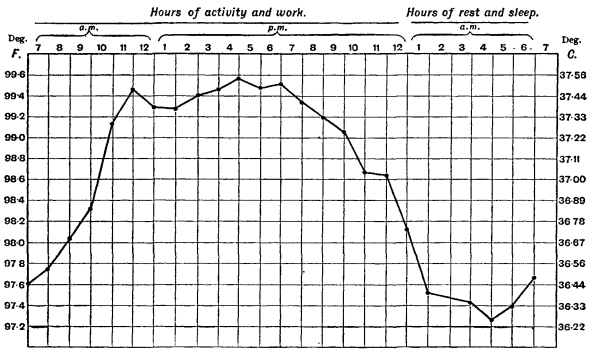
Chart showing diurnal variation in body temperature, ranging from about 37.5° C. from 10 A.M. to 6 P.M., and falling to about 36.3° C. from 2 A.M to 6 A.M.
Variations in the Temperature of Man and some other Animals.—As stated above, the temperature of warm-blooded animals is maintained with but slight variation. In health under normal conditions the temperature of man varies between 36° C. and 38° C., or if the thermometer be placed in the axilla, between 36.25° C. and 37.5° C. In the mouth the reading would be from .25° C. to 1.5° C. higher than this; and in the rectum some .9° C. higher still. The temperature of infants and young children has a much greater range than this, and is susceptible of wide divergencies from comparatively slight causes.
Of the lower warm-blooded animals, there are some that appear to be cold-blooded at birth. Kittens, rabbits and puppies, if removed from their surroundings shortly after birth, lose their body heat until their temperature has fallen to within a few degrees of that of the surrounding air. But such animals are at birth blind, helpless and in some cases naked. Animals who are born when in a condition of greater development can maintain their temperature fairly constant. In strong, healthy infants a day or two old the temperature rises slightly, but in that of weakly, ill-developed children it either remains stationary or falls. The cause of the variable temperature in infants and young immature animals is the imperfect development of the nervous regulating mechanism.
The average temperature falls slightly from infancy to puberty and again from puberty to middle age, but after that stage is passed the temperature begins to rise again, and by about the eightieth year is as high as in infancy. A diurnal variation has been observed dependent on the periods of rest and activity, the maximum ranging from 10 A.M. to 6 P.M., the minimum from 11 P.M. to 3 A.M. Sutherland Simpson and J. J. Galbraith have recently done much work on this subject. In their first experiments they showed that in a monkey there is a well-marked and regular diurnal variation of the body temperature, and that by reversing the daily routine this diurnal variation is also reversed. The diurnal temperature curve follows the periods of rest and activity, and is not dependent on the incidence of day and night; in monkeys which are active during the night and resting during the day, the body temperature is highest at night and lowest through the day. They then made observations on the temperature of animals and birds of nocturnal habit, where the periods of rest and activity are naturally the reverse of the ordinary through habit and not from outside interference. They found that in nocturnal birds the temperature is highest during the natural period of activity (night) and lowest during the period of rest (day), but that the mean temperature is lower and the range less than in diurnal birds of the same size. That the temperature curve of diurnal birds is essentially similar to that of man and other homoiothermal animals, except that the maximum occurs earlier in the afternoon and the minimum earlier in the morning. Also that the curves obtained from rabbit, guinea-pig and dog were quite similar to those from man. The mean temperature of the female was higher than that of the male in all the species examined whose sex had been determined.
Meals sometimes cause a slight elevation, sometimes a slight depression—alcohol seems always to produce a fall. Exercise and variations of external temperature within ordinary limits cause very slight change, as there are many compensating influences at work, which are discussed later. Even from very active exercise the temperature does not rise more than one degree, and if carried to exhaustion a fall is observed. In travelling from very cold to very hot regions a variation of less than one degree occurs, and the temperature of those living in the tropics is practically identical with those dwelling in the Arctic regions.
Limits compatible with Life.—There are limits both of heat and cold that a warm-blooded animal can bear, and other far wider limits that a cold-blooded animal may endure and yet live. The effect of too extreme a cold is to lessen metabolism, and hence to lessen the production of heat. Both katabolic and anabolic changes share in the depression, and though less energy is used up, still less energy is generated. This diminished metabolism tells first on the central nervous system, especially the brain and those parts concerned in consciousness. Both heart-beat and respiration-number become diminished, drowsiness supervenes, becoming steadily deeper until it passes into the sleep of death. Occasionally, however, convulsions may set in towards the end, and a death somewhat similar to that of asphyxia takes place. In some recent experiments on cats performed by Sutherland Simpson and Percy T. Herring, they found them unable to survive when the rectal temperature was reduced below 16° C. At this low temperature respiration became increasingly feeble, the heart-impulse usually continued after respiration had ceased, the beats becoming very irregular, apparently ceasing, then beginning again. Death appeared to be mainly due to asphyxia, and the only certain sign that it had taken place was the loss of knee jerks. On the other hand, too high a temperature hurries on the metabolism of the various tissues at such a rate that their capital is soon exhausted. Blood that is too warm produces dyspnoea and soon exhausts the metabolic capital of the respiratory centre. The rate of the heart is quickened, the beats then become irregular and finally cease. The central nervous system is also profoundly affected, consciousness may be lost, and the patient falls into a comatose condition, or delirium and convulsions may set in. All these changes can be watched in any patient suffering from an acute fever. The lower limit of temperature that man can endure depends on many things, but no one can survive a temperature of 45° C. (113° F.) or above for very long. Mammalian muscle becomes rigid with heat rigor at about 50° C., and obviously should this temperature be reached the sudden rigidity of the whole body would render life impossible. H. M. Vernon has recently done work on the death temperature and paralysis temperature (temperature of heat rigor) of various animals. He found that animals of the same class of the animal kingdom showed very similar temperature values, those from the Amphibia examined being 38.5° C., Fishes 39°, Reptilia 45°, and various Molluscs 46°. Also in the case of Pelagic animals he showed a relation between death temperature and the quantity of solid constituents of the body, Cestus having lowest death temperature and least amount of solids in its body. But in the higher animals his experiments tend to show that there is greater variation in both the chemical and physical characters of the protoplasm, and hence greater variation in the extreme temperature compatible with life.
Regulation of Temperature.—The heat of the body is generated by the chemical changes—those of oxidation—undergone not by any particular substance or in any one place, but by the tissues at large. Wherever destructive metabolism (katabolism) is going on, heat is being set free. When a muscle does work it also gives rise to heat, and if this is estimated it can be shown that the muscles alone during their contractions provide far more heat than the whole amount given out by the body. Also it must be remembered that the heart—also a muscle,—never resting, does in the 24 hours no inconsiderable amount of work, and hence must give rise to no inconsiderable amount of heat. From this it is clear that the larger proportion of total heat of the body is supplied by the muscles. These are essentially the "thermogenic tissues." Next to the muscles as heat generators come the various secretory glands, especially the liver, which appears never to rest in this respect. The brain also must be a source of heat, since its temperature is higher than that of the arterial blood with which it is supplied. Also a certain amount of heat is produced by the changes which the food undergoes in the alimentary canal before it really enters the body. But heat while continually being produced is also continually being lost by the skin, lungs, urine and faeces. And it is by the constant modification of these two factors, (1) heat production and (2) heat loss, that the constant temperature of a warm-blooded animal is maintained. Heat is lost to the body through the faeces and urine, respiration, conduction and radiation from the skin, and by evaporation of perspiration. The following are approximately the relative amounts of heat lost through these various channels (different authorities give somewhat different figures):—faeces and urine about 3, respiration about 20, skin (conduction, radiation and evaporation) about 77. Hence it is clear the chief means of loss are the skin and the lungs. The more air that passes in and out of the lungs in a given time, the greater the loss of heat. And in such animals as the dog, who do not perspire easily by the skin, respiration becomes far more important.
But for man the great heat regulator is undoubtedly the skin, which regulates heat loss by its vasomotor mechanism, and also by the nervous mechanism of perspiration. Dilatation of the cutaneous vascular areas leads to a larger flow of blood through the skin, and so tends to cool the body, and vice versa. Also the special nerves of perspiration can increase or lessen heat loss by promoting or diminishing the secretions of the skin. There are greater difficulties in the exact determination in the amount of heat produced, but there are certain well-known facts in connexion with it. A larger living body naturally produces more heat than a smaller one of the same nature, but the surface of the smaller, being greater in proportion to its bulk than that of the larger, loses heat at a more rapid rate. Hence to maintain the same constant bodily temperature, the smaller animal must produce a relatively larger amount of heat. And in the struggle for existence this has become so.
Food temporarily increases the production of heat, the rate of production steadily rising after a meal until a maximum is reached from about the 6th to the 9th hour. If sugar be included in the meal the maximum is reached earlier; if mainly fat, later. Muscular work very largely increases the production of heat, and hence the more active the body the greater the production of heat.
But all the arrangements in the animal economy for the production and loss of heat are themselves probably regulated by the central nervous system, there being a thermogenic centre—situated above the spinal cord, and according to some observers in the optic thalamus.
AUTHORITIES.—M. S. Pembrey, "Animal Heat," in Schafer's Textbook of Physiology (1898); C. R. Richet, "Chaleur," in Dictionnaire de physiologie (Paris, 1898); Hale White, Croonian Lectures, Lancet, London, 1897; Pembrey and Nicol, Journal of Physiology, vol. xxiii., 1898-1899; H. M. Vernon, "Heat Rigor," Journal of Physiology, xxiv., 1899; H. M. Vernon, "Death Temperatures," Journal of Physiology, xxv., 1899; F. C. Eve, "Temperature on Nerve Cells," Journal of Physiology, xxvi., 1900; G. Weiss, Comptes Rendus, Soc. de Biol., lii., 1900; Swale Vincent and Thomas Lewis, "Heat Rigor of Muscle," Journal of Physiology, 1901; Sutherland Simpson and Percy Herring, "Cold and Reflex Action," Journal of Physiology, 1905; Sutherland Simpson, Proceedings of Physiological Soc., July 19, 1902; Sutherland Simpson and J. J. Galbraith, "Diurnal Variation of Body Temperature," Journal of Physiology, 1905; Transactions Royal Society Edinburgh, 1905; Proc. Physiological Society, p. xx., 1903; A. E. Boycott and J. S. Haldane, Effects of High Temperatures on Man.
ANIMAL WORSHIP, an ill-defined term, covering facts ranging from the worship of the real divine animal, commonly conceived as a "god-body," at one end of the scale, to respect for the bones of a slain animal or even the use of a respectful name for the living animal at the other end. Added to this, in many works on the subject we find reliance placed, especially for the African facts, on reports of travellers who were merely visitors to the regions on which they wrote.
Classification.—Animal cults may be classified in two ways: (A) according to their outward form; (B) according to their inward meaning, which may of course undergo transformations.
(A) There are two broad divisions: (1) all animals of a given species are sacred, perhaps owing to the impossibility of distinguishing the sacred few from the profane crowd; (2) one or a fixed number of a species are sacred. It is probable that the first of these forms is the primary one and the second in most cases a development from it due to (i.) the influence of other individual cults, (ii.) anthropomorphic tendencies, (iii.) the influence of chieftainship, hereditary and otherwise, (iv.) annual sacrifice of the sacred animal and mystical ideas connected therewith, (v.) syncretism, due either to unity of function or to a philosophic unification, (vi.) the desire to do honour to the species in the person of one of its members, and possibly other less easily traceable causes.
(B) Treating cults according to their meaning, which is not necessarily identical with the cause which first led to the deification of the animal in question, we can classify them under ten specific heads: (i.) pastoral cults; (ii.) hunting cults; (iii.) cults of dangerous or noxious animals; (iv.) cults of animals regarded as human souls or their embodiment; (v.) totemistic cults; (vi.) cults of secret societies, and individual cults of tutelary animals; (vii.) cults of tree and vegetation spirits; (viii.) cults of ominous animals; (ix.) cults, probably derivative, of animals associated with certain deities; (x.) cults of animals used in magic.
(i.) The pastoral type falls into two sub-types, in which the species (a) is spared and (b) sometimes receives special honour at intervals in the person of an individual. (See Cattle, Buffalo, below.)
(ii.) In hunting cults the species is habitually killed, but (a) occasionally honoured in the person of a single individual, or (b) each slaughtered animal receives divine honours. (See Bear, below.)
(iii.) The cult of dangerous animals is due (a) to the fear that the soul of the slain beast may take vengeance on the hunter, (b) to a desire to placate the rest of the species. (See Leopard, below.)
(iv.) Animals are frequently regarded as the abode, temporary or permanent, of the souls of the dead, sometimes as the actual souls of the dead. Respect for them is due to two main reasons: (a) the kinsmen of the dead desire to preserve the goodwill of their dead relatives; (b) they wish at the same time to secure that their kinsmen are not molested and caused to undergo unnecessary suffering. (See Serpent, below.)
(v.) One of the most widely found modes of showing respect to animals is known as totemism (see TOTEM AND TOTEMISM), but except in decadent forms there is but little positive worship; in Central Australia, however, the rites of the Wollunqua totem group are directed towards placating this mythical animal, and cannot be termed anything but religious ceremonies.
(vi.) In secret societies we find bodies of men grouped together with a single tutelary animal; the individual, in the same way, acquires the nagual or individual totem, sometimes by ceremonies of the nature of the bloodbond.
(vii.) Spirits of vegetation in ancient and modern Europe and in China are conceived in animal form. (See Goat, below.)
(viii.) The ominous animal or bird may develop into a deity. (See Hawk, below.)
(ix.) It is commonly assumed that the animals associated with certain deities are sacred because the god was originally theriomorphic; this is doubtless the case in certain instances; but Apollo Smintheus, Dionysus Bassareus and other examples seem to show that the god may have been appealed to for help and thus become associated with the animals from whom he protected the crops, &c.
(x.) The use of animals in magic may sometimes give rise to a kind of respect for them, but this is of a negative nature. See, however, articles by Preuss in Globus, vol. lxvii., in which he maintains that animals of magical influence are elevated into divinities.
Animal Cults.
Bear.—The bear enjoys a large measure of respect from all savage races that come in contact with it, which shows itself in apologies and in festivals in its honour. The most important developments of the cult are in East Asia among the Siberian tribes; among the Ainu of Sakhalin a young bear is caught at the end of winter and fed for some nine months; then after receiving honours it is killed, and the people, who previously show marks of grief at its approaching fate, dance merrily and feast on its body. Among the Gilyaks a similar festival is found, but here it takes the form of a celebration in honour of a recently dead kinsman, to whom the spirit of the bear is sent. Whether this feature or a cult of the hunting type was the primary form, is so far an open question. There is a good deal of evidence to connect the Greek goddess Artemis with a cult of the bear; girls danced as "bears" in her honour, and might not marry before undergoing this ceremony. The bear is traditionally associated with Bern in Switzerland, and in 1832 a statue of Artio, a bear goddess, was dug up there.
Buffalo.—The Todas of S. India abstain from the flesh of their domestic animal, the buffalo; but once a year they sacrifice a bull calf, which is eaten in the forest by the adult males.
Cattle.—Cattle are respected by many pastoral peoples; they live on milk or game, and the killing of an ox is a sacrificial function. Conspicuous among Egyptian animal cults was that of the bull, Apis. It was distinguished by certain marks, and when the old Apis died a new one was sought; the finder was rewarded, and the bull underwent four months' education at Nilopolis. Its birthday was celebrated once a year; oxen, which had to be pure white, were sacrificed to it; women were forbidden to approach it when once its education was finished. Oracles were obtained from it in various ways. After death it was mummified and buried in a rock-tomb. Less widespread was the cult of the Mnevis, also consecrated to Osiris. Similar observances are found in our own day on the Upper Nile; the Nuba and Nuer worship the bull; the Angoni of Central Africa and the Sakalava of Madagascar keep sacred bulls. In India respect for the cow is widespread, but is of post-Vedic origin; there is little actual worship, but the products of the cow are important in magic.
Crow.—The crow is the chief deity of the Thlinkit Indians of N.W. America; and all over that region it is the chief figure in a group of myths, fulfilling the office of a culture hero who brings the light, gives fire to mankind, &c. Together with the eagle-hawk the crow plays a great part in the mythology of S.E. Australia.
Dog.—Actual dog-worship is uncommon; the Nosarii of western Asia are said to worship a dog; the Kalangs of Java had a cult of the red dog, each family keeping one in the house; according to one authority the dogs are images of wood which are worshipped after the death of a member of the family and burnt after a thousand days. In Nepal it is said that dogs are worshipped at the festival called Khicha Puja. Among the Harranians dogs were sacred, but this was rather as brothers of the mystae.
Elephant.—In Siam it is believed that a white elephant may contain the soul of a dead person, perhaps a Buddha; when one is taken the capturer is rewarded and the animal brought to the king to be kept ever afterwards; it cannot be bought or sold. It is baptized and fêted and mourned for like a human being at its death. In some parts of Indo-China the belief is that the soul of the elephant may injure people after death; it is therefore fêted by a whole village. In Cambodia it is held to bring luck to the kingdom. In Sumatra the elephant is regarded as a tutelary spirit. The cult of the white elephant is also found at Ennarea, southern Abyssinia.
Fish.—Dagon seems to have been a fish-god with human head and hands; his worshippers wore fish-skins. In the temples of Apollo and Aphrodite were sacred fish, which may point to a fish cult. Atargatis is said to have had sacred fish at Askelon, and from Xenophon we read that the fish of the Chalus were regarded as gods.
Goat.—Dionysus was believed to take the form of a goat, probably as a divinity of vegetation. Pan, Silenus, the Satyrs and the Fauns were either capriform or had some part of their bodies shaped like that of a goat. In northern Europe the wood spirit, Ljesche, is believed to have a goat's horns, ears and legs. In Africa the Bijagos are said to have a goat as their principal divinity.
Hare.—In North America the Algonquin tribes had as their chief deity a "mighty great hare" to whom they went at death. According to one account he lived in the east, according to another in the north. In his anthropomorphized form he was known as Menabosho or Michabo.
Hawk.—In North Borneo we seem to see the evolution of a god in the three stages of the cult of the hawk among the Kenyahs, the Kayans and the sea Dyaks. The Kenyahs will not kill it, address to it thanks for assistance, and formally consult it before leaving home on an expedition; it seems, however, to be regarded as the messenger of the supreme god Balli Penyalong. The Kayans have a hawk-god, Laki Neho, but seem to regard the hawk as the servant of the chief god, Laki Tenangan. Singalang Burong, the hawk-god of the Dyaks, is completely anthropomorphized. He is god of omens and ruler of the omen birds; but the hawk is not his messenger, for he never leaves his house; stories are, however, told of his attending feasts in human form and flying away in hawk form when all was over.
Horse.—There is some reason to believe that Poseidon, like other water gods, was originally conceived under the form of a horse. In the cave of Phigalia Demeter was, according to popular tradition, represented with the head and mane of a horse, possibly a relic of the time when a non-specialized corn-spirit bore this form. Her priests were called Poloi (colts) in Laconia. In Gaul we find a horse-goddess, Epona; there are also traces of a horse-god, Rudiobus. The Gonds in India worship a horse-god, Koda Pen, in the form of a shapeless stone; but it is not clear that the horse is regarded as divine. The horse or mare is a common form of the corn-spirit in Europe.
Leopard.—The cult of the leopard is widely found in West Africa. Among the Ewe a man who kills one is liable to be put to death; no leopard skin may be exposed to view, but a stuffed leopard is worshipped. On the Gold Coast a leopard hunter who has killed his victim is carried round the town behind the body of the leopard; he may not speak, must besmear himself so as to look like a leopard and imitate its movements. In Loango a prince's cap is put upon the head of a dead leopard, and dances are held in its honour.
Lion.—The lion was associated with the Egyptian gods Rē and Horus; there was a lion-god at Baalbek and a lion-headed goddess Sekhet. The Arabs had a lion-god, Yaghuth. In modern Africa we find a lion-idol among the Balonda.
Lizard.—The cult of the lizard is most prominent in the Pacific, where it appears as an incarnation of Tangaloa. In Easter Island a form of the house-god is the lizard; it is also a tutelary deity in Madagascar.
Mantis.—Cagn is a prominent figure in Bushman mythology; the mantis and the caterpillar, Ngo, are his incarnations. It was called the "Hottentots' god" by early settlers.
Monkey.—In India the monkey-god, Hanuman, is a prominent figure; in orthodox villages monkeys are safe from harm. Monkeys are said to be worshipped in Togo. At Porto Novo, in French West Africa, twins have tutelary spirits in the shape of small monkeys.
Serpent.—The cult of the serpent is found in many parts of the Old World; it is also not unknown in America; in Australia, on the other hand, though many species of serpent are found, there does not appear to be any species of cult unless we include the Warramunga cult of the mythical Wollunqua totem animal, whom they seek to placate by rites. In Africa the chief centre of serpent worship was Dahomey; but the cult of the python seems to have been of exotic origin, dating back to the first quarter of the 17th century. By the conquest of Whydah the Dahomeyans were brought in contact with a people of serpent worshippers, and ended by adopting from them the cult which they at first despised. At Whydah, the chief centre, there is a serpent temple, tenanted by some fifty snakes; every python of the danh-gbi kind must be treated with respect, and death is the penalty for killing one, even by accident. Danh-gbi has numerous wives, who until 1857 took part in a public procession from which the profane crowd was excluded; a python was carried round the town in a hammock, perhaps as a ceremony for the expulsion of evils. The rainbow-god of the Ewe was also conceived to have the form of a snake; his messenger was said to be a small variety of boa; but only certain individuals, not the whole species, were sacred. In many parts of Africa the serpent is looked upon as the incarnation of deceased relatives; among the Amazulu, as among the Betsileo of Madagascar, certain species are assigned as the abode of certain classes; the Masai, on the other hand, regard each species as the habitat of a particular family of the tribe.
In America some of the Amerindian tribes reverence the rattlesnake as grandfather and king of snakes who is able to give fair winds or cause tempest. Among the Hopi (Moqui) of Arizona the serpent figures largely in one of the dances. The rattlesnake was worshipped in the Natchez temple of the sun; and the Aztec deity Quetzalcoatl was a serpent-god. The tribes of Peru are said to have adored great snakes in the pre-Inca days; and in Chile the Araucanians made a serpent figure in their deluge myth.
Over a large part of India there are carved representations of cobras (Nāgas) or stones as substitutes; to these human food and flowers are offered and lights are burned before the shrines. Among the Dravidians a cobra which is accidentally killed is burned like a human being; no one would kill one intentionally; the serpent-god's image is carried in an annual procession by a celibate priestess.
Serpent cults were well known in ancient Europe; there does not, it is true, appear to be much ground for supposing that Aesculapius was a serpent-god in spite of his connexion with serpents. On the other hand, we learn from Herodotus of the great serpent which defended the citadel of Athens; the Roman genius loci took the form of a serpent; a snake was kept and fed with milk in the temple of Potrimpos, an old Slavonic god. To this day there are numerous traces in popular belief, especially in Germany, of respect for the snake, which seems to be a survival of ancestor worship, such as still exists among the Zulus and other savage tribes; the "house-snake," as it is called, cares for the cows and the children, and its appearance is an omen of death, and the life of a pair of house-snakes is often held to be bound up with that of the master and mistress themselves. Tradition says that one of the Gnostic sects known as the Ophites caused a tame serpent to coil round the sacramental bread and worshipped it as the representative of the Saviour. See also SERPENT-WORSHIP.
Sheep.—Only in Africa do we find a sheep-god proper; Ammon was the god of Thebes; he was represented as ram-headed; his worshippers held the ram to be sacred; it was, however, sacrificed once a year, and its fleece formed the clothing of the idol.
Tiger.—The tiger is associated with Siva and Durga, but its cult is confined to the wilder tribes; in Nepal the tiger festival is known as Bagh Jatra, and the worshippers dance disguised as tigers. The Waralis worship Waghia the lord of tigers in the form of a shapeless stone. In Hanoi and Manchuria tiger-gods are also found.
Wolf.—Both Zeus and Apollo were associated with the wolf by the Greeks; but it is not clear that this implies a previous cult of the wolf. It is frequently found among the tutelary deities of North American dancing or secret societies. The Thlinkits had a god, Khanukh, whose name means "wolf," and worshipped a wolf-headed image.
AUTHORITIES.—For a fuller discussion and full references to these and other cults, that of the serpent excepted, see N. W. Thomas in Hastings' Dictionary of Religions; Frazer, Golden Bough; Campbell's Spirit Basis of Belief and Custom; Maclennan's Studies (series 2); V. Gennep, Tabou et totémisme à Madagascar. For the serpent, see Ellis, Ewe-speaking Peoples, p. 54; Internat. Archiv, xvii. 113; Tylor, Primitive Culture, ii. 239; Fergusson, Tree and Serpent Worship; Mähly,Die Schlange im Mythus; Staniland Wake, Serpent Worship, &c.; 16th Annual Report of the American Bureau of Ethnology, p. 273, and bibliography, p. 312. For the bull, &c., in Egypt, see EGYPT: Religion.
(N. W. T.)
ANIMÉ, an oleo-resin (said to be so called because in its natural state it is infested with insects) which is exuded from the locust tree, Hymenaea coumaril, and other species of Hymenaea growing in tropical South America. It is of a pale brown colour, transparent, brittle, and in consequence of its agreeable odour is used for fumigation and in perfumery. Its specific gravity varies from 1.054 to 1.057. It melts readily over the fire, and softens even with the heat of the mouth; it is insoluble in water, and nearly so in cold alcohol. It is allied to copal in its nature and appearance, and is much used by varnish-makers. The name is also given to Zanzibar copal (q.v.).
ANIMISM (from animus, or anima, mind or soul), according to the definition of Dr. E. B. Tylor, the doctrine of spiritual beings, including human souls; in practice, however, the term is often extended to include panthelism or animatism, the doctrine that a great part, if not the whole, of the inanimate kingdom, as well as all animated beings, are endowed with reason, intelligence and volition, identical with that of man. This latter theory, which in many cases is equivalent to personification, though it may be, like animism, a feature of the philosophy of peoples of low culture, should not be confused with it. But it is difficult in practice to distinguish the two phases of thought and no clear account of animatism can yet be given, largely on the ground that no people has yet been discovered which has not already developed to a greater or less extent an animistic philosophy. On theoretical grounds it is probable that animatism preceded animism; but savage thought is no more consistent than that of civilized man; and it may well be that animistic and panthelistic doctrines are held simultaneously by the same person. In like manner one portion of the savage explanation of nature may have been originally animistic, another part animatistic.
Origin.—Animism may have arisen out of or simultaneously with animatism as a primitive explanation of many different phenomena; if animatism was originally applied to non-human or inanimate objects, animism may from the outset have been in vogue as a theory of the nature of man. Lists of phenomena from the contemplation of which the savage was led to believe in animism have been given by Dr. Tylor, Herbert Spencer, Mr. Andrew Lang and others; an animated controversy arose between the former as to the priority of their respective lists. Among these phenomena are: trance (q.v.) and unconsciousness, sickness, death, clairvoyance (q.v.), dreams (q.v.), apparitions (q.v.) of the dead, wraiths, hallucinations (q.v.), echoes, shadows and reflections.
Primitive ideas on the subject of the soul, and at the same time the origin of them, are best illustrated by an analysis of the terms applied to it. Readers of Dante know the idea that the dead have no shadows; this was no invention of the poet's but a piece of traditionary lore; at the present day among the Basutos it is held that a man walking by the brink of a river may lose his life if his shadow falls on the water, for a crocodile may seize it and draw him in; in Tasmania, North and South America and classical Europe is found the conception that the soul—σκιά, umbra—is somehow identical with the shadow of a man. More familiar to the Anglo-Saxon race is the connexion between the soul and the breath; this identification is found both in Aryan and Semitic languages; in Latin we have spiritus, in Greek pneuma, in Hebrew ruach; and the idea is found extending downwards to the lowest planes of culture in Australia, America and Asia. For some of the Red Indians the Roman custom of receiving the breath of a dying man was no mere pious duty but a means of ensuring that his soul was transferred to a new body. Other familiar conceptions identify the soul with the liver (see OMEN) or the heart, with the reflected figure seen in the pupil of the eye, and with the blood. Although the soul is often distinguished from the vital principle, there are many cases in which a state of unconsciousness is explained as due to the absence of the soul; in South Australia wilyamarraba (without soul) is the word used for insensible. So too the autohypnotic trance of the magician or shaman is regarded as due to his visit to distant regions or the nether world, of which he brings back an account. Telepathy or clairvoyance (q.v.), with or without trance, must have operated powerfully to produce a conviction of the dual nature of man, for it seems probable that facts unknown to the automatist are sometimes discovered by means of crystal-gazing (q.v.), which is widely found among savages, as among civilized peoples. Sickness is often explained as due to the absence of the soul; and means are sometimes taken to lure back the wandering soul; when a Chinese is at the point of death and his soul is supposed to have already left his body, the patient's coat is held up on a long bamboo while a priest endeavours to bring the departed spirit back into the coat by means of incantations. If the bamboo begins to turn round in the hands of the relative who is deputed to hold it, it is regarded as a sign that the soul of the moribund has returned (see AUTOMATISM). More important perhaps than all these phenomena, because more regular and normal, was the daily period of sleep with its frequent concomitant of fitful and incoherent ideas and images. The mere immobility of the body was sufficient to show that its state was not identical with that of waking; when, in addition, the sleeper awoke to give an account of visits to distant lands, from which, as modern psychical investigations suggest, he may even have brought back veridical details, the conclusion must have been irresistible that in sleep something journeyed forth, which was not the body. In a minor degree revival of memory during sleep and similar phenomena of the sub-conscious life may have contributed to the same result. Dreams are sometimes explained by savages as journeys performed by the sleeper, sometimes as visits paid by other persons, by animals or objects to him; hallucinations, possibly more frequent in the lower stages of culture, must have contributed to fortify this interpretation, and the animistic theory in general. Seeing the phantasmic figures of friends at the moment when they were, whether at the point of death or in good health, many miles distant, must have led the savage irresistibly to the dualistic theory. But hallucinatory figures, both in dreams and waking life, are not necessarily those of the living; from the reappearance of dead friends or enemies primitive man was inevitably led to the belief that there existed an incorporeal part of man which survived the dissolution of the body. The soul was conceived to be a facsimile of the body, sometimes no less material, sometimes more subtle but yet material, sometimes altogether impalpable and intangible.
Animism and Eschatology.—The psychological side of animism has already been dealt with; almost equally important in primitive creeds is the eschatological aspect. In many parts of the world it is held that the human body is the seat of more than one soul; in the island of Nias four are distinguished, the shadow and the intelligence, which die with the body, a tutelary spirit, termed begoe, and a second which is carried on the head. Similar ideas are found among the Euahlayi of S.E. Australia, the Dakotas and many other tribes. Just as in Europe the ghost of a dead person is held to haunt the churchyard or the place of death, although more orthodox ideas may be held and enunciated by the same person as to the nature of a future life, so the savage, more consistently, assigns different abodes to the multiple souls with which he credits man. Of the four souls of a Dakota, one is held to stay with the corpse, another in the village, a third goes into the air, while the fourth goes to the land of souls, where its lot may depend on its rank in this life, its sex, mode of death or sepulture, on the due observance of funeral ritual, or many other points (see ESCHATOLOGY). From the belief in the survival of the dead arose the practice of offering food, lighting fires, &c., at the grave, at first, maybe, as an act of friendship or filial piety, later as an act of worship (see ANCESTOR WORSHIP). The simple offering of food or shedding of blood at the grave develops into an elaborate system of sacrifice; even where ancestor-worship is not found, the desire to provide the dead with comforts in the future life may lead to the sacrifice of wives, slaves, animals, &c., to the breaking or burning of objects at the grave or to the provision of the ferryman's toll, a coin put in the mouth of the corpse to pay the travelling expenses of the soul. But all is not finished with the passage of the soul to the land of the dead; the soul may return to avenge its death by helping to discover the murderer, or to wreak vengeance for itself; there is a widespread belief that those who die a violent death become malignant spirits and endanger the lives of those who come near the haunted spot; the woman who dies in child-birth becomes a pontianak, and threatens the life of human beings; and man resorts to magical or religious means of repelling his spiritual dangers.
Development of Animism.—If the phenomena of dreams were, as suggested above, of great importance for the development of animism, the belief, which must originally have been a doctrine of human psychology, cannot have failed to expand speedily into a general philosophy of nature. Not only human beings but animals and objects are seen in dreams; and the conclusion would be that they too have souls; the same conclusion may have been reached by another line of argument; primitive psychology posited a spirit in a man to account, amongst other things, for his actions; a natural explanation of the changes in the external world would be that they are due to the operations and volitions of spirits.
Animal Souls.—But apart from considerations of this sort, it is probable that animals must, early in the history of animistic beliefs, have been regarded as possessing souls. Education has brought with it a sense of the great gulf between man and animals; but in the lower stages of culture this distinction is not adequately recognized, if indeed it is recognized at all. The savage attributes to animals the same ideas, the same mental processes as himself, and at the same time vastly greater power and cunning. The dead animal is credited with a knowledge of how its remains are treated and sometimes with a power of taking vengeance on the fortunate hunter. Powers of reasoning are not denied to animals nor even speech; the silence of the brute creation may be put down to their superior cunning. We may assume that man attributed a soul to the beasts of the field almost as soon as he claimed one for himself. It is therefore not surprising to find that many peoples on the lower planes of culture respect and even worship animals (see TOTEM; ANIMAL WORSHIP); though we need not attribute an animistic origin to all the developments, it is clear that the widespread respect paid to animals as the abode of dead ancestors, and much of the cult of dangerous animals, is traceable to this principle. With the rise of species, deities and the cult of individual animals, the path towards anthropomorphization and polytheism is opened and the respect paid to animals tends to lose its strict animistic character.
Plant Souls.—Just as human souls are assigned to animals, so primitive man often credits trees and plants with souls in both human or animal form. All over the world agricultural peoples practise elaborate ceremonies explicable, as Mannhardt has shown, on animistic principles. In Europe the corn spirit sometimes immanent in the crop, sometimes a presiding deity whose life does not depend on that of the growing corn, is conceived in some districts in the form of an ox, hare or cock, in others as an old man or woman; in the East Indies and America the rice or maize mother is a corresponding figure; in classical Europe and the East we have in Ceres and Demeter, Adonis and Dionysus, and other deities, vegetation gods whose origin we can readily trace back to the rustic corn spirit. Forest trees, no less than cereals, have their indwelling spirits; the fauns and satyrs of classical literature were goat-footed and the tree spirit of the Russian peasantry takes the form of a goat; in Bengal and the East Indies wood-cutters endeavour to propitiate the spirit of the tree which they cut down; and in many parts of the world trees are regarded as the abode of the spirits of the dead. Just as a process of syncretism has given rise to cults of animal gods, tree spirits tend to become detached from the trees, which are thenceforward only their abodes; and here again animism has begun to pass into polytheism.
Object Souls.—We distinguish between animate and inanimate nature, but this classification has no meaning for the savage. The river speeding on its course to the sea, the sun and moon, if not the stars also, on their never-ceasing daily round, the lightning, fire, the wind, the sea, all are in motion and therefore animate; but the savage does not stop short here; mountains and lakes, stones and manufactured articles, are for him alike endowed with souls like his own; he deposits in the tomb weapons and food, clothes and implements, broken, it may be, in order to set free their souls; or he attains the same result by burning them, and thus sending them to the Other World for the use of the dead man. Here again, though to a less extent than in tree cults, the theriomorphic aspect recurs; in the north of Europe, in ancient Greece, in China, the water or river spirit is horse or bull-shaped; the water monster in serpent shape is even more widely found, but it is less strictly the spirit of the water. The spirit of syncretism manifests itself in this department of animism too; the immanent spirit of the earlier period becomes the presiding genius or local god of later times, and with the rise of the doctrine of separable souls we again reach the confines of animism pure and simple.
Spirits in General.—Side by side with the doctrine of separable souls with which we have so far been concerned, exists the belief in a great host of unattached spirits; these are not immanent souls which have become detached from their abodes, but have every appearance of independent spirits. Thus, animism is in some directions little developed, so far as we can see, among the Australian aborigines; but from those who know them best we learn that they believe in innumerable spirits and bush bogies, which wander, especially at night, and can be held at bay by means of fire; with this belief may be compared the ascription in European folk belief of prophylactic properties to iron. These spirits are at first mainly malevolent; and side by side with them we find the spirits of the dead as hostile beings. At a higher stage the spirits of dead kinsmen are no longer unfriendly, nor yet all non-human spirits; as fetishes (see FETISHISM), naguals (see TOTEM), familiars, gods or demi-gods (for which and the general question see DEMONOLOGY), they enter into relations with man. On the other hand there still subsists a belief in innumerable evil spirits, which manifest themselves in the phenomena of possession (q.v.), lycanthropy (q.v.), disease, &c. The fear of evil spirits has given rise to ceremonies of expulsion of evils (see EXORCISM), designed to banish them from the community.
Animism and Religion.—Animism is commonly described as the most primitive form of religion; but properly speaking it is not a religion at all, for religion implies, at any rate, some form of emotion (see RELIGION), and animism is in the first instance an explanation of phenomena rather than an attitude of mind toward the cause of them, a philosophy rather than a religion. The term may, however, be conveniently used to describe the early stage of religion in which man endeavours to set up relations between himself and the unseen powers, conceived as spirits, but differing in many particulars from the gods of polytheism. As an example of this stage in one of its aspects may be taken the European belief in the corn spirit, which is, however, the object of magical rather than religious rites; Dr. Frazer has thus defined the character of the animistic pantheon, "they are restricted in their operations to definite departments of nature; their names are general, not proper; their attributes are generic rather than individual; in other words, there is an indefinite number of spirits of each class, and the individuals of a class are much alike; they have no definitely marked individuality; no accepted traditions are current as to their origin, life and character." This stage of religion is well illustrated by the Red Indian custom of offering sacrifice to certain rocks, or whirlpools, or to the indwelling spirits connected with them; the rite is only performed in the neighbourhood of the object, it is an incident of a canoe or other voyage, and is not intended to secure any benefits beyond a safe passage past the object in question; the spirit to be propitiated has a purely local sphere of influence, and powers of a very limited nature. Animistic in many of their features too are the temporary gods of fetishism (q.v.), naguals or familiars, genii and even the dead who receive a cult. With the rise of a belief in departmental gods comes the age of polytheism; the belief in elemental spirits may still persist, but they fall into the background and receive no cult.
Animism and the Origin of Religion.—Two animistic theories of the origin of religion have been put forward, the one, often termed the "ghost theory," mainly associated with the name of Herbert Spencer, but also maintained by Grant Allen, refers the beginning of religion to the cult of dead human beings; the other, put forward by Dr. E. B. Tylor, makes the foundation of all religion animistic, but recognizes the non-human character of polytheistic gods. Although ancestor-worship, or, more broadly, the cult of the dead, has in many cases overshadowed other cults or even extinguished them, we have no warrant, even in these cases, for asserting its priority, but rather the reverse; not only so, but in the majority of cases the pantheon is made up by a multitude of spirits in human, sometimes in animal form, which bear no signs of ever having been incarnate; sun gods and moon goddesses, gods of fire, wind and water, gods of the sea, and above all gods of the sky, show no signs of having been ghost gods at any period in their history. They may, it is true, be associated with ghost gods, but in Australia it cannot even be asserted that the gods are spirits at all, much less that they are the spirits of dead men; they are simply magnified magicians, super-men who have never died; we have no ground, therefore, for regarding the cult of the dead as the origin of religion in this area; this conclusion is the more probable, as ancestor-worship and the cult of the dead generally cannot be said to exist in Australia.
The more general view that polytheistic and other gods are the elemental and other spirits of the later stages of animistic creeds, is equally inapplicable to Australia, where the belief seems to be neither animistic nor even animatistic in character. But we are hardly justified in arguing from the case of Australia to a general conclusion as to the origin of religious ideas in all other parts of the world. It is perhaps safest to say that the science of religions has no data on which to go, in formulating conclusions as to the original form of the objects of religious emotion; in this connexion it must be remembered that not only is it very difficult to get precise information of the subject of the religious ideas of people of low culture, perhaps for the simple reason that the ideas themselves are far from precise, but also that, as has been pointed out above, the conception of spiritual often approximates very closely to that of material. Where the soul is regarded as no more than a finer sort of matter, it will obviously be far from easy to decide whether the gods are spiritual or material. Even, therefore, if we can say that at the present day the gods are entirely spiritual, it is clearly possible to maintain that they have been spiritualized pari passu with the increasing importance of the animistic view of nature and of the greater prominence of eschatological beliefs. The animistic origin of religion is therefore not proven.
Animism and Mythology.—But little need be said on the relation of animism and mythology (q.v.). While a large part of mythology has an animistic basis, it is possible to believe, e.g. in a sky world, peopled by corporeal beings, as well as by spirits of the dead; the latter may even be entirely absent; the mythology of the Australians relates largely to corporeal, non-spiritual beings; stories of transformation, deluge and doom myths, or myths of the origin of death, have not necessarily any animistic basis. At the same time, with the rise of ideas as to a future life and spiritual beings, this field of mythology is immensely widened, though it cannot be said that a rich mythology is necessarily genetically associated with or combined with belief in many spiritual beings.
Animism in Philosophy.—The term "animism" has been applied to many different philosophical systems. It is used to describe Aristotle's view of the relation of soul and body held also by the Stoics and Scholastics. On the other hand monadology (Leibnitz) has also been termed animistic. The name is most commonly applied to vitalism, a view mainly associated with G. E. Stahl and revived by F. Bouillier (1813-1899), which makes life, or life and mind, the directive principle in evolution and growth, holding that all cannot be traced back to chemical and mechanical processes, but that there is a directive force which guides energy without altering its amount. An entirely different class of ideas, also termed animistic, is the belief in the world soul, held by Plato, Schelling and others.
BIBLIOGRAPHY.—Tyler, Primitive Culture; Frazer, Golden Bough; Id. on Burial Customs in J. A. I. xv.; Mannhardt, Baumkultus; G. A. Wilken, Het Animisme; Koch on the animism of S. America in Internationales Archiv, xiii., Suppl.; Andrew Lang, Making of Religion; Skeat, Malay Magic; Sir G. Campbell, "Spirit Basis of Belief and Custom," in Indian Antiquary, xxiii. and succeeding volumes; Folklore, iii. 289. xi. 162; Spencer, Principles of Sociology; Mind (1877), 141, 415 et seq. For animism in philosophy, Stahl, Theoria; Bouillier, Du Principe vital.
(N. W. T.)
ANIMUCCIA, GIOVANNI, Italian musical composer, was born at Florence in the last years of the 15th century. At the request of St. Filippo Neri he composed a number of Laudi, or hymns of praise, to be sung after sermon time, which have given him an accidental prominence in musical history, since their performance in St. Filippo's Oratory eventually gave rise (on the disruption of 16th century schools of composition) to those early forms of "oratorio" that are not traceable to the Gregorian-polyphonic "Passions." St. Filippo admired Animuccia so warmly that he declared he had seen the soul of his friend fly upwards towards heaven. In 1555 Animuccia was appointed maestro di capella at St. Peter's, an office which he held until his death in 1571. He was succeeded by Palestrina, who had been his friend and probably his pupil. The manuscript of many of Animuccia's compositions is still preserved in the Vatican Library. His chief published works were Madrigali e Motetti a quattro e cinque voci (Ven. 1548) and Il primo Libra di Messe (Rom. 1567). From the latter Padre Martini has taken two specimens for his Saggio di Contrapunto. A mass from the Primo Libra di Messe on the canto fermo of the hymn Conditor alme siderum is published in modern notation in the Anthologie des maîtres religieux primitifs of the Chanteurs de Saint Gervais. It is solemn and noble in conception, and would be a great work but for a roughness which is more careless than archaic.