Front matter (continued 2)
Reading edition
Stark laughed. He roared with it.
"It's not enough that I'm a slave to the Lhari. Now I must be executioner and herd bull as well!" He looked at her keenly. "Why me, Varra? Why pick on me?"
"Because, as I have said, you are the first man I have seen since my father died. Also, there is something about you...."
She pushed herself upward to hover lazily, her lips just brushing his.
"Do you think it would be so bad a thing to live with me, wild man?"
She was lovely and maddening, a silver witch shining among the dim fires of the sea, full of wickedness and laughter. Stark reached out and drew her to him.
"Not bad," he murmured. "Dangerous."
He kissed her, and she whispered, "I think you're not afraid of danger."
"On the contrary, I'm a cautious man." He held her off, where he could look straight into her eyes. "I owe Egil something on my own, but I will not murder. The fight must be fair, and Cond will have to take care of himself."
"Fair! Was Egil fair with you—or me?"
He shrugged. "My way, or not at all."
She thought it over a while, then nodded. "All right. As for Cond, you will give him a blood debt, and pride will make him fight. The Lhari are all proud," she added bitterly. "That's our curse. But it's bred in the bone, as you'll find out."
"One more thing. Zareth and Helvi are to go free, and there must be an end to this slavery."
She stared at him. "You drive a hard bargain, wild man!"
"Yes or no?"
"Yes and no. Zareth and Helvi you may have, if you insist, though the gods know what you see in that pallid child. As to the other...." She smiled very mockingly. "I'm no fool, Stark. You're evading me, and two can play that game."
He laughed. "Fair enough. And now tell me this, witch with the silver curls—how am I to get at Egil that I may kill him?"
"I'll arrange that."
She said it with such vicious assurance that he was pretty sure she would arrange it. He was silent for a moment, and then he asked,
"Varra—what are the Lhari searching for at the bottom of the sea?"
She answered slowly, "I told you that we are a proud clan. We were driven out of the High Plateaus centuries ago because of our pride. Now it's all we have left, but it's a driving thing."
She paused, and then went on. "I think we had known about the city for a long time, but it had never meant anything until my father became fascinated by it. He would stay down here days at a time, exploring, and it was he who found the weapons and the machine of power which is on the island. Then he found the chart and the metal book, hidden away in a secret place. The book was written in pictographs—as though it was meant to be deciphered—and the chart showed the square with the ruined building and the temples, with a separate diagram of catacombs underneath the ground.
"The book told of a secret—a thing of wonder and of fear. And my father believed that the building had been wrecked to close the entrance to the catacombs where the secret was kept. He determined to find it."
Sixteen years of other men's lives. Stark shivered. "What was the secret, Varra?"
"The manner of controlling life. How it was done I do not know, but with it one might build a race of giants, of monsters, or of gods. You can see what that would mean to us, a proud and dying clan."
"Yes," Stark answered slowly. "I can see."
The magnitude of the idea shook him. The builders of the city must have been wise indeed in their scientific research to evolve such a terrible power. To mold the living cells of the body to one's will—to create, not life itself but its form and fashion....
A race of giants, or of gods. The Lhari would like that. To transform their own degenerate flesh into something beyond the race of men, to develop their followers into a corps of fighting men that no one could stand against, to see that their children were given an unholy advantage over all the children of men.... Stark was appalled at the realization of the evil they could do if they ever found that secret.
Varra said, "There was a warning in the book. The meaning of it was not quite clear, but it seemed that the ancient ones felt that they had sinned against the gods and been punished, perhaps by some plague. They were a strange race, and not human. At any rate, they destroyed the great building there as a barrier against anyone who should come after them, and then let the Red Sea in to cover their city forever. They must have been superstitious children, for all their knowledge."
"Then you all ignored the warning, and never worried that a whole city had died to prove it."
She shrugged. "Oh, Treon has been muttering prophecies about it for years. Nobody listens to him. As for myself, I don't care whether we find the secret or not. My belief is it was destroyed along with the building, and besides, I have no faith in such things."
"Besides," mocked Stark shrewdly, "you wouldn't care to see Egil and Cond striding across the heavens of Venus, and you're doubtful just what your own place would be in the new pantheon."
She showed her teeth at him. "You're too wise for your own good. And now good bye." She gave him a quick, hard kiss and was gone, flashing upward, high above the tree-tops where he dared not follow.
Stark made his way slowly back to the city, upset and very thoughtful.
As he came back into the great square, heading toward the barracks, he stopped, every nerve taut.
Somewhere, in one of the shadowy temples, the clapper of a votive bell was swinging, sending its deep pulsing note across the silence. Slowly, slowly, like the beating of a dying heart it came, and mingled with it was the faint sound of Zareth's voice, calling his name.
IX
He crossed the square, moving very carefully through the red murk, and presently he saw her.
It was not hard to find her. There was one temple larger than all the rest. Stark judged that it must once have faced the entrance of the fallen building, as though the great figure within was set to watch over the scientists and the philosophers who came there to dream their vast and sometimes terrible dreams.
The philosophers were gone, and the scientists had destroyed themselves. But the image still watched over the drowned city, its hand raised both in warning and in benediction.
Now, across its reptilian knees, Zareth lay. The temple was open on all sides, and Stark could see her clearly, a little white scrap of humanity against the black unhuman figure.
Malthor stood beside her. It was he who had been tolling the votive bell. He had stopped now, and Zareth's words came clearly to Stark.
"Go away, go away! They're waiting for you. Don't come in here!"
"I'm waiting for you, Stark," Malthor called out, smiling. "Are you afraid to come?" And he took Zareth by the hair and struck her, slowly and deliberately, twice across the face.
All expression left Stark's face, leaving it perfectly blank except for his eyes, which took on a sudden lambent gleam. He began to move toward the temple, not hurrying even then, but moving in such a way that it seemed an army could not have stopped him.
Zareth broke free from her father. Perhaps she was intended to break free.
"Egil!" she screamed. "It's a trap...."
Again Malthor caught her and this time he struck her harder, so that she crumpled down again across the image that watched with its jewelled, gentle eyes and saw nothing.
"She's afraid for you," said Malthor. "She knows I mean to kill you if I can. Well, perhaps Egil is here also. Perhaps he is not. But certainly Zareth is here. I have beaten her well, and I shall beat her again, as long as she lives to be beaten, for her treachery to me. And if you want to save her from that, you outland dog, you'll have to kill me. Are you afraid?"
Stark was afraid. Malthor and Zareth were alone in the temple. The pillared colonnades were empty except for the dim fires of the sea. Yet Stark was afraid, for an instinct older than speech warned him to be.
It did not matter. Zareth's white skin was mottled with dark bruises, and Malthor was smiling at him, and it did not matter.
Under the shadow of the roof and down the colonnade he went, swiftly now, leaving a streak of fire behind him. Malthor looked into his eyes, and his smile trembled and was gone.
He crouched. And at the last moment, when the dark body plunged down at him as a shark plunges, he drew a hidden knife from his girdle and struck.
Stark had not counted on that. The slaves were searched for possible weapons every day, and even a sliver of stone was forbidden. Somebody must have given it to him, someone....
The thought flashed through his mind while he was in the very act of trying to avoid that death blow. Too late, too late, because his own momentum carried him onto the point....
Reflexes quicker than any man's, the hair-trigger reactions of a wild thing. Muscles straining, the centre of balance shifted with an awful wrenching effort, hands grasping at the fire-shot redness as though to force it to defy its own laws. The blade ripped a long shallow gash across his breast. But it did not go home. By a fraction of an inch, it did not go home.
While Stark was still off balance, Malthor sprang.
They grappled. The knife blade glittered redly, a hungry tongue eager to taste Stark's life. The two men rolled over and over, drifting and tumbling erratically, churning the sea to a froth of sparks, and still the image watched, its calm reptilian features unchangingly benign and wise. Threads of a darker red laced heavily across the dancing fires.
Stark got Malthor's arm under his own and held it there with both hands. His back was to the man now. Malthor kicked and clawed with his feet against the backs of Stark's thighs, and his left arm came up and tried to clamp around Stark's throat. Stark buried his chin so that it could not, and then Malthor's hand began to tear at Stark's face, searching for his eyes.
Stark voiced a deep bestial sound in his throat. He moved his head suddenly, catching Malthor's hand between his jaws. He did not let go. Presently his teeth were locked against the thumb-joint, and Malthor was screaming, but Stark could give all his attention to what he was doing with the arm that held the knife. His eyes had changed. They were all beast now, the eyes of a killer blazing cold and beautiful in his dark face.
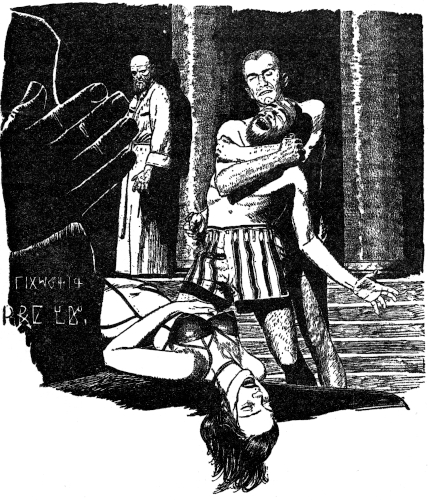
Stark voiced a deep bestial sound in his throat.
There was a dull crack, and the arm ceased to strain or fight. It bent back upon itself, and the knife fell, drifting quietly down. Malthor was beyond screaming now. He made one effort to get away as Stark released him, but it was a futile gesture, and he made no sound as Stark broke his neck.
He thrust the body from him. It drifted away, moving lazily with the suck of the currents through the colonnade, now and again touching a black pillar as though in casual wonder, wandering out at last into the square. Malthor was in no hurry. He had all eternity before him.
Stark moved carefully away from the girl, who was trying feebly now to sit up on the knees of the image. He called out, to some unseen presence hidden in the shadows under the roof,
"Malthor screamed your name, Egil. Why didn't you come?"
There was a flicker of movement in the intense darkness of the ledge at the top of the pillars.
"Why should I?" asked the Lord Egil of the Lhari. "I offered him his freedom if he could kill you, but it seems he could not—even though I gave him a knife, and drugs to keep your friend Helvi out of the way."
He came out where Stark could see him, very handsome in a tunic of yellow silk, the blunt black weapon in his hands.
"The important thing was to bait a trap. You would not face me because of this—" He raised the weapon. "I might have killed you as you worked, of course, but my family would have had hard things to say about that. You're a phenomenally good slave."
"They'd have said hard words like 'coward', Egil," Stark said softly. "And Varra would have set her bird at you in earnest."
Egil nodded. His lip curved cruelly. "Exactly. That amused you, didn't it? And now my little cousin is training another falcon to swoop at me. She hooded you today, didn't she, Outlander?"
He laughed. "Ah well. I didn't kill you openly because there's a better way. Do you think I want it gossiped all over the Red Sea that my cousin jilted me for a foreign slave? Do you think I wish it known that I hated you, and why? No. I would have killed Malthor anyway, if you hadn't done it, because he knew. And when I have killed you and the girl I shall take your bodies to the barrier and leave them there together, and it will be obvious to everyone, even Varra, that you were killed trying to escape."
The weapon's muzzle pointed straight at Stark, and Egil's finger quivered on the trigger stud. Full power, this time. Instead of paralysis, death. Stark measured the distance between himself and Egil. He would be dead before he struck, but the impetus of his leap might carry him on, and give Zareth a chance to escape. The muscles of his thighs stirred and tensed.
A voice said, "And it will be obvious how and why I died, Egil? For if you kill them, you must kill me too."
Where Treon had come from, or when, Stark did not know. But he was there by the image, and his voice was full of a strong music, and his eyes shone with a fey light.
Egil had started, and now he swore in fury. "You idiot! You twisted freak! How did you come here?"
"How does the wind come, and the rain? I am not as other men." He laughed, a sombre sound with no mirth in it. "I am here, Egil, and that's all that matters. And you will not slay this stranger who is more beast than man, and more man than any of us. The gods have a use for him."
He had moved as he spoke, until now he stood between Stark and Egil.
"Get out of the way," said Egil.
Treon shook his head.
"Very well," said Egil. "If you wish to die, you may."
The fey gleam brightened in Treon's eyes. "This is a day of death," he said softly, "but not of his, or mine."
Egil said a short, ugly word, and raised the weapon up.
Things happened very quickly after that. Stark sprang, arching up and over Treon's head, cleaving the red gasses like a burning arrow. Egil started back, and shifted his aim upward, and his finger snapped down on the trigger stud.
Something white came between Stark and Egil, and took the force of the bolt.
Something white. A girl's body, crowned with streaming hair, and a collar of metal glowing bright around the slender neck.
Zareth.
They had forgotten her, the beaten child crouched on the knees of the image. Stark had moved to keep her out of danger, and she was no threat to the mighty Egil, and Treon's thoughts were known only to himself and the winds that taught him. Unnoticed, she had crept to a place where one last plunge would place her between Stark and death.
The rush of Stark's going took him on over her, except that her hair brushed softly against his skin. Then he was on top of Egil, and it had all been done so swiftly that the Lord of the Lhari had not had time to loose another bolt.
Stark tore the weapon from Egil's hand. He was cold, icy cold, and there was a strange blindness on him, so that he could see nothing clearly but Egil's face. And it was Stark who screamed this time, a dreadful sound like the cry of a great cat gone beyond reason or fear.
Treon stood watching. He watched the blood stream darkly into the sea, and he listened to the silence come, and he saw the thing that had been his cousin drift away on the slow tide, and it was as though he had seen it all before and was not surprised.
Stark went to Zareth's body. The girl was still breathing, very faintly, and her eyes turned to Stark, and she smiled.
Stark was blind now with tears. All his rage had run out of him with Egil's blood, leaving nothing but an aching pity and a sadness, and a wondering awe. He took Zareth very tenderly into his arms and held her, dumbly, watching the tears fall on her upturned face. And presently he knew that she was dead.
Sometime later Treon came to him and said softly, "To this end she was born, and she knew it, and was happy. Even now she smiles. And she should, for she had a better death than most of us." He laid his hand on Stark's shoulder. "Come, I'll show you where to put her. She will be safe there, and tomorrow you can bury her where she would wish to be."
Stark rose and followed him, bearing Zareth in his arms.
Treon went to the pedestal on which the image sat. He pressed in a certain way upon a series of hidden springs, and a section of the paving slid noiselessly back, revealing stone steps leading down.
X
Treon led the way down, into darkness that was lightened only by the dim fires they themselves woke in passing. No currents ran here. The red gas lay dull and stagnant, closed within the walls of a square passage built of the same black stone.
"These are the crypts," he said. "The labyrinth that is shown on the chart my father found." And he told about the chart, as Varra had.
He led the way surely, his misshapen body moving without hesitation past the mouths of branching corridors and the doors of chambers whose interiors were lost in shadow.
"The history of the city is here. All the books and the learning, that they had not the heart to destroy. There are no weapons. They were not a warlike people, and I think that the force we of the Lhari have used differently was defensive only, protection against the beasts and the raiding primitives of the swamps."
With a great effort, Stark wrenched his thoughts away from the light burden he carried.
"I thought," he said dully, "that the crypts were under the wrecked building."
"So we all thought. We were intended to think so. That is why the building was wrecked. And for sixteen years we of the Lhari have killed men and women with dragging the stones of it away. But the temple was shown also in the chart. We thought it was there merely as a landmark, an identification for the great building. But I began to wonder...."
"How long have you known?"
"Not long. Perhaps two rains. It took many seasons to find the secret of this passage. I came here at night, when the others slept."
"And you didn't tell?"
"No!" said Treon. "You are thinking that if I had told, there would have been an end to the slavery and the death. But what then? My family, turned loose with the power to destroy a world, as this city was destroyed? No! It was better for the slaves to die."
He motioned Stark aside, then, between doors of gold that stood ajar, into a vault so great that there was no guessing its size in the red and shrouding gloom.
"This was the burial place of their kings," said Treon softly. "Leave the little one here."
Stark looked around him, still too numb to feel awe, but impressed even so.
They were set in straight lines, the beds of black marble—lines so long that there was no end to them except the limit of vision. And on them slept the old kings, their bodies, marvelously embalmed, covered with silken palls, their hands crossed upon their breasts, their wise unhuman faces stamped with the mark of peace.
Very gently, Stark laid Zareth down on a marble couch, and covered her also with silk, and closed her eyes and folded her hands. And it seemed to him that her face, too, had that look of peace.
He went out with Treon, thinking that none of them had earned a better place in the hall of kings than Zareth.
"Treon," he said.
"Yes?"
"That prophecy you spoke when I came to the castle—I will bear it out."
Treon nodded. "That is the way of prophecies."
He did not return toward the temple, but led the way deeper into the heart of the catacombs. A great excitement burned within him, a bright and terrible thing that communicated itself to Stark. Treon had suddenly taken on the stature of a figure of destiny, and the Earthman had the feeling that he was in the grip of some current that would plunge on irresistibly until everything in its path was swept away. Stark's flesh quivered.
They reached the end of the corridor at last. And there, in the red gloom, a shape sat waiting before a black, barred door. A shape grotesque and incredibly misshapen, so horribly malformed that by it Treon's crippled body appeared almost beautiful. Yet its face was as the faces of the images and the old kings, and its sunken eyes had once held wisdom, and one of its seven-fingered hands were still slim and sensitive.
Stark recoiled. The thing made him physically sick, and he would have turned away, but Treon urged him on.
"Go closer. It is dead, embalmed, but it has a message for you. It has waited all this time to give that message."
Reluctantly, Stark went forward.
Quite suddenly, it seemed that the thing spoke.
Behold me. Look upon me, and take counsel before you grasp that power which lies beyond the door!
Stark leaped back, crying out, and Treon smiled.
"It was so with me. But I have listened to it many times since then. It speaks not with a voice, but within the mind, and only when one has passed a certain spot."
Stark's reasoning mind pondered over that. A thought-record, obviously, triggered off by an electronic beam. The ancients had taken good care that their warning would be heard and understood by anyone who should solve the riddle of the catacombs. Thought-images, speaking directly to the brain, know no barrier of time or language.
He stepped forward again, and once more the telepathic voice spoke to him.
"We tampered with the secrets of the gods. We intended no evil. It was only that we love perfection, and wished to shape all living things as flawless as our buildings and our gardens. We did not know that it was against the Law....
"I was one of those who found the way to change the living cell. We used the unseen force that comes from the Land of the Gods beyond the sky, and we so harnessed it that we could build from the living flesh as the potter builds from the clay. We healed the halt and the maimed, and made those stand tall and straight who came crooked from the egg, and for a time we were as brothers to the gods themselves. I myself, even I, knew the glory of perfection. And then came the reckoning.
"The cell, once made to change, would not stop changing. The growth was slow, and for a while we did not notice it, but when we did it was too late. We were becoming a city of monsters. And the force we had used was worse than useless, for the more we tried to mould the monstrous flesh to its normal shape, the more the stimulated cells grew and grew, until the bodies we laboured over were like things of wet mud that flow and change even as you look at them.
"One by one the people of the city destroyed themselves. And those of us who were left realized the judgment of the gods, and our duty. We made all things ready, and let the Red Sea hide us forever from our own kind, and those who should come after.
"Yet we did not destroy our knowledge. Perhaps it was our pride only that forbade us, but we could not bring ourselves to do it. Perhaps other gods, other races wiser than we, can take away the evil and keep only the good. For it is good for all creatures to be, if not perfect, at least strong and sound.
"But heed this warning, whoever you may be that listen. If your gods are jealous, if your people have not the wisdom or the knowledge to succeed where we failed in controlling this force, then touch it not! Or you, and all your people, will become as I."
The voice stopped. Stark moved back again, and said to Treon incredulously, "And your family would ignore that warning?"
Treon laughed. "They are fools. They are cruel and greedy and very proud. They would say that this was a lie to frighten away intruders, or that human flesh would not be subject to the laws that govern the flesh of reptiles. They would say anything, because they have dreamed this dream too long to be denied."
Stark shuddered and looked at the black door. "The thing ought to be destroyed."
"Yes," said Treon softly.
His eyes were shining, looking into some private dream of his own. He started forward, and when Stark would have gone with him he thrust him back, saying, "No. You have no part in this." He shook his head.
"I have waited," he whispered, almost to himself. "The winds bade me wait, until the day was ripe to fall from the tree of death. I have waited, and at dawn I knew, for the wind said, Now is the gathering of the fruit at hand."
He looked suddenly at Stark, and his eyes had in them a clear sanity, for all their feyness.
"You heard, Stark. 'We made those stand tall and straight who came crooked from the egg.' I will have my hour. I will stand as a man for the little time that is left."
He turned, and Stark made no move to follow. He watched Treon's twisted body recede, white against the red dusk, until it passed the monstrous watcher and came to the black door. The long thin arms reached up and pushed the bar away.
The door swung slowly back. Through the opening Stark glimpsed a chamber that held a structure of crystal rods and discs mounted on a frame of metal, the whole thing glowing and glittering with a restless bluish light that dimmed and brightened as though it echoed some vast pulse-beat. There was other apparatus, intricate banks of tubes and condensers, but this was the heart of it, and the heart was still alive.
Treon passed within and closed the door behind him.
Stark drew back some distance from the door and its guardian, crouched down, and set his back against the wall. He thought about the apparatus. Cosmic rays, perhaps—the unseen force that came from beyond the sky. Even yet, all their potentialities were not known. But a few luckless spacemen had found that under certain conditions they could do amazing things to human tissue.
It was a line of thought Stark did not like at all. He tried to keep his mind away from Treon entirely. He tried not to think at all. It was dark there in the corridor, and very still, and the shapeless horror sat quiet in the doorway and waited with him. Stark began to shiver, a shallow animal-twitching of the flesh.
He waited. After a while he thought Treon must be dead, but he did not move. He did not wish to go into that room to see.
He waited.
Suddenly he leaped up, cold sweat bursting out all over him. A crash had echoed down the corridor, a clashing of shattered crystal and a high singing note that trailed off into nothing.
The door opened.
A man came out. A man tall and straight and beautiful as an angel, a strong-limbed man with Treon's face, Treon's tragic eyes. And behind him the chamber was dark. The pulsing heart of power had stopped.
The door was shut and barred again. Treon's voice was saying, "There are records left, and much of the apparatus, so that the secret is not lost entirely. Only it is out of reach."
He came to Stark and held out his hand. "Let us fight together, as men. And do not fear. I shall die, long before this body changes." He smiled, the remembered smile that was full of pity for all living things. "I know, for the winds have told me."
Stark took his hand and held it.
"Good," said Treon. "And now lead on, stranger with the fierce eyes. For the prophecy is yours, and the day is yours, and I who have crept about like a snail all my life know little of battles. Lead, and I will follow."
Stark fingered the collar around his neck. "Can you rid me of this?"
Treon nodded. "There are tools and acid in one of the chambers."
He found them, and worked swiftly, and while he worked Stark thought, smiling—and there was no pity in that smile at all.
They came back at last into the temple, and Treon closed the entrance to the catacombs. It was still night, for the square was empty of slaves. Stark found Egil's weapon where it had fallen, on the ledge where Egil died.
"We must hurry," said Stark. "Come on."
XI
The island was shrouded heavily in mist and the blue darkness of the night. Stark and Treon crept silently among the rocks until they could see the glimmer of torchlight through the window-slits of the power station.
There were seven guards, five inside the blockhouse, two outside to patrol.
When they were close enough, Stark slipped away, going like a shadow, and never a pebble turned under his bare foot. Presently he found a spot to his liking and crouched down. A sentry went by not three feet away, yawning and looking hopefully at the sky for the first signs of dawn.
Treon's voice rang out, the sweet unmistakable voice. "Ho, there, guards!"
The sentry stopped and whirled around. Off around the curve of the stone wall someone began to run, his sandals thud-thudding on the soft ground, and the second guard came up.
"Who speaks?" one demanded. "The Lord Treon?"
They peered into the darkness, and Treon answered, "Yes." He had come forward far enough so that they could make out the pale blur of his face, keeping his body out of sight among the rocks and the shrubs that sprang up between them.
"Make haste," he ordered. "Bid them open the door, there." He spoke in breathless jerks, as though spent. "A tragedy—a disaster! Bid them open!"
One of the men leaped to obey, hammering on the massive door that was kept barred from the inside. The other stood goggle-eyed, watching. Then the door opened, spilling a flood of yellow torchlight into the red fog.
"What is it?" cried the men inside. "What has happened?"
"Come out!" gasped Treon. "My cousin is dead, the Lord Egil is dead, murdered by a slave."
He let that sink in. Three or more men came outside into the circle of light, and their faces were frightened, as though somehow they feared they might be held responsible for this thing.
"You know him," said Treon. "The great black-haired one from Earth. He has slain the Lord Egil and got away into the forest, and we need all extra guards to go after him, since many must be left to guard the other slaves, who are mutinous. You, and you—" He picked out the four biggest ones. "Go at once and join the search. I will stay here with the others."
It nearly worked. The four took a hesitant step or two, and then one paused and said doubtfully,
"But, my lord, it is forbidden that we leave our posts, for any reason. Any reason at all, my lord! The Lord Cond would slay us if we left this place."
"And you fear the Lord Cond more than you do me," said Treon philosophically. "Ah, well. I understand."
He stepped out, full into the light.
A gasp went up, and then a startled yell. The three men from inside had come out armed only with swords, but the two sentries had their shock-weapons. One of them shrieked,
"It is a demon, who speaks with Treon's voice!"
And the two black weapons started up.
Behind them, Stark fired two silent bolts in quick succession, and the men fell, safely out of the way for hours. Then he leaped for the door.
He collided with two men who were doing the same thing. The third had turned to hold Treon off with his sword until they were safely inside.
Seeing that Treon, who was unarmed, was in danger of being spitted on the man's point, Stark fired between the two lunging bodies as he fell, and brought the guard down. Then he was involved in a thrashing tangle of arms and legs, and a lucky blow jarred the shock-weapon out of his hand.
Treon added himself to the fray. Pleasuring in his new strength, he caught one man by the neck and pulled him off. The guards were big men, and powerful, and they fought desperately. Stark was bruised and bleeding from a cut mouth before he could get in a finishing blow.
Someone rushed past him into the doorway. Treon yelled. Out of the tail of his eyes Stark saw the Lhari sitting dazed on the ground. The door was closing.
Stark hunched up his shoulders and sprang.
He hit the heavy panel with a jar that nearly knocked him breathless. It slammed open, and there was a cry of pain and the sound of someone falling. Stark burst through, to find the last of the guards rolling every which way over the floor. But one rolled over onto his feet again, drawing his sword as he rose. He had not had time before.
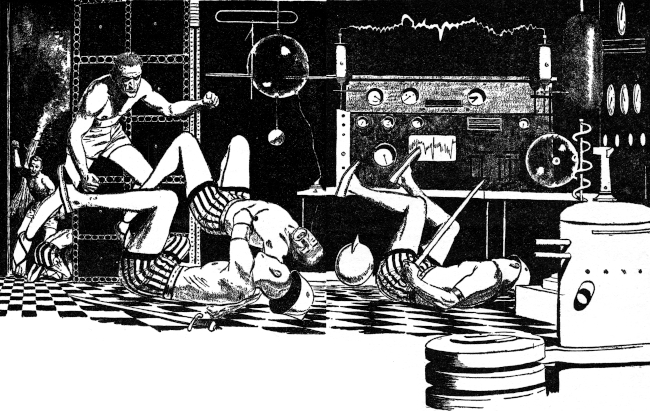
Stark burst through.
Stark continued his rush without stopping. He plunged headlong into the man before the point was clear of the scabbard, bore him over and down, and finished the man off with savage efficiency.
He leaped to his feet, breathing hard, spitting blood out of his mouth, and looked around the control room. But the others had fled, obviously to raise the warning.
The mechanism was simple. It was contained in a large black metal oblong about the size and shape of a coffin, equipped with grids and lenses and dials. It hummed softly to itself, but what its source of power was Stark did not know. Perhaps those same cosmic rays, harnessed to a different use.
He closed what seemed to be a master switch, and the humming stopped, and the flickering light died out of the lenses. He picked up the slain guard's sword and carefully wrecked everything that was breakable. Then he went outside again.
Treon was standing up, shaking his head. He smiled ruefully.
"It seems that strength alone is not enough," he said. "One must have skill as well."
"The barriers are down," said Stark. "The way is clear."
Treon nodded, and went with him back into the sea. This time both carried shock-weapons taken from the guards—six in all, with Egil's. Total armament for war.
As they forged swiftly through the red depths, Stark asked, "What of the people of Shuruun? How will they fight?"
Treon answered, "Those of Malthor's breed will stand for the Lhari. They must, for all their hope is there. The others will wait, until they see which side is safest. They would rise against the Lhari if they dared, for we have brought them only fear in their lifetimes. But they will wait, and see."
Stark nodded. He did not speak again.
They passed over the brooding city, and Stark thought of Egil and of Malthor who were part of that silence now, drifting slowly through the empty streets where the little currents took them, wrapped in their shrouds of dim fire.
He thought of Zareth sleeping in the hall of kings, and his eyes held a cold, cruel light.
They swooped down over the slave barracks. Treon remained on watch outside. Stark went in, taking with him the extra weapons.
The slaves still slept. Some of them dreamed, and moaned in their dreaming, and others might have been dead, with their hollow faces white as skulls.
Slaves. One hundred and four, counting the women.
Stark shouted out to them, and they woke, starting up on their pallets, their eyes full of terror. Then they saw who it was that called them, standing collarless and armed, and there was a great surging and a clamour that stilled as Stark shouted again, demanding silence. This time Helvi's voice echoed his. The tall barbarian had wakened from his drugged sleep.
Stark told them, very briefly, all that happened.
"You are freed from the collar," he said. "This day you can survive or die as men, and not slaves." He paused, then asked, "Who will go with me into Shuruun?"
They answered with one voice, the voice of the Lost Ones, who saw the red pall of death begin to lift from over them. The Lost Ones, who had found hope again.
Stark laughed. He was happy. He gave the extra weapons to Helvi and three others that he chose, and Helvi looked into his eyes and laughed too.
Treon spoke from the open door. "They are coming!"
Stark gave Helvi quick instructions and darted out, taking with him one of the other men. With Treon, they hid among the shrubbery of the garden that was outside the hall, patterned and beautiful, swaying its lifeless brilliance in the lazy drifts of fire.
The guards came. Twenty of them, tall armed men, to turn out the slaves for another period of labour, dragging the useless stones.
And the hidden weapons spoke with their silent tongues.
Eight of the guards fell inside the hall. Nine of them went down outside. Ten of the slaves died with blazing collars before the remaining three were overcome.
Now there were twenty swords among ninety-four slaves, counting the women.
They left the city and rose up over the dreaming forest, a flight of white ghosts with flames in their hair, coming back from the red dusk and the silence to find the light again.
Light, and vengeance.
The first pale glimmer of dawn was sifting through the clouds as they came up among the rocks below the castle of the Lhari. Stark left them and went like a shadow up the tumbled cliffs to where he had hidden his gun on the night he had first come to Shuruun. Nothing stirred. The fog lifted up from the sea like a vapour of blood, and the face of Venus was still dark. Only the high clouds were touched with pearl.
Stark returned to the others. He gave one of his shock-weapons to a swamplander with a cold madness in his eyes. Then he spoke a few final words to Helvi and went back with Treon under the surface of the sea.
Treon led the way. He went along the face of the submerged cliff, and presently he touched Stark's arm and pointed to where a round mouth opened in the rock.
"It was made long ago," said Treon, "so that the Lhari and their slavers might come and go and not be seen. Come—and be very quiet."
They swam into the tunnel mouth, and down the dark way that lay beyond, until the lift of the floor brought them out of the sea. Then they felt their way silently along, stopping now and again to listen.
Surprise was their only hope. Treon had said that with the two of them they might succeed. More men would surely be discovered, and meet a swift end at the hands of the guards.
Stark hoped Treon was right.
They came to a blank wall of dressed stone. Treon leaned his weight against one side, and a great block swung slowly around on a central pivot. Guttering torchlight came through the crack. By it Stark could see that the room beyond was empty.
They stepped through, and as they did so a servant in bright silks came yawning into the room with a fresh torch to replace the one that was dying.
He stopped in mid-step, his eyes widening. He dropped the torch. His mouth opened to shape a scream, but no sound came, and Stark remembered that these servants were tongueless—to prevent them from telling what they saw or heard in the castle, Treon said.
The man spun about and fled, down a long dim-lit hall. Stark ran him down without effort. He struck once with the barrel of his gun, and the man fell and was still.
Treon came up. His face had a look almost of exaltation, a queer shining of the eyes that made Stark shiver. He led on, through a series of empty rooms, all sombre black, and they met no one else for a while.
He stopped at last before a small door of burnished gold. He looked at Stark once, and nodded, and thrust the panels open and stepped through.
XII
They stood inside the vast echoing hall that stretched away into darkness until it seemed there was no end to it. The cluster of silver lamps burned as before, and within their circle of radiance the Lhari started up from their places and stared at the strangers who had come in through their private door.
Cond, and Arel with her hands idle in her lap. Bor, pummelling the little dragon to make it hiss and snap, laughing at its impotence. Varra, stroking the winged creature on her wrist, testing with her white finger the sharpness of its beak. And the old woman, with a scrap of fat meat halfway to her mouth.
They had stopped, frozen, in the midst of these actions. And Treon walked slowly into the light.
"Do you know me?" he said.
A strange shivering ran through them. Now, as before, the old woman spoke first, her eyes glittering with a look as rapacious as her appetite.
"You are Treon," she said, and her whole vast body shook.
The name went crying and whispering off around the dark walls, Treon! Treon! Treon! Cond leaped forward, touching his cousin's straight strong body with hands that trembled.
"You have found it," he said. "The secret."
"Yes." Treon lifted his silver head and laughed, a beautiful ringing bell-note that sang from the echoing corners. "I found it, and it's gone, smashed, beyond your reach forever. Egil is dead, and the day of the Lhari is done."
There was a long, long silence, and then the old woman whispered, "You lie!"
Treon turned to Stark.
"Ask him, the stranger who came bearing doom upon his forehead. Ask him if I lie."
Cond's face became something less than human. He made a queer crazed sound and flung himself at Treon's throat.
Bor screamed suddenly. He alone was not much concerned with the finding or the losing of the secret, and he alone seemed to realize the significance of Stark's presence. He screamed, looking at the big dark man, and went rushing off down the hall, crying for the guard as he went, and the echoes roared and racketed. He fought open the great doors and ran out, and as he did so the sound of fighting came through from the compound.
The slaves, with their swords and clubs, with their stones and shards of rock, had come over the wall from the cliffs.
Stark had moved forward, but Treon did not need his help. He had got his hands around Cond's throat, and he was smiling. Stark did not disturb him.
The old woman was talking, cursing, commanding, choking on her own apoplectic breath. Arel began to laugh. She did not move, and her hands remained limp and open in her lap. She laughed and laughed, and Varra looked at Stark and hated him.
"You're a fool, wild man," she said. "You would not take what I offered you, so you shall have nothing—only death."
She slipped the hood from her creature and set it straight at Stark. Then she drew a knife from her girdle and plunged it into Treon's side.
Treon reeled back. His grip loosened and Cond tore away, half throttled, raging, his mouth flecked with foam. He drew his short sword and staggered in upon Treon.
Furious wings beat and thundered around Stark's head, and talons were clawing for his eyes. He reached up with his left hand and caught the brute by one leg and held it. Not long, but long enough to get one clear shot at Cond that dropped him in his tracks. Then he snapped the falcon's neck.
He flung the creature at Varra's feet, and picked up the gun again. The guards were rushing into the hall now at the lower end, and he began to fire at them.
Treon was sitting on the floor. Blood was coming in a steady trickle from his side, but he had the shock-weapon in his hands, and he was still smiling.
There was a great boiling roar of noise from outside. Men were fighting there, killing, dying, screaming their triumph or their pain. The echoes raged within the hall, and the noise of Stark's gun was like a hissing thunder. The guards, armed only with swords, went down like ripe wheat before the sickle, but there were many of them, too many for Stark and Treon to hold for long.
The old woman shrieked and shrieked, and was suddenly still.
Helvi burst in through the press, with a knot of collared slaves. The fight dissolved into a whirling chaos. Stark threw his gun away. He was afraid now of hitting his own men. He caught up a sword from a fallen guard and began to hew his way to the barbarian.
Suddenly Treon cried his name. He leaped aside, away from the man he was fighting, and saw Varra fall with the dagger still in her hand. She had come up behind him to stab, and Treon had seen and pressed the trigger stud just in time.
For the first time, there were tears in Treon's eyes.
A sort of sickness came over Stark. There was something horrible in this spectacle of a family destroying itself. He was too much the savage to be sentimental over Varra, but all the same he could not bear to look at Treon for a while.
Presently he found himself back to back with Helvi, and as they swung their swords—the shock-weapons had been discarded for the same reason as Stark's gun—Helvi panted,
"It has been a good fight, my brother! We cannot win, but we can have a good death, which is better than slavery!"
It looked as though Helvi was right. The slaves, unfortunately, weakened by their long confinement, worn out by overwork, were being beaten back. The tide turned, and Stark was swept with it out into the compound, fighting stubbornly.
The great gate stood open. Beyond it stood the people of Shuruun, watching, hanging back—as Treon had said, they would wait and see.
In the forefront, leaning on his stick, stood Larrabee the Earthman.
Stark cut his way free of the press. He leaped up onto the wall and stood there, breathing hard, sweating, bloody, with a dripping sword in his hand. He waved it, shouting down to the men of Shuruun.
"What are you waiting for, you scuts, you women? The Lhari are dead, the Lost Ones are freed—must we of Earth do all your work for you?"
And he looked straight at Larrabee.
Larrabee stared back, his dark suffering eyes full of a bitter mirth. "Oh, well," he said in English. "Why not?"
He threw back his head and laughed, and the bitterness was gone. He voiced a high, shrill rebel yell and lifted his stick like a cudgel, limping toward the gate, and the men of Shuruun gave tongue and followed him.
After that, it was soon over.
They found Bor's body in the stable pens, where he had fled to hide when the fighting started. The dragons, maddened by the smell of the blood, had slain him very quickly.
Helvi had come through alive, and Larrabee, who had kept himself carefully out of harm's way after he had started the men of Shuruun on their attack. Nearly half the slaves were dead, and the rest wounded. Of those who had served the Lhari, few were left.
Stark went back into the great hall. He walked slowly, for he was very weary, and where he set his foot there was a bloody print, and his arms were red to the elbows, and his breast was splashed with the redness. Treon watched him come, and smiled, nodding.
"It is as I said. And I have outlived them all."
Arel had stopped laughing at last. She had made no move to run away, and the tide of battle had rolled over her and drowned her unaware. The old woman lay still, a mountain of inert flesh upon her bed. Her hand still clutched a ripe fruit, clutched convulsively in the moment of death, the red juice dripping through her fingers.
"Now I am going, too," said Treon, "and I am well content. With me goes the last of our rotten blood, and Venus will be the cleaner for it. Bury my body deep, stranger with the fierce eyes. I would not have it looked on after this."
He sighed and fell forward.
Bor's little dragon crept whimpering out from its hiding place under the old woman's bed and scurried away down the hall, trailing its dragging rope.
Stark leaned on the taffrail, watching the dark mass of Shuruun recede into the red mists.
The decks were crowded with the outland slaves, going home. The Lhari were gone, the Lost Ones freed forever, and Shuruun was now only another port on the Red Sea. Its people would still be wolf's-heads and pirates, but that was natural and as it should be. The black evil was gone.
Stark was glad to see the last of it. He would be glad also to see the last of the Red Sea.
The off-shore wind set the ship briskly down the gulf. Stark thought of Larrabee, left behind with his dreams of winter snows and city streets and women with dainty feet. It seemed that he had lived too long in Shuruun, and had lost the courage to leave it.
"Poor Larrabee," he said to Helvi, who was standing near him. "He'll die in the mud, still cursing it."
Someone laughed behind him. He heard a limping step on the deck and turned to see Larrabee coming toward him.
"Changed my mind at the last minute," Larrabee said. "I've been below, lest I should see my muddy brats and be tempted to change it again." He leaned beside Stark, shaking his head. "Ah, well, they'll do nicely without me. I'm an old man, and I've a right to choose my own place to die in. I'm going back to Earth, with you."
Stark glanced at him. "I'm not going to Earth."
Larrabee sighed. "No. No, I suppose you're not. After all, you're no Earthman, really, except for an accident of blood. Where are you going?"
"I don't know. Away from Venus, but I don't know yet where."
Larrabee's dark eyes surveyed him shrewdly. "'A restless, cold-eyed tiger of a man', that's what Varra said. He's lost something, she said. He'll look for it all his life, and never find it."
After that there was silence. The red fog wrapped them, and the wind rose and sent them scudding before it.
Then, faint and far off, there came a moaning wail, a sound like broken chanting that turned Stark's flesh cold.
All on board heard it. They listened, utterly silent, their eyes wide, and somewhere a woman began to weep.
Stark shook himself. "It's only the wind," he said roughly, "in the rocks by the strait."
The sound rose and fell, weary, infinitely mournful, and the part of Stark that was N'Chaka said that he lied. It was not the wind that keened so sadly through the mists. It was the voices of the Lost Ones who were forever lost—Zareth, sleeping in the hall of kings, and all the others who would never leave the dreaming city and the forest, never find the light again.
Stark shivered, and turned away, watching the leaping fires of the strait sweep toward them.