CABINET OF BIOGRAPHY.
Reading edition
CONDUCTED BY THE
REV. DIONYSIUS LARDNER, LL.D. F.R.S. L. & E.
M.R.I.A. F.R.A.S. F.L.S. F.Z.S. Hon. F.C.P.S. &c. &c.
ASSISTED BY
EMINENT LITERARY AND SCIENTIFIC MEN.
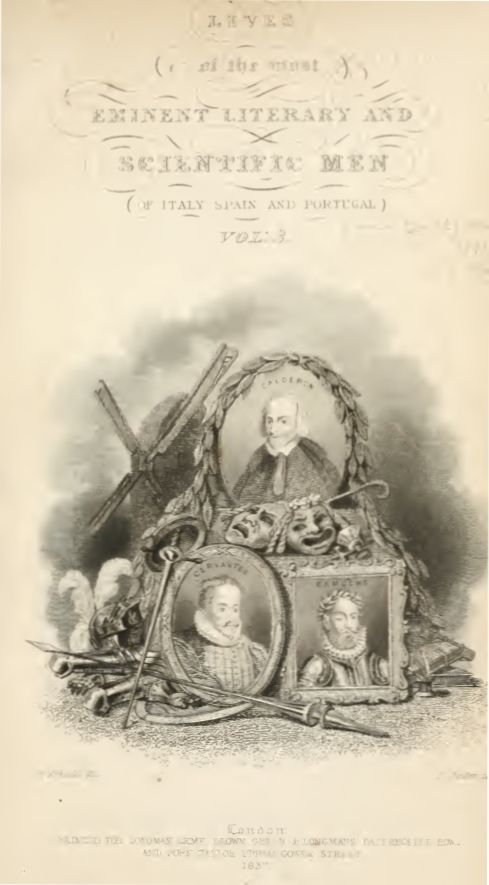
EMINENT LITERARY AND SCIENTIFIC MEN OF ITALY, SPAIN AND PORTUGAL.
VOL. III.
LONDON: PRINTED FOR LONGMAN, ORME, BROWN, GREEN, & LONGMANS, PATERNOSTER-ROW; AND JOHN TAYLOR, UPPER GOWER STREET.
1837.
CONTENTS
TABLE, ANALYTICAL AND CHRONOLOGICAL, TO THE FIRST VOLUME OF LIVES OF EMINENT LITERARY AND SCIENTIFIC MEN OF ITALY, SPAIN, AND PORTUGAL. TABLE, ANALYTICAL AND CHRONOLOGICAL, TO THE SECOND VOLUME OF LIVES OF EMINENT LITERARY AND SCIENTIFIC MEN OF ITALY, SPAIN, AND PORTUGAL. TABLE, ANALYTICAL AND CHRONOLOGICAL, TO THE THIRD VOLUME OF LIVES OF EMINENT LITERARY AND SCIENTIFIC MEN OF ITALY, SPAIN, AND PORTUGAL. INTRODUCTION MOSEN JORDI THE CANCIONEROS ALPHONSO X. AND HIS COURT ALPHONSO XI. AND HIS COURT JUAN DE MENA JUAN DE ENZINA BOSCAN GARCILASO DE LA VEGA DIEGO HURTADO DE MENDOZA LUIS DE LEON HERRERA SAA DE MIRANDA JORGE DE MONTEMAYOR CASTILLEJO THE EARLY DRAMATISTS ERCILLA CERVANTES LOPE DE VEGA VICENTE ESPINEL—ESTEBAN DE VILLEGAS GONGORA QUEVEDO CALDERON EARLY POETS OF PORTUGAL RIBEYRA SAA DE MIRANDA GIL VICENTE FERREIRA CAMOENS INDEX
TABLE, ANALYTICAL AND CHRONOLOGICAL, TO THE FIRST VOLUME OF
LIVES OF EMINENT LITERARY AND SCIENTIFIC MEN OF ITALY, SPAIN, AND PORTUGAL.
DANTE ALEGHIERI.
A. D.
PAGE
His Descent
1
His Birth
1265.
2
His Mother's Dream
3
Brunetto Latini
4
Story of his early Love for Beatrice
6
Her Death
1290.
7
"Vita Nuova"
7
Uncertain Traditions concerning the early Part of Dante's Life
9
His Marriage with Madonna Gemma
10
The Guelfs and Ghibelines
13
The Battle of Campaldino
1289.
14
Dante serves in the Cavalry
14
Extract from his Inferno, Canto XXII., giving an Account, of this Conflict
15
He again takes the Field at the Siege of Caprona
15
Extract from the Inferno, Canto XXI.
15
He is chosen chief Prior of his native City
16
Origin of the Schism between the Bianchi and the Neri
17
The Cerchi and the Donati
18
Banishment of the principal Instigators of the Neri and the Bianchi
19
Dante suspected of favouring the Bianchi Party
20
He vindicates himself
20
Entrance of Charles into Florence
20
The Recal of the Neri
20
Six Hundred of the Bianchi driven into Exile
21
Embassy of Dante to Rome
21
Boccaccio accuses him of Self-confidence and Disparagement of others
21
Confiscation of Dante's Property
22
His Banishment
22
He joins the Confederates of the Bianchi at Arezzo
23
Their unfortunate Expedition against Florence
23
Pietro Petracco
23
Dante quits the Confederacy
23
His personal Humiliation
24
Extract from his "Purgatorio"
24
Henry of Luxembourg raised to the Throne of Germany
1308.
26
Dante professes himself a Ghibeline
26
Henry of Luxembourg poisoned
1313.
26
Dante dedicates his "De Monarchia"
26
He wanders from one petty Court to another
27
Busone da Gubbio affords him shelter at Arezzo
27
Anecdote of him while at Verona
28
Guido Novello da Polenta, Lord of Ravenna
29
Mental Sufferings of Dante
30
His Letter to a Friend who had obtained Leave for him to return to his Country
31
Extracts from his "Paradiso"
32
His Residence at Ravenna
32
His Death
1321.
33
A Copy of his "Divina Commedia" embellished by Michael Angelo
34
Dante—his Tomb at Ravenna
35
Restoration of his Property to his Family
35
The "De Monarchia" publicly burnt at Rome, by Order of the Pope
35
Description of Dante by Boccaccio
36
Musical Talents of Dante
37
Extract from his "Purgatorio"
37
His two Sons the first Commentators
39
Lyrics of Dante
41
Origin of the "Divina Commedia"
43
Observations on the Title of the "Divina Commedia"
44
Extracts from the "Inferno"
46
Strictures on it
51
And on the "Inferno"
53
PETRARCH.
His Progenitors
1302.
61
Banishment from Florence
61
Petrarch and his Mother return from Banishment
1305.
62
They remove to Pisa
1312.
62
They proceed to Avignon
62
They quit this for Carpentras, where Petrarch becomes acquainted with Settimo
1315.
63
He enters the University of Montpelier
1319.
63
His Father destines him for the Law
63
His Aversion to it
64
He goes to Bologna
1323.
64
His Recal to France, on the Death of his Father; he abandons the Law
64
He resides with his Brother at Avignon; he becomes a Favourite with the Nobles
65
His Person
65
His Friendship for John of Florence
65
Giacomo Colonna; his illustrious Descent
66
His Friendship for Petrarch
67
Character of Petrarch
68
(April 6th.) His Acquaintance with Laura
1327.
68
His Devotion to her
70
His poetic Life commences
71
His Patriotism
72
Giacomo Colonna made Bishop of Lombes; Petrarch accompanies him to his Bishoprick
1330.
72
His Friendship for Lello and Louis
72
He makes the Tour of France, Flanders, and Brabant
1331.
73
He meets with a Disappointment at Lyons
75
His Arrival at Rome
76
(August 6th.) He returns to Avignon
76
His Excursion to Mont Ventoux
76
His Letter to Father Dionisio Robertis
77
His Retirement to the Valley of Vaucluse
78
A Description of it
78
Version of one of Petrarch's Canzoni, by Lady Dacre
80
Criticisms on Petrarch's Italian Poetry
81
Philip de Cabassoles, Bishop of Cavaillon, becomes the Intimate of Petrarch
83
Letter of Petrarch to Giacomo Colonna
84
Petrarch receives Letters from Rome and Paris, inviting him to accept the Crown of Poetry; he accepts the former
1340.
85
His Reception at the Court of King Robert of Naples
1341.
86
(April 17th.) His Coronation
86
He leaves Rome and arrives at Parma
87
He meets Azzo Correggio
87
Death of Giacomo Colonna
87
Early Death of Thomas of Messina
87
Petrarch's Grief for the Loss of these Friends
88
He and Rienzi sent on an Embassy to Rome, on the Accession of Pope Clement VI.
89
He meets Laura at Avignon
89
His Confidants
90
Death of Robert, King of Naples
1343.
91
He is succeeded by his Daughter Giovanna
91
Mission of Petrarch to Queen Giovanna
92
Nicola di Rienzi seizes upon the Government of Rome, and assumes the Name of Tribune
1345.
92
Change produced by him in the State of the Country
92
Petrarch offered a Bishoprick, which he refuses
93
He leaves Avignon, and repairs to Parma
1347.
94
Downfal of Rienzi
94
The Plague in Italy
1348.
94
(January 25th.) An Earthquake
94
(April 6th.) Death of Laura
94
Petrarch's Account of it
94
He visits Rome on Occasion of the Jubilee
1350.
98
Assassination of Giacomo da Carrara, Lord of Padua
98
Restitution of Petrarch's paternal Property
1351.
99
Arrival of Petrarch at Avignon
100
His Letter to Pope Clement VI. on the Choice of a Physician
100
He revisits Vaucluse
100
Death of Pope Clement VI.
1352.
100
Petrarch visits the Carthusian Convent
101
His Treatise "On Solitary Life"
101
He crosses the Alps, and visits Milan
1353.
101
Is invited by Charles, Emperor of Germany, to visit Mantua
1354.
102
He exhorts Charles to deliver Italy
102
Petrarch at Milan
1355.
103
He is sent on two Missions—one to Venice, the other to Prague
103
Invasion of France by the English
1360.
103
Petrarch sent to congratulate King John on his Return from Imprisonment
103
He returns to Italy
104
His Letter to Settimo
104
Italy again visited by the Plague
1361.
105
Death of Petrarch's Son
105
Marriage of Francesco, Daughter of Petrarch
106
The Poetry of Dante and Petrarch compared
106
"The Triumph of Death"
107
Petrarch's Description of Laura's Death
107
Boccaccio, his Attachment for Petrarch
1363.
110
Leonzio Pilato's Death
110
Petrarch's Letter to Pope Urban V.
1367.
110
His Reply
110
Petrarch suffers from Fever
1369.
110
(January.) His Letter to a Friend who had asked him, "how he was"
1372.
112
His Opinion of the Decameron of Boccaccio
1374.
113
His Death
114
His Will
114
BOCACCIO.
Origin of his Family
115
His Birth
1313.
116
He enters on the Study of the Canonical Law
1329.
117
His Dislike for this Study
1333.
117
He goes to Naples
117
He visits the Tomb of Virgil
1338.
118
A Description of it
118
Boccaccio—his Admiration of it
119
Another Circumstance occurs which confirms his Predilection for Literature
1341.
120
Commencement of his Attachment for Lady Mary
121
Some Account of her
121
Her Person
122
His first Book, "Filocopo"
123
The Story of it
123
His Style
124
His Recal to Florence on the Death of his Father
1342.
125
His "Ameto"
126
He returns to Naples
1344.
126
Death of King Robert
126
Queen Jane and her Court
126
"Filostrato," of Boccaccio
126
His "Amorosa Fiammetta" and "Amorosa Visione"
127
He writes "The Decameron"
1348.
127
The Preface
127
Description of the Plague in Florence
128
Critique on the "Decameron"
130
Burning of the "Decameron"
1497.
130
The "Ventisettana" and "Delphin" edition of the "Decameron" published
1527.
130
Return of Boccaccio to Florence
1350.
131
His various Embassies
131
He visits Petrarch at Padua
1351.
132
He is sent to Bohemia to Louis of Bavaria
133
Again sent on a Mission to Avignon
1354.
133
His violent Party Feelings
133
His Letter to Petrarch
133
Petrarch's Answer
134
Boccaccio—his enthusiastic Love for the Study of the Ancients
135
His celebrated Copy of Dante
136
He visits Petrarch at Milan
137
Moral Change in him
137
A singular Circumstance occurs which achieves this moral Work
1361.
139
He communicates this Circumstance to Petrarch
140
Petrarch's Letter in Answer
140
Power and Influence of Acciajuolo, Seneschal of Naples
1363.
142
He invites Boccaccio to his Palace
142
His unworthy Treatment of Boccaccio
143
He removes from his Palace in consequence
143
He returns to Florence
143
His Residence at Certaldo
144
His Work, "De Casibus Virorum et Færainarum Illustrium"
145
His Embassy to Pope Urban V.
1355.
145
He projects a Visit to Venice
145
His Letter to Petrarch, whom he missed seeing
145
His Visit to Niccolo di Montefalcone, Abbot of the Carthusian Monastery of San Stefano, in Calabria
1370.
147
He visits Naples
1372.
147
He returns to his Retreat at Certaldo
1373.
147
His Work on "The Genealogy of the Gods"
147
The Professorship for the Public Explanation of the "Divina Commedie" conferred on him
148
Petrarch's Death
1374.
149
Grief of Boccaccio
149
(December 21st.) Death of Boccaccio
1375.
149
LORENZO DE' MEDICI.
Ficino, Pico Della Mirandola, Politian, the Pulci, &c.
151
Platonic Doctrines in Italy
1438.
151
Gemisthus Pletho
151
The Medicean Library founded by Cosmo
152
His Death
1464.
152
Lorenzo de' Medici succeeds to his Father's Wealth and Influence
152
The Pazzi Conspiracy
1478.
152
Pope Sixtus VI. leagues all Italy against Florence
1479.
152
Lorenzo de' Medici—his Firmness and Talents
1480.
152
He induces the King of Naples to conclude a Treaty with Florence
153
A Yearly Anniversary of Plato's Death instituted
153
Lorenzo de' Medici—his Commentary on his first Sonnet
155
Extract of a Translation of one of his Sonnets
156
His "Nencia da Barbarino"
157
And another, "Canzoni Carnaleschi"
157
His descriptive Poems
158
His Death
1492.
159
MARSIGLIO FICINO.
His Birth
1433.
159
He is adopted by Lorenzo de' Medici
160
His "Platonic Institutions"
160
His "Treatise on the Origin of the World"
160
He assumes the Clerical Profession
1468.
160
He obtains the Cure of two Churches and Cathedral of Florence
1475.
160
(October 1st.) His Death
1499.
161
GIOVANNI PICO DELLA MIRANDOLA.
His Birth
1463.
161
His Parentage
161
He visits Rome
161
His 900 Propositions published
162
His Persecution and Death
1494.
162
ANGELO POLIZIANO.
(July 24th.) His Birth
1454.
162
In Florence, he attracts the Attention of Lorenzo de' Medici
163
He engages him as Tutor to his Children
164
He obtains the Professorship of Greek and Latin in the University of Florence
165
His Letter to Jacopo Antiquario
1492.
165
Disasters which befell the Medici
166
Politian's Monody on Lorenzo
166
(September 24th.) Politian.—His Death
1494.
167
BERNARDO PULCI.
His Origin
167
His Works
167
LUCA FULCI.
His Works
167
LUIGI PULCI.
Author of the "Morgante Maggiore"
168
Critique on "Morgante Maggiore"
168
The Family of the Heroes of Romance
169
Extract from the "Morgante Maggiore"
171
The Subject of the Poem
172
CIECO DA FERRARA.
Author of "Mambriano"
1509.
179
BURCHIELLO.
His Death
1448.
180
BOJARDO.
Matteo Maria Bojardo; his Ancestors
181
His Birth
1434.
181
His Parents
181
His Education
181
He is sent out as one of the Noblemen to welcome Frederic III. to Ferrara
1469.
181
Borso, Marquess of Ferrara, created Duke
1471.
181
Bojardo accompanies him to Rome on his Investiture
181
Marriage of Bojardo to Taddea
1472.
182
Bojardo selected by the Duke of Ercole to escort his Wife to Ferrara
1473.
182
He is made Governor of Reggio
1478.
182
His Death
1494.
182
His Lyrical Poetry
182
His Classical Works
182
An Extract from his "Orlando Innamorato"
183
BERNI.
Francesco Berni
188
His Birth
188
His early Life
188
The Vignaiuoli established at Rome by Oberto Strozzi
188
Rome plundered by the Colonna
1526.
188
(July 26th.) Death of Berni
1536.
189
Publication of his "Rifacimento"
189
Alterations made by Berni in "Orlando Innamorato"
192
His introductory Stanzas which he appended to each Canto
193
His Person and Disposition
193
An Extract as a Specimen of his Humour
194
Bernese Poetry
195
ARIOSTO.
(September 8th.) Ludovico Ariosto, his Birth
1474.
196
His Lineage
196
His early Studies
197
Latin the universal Language of Writers
198
The Transmutation and Transfusion of the dead Languages into modern Tongues
199
Death of Ariosto's Father
199
His pecuniary Difficulties in consequence
199
His filial and paternal Affection
200
His Brothers Gabriele and Galasso
200
His Sisters
200
A Quotation from his second Satire, alluding to his Mother
201
His Bagatelles
202
He composes his "Orlando Furioso"
203
His Answer to Cardinal Bembo, who advises him to write it in Latin
204
The Duke of Ferrara threatened with the Thunders of the Vatican
204
Ariosto sent as Ambassador to Rome on this Occasion
205
Julius II. enters into a League with the Venetians
205
The Papal Forces defeated at Ravenna
205
The Capture and Dispersion of the Republican Squadron on the River Po
205
Ariosto, his gallant Conduct on this Occasion
205
His second Embassy to Rome
206
His uncourteous Reception by the Pontiff
206
Emperor Alfonso, his fruitless Negotiations with the implacable Julius
207
And the perfidious Treatment he receives
207
The singular Manner in which he retaliates
207
The first Edition of the "Orlando Furioso"
1515.
207
Succeeding Reprints and Variations of it
208
The last Edition
1532.
208
Ariosto refuses to accompany Cardinal Hippolito to his Bishopric
208
Their consequent Estrangement
209
A Story of Hippolito, his natural Brother, and a Lady to whom they both paid their Addresses; the infamous and unnatural Conduct of the Cardinal
209
Independence of Ariosto
210
Ease, Freedom, and Independence necessary to the Life of a Poet
210
Letter of Ariosto to his Brother Alessandro
212
Ariosto enters the Service of Duke Alfonso
217
Discomforts and Mortifications of his precarious Circumstances
218
His Reasons for not taking Orders
219
Pope Leo X. issues a Bull in favour of the "Orlando Furioso"
219
What Claims had Ariosto on the Bounty of Leo X.?
220
Extracts from his Satires
221
The Dignity and Ease he enjoys at the Court of Alfonso
226
His Government of Graffagnana
226
His Rencontre with some of his uncouth Neighbours
227
Baretti, his Version of this Anecdote
228
Extract from his Satires
229
He is invited to accept a third Embassy to Rome
230
His Answer to Bonaventura Pistolfo
230
His Release from his Government
232
He perfects his "Orlando;" his Dramatic Works
232
A curious Anecdote of him when a Child
232
Remarks on his Writings
234
Ariosto, his last Illness
1532.
234
Apocryphal Traditions of him
235
His Person
235
His Character
236
His Sons
237
His Elegies, Sonnets, and Madrigals
237
A Translation of one of his Sonnets
238
Difficulty of translating his Works
239
English Versions of his "Orlando Furioso"
239
His Recitation
240
Anecdote of him
240
His whimsical Peculiarities; his Habits
241
His Reveries
242
His last Hours
243
His Monument
244
Sketch of the Outline of the "Orlando Furioso"
245
Critical Remarks on it
247
A Sequel and Imitation of it
250
MACHIAVELLI.
Origin of his Family
850.
256
(February 3d.) His Birth
1469.
257
His Parentage
257
Nothing known of his Childhood and Education
257
Paul Jovius
257
Machiavelli Secretary under Marcellus Virgil
1494.
257
Florence agitated by the Prophet Salvanorola
1497.
258
Marcellus Virgil elected High Chancellor
258
Machiavelli made Chancellor of the Second Court
1498.
258
Is Secretary of the Council of Ten
259
His Missions to various Sovereigns and States
259
Italy convulsed by foreign Armies and domestic Quarrels
1492.
259
Ludovico Sforza invites Charles VIII. of France into Italy, instigating him to assert his Right to the Neapolitan Crown
260
Entrance of the French into Italy; causes great Commotion in Florence; the Overthrow and Exile of the Medicean Family
1493.
260
Italy overrun by Charles
260
The Italian System of Warfare
260
Death of Charles VIII.
1498.
261
Louis XII. succeeds him; his speedy Conquest of Milan
261
Pisa, under the Rule of Florence, repines at its Servitude; they implore Charles to restore their Independence
1501.
261
Pisa besieged by the Florentines
1500.
262
Machiavelli and Francesco della Caza employed by the Republic as Envoys to the French Court; curious Style of their Instructions
262
They fail in their Object, and return to Italy
263
Machiavelli, his Mission to Cæsar Borgia
263
Roderigo Borgia chosen Pope; he assumes the Name of Alexander VI.
264
His Character
264
Cæsar Borgia raised to the Rank of Cardinal; his Dislike to the Church
264
His Jealousy of his Brother, the Duke of Candia, whom he causes to be waylaid and murdered
264
He abdicates the Cardinal's Hat, and obtains the Duchy of Valence in France
265
He determines to form the Principality in Italy
265
His Encroachments supported by an Alliance with Louis XII.
265
His Attack on Bologna
266
Revolt of his chief Condottieri
266
Conspiracy of Magione
267
Arrival of Machiavelli at Imola
1502.
268
His Interview with Caesar Borgia
268
His Opinion of him
268
Cæsar Borgia, his Method of defending himself
269
His Policy
269
Paolo Orsino, his Arrival at Imola
269
Machiavelli, his Letter to the Signoria of Florence
269
His Conversation with Cæsar Borgia
270
His Admiration of Borgia's Talents
271
Machiavelli solicits to be recalled
271
Treaty between Caesar Borgia and the Confederates
271
Letter of Machiavelli on this Subject
272
Borgia leaves Imola
273
Machiavelli follows the Court to Cesena
273
His Letter
273
He again writes from Cesena
274
The Confederates sent to Sinigaglia
275
Arrival of Borgia at Sinigaglia
275
He causes the Orsini and Vitellozzo to be taken Prisoners
275
Machiavelli, his Account of this Transaction
275
His Letter
275
Treacherous and cruel Revenge of Borgia on the Confederates
276
(January 8th.) Machiavelli, his Letter to the Republic
277
His Recal to Florence
1503.
278
His Description of the Method used by the Valentian Duke in putting to death Vitellozzo Vitelli
278
The "Decenal"
278
An Anecdote of Cæsar Borgia
279
Narrow Escape of Cæsar Borgia at Rome, it is supposed from Poison
280
(August 28th.) Sudden Death of his Father, Pope Alexander
281
Accession of Pope Pius III.
281
Fall of the Fortunes of Cæsar Borgia
281
Machiavelli's Embassy to Rome to influence the Consultations concerning the future Destination of Cæsar Borgia
281
Julius II.
281
Borgia sent to Romagna in the Name of the Holy See
282
Cardinal Volterra sent after him with a Requisition; Borgia refuses to comply; he is arrested in consequence, and sent on board a French Galley
283
He is brought back to the Vatican; he is liberated
283
He goes to Naples
283
He forms new Schemes, is again arrested, and confined in the Fortress of Medina del Campo
284
His Escape and Death
1506.
284
Machiavelli leaves Rome, and goes to France
1504.
284
Peace between France and Spain
284
Formation of a native Militia in Florence
1506.
285
Pope Julius II., his Projects
285
The Florentines delegate Machiavelli to the Court Militant at Rome; his Letters
285
Francesco Vettori treats with the Emperor Maximilian at Trent
1507.
286
Machiavelli sent with the Ultimatum of the Florentines to Trent
1508.
286
On his Return, writes his "Account of Germany"
286
Pisa besieged by the Florentines
1509.
286
Machiavelli sent to assist them
286
Enmity between Louis XII. and the Pope
287
Machiavelli, his Mission to Louis; his Letters
1510.
287
His Audience with the King at Blois
288
Pietro Soderini elected Doge of Florence
1511.
288
Louis determines to dethrone him; Florence offers him Pisa for it
288
Terrified by the Menaces of the Pope, they send Machiavelli to recal this Offer
288
Disastrous War, the Consequence
289
Diet of Mantua
1512.
289
Overthrow of the existing Government of Florence
289
Restoration of the Medici
289
Machiavelli deprived of his Place
291
Conspiracy against the Medici
291
Machiavelli supposed to be implicated; is thrown into Prison in consequence
291
He is included in an Amnesty of the new Pope, Leo X.
291
His Letter to Francesco Vettori; his Liberation
1513.
291
Letter of Vettori to Machiavelli
292
His Letter in Reply
292
Vettori, his Endeavours in behalf of Machiavelli
293
Machiavelli, his Letter to Vittori
294
Analysis of his Work, called the "Prince"
297
Machiavelian Policy
300
His Essays on the first "Decade of Livy"
304
His "Art of War"
304
His "Belfegor"
304
His Comedies
304
His Letter to Vettori
1514.
305
Address of Pope Leo X. to Machiavelli; his Advice
1519.
306
Machiavelli, his Reply
306
His "Essay on the Reform of the Government of Florence"
306
Machiavelli Ambassador to the Minor Friars at Carpi
1521.
306
Letter of Francesco Guicciardini on his Appointment; Machiavelli, his Reply
307
Cardinal Julius commissions him to write the History of Florence
1524.
307
Cardinal Julius becomes Pope Clement VII.; he makes Machiavelli his Historiographer
1526.
308
Deplorable State of Italy
308
Constable Bourbon at Milan
308
Machiavelli sent by the Pope to inspect the Fortifications at Florence
309
Arrival of Bourbon at Bologna
1527.
309
A Truce concluded between Clement VII. and Charles V.
310
(6th of May.) Sack of Rome
310
Machiavelli assists the Italians in relieving the Pope, who is besieged in the Castel Sant' Angelo
310
He returns to Florence
310
His Death
311
His Wife and Children
311
His Person and Character
311
Complete Edition of his Works published
1782.
312
His Descendants
312
TABLE, ANALYTICAL AND CHRONOLOGICAL, TO THE SECOND VOLUME OF
LIVES OF EMINENT LITERARY AND SCIENTIFIC MEN OF ITALY, SPAIN, AND PORTUGAL.
GALILEO.
A. D.
PAGE
(15th of February.) His Birth
1564.
1
His Ancestors
2
His early Years
3
A Scholar of Arts at the University of Pisa
1581.
3
Studies Medicine under Andrew Cæsalpinus
3
His Work on the Hydrostatical Balance
4
Guido Ubaldi engages him to investigate the Centre of Gravity of solid Bodies
4
Appointed Lecturer of Mathematics at the University of Pisa
4
Giordano Bruno burnt
1600.
4
Galileo attacks by Argument and Experiment the Aristotelian Laws of Gravity
5
Opposition of the Aristotelians to his Discoveries
6
A Method of clearing out the Harbour of Leghorn proposed by Don Giovanni de' Medici
6
Galileo opposes this Opinion; is persecuted in consequence
6
He obtains the Professorship of Mathematics at the University of Padua
1592.
6
Account of his Conversion to the Copernican System
1593.
7
He meets with an Accident
9
He completes his first Engagement at Padua
9
Is re-elected other six Years
1598.
9
Accusation brought against him with respect to Marina Gamba
10
A new Star excites the Attention of Galileo
1604.
10
Again re-elected to the Professorship of Padua
1606.
10
His increasing Popularity
10
His Examination of the Properties of the Loadstone
10
Doctor Gilbert's Work, the "De Magnete," published
1500.
11
His Death
1603.
11
Cosmo proposes to Galileo to return to Pisa
11
The Arrangements suggested by Galileo, and the Manner of urging them
12
Dutch Telescopes
13
Galileo constructs his first Telescope
13
Interest which the Telescope excited in Venice
14
The Art of cleaning and polishing Lenses very imperfect
15
Results of the Observations of Galileo on the Moon
16
His Examination of the fixed Stars
16
The Satellites of Jupiter discovered by Galileo
1610.
18
Galileo's Work, the "Sidereal Messenger," published
18
Reception which these Discoveries met with from Kepler
19
Horky; his Work against the Discoveries of Galileo
20
Simon Mayer
21
Discovery of new Satellites
21
First Enigma of Galileo published
23
His Observations on Saturn and Venus
23
His Reception at Rome; he erects his Telescope in the Quirinal Garden
1611.
24
(March.) He discovers the Solar Spots
24
Thomas Harriot discovers the Solar Spots (in December)
1610.
25
Professor Scheiner; his Letters on the Subject of the Solar Spots
26
These Letters answered by Galileo
26
Faculæ or Luculi discovered on the Sun's Disc, by Galileo
26
His Observations on Saturn
27
The Subject of floating Bridges discussed
28
Galileo "On Floating Bodies"
28
His Letter to the Abbé Castelli
1613.
31
Caccini attacks Galileo from the Pulpit
31
Luigi Maraffi apologises to Galileo for this Conduct
31
Galileo, his Letter to the Grand Duchess Christian
31
(26th of February.) Galileo appears before the Inquisition
1615.
31
He renounces his Opinions
33
The Copernican System condemned by the Inquisition
34
Interview of Galileo with Pope Paul V.
1616.
34
Letter of Querenghi to the Cardinal D'Este
34
Negotiations of Galileo with Spain
35
Three Comets appear
1618.
36
Discourse on Comets by Marco Guiducci
1619.
36
"The Astronomical and Philosophical Balance"
37
Galileo, his Work "Il Saggiatore"
1623.
37
Accession of Cardinal Barberini to the papal Throne
37
Galileo, his Visit to Pope Urban VIII.
1624.
38
His Reception
38
Death of Cosmo
1629.
39
Pecuniary Difficulties of Galileo
39
Work of Galileo demonstrating the Copernican System
1630.
41
"The System of the World of Galileo Galilei"
1632.
42
Influence of this Work on the public Mind
43
Galileo summoned to appear before the Inquisition
44
(14th of February.) He arrives at Rome
1633.
45
Is visited by Cardinal Barberini; his Kindness to him
46
Trial of Galileo
47
(22d of June.) His Sentence
48
His Abjuration
49
What Excuse is there for his Humiliation and Abjuration?
50
Imprisonment of Galileo
52
He leaves Rome
52
He returns to Arcetri
52
Death of his Daughter
53
His Indisposition and Melancholy
53
He obtains Permission of the Pope to return to Florence
1638.
53
Continued Kindness of the Grand Duke of Tuscany for him
54
His "Dialogues on Local Motion"
54
Discovery of the Moon's Libration
55
Blindness of Galileo
1637.
56
He is visited by a Number of Strangers
58
(8th of January.) His Death
1642.
58
His Epitaph and Monument
95
His House
60
His domestic Character
60
His Person
60
His scientific Character
61
GUICCIARDINI.
(6th of March.) His Birth
1482.
63
His Parentage
63
His Education
64
He obtains the Degree of Doctor of Laws
64
His Marriage
64
Sent as Ambassador, by the Republic, to Ferdinand King Aragon
65
He returns home
65
Leo X. visits Florence
65
Guicciardini sent to receive him at Cortona
65
He makes him Governor of Reggio and Modena
66
Death of Leo
66
Guicciardini, his memorable Defence of Parma
66
Made President of Romagna
67
His Administration
67
Made Lieutenant-general of the Pontifical Army
67
The Power of the Medici becomes odious in Florence
67
Dangers to which Clement VII. is exposed
67
The Palace of Government seized by the younger Nobility
67
Frederigo da Bozzole sent to treat for it
68
Guicciardini, his Zeal in the Cause of the Medici
69
Reconciliation between Charles V. and Pope Clement VII.
69
Their united Arms turned against Florence
69
Second Restoration of the Medici
70
Overthrow of the Liberties of Florence
70
The Office of Gonfaloniere established
70
Alessandro de' Medici named Duke
70
His disgraceful Birth
70
His Vices
71
Guicciardini resigns the Government of Romagna
71
Murder of the Duke Alexander by Lorenzino de' Medici
72
Cosmo raised to the supreme Power
72
Guicciardini retires to his Country Seat at Montici
72
(27th of May.) His Death
1540.
74
VITTORIA COLONNA.
Women who aspired to literary Fame in Italy
75
Cassandra Fidele born; Politian's Letter to her
1465.
76
Vittoria Colonna, her Parentage
1490.
77
Her Marriage with the Marquess of Pescara
77
Pescara made General of the Army at Ravenna
77
His Testimony of Affection to his Wife
77
Her Answer
78
Death of Pescara
78
Vittoria Colonna, her Grief in consequence
79
Her Poetry
80
Her Friendship for Cardinal Pole and Michael Angelo
81
Her Death
1547.
81
GUARINI.
His Birth
1537.
82
Little known of his early Life
82
His Marriage
82
His Embassy to Venice to congratulate the new Doge, Pietro Loredano
1565.
83
His Embassy to Rome to pay Homage to Gregory XIII.
1571.
83
His Mission to Poland to congratulate Henry of Valois on his Accession
1573.
83
On his Return made Chancellor and Secretary of State
83
His second Visit to Poland
83
(25th of November). His Letter to his Wife during his Journey
1575.
83
His "Pastor Fido"
87
His Quarrel with Tasso
87
He requests his Dismissal from the Duke; he retires to his Villa
1582.
88
His "Pastor Fido" acted at Turin
1585.
91
Guarini returns to his Post at Court; is made Secretary of State
1586.
92
His Missions to Umbria and Milan
92
His Quarrel with his Son
92
He leaves the Court of Alfonso and goes to that of Savoy
1590.
93
He leaves Savoy, and goes to Padua
93
He loses his Wife
1591.
93
His Letter to Cardinal Gonzaga
93
His Visit to Urbino
94
He retires to Ferrara, deputed by the Citizens to congratulate Paul Usur
95
Nuptials of Gonzaga and Marguerite of Savoy
1608.
95
(7th of October.) His Death
1612.
95
TORQUATO TASSO, SON OF BERNARDO TASSO.
Their Ancestors
98
Bernardo Tasso appointed Secretary of State to Ferrante Sanseverino, Prince of Salerno
1493.
99
His Marriage with Portia Rossi
100
(11th of March.) Torquato Tasso, his Birth
1544.
101
Bernardo Tasso joins his Patron in the War
102
Infancy of Torquato
103
Return of Bernardo from the War
103
The Prince of Salerno and his Adherents declared Rebels
1552.
104
Bernardo, his Exile
104
Torquato Tasso, his Separation from his Mother; Lines written by him on this Occasion
105
He and Cowper compared
107
Death of his Mother
1556.
108
Torquato Tasso at Rome with his Father
108
Is implicated in his reputed Treason
109
His Letter to Vittoria Colonna on the Marriage of his Sister Cornelia
110
Letter of Bernardo to his Daughter
110
Bernardo flies to Ravenna
111
He is invited to Pesaro
111
Vicissitudes of Bernardo Tasso
112
Torquato Tasso, his Studies
114
Boileau
115
"Joan of Arc"
117
"Curiosities of Literature"
118
Torquato translates his Father's Poems and Letters
118
"Amadigi"
119
Torquato Tasso studies Jurisprudence at Padua
122
His "Rinaldo"
122
Epic Poetry
125
"Gerusalemme Liberata"
126
Torquato leaves the Study of the Law, and repairs to Bologna
127
He returns to Padua and establishes the Degli Eterei
128
His "Discourses on Heroic Poetry"
130
He visits his Father at Mantua
1564.
130
His Illness
131
Bernardo Tasso, his Death
1569.
131
Torquato Tasso appointed one of the personal Attendants Cardinal D'Este
131
Zoilus
131
Torquato Tasso at Ferrara, in the Service of Cardinal Luigi
1565.
132
Marriage of Alfonso Duke of Ferrara
132
Death of Pope Pius IV.
133
Torquato becomes acquainted with Lucretia and Leonora Este
133
A quotation from his "Aminta"
134
Marriage of the Princess Anna of Este with the Duke Guise
1568.
136
Marriage of Lucretia D'Este with the Prince of Urbino
136
Torquato Tasso accompanies the Cardinal Luigi, as Legate, the Court of France
138
Two or three Anecdotes related of him
139
Arrival of Tasso at Rome
1572.
140
His Reception by Pope Pius V.
140
Admitted into the Service of the Duke Alfonso
140
His "Aminta"
141
His "Torindo" and "Torrismondo"
143
His Illness
144
His Escape to Rome, with the Duke Alfonso's Consent
146
He returns to Ferrara
146
An Incident occurs to him which establishes him a Hero
147
His Malady
148
Is confined as a Lunatic by the Duke Alfonso
148
Efforts of the Duke to calm his Mind
149
His Love for the Princess Leonora
149
He visits his Sister
150
Committed as a Lunatic to St Anne's Hospital
1579.
152
His Letter to Scipio Gonzaga
152
Death of the Princess Leonora
1581.
156
Its Effect on Tasso
156
Liberation of Tasso
1586.
157
His Controversy with the Della Cruscan Academy
158
His last Work, "Sette Giornate"
158
He recovers his Mother's Dowry
158
The Pope grants him a Pension
158
Manso, his Account of his Interview with Tasso during Time he supposed he was visited by a Spirit
159
(25th of April.) Death of Tasso
1594.
161
His Works
161
CHIABRERA.
His Birth
1552.
163
His Parentage
163
His Childhood
163
Enters the Service of Cardinal Comaro Camerlingo
164
His disastrous Residence at Rome
163
His Studies
164
His Style
165
His Elegiac Poems
166
A Quotation from Wordsworth's Translation
166
Generous Overtures of Charles Emanuel
167
He refuses
168
His Death
1637.
168
TASSONI.
His Birth
1565.
169
His early Life
169
Obtains the Degree of Doctor of Laws at the University of Bologna
1585.
169
Visits Rome; enters the Service of Cardinal Colonna; sent by him to obtain Permission of Pope Clement VIII. to accept the Viceroyalty of Aragon; his Success
1597.
170
His Works
1622.
171
His Death
1635.
173
MARINI.
(18th of October.) His Birth
1569.
174
He opposes his Father's Wishes to become a Lawyer; turns him out in consequence
174
Publishes his "Canzoni de' Baci"
1589.
174
Concerned in some youthful Scrapes
175
Accompanies Cardinal Aldobrandini to Turin
175
His literary Quarrels
175
Marini publishes his Poem on the Murder of the Innocents
176
He accepts the Invitation of Marguerite of France
176
Her Death before his Arrival
176
Is received by Mary de' Medici
176
He publishes his "Adone"
1623.
177
He returns to Rome
178
(25th of March.) His Death
1625.
179
FILICAJA.
(30th of December.) His Birth
1642.
180
His Parentage
180
His Education
180
His Marriage
181
His Odes
181
Kindness and Liberality of Christina of Sweden to Filicaja
182
He is appointed Governor of Volterra
182
His Return to Florence; his Character: his "Ode to the Virgin"
183
His Death
1717.
184
METASTASIO.
His obscure Origin
185
(13th of January.) His Birth; his Name
1698.
185
His Adoption by Vincenzo Gravina
185
His first Tragedy, "Giustino"
186
His Letter to Algarotti
187
His Letter to Don Saverio Mattei
188
Death of his adopted Father Gravina
189
His Studies
189
His Imprudence
189
Commences the Study of the Law at Naples
190
He composes his "Orti Esperidi"
190
He quits his Legal Studies
191
And resides at the House of the Prima Donna Marianna Bulgarelli
191
He studies Music
192
Operatic Dramas first introduced at Florence
1594.
192
Metastasio composes his "Didone Abbandonato;" also his "Siroe"
1724.
192
He accompanies the Prima Donna to Rome
193
He writes his Drama of "Cato"
1727.
193
He is invited to become the Court Poet of Vienna
1729.
193
Apostolo Zeno
194
Metastasio fulfils his Engagement to the Roman Theatre
1730.
194
He enters on his Employments at Vienna; Success of his Dramas
194
Becomes Treasurer of the Province of Cosenza, in Naples
195
His Letters to Marianna Bulgarelli
196
Her Death
1733.
198
Metastasio's Letters to his Brother on her Death
198
His Style
200
His "Attilio Regulo"
201
"Themistocles" and "Olimpiade:" his Dramas
202
His Canzonetti
203
Death of the Emperor Charles VI.
1740.
203
Francis I. elected Emperor
1745.
204
Several European Sovereigns invite Metastasio to their Court
204
His Malady
204
His Letters
205
His Letter to his Brother on the Death of his Father
205
Death of his Brother Leopold
1770.
208
Farinelli
1737.
208
Death of Philip V. of Spain
1746.
209
Accession of Charles III.
1763.
209
Physical Sufferings of Metastasio
209
Death of the Empress Maria Theresa
209
Doctor Burney's Account of Metastasio
1772.
210
(12th of April.) Death of Metastasio
1782.
211
GOLDONI.
His Birth
1707.
213
His Origin
213
Death of his Grandfather; Pecuniary Difficulties of his Family
1712.
214
Education of Goldoni
215
His Departure with his Family from Perugia
216
Carlo Goldoni studies at Rimini
216
His Parents embark for Chiozza
216
Description of Chiozza
216
Goldoni escapes from Rimini
217
He arrives at Chiozza
218
He studies the Law under his Uncle, at Venice
219
His Success at the University of Pavia
1723.
220
His Expulsion, and the Cause of it
221
Returns to his Parents
221
He pursues his Legal Studies at Modena
222
He determines to become a Monk
223
Prudent Conduct of his Parents on this Occasion
223
Goldoni becomes Coadjutor to the Chancellor of Feltri
224
He falls in Love
224
He joins his Father at Ravenna
1731.
225
Death of the elder Goldoni
225
Goldoni enters the Profession of Barrister, at Venice
225
An Incident occurs which destroys his Prospects
226
His Tragedy of "Amalassunta"
228
Its Fate
229
Buonafede Vitali
229
Siege of Milan
1733.
230
Journey of Goldoni to Modena
230
Disasters which he met with
231
His "Belisarius" acted at Vienna
1734.
232
Good Fortune which he meets with at Genoa
233
His Marriage
233
He attempts to reform the Italian Theatre
233
The old Comedy of Italy
234
Goldoni obtains the Genoese Consulship at Venice
235
He meets with a Ragusan Adventurer
235
His Play on the Subject
1741.
235
His Life at Rimini
236
His Journey to Cattolica, and the Misfortune that befel him
237
He becomes a Pleader at the Pisan Bar
238
His Comedies
238
His Style
239
The Plot of his "Donne Puntigliose"
240
Story of the "Donna Prudente"
241
His "Pettegollezzi"
241
The Subject of "Villeggiatura" and the "Smanie della Villeggiatura"
242
His other Comedies
243
He receives an Offer from the French Court
1760.
245
His Debûbt as an Author in the French Capital
1761.
246
His Death
1792.
246
ALFIERI.
The Italian Poets of the early Ages
247
(17th of January.) Birth of Vittorio Alfieri
1749.
250
His noble Origin
250
His Childhood
251
His Education
252
Account of the Academy of Turin
252
System of Education
253
Effect of Music on the Mind of Alfieri
255
Circumstances of his Life altered by the Death of his Uncle
256
Change of his Situation in College
1763.
256
Effect of this on his Conduct
256
His Extravagance
257
His Confinement
257
His Liberation on the Marriage of his Sister Julia
1764.
258
His Return to College
259
His Journey to Genoa
1765.
259
He enters the Provincial Army of Asti
1766.
260
His dislike of Military Discipline; he obtains Leave of Absence
260
His Tour
261
His second Leave of Absence; his second Tour
265
His first Entrance into Paris
265
His enthusiastic Feelings on visiting England
266
He returns to Turin, and resides with his Sister
267
He takes another Tour
1769.
268
His second Visit to England; his Love Adventure
269
He returns to Paris
271
His Quarrel with his Servant
271
Returns to Turin, and becomes a Cavaliere Servente
1772.
272
He determines to break off this disgraceful Intercourse
1774.
274
His first Attempt at Composition
274
He enters into an Engagement with the Public to write Tragedies
1777.
276
He visits Siena; his Friendship with Francesco Gori
278
He visits Florence
279
His Attachment for Louisa de Stolberg, Countess of Albany
280
He makes a Donation of his Property to his Sister Julia
280
The distinguishing Marks of his Dramas
282
Distinction between Shakspeare and other Dramatic Writers
283
Alfieri, his Tragedy of "Philip," its Subject
284
He continues the _Amico di Casa_ of the Countess of Albany
286
Cruel Conduct of her Husband
286
She is separated from him
286
Alfieri at Rome with the Countess
287
He completes his fourteen Tragedies
1782.
288
His Intercourse with the Countess of Albany begins to excite Censure
289
He goes into voluntary Exile in consequence of his Sufferings
290
He visits England to purchase Horses
1783.
290
He returns to Italy
291
His Visit to the Countess of Albany at Alsatia
291
He composes his "Agis," "Sofonisba," and "Mirra"
291
Death of his Friend Gori
292
Returns to Siena
292
Countess of Albany visits Paris
293
She goes to Baden, where she is joined by Alfieri
293
Residence of Alfieri at Colmar
293
His Illness; visited by his Friend the Abbate Caluso
1787.
293
The Countess at Paris; Alfieri joins her
293
Death of her Husband
294
Corrected Editions of Alfieri's Tragedies
294
His Translation of the Comedies of Terence
1790.
294
His Treatise on "Princes and Literature;" Critique on his Style
295
He accompanies the Countess of Albany to England
1791.
296
They return to Paris
296
(10th of August.) The French Revolution
1792.
296
Imprisonment of Louis XVI.
296
Departure of the Countess and Alfieri from Paris; their Furniture, Horses, and Books confiscated
297
They return to Florence
297
The Tragedy of "Saul" acted, Alfieri performing the Part of the King
298
He studies the Greek Language
299
Invasion of Italy by the French
299
Alfieri and the Countess leave Florence
299
French driven from Tuscany
299
Second Invasion of the French; Effect of these political Events on the Mind of Alfieri
300
(8th of October.) His Death
301
His Tomb
301
MONTI.
Arcadian Poetry
303
(19th of February.) His Birth
1754.
305
His Parentage
305
Italian Farmers
305
Early Boyhood of Monti
306
Anecdote of him
306
His Studies at Faenza
307
Destined by his Father to Agricultural Labour; his Dislike of this Occupation
307
Ineffectual Attempts of his Father to overcome this
308
His first Italian Poem; he adopts Alighieri as his Model
308
His "Vision of Ezekiel"
308
Cardinal Borghese takes Monti under his Protection; he accompanies the Cardinal to Rome
309
The Arcadians of the Bosco Parrasio celebrate the Quinquenalli of Pius VI.
1780.
309
Monti made Secretary to the Duke of Braschi
309
His want of political Integrity
310
His Ode on the Marriage of the Duke of Braschi
311
His Ambition excited by the Emulation inspired by Alfieri
1779.
311
His "Aristodemo" acted at Rome with great Success
1787.
312
Plot of this Tragedy
312
Marriage of Monti
313
Hugh Basseville
314
Sent by the French to spread their Revolutionary Tenets beyond the Alps
314
His History of the French Revolution
315
His Assassination
1793.
315
(January 19th.) Louis XVI. beheaded
315
Monti, his Poem, the "Basvilliana"
315
His Poem on the French Revolution
316
His Plagiarism
316
Spread of French Republicanism
317
Defeat of the Austrians
317
(January 3d.) Cisalpine Republic erected
1797.
318
Monti meets General Marmont at Rome
318
He proceeds with him to Florence
318
Monti, his Admiration of Napoleon
318
Made Secretary of Foreign Affairs at Milan
319
He suffers Persecution
319
A Law passed by the Cisalpine Republic
319
Monti loses his Situation in consequence
319
His "Musogonia"
319
Subject of his Poem entitled "Prometeo"
320
He obtains the Professor's Chair of Belles Lettres in Brera
321
Suvaroff and the Austrians drive the French from Italy
1799.
321
End of the Italian Republics
321
Deplorable Destitution of Monti during his Exile
321
Goes to Pans on the Invitation of Mareschalchi
322
He composes a Hymn and an Ode on the Victory of Marengo
322
He returns to Italy
323
His Poem, the "Mascheroniana"
323
His Tragedy, "Caius Gracchus"
325
The Cisalpine Congress meet at Lyons
1802.
326
Bonaparte made President
326
Monti, his Ode to Napoleon in the Name of the Congress
326
He obtains a Professorship at Pavia
327
Goes to Milan, where a Number of Offices are conferred on him
327
Napoleon crowned King of Italy
1805.
327
Monti commanded to celebrate the Event
327
He composes his "Il Benificio"
328
His "Spada di Federico"
329
His "Palingenesi"
329
His "Jerogamia"
331
Remarks on "the Winged Horse of Arsinoe"
332
Translation of the Iliad
332
Visconti, his Praise of Monti's Iliad
333
Overthrow of Napoleon
1814.
333
Monti loses all his public Employments
333
Pensions bestowed on him by the Emperor of Austria
333
He composes the "Mistico Omaggio"
334
His other Works
335
Marriage of his Daughter
1812.
335
Her Poem "On a Rose"
335
The Della Crusca Controversy
336
Different Dialects of Italy
336
Bocca Romana
337
Florentine Dialect
337
Dispute of Monti with the Tuscans
338
Extracts from his Letters to his Friend Mustoxidi
338
Monti resides at Milan
340
Beauty of his Recitation
341
Extract of his Letters to a Friend on the Classic and Romantic Schools
341
Monti resides with his Daughter and Son-in-law, at Pesaro
1821-1822.
343
Monti, his Letter to his Wife
1821.
343
Another Letter to his Wife
344
His Letter, giving a Picture of Italian Manners
1822.
345
His Visit to Pesaro on the Death of his Son-in-law
347
His Letter to his Friend Mustoxidi
347
His Illness
1823.
348
(13th of October.) His Death
1828.
350
His Character
350
His Person
351
UGO FOSCOLO.
His Birth
1778.
354
His Origin
354
The Ionian Islands
355
Foscolo studies at Padua under Cesarotti
355
His Tragedy of "Thyestes" represented at Venice
1797.
357
Foscolo becomes a voluntary Exile
357
His "Letters of Jacopo Ortis"
357
His Opinion of Bonaparte
359
He visits Tuscany
360
And Florence
360
He goes to Milan; Description of the Cisalpine Republic
361
Foscolo becomes acquainted with Monti
361
Likeness between him and his imaginary Hero, Ortis
362
His unfortunate Attachment for a Pisan Lady
362
He joins the Lombard Legion
363
Invasion of the Austrio-Russians
1800.
363
Foscolo joins the French Army at Genoa
363
Siege of Genoa
364
Foscolo, his Letter to Bonaparte
364
(June 4th.) Surrender of Genoa
365
Conveyance of the Garrison to France by the English Fleet; Foscolo accompanies them
365
"Ortis"
366
Comparison between Goethe's "Werter" and "Ortis"
366
Person and Manners of Foscolo
369
Meeting of a Congress at Lyons to reform the Cisalpine Republic
1802.
370
Foscolo, his "Oration to Bonaparte"
370
Foscolo holds a Commission in the Italian Legion
372
His Translation of Sterne's "Sentimental Journey"
373
He becomes intimate with General Caffarelli
1805.
375
The Brescians
375
Foscolo, his "Ode on Sepulchres"
375
He is made Professor of Eloquence in the University of Pavia; his Introductory Oration
1808.
377
He incurs the Displeasure of Bonaparte
378
Loses his Professorship, and retires to the Lake of Como
375
Description of the Lake
375
His Tragedy of "Ajax"
379
Its Politics found fault with; he is persecuted in consequence
380
He is exiled from Milan, and visits Tuscany
380
Manifesto of Lord William Bentinek
1813.
382
Treaty of Fontainebleau
382
Foscolo, his Adherence to the Cause of Liberty
384
His Conversation with Pecchio
385
He resides in Italy
385
Lord Castlereagh
386
Arrival of Foscolo in England
386
His Retreat at St. John's Wood
387
Pecchio visits him
1822.
387
Foscolo, his "Ricciarda"
388
The Story on which it is founded
388
Dedicated to Lord William Russell
388
Lady Dacre interests herself in behalf of Foscolo
1823.
389
Description of Foscolo's House at South Bank
389
Imprudence of Foscolo; his pecuniary Difficulties
392
(October 10th.) His Death
1827.
392
His Character
393
TABLE, ANALYTICAL AND CHRONOLOGICAL, TO THE THIRD VOLUME OF
LIVES OF EMINENT LITERARY AND SCIENTIFIC MEN OF ITALY, SPAIN, AND PORTUGAL.
INTRODUCTION.
A. D.
PAGE
Preliminary Remarks
1
Aborigines of Spain
2
Silius Italicus
2
Lucan
2
The Senecas
2
The Roman Power in Spain annihilated by the Visigoths
3
Anecdotes of the Goths
3
Conquest of Spain by the Moors
3
The University of Cordova founded by Abdorrhaman III.
4
Settlement of the Jews in Spain
4
Arabic Authors
5
The Romances Moriscos
5
Troubadours
5
Mosen Jordi de Sant Jordi
6
The Redondillas
7
The Cancionero general and the Romancero general
9
Quotation from Doctor Bowring's Translation of the Redondillas
9
Romances of Chivalry
10
Vasco Lobeira
1325.
10
Alphonso X., surnamed the Wise
11
The Cultivation which he bestowed on the Castilian Language
11
His Works
11
The Alphonsine Tables
11
Alphonso XI.
11
Spain desolated by Civil Wars
12
Juan Ruiz
12
John II., his disastrous Reign
1407.
12
The Marquis of Villena institutes Floral Games
13
His Death
1434.
13
Marquis of Santillana
13
Marcias, his melancholy Fate
13
Juan de Mena, the Ennius of Spain
1412.
14
His Birth
14
His Origin
14
He studies at the University of Salamanca
14
His Works
15
His Death
1456.
15
Quintano, his Opinion of the "Labyrinto"
15
Juan de Enzina, Author of the first Spanish Plays
17
His Birth
17
His Songs and Lyrics
18
His Name becomes proverbial in Spain by his Song of Contraries or Absurdities
18
A Quotation from Doctor Bowring's Translation
18
Union of the Crowns of Castile and Arragon
19
Castilian adopted as the classic Language of the Country
20
BOSCAN.
The first Spanish Poet who introduced the Italian Style
21
His Birth
1500.
21
His noble Descent
21
His Marriage
21
Chosen Governor to the Duke of Alva
22
Andrea Navagero, the Venetian Ambassador
1525.
22
His Arrival at the Court of Charles V. at Toledo; he meets with Boscan and Garcilaso
22
He induces them to quit their national Redondillas
22
This Circumstance referred to by Boscan in the Dedication of his Poems to the Duchess of Soma
23
A Translation of one of Garcilaso's Poems
24
Translation of the Epistle of Boscan to Don Diego Hurtado de Mendoza
26
Petrarch and Boscan compared
1543.
34
GARCILASO DE LA VEGA.
His illustrious Descent
36
His Birth
1503.
37
Accession of Charles V.
38
Death of Cardinal Ximenes
38
Election of Charles to the Imperial Crown, and his intended Departure for Germany
38
Revolution in Spain in consequence
38
Garcilaso distinguishes himself at the Battle of Pavia
39
His Marriage
1528.
39
Invasion of Hungary by Solyman
1532.
39
Garcilaso falls into Disgrace at Court
39
His Exile
39
His Ode in Commemoration of his Imprisonment
40
Muley Hassan driven out of Algiers by Barbarossa, who possesses himself of it
40
He fortifies the Citadel
41
Algiers invested by the Emperor Charles
41
Garcilaso serves in the Imperial Army; his Gallantry nearly proves fatal to him
41
Return of Charles to Italy
41
Garcilaso, his Residence at Naples
41
Quotation from his Elegy to Boscan
42
(5th of August.) Cardinal Bemboa, his Letter to a Friend in Commendation of Garcilaso
1535.
42
His Letter to Garcilaso
44
Charles V. enters France; he recals Garcilaso, and confers on him the Command over eleven Companies of Infantry
45
Epistle of Garcilaso to Boscan from Vaucluse
45
Death of Garcilaso while attacking a Tower
1536.
46
His Character
47
His Children
47
His second Eclogue
47
Quotation from it
49
Translation of his Ode to the "Flower of Gnido"
50
MENDOZA.
His numerous Titles
58
His Birth
1500.
58
His noble Extraction
58
Originality of his Genius
59
He studies Theology in the University of Salamanca
59
He leaves the Clerical Profession
59
Appointed Ambassador to Venice
59
Deputed to attend the Council of Trent
1545.
60
He is made Governor and Captain General of Siena
1547.
60
The Salvi
60
A new Oligarchy erected in Siena
1545.
61
Revolt of Siena
61
Mendoza, his Government; he leaves Siena; on the Death of Paul III. he repairs to Rome to watch the Progress of the Conclave
62
The Sienese take Advantage of his Absence, and solicit the Aid of the French King
63
Mendoza applies to the Pope for Assistance; he evades his Request
63
Loss of Siena to the Emperor
1552.
63
Recal of Mendoza to Spain
1554.
64
Battle of St. Quentin
1557.
65
Mendoza present at it; characteristic Adventure related of him
65
He composes his Work on "The History of the War of the Moriscos in Granada"
65
A complete Edition of his Works published
1776.
67
Death of Mendoza; his Character
1775.
67
Critique on his Poetry
68
LUIS DE LEON.
Preliminary Remarks
70
His Birth
1527.
71
His Childhood
71
Becomes Doctor of Theology to the University of Salamanca
72
His Election to the Chair of St. Thomas
1561.
72
His Enemies
72
He translates the Song of Solomon into Spanish, for which he is imprisoned by the Inquisition at Valladolid
1572.
72
His Odes to the Virgin written during his Imprisonment
73
His Liberation
1576.
76
He visits Madrid
76
He is elected Vicar-General of his Province
1591.
76
(23d of August.) His Death
76
His Person
76
His Character
77
His Theological Works
78
His Translations
78
A Quotation from one of his Odes, and a Translation of it
79
FERNANDO HERRERA.
An Account of him by Rodrigo Caro
83
Opinions of different Spanish Writers on his Poems
86
His "Ode to Sleep"
87
SAA DE MIRANDA.
His Birth
1494.
88
Style of his Poetry
88
JORGE DE MONTEMAYER.
His Birth
1520.
89
Origin of his Name
89
He emigrates to Castile
89
His Work "Diana," critical Remarks on it
89
Supposed Time of his Death
1661.
92
CASTILLEJO.
Fernando de Acuna
1580.
92
Gil Polo
1550.
92
Cetina
93
Cristoval Castillejo
1596.
93
His Satires
93
THE DRAMATISTS.
"Celestina, Tragicomedia de Calisto y Melibea"
95
The Plot of this Play
95
A Translation of the Amphitryon of Plautus, printed, and of the Electra of Sophocles
1515.
96
Perez de Oliva
96
Obscurity of the earliest regular Dramas written in Spanish
97
Bartolomé Torres Naharro, his Dramatic Writings
97
Lope de Rueda, his Birth
98
Account of him by Cervantes
98
His Plays
99
State of Literature under Charles V.
100
Originality the Distinctive of the Spanish Character
101
ERCILLA.
Preliminary Remarks
103
(7th of March.) Don Alonso de Ercilla; his Birth
1533.
104
His Ancestors
104
His Education
104
He is made Page of Honour to Prince Philip
104
Ambition of Charles V.
105
Insurrection of the Araucanos in South America
105
The Charge of subduing them committed to Geronimo de Alderete
105
Ercilla leaves the personal Service of the Prince, and follows the Adelantado to the East
106
Expedition of Don Garcia against the Araucanos
106
Ercilla distinguishes himself in the Indian War
107
Philip II. succeeds to the Throne of Spain
108
Ercilla escapes an early and disastrous End
109
Cruelties committed by Lope de Aguirre on the Indians at Venezuela
110
Ercilla returns to Spain; his Marriage
1562.
111
He is appointed Chamberlain to Maximilian II.
112
His Destitution and Abandonment
1580.
112
The supposed Time of his Death
1595.
113
His Character
113
His "Araucana;" Analysis and partial Translation of it
115
Critique on it
116
CERVANTES.
Preliminary Remarks
120
(9th of October.) His Birth
1547.
123
His Origin
123
His early Studies
123
Death of Isabella of Valois, Wife of Philip II.
1569.
124
Lopez de Hoyos
124
Cervantes quits Madrid
125
He enters the Service of the Cardinal Acquaviva
1568.
125
He visits Rome
1569.
126
He enlists under General Antonio Colonna in the Campaign against the Turks
126
The combined Fleets of Venice, Spain, and the Pope assemble at Messina
1571.
126
(7th of October.) Battle of Lepanto
127
Gallant Conduct of Cervantes
127
He is wounded, and remains in the Hospital at Messina six Months
128
Don John of Austria
1572.
128
Second Campaign against the Turks
128
The Spaniards alone prosecute the War
128
Attempted and unsuccessful Assault on the Castle of Navarino
128
The Venetians sign a Peace with Selim
1573.
129
Cervantes enters Tunis with the Marquis de Santa Cruz, and returns to Palermo with the Fleet
129
Cervantes obtains leave to return to Spain
129
The Galley he embarked in attacked by an Algerine Squadron
129
He is taken Prisoner by the Arnaout Captain
130
Piracies carried on by the Algerine Corsairs
131
Their System
131
Interesting Details of the Captivity of Cervantes
131
His Tale of the "Captive"
131
His first Attempt at Escape with some of his Companions
1576.
133
Its Failure
133
Gabrièl de Castañedo ransomed; he brings Letters from Cervantes to his Father
133
His Father unable to procure Money to ransom both him and his Brother; Cervantes gives up his Share to secure the Freedom of his Brother
1577.
134
He arranges another Plan of Escape
134
He is purchased by Hassan Aga
1578.
137
He concerts a new Plan of Escape with the Renegade Abd-al-Rhamen
1579.
138
Is again betrayed
138
His Liberation
140
He refutes certain Calumnies, of which he was the Object
141
Landing of Cervantes in Spain
1581.
142
He again enters the Army; he embarks in the Squadron of Don Pedro
143
He serves in a naval Battle under Santa Cruz
1582.
143
Also at the Taking of Terceira
1583.
143
He publishes his "Galatea"
1584.
145
His Marriage
145
He accepts the Situation of Commissary to the Invincible Armada
1588.
147
His Office abolished
1593.
148
He manages the Affairs, and becomes the Friend, of Don Hernando de Toledo
148
His two Sonnets
149
The Subject of the first
149
A magnificent Catafalque erected in the Cathedral of Seville on the Death of Philip II.
1598.
149
Sonnet of Cervantes to the Monument of the King at Seville
151
Anecdote of a mercantile Casualty which happened to Cervantes; financial Annoyance
1594.
151
Another Anecdote
1597.
152
He removes to Valladolid
1603.
153
He becomes the Victim of litigious Proceedings
154
He composes his "Don Quixote"
155
He returns to Spain
1604.
156
A Story respecting the Dedication of "Don Quixote" to the Duke of Bejar
157
Disputes respecting the Existence of the "Buscapié"
1605.
158
Satires against "Don Quixote"
160
James I. of England sends Lord Howard to present a Treaty of Peace to Philip III., and to congratulate him on the Birth of his Son
161
An Account of these Festivities, written by Cervantes
161
An Event occurs by which Cervantes is greatly distressed
161
He follows the Court to Madrid
1606.
163
Despotism and Bigotry extend their Influence over Spain
163
Kindness of Don Bernardo de Sandoval, Archbishop of Toledo, to Cervantes
163
Count of Lemos made Viceroy of Naples
1610.
164
The Argensolas, surnamed the Horaces of Spain
164
Disappointment of Cervantes at their Neglect
164
Anecdote of Philip III.
165
The Censorship of "Don Quixote" intrusted to Francisco Marquez Torres
1615.
166
His Account of the Neglect with which the Spaniards treated Cervantes
166
Preface to the "Twelve Tales" of Cervantes
1608.
167
He publishes his "Voyage to Parnassus"
1614.
168
Preface to his Work, "Comedias y Entremeses"
169
Poetic Games
1615.
170
The "Don Quixote" of Avellanada
170
Indignation of Cervantes on its Publication
171
Illness of Cervantes
172
His Excursion from Esquivias to Madrid
1616.
172
His Adieu to the World
173
His Dedication to his Protector, the Count of Lemos
174
(23d of April.) His Death
174
His Will
174
His Character
175
His "Galatea"
175
His "Numantia;" the Plot of this Play
176
His Comedy of "A Life in Algiers"
178
Godwin's Opinion of "Don Quixote"
182
Remarks on "Don Quixote"
182
Extracts from "Voyage to Parnassus"
184
LOPE DE VEGA.
His Career and that of Cervantes compared
189
Epithets of Praise heaped on him
190
His Birth
1562.
190
His Parentage
191
His Boyhood
191
An Adventure related of him while at School
192
He becomes the Protégé of Geronimo Manrique, the Grand Inquisitor
193
He enters the University of Alcala
193
He enters the Service of the Duke of Alva
194
His "Arcadia;" a Detail of the Story
195
Publication of the "Arcadia"
1598.
198
Lope de Vega leaves the Duke's Service
198
His Marriage
199
He is engaged in a Duel, which causes him to go to Valencia
199
He returns to Madrid; Death of his Wife
200
He becomes a Soldier, and joins the Invincible Armada
1588.
200
His Eclogue to Claudio
200
His Sonnets
1604.
200
A Translation of two of his Sonnets
202
Some Account of his "Dorotea"
204
Sanguine Expectations of the Invincible Armada
209
Piratical Expeditions of Drake and Hawkins excite the Animosity and Vengeance of the Spaniards
209
An animated Description of the setting forth of the Invincible Armada, by Lope de Vega
210
He composes "The Beauty of Angelica"
210
He returns from the Armada, and enters the Service of Count Lemos
1590.
211
His second Marriage
211
His Work, "The True Lover"
1620.
212
Extracts from his Epistles
213
Uncertain Dates of the various Events of his Life
216
Canonisation of St. Isidro
1598.
217
The Reputation of Lope de Vega awakens the Enmity of Rivals and Critics
217
His War with Gongora
218
His unexampled Popularity
1616.
219
His Novel
1621.
219
His "Soliloquies on God"
220
His Poem on the Death of Mary Queen of Scots
220
Exaggerated Account of the Quantity of his Writings
220
Anecdote of him and Montalvan
221
Extract from his Poems
222
His Presentiments of his approaching Dissolution
1635.
225
(18th of August) His Death
226
His Funeral
226
His Person
227
His Character
227
The "Dragon tea"
228
The "Jerusalem"
229
Difficulties of establishing the Theatre in Spain
230
Spanish Theatres
231
Analysis of the "Star of Seville," by Lord Holland
233
Sacred Dramas and Autos Sacramentales of Lope de Vega
235
Incongruities of his Plots
236
VICENTE ESPINEL. ESTEVAN DE VILLEGAS.
The Poetry of Spain
238
Birth of Vicente Espinel
1544.
239
His Parentage
239
His Death
1634.
240
Birth of Estévan Manuel de Villégas, named the Anacreon of Spain
1595.
240
His Parentage
240
His original Anacreontics published
1618.
240
His Marriage
1626.
241
His Death
1669.
241
Translation of one of his Sapphics
242
GONGORA.
(11th of July.) His Birth
1561.
243
His Parentage
243
A cursory Review of his Life
243
(24th of May.) His Death
1627.
244
His Person and Disposition
245
His early Poetry
245
His Style
245
His "Song of Catherine of Arragon"
246
Extract from his Songs
247
His System
248
Quotations from Lope de Vega, showing the Absurdity of Gongora's Style
248
The "Polyphemus" of Gongora
252
Extract from his "Solitudes"
252
QUEVEDO.
The Talent and Genius of the Spaniards during the fourteenth and fifteenth Centuries
255
Their Energies and Genius blighted by the Infamy of the Political Institutions
256
(September.) Birth of Quevedo
1580.
256
His Parentage
256
He enters the University of Alcalà
256
A Circumstance occurs which obliges him to quit the Court
257
He takes refuge in Italy
258
Don Pedro Giron Duke of Osuna
258
His Character
258
The Court of Philip III.
258
Quevedo sent as Ambassador to Madrid
259
His Success; a Pension bestowed on him
259
Duke of Osuna advanced to the Viceroyalty of Naples; his Victories over the Turks
259
The Spanish Power threatens to become omnipotent in Italy
260
Charles Emanuel endeavours to make head against it
260
The Duke of Osuna opposes the Venetians
260
The lawless and dishonourable Means he takes
260
He protects the Uscocchi against the Venetians
260
The Merchants of Naples and the French make Representations at the Court of Madrid in consequence
260
Osuna ordered to suspend Hostilities
260
The Bedmar Conspiracy
1618.
261
Quevedo and Osuna supposed to be implicated in the Plot
262
Quevedo escapes from Venice
262
Osuna continues Viceroy of Naples; he is suspected of intending to arrogate Power independent of the King
263
He is ordered to return to Madrid
263
Cautious proceedings of the Court with respect to him
264
Cardinal Don Gaspar de Borgia is named his Successor
264
Return of Osuna to Spain
264
His Imprisonment and Death
1624.
264
Quevedo, his attachment to Osuna
1620.
264
He is suspected of participating in his treasonable Designs
265
His Imprisonment in consequence
265
His Liberation
265
He is made Secretary to the King
1632.
266
He leaves the Church, and marries
1634.
266
His Wife dies
266
His own Words, alluding to his evil Fate
267
He is suspected of being the Author of certain Libels; is arrested and imprisoned in Consequence
1641.
268
Two Letters of his
269
His Memorial to Count Olivarez
270
His Liberation
271
(September 8th.) His Death
1647.
272
His Person
272
His Character
272
His Style
273
A singular Circumstance appertaining to his literary Career
274
Critique on his Prose Writings
275
His "Vision of Calvary"
276
His "Alguazil possessed"
277
CALDERON.
Misrule and Oppression destroy the Spirit and Intellect of Spain
278
Luzan
278
Moratin
278
Birth of Calderon
1601.
279
His illustrious Descent
279
He enters the University of Salamanca
279
He leaves Salamanca
1620.
280
He enters the Military Service
1626.
280
He serves in the Milanese and Flanders
280
He is recalled to Court
1637.
280
Innumerable Dramas appear under the patronage of Philip IV.
280
He summons Calderon to his Court
281
Marriage of Philip VI. with Maria Ana of Austria
1650.
281
Calderon quits the military Career, and becomes a Priest
281
He becomes Chaplain to the Royal Chapel at Toledo
1654.
282
(May 29th.) His Death
1687.
282
His Character
282
Characteristics of his Plays
283
Character of his Poetry
285
THE EARLY POETS OF PORTUGAL RIBEYRO—GIL VICENTE—SAA DE MIRANDA—FERREIRA.
Original Portuguese Tongue
288
Alphonso Henriquez, Founder of the Portuguese Monarchy
288
Portuguese Poetry
289
Bartolomeo Diaz doubles the Cape of Good Hope
1487.
289
Vasco de Gama visits the Shores of India
289
A Portuguese Kingdom founded in Hindostan
290
Bernardim Ribeyro, the Ennius of Portugal
290
Saa de Miranda, Founder of Portuguese Poetry
291
Gil Vicente, the Portuguese Plautus
292
Antonio Ferreira, the Portuguese Horace
292
His Death
1569.
293
His Style
293
CAMOENS.
Camoens and Cervantes, their Destiny similar in many Respects
295
The "Lusiad," Translation of it
1817.
295
Origin of the Family of Camoens
295
Derivation of his Name
296
Vasco Perez de Camoens takes the Part of Castile against Portugal
1370.
297
Birth of Camoens
1524.
298
Foundation of the University of Coimbra by King Diniz
1308.
299
Camoens enters the University of Coimbra
1537.
300
Extract from his fourth Canzone
301
Another Extract from another
301
He leaves Coimbra
1545.
302
His Arrival at Court
302
He falls in Love; his Sonnet in Commemoration of this Occasion
303
The Poetry of Camoens and Petrarch compared
304
Translations of Camoens' Sonnets, by Doctor Southey
306
Exile of Camoens from the Palace
306
Writes several of his Lyrics during his Banishment
307
Lord Strangford's Translation of an Elegy written at this Time
307
Bravery of Camoens while with the Troops at Ceuta
1550.
310
Loses one of his Eyes in a naval Engagement in the Straits of Gibraltar
310
He embarks for India
1553.
310
Don Alfonso de Noronha, Viceroy of Goa
312
Camoens joins the Armament sent from Goa against the King of Cochin
312
Returns to Goa
312
Death of Antonio de Noronha
312
Camoens' Letter to a Friend, inclosing a Sonnet and Elegy on his Death
313
Dom Pedro Mascarenhas succeeds Noronha in the Viceroyalty of Goa
1554.
315
Cruising of the Mahometans detrimental to the Portuguese
315
Expedition of de Vasconcellos to protect the Merchantmen
315
Camoens joins this Expedition
315
Returns to Goa, and writes his ninth Canzone
1555.
315
Extortion and Tyranny of the Portuguese Government
316
Causes Camoens to write his Satire, "Follies of India"
316
Departs from Goa in the Fleet which Barreto despatched to the South
1556.
317
Is appointed Commissary
317
Description of Camoens' Grotto at Macao
318
He composes the "Lusiad"
318
On his Return to Goa he is wrecked on the River Mecon
319
Arrives at Goa; the Kindness with which he is received by the new Governor, Dom Constantine de Braganza
320
Accused of Malversation in the Exercise of his Office at Macao
320
Extract from the "Lusiad"
320
Camoens pursues his military Career in India
321
He commemorates the Death of Dona Catarina de Atayde
322
Pedro Barreto appointed Governor of Sofala in the Mozambique
323
Camoens accompanies him
323
His dependent State
323
Quarrels with Barreto
323
Arrival of his Indian Friends, who supply his Wants, and invite him to accompany them
324
Barreto refuses to let him go until he paid 200 Ducats
324
He accompanies his Friends home
325
Arrives at Lisbon
1569.
325
The Plague at Lisbon
325
Political State of the Kingdom disadvantageous to Camoens
325
The "Lusiad" published
1571.
326
Melancholy Circumstances attending the last Days of Camoens
327
Defeat of Sebastian in Africa
1578.
328
Its Effect on Camoens
328
Last Scene of Camoens' Life
1579.
328
His Tomb
329
His Person
329
A Review of his Life
330
Extract from the "Lusiad," and a Critique on it
332
LIVES OF EMINENT LITERARY AND SCIENTIFIC MEN.
INTRODUCTION
MOSEN JORDI.—CANCIONERO.—ALPHONSO X. AND HIS COURT.—ALPHONSO XI. AND HIS COURT.—JUAN DE MENA.
In every other country, to treat of its literary men is at the same time to give a history of its literature. In Spain it is otherwise. We have no trace of who the poets were who produced that vast collection of ballads and romances, which, full of chivalry and adventure, love and war, fascinate the imagination, and bestow immortality on heroes—some real, some fictitious—who otherwise had never been known. To understand the merits of the later writers, to know on what their style and spirit was formed, it is necessary to give some account of the early, and also of the anonymous, poetry of Spain. Nor will it be foreign to the subject, nor uninteresting, slightly to trace the progress of literature in the Peninsula from its earliest date. From a thousand causes Spain is the land of romance. There never was any one who has travelled in that country, whatever might be his political opinions, or his view of human nature and society, but admired and loved the Spaniards. There is an originality, an independence, an enthusiasm, in the Spanish character that distinguishes them from every other people. Despotism and the Inquisition, ignorance and superstition, have been unable to level the noble altitude of their souls; and even while the manifestations of genius have been crushed, genius has survived.
From early times Spain was the birthplace of men of eminence in literature. We know little of the aborigines, and nothing of their language, except that from the earliest times they appear to have been gifted with that love of song that survives to this day. Silius Italicus hears testimony to this taste, when with all the arrogance of assumed superiority he speaks of the verses sung by the Gallicians in their native dialect, "barbara nunc patriis ululantem carmina linguis," and Strabo alludes to immemorial ballads sung by the inhabitants of Betica. When the Spaniards shared the refinements and learning of the capital, several names became distinguished. Lucan was a native of Cordova. We can fancy that we trace the genuine Spanish spirit in this poet—earnestness, enthusiasm, gaudiness, and an inveterate tendency to diffuseness. The two Senecas were natives, also, of the same town.[1] The Spaniards with fond pride collect other names which the tide of time sweeping by, has cast on the shore, too obscure for fame, but sufficiently known to prove that the Spanish nation was always prolific in men who sought to distinguish themselves in literature.
These recollections, however, belong to another race. The Visigoths swept over the land, annihilated the Roman power, and, as far as any traces that have come down to us avouch, absorbed the aboriginal Iberian in their invasion. Yet, though they conquered and reigned over the land, it is to be doubted how far they actually amalgamated with the natives. And it is conjectured that one of the causes why the Moors, after conquering Don Roderick in battle, so soon possessed themselves of city and district, and founded what at first was a sway as peaceful as universal, was occasioned by the distinction still subsisting between Iberian and Goth, which led the former the more readily to submit to new masters.
The Goths were an illiterate people. There is an anecdote recorded in proof of their barbarism on this point. Queen Amalasunta, who appears to have possessed a more refined and exalted mind than the men of her time, was eager to confer on her son Alaric the graces and accomplishments of literature. The warriors of the land opposed her purpose,—"No," they cried, "the idleness of study is unworthy of the Goth: high thoughts of glory are not fed by books, but by deeds of valour. He is to be a king whom all should dread. He shall not be compelled to fear his instructors."[2]
Another proof of the ignorance and small influence of the Goths is their having adopted the language of the conquered country. All that has come down to us from them, with the exception of a few inscriptions, is in the Latin language, and several poems were written in that tongue. Still the Goths loved warlike songs and music. To their days some would trace the redondilla, while it has also been conjectured that the peculiar rhythm of these national ballads had its origin in the camp songs of the Roman soldiers.[3]
At length the Gothic power fell—the Moors entered, overran, and conquered Spain. At first the resistance they met was not at all proportionate to what we should consider to have been the resources of the Spanish nation. But a noble spirit of resistance was awakened. Difference of religion kept alive what difference of language and habits originated. The enthusiastic patriotism which had gathered as waters in a mountain tarn, overflowed from the heights to which it had retreated, and finally poured over the whole land. From the struggle that ensued a thousand deeds of heroism had birth, and those circumstances were developed, which became the subjects to be consecrated by those beautiful ballads and songs, "in which," to use the appropriate language of a modern critic, "truth wears the graceful garb of romance, and romance appears the honest handmaid of truth."
Spain owed much to the Moor, however, from other causes. The Arabs were a learned and refined race. They built cities, palaces, and mosques; they founded universities, they encouraged learning. The most eminent scholars came from the East to grace their schools, and introduced a spirit of inquiry and a love of knowledge which survived their power. Abdorrhaman III. founded the university at Cordova. He established schools and collected a library, it is said, to the extent of six hundred thousand volumes. The blessings of civilisation was fostered by the Omajad dynasty. Mahometanism never flourished with such true glory as under the Spanish caliphs.
One of the most remarkable circumstances of this era is, the prosperity and learning of the Jews settled in Spain. Persecuted by the Goths[4], this hapless nation doubtless welcomed the Moors gladly; and finding toleration under their rule, and their schools open to them, they flocked to the universities of Cordova and Toledo in such numbers, that one Jewish writer tells us that there were twelve thousand Israelitish students at Toledo; and they gave evidence of the perseverance, sagacity, and talent which belong to that people, and which, fostered by the blessed spirit of toleration, bore worthy fruit.
A succession of Hebrew scholars may be traced from the tenth to the fifteenth centuries. De Castro gives an account of seven hundred different works. Every Jew could read. The higher classes flourished in glory and prosperity, so that many of the noblest Spanish families include Jewish sprouts in the tree of their genealogy. Even to this day the Jews' sons of those driven from Spain to this country remember their Spanish renown, and have preserved a recollection of its language.
Of the Arabic authors of Spain the greater portion were natives of Andalusia. The number of their poets was very considerable. Of the Romances Moriscos doubtless many originated in Arabic poetry. The old Roman rhythm, the Gothic love of music, the Arab chivalry, and the noble spirit generated by a generous love of freedom, were the sources of these romances. Before we recur to them however, we will mention the connection between the troubadour and Provençal poetry with the Valentian. It is a singular anomaly, we may almost call it, in literature, that a dialect become a written one, adorned by poets and spoken through extensive provinces, should have become the dead tongue of modern times. The French, Italian, and Castillian absorbed the genius that once took form in a tongue which, whether it be called Provençal, Limousin, or Valentian, is still the same, and in it were written the earliest modern verses. Petrarch and Dante raised their native tongue in opposition; but the poetry they studied as anterior to their own was the Provençal. The peculiar tone of troubadour poetry; the refined and somewhat abstract mode in which love is treated, was adopted by Petrarch, and by Dante also, in his sonnets and canzoni. The rhythm and the subjects were more artful and scientific than the songs of Castille, and thus at one time it was held in higher regard by the Spanish sovereigns who wished to introduce learning and poetry among their subjects. John I. of Arragon invited many Provençal and Narbonne poets to settle at Barcelona and Tortosa. He established an academy in the former city for the cultivation of poetry. The Spanish troubadours became celebrated; Mosen Jordi de Sant Jordi is one of the first and best-known. Petrarch read and, perhaps, imitated him.[5]
Though protected and encouraged by the sovereigns of Arragon, and read and lauded, and even imitated, by the nobles of their courts, the Valentian never became the national poetry of Spain, and we turn from poets who will find better place among the early French writers to the genuine productions of Castille.
We have seen that it was during the Moorish wars, under the successors of Don Pelayo, that these romances had birth. The kings of the various provinces of Spain, ever at war with the Moors, were, of course, in a state of great dependence on their warrior nobles. They needed their subjects to form expeditions against the enemy or to resist their encroachments. Often, also, the Spanish princes were at enmity with each other; and civil discord, or the war of one Christian kingdom against the other, caused temporary alliance with the Mahometans. This brought the chivalry of the two nations into contact. The Spaniards learned the arts of civilisation from their conquerors—they learned also the language of love.
In the midst of these romantic wars, there sprung up a species of poetry which in its simplicity and truth resembles the old English ballads, but which, from the nature of the events it commemorates, is conceived in a loftier and more chivalrous tone. The most ancient of these is a poem on the Cid, written an hundred and fifty years before the time of Dante: its versification is barbarous. It was written in the infancy of language; but it displays touches of nature, and a vivacity of action, that show it to have been the work of men of an heroic and virile age.
By degrees the romances or ballads of Spain assumed a lighter and more tripping rhythm, fitter to be easily remembered and to be accompanied by music. These metrical compositions were called redondillas.[6] Boutervek imagines that they may be considered as a relic of the songs of the Roman soldiers. There was something singularly popular in their freedom from constraint, and catching in their effect on the ear. The sonorous harmony of the Spanish language gave them dignity; they were easy to compose, easy to remember; they required only a subject, and the words flowed, as it were, with the facility of a running stream.
There are several volumes, called the Cancionero general and Romancero general, filled with these compositions. The most singular circumstance is, that they are nearly all anonymous. No doubt, as language improved, they were altered and amended from oral tradition, and no one had a right to claim undivided authorship. Their subjects were love and war, and came home to the heart of every Spaniard: the sentiments were simple, yet heroic; the action was always impassioned, and sometimes tragic.
Doctor Bowring, who has a happy facility in rendering the poetry of foreign nations into our own, has been more felicitous than any other author in translating these compositions. His volume is well known, and we will not quote largely from it, as we are tempted. One poem, which Boutervek pronounces to be untranslatable through its airiness and lightness, we present as a specimen of that talent, so peculiar to the redondilla, of catching and portraying a sentiment, as it were, by sketches and hints, where the reader fills up the picture from his own imagination, and is pleased by the very vagueness which incites him to exert that faculty.
"'Lovely flow'ret, lovely flow'ret— Oh! what thoughts your beauties move! When I pressed thee to my bosom, Little did I know of love; Now that I have learnt to love thee. Seeking thee in vain I rove.' 'But the fault was thine, young warrior, Thine it was—it was not mine; He who brought thy earliest letter, Was a messenger of thine; And he told me—graceless traitor— Yes! he told me—lying one— That thou wert already married In the province of Leon; Where thou hadst a lovely lady, And, like flowers too, many a son.' 'Lady! he was but a traitor. And his tale was all untrue, In Castille I never entered— From Leon too, I withdrew When I was in early boyhood, And of love I nothing knew.'"[7]
In addition to these ballads we must mention the romances of chivalry. There is an undying discussion as to the nation in which these works originated. According to Spanish writers, the real author of the first or genuine Amadis was Vasco Lobeira, a native of Portugal, who flourished at the end of the thirteenth century, and lived till the year 1325. Perverted as history and geography are in this and other similar works, they are full of invention, and alive with human feeling. Heroic deeds are blended with fairy machinery, borrowed from Arabian tales; every thing is brought in to adorn and to exalt the character of the knight, in war and in love. Even now Amadis preserves its charm; hew great must have been its influence among nobles whose lives were dedicated to the hardships of war, and whose own hearts were the birthplace of passion, as sincere and vehement as any that warmed the heart of fictitious cavalier.
Already, however, had various kings and nobles of Spain cultivated letters. The first authors whose names appear were less of poets than many whose works appear in the various Cancioneros. Elevated in rank, they addicted themselves to study from a love of knowledge. Eagerly curious about the secrets of nature, or observant of the philosophy of life, they were desirous of instructing their countrymen. They deserve infinite praise for their exertions, and the motives that animated them; but their productions cannot have the same interest for us as the genuine emanations of the feelings. The heart of man, its passions and its emotions, endures for ever the same, and the poet who touches with truth the simplest of its chords remains immortal; but our heads change their fashion and furniture. We disregard obsolete knowledge as a ruin, out of proportion and fallen to pieces; while the language of the passions, like vegetation for ever growing, is always fresh. Alphonso X., surnamed the Wise, loved learning. He rendered a great service to his country by the cultivation he bestowed on the Castillian language. His verses bear the marks of the attention he paid to correctness, and by his command the Spanish language was substituted for Latin in public instruments. Through him the Bible was translated into Castillian, and a Chronicle of Spain was commenced under his directions. He favoured the troubadours, and himself aspired to write verses. There is an entire book of Cantigas or Letras, composed in the Gallician dialect, by him. El Teroso is his principal work; it detailed his alchymical secrets, and is written in Castillian, in versos de arte mayor: much of this work remains still undeciphered. To him also is attributed a poem called Las Querellas, of which two stanzas only are preserved, and those so superior in versification to the Tesoro, that it is doubted whether they can be the production of the same man and age. The most useful work that owed its existence to his superintendence was the Alphonsine Tables, containing calculations truly extraordinary for that period.
Alphonso XI. followed in his footsteps in the cultivation of the Castillian language. He is said to have composed a General Chronicle of Redondillas, which is lost.
It was in the time of Alphonso XI. that Don Juan Manuel wrote his Count Lucanor, a series of tales put together somewhat in the style of the "Seven Wise Masters." An inexperienced prince, when in any difficulty, applies to his minister for advice, who replies by relating some tale or fable, concluded by a maxim in verse, as the moral of the story. These show his knowledge of the world; and one, in opposition to that of the Grecian sage, who said, men were to treat their friends as if they were one day to become their enemies, deserves to be recorded in honour of the more noble-minded Castilian;
"Quien te conseja encobrir de tus amigos, engañarte quiera assaz, y sin testigos."
"Whoever counsels you to be reserved with your friends, wishes to betray you without witnesses." Count Lucanor is praised for the artless simplicity of its style, joined to acuteness of observation. In addition, Manuel composed a Chronicle of Spain, and other prose works, as well as several poems.
The civil wars and rebellions that desolated Spain at this time checked the literary spirit, and prevented the cultivation of learning. Juan Ruiz, arch-priest of Hita, and Ayala, the historiographer, are almost the only names we find in addition to those already mentioned. Juan Ruiz wrote an allegorical satire in Castillian Alexandrines.
With John II., who reigned from 1407 to 1454, began a brighter æra. Politically, his reign was disastrous and stormy. The monarchy was threatened with destruction, and the king had not sufficient firmness to make himself respected. His love of poetry and learning, sympathised in by many of his nobles, secured him, however, the affections of his adherents; and in the midst of civil commotion, despite his deficiency of resolution, there gathered round him a court faithful to his cause, and civilised by its love of letters. The marquess of Villena had already distinguished himself; he was so celebrated for his acquirements in natural and metaphysical knowledge that he came to be looked on as a magician. He was admired also as a poet. He wrote an allegorical drama, which was represented at court. He translated the Æneid, and extended his patronage and protection to other poets by instituting floral games. To instruct them, he wrote a sort of Art of Poetry, termed La Gaya Ciencia. In it he praises, as Petrarch had done at the Neapolitan court, the uses of poetry. "So great," he says, "are the benefits derived from this science on civil life, banishing indolence and employing noble minds in useful inquiries, that other nations have sought and established among themselves schools for this art, so that it became spread through various parts of the world." The zeal of this noble elevated the art he protected; he inspired others, as well born as himself, with equal enthusiasm, and was the patron of those less fortunate in worldly advantages. He died at Madrid in 1434.
His friend and pupil, the marquess of Santillana, was a better poet. Quintana remarks of him that "he was one of the most generous and valiant knights that adorned his age. A learned man, an easy and sweet love poet, just and serious in sentiment." His elegy on the death of the marquess of Villena is the most celebrated of his poems. Other names occur of less note. Jorge Manrique, who has left a fragment of poetry more purely written than belongs to his age. Garci Sanchez of Badajos, and Marcias. This last is less known for his poetry, of which we possess only four songs, than for his melancholy death. He loved one who refused to, or, disdaining, him, married another. But still he was unable to conquer his fatal attachment. The husband obtained that he should be thrown into prison; but this did not suffice for his vengeance, nor are we surprised when we know the delicate sense of connubial honour entertained by the Spaniards. He, the husband, concerted with the alcaide of the tower in which Marcias was imprisoned, and found means to throw his lance at him as he stood at a window. Marcias was at this moment singing one of the songs he had composed upon the lady of his love; the lance pierced him to the heart, and he died with the tale of passion still hovering on his lips. These circumstances, and probably the enthusiastic and amiable qualities of the poet, rendered him an object of reverence and regret to his countrymen. He was surnamed the Enemorado, and his name, grown into a proverb, is still the synonyme in Spain for a martyr to devoted love. His contemporary, Juan de Mena, has commemorated his death in some of the sweetest and most poetic verses of his Labyrinto.
Juan de Mena is often called the Ennius of Spain. He is the most renowned of the writers of that early age. He was born at Cordova in about the year 1412. Cordova, the seat of the most famous Moorish university, had just been recovered by the Christians. Juan de Mena was sprung from a respectable though not noble family; at the age of twenty-three he fulfilled some civil office in his native city, of which in after times he spoke with affection, as we find these lines in one of his poems:—
"Thou flower of wisdom and of chivalry, Cordova, mother mine! forgive thy son, If in the music of my lyre, no tone Be sweet and loud enough to honour thee. Models of wisdom and of bravery I see reflected through thy annals bright. I will not praise thee, praise thee though I might. Lest I of flattery should suspected be."[8]
Juan de Mena studied, however, at the university of Salamanca, and, induced by a love of inquiry and desire to gain knowledge, made a journey to Rome. Sismondi says, "On becoming acquainted with the poetry of Dante, his imagination received no inspiration, and his taste was spoilt. His greatest work is called El Labyrinto, or Las Trescients Coplas; it is an allegory, in tetradactyls, of human life." A man is more likely to be incited by the spirit of his age than a single poem. Dante and his contemporaries had most at heart the instructing of their fellow-creatures. The great Tuscan poet, in his Divina Commedia, had the design of comprehending all human knowledge; and the literary men of those days considered visions the proper poetical mode of conveying the secrets of nature and of morals. It is no wonder that Juan de Mena, whose poetic genius was certainly not of the highest description (it might be compared to that of Bruno Latini, the master of Dante), was more led away by the theories and tenets he must have heard continually discussed in conversation in Italy, and endeavoured, as his highest aim, rather to instruct his countrymen in the mysteries of life and death, nature and philosophy, than to express actions and feelings in such harmonious numbers as he heard frequently carolled among the hills, or sung at night beneath some beauty's window. The romances we now prize, as the genuine and poetic expression of the passions of man, could not in his eyes aspire to the height of the muse, whom he sought to gift with the power of penetrating and explaining the mysteries of life and death—the globe and all that it contains.
In this manner, however, he excited the respect of the patrons of learning. King John and the marquess of Santillana both honoured and loved him; he was named one of the king's historiographers, an institution originating with Alphonso X., and those appointed to it were expected to continue the national chronicles down to their own time. Juan de Mena lived in high favour at the court of John II., and constantly adhered to him. He died in 1456, at Guadalaxara in New Castille, and the marquess of Santillana erected a monument to him.
Quintana speaks of the Labyrinto as "the most interesting monument of Spanish poetry in that age, which left all contemporary writers far behind him." But after all, it is a mere specimen of the poetic art of those days: not like Dante, could be put a human soul into his allegory, which wins and enchants with ever renewing interest, nor adorn visible objects with that truth and delicacy, and vividness of description, in which art Dante has been unsurpassed by any poet of any age or country. Juan de Mena's allegory is heavy, his details tiresome, the interest absolutely null, and his poetical invention, such as it was, subordinate to false learning.
He intends to sing of the vicissitudes of fortune, ruled, as they are, by the seven planets, to whom Providence gives such power. He invokes Apollo and Calliope, and then apostrophises Fortune, asking leave to blame her when she may deserve censure. He then, in imitation of all vision-writers, loses himself, when a lady of wonderful beauty appears, and presents herself to him as his guide. The lady is Providence: she bids him look, and he goes on to describe what he saw:—
Turning my eyes to where she bade me gaze, Behold, three ponderous wheels I saw within; And two were still—nor even moved their place; The other swiftly, round and round, did spin. Below them on the ground I saw the space O'erspread by nations vast, who once had been, And each upon the brow engraven wore The name and fate the which on earth they bore. And in one wheel that stood immoveable I saw the gatherings of a future race; And that, which to the ground was doomed to fall, A dark veil cast upon the hideous place, Covered with all her dead.—I was not able The meaning of the sight I saw to trace; So I implored my guide that she would show The meaning of the vision there below.[9]
The wheels of course represent the past, present, and future, each governed by the seven planets. Providence points out the various personages distinguished in the wheel of the past and the present; and the poet has thus occasion to make great display of knowledge on every subject, and deduces from time to time maxims upon the conduct of life and the government of nations; and thus, as Dante intended in his Commedia, does Juan de Mena introduce instruction on all the sciences then known. In common with every writer of his class, he thinks more of what he has to say, than of the melody of his versification; sometimes his subject suggests lines at once animated and sonorous; at other times they are tame or turgid. He is not backward in giving moral lessons, either to prince or people; yet Quintana regards this work probably with too much partiality when he says that we shall always dip into it with pleasure. We regard it with some curiosity, and more respect, and with but little liking.