PART TWO (continued 2)
Reading edition
"Good Lord!" he would cry out to Hester through her half-opened door, "what mornings! how a man lives and feels the blood rushing through his veins! Rain or shine, it's all the same to me. I can't stay indoors. Just to tramp through wet or dry heather, or under dripping or shining trees, is enough. How can one believe one has ever lain sweating with one's tongue lolling out, and listened to the whining creak of the punkah through nights too deadly hot to sleep in! It's like remembering hell while one lives in Paradise."
"We shan't live in Paradise long," Hester said once with some bitterness. "Hell is waiting for us."
"Damn it! don't remind a man. There are times when I don't believe it." He almost snarled the answer. It was true that his habit was to enhance the pleasure of his days by thrusting into the background all recollections of the reality of any other existence than that of the hour. As he tramped through fern and heather he would remember nothing but that there was a chance—there was chance, good Lord! After a man not over strong reached fifty-four or five, there were more chances than there had been earlier.
After hours spent in such moods, it was not pleasant to come by accident upon Walderhurst riding his fine chestnut, erect and staid, and be saluted by the grave raising of his whip to his hat. Or to return to the Farm just as the Palstrey barouche turned in at the gate with Lady Walderhurst sitting in it glowing with health and that enjoyable interest in all things which gave her a kind of radiance of eye and colour.
She came at length in a time when she did not look quite so radiant. This, it appeared, was from a reason which might be regarded as natural under the circumstances. A more ardent man than Lord Walderhurst might have felt that he could not undertake a journey to foreign lands which would separate him from a wife comparatively new. But Lord Walderhurst was not ardent, and he had married a woman who felt that he did all things well—that, in fact, a thing must be well because it was his choice to do it. His journey to India might, it was true, be a matter of a few months, and involved diplomatic business for which a certain unimpeachable respectability was required. A more brilliant man, who had been less respectable in the most decorous British sense, would not have served the purpose of the government.
Emily's skin had lost a shade of its healthful freshness, it struck Hester, when she saw her. There was a suggestion of fulness under her eyes. Yet with the bright patience of her smile she defied the remote suspicion that she had shed a tear or so before leaving home. She explained the situation with an affectionally reverent dwelling upon the dignity of the mission which would temporarily bereave her of her mate. Her belief in Walderhurst's intellectual importance to the welfare of the government was a complete and touching thing.
"It will not be for very long," she said, "and you and I must see a great deal of each other. I am so glad you are here. You know how one misses—" breaking off with an admirable air of determined cheer—"I must not think of that."
Walderhurst congratulated himself seriously during the days before his departure. She was so exactly what he liked a woman to be. She might have made difficulties, or have been sentimental. If she had been a girl, it would have been necessary to set up a sort of nursery for her, but this fine amenable, sensible creature could take perfect care of herself. It was only necessary to express a wish, and she not only knew how to carry it out, but was ready to do so without question. As far as he was concerned, he was willing to leave all to her own taste. It was such decent taste. She had no modern ideas which might lead during his absence to any action likely to disturb or annoy him. What she would like best to do would be to stay at Palstrey and enjoy the beauty of it. She would spend her days in strolling through the gardens, talking to the gardeners, who had all grown fond of her, or paying little visits to old people or young ones in the village. She would help the vicar's wife in her charities, she would appear in the Manor pew at church regularly, make the necessary dull calls, and go to the unavoidable dull dinners with a faultless amiability and decorum.
"As I remarked when you told me you had asked her to marry you," said Lady Maria on the occasion of his lunching with her on running up to town for a day's business, "you showed a great deal more sense than most men of your age and rank. If people will marry, they should choose the persons least likely to interfere with them. Emily will never interfere with you. She cares a great deal more about your pleasure than her own. And as to that, she's so much like a big, healthy, good child that she would find pleasure wheresoever you dropped her."
This was true, yet the healthy, childish creature had, in deep privacy, cried a little, and was pathetically glad to feel that the Osborns were to be near her, and that she would have Hester to think of and take care of during the summer.
It was pathetic that she should cherish an affection so ingenuous for the Osborns, for one of them at least had no patience with her. To Captain Osborn her existence and presence in the near neighbourhood were offences. He told himself that she was of the particular type of woman he most disliked. She was a big, blundering fool, he said, and her size and very good nature itself got on his nerves and irritated him.
"She looks so deucedly prosperous with her first-rate clothes and her bouncing health," he said.
"The tread of her big feet makes me mad when I hear it."
Hester answered with a shrill little laugh.
"Her big feet are a better shape than mine," she said. "I ought to hate her, and I would if I could, but I can't."
"I can," muttered Osborn between his teeth as he turned to the mantel and scratched a match to light his pipe.

When Lord Walderhurst took his departure for India, his wife began to order her daily existence as he had imagined she would. Before he had left her she had appeared at the first Drawing-room, and had spent a few weeks at the town house, where they had given several imposing and serious dinner parties, more remarkable for dignity and good taste than liveliness. The duties of social existence in town would have been unbearable for Emily without her husband. Dressed by Jane Cupp with a passion of fervour, fine folds sweeping from her small, long waist, diamonds strung round her neck, and a tiara or a big star in her full brown hair, Emily was rather superb when supported by the consciousness that Walderhurst's well-carried maturity and long accustomedness were near her. With him she could enjoy even the unlively splendour of a function, but without him she would have been very unhappy. At Palstrey she was ceasing to feel new, and had begun to realise that she belonged to the world she lived in. She was becoming accustomed to her surroundings, and enjoyed them to the utmost. Her easily roused affections were warmed by the patriarchal atmosphere of village life. Most of the Palstrey villagers had touched their forelocks or curtsied to Walderhursts for generations. Emily liked to remember this, and had at once conceived a fondness for the simple folk, who seemed somehow related so closely to the man she worshipped.
Walderhurst had not the faintest conception of what this worship represented. He did not even reach the length of realising its existence. He saw her ingenuous reverence for and belief in him, and was naturally rather pleased by them. He was also vaguely aware that if she had been a more brilliant woman she would have been a more exacting one, and less easily impressed. If she had been a stupid woman or a clumsy one, he would have detested her and bitterly regretted his marriage. But she was only innocent and gratefully admiring, which qualities, combining themselves with good looks, good health, and good manners, made of a woman something he liked immensely. Really she had looked very nice and attractive when she had bidden him good-by, with her emotional flush and softness of expression and the dewy brightness of her eyes. There was something actually moving in the way her strong hand had wrung his at the last moment.
"I only wish," she had said, "I only do so wish that there was something I could do for you while you are away—something you could leave me to do."
"Keep well and enjoy yourself," he had answered. "That will really please me."
Nature had not so built him that he could suspect that she went home and spent the rest of the morning in his rooms, putting away his belongings with her own hands, just for the mere passion of comfort she felt in touching the things he had worn, the books he had handled, the cushions his head had rested against. She had indeed mentioned to the housekeeper at Berkeley Square that she wished his lordship's apartments to remain untouched until she herself had looked over them. The obsession which is called Love is an emotion past all explanation. The persons susceptible to its power are as things beneath a spell. They see, hear, and feel that of which the rest of their world is unaware, and will remain unaware for ever. To the endearing and passion-inspiring qualities Emily Walderhurst saw in this more than middle-aged gentleman an unstirred world would remain blind, deaf, and imperceptive until its end transpired. This, however, made not the slightest difference in the reality of these things as she saw and felt and was moved to her soul's centre by them. Bright youth in Agatha Norman, at present joyously girdling the globe with her bridegroom, was moved much less deeply, despite its laughter and love.
A large lump swelled in Emily's throat as she walked about the comfortable, deserted apartments of her James. Large tears dropped on the breast of her dress as they had dropped upon her linen blouse when she walked across the moor to Maundell. But she bravely smiled as she tenderly brushed away with her hand two drops which fell upon a tweed waistcoat she had picked up. Having done this, she suddenly stooped and kissed the rough cloth fervently, burying her face in it with a sob.
"I do love him so!" she whispered, hysterically. "I do so love him, and I shall so miss him!" with the italicised feelingness of old.
The outburst was in fact so strongly italicised that she felt the next moment almost as if she had been a little indecent. She had never been called upon by the strenuousness of any occasion to mention baldly to Lord Walderhurst that she "loved" him. It had not been necessary, and she was too little used to it not to be abashed by finding herself proclaiming the fact to his very waistcoat itself. She sat down holding the garment in her hands and let her tears fall.
She looked about her at the room and across the corridor through the open door at his study which adjoined it. They were fine rooms, and every book and bust and chair looked singularly suggestive of his personality. The whole house was beautiful and imposing in Emily's eyes. "He has made all my life beautiful and full of comfort and happiness," she said, trembling. "He has saved me from everything I was afraid of, and there is nothing I can do. Oh!" suddenly dropping a hot face on her hands, "if I were only Hester Osborn. I should be glad to suffer anything, or die in any way. I should have paid him back—just a little—if I might."
For there was one thing she had learned through her yearning fervour, not through any speech of his. All the desire and pride in him would be fed full and satisfied if he could pass his name on to a creature of his own flesh and blood. All the heat his cold nature held had concentrated itself in a secret passion centred on this thing. She had begun to awaken to a suspicion of this early in their marriage, and afterwards by processes of inclusion and exclusion she had realised the proud intensity of his feeling despite his reserve and silence. As for her, she would have gone to the stake, or have allowed her flesh to be cut into pieces to form that which would have given him reason for exultation and pride. Such was the helpless, tragic, kindly love and yearning of her.
The thing filled her with a passion of tenderness for Hester Osborn. She yearned over her, too. Her spinster life had never brought her near to the mystery of birth. She was very ignorant and deeply awed by the mere thought of it. At the outset Hester had been coldly shy and reticent, but as they saw each other more she began to melt before the unselfish warmth of the other woman's overtures of friendship. She was very lonely and totally inexperienced. As Agatha Slade had gradually fallen into intimacy of speech, so did she. She longed so desperately for companionship that the very intensity of her feelings impelled her to greater openness than she had at first intended.
"I suppose men don't know," she said to herself sullenly, in thinking of Osborn, who spent his days out of doors. "At any rate, they don't care."
Emily cared greatly, and was so full of interest and sympathy that there was something like physical relief in talking to her.
"You two have become great pals," Alec said, on an afternoon when he stood at a window watching Lady Walderhurst's carriage drive away. "You spend hours together talking. What is it all about?"
"She talks a good deal about her husband. It is a comfort to her to find someone to listen. She thinks he is a god. But we principally talk about—me."
"Don't discourage her," laughed Osborn. "Perhaps she will get so fond of you that she will not be willing to part with us, as she will be obliged to take both to keep one."
"I wish she would, I wish she would!" sighed Hester, tossing up her hands in a languid, yet fretted gesture.
The contrast between herself and this woman was very often too great to be equably borne. Even her kindness could not palliate it. The simple perfection of her country clothes, the shining skins of her horses, the smooth roll of her carriage, the automatic servants who attended her, were suggestive of that ease and completeness in all things, only to be compassed by long-possessed wealth. To see every day the evidences of it while one lived on charitable sufferance on the crumbs which fell from the master's table was a galling enough thing, after all. It would always have been galling. But it mattered so much more now—so much more to Hester than she had known it could matter even in those days when as a girl she had thirstily longed for it. In those days she had not lived near enough to it all to know the full meaning and value of it—the beauty and luxury, the stateliness and good taste. To have known it in this way, to have been almost part of it and then to leave it, to go back to a hugger-mugger existence in a wretched bungalow hounded by debt, pinched and bound hard and fast by poverty, which offered no future prospect of bettering itself into decent good luck! Who could bear it?
Both were thinking the same thing as their eyes met.
"How are we to stand it, after this?" she cried out sharply.
"We can't stand it," he answered. "Confound it all, something must happen."
"Nothing will," she said; "nothing but that we shall go back worse off than before."
At this period Lady Walderhurst went to London again to shop, and spent two entire happy days in buying beautiful things of various kinds, which were all to be sent to Mrs. Osborn at The Kennel Farm, Palstrey. She had never enjoyed herself so much in her life as she did during those two days when she sat for hours at one counter after another looking at exquisite linen and flannel and lace. The days she had spent with Lady Maria in purchasing her trousseau had not compared with these two. She looked actually lovely as she almost fondled the fine fabrics, smiling with warm softness at the pretty things shown her. She spent, in fact, good deal of money, and luxuriated in so doing as she could never have luxuriated in spending it in finery for herself. Nothing indeed seemed too fairy-like in its fineness, no quantity of lace seemed in excess. Her heart positively trembled in her breast sometimes, and she found strange tears rising in her eyes.
"They are so sweet," she said plaintively to the silence of her own bedroom as she looked some of her purchases over. "I don't know why they give me such a feeling. They look so little and—helpless, and as if they were made to hold in one's arms. It's absurd of me, I daresay."
The morning the boxes arrived at The Kennel Farm, Emily came too. She was in the big carriage, and carried with her some special final purchases she wanted to bring herself. She came because she could not have kept away. She wanted to see the things again, to be with Hester when she unpacked them, to help her, to look them all over, to touch them and hold them in her hands.
She found Hester in the large, low-ceilinged room in which she slept. The big four-post bed was already snowed over with a heaped-up drift of whiteness, and open boxes were scattered about. There was an odd expression in the girl's eyes, and she had a red spot on either cheek.
"I did not expect anything like this," she said. "I thought I should have to make some plain, little things myself, suited to its station," with a wry smile. "They would have been very ugly. I don't know how to sew in the least. You forget that you were not buying things for a prince or a princess, but for a little beggar."
"Oh, don't!" cried Emily, taking both her hands. "Let us be happy! It was so nice to buy them. I never liked anything so much in my life."
She went and stood by the bedside, taking up the things one by one, touching up frills of lace and smoothing out tucks.
"Doesn't it make you happy to look at them?" she said.
"You look at them," said Hester, staring at her, "as if the sight of them made you hungry, or as if you had bought them for yourself."
Emily turned slightly away. She said nothing. For a few moments there was a dead silence.
Hester spoke again. What in the world was it in the mere look of the tall, straight body of the woman to make her feel hot and angered?
"If you had bought them for yourself," she persisted, "they would be worn by a Marquis of Walderhurst."
Emily laid down the robe she had been holding. She put it on the bed, and turned round to look at Hester Osborn with serious eyes.
"They may be worn by a Marquis of Walderhurst, you know," she answered. "They may."
She was remotely hurt and startled, because she felt in the young woman something she had felt once or twice before, something resentful in her thoughts of herself, as if for the moment she represented to her an enemy.
The next moment, however, Hester Osborn fell upon her with embraces.
"You are an angel to me," she cried. "You are an angel, and I can't thank you. I don't know how."
Emily Walderhurst patted her shoulder as she kindly enfolded her in warm arms.
"Don't thank me," she half whispered emotionally. "Don't. Just let us enjoy ourselves."
Alec Osborn rode a good deal in these days. He also walked a good deal, sometimes with a gun over his shoulder and followed by a keeper, sometimes alone. There was scarcely a square yard of the Palstrey Manor lands he had not tramped over. He had learned the whole estate by heart, its woods, its farms, its moorlands. A morbid secret interest in its beauties and resources possessed him. He could not resist the temptation to ask apparently casual questions of keepers and farmers when he found himself with them. He managed to give his inquiries as much the air of accident as possible, but he himself knew that they were made as a result of a certain fevered curiosity. He found that he had fallen into the habit of continually making plans connected with the place. He said to himself, "If it were mine I would do this, or that. If I owned it, I would make this change or that one. I would discharge this keeper or put another man on such a farm." He tramped among the heather thinking these things over, and realising to the full what the pleasure of such powers would mean to a man such as himself, a man whose vanity had never been fed, who had a desire to control and a longing for active out-of-door life.
"If it were mine, if it were mine!" he would say to himself. "Oh! damn it all, if it were only mine!"
And there were other places as fine, and finer places he had never seen,—Oswyth, Hurst, and Towers,—all Walderhurst's all belonging to this one respectable, elderly muff. Thus he summed up the character of his relative. As for himself he was young, strong, and with veins swelling with the insistent longing for joyful, exultant life. The sweating, panting drudgery of existence in India was a thought of hell to him. But there it was, looming up nearer and nearer with every heavenly English day that passed. There was nothing for it but to go back—go back, thrust one's neck into the collar again, and sweat and be galled to the end. He had no ambitions connected with his profession. He realised loathingly in these days that he had always been waiting, waiting.
The big, bright-faced woman who was always hanging about Hester, doing her favours, he actually began to watch feverishly. She was such a fool; she always looked so healthy, and she was specially such a fool over Walderhurst. When she had news of him, it was to be seen shining in her face.
She had a sentimental school-girl fancy that during his absence she would apply herself to the task of learning to ride. She had been intending to do so before he went away; they had indeed spoken of it together, and Walderhurst had given her a handsome, gentle young mare. The creature was as kind as she was beautiful. Osborn, who was celebrated for his horsemanship, had promised to undertake to give the lessons.
A few days after her return from London with her purchases, she asked the husband and wife to lunch with her at Palstrey, and during the meal broached the subject.
"I should like to begin soon, if you can spare the time for me," she said. "I want to be able to go out with him when he comes back. Do you think I shall be slow in learning? Perhaps I ought to be lighter to ride well."
"I think you will be pretty sure to have a first-class seat," Osborn answered. "You will be likely to look particularly well."
"Do you think I shall? How good you are to encourage me. How soon could I begin?"
She was quite agreeably excited. In fact, she was delighted by innocent visions of herself as Walderhurst's equestrian companion. Perhaps if she sat well, and learned fine control of her horse, he might be pleased, and turn to look at her, as they rode side by side, with that look of approval and dawning warmth which brought such secret joy to her soul.
"When may I take my first lesson?" she said quite eagerly to Captain Osborn, for whom a footman was pouring out a glass of wine.
"As soon," he answered, "as I have taken out the mare two or three times myself. I want to know her thoroughly. I would not let you mount her until I had learned her by heart."
They went out to the stables after lunch and visited the mare in her loose box. She was a fine beast, and seemed as gentle as a child.
Captain Osborn asked questions of the head groom concerning her. She had a perfect reputation, but nevertheless she was to be taken over to the Kennel stables a few days before Lady Walderhurst mounted her.
"It is necessary to be more than careful," Osborn said to Hester that night. "There would be the devil and all to pay if anything went wrong."
The mare was brought over the next morning. She was a shining bay, and her name was Faustine.
In the afternoon Captain Osborn took her out. He rode her far and learned her thoroughly before he brought her back. She was as lively as a kitten, but as kind as a dove. Nothing could have been better tempered and safer. She would pass anything, even the unexpected appearance of a road-mending engine turning a corner did not perceptibly disturb her.
"Is she well behaved?" Hester asked at dinner time.
"Yes, apparently," was his answer; "but I shall take her out once or twice again."
He did take her out again, and had only praise for her on each occasion. But the riding lessons did not begin at once. In fact he was, for a number of reasons, in a sullen and unsociable humour which did not incline him towards the task he had undertaken. He made various excuses for not beginning the lessons, and took Faustine out almost every day.
But Hester had an idea that he did not enjoy his rides. He used to return from them with a resentful, sombre look, as if his reflections had not been pleasant company for him. In truth they were not pleasant company. He was beset by thoughts he did not exactly care to be beset by—thoughts which led him farther than he really cared to go, which did not incline him to the close companionship of Lady Walderhurst. It was these thoughts which led him on his long rides; it was one of them which impelled him, one morning, as he was passing a heap of broken stone, piled for the mending of the ways by the roadside, to touch Faustine with heel and whip. The astonished young animal sprang aside curvetting. She did not understand, and to horse-nature the uncomprehended is alarming. She was more bewildered and also more fretted when, in passing the next stone heap, she felt the same stinging touches. What did it mean? Was she to avoid this thing, to leap at sight of it, to do what? She tossed her delicate head and snorted in her trouble. The country road was at some distance from Palstrey, and was little frequented. No one was in sight. Osborn glanced about him to make sure of this fact. A long stretch of road lay before him, with stone heaps piled at regular intervals. He had taken a big whiskey and soda at the last wayside inn he had passed, and drink did not make him drunk so much as mad. He pushed the mare ahead, feeling in just the humour to try experiments with her.
"Alec is very determined that you shall be safe on Faustine," Hester said to Emily. "He takes her out every day."
"It is very good of him," answered Emily.
Hester thought she looked a trifle nervous, and wondered why. She did not say anything about the riding lessons, and in fact had seemed of late less eager and interested. In the first place, it had been Alec who had postponed, now it was she. First one trifling thing and then another seemed to interpose.
"The mare is as safe as a feather-bed," Osborn said to her one afternoon when they were taking tea on the lawn at Palstrey. "You had better begin now if you wish to accomplish anything before Lord Walderhurst comes back. What do you hear from him as to his return?"
Emily had heard that he was likely to be detained longer than he had expected. It seemed always to be the case that people were detained by such business. He was annoyed, but it could not be helped. There was a rather tired look in her eyes and she was paler than usual.
"I am going up to town to-morrow," she said. "The riding lessons might begin after I come back."
"Are you anxious about anything?" Hester asked her as she was preparing for the drive back to The Kennel Farm.
"No, no," Emily answered. "Only—"
"Only what?"
"I should be so glad if—if he were not away."
Hester gazed reflectively at her suddenly quivering face.
"I don't think I ever saw a woman so fond of a man," she said.
Emily stood still. She was quite silent. Her eyes slowly filled. She had never been able to say much about what she felt for Walderhurst. Hers was a large, dumb, primitive affection.
She sat at her open bedroom window a long time that evening. She rested her chin upon her hand and looked up at the deeps of blue powdered with the diamond dust of stars. It seemed to her that she had never looked up and seen such myriads of stars before. She felt far away from earthly things and tremulously uplifted. During the last two weeks she had lived in a tumult of mind, of amazement, of awe, of hope and fear. No wonder that she looked pale and that her face was full of anxious yearning. There were such wonders in the world, and she, Emily Fox-Seton, no, Emily Walderhurst, seemed to have become part of them.
She clasped her hands tight together and leaned forward into the night with her face turned upwards. Very large drops began to roll fast down her cheeks, one after the other. The argument of scientific observation might have said she was hysterical, and whether with or without reason is immaterial. She did not try to check her tears or wipe them away, because she did not know that she was crying. She began to pray, and heard herself saying the Lord's Prayer like a child.
"Our Father who art in Heaven—Our Father who art in Heaven, hallowed be Thy name," she murmured imploringly.
She said the prayer to the end, and then began it over again. She said it three or four times, and her appeal for daily bread and the forgiveness of trespasses expressed what her inarticulate nature could not have put into words. Beneath the entire vault of heaven's dark blue that night there was nowhere lifted to the Unknown a prayer more humbly passion-full and gratefully imploring than her final whisper.
"For Thine is the kingdom, the power, and the glory, for ever and ever. Amen, amen."
When she left her seat at the window and turned towards the room again, Jane Cupp, who was preparing for the morrow's journey and was just entering with a dress over her arm, found herself restraining a start at sight of her.
"I hope you are quite well, my lady," she faltered.
"Yes," Lady Walderhurst answered. "I think I am very well—very well, Jane. You will be quite ready for the early train to-morrow morning."
"Yes, my lady, quite."
"I have been thinking," said Emily gently, almost in a tone of reverie, "that if your uncle had not wanted your mother so much it would have been nice to have her here with us. She is such an experienced person, and so kind. I never forget how kind she was to me when I had the little room in Mortimer Street."
"Oh! my lady, you was kind to us," cried Jane.
She recalled afterwards, with tears, how her ladyship moved nearer to her and took her hand with what Jane called "her wonderful good look," which always brought a lump to her throat.
"But I always count on you, Jane," she said. "I count on you so much."
"Oh! my lady," Jane cried again, "it's my comfort to believe it. I'd lay down my life for your ladyship, I would indeed."
Emily sat down, and on her face there was a soft, uplifted smile.
"Yes," she said, and Jane Cupp saw that she was reflective again, and the words were not addressed exactly, to herself, "one would be quite ready to lay down one's life for the person one loved. It seems even a little thing, doesn't it?"

Lady Walderhurst remained in town a week, and Jane Cupp remained with her, in the house in Berkeley Square, which threw open its doors to receive them on their arrival quite as if they had never left it. The servants' hall brightened temporarily in its hope that livelier doings might begin to stir the establishment, but Jane Cupp was able to inform inquirers that the visit was only to be a brief one.
"We are going back to Palstrey next Monday," she explained. "My lady prefers the country, and she is very fond of Palstrey; and no wonder. It doesn't seem at all likely she'll come to stay in London until his lordship gets back."
"We hear," said the head housemaid, "that her ladyship is very kind to Captain Osborn and his wife, and that Mrs. Osborn's in a delicate state of health."
"It would be a fine thing for us if it was in our family," remarked an under housemaid who was pert.
Jane Cupp looked extremely reserved.
"Is it true," the pert housemaid persisted, "that the Osborns can't abide her?"
"It's true," said Jane, severely, "that she's goodness itself to them, and they ought to adore her."
"We hear they don't," put in the tallest footman. "And who wonders. If she was an angel, there's just a chance that she may give Captain Osborn a wipe in the eye, though she is in her thirties."
"It's not for us," said Jane, stiffly, "to discuss thirties or forties or fifties either, which are no business of ours. There's one gentleman, and him a marquis, as chose her over the heads of two beauties in their teens, at least."
"Well, for the matter of that," admitted the tall footman, "I'd have chose her myself, for she's a fine woman."
Lady Maria was just on the point of leaving South Audley Street to make some visits in the North, but she came and lunched with Emily, and was in great form.
She had her own opinion of a number of matters, some of which she discussed, some of which she kept to herself. She lifted her gold lorgnette and looked Emily well over.
"Upon my word, Emily," she said, "I am proud of you. You are one of my successes. Your looks are actually improving. There's something rather etherealised about your face to-day. I quite agree with Walderhurst in all the sentimental things he says about you."
She said this last partly because she liked Emily and knew it would please her to hear that her husband went to the length of dwelling on her charms in his conversation with other people, partly because it entertained her to see the large creature's eyelids flutter and a big blush sweep her cheek.
"He really was in great luck when he discovered you," her ladyship went on briskly. "As for that, I was in luck myself. Suppose you had been a girl who could not have been left. As Walderhurst is short of female relatives, it would have fallen to me to decently dry-nurse you. And there would have been the complications arising from a girl being baby enough to want to dance about to places, and married enough to feel herself entitled to defy her chaperone; she couldn't have been trusted to chaperone herself. As it is, Walderhurst, can go where duty calls, etc., and I can make my visits and run about, and you, dear thing, are quite happy at Palstrey playing Lady Bountiful and helping the little half-breed woman to expect her baby. I daresay you sit and make dolly shirts and christening robes hand in hand."
"We enjoy it all very much," Emily answered, adding imploringly, "please don't call her a little half-breed woman. She's such a dear little thing, Lady Maria."
Lady Maria indulged in the familiar chuckle and put up her lorgnette to examine her again.
"There's a certain kind of early Victorian saintliness about you, Emily Walderhurst, which makes my joy," she said. "You remind me of Lady Castlewood, Helen Pendennis, and Amelia Sedley, with the spitefulness and priggishness and catty ways left out. You are as nice as Thackeray thought they were, poor mistaken man. I am not going to suffuse you with blushes by explaining to you that there is what my nephew would call a jolly good reason why, if you were not an early Victorian and improved Thackerayian saint, you would not be best pleased at finding yourself called upon to assist at this interesting occasion. Another kind of woman would probably feel like a cat towards the little Osborn. But even the mere reason itself, as a reason, has not once risen in your benign and pellucid mind. You have a pellucid mind, Emily; I should be rather proud of the word if I had invented it myself to describe you. But I didn't. It was Walderhurst. You have actually wakened up the man's intellects, such as they are."
She evidently had a number of opinions of the Osborns. She liked neither of them, but it was Captain Osborn she especially disliked.
"He is really an underbred person," she explained, "and he hasn't the sharpness to know that is the reason Walderhurst detests him. He had vulgar, cheap sort of affairs, and nearly got into the kind of trouble people don't forgive. What a fool a creature in his position is to offend the taste of the man he may inherit from, and who, if he were not antagonistic to him, would regard him as a sort of duty. It wasn't his immorality particularly. Nobody is either moral or immoral in these days, but penniless persons must be decent. It's all a matter of taste and manners. I haven't any morals myself, my dear, but I have beautiful manners. A woman can have the kind of manners which keep her from breaking the Commandments. As to the Commandments, they are awfully easy things not to break. Who wants to break them, good Lord! Thou shall do no murder. Thou shalt not steal. Thou shalt not commit, etc. Thou shalt not bear false witness. That's simply gossip and lying, and they are bad manners. If you have good manners, you don't."
She chatted on in her pungent little worldly, good-humoured way through the making of a very excellent lunch. After which she settled her smart bonnet with clever touches, kissed Emily on both cheeks, and getting into her brougham rolled off smiling and nodding.
Emily stood at the drawing-room window and watched her equipage roll round the square and into Charles Street, and then turned away into the big, stately empty room, sighing without intending to do so while she smiled herself.
"She's so witty and so amusing," she said; "but one would no more think of telling her anything than one would think of catching a butterfly and holding it while one made it listen. She would be so bored if she was confided in."
Which was most true. Never in her life had her ladyship allowed herself the indiscretion of appearing a person in whom confidences might be reposed. She had always had confidences enough of her own to take care of, without sharing those of other people.
"Good heavens!" she had exclaimed once, "I should as soon think of assuming another woman's wrinkles."
On the first visit Lady Walderhurst made to The Kennel Farm the morning after her return to Palstrey, when Alec Osborn helped her from her carriage, he was not elated by the fact that he had never seen her look so beautifully alive and blooming during his knowledge of her. There was a fine rose on her cheek, and her eyes were large and happily illumined.
"How well you look!" broke from him with an involuntariness he was alarmed to realise as almost spiteful. The words were an actual exclamation which he had not meant to utter, and Emily Walderhurst even started a trifle and looked at him with a moment's question.
"But you look well, too," she answered. "Palstrey agrees with both of us. You have such a colour."
"I have been riding," he replied. "I told you I meant to know Faustine thoroughly before I let you mount her. She is ready for you now. Can you take your first lesson to-morrow?"
"I—I don't quite know," she hesitated. "I will tell you a little later. Where is Hester?"
Hester was in the drawing-room. She was lying on a sofa before an open window and looking rather haggard and miserable. She had, in fact, just had a curious talk with Alec which had ended in something like a scene. As Hester's health grew more frail, her temper became more fierce, and of late there had been times when a certain savagery, concealed with difficulty in her husband's moods, affected her horribly.
This morning she felt a new character in Emily's manner. She was timid and shy, and a little awkward. Her child-like openness of speech and humour seemed obscured. She had less to say than usual, and at the same time there was a suggestion of restless unease about her. Hester Osborn, after a few minutes, began to have an odd feeling that the woman's eyes held a question or a desire in them.
She had brought some superb roses from the Manor gardens, and she moved about arranging them for Hester in vases.
"It is beautiful to come back to the country," she said. "When I get into the carriage at the station and drive through the sweet air, I always feel as if I were beginning to live again, and as if in London I had not been quite alive. It seemed so heavenly in the rose garden at Palstrey to-day, to walk about among those thousands of blooming lovely things breathing scent and nodding their heavy, darling heads."
"The roads are in a beautiful condition for riding," Hester said, "and Alec says that Faustine is perfect. You ought to begin to-morrow morning. Shall you?"
She spoke the words somewhat slowly, and her face did not look happy. But, then, it never was a really happy face. The days of her youth had been too full of the ironies of disappointment.
There was a second's silence, and then she said again:
"Shall you, if it continues fine?"
Emily's hands were full of roses, both hands, and Hester saw both hands and roses tremble. She turned round slowly and came towards her. She looked nervous, awkward, abashed, and as if for that moment she was a big girl of sixteen appealing to her and overwhelmed with queer feelings, and yet the depths of her eyes held a kind of trembling, ecstatic light. She came and stood before her, holding the trembling roses as if she had been called up for confession.
"I—I mustn't," she half whispered. The corners of her lips drooped and quivered, and her voice was so low that Hester could scarcely hear it. But she started and half sat up.
"You mustn't?" she gasped; yes, really it was gasped.
Emily's hand trembled so that the roses began to fall one by one, scattering a rain of petals as they dropped.
"I mustn't," she repeated, low and shakily. "I had—reason.—I went to town to see—somebody. I saw Sir Samuel Brent, and he told me I must not. He is quite sure."
She tried to calm herself and smile. But the smile quivered and ended in a pathetic contortion of her face. In the hope of gaining decent self-control, she bent down to pick up the dropped roses. Before she had picked up two, she let all the rest fall, and sank kneeling among them, her face in her hands.
"Oh, Hester, Hester!" she panted, with sweet, stupid unconciousness of the other woman's heaving chest and glaring eyes. "It has come to me too, actually, after all."
The Palstrey Manor carriage had just rolled away carrying Lady Walderhurst home. The big, low-ceilinged, oak-beamed farm-house parlour was full of the deep golden sunlight of the late afternoon, the air was heavy with the scent of roses and sweet-peas and mignonette, the adorable fragrance of English country-house rooms. Captain Osborn inhaled it at each breath as he stood and looked out of the diamond-paned window, watching the landau out of sight. He felt the scent and the golden glow of the sunset light as intensely as he felt the dead silence which reigned between himself and Hester almost with the effect of a physical presence. Hester was lying upon the sofa again, and he knew she was staring at his back with that sardonic widening of her long eyes, a thing he hated, and which always foreboded things not pleasant to face.
He did not turn to face them until the footman's cockade had disappeared finally behind the tall hedge, and the tramp of the horses' feet was deadening itself in the lane. When he ceased watching and listening, he wheeled round suddenly.
"What does it all mean?" he demanded. "Hang her foolish airs and graces. Why won't she ride, for she evidently does not intend to."
Hester laughed, a hard, short, savage little un-mirthful sound it was.
"No, she doesn't intend to," she answered, "for many a long day, at least, for many a month. She has Sir Samuel Brent's orders to take the greatest care of herself."
"Brent's? Brent's?"
Hester struck her lean little hands together and laughed this time with a hint at hysteric shrillness.
"I told you so, I told you so!" she cried. "I knew it would be so, I knew it! By the time she reaches her thirty-sixth birthday there will be a new Marquis of Walderhurst, and he won't be either you or yours." And as she finished, she rolled over on the sofa, and bit the cushions with her teeth as she lay face downwards on them. "He won't be you, or belong to you," she reiterated, and then she struck the cushions with her clenched fist.
He rushed over to her, and seizing her by the shoulders shook her to and fro.
"You don't know what you are talking about," he said; "you don't know what you are saying."
"I do! I do! I do!" she screamed under her breath, and beat the cushions at every word. "It's true, it's true. She's drivelling about it, drivelling!"
Alec Osborn threw back his head, drawing in a hard breath which was almost a snort of fury.
"By God!" he cried, "if she went out on Faustine now, she would not come back!"
His rage had made him so far beside himself that he had said more than he intended, far more than he would have felt safe. But the girl was as far beside herself as he was, and she took him up.
"Serve her right," she cried. "I shouldn't care. I hate her! I hate her! I told you once I couldn't, but I do. She's the biggest fool that ever lived. She knew nothing of what I felt. I believe she thought I would rejoice with her. I didn't know whether I should shriek in her face or scream out laughing. Her eyes were as big as saucers, and she looked at me as if she felt like the Virgin Mary after the Annunciation. Oh! the stupid, inhuman fool!"
Her words rushed forth faster and faster, she caught her breath with gasps, and her voice grew more shrill at every sentence. Osborn shook her again.
"Keep quiet," he ordered her. "You are going into hysterics, and it won't do. Get hold of yourself."
"Go for Ameerah," she gasped, "or I'm afraid I can't. She knows what to do."
He went for Ameerah, and the silently gliding creature came bringing her remedies with her. She looked at her mistress with stealthily questioning but affectionate eyes, and sat down on the floor rubbing her hands and feet in a sort of soothing massage. Osborn went out of the room, and the two women were left together. Ameerah knew many ways of calming her mistress's nerves, and perhaps one of the chief ones was to lead her by subtle powers to talk out her rages and anxieties. Hester never knew that she was revealing herself and her moods until after her interviews with the Ayah were over. Sometimes an hour or so had passed before she began to realise that she had let out things which she had meant to keep secret. It was never Ameerah who talked, and Hester was never conscious that she talked very much herself. But afterwards she saw that the few sentences she had uttered were such as would satisfy curiosity if the Ayah felt it. Also she was not, on the whole, at all sure that the woman felt it. She showed no outward sign of any interest other than the interest of a deep affection. She loved her young mistress to-day as passionately as she had loved her as a child when she had held her in her bosom as if she had been her own. By the time Emily Walderhurst had reached Palstrey, Ameerah knew many things. She understood that her mistress was as one who, standing upon the brink of a precipice, was being slowly but surely pushed over its edge—pushed, pushed by Fate. This was the thing imaged in her mind when she shut herself up in her room and stood alone in the midst of the chamber clenching her dark hands high above her white veiled head, and uttering curses which were spells, and spells which were curses.
Emily was glad that she had elected to be alone as much as possible, and had not invited people to come and stay with her. She had not invited people, in honest truth, because she felt shy of the responsibility of entertainment while Walderhurst was not with her. It would have been proper to invite his friends, and his friends were all people she was too much in awe of, and too desirous to please to be able to enjoy frankly as society. She had told herself that when she had been married a few years she would be braver.
And now her gladness was so devout that it was pure rejoicing. How could she have been calm, how could she have been conversational, while through her whole being there surged but one thought. She was sure that while she talked to people she would have been guilty of looking as if she was thinking of something not in the least connected with themselves.
If she had been less romantically sentimental in her desire to avoid all semblance of burdening her husband she would have ordered him home at once, and demanded as a right the protection of his dignity and presence. If she had been less humble she would have felt the importance of her position and the gravity of the claims it gave her to his consideration, instead of being lost in prayerful gratitude to heaven.
She had been rather stupidly mistaken in not making a confidante of Lady Maria Bayne, but she had been, in her big girl shyness, entirely like herself. In some remote part of her nature she had shrunk from a certain look of delighted amusement which she had known would have betrayed itself, despite her ladyship's good intentions, in the eyes assisted by the smart gold lorgnette. She knew she was inclined to be hyper-emotional on this subject, and she felt that if she had seen the humour trying to conceal itself behind the eye-glasses, she might have been hysterical enough to cry even while she tried to laugh, and pass her feeling off lightly. Oh, no! Oh, no! Somehow she knew that at such a moment, for some fantastic, if subtle, reason, Lady Maria would only see her as Emily Fox-Seton, that she would have actually figured before her for an instant as poor Emily Fox-Seton making an odd confession. She could not have endured it without doing something foolish, she felt that she would not, indeed.
So Lady Maria went gaily away to make her round of visits and be the amusing old life and soul of house-party after house-party, suspecting nothing of a possibility which would actually have sobered her for a moment.
Emily passed her days at Palstrey in a state of happy exaltation. For a week or so they were spent in wondering whether or not she should write a letter to Lord Walderhurst which should convey the information to him which even Lady Maria would have regarded as important, but the more she argued the question with herself, the less she wavered from her first intention. Lady Maria's frank congratulation of herself and Lord Walderhurst in his wife's entire unexactingness had indeed been the outcome of a half-formed intention to dissipate amiably even the vaguest inclination to verge on expecting things from people. While she thought Emily unlikely to allow herself to deteriorate into an encumbrance, her ladyship had seen women in her position before, whose marriages had made perfect fools of them through causing them to lose their heads completely and require concessions and attentions from their newly acquired relations which bored everybody. So she had lightly patted and praised Emily for the course of action she preferred to "keep her up to."
"She's the kind of woman ideas sink into if they are well put," she had remarked in times gone by. "She's not sharp enough to see that things are being suggested to her, but a suggestion acts upon her delightfully."
Her suggestions acted upon Emily as she walked about the gardens at Palstrey, pondering in the sunshine and soothed by the flower scents of the warmed borders. Such a letter written to Walderhurst might change his cherished plans, concerning which she knew he held certain ambitions. He had been so far absorbed in them that he had gone to India at a time of the year which was not usually chosen for the journey. He had become further interested and absorbed after he had reached the country, and he was evidently likely to prolong his stay as he had not thought of prolonging it. He wrote regularly though not frequently, and Emily had gathered from the tone of his letters that he was more interested than he had ever been in his life before.
"I would not interfere with his work for anything in the world," she said. "He cares more for it than he usually cares for things. I care for everything—I have that kind of mind; an intellectual person is different. I am perfectly well and happy here. And it will be so nice to look forward."
She was not aware how Lady Maria's suggestions had "sunk in." She would probably have reached the same conclusion without their having been made, but since they had been made, they had assisted her. There was one thing of all others she felt she could not possibly bear, which was to realise that she herself could bring to her James's face an expression she had once or twice seen others bring there (Captain Osborn notably),—an expression of silent boredom on the verge of irritation. Even radiant domestic joy might not be able to overrule this, if just at this particular juncture he found himself placed in the position of a man whom decency compelled to take the next steamer to England.
If she had felt tenderly towards Hester Osborn before, the feeling was now increased tenfold. She went to see her oftener, she began to try to persuade her to come and stay at Palstrey. She was all the more kind because Hester seemed less well, and was in desperate ill spirits. Her small face had grown thin and yellow, she had dark rings under her eyes, and her little hands were hot and looked like bird's claws. She did not sleep and had lost her appetite.
"You must come and stay at Palstrey for a few days," Emily said to her. "The mere change from one house to another may make you sleep better."
But Hester was not inclined to avail herself of the invitation. She made obstacles and delayed acceptance for one reason and another. She was, in fact, all the more reluctant because her husband wished her to make the visit. Their opposed opinions had resulted in one of their scenes.
"I won't go," she had said at first. "I tell you I won't."
"You will," he answered. "It will be better for you."
"Will it be worse for me if I don't?" she laughed feverishly. "And how will it be better for you if I do? I know you are in it."
He lost his temper and was indiscreet, as his temper continually betrayed him into being.
"Yes, I am in it," he said through his teeth, "as you might have the sense to see. Everything is the better for us that throws us with them, and makes them familiar with the thought of us and our rights."
"Our rights," the words were a shrill taunt.
"What rights have you, likely to be recognised, unless you kill her. Are you going to kill her?"
He had a moment of insanity.
"I'd kill her and you too if it was safe to do it. You both deserve it!"
He flung across the room, having lost his wits as well as his temper. But a second later both came back to him as in a revulsion of feeling.
"I talk like a melodramatic fool," he cried. "Oh, Hester, forgive me!" He knelt on the floor by her side, caressing her imploringly. "We both take fire in the same way. We are both driven crazy by this damned blow. We're beaten; we may as well own it and take what we can get. She's a fool, but she's better than that pompous, stiff brute Walderhurst, and she has a lot of pull over him he knows nothing about. The smug animal is falling in love with her in his way. She can make him do the decent thing. Let us keep friends with her."
"The decent thing would be a thousand a year," wailed Hester, giving in to his contrition in spite of herself, because she had once been in love with him, and because she was utterly helpless. "Five hundred a year wouldn't be indecent."
"Let us keep on her good side," he said, fondling her, with a relieved countenance. "Tell her you will come and that she is an angel, and that you are sure a visit to the Manor will save your life."
They went to Palstrey a few days later. Ameerah accompanied them in attendance upon her mistress, and the three settled down into a life so regular that it scarcely seemed to wear the aspect of a visit. The Osborns were given some of the most beautiful and convenient rooms in the house. No other visitors were impending and the whole big place was at their disposal. Hester's boudoir overlooked the most perfect nooks of garden, and its sweet chintz draperies and cushions and books and flowers made it a luxurious abode of peace.
"What shall I do," she said on the first evening in it as she sat in a soft chair by the window, looking out at the twilight and talking to Emily. "What shall I do when I must go away?"
"I don't mean only from here,—I mean away from England, to loathly India."
"Do you dislike it so?" Emily asked, roused to a new conception of her feeling by her tone.
"I could never describe to you how much," fiercely. "It is like going to the place which is the opposite of Heaven."
"I did not know that," pityingly. "Perhaps—I wonder if something might not be done: I must talk to my husband."
Ameerah seemed to develop an odd fancy for the society of Jane Cupp, which Jane was obliged to confess to her mistress had a tendency to produce in her system "the creeps."
"You must try to overcome it, Jane," Lady Walderhurst said. "I'm afraid it's because of her colour. I've felt a little silly and shy about her myself, but it isn't nice of us. You ought to read 'Uncle Tom's Cabin,' and all about that poor religious Uncle Tom, and Legree, and Eliza crossing the river on the blocks of ice."
"I have read it twice, your ladyship," was Jane's earnestly regretful response, "and most awful it is, and made me and mother cry beyond words. And I suppose it is the poor creature's colour that's against her, and I'm trying to be kind to her, but I must own that she makes me nervous. She asks me such a lot of questions in her queer way, and stares at me so quiet. She actually asked me quite sudden the other day if I loved the big Mem Sahib. I didn't know what she could mean at first, but after a while I found out it was her Indian way of meaning your ladyship, and she didn't intend disrespect, because she spoke of you most humble afterwards, and called his lordship the Heaven born."
"Be as kind as you can to her, Jane," instructed her mistress. "And take her a nice walk occasionally. I daresay she feels very homesick here."
What Ameerah said to her mistress was that these English servant women were pigs and devils, and could conceal nothing from those who chose to find out things from them. If Jane had known that the Ayah could have told her of every movement she made during the day or night, of her up-gettings and down-lyings, of the hour and moment of every service done for the big Mem Sahib, of why and how and when and where each thing was done, she would have been frightened indeed.
One day, it is true, she came into Lady Walderhurst's sleeping apartment to find Ameerah standing in the middle of it looking round its contents with restless, timid, bewildered eyes. She wore, indeed, the manner of an alarmed creature who did not know how she had got there.
"What are you doing here?" demanded Jane. "You have no right in this part of the house. You're taking a great liberty, and your mistress will be angry."
"My Mem Sahib asked for a book," the Ayah quite shivered in her alarmed confusion. "Your Mem Sahib said it was here. They did not order me, but I thought I would come to you. I did not know it was forbidden."
"What was the book?" inquired Jane severely. "I will take it to her ladyship."
But Ameerah was so frightened that she had forgotten the name, and when Jane knocked at the door of Mrs. Osborn's boudoir, it was empty, both the ladies having gone into the garden.
But Ameerah's story was quite true, Lady Walderhurst said in the evening when Jane spoke of the matter as she dressed her for dinner. They had been speaking of a book containing records of certain historical Walderhursts. It was one Emily had taken from the library to read in her bedroom.
"We did not ask her to go for it. In fact I did not know the woman was within hearing. She moves about so noiselessly one frequently does not know when she is near. Of course she meant very well, but she does not know our English ways."
"No, my lady, she does not," said Jane, respectfully but firmly. "I took the liberty of telling her she must keep to her own part of the house unless required by your ladyship."
"You mustn't frighten the poor creature," laughed her mistress. She was rather touched indeed by the slavish desire to please and do service swiftly which the Ayah's blunder seemed to indicate. She had wished to save her mistress even the trouble of giving the order. That was her Oriental way, Emily thought, and it was very affectionate and child-like.
Being reminded of the book again, she carried it down herself into the drawing-room. It was a volume she was fond of because it recorded romantic stories of certain noble dames of Walderhurst lineage.
Her special predilection was a Dame Ellena, who, being left with but few servitors in attendance during her lord's absence from his castle on a foraging journey into an enemy's country, had defended the stronghold boldly against the attack of a second enemy who had adroitly seized the opportunity to forage for himself. In the cellars had been hidden treasure recently acquired by the usual means, and knowing this, Dame Ellena had done splendid deeds, marshalling her small forces in such way as deceived the attacking party and showing herself in scorn upon the battlements, a fierce, beauteous woman about to give her lord an heir, yet fearing naught, and only made more fierce and full of courage by this fact. The son, born but three weeks later, had been the most splendid and savage fighter of his name, and a giant in build and strength.
"I suppose," Emily said when they discussed the legend after dinner, "I suppose she felt that she could do anything," with her italics. "I daresay nothing could make her afraid, but the thought that something might go wrong while her husband was away. And strength was given her."
She was so thrilled that she got up and walked across the room with quite a fine sweep of heroic movement in her momentary excitement. She held her head up and smiled with widening eyes.
But she saw Captain Osborn drag at his black moustache to hide an unattractive grin, and she was at once abashed into feeling silly and shy. She sat down again with awkward self-consciousness.
"I'm afraid I'm making you laugh at me," she apologised, "but that story always gives me such a romantic feeling. I like her so."
"Oh! not at all, not all," said Osborn. "I was not laughing really; oh no!"
But he had been, and had been secretly calling her a sentimental, ramping idiot.
It was a great day for Jane Cupp when her mother arrived at Palstrey Manor. It was a great day for Mrs. Cupp also. When she descended from the train at the little country station, warm and somewhat flushed by her emotions and the bugled splendours of her best bonnet and black silk mantle, the sight of Jane standing neatly upon the platform almost overcame her. Being led to his lordship's own private bus, and seeing her trunk surrounded by the attentions of an obsequious station-master and a liveried young man, she was conscious of concealing a flutter with dignified reserve.
"My word, Jane!" she exclaimed after they had taken their seats in the vehicle. "My word, you look as accustomed to it as if you had been born in the family."
But it was when, after she had been introduced to the society in the servants' hall, she was settled in her comfortable room next to Jane's own that she realised to the full that there were features of her position which marked it with importance almost startling. As Jane talked to her, the heat of the genteel bonnet and beaded mantle had nothing whatever to do with the warmth which moistened her brow.
"I thought I'd keep it till I saw you, mother," said the girl decorously. "I know what her ladyship feels about being talked over. If I was a lady myself, I shouldn't like it. And I know how deep you'll feel it, that when the doctor advised her to get an experienced married person to be at hand, she said in that dear way of hers, 'Jane, if your uncle could spare your mother, how I should like to have her. I've never forgot her kindness in Mortimer Street.'"
Mrs. Cupp fanned her face with a handkerchief of notable freshness.
"If she was Her Majesty," she said, "she couldn't be more sacred to me, nor me more happy to be allowed the privilege."
Jane had begun to put her mother's belongings away. She was folding and patting a skirt on the bed. She fussed about a little nervously and then lifted a rather embarrassed face.
"I'm glad you are here, mother," she said. "I'm thankful to have you!"
Mrs. Cupp ceased fanning and stared at her with a change of expression. She found herself involuntarily asking her next question in a half whisper.
"Why, Jane, what is it?"
Jane came nearer.
"I don't know," she answered, and her voice also was low. "Perhaps I'm silly and overanxious, because I am so fond of her. But that Ameerah, I actually dream about her."
"What! The black woman?"
"If I was to say a word, or if you did, and we was wrong, how should we feel? I've kept my nerves to myself till I've nearly screamed sometimes. And my lady would be so hurt if she knew. But—well," in a hurried outburst, "I do wish his lordship was here, and I do wish the Osborns wasn't. I do wish it, I tell you that."
"Good Lord!" cried Mrs. Cupp, and after staring with alarmed eyes a second or so, she wiped a slight dampness from her upper lip.
She was of the order of female likely to take a somewhat melodramatic view of any case offering her an opening in that direction.
"Jane!" she gasped faintly, "do you think they'd try to take her life?"
"Goodness, no!" ejaculated Jane, with even a trifle of impatience. "People like them daren't. But suppose they was to try to, well, to upset her in some way, what a thing for them it would be."
After which the two women talked together for some time in whispers, Jane bringing a chair to place opposite her mother's. They sat knee to knee, and now and then Jane shed a tear from pure nervousness. She was so appalled by the fear of making a mistake which, being revealed by some chance, would bring confusion upon and pain of mind to her lady.
"At all events," was Mrs. Cupp's weighty observation when their conference was at an end, "here we both are, and two pairs of eyes and ears and hands and legs is a fat lot better than one, where there's things to be looked out for."
Her training in the matter of subtlety had not been such as Ameerah's, and it may not be regarded as altogether improbable that her observation of the Ayah was at times not too adroitly concealed, but if the native woman knew that she was being remarked, she gave no sign of her knowledge. She performed her duties faithfully and silently, she gave no trouble, and showed a gentle subservience and humbleness towards the white servants which won immense approbation. Her manner towards Mrs. Cupp's self was marked indeed by something like a tinge of awed deference, which, it must be confessed, mollified the good woman, and awakened in her a desire to be just and lenient even to the dark of skin and alien of birth.
"She knows her betters when she sees them, and has pretty enough manners for a black," the object of her respectful obeisances remarked. "I wonder if she's ever heard of her Maker, and if a little brown Testament with good print wouldn't be a good thing to give her?"
This boon was, in fact, bestowed upon her as a gift. Mrs. Cupp bought it for a shilling at a small shop in the village. Ameerah, in whose dusky being was incorporated the occult faith of lost centuries, and whose gods had been gods through mystic ages, received the fat, little brown book with down-dropped lids and grateful obeisance. These were her words to her mistress:
"The fat old woman with protruding eyes bestowed it upon me. She says it is the book of her god. She has but one. She wishes me to worship him. Am I a babe to worship such a god as would please her. She is old, and has lost her mind."
Lady Walderhurst's health continued all that could be desired. She arose smiling in the morning, and bore her smile about with her all day. She walked much in the gardens, and spent long, happy hours sewing in her favourite sitting-room. Work which she might have paid other women to do, she did with her own hands for the mere sentimental bliss of it. Sometimes she sat with Hester and sewed, and Hester lay on a sofa and stared at her moving hands.
"You know how to do it, don't you?" she once said.
"I was obliged to sew for myself when I was so poor, and this is delightful," was Emily's answer.
"But you could buy it all and save yourself the trouble."
Emily stroked her bit of cambric and looked awkward.
"I'd rather not," she said.
Well as she was, she began to think she did not sleep quite so soundly as had been habitual with her. She started up in bed now and again as if she had been disturbed by some noise, but when she waited and listened she heard nothing. At least this happened on two or three occasions. And then one night, having been lying folded in profound, sweet sleep, she sprang up in the black darkness, wakened by an actual, physical reality of sensation, the soft laying of a hand upon her naked side,—that, and nothing else.
"What is that? Who is there?" she cried. "Someone is in the room!"
Yes, someone was there. A few feet from her bed she heard a sobbing sigh, then a rustle, then followed silence. She struck a match and, getting up, lighted candles. Her hand shook, but she remembered that she must be firm with herself.
"I must not be nervous," she said, and looked the room over from end to end.
But it contained no living creature, nor any sign that living creature had entered it since she had lain down to rest. Gradually the fast beating of her heart had slackened, and she passed her hand over her face in bewilderment.
"It wasn't like a dream at all," she murmured; "it really wasn't. I felt it."
Still as absolutely nothing was to be found, the sense of reality diminished somewhat, and being so healthy a creature, she regained her composure, and on going back to bed slept well until Jane brought her early tea.
Under the influence of fresh morning air and sunlight, of ordinary breakfast and breakfast talk with the Osborns, her first convictions receded so far that she laughed a little as she related the incident.
"I never had such a real dream in my life," she said; "but it must have been a dream."
"One's dreams are very real sometimes," said Hester.
"Perhaps it was the Palstrey ghost," Osborn laughed. "It came to you because you ignore it." He broke off with a slight sudden start and stared at her a second questioningly. "Did you say it put its hand on your side?" he asked.
"Don't tell her silly things that will frighten her. How ridiculous of you," exclaimed Hester sharply. "It's not proper."
Emily looked at both of them wonderingly.
"What do you mean?" she said. "I don't believe in ghosts. It won't frighten me, Hester. I never even heard of a Palstrey ghost."
"Then I am not going to tell you of one," said Captain Osborn a little brusquely, and he left his chair and went to the sideboard to cut cold beef.
He kept his back towards them, and his shoulders looked uncommunicative and slightly obstinate. Hester's face was sullen. Emily thought it sweet of her to care so much, and turned upon her with grateful eyes.
"I was only frightened for a few minutes, Hester," she said. "My dreams are not vivid at all, usually."
But howsoever bravely she ignored the shock she had received, it was not without its effect, which was that occasionally there drifted into her mind a recollection of the suggestion that Palstrey had a ghost. She had never heard of it, and was in fact of an orthodoxy so ingenuously entire as to make her feel that belief in the existence of such things was a sort of defiance of ecclesiastical laws. Still, such stories were often told in connection with old places, and it was natural to wonder what features marked this particular legend. Did it lay hands on people's sides when they were asleep? Captain Osborn had asked his question as if with a sudden sense of recognition. But she would not let herself think of the matter, and she would not make inquiries.
The result was that she did not sleep well for several nights. She was annoyed at herself, because she found that she kept lying awake as if listening or waiting. And it was not a good thing to lose one's sleep when one wanted particularly to keep strong.
Jane Cupp during this week was, to use her own words, "given quite a turn" by an incident which, though a small matter, might have proved untoward in its results.
The house at Palstrey, despite its age, was in a wonderful state of preservation, the carved oak balustrades of the stairways being considered particularly fine.
"What but Providence," said Jane piously, in speaking to her mother the next morning, "made me look down the staircase as I passed through the upper landing just before my lady was going down to dinner. What but Providence I couldn't say. It certainly wasn't because I've done it before that I remember. But just that one evening I was obliged to cross the landing for something, and my eye just lowered itself by accident, and there it was!"
"Just where it would have tripped her up. Good Lord! it makes my heart turn over to hear you tell it. How big a bit of carving was it?" Mrs. Cupp's opulent chest trimmings heaved.
"Only a small piece that had broken off from old age and worm-eatenness, I suppose, but it had dropped just where she wouldn't have caught sight of it, and ten to one would have stepped on it and turned her ankle and been thrown from the top to the bottom of the whole flight. Suppose I hadn't seen it in time to pick it up before she went down. Oh, dear! Oh, dear! Mother!"
"I should say so!" Mrs. Cupp's manner approached the devout. This incident it was which probably added to Jane's nervous sense of responsibility. She began to watch her mistress's movements with hyper-sensitive anxiety. She fell into the habit of going over her bedroom two or three times a day, giving a sort of examination to its contents.
"Perhaps I'm so fond of her that it's making me downright silly," she said to her mother; "but it seems as if I can't help it. I feel as if I'd like to know everything she does, and go over the ground to make sure of it before she goes anywhere. I'm so proud of her, mother; I'm just as proud as if I was some connection of the family, instead of just her maid. It'll be such a splendid thing if she keeps well and everything goes as it should. Even people like us can see what it means to a gentleman that can go back nine hundred years. If I was Lady Maria Bayne, I'd be here and never leave her. I tell you nothing could drive me from her."
"You are well taken care of," Hester had said. "That girl is devoted to you. In her lady's maid's way she'd fight for your life."
"I think she is as faithful to me as Ameerah is to you," Emily answered. "I feel sure Ameerah would fight for you."
Ameerah's devotion in these days took the form of a deep-seated hatred of the woman whom she regarded as her mistress's enemy.
"It is an evil thing that she should take this place," she said. "She is an old woman. What right hath she to think she may bear a son. Ill luck will come of it. She deserves any ill fortune which may befall her."
"Sometimes," Lady Walderhurst once said to Osborn, "I feel as if Ameerah disliked me. She looks at me in such a curious, stealthy way."
"She is admiring you," was his answer. "She thinks you are something a little supernatural, because you are so tall and have such a fresh colour."
There was in the park at Palstrey Manor a large ornamental pool of water, deep and dark and beautiful because of the age and hugeness of the trees which closed around it, and the water plants which encircled and floated upon it. White and yellow flags and brown velvet rushes grew thick about its edge, and water-lilies opened and shut upon its surface. An avenue of wonderful limes led down to a flight of mossy steps, by which in times gone by people had descended to the boat which rocked idly in the soft green gloom. There was an island on it, on which roses had been planted and left to run wild; early in the year daffodils and other spring flowers burst up through the grass and waved scented heads. Lady Walderhurst had discovered the place during her honeymoon, and had loved it fondly ever since. The avenue leading to it was her favourite walk; a certain seat under a tree on the island her favourite resting-place.
"It is so still there," she had said to the Osborns. "No one ever goes there but myself. When I have crossed the little old bridge and sit down among the greenness with my book or work, I feel as if there was no world at all. There is no sound but the rustle of the leaves and the splash of the moor-hens who come to swim about. They don't seem to be afraid of me, neither do the thrushes and robins. They know I shall only sit still and watch them. Sometimes they come quite near."
She used, in fact, to take her letter-writing and sewing to the sweet, secluded place and spend hours of pure, restful bliss. It seemed to her that her life became more lovely day by day.
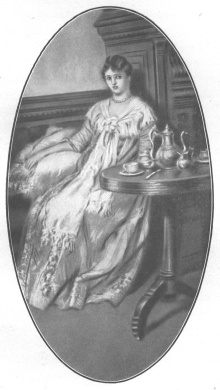
Hester Osborn
Hester did not like the pool. She thought it too lonely and silent. She preferred her beflowered boudoir or the sunny garden. Sometimes in these days she feared to follow her own thoughts. She was being pushed—pushed towards the edge of her precipice, and it was only the working of Nature that she should lose her breath and snatch at strange things to stay herself. Between herself and her husband a sort of silence had grown. There were subjects of which they never spoke, and yet each knew that the other's mind was given up to thought of them day and night. There were black midnight hours when Hester, lying awake in her bed, knew that Alec lay awake in his also. She had heard him many a time turn over with a caught breath and a smothered curse. She did not ask herself what he was thinking of. She knew. She knew because she was thinking of the same things herself. Of big, fresh, kind Emily Walderhurst lost in her dreams of exultant happiness which never ceased to be amazed and grateful to prayerfulness; of the broad lands and great, comfortable houses; of all it implied to be the Marquis of Walderhurst or his son; of the long, sickening voyage back to India; of the hopeless muddle of life in an ill-kept bungalow; of wretched native servants, at once servile and stubborn and given to lies and thefts. More than once she was forced to turn on her face that she might smother her frenzied sobs in her pillow.
It was on such a night—she had awakened from her sleep to notice such stillness in Osborn's adjoining room, that she thought him profoundly asleep—that she arose from her bed to go and sit at her open window.
She had not been seated there many minutes before she became singularly conscious, she did not know how, of some presence near her among the bushes in the garden below. It had indeed scarcely seemed to be sound or movement which had attracted her attention, and yet it must have been one or both, for she involuntarily turned to a particular spot.
Yes, something, someone, was standing in a corner, hidden by shrubbery. It was the middle of the night, and people were meeting. She sat still and almost breathless. She could hear nothing and saw nothing but, between the leafage, a dim gleam of white. Only Ameerah wore white. After a few seconds' waiting she began to think a strange thing, though she presently realised that, taking all things into consideration, it was not strange at all. She got up very noiselessly and stole into her husband's room. He was not there; the bed was empty, though he had slept there earlier in the night.
She went back to her own bed and got into it again. In ten minutes' time Captain Osborn crept upstairs and returned to bed also. Hester made no sign and did not ask any questions. She knew he would have told her nothing, and also she did not wish to hear. She had seen him speaking to Ameerah in the lane a few days before, and now that he was meeting her in the night she knew that she need not ask herself what the subject of their consultation might be. But she looked haggard in the morning.
Lady Walderhurst herself did not look well, For the last two or three nights she had been starting from her sleep again with that eerie feeling of being wakened by someone at her bedside, though she had found no one when she had examined the room on getting up.
"I am sorry to say I am afraid I am getting a little nervous," she had said to Jane Cupp. "I will begin to take valerian, though it is really very nasty."
Jane herself had a somewhat harried expression of countenance. She did not mention to her mistress that for some days she had been faithfully following a line of conduct she had begun to mark out for herself. She had obtained a pair of list slippers and had been learning to go about softly. She had sat up late and risen from her bed early, though she had not been rewarded by any particularly marked discoveries. She had thought, however, that she observed that Ameerah did not look at her as much as had been her habit, and she imagined she rather avoided her. All she said to Lady Walderhurst was:
"Yes, my lady, mother thinks a great deal of valerian to quiet the nerves. Will you have a light left in your room to-night, my lady?"
"I am afraid I could not sleep with a light," her mistress answered. "I am not used to one."
She continued to sleep, disturbedly some nights, in the dark. She was not aware that on some of the nights Jane Cupp either slept or laid awake in the room nearest to her. Jane's own bedroom was in another part of the house, but in her quiet goings about in the list shoes she now and then saw things which made her nervously determined to be within immediate call.
"I don't say it isn't nerves, mother," she said, "and that I ain't silly to feel so suspicious of all sorts of little things, but there's nights when I couldn't stand it not to be quite near her."
The Lime Avenue was a dim, if lovely, place at twilight. When the sun was setting, broad lances of gold slanted through the branches and glorified the green spaces with mellow depths of light. But later, when the night was drawing in, the lines of grey tree-trunks, shadowed and canopied by boughs, suggested to the mind the pillars of some ruined cathedral, desolate and ghostly.
Jane Cupp, facing the gloom of it during her lady's dinner-hour, and glancing furtively from side to side as she went, would have been awed by the grey stillness, even if she had not been in a timorous mood to begin with. In the first place, the Lime Avenue, which was her ladyship's own special and favourite walk, was not the usual promenade of serving-maids. Even the gardeners seldom set foot in it unless to sweep away dead leaves and fallen wood. Jane herself had never been here before. This evening she had gone absolutely because she was following Ameerah.
She was following Ameerah because, during the afternoon tea-hour in the servants' hall, she had caught a sentence or so in the midst of a gossiping story, which had made her feel that she should be unhappy if she did not go down the walk and to the water-side,—see the water, the boat, the steps, everything.
"My word, mother!" she had said, "it's a queer business for a respectable girl that's maid in a great place to be feeling as if she had to watch black people, same as if she was in the police, and not daring to say a word; for if I did say a word, Captain Osborn's clever enough to have me sent away from here in a jiffy. And the worst of it is," twisting her hands together, "there mayn't be anything going on really. If they were as innocent as lambs they couldn't act any different; and just the same, things might have happened by accident."
"That's the worst of it," was Mrs. Cupp's fretted rejoinder. "Any old piece of carving might have dropped out of a balustrade, and any lady that wasn't well might have nightmare and be disturbed in her sleep."
"Yes," admitted Jane, anxiously, "that is the worst of it. Sometimes I feel so foolish I'm all upset with myself."
The gossip in servants' halls embraces many topics. In country houses there is naturally much to be said of village incidents, of the scandals of cottages and the tragedies of farms. This afternoon, at one end of the table the talk had been of a cottage scandal which had verged on tragedy. A handsome, bouncing, flaunting village girl had got into that "trouble" which had been anticipated for her by both friends and enemies for some time. Being the girl she was, much venomous village social stir had resulted. It had been predicted that she would "go up to London," or that she would drown herself, having an impudent high spirit which brought upon her much scornful and derisive flouting on her evil day. The manor servants knew a good deal of her, because she had been for a while a servant at The Kennel Farm, and had had a great fancy for Ameerah, whom it had pleased her to make friends with. When she fell suddenly ill, and for days lay at the point of death, there was a stealthy general opinion that Ameerah, with her love spells and potions, could have said much which might have been enlightening, if she had chosen. The girl had been in appalling danger. The village doctor, who had been hastily called in, had at one moment declared that life had left her body. It was, in fact, only Ameerah who had insisted that she was not dead. After a period of prostration, during which she seemed a corpse, she had slowly come back to earthly existence. The graphic descriptions of the scenes by her bedside, of her apparent death, her cold and bloodless body, her lagging and ghastly revival to consciousness, aroused in the servants' hall a fevered interest. Ameerah was asked questions, and gave such answers as satisfied herself if not her interlocutors. She was perfectly aware of the opinions of her fellow servitors. She knew all about them while they knew nothing whatsoever about her. Her limited English could be used as a means of baffling them. She smiled, and fell into Hindustani when she was pressed.
Jane Cupp heard both questions and answers. Ameerah professed to know nothing but such things as the whole village knew. Towards the end of the discussion, however, in a mixture of broken English and Hindustani, she conveyed that she had believed that the girl would drown herself. Asked why, she shook her head, then said that she had seen her by the Mem Sahib's lake at the end of the trees. She had asked if the water was deep enough, near the bridge, to drown. Ameerah had answered that she did not know.
There was a general exclamation. They all knew it was deep there. The women shuddered as they remembered how deep they had been told it was at that particular spot. It was said that there was no bottom to it. Everybody rather revelled in the gruesomeness of the idea of a bottomless piece of water. Someone remembered that there was a story about it. As much as ninety years ago two young labourers on the place had quarrelled about a young woman. One day, in the heat of jealous rage one had seized the other and literally thrown him into the pond. He had never been found. No drags could reach his body. He had sunk into the blackness for ever.
Ameerah sat at the table with downcast eyes. She had a habit of sitting silent with dropped eyes, which Jane could not bear. As she drank her tea she watched her in spite of herself.
After a few minutes had passed, her appetite for bread and butter deserted her. She got up and left the hall, looking pale.
The mental phases through which she went during the afternoon ended in her determination to go down the avenue and to the water's side this evening. It could be done while her ladyship and her guests were at dinner. This evening the Vicar and his wife and daughter were dining at the Manor.