Volume 2 — CHAPTER V.
Reading edition
1761 — DEATH OF ADMIRAL BOSCAWEN—CORRESPONDENCE WITH LORD BATH — CORONATION OF GEORGE III. — IN LONDON, AT SANDLEFORD, AND AT TUNBRIDGE WELLS.
1761
Matthew Robinson, Mrs. Montagu’s eldest brother, who had been member for the borough of Canterbury, did not propose to offer himself for re-election to the new parliament, but presented the Canterbury address to the new king at Court. He was clad in such a peculiar and uncourtierlike garb that his sister writes to her husband at Newcastle—
“I am glad he is gone into the country, but he has made a most astonishing appearance at court with the Canterbury address. Morris says he hears of nothing else. I wish the Beefeaters had not let him pass the door. Lord Harry Beauclerc on the buzz his appearance occasioned, desired the people to be quiet, for that he had never seen the gentleman so well dressed before.”
ADMIRAL BOSCAWEN ILL
Mr. Montagu, having attended the Durham election in favour of Sir Thomas Clavering, was preparing to go to Huntingdon for his own re-election. In Mrs. Montagu’s next letter she says—
“I told you in my last that Admiral Boscawen was ill of a fever, I hope he is out of danger. The noble admiral does not fight so well with a fever as he does with the French; he will not lye in bed, where he would soonest subdue it. Poor Mrs. Boscawen is very anxious and unhappy about the Admiral, and indeed the loss to her and her children would be as great as possible.”
In this letter she remarks upon having heard from Mrs. William Robinson, her sister-in-law, from Lisbon dated November 12: “they are all well, and going on to Madrid.” “They” were the Rev. William Robinson, his wife, and her brother, Mr. Richardson, who, being in bad health, was ordered abroad, and was going to Italy. On December 20, Admiral Boscawen is reported as out of danger, but on the 27th Mrs. Montagu writes—
“His fever still hangs upon him, his strength is quite subdued; any sudden attack, any degree more of fever, and my dear Friend loses a good husband, her children a fond father, their situation in life will suffer a grievous alteration, and the publick will be deprived of a man who serves it with zeal and ability and is always more tender of the honour of his country than of his own person.”
The admiral had a relapse, and Mrs. Montagu, with her husband’s permission, flew to see her friend, but, to avoid alarming the admiral, slept at Mr. Botham’s at Albury. She, however, returned to London, as the admiral could not bear his wife out of his sight, and begrudged any friend taking her away from him for an instant. In this same letter she mentions that old Mr. Wortley Montagu was very ill.
Dr. Monsey, who himself was very unwell, wrote on January 9 to tell Mrs. Montagu he was sure the admiral would not recover; he begs her to remember it is God’s will, and “to try and guard Mrs. Boscawen’s mind and let money and the world be thrown into the Coal Hole.”
DEATH OF ADMIRAL BOSCAWEN
The admiral expired on January 10 at 7 a.m. He died of a putrid fever, and before death sent for his sister, Mrs. Frederick, to desire her to take his wife and children to London the moment he was dead. Mrs. Montagu went at once to her friend to endeavour to comfort her. Mr. Montagu, with his characteristic kindness, begged Mrs. Boscawen to go to Hill Street, but she remained at the Admiralty. Mrs. Montagu writes of her on January 17—
“I thank God her mind is very calm and settled, she endeavours all she can to bring herself to submit to this dire misfortune; I know time must be her best comforter, so that I oppose her lamentations rarely and gently, but when they continue long, set before her the merit of her five children, the want they will have of her, and the comfort she may derive from them.... Mr. Boscawen has left all his fortune, except a purchase he made in Cornwall, to Mrs. Boscawen at her entire disposition, the land in Cornwall he has left her only for life, and then to his eldest son. This estate cost but £10,000, and so is a small part of his fortune, so that the children are entirely dependent on her. I hear old Mr. Wortley can last but a very short time. It is supposed Lady Mary will come to England.”
DEATH OF OLD MR. WORTLEY MONTAGU
Writing to her husband, still at Newcastle, at the end of January, Mrs. Montagu says—
“I believe it will be agreeable to you to hear that Lord Sandwich called on me this morning to desire me to write you word that he hopes that the second week in February you will be ready for Huntingdon; his Lordship says he will give you only two days’ trouble, one to canvass, another to be elected.... Mr. Wortley Montagu dyed last night, the disposition of his effects not known as yet, by next post you shall hear.”
In her next letter she says—
“I have had a full account of Mr. Wortley’s will, it runs thus:—‘To his son £1000 per annum rentcharge,’ with an order it should not be liable to his debts, which by-the-bye is nonsense. The Leicestershire estate, we know to our sorrow is his. If the present wife[313] dyes and he has legitimate issue, that issue is to have the Wortley estate. In case he has not such issue, then the whole of his personal and real estate is to go to Lady Bute’s second son, he taking the noble name of Wortley. Two thousand pounds apiece indeed to each of Lady Bute’s younger children! The old gentleman’s wealth is reckoned immense.”
In another letter his estate is stated to be £800,000 in money, and £17,000 per annum in land, mines, etc.!
Mr. Montagu writes in reply to this—
“I am extremely sorry that Mr. Wortley has made such a will as you mention. I think he has been unworthy of being a Father. I cannot pretend to say but his son gave him too good reason to take care he should not waste and consume his estate, it was mine and the opinion of others that, as the phrase is, he would have tyed him up, but if he had done it in the literal sense he would have been less cruel to him; this poor man was not without very good parts, he was greatly altered; if he had done kindly by him, it was not impossible that he might have been reclaimed and have yet made some figure in life. What is now to become of him I don’t know. I suppose he is not to come into Parliament again, and if so I cannot see what he can do but leave his native country, and live in perpetual banishment abroad. I cannot but greatly commiserate this poor man, and reflect with horror on his cruel unrelenting parent.”
On February 15 Mr. Montagu writes from Hinchingbrooke, as he spells it—
“My Dearest,
“We got here on Friday night. Our canvassing the town is put off to Tuesday. Lord Hinching[314] is here, who is much grown and every way improved. My Lord has made considerable alterations to the house, and by the addition of two or three rooms is very convenient, and he says without much expense.... Calling at Barnet j heard poor Wortley’s stock upon his farme was the day before sold by auction, and fetched a thousand pounds, which j fear will be devour’d by the creditors.”
“MONTAGU MINERVA!”
Soon after this Mr. Montagu joined his wife in Hill Street. A folio letter from James Stuart[315] (Athenian Stuart) ends the month of February. In it he represents himself as an English horse—a hunter dragging Greek treasures to Mrs. Montagu, whom he addresses in verse as—
“Fairest and best! hail Montagu Minerva! Smile on my labours. Say that my rich freightage Amply deserved the Price and Pains it cost. So that the Muses thy companions dear, The Graces and the Virtues all approve My bold Emprise: And end at once and recompense my toil.”
VOLTAIRE’S TANCRED
Lord Bath writes March 4, 1761—
“Madam,
“I am sorry that I cannot wait on you this evening, being engaged to go to Lady Strafford’s,[316] and afterwards to Lady Darlington’s[317] to play at cards; but on Saturday I will have the honour to call on you and stay the evening with you, if you are not otherwise engaged, and your feverish disorder will allow you to come down stairs. I have sent for your amusement Voltaire’s Tancred, which has many fine lines in it, but the speeches are too long, as they generally are in French Plays. When I have the honour of waiting on you I will bring with me Emin’s letter.
“I am, Madᵐᵉ,
“Yours most truly,
“B.”
MACPHERSON’S “FINGAL”
To this Mrs. Montagu replies—
“My Lord,
“I return the Tragedy with many thanks. The character your Lordship gave of it kept up my hopes and my spirits through the long tedious speeches with which it opens, and upon the whole it appears to me to be one of the best of Voltaire’s Tragedies, as it is, what few of his are, interesting. Pompous declamation season’d with Moral reflections is surely far from the perfection of dramatick writing, tho’ in a nation too much polish’d and refin’d, it is prefer’d to the natural sallies of passion in our Shakespear, as fops love essences better than the flowers from whence they are extracted. I find in this Tragedy many petty larcenies from Corneille. The character of Aménaide is in part an imitation of the Sister of Horatius, but the Roman name supports the fierté of her character, born in any other city I should call her a termagant, there I consider her as a She Roman, the female of the Lion. The fair Amenaide is too much an esprit fort in regard to her duties to please me. She does not follow Virtue as by law establish’d, but despises forms and follows sentiment, a dangerous guide. Design’d by Nature to act but a second part, it is a woman’s duty to obey rules, she is not to make or redress them. I must confess that Aménaide is noble and heroick, and a proper mistress for a Knight Errant, whose motto is ‘l’amour et l’honneur.’ I have seen many poems form’d on the manners of Chivalry, but I never saw them before in Drama. They admit of the bombast in honour and love, which the French and Spanish Theater affect, and will furnish those brilliant sentiments they so much admire, but which indeed come better from any Muse but the pathetick Melpomène.
“I shall be very glad of the honour of your Lordship’s company on Saturday evening. I was to have gone to the play that night, but if my fever should have left me by that time, I have a cough which would be louder than Mrs. Prichard.[318] I have taken the liberty to enclose Mr. Macpherson’s proposals, and if your Lordship designs to subscribe to the work, and have not already done so, I should be very glad to have the honour of your name on my list. I have read the first canto,[319] which far exceeded my expectation. The various incidents recited take off that sameness of character which appeared in the detached pieces, and which were their greatest fault. The original Ersh is to be seen at Mr. Millar’s. I have also enclosed a letter from Edinburgh which gives an account of these poems. By this long letter I have taken some revenge upon your Lordship for not coming here last night, and now I am in perfect charity, mix’d with some compassion for the trouble I have given you.
“My Lord,
“Your Lordship’s
Most obliged and obedient Hᵇˡᵉ Serᵛᵗ,
“E.M.”
LORD BATH’S LETTER TO MRS. CARTER
At this period Mrs. Montagu and Mrs. Carter went to stay with Lord Bath at Ives Place.[320] Dr. Monsey was to have accompanied them, but he was suffering with acute pain in his back, for which Dr. Gataker gave him a plaister, which he said would pull his head to his back.
Lord Bath writes to Mrs. Montagu the following:—
“Madam,
“I am going to entrust you with a most prodigious secret; and in order to engage you the better to keep it, must desire you to be a joynt agent with me in conducting it, and carrying it on, and yet it is not every woman neither that can keep that very important secret of joynt agency, but you, I am very sure, will be true to me when I tell you what it is. You must know, Madam, that I have a great desire of making a small present to Mrs. Carter, to make her fine, when she comes to Tunbridge, and I must beg of you to take the trouble of buying the silk or Damask, or what you please, and in order to engage her to have no difficulty or scruples in accepting it, I will send with it the following letter:—
“‘To Mrs. Carter.
“‘Madam,
“‘I have sent you a trifling present which I desire you will accept, and that you may have no difficulty in doing it I will tell you the plain truth. The first thing is this—I have found in my Library some books, which tho’ they may be very good ones, can be of no use to me, as they are in Greek,[321] and possibly they may be of service to you. The next thing is that I have two pounds of very bad tea, which I cannot so much as take myself, nor offer to anybody else, unless it be to you: the last thing is this: I found in the drawer of an old India Cabinet a piece of silk with this wrote in a paper upon it: Enough for a Mantua and petty coat. Now, Madam, as I neither wear a mantua nor pettycoats, I do not know what to do with it, unless you will accept of it, which you may very readily do, since you may perceive that it lays you under no manner of obligation to your, etc.
“‘Bath.’
“But after all I have said, if you think, Madam, giving you the two enclosed Bank bills of 20 pounds each to send privately to her without letting her know or guess from whom they come, may be of more real use and service to her, you may do it as you think fit, and I can venture to say of the Bank Bills just what I have done of the Greek books, that they are of little use to me, and possibly may be of great service to her, and more in that I hope than any other.
“I am, Madam,
“Your most obedient and very
humble servant,
“Bath.
“Piccadilly, April 2, 1761.
“P.S.—I am afraid you will be puzzled at first to know what all this nonsensical stuff can mean, but you may remember that when you were at Ives Place, I mentioned something of this kind to you.”
GOING TO WELLWYN
Mrs. Montagu and Mrs. Carter proposed a visit to Dr. Young at Welwyn, and on April 9 he writes as follows—
“Dear Madam,
“Your letter, etc., lay me under great obligations, but the greatest lies in the kind promise you make me that I shall kiss the hands of two fair Pilgrims at Wellwyn. I hope they are too much Protestants to think there is anything sacred in the shrine you speak of. I have too many sins beside, to pretend that I am a Saint. Was I a Saint and could work miracles I would reduce you two ladys to the common level of your sex being jealous for the credit of my own; which has hitherto presum’d to boast an usurp’d superiority in the realms of genius and the letter’d world. For you, Madam, I shall say nothing, for who can say enough? Miss Carter has my high esteem for showing us in so masterly a manner that Christianity has a foil in one of the brightest jewels of Pagan Wisdom, a jewel which you will allow she has set in gold. Might not such an honour from a fair hand, make even an Epictetus proud without being blamed for it? Nor let Miss Carter’s amiable modesty become blameable, by taking offence at the truth, but stand the shock of applause, which she has brought upon herself; for tho’ it pains her, it does credit to the publick, and she should support it patiently, as her Stoical Hero did his broken leg. I rejoice that you are recovered; I too, Madam, have been very ill of late, and stand in no small need of a cordial: hasten therefore your favour, which the sooner it is, will be the kinder to, dear Madam,
“Your most obedient
and obliged, humble servant,
“E. Young.”
On April 28 Lord Bath writes to Mrs. Montagu—
“Madam,
“I would sooner have answer’d your letter, and sent you back the enclosed Dialogue, but that I went out to take the air in my chaize. You may depend upon my secrecy, but should it ever be published, it will be known to be yours, because nobody can write like it. I will endeavour to wait on you when you return from Dr. Young’s, unless I go to Ives Place for a day or two.
“I am, with the greatest regard and truth,
“Your most humble and obedient servant,
“Bath.”
ANOTHER DIALOGUE OF THE DEAD — BERENICE V. CLEOPATRA — THE “WORLD WELL LOST!”
This is the dialogue which I believe has not yet been published:—
“Berenice and Cleopatra.”
Berenice. The similitudes and dissimilitudes of our fortune have long made me wish to converse with you, if the charming, the victorious Cleopatra by her lover prefer’d to glory, to empire, to life, will deign to hold converse with the forsaken, the abandon’d, the discarded Berenice.
Cleopatra. The scorns of Octavius, the bite of the aspic, the waters of Lethe have so subdued my female vanity, that I will own to you I greatly suspect my greater success with my lover did not arise so much from my charms as in my skill of management of them.
Berenice. I can scarce understand you. Beauty and love I thought to be the greatest attractions. In the first you must have excell’d me, but in the second you certainly could not: I had beauty, youth, regal dignity, and an elevated mind. I was distinguished by many qualities and accomplishments which were so dedicated to my Lover, that of all I had been and all I could be, I was, I would be, only l’amante of Titus. I thought the next person in merit and dignity to Titus himself was the woman who ador’d him, and I was more proud of the homage I paid him, than of all I had receiv’d from lovers or subjects. But you, Cleopatra, had loved Cesar before Anthony, and other passions besides the gentle one of love seemed still to have your heart. Yet for you Anthony despised the dangers of war, the competition of a rival in Empire, the motives of military glory, and the resentment of a Senate and people not yet taught to submit to or flatter the passions of a master. Over these you triumph’d; but I was sacrificed to the low murmurs of the people, and the cautious counsels of gray-headed Statesmen. Was it that Minerva desired to triumph over Venus in the noblest and gentlest heart that ever was contain’d in the breast of mortal? Tell me, Cleopatra, for 1700 years have not made me forget my love and my grief?
Cleopatra. I have often with attention listen’d to your story; and your looks, on which still remain the sadness of a lover’s farewell, move my compassion. I wish I could have assisted you with my counsels when Titus was meditating your departure. I would have taught you those arts by which I enslaved the Soul of Anthony, and brought Ambition and the Roman Eagles to lye at my feet.
Berenice. Your arts would have been of little service to me, I had no occasion to counterfeit love. From Titus’s perfection one learn’d to love in reality beyond whatever fiction pretended; no feigned complaisance could imitate my sympathy; if he sigh’d I wept, if he was grave I grew melancholy, if he sicken’d I dyed. My heart echoed his praises, it beat for his glory, it rejoiced in his fortunes, it trembled at his dangers.
Cleopatra. Indeed, Berenice, you talk more like a Shepherdess than a great Queen. You might perhaps in the simplicity of pastoral life have engaged some humble Swain, but there was too much of nature and too little of art in your conduct, to captivate a man used to flattery, to pleasures, to variety. I find you was but the mirror of Titus, you gave him back his own image, while I presented every hour a new Cleopatra to Anthony. I was gay, voluptuous, haughty, gracious, fond and indifferent by turns; if he frown’d on me, I smiled on Dollabella; if he grew thoughtful, I turn’d the Banquet to a Riot. I dash’d the soberness of counsels by the vivacity of mirth, and gilded over his disgrace by show and magnificence; if his reason began to return, I subdued it by fondness, or disturb’d it by jealousy. Thus did I preserve my conquest, establish my fame, and put Anthony first in the list of
“all the mighty names by love undone.”
Had I only wept when honour and Octavia call’d him home I might have been the burthen of a love ballad, or subject of a tender Elegy, who now am the glory of our sex, and the great instance of beauty’s power. Do not you wish you had used the same managements?
Berenice. I might have used them had I loved the same man: Cleopatra, the coquette was a proper mistress for the Reveller Anthony; but the god-like Titus, the delight as well as Master of Mankind, left no part of the heart unengaged and at liberty to dissemble. What had not yielded to his wisdom, submitted to his witt, was subdued by his magnanimity, or won by his gentleness; when affection does not vary, behaviour cannot change; and methinks Anthony should have quitted you from distrust of your love, and Titus have retain’d me from confidence in mine. After what you have told me, I am more than ever surprised at your fate and my own.
Cleopatra. If you want this explain’d ask Eneas, Theseus, Jason, and the infinite multitude of faithless lovers, but if my authority will pass, believe me Anthony was preserved by his doubt of my love, and Titus was lost by his confidence in yours. Do not look so concern’d. From the era of your disaster to this very day you will find every faithful and fond Berenice discarded, while the gay, vain, and capricious fair one is to her Anthony a Cleopatra and the “world well lost.”
From the following letter of Dr. Young’s to Mrs. Montagu it would appear that she had sent this dialogue for him to read.
“Dear Madam,
“I hope you will allow that a curiosity is better than a good thing. I send you a paper which may be called a curiosity, as it is printed, but not for the publick, only for your ease in perusing it.
“I much thank you for the bright specimen of genius you was so kind as to send me. I admire it as much as you. I hope you are recover’d of the Indysposition you mention’d in your Last, and that you, the cloud remov’d, will continue to shine on,
“Dear Madam,
“Your most obedient
and Humble Servᵗ,
“E. Young.”
“May 26, 1761.”
LIKENESS TO FREDERICK THE GREAT
Emin, from “Standgate Creek, on board of the ship Northumberland,” writes on May 5 to Mrs. Montagu, addressing her thus—
“To the wisdom of Europe, sister to the great King of Prussia, excellent Mrs. Montagu.”
Not only did he think Mrs. Montagu equal in cleverness to Frederick the Great, but he considered her forehead and eyes like his, to the great indignation of Lord Bath and Dr. Monsey, who pronounced it impossible she should resemble so bloodthirsty a character.
Mrs. Carter took leave of Mrs. Montagu on May 18, and that very evening Mrs. Montagu writes to her—
“You left London only this morning, and I am writing to you to-night; does it not seem unreasonable? I hope not, as you must know there are habits which it is hard to break, and alas! I was in the habit of conversing with you every day. I feel like a traveller, who by the chearfull light of the Sun has pleasantly pursued his day’s journey, but seeing it below the horizon, enjoys and would fain prolong the twilight, which tho’ it has not the warmth and lustre of the noon-day, yet is a kind interposition between it and the gloom of the night.”
She dates her letter from Ealing, where she had gone to the Botham’s for the night, “imagining I should hear your tones better from the nightingale than in the din and chatter of London.” So much did Mrs. Carter value Mrs. Montagu’s letters that she always noted the day and year of their reception of them, which is a great help to an editor in compiling, as many of Mrs. Montagu’s letters are undated. In the end of this letter she mentions that she is returning to London next day to spend the evening with Mrs. Boscawen, who was to leave the Admiralty that day for her new house.
“She will be too apt to reflect on the change of her condition upon such an occasion, and the less time she has to dwell on the subject the better. Alas, how few people are there so happily situated that they can intrepidly look on their condition! Mr. Melmoth[322] made me a visit this evening. I exhorted him to give his leisure hours to the publick, and hope he will do it, as his health is now much improved.”
LORD BATH’S HOUSE IN PICCADILLY
A most curious anonymous letter to Lord Bath concerning his house in Piccadilly, dated June 5, 1761, is next in order. The handwriting is large and bold.
“My Lord,
“A zeal for the glory of the Nation and of the town, also of your Lordship, induces me to recommend to you to modernize your house in Piccadilly, at least externally, by facing it with stone or Stucco, as brick has an ignoble appearance, and is considered by foreigners only fit for a Maison bourgeoise; a Portico with a Rampe,[323] as at the Hotels of Prince Eugene and Swartzenburg at Vienna, unites Conveniency, Elegance, and Grandeur, as chairs and coaches can go up the Rampe and under the Portico, whereas a Perron[324] or open steps are always inconvenient, and often dangerous in snowy, wet, and frosty weather. I hope that your Lordship will give a Proof and monument of your Taste, Spirit, and Generosity in architecture, contributing thereby to the embellishment of the Metropolis. A House of Distinction sho’d be always insulated without any Building contiguous thereto, which insulation has many advantages.
“I have the Honour to be, with Respect,
“Etc.
“June 5, 1761.”
THE BRITISH MUSEUM
The British Museum, containing the library and collection of Sir Hans Sloane, the Cottonian and Harleian MSS., etc., had been established in Montagu House, bought of the Earl of Halifax, and opened in 1759. The following letter from Mr. Charles Morton, the curator, will show the conditions under which the Museum was then shown. The Earl of Halifax, who had owned Montagu House, was a cousin of Mr. Montagu’s.
“To Mrs. Montagu.
“Madam,
“I am extremely sorry not to have received the Honour of your Message before eleven o’clock last night, being detained abroad by Business till that Time. I flatter myself, however, that the affair you mention will not have suffered by my absence; for on fridays and mondays the Museum is open in the afternoon only, at the Hours of four and six, calculated to accommodate for a few months persons of a different class, and on Saturdays the Museum is shut up. I have therefore secured places for Mrs. Montagu and her company for Tuesday sennight, at one o’clock, and promise myself the Pleasure to send the Tickets on Wednesday next, unless the Time I have engaged should be inconvenient to you; in which latter case, I beg the Honour of a note to-morrow some time before noon.
“Madam, I remain, with great respect,
“Your most obedient
and most humble Servant,
“Chas. Morton.
“Montagu House, June 7, 1761.”
A COUNTRY GENTLEWOMAN — GESNER’S “MORT D’ABEL”
From Sandleford, on June 23, Mrs. Montagu writes to Mrs. Carter—
“Dear Madam,
“I told you in my last that I was going to take a flight into Berkshire; and here I have been ever since Friday evening, leading a Pastoral life in the finest weather I ever saw. Tho’ the most sage Horace says we change our climate without changing our disposition, I must be of another opinion, for by only the difference of latitude and longitude between Hill Street and Sandleford I am become one of the most reasonable, quiet, good, kind of country gentlewoman that ever was. In the days when misses employ’d their crimping and wimpling irons upon cheese-cakes and tarts, not on flounces and furbelows, and matrons used no rouge, but a little cochineal to give a fine colour to a dried neat’s-foot tongue, they could not be further from the temper and qualities and conditions of a fine lady than your humble servant at this present writing. My health is much improved by the country air; I saunter all day, and when Phœbus sets in the material world, he rises in the Intellectual; then I sit down to read what he has inspired, and I find the amusements of the day here prepare me well for my evening’s lecture....
“The mention of poetry puts me in mind to tell you I am very well satisfied with the share of praise you give to Cowley.[325] He had a rich vein of thought, but being too ostentatious of it, we are disgusted at the proud display of his treasures, as at the pomp of a rich man, when it goes beyond the bounds modesty and a sound judgment should set to it. I agree with you that his love verses are insufferable. I think you and I who have never been in love, could describe it better were we ask’d, what is it like? I think some of his verses, like Anacreon, very pretty, and the verses by the god of love in honour of Anacreon are very pretty tho’ a little too long. I think you was too temperate in your commendation of ‘La Mort D’Abel.’[326] I was infinitely delighted with it as a work of genius. On your recommendation I lent it to my Lord Lyttelton, who sent it back with great approbation. But to be sincere in spite of you both, some silly prejudices against the Author and the language the poem was originally written in, a little damped my expectations, and the beginning, in which he imitates Milton, with all the faintness of reflected beams, make me advance very soberly. But what a feast is the Patriarchal dinner! How sweetly innocent their manners! Eve’s horror at the first storm, her surprize at Adam’s fastening up the mouth of the cave, concern at the first sight of death, which is finely supposed to seize a dove, because in that animal only could the grief of a surviving friend be shown, with ten thousand other circumstances in hers and Adam’s narration, all so natural and yet so new that I must call Mr. Gesner a Poet. A Poet should create, but he should not make monsters. I think our Author has not the sublime, but his genius suits his subject. What a noble piety! what a purity of heart in Abel! and how finely is his character contrasted with Cain’s. Abel’s are virtues of disposition and temper in a great degree, and so are Cain’s vices, which rightly imagined in a state of life where example and discipline could not have so much influence as in a larger society and more mix’d life. Milton’s and Mr. Gesner’s pastoral scenes are so ennobled and refined by Religion, that the Shepherds and Shepherdesses who worship the wanton Pan and drunken Silenus, make a mean figure when compared to them. I agree with you in liking Mr. Gesner’s Pastorals extreamly, but let him still keep to the more than golden age of the Poets. I would fain propose to him to take the story of Joseph next. He has a fine genius for Drama! The last three books of Abel make a noble tragedy. Did you not drop a tear at the lamentation of Cain’s children over Abel’s body? Il ne se reveillera plus! Il ne se reveillera plus! How simple! how natural! how affecting! What a witchcraft is there in words! repeat, il est mort, it is nothing, but the simplicity of children who had not a name for death and the words at once signifying the circumstance is very touching.... I have taken a house at Tunbridge from the 3rd of July. I hope my dear friend will be ready to come to me. I shall send the post-chaize to you as soon as I am at Tunbridge.
“I am, my dear Madam,
“With most sincere and tender affection,
“Yours,
“E. Montagu.”
GOING TO TUNBRIDGE — CHARACTER OF LORD BATH
Writing from Sandleford on June 26 to Mrs. Scott, Mrs. Montagu mentions that she is going to Tunbridge
“for 6 or 7 weeks perhaps, and the rest of the summer I shall pass at Sandleford, except my excursion to Bath Easton. Mrs. Carter is to come to Tunbridge to me as soon as I get thither, and, I hope, stay with me the whole season. I was so fortunate as to enjoy her company much longer in town this year than usual, but that only makes me wish the more to have her again. She was not in the house with me in town, preferring the quiet of a lodging to herself, and indeed it would not be any delight to Mr. Montagu to have her in the house; tho’ he says she would be a good sort of woman if she was not so pious.[327] My Lord Bath told me he was to go to Bath on Wednesday, the day we dined with him....
“I shall have Mrs. Boscawen for my neighbour at Tunbridge; she is to be at Sir Sydney Smythe’s, only three miles from the Wells. Lady Frances Williams is in the deepest affliction for Lady Coningsbye.[328] To show the last respect to her, Lady Frances staid in the house with the dead body in spite of all her friends could do; she did not leave Lady Coningsbye’s house till last Saturday; she has been so singularly unfortunate that, had she not the strongest piety and the strongest reason to support her, she must sink under the repeated strokes of affliction.... I suppose you have read Dr. Hawkesworth’s[329] ‘Oriental Tales,’ it is not written with so much spirit as the Oriental tales in ‘the Adventurer’ which were by him, but there are some fine things in it.... I have heard my Lord Bath speak with great regard for you and Lady Bab Montagu. I believe we shall call on him on Monday, on our way to London. We were asked to dine or lye there in our journey down, and at our return. He has recovered his health and spirits and is the most delightfull companion imaginable. I think he has great good qualities, and I do not perceive the least of that covetousness which was attributed to him while his wife lived; he lives nobly, entertains generously, and I know many acts of generosity he has done, and I have known them from the report and acknowledgements of the persons obliged, for by his behaviour to such of them as I have seen at his house you would think he had received favours from them, which nobly enhances the benefit. He seems to have the strongest sense of Religion, and on all occasions to show it without the ostentation of one who wants to be praised for piety, nor does he ever in the gayest of his conversation forget the respect due to every moral duty. It would give one pain to discover any faults in one who has such extraordinary perfections and endowments, and I think his Lordship has outlived the errors which the hustling of a mighty Spirit may in youth have led him: as to his consort, she was, in Milton’s phrase, a cleaving mischief in his way to virtue.
“I am glad Lord Bath is to be at Tunbridge. Mrs. Carter is a great favourite, and I hope we shall have a good deal of his company.”
She winds up her letter with high commendation of Gesner’s “Death of Abel” mentioned before.
BLIND MAN’S BUFF
Dr. Young now writes—
“Dear Madam,
“You and I are playing blind man’s buff; we both fancy we are catching something, and we are both mistaken. You say you have sent me two somethings, and I have not received so much as one, and you expected one from me, which is not yet come to your hand, which will kiss your hand this week, and if you are at the trouble of reading it over you will find a sufficient excuse for my delay. By what you say in your kind letter, you give me a very keen appetite for both the books which you promise. I have heard nothing yet of the time of my going to Kew: when I am there I shall make it my endeavour to enjoy as much of you as I can. I have been in very great pain with my rheumatism for some time, but now, I bless God, I hope the worst is over. May health and peace keep company with that benevolence and genius which are already with you.
“I am, dear Madam,
“Your much obliged
and most obedient humble Servt.,
“E. Young.
“Mrs. Hallows[330] sends her best respects.
“Wellwyn, the 2nd July, ’61.”
Dr. Young’s allusion to Kew was the fact that he had recently been appointed Clerk of the Closet to the Princess Dowager of Wales.
THE FUTURE QUEEN
On July 7 Mrs. Montagu started for Tunbridge Wells, and on the following Monday sent her post-chaise to fetch Mrs. Carter, and Lord Bath arrived from London on the same day. Mr. Montagu, who was going to Sandleford for a while, mentions in a letter of July 11 to his wife that
“there was a great appearance of the privy council when the King declar’d his intention of demanding the Princess of Mecklenburgh in marriage, a request that can never be denied. The family is ancient, and the blood high, but I suppose the Dukedom not very rich, but this may be helped with subsidies, etc., but this is not much to be grudged if by making our young Monarch happy it contributes to that of the Nation, tho’ Princes are under a disadvantage from which their subjects are free, of marrying those whom they have never seen or convers’d with, still I hope there is reason to be believed that this alliance, as it was of the young Monarch’s choosing and not of the imposing of a Father, and as money, etc., is out of the case, that care has been taken by those employ’d to give a true information both of the perfections of the mind and body of this Princess, and he will be happy.”
Mr. Montagu adds that the pictures at Newbold Verdon were to be sold for Mr. Edward Wortley-Montagu’s debts, but that a list of them had been sent to him by Mr. E. Wortley-Montagu, who desired to know which he would accept of as a present. Mr. Montagu had marked his brother’s portrait (Mr. James Montagu), and asks his wife to say if there were any she wished for. Very probably the picture by Sir Peter Lely of the first Earl of Sandwich, Mr. Montagu’s grandfather, which I possess, came from there.
Lord Bath conveyed Mrs. Montagu and Mrs. Carter “to Mr. Pratt’s[331] place, call’d Bayham Abbey, which I believe you once saw with Mr. Pitt. The ruins of the Abbey are very noble. Tho’ the Gothick buildings have not in their time of utmost perfection the beauty of the Græcian; time seems to have a greater triumph in the destruction of strength than of grace.... I have just now the pleasure of hearing Pondicherry[332] is taken. I hope this will depress the spirits of the French.... Lord Bath and Lord Lyttelton and Mrs. Carter and Doctor Smythe and many others desire their compliments.”
On July 20 Dr. Stillingfleet writes from Stanlake, Berks, the seat of his friend, Richard Neville Aldworth, expressing his regret that he cannot accept Mrs. Montagu’s kind invitation to Tunbridge Wells, as his friend, Mr. Aldworth, had made him promise to spend a summer with him at Stanlake. “This friend has had his constitution broken so by the gout, that he is become a valetudinarian, and therefore I can the less think of leaving him. He is ordered by his Physician to drink the Sunning Hill Waters, and we are going there as soon as he is able.” Mr. Aldworth was an ancestor of Lord Braybrooke’s.
MR. RICHARDSON’S DEATH
Mr. Richardson, the author of “Clarissa Harlowe,” etc., died on July 4, to the great grief of Dr. Young, who was a bosom friend of his. Mrs. Montagu bade Dr. Young come to Tunbridge to cheer his spirits. He writes—
“Dear Madam,
“On your very kind invitation I have inquired if it is in my power to accept of it, but I am not yet satisfied in that point. Probabilities will not excuse me if her R. H. should go to Kew. I should be very happy to be with you. I have so much to say to you that at present I shall say nothing. You will hear further of me in a little while. I beg my humble service to Mrs. Carter. May the Waters continue to be as serviceable to you as I would be if it was in my power.
“I am, dear Madam,
“Your obliged
and most obedient humble Servt.,
“E. Young.
“July 21, 1761.”
“COOLING STANZAS!”
On July 30 Dr. Young writes that he is obliged to refuse Mrs. Montagu’s kind invitation “as he had a friend with him he could not leave,” and as “her Royal Highness sent me word she would send for me when she wanted me; for these reasons I deny myself the great pleasure of waiting on you. I have ordered some Stanzas to be sent to you; they are of a cooling nature, and may qualify your waters.”
In this year (1761) a complete collection of the doctor’s works was printed.
UPON THE FUTURE QUEEN
On the 8th of July George III. had announced his intention of demanding in marriage the Princess Charlotte of Mecklenburg Strelitz; negotiations were immediately commenced. Mrs. Montagu writes from Tunbridge Wells to her husband thus—
“We are all disappointed here at hearing our new Queen is fair; the first report was that by a lively bloom she would cast a shade over the white complexions of our royal family. The sight of our brilliant Court, the salutations of our navy on her arrival, the opulent appearance of our towns, and the greatness of our capital city will astonish her. I hope her mind is more proportioned to her lot in marriage than such a situation is to her present circumstances. A noble mind will fill a great situation, and enjoy it with pleasure and gratitude, without the swellings of insolence, but such a change is dangerous where there is a mediocrity of sense and virtue. I heartily wish she may be worthy of our young King, be pleasing in the domestick scene, and great in the publick; his good nature will impart to her a share of power and a degree of confidence, and I wish for the publick she may never abuse the one, nor misapply the other. There seems not to be a very good choice of ladies about her, there is not one who is quite fit to teach her even the forms of her publick conduct, none at all equal to advise her private, ignorant as she must be of the behaviour that will be expected of her, she should have had some woman of quality of remarkable discretion, character, and politeness, whom high birth and great situation had approached as nearly as a subject can to the station of a Queen. Lady Bute would have been the properest person, but I suppose she might out of delicacy avoid putting herself about the Queen’s person, as thinking it might look like watching her, and indeed so happy as Lady Bute is in her circumstances, the slavery of personal attendance is more than anything but great ambition could pay her for. I think, however, they have chosen the ladies[333] of the bedchamber; her Majesty must consult Lady Bute upon everything.... Lord Bath always inquires after you and sends his compliments. Lord Lyttelton is gone on a party of pleasure with Mr. Selwyn.[334] This place is pretty full of I know not who. Sir Edward Dering and his family and the Lambarts breakfasted at Tunbridge, and go back again.
“I am, my Dearest,
“With the greatest gratitude
and affection, your most faithful wife,
“E. M.”
A LETTER OF ADVICE — LES BELLES LETTRES
THE FEAR OF GOD
Mrs. Montagu’s letter of advice to Mr. Thomas Lyttelton, who had now left Eton and gone to Christ Church, Oxford, though undated, may be placed here.
“Tunbridge, 28 (July?).
“Dear Sir,
“I have often check’d my inclination to write to you while you were at Eton for fear of calling you off from your school exercises; but as you are now in a situation, where there is a vacancy of business and pleasure, I do not feel the same scruples, may write you long letters, and expect full answers to them. However, I will be so far reasonable, that if you send me a card, to signify that you are engaged for the week, or month, to Cicero or Livy, it will be a more valid excuse to me than if, on inviting you to dinner, you told me you were engaged to a beauty or a Duchess. My love for you, my hope of you, my wishes for you, and my expectations from you, unite in giving me a respect for your time, and a deep concern for your employment of it. The morning of life, like the morning of the day, should be dedicated to business. On the proper use of that ‘sweet hour of prime’ will depend the glory of your noon of life, and serenity of the evening. Give it, therefore, dear Mr. Lyttelton, to the strenuous exertion and labour of the mind, before the indolence of the meridian hour, or the unabated fervour of the exhausted day renders you unfit for severe application. I hope you will not (like many young men who have been reckoned good scholars at Eton and Westminster) take leave of it there, and fall into the study of les belles lettres, as we call our modern books. I suppose from the same courtesy the weakest part of the rational species is styled the fair sex, though it can boast of few perfect beauties, and perhaps the utmost grace and dignity of the human form is never found in it. As you have got a key to the sacred shades of Parnassus, do not lose your time in sauntering in the homely orchards or diminutive pleasure gardens of the latter times. If the ancient inhabitants of Parnassus were to look down from their immortal bowers on our labyrinths, whose greatest boast is a fanciful intricacy, our narrow paths where genius cannot take his bounding steps, and all the pert ornaments in our parterres of wit, they would call them the modern’s folly; a name the wise farmer often gives to some spot from whence the Squire has banished the golden harvest, to trim it up for pleasure with paltry ornaments and quaint conceits. I should be sorry to see you quit Thucydides for Voltaire, Livy for Vertot, Xenophon for the bragging Memoirs of French Marshals, and the universal Tully and deep Tacitus for speculative politicians, modern orators, and the dreamers in Universities or convents. I will own that in Natural Philosophy and some of the lesser branches of learning the Moderns excel; but it would not be right for a person of your situation to strike into any private paths of Science. The study of History will best fit you for active life. From history you will acquire a knowledge of mankind, and a true judgment in politics; in moral, as well as physical enquiries, we should have recourse to experiments. As to the particular study of eloquence, I need hardly exhort you to do it; for eloquence is not only the most beautiful of all the daughters of wisdom, but has also the best dowry; and we may say of her, as Solomon did of her Mother, riches and honours are in her right hand. Elevation of sentiment and dignity of language are necessary to make an orator; modern life and modern language will hardly inspire you with either. I look upon Virtue as the muse of Eloquence, she inspired the phillippics of the Grecian and Roman Orator, her voice awakened Rome, slumbering in the snares of Catiline. Public spirit will teach the art of public speaking better than the rules of rhetoric, but above all things, the character of the orator gives persuasion, grace, and dignity to the Oration. Integrity of Manners gives the best testimony of sincerity of speech. If you form your conduct upon the sacred book which gives rules far more perfect than human wisdom could contrive, you will be an honour to religion, a support to your country, and a blessing to your family. It may seem strange that I have last mentioned what should be first regarded. The Bible alone will make a good man; human learning without the fear of God, which is the beginning of Wisdom and the knowledge of Him, which is understanding, will produce but a poor inconsistent character; but duties are enlarged and multiplied by the power and circumstances with which God has intrusted us, and in which He has placed us. Your talents and situation will fit you for public trusts; it is a duty in you to qualify yourself for them, to give your virtue every strength, and then to employ it in the service of your country in its most important interests, true religion, and good government. I hope you will excuse my having said so much, that has the air of advice to one who wants it so little, but young people are apt to be prodigal of time because they think they have so many years before them; but if life be long, the season for improvement is short.
“I hope Mrs. Fortescue[335] liked the Indian paper; it is new and uncommon, and I thought much prettier than any I could get at a moderate price. I beg my respects to her and my dear Miss Lyttelton.[336] I hear there will be a turnpike road between Oxford and Newbury, and I hope you will frequently make use of it. I shall leave Tunbridge on Monday. I have enjoyed perfect health here, and the society of some of my best friends, so you may believe I have passed the season very happily, but a happy life seems always a short one. Mrs. Carter was so good as to give me her company in my house. My Lord Lyttelton and my Lord Bath were often with us; having had their characters continually before me, you will not wonder I should think great acquirements as well as great talents necessary to make all possible perfection. I am sure you will be pleased to hear that my Lord Bath greatly approves and admires that part of my Lord Lyttelton’s history which is already printed. I believe there is not any one living whose approbation would give Lord Lyttelton so much pleasure; talents and virtues and extensive knowledge all in the highest degree join to make him a perfect judge, and his great reputation gives him a decisive authority; your Father is proud of his praise as a critick, and pleased with it on motives of friendship, which touch his heart more nearly than any where vanity has a part, tho’ he is an author and a poet. His Lordship’s Muse met him in the shades of Penshurst, and with love or flattery prompted two charming pieces, one to Mrs. Carter, and one to my Lord Bath. Mrs. Carter, Dr. Monsey and Mr. Montagu desire their compliments to you.
“I am, dear Sir,
“Your most sincere and affectionate friend
and obedient humble Servant,
“E. Montagu.”
A BLOOM-COLOURED COAT
Dr. Monsey, who had recovered from a severe illness, had joined the party at Tunbridge, and had appeared in a new bloom-coloured coat, to the amusement of the Montagu circle, who chaffed him upon it.
On August 22 Mr. Charles Morton wrote to Mrs. Montagu the following:—
“Madam,
“As I conceive the following article which I have just received in a letter from Paris, to relate to the Countess of Pomfret,[337] I thought it might be agreeable to you to acquaint Her Ladyship therewith.
“‘Monsʳ Bejot, who, since the death of the Abbé Sallier, has care of the manuscripts in the King’s Library, is a most worthy and obliging gentleman; he has promised me to have copies drawn of the curious Cuts in the beautiful Manuscript of Froissard’s Chronicle, for an English lady, a great friend to Oxford.’ This letter is dated Paris, August 1st; the writer is the Butler who travels with Mr. Howard, nephew to the Duke of Norfolk. I am much obliged to you for the Highland Poems; and have the honour to remain, Madam,
“Your most obliged and most humble servant,
“Charles Morton.
“Museum, August 22, 1761.”
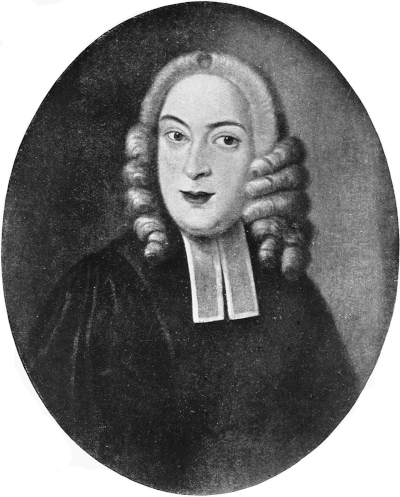
DR. EDWARD YOUNG.
DR. YOUNG
Mrs. Montagu quitted Tunbridge Wells on August 30. On September 2 she wrote to Mrs. Carter—
“I found on my table a poem on ‘Resignation’[338] by Dr. Young; he sent me a copy for you which I will send by the Deal coach.... You will be pleased I think with what he says of Voltaire, you know we exhorted him to attack a character whose authority is so pernicious. In vain do Moralists attack the shadowy forms of Vice while the living Temples of it are revered and admired.”
Dr. Young writes on September 2—
“Dear Madam,
“I was in too much haste and ordered a thing to be sent to you (which I suppose you have received) before I had read it myself. On reading it, I find my distance from the Press has occasioned many errors; so that in some parts I have had the impudence to present you with perfect nonsense.
“Page 18, Stanza 2nd, should be thus (viz.)—
“‘Earth, a cast Mistress then disgusts, etc.’
“Page 34: It should be thus (viz.)—
“‘Receive the triple prize, etc.’
“Pray pardon this trouble from, dear Madam,
“Your much obliged and most obedient
“H. Servant,
“E. Young.
“P.S.—I know not how to direct the enclosed, excuse my insolence in desiring you to do it for me.”
LORD BATH’S PORTRAIT
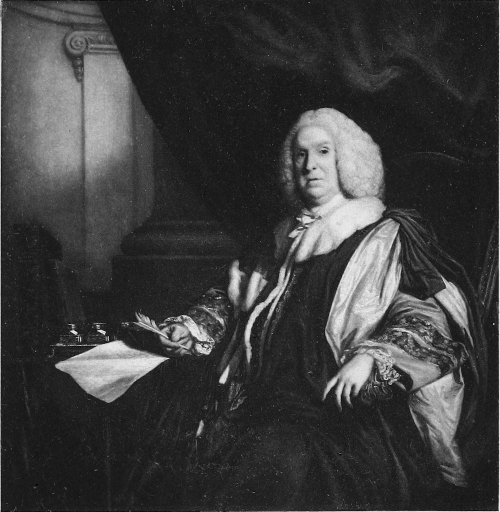
Sir J. Reynolds P.R.A. Pinx. Emery Walker Ph.Sc.
William Pulteney, 1st Earl of Bath
Lord Bath was having his picture (now in the National Portrait Gallery) painted by Sir Joshua Reynolds for Mrs. Montagu. He left London for Ives Place, and writes—
“I shall be in town again in a few days, but not till after the Queen’s arrival, for I have had the opportunity of making my excuses, in the proper place, for not attending the marriage ceremony. You will judge of the likeness of the Picture best, when I am not present, if it could speak, it would tell you, what I can scarce venture to do. How much I love and am, etc.”
THE CORONATION
Mrs. Montagu went to London for the coronation, which took place September 22, leaving Mr. Montagu at Sandleford. She writes to him—
“I have not got any cold or mischief from the coronation, at half an hour after four I got into the coach, went by Fulham to Lambeth, from whence I crossed the water in a boat which landed me at the cofferer’s office, where I was to see the Show. I had a perfect view of the procession to and from Westminster to the Abbey, and I must say it rather exceeded my expectation. The ladies made a glorious appearance; whenever there was any beauty of countenance or shape or air they were all heightened by the dress. Lady Talbot was a fine figure. The Queen, being very little, did not appear to advantage. The King had all the impressions of decent satisfaction and good-natured joy in his face; looked about him with great complacency, and tried to make himself as visible as he could to the mob, but the canopy carried over his Majesty’s head and the persons who carried his train made him not so conspicuous. His behaviour at the Abbey pleased much. It was perfectly dark before the Procession returned from the Abbey, so we lost the second view. I got into a barge which I hired for 7s. 6d., and got to the coach which waited at Yorke buildings. Mr. Botham and his daughters are just gone. Lord Lyttelton was near fainting away just as the procession set out from the Hall, and was obliged to sit down and take drops till a chair could be got to carry him home. Lady Albemarle fainted presently after. Lord Grantham was ill, but able to go thro’ the ceremony.
“The early hour the Peers and Peeresses are forced to rise at and the weight of their robes and all the whole affair is fatiguing, but they make a good figure, for there is something very majestick in the dress.
“I believe my Lord Bath will come down to us about Wednesday or perhaps Tuesday. I shall be at Sandleford on Monday.”
HIS MAJESTY’S BEHAVIOUR
In another letter describing the coronation to Mrs. Carter, Mrs. Montagu says—
“It is impossible to say enough of the behaviour of the King. During the procession his countenance expressed a benevolent joy in the vast concourse of people and their loud acclamations, but with not the least air of pride or insolent exultation. In the religious offices his Majesty behaved with the greatest reverence and deepest attention; he pronounced with earnest solemnity his engagements to his people, and when he was to receive the Sacrament he pulled off his crown. How happy that in the day of the greatest worldly pomp and adorned with the ensigns of regal power he should remember his duty to the King of Kings. The Archbishop pleased much in the Coronation Service. I am indeed grieved at the heart for Mrs. Chapone:[339] all calamities are light in comparison of the loss of what one loves, uniquement; after that dear object is lost the glories of the golden day are for ever overcast, and there is no tranquillity under the silent moon, the soft and quiet pleasures are over, business may employ and diversions amuse the mind, but the soul’s calm sunshine and the heartfelt joy can never be regained. Mrs. Chapone has great virtues, and if she has the Martyr’s sufferings will have the martyr’s reward.”
LADY POMFRET
The following letter is from Lady Pomfret:—
“Richmond Hill, October 4, 1761.
“Dear Madam,
“The reason you give for my being deprived of the pleasure of a visit from you before you left London doubles the mortification. I was in hope Tunbridge had established your Health. The return of my fever (which has left me but a few daies) was the cause that I made no attempt to wait on you, the week you stayed after the Coronation, and when I did found you had been gone the day before; but soon after, Froissart and your letter informed me that your goodness to me subsisted, in all the bustle of magnificence and oppression of sickness, since you found time to read my old Chronicle with my Lord Lyttelton, to whom, and to you, I know not how to express my gratitude enough, but I really feel a great deal.
“Your criticism delights me, as it was always my opinion that such words as you mention ought to be changed for more intelligible ones, and that it might be done, with propriety, without altering the idiom, but I was so charged not to deviate from the old language that, till I had such authorities as you and my Lord Lyttelton, I did not dare to follow my own judgment, but shall now with alacrity go about it, being very happy in your approbation of the rest of the book, which I hope will be finish’d before the meeting of the Parliament, and that I shall have the assistance of such friends for the perfecting of it. Your partiality to me, dear Madam, is very flattering; but let Mrs. Montagu know that if I ever was or am proud of my discerning faculty ’tis because I see her in her true light; of brightness with modesty, Reason without Vanity, and a thorough knowledge of this and the next world as far as is permitted to mortals; this I might have heard, but I glory that I see it. I need not add what must be the consequence; that
“I am, Madam,
“Your sincere admirer: and
“Most faithful Humᵉ servᵗ,
“J. Pomfret.
“Lady Sophia Carteret and Mrs. Shelley beg your acceptance of their best respects.”
Lady Pomfret died on December 16, 1761, at Marlborough, Wilts.
LORD LYTTELTON’S LETTER
On October 5 Lord Lyttelton writes to Mrs. Montagu from Hagley a long letter, an extract of which I give—
“Tom proposes to give a ball to some young people of the neighbourhood on this day sennight, which will add to our number and our jollity. He desires me to tell you that if you were within twenty miles of our Ball-room he would invite you to it among the handsome young women; which you may notify to the cynic Monsey, when he talks to you next of the horrid gulph of forty, and bid him hold his fool’s tongue. I believe you fib about your age and make yourself at least ten years older than you are, to be nearer to Lord Bath. I hope you have been, and are still as happy with him at Sandleford as your heart can desire. You will not think it a compliment to either of you when I say, that I would be glad to exchange all the mirth of our ball for the dullest of your evenings; but I will add in great truth, that I would give up the finest day in Hagley Park for a rainy one in your company. I had a letter last post from the Dean,[340] in which he says, ‘Your Lordship must not be surprised if you hear in a post or two of Mr. Secretary Pitt’s and Lord Temple’s being out of their employments. Unless something extraordinary happens, this event will certainly take place in a few days. I have this intelligence not from common report, but from the best authority. The reason given for their resignation is the opposition made in the Cabinet to Mr. Pitt’s proposal of sending a fleet immediately to intercept the Spanish Flota daily expected home, and likewise to attack their men-of-war wherever they are to be found, but your Lordship knows there are other causes of discontent.’ If this should be true, I imagine Lord Egremont[341] will be Secretary of State and Lord Hardwick[342] Privy Seal. Mr. James Grenville will probably lay down with his brother, which will make a vacancy at the Cofferer’s Office, one of the few I might take if there was an inclination to bring me into employment. I wish much to know Lord Bath’s opinion of Pitt’s advice. To me it seems to be that of a man who (in a political sense) fears neither God nor man. It certainly must be founded upon a supposition that a war with Spain is inevitable, which I should hope is not true; and even in that case I think England ought to be very cautious not to appear the aggressor, which this conduct would make her. But I had rather hear his Lordship’s judgment upon this question than give my own.”
LORD BATH’S JOURNEY — THE POSITION OF MINISTERS
Lord Bath had left Sandleford before this letter arrived there.
On October 8 he writes—
“I can never sufficiently, Madam, acknowledge my great obligations to you and to Mr. Montagu for the honours I received at Sandleford. Six more agreeable days I never passed in my whole Life, but when one has been excessively happy we always pay most severely for the change, when forced to quit it. This made the Doctor’s[343] journey and mine most excessively stupid and melancholy. He was seized with such a soporifick Torpor (as if a deluge of rain was hanging in the clouds), and yet we had not a drop the whole way, and I was so wretchedly miserable, that all I could say to him was, ‘Doctor, I passed over this same ground yesterday from coming from Padworth much more cheerfully and happily than I do now, but one comfort is that we are allowed the liberty of hoping for a renewal of the same happiness some other time.’ When we got to Reading, where we stopped for 10 or 12 minutes (without getting out of our chaize), our landlady seeing we looked melancholy, endeavoured to comfort us by telling us a piece of good news, that an express was just arrived with an account of a complete victory obtained by the King of Prussia over the Russians. On this we speculated and ruminated for some time, when we met Mr. Cambridge, who assured us it was all a lye, but that another event had occurred which would surprize us extremely, and then told us Mr. Pitt[344] had quitted the seals; this astonished the Doctor more than it did me, who had received some hint of it before, but we both agreed it was a very unlucky time for adventuring on such rough measures, so near the Meeting of Parliament, and before anything was fixed for the obtaining of peace, or preparing for a further prosecution of the War; in short, we ended in wishing all Ministers at the Devil, rather than that their disagreements and dissentions amongst one another should bring any difficulties or dishonour on the best man in the world, the master of all of them.... I will make this reflection upon all human happiness, that the state and duration of it is extremely uncertain. A minister may be a very great and think himself a very happy man one day, and nothing at all the very next. Just so was I, Madam, happy beyond measure a few days ago, and now forced at a terrible distance to be assuring you that I am, with all possible respect,
“Your Ladyship’s most humble
and most obedient Servant,
“Bath.”
Lord Lyttelton writes on October 14 to Mrs. Montagu—
“Since my last, Mr. Pitt has brought his bark into a happy port. A Barony for his wife and a pension of £3000 a year for three lives are agreeable circumstances in a retreat, which delivers him from the difficulty of carrying on the War, or making the Peace, and keeps all his laurels green and unfading on his brow. No Minister in this country has ever known so well the times and seasons of going in and coming out with advantage to himself. I hope there will be new gold boxes sent to him by the cities and Boroughs to express their sense of his noble and disinterested conduct, and to assure him that their lives and fortunes are all at his service. In effect, I hear that all over this country since first we had the news of his resigning the Seals, the cry of the people in Taverns and Alehouses is, ‘No Pitt, no King.’ However, I imagine that as he has condescended to accept of this mark of royal favour, he will be so good as to allow the King to remain on the throne.”
AN ACT OF HUMILITY
On the same day as this last letter Dr. Monsey writes from St. James’s to Mrs. Montagu. This paragraph is interesting—
“But here’s a Rout about giving a patriot 3s. 6d. for his past services either for speaking to the purpose, or holding his tongue for a very good one. Why, he might have been Governor-General of all North America with a pension of £5000. This was confidently said at the ‘Mount’ Coffee House as offered by the King, and was told by Manby as coming from P——, no joke indeed, no more than he has advertised seven good horses, ‘late Mr. Pitt’s,’ to be sold. There’s an act of humility for you.”
Miss Mary Pitt, Mr. Pitt’s sister, writes to Mrs. Montagu—
“Dear Madam,
“Tho’ I suppose you know all that has happened since last Monday, I cannot forbear talking to you upon what the King has been so very gracious as to do for my family, in granting a pension of three thousand pounds a year to Mr. Pitt for three lives, and as he knows that he feels a repugnancy to having his name upon the Irish pensions, his is upon the American Duties, and the Peerage which his Majesty has also done him the honour to bestow upon his family is given to Lady Hester,[345] who is made Baroness of Chatham, by which means he is left still at liberty to be an Alderman; as to all the rest, which you may know, I will do comme si vous ne saviez pas. My Lord Egremont received the Seals of Secretary of State yesterday, my Lord Temple gave up his seals yesterday, and I was informed last night that my Lord Hardwick was to be Privy Seal, which I do not doubt, tho’ it is not declared. Mr. George Grenville is not to be Speaker, that he may have the management of the House of Commons. My Lord Temple is very angry with him, and I believe very much disappointed; at the same time I am assured that my Lord Bristol writes in the strongest manner everything that can give satisfaction to the present Ministry with regard to the intentions of the Spanish Court, and those despatches are said to have come Wednesday last.... I heard a few days ago from Paris that the Duc de Nivernois[346] had got a passport for my nephew.” This was for Mr. Tom Pitt.
At this period Dr. Gregory lost his wife, and was in great despair; she was a daughter of William, Lord Forbes.
WIDOWS’ WEEDS
At the end of October Mrs. Montagu set out on a short visit to her sister, Mrs. Scott, and Lady Bab Montagu at Bath Easton. Dr. Monsey was then at Bath, whither later Mrs. Montagu also repaired. Bath society was enthusiastic upon the subject of Mr. Pitt and a political letter he wrote at this period. From a letter written from Bath to Mrs. Carter about a Mrs. Talbot, a reduced lady, who was an applicant for a lady’s-maid situation, we learn that £10 per annum were regarded as adequate wages for such an attendant. I subjoin a curious paragraph as to a widow’s dress—
“The fashionable dress for a widow is a gown with two broad plaits in the back, a short cuff which comes a little below the elbow, round double ruffles very shallow. The dress weed is made of silk made on purpose, undress crape, a black silk long apron, black handkerchief, black hood, and a plain sort of night-cap. Either a night-gown or sack may be worn with a short train, no flounce or ornament of any sort, and if a sack scanty, and only two broad plaits. Many women of condition who are not young, wear merely a common crape sack, the younger sort wear the dress that denotes their widowhood, and in a country town I should suppose the full form must be observed. I imagine your enquiry is for poor Mrs. Primrose.”
A CALL FOR POETRY
On November 17 Mrs. Montagu writes from Hill Street to Mrs. Carter—
“My dear Friend,
“I had this day the pleasure of receiving my dear Friend’s most charming ode. I, alas! am like Monsr. Jourdain, I speak nothing but prose, but I believe my heart feels with all the enthusiasm of poetry.... My Lord Bath is vastly happy that you are to be in town the 1st of January. My Lord Lyttelton is better, but his fever is not quite gone.... I think you should print the verses my Lord Lyttelton addressed to you from Penshurst. Pray write some more odes, and let your seamstresses do your plain work, and the Clerk transcribe your verses.”
This year an edition of Mrs. Carter’s various works was printed. When Mrs. Carter was in London she lodged with Mrs. Norman in Clarges Street. Mrs. Montagu having ascertained that she could have her lodgings there from the 1st of January, adds—
“You do not deign to mention Fingal, etc., but that I could pardon, for Poet Ossian has been dead full many a day, but there is a head on which laurels now grow, and it bears more than Parnassian bays, even wreaths of sacred Virtue, and this head is apt to ake, and then my heart akes for sympathy. Poor Lady Pomfret by weary stages reached Marlborough, from thence she yesterday morning quitted the weary journey of human life and passed with resignation to a better. I am angry with Dr. James for sending her in so hopeless a state from her quiet home to the noise and inconvenience of Inns.... I think Mr. Rivington must be bewitched. I will send the books as you direct. I had a quadrille table last night; and last week the Bard Macpherson and many others of the tuneful train and we had the feast of shells and drank out of a nautilus to the immortal memory of Ossian. The Nautilus, you know, is a perfect sailor as the other is a poet by nature. I am a little mortified that you had not a word to fling at Ossian. Take a modern Poet Laureate and put out his eyes and see whether he will sing as sweetly, tho’ he sings darkling.”
THE BAS-BLEUS AND SHELLS
The bas-bleus from this time constantly celebrated, amongst their intimates, the feast of shells mentioned in Ossian by drinking out of them on any particular occasion.
Lord Bath’s portrait, not satisfying Mrs. Montagu, had been returned to Mr. Reynolds for amendment, and Lord Bath writes—
“Madam,
“I will sitt to Mr. Reynolds either Wenesday or Saturday next, whichever is most convenient to him, and shall be glad to meet Mr. Tristram Shandy (as you call him) or Mr. Sterne (as I must call him) there, but where it is to be you do not mention. If the alteration can be made in a quarter of an hour, it is scarce worth taking the Picture out of your house, but if it is to be altered at Mr. Reynolds’ I will be there on either of the days mentioned. Last night I slept extreamely well and the better since I went from Mrs. Vesey’s, happy in seeing you look so charmingly and well....
“3 a clock, Dec. 26th, 1761.”
LAURENCE STERNE
Lord Bath had remarkably penetrating and brilliant eyes, and one of the faults found with the picture was in the representation of this feature.
The next letter from Lord Bath runs—
“How cruel was it, before I got out of bed, to receive a letter forbidding me coming to you this night! but I hope nothing will prevent me from having that happiness to-morrow. On Wenesday about one of the Clock, I will most certainly be at Mr. Reynolds’ to mend my sickly looks, and to sitt down in my chair, as I should do; instead of being half standing, which criticism of Mr. Sterne’s I think perfectly right; as for my looks, I fear they will not be much mended by any Physick of Mr. Reynolds. He has made an old man look as if he was in pain, which an old man generally is, and so far he is right.”
Mrs. Montagu took Mr. Sterne to the sittings so that he might amuse Lord Bath with his bons mots! Surely this would form a pretty and historical picture if any artist would paint it.
On the publication of her poems, to which Mrs. Carter looked forward in a nervous frame of mind, Mrs. Montagu says—
“I am sorry for your tremors and trepidations, but they are mere nervous disorders, and the manuscript must be printed, so my dear Urania, away with your lamentations, sit down, revise, correct, augment, print, and publish. I am sure you will have a pleasure in communicating the pious, virtuous sentiments that breathe in all your verses. My inferior Soul will feel a joy in your producing such proofs of genius to the world.... The very best of your poetical productions have never been published, they may indeed have been seen by a few in manuscripts, but the finest things on sheets are soon lost—
‘Foliis tantum ne carmina manda; Ne turbata volent rapidis ludibria Ventis.’
Print them and bind them fast I beg you.”
Writing to her brother, William Robinson, then at Rome, at this period, Mrs. Montagu congratulates him on the prospect of a son or daughter—
“I desire to have all the share I can in the little one, shall be happy to be accepted as a godmother, and thank you for being so obliging as to intend it my name if it is a girl; it will not disgrace her if she should be a toast, for I once knew a Miss Betty Robinson that set up for one; if it is not disagreeable to you I should be glad if it was christened Elizabeth Montagu, which will be also a compliment to my husband. I envy you, my dear brother, the pleasure of seeing at your leisure the Queen of Cities, Imperial Rome.”
STERNE GOES ABROAD — STERNE’S “MEMORANDUMS”
The Rev. Laurence Sterne had been in bad health for some time; he had just completed his fifth and sixth volumes of “Tristram Shandy,” and with permission from the Archbishop of York for absence for a year or more, he left Coxwould for the South of France, leaving the following paper with Mrs. Montagu, who, it will be remembered, was his cousin by marriage.
“December 28, 1761.
“Memorandums left with Mrs. Montagu in case I should die abroad.
“L. Sterne.
“My sermons in a trunk at my friend Mr. Hall’s, St. John’s Street, 2 Vols. to be picked out of them.—N.B. There are enough for 3 Vols.—
“My Letters in my bureau at Coxwould and a bundle in a trunk with my sermons.—
“Note. The large piles of letters in the garrets at York, to be sifted over, in search for some either of Wit, or Humour—or what is better than both—of Humanity and good Nature—these will make a couple of Volumes more, and as not one of ’em was ever wrote, like Pope’s or Voiture’s, to be printed, they are more likely to be read—if there wants ought to serve the completion of a 3rd volume—the Political Romance I wrote, which was never publish’d—may be added to the fag end of the volumes.... Tho’ I have 2 reasons why I wish it may not be wanted—first an undeserved compliment to one, whom I have since found to be a very corrupt man—I knew him weak and ignorant—but thought him honest. The other reason is I have hung up Dr. Topham in the romance in a ridiculous light—which upon my soul I now doubt whether he deserves it—so let the Romance go to sleep not by itself—for ’twil have company.
“My Conscio ad Clinum in Latin which I made for Fountayne, to preach before the University to enable him to take his Doctor’s Degree—you will find 2 copies of it, with my sermons—
“—He got Honour by it—What got I?—Nothing in my lifetime, then let me not (I charge you Mrs. Sterne) be robbed of it after my death. That long pathetic letter to him of the hard measure I have received—I charge you, to let it be printed—’Tis equitable you should derive that good from my sufferings at least.
“I have made my will—but I leave all I have to you and my Lydia—you will not Quarrel about it—but I advise you to sell my estate, which will bring 1800 pds. (or more after the year), and what you can raise from my Works—and the sale of the last copyright of the 5th and 6th Vols. of Tristram—and the produce of this last work, all of which I have left (except 50 pds. in my bookseller Becket’s hands, and which Mr. Garrick will receive and lay out in stocks for me)—all these I would advise you to collect—together with the sale of my library, &c., &c.—and lay it out in Government Securities—If my Lydia should marry—I charge you,—I charge you over again (that you may remember it the more)—That upon no Delusive prospect, or promise from any one, you leave yourself DEPENDENT; reserve enough for your comfort—or let her wait your Death. I leave this in the hands of our Cosin Mrs. Montagu—not because she is our cosin—but because I am sure she has a good heart.
“We shall meet again.
“—Memᵈᵘᵐ. Whenever I die—’tis most probable, I shall have about £200 due to me from my living—If Lydia should dye before you; Leave my Sister something worthy of your self—in case you do not think it meet to purchase an annuity for your greater comfort; if you chuse that—do it in God’s name—
“—The pictures of the Mountebank and his Macaroni—is in a Lady’s hands, who upon seeing ’em most cavaliery declared she would never part with them—and from an excess of civility—or rather weakness I could not summon up severity to demand them.
“—If I dye, her Name, &c., is inclosed in a billet seal’d up and given with this—and then you must demand them—If refused—you have nothing to do but send a 2d. message importing—’tis not for her Interest to keep them.
“Laurence Sterne.
“Memorandums left by Mr. Sterne in Mrs. Montagu’s hands before he left England.”
TWO TEARDROPS
Two teardrops are on this paper, which indicate Sterne’s emotional temperament.
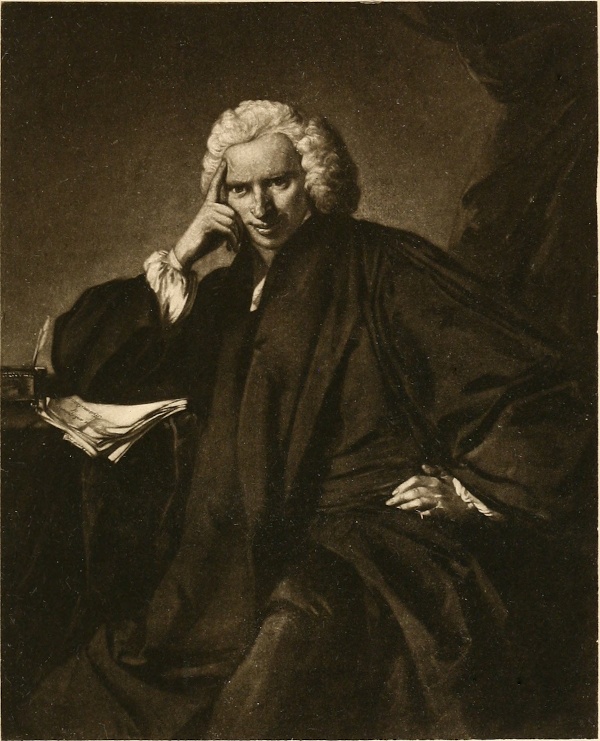
Sir J. Reynolds, pinx. E. Fisher. sc.
Laurence Sterne.
Walker & Cockerell, ph. sc.
FINIS
And now, patient reader, I, the Editress of this literary mosaic of my great-great-aunt’s letters and those of her friends, take leave of you. If life and eyesight are vouchsafed to me, I hope to write the remainder of her life some day, for she lived till 1800. Each year added to her enormous circle of clever acquaintance, British and foreign. The letters of Garrick and his wife, later ones of Sterne and Dr. Johnson, Mrs. Vesey, Edmund Burke, Hannah More, and a host of other notabilities, belong to a different period. As it is, the compilation of this work has occupied me five years. One whole winter was devoted to arranging the correspondence in chronological order, as very few of the letters are dated.