Addenda
Reading edition
THE HUSBAND OF ELIZABETH HOOTON (pp. 2, 16)
Several writers on Elizabeth Hooton have stated that her husband was Samuel: James Bowden, Hist. i. 260; A. C. Bickley in D.N.B.; Charlotte Fell Smith in The British Friend, 1893.
Mrs. Manners has come to the conclusion that Elizabeth’s husband was Oliver. She thus states her case:
1. Though an exhaustive search of the Nottinghamshire Parish Registers has been made, I failed to find any marriage of a Samuel Hooton to Elizabeth ⸺ in any years when it would possibly have occurred.
2. At Ollerton (which village is said by Thoroton to have been partly owned by Hootons) I found that in the year 1628 Oliver Hooton married Elizabeth Carrier—and on the 4th of May, 1633, Samuel, son of Oliver and Elizabeth Hooton, was baptized. (Ollerton Parish Registers.)
3. No entries in Ollerton Registers between the years 1633 and 1636.
4. At Skegby in the year 1636 a son was born to Oliver and Elizabeth Hooton, and in succeeding years the children born are described as above.
5. In 1657, in the Friends’ Digest Register, the death of Oliver Hooton is recorded, and under the same year the Skegby Parish Registers record Oliver Hooton the elder buried.
6. We learn from a letter written by Thomas Aldam from York Castle, where he and Elizabeth Hooton were imprisoned in 1652, that E. H.’s husband was living at that time.
7. George Fox in his Testimony concerning E. H. says: “Her husband being Zealous for yᵉ Priests much opposed her, in soe much that they had like to have parted but at Last it pleased yᵉ Lord to open his understanding that hee was Convinced alsoe & was faithfull untill Death.” From this statement I should expect to find the entry of his death in the Friends’ Register. The name of Samuel does not occur in either Register of deaths.
8. The late Mary Radley also arrived at the conclusion that the husband’s name was Oliver, and our investigations were conducted entirely independently.
NOAH BULLOCK (p. 7)
The name of Noah Bullock does not appear in the list of Mayors of Derby given in William Hutton’s History of Derby, ed. of 1791, but the following curious allusion to Bullock occurs in the same work, page 236:
“1676—We sometimes behold that singularity of character which joyfully steps out of the beaten track for the sake of being ridiculous; thus the Barber, to excite attention, exhibited in his window green, blue and yellow wigs, and thus Noah Bullock, enraptured with his name, that of the first navigator, and the founder of the largest family upon record, having 3 sons, named them after those of his predecessor, Shem, Ham and Japhet; and to complete the farce, being a man of property, built an ark, and launched it upon the Derwent, above St. Mary’s-bridge; whether a bullock graced the stern history is silent. Here Noah and his sons enjoyed their abode and the world their laugh. But nothing is more common than for people to deceive each other. The world acts under a mask. If they publicly ridiculed him, he privately laughed at them: for it afterwards appeared he had more sense than honesty; and more craft than either; for this disguise and retreat were to be a security to coin money. He knew Justice could not easily overtake him, and if it should, the deep was ready to hide his coins and utensils. Sir Simon Degge, an active magistrate, who resided at Babington-hall, was informed of Noah’s proceedings, whom he personally knew: the Knight sent for him and told him, ‘he had taken up a new occupation, and desired to see a specimen of his work.’ Noah hesitated. The magistrate promised that no evil should ensue, provided that he relinquished the trade. He then pulled out a sixpence and told Sir Simon ‘He could make as good work as that.’ The Knight smiled; Noah withdrew, broke up his ark, and escaped the halter.”
The family is an ancient one; there are monumental inscriptions in St. Alkmund’s church to Bullocks of Darley Abbey. The name is still represented in the town.
Information supplied by Edward Watkins, of Fritchley, Derby.
COMMITMENT TO LINCOLN CASTLE (p. 14)
Lyncolnshere.
J was gon out of becingham, & was gone to barnbe in Nottingham shire, & as J was warneing some to repent in yᵉ towne, there come a wicked man forth whose name was Atkingson, a proud man, he stroake me unreasonably, then pul’d he me out of my way over a bridge & when J was over he sent to the Preist of becingham to serve his warrant upon me, & wᵗʰ his warrant he sent me to the Justice, & the Justice being a wicked man he sent me to prison to Lincoln goal. The same Preist put another Man friend into prison for tithes, & hee dyed, & his house keeper came through the chamber where the Preist lay, & he sᵈ good morrow Valentine in a vain light condition, & tooke her in his armes to salute her & suddainly the Lord stroak him wᵗʰ death, though he cryed for his bottle of strong waters but it would not save him, thus the hand of the Lord is agᵗ wicked men, both old & young, [they] shall perish if they transgress. Atkingson came to nought alsoe & was taken away suddainly, yet the Lord was with me in prison though J endured a very cold winter, it was God’s mercy in preserving me that winter from being starved to death, & this widdow woman that kept yᵉ goal was full of cruelty towards me & all yᵉ prisoners.
[Endorsement]
An imperfect paper, yet expressing the Manner of her being sent to Lyncolne Prison: and Gods hand upon yᵉ Priest & Atkinson that were yᵉ cause of her Jmprisonmᵗ there.
MS. in D. (Portfolio i. 136)
LINCOLN CASTLE GATEWAY.
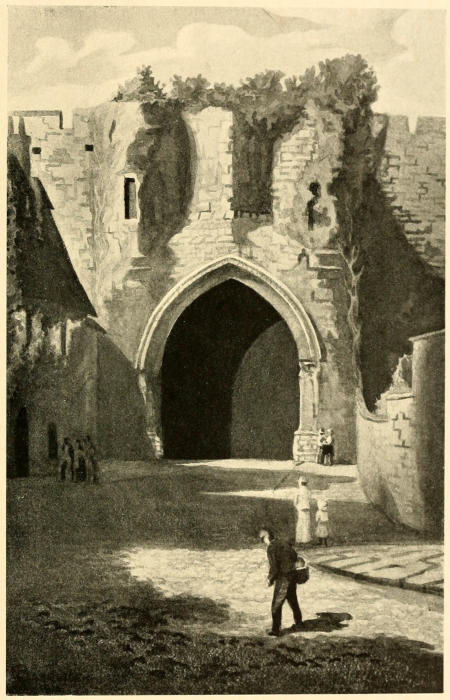
To face p. 78.] [See p. vii.
UNKETTY (page 43)
An enquiry addressed to Augustine Jones, LL.B., of Newton Highlands, Mass., has brought the following information:
Unquity, or Unquity-quisset was the Indian name for Dorchester, which, in 1662, was incorporated as Milton. It is across the Neponset River from Boston, on the somewhat indirect way from Cambridge to Scituate.
Unquity means “a place at the end of the small tidal stream or creek.”
A YOUNG MAN OUT OF THE NORTH OF ENGLAND (p. 43)
This was probably Thomas Newhouse, whose name is included in a list of English Friends visiting N.E., 1661 to 1671 (in the possession of William C. Braithwaite, Banbury, Oxon). The incident is associated with the name of Thomas Newhouse in the histories of Bishop, Besse and Bowden. In Newhouse’s own account of the event and its results, given by Bishop (op. cit. p. 472), we read:
“Upon a Lecture-day at Boston in New-England, I was much pressed in Spirit to go into their Worship-house amongst them.... They cryed, Away with him; and some took me by the Throat, and would not suffer me to answer to it, but hurried me down Stairs, to the Carriage of a great Gun, which stood in the Market place, where I was stripp’d, and tyed to the wheel, and whipp’d with ten Stripes ... and then ... whipp’d ... at Roxbury ... and at Dedham ... and then sent into the Woods.”
In Bishop’s fuller account of this scene, he tells us (op. cit. p. 432) that Newhouse, “having two Glass Bottles in his Hands, dash’d them to pieces, saying to this effect, That so they should be dash’d in Pieces”—a very close parallel with the account given by E. Hooton.
William Edmondson states in his Journal, under date 1672, that the Friends of Virginia were “stumbled and scatter’d by his [Newhouse’s] evil Example ... who went from Truth into the Filth and Uncleanness of the World.” See Jones, Quakers in American Colonies.
It must have been a sorry spectacle—an old woman and a young man, both half naked, tied side by side to the back of a cart, and lashed with a whip of three knotted cords till blood ran.
HOOTON DESCENDANTS
The materials with which to re-erect the house of Hooton are scattered and difficult to identify; the frequent use of the same fore-name is a source of danger; but we venture to place before our readers such facts as at present see the light, in the hope that later research will be aided thereby.
Samuel Hooton
Samuel, son of Oliver and Elizabeth Hooton, was baptized at Ollerton in 1633.
The hand of persecution rested upon him in early life; we find him in prison in Nottingham in 1660 for refusing to take the Oath of Allegiance,[150] and in Leicester in 1662 he was in prison with George Fox and others,[151] being “cast into yᵉ Dungeon amongst yᵉ felons. There was hardeley roome to lye downe they [the prisoners] were soe thronge.”[152] Before reaching the age of thirty he was the objective of Muggletonian curses,[153] as was his mother later; and eight years after, in 1670, as recorded by Besse,[154] restraints were laid upon his goods “for the Cause of religiously Assembling to worship God.”
On the 30th of November, 1670, Samuel Hooton married Elizabeth Smedley, both of Skegby, at the home of the bridegroom’s mother. There were two children born at Skegby, Oliver[155] in 1671 and Elizabeth in 1673.
Of his religious service we have found nothing before his departure for New England early in 1666, as related ante, and the next reference is dated two years later, May, 1668: “one Samuel, son of old Elizabeth Hooten,” is mentioned among “those that labour in the work of the ministry.”[156]
Towards the close of 1670, among signatories to An Appeal from Nottinghamshire, occurs the name Samuel Hooton.
In the Minute Book of Nottinghamshire Quarterly Meeting, at the date, 26 x. (Dec.) 1670, the same date on which his mother wrote the letter given ante, the word “backslider” is written beside the name of Samuel Hooton (see photo. facsimile, p. 75). This was probably done a few years later in connection with the passing of the following minutes by the Nottinghamshire Q.M.:
Nine & Twentith Meeting
At the Quarterly Meeting at Maunsfeild the 29ᵗʰ day of first month 1675.
Exhortation the 1ˢᵗ time
Robert Grace & Thomas ffarnsworth Exhorted Sammuell Hooten for paing of Tyths, as to that he would giue noe Answer but was found very scornefull.
Exhortation the 2ⁿᵈ time.
Georg Cockram, & Mathias Brackney Exhorted Sammuell Hooten for paing of Tyths, his answer was, he was neuer conuienced in his conscience but that they ought to be payed, it was spoken to him as that he did beare his testimoney against them and suffered the spoyling of his goods for his Testimony he said that he did it out of the strength of his owne will.
Agreed that a Testimonie be drawne up Against the Spirit that Leads Sammuell Hooten To pay tythes (& justifie his paying of them) and to be giuen him by Robert Grace and William Malson, a Coppy as followeth:
“A Testimonie from the people of god (in scorne called Quakers) Against Tythes & Tithe takers & all that pay them in Generall (whoe denie Christ Jesus come in the flesh—who hath Ended the Law & the Changable preisthood, and is becom the unchangable high preist over the house of god for Euer) But more Especialy against the Spirit that now acts in & by Sammuell Hooten.
“Whereas Sammuell Hooten hath Long beene a professor of gods blessed truth and hath borne a Larg verball Testimony thereunto & not onely soe but hath suffered much thereby, by all which according to outward Apearance he was Looked upon by many to be a faithfull wittness for god, but Alass as a flourishing tree which brings forth noe good fruite, soe is a profession without the possession of the truth, & as Euery Tree is knowne by his fruite soe is Euery spirit knowne by its Action, and though the said Sammuell hath walked Long in apearance as aboue said, yet hath he Lately brought forth bad fruit to the dishoner of god in paing Tiths to an Jmpropriator and though he hath beene tenderly dealt withall yet he still persists to manetaine the thing as Lawfull, soe that wee are constrained for the truth sake to giue forth this testimony against that Spirit that Led him to pay tiths (and plead for them) and doe foreuer judg it, & Condemne it in him or in whome-soeuer it is found, being the same Spirit with them that takes Tithes by whome many of our deare friends haue suffered Jmprisonment unto death & sealed there testimoney with there Bloud, and this is to goe forth into the world that truth may be cleared, & all false Reports stopped & Judged, who now say we alow what we formerly declared against, noe more but in true Loue to all people we Reste.”
ffrom the Quarterly Meeting at Maunsfeild, the 29ᵗʰ day of the 1ˢᵗ month 1675.
It is possible that the family emigrated to the Western World. Mrs. Amelia Mott Gummere, of Haverford, Pa., contributes the following, which may refer to the above Samuel:
“Elizabeth Hooton, wife of Samuel Hooton, of Shrewsbury, New Jersey, with her daughter Elizabeth, wife of Thomas Hillborne, were appointed guardians of Samuel Hooton, when the latter became insane in 1694. Thomas Hillborne and Elizabeth Hooton, both of Shrewsbury, N.J., were married 12th December, 1688, at the house of her mother, Elizabeth Hooton. The original marriage certificate was in the possession of Thomas Darlington, of Birmingham, Pa., in 1863.”
Of the Hootons of N.J., Mrs. Kate B. Stillé wrote in the Jnl. F.H.S. iv. 50: “Their descendants hold the land near Burlington and Evesham, which was bought from the Indians.”
Elizabeth Hooton, Jr., Afterwards Lambert.
The marriage of the younger Elizabeth with Thomas Lambert, of Tickhill, 21st of September, 1669, is recorded in the Registers of Nottinghamshire, but there is no entry therein of any children or of the deaths of Thomas and Elizabeth Lambert.
We may hazard the suggestion that emigration to the New World removed their names from the Registers of the Old. In the published New Jersey Archives, first series, vol. xxiii., p. 236, we read:
“1692-3, Feb. 20. Hooton John. Letters of administration on the estate of, formerly granted to Thomas Lambert in behalf of his wife, confirmed, notwithstanding application of Richard & Thomas Hilbourne on behalf of Samuel Hooton for it, based on the order of Gov. Hamilton making Elizabeth, the wife of the said Samuel, Thos. Hilbourne and wife Elizabeth, daughter of Samuel, his guardians during his lunacy (N.J. Arch., vol. xxi., p. 193). John White, attorney for Thos. Lambert, submits the affidavit of John Snowden, to whom John Hooton had said, shortly before his death, he did not intend his brother Samuel should have his plantation, while William Black and John Birch attest that deceased had expressed his intention that John, the son of his brother, Thomas Lambert, should have it. (Burlington Records, p. 18.)”
Oliver Hooton
1. Oliver, son of Elizabeth, is mentioned by Fox in his Journal, under date 1672, and he was apparently at home in England at the time (Camb. Jnl. ii. 213).
His “hystry” is referred to on page 4, also his Certificate concerning George Fox.
He was at Skegby in May, 1666 (page 54).
2. Oliver Hooton, living in Barbados, is referred to in sundry places.
He wrote a Testimony concerning William Sympson (dropping into verse at the close), on the 16th of February, 1670, printed in A Short Relation ... of William Simpson, 1671.
In 1674, he was fined 1,592 lbs. of sugar for “not appearing in Arms.”[157]
Thomas and Alice Curwen visited him, and wrote a letter from his house, dated the 12th February, 1676.[158]
In 1677, with other Friends, he signed an Appeal to Governor Atkins on behalf of sufferers for the Truth.[159]
There is a letter in D.[160] from O. Hooton to George Fox, dated “Barbados yᵉ 8: 2ᵈ mᵒ 1682.” References to the writer’s personal history are wanting, but he writes as one who knew Fox, “from the begining of yᵉ apearance of yᵗ Glorious Day, yᵉ dawnings wherof (in our dayes) first made knowne its Splendor through thee.... I have both loved and honored thee from yᵉ first.” The writer is on the eve of a visit “to see yᵉ new Countreys of new Jarsey and Pensilvania,” but he “cannot say to Setle there.”
There does not appear to be sufficient evidence to state that 1 and 2 are the same persons.
3. The Registers of Mansfield Monthly Meeting record the death of Oliver Hooton, son of Samuel and Elizabeth Hooton, 14 xi. 1671, who died at his parents’ house at “Seckby” and was buried at “Skegby.” See page 81, note 1.
Martha Hooton
The name, Martha Hooton, also appears in the records of Barbados—in 1689 she was fined £4 19s. 0d. “for Default of sending a Man and a Horse armed in to the Troop,”[161] and there is in D. a curious manuscript, being a petition from a slave girl named Mama to obtain the freedom granted by her mistress, Martha Hooton, widow, in her will dated “the third day of the fifth Month ... 1704,” she having died on the 8th September of that year.
Thomas Hooton
1. Thomas, son of Oliver and Elizabeth Hooton, was baptized 1636. Of this son, Mrs. Manners writes: “The late Mary Radley thought that Thomas was an older son of Oliver and Elizabeth Hooton, but I think she must have read this name as ‘Timothy.’ Mrs. Dodsley, who searched the Skegby Parish Registers for me, thinks the name given is ‘Thomas,’ and as I have found no mention of ‘Timothy’ in any of the documents I have searched, I am inclined to think Mrs. Dodsley’s surmise is correct.”
2. According to the Friends’ Registers for the County of Lincoln, Thomas Hooton, of Sibsey [? Sibson], Leicestershire, married Mary Sharp of Barnby at the house of John Pidd, at Barnby, Notts, 1662 xii. 15. The Hooton home in Leicestershire was Sileby, and the home of the bride, Barnby, is not far distant from Ollerton, the Notts Hooton home.
3. The following extracts have been taken from the Minutes of Nottinghamshire Q.M.:
Thirteth Meeting
At the Quarterly Meeting at Maunsfeild the 28ᵗʰ day of the 4ᵗʰ month 1675.
Agreed that William Malson Robert Grace Francis Clay, & Mathias Brackney, doe consider with Thomas Hooton about the Repairing of Joseph Roberts house.
One and Thirteth Meeting
At the Quarterly Meeting at Maunsfeild the 27ᵗʰ day of the 7ᵗʰ month 1675.
It is Agreed that friends at the monthly meeting belonging to Maunsfeild put an End to the buseniss betwixt Thomas Hooton and friends, About Joseph Roberts house & ground.
Six & Thirteth Meeting
At the Quarterly Meeting at Nottingham the 28ᵗʰ day of the 10ᵗʰ month 1676.
Paid out of the publique Stocke for the Reparing of Joseph Roberts house the sume of £2: 10: 6.
4. At a Quarterly Meeting held at Lincoln, 27 x. 1693, the following minute was made: “At this meeting Thomas Hooton sent Twenty Shillings to be disposed of this Meeting received and disposed of at this accordingly.”
5. There was a Thomas Hooton of London, of whom more is known. He and his family emigrated to New Jersey. See Besse’s Sufferings; Clement’s Settlers in West New Jersey, 1877, p. 301; The Friend (Phila.), lxxvii. (1903), p. 52; New Jersey Archives.
John Hooton
The following is from the Minutes of the Nottinghamshire Q.M.:
Seauen Twentith Meeting
At the Quarterly meeting at Maunsfeild, the 28ᵗʰ day of the 7ᵗʰ moᵗʰ 1674.
Exhortation the first time—
Georg Corkram & Mathias Brackney exhorted John Hooton for paying of Tyths, his answer was that if they take it he would not hinder them and that he had as good pay tythes as pay Rente for them.
Eight and Twentith Meeting
At the Quarterly Meeting at Maunsfeild, the 28ᵗʰ day of the 10ᵗʰ month 1674.
Exhortation the Second time
Robert Grace & Thomas ffarnsworth Exhorted John Hooton for paing of Tythes, & his Answer was, he was not fully conuinced, but that it was the Jmpropriators Right or due after they had set there marke in it and he said if he found anything in himselfe that did oppose it for the time to come he hoped he should be faithfull to it, And he was Lowe & tender.
One and Thirteth Meeting
At the Quarterly Meeting at Maunsfeild the 27ᵗʰ day of the 7ᵗʰ month 1675.
Exhortation the 3ʳᵈ time.
Francis Clay, and Robert Grace Exhorted John Hooton for paing of tyths, his Answer was that he found that it was not right to be paied, neither did he jntend to pay any more but he said his seruants did Leaue some contrary to his order, and he was found very tender.
For John Hooton, of N.J., see under Elizabeth Hooton, aft. Lambert.
Josiah Hooton
Of Josiah Hooton, mentioned on page 3, nothing further appears.
JUDGE ENDICOTT (p. 50)
“It was not the people of Massachusetts—it was Endicott and the Clergy”—who persecuted the Quakers.—John Fiske, Beginnings of New England, 1895.