Book 2 — APPENDIX TO
Reading edition
THE FIFTH EDITION OF DE MORGAN’S ELEMENTS OF ARITHMETIC.
I. ON THE MODE OF COMPUTING.
The rules in the preceding work are given in the usual form, and the examples are worked in the usual manner. But if the student really wish to become a ready computer, he should strictly follow the methods laid down in this Appendix; and he may depend upon it that he will thereby save himself trouble in the end, as well as acquire habits of quick and accurate calculation.
I. In numeration learn to connect each primary decimal number, 10, 100, 1000, &c. not with the place in which the unit falls, but with the number of ciphers following. Call ten a one-cipher number, a hundred a two-cipher number, a million a six-cipher number, and so on. If five figures be cut off from a number, those that are left are hundred-thousands; for 100,000 is a five-cipher number. Learn to connect tens, hundreds, thousands, tens of thousands, hundreds of thousands, millions, &c. with 1, 2, 3, 4, 5, 6, &c. in the mind. What is a seventeen-cipher number? For every 6 in seventeen say million, for the remaining 5 say hundred-thousand: the answer is a hundred thousand millions of millions. If twelve places be cut off from the right of a number, what does the remaining number stand for?—Answer, As many millions of millions as there are units in it when standing by itself.
II. After learning to count forwards and backwards with rapidity, as in 1, 2, 3, 4, &c. or 30, 29, 28, 27, &c., learn to count forwards or backwards by twos, threes, &c. up to nines at least, beginning from any number. Thus, beginning from four and proceeding by sevens, we have 4, 11, 18, 25, 32, &c., along which series you must learn to go as easily as along the series 1, 2, 3, 4, &c.; that is, as quick as you can pronounce the words. The act of addition must be made in the mind without assistance: you must not permit yourself to say, 4 and 7 are 11, 11 and 7 are 18, &c.; but only 4, 11, 18, &c. And it would be desirable, though not so necessary, that you should go back as readily as forward; by sevens for instance, from sixty, as in 60, 53, 46, 39, &c.
III. Seeing a number and another both of one figure, learn to catch instantly the number you must add to the smaller to get the greater. Seeing 3 and 8, learn by practice to think of 5 without the necessity of saying 3 from 8 and there remains 5. And if the second number be the less, as 8 and 3, learn also by practice how to pass up from 8 to the next number which ends with 3 (or 13), and to catch the necessary augmentation, five, without the necessity of formally undertaking in words to subtract 8 from 13. Take rows of numbers, such as
4 2 6 0 5 0 1 8 6 4
and practise this rule upon every figure and the next, not permitting yourself in this simple case ever to name the higher one. Thus, say 4 and 8 (4 first, 2 second, 4 from the next number that ends with 2, or 12, leaves 8), 2 and 4, 6 and 4, 0 and 5, 5 and 5, 0 and 1, 1 and 7, 8 and 8, 6 and 8.
IV. Study the same exercise as the last one with two figures and one. Thus, seeing 27 and 6, pass from 27 up to the next number that ends with 6 (or 36), catch the 9 through which you have to pass, and allow yourself to repeat as much as “27 and 9 are 36.” Thus, the row of figures 17729638109 will give the following practice: 17 and 0 are 17; 77 and 5 are 82; 72 and 7 are 79; 29 and 7 are 36; 96 and 7 are 103; 63 and 5 are 68; 38 and 3 are 41; 81 and 9 are 90; 10 and 9 are 19.
V. In a number of two figures, practise writing down the units at the moment that you are keeping the attention fixed upon the tens. In the preceding exercise, for instance, write down the results, repeating the tens with emphasis at the instant of writing down the units.
VI. Learn the multiplication table so well as to name the product the instant the factors are seen; that is, until 8 and 7, or 7 and 8, suggest 56 at once, without the necessity of saying “7 times 8 are 56.” Thus looking along a row of numbers, as 39706548, learn to name the products of every successive pair of digits as fast as you can repeat them, namely, 27, 63, 0, 0, 30, 20, 32.
VII. Having thoroughly mastered the last exercise, learn further, on seeing three numbers, to augment the product of the first and second by the third without any repetition of words. Practise until 3, 8, 4, for instance, suggest 3 times 8 and 4, or 28, without the necessity of saying “3 times 8 are 24, and 4 is 28.” Thus, 179236408 will suggest the following practice, 16, 65, 21, 12, 22, 24, 8.
VIII. Now, carry the last still further, as follows: Seeing four figures, as 2, 7, 6, 9, catch up the product of the first and second, increased by the third, as in the last, without a helping word; name the result, and add the next figure, name the whole result, laying emphasis upon the tens. Thus, 2, 7, 6, 9, must immediately suggest “20 and 9 are 29.” The row of figures 773698974 will give the instances 52 and 6 are 58; 27 and 9 are 36; 27 and 8 are 35; 62 and 9 are 71; 81 and 7 are 88; 79 and 4 are 83.
IX. Having four numbers, as 2, 4, 7, 9, vary the last exercise as follows: Catch the product of the first and second, increased by the third; but instead of adding the fourth, go up to the next number that ends with the fourth, as in exercise IV. Thus, 2, 4, 7, 9, are to suggest “15 and 4 are 19.” And the row of figures 1723968929 will afford the instances 9 and 4 are 13; 17 and 2 are 19; 15 and 1 are 16; 33 and 5 are 38; 62 and 7 are 69; 57 and 5 are 62; 74 and 5 are 79.
X. Learn to find rapidly the number of times a digit is contained in given units and tens, with the remainder. Thus, seeing 8 and 53, arrive at and repeat “6 and 5 over.” Common short division is the best practice. Thus, in dividing 236410792 by 7,
7)236410792
33772970, remainder 2.
All that is repeated should be 3 and 2; 3 and 5; 7 and 5; 7 and 2; 2 and 6; 9 and 4; 7 and 0; 0 and 2.
In performing the several rules, proceed as follows:
Addition. Not one word more than repeating the numbers written in the following process: the accented figure is the one to be written down; the doubly accented figure is carried (and don’t say “carry 3,” but do it).
47963 6, 15, 17, 23, 31, 3″ 4′;
1598 11, 12, 21, 22, 31, 3″7′;
26316 9, 17, 24, 27, 32, 4″1′;
54792 10, 14, 20, 21, 2″8′; 7, 9, 1′3′.
819
6686
138174
In verifying additions, instead of the usual way of omitting one line, adding without it, and then adding the line omitted, verify each column by adding it both upwards and downwards.
Subtraction. The following process is enough. The carriages, being always of one, need not be mentioned.
From 79436258190
Take 58645962738
20790295452
8 and 2′, 4 and 5′, 7 and 4′, 3 and 5′, 6 and 9′, 10 and 2′, 6 and 0′, 4 and 9′, 7 and 7′, 9 and 0′, 5 and 2′. It is useless to stop and say, 8 and 2 make 10; for as soon as the 2 is obtained, there is no occasion to remember what it came from.
Multiplication. The following, put into words, is all that need be repeated in the multiplying part; the addition is then done as usual. The unaccented figures are carried.
670383
9876
4022298 18′, 49′, 22′, 2′, 42′, 4′0′,
4692681 21′, 58′, 26′, 2′, 49′, 4′6′,
5363064 24′, 66′, 30′, 3′, 56′, 5′3′,
6033447 27′, 74′, 34′, 3′, 63′, 6′0′.
6620702508
Verify each line of the multiplication and the final result by casting out the nines. (Appendix II. p. 166.)
It would be almost as easy, for a person who has well practised the 8th exercise, to add each line to the one before in the process, thus:
670383
9876
4022298 8; 21 and 9 are 30′; 59 and 2
50949108 are 61′; 27 and 2 are 29; 2
587255508 and 2 are 4′; 49 and 0 are 49′;
6620702508 46 and 4 are 5′0′.
On the right is all the process of forming the second line, which completes the multiplication by 76, as the third line completes that by 876, and the fourth line that by 9876.
Division. Make each multiplication and the following subtraction in one step, by help of the process in the 9th exercise, as follows:
27693)441972809662(15959730
165042
265778
165410
269459
202226
83756
6772
The number of words by which 26577 is obtained from 165402 (the multiplier being 5) is as follows: 15 and 7′ are 2″2; 47 and 7′ are 5″4; 35 and 5′ are 4″0; 39 and 6′ are 4″5; 14 and 2′ are 16.
The processes for extracting the square root, and for the solution of equations (Appendix XI.), should be abbreviated in the same manner as the division.[57]
APPENDIX II. ON VERIFICATION BY CASTING OUT NINES AND ELEVENS.
The process of casting out the nines, as it is called, is one which the young computer should learn and practise, as a check upon his computations. It is not a complete check, since if one figure were made too small, and another as much too great, it would not detect this double error; but as it is very unlikely that such a double error should take place, the check furnishes a strong presumption of accuracy.
The proposition upon which this method depends is the following: If a, b, c, d be four numbers, such that
a = bc + d,
and if m be any other number whatsoever, and if a, b, c, d, severally divided by m, give the remainders p, q, r, s, then
p and qr + s
give the same remainder when divided by m (and perhaps are themselves equal).
For instance, 334 = 17 × 19 + 11;
divide these four numbers by 7, the remainders are 5, 3, 5, and 4. And 5 and 5 × 3 + 4, or 5 and 19, both leave the remainder 5 when divided by 7.
Any number, therefore, being used as a divisor, may be made a check upon the correctness of an operation. To provide a check which may be most fit for use, we must take a divisor the remainder to which is most easily found. The most convenient divisors are 3, 9, and 11, of which 9 is far the most useful.
As to the numbers 3 and 9, the remainder is always the same as that of the sum of the digits. For instance, required the remainder of 246120377 divided by 9. The sum of the digits is 2 + 4 + 6 + 1 + 2 + 0 + 3 + 7 + 7, or 32, which gives the remainder 5. But the easiest way of proceeding is by throwing out nines as fast as they arise in the sum. Thus, repeat 2, 6 (2 + 4), 12 (6 + 6), say 3 (throwing out 9), 4, 6, 9 (throw this away), 7, 14, (or throwing out the 9) 5. This is the remainder required, as would appear by dividing 246120377 by 9. A proof may be given thus: It is obvious that each of the numbers, 1, 10, 100, 1000, &c. divided by 9, leaves a remainder 1, since they are 1, 9 + 1, 99 + 1, &c. Consequently, 2, 20, 200, &c. leave the remainder 2; 3, 30, 300, the remainder 3; and so on. If, then, we divide, say 1764 by 9 in parcels, 1000 will be one more than an exact number of nines, 700 will be seven more, and 60 will be six more. So, then, from 1, 7, 6, 4, put together, and the nines taken out, comes the only remainder which can come from 1764.
To apply this process to a multiplication: It is asserted, in page 32, that
10004569 × 3163 = 31644451747.
In casting out the nines from the first, all that is necessary to repeat is, one, five, ten, one, seven; in the second, three, four, ten, one, four; in the third, three, four, ten, one, five, nine, four, nine, eight, twelve, three, ten, one. The remainders then are, 7, 4, 1. Now, 7 × 4 is 28, which, casting out the nines, gives 1, the same as the product.
Again, in page 43, it is asserted that
23796484 = 130000 × 183 + 6484.
Cast out the nines from 13000, 183, 6484, and we have 4, 3, and 4. Now, 4 × 3 + 4, with the nines cast out, gives 7; and so does 23796484.
To avoid having to remember the result of one side of the equation, or to write it down, in order to confront it with the result of the other side, proceed as follows: Having got the remainder of the more complicated side, into which two or more numbers enter, subtract it from 9, and carry the remainder into the simple side, in which there is only one number. Then the remainder of that side ought to be 0. Thus, having got 7 from the left-hand of the preceding, take 2, the rest of 9, forget 7, and carry in 2 as a beginning to the left-hand side, giving 2, 4, 7, 14, 5, 11, 2, 6, 14, 5, 9, 0.
Practice will enable the student to cast out nines with great rapidity.
This process of casting out the nines does not detect any errors in which the remainder to 9 happens to be correct. If a process be tedious, and some additional check be desirable, the method of casting out elevens may be followed after that of casting out the nines. Observe that 10 + 1, 100-1, 1000 + 1, 10000-1, &c. are all divisible by eleven. From this the following rule for the remainder of division by 11 may be deduced, and readily used by those who know the algebraical process of subtraction. For those who have not got so far, it may be doubted whether the rule can be made easier than the actual division by 11.
Subtract the first figure from the second, the result from the third, the result from the fourth, and so on. The final result, or the rest of 11 if the figure be negative, is the remainder required. Thus, to divide 1642915 by 11, and find the remainder, we have 1 from 6, 5; 5 from 4, -1; -1 from 2, 3; 3 from 9, 6; 6 from 1, -5; -5 from 5, 10; and 10 is the remainder. But 164 gives-1, and 10 is the remainder; 164291 gives-5, and 6 is the remainder. With very little practice these remainders may be read as rapidly as the number itself. Thus, for 127619833424 need only be repeated, 1, 6, 0, 1, 8, 0, 3, 0, 4, -2, 6, and 6 is the remainder.
When a question has been tried both by nines and elevens, there can be no error unless it be one which makes the result wrong by a number of times 99 exactly.
APPENDIX III. ON SCALES OF NOTATION.
We are so well accustomed to 10, 100, &c., as standing for ten, ten tens, &c., that we are not apt to remember that there is no reason why 10 might not stand for five, 100 for five fives, &c., or for twelve, twelve twelves, &c. Because we invent different columns of numbers, and let units in the different columns stand for collections of the units in the preceding columns, we are not therefore bound to allow of no collections except in tens.
If 10 stood for 2, that is, if every column had its unit double of the unit in the column on the right, what we now represent by 1, 2, 3, 4, 5, 6, &c., would be represented by 1, 10, 11, 100, 101, 110, 111, 1000, 1001, 1010, 1011, 1100, &c. This is the binary scale. If we take the ternary scale, in which 10 stands for 3, we have 1, 2, 10, 11, 12, 20, 21, 22, 100, 101, 102, 110, &c. In the quinary scale, in which 10 is five, 234 stands for 2 twenty-fives, 3 fives, and 4, or sixty-nine. If we take the duodenary scale, in which 10 is twelve, we must invent new symbols for ten and eleven, because 10 and 11 now stand for twelve and thirteen; use the letters t and e. Then 176 means 1 twelve-twelves, 7 twelves, and 6, or two hundred and thirty-four; and 1te means two hundred and seventy-five.
The number which 10 stands for is called the radix of the scale of notation. To change a number from one scale into another, divide the number, written as in the first scale, by the number which is to be the radix of the new scale; repeat this division again and again, and the remainders are the digits required. For example, what, in the quinary scale, is that number which, in the decimal scale, is 17036?
5)17036
5)3407 Remʳ. 1
5)681 2
5)136 1
5)27 1
5)5 2
5)1 0
01
Answer 1021121
Quinary. Decimal.
Verification, 1000000 means 15625
20000 1250
1000 125
100 25
20 10
1 1
1021121 17036
The reason of this rule is easy. Our process of division is nothing but telling off 17036 into 3407 fives and 1 over; we then find 3407 fives to be 681 fives of fives and 2 fives over. Next we form 681 fives of fives into 136 fives of fives of fives and 1 five of fives over; and so on.
It is a useful exercise to multiply and divide numbers represented in other scales of notation than the common or decimal one. The rules are in all respects the same for all systems, the number carried being always the radix of the system. Thus, in the quinary system we carry fives instead of tens. I now give an example of multiplication and division:
Quinary. Decimal.
42143 means 2798
1234 194
324232 11192
232034 25182
134341 2798
42143
114332222 542812
Duodecimal. Decimal.
4t9)76t4e08(16687 705)22610744(32071
4t9 1460
2814 5074
2546 1394
28te 689
2546
3650
3320
3308
2t33
495
Another way of turning a number from one scale into another is as follows: Multiply the first digit by the old radix in the new scale, and add the next digit; multiply the result again by the old radix in the new scale, and take in the next digit, and so on to the end, always using the radix of the scale you want to leave, and the notation of the scale you want to end in.
Thus, suppose it required to turn 16687 (duodecimal) into the decimal scale, and 16432 (septenary) into the quaternary scale:
16687 16432
Duodecimals into Decimals. Septenaries into Quaternaries.
1 × 12 + 6 = 18 1 × 7 + 6 = 31
× 12 + 6 × 7 + 4
222 1133
× 12 + 8 × 7 + 3
2672 22130
× 12 + 7 × 7 + 2
Answer 32071 1021012
Owing to our division of a foot into 12 equal parts, the duodecimal scale often becomes very convenient. Let the square foot be also divided into 12 parts, each part is 12 square inches, and the 12th of the 12th is one square inch. Suppose, now, that the two sides of an oblong piece of ground are 176 feet 9 inches 7-12ths of an inch, and 65 feet 11 inches 5-12ths of an inch. Using the duodecimal scale, and duodecimal fractions, these numbers are 128·97 and 55·e5. Their product, the number of square feet required, is thus found:
128·97
55·e5
617ee
116095
617ee
617ee
68e8144e
Answer, 68e8·144e (duod.) square feet, or 11660 square feet 16 square inches ⁴/₁₂ and ¹¹/₁₄₄ of a square inch.
It would, however, be exact enough to allow 2-hundredths of a foot for every quarter of an inch, an additional hundredth for every 3 inches,[58] and 1-hundredth more if there be a 12th or 2-12ths above the quarter of an inch. Thus, 9⁷/₁₂ inches should be ·76 + ·03 + ·01, or ·80, and 11⁵/₁₂ would be ·95; and the preceding might then be found decimally as 176·8 × 65·95 as 11659·96 square feet, near enough for every practical purpose.
APPENDIX IV. ON THE DEFINITION OF FRACTIONS.
The definition of a fraction given in the text shews that ⁷/₉, for instance, is the ninth part of seven, which is shewn to be the same thing as seven-ninths of a unit. But there are various modes of speech under which a fraction may be signified, all of which are more or less in use.
1. In ⁷/₉ we have the 9th part of 7.
2. 7-9ths of a unit.
3. The fraction which 7 is of 9.
4. The times and parts of a time (in this case part of a time only) which 7 contains 9.
5. The multiplier which turns nines into sevens.
6. The ratio of 7 to 9, or the proportion of 7 to 9.
7. The multiplier which alters a number in the ratio of 9 to 7.
8. The 4th proportional to 9, 1, and 7.
The first two views are in the text. The third is deduced thus: If we divide 9 into 9 equal parts, each is 1, and 7 of the parts are 7; consequently the fraction which 7 is of 9 is ⁷/₉. The fourth view follows immediately: For a time is only a word used to express one of the repetitions which take place in multiplication, and we allow ourselves, by an easy extension of language, to speak of a portion of a number as being that number taken a part of a time. The fifth view is nothing more than a change of words: A number reduced to ⁷/₉ of its amount has every 9 converted into a 7, and any fraction of a 9 which may remain over into the corresponding fraction of 7. This is completely proved when we prove the equation ⁷/₉ of a = 7 times a/9. The sixth, seventh, and eighth views are illustrated in the chapter on proportion.
When the student comes to algebra, he will find that, in all the applications of that science, fractions such as a/b most frequently require that a and b should be themselves supposed to be fractions. It is, therefore, of importance that he should learn to accommodate his views of a fraction to this more complicated case.
Suppose we take 2½ .
4³/₅
We shall find that we have, in this case, a better idea of the views from and after the third inclusive, than of the first and second, which are certainly the most simple ways of conceiving ⁷/₉. We have no notion of the (4³/₅)th part of 2½,
nor of 2 1 ( 4 3 )
2 5
of a unit; indeed, we coin a new species of adjective when we talk of the (4³/₅)th part of anything. But we can readily imagine that 2½ is some fraction of 4³/₅; that the first is some part of a time the second; that there must be some multiplier which turns every 4³/₅ in a number into 2½; and so on. Let us now see whether we can invent a distinct mode of applying the first and second views to such a compound fraction as the above.
We can easily imagine a fourth part of a length, and a fifth part, meaning the lines of which 4 and 5 make up the length in question; and there is also in existence a length of which four lengths and two-fifths of a length make up the original length in question. For instance, we might say that 6, 6, 2 is a division of 14 into 2⅓ equal parts—2 equal parts, 6, 6, and a third of a part, 2. So we might agree to say, that the (2⅓)th, or (2⅓)rd, or (2⅓)st (the reader may coin the adjective as he pleases) part of 14 is 6. If we divide the line a b into eleven equal parts in c, d, e, &c., we must then say that a c is the 11th part,

a d the (5½)th, a e the (3⅔)th, a f the (2¾)th, a g the (2⅕)th, a h the (1⅚)th, a i the (1⁴/₇)th, a k the (1⅜)th, a l the (1²/₉)th, a m the (1⅒)th, and a b itself the 1st part of a b. The reader may refuse the language if he likes (though it is not so much in defiance of etymology as talking of multiplying by ½); but when a b is called 1, he must either call a f 1/(2¾), or make one definition of one class of fractions and another of another. Whatever abbreviations they may choose, all persons will agree that a/b is a direction to find such a fraction as, repeated b times, will give 1, and then to take that fraction a times.
So, to get 2½/4⅗, the simplest way is to divide the whole unit into 46 parts; 10 of these parts, repeated 4⅗ times, give the whole. The
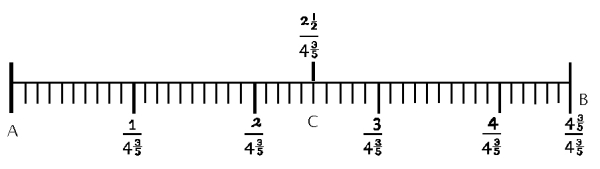
4⅗th is then ¹⁰/₄₆, and 2½ such parts is ²⁵/₄₆, or a c. The student should try several examples of this mode of interpreting complex fractions.
But what are we to say when the denominator itself is less than unity, as in 3¼/⅖? Are we to have a (⅖)th part of a unit? and what is it? Had there been a 5 in the denominator, we should have taken the part of which 5 will make a unit. As there is ⅖ in the denominator, we must take the part of which ⅖ will be a unit. That part is larger than a unit; it is 2½ units; 2½ is that of which ⅖ is 1. The above fraction then directs us to repeat 2½ units 3¼ times. By extending our word ‘multiplication’ to the taking of a part of a time, all multiplications are also divisions, and all divisions multiplications, and all the terms connected with either are subject to be applied to the results of the other.
If 2⅓ yards cost 3½ shillings, how much does one yard cost? In such a case as this, the student looks at a more simple question. If 5 yards cost 10 shillings, he sees that each yard costs ¹⁰/₅, or 2 shillings, and, concluding that the same process will give the true result when the data are fractional, he forms 3½/2⅓, reduces it by rules to ³/₂ or 1½, and concludes that 1 yard costs 18 pence. The answer happens to be correct; but he is not to suppose that this rule of copying for fractions whatever is seen to be true of integers is one which requires no demonstration. In the above question we want money which, repeated 2⅓ times, shall give 3½ shillings. If we divide the shilling into 14 equal parts, 6 of these parts repeated 2⅓ times give the shilling. To get 3½ times as much by the same repetition, we must take 3½ of these 6 parts at each step, or 21 parts. Hence, ²¹/₁₄, or 1½, is the number of shillings in the price.
APPENDIX V. ON CHARACTERISTICS.
When the student comes to use logarithms, he will find what follows very useful. In the mean while, I give it merely as furnishing a rapid rule for finding the place of a decimal point in the quotient before the division is commenced.
When a bar is written over a number, thus, 7 let the number be called negative, and let it be thus used: Let it be augmented by additions of its own species, and diminished by subtractions; thus, 7 and 2 give 9 , and let 7 with 2 subtracted give 5 . But let the addition of a number without the bar diminish the negative number, and the subtraction increase it. Thus, 7 and 4 are 3 , 7 and 12 make 5, 7 with 8 subtracted is 15 . In fact, consider 1, 2, 3, &c., as if they were gains, and 1 , 2 , 3 , as if they were losses: let the addition of a gain or the removal of a loss be equivalent things, and also the removal of a gain and the addition of a loss. Thus, when we say that 4 diminished by 11 gives 7, we say that a loss of 4 incurred at the moment when a loss of 11 is removed, is, on the whole, equivalent to a gain of 7; and saying that 4 diminished by 2 is 6 , we say that a loss of 4, accompanied by the removal of a gain of 2, is altogether a loss of 6.
By the characteristic of a number understand as follows: When there are places before the decimal point, it is one less than the number of such places. Thus, 3·214, 1·0083, 8 (which is 8·00 ...) 9·999, all have 0 for their characteristics. But 17·32, 48, 93·116, all have 1; 126·03 and 126 have 2; 11937264·666 has 7. But when there are no places before the decimal point, look at the first decimal place which is significant, and make the characteristic negative accordingly. Thus, ·612, ·121, ·9004, in all of which significance begins in the first decimal place, have the characteristic 1 ; but ·018 and ·099 have 2 ; ·00017 has 4 ; ·000000001 has 9 .
To find the characteristic of a quotient, subtract the characteristic of the divisor from that of the dividend, carrying one before subtraction if the first significant figures of the divisor are greater than those of the dividend. For instance, in dividing 146·08 by ·00279. The characteristics are 2 and 3 ; and 2 with 3 removed would be 5. But on looking, we see that the first significant figures of the divisor, 27, taken by themselves, and without reference to their local value, mean a larger number than 14, the first two figures of the dividend. Consequently, to 3 we carry 1 before subtracting, and it then becomes 2 , which, taken from 2, gives 4. And this 4 is the characteristic of the quotient, so that the quotient has 5 places before the decimal point. Or, if abcdef be the first figures of the quotient, the decimal point must be thus placed, abcde·f. But if it had been to divide ·00279 by 146·08, no carriage would have been required; and 3 diminished by 2 is 5 ; that is, the first significant figure of the quotient is in the 5th place. The quotient, then, has ·0000 before any significant figure. A few applications of this rule will make it easy to do it in the head, and thus to assign the meaning of the first figure of the quotient even before it is found.
APPENDIX VI. ON DECIMAL MONEY.
Of all the simplifications of commercial arithmetic, none is comparable to that of expressing shillings, pence, and farthings as decimals of a pound. The rules are thereby put almost upon as good a footing as if the country possessed the advantage of a real decimal coinage.
Any fraction of a pound sterling may be decimalised by rules which can be made to give the result at once.
Two shillings is £·100
One shilling is £·050
Sixpence is £·025
One farthing is £·001 04⅙
Thus, every pair of shillings is a unit in the first decimal place; an odd shilling is a 50 in the second and third places; a farthing is so nearly the thousandth part of a pound, that to say one farthing is ·001, two farthings is ·002, &c., is so near the truth that it makes no error in the first three decimals till we arrive at sixpence, and then 24 farthings is exactly ·025 or 25 thousandths. But 25 farthings is ·026, 26 farthings is ·027, &c. Hence the rule for the first three places is
One in the first for every pair of shillings; 50 in the second and third for the odd shilling, if any; and 1 for every farthing additional, with 1 extra for sixpence.
Thus, 0s. 3½d. = £·014
0s. 7¾d. = £·032
1s. 2½d. = £·060
1s. 11¼d. = £·096
2s. 6d. = £·125
2s. 9½d. = £·139
3s. 2¾d. = £·161
13s. 10¾d. = £·694
In the fourth and fifth places, and those which follow, it is obvious that we have no produce from any farthings except those above sixpence. For at every sixpence, ·00004⅙ is converted into ·001, and this has been already accounted for. Consequently, to fill up the fourth and fifth places,
Take 4 for every farthing[59] above the last sixpence, and an additional 1 for every six farthings, or three halfpence.
The remaining places arise altogether from ·00000⅙ for every farthing above the last three halfpence; for at every three halfpence complete, ·00000⅙ is converted into ·00001, and has been already accounted for. Consequently, to fill up all the places after the fifth,
Let the number of farthings above the last three halfpence be a numerator, 6 a denominator, and annex the figures of the corresponding decimal fraction.
It may be easily remembered that
The figures of ¹/₆ are 166666...
” ²/₆ ... 333333...
” ³/₆ ... 5
” ⁴/₆ ... 666666...
” ⁵/₆ ... 833333...
0s. 3½d. = ·014 58 3333...
0s. 7¾d. = ·032 29 1666...
1s. 2½d. = ·060 41 6666...
1s. 11¼d. = ·096 87 83333...
2s. 6d. = ·125 00 0000...
2s. 9½d. = ·139 58 3333...
3s. 2¾d. = ·161 45 83333...
13s. 10¾d. = 694 79 1666...
The following examples will shew the use of this rule, if the student will also work them in the common way.
To turn pounds, &c., into farthings: Multiply the pounds by 960, or by 1000-40, or by 1000(1-⁴/₁₀₀); that is, from 1000 times the pounds subtract 4 per cent of itself. Thus, required the number of farthings in £1663. 11. 9¾.
1663·590625 × 1000 = 1663590·625
4 per cent of this, 66543·625
No. of farthings required, 1597047
What is 47½ per cent of £166. 13. 10 and ·6148 of £2971. 16. 9?
166·691
40 p. c. 66·6764
5 p. c. 8·3346
2½ p. c. 4·1673
79·1783
£79.3.6¾
2971·837
·6 1783·1022
·01 29·7184
·004 11·8873
·0008 2·3775
1827·0854
£1827.1.8½
The inverse rule for turning the decimal of a pound into shillings, pence, and farthings, is obviously as follows:
A pair of shillings for every unit in the first place; an odd shilling for 50 (if there be 50) in the second and third places; and a farthing for every thousandth left, after abating 1 if the number of thousandths so left exceed 24.
The direct rule (with three places) gives too little, the inverse rule too much, except at the end of a sixpence, when both are accurate. Thus, £·183 is rather less than 3s. 8d., and 6s. 4¾d. is rather greater than £319; or when the two do not exactly agree, the common money is the greatest. But £·125 and £·35 are exactly 2s. 6d. and 7s.
Required the price of 17 cwt. 81 lb. 13½ oz. at £3.11.9¾ per cwt. true to the hundredth of a farthing.
3·590625
17
61·040625
lb. 56 ½ 1·795313
16 ⅐ ·512946
7 ⅛ ·224414
2 ⅛ ·064118
oz. 8 ¼ ·016029
4 ½ ·008015
1 ¼ ·002004
½ ½ ·001002
£63·664466
£63.13.3½
Three men, A, B, C, severally invest £191.12.7¾, £61.14.8, and £122.1.9½ in an adventure which yields £511.12.6½. How ought the proceeds to be divided among them?
A, 191·63229
B, 61·73333
C, 122·08958 Produce of £1.
375·45520)511·62708 (1·362686
136·17188
23·53532
1·00801
25710
3183
180
1·362686 1·362686 1·362686
92·236191 33·33716 85·980221
1·362686 8·17612 1·362686
1·226417 13627 272537
13627 9538 27254
8176 409 1090
409 41 122
27 4 7
3 8·41231 1
1 1·663697
2·611346
261·1346 ... A’s share £261.2.8¼
84·1231 ... B’s ... 84.2.5¾
166·3697 ... C’s ... 166.7.4¾
511·6274 £511.2.6¾
If ever the fraction of a farthing be wanted, remember that the coinage-result is larger than the decimal of a pound, when we use only three places. From 1000 times the decimal take 4 per cent, and we get the exact number of farthings, and we need only look at the decimal then left to set the preceding right. Thus, in
134·6 123·1 369·7
5·38 4·92 14·79
·22 ·18 ·91
we see that (if we use four decimals only) the pence of the above results are nearly 8d. ·22 of a farthing, 5½d. ·18, and 4½d. ·91.
A man can pay £2376. 4. 4½, his debts being £3293. 11. 0¾. How much per cent can he pay, and how much in the pound?
3293·553)2376·2180(·7214756
70·7309
4·8598
1·5662
2488
183
18
Answer, £72. 2.11½ per cent.
0.14. 5¼ per pound.
APPENDIX VII. ON THE MAIN PRINCIPLE OF BOOK-KEEPING.
A brief notice of the principle on which accounts are kept (when they are properly kept) may perhaps be useful to students who are learning book-keeping, as the treatises on that subject frequently give too little in the way of explanation.
Any person who is engaged in business must desire to know accurately, whenever an investigation of the state of his affairs is made.
1, What he had at the commencement of the account, or immediately after the last investigation was made; 2, What he has gained and lost in the interval in all the several branches of his business; 3, What he is now worth. From the first two of these things he obviously knows the third. In the interval between two investigations, he may at any one time desire to know how any one account stands.
An account is a recital of all that has happened, in reference to any class of dealings, since the last investigation. It can only consist of receipts and expenditures, and so it is said to have two sides, a debtor and a creditor side.
All accounts are kept in money. If goods be bought, they are estimated by the money paid for them. If a debtor give a bill of exchange, being a promise to pay a certain sum at a certain time, it is put down as worth that sum of money. All the tools, furniture, horses, &c. used in the business are rated at their value in money. All the actual coin, bank-notes, &c., which are in or come in, being the only money in the books which really is money, is called cash.
The accounts are kept as if every different sort of account belonged to a separate person, and had an interest of its own, which every transaction either promotes or injures. If the student find that it helps him, he may imagine a clerk to every account: one to take charge of, and regulate, the actual cash; another for the bills which the house is to receive when due; another for those which it is to pay when due; another for the cloth (if the concern deal in cloth); another for the sugar (if it deal in sugar); one for every person who has an account with the house; one for the profits and losses; and so on.
All these clerks (or accounts) belonging to one merchant, must account to him in the end—must either produce all they have taken in charge, or relieve themselves by shewing to whom it went. For all that they have received, for every responsibility they have undertaken to the concern itself, they are bound, or are debtors; for everything which has passed out of charge, or about which they are relieved from answering to the concern, they are unbound, or are creditors. These words must be taken in a very wide sense by any one to whom book-keeping is not to be a mystery. Thus, whenever any account assumes responsibility to any parties out of the concern, it must be creditor in the books, and debtor whenever it discharges any other parties of their responsibility. But whenever an account removes responsibility from any other account in the same books it is debtor, and creditor whenever it imposes the same.
To whom are all these parties, or accounts, bound, and from whom are they released? Undoubtedly the merchant himself, or, more properly, the balance-clerk, presently mentioned. But it is customary to say that the accounts are debtors to each other, and creditors by each other. Thus, cash debtor to bills receivable, means that the cash account (or the clerk who keeps it) is bound to answer for a sum which was paid on a bill of exchange due to the house. At full length it would be: “Mr. C (who keeps the cash-box) has received, and is answerable for, this sum which has been paid in by Mr. A, when he paid his bill of exchange.” On the other hand, the corresponding entry in the account of bills receivable runs—bills receivable, creditor by cash. At full length: “Mr. B (who keeps the bills receivable) is freed from all responsibility for Mr. A’s bill, which he once held, by handing over to Mr. C, the cash-clerk, the money with which Mr. A took it up.” Bills receivable creditor by cash is intelligible, but cash debtor to bills receivable is a misnomer. The cash account is debtor to the merchant by the sum received for the bill, and it should be cash debtor by bill receivable. The fiction of debts, not one of which is ever paid to the party to whom it is said to be owing, though of no consequence in practice, is a stumbling-block to the learner; but he must keep the phrase, and remember its true meaning.
The account which is made debtor, or bound, is said to be debited; that which is made creditor, or released, is said to be credited. All who receive must be debited; all who give must be credited.
No cancel is ever made. If cash received be afterwards repaid, the sum paid is not struck off the receipts (or debtor-side of the cash account), but a discharge, or credit, is written on the expenditure (or credit) side.
The book in which the accounts are kept is called a ledger. It has double columns, or else the debtor-side is on one page, and the creditor side on the opposite, of each account. The debtor-side is always the left. Other books are used, but they are only to help in keeping the ledger correct. Thus there may be a waste-book, in which all transactions are entered as they occur, in common language; a journal, in which the transactions described in the waste-book are entered at stated periods, in the language of the ledger. The items entered in the journal have references to the pages of the ledger to which they are carried, and the items in the ledger have also references to the pages of the journal from which they come; and by this mode of reference it is easy to make a great deal of abbreviation in the ledger. Thus, when it happens, in making up the journal to a certain date, that several different sums were paid or received at or near the same time, the totals may be entered in the ledger, and the cash account may be made debtor to, or creditor by, sundry accounts, or sundries; the sundry accounts being severally credited or debited for their shares of the whole. The only book that need be explained is the ledger. All the other books, and the manner in which they are kept, important as they may be, have nothing to do with the main principle of the method. Let us, then, suppose that all the items are entered at once in the ledger as they arise. It has appeared that every item is entered twice. If A pay on account of B, there is an entry, “A, creditor by B;” and another, “B, debtor to A.” This is what is called double-entry; and the consequence of it is, that the sum of all the debtor items in the whole book is equal to the sum of all the creditor items. For what is the first set but the second with the items in a different order? If it were convenient, one entry of each sum might be made a double-entry. The multiplication table is called a table of double-entry, because 42, for instance, though it occurs only once, appears in two different aspects, namely, as 6 times 7 and as 7 times 6. Suppose, for example, that there are five accounts, A, B, C, D, E, and that each account has one transaction of its own with every other account; and let the debits be in the columns, the credits in the rows, as follows:
Debtor A B C D E
A, Creditor 23 19 32 4
B, Creditor 17 6 11 25
C, Creditor 9 41 10 2
D, Creditor 14 28 16 3
E, Creditor 15 4 60 1
Here the 16 is supposed to appear in D’s account as D creditor by C, and in C’s account as C debtor to D. And to say that the sum of debtor items is the same as that of creditor items, is merely to say that the preceding numbers give the same sum, whether the rows or the columns be first added up.
If it be desired to close the ledger when it stands as above, the following is the way the accounts will stand: the lines in italics will presently be explained.
A, Debtor. A, Creditor. B, Debtor. B, Creditor.
To B 17 By B 23 To A 23 By A 17
To C 9 By C 19 To C 41 By C 6
To D 14 By D 32 To D 28 By D 11
To E 15 By E 4 To E 4 By E 25
To Balance 23 By Balance 37
78 78 96 96
C, Debtor. C, Creditor. D, Debtor. D, Creditor.
To A 19 By A 9 To A 32 By A 14
To B 6 By B 41 To B 11 By B 28
To D 16 By D 10 To C 10 By C 16
To E 60 By E 2 To E 1 By E 3
By Balance 39 To Balance 7
101 101 61 61
E, Debtor. E, Creditor. Balance, Debtor. Balance, Cred.
To A 4 By A 15 To B 37 By A 23
To B 25 By B 4 To C 39 By D 7
To C 2 By C 60 By E 46
To D 3 By D 1 76 76
To Balance 46
80 80
In all the part of the above which is printed in Roman letters we see nothing but the preceding table repeated. But when all the accounts have been completed, and no more entries are left to be made, there remains the last process, which is termed balancing the ledger. To get an idea of this, suppose a new clerk, who goes round all the accounts, collecting debts and credits, and taking them all upon himself, that he alone may be entitled to claim the debts and to be responsible for the assets of the concern. To this new clerk, whom I will call the balance-clerk, every account gives up what it has, whether the same be debt or credit. The cash-clerk gives up all the cash; the clerks of the two kinds of bills give up all their documents, whether bills receivable or entries of bills payable (remember that any entry against which there is money set down in the books counts as money when given up, that is, as money due or money owing); the clerks of the several accounts of goods give up all their unsold remainders at cost prices; the clerks of the several personal accounts give up vouchers for the sums owing to or from the several parties; and so on. But where more has been paid out than received, the balance-clerk adjusts these accounts by giving instead of receiving; in fact, he so acts as to make the debtor and creditor sides of the accounts he visits equal in amount. For instance, the A account is indebted to the concern 55, while payments or discharges to the amount of 78 have been made by it. The balance-clerk accordingly hands over 23 to that account, for which it becomes debtor, while the balance enters itself as creditor to the same amount. But in the B account there is 96 of receipt, and only 59 of payment or discharge. The balance-clerk then receives 37 from this account, which is therefore credited by balance, while the balance acknowledges as much of debt. The balance account must, of course, exactly balance itself, if the accounts be all right; for of all the equal and opposite entries of which the ledger consists, so far as they do not balance one another, one goes into one side of the balance account, and the other into the other. Thus the balance account becomes a test of the accuracy of one part of the work: if its two sides do not give the same sums, either there have been entries which have not had their corresponding balancing entries correctly made, or else there has been error in the additions.
But since the balance account must thus always give the same sum on both sides, and since balance debtor implies what is favourable to the concern, and balance creditor what is unfavourable, does it not appear as if this system could only be applied to cases in which there is neither loss nor gain? This brings us to the two accounts in which are entered all that the concern began with, and all that it gains or loses—the stock account, and the profit-and-loss account. In order to make all that there was to begin with a matter of double entry, the opening of the ledger supposes the merchant himself to put his several clerks in charge of their several departments. In the stock account, stock, which here stands for the owner of the books, is made creditor by all the property, and debtor by all the liabilities; while the several accounts are made debtors for all they take from the stock, and creditors by all the responsibilities they undertake. Suppose, for instance, there are £500 in cash at the commencement of the ledger. There will then appear that the merchant has handed over to the cash-box £500, and in the stock account will appear, “Stock creditor by cash, £500;” while in the cash account will appear, “Cash debtor to stock, £500.” Suppose that at the beginning there is a debt outstanding of £50 to Smith and Co., then there will appear in the stock account, “Stock debtor to Smith and Co. £50,” and in Smith and Co.’s account will appear “Smith and Co. creditors by stock, £50.” Thus there is double entry for all that the concern begins with by this contrivance of the stock account.
The account to which everything is placed for which an actual equivalent is not seen in the books is the profit-and-loss account. This profit-and-loss account, or the clerk who keeps it, is made answerable for every loss, and the supposed cause of every gain. This account, then, becomes debtor for every loss, and creditor by every gain. If goods be damaged to the amount of £20 by accident, and a loss to that amount occur in their sale, say they cost £80 and sell for £60 cash, it is clear that there is an entry “Cash debtor to goods £60,” and “Goods creditor by cash £60.” Now, there is an entry of £80 somewhere to the debit of the goods for cash laid out, or bills given, for the whole of the goods. It would affect the accuracy of the accounts to take no notice of this; for when the balance-clerk comes to adjust this account, he would find he receives £20 less than he might have reckoned upon, without any explanation of the reason; and there would be a failure of the principle of double-entry. Since it is convenient that the balance account of the goods should merely represent the stock in hand at the close, the account of goods therefore lays the responsibility of £20 upon the profit-and-loss account, or there is the entry “Goods creditor by profit-and-loss, £20,” and also “Profit-and-loss debtor to goods, £20.” Again, in all payments which are not to bring in a specific return, such as house and trade expenses, wages, &c. these several accounts are supposed to adjust matters with the profit-and-loss account before the balance begins. Thus, suppose the outgoings from the mere premises occupied exceed anything those premises yield by £200, or the debits of the house account exceed its credits by £200, the account should be balanced by transferring the responsibility to the profit-and-loss account, under the entries “House expenses creditor by profit-and-loss, £200”, “Profit-and-loss debtor to house expenses, £200.” In this way the profit-and-loss account steps in from time to time before the balance account commences its operations, in order that that same balance account may consist of nothing but the necessary matters of account for the next year’s ledger.
This transference of accounts, or transfusion of one account into another, requires attentive consideration. The receiving account becomes creditor for the credits, and debtor for the debits, of the transmitting account. The rule, therefore, is: Make the transmitting account balance itself, and, on whichever side it is necessary to enter a balancing sum, make the account debtor or creditor, as the case may be, to the receiving account, and the latter creditor or debtor to the former. Thus, suppose account A is to be transferred to account B, and the latter is to arrange with the balance account. If the two stand as in Roman letters, the processes in Italic letters will occur before the final close.
A, Debtor. A, Creditor. B, Debtor. B, Creditor.
To sundries £100 By sundries £500 To sundries £600 By sundries £400
To B 400 To Balance 200 By A 400
£500 £500 £800 £800
And the entry in the balance account will be, “Creditor by B, £200,” shewing that, on these two accounts, the credits exceed the debits by £200.
Still, before the balance account is made up, it is desirable that the profit-and-loss account should be transferred to the stock account; for the profit and loss of this year is of no moment as a part of next year’s ledger, except in so far as it affects the stock at the commencement of the latter. Let this be done, and the balance account may then be made in the form required.
The stock account and the profit-and-loss account, the latter being the only direct channel of alteration for the former, differ in a peculiar manner[60] from the other preliminary accounts, and the balance account is a species of umpire. They represent the merchant: their interests are his interests; he is solvent upon the excess of their credits over their debits, insolvent upon the excess of their debits over their credits. It is exactly the reverse in all the other accounts. If a malicious person were to get at the ledger, and put on a cipher to the pounds in various items, with a view of making the concern appear worse than it really is, he would make his alterations on the debtor sides of the stock and profit-and-loss accounts, and on the creditor sides of all the others. Accordingly, in the balance account, the net stock, after the incorporation of the profit-and-loss account, appears on the creditor side (if not, it should be called amount of insolvency, not stock), and the debts of the concern appear on the same side. But on the debit side of the balance account appear all the assets of the concern (for which the balance-clerk is debtor to the clerks from whom he has taken them).
The young student must endeavour to get the enlarged view of the words debtor and creditor which is requisite, and must then learn by practice (for nothing else will give it) facility in allotting the actual entries in the waste-book to the proper sides of the proper accounts. I do not here pretend to give more than such a view of the subject as may assist him in studying a treatise on book-keeping, which he will probably find to contain little more than examples.
APPENDIX VIII. ON THE REDUCTION OF FRACTIONS TO OTHERS OF NEARLY EQUAL VALUE.
There is a useful method of finding fractions which shall be nearly equal to a given fraction, and with which the computer ought to be acquainted. Proceed as in the rule for finding the greatest common measure of the numerator and denominator, and bring all the quotients into a line. Then write down,
1 2nd Quot.
1st Quot. 1st Quot. × 2d Quot. + 1
Then take the third quotient, multiply the numerator and denominator of the second by it, and add to the products the preceding numerator and denominator. Form a third fraction with the results for a numerator and denominator. Then take the fourth quotient, and proceed with the third and second fractions in the same way; and so on till the quotients are exhausted. For example, let the fraction be ⁹¹³¹/₁₃₁₂₈.
9131)13128(1, 2
1137 3997(3, 1
551 586(1, 15
201 35(1, 2
26 9(1, 8
8 1
This is the process for finding the greatest common measure of 9131 and 13128 in its most compact form, and the quotients and fractions are:
1 2 3 1 1 15 1 2 1 8
1 2 7 9 16 249 265 779 1044 9131
1 3 10 13 23 358 381 1120 1501 13128
It will be seen that we have thus a set of fractions ending with the original fraction itself, and formed by the above rule, as follows:
1st Fraction = 1 = 1
1st Quot. 1
2d Fraction = 2d Quot. = 2
1st Quot. × 2d Quot. + 1 3
3d Fraction = 2d Numʳ. × 3d Quot. + 1st Numʳ. = 2 × 3 + 1 = 7
2d Denʳ. × 3d Quot. + 1st Denʳ. 3 × 3 + 1 10
4th Fraction = 3d Numʳ. × 4th Quot. + 2d Numʳ. = 7 × 1 + 2 = 9 ;
3d Denʳ. × 4th Quot. + 2d Denʳ. 10 × 1 + 3 13
and so on. But we have done something more than merely reascend to the original fraction by means of the quotients. The set of fractions, ¹/₁, ²/₃, ⁷/₁₀, ⁹/₁₃, &c. are continually approaching in value to the original fraction, the first being too great, the second too small, the third too great, and so on alternately, but each one being nearer to the given fraction than any of those before it. Thus, ¹/₁ is too great, and ²/₃ is too small; but ²/₃ is not so much too small as ¹/₁ is too great. And again, ⁷/₁₀, though too great, is not so much too great as ²/₃ is too small.
Moreover, the difference of any of the fractions from the original fraction is never greater than a fraction having unity for its numerator and the product of the denominator and the next denominator for its denominator. Thus, ¹/₁ does not err by so much as ¹/₃, nor ²/₃ by so much as ¹/₃₀, nor ⁷/₁₀ by so much as ¹/₁₃₀, nor ⁹/₁₃ by so much as ¹/₂₉₉, &c.
Lastly, no fraction of a less numerator and denominator can come so near to the given fraction as any one of the fractions in the list. Thus, no fraction with a less numerator than 249, and a less denominator than 358, can come so near to
9131 as 249 .
13128 358
The reader may take any example for himself, and the test of the accuracy of the process is the ultimate return to the fraction begun with. Another test is as follows: The numerator of the difference of any two consecutive approximating fractions ought to be unity. Thus, in our instance, we have ¹⁶/₂₃ and ²⁴⁹/₃₅₈, which, with a common denominator, 23 × 358, have 5728 and 5727 for their numerators.
As another example, let us examine this question: The length of the year is 365·24224 days, which is called in common life 365¼ days. Take the fraction ²⁴²²⁴/₁₀₀₀₀₀, and proceed as in the rule.
24224)100000(4, 7, 1, 4, 9, 2
2496 3104
64 608
0 32
1 7 8 39 359 757
4 29 33 161 1482 3125
and ⁷⁵⁷/₃₁₂₅ is ·24224 in its lowest terms. Hence, it appears that the excess of the year over 365 days amounts to about 1 day in 4 years, which is not wrong by so much as 1 day in 116 years; more accurately, to 7 days in 29 years, which is not wrong by so much as 1 day in 957 years; more accurately still, to 8 days in 33 years, which is not wrong by so much as 1 day in 5313 years; and so on.
This method may be applied to finding fractions nearly equal to the square roots of integers, in the following manner:
√43 = 6 + ...
6 1 5 4 5 5 4 5 1 6 6 1 5 4, &c.
1 7 6 3 9 2 9 3 6 7 1 7 6 3, &c.
6 1 1 3 1 5 1 3 1 1 1 2 1 1 3, &c.
Set down the number whose square root is wanted, say 43. This square root is 6 and a fraction. Set down the integer 6 in the first and third row, and 1 in the second row always. Form the successive rows each from the one before, in the following manner:
One row being The next row has b′, a′, c′, formed in this order, thus,
a a′ = excess of b′c′, already formed, over a.
b b′ = quotient of 43 - a² divided by b.
c c′ = integer in the quotient of 6 + a divided by b′.
Thus the second row is formed from the first, as under:
6 1 = excess of 7 × 1 (both just found) over 6.
1 7 = 43 - 6 × 6 divided by 1.
6 1 = integer of 6 + 6 divided by 7 (just found).
The third row is formed from the second, thus:
1 5 = excess of 1 × 6 over 1.
7 6 = 43 - 1 × 1 divided by 7.
1 1 = integer of 6 + 1 divided by 6;
and so on. In process of time the second column, 1, 7, 1, occurs again, after which the several columns are repeated in the same order. As a final process, take the set in the lowest line (excluding the first, 6), namely, 1, 1, 3, 1, 5, 1, 3, &c. and use them by the rule given at the beginning of this article, as follows:
1 1 3 1 5 1 3 1 1, &c.
1 1 4 5 29 34 131 165 296
1 2 7 9 52 61 235 296 531
Hence, 6¹⁶⁵/₂₉₆ is very near the square root of 43, not erring by so much as
1 .
296 × 531
If we try it, we shall find (⁶¹⁶⁵/₂₉₆) to be ¹⁹⁴¹/₂₉₆, the square of which is ³⁷⁶⁷⁴⁸¹/₈₇₆₁₆, or 43⁷/₈₇₆₁₆.
This rule is of use when it is frequently wanted to use one square root, and therefore desirable to ascertain whether any easy approximation exists by means of a common fraction. For example, √2 is often used.
√2 = 1 + ...
1 1 1
1 1 1
1 2 2 2 2 2 2
1 2 5 12 29 70 &c.
2 5 12 29 70 169
Here it appears that
1 29 does not err by 1 ;
70 70 × 169
consequently, 99 or 100 - 1 is,
70 70
considering the ease of the operation, a fair approximation. In fact, ⁹⁹/₇₀ is 1·4142857 ... the truth being 1·4142135 ...
The following is an additional example:
√ 19 = 4 + ...
4 2 3 3 2 4 4 2
1 3 5 2 5 3 1 3
4 2 1 3 1 2 8 2 1 3 1 2, &c.
1 1 4 5 14 , &c.
2 3 11 14 39
APPENDIX IX. ON SOME GENERAL PROPERTIES OF NUMBERS.
Prop. 1. If a fraction be reduced to its lowest terms, so called,[61] that is, if neither, numerator nor denominator be divisible by any integer greater than unity, then no fraction of a smaller numerator and denominator can have the same value.
Let a/b be a fraction in which a and b have no common measure greater than unity: and, if possible, let c/d be a fraction of the same value, c being less than a, and d less than b. Now, since
a = c we have a = b ;
b d c d
let m be the integer quotient of these last fractions (which must exist, since a > c, b > d), and let e and f be the remainders. Then
a or mc + e = c = mc
b md + f d md
Hence,
e and mc must be equal, for if not,
f md
mc + e would lie between mc and e ,
md + f md f
instead of being equal to the former. Hence,
a = e ;
b f
so that if a fraction whose numerator and denominator have no common measure greater than unity, be equal to a fraction of lower numerator and denominator, it is equal to another in which the numerator and denominator are still lower. If we proceed with
a = e in a similar manner, we find
b f
a = g where g < e, h < f,
b h
and so on. Now, if there be any process which perpetually diminishes the terms of a fraction by one or more units at every step, it must at last bring either the numerator or denominator, or both, to 0. Let
a = v
b w
be one of the steps, and let a = kv + x, b = kw + y; so that
kv + x = v
kw + y w
Now, if x = 0 but not y, this is absurd, for it gives
kv = kv .
kw + y kw
A similar absurdity follows if y be 0, but not x; and if both x and y be = 0, then a = kv, b = kw, or a and b have a common measure, k. Now k must be greater than 1, for v and w are less than c and d, which by hypothesis are less than a and b. Consequently a and b have a common measure k greater than 1, which by hypothesis they have not. If, then, a and b be integers not divisible by any integer greater than 1, the fraction a/b is really in its lowest terms. Also a and b are said to be prime to one another.
Prop. 2. If the product ab be divisible by c, and if c be prime to b, it must divide a. Let
ab = d, then b = d .
c c c
Now b/c is in its lowest terms; therefore, by the last proposition, d and a must have a common measure. Let the greatest common measure be k, and let a = kl, d = km. Then
b = km = m , and m
c kl l l
is also in its lowest terms; but so is b/c; therefore we must have m = b, l = c, for otherwise a fraction in its lowest terms would be equal to another of lower terms. Therefore a = kc, or a is divisible by c. And from this it follows, that if a number be prime to two others, it is prime to their product. Let a be prime to b and c, then no measure of a can measure either b or c, and no such measure can measure the product bc; for any measure of bc which is prime to one must measure the other.
Prop. 3. If a be prime to b, it is prime to all the powers of b. Every measure[62] of a is prime to b, and therefore does not divide b. Hence, by the last, no measure of a divides b²; hence, a is prime to b², and so is every measure of it; therefore, no measure of a divides bb², consequently a is prime to b³, and so on.
Hence, if a be prime to b, a cannot divide without remainder any power of b. This is the reason why no fraction can be made into a decimal unless its denominator be measured by no prime[63] numbers except 2 and 5. For if
a = c ,
b 10ⁿ
which last is the general form of a decimal fraction, let
a be in its lowest terms; then 10ⁿa ,
b b
is an integer, whence (Prop. 2) b must divide 10ⁿ, and so must all the divisors of b. If, then, among the divisors of b there be any prime numbers except 2 and 5, we have a prime number (which is of course a number prime to 10) not dividing 10, but dividing one of its powers, which is absurd.
Prop. 4. If b be prime to a, all the multiples of b, as b, 2b, ... up to (a-1)b must leave different remainders when divided by a. For if, m being greater than n, and both less than a, we have mb and nb giving the same remainder, it follows that mb-nb, or (m-n)b, is divisible by a; whence (Prop. 2), a divides m-n, a number less than itself, which is absurd.
If a number be divided into its prime factors, or reduced to a product of prime numbers only (as in 360 = 2 × 2 × 2 × 3 × 3 × 5), and if a, b, c, &c. be the prime factors, and α, β, γ, &c. the number of times they severally enter, so that the number is aα × bᵝ × cᵞ × &c., then this can be done in only one way: For any prime number v, not included in the above list, is prime to a, and therefore to aα, to b and therefore to bᵝ and therefore to aα × bᵝ Proceeding in this way, we prove that v is prime to the complete product above, or to the given number itself.
The number of divisors which the preceding number aαbᵝcᵞ ... can have, 0 and itself included, is (α + 1)(β+ 1)(γ + 1).... For aα as the divisors 1, a, a² ... aα and no others, α + 1 in all. Similarly, bᵝ has β+ 1 divisors, and so on. Now as all the divisors are made by multiplying together one out of each set, their number (page 202) is (α + 1)(β + 1)(γ+ 1)....
If a number, n, be divisible by certain prime numbers, say 3, 5, 7, 11, then the third part of all the numbers up to n is divisible by 3, the fifth part by 5, and so on. But more than this: when the multiples of 3 are omitted, exactly the fifth part of those which remain are divisible by 5; for the fifth part of the whole are divisible by 5, and the fifth part of those which are removed are divisible by 5, therefore the fifth part of those which are left are divisible by 5. Again, because the seventh part of the whole are divisible by 7, and the seventh part of those which are divisible by 3, or by 5, or by 15, it follows that when all those which are multiples of 3 or 5, or both, are removed, the seventh part of those which remain are divisible by 7; and so on. Hence, the number of numbers not exceeding n, which are not divisible by 3, 5, 7, or 11, is ¹⁰/₁₁ of ⁶/₇ of ⁴/₅ of ²/₃ of n. Proceeding in this way, we find that the number of numbers which are prime to n, that is, which are not divisible by any one of its prime factors, a, b, c, ... is
n a -1 b - 1 c - 1 ...
a b c
or aα-1bβ-1cγ-1 ... (a - 1)(b - 1)(c - 1)....
Thus, 360 being 2³3²5, its number of divisors is 4 × 3 × 2, or 24, and there are 2³3.1.2.4 or 96 numbers less than 360 which are prime to it.
Prop. 5. If a be prime to b, then the terms of the series, a, a², a³, ... severally divided by b, must all leave different remainders, until 1 occurs as a remainder, after which the cycle of remainders will be again repeated.
Let a + b give the remainder r (not unity); then a² ÷ b gives the same remainder as ra + b, which (Prop. 4) cannot be r: let it be s. Then aˢ ÷ b gives the same remainder as sa ÷ b, which (Prop. 4) cannot be either r or s, unless s be 1: let it be t. Then aᵗ ÷ b gives the same remainder as ta ÷ b; if t be not 1, this cannot be either r, s, or t: let it be u. So we go on getting different remainders, until 1 occurs as a remainder; after which, at the next step, the remainder of a ÷ b is repeated. Now, 1 must come at last; for division by b cannot give any remainders but 0, 1, 2, ... b- 1; and 0 never arrives (Prop. 3), so that as soon as b-2 different remainders have occurred, no one of which is unity, the next, which must be different from all that precede, must be 1. If not before, then at aᵇ⁻¹ we must have a remainder 1; after which the cycle will obviously be repeated.
Thus, 7, 7², 7³, 7⁴, &c. will, when divided by 5, be found to give the remainders 2, 4, 3, 1, &c.
Prop. 6. The difference of two mth powers is always divisible without remainder by the difference of the roots; or aᵐ -bᵐ is divisible by a-b; for
aᵐ - bᵐ = aᵐ - aᵐ⁻¹b + aᵐ⁻¹b - bᵐ
= aᵐ⁻¹(a - b) + b(aᵐ⁻¹ - bᵐ⁻¹)
From which, if aᵐ⁻¹-bᵐ⁻¹ is divisible by a - b, so is aᵐ-bᵐ. But a - b is divisible by a - b; so therefore is a²- b²; so therefore is a³-b³; and so on.
Therefore, if a and b, divided by c, leave the same remainder, a² and b², a³ and b³, &c. severally divided by c, leave the same remainders; for this means that a - b is divisible by c. But aᵐ - bᵐ is divisible by a - b, and therefore by every measure of a-b, or by c; but aᵐ - bᵐ cannot be divisible by c, unless aᵐ and bᵐ, severally divided by c, give the same remainder.
Prop. 7. If b be a prime number, and a be not divisible by b, then aᵇ and (a-1)ᵇ + 1 leave the same remainder when divided by b. This proposition cannot be proved here, as it requires a little more of algebra than the reader of this work possesses.[64]
Prop. 8. In the last case, aᵇ⁻¹ divided by b leaves a remainder 1. From the last, aᵇ-a leaves the same remainder as (a-1)ᵇ + 1-a or (a-1)ᵇ- (a-1); that is, the remainder of aᵇ - a is not altered if a be reduced by a unit. By the same rule, it may be reduced another unit, and so on, still without any alteration of the remainder. At last it becomes 1ᵇ-1, or 0, the remainder of which is 0. Accordingly, aᵇ - a, which is a(aᵇ⁻¹- 1), is divisible by b; and since b is prime to a, it must (Prop. 2) divide aᵇ⁻¹-1; that is, aᵇ⁻¹, divided by b, leaves a remainder 1, if b be a prime number and a be not divisible by b.
From the above it appears (Prop. 5 and 7), that if a be prime to b, the set 1, a, a², a³, &c. successively divided by b, give a set of remainders beginning with 1, and in which 1 occurs again at aᵇ⁻¹, if not before, and at aᵇ⁻¹ certainly (whether before or not), if b be a prime number. From the point at which 1 occurs, the cycle of remainders recommences, and 1 is always the beginning of a cycle. If, then, aᵐ be the first power which gives 1 for remainder, m must either be b-1, or a measure of it, when b is a prime number.
But if we divide the terms of the series m, ma, ma², ma³, &c. by b, m being less than b, we have cycles of remainders beginning with m. If 1, r, s, t, &c. be the first set of remainders, then the second set is the set of remainders arising from m, mr, ms, mt, &c. If 1 never occur in the first set before aᵇ⁻¹ (except at the beginning), then all the numbers under b-1 inclusive are found among the set 1, r, s, t, &c.; and if m be prime to b (Prop. 4), all the same numbers are found, in a different order, among the remainders of m, mr, &c. But should it happen that the set 1, r, s, t, &c. is not complete, then m, mr, ms, &c. may give a different set of remainders.
All these last theorems are constantly verified in the process for reducing a fraction to a decimal fraction. If m be prime to b, or the fraction m/b in its lowest terms, the process involves the successive division of m, m × 10, m × 10², &c. by b. This process can never come to an end unless some power of 10, say 10ⁿ, is divisible by b; which cannot be, if b contain any prime factors except 2 and 5. In every other case the quotient repeats itself, the repeating part sometimes commencing from the first figure, sometimes from a later figure. Thus, ¹/₇ yields ·142857142857, &c., but ¹/₁₄ gives ·07(142857)(142857), &c., and ¹/₂₈ gives ·03(571428)(571428), &c.
In m/b, the quotient always repeats from the very beginning whenever b is a prime number and m is less than b; and the number of figures in the repeating part is then always b-1, or a measure of it. That it must be so, appears from the above propositions.
Before proceeding farther, we write down the repeating part of a quotient, with the remainders which are left after the several figures are formed. Let the fraction be ¹/₁₇, we have
0₁₀5₁₅8₁₄8₄2₆3₉5₅2₁₆9₇4₂1₃1₁₃7₁₁6₈4₁₂7₁
This may be read thus: 10 by 17, quotient 0, remainder 10; 10² by 17, quotient 05, remainder 15; 10³ by 17, quotient 058, remainder 14; and so on. It thus appears that 10¹⁶ by 17 leaves a remainder 1, which is according to the theorem.
If we multiply 0588, &c. by any number under 17, the same cycle is obtained with a different beginning. Thus, if we multiply by 13, we have
7647058823529411
beginning with what comes after remainder 13 in the first number. If we multiply by 7, we have 4117, &c. The reason is obvious: ¹/₁₇ × 13, or ¹³/₁₇, when turned into a decimal fraction, starts with the divisor 130, and we proceed just as we do in forming ¹/₁₇, when within four figures of the close of the cycle.
It will also be seen, that in the last half of the cycle the quotient figures are complements to 9 of those in the first half, and that the remainders are complements to 17. Thus, in 0₁₀5₁₅8₁₄8₄, &c. and 9₇4₂1₃1₁₃, &c. we see 0 + 9 = 9, 5 + 4 = 9, 8 + 1 = 9, &c., and 10 + 7 = 17, 15 + 2 = 17, 14 + 3 = 17, &c. We may shew the necessity of this as follows: If the remainder 1 never occur till we come to use aᵇ⁻¹, then, b being prime, b-1 is even; let it be 2k. Accordingly, a²ᵏ-1 is divisible by b; but this is the product of aᵏ-1 and aᵏ + 1, one of which must be divisible by b. It cannot be aᵏ - 1, for then a power of a preceding the (b - 1)th would leave remainder 1, which is not the case in our instance: it must then be aᵏ + 1, so that aᵏ divided by b leaves a remainder b-1; and the kth step concludes the first half of the process. Accordingly, in our instance, we see, b being 17 and a being 10, that remainder 16 occurs at the 8th step of the process. At the next step, the remainder is that yielded by 10(b-1), or 9b + b - 10, which gives the remainder b-10. But the first remainder of all was 10, and 10 + (b - 10) = b. If ever this complemental character occur in any step, it must continue, which we shew as follows: Let r be a remainder, and b - r a subsequent remainder, the sum being b. At the next step after the first remainder, we divide 10r by b, and, at the next step after the second remainder, we divide 10b - 10r by b. Now, since the sum of 10r and 10b - 10r is divisible by b, the two remainders from these new steps must be such as added together will give b, and so on; and the quotients added together must give 9, for the sum of the remainders 10r and 10b - 10r yields a quotient 10, of which the two remainders give 1.
If ¹/₅₉ and ¹/₆₁ be taken, the repeating parts will be found to contain 58 and 60 figures. Of these we write down only the first halves, as the reader may supply the rest by the complemental property just given.
01694915254237288135593220338, &c. 016393442622950819672131147540, &c.
Here, then, are two numbers, the first of which multiplied by any number under 59, and the second by any number under 61, can have the products formed by carrying certain of the figures from one end to the other.
But, b being still prime, it may happen that remainder 1 may occur before b - 1 figures are obtained; in which case, as shewn, the number of figures must be a measure of b - 1. For example, take ¹/₄₁. The repeating quotient, written as above, has only 5 figures, and 5 measures 41 - 1.
0₁₀2₁₈4₁₆3₃₇9₁
Now, this period, it will be found, has its figures merely transposed, if we multiply by 10, 18, 16, or 37. But if we multiply by any other number under 41, we convert this period into the period of another fraction whose denominator is 41. The following are 8 periods which may be found.
0₁₀2₁₈4₁₆3₃₇9₁ 1₉2₈1₃₉9₂₁5₅
0₂₀4₃₆8₃₂7₃₃8₂ 1₁₉4₂₆6₁₄3₁₇4₆
0₃₀7₁₃3₇1₂₉7₃ 2₂₈6₃₄8₁₂2₃₈9₁₁
0₄₀9₈₁7₂₃5₂₅6₄ 3₂₇6₂₄5₃₅8₂₂5₁₅
To find m/41, look out for m among the remainders, and take the period in which it is, beginning after the remainder. Thus, ³⁴/₄₁ is ·8292682926, &c., and ¹⁵/₄₁ is ·3658536585, &c. These periods are complemental, four and four, as 02439 and 97560, 07317 and 92682, &c. And if the first number, 02439, be multiplied by any number under 41, look for that number among the remainders, and the product is found in the period of that remainder by beginning after the remainder. Thus, 02439 multiplied by 23 gives 56097, and by 6 gives 14634.
The reader may try to decipher for himself how it is that, with no more figures than the following, we can extend the result of our division. The fraction of which the period is to be found is ¹/₈₇.
87)100(01149425
130
430
82001149425 × 25
37028735625 × 25
220718390625 × 25
46017959765625 × 25
25448994140625
0114942528735625
718390625
1795976 5625
448994
0114942528735632183908045977|011494
|
APPENDIX X. ON COMBINATIONS.
There are some things connected with combinations which I place in an appendix, because I intend to demonstrate them more briefly than the matters in the text.
Suppose a number of boxes, say 4, in each of which there are counters, say 5, 7, 3, and 11 severally. In how many ways can one counter be taken out of each box, the order of going to the boxes not being regarded. Answer, in 5 × 7 × 3 × 11 ways. For out of the first box we may draw a counter in 5 different ways, and to each such drawing we may annex a drawing from the second in 7 different ways—giving 5 × 7 ways of making a drawing from the first two. To each of these we may annex a drawing from the third box in 3 ways—giving 5 × 7 × 3 drawings from the first three; and so on. The following statements may now be easily demonstrated, and similar ones made as to other cases.
If the order of going to the boxes make a difference, and if a, b, c, d be the numbers of counters in the several boxes, there are 4 × 2 × 3 × 1 × a × b × c × d distinct ways. If we want to draw, say 2 out of the first box, 3 out of the second, 1 out of the third, and 3 out of the fourth, and if the order of the boxes be not considered, the number of ways is
a a -1 × b - 1 b - 2 × c × d d - 1 d - 2
2 2 3 2 3
If the order of going to the boxes be considered, we must multiply the preceding by 4 × 3 × 2 × 1. If the order of the drawings out of the boxes makes a difference, but not the order of the boxes, then the number of ways is
a(a-1)b(b-1)(b-2)cd(d-1)(d-2)
The nth power of a, or aⁿ, represents the number of ways in which a counters differently marked can be distributed in n boxes, order of placing them in each box not being considered. Suppose we want to distribute 4 differently-marked counters among 7 boxes. The first counter may go into either box, which gives 7 ways; the second counter may go into either; and any of the first 7 allotments may be combined with any one of the second 7, giving 7 × 7 distinct ways; the third counter varies each of these in 7 different ways, giving 7 × 7 × 7 in all; and so on. But if the counters be undistinguishable, the problem is a very different thing.
Required the number of ways in which a number can be compounded of other numbers, different orders counting as different ways. Thus, 1 + 3 + 1 and 1 + 1 + 3 are to be considered as distinct ways of making 5. It will be obvious, on a little examination, that each number can be composed in exactly twice as many ways as the preceding number. Take 8 for instance. If every possible way of making 7 be written down, 8 may be made either by increasing the last component by a unit, or by annexing a unit at the end. Thus, 1 + 3 + 2 + 1 may yield 1 + 3 + 2 + 2, or 1 + 3 + 2 + 1 + 1: and all the ways of making 8 will thus be obtained; for any way of making 8, say a + b + c + d, must proceed from the following mode of making 7, a + b + c + (d - 1). Now, (d - 1) is either 0—that is, d is unity and is struck out—or (d - 1) remains, a number 1 less than d. Hence it follows that the number of ways of making n is 2ⁿ⁻¹. For there is obviously 1 way of making 1, 2 of making 2; then there must be, by our rule, 2² ways of making 3, 2³ ways of making 4; and so on.
1 1 + 1 + 1 + 1

1 + 1 + 1 1 + 1 + 2

1 + 1 1 + 2 + 1
1 + 2 1 + 3
2 + 1 2 + 1 + 1
2 2 + 2
3 3 + 1
4
This table exhibits the ways of making 1, 2, 3, and 4. Hence it follows (which I leave the reader to investigate) that there are twice as many ways of forming a + b as there are of forming a and then annexing to it a formation of b; four times as many ways of forming a + b + c as there are of annexing to a formation of a formations of b and of c; and so on. Also, in summing numbers which make up a + b, there are ways in which a is a rest, and ways in which it is not, and as many of one as of the other.
Required the number of ways in which a number can be compounded of odd numbers, different orders counting as different ways. If a be the number of ways in which n can be so made, and b the number of ways in which n + 1 can be made, then a + b must be the number of ways in which n + 2 can be made; for every way of making 12 out of odd numbers is either a way of making 10 with the last number increased by 2, or a way of making 11 with a 1 annexed. Thus, 1 + 5 + 3 + 3 gives 12, formed from 1 + 5 + 3 + 1 giving 10. But 1 + 9 + 1 + 1 is formed from 1 + 9 + 1 giving 11. Consequently, the number of ways of forming 12 is the sum of the number of ways of forming 10 and of forming 11. Now, 1 can only be formed in 1 way, and 2 can only be formed in 1 way; hence 3 can only be formed in 1 + 1 or 2 ways, 4 in only 1 + 2 or 3 ways. If we take the series 1, 1, 2, 3, 5, 8, 13, 21, 34, 55, 89, &c. in which each number is the sum of the two preceding, then the nth number of this set is the number of ways (orders counting) in which n can be formed of odd numbers. Thus, 10 can be formed in 55 ways, 11 in 89 ways, &c.
Shew that the number of ways in which mk can be made of numbers divisible by m (orders counting) is 2ᵏ⁻¹.
In the two series, 1 1 1 2 3 4 6 9 13 19 28, &c. 0 1 0 1 1 1 2 2 3 4 5, &c.,
the first has each new term after the third equal to the sum of the last and last but two; the second has each new term after the third equal to the sum of the last but one and last but two. Shew that the nth number in the first is the number of ways in which n can be made up of numbers which, divided by 3, leave a remainder 1; and that the nth number in the second is the number of ways in which n can be made up of numbers which, divided by 3, leave a remainder 2.
It is very easy to shew in how many ways a number can be made up of a given number of numbers, if different orders count as different ways. Suppose, for instance, we would know in how many ways 12 can be thus made of 7 numbers. If we write down 12 units, there are 11 intervals between unit and unit. There is no way of making 12 out of 7 numbers which does not answer to distributing 6 partition-marks in the intervals, 1 in each of 6, and collecting all the units which are not separated by partition-marks. Thus, 1 + 1 + 3 + 2 + 1 + 2 + 2, which is one way of making 12 out of 7 numbers, answers to
1 1 111 11 1 11 11
in which the partition-marks come in the 1st, 2d, 5th, 7th, 8th, and 10th of the 11 intervals. Consequently, to ask in how many ways 12 can be made of 7 numbers, is to ask in how many ways 6 partition-marks can be placed in 11 intervals; or, how many combinations or selections can be made of 6 out of 11. The answer is,
11 × 10 × 9 × 8 × 7 × 6 , or 462.
1 × 2 × 3 × 4 × 5 × 6
Let us denote by mₙ the number of ways in which m things can be taken out of n things, so that mₙ is the abbreviation for
n × n - 1 × n - 2 ... as far as n - m + 1
2 3 m
Then mₙ also represents the number of ways in which m + 1 numbers can be put together to make n + 1. What we proved above is, that 6₁₁ is the number of ways in which we can put together 7 numbers to make 12. There will now be no difficulty in proving the following:
2ⁿ = 1 + 1ₙ + 2ₙ + 3ₙ ... + nₙ
In the preceding question, 0 did not enter into the list of numbers used. Thus, 3 + 1 + 0 + 0 was not considered as one of the ways of putting together four numbers to make 5. But let us now ask, what is the number of ways of putting together 7 numbers to make 12, allowing 0 to be in the list of numbers. There can be no more (nor fewer) ways of doing this than of putting 7 numbers together, among which 0 is not included, to make 19. Take every way of making 12 (0 included), and put on 1 to each number, and we get a way of making 19 (0 not included). Take any way of making 19 (0 not included), and strike off 1 from each number, and we have one of the ways of making 12 (0 included). Accordingly, 6₁₈ is the number of ways of putting together 7 numbers (0 being allowed) to make 12. And (m- 1)ₙ₊ₘ₋₁ is the number of ways of putting together m numbers to make n, 0 being included.