INTRODUCTION (continued 2)
Reading edition
120 THE ADVENTURES OF SANEHAT
had come to conduct me to the roads of Horus. I spoke to each one by his name, and I gave the presents to each as was intended. I received and I returned the salutation, and I continued thus until I reached the city of Thetu. When the land was brightened, and the new day began, four men came with a summons for me; and the four men went to lead me to the palace. I saluted with both my hands on the ground; the royal children stood at the courtyard to conduct me: the courtiers who were to lead me to the hall brought me on the way to the royal chamber. I found his Majesty on the great throne in the hall of pale gold. Then I threw myself on my belly; this god, in whose presence I was, knew me not. He questioned me graciously, but I was as one seized with blindness, my spirit fainted, my limbs failed, my heart was no longer in my bosom, and I knew the difference
THE ADVENTURES OF SANEHAT 121
between life and death. His majesty said to one of the companions,"Lift him up, let him speak to me." And his majesty said, "Behold thou hast come, thou hast trodden the deserts, thou hast played the wanderer. Decay falls on thee, old age has reached thee; it is no small thing that thy body should be embalmed, that the Pedtiu shall not bury thee. Do not, do not, be silent and speechless; tell thy name; is it fear that prevents thee?" I answered in reply, "I fear, what is it that my lord has said that I should answer it? I have not called on me the hand of God, but it is terror in my body, like that which brings sudden death. Now behold I am before thee; thou art life; let thy majesty do what pleaseth him." The royal children were brought in, and his majesty said to the queen, "Behold thou Sanehat has come as an Amu, whom the Sati have produced." She cried aloud, and the royal children
122 THE ADVENTURES OF SANEHAT
spake with one voice, saying, before his majesty, "Verily it is not so, O king, my lord." Said his majesty, "It is verily he." Then they brought their collars, and their wands, and their sistra in their hands, and displayed them before his majesty; and they sang— "May thy hands prosper, O king; May the ornaments of the Lady of Heaven continue. May the goddess Nub give life to thy nostril; May the mistress of the stars favour thee, when thou sailest south and north. All wisdom is in the mouth of thy majesty; Thy uraeus is on thy forehead, thou drivest away the miserable.
Thou art pacified, O Ra, lord of the lands; They call on thee as on the mistress of all. Strong is thy horn, Thou lettest fly thine arrow. Grant the breath to him who is without it; Grant good things to this traveller, Samehit the Pedti,
born in the land of Egypt, Who fled away from fear of thee, And fled this land from thy terrors. Does not the face grow pale, of him who beholds thy countenance; Does not the eye fear, which looks upon thee."
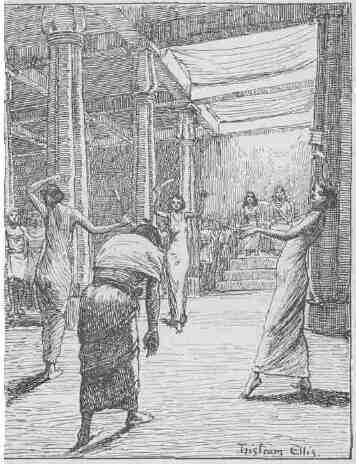
THE SONG OF THE PRINCESSES
THE ADVENTURES OF SANEHAT 125
Said his majesty, " Let him not fear, let him be freed from terror. He shall be a Royal Friend amongst the nobles; he shall be put within the circle of the courtiers. Go ye to the chamber of praise to seek wealth for him." When I went out from the palace, the royal children offered their hands to me; we walked afterwards to the Great Gates. I was placed in a house of a king's son, in which were delicate things, a place of coolness, fruits of the granary, treasures of the White House, clothes of the king's guardrobe, frankincense, the finest perfumes of the king and the nobles whom he loves, in every chamber. All the servitors were in their several offices. Years were removed from my limbs: I was shaved, and polled my locks of hair; the foulness was cast to the desert with the garments of the Nemau-sha. I clothed me in fine linen, and anointed myself with the fine oil of Egypt; I laid me on a bed. I
126 THE ADVENTURES OF SANEHAT
gave up the sand to those who lie on it; the oil of wood to him who would anoint himself therewith. There was given to me the mansion of a lord of serfs, which had belonged to a royal friend. There many ex-
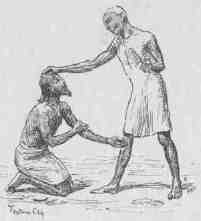
THE SHAVING OF SANEHAT
cellent things were in its buildings; all its wood was renewed. There were brought to me portions from the palace, thrice and four times each day; besides the gifts of the royal children, always, without ceasing. There was built for me a pyramid of stone
REMARKS
127 amongst the pyramids. The overseer of the architects measured its ground; the chief treasurer wrote it; the sacred masons cut the well; the chief of the labourers on the tombs brought the bricks; all things used to make strong a building were there used. There were given to me peasants; there were made for me a garden, and fields in it before my mansion, as is done for the chief royal friend. My statue was inlayed with gold, its girdle of pale gold; his majesty caused it to be made. Such is not done to a man of low degree.May I be in the favour of the king until the day shall come of my death. (This is finished from beginning to end, as was found in the writing.) REMARKS The Adventures of Sanehat appears to have been a popular tale, as portions of three copies remain. The first papyrus
128 THE ADVENTURES OF SANEHAT
known (Berlin No. 1) was imperfect at the beginning; but since then a flake of limestone found in a tomb bore the beginning of the tale, and the same part is found on a papyrus in the Amherst collection. The main text has been translated by Chabas ("Le papyrus de Berlin," 37-51), Goodwin, and Maspero ("Mel. d'arch.," iii. 68, 140, and "Contes Populaire," 89-130); while the beginning is treated in "Memoires de l'institut Egyptien," ii. 1-23, and in Proc. S.B.A., 452. The present translation is mainly based on Mr. Griffith's readings in all cases of difficulty. This is perhaps the most interesting of all the tales, because it bears such signs of being written in the times of which it treats, it throws so much light on the life of the time in Egypt and Syria, and if not a real narrative, it is at least so probable that it may be accepted without much difficulty. For my own part, I incline to look on it as strictly historical; and in the absence of a single
REMARKS 129
point of doubt, I shall here treat it as seriously as the biographical inscriptions of the early tombs. Possibly some day the tomb of Sanehat may be found, and the whole inscription be read complete upon the walls. The name Sa-nehat means "son of the sycamore," probably from his having been born, or living, at some place where was a celebrated sacred sycamore. This was a common tree in ancient, as in modern, Egypt; but an allusion in the tale, to Sanehat turning his back on the sycamore, when he was fleeing apparently up the west side of the Delta, makes it probable that the sycamore was that of Aa-tenen, now Batnun, at the middle of the west side of the Delta. The titles given to Sanehat at the opening are of a very high rank, and imply that he was the son either of the king or of a great noble. And his position in the queen's household shows him to have been of importance; the manner in which he is received 10
130 THE ADVENTURES OF SANEHAT
by the royal family at the end implying that he was quite familiar with them in early days. But the great difficulty in the account has been the sudden panic of Sanehat on hearing of the death of Amenemhat, and no explanation of this has yet been brought forward. It seems not unlikely that he was a son of Amenemhat by some concubine. This would at once account for his high titles—for his belonging to the royal household—for his fear of his elder brother Usertesen, who might see in him a rival, and try to slay him after his father's death—for the command to him to leave all his possessions and family behind him in Syria, as the condition of his being allowed to return to end his days in Egypt—for his familiar reception by the royal family, and for the property given to him on his return. The date recorded for the death of Sehote-pabra—Amenemhat I., the founder of the XIIth Dynasty—agrees with the limit of his reign on the monuments. And the expres-
REMARKS 131
sions for his death are valuable as showing the manner in which a king's decease was regarded; under the emblem of a hawk—the bird of Ra—he flew up and joined the sun. Sometime before his death Amenemhat had been in retirement; after twenty years of reign (which was probably rather late in his life, as he seems to have forced his way to the front as a successful man and founder of a family) he had associated his son, the first Usertesen, on the throne, and apparently resigned active life; for in the third year of Usertesen we find the coregent summoning his court and decreeing the founding of the temple of Heliopolis without any mention of his father. The old king, however, lived yet ten years after his retirement, and died (as this narrative shows us) during an expedition of his son Usertesen. The time of year mentioned here would fall in about the middle of the inundation in those days. Hence it seems that the military expeditions were made after the harvest was
132 THE ADVENTURES OF SANEHAT
secured, and while the country was under water and the population disengaged from other labour. The course of Sanehat's flight southward, reaching the Nile at Cairo after two days' haste, indicates that the army was somewhere west of the Delta. This would point to its being on the road to the oasis of the Natron Lakes, which would be the natural course for a body of men needing water supply. His throwing himself between two bushes to hide from the army shows that the message came early in the day, otherwise he would have fled in the dark. He then fled a day's journey to the south, turning his back on the sycamore, and slept in the open field at Shi-Seneferu somewhere below the Barrage. The second day he reached the Nile opposite Old Cairo in the afternoon, and ferried himself over, passed the quarries at Gebel Mokattam, and the red hill of Gebel Ahmar, and came to a frontier wall before dark. This cannot have been far from Old Cairo, by the time;
REMARKS 133
and as Heliopolis was in course of building by Usertesen, it would be probably on the desert near there, for the protection of the town. Passing the desert guards by night he pushed on and reached Peten, near Belbeis, by dawn, and turned east toward the valley of Kemur, or Wady Tumilat. Here in his extremity he was found by the Sati or Asiatics, and rescued. This shows that the eastern desert was left to the wandering tribes, and was without any regular government at this period; though all the eastern Delta was already well in Egyptian hands, as we know by the monuments at Bubastis, Dedamun, and Tanis. The land of Adim to which Sanehat fled appears to be the same as Edom or the southeast corner of Syria. It was evidently near the upper Tenu, or Rutennu, who seem to have dwelt on the hill country of Palestine. The hill and the plain of Palestine are so markedly different, that in all ages they have tended to be held by opposing people. In
134 THE ADVENTURES OF SANEHAT
the time of Sanehat the upper Tenu who held the hills were opposed to the Tenu in general who held the plains; later on the Semites of the hills opposed the Philistines of the plain, and now the fellah of the hills opposes the Bedawi of the plain. The district of Amuanshi in which Sanehat settled was a goodly land, bearing figs and grapes and olives, flowing with wine and honey and oil, yielding barley and wheat without end, and much cattle. This abundance points rather to the hill country near Hebron or between there and Belt Jibrin, as this south part of the hills is notably fertile. The Tenu who came to defy Sanehat, being in opposition to the upper Tenu, were probably those of the plain; and the opposition to Sanehat may have arisen from his encroaching on the fertile plain at the foot of his hills, as he was in the best of the land "on the border of the next land." The Egyptian was evidently looked on as being of a superior race by the Tenu, and
REMARKS 135
his civilisation won for him the confidence which many wandering Englishmen now find in Africa or Polynesia, like John Dunn. The set combat of two champions seems—by the large gathering—to have been a well-recognised custom among the Tenu, while it exactly accords with Goliath's offer in later times. And raising the shout of victory on the back of the fallen champion reminds us of David's standing on Goliath. The transition from the recital of the Syrian adventures to the petition to Pharaoh is not marked in the manuscript; but from the construction the beginning of the petition is evidently at the place here marked. The manner in which Sanehat appeals to the queen shows how well he must have been known to her in his former days. The decree in reply to Sanehat is in the regular style of royal decrees of the period. Apparently by a clerical error the scribe has substituted the name Amenemhat for Userte-sen, but the Horus name and the throne name
136 THE ADVENTURES OF SANEHAT
leave no doubt that Usertesen I. is intended here. The tone of the reply is as gracious as possible, according with the king's character as stated by Sanehat, "He is a friend of great sweetness, and knows how to gain love." He quite recognises the inquiries after the queen, and replies concerning her. And then he assures Sanehat of welcome on his return, and promises him all that he asks, including a tomb "in the company of the royal children," a full recognition of his real rank. Incidentally we learn that the Amu buried their dead wrapped in a sheep's skin; as we also learn, further on, that they anointed themselves with oil (olive?), wore the hair long, and slept on the ground. The funeral that is promised accords with the burials of the XIIth Dynasty: the gilded case, the head painted blue, and the canopy of cypress wood, are all known of this period, but would be out of place in describing a Ramesside burial. Sanehat's reply is a full course of the usual
REMARKS
137 religious adulation, and differs in this remarkably from his petition. In fact it is hard to be certain where his petition begins; possibly the opening of it has been lost out of the text in copying from a mutilated papyrus; or possibly it was sent merely as a memorandum of Sanehat's position and desires, without venturing to address it personally to the king; or even it may have not been allowable then to make such petitions formally, so as to leave the initiative to the king's free will, just as it is not allowable nowadays to question royalty, but only to answer when spoken to. The proposal to bring forward his fellow-sheikhs as witnesses of his unabated loyalty is very curious, and seems superfluous after Usertesen's assurances. Beyond Abisha of the Amu at Beni Hasan, these are the only early personal names of Syrians that we know. The Fenkhu in this connection can hardly be other than the Phoenicians; and, if so, this points to their being already estab-
138 THE ADVENTURES OF SANEHAT
lished in southern Syria at this date. But these chiefs were not allowed to come forward; and it seems to have been the policy of Egypt to keep the Syrians off as much as possible, not a single man who came with Sanehat being allowed to cross the frontier. The allusion to the Tenu belonging to Pharaoh, like his dogs, is peculiarly fitting to this period, as the dog seems to have been more familiarly domesticated in the XIth and XIIth Dynasties than at any other age, and dogs are often then represented on the funereal steles, even with their names. The expression for strangeness—"as a man of the Delta sees himself at the cataract, as a man of the plain who sees himself in the deserts"—is true to this day. Nothing upsets an Egyptian's self-reliance like going back a few miles into the desert; and almost any man of the cultivated plain will flee with terror if he finds himself left alone far in the desert, or even taken to the top of the desert hills. .
REMARKS 139
We learn incidentally that the Egyptian frontier, even in the later years of Usertesen I., had not been pushed beyond the Wady Tumilat; for Sanehat travels south to the Roads of Horus, where he finds the frontier garrison, and leaves his Syrian friends; and there laden boats meet him, showing that it must have been somewhere along a waterway from the Nile. The abasement of Sanehat might well be due to natural causes, beside the reverence for the divine person of the king. The Egyptian court must have seemed oppressively splendid, with the brilliant and costly workmanship of Usertesen, to one who had lived a half-wild life for so many years; and, more than that, the recalling of all his early days and habits and friendships would overwhelm his mind and make it difficult to collect his thoughts. Sanehat's appearance was so much changed by his long hair, his age, and his strange dress, that his former mistress and com-
140 THE ADVENTURES OF SANEHAT
panions could not recognise him. The use of collars and sceptres in the song and dance is not clear to us. The sistra were, of course, to beat or rattle in time with the song; the sceptres or wands were perhaps the same as the engraved wands of ivory common in the XIIth Dynasty, or of blue glazed ware in XVIIIth, and would be used to wave or beat time with; but the use of the collar and counterpoise, or menat, is unexplained, though figures of dancers are shown holding a collar and menat, and such objects were found buried in the ceremonial foundation deposit of Tahutmes III. at Koptos. This song of the princesses is clearly in parallel phrases. First are four wishes for the king and queen, in four lines. Second, an ascription of wisdom and power, in two lines. Third, a comparison of the king to Ra, and of the queen to the great goddess, in two lines. Fourth, an ascription of righting power. Fifth, a petition for Sanehat, winding up with the statement of fear inspired by
REMARKS 141
the king, as explaining Sanehat's abasement. To this the king responds by reassuring Sanehat, and promising him position and wealth. The account of Sanehat's renewal of his old national ways can best be appreciated by any one who has lived a rough life for a time and then comes back to civilisation. Doubtless these comforts were all the more grateful to him in his old age, when he was weary of his unsettled life. In the preparation of his tomb it is stated to have been a pyramid, with rock-cut well chamber, and built of bricks above. This just accords with the construction of the pyramids of the XIIth Dynasty. The last phrase implies that this was composed during Sanehat's life; and such a life would be so remarkable that this biography might be prepared with good reason. Also it is very unlikely that a mere story-teller would have dropped the relation without describing his grand funeral which was pro-
142 THE ADVENTURES OF SANEHAT
mised to him. From suddenly stopping at the preparation of the tomb, without going further, we have a strong presumption that this was a true narrative, written at Sanehat's dictation, and probably intended to be inscribed on his tomb wall. In any case, we have here an invaluable picture of life in Palestine and in Egypt, and the relations of the two countries, at an epoch before the time of Abraham, and not paralleled by any other document until more than a thousand years later.
INDEX
AA-TENEN, 129
Adim (Edom), 102, 133
Age of 110 years, 25
Ahnas, 76
Aku, 100
Amen, priestesses of, 50
Amenemhat I., death, 97, 130
Amu, burial of, 115, 136
Amu-an-shi, 102-103
Ankhet-Usertesen, 97
Asri, 62
Asses, 61-78; sacrificed, 90, 95
BATHING at even, 11
Baufra, 16
Beating of servants, 42; of sekhti,
70
Brewing barley, 41 Burial of Amu, 115, 136 Burning, punishment of, 15, 51.
89 Burnt-offering, 83
CASKET of ebony, II Champion fight, 108 Combat, single, 109 Crocodile, carried away by, 15, 45; magic, 11
DANCING girls, 34-57 Date of Hordedef's tale, 55 Decree royal, 113, 135 Dedi, 22, 54 Ded-sneferu, 22, 54 Diadem's hidden, 38 Dogs,:38 Dyke path, 62
ENCHANTED crocodile, 11; duck, 28; isle, 83-87, 94; ox, 31
FEKA, 61
Fenkhu, 117, 137
Flax binding, 42
Funeral ceremonies, 115, 136
144
INDEX
GEBEL AIIMAR, too, 132 Goliath, 135
HAKT, 33-37 Heliopolis, 31 Hemti, or tvpical workman, 62,
76
Henenseten, 61, 76 Ilerakleopolis, 76
IAA, 105, 119
Isis, 33-38
Isle of the blessed, 87
Jewel found, 21; lost, 17
KANEFER, 97
Kemur, IOI, 133
Khafra, 9
Kher-ahau, 100
Khnumu, 34-38
Khufu, 9
Kings of the Vth Dynasty, 37, 55
King's decease, 97, 130
LAPIS Lazuli, 34, 56, 83, 95 Letopolis, 32
MAGIC, belief in, 50; crocodile, 11; powers over animals, 25; serpent, 83
Malachite jewel, 17, 21
Medum, 54
Mentu, no
Meruitensa, 62-66
Meskhent, 33-37
Mourning, 45, 98
NATRON lakes, 132 Nebhat, 33-37 Nebka, 9, 15 Neb-ka-n-ra, 69 Nemau-shaw, 105, 126 Nets for garments, 17 Nobles, council of, 67, 79
OARS, inlayed, 17; steering, 17, 53
PALESTINE, 133
Path, rights of, 77; stopped, 62
Peten, 101, 133
Petitions of Sekhti, 68, 73; of
Sanehat, no, 116 Pleasure, demand for new, 16,
53
Present of garments, 10, 50 Priestly descent of Vth Dynasty,
56
Proverbs, 28, 65, 78, 118, 138
Ptah of Ankhtaui, 9
Punishment, capital, 28; burning, 15, 51, 89
Purification of women, 41, 57
RA, children of, 32, 55; son of,
title, 55; temple of, 32 Ra-user, 34 Rowers, maidens, 17 Rubbing by servants, 26 Rud-didet, 31, 55; children of, 33-38
SAKHKEU, 32 Salutations, 26, 27
INDEX
Sanehat, 97-142
Sati, 100-121
Sealing property, 41, 57
Sekhet Heniat, 61-77
Sekhti, or typical peasant, 61,
76
Seneferu, 16 Semnut, 8l Ship, 25, 82 Shi-Seneferu, 100, 132 Song of princesses, 122, 140 Steertr, 17, 53, 54 Storm raised, 38, 82 Syrian chiefs, 102, 117, 137
TAHUTI, dwelling of, 25, 55 Tedium, ancient, 53 Temehu (Lybians), 98
Temple of Ptah, 9, 10 Tenu, 102, 107, 117, 133 Thetu, 120 Trespass, 65
UBA-ANER, 10, 49 Usertesen I., 98, 131
WADY Tumilat, 133 Water party, 17 Waters removed, 21 Wawat (Nubia), 81 Wax figures, 11,51 Women, position of, 49; rights of, 49, 50
ZAZAMANKH, 16, 18, 22
I I