JAMES HUNEKER (continued 2)
Reading edition
To smash legends, Eugène Crépet's biographical study, first printed in 1887, has been republished with new notes by his son, Jacques Crépet. This is an exceedingly valuable contribution to Baudelaire lore; a dispassionate life, however, has yet to be written, a noble task for some young poet who will disentangle the conflicting lies originated by Baudelaire—that tragic comedian—from the truth and thus save him from himself. The new Crépet volume is really but a series of notes; there are some letters addressed to the poet by the distinguished men of his day, supplementing the rather disappointing volume of Letters, 1841-1866, published in 1908. There are also documents in the legal prosecution of Baudelaire, with memories of him by Charles Asselineau, Léon Cladel, Camille Lemonnier, and others.
In November, 1850, Maxime du Camp and Gustave Flaubert found themselves at the French Ambassador's, Constantinople. The two friends had taken a trip in the Orient which later bore fruit in Salammbô. General Aupick, the representative of the French Government, received the young men cordially; they were presented to his wife, Madame Aupick. She was the mother of Charles Baudelaire, and inquired of Du Camp, rather anxiously: "My son has talent, has he not?" Unhappy because her second marriage, a brilliant one, had set her son against her, the poor woman welcomed from such a source confirmation of her eccentric boy's gifts. Du Camp tells the much-discussed story of a quarrel between the youthful Charles and his stepfather, a quarrel that began at table. There were guests present. After some words Charles bounded at the General's throat and sought to strangle him. He was promptly boxed on the ears and succumbed to a nervous spasm. A delightful anecdote, one that fills with joy psychiatrists in search of a theory of genius and degeneration. Charles was given some money and put on board a ship sailing to East India. He became a cattle-dealer in the British army, and returned to France years afterward with a Vénus noire, to whom he addressed extravagant poems! All this according to Du Camp. Here is another tale, a comical one. Baudelaire visited Du Camp in Paris, and his hair was violently green. Du Camp said nothing. Angered by this indifference, Baudelaire asked: "You find nothing abnormal about me?" "No," was the answer. "But my hair—it is green!" "That is not singular, mon cher Baudelaire; every one has hair more or less green in Paris." Disappointed in not creating a sensation, Baudelaire went to a café, gulped down two large bottles of Burgundy, and asked the waiter to remove the water, as water was a disagreeable sight for him; then he went away in a rage. It is a pity to doubt this green hair legend; presently a man of genius will not be able to enjoy an epileptic fit in peace—as does a banker or a beggar. We are told that St. Paul, Mahomet, Handel, Napoleon, Flaubert, Dostoïevsky were epileptoids; yet we do not encounter men of this rare kind among the inmates of asylums. Even Baudelaire had his sane moments.
The joke of the green hair has been disposed of by Crépet. Baudelaire's hair thinning after an illness, he had his head shaved and painted with salve of a green hue, hoping thereby to escape baldness. At the time when he had embarked for Calcutta (May, 1841), he was not seventeen, but twenty, years of age. Du Camp said he was seventeen when he attacked General Aupick. The dinner could not have taken place at Lyons because the Aupick family had left that city six years before the date given by Du Camp. Charles was provided with five thousand francs for his expenses, instead of twenty—Du Camp's version—and he never was a beef-drover in the British army, for a good reason—he never reached India. Instead, he disembarked at the Isle of Bourbon, and after a short stay was seized by homesickness and returned to France, being absent about ten months. But, like Flaubert, on his return home Baudelaire was seized with the nostalgia of the East; out there he had yearned for Paris. Jules Claretie recalls Baudelaire saying to him with a grimace: "I love Wagner; but the music I prefer is that of a cat hung up by his tail outside of a window, and trying to stick to the panes of glass with its claws. There is an odd grating on the glass which I find at the same time: strange, irritating, and singularly harmonious." Is it necessary to add that Baudelaire, notorious in Paris for his love of cats, dedicating poems to cats, would never have perpetrated such revolting cruelty?
Another misconception, a critical one, is the case of Poe and Baudelaire. The young Frenchman first became infatuated with Poe's writings in 1846 or 1847—he gives these two dates, though several stories of Poe had been translated into French as early as 1841 or 1842; L'Orang-Outang was the first, which we know as The Murders in the Rue Morgue; Madame Meunier also adapted several Poe stories for the reviews. Baudelaire's labours as a translator lasted over ten years. That he assimilated Poe, that he idolized Poe, is a commonplace of literary gossip. But that Poe had overwhelming influence in the formation of his poetic genius is not the truth. Yet we find such an acute critic as the late Edmund Clarence Stedman writing, "Poe's chief influence upon Baudelaire's own production relates to poetry." It is precisely the reverse. Poe's influence affected Baudelaire's prose, notably in the disjointed confessions, Mon cœur mis à nu, which recall the American writer's Marginalia. The bulk of the poetry in Les Fleurs de Mal was written before Baudelaire had read Poe, though not published in book form until 1857. But in 1855 some of the poems saw the light in the Revue des deux Mondes, while many of them had been put forth a decade or fifteen years before as fugitive verse in various magazines. Stedman was not the first to make this mistake. In Bayard Taylor's The Echo Club we find on page 24 this criticism: "There was a congenital twist about Poe.. .. Baudelaire and Swinburne after him have been trying to surpass him by increasing the dose; but his muse is the natural Pythia, inheriting her convulsions, while they eat all sorts of insane roots to produce theirs." This must have been written about 1872, and after reading it one would fancy Poe and Baudelaire were rhapsodic wrigglers on the poetic tripod, whereas their poetry is often reserved, even glacial. Baudelaire, like Poe, sometimes "built his nests with the birds of Night," and that was enough to condemn the work of both men with critics of the didactic school.
Once, when Baudelaire heard that an American man-of-letters (?) was in Paris, he secured an introduction and called. Eagerly inquiring after Poe, he learned that he was not considered a genteel person in America. Baudelaire withdrew, muttering maledictions. Enthusiastic poet! Charming literary person! But the American, whoever he was, represented public opinion at the time. To-day criticisms of Poe are vitiated by the desire to make him an angel. It is to be doubted whether without his barren environment and hard fortunes we should have had Poe at all. He had to dig down deeper into the pit of his personality to reach the central core of his music. But every ardent young soul entering "literature" begins by a vindication of Poe's character. Poe was a man, and he is now a classic. He was a half-charlatan as was Baudelaire. In both the sublime and the sickly were never far asunder. The pair loved to mystify, to play pranks on their contemporaries. Both were implacable pessimists. Both were educated in affluence, and both had to face unprepared the hardships of life. The hastiest comparison of their poetic work will show that their only common ideal was the worship of an exotic beauty. Their artistic methods of expression were totally dissimilar. Baudelaire, like Poe, had a harp-like temperament which vibrated in the presence of strange subjects. Above all he was obsessed by sex. Woman, as angel of destruction, is the keynote of his poems. Poe was almost sexless. His aerial creatures never footed the dusty highways of the world. His lovely lines, "Helen, thy beauty is to me," could never have been written by Baudelaire; while Poe would never have pardoned the "fulgurant" grandeur, the Beethoven-like harmonies, the Dantesque horrors of that "deep wide music of lost souls" in "Femmes Damnées":
Descendez, descendez, lamentables victimes.
Or this, which might serve as a text for one of John Martin's vast sinister mezzotints:
J'ai vu parfois au fond d'un théâtre banal Qu'enflammait l'orchestre sonore, Une fée allumer dans un ciel infernal Une miraculeuse aurore; J'ai vu parfois au fond d'un théâtre banal Un être, qui n'était que lumière, or et gaze, Terrasser l'énorme Satan; Mais mon cœur que jamais ne visite l'extase, Est un théâtre où l'on attend Toujours, toujours en vain l'Etre aux ailes de gaze.
Professor Saintsbury thus sums up the differences between Poe and Baudelaire: "Both authors—Poe and De Quincey—fell short of Baudelaire himself as regards depth and fulness of passion, but both have a superficial likeness to him in eccentricity of temperament and affection for a certain peculiar mixture of grotesque and horror." Poe is without passion, except a passion for the macabre; for what Huysmans calls "The October of the sensations"; whereas, there is a gulf of despair and terror and humanity in Baudelaire which shakes your nerves yet stimulates the imagination. However, profounder as a poet, he was no match for Poe in what might be termed intellectual prestidigitation. The mathematical Poe, the Poe of the ingenious detective tales, tales extraordinary, the Poe of the swift flights into the cosmical blue, the Poe the prophet and mystic—in these the American was more versatile than his French translator. That Baudelaire said, "Evil, be thou my good," is doubtless true. He proved all things and found them vanity. He is the poet of original sin, a worshipper of Satan for the sake of paradox; his Litanies to Satan ring childish to us—in his heart he was a believer. His was "an infinite reverse aspiration," and mixed up with his pose was a disgust for vice, for life itself. He was the last of the Romanticists; Sainte-Beuve called him the Kamtschatka of Romanticism; its remotest hyperborean peak. Romanticism is dead to-day, as dead as Naturalism; but Baudelaire is alive, and is read. His glistening phosphorescent trail is over French poetry and he is the begetter of a school:—Verlaine, Villiers de l'Isle Adam, Carducci, Arthur Rimbaud, Jules Laforgue, Verhaeren, and many of the youthful crew. He affected Swinburne, and in Huysmans, who was not a poet, his splenetic spirit lives. Baudelaire's motto might be the opposite of Browning's lines: "The Devil is in heaven. All's wrong with the world."
When Goethe said of Hugo and the Romanticists that they all came from Chateaubriand, he should have substituted the name of Rousseau —"Romanticism, it is Rousseau," exclaims Pierre Lasserre. But there is more of Byron and Petrus Borel—a forgotten mad poet—in Baudelaire; though, for a brief period, in 1848, he became a Rousseau reactionary, sported the workingman's blouse, shaved his head, shouldered a musket, went to the barricades, wrote inflammatory editorials calling the proletarian "Brother!" (oh, Baudelaire!) and, as the Goncourts recorded in their diary, had the head of a maniac. How seriously we may take this swing of the pendulum is to be noted in a speech of the poet's at the time of the Revolution: "Come," he said, "let us go shoot General Aupick!" It was his stepfather that he thought of, not the eternal principles of Liberty. This may be a false anecdote; many were foisted upon Baudelaire. For example, his exclamations at cafés or in public places, such as: "Have you ever eaten a baby? I find it pleasing to the palate!" or, "The night I killed my father!" Naturally people stared and Baudelaire was happy—he had startled the bourgeois. The cannibalistic idea he may have borrowed from Swift's amusing pamphlet, for this French poet knew English literature.
Gautier compares the poems to a certain tale of Hawthorne's in which there is a garden of poisoned flowers. But Hawthorne worked in his laboratory of evil wearing mask and gloves; he never descended into the mud and sin of the street. Baudelaire ruined his health, smudged his soul, yet remained withal, as Anatole France says, "a divine poet." How childish, yet how touching is his resolution—he wrote in his diary of prayer's dynamic force—when he was penniless, in debt, threatened with imprisonment, sick, nauseated with sin: "To make every morning my prayer to God, the reservoir of all force, and all justice; to my father, to Mariette, and to Poe as intercessors." (Evidently, Maurice Barrès encountered here his theory of Intercessors.) Baudelaire loved the memory of his father as much as Stendhal hated his. His mother he became reconciled with after the death of General Aupick, in 1857. He felt in 1862 that his own intellectual eclipse was approaching, for he wrote: "I have cultivated my hysteria with joy and terror. To-day imbecility's wing fanned me as it passed." The sense of the vertiginous gulf was abiding with him; read his poem, "Pascal avait son gouffre."
In preferring the Baudelaire translations of Poe to the original—and they give the impression of being original works—Stedman agreed with Asselineau that the French is more concise than the English. The prose of Poe and Baudelaire is clear, sober, rhythmic; Baudelaire's is more lapidary, finer in contour, richer coloured, more supple, though without the "honey and tiger's blood" of Barbey d'Aurevilly's. Baudelaire's soul was patiently built up as a fabulous bird might build its nest—bits of straw, the sobbing of women, clay, cascades of black stars, rags, leaves, rotten wood, corroding dreams, a spray of roses, a sparkle of pebble, a gleam of blue sky, arabesques of incense and verdigris, despairing hearts and music and the abomination of desolation for ground-tones. But this soul-nest is also a cemetery of the seven sorrows. He loved the clouds .... les nuages ... là bas ... It was là bas with him even in the tortures of his wretched love-life. Corruption and death were ever floating in his consciousness. He was like Flaubert, who saw everywhere the hidden skeleton. Félicien Rops has best interpreted Baudelaire: the etcher and poet were closely knit spirits. Rodin, too, is a Baudelarian. If there could be such an anomaly as a native wood-note evil, it would be the lyric and astringent voice of this poet. His sensibility was both catholic and morbid, though he could be frigid in the face of the most disconcerting misfortunes. He was a man for whom the visible word existed; if Gautier was pagan, Baudelaire was a strayed spirit from mediæval days. The spirit ruled, and, as Paul Bourget said, "he saw God." A Manichean in his worship of evil, he nevertheless abased his soul: "Oh! Lord God! Give me the force and courage to contemplate my heart and my body without disgust," he prays: But as some one remarked to Rochefoucauld, "Where you end, Christianity begins."
Baudelaire built his ivory tower on the borders of a poetic Maremma, which every miasma of the spirit pervaded, every marsh-light and glow-worm inhabited. Like Wagner, Baudelaire painted in his sultry music the profundities of abysms, the vastness of space. He painted, too, the great nocturnal silences of the soul.
Pacem summam tenent! He never reached peace on the heights. Let us admit that souls of his kind are encased in sick frames; their steel is too shrewd for the scabbard; yet the enigma for us is none the less unfathomable. Existence for such natures is a sort of muffled delirium. To affiliate him with Poe, De Quincey, Hoffmann, James Thomson, Coleridge, and the rest of the sombre choir does not explain him; he is, perhaps, nearer Donne and Villon than any of the others—strains of the metaphysical and sinister and supersubtle are to be discovered in him. The disharmony of brain and body, the spiritual bi-location, are only too easy to diagnose; but the remedy? Hypocrite lecteur—mon semblable—mon frère! When the subtlety, force, grandeur, of his poetic production be considered, together with its disquieting, nervous, vibrating qualities, it is not surprising that Victor Hugo wrote to the poet: "You invest the heaven of art with we know not what deadly rays; you create a new shudder." Hugo could have said that he turned Art into an Inferno. Baudelaire is the evil archangel of poetry. In his heaven of fire, glass, and ebony he is the blazing Lucifer. "A glorious devil, large in heart and brain, that did love beauty only...." sang Tennyson.
II
As long ago as 1869 and in our "barbarous gas-lit country," as Baudelaire named the land of Poe, an unsigned review appeared in which this poet was described as "unique and as interesting as Hamlet. He is that rare and unknown being, a genuine poet—a poet in the midst of things that have disordered his spirit—a poet excessively developed in his taste for and by beauty ... very responsive to the ideal, very greedy of sensation." A better description of Baudelaire does not exist. The Hamlet-motive, particularly, is one that sounded throughout the disordered symphony of the poet's life.
He was, later, revealed to American readers by Henry James. This was in 1878, when appeared the first edition of French Poets and Novelists. Previous to that there had been some desultory discussion, a few essays in the magazines, and in 1875 a sympathetic paper by Professor James Albert Harrison of the University of Virginia. But Mr. James had the ear of a cultured public. He denounced the Frenchman for his reprehensible taste, though he did not mention his beautiful verse or his originality in the matter of criticism. Baudelaire, in his eyes, was not only immoral, but he had, with the approbation of Sainte-Beuve, introduced Poe as a great man to the French nation. (See Baudelaire's letter to Sainte-Beuve in the newly published Letters, 1841-1866.) Perhaps Mr. Dick Minim and his projected Academy of Criticism might make clear these devious problems.
The Etudes Critiques of Edmond Schérer were collected in 1863. In them we find this unhappy, uncritical judgment: "Baudelaire, lui, n'a rien, ni le cœur, ni l'esprit, ni l'idée, ni le mot, ni la raison, ni la fantaisie, ni la verve, ni même la facture ... son unique titre c'est d'avoir contribué à créer l'esthétique de la débauche." It is not our intention to dilate upon the injustice of this criticism. It is Baudelaire the critic of æsthetics in whom we are interested. Yet I cannot forbear saying that if all the negations of Schérer had been transformed into affirmations, only justice would have been accorded Baudelaire, who was not alone a poet, the most original of his century, but also a critic of the first rank, one who welcomed Richard Wagner when Paris hooted him and his fellow composer, Hector Berlioz, played the rôle of the envious; one who fought for Edouard Manet, Leconte de Lisle, Gustave Flaubert, Eugène Delacroix; fought with pen for the modern etchers, illustrators, Meryon, Daumier, Félicien Rops, Gavarni, and Constantin Guys. He literally identified himself with De Quincey and Poe, translating them so wonderfully well that some unpatriotic critics like the French better than the originals. So much was Baudelaire absorbed in Poe that a writer of his times asserted the translator would meet the same fate as the American poet. A singular, vigorous spirit is Baudelaire's, whose poetry with its "icy ecstasy" is profound and harmonic, whose criticism is penetrated by a catholic quality, who anticipated modern critics in his abhorrence of schools and environments, preferring to isolate the man and study him uniquely. He would have subscribed to Swinburne's generous pronouncement: "I have never been able to see what should attract man to the profession of criticism but the noble pleasure of praising." The Frenchman has said that it would be impossible for a critic to become a poet; and it is impossible for a poet not to contain a critic.
Théophile Gautier's study prefixed to the definitive edition of Les Fleurs du Mal is not only the most sympathetic exposition of Baudelaire as man and genius, but it is also the high-water mark of Gautier's gifts as an essayist. We learn therein how the young Charles, an incorrigible dandy, came to visit Hôtel Pimodan about 1844. In this Hôtel Pimodan a dilettante, Ferdinand Boissard, held high revel. His fantastically decorated apartments were frequented by the painters, poets, sculptors, romancers, of the day—that is, carefully selected ones such as Liszt, George Sand, Mérimée, and others whose verve or genius gave them the privilege of saying Open Sesame! to this cave of forty Supermen. Balzac has in his Peau de Chagrin pictured the same sort of scenes that were supposed to occur weekly at the Pimodan. Gautier eloquently describes the meeting of these kindred artistic souls, where the beautiful Jewess Maryx, who had posed for Ary Scheffer's Mignon and for Paul Delaroche's La Gloire, met the superb Mme. Sabatier, the only woman that Baudelaire loved, and the original of that extraordinary group of Clésinger's—the sculptor and son-in-law of George Sand—la Femme au Serpent, a Salammbô à la mode in marble. Hasheesh was eaten, so Gautier writes, by Boissard and by Baudelaire. As for the creator of Mademoiselle Maupin, he was too robust for such nonsense. He had to work for his living at journalism, and he died in harness an irreproachable father, while the unhappy Baudelaire, the inheritor of an intense, unstable temperament, soon devoured his patrimony of 75,000 francs and for the remaining years of his life was between the devil of his dusky Jenny Duval and the deep sea of debt.
It was at these Pimodan gatherings, which were no doubt much less wicked than the participants would have us believe, that Baudelaire encountered Emile Deroy, a painter of skill, who made his portrait, and encouraged the fashionable young fellow to continue his art studies. We have seen an album containing sketches by the poet. They betray talent of about the same order as Thackeray's, with a superadded note of the horrific—that favourite epithet of the early Poe critics. Baudelaire admired Thackeray, and when the Englishman praised the illustrations of Guys, he was delighted. Deroy taught his pupil the commonplaces of a painter's technique; also how to compose a palette—a rather meaningless phrase nowadays. At least he did not write of the arts without some technical experience. Delacroix took up his enthusiastic disciple, and when the Salons of Baudelaire appeared in 1845, 1846, 1855, and 1859, the praise and blame they evoked were testimonies to the training and knowledge of their author. A new spirit had been born.
The names of Diderot and Baudelaire were coupled. Neither academic nor spouting the jargon of the usual critic, the Salons of Baudelaire are the production of a humanist. Some would put them above Diderot's. Mr. Saintsbury, after Mr. Swinburne the warmest advocate of Baudelaire among the English, thinks that the French poet in his picture criticism observed too little and imagined too much. "In other words," he adds, "to read a criticism of Baudelaire's without the title affixed is by no means a sure method of recognizing the picture afterward." Now, word-painting was the very thing that Baudelaire avoided. It was his friend Gautier, with the plastic style, who attempted the well-nigh impossible feat of competing in his verbal descriptions with the certitudes of canvas and marble. And if he with his verbal imagination did not entirely succeed, how could a less adept manipulator of the vocabulary? We do not agree with Mr. Saintsbury. No one can imagine too much when the imagination is that of a poet. Baudelaire divined the work of the artist and set it down scrupulously in prose of rectitude. He did not paint pictures in prose. He did not divagate. He did not overburden his pages with technical terms. But the spirit he did disengage in a few swift phrases. The polemics of historical schools were a cross for him to bear, and he bore all his learning lightly. Like a true critic, he judged more by form than theme. There are no types; there is only life, he had cried before Jules Laforgue. He was ever for art-for-art, yet, having breadth of comprehension and a Heine-like capacity for seeing both sides of his own nature and its idiosyncrasies, he could write: "The puerile utopia of the school of art for art, in excluding morality, and often even passion, was necessarily sterile. All literature which refuses to advance fraternally between science and philosophy is a homicidal and a suicidal literature."
Baudelaire, then, was no less sound a critic of the plastic arts than of music and literature. Like his friend Flaubert, he had a horror of democracy, of the démocratisation of the arts, of all the sentimental fuss and fuddle of a pseudo-humanitarianism. During the 1848 agitation the former dandy of 1840 put on a blouse and spoke of barricades. These things were in the air. Wagner rang the alarm-bells during the Dresden uprising. Chopin wrote for the pianoforte a revolutionary étude. Brave lads! Poets and musicians fight their battles best in the region of the ideal. Baudelaire's little attack of the equality-measles soon vanished. He lectured his brother poets and artists on the folly and injustice of abusing or despising the bourgeois (being a man of paradoxes, he dedicated a volume of his Salons to the bourgeois), but he would not have contradicted Mr. George Moore for declaring that "in art the democrat is always reactionary. In 1830 the democrats were against Victor Hugo and Delacroix." And Les Fleurs du Mal, that book of opals, blood, and evil swamp-flowers, can never be savoured by the mob.
In his Souvenirs de Jeunesse, Champfleury speaks of the promenades in the Louvre he enjoyed in company with Baudelaire. Bronzino was one of the latter's preferences. He was also attracted to El Greco—not an unnatural admiration, considering the sombre extravagance of his own genius. Goya he has written of in exalted phrases. Velasquez was his touchstone. Being of a perverse nature, his nerves ruined by abuse of drink and drugs, the landscapes of his imagination or those by his friend Rousseau were more beautiful than Nature herself. The country, he declared, was odious. Like Whistler, whom he often met—see the Hommage à Delacroix by Fantin-Latour, with its portraits of Whistler, Baudelaire, Manet, Bracquemond the etcher, Legros, Delacroix, Cordier, Duranty the critic, and De Balleroy—he could not help showing his aversion to "foolish sunsets." In a word, Baudelaire, into whose brain had entered too much moonlight, was the father of a lunar school of poetry, criticism and fiction. His Samuel Cramer, in La Fanfarlo, is the literary progenitor of Jean, Due d'Esseintes, of Huysmans's A Rebours. Huysmans modelled at first himself on Baudelaire. His Le Drageoir aux Epices is a continuation of Petits Poèmes en Prose. And to Baudelaire's account must be laid much artificial morbid writing. Despite his pursuit of perfection in form, his influence has been too often baneful to impressionable artists in embryo. A lover of Gallic Byronism, and high-priest of the Satanic school, there was no extravagance, absurd or terrible, that he did not commit, from etching a four-part fugue on ice to skating hymns in honour of Lucifer. In his criticism alone was he the sane, logical Frenchman. And while he did not live to see the success of the Impressionist group, he would have surely acclaimed their theories and practice. Was he not an impressionist himself?
As Richard Wagner was his god in music, so Delacroix quite overflowed his æsthetic consciousness. Read Volume II. of his collected works, Curiosités Esthétiques, which contains his Salons; also his essay, De l'Essence du Rire (worthy to be placed side by side with George Meredith's essay on Comedy). Caricaturists, French and foreign, are considered in two chapters at the close of the volume. Baudelaire was as conscientious as Gautier. He toiled around miles of mediocre canvas, saying an encouraging word to the less talented, boiling over with holy indignation, glacial irony, before the rash usurpers occupying the seats of the mighty, and pouncing on new genius with promptitude. Upon Delacroix he lavished the largesse of his admiration. He smiled at the platitudes of Horace Vernef, and only shook his head over the Schnetzes and other artisans of the day. He welcomed William Hausoullier, now so little known. He praised Devéria, Chasseriau—who waited years before he came into his own; his preferred landscapists were Corot, Rousseau and Troyon. He impolitely spoke of Ary Scheffer and the "apes of sentiment"; while his discussions of Hogarth, Cruikshank, Pinelli and Breughel proclaim his versatility of vision. In his essay Le Peintre de la Vie Moderne he was the first among critics to recognize the peculiar quality named "modernity," that nervous, naked vibration which informs the novels of Goncourt, Flaubert's L'Education Sentimentale, and the pictures of Manet, Monet, Degas and Raffaelli with their evocations of a new, nervous Paris. It is in his Volume III., entitled, L'Art Romantique, that so many things dear to the new century were then subjects of furious quarrels. This book contains much just and brilliant writing. It was easy for Nietzsche to praise Wagner in Germany in 1876, but dangerous at Paris in 1861 to declare war on Wagner's critics. This Baudelaire did.
The relations of Baudelaire and Edouard Manet were exceedingly cordial. In a letter to Théophile Thoré, the art critic (Letters, p. 361), we find Baudelaire defending his friend from the accusation that his pictures were pastiches of Goya. He wrote: "Manet has never seen Goya, never El Greco; he was never in the Pourtalés Gallery." Which may have been true at the time, 1864, but Manet visited Madrid and spent much time studying Velasquez and abusing Spanish cookery. (Consider, too, Goya's Balcony with Girls and Manet's famous Balcony.) Raging at the charge of imitation, Baudelaire said in this same epistle: "They accuse even me of imitating Edgar Poe.... Do you know why I so patiently translated Poe? Because he resembled me." The poet italicised these words. With stupefaction, therefore, he admired the mysterious coincidences of Manet's work with that of Goya and El Greco.
He took Manet seriously. He wrote to him in a paternal and severe tone. Recall his reproof when urging the painter to exhibit his work. "You complain about attacks, but are you the first to endure them? Have you more genius than Chateaubriand and Wagner? They were not killed by derision. And in order not to make you too proud I must tell you that they are models, each in his way, and in a very rich world, while you are only the first in the decrepitude of your art." (Letters, p. 436.)
Would Baudelaire recall these prophetic words if he were able to revisit the glimpses of the Champs Elysées at the autumn Salons? What would he think of Cézanne? Odilon Redon he would understand, for he is the transposer of Baudelairianism to terms of design and colour. And perhaps the poet whose verse is saturated with tropical hues—he, when young, sailed in southern seas—might appreciate the monstrous debauch of form and colour in the Tahitian canvases of Paul Gauguin.
Baudelaire's preoccupation with pictorial themes may be noted in his verse. He is par excellence the poet of æsthetics. To Daumier he inscribed a poem; and to the sculptor Ernest Christophe, to Delacroix (Sur Le Tasse en Prison), to Manet, to Guys (Rêve Parisien), to an unknown master (Une Martyre); and Watteau, a Watteau à rebours, is seen in Un Voyage à Cy there; while in Les Phares this poet of ideal, spleen, music, and perfume shows his adoration for Rubens, Leonardo da Vinci, Michaelangelo, Rembrandt, Puget, Goya, Delacroix—"Delacroix, lac de sang hanté des mauvais anges." And what could be more exquisite than his quatrain to Lola de Valence, a poetic inscription for the picture of Edouard Manet, with its last line as vaporous, as subtle as Verlaine: Le charme inattendu d'un bijou rose et noir! Heine called himself the last of the Romantics. The first of the "Moderns" and the last of the Romantics was the many-sided Charles Baudelaire.
III
He was born at Paris April 9, 1821 (Flaubert's birth year), and not April 21st as Gautier has it. His father was Joseph Francis Baudelaire, or Beaudelaire, who occupied a government position. A cultivated art lover, his taste was apparent in the home he made for his second wife, Caroline Archimbaut-Dufays, an orphan and the daughter of a military officer. There was a considerable difference in the years of this pair; the mother was twenty-seven, the father sixty-two, at the birth of their only child. By his first marriage the elder Baudelaire had one son, Claude, who, like his half-brother Charles, died of paralysis, though a steady man of business. That great neurosis, called Commerce, has its mental wrecks, too, but no one pays attention; only when the poet falls by the wayside is the chase begun by neurologists and other soul-hunters seeking for victims. After the death of Baudelaire's father, the widow, within a year, married the handsome, ambitious Aupick, then chef de bataillon, lieutenant-colonel, decorated with the Legion of Honour, and later general and ambassador to Madrid, Constantinople, and London. Charles was a nervous, frail youth, but unlike most children of genius, he was a scholar and won brilliant honours at school. His step-father was proud of him. From the Royal College of Lyons, Charles went to the Lycée Louis-le-Grand, Paris, but was expelled in 1839. Troubles soon began at home for him. He was irascible, vain, very precocious, and given to dissipation. He quarrelled with General Aupick, and disdained his mother. But she was to blame, she has confessed; she had quite forgotten the boy in the flush of her second love. He could not forget, or forgive what he called her infidelity to the memory of his father. Hamlet-like, he was inconsolable. The good bishop of Montpellier, who knew the family, said that Charles was a little crazy—second marriages usually bring woe in their train. "When a mother has such a son, she doesn't remarry," said the young poet. Charles signed himself Baudelaire-Dufays, or sometimes, Dufais. He wrote in his journal: "My ancestors, idiots or maniacs ... all victims of terrible passions"; which was one of his exaggerations. His grand-father on the paternal side was a Champenois peasant, his mother's family presumably Norman, but not much is known of her forbears. Charles believed himself lost from the time his half-brother was stricken. He also believed that his instability of temperament—and he studied his "case" as would a surgeon—was the result of his parents' disparity in years.
After his return from the East, where he did not learn English, as has been said—his mother taught him as a boy to converse in and write the language—he came into his little inheritance, about fifteen thousand dollars. Two years later he was so heavily in debt that his family asked for a guardian on the ground of incompetency. He had been swindled, being young and green. How had he squandered his money? Not exactly on opera-glasses, like Gérard de Nerval, but on clothes, pictures, furniture, books. The remnant was set aside to pay his debts. Charles would be both poet and dandy. He dressed expensively but soberly, in the English fashion; his linen dazzling, the prevailing hue of his habiliments black. In height he was medium, his eyes brown, searching, luminous, the eye of a nyctalops, "eyes like ravens'"; nostrils palpitating, cleft chin, mouth expressive, sensual, the jaw strong and square. His hair was black, curly, and glossy, his forehead high, square, white. In the Deroy portrait he wears a beard; he is there, what Catulle Mendès nicknamed him: His Excellence, Monseigneur Brummel! Later he was the elegiac Satan, the author of L'Imitation de N. S. le Diable; or the Baudelaire of George Moore: "the clean-shaven face of the mock priest, the slow cold eyes and the sharp cunning sneer of the cynical libertine who will be tempted that he may better know the worthlessness of temptation." In the heyday of his blood he was perverse and deliberate. Let us credit him with contradicting the Byronic notion that ennui could be best cured by dissipation; in sin Baudelaire found the saddest of all tasks. Mendès laughs at the legend of Baudelaire's violence, of his being given to explosive phrases. Despite Gautier's stories about the Hôtel Pimodan and its club of hasheesh-eaters, M. Mendès denies that Baudelaire was a victim of the hemp. What the majority of mankind does not know concerning the habits of literary workers is this prime fact: men who work hard, writing verse—and there is no mental toil comparable to it—cannot drink, or indulge in opium, without the inevitable collapse. The old-fashioned ideas of "inspiration," spontaneity, easy improvisation, the sudden bolt from heaven, are delusions still hugged by the world. To be told that Chopin filed at his music for years, that Beethoven in his smithy forged his thunderbolts, that Manet toiled like a labourer on the dock, that Baudelaire was a mechanic in his devotion to poetic work, that Gautier was a hard-working journalist, is a disillusion for the sentimental. Minerva springing full-fledged from Jupiter's skull to the desk of the poet is a pretty fancy; but Balzac and Flaubert did not encourage this fancy. Work literally killed Poe, as it killed Jules de Goncourt, Flaubert, and Daudet. Maupassant went insane because he would work and he would play the same day. Baudelaire worked and worried. His debts haunted him his life long. His constitution was flawed—Sainte-Beuve told him that he had worn out his nerves—from the start, he was détraqué; but that his entire life was one huge debauch is a nightmare of the moral police in some white cotton night-cap country.
His period of mental production was not brief or barren. He was a student. Du Camp's charge that he was an ignorant man is disproved by the variety and quality of his published work. His range of sympathies was large. His mistake, in the eyes of his colleagues, was to write so well about the seven arts. Versatility is seldom given its real name—which is protracted labour. Baudelaire was one of the elect, an aristocrat, who dealt with the quintessence of art; his delicate air of a bishop, his exquisite manners, his modulated voice, aroused unusual interest and admiration. He was a humanist of distinction; he has left a hymn to Saint Francis in the Latin of the decadence. Baudelaire, like Chopin, made more poignant the phrase, raised to a higher intensity the expressiveness of art.
Women played a commanding rôle in his life. They always do with any poet worthy of the name, though few have been so frank in acknowledging this as Baudelaire. Yet he was in love more with Woman than the individual. The legend of the beautiful creature he brought from the East resolves itself into the dismal affair with Jeanne Duval. He met her in Paris, after he had been in the East. She sang at a café-concert in Paris. She was more brown than black. She was not handsome, not intelligent, not good; yet he idealized her, for she was the source of half his inspiration. To her were addressed those marvellous evocations of the Orient, of perfume, tresses, delicious mornings on strange far-away seas and "superb Byzant" domes that devils built. Baudelaire is the poet of perfumes; he is also the patron saint of ennui. No one has so chanted the praise of odours. His soul swims on perfume as do other souls on music, he has sung. As he grew older he seemed to hunt for more acrid odours; he often presents an elaborately chased vase the carving of which transports us, but from which the head is quickly averted. Jeanne, whom he never loved, no matter what may be said, was a sorceress. But she was impossible; she robbed, betrayed him; he left her a dozen times only to return. He was a capital draughtsman with a strong nervous line and made many pen-and-ink drawings of her. They are not prepossessing. In her rapid decline, she was not allowed to want; Madame Aupick paying her expenses in the hospital. A sordid history. She was a veritable flower of evil for Baudelaire. Yet poetry, like music, would be colourless, scentless, if it sounded no dissonances. Fancy art reduced to the beatific and banal chord of C major!
He fell in love with the celebrated Madame Sabatier, a reigning beauty, at whose salon artistic Paris assembled. She had been christened by Gautier Madame la Présidente, and her sumptuous beauty was portrayed by Ricard in his La Femme au Chien. She returned Baudelaire's love. They soon parted. Again a riddle that the published letters hardly solve. One letter, however, does show that Baudelaire had tried to be faithful, and failed. He could not extort from his exhausted soul the sentiment; but he put its music on paper. His most seductive lyrics were addressed to Madame Sabatier: "A la très chère, à la très-belle," a hymn saturated with love. Music, spleen, perfumes—"colour, sound, perfumes call to each other as deep to deep; perfumes like the flesh of children, soft as hautboys, green like the meadows"—criminals, outcasts, the charm of childhood, the horrors of love, pride, and rebellion, Eastern landscapes, cats, soothing and false; cats, the true companions of lonely poets; haunted clocks, shivering dusks, and gloomier dawns—Paris in a hundred phases—these and many other themes this strange-souled poet, this "Dante, pacer of the shore," of Paris has celebrated in finely wrought verse and profound phrases. In a single line he contrives atmosphere; the very shape of his sentence, the ring of the syllables, arouses the deepest emotion. A master of harmonic undertones is Baudelaire. His successors have excelled him in making their music more fluid, more singing, more vapourous—all young French poets pass through their Baudelarian green-sickness—but he alone knows the secrets of moulding those metallic, free sonnets, which have the resistance of bronze; and of the despairing music that flames from the mouths of lost souls trembling on the wharves of hell. He is the supreme master of irony and troubled voluptuousness.
Baudelaire is a masculine poet. He carved rather than sang; the plastic arts spoke to his soul. A lover and maker of images. Like Poe, his emotions transformed themselves into ideas. Bourget classified him as mystic, libertine, and analyst. He was born with a wound in his soul, to use the phrase of Père Lacordaire. (Curiously enough, he actually contemplated, in 1861, becoming a candidate for Lacordaire's vacant seat in the French Academy. Sainte-Beuve dissuaded him from this folly.) Recall Baudelaire's prayer: "Thou, O Lord, my God, grant me the grace to produce some fine lines which will prove to myself that I am not the last of men, that I am not inferior to those I contemn." Individualist, egoist, anarchist, his only thought was of letters. Jules Laforgue thus described Baudelaire: "Cat, Hindoo, Yankee, Episcopal, alchemist." Yes, an alchemist who suffocated in the fumes he created. He was of Gothic imagination, and could have said with Rolla: Je suis venu trop tard dans un monde trop vieux. He had an unassuaged thirst for the absolute. The human soul was his stage, he its interpreting orchestra.
In 1857 The Flowers of Evil was published by the devoted Poulet-Malassis, who afterward went into bankruptcy—a warning to publishers with a taste for fine literature. The titles contemplated were Limbes, or Lesbiennes. Hippolyte Babou suggested the one we know. These poems were suppressed on account of six, and poet and publisher summoned. As the municipal government had made a particular ass of itself in the prosecution of Gustave Flaubert and his Madame Bovary, the Baudelaire matter was disposed of in haste. He was condemned to a fine of three hundred francs, a fine which was never paid, as the objectionable poems were removed. They were printed in the Belgian edition, and may be read in the new volume of Œuvres Posthumes.
Baudelaire was infuriated over the judgment, for he knew that his book was dramatic in expression. He had expected, like Flaubert, to emerge from the trial with flying colours; to be classed as one who wrote objectionable literature was a shock. "Flaubert had the Empress back of him," he complained; which was true; the Empress Eugénie, also the Princess Mathilde. But he worked as ever and put forth those polished intaglios called Poems in Prose, for the form of which he had taken a hint from Aloys Bertrand's Gaspard de la Nuit. He filled this form with a new content; not alone pictures, but moods, are to be found in these miniatures. Pity is their keynote, a tenderness for the abject and lowly, a revelation of sensibility that surprised those critics who had discerned in Baudelaire only a sculptor of evil. In one of his poems he described a landscape of metal, of marble and water; a babel of staircases and arcades, a palace of infinity, surrounded by the silence of eternity. This depressing yet magical dream was utilised by Huysmans in his A Rebours. But in the tiny landscapes of the Prose Poems there is nothing rigid or artificial. Indeed, the poet's deliberate attitude of artificiality is dropped. He is human. Not that the deep fundamental note of humanity is ever absent in his poems; the eternal diapason is there even when least overheard. Baudelaire is more human than Poe. His range of sympathy is wider. In this he transcends him as a poet, though his subject-matter often issues from the very dregs of life. Brother to pitiable wanderers, there is, nevertheless, no trace of cant, no "Russian pity" à la Dostoïevsky, no humanitarian or socialistic rhapsodies in his work. Baudelaire is an egoist. He hated the sentimental sapping of altruism. His prose-poem, Crowds, with its "bath of multitude," may have been suggested by Poe; but in Charles Lamb we find the idea: "Are there no solitudes out of caves and the desert? or, cannot the heart, in the midst of crowds, feel frightfully alone?"
His best critical work is the Richard Wagner and Tannhäuser, a more significant essay than Nietzsche's Richard Wagner in Bayreuth; Baudelaire's polemic appeared at a more critical period in Wagner's career. Wagner sent a brief, hearty letter of thanks to the critic and made his acquaintance. To Wagner Baudelaire introduced a young Wagnerian, Villiers de l'Isle Adam. This Wagner letter is included in the volume of Crépet; but there are no letters published from Baudelaire to Franz Liszt, though they were friends. In Weimar I saw at the Liszt house several from Baudelaire which should have been included in the Letters. The poet understood Liszt and his reforms as he understood Wagner's. The German composer admired the French poet, and his Kundry, of the sultry second act, Parsifal, has a Baudelairian hue, especially in the temptation scene.
The end was at hand. Baudelaire had been steadily, rather, unsteadily, going downhill; a desperate figure, a dandy in shabby attire. He went out only after dark, he haunted the exterior boulevards, associated with birds of nocturnal plumage. He drank without thirst, ate without hunger, as he has said. A woeful decadence for this aristocrat of life and letters. Most sorrowful of sinners, his morose delectation scourged his nerves and extorted the darkest music from his lyre. He fled to Brussels, there to rehabilitate his dwindling fortunes. He gave a few lectures, and met Rops, Lemonnier, drank to forget, and forgot to work. He abused Brussels, Belgium, its people. A country where the trees are black, the flowers without odour, and where there is no conversation. He, the brilliant causeur, the chief blaguer of a circle in which young James McNeill Whistler was reduced to the rôle of a listener—this most spirituel among artists found himself a failure in the Belgian capital. It may not be amiss to remind ourselves that Baudelaire was the creator of most of the paradoxes attributed, not only to Whistler, but to an entire school—if one may employ such a phrase. The frozen imperturbability of the poet, his cutting enunciation, his power of blasphemy, his hatred of Nature, his love of the artificial, have been copied by the æsthetic blades of our day. He it was who first taunted Nature with being an imitator of art, with being always the same. Oh, the imitative sunsets! Oh, the quotidian eating and drinking! And as pessimist, too, he led the mode. Baudelaire, like Flaubert, grasped the murky torch of pessimism once held by Chateaubriand, Benjamin Constant, and Sénancour. Doubtless all this stemmed from Byronism. To-day it is all as stale as Byronism.
His health failed rapidly, and he didn't have money enough to pay for doctor's prescriptions; he owed for the room in his hotel. At Namur, where he was visiting the father-in-law of Félicien Rops (March, 1866), he suffered from an attack of paralysis. He was removed to Brussels. His mother, who lived at Honfleur, in mourning for her husband, came to his aid. Taken to France, he was placed in a sanatorium. Aphasia set in. He could only ejaculate a mild oath, and when he caught sight of himself in the mirror he would bow pleasantly as if to a stranger. His friends rallied, and they were among the most distinguished people in Paris, the élite of souls. Ladies visited him, one or two playing Wagner on the piano—which must have added a fresh nuance to death—and they brought him flowers. He expressed his love for flowers and music to the last. He could not bear the sight of his mother; she revived in him some painful memories, but that passed, and he clamoured for her when she was absent. If anyone mentioned the names of Wagner or Manet, he smiled. Madame Sabatier came; so did the Manets. And with a fixed stare, as if peering through some invisible window opening upon eternity, he died, August 31, 1867, aged forty-six.
Barbey d'Aurevilly, himself a Satanist and dandy (oh, those comical old attitudes of literature!), had prophesied that the author of Fleurs du Mal would either blow out his brains or prostrate himself at the foot of the cross. (Later he said the same of Huysmans.) Baudelaire had the latter course forced upon him by fate after he had attempted spiritual suicide for how many years? (He once tried actual suicide, but the slight cut in his throat looked so ugly that he went no farther.) His soul had been a battle-field for the powers of good and evil. That at the end he brought the wreck of both soul and body to his God is not a subject of comment. He was an extraordinary poet with a bad conscience, who lived miserably and was buried with honours. Then it was that his worth was discovered (funeral orations over a genius are a species of public staircase wit). His reputation waxes with the years. He is an exotic gem in the crown of French poetry. Of him Swinburne has chanted Ave Atque Vale:
Shall I strew on thee rose or rue or laurel, Brother, on this that was the veil of thee?
III
THE REAL FLAUBERT
Ah, did you once see Shelley plain, And did he stop and speak to you....
I
It was some time in the late spring or early summer of 1879. I was going through the Chaussée d'Antin when a huge man, a terrific old man, passed me. His long straggling gray hair hung low. His red face was that of a soldier or a sheik, and was divided by drooping white moustaches. A trumpet was his voice, and he gesticulated freely to the friend who accompanied him. I did not look at him with any particular interest until some one behind me—if he be dead now may he be eternally blest!—exclaimed: "C'est Flaubert!" Then I stared; for though I had not read Madame Bovary I adored the verbal music of Salammbô, secretly believing, however, that it had been written by Melchior, one of the three Wise Kings who journeyed under the beckoning star of Bethlehem—how else account for its planturous Asiatic prose, for its evocations of a vanished past? But I knew the name of Flaubert, that magic collocation of letters, and I gazed at him. He returned my glance from prominent eyeballs, the colour of the pupil a bit of faded blue sky. He did not smile. He was too tender-hearted, despite his appreciation of the absurd. Besides, he knew, He, too, had been young and foolish. He, too, had worn a velvet coat and a comical cap, and had dreamed. I must have been a ridiculous spectacle. My hair was longer than my technique. I was studying Chopin or lunar rainbows then—I have forgotten which—and fancied that to be an artist one must dress like a cross between a brigand and a studio model. But I was happy. Perhaps Flaubert knew this, for he resisted the temptation to smile. And then he passed from my view. To be frank, I was not very much impressed, because earlier in the day I had seen Paul de Cassagnac and that famous duellist was romantic-looking, which the old Colossus of Croisset was not. When I returned to the Batignolles I told the concièrge of my day's outing.
"Ah!" he remarked, "M. Flaubert! M. Paul de Cassagnac!—a great man, Monsieur P-paul!" He stuttered a little. Now I only remember "M. Flaubert," with his eyes like a bit of faded blue sky. Was it a dream? Was it Flaubert? Did some stranger cruelly deceive me? But I'll never relinquish the memory of my glorious mirage.
Where was he going, Gustave Flaubert, on that sunny afternoon? It was at the time when Jules Ferry appointed him an assistant-librarian at the Mazarine; hors cadre, a sinecure, a veiled pension with 3,000 francs a year; a charity, as the great writer bitterly complained. He was poor. He had given up, without a murmur, his entire fortune to his niece, then Madame Caroline Commainville, and through the influence of Turgenev and a few others this position had been created for him. He had no duties, yet he insisted on arriving at his post as early as half-past seven in the morning. He planned later that the government should be reimbursed for its outlay. His brother, Dr. Achille Flaubert, of Rouen, gave him a similar allowance, so the unhappy man had enough to live upon. Perhaps he was going to the Gare Saint-Lazare to take a train for Croisset; perhaps he was starting for Ancient Corinth—I thought—to see once more his Salammbô veiled by the sacred Zaïmph; or he might have been on the point of departing for Taprobana, the Ceylon of the antique world; that island whose very name he repeated with the same pleasure as did the old woman the blessed name of "Mesopotamia."
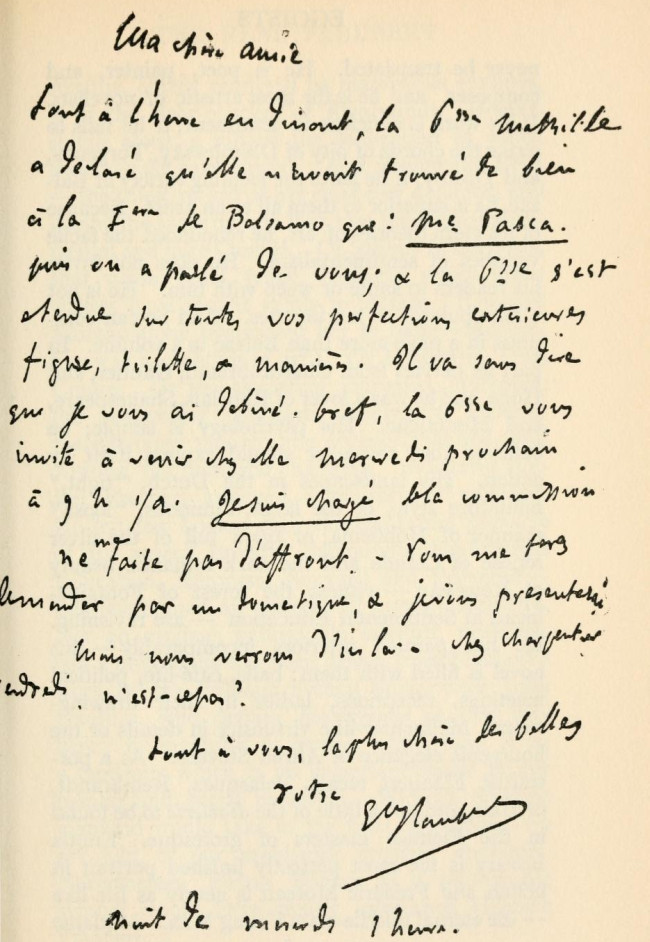
Fac-simile of an unpublished Flaubert letter.
Taprobana! Taprobana! would cry Gustave Flaubert, to the despair of his friends. He was a man in love with beautiful sounds. He filled his books with them and with beautiful pictures. You must go to Beethoven or Liszt for a like variety in rhythms; the Flaubertian prose rhythms change in every sentence, like a landscape alternately swept by sunlight or shadowed by clouds. They vary with the moods and movements of the characters. They are music for ear and eye. And they can never be translated. He is poet, painter, and composer, and he is the most artistic of novelists. If his work is deficient in sentiment; if he fails to strike the chords of pity of Dostoïevsky, Turgenev, and Tolstoy; if he lacks the teeming variety of Balzac, he is superior to them all as an artist. Because of his stern theories of art, he renounced the facile victories of sentimentalism. He does not invite his readers to smile or weep with him. He is not a manipulator of marionettes. And he can compress in a page more than Balzac in a volume. In part he derives from Chateaubriand, Gautier, and Hugo, and he was a lover of Rabelais, Shakespeare, and Montaigne. His psychology is simple; he believed that character should express itself by action. His landscapes in the Dutch, "tight," miniature style, or the large, luminous, "loose" manner of Hobbema; or again full of the silver repose of Claude and the dark romantic beauty of Rousseau—witness the forest of Fontainebleau in Sentimental Education—are ravishing. He has painted interiors incomparably—this novel is filled with them: balls, café-life, political meetings, receptions, ladies in their drawing-rooms, Meissonier-like virtuosity in details or the bourgeois elegance of Alfred Stevens. As a portraitist Flaubert recalls Velasquez, Rembrandt, or Hals, and not a little of the diablerie to be found in the Flemish masters of grotesque. Emma Bovary is the most perfectly finished portrait in fiction and Frédéric Moreau is nearly as lifelike—the eternal middle-class Young Man. Madame Arnoux, chiefly rendered by marvellous evasions, is in the clear-obscure of Rembrandt. Homais stands alone, a subject the delineation of which Swift would have envied. And Rosannette Bron—the truest record of her class ever depicted, and during the same decade that saw the odious sentimental and false Camille. Or Salome in Hérodias, that vision, cruel, feline, exquisite, which lesser writers have sought vainly to imitate. (Gustave Moreau alone transposed her to paint—Moreau, too, was a cenobite of art.) Or Félicité in Trois Contes. Or the perpetual journalist, Hussonet, the swaggering politician, Regimbart, Pellerin, the dilettante painter, the socialist, Sénecal, and Arnoux, the immortal charlatan. Whatever subject Flaubert attacked, a masterpiece emerged. He left few books; each represents the pinnacle of its genre: Bovary, Salammbô, Sentimental Education, Hérodias, Bouvard and Pécuchet—this last-named an epitome of human stupidity. Not an original philosophic intellect, nevertheless a philosophy has been drawn from Flaubert's work by the brilliant French philosopher Jules Gaultier, who defines Bovaryisme as that tendency in mankind to appear other than it is; a tendency which is an important factor in our mental and social evolution. Without illusions mankind would take to the trees, the abode, we are told, of our prehistoric arboreal ancestors. Nevertheless, Emma Bovary as a philosophic symbol would have greatly astonished Gustave Flaubert.
II
"Since Goethe," might be a capital title for an essay on the epics that were written after the death of the noblest German of them all. The list would be small. In France there are only the rather barren rhetorical exercise of Edgar Quinet's Ahasvérus, the surging insurrectionary poems of Hugo, and the faultlessly frigid performance of Leconte de Lisle. But a work of such heroic power and proportions as Faust there is not, except Flaubert's Temptation of Saint Antony, which is so impregnated by the Faustian spirit—though poles apart from the German poem in its development—that, when we hear the youthful Gustave was a passionate admirer and student of Goethe, even addressing a long poem in alexandrines to his memory, we are not surprised. The real Flaubert is only beginning to be revealed. His four volumes of correspondence, his single volume of letters addressed to George Sand, and the recently published letters to his niece Caroline—now Madame Franklin Grout of Antibes—have shown us a very different Flaubert from the legend chiefly created by Maxime du Camp. Dr. Félix Dumesnil, in his remarkable study, has told us of the Rouen master's neurasthenia and has utterly disproved Du Camp's malicious yarns about epilepsy. Above all, Flaubert's devotion to Goethe and the recent publication of the first version of his Saint Antony have presented a novel picture of his personality. We now know that, striving to become impersonal in art, he is personal and present in every page he ever wrote; furthermore that, despite his incessant clamours and complaints, he, in reality, loved his galley-like, self-imposed labours.
The Temptation of Saint Antony is the only modern poem of epical largeness that may be classed with Brand or Zarathustra. It recalls at times the Second Part of Faust in its sweep and grandeur, in its grandiose visions; but though it is superior in verbal beauty it falls short of Goethe in its presentation of the problems of human will. Faust is a man who wills; Antony is static, not dynamic; the one is tempted by the Devil and succumbs, but does not lose his soul; Flaubert's hermit resists the Devil at his subtlest, yet we do not feel that his soul is as much worth the saving as Faust's. Ideas are the heroes in Flaubert's prose epic. Saint Antony is a metaphysical drama, not a human one like Faust; nevertheless, to Faust alone may we compare it.
Flaubert was born at Rouen, December 12, 1821, where he died May 18, 1880. That he practically passed his years at Croisset, his mother's home, below Rouen facing the Seine, and in his study toiling like a titan over his books, should be recorded in every text-book of literature. For he is the patron-saint of all true literary men. He had a comfortable income. He thought, talked, lived literature. His friends Du Camp, Louis Bouilhet, Turgenev, Taine, Baudelaire, Zola, the Goncourts, Daudet, Renan, Maupassant, Henry James, have testified to his absorption in his art. It is almost touching in these times when a man goes into the writing business as if vending tripe, to recall the example of Flaubert for whom art was more sacred than religion. Naturally, he has been proved by the madhouse doctors to have been half cracked. Perhaps he was not as sane as a stockbroker, but it takes all sorts to make a world and a writer of Flaubert's rank should not be weighed in the same scales with, say, a successful politician.
He was endowed with a nervous temperament, though up to his twenty-second year he was as handsome and as free from sickness as a god. He was very tall and his eyes were sea-green. A nervous crisis supervened and at wide intervals returned. It was almost fatal for Gustave. He became pessimistic and afraid of life. However, the talk of his habitual truculent pessimism has been exaggerated. Naturally optimistic, with a powerful constitution and a stout heart, he worked like the Trojan he was. His pessimism came with the years during his boyhood—Byronic literary spleen was in the air. He was a grumbler and rather overdid the peevish pose. As Zola asked: "What if he had been forced to earn his living by writing?" But, even in his blackest moods, he was glad to see his friends at Croisset, glad to go up to Paris for recreation. His letters, so free, fluent, explosive, give us the true Flaubert who childishly roared yet was so hearty, so friendly, so loving to his mother, niece, and intimates. His heredity was puzzling. His father was, like Baudelaire's grandfather, of Champenois stock; bourgeois, steady, a renowned surgeon. From him Gustave inherited his taste for all that pertained to medicine and science. Recall his escapades as a boy when he would peep for hours into the dissecting-room of the Rouen hospital. Such matters fascinated him. He knew more about the theory and practice of medicine than many professional men. An air of mortality exhales from his pages. He is in Madame Bovary the keen soul-surgeon. His love of a quiet, sober existence came to him from his father. He clung to one house for nearly a half century. He has said that one must live like a bourgeois and think like an artist; to be ascetic in life and violent in art—that was a Flaubert maxim. "I live only in my ideas," he wrote. But from the mother's side, a Norman and aristocrat she was, he inherited his love of art, his disdain for philistines, his adventurous disposition—transposed because of his malady to the cerebral region, to his imagination. He boasted Canadian blood, "red skin," he called it, but that was merely a mystification. The dissonance of temperament made itself felt early. He was the man of Goethe with two spirits struggling within him. Dual in temperament, he swung from an almost barbaric Romanticism to a cruel analysis of life that made him the pontiff of the Realistic school. He hated realism, yet an inner force set him to the disagreeable task of writing Madame Bovary and Sentimental Education—the latter, with its daylight atmosphere, the supreme exemplar of realism in fiction. So was it with his interior life. He was a mystic who no longer believed. These dislocations of his personality he combated all his life, and his books show with what success. "Flaubert," wrote Turgenev, his closest friend, to George Sand, "has tenacity without energy, just as he has self-love without vanity." But what tenacity!
Touching on the question of epilepsy, a careful reading of Dumesnil convinces anyone, but the neurologist with a fixed idea, that Flaubert was not a sufferer from genuine epilepsy. Not that there is any reason why epilepsy and genius should be divorced; we know in many cases the contrary is the reverse. Take the case of Dostoïevsky—his epilepsy was one of the most fruitful of motives in his stories. Nearly all his heroes and heroines are attainted. (Read The Idiot or the Karamsoff Brothers.) But Flaubert's epilepsy was arranged for him by Du Camp, who thought that by calling him an epilept in his untrustworthy Memoirs he would belittle Flaubert. And he did, for in his time the now celebrated—and discredited—theory of genius and its correlation with the falling-sickness had not been propounded. Flaubert had hystero-neurasthenia. He was rheumatic, asthmatic, predisposed to arterio-sclerosis and apoplexy. He died of an apoplectic stroke. His early nervous fits were without the aura of epilepsy; he did not froth at the mouth nor were there muscular contractions; not even at his death. Dr. Tourneaux, who hastened to aid him in the absence of his regular physician, Dr. Fortin, denied the rumours of epilepsy that were so gaily spread by that sublime old gossip, Edmond de Goncourt, also by Zola and Du Camp. The contraction of Flaubert's hands was caused by the rigidity of death; most conclusive of all evidence against the epileptic theory is the fact that during his occasional fits Gustave never lost consciousness. Nor did he suffer from any attacks before he had attained his majority, whereas epilepsy usually begins at an early age. He studied with intense zeal his malady and in a dozen letters refers to it, tickets its symptoms, tells of plans to escape the crises, and altogether, has furnished students of pathology many examples of nerve-exhaustion and its mitigation. His first attacks began at Pont-Audemar, in 1843. In 1849 he had a fresh attack. His trip to the Orient relieved him. He was a Viking, a full-blooded man, who scorned sensible hygiene; he took no exercise beyond a walk in the morning, a walk in the evening on his terrace, and in summer an occasional swim in the Seine. He ate copiously, was moderate in drinking, smoked fifteen or twenty pipes a day, abused black coffee, and for months at a stretch worked fifteen hours out of the twenty-four at his desk. He warned his disciple, Guy de Maupassant, against too much boating as being destructive of mental productivity. After Nietzsche read this he wrote: "Sedentary application is the very sin against the Holy Ghost. Only thoughts won by walking are valuable." In 1870 another crisis was brought on by protracted labours over the revision of the definitive version of the Saint Antony. His travels in Normandy, in the East, his visits to London (1851) and to Righi-Kaltbad, together with sojourns in Paris—where he had a little apartment—make up the itinerary of his fifty-eight years. Is it any wonder that he died of apoplexy, stricken at his desk, he of a violently sanguine temperament, bull-necked, and the blood always in his face?
Maurice Spronck, who took too seriously the saying of Flaubert—a lover of extravagant paradox—thinks the writer had a cerebral lesion, which he called audition colorée. It is a malady peculiar to imaginative natures, which transposes tone to colour, or odour to sound. As this "malady" may be found in poets from the dawn of creation, "coloured audition" must be a necessary quality of art. Flaubert took pains to exaggerate his speech when in company with the Goncourts. He suspected their diary-keeping weakness and he humoured it by telling fibs about his work. "I have finished my book, the cadence of the last paragraph has been found. Now I shall write it." Aghast were the brothers at the idea of an author beginning his book backward. Flaubert boasted that the colour of Salammbô was purple. Sentimental Education (a bad title, as Turgenev wrote him; Withered Fruits, his first title, would have been better) was gray, and Madame Bovary was for him like the colouring of certain mouldy wood-vermin. The Goncourts solemnly swallowed all this, as did M. Spronck. Which moved Anatole France to exclaim: "Oh these young clinicians!"
But what is all this when compared with the magnificent idiocy of Du Camp, who asserted that if Flaubert had not suffered from epilepsy he would have become a genius! Hénaurme! as the man who made such masterpieces as Madame Bovary, Sentimental Education, Temptation of Saint Antony, the Three Tales, Bouvard et Pécuchet, had a comical habit of exclaiming. Enormous, too, was Guy de Maupassant's manner of avenging his master's memory. In the final edition—eight volumes long—Maupassant, with the unerring eye of hatred, affixed an introduction to Bouvard et Pécuchet. Therein he printed Maxime du Camp's letters to Flaubert during the period when Madame Bovary was appearing in the Revue de Paris. Du Camp was one of its editors. He urged Flaubert to cut the novel—the concision of which is so admirable, the organic quality of which is absolute. Worse still remains. If Flaubert couldn't perform the operation himself, then the aforesaid Du Camp would hire some experienced hack to do it for the sensitive author; wounded vanity Du Camp believed to be the cause of indignant remonstrances. They eliminated the scene of the agricultural fair and the operation on the hostler's foot—one scene as marvellous as a genre painting by Teniers with its study of the old farm servant, and psychologically more profound; the other necessary to the development of the story. Thus Madame Bovary was slaughtered serially by a man ignorant of art, that Madame Bovary which is one of the glories of French literature, as Mr. James truly says. Flaubert scribbled on Du Camp's letters another of his favourite expletives, Gigantesque! Flaubert never forgave him, but they were apparently reconciled years later. Du Camp went into the Academy; Flaubert refused to consider a candidacy, though Victor Hugo—wittily nicknamed by Jules Laforgue "Aristides the Just"—urged him to do so. Even the mighty Balzac was too avid of glory and gold for Flaubert, to whom art and its consolations were all-sufficing.
III
Bouvard et Pécuchet was never finished. Its increasing demands killed Flaubert. In his desk were found many cahiers of notes taken to illustrate the fatuity of mankind, its stupidity, its bêtise. He was as pitiless as Swift or Schopenhauer in his contempt for low ideals and vulgar pretensions, for the very bourgeois from whom he sprung. In the collection we find this gem of wisdom uttered by Louis Napoleon in 1865: "The richness of a country depends on its general prosperity." To it should be included the Homais-like dictum of Maxime du Camp that if Flaubert had not been an epilept he would have been a genius! Or, the following hospital criticism; Flaubert was denied creative ability! Who has denied it to him? Homais alone in his supreme asininity should be a beacon-light of warning for any one of these inept critics. Flaubert once wrote: "I am reading books on hygiene; how comical they are! What impertinence these physicians have! What asses for the most part they are!" And he, the son of a celebrated surgeon and the brother of another, a medical student himself, might have made Homais a psychiatrist instead of a druggist, if he had lived longer.
Du Camp—who, clever and witty as well as inexact and reckless in statement, was a man given to envies and literary jealousies—never got over Flaubert's startling success with Madame Bovary. He once wrote a fanciful epitaph for Louise Colet, a French woman of mediocrity, the "Muse" of Flaubert, a general trouble-breeder and a recipient of Flaubert's correspondence. The Colet had embroiled herself with De Musset and published a spiteful romance in which poor Flaubert was the villain. This the Du Camp inscription: "Here lies the woman who compromised Victor Cousin, made Alfred de Musset ridiculous, calumniated Gustave Flaubert, and tried to assassinate Alphonse Karr: Requiescat in pace." A like epitaph suggests itself for Maxime du Camp: Hic jacet the man who slandered Baudelaire, traduced his loving friend Gustave Flaubert, and was snuffed out of critical existence by Guy de Maupassant.
The massive-shouldered Hercules, Flaubert, a Hercules spinning prose for his exacting Dejanira of art, was called unintelligent by Anatole France. He had not, it is true, the subtle critical brain and thorough scholarship of M. France; yet Flaubert was learned. Brunetière even taxed him with an excess of erudition. But his multitudinous conversation, his lack of logic, his rather gross sense of humour, are not to be found in his work. Without that work, without Salammbô, for example, should we have had the pleasure, thrice-distilled, of reading Anatole France's Thaïs? (See a single instance in the definitive edition Temptation, page 115, the episode of the Gymnosophist.) All revivals of the antique world are unsatisfactory at best, whether Chateaubriand's Martyrs, or the unsubstantial lath and plaster of Bulwer's Last Days of Pompeii, or the flabbiness and fustian of Quo Vadis. The most perfect attempt is Salammbô, an opera in words, and its battlements of purple prose were riddled by Sainte-Beuve, by Froehner, and lately by Maurice Pézard—who has proved to his own satisfaction that Flaubert was sadly amiss in his Punic archæology. Well, who cares if he was incorrect in details? His partially successful reconstruction of an epoch is admitted, though the human element is somewhat obliterated. Flaubert was bound to be more Carthaginian than Carthage.
After the scandal caused by the prosecution of Madame Bovary Flaubert was afraid to publish his 1856, second version of Saint Antony. He had been advised by the sapient Du Camp to cast the manuscript into the fire, after a reading before Bouilhet and Du Camp lasting thirty-three hours. He refused. This was in September, 1849. Du Camp declares that he asked him to essay "the Delaunay affair" meaning the Delamarre story. This Flaubert did, and the result was the priceless history of Charles and Emma Bovary. D'Aurevilly attacked the book viciously; Baudelaire defended it. Later Turgenev wrote to Flaubert: "After all you are Flaubert!" George Sand was a motherly consoler. Their letters are delightful. She did not quite understand the bluff, naïve Gustave, she who composed so flowingly, and could turn on or off her prose like the tap of a kitchen hydrant (the simile is her own). How could she fathom the tormented desire of her friend for perfection, for the blending of idea and image, for the eternal pursuit of the right word, the shapely sentence, the cadenced coda of a paragraph? And of the larger demands of style, of the subtle tone of a page, a chapter, a book, why should this fluent and graceful writer, called George Sand, concern herself with such superfluities! It was always O altitudo in art with Flaubert—the most copious, careless of correspondents. He had set for himself an impossible standard of perfection and an ideal of impersonality neither of which he realized. But there is no outward sign of conflict in his work; all trace of the labour bestowed upon his paragraphs is absent. His style is simple, direct, large, above all, clear, the clarity of classic prose.
His declaiming aloud his sentences has been adduced to prove his absence of sanity. Beethoven, too, was pronounced crazy by his various landladies because he sang and howled in his voice of a composer his compositions in the making. Flaubert was the possessor of an accurate musical ear; not without justice did Coppée call him the "Beethoven of French prose." His sense of rhythm was acute; he carried it so far that he would sacrifice grammar to rhythmic flow. He tested his sentences aloud. Once in his apartment, Rue Murillo, overlooking Parc Monceau, he rehearsed a page of a new book for hours. Belated coachmen, noting the open windows, hearing an outrageous vocal noise, concluded that a musical soiree was in progress. Gradually the street filled on either side with carriages in search of passengers. But the guests never emerged from the house. In the early morning the lights were extinguished and the oaths of the disappointed ones must have been heard by Flaubert.
He would annotate three hundred volumes for a page of facts. His bump of scrupulousness was large. In twenty pages he sometimes saved three or four from destruction. He did not become, however, as captious as Balzac in the handling of proofs. A martyr of style, he was not altogether an enameller in precious stones, not a patient mosaic-maker, superimposing here and there a precious verbal jewel. First, the image, and then its appropriate garb; sometimes image and phrase were born simultaneously, as was the case with Richard Wagner. These extraordinary things may happen to men of genius, who are neither opium-eaters nor lunatics. The idea that Flaubert was ever addicted to drugs—beyond the quinine with which his good father dosed him after the fashion of those days—is ridiculous. The gorgeous visions of Saint Antony are the results of stupendous preparatory studies, a stupendous power of fantasy, and a stupendous concentration. Opium superinduces visions, but not the power and faculty of attention to record them in terms of literature for forty years. George Saintsbury has pronounced Saint Antony the most perfect specimen of dream literature extant. And because of its precision in details, its architectonic, its deep-hued waking hallucinations.
Flaubert was a very nervous man, "as hysterical as an old woman," said Dr. Hardy of the hospital Saint-Louis, but neither mad nor epileptic. His mental development was not arrested in his youth, as asserted by Du Camp; he had arranged his life from the time he decided to become a writer. He was one with the exotic painter, Gustave Moreau, in his abhorrence of the mob. He was a poet who wrote a perfect prose, not prose-poetry. Enamoured of the antique, of the Orient, of mystical subjects, he spent a lifetime in the elaboration of his beloved themes. That he was obsessed by them is merely to say that he was the possessor of mental energy and artistic gifts. He was not happy. He never brought his interior and exterior lives into complete harmony. An unparalleled observer, an imaginative genius, he was a child outside the realm of art. Soft of heart, he raised his niece as a daughter; a loving son, he would console himself after his mother's death by looking at the dresses she once wore. Flaubert a sentimentalist! He outlived his family and his friends, save a few; death was never far away from his thoughts; he would weep over his souvenirs. At Croisset I have talked with the faithful Colange, whose card reads: "E. Colange, ex-cook of Gustave Flaubert!" The affection of the novelist for cats and dogs, he told me, was marked. The study pavilion is to-day a Flaubert Memorial. The parent house is gone, and in 1901 there was a distillery on the grounds, which is now a printing establishment. Flaubert cherished the notion that Pascal had once stopped in the old Croisset homestead; that Abbé Prévost had written Manon Lescaut within its walls. He had many such old-fashioned and darling tics, and he is to be envied them.
Since Madame Bovary French fiction, for the most part, has been Flaubert with variations. His influence is still incalculable. François Coppée wrote: "By the extent and the magnificence of his prose, Gustave Flaubert equals Bossuet and Chateaubriand. He is destined to become a great classic. And several centuries hence—everything perishes—when the French language shall have become only a dead language, candidates for the bachelor's degree will be able to obtain it only by expounding (along with the famous exordium, He Who Reigns in the Heavens, etc., or The Departure of the Swallows, of René) the portrait of Catharine le Roux, the farm servant, in Madame Bovary, or the episode of the Crucified Lions in Salammbô."
IV
With the critical taste that uncovers bare the bones of the dead I have no concern, nor shall I enter the way which would lead me into the dusty region of professional ethics. Every portrait painter from Titian to John Sargent, from Velasquez to Zuloaga, has had a model. Novelists are no less honest when they build their characters upon human beings they have known and studied, whether their name be Fielding or Balzac or Flaubert.
The curiosity which seeks to unveil the anonymity of a novelist's personages may not be exactly laudable; it is yet excusable. I am reminded of its existence by a certain Parisian journalist who, acting upon information that appeared in the pages of a well-known French literary review, went to Normandy in search of the real Emma Bovary. Once called wicked, the novel has been pronounced as moral as a Sunday-school tract. Thackeray admired its style, but deplored, with his accustomed streak of sentimentalism, the cold-blooded analysis which hunted Emma to an ignominious grave. Yet the author of Vanity Fair did not hesitate to pursue through many chapters his mercurial Rebecca Sharp.
The story of Emma Bovary would hardly attract, if published in the daily news columns, much attention nowadays. A good-looking young provincial woman tires of her honest, slow-going husband. She reads silly novels, as do thousands of silly married girls to-day. Emma lived in a little town not far from Rouen. Flaubert named it Yonville. We read that Emma flirted with a country squire who in order to escape eloping with the romantic goose suddenly disappeared. She consoled herself with a young law student, but when he tired of her the consequences were lamentable. Harassed by debt, Emma took poison. Her stupid husband, a hard-working district doctor, was aghast at her death and puzzled by the ruin which followed fast at its heels. He found it all out, even the love-letters of the squire. He died suddenly.
A sordid tale, but perfectly told and remarkable not only for the fidelity of the landscapes, the chaste restraint of the style, but also because there are half a dozen marvellously executed characters, several of which have entered into the living current of French speech. Homais, the vainglorious, yet human and likable Homais, is a synonym for pedantic bragging mediocrity. He is a druggist. He would have made an ideal politician. He stands for a shallow "modernity" but is more superstitious than a mediæval sexton. Flaubert's novel left an indelible mark in French fiction and philosophy. Even Balzac did not create a Homais.
Now comes the curious part of the story. It was the transcription of a real occurrence. Flaubert did not invent it. In a town near Rouen named Ry there was once a young physician, Louis Delamarre. He originally hailed from Catenay, where his father practised medicine. In the novel Ry is called Yonville. Delamarre paid his addresses to Delphine Couturier, who in 1843 was twenty-three years of age. She was comely, had a bright though superficial mind, spoke in a pretentious manner, and over-dressed. From her father she inherited her vanity and the desire to appear as occupying a more exalted position than she did. The elder Couturier owned a farm, though heavily mortgaged, at Vieux-Château. He was a close-fisted Norman anxious to marry off his daughters—Emma had a sister. He objected to the advances of the youthful physician, chiefly because he saw no great match for his girl. Herein the tale diverges from life.
But love laughs at farmers as well as locksmiths, and by a ruse worthy of Paul de Kock, Delphine, by feigning maternity, got the parental permission. She soon regretted her marriage. The husband, Louis, was prosaic. He earned the daily bread and butter of the household, and even economised so that his pretty wife could buy fallals and foolish books. She hired a servant and had her day at home—Fridays. No one visited her. She was only an unimportant spouse of a poverty-stricken country doctor. At Saint-Germain des Essours there still lives an octogenarian peasant woman once the domestic of the Delamarres-Bovarys. She said, when asked to describe her mistress: "Heavens, but she was pretty. Face, figure, hair, all were beautiful."
In Ry there was a druggist named Jouanne. He is the original Homais. Delphine's, or rather Emma Bovary's, first admirer was a law clerk, Louis Bottet. He is described as a small, impatient, alert old man at the time of his death. The faithless Rodolphe—what a name for sentimental melodrama—was really a proprietor named Campion. He lost his farm and revenue after Emma's death and went to America to make his fortune. Unsuccessful, he returned to Paris, and about 1852 shot himself on the boulevard. Who may deny, after this, that truth is stranger than Flaubert's fiction?
The good, sensible old Abbé Boumisien, who advised Emma Bovary, when she came to him for spiritual consolation, to consult her doctor husband, was, in reality, an Abbé Lafortune. The irony of events is set forth in sinister relief by the epitaph which the real Emma's husband had carved on her tomb: "She was a good mother, a good wife." Gossips of Ry aver that after the truth came to Dr. Delamarre he took a slow poison. But this seems turning the screw a trifle too far. Mme. Delamarre, or Emma Bovary, was buried in the graveyard of the only church at Ry. To-day the tomb is no longer in existence. She died March 6, 1848. The inhabitants still show the church,—the porch of which was too narrow to allow the passage of unlucky Emma's coffin—the house of her husband, and the apothecary shop of M. Homais. The latter survived for many years the unhappy heroine, who stole the poison that killed her from his stock. A delightful touch of Homais-like humour was displayed—one that exonerated Flaubert from the charge of exaggeration in portraying Homais—when the novel appeared. The characters were at once recognized, both in Rouen and Ry. This druggist, Jouanne-Homais, was flattered at the lengthy study of himself, of course missing its relentless ironic strokes. He regretted openly that the author had not consulted him; for, said he, "I could have given him many points about which he knew nothing." The epitaph which the real Homais composed for the tomb of his wife—surely you can never forget her after reading the novel—is magnificent in its bombast. Flaubert knew his man.
The distinguished writer is a sober narrator of facts. His is not a domain of delicate thrills. His women are neither doves nor devils. He does not paint those acrobats of the soul so dear to psychological fiction. Despite his pretended impassibility, he is tender-hearted; the pity he felt for his characters is not effusively expressed. But the larger rhythms of humanity are ever present. If he had been hard of heart, he would have related the Bovary tale as it happened in life. Charles Bovary finds the love-letters and meets Rodolphe. Nothing happens. The real Charles never knew of the real Emma's treachery. Madame d'Epinay was not far amiss when she wrote: "The profession of woman is very hard."
V
No less a masterpiece than Don Quixote has been cited in critical comparison with Madame Bovary. Flaubert was called the Cervantes who had ridiculed from the field the Romantic School. This irritated him, for he never posed as a realist; indeed, he confessed that he had intended to mock the Realistic School—then headed by Champfleury—in his Bovary. The very name of this book would arouse a storm of abuse from him. He knew that he had more than one book in him, he believed better books; the indifference of the public to Sentimental Education and the Temptation he never understood. Much astonishment was expressed, after the appearance of Bovary, that such a mature work of art should have been the author's first. But Beethoven, Chopin, Brahms did not permit their juvenile efforts to see the light; the same was the case with Flaubert. In 1835—he was fourteen at the time—he wrote Mort du Duc de Guise; in 1836 another historical study. Short stories in the style of Hoffmann, with thrilling titles, such as Rage et Impuissance, Le Rêve d'Enfer (1837), and a psychologic effort, Agonies (dedicated to Alfred le Poittevin—as are both versions of the Temptation; Alfred's sister later became the mother of Guy de Maupassant): all these exercises, as is a Dance of Death, are still in manuscript. But in 1839 a scenario of a mystery bearing the cryptic title of Smarh was written; and this with Novembre, and a study of Rabelais, and Nuit de Don Juan, have been published in the definitive edition; with a record of travels in Normandy. The Memoirs of a Madman appeared a few years ago in a Parisian magazine. It was a youthful effort. There is also in the collection of Madame Grout a 300-page manuscript (1843-1845) named L'Education Sentimentale—vaguely inspired by Wilhelm Meister—which has nothing in common with his novel of the same name published in 1869.
Flaubert's taste in the matter of titles was lamentable. He made a scenario for a tale called Spiral, and he often asserted that he hankered to write in marmoreal prose the Combat of Thermopylae; he meditated, too, a novel the scene and characters laid in the Second Empire, and dilated upon the beauty of a portrait executed in microscopic detail of that immortal character, M. le Préfet. We might have had a second Homais if he had made this project a reality. He told Turgenev that he had another idea, a sort of modern Matron of Ephesus —in the Temptation there is an episode that suggests the Ephesus. He did not lack invention and he was an extremely rapid writer—but his artistic conscience was morbidly sensitive. It pained him to see Zola throwing his better self to the dogs in his noisy, inartistic novels—in which, he said, was neither poetry nor art. And he wrote this opinion to Zola, who promptly called him an idiot. In that correct but colourless book of Faguet's on Flaubert, the critic makes note of all the novelist's grammatical errors and reaches the conclusion that he was a stylist unique, but not careful in his grammar. Now, while this is piffling pedantry, the facts are in Faguet's favour; Faguet, who holds the critical scales nicely, as he always does, though listlessly. But in the handling of such a robust, red-blooded subject as Flaubert the college professor was hardly a wise selection. The Faguet study is clear and painstaking but not sympathetic. Mr. James has praised it, possibly because Faguet agrees with him as to the psychology of Sentimental Education. Not a study, Faguet's, for Flaubertians, who see the faults of their Saint Polycarp—his favourite self-appellation—and love him for his all-too-human imperfections.
In 1845 Flaubert, on a visit to Italy, stopped at Genoa. There, in the Palace Balbi-Senarega—and not at the Doria, as Du Camp wrote, with his accustomed carelessness—the young Frenchman saw an old picture by Breughel (probably by Pieter the Younger, surnamed Hell-Breughel) that represents a temptation of Saint Antony. It is hardly a masterpiece, this Breughel, and is dingy in colour. But Flaubert, who loved the grotesque, procured an engraving of this picture and it hung in his study at Croisset until the day of his death. It was the spring-board of his own Temptation. The germ may be found in his mystery, Smarh, with its Demon and metaphysical colouring. Breughel set into motion the mental machinery of the Temptation that never stopped whirring until 1874. The first brouillon of the Temptation was begun May 24, 1848, and finished September 12, 1849. It numbered 540 pages of manuscript. Set aside for Bovary, Flaubert took up the draft again and made the second version in 1856. When he had done with it, the manuscript was reduced to 193 pages. Not satisfied, he returned to the work in 1872, and when ready for publication in 1874 the number of pages were 136. He even then cut, from ten chapters, three. Last year the French world read the second version of 1856 and was astonished to find it so different from the definitive one of 1874. The critical sobriety and courage of Flaubert were vindicated. In 1849, reading to Bouilhet and Du Camp, he had been advised to burn the stuff; instead he boiled it down for the 1856 version. To Turgenev he had submitted the 1872 draft, and thus it came that this wonderful coloured-panorama of philosophy, this Gulliver-like travelling amid the master ideas of the antique and the early Christian worlds, was published.
All the youthful romantic Flaubert—the "spouter" of blazing phrases, the lover of jewelled words, of monstrous and picturesque ideas and situations—is in the first turbulent version of the Temptation. In the later version he is more critical and historical. Flaubert had grown intellectually as his emotions had cooled with the years. The first Temptation is romantic and religious; the 1874 version cooler and more sceptical. Dramatic, arranged more theatrically than the first, the author's affection for mysticism, the East, and the classic world shows more in this version. Psychologic gradations of character and events are clearer in the second version. I cannot agree with Louis Bertrand, who edited the 1856 version, that it is superior in interest to the 1874 version. It is a novelty, but Flaubert was never so much the surgeon as when he operated upon his own manuscript. He often hesitated, he always suffered, and he never flinched when his mind was finally satisfied. Faguet calls the Temptation an abstract pessimistic novel. He also complains that the philosophic ideas are not novel; a new philosophy would be a veritable phoenix. Why should they be? Flaubert does not enunciate a new philosophy. He is the artist who shows us apocalyptic visions of all philosophies, all schools, ethical systems, cultures, religions. The gods from every land defile by and are each in turn swept away by the relentless Button-Moulder, Oblivion. There was a talking and amusing pig in the first version; he is not present in the second—possibly because Flaubert discovered that it was not Saint Antony of Egypt, but Saint Antony of Padua, who had a pig. (Rops has remembered the animal in his etching of Flaubert's Antony.) The Antony of 1856 has a more modern soul; the second reveals the determinism of Flaubert. He is phlegmatic, almost stupid, a supine Faust incapable of self-irony. Everything revolves about him—the multi-coloured splendours of Alexandria, of the Queen of Sheba; Satan, Death and Luxury, Hilarion, Simon Magus and Apollonius of Tyana tempt him; upon his ears fall the enchanting phrases of the eternal dialogue between Sphinx and Chimera—we dream of the Songs of Solomon when reading: "Je cherche des parfums nouveaux, des fleurs plus larges, des plaisirs inéprouvés"; the speech of the Chimera. Flaubert knew the Old Testament rhythms and beauty of phrase; witness this speech of Death's: "et on fait la guerre avec de la musique, des panaches, des drapeaux, des harnais d'or...." You seem to overhear the golden trumpets of Bayreuth.