Part 2 — CHAPTER XI EDINBURGH TO-DAY AND TO-MORROW
Reading edition
Life holds not an hour that is better to live in: the past is a tale that is told, The future a sun-flecked shadow, alive and asleep, with a blessing in store. Swinburne.
IN Edinburgh, at whatever other hour of the day the resident or tourist may let his mind dwell in the past, at one o’clock he will always be brought back to the present moment; for at one o’clock the gun goes off at the Castle, and horses and men and women that are gun-shy are greatly startled, and every one pulls out his watch. But, except precisely at one o’clock, it is as impossible to exist in Edinburgh without living in the past as it would be to walk along Princes Street without seeing the Castle. We are a little archaic in Edinburgh. Yet there are other things of the present that you may notice after you have set your watch to Greenwich time by the one-o’clock gun. Princes Street is gay with shop windows under awnings, with the big bow-windows of the Clubs, with many hotels; and now there are bigger and newer hotels to east and to west, at the railway stations. And Princes Street is full of a constant stream of traffic, plying in the wide street between the one broad pavement on the north side and the row of statues along the green sward and the blazing flower-beds in the beautiful gardens opposite: cable cars with noisy bells, motor cars, carriages, bicycles, electric broughams, station lorries, hansom cabs, and the crawling “char-a-bancs,” with their scarlet-coated drivers, picking up passengers for the Forth Bridge or Roslin. But still the north-east wind takes the liberty of blowing from the Forth among all these modern innovations, and whirling an unwary hat or a too-lightly-held newspaper high into the air.
As the wind is unchanged in temper, so are the natural features unchanged in beauty; and the views of the city, “from a’ the airts the wind can blaw,” are pictures to gladden the artist or the poet. There is the “Marmion view” from the south,—the view that Scott loved and Turner painted,—but with a denser massing of suburb than they saw, reaching right up to the furzy knoll where Marmion stood. Here is the Castle in all its majesty, with the Grassmarket and Cowgate huddled picturesquely under its precipices, and the old dark descending spine of the High Street, with St. Giles’s open crown over the roofs, and then all the maze and glitter of a newer world, with its many domes and steeples, and the Forth beyond.
This is from the south; but, seen from the western roads and heights, the city is even more striking. As you drive to the Forth Bridge along the fine old coach road to Queensferry,—the very road along which Jonathan Oldbuck and his companion drove in their journey in The Antiquary—you pass an occasional farm-house with mellow stacks about it and a smoky throat, and you must remember you are “within a mile of Edinburgh toun,” where “Bonny Jockie, blythe and gay, kissed sweet Jenny making hay.” Here, turn your head and you will see the dark mass of Arthur’s Seat lifted up in the air, and upon its western wall the fretted outline of the city and the Castle Rock, seeming not painted but actually engraven like some old hieroglyphic.
To view Edinburgh from the north, you must journey over the Forth Bridge and look across from the Fife coast opposite. From the wooded “haughs” between Aberdour and Burntisland, Edinburgh, seen through a veil of green summer leaves across six miles of rough bright blue, seems painted in air, a scene of magic loveliness not to be excelled in all the idyllic world of romance or dream. In the nearest foreground the little island of Inchcolm with its tiny golden strand and ruined monastery; farther out to sea Inchkeith’s lighthouse ringed with a fringe of foam; and, beyond, a world of heights and hollows: Arthur’s Seat and the rigid uncurved slant of the Salisbury Crags, and the gabled intricacy of the Old Town, stretching from the hollow up to the black mass of rock on which the Castle glooms in mid-air, and then the New Town fantastically domed and steepled in the low foreground, and the white-columned summit of Calton Hill. Down at the water’s edge, between the Forth and this fairy show, are the dusky roofs and docks and shipping of Granton and Leith. Away to the west, the dwindling Forth is spanned by the arches of the monster bridge; and beyond it stretch the woods of Dalmeny and Abercorn. In the far east, where the Forth has widened to the sea, are the outjutting headlands, and on one of them is the curious cone called Berwick Law; while, behind all, for a background, the distant Pentlands slope to the south in softest purple.
Dear to the heart of the resident is the view seen as one comes down the Mound on a winter’s afternoon at sunset, when the Castle stands dark against the glorious red of the western sky, and Princes Street, her lamps and her windows all alight, looks like a jewelled necklace.
But of all views of Edinburgh the most mystically beautiful is that seen from the Calton Hill by night. The city is close about you; but in the darkness there is isolation. Across a gulf of impenetrable gloom there is spread a panorama of heights and depths, beaded by a myriad of lights, with those in the depths seeming to be reflected from those in the heights, like a starry sky seen in a deep pool. And, as you encircle the hill, you find always some new phantasy of light and gloom, until on the side towards the Firth there seems to be a stretch of flat black country garlanded with lights that dip and rise with every bend of the land down to the lip of the sea; and all round the coast every

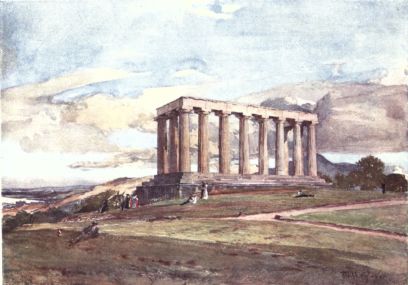
THE NATIONAL MONUMENT ON CALTON HILL
This noble monument represents a partial reproduction of the Parthenon on the Acropolis at Athens. In the picture the spectator is supposed to be looking at the north-west angle of the Temple, showing the eight columns of the west front and two on the north side. On the left of the picture is a glimpse of the Firth of Forth, while to the right, behind the columns, rises Arthur’s Seat.
point and pier and headland is studded with coloured sea-lights; and far out in the measureless mid-Firth flashes the great Eye of the revolving light of Inchkeith.
Brave the “sharp sops of sleet and snipand snaw,” and come to Edinburgh in winter, and you will find all the residents at home and busy: the Law Courts sitting; the University at work; a regiment, with khaki coverings to their kilts, quartered at the Castle, and tramping through the town in rhythm to the tune of the pipes; and all the gaiety of balls and dinners and theatres in the evening hours. Risk the keen blast of the east wind, and come to Edinburgh in April, and you will be able to attend the Graduation in Arts at the M‘Ewan Hall,—in the character of an honorary graduate if you deserve it. Come in May, and you will find the streets thronged with black-coated ministers and elders from every parish in Scotland; for the Assemblies will be sitting, and the Lord High Commissioner will be holding semi-royal state at Holyrood. Come in autumn, as you always will; and it will be to find the long rows of stately stone dwellings left tenantless, and their appalling regularity and monotony rendered even more appalling by the brown paper that fills the windows, and by the boarding that is up before the doors. But the shop windows will be full of tartans for your edification, and you will find your cabman able to tell you all you want to know. At any other season Edinburgh is a hospitable city, and it is growing every day a more cosmopolitan one. English residents have altered national ways; ruthless hands are tearing down our beautiful old stone houses, and building tenements in their places; and soon—too soon—all Scottish traits will be lost.
But the Castle Rock cannot be levelled. It was there, in the mist and the rain, before Edinburgh began; and it will be there, in the mist and the rain, when Edinburgh has ceased to be.
Index
A, B, C, D, E, F, G, H, I, J, K, L, M, N, O, P, Q, R, S, T, U, V, W.
Abbotsford, 138, 141, 145 Abercromby, George (Lord), 134 Adamson, Bishop (1584), 55 Advocates’ Close, 72, 73 Albany, Duke of, brother of James III., 13-14 Alexander II., 46 Alexander III., 9, 17, 24 Allan, Sir William, 138, 149 Alnwick Castle, 6 Anchor Close, 75, and note Angus, Earl of, called “Archibald Bell-the-Cat,” 48, 49 Angus, Earl of, 15 note, 50, 88 Anne of Denmark, wife of James VI., 71, 102 Argyle, Marquis of, 15-16, 80 Arran, Earl of, 88, 89 Arthur’s Seat, 23, 27, 36, 38, 165 Ashestiel, 138 Assembly Rooms (Old Edinburgh), 73, 74, 75 Auchinleck, Lord, his caustic saying concerning Dr. Johnson, 110 Ayala, Don Pedro de, ambassador from Ferdinand and Isabella of Spain to the Court of James IV., 28, 29 Aytoun, Professor, 149 Bailie Fyfe’s Close, 74, 77 Baillie, Joanna, 138 Balcarres, Countess of. See Hyndford’s Close Balfour, Dr., grandfather of R. L. Stevenson, 157 Bannatyne Club, the, 142 “Banner of Blue,” 14 Barbauld, Mrs., 134 Barnard, Lady Anne (née Lindsay), 62, 77 Bastian, servant of Mary, Queen of Scots, 40 Baxter’s Close, 70 Beaton, Cardinal, 50, 76 Beaton, James, Archbishop of Glasgow, 88-89 Beattie, the poet, 108 Beaufort, Jane, wife of James I., 11-12, 25-26 “Begbie murder,” the, 77 Belches of Invermay, Sir John and Lady Jane, and their daughter, Scott’s first love, 133 “Bell-the-Cat.” See Angus Bell’s Wynd, 73, 74 Bernham, David de, Norman Bishop of St. Andrews (1243), 46 “Bible Close,” 78 Bishops of Edinburgh (Established Episcopalian), 54 Bishop’s Palace. See Whitehorse Close Black, Adam, 151 Black, Professor, 120 Blackford Hill, 130, 159 Blackfriars Street, formerly Wynd, 40, 76, 88, 109 Blackie, Professor, 152 Blackwood’s Magazine, 149 Blair, Dr., 108 Borthwick, Master Gunner to James IV., 27 Boswell, Sir Alexander, his verses on Miss Nicky Murray, 73-74, 138 Boswell, James, 68, 100, 108-109, 110 Boswell, Mrs., 108-109 Bothwell, Adam, Bishop of Orkney, 40, 71-72 Bothwell, Earl of, 39, 40, 41, 66, 71 “Bow-head Saints,” the, 96-97 Boyd, George. See Mound Boyd’s Close, 82 note, 107-108 Braid Hills, the, 159 Brantôme, Sieur de, 36, 37 Brewster, Sir David, 151 Bristo Street, 113 Brodie’s Close, 70 Brougham, Lord, 150, 151 Brown, George, builder of George Square and Brown Square, 122 Brown, Dr. John, 151 Brown, Dr. Thomas, 149 Brown Square, 122 Bruce, King Robert the, 9, 10, 18, 42, 83 Bruce, Marjory, daughter of King Robert the Bruce, 42 Buchan, Earl of, 108 Buchanan, George, 50, 91, 92-93 Burnet, Miss, 112, 114 Burns, Robert, lodges in Baxter’s Close, 70, 75; his triumphant reception in Edinburgh, 111-113; meeting with Scott, 113; “Clarinda and Sylvander,” 113-114; Edina, Scotia’s darling seat, 114-115 Burton, Dr. John Hill, 151 Byers’ Close, 71-73, and 71 note Byers of Coates, John, 71 note Caledonian Hunt, the, and Burns’s Poems, 112-113 Calton Hill, 46; the view from, 166 Campbell, Thomas, 137, 149 Candlish, Dr., 150 Canongate, the, 24, 62, 63, 64, 67, 78-82, 100, 101, 105, 106, 124 Cant’s Close, 76 Carberry Hill, battle of, 41, 66 Carey, Sir Robert, 41-42 Carlyle, Dr., of Inveresk, 107 Carlyle, Thomas, 150, 151 Carnegie, Andrew, 154 “Castell of Maydens,” 5 Castle, the, 3-21; story of Malcolm Canmore and Queen Margaret, 5-8; Queen Margaret’s Chapel in, 5, 7, 9, 15, 16; “Frank’s Escalade,” 10; besieged by Henry IV. of England, 11; the “Black Dinner” (1440), 12-13, 17; story of the Duke of Albany, 13-14; James VI. born in the Palace of, 15; Jacobites imprisoned in, 16; the Great Hall of, 16-18, 155; the Regalia, 18-20, 140; “Mons Meg,” 20-21, 144; mentions of, 23, 24, 26, 69, 86, 120; the “one-o’clock gun,” 163, 164, 165, 166, 167, 168 Castle Street, 135, 136, 137 note, 138, 139, 142, 143, 145 Cathedral (St. Giles’s). See St. Giles, Church of St. Mary, 71 note, 154 Chalmers, Dr., 150 Chambers’s Edinburgh Journal, 149 Chambers, Robert, 19, and note, 20, 54, 72, 73, 74, 81, 119-121, 129; his writings, and his friendship with Scott, 149 Chambers, William, 61, 155 Charles I., 18, 41, 42, 43, 54, 82, 94 Charles II., 19, 43, 58, 65, 95 Charles Edward Stuart (Prince Charlie), 43-44, 99, 130, 131 note Chepman, Walter, earliest Scottish printer, 27, 47, 48, 49 note Chiesley of Dalry, 153 Christison, Sir Robert, 151 “Christopher North.” See Wilson Church of St. Giles. See St. Giles “Clarinda” (Mrs. M‘Lehose), 113-114 Claverhouse, Graham of, 126, 138 “Cleanse the Causeway,” 66, 88-89, 127 Clerks of Penicuik, the, 98, 132, 133, 136, 138 Closes and Wynds of Edinburgh, 62-82, 88, 95-96, 99, 100, 105, 106, 108, 109, 120, 129 Coalstoun, Lord, story of, 72-73 Coates House, 71 note Cockburn, Lord, 149, 150 Cockburn, Mrs., 100 Colinton, 156, 157, 158, 160, 162 College Wynd, 106, 120, 129 Combe, George, 151 Comely Bank, 150 Constable, Thomas, 141 Court of Session, 85 Covenanters, the, 59, 96, 160 Cowgate, the, 40, 64, 87, 88, 90, 91, 95, 96, 120, 164 Crabbe, George, 138, 143 Craig, Lord, 113 Craigie, Lord President, 124 Craigmillar, 144 note Craigmillar Quarry, 122 Crail, 35 Cranstoun, George (Lord Corehouse), 134 Cranstoun, Miss, 134, 135 Creech’s Land, 105 “Crochallan Fencibles,” 75, 112 Cromwell, Oliver, banquets in the Hall of the Castle, 18; stays at Moray House, 79-80; enters Edinburgh after the battle of Dunbar, 58 Cross, the City, 31, 43, 58, 98, 132, 141 Cullen Professor, 120 Cunningham, Alison, 157 Cunningham, Dr., 150 Cunyie House (the Scottish Mint), 76 Currie, 161 Dalkeith, 30, 144 Dalmeny, the woods of, 166 Darnley, Earl of, 38-39, 39-40, 42, 76 David I., 23-24, 46 David II., and David’s Tower in the Castle, 10 Dawney Douglas’s Tavern, 75, 112 Deacon Brodie. See Brodie’s Close Defoe, 104-105 “Delta.” See Moir De Quincey, 150 Dick of Prestonfield, Sir Alexander, 109 Dickens, Charles, 151 Disruption, the, 150-151 Don of Newton, Sir Alexander, 138 Donald Bane, 7 Douglas, Duchess of, 108 Douglas, Duke of, 125 Douglas, Gavin, 27; account of, 48-50, 87-89, 148 Douglas, Lady Jane, 70 Dowie’s Tavern, 112 Drummond of Hawthornden, 29, 94, 104 Drummond, Lord Provost, 123 Drummond Place, 125, 126, 152 Drummore, Lord, 124-125 Drumsheugh, the ancient forest of, 23, 31, 46 Duddingston, 100 Dunbar, William, 28, 29, 31, 87 Dundas, Sir Laurence, 125 Dundonald, Earl of, 70 Dunfermline, 4, 6, 8, 155 Edgar, second son of Malcolm Canmore, 7 Edinburgh made an Episcopal See (1633), 54 Edinburgh Courant, 104 Edinburgh Review, 137 and note, 149 Edward I. of England, 9, 24, 46, 50 Edward II. of England, 25, 46 Edward “the Confessor,” 5 Eglintoun, Susanna, Countess of, 75, 98-100 Eglintoun, Lord, 98-99 Elizabeth, Queen of England, 42 Elliott of Minto, Miss Jeanie, 122 Erskine, friend of Scott, 134 Erskine, Henry, Advocate, 108 “Ettrick Shepherd,” the. See Hogg Fairmilehead, 161 Falkland, 11, 35 Fergusson, Professor, 113, 134 Fergusson, Robert, 112 Ferrier, the family of, 112, 114 Ferrier, Miss, 149 Findlay, John Ritchie, 154 Firth of Forth. See Forth Fleming of Cumbernauld, Sir Malcolm, 12, 13 Flodden, battle of, 31-33, 35, 49 note; the Flodden Wall, 62, 87 Forbes of Pitsligo, Sir William, and Burns, 112 Forbes of Pitsligo, Sir William, and Scott, 133, 145 Forbes, William, first Established Episcopal Bishop of Edinburgh (1634), 54 “Fore-stairs,” 65, 66, 76 Forth (river, and Firth of), 3-4, 5, 7, 8, 21, 35, 36, 46, 155, 159, 165, 166, 167 Forth Bridge, the, 4, 155, 164, 165, 166 Fortune’s Tavern, 75-76 Franklin, Benjamin, 107 Gay, John, 81, 105-106 General’s Entry, 113 George I., 16 George III., 98, 99, 126 George IV., 141, 142 George Square, 122, 130, 131 George Street, 135, 139, 150, 157 Glammis, Lady, 14-15, and note Glenlee, Lord, 122 “Golden Charter,” 14 Goldsmith, Oliver, 73, 106 Goodsir, Professor John, 151 “Goose Pie, the,” 98 Gordon, Duchess of, 76-77, 112 Gordon of Haddo, Sir John, 58 Grange, Lord, 74 Granton, 150, 166 Grassmarket, the, 15, 97, 120, 164 Gray of Pittendrum, Lord, and Lady, 68-69, and note Great King Street, 150 Greyfriars’ Church and Churchyard, 51, 96, 133 Gustavus Vasa, Prince, 141 Guthrie, Dr., 150 Haddington, first Earl of (“Tam o’ the Cowgate”), 90-92 “Haddo’s Hole,” in St. Giles’s, 58, 59 Hailes, Lord, 108 Hall, the Rev. Mr., Presbyterian divine (1603), 53 Hamilton, Sir William, 150 Hart, Andro, 94 Hawthornden, 94, 109, 159 Hay, James, story of, 96 “Heart of Midlothian,” 63. See also Tolbooth Henry III. of England, 9 Henry IV. of England, 11 Henry VII. of England, 30 Henry VIII. of England, 35, 37, 46, 50 Henry, Prince, eldest son of James VI., 41 Heriot, George, 90-91 Heriot Row, 156, 157 High School, the (in Old Edinburgh), 71, 92, 130 High Street, the, 62, 76, 77, 80, 88, 90, 94, 96, 105, 108, 123, 124, 127, 141, 164 “Highland Lady,” the, 153 Hogg, James (the “Ettrick Shepherd”), 136-137, 149, 160 Holbein, his miniature portrait of James IV., 29 Holyrood, 18, 22-44, 47, 53, 62, 63, 64, 65, 70, 76, 84, 91, 109, 120, 144, 167; legend of the founding of the Abbey, 23; Abbey burnt by Edward II., 25; in reign of James IV., 26-33; in reign of James V., 33-35; in reign of Queen Mary, 35-41; Charles I. christened at, 41; and crowned at, 42; rebuilt by Charles II., 43; Abbey Church restored by James VII., 43; Prince Charlie at, 43-44; the Abbey desecrated and destroyed, 44 Home, John, 107 Hope, Sir Thomas, King’s Advocate, 34, 95 Homer, Francis, 52 Hume, David, 68, 71, 100-101, 109, 125 Hunter’s Tryst, 160 Huntly, Earl of, 39 Hyndford’s Close, 76, 77 Inchcolm, 165 Inchkeith, 109, 165 Irving, John, 134 Isles, Lord of the, story of, in 1429, 25-26 Jack’s Land, 101 Jacobites imprisoned in the Castle, 16 James I., 11, 12, 22, 26, 84 James II., 17, 26, 85, 86 James III., 14, 26, 68, 85 James IV., 16, 19, 26, 27, 28, 29, 30, 31, 32, 33, and note, 37, 38, 42, 49 note, 66, 87 James V., 14, 18, 33, 35, 85, 87, 88, 89 James VI., 15, 18, 41-42, 43, 52, 53, 71, 85, 90, 91, 92, 93, 94, 102-103, 104, 124 James VII., 43, 95 James’s Court, 68, 70, 101, 108, 125 Jeffrey, Lord, 131-132, 137, and note, 138, 149, 150 “Jenny Geddes,” 45, 54-58, 59 “Jock o’ Sklates.” See Mar, Earl of Jonson, Ben, 104 Johnson, Dr., 68, 82 note, 100, 107-109, 110, 111 Kames, Lord, 108 Keith of Ravelston, Mrs., 148 Kemp, architect of the Scott Monument, 154 note Kennedy, Bishop, 85-86 Kennedy, Sir Archibald, 98 Kincaid, Alexander, publisher, 107 Kingsley, Charles, 151 Kirkaldy of Grange, 52 Knox, John, 38, 49 note, 50, 51, and note, 52, 55, 61; his house, 65, 77, 90, and note; his grave, 65, 149 Krames, the, 53 Lady Stair’s Close, 68-70, 105 “Laigh Council House,” the, 91 Laing, David, 106, 149 Laing, Malcolm, 134 Lands, the (in Old Edinburgh), 62-82, 85, 87, 88, 89, 90, 91, 95, 99, 100, 101, 103, 105, 107, 108, 112, 113 Lang Dykes (called also Lang Gait), 121, 126 Lasswade, Scott’s cottage at, 136 Laud, Archbishop, his Service-Book, 55, and note, 56 Lauder, 48 Lauder of Blyth, Sir Alexander, 49 Lawnmarket, the, 62, 63, 68, 69, 127 Leith, 13, 14, 20, 26, 27, 34, 36, 97, 104, 142, 166 Leslie, Alexander, the Covenanting General, 18 Leven, Earl of, 76 Libberton’s Wynd, 112 Library, Advocates’, 96, 134; Public, 95, 154; Signet, 91 Lindores, Abbey Church of, 52 Lindsay, Earl of, 41 Lindsay, Sir David, 34, 89 Linlithgow, 35 Lister, Lord, 151-152 Lockhart of Carnwath, George, 122 Lockhart, John Gibson, 140, 141, 144, 149 “Logy, Maister Leonard,” 33 note Lord of the Isles. See Isles Lorn, Lord (1650), 80 Loudoun, Earl of, 69 Luckenbooths, the, 105 Macaulay, Lord, 151 M‘Crie, Thomas, 149 M‘Ewan, William, 154 M‘Ewan Hall, the, 154, 167 Mackenzie, Sir George, 76, 95-96 Mackenzie, Henry (“the Man of Feeling”), 149 Maclean, of Torloisk, Mrs., and her daughters, 138 Macmorran, Bailie, 71 Madeleine, first wife of James V., 34, 44, 94 Malcolm Canmore, 4, 5-8, 35, 126, 155 Mansfield, Earl of, 74 Mar, Earl of, 18; Earl of Mar called “Jock o’ Sklates,” 92 Margaret, Saint, Queen of Scotland, second wife of Malcolm Canmore, 5-8, 9, 15, 16, 24, 126, 155 Margaret, daughter of Henry III. of England, betrothed to Alexander III., 9 Margaret of Denmark, wife of James III., 26 Margaret Tudor, wife of James IV., 30, 35, 37, 50, 66, 87 “Marmion view,” the, 164 Mary of Gueldres, wife of James II., 26, 86 Mary of Lorraine (Mary of Guise), second wife of James V., and Regent of Scotland, 35, 50, 51, 89-90 Mary, Queen of Scots, 5, 8, 15, 18, 35-41, 50, 52, 66, 76, 84, 143 Maud, daughter of Malcolm Canmore and Queen Margaret, 126 Maxwell of Monreith, Lady, and her daughters, 76-77 Meadows, the, 122 Melrose, dwelling of the Abbots of, 76, 95 Melville, Andrew, 93 Menzies, William, anecdote concerning Scott and son of, 138 Merchiston Castle, 93, 153 Miller, Hugh, 151 Mint, the Scottish. See Cunyie House Moir, Dr. (“Delta”), 150 Monboddo, Lord, 112 “Mons Meg,” 20-21, 144 Montrose, Marquis of, 59, 69, 80, and note Moray House, account of, 79-80 Morocco Close, 78 Mound, the, formation of, 127; and Sir Walter Scott, 137, 139; view from, 166 Munro, Professor, 120 Murray, Dr. Alexander, 149 Murray of Auchtertyre, Patrick, 134 Murray of Broughton, 131, and note Murray of Henderland, Mrs., 108 Murray, Miss Nicky, 74, 77 Murray of Simprim, Patrick, 134 Murray, manager of the Theatre Royal, 144 Myllar, Andro, 27 Mylne’s Court, 68 Mylne, John, Royal Master Mason, 43 Mylne, Robert, Royal Master Mason, 68 Mylne, Robert, F.R.S., Royal Master Mason, account of, 74-75, and note Nairne, Baroness, 100, 148 Nairne Lodge, 100 Napier of Merchiston, 93 National Portrait Gallery, 154 Neaves, Lord, 150 Nelson, Thomas, 155 Netherbow Port, the, 62, 63 Newark, Lord, Covenanting General, 98 Niddry’s Wynd, 74 Nor’ Loch, 26, 51, 69, 120, 124, 126-127 North Bridge, the, 123, 137 Old Assembly Close, 73 “Old Kirk, the” (in St. Giles’s), 51 Oliphants of Gask, the, 100, 148 “Outer Tolbooth,” the, 49 note Panmure’s Close, 100 Paoli, the Corsican, 68 Parliament House, 65, 72, 81, 85, 134, 142, 144 Paterson, John, Bishop of Edinburgh, 82 Pembroke, Earl of (Shakespeare’s friend), 103 Pentlands, the, 156, 159, 161, 166 Philosophical Institution, the, and its first Presidents and Lecturers, 151 Playfair, Lyon (Lord Playfair), 151 Poker Club, the, 75, 76, 120 Pope Innocent IV. (and St. Margaret), 8 Pope Julius II. (and James IV)., 19 Potterrow, 79, 100, 113, 130 Preston Aisle, the (in St. Giles’s), 47 Preston of Gorton, William, 47 Priestfield (now Prestonfield), 27, 109 Primrose, James, Viscount, 69 Princes Street, 124, 125, 126, 132, 142, 153, 154, 157, 163, 164, 166 Printing in Edinburgh in the reign of James IV., 27 Queen Street, 143, 152, 154, 157 Queensberry, Duchess of (“Kitty”), 81, 105 Queensberry House, 79; tragedy in, 80-81 Queensberry, Marquis of, 81 Queensferry Road, view of Edinburgh from, 165 Raeburn, Sir Henry, 144, 149 Ramsay, Allan (the poet), 74, 97-98, 99, 105-106, 107, 160 Ramsay, Allan (the artist), 98, 108 Ramsay, Dean, 150 Ramsay, General, 98 Randolph of Strathdon, Sir Thomas, 10 Regalia, the Scottish, 18-20, 140, 144 Riccio, David, 15, 38-39 Richard II. of England, 46 Riddle’s Close, 70, 101 Robertson, Principal, 108, 109 Ronsard (the French poet), 34 Rose, Abernethy, Bishop of Edinburgh, 54 Rosebery, the Earl of, 68 Rosehaugh Close, 95-96 Roslin, Boswell takes Dr. Johnson to, 109; Scott takes Wordsworth to, 136, 164 Ross, the Lords, and Ross House, 122 Rothesay, the Duke of, eldest son of Robert III., 11 Royal Scottish Academy, 142 Royal Scottish Society, 142 Rullion Green, battle of, 59, 160 Ruskin, John, 151 Russel, Alexander, 151 Ruthven, Earl of, 41 St. Andrew’s Church in George Street, 150 St. Andrew Square, 124, 125 St. Cecilia’s Hall, 74-75 St. David Street, 125, 145 St. Giles, Church of, 24, 27, 45-61, 63, 65, 72, 86, 87, 94, 120, 144, 155, 164 St. John Street, 107 Salamander Land, 105 Salisbury Crags, 26, 165 Sandilands’ Close, 85 Scott, Anne, 145 Scott, General, 125-126, 152 Scott, Sir Gilbert, 154 Scott of Harden, Hugh, 135 Scott, Lady, wife of Sir Walter Scott, 135, 137; death of, 145 Scott, Mr. and Mrs., parents of Sir Walter, 131 Scott, Sophia, 140 Scott, Sir Walter, 11, 20, 65, 69-70, 113, 129-146, 147, 160; his homes in and near Edinburgh, 135-139, 141, 143, 145; his later places of residence, 145; his circle of friends, 148-150; the Scott Monument, 153-154 Scottish Regalia. See Regalia Scougall, John, artist, 73 “Seven Sisters of Borthwick,” 20, 27 Simpson, Sir James Y., 151 Shakespeare, 5; was he in Edinburgh? 103 Shandwick Place, 145 Sharpe, Kirkpatrick, 138, 149 Shoemaker’s Land, 78 Six Feet Club, 160 Skelton, John, 151 Skene of Rubislaw, 135, 145 Skene, W. F., 151 Smith, Adam, 100 Smith, Alexander, 151 Smith, Sydney, 138 Smollett, Tobias, 107 Solway Moss, battle of, 35 South Gray’s Close, 76 Spottiswoode, Archbishop, 56 Stair, the Earl of, 69 Stair, Lady, and Lady Stair’s Close, 68-70 Stamp Office Close, 75-76, 99 Steele, Richard, 105 Stevenson, Robert Louis, 77, 78, 156-162 Stewart, Dugald, 149 Strichen’s Close, 76, 95 Stuart, Sir John (the “Black Knight of Lorn”), 12 Swanston, 156, 159-160, 161 Syme, Professor, 151 Tait, Professor, 151 “Tam o’ the Cowgate.” See Haddington, Earl of Taylor, “the Water Poet,” 64, 104 Telfer, Mrs., of Scotstoun, 107 Tercentenary of the University, 152 Thackeray, 151 Thomson, Thomas, legal antiquary, 133 Tinwald, Lord Justice Clerk, 124 “Tolbooth Kirk, the” (in St. Giles’s), 51 note Tolbooth, the, 53, 59, 63, 65, 69, 80, 155 note Topham, Captain, 73, 109-111 Trollope, Anthony, 151 Tron Church, the, 132 “Tulzie,” a, 66 Turgot, Bishop, 6, 7, 8 Tweeddale Close, 77 Tytlers of Woodhouselee, the, 136 Union, the (1707), 64, 76; Treaty of, 80, 81 Union, the Students’ University, 154 United Free Assembly Hall, 90 University, the, 85, 92, 109, 111, 120, 151, 152, 154, 159, 167 Vasa, Prince Gustavus, and the Baron Polier, 141 Victoria, Queen, her first visit to Edinburgh (1842), 147, 150 Volunteers, the Scottish Light Horse, 135 Walker Street, 145 Wallace, Sir William, 9, 24 Warbeck, Perkin, at the Court of James IV., 28 Watt, the Republican, 134 Webber, his attempt on Scott’s life, 139 Weir, Major, and his sister Grisel, 96-97 West Bow, 97 West Port, 92 Whiteford, Sir John, 112 Whiteford, Miss, 114 Whitehorse Close, 54, 81-82, and 82 note Whitehorse Inn. See Boyd’s Close Wilson, Professor (“Christopher North”), 149 Wishart, Chaplain to Montrose, and afterward Bishop of Edinburgh, 59 Wood, Sir Andrew, 27-28 Wordsworth and his sister Dorothy visit Scott in 1803, 136 World’s End Close, 76 Wynds (of Edinburgh). See Closes
THE END
Printed by R. & R. Clark, Limited, Edinburgh.
Books by Rosaline Masson
In Our Town.
“A romance of Edinburgh which will captivate even a degenerate Southerner.”—Guardian.
“A graceful and touching love-story, grafted on much interesting and detailed description of her city of Edinburgh.”—Illustrated London News.
“Full of the atmosphere and legal life of modern Edinburgh.”—Literature.
“Lovers of Edinburgh, and all exiled Scots will joy over In Our Town.”—Outlook.
“Miss Masson knows her Edinburgh thoroughly—its sets, its prejudices, its pride; and she touches them all gently, wittily, and thoughtfully.”—Ladies’ Field.
“Something of the persistent persuasiveness of delightful Jane Austen.”—Glasgow Herald.
“A book of more than passing interest.”—Spectator.
[Hodder & Stoughton.
Leslie Farquhar.
“The most attractive Scotch novel we have read for a long while.”—Standard.
“A book which in respect of its strength and its beauty of diction, its excellent portrayal of a wide range of character, and its workmanlike construction—not the least essential of the novel—deserves to take a high place in modern fiction.”—Scotsman.
“Not since William Black’s pen was laid aside has so much of the colour, fragrance, and feeling of Western Scotland been rendered in print.... The story would appear to be the outcome of a moving realisation of all that makes the Highlands what they are to the poetic sense, of which the author of A Princess of Thule was perhaps the best modern interpreter.”—Glasgow Herald.
“Seldom since William Black gave us of his best has the land of moss and fell and deer forest been better painted in words.”—St. James’s Budget.
“Well-written story of Scotch county society.”—Times.
[John Murray.
The Transgressors.
“Those who know their Edinburgh well will doubtless recognise many among the portraits of its great and popular men here given; and those who do not will be glad of this opportunity of obtaining a glimpse into the life of a city whose culture runs on such different lines to those familiar to Englishmen.”—Guardian.
“The book is all about Edinburgh life and Edinburgh people as they are to be seen to-day by anybody who has eyes to see them ... introduces its readers to several typical Edinburgh households ... full of little bits of the streets of Edinburgh.”—Scotsman.
“The charm of the book is in its intimate sketches of Edinburgh society. Miss Masson seems to know it in every phase, and hits off its characteristics with a sure and kindly hand.”—Sketch.
[Hodder & Stoughton.
Lives of Pollock and Aytoun. (Famous Scots Series.)
“Has managed to invest the story of Pollock, whose Course of Time is practically unknown to the present generation, with a good deal of interest.”—Literature.
[Oliphant, Anderson & Ferrier.
A Departure from Tradition, & other Stories.
“Brisk little stories these, with a pleasant dash of sentiment and plenty of fun.”—Tablet.
[Sands & Co.
My Poor Niece, and other Stories.
“Eminently artistic.”—Daily Chronicle.
[Oliphant, Anderson & Ferrier.
Use and Abuse of English.
“A guide which is the pithiest, clearest, and handiest that we have yet seen. One could find no livelier companion for a railway journey than this booklet; it will easily go into the pocket, and will amply repay close study.”—Aberdeen Free Press.
[James Thin, Edinburgh.
BONNIE SCOTLAND
PAINTED BY SUTTON PALMER
DESCRIBED BY A. R. HOPE MONCRIEFF
Containing 75 Full-Page Illustrations in Colour
SQUARE DEMY 8vo. GILT TOP
PRICE 20s. NET
Edition de Luxe (limited impression), price 2 guineas net
“HAPPY ENGLAND,” by Mrs. Allingham, the England of sunshine, flower gardens and lovely rural scenes, which the summer of 1904 has shown to be no mere memory but actual fact, is now to be followed by BONNIE SCOTLAND, the next volume in Messrs. Black’s series of Beautiful Books illustrated in colour.
Mr. Sutton Palmer is the artist, and his style is not unlike Mrs. Allingham’s in its careful drawing and regard for detail, while he, too, has an eye for colour as is exemplified in his sketches of brown hills and purple heather, and in the glimpses of the indigo colouring of the deep lochs. Both artists are alike also in having elicited Mr. Ruskin’s praise of their work.
It was the heartfelt wish of Robert Burns to “make a beuk for poor auld Scotland’s sake”; he succeeded better than he knew. And Sir Walter Scott, a quarter of a century later, by publishing “The Lady of the Lake” and the “Waverley Novels,” became the Columbus of the Highlands, making the people and their country known to Englishmen. In BONNIE SCOTLAND the scenery familiar to many from Scott’s verbal descriptions will become real to the eye, and even those who know not Scotland cannot fail to feel the charm of this wonderful land of which Mr. Menpes has said: “Take the finest bit of Switzerland and the finest bit of Norway, dip them in water and you have Scotland.” And again, “It is the chief charm of Scotland that one sees everywhere such rich, deep, stirring colour.”
Mr. A. R. Hope Moncrieff, himself a Scot, who contributes the letterpress, has not written merely descriptive matter. He has given an outline of Scotland’s salient features, and glimpses of her history, national church, and literature, lightened by the entertaining reminiscences and anecdotes of one who has travelled widely and is able to judge his countrymen at their proper worth. In fact, this is a book that will have to take its place in the library of every lover of Scotland.
PUBLISHED BY ADAM AND CHARLES BLACK, SOHO SQUARE, LONDON, W.
SCOTTISH
LIFE AND CHARACTER
PAINTED BY H. J. DOBSON, R.S.W.
DESCRIBED BY WM. SANDERSON
Containing 20 Full-Page Illustrations in Colour Facsimile
PRICE 7s. 6d. NET
Many volumes and countless articles have been written about Scottish life and character, while the grand and beautiful in the scenery of Scotland have been reproduced in numerous ways, from the rough wood-cut to the latest colour process, but in the present book the hard-beaten path is departed from, and some of the less familiar pictures of Scottish life are represented. Mr. Henry J. Dobson, R.S.W., has devoted much of his life to placing on canvas those humble Scottish interiors which are fast disappearing, and, though his work in this direction is well known to art lovers, the present reproduction in colours of twenty of his paintings will receive a wide welcome. The quiet, grey tones of the interiors, and the life-like portraits of the inmates, will recall to many the old country life in Scotland, when time to them was still young. The letterpress, which has been written by Mr. Wm. Sanderson, editor of the Border Magazine, deals in a pleasing way with many varied phases of Scottish life which, like the illustrations, will be sure to awaken cherished memories of the past in the hearts of many readers.
PUBLISHED BY ADAM AND CHARLES BLACK, SOHO SQUARE, LONDON, W.
A. & C. BLACK’S LIST OF BOOKS ILLUSTRATED IN COLOUR. AUTUMN, 1904
IN THE SAME SERIES
ALL WITH PAGE ILLUSTRATIONS IN COLOUR
EACH 20s. NET
“Of all God’s gifts to the sight of man, colour is the holiest, the most Divine, the most solemn.”—Ruskin.
PAINTED BY SUTTON PALMER
DESCRIBED BY A. R. HOPE MONCRIEFF
BONNIE SCOTLAND
CONTAINING 75 FULL-PAGE ILLUSTRATIONS IN COLOUR
TEXT BY MARCUS B. HUISH
BRITISH WATER-COLOUR ART, ETC.
CONTAINING 60 OF THE KING’S PICTURES
PAINTED BY ROSE BARTON
FAMILIAR LONDON
CONTAINING 61 FULL-PAGE ILLUSTRATIONS IN COLOUR
PAINTED BY A. S. FORREST
DESCRIBED BY S. L. BENSUSAN
MOROCCO
CONTAINING 74 FULL-PAGE ILLUSTRATIONS IN COLOUR
BY HELEN ALLINGHAM
TEXT BY MARCUS B. HUISH
HAPPY ENGLAND
CONTAINING 80 FULL-PAGE ILLUSTRATIONS IN COLOUR
“All men completely organized and justly tempered enjoy colour; it is meant for the perpetual comfort and delight of the human heart.”—Ruskin.
BY MORTIMER MENPES
TEXT BY DOROTHY MENPES
VENICE
CONTAINING 100 FULL-PAGE ILLUSTRATIONS IN COLOUR
BY MORTIMER MENPES
TEXT BY DOROTHY MENPES
THE DURBAR
CONTAINING 100 FULL-PAGE ILLUSTRATIONS IN COLOUR
BY MORTIMER MENPES
TEXT BY DOROTHY MENPES
JAPAN
CONTAINING 100 FULL-PAGE ILLUSTRATIONS IN COLOUR
BY MORTIMER MENPES
TEXT BY DOROTHY MENPES
PARIS
CONTAINING 75 FULL-PAGE ILLUSTRATIONS IN COLOUR
PAINTED AND DESCRIBED BY R. TALBOT KELLY
EGYPT
CONTAINING 75 FULL-PAGE ILLUSTRATIONS IN COLOUR
BEAUTIFUL BOOKS
IN THE SAME SERIES
ALL WITH PAGE ILLUSTRATIONS IN COLOUR
EACH 20s. NET
BY NICO JUNGMAN
TEXT BY BEATRIX JUNGMAN
HOLLAND
CONTAINING 76 FULL-PAGE ILLUSTRATIONS IN COLOUR
PAINTED BY HENRY B. WIMBUSH
DESCRIBED BY EDITH F. CAREY
THE CHANNEL ISLANDS
CONTAINING 76 FULL-PAGE ILLUSTRATIONS IN COLOUR
DESCRIBED BY SIR MARTIN CONWAY
PAINTED BY A. D. M‘CORMICK
THE ALPS
CONTAINING 70 FULL-PAGE ILLUSTRATIONS IN COLOUR
PAINTED BY COLONEL R. C. GOFF
DESCRIBED BY MRS. GOFF
FLORENCE
CONTAINING 75 FULL-PAGE ILLUSTRATIONS IN COLOUR
PAINTED BY JOHN FULLEYLOVE, R.I.
DESCRIBED BY E. W. THOMAS
OXFORD
CONTAINING 60 FULL-PAGE ILLUSTRATIONS IN COLOUR
BY CAPT. S. E. ST. LEGER
WAR SKETCHES IN COLOUR
CONTAINING 165 ILLUSTRATIONS (50 IN COLOUR)
EACH 20s. NET
BY MORTIMER MENPES
TEXT BY DOROTHY MENPES
WORLD’S CHILDREN
CONTAINING 100 FULL-PAGE ILLUSTRATIONS IN COLOUR
BY MORTIMER MENPES
TEXT BY DOROTHY MENPES
WORLD PICTURES
CONTAINING 500 ILLUSTRATIONS (50 IN COLOUR)
BY MORTIMER MENPES
TEXT BY DOROTHY MENPES
WAR IMPRESSIONS
CONTAINING 99 FULL-PAGE ILLUSTRATIONS IN COLOUR
BY AUGUSTINE FITZGERALD
TEXT BY SYBIL FITZGERALD
NAPLES
CONTAINING 80 FULL-PAGE ILLUSTRATIONS IN COLOUR
PAINTED BY JOHN FULLEYLOVE, R.I.
DESCRIBED BY THE REV. JOHN KELMAN, M.A.
THE HOLY LAND
CONTAINING 92 FULL-PAGE ILLUSTRATIONS, MOSTLY IN COLOUR
TEXT BY JOSEPH GREGO
CRUIKSHANK’S WATER-COLOURS
CONTAINING 68 FULL-PAGE FACSIMILE REPRODUCTIONS IN COLOUR
ILLUSTRATED IN THE SAME STYLE AS THE 20s. SERIES
PRICE 7s. 6d. NET EACH
PAINTED BY JOHN FULLEYLOVE, R.I.
TEXT BY MRS. A. MURRAY SMITH
WESTMINSTER ABBEY
CONTAINING 21 FULL-PAGE ILLUSTRATIONS IN COLOUR
BY GORDON HOME
YORKSHIRE COAST AND MOORLAND SCENES
CONTAINING 32 FULL-PAGE ILLUSTRATIONS IN COLOUR
BY OLIVER GOLDSMITH
THE VICAR OF WAKEFIELD
CONTAINING 13 FULL-PAGE ILLUSTRATIONS IN COLOUR BY AN EIGHTEENTH-CENTURY ARTIST
BY C. LEWIS HIND
ADVENTURES AMONG PICTURES
CONTAINING 24 ILLUSTRATIONS (8 IN COLOUR, 16 IN BLACK AND WHITE)
PAINTED AND DESCRIBED BY GORDON HOME
INNS OF COURT
In preparation
CONTAINING 20 FULL-PAGE ILLUSTRATIONS IN COLOUR
PAINTED BY JOHN FULLEYLOVE, R.I.
TEXT BY ROSALINE MASSON
EDINBURGH
CONTAINING 21 FULL-PAGE ILLUSTRATIONS IN COLOUR
PAINTED BY H. J. DOBSON
TEXT BY WM. SANDERSON
SCOTTISH LIFE AND CHARACTER
CONTAINING 20 FULL-PAGE ILLUSTRATIONS IN COLOUR
PAINTED AND DESCRIBED BY MRS. WILLINGHAM RAWNSLEY
THE NEW FOREST
CONTAINING 20 FULL-PAGE ILLUSTRATIONS IN COLOUR
BY LADY BUTLER
PAINTER OF “THE ROLL CALL”
LETTERS FROM THE HOLY LAND
CONTAINING 16 FULL-PAGE ILLUSTRATIONS IN COLOUR BY LADY BUTLER
BY W. EARL HODGSON
TROUT FISHING
CONTAINING A MODEL BOOK OF FLIES IN COLOUR
PRICE 5s. NET
BY SIR WALTER SCOTT
THE LADY OF THE LAKE
CONTAINING 50 FULL-PAGE ILLUSTRATIONS—EIGHT BEING IN COLOUR FROM ORIGINAL WATER-COLOUR DRAWINGS BY SUTTON PALMER, AND THE REST IN BLACK AND WHITE FROM PHOTOGRAPHS.
WHISTLER AS I KNEW HIM
BY MORTIMER MENPES
SQUARE IMPERIAL 8vo., CLOTH, GILT TOP (11 × 8-3/4 INCHES)
CONTAINING 125 FULL-PAGE ILLUSTRATIONS IN COLOUR AND TINT OF WHISTLER OIL-COLOURS, WATER-COLOURS, PASTELS, AND ETCHINGS
ORDINARY EDITION
PRICE 2 POUNDS NET
EDITION DE LUXE
PRICE 5 GUINEAS NET
WITH FULL-PAGE ILLUSTRATIONS IN COLOUR
BOOKS FOR BOYS AND GIRLS
PRICE 6s. EACH
BY S. R. CROCKETT
RED CAP TALES
STOLEN FROM THE TREASURE-CHEST OF THE WIZARD OF THE NORTH
CONTAINING 16 FULL-PAGE ILLUSTRATIONS IN COLOUR BY SIMON HARMON VEDDER
ANIMAL AUTOBIOGRAPHIES
BY G. M. A. HEWETT
THE RAT
BY G. E. MITTON
THE DOG
Others in preparation
EACH CONTAINING 12 FULL-PAGE ILLUSTRATIONS IN COLOUR
GULLIVER’S TRAVELS
CONTAINING 16 FULL-PAGE ILLUSTRATIONS IN COLOUR BY S. BAGHOT DE LA BERE
BY HARRIET BEECHER STOWE
UNCLE TOM’S CABIN
CONTAINING 8 FULL-PAGE ILLUSTRATIONS IN COLOUR, AND MANY OTHERS IN THE TEXT
BY JOHN BUNYAN
THE PILGRIM’S PROGRESS
CONTAINING 8 FULL-PAGE ILLUSTRATIONS IN COLOUR BY GERTRUDE DEMAIN HAMMOND
BY P. G. WODEHOUSE
WILLIAM TELL TOLD AGAIN
CONTAINING 16 FULL-PAGE ILLUSTRATIONS IN COLOUR BY PHILIP DADD
BY C. E. MITTON
CHILDREN’S BOOK OF LONDON
CONTAINING 12 FULL-PAGE ILLUSTRATIONS IN COLOUR BY JOHN WILLIAMSON
BY THE REV. R. C. GILLIE
THE STORY OF STORIES
CONTAINING 32 FULL-PAGE ILLUSTRATIONS
BY THE REV. R. C. GILLIE
THE KINSFOLK AND FRIENDS OF JESUS
CONTAINING 16 FULL-PAGE ILLUSTRATIONS IN COLOUR AND SEPIA
PUBLISHED BY A. & C. BLACK, SOHO SQUARE, LONDON, W.
FOOTNOTES: