EASTERN NIGHTS—AND FLIGHTS (continued 3)
Reading edition
"Adieu, mister the commandant."
He strutted down the platform; and we passed from Alukeeshla to whatever weird experiences might be waiting for us elsewhere.
This chapter is but an amplification of an inscription signed by H. and myself before we left our mud home. When passing toward Alukeeshla from the station, take the second turning to the right beyond the gendarmerie, then the first to the left, and enter the fifth house in a row of buildings that stare at you from the bottom of a blind alley. Climb some rickety stairs to the back room on the first floor, and you may still find these words on one of the walls:
"In memory of some bad days and good yarns, spent and told in this dirty room of this verminous hut in this God-forsaken village. To Hell with the Turks!"
CHAPTER VII
IN THE SHADOW OF THE BLACK ROCK
Moored under a willow tree, we were clearing what was left of the cold chicken and salad from the middle of a punt. I filled the Chambertin bottle with water and dropped it overboard. It plashed and sank noiselessly to the bottom of the Thames. From the far side of our island came the metallic strains of a gramophone, made less blatant by the soft atmosphere of the river. A passing punt-pole clacked, rose from the surface, stabbed the water and clacked again. Flies danced from the hot sunlight into the shade of the willow, and hovered over the remains of our lunch. I composed the cushions and lay down, opposite Phyllis.
But the cushions became harder and harder, and the breeze merged gradually into a stuffy, dark oppressiveness. I opened my eyes, and sat up. The head cushion, it appeared, was a sackful of kit, my white flannels were a uniform in creased and dirtied khaki, Phyllis was Alfonso the Turkish guard, and the Thames the military baths at Afion-kara-Hissar, in the centre of Anatolia.
Some ragged Turks arrived through the stone passage that led to the hot room, and began undressing. Cuthbert was talking to the bath attendant, while Alfonso lay opposite me and snored. H. and W. also snored in dissonant notes. R. was sorting out his kit. The rest of the party still slumbered silently, stretched out in twisted attitudes on the stone floor.
Then I remembered how we were dragged from the train in the early hours of the morning, and had wandered through the streets of Afion-kara-Hissar, looking for the prison camp. Finding it closed to night arrivals, Cuthbert and Alfonso led us to the Madrissah hammam, in the courtyard of a mosque. Weary with want of sleep and the hardships of a long journey, we had slept for several hours on the floor of the outer bath-room.
Only R. had risked taking off his boots; and these had evidently disappeared, for as he searched his loud curses echoed from the domed roof. As was to be expected, all the Turks in the room disclaimed volubly any knowledge of the missing boots, so that when we moved to the prisoners' camp R. clattered along the streets in a pair of wooden sandals borrowed from the bath attendant.
A Turkish officer met us at the barrier which divided the street of prison-houses from the rest of the town, and sent us to meet the British adjutant of the camp. Cuthbert and Alfonso waved a good-humoured farewell and disappeared. With them they took our cooking pots—although we did not discover this fact until later in the day. By that time they had left Afion-kara-Hissar. We swore long and loud at the memory of the two guards, for in those days any sort of a cooking utensil was in Turkey worth at least two pounds.
Passing up the narrow street we were greeted by groups of weirdly clothed Britishers. Some wore torn and creased uniforms and a civilian cap or a much-dented billycock; some a military hat and ill-fitting suits of shoddy mufti; some were in khaki shorts surmounted by shirts of violent colours open at the neck; some wore heavy boots, some wore bedroom slippers, some wore sandals.
Many of them were survivors of the Kut-el-Amara garrison and had been prisoners in Turkey for two and a half years. Their uniforms had long since become scarecrow relics of better days, since when they had depended for clothing on the supplies forwarded by the Dutch Legation at Constantinople. The productions of the Turkish tailors and shirt-makers, as issued to the prisoners at Afion, were entertaining but rather anarchic.
Afion-kara-Hissar contained the largest prison-camp in Turkey, although there were others at Yozgad, Broussa and Geddós—the last-named being for the fifty or sixty of his Majesty's officers who had been persuaded to give parole not to attempt an escape. When the first batch of British officers arrived at Afion the Turks turned some Armenian families out of their homes, confiscated the furniture, and told the captives from the Dardanelles and Mesopotamia that they were to live in the empty houses.
"Beds? Furniture?" said the commandant. "We have none, and it is impossible to supply any."
"Food?" he said in reply to another demand. "It is well known that all British officers are rich. You have money enough to buy food for yourselves."
And so it had to be. At first the British officers lived on their pay as captives; which, according to rank, was at the rate of seven to ten Turkish pounds a month. But food prices soon expanded to extraordinary proportions, while the exchange value of the Turkish pound continued to decrease. By the beginning of 1918 it was worth less than two and a half dollars; while sugar, for example, was four dollars a pound. Tea was fifty dollars a pound, and real coffee was unobtainable. Under these conditions, it became almost impossible to obtain even a bare subsistence on seven Turkish pounds a month without outside help. The Dutch Legation, therefore, supplemented each captive officer's pay to the extent of five, then fifteen, Turkish pounds a month, taken from the Red Cross funds at their disposal.
Even thus the food difficulties could not have been solved without the help of parcels from home. These arrived either seven or eight months after they left England, or never. Many were delivered only after the Turks had looted from them such articles as were scarce, including boots, clothes, and good tobacco. Letters from England needed from two to five months for transit.
The lack of furniture was overcome by amateur carpentry. With string, nails, and planks of wood each newly arrived prisoner constructed a bed, a table, and a chair. Profiteers in the bazaar naturally took advantage of the demand for wood, and, by the time of which I write, the price of it had soared to two Turkish pounds a plank.
Besides the officers there were at Afion about two hundred Tommies shut up in a Greek church. Their daily rations from the Turks were one small loaf of bad bread and one basin of thin soup. For the rest, they existed on the tinned food which they received from time to time in parcels.
As for the Russian soldiers, who were herded into the Madrissah buildings, they were literally starving, and most of them had sold part of their clothing to buy extra food. Weak and ragged, they passed the time in walking round and round the courtyard. During the bitter months of winter scores of them died from hunger and cold.
Conditions in the prison camp varied according to the character of whoever happened to be the Turkish commandant. For a time the officer in charge was one Muslum Bey, who was reported to have committed several executions for Enver Pasha during the turbulent days of the Young Turk coup d'état in 1908. He was a brute, a swindler, and a degenerate, and during his reign unspeakable outrages were committed. He himself gave a Russian officer who had committed some minor offence more than a hundred strokes of the bastinado. When his arm was tired he made his sergeant-major continue the flogging until the Russian fainted. The unconscious body of the victim was then thrown into a cellar, where a part of his face was burned by contact with quick-lime.
Muslum Bey not only stole food parcels from England but made a practice of deducting part of the monthly pay which helped to procure for the British Tommies a bare existence. In addition, he made an arrangement with bazaar traders whereby a monopoly in certain articles of food came into being, so that the prisoners had to pay incredible prices, or go hungry.
It was not until the visit of a Swiss Commission that was investigating the prison-camps of Turkey that the British officers at Afion-kara-Hissar heard of Muslum Bey's worst outrage. The brutal commandant had taken great care that there should be no communication between the captive officers and the captive men, and severe punishment was inflicted if a Tommy tried to speak with a British officer whom he chanced to pass in the street. Scenting that something was wrong the officers induced members of the Swiss Commission to take with them the senior British doctor when they visited the Tommies in the Greek Church. Almost the first words that Colonel B., the doctor in question, heard on entering the building were the equivalent of "I've been outraged, sir." He then learned the story of how two British soldiers, thrown into jail for some trivial offence, had been forcibly outraged, first by the commandant and then by his sergeant-major.
The Swiss Commission itself was not immune from Muslum Bey's criminality. An Australian officer took a member of it aside, and told him the full story of the awful death-march from Kut-el-Amara, on which the captured garrison, already reduced by hunger, were forced to trek over 800 miles of desert and mountain, being left to die in the scorching sun if they fell out owing to weakness—a death-march which is responsible for the fact that less than 25 per cent. of the men captured at Kut-el-Amara are alive to-day.
"Yes, we know all about it," said the Swiss, "and we had it in our notes. But most of our papers were stolen the other day."
When I reached Afion, in May, 1918, the conditions had improved. As a result of a secret report by the senior British officer, smuggled to the headquarters at Constantinople of the Ottoman Red Crescent, Muslum Bey had been removed from his position and imprisoned. He was put on trial for his many crimes; but owing to baksheesh and to political protection the sentence was but a few months' imprisonment. He had already served this period while awaiting trial, and was therefore released immediately after sentence. He went into business as a shopkeeper, and sold among other things tinned food bearing British labels—tinned food of the kind that anxious people in England and India lovingly bought and lovingly packed for their husbands, sons, and relatives who were prisoners of war.
Meanwhile, although Muslum Bey had been given only the travesty of a punishment by the Turkish judges, instructions were sent from the Turkish War Office that life at the prison-camps of Afion-kara-Hissar was to be made more pleasant. We were, for example, allowed the run of a portion of the hillside. In cold print such a concession seems unimportant enough, but to men who had become staled and unspeakably bored by months of captivity during which their only exercise was to walk up and down a narrow street, it was a godsend. Cricket and football matches were also allowed, and two or three times a week long walks were arranged.
Members of these walking parties would study the flat plain that surrounded Afion-kara-Hissar and the succession of hill-ranges beyond it, and would dream of an escape to some point on the coast.
From this town in the centre of Anatolia, however, escape seemed an impossibility, for the nearest point of the coast was 150 miles distant, and the intervening country, wild and almost trackless, was full of brigands and starving outlaws of every description, who would cheerfully kill a chance traveller for a pair of boots, a loaf of bread, or merely for practice. In any case, a tramp to the coast must extend over at least five weeks, and it was difficult to see how food for this long period could be carried.
Several officers were carrying on a secret correspondence with friends in England by means of code, and were trying to prepare wild schemes whereby a boat was to be waiting for them at some specified part of the coastline between specified dates, or whereby an aeroplane was to pick them up during the night. Most of us gave up the idea of making a dash for freedom from Afion, and schemed to be sent to Constantinople, where the chances of success would be greater.
When a recently captured prisoner first accepted the fact that escape from Afion-kara-Hissar was impossible, and when the monotony of captivity had permeated him, he would as a rule pass through a period of melancholia and the deepest depression. A black rock—huge, gaunt, and forbidding—overshadowed the little town from its height of 2,000 feet of almost sheer precipice. For hours at a time one would stare at its bare blackness, and at the crumbling ruins of the fortress, built by the Seljak Turks, which topped the rock; and the blackness and bareness would enter into one's soul and plunge one into a swirling vortex of morbid thoughts. For me the rock was a symbol of captivity—bleak, inexorable, and unrelenting.
Yet, as a rule, the period of melancholia soon passed, and gave place to resigned acceptance of the trivial and monotonous daily round of prison life. This more or less sane view of things was only made possible by improvised distractions, by reading, and by the discussion of the thousand-and-one rumours that spread from the bazaars. Time and again it would be whispered by some Greek trader that Talaat Pasha was negotiating a separate peace and had agreed to open the Dardanelles, or that war was about to be declared between Turkey and Bulgaria as a result of the Dobrudja dispute, or that Enver Pasha had been assassinated, or that the Sultan was determined to rid himself of the Young Turk government. We knew well that these reports were untrue and scarce worth even the attention of bitter laughter; but since we wanted them to be true they would be discussed with gravity over the mess-tables until the next batch of newspapers proved their falsity.
The most useful means to forgetfulness was the camp library. Many hundreds of books were sent to the prison-camps of Turkey by various societies and individual sympathizers in England. It was at Afion-kara-Hissar that I first found the courage and concentration necessary to read through each and every consecutive volume of Gibbon. "The Decline and Fall of the Roman Empire," by the way, was probably more in demand than anything else in the library; for the state of mind induced by captivity needed something more solid and satisfying than the best yeller-seller. Great favourites, too, were books of Eastern travel and adventure—in particular the works of Burton and Lamartine, the "Travels of Marco Polo the Venetian," and Morier's "Hajji Baba." A copy of Plutarch's "Lives" also received the attention of much wear and tear. For the rest, many a time have I thanked the gods for Kipling; but never more heartily than when lying on the hillside at Afion and forgetting the Black Rock and all that it stood for in the company of Kim the lovable, Lalun the lovely, and The Man Who Would Be King.
Away from the ragtime blare and rush of modern life this isolation in a small town of a semi-civilized province gave the prisoners time and opportunity to "find" themselves, so that for the first time in their lives many began to think individually, instead of accepting conventional opinions at second hand. At least one book of promise was written at Afion-kara-Hissar, and four others have found publication. Several excellent poems were born there amid a welter of verse that was deathless because lifeless. Plays, paintings, and songs were produced in profusion. One man, an Australian, made a very thorough study of the ancient civilizations of the Middle East, and could supply accurate information, without reference to a book, about every phase of the rise and fall of Babylon and Nineveh, of the Medes and Persians, of the Chaldeans and Assyrians, with the extent and location and customs of the various empires. Yet he confessed that three years earlier, at a time when he was flying in Mesopotamia, he had no more interest in Babylon than in Nashville, Tennessee.
Apart, however, from the quality of this work pour passer le temps, the very fact that so many should adventure into the unknown country of creative effort proved that, when away from the preoccupations of an artificial social system, even the average Englishman turned instinctively to learning and the arts.
Meanwhile, many a lively performance was given in the garden which served as open-air theatre, with plays written and songs composed by people who, before being subjected to the isolation of captivity, had occupied themselves solely with soldiering or business. Comic relief also was provided by two youthful subalterns who set up shop as earnest-minded philosophers, and on a foundation of Nietzsche, Wilde, and Shaw built a gargoyled edifice that was perverted and extravagantly young, but withal vastly entertaining.
The social life of the camp was complex. Despite the absence of the female of the species, it resembled in many ways that of a suburb in some wealthy city of the Midlands. As was to be expected among a hundred people confined in two small streets, innumerable cliques were formed, from each of which ripples of gossip spread outward until they merged into and were overwhelmed by another eddy of gossip. Starting in the morning from a small room in a wooden house an item of scandal would, by the evening, have reached every room of thirty other houses—how X. had received a pair of pyjamas for nothing from the Red Cross supply and sold them for three liras; how Y. had climbed over several roofs at night-time and, in the shadow of a chimney, met that Armenian girl with the large eyes; how Z. had begun to smoke opium. Opium, by the way, could be had in plenty. The production of it was the chief industry of Afion-kara-Hissar ("afion" is Turkish for "poppy," "kara hissar" being "black rock"). Enormous poppy-fields spread all round the town in vivid splashes of red and white.
Yet with all the trivial gossip and light scandal there was a very real sense of comradeship. If any man were sick the remainder would fall over each other in their desire to be of help. If any house were short of wood during the bitter months of winter its inmates could always borrow from such as had enough and to spare. A new prisoner, possessing no money and a minimum of clothes—as was the case with most of us—would find himself overwhelmed by loans and gifts.
When I was at Afion the camp was very much preoccupied with rumours of a forthcoming exchange of sick prisoners between Great Britain and Turkey. Scores of intrigues centred round the room of Major H., then senior medical officer among the British; for it would be his task to examine the "unfit" before deciding which were to be sent for further and final examinations by Turkish medical boards. Scarcely a man failed to produce an ailment. Wounds that had healed years before were bandaged and treated with unnecessary care. Limps of every description were to be seen in the street. Some claimed to be deaf. Others allowed their gray hairs to grow long, and continued to express an opinion that the old and feeble should be sent home first. Such as could produce neither old age nor some physical ailment discussed loss of memory and mental trouble.
All day long Major H. examined the claimants, smiled to himself, and compiled lists. These, I imagine, must have been subdivided something like this—(a) those who suffered from real injuries or illnesses; (b) those who were middle-aged, and had minor ailments; (c) those who were young, and had minor ailments; (d) those who might conceivably have minor ailments but could supply no visible symptoms; (e) those who had nothing the matter with them, but were good liars, and as such might convince the Turks; (f) those who were not only healthy, but bad liars.
Besides the British there were at Afion about a hundred Russian officers; for although the peace of Brest-Litovsk had been signed and Russia was at peace with Germany, the Russian was the traditional enemy of the Turk, and none knew when war might break out between Turkey and the small states which had sprung up in the Caucasus. With no money, no Red Cross supplies, no means of communicating with their relatives, and no knowledge of whether these relatives had survived the Bolshevist terror, the Russian officers among us lived miserably, and were largely dependent upon the charity of British fellow-captives. In return they taught some of us a smattering of Russian, and helped to pass the time with their interminable but entertaining talk. They also provided a really fine choir, with Captain Korniloff, a cousin of the famous general, as one of its leading members. Besides ourselves, its audience, when the choir sang on the hillside, never failed to include the dark-haired Armenian girls—the only Armenians left in the town—who had been saved from the exodus and massacres of 1915-16 that they might serve the pleasures of Turkish officers and officials. They listened from a distance, and looked their sympathy, as we looked ours.
At the beginning of each month, when the funds arrived from Constantinople, there would be a succession of birthday parties. On these occasions the rule was relaxed whereby each prisoner must remain in his own house after seven o'clock. The Turks reverence birthdays, and by playing upon this fact permission would be obtained to celebrate in a friend's room. It was necessary to claim birthdays in rotation, for even the Turks might have disbelieved if the same prisoner had three of them in three successive months.
I shall always remember a party given on the evening of my arrival by White, an Australian aviator captured in the early days of the Mesopotamian campaign. It was my first introduction to árak, a kind of a tenth-rate absinthe, which, excepting some incredibly bad brandy, was then the only alcoholic stimulant to be bought in Anatolia. Finding it far stronger than it seemed, I had almost forgotten captivity and its miseries in an unreal enjoyment of the songs, the stories, and the general hilarity—hilarity which was merely a cloak for forgetfulness. And then, amid the fumes and the shouting, there recurred insistently the thought of escape. I spoke of it to the man nearest me, a short figure in a faded military overcoat, Turkish slippers, and an eyeglass.
"Not so loud," he warned. "You can't trust half these Russians. Come over into the corner."
Yeats-Brown, the speaker, began to suggest advice about how best to escape. One's only chance, he declared, was to get to Constantinople. He himself claimed nose trouble, and having cultivated the friendship of the local Turkish doctor, he was to be sent for treatment to a hospital in the capital. If I could invent some plausible ailment he would persuade the Turkish doctor to use his influence on my behalf. Meanwhile, we would have further talks and discuss plans. The great thing was to get to Constantinople.
Although I did not know it at the time there were in that bare room several men with whom, in a few weeks' time, I was to be involved in a succession of extraordinary intrigues and adventures, when we should have met again in Constantinople. There was the host himself—Captain White—who later on joined me in a thousand-mile journey, through Russia and Bulgaria, to freedom; there was Captain Yeats-Brown, who for weeks went about an enemy capital disguised as a girl; there was Paul, who was to escape three times, be recaptured twice, and finally to marry the English lady who helped him; there was Prince Constantine Avaloff, a Russian colonel, who was to help us all by acting as go-between; there was Lieutenant Vladimir Wilkowsky, a Polish aviator, whom I was to see again on the other side of the Black Sea, in German-occupied Odessa. Meanwhile, the árak bottle passed round, and the songs grew louder and wilder, until daylight broke up the party and we returned to our rough, hand-made beds.
It now became my aim in life to reach Constantinople. My injuries had healed, and at a moment's notice I could produce no convincing illness. I decided, therefore, on some form of mental trouble. Yeats-Brown had already mentioned me to his friend the Turkish doctor; and I was to have been examined, when yet again the unexpected happened. It was ordered by the Ministry of War that the seven of us who left Damascus together were to be forwarded to Constantinople, presumably for interrogation.
I took with me high hopes and the addresses of various civilians in the capital who might be of help. As we entrained, and moved westward through the poppy-fields, the Black Rock—which more than ever seemed a symbol of the blackness and menace which overshadowed prisoners in this half-barbaric country—loomed gigantic and forbidding, so that we were thankful when the railway wound round a hill and shut it from sight. I vowed to myself that never again would I return to the monotonous death-in-life of the prison camp at its foot, on the fringe of the squalid town of Afion-kara-Hissar.
CHAPTER VIII
CONSTANTINOPLE; AND HOW TO BECOME MAD
"Your best card," said Pappas Effendi, "is vertige. Melancholia and loss of memory and nervous breakdown and all that'll be helpful, but play up vertige for all you're worth. It can mean anything. Besides, it's impressive."
Pappas Effendi was a Roman Catholic chaplain, waiting at Psamatia (a suburb of Constantinople) to be exchanged as a sick prisoner of war. He and I were discussing how best I could be admitted to hospital, so as to remain in the capital. As my injuries had healed, and I could conjure up no physical disorder, I decided to claim, therefore, that as a result of the aeroplane crash in Palestine I suffered from nervous and mental troubles.
For the few British officers at Psamatia the accommodation was fair to very fair; but for the soldiers of many nationalities in the same camp, life must have been dreadful. Hundreds of them—Britishers, Indians, Russians, Roumanians, and Serbs—were herded together into filthy, crowded outhouses and sheds. They were allowed outside them only twice a day, when they walked backward and forward, forward and backward across the yard, by way of exercise. Most of them had done nothing else for months. Their daily rations were the usual loaf of bread and basin of unnourishing soup.
For the Britishers and Indians conditions were not so bad, because they received occasional food parcels from home, and a small monthly remittance from the Red Cross. The Russians, Roumanians, and Serbs had neither money nor parcels. Some died of weakness, some sold half their clothing to buy food, and in consequence died of cold during the bitter winters. The Tommies were also better off in that they were supplied with clothes and boots by the Dutch Legation, which administered the Red Cross funds. Prisoners of other nationalities walked about gaunt and in tatters. The British gave them whatever food and tobacco could be spared on parcel-days, but even so they could often be seen scrambling for a thrown-away stump of cigarette, or for bits of bread or biscuit. Many seemed almost bestial in their hopeless misery. Only the Serbs, stoic as always maintained a reserved dignity and scorned to beg.
Two or three times a week we were allowed into Stamboul, in parties of two or three, each with a guard. On such days the usual rendezvous for lunch was a little restaurant near the bridge across the Golden Horn. To pass over the bridge across the Golden Horn was forbidden; for Pera, the European quarter, was pro-Ally almost to a man, and a British prisoner might find many helpers there. Even in the preëminently Turkish Stamboul one often happened upon sympathizers. There was, for example, a young Armenian who, whenever he could, talked politics to us on the little suburban railway between Stamboul and Psamatia, and told us the latest false report of an imminent peace.
"Nous sommes tous des Anglophiles acharnés," he assured F. and me.
The threatened interrogation never happened; and one evening it was announced that our party of seven was to return to Afion-kara-Hissar. From every point of view it would be advisable to remain in Constantinople. I believed it to be the only Turkish town in which one might arrange a successful escape, and I knew that it contained civilians who were either British themselves or willing to help British prisoners. Moreover, it offered infinite possibilities in the way of distraction, which were always attainable through baksheesh, that lowest common denominator of the Turkish Empire. And if the long-promised exchange of sick prisoners took place Constantinople was obviously the place where strings must be pulled if one wanted to be sent home on the strength of some feigned weakness.
There were at Psamatia two officers who had been told that they would be among the first batch of prisoners to leave the country. One of them, Flight-Lieutenant F., claimed to be suffering from some form of tuberculosis difficult of definition and detection but strongly supported by influential friends. The other was Father M., a Roman Catholic padre who was among the captured garrison of Kut-el-Amara. It was evident that thirty months of captivity had seriously affected his well-being, mental and physical. In any case, as a non-combatant well over military age, the white-haired priest should most certainly have been allowed to leave Turkey. Meanwhile, he was well loved by all at Psamatia, even by the guards, who knew him as "Pappas Effendi." Whenever he passed down the street children from among the Catholic Christians who lived near the prison-house would stand in his way, and demand a blessing.
Unfortunately there was in the camp library no medical text-book to tell how a prisoner might feign nervous disorders. I had to be content with coaching from Pappas Effendi, and with practising before the mirror a doleful look, tempered by a variety of twitchings. Then I visited the camp doctor. Ever since my aeroplane smash, I complained with mournful insistence, I had suffered terribly from vertige, from periods of utter forgetfulness, from maddening melancholia, and from nervous outbreaks. Above all from vertige.
Fortunately the doctor, like most Turkish medical men, was both ignorant and lazy. His day's work was to sit in an office for two hours, always smoking a cigarette through an absurdly long holder, and having listened to the translated statements of would-be patients, either to send them away with a pill or to write out a form whereby they could be examined at a hospital.
A wound or an injury he might have treated by pill; but it was plain that the very suggestion of mental trouble stumped him. He could not withstand the word vertige, and after a second repetition of it I had no difficulty in procuring a chit ordering me to be dealt with by a hospital doctor.
That same afternoon I was led to Gumuch Souyou Hospital, in Péra. There my claims to admission as a mentally afflicted person were granted without question, so that I began to wonder whether or not I really was in my right mind. Having heard the list of pretended symptoms, not forgetting the vertige, an Armenian doctor sent me to bed for a fortnight's rest.
W., whose wounded arm was badly inflamed, already occupied a bed in the same room, as did Ms., who years before had ricked his right knee and, by reason of its weakness, managed to stay in hospital, with one eye on the possibilities of an exchange of prisoners. R., who had the same object in view, turned up from Psamatia later in the day. He had shown two perfectly healed bullet-wounds in the leg, received three years earlier in Gallipoli, and bluffed the Turkish doctor into believing that they were giving him renewed trouble.
Now clearly, if I wished to maintain a reputation for melancholia, nervous fits, and vertige, I should have to prove abnormality; and just as clearly it would be difficult to give convincing performances before fellow-prisoners who knew me to be normal. The only solution was to demand removal to a single-bedded room, for the sake of quiet.
"Pulse and heart normal," commented the ward doctor next morning. Pulses, hearts, and doctors are often unaccommodating.
"Yes, Monsieur le docteur. For the moment nothing worries me, except that I have forgotten all that has happened since the aeroplane smash. Sometimes my mind is a black blank, sometimes I am unconscious of what I do, sometimes the vertige is so bad that I cannot stand on my feet. Above all, I hate being near anybody. I desire complete rest. Will you be so kind as to let me go to a small room where I can remain alone?"
The doctor was only half convinced; but he gave instructions for the change, while W. turned over suddenly to hide his face, and covered his head with a blanket so as not to laugh out loud.
Once again, as I lay in bed and racked my common-sense for ideas on the subject of nervous fits and vertige, I deplored the lack of any kind of medical text-book; for never before had I suffered from mental derangement.
"Pulse and heart normal," the doctor said inexorably on the following morning.
Then, some hours later, the conduct of Ibrahim, the fat orderly, suggested the required inspiration. Disregarding instructions not to worry me, he entered the room in the heat of early afternoon, sat down, leaned his head on the table, and began to snore. That really did upset my nerves, and consciously I stimulated the sense of irritation until I was furious with the Turkish orderly. Finally, blending this anger with the need of producing some sort of a fit, I considered how best to attack him, and what attitude to adopt afterward.
I jumped out of bed, opened the door, seized Ibrahim round the middle, and flung him into the corridor, while he yelled with surprise. Next I sat down on the bed, and began tearing the sheets into long strips. The corporal of the guard, with another Turkish soldier, half opened the door, cautiously, and looked inside. I stared at them blankly, then got into bed and lay down quietly, facing the wall.
Ibrahim returned presently with the doctor of the day, who entered with a surprised and quizzical "Qu' est-ce qu'il y'a?"
"Doctor," I said, "I fail to remember what I've been doing during the last five minutes. But I feel I've been through a crisis. Even now my head swims. I suffer from acute vertige."
Followed a long explanation in Turkish, with gestures, from Ibrahim. The doctor felt my pulse, which fortunately had accelerated during the calculated excitement of heaving the orderly out of the room.
"Calmez-vous, donc," said the doctor. "Tout sera bien après quelques semaines." I liked the suggestion of "some weeks," for anything might happen in that time.
Before leaving me the doctor prescribed some sort of a bromide mixture, with calming qualities. The first performance, I felt, had been rather a success. As for the bromide mixture, I poured it out of the window during the night. The bottle was filled again in the morning.
Next day was a fitless one; and by the evening I felt that something must be done to maintain my reputation. Still knowing little of how a man with my complaints must act, I thought—wrongly, as I discovered later—that somnambulism would fit in with the general scheme of abnormality.
I stayed awake until two A.M.; and then, wearing a nightshirt, walked woodenly into the passage, with arms outstretched and head upheld. The guard was dozing on a bench that faced the door, and when I passed he took not the least notice. Feeling hurt at such disregard, I turned and passed him again, this time taking care to nudge his knee. He rubbed his eyes, shrilled an exclamation, and began running in the opposite direction. When he returned with the sergeant of the guard, a quarter of an hour later, I was in bed and apparently asleep.
During the week that followed I gave several minor performances. Soon, however, I was ousted from my single-bedded blessedness by a more worthy madman. A Turkish soldier passed into a violent delirium, and ran down the corridor on all fours, calling out that he was a horse. This was far more striking than anything I had imagined or attempted. The delirious Turk was therefore confined apart in my little room while I shared a ward with four Turkish officers.
I chose melancholia for the first demonstration in the new quarters. All day I stared at the ceiling, and answered questions with a rough "oui" or "non" without looking at the questioner. Then, at three A.M., when the four Turks were asleep, I picked up a medicine bottle, half filled with the bromide medicine, and flung it at the wall. It struck, tinkled, and scattered in fragments; while three of the Turkish officers woke and sat up in bed.
"Air-raid?" suggested one of them—for at that time British bombers from Mudros were visiting Constantinople on most moonlit nights.
"No, a bottle," said another, switching on a light and pointing to the splintered glass.
He proceeded to protest angrily in Turkish, and I caught the words "mad Englishman." He turned off the light, and all lay down again. When the night orderly arrived he found everything quiet, and dared ask no questions for fear of disturbing the Turkish officers.
Next morning, however, the senior officer in the ward protested to the chief doctor against being submitted to disturbance and possible violence from a mentally afflicted Englishman. I was then moved into a large room where were W., R., Ms., and other officer prisoners.
To sham violence before fellow-Britishers was almost impossible, I found, even though they coöperated in casting dust into Turkish eyes. I modified the fits into starts and twitchings whenever a sudden noise coincided with the presence of a doctor. The melancholia and loss of memory I retained, for these were easy of accomplishment.
In any case I should have been obliged to become normal enough for walks outside the hospital, if my hopes were to become realities. Staying in Constantinople when the rest of the party had returned to Anatolia was all very well, but it availed nothing unless I could get into touch with people who might help me to plan an escape.
Each Sunday morning such British officers as were not confined to bed attended service at the Crimean Memorial Church, off the Grande Rue de Péra. I wished to make use of this fact in my search for helpers. Besides the clergyman himself there were still a few British civilians free in Constantinople, and most of them visited the church on Sunday mornings. Above all, there would be the chance of asking advice from Miss Whittaker, a very plucky and noble lady who had taken great risks upon herself in helping prisoners. Already she had managed to visit us at Gumuch Souyou, in the company of a Dutch diplomat's wife who came with official sanction.
A fortnight of fairly mild behaviour gained me permission to attend divine service. With guards keeping a yard or so behind us we walked through the Grande Rue de Péra, with its crowd of evident sympathizers, and so to the church at the bottom of a winding side street. Then, for an hour, I was in England. Even to such a constant absentee from church services as myself all England was suggested by the pretty little building, with its floor smoothly flagged in squares, its simply compact altar, its well-ordered pews, its consciously reverent congregation, its rippling organ, and—yes, by the great truths and dogmatic commonplaces that were platitudinized from its pulpit. The very sermon—dull, undistinguished, and full of the obvious levelness that one hears in any of a thousand small churches on any Sunday—brought joy unspeakable because of its associations.
The guards, who had been standing at the back of the church with hat on head, refused to let us remain near the door when the congregation dispersed. It was inadvisable to bribe them in public; so with a friendly wave from Miss Whittaker, and sympathetic looks from unknown British civilians, we left at once. We crossed the Golden Horn to Stamboul, and lunched at our usual restaurant, where I met Pappas Effendi again.
Presently, in strolled another old acquaintance—Colonel Prince Constantine Avaloff, the Georgian. He had just arrived at Psamatia from Afion-kara-Hissar, and brought with him the latest news from that camp—the arrival of a new commandant who seemed quite pleasant, the success of the latest concert, the delivery of a batch of parcels, the increase in price of árak, and other of the small happenings that filled the deadly life of a prisoner of war in Turkey. For me the most interesting item of news was that Captain Tom White was to be sent to a Constantinople hospital. Although he had said nothing about escaping, I rather thought he intended to try it. If he came to Gumuch Souyou he would be a useful companion, for I knew him to be both ingenious and unafraid. Meanwhile, I revealed my own hopes to the prince, who promised to help in any way possible. He was likely to be of use, for as a result of Georgia's submission to Germany, he was now free to move about the city without a guard. I walked back to Pera light-heartedly, with an instinctive knowledge that opportunity was in the offing.
A tousled scarecrow of a man was sitting up in a hitherto empty bed as we reëntered the prisoners' ward of the hospital. His long, untrimmed hair hung over an unwashed neck, his cheeks were sunken, his hands were clasped over the bedclothes that covered his shins. He never looked at us, but with an expression of the most unswerving austerity continued to read a book that lay open on his knees. As I passed I saw, from the ruling and paragraphing of the pages, that it must be a copy of the Bible.
I looked round for enlightenment, only to find myself face to face with an even stranger figure. In a bed opposite the scarecrow sat a man whose face was unnaturally white. The young forehead was divided and sub-divided by deep wrinkles; a golden beard tufted from the chin; the head was covered by a too-large fez made of white linen. He grinned and waved an arm toward the Turkish orderly; but when we looked at him, he shrank back in apparent affright, then hid under the bedclothes.
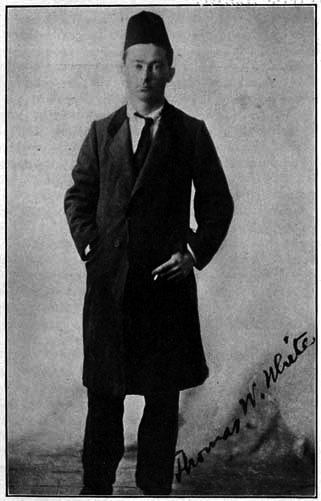
Captain T. W. White, Australian Flying Corps, who accompanied Captain Alan Bott in the 1,000 mile Odyssey to Freedom, starting from Constantinople. The clothes are the disguise worn by Captain White in Constantinople.
"English officers," said the orderly, "come from Haidar Pasha Hospital. Both mad."
"I am not English," protested in Turkish the strange befezzed head as it shot from under the bedclothes. "I am a good Turk. The English are my enemies. I wrote to His Excellency Enver Pasha, telling him I wished to become a Turkish officer."
"Mulazim Heel," continued the Turk, pointing toward the scarecrow. Then, as he swung his hand in the direction of the man who had written to Enver Pasha, "Mulazim Jaw-nès."
"My name is not Jones," the Fantastic shouted, still speaking in Turkish, "I am Ahmed Hamdi Effendi."
Yet he was indeed Jones, just as much as the scarecrow opposite him was Hill. We had heard stories of their extravagant doings, but this was our first sight of the famous lunatics whose reputation had spread through every prison-camp in Turkey. The Turks believed them to be mad, and although there were sceptics, so did many of the British prisoners. When, after watching the pair for several hours, we went into the garden that evening and discussed them, we agreed that they were either real lunatics or brilliant actors.
It had all begun months earlier at Yózgad. To pass the weary time Jones and Hill dabbled in and experimented with hypnotism and telepathy. By making ingenuity and the conjuror's artifice (at which Hill was an expert) adjuncts of their seances, they nonplussed fellow-prisoners and Turks alike; for it was impossible to tell whether trickery or something inexplicable was the basis of their astonishing demonstrations. By means of the Spirit of Music (a hidden lamp with the wick turned too high), the Buried Treasure Guarded by Arms (some coins and an old pistol that were first placed in position and then "revealed" by digging), the Miraculous Photographs (taken with a secret camera designed and constructed by themselves), and other devices, they reduced the camp commandant and his staff to a state of bewildered fear. When they had hoodwinked the commandant into the belief that they could exchange mind-messages with local civilians, he confined them in a small room, and allowed no communication with other prisoners.
From this time onward, moreover, Jones and Hill showed apparent dread of their fellow-prisoners. The British officers at Yózgad wanted to destroy them, they informed the Turkish commandant, adding a plea for protection. Meanwhile, their hair and beards grew longer and more untrimmed, their general appearance stranger and wilder. Perhaps their most impressive exploit at Yózgad was when a guard found them hanging side by side on ropes that were suspended from a beam, the chairs that supported their weight having been kicked away just before he entered the room. He cut down the dangling bodies, and his tale confirmed the commandant in the belief that the spiritualistic prisoners were altogether insane. A few days later they went under escort to Constantinople, and were admitted to Haidar Pasha Hospital.
From this hospital their reputation spread all over Constantinople. Long before they were transferred to Gumuch Souyou I had heard how Hill read the Bible all day, and uttered never a word except when he prayed aloud; and how Jones, having in two months learned to talk Turkish perfectly, proclaimed himself a Turk, and would speak no other language. His name, he insisted time and again, was Ahmed Hamdi Effendi. He disregarded all Britishers in Haidar Pasha Hospital unless it were to tell the Turkish doctor that Jones was mad, and therefore, as the afflicted of Allah, not to be blamed.
Once he threw himself into the pond in the garden. Once, having received the usual Red Cross monthly remittance from an official of the Dutch Legation, he tore the bank-notes in two, threw the scraps of paper across the room, and declared that he wanted no English money. During an air-raid over Constantinople he ran into the open and demanded a gun, so that he might shoot down the British aeroplanes.
At about sundown on his first evening with us Hill closed the Bible, stepped out of bed, and knelt down, facing the east. Then, without a pause, he recited prayers in a loud voice for twenty minutes. Several Turks came in to listen, while Jones, tapping his befezzed head, explained to them that the kneeling figure was mad.
Each morning and each evening Hill knelt on the floor and prayed aloud. Sometimes during the night he would walk to another bedside, wake up its occupant, and exhort him to prayer. For the rest he spoke never a word other than "Yes" or "No," or "I don't know," in answer to questions. All day he sat in bed, with eyes riveted on the Bible by unswerving concentration, or clasped his head and appeared lost in meditation. When the doctor examined him he paid not the slightest attention, but when an effort was made to take away the Bible, he clutched it desperately, and was evidently ready to use violence. His hair and beard grew longer and more tousled, until he was forcibly shaved; whereupon, with his hollowed cheeks and sunken, glowing eyes, he looked more of a scarecrow than ever.
Jones kept himself quite dapper in his own peculiar fashion. His curly golden beard and moustache seemed to be his especial pride. At first Ms. attempted conversations with him; but as he always turned away and showed fright, we left him alone. Yet twice he sought out the chief doctor, and complained that the British officers wanted to murder him. Being a Turk, he continued, why was he kept in a room with Englishmen, who were his enemies and wanted to hurt him?
Beyond laughing and remarking how sad it was that our comrade should be so mad, the chief doctor took no notice. Thereupon Ahmed Hamdi sat down and wrote a letter of furious complaint to His Excellency Enver Pasha, Minister of War in the Young Turk government, and incidentally the most ruthless desperado in that all-desperado body, the Committee of Union and Progress.
I still remember every detail and movement of an absurd scene. Ms. lay asleep one hot afternoon, with a bare foot protruding through the bars at the bottom of the bed. R. crawled across the floor, intending to crouch beneath Ms.'s bedstead and tickle the sole of his foot with a feather. Jones, whose bed was next to that of Ms., shrank back and made a tentative move toward the door as R. glided nearer. R. looked up casually from his all-fours position and found the lunatic's face glaring at him with wide-open, rolling eyes. The pair stared at each other surprisedly for a few seconds, then Ahmed Hamdi Jones yelled, leaped from his bed, and ran out of the room.
If that was acting, we agreed, it was very wonderful acting. We inclined to the theory that Hill and Jones had in the beginning merely shammed lunacy, as a passport for England, but that under the mental stress and nervous strain of living their abnormal rôles they had really become insane. Another suggestion was that they lost their reason already at Yózgad, as a result of dabbling overmuch in spiritualism.
It was White who solved the mystery, although at the time he revealed it only to me. With a badly marked ankle (the result of a too-hot poultice) well in evidence, he arrived one day from Afion-kara-Hissar, and suggested to the doctors that the said ankle was tubercular. He was placed in the bed next to the scarecrow's.
Hill had let it be known that he was undertaking a forty-days' penance, during which he would eat nothing but bread. All other food offered him by the Turks he ignored. After a few days of semi-starvation his cheek-bones were more prominent than ever, his cheeks more hollowed, and the colour of his face was an unhealthy faint yellow.
In the middle of the night, when everybody else was asleep, White woke him and passed over a note. In this, as a fellow-Australian, he offered any sort of assistance that might be acceptable. Then he handed Hill some chocolate and biscuits taken from a newly arrived parcel. These the scarecrow accepted, and, not daring to whisper in case somebody were listening, wrote a sanely worded message thanking White for the offer, which he accepted. It contained also a warning that, for safety's sake, the other Britishers must be led to believe that both he and Jones were mad.
Thereafter White fed him secretly each night. In the daytime he maintained his long fast, to the great astonishment of the Turks. White also helped by complaining that the madman woke him at night-time, and asked him to pray.
Later, having heard escape talk between White and me, Hill wrote down an address where we might hide in Constantinople, and let me into the secret that he was pretending lunacy, so as to be sent out of the country as a madman.
Now that I knew the scarecrow and Ahmed Hamdi Jones to be as sane as myself, I marvelled at their flawless presentation of different aspects of lunacy, and at the determination which allowed them to play their strange parts for months. Hill, in particular, had a difficult rôle, and I wondered that his mind never gave way under it. To sit up in bed for twelve hours a day, reading and rereading a Bible; to talk to nobody and look at nobody, and to show no sign of interest when vital subjects were being discussed by fellow-prisoners a few yards away; to pray aloud for nearly half an hour each morning and evening, in the presence of a dozen people; to maintain an expression of rigid melancholy, and not to let even the ghost of a smile touch one's features for many weeks—this must require almost inhuman concentration.
Jones had a far better time, for his specialty was not studied tragedy but spontaneous farce. He seemed to enjoy enormously the complete fooling of all around him, the planning of a new fantasy and the head-over-heels performance of it, without being restrained by convention or ridicule, or a sense of the normal.
Cheerful lunacy, in fact, is great fun. Even in my own minor assumptions of a state of unreason I had found it very stimulating and amusing. A mental holiday from logic, custom, the consideration of public opinion and other irksome boundaries of artificial stability is glorious. Itself untrammelled, the mind can watch from a spectator's point of view the patch-work restraints and littlenesses of civilization, and take delight in tilting at them.
Often I envied Jones, with his fez, his golden beard and his rôle of Ahmed Hamdi Effendi, as he talked to a group of Turkish officers. They would laugh at him openly; but secretly he would laugh much more heartily at them.
Few things in our roomful of nine British officers were not farcical. Only one of us—old W., with his wounded arm—had any real claim to be in hospital. R., with a healed wound scar dating back to the Gallipoli campaign; C., with sciatica and late middle-age; and Ms., with a weak knee dating back to before the war, were trying to build up a case for release as exchanged prisoners of war. Jones and Hill, by means of magnificent acting, had made everybody believe in their assumed madness, and were also hoping to be sent home in consequence. "Wormy"—formerly aide-de-camp to General Townsend—wanted to remain a hospital patient because he had friends and amusements in Constantinople, and achieved this wish by means of mythical hemorrhages.
For my part, I still gave false evidence of nervous disorders, although such efforts were dwarfed by the exploits of Jones and Hill. In any case, it was to my interest to show only mild symptoms, such as fits of trembling during an air-raid, or whenever a gun was fired. Had I been more violent, I should not have been allowed into the city on Sundays, at a time when I had made useful acquaintances and was plotting an escape.
So the strange days passed. Hill and Jones, spurred by reports of a near-future exchange of prisoners, gave constant and enlivening performances. M. and R. cultivated effective limps. Wormy amused himself. White and I discussed our plans while strolling in the garden. Each morning the doctor walked once round the ward, said to each patient: "Bonjour, ça va bien?" signed the diet sheets, and left us. Of other medical attendance there was none, except when W's arm was operated on, or when Jones complained to the chief doctor about our desire to murder him.
How the madmen were included in the first batch of British prisoners to be exchanged from Turkey, how they were led on board the Red Cross ship that the Turks had allowed to the Gulf of Smyrna, how Ahmed Hamdi Jones protested against being handed over to his enemies the British, and how he and the Bible-reader miraculously recovered their sanity as soon as the British vessel had left Turkish waters, all that is a story in itself.
CHAPTER IX
INTRODUCING THEODORE THE GREEK, JOHN WILLIE THE BOSNIAN, AND DAVID LLOYD GEORGE'S SECOND COUSIN
The Maritza is a little restaurant near Stamboul station. Coming toward it from the bridge across the Golden Horn one passed along a side street so narrow that the bodies of passengers clinging to the rails of the swaying and much-loaded tram-cars often collided with pedestrians. With a guard at our heels, we would disappear through a doorway, and find ourselves in a low room that reeked of sausages and intrigue.
Whenever the captive officers at Psamatia came to Stamboul they lunched at the Maritza, where they could hear the latest rumours from the bazaars. On Sundays they were joined there by not-too-sick officers from our hospital and that of Haidar Pasha.
Theodore, the Greek waiter, looked exactly what he was—a born conspirator who had strayed from melodrama into real life. In the whole of Turkey there was no greater expert in the science of throwing dust into the eyes of soldiers and gendarmes. He not only lived by plotting, but, next to money, seemed to like it better than anything in the world.
He was also a first-rate gossip. Having seated the guards in a corner where they could see but not hear us, the little Greek, with his bent shoulders and blue-glassed spectacles, would sidle up to our table, and producing a menu-card, say:
"Bonjour! What would you like, gentlemen?" Then, running his finger down the list as if suggesting something to eat, he would continue: "I heard to-day that the Grand Vizier had quarrelled once more with the Sultan"; or, "Enver Pasha was shot at in Galata yesterday, and is wounded in the chest. It is said that he will not recover." He never failed to produce at least one such rumour as these. Most often he would announce that Bulgaria was about to make a separate peace, which possibility was reported in Constantinople at least a dozen times before it really happened.
I always found him trustworthy, for his hatred of the Turks was stronger even than his greed for money, and no sum could have tempted him to become a spy in the service of the Turkish police—a position once offered to him. In any case, he was always convinced that the British would win the war; and, therefore, knowing which side his bread was buttered, would never have dared to betray the Britishers who employed him.
As an intermediary for correspondence he was reliable but expensive, his charge being twenty piastres for each letter delivered.
"Theodore, my friend," one would say, "I want you to go to Pera for me."
"Good. If you have not written the letter I will engage the guards while you prepare it."
He would then stroll across to the guards' table with the news that the British officers would be pleased to buy them whatever they wanted to eat; and the prisoner scribbled his note, a slip of paper resting on his lap and the body of Theodore screening him from the guards in the far corner. Later the letter would be handed to Theodore, in the middle of the banknotes with which one paid the bill.
If a reply were brought, Theodore delivered it under cover of a menu-card, always with a whispered reminder, "Twenty piastres." During the last six months of the war the Greek waiter must have been the messenger for scores of secret communications.
It was early in July when we heard of the arrival in Haidar Pasha Hospital—across the Sea of Marmora—of Captain Yeats-Brown and Captain Sir Robert Paul. Yeats-Brown was demanding attention for his nose and Paul for his ear. With vivid memories of conversations in Afion, I had sympathy for neither the nose nor the ear, but a great deal for the schemes of escape which I knew them to be planning. I sent Yeats-Brown a note, through the agency of Theodore, suggesting an appointment for lunch on the following Sunday.
As a matter of fact, I met him before lunch-time. With the rest of the congregation we were leaving for the little English church off the Grande Rue de Péra, when the pair approached the vestry door with guards at their heels. Since I last saw them both had grown moustaches, and an appearance of dishevelled untidiness was given to Paul by a short, stubby tuft of beard. At the time I was talking to Miss Whittaker, and I took the opportunity of introducing the new arrivals. Paul drew Miss Whittaker aside, and began talking earnestly, while Yeats-Brown told me that the guards' orders were to take him direct to Haidar Pasha, and that we should have to wait a week longer before meeting at the Maritza.
Next Sunday afternoon, on entering the little restaurant, I heard Yeats-Brown asking Theodore to show him where a special brand of cigarettes might be bought. This he did in a loud voice, speaking Turkish, as if he wished the guards to overhear. The pair left the doorway, and disappeared into a tobacco shop. Both departed bare-headed, so that the guards remained in their seats and were unsuspicious. Paul was at a table near them, taking great care to appear unconcerned. His beard had grown longer during the past seven days, and he looked stranger and more dishevelled than ever.
Five minutes later he and I were joined by Yeats-Brown, who, as he returned with Theodore, took care to flaunt a newly bought box of cigarettes before the eyes of his guard. He had been to look at the outside of Theodore's own house, so that he might recognize it.
He and Paul were to be turned out of hospital in two days' time. They had had no time to arrange a definite scheme, but as they were to be sent to Asia Minor very shortly, it would be necessary for them to escape almost immediately. I did not seek to join them, for White and I were still safe in Gumuch Souyou and had hopes of stealing an aeroplane. I therefore wished Yeats-Brown the best of luck, and after returning to hospital, waited anxiously for news.
Our first intimation of what had happened came when the chief doctor announced that no Britishers were to be allowed into the city, because two prisoners had escaped. Soon afterward a Russian, who arrived from Psamatia with influenza, brought details. With their bank-notes (obtained from Mr. S., a British civilian living in Pera) sewn up in suspenders and braces, with faces and hands stained brown, and each wearing a fez, the pair had climbed out of their window at Psamatia in the middle of the night, crept along a ledge, tied a rope to the gutter of the roof, and let themselves down into a dark doorway. The rope was found in the morning, still dangling from the roof. Since then—three days ago—nothing had been heard of them.
Meanwhile the hopes of White and myself revolved round John Willie the Bosnian. This man, an Austrian aviator who was a lieutenant in the Turkish Flying Corps, had been shot down in Palestine, and in the ward next to ours was receiving treatment for minor injuries. He told Ms. that in a few weeks' time he would desert from Turkey by aeroplane, and said he wanted a letter of recommendation, to be presented to the British when he landed at Mudros. Ms. refused to write such a compromising letter, and, not trusting the Bosnian, disregarded a suggestion that he should be taken as passenger in the proposed flight to Mudros.
Next, Ms. having left the hospital, the Bosnian approached me. Finding that I was a fellow-aviator, his first overtures dealt, innocuously enough, with war-flying in general and his own experiences in particular.
Then, one evening, he announced, with the air of a conspirator, that he was about to tell me an important secret. I knew what was coming, but was careful to pretend ignorance. John Willie—the name by which he became known to us, for we dared not risk suspicion by mentioning his real name when we talked among ourselves in the presence of Turks—thereupon produced an English grammar, and said I must make pretence of teaching him English, so that we might meet each day. He would tell the Turkish doctors that I had become his schoolmaster.
His first suggestion, as we sat down on a shady bench, was that I should write him a letter to take to Mudros. Like Ms., I declined, not knowing what was at the back of his mind. A Turkish corporal passed the bench, whereupon John Willie began mispronouncing some English words, taken at random from the page of the grammar which lay open on his lap.
"If," I said, "you can get me an aeroplane to fly to Mudros myself I will. The book is on the table, das Buch liegt auf dem Tische." This last when the Turkish corporal turned back and glanced at us as he passed a second time.
"Ze book eez on tâbel," repeated John Willie. Then in German, "I was going to suggest the same thing myself."
John Willie proceeded to reveal the reasons why he was so anxious to desert. As a Bosnian, he said, he hated the Austrians, and it was because of this that he entered the Turkish and not the Austrian army. In any case, his mother was of American birth and was now in the United States, while his brother, so he learned, had enlisted in the American army.
His own sympathies were pro-British and pro-American, and it was his earnest desire to join his mother and become naturalized as an American citizen. If, however, he landed at Mudros in Turkish uniform, he would be made a prisoner of war; whereas if, as a guarantee of good faith, he took with him a British prisoner or a letter from a British prisoner, all would be well.
Next he proceeded to give details of his plan, while running his finger over the open page of the English grammar, as if reading from it. In about a fortnight's time he would be discharged from hospital, and through the influence of a friendly staff officer he would be posted to the aerodrome at San Stefano. This aerodrome, situated about twenty miles from Stamboul, was the headquarters of the German pilots who made a pretence of defending Constantinople from British air-raids.
Having got himself appointed orderly officer for the night, and being the only pilot in the neighbourhood of the hangars (for the officers' billets were in San Stefano itself, half a mile from the aerodrome), it would be easy for him to take a petrol-loaded machine into the air, head westward, fly over the Dardanelles to the open sea, and so to Mudros.
"If," continued John Willie, "you can make your way to San Stefano, it will be a simple matter to pick you up near the aerodrome, and to take you as passenger in the back seat."
"But," I objected, "there would be a friend with me. If I fly to Mudros, he also must come."
The Bosnian showed his eagerness by an evident determination to override all suggested difficulties. A two-seated Rumpler, he pointed out, could take, besides the pilot, two men in the observer's cockpit, as had been proven many times. The only drawback was that if three of us travelled in the same machine our combined weight would add at least three-quarters of an hour to the flight for freedom, and if we were chased and attacked an adequate defence would be made difficult. He proposed that I might pilot the two-seater while he followed and pretended to give chase in an Albatross scout. He was more than willing to escort two of us to Mudros if only we would sponsor him with the British authorities, and pay his passage to America.
Several times during the days that followed I plotted with the Bosnian in the garden, always with the English grammar as camouflage for earnest talks. Finally, after discussing every detail, we evolved a plan which seemed workable. When John Willie should have been posted to San Stefano, White and I were to claim that we were cured. We should then be transferred to Psamatia, which was already half-way between Stamboul and San Stefano. He refused to take the risk of helping us to escape from Psamatia, but he would meet us after we should have reached the neighbourhood of the aerodrome. He could arrange to be night orderly officer between two given dates, and during this period he would seek us at the place of rendezvous, at three o'clock each morning.
His plan, having found us, was to go to the hangars, and on the pretence of testing a Rumpler two-seater, take it into the air. He would land in a field near us, keeping his engine ticking over. White and I must run toward him and climb into the rear cockpit. He would leave the ground again immediately, and head for the Dardanelles.
Even taking into account the heavy load of three men, pursuit seemed unlikely, because all the other pilots would be asleep in their billets. In any case, it was improbable that the mechanics from the aerodrome would see us climbing into the Rumpler. We abandoned the suggestion that I should fly the two-seater while the Bosnian gave chase in an Albatross, as we failed to think of a plausible tale for John Willie to tell his mechanics, by way of explaining how the Rumpler could have been stolen from him by strangers.
The Bosnian drew detailed maps, giving the position of the aerodrome in relation to San Stefano station, with the hangars, the officers' mess, and other buildings marked on it. The place of rendezvous was to be the fringe of a small wood that bordered a field southwest of the aerodrome, on the left-hand side of the road to Bulgaria.
John Willie also procured for us a German staff-map, which included the countryside between Psamatia and San Stefano. White and I had decided, however, that our best plan would be to give the guards the slip during the daytime in one of the winding side streets of Stamboul, to buy tickets openly at the railway station, and to travel to San Stefano as ordinary passengers. Using John Willie's pencilled map, we could then find the place of rendezvous and lie low in the wood until the following morning.
Meanwhile, now that Sunday visits to the city were forbidden, I employed the Bosnian as messenger for letters to Theodore. We had in mind the alternative plan of a stowaway voyage from Constantinople across the Black Sea, and we intended to carry it out if John Willie failed us. We could not altogether trust him, for he continued to demand small loans for preliminary expenses. He showed himself, besides, to be both careless and heedless, so that he seemed a far from desirable companion for a desperate adventure. We found that in conversation with some English Tommies, who were patients in another ward, he had boasted of his plan to take White and myself to Mudros; and we feared that any day, with so many people discussing it, the story might be overheard by an English-speaking doctor.
Possibly that is what happened, for I noticed that each time the Bosnian and I met in the garden we were watched closely. One of the patients—a bearded, shifty-looking Turk with one arm in a sling—made it his business to sit on the same bench, and to listen while I pretended to give instruction in the proper pronunciation of English. Although I warned John Willie to be very careful, he failed to realize the danger, and continued to make us all the more conspicuous by talking in a low voice.
One afternoon he approached me with the English grammar open in his hand, and pointed to a folded note which lay on one of its pages. Two Turkish nurses were passing. Seeing that they looked at the book, I turned the page quickly to hide the note. But the nurses had apparently seen everything, for as they entered the door of the hospital they whispered and turned back. A few minutes later the doctor on duty joined us in the garden, and told John Willie that in future it would be forbidden to talk with British prisoners.
Yet we managed three further meetings, which took place at the wash-house in the evening. Then John Willie disappeared suddenly from the hospital, and we were left to our own resources.
We still had his maps of San Stefano; and when the period set for the escape arrived we should know by means of a pre-arranged signal if he was still prepared to take us to Mudros. This was that on the Sunday morning preceding the first date of rendezvous he was to fly over Psamatia in a Nieuport scout, and perform stunts.
Meanwhile, White and I now lacked a go-between. More than ever it was necessary that one or both of us should see Theodore, and try to get into touch with somebody on the Ukranian steamer Batoum, which I could see from our ward window, moored opposite the Sultan's Palace of Dolma Bagtché.
Every request that we might be permitted to visit the shops was refused, and when White asked to see a dentist in Constantinople he was referred to the military dentist in the hospital. We had almost decided to leave for Psamatia before our time, when chance provided a way out.
My fame as a teacher of English had spread through the hospital. Aziz Bey, a young Turkish doctor, arrived at my bedside one morning, with text-books and a request for lessons. I agreed willingly, and in a few days became quite friendly with him over conjugations, and references to the green socks worn by the son of the gardener.
At that time intelligent Turks, many of whom hated the Germans worse even than they hated the Armenians, were just beginning to realize that the Allies might well win the war. In a conversation Aziz Bey referred to this possibility, and expressed admiration for the British. In particular he praised a man named Meester Djavid Loijorge, who, it appeared, was the principal leader of the Allies. Djavid Loijorge, declared Aziz Bey, was a very great man indeed.
It was then that, without any forethought, an inspiration came to me. Remembering the fear inspired in all Turks by such despotic ministers as Talaat Pasha and Enver Pasha, and realizing the consideration that would be paid to any connection of the British Prime Minister, whom Aziz Bey would regard as a kind of western Talaat Pasha, I announced:
"Mr. David Lloyd George is a very great man indeed, and I am his second cousin."
"Really?" said Aziz after a taken-aback pause, with credulity and obvious respect. "I never expected to learn English from a relative of Meester Loijorge."
I hastened to explain that the matter was confidential, and must not be talked about, as I did not wish the Turkish Ministry of War to know it. I relied upon him, as a friend, to keep the relationship secret. He promised, and as far as I know only broke the promise to the extent of telling four or five or ten or twelve friends of his, all of whom treated me with the greatest consideration.
Now I am neither a second cousin of Mr. David Lloyd George nor anxious for such relationship. But in view of the curious circumstances, I was bold enough to believe that the statesman would not have objected to the claim. It needed little persuasion to induce Aziz Bey to take Mr. Lloyd George's second cousin into Constantinople whenever he had a free afternoon; and the chief doctor, who was let into the secret, gave the required permission readily enough.
Aziz and another doctor, whose name I forget, invited me to tea at the Tokatlian Hotel and the Petits Champs Gardens, took me for sails on the Bosphorus and the Sea of Marmora, and introduced me, after preliminary whisperings, to several of their friends.
Fortunately for me the news from the Western front was then taking a turn for the better. Hindenburg's great drive was expended, the Germans had been thrown back across the Marne. With each day's telegrams Mr. Lloyd George's second cousin gained further respect; and finally he was given permission to visit the shops of Pera, escorted only by a guard.
I walked over the bridge across the Golden Horn to the Maritza restaurant, and there was fortunate enough to find Prince Constantine Avaloff. He was making inquiries, he said, among the officers of the Batoum, and he thought that, for a suitable bribe, they would be quite willing, when the ship left for Odessa, to take White and myself as stowaways. The Batoum was expected to leave in about three weeks' time.
From Avaloff, who was still in touch with Yeats-Brown and Paul, I heard of their adventures after escaping from Psamatia. Yeats-Brown was still at large in the city, dressed in girl's clothes lent him by Miss Whittaker. Paul, from whom Avaloff had just received a letter, was trekking toward the Gulf of Enos with a young Greek waiter from the Maritza as guide. They hoped to put to sea from near Enos, accompanied by a Greek boatman. Paul, who spoke Arabic fluently, was dressed as an Arab. I remembered the tuft of unkempt beard which he had been growing before his escape, and now saw the reason for it.
Meanwhile, a party that included Yeats-Brown and two Turkish officers was waiting in Constantinople on the result of Paul's attempt. If he succeeded, said Avaloff, they would follow in his tracks, and the Greek boatman would return to the Gulf of Enos for them.
White and I decided, out of consideration for Miss Whittaker, not to ask her for any help, as we heard that since the escape of Paul and Yeats-Brown she had been closely watched. The Turkish police suspected her connivance, especially when they learned that she had met them in the park at Stamboul on the day before they left Psamatia. On the following Sunday morning, when, for the first time in three weeks, we were allowed to attend service in the English Church at Pera, we took care never to look in her direction, not knowing whether one of Constantinople's myriad informers might be among the congregation.
For the moment our greatest problem was to obtain funds. We hoped to find a banker in Mr. S., the English merchant who, on his own responsibility and at great risk to himself, had several times cashed large cheques for officers who wanted to escape. We knew several Armenian and Greek merchants, but these we could not induce to supply us with money, as we had no orthodox cheque-books. Such cheques as we cashed on the Dutch Legation, or on Mr. S., were written on sheets of blank paper.
In those days British bombers from Mudros and Imbros were visiting Constantinople every fine moonlit night, and spreading great terror all over the city. Whenever an alarm, false or real, was given, we were wakened by the firing of scores of machine-guns planted on the near-by roofs. Turkish soldiers, who, next to food and wives, love fireworks better than anything on earth, would continue firing into the vacant air for hours, until all their ammunition was exhausted, merely for the pleasure of hearing the rap-rapping. Except on one occasion the bombs themselves did little damage; but many people were killed by the chance-falling bullets from the machine-guns.
Sometimes the aeroplanes came during the daytime; and then, anxious to see some of our own machines, we would race into the garden while the Turks were scurrying from it into the shelter of the hospital. Once a very fat Turkish pasha, with paunch and dignity well to the fore, paid Gumuch Souyou a visit of inspection and happened to be in the middle of the garden when the anti-aircraft firing began. He cast off the dignity, and would doubtless have liked to cast off the paunch, as he raced for the hospital door and inquired for the underground baths.
The Turkish love of fireworks was useful to me during the Mohammedan month of Ramazan. At each sunset guns were fired and puff-balls were exploded, at interval of a few seconds, all round Constantinople. Whenever I went into the city with Aziz Bey I arranged that we should be at sunset near Taxim Gardens, opposite which some puff-balls were exploded. On the first explosion I started violently and began to tremble, then continued to swerve and shiver at each subsequent noise. Having returned to Gumuch Souyou I would demand aspirin and bromide to calm my nerves, which—as Azid Bey could bear witness—must still be in bad condition. This I did because a few days earlier it had been suggested that I was now in a fit state to return to a prisoners' camp; whereas we were still a fortnight from the opening date of rendezvous with John Willie the Bosnian, and from the time when the Batoum might be expected to weigh anchor.
But ill-luck disbanded the queer company in the prisoners' ward of Gumuch Souyou Hospital early in the following week. On the Sunday afternoon, after our visit to the church, White, R., and I visited some of my newly made friends, in a street behind the Tokatlian. Our two guards, bribed for the purpose and placated with a promise that we would return to them in an hour's time, loafed outside the doorway. One of the city's innumerable police spies saw us handing over a fifty-piastre note, and having by inquiries discovered that we were British officers, reported the incident to the War Office. Next morning all but the two mad-men were ordered to Psamatia, at an hour's notice.
White and I were not disappointed at the change for it now wanted but a week to August the 7th, when at three o'clock in the morning we might expect to meet John Willie the Bosnian at the corner of a wood outside San Stefano aerodrome. Meanwhile, there remained the urgent necessity of cashing some cheques on Mr. S.; for only ready money could make possible our escape, whether we flew to Mudros or crossed the Black Sea as stowaways on the Batoum.
CHAPTER X
THE THIRD AND FOURTH FAILURES
"The clothes of the Capitaine Sir Paul," demanded with triumphant satisfaction Zikki Bey, the one-eyed Turkish officer at Psamatia prison. "The Capitaine Sir Paul needs the clothes he left here, because he finds that his Arab dress is unsuitable for the Ministry of War prison."
For the past two days we had heard rumours of Paul's recapture. Yet Zikki Bey's unwelcome confirmation, as he broke in upon a bridge party one evening, was a shock to us. The cards were abandoned as we prepared clothes and food to be sent to whatever cell of the infamous "Black Hole of Constantinople" Paul might have been taken, still dressed in the Arab disguise in which he tried to reach the Gulf of Enos.
The bad news was an especial blow to four of us—White, Fulton, Stone, and myself—for we ourselves were preparing to bolt within a few days. Others regarded it more philosophically. Among the party was a certain Colonel who deprecated attempts to escape, because they reacted on one's fellow-prisoners. He also contended that it was impossible for a Britisher to escape from Turkey.
"I knew it, I knew it," he now said; "they've nabbed Paul, and soon they'll nab Yeats-Brown."
A few days later, having heard that certain others were ready to flit, the Colonel delivered an ultimatum. Already the restrictions at Psamatia were severe, because of the disappearance of Paul and Yeats-Brown. If others went, he contended, life would not be worth living, especially for middle-aged colonels who had prepared medical histories of well-imagined ailments and were hoping to see their names on the list of prisoners to be exchanged as unfit.
"After the war I'll heng, draw, and quarter the next fellow who clears off from Psamatia while I'm here," he told Fulton, Stone, and myself, slapping a knee that rested on the garden wall. "A successful escape can't be done in Turkey, and it's futile to try."
Five days later four of us did clear off from Psamatia. The war is over long since; but for some reason or other we remain unhenged, undrawn, and unquartered. As for the pronouncement that to escape from Turkey was impossible, within six weeks no less than ten men proved the contrary.
White and I had been at Psamatia for ten days. Although expeditions to Stamboul were now forbidden, we managed to go there three times, on the pretence of seeing a dentist. We visited Theodore, and through him received from Mr. S. about three hundred Turkish pounds in return for foolscap-paper cheques.
After very careful consideration we had chosen the plan of crossing the Black Sea as stowaways, in preference to that of trusting John Willie the Bosnian aviator to fly us out of the country. Since his sudden disappearance from the hospital we had heard no definite word of him; unless, indeed, a rumour that a Bosnian officer was in the Ministry of War Prison as a political suspect applied to him.
Moreover, he either failed to give us the signal that he was ready, or gave it otherwise than according to plan. On the Sunday morning preceding the first date of the rendezvous outside San Stefano aerodrome he was to have flown over Psamatia on a Nieuport scout and performed stunts to attract our attention. An aeroplane did fly over Psamatia, and even looped the loop several times; but it was a big two-seater instead of a little Nieuport. Under the circumstances we decided not to risk losing the comparative certainty of a slow journey to freedom via Russia for the dubious uncertainty of a quick flight to Mudros.
Fulton and Stone were glad enough to inherit our arrangements with John Willie, and to take the chance of meeting him at San Stefano. Now that Paul was captured they were at a loose end, for if he had succeeded they would have followed in his footsteps by joining the second party that was to make for the Gulf of Enos. I gave them my map of the aerodrome, showing the place of rendezvous, and also a non-committal note, scribbled in German, which would explain their identity if they met the Bosnian.
For White and myself a passage on the tramp steamer Batoum was definitely arranged. Prince Avaloff had shown himself to be a too-talkative intermediary; but White met a more useful man in one Lieutenant Vladimir Stepanovitch Wilkowsky, a Polish aviator whom he had known at Afion-kara-Hissar, and who was also planning an early escape. Unlike us, the Russians were still allowed into Stamboul with their guards. Having placated his own particular guard with a bribe, Wilkowsky often crossed the Golden Horn alone. Several times he met Titoff, the Batoum's chief engineer, in cafés at Galata; and finally, after much bargaining, completed arrangements whereby White and I were to travel as stowaways. He himself was also planning an escape to Odessa.
Zikki Bey warned us that everybody at Psamatia would be sent into Anatolia very shortly. White, Fulton, Stone, and I went into conference, and decided to forestall the removal by making our dash two days later, on August the twenty-first. This suited Fulton and Stone, for it would bring them to the period named by the Bosnian aviator. As for White and myself, a hiding-place in Pera, where we could remain until the Batoum sailed, had been arranged by Titoff. A Russian civilian was to conceal us; and, after giving our guards the slip, we were to meet him by appointment at a beerhouse in the Rue de Galata.
On the morning of July the twenty-first all four of us left Psamatia by the ten o'clock train on the little suburban railway that runs between Stamboul and San Stefano. It would be less difficult to dodge the guards if we were in two parties, so Fulton and Stone chose an optician as their excuse for a trip to Stamboul, while White and I were to visit our old friend the dentist. Our real destination was the beerhouse in the Rue de Galata, that of the other pair being the small wood outside San Stefano.
We split up into twos as the train steamed up, Fulton's farewell being "Good-bye, old man. See you in the Ministry of War to-morrow!" He and Stone went into a compartment near the engine, while White and I chose the rear end of the train. All of us hoped to lose our guards among the crowd at Stamboul station.
Ten minutes before we should have reached Stamboul station the god of coincidence sent an extraordinary opportunity. Just beyond Koum-kapou the train rounded a sharp corner, and ran into some empty trucks that were stationary on the line. There was a succession of clangs, a violent shock, and many a jolt and jar, mingled with screams, gasps, and frightened confusion.
One of the two guards with White and I fell on to an iron platform between two carriages. The other, unfortunately, kept both his balance and his head. I was standing a yard in front of him, behind White.
"Now's our chance. I'm off." said White as he pushed his way through the struggling passengers to the farther end of the compartment. I began to follow, but seeing that the guard was already suspicious of White's movements, I slowed down, and pretended to pacify a nervous woman, thus blocking the guard's advance and allowing White more room.
"He's after you," I called, as White turned his head.
In the confusion White misunderstood these words as "I'm with you." Thinking that I was ready to follow him, he edged his way to the steps at the far end of the compartment. The guard, meanwhile, shouted a warning to his companion, who had picked himself up and left the train. This second guard ran toward White along the railway embankment.
White was wearing a cap. In his inside pocket he had a felt hat, his idea being to change headgear in a crowd, so that the guards, looking for a man with a cap, would fail to notice him. I now saw him fling the cap under the carriage, jam the felt hat on his head, descend from the train and jump down the embankment. The guard with me yelled, while the second Turkish soldier leaped down the embankment, clutched at White, and almost caught him.
White dodged clear, and the last I saw of him that day was as he raced down a narrow, winding street, pulling and pushing out of his way the Turks and Greeks who streamed in the opposite direction, towards the scene of the collision. Close behind him the guard gave chase, while commanding passers-by to stop the British prisoner.
I jumped down the embankment, partly in a desperate attempt to elude the other guard, and partly to create a diversion for White. At the bottom of the slope I twisted an ankle and fell. My guard dropped on top of me. We scrambled to our feet, myself unstable on the weak ankle, and the Turk clutching my right arm with both his hands. Under the circumstances it was useless to struggle. I remained quiet, while the guard called to his aid a passing soldier.
I stood at the bottom of the embankment, gripped painfully by the two Turks. The moments that followed were indescribably bitter. White was probably at liberty, with the glorious prospect of a successful escape. I had failed, for the third time since capture, and was probably booked for a cell under the Turkish Ministry of War. My one consolation, my one hope, was in the wads of money distributed among various parts of my clothing. These would provide a chance to bribe the guards into silence, leaving me free for another attempt before the British prisoners at Psamatia were moved to Anatolia.
The three of us remained thus for ten minutes, an unregarded island in the sea of people that surged round the derailed coaches. The shaken passengers were climbing down the slope, the new arrivals were climbing up it to see the wreckage. A few yards away first aid was being administered to an injured woman.
Presently I saw Fulton and Stone, with their guards approaching from the front of the train. They stopped short on seeing me held by two soldiers. I shook my head and signalled them not to come any nearer, whereupon they turned away.
The guard who had chased White returned, alternately cursing and invoking the wrath of Allah on all Englishmen. In his anger he took off his cloth hat, threw it on the ground, shook his fist at me, and said, "English very bad!"
Although White had eluded him he did not give up hope at once, but led us through a maze of alleys and streets, peering forlornly into the doorways of shops and houses and through the gratings of cellars. Finally he held a conference with his companions, and determined to take me to Koum-kapou police station. My ankle, I was glad to find, had been ricked only slightly, and was now normal again.
"English very bad," said the man who had chased White, in the clipped Turkish used between prisoners and guards. "We"—pointing to himself and my own guard—"prison. Prison very bad. No food."
"Here is food for prison," I consoled him, handing over two Turkish pounds.
The sight of money partly pacified them, and their anger cooled. Soon they were in a fit state of mind to talk baksheesh, that touchstone of the Turkish character.
I produced ten more banknotes, each of one Turkish pound. Again using pidgin-Turkish, with many an expressive gesture, I offered them to the guards, on condition that when we reached the police station they would say that although White had escaped I made no attempt to do so.
The matter needed several minutes of explanation before misunderstandings were cleared up, so that we withdrew into a side street. The two guards needed little persuasion to make them accept. Thereupon the third man (the soldier who helped to hold me at the bottom of the embankment) demanded a share. To satisfy him I was forced to produce a further sum of five Turkish pounds. He saluted and left us.
The two guards carried on an animated talk for some time longer, and, as far as I could understand, discussed what tale to the police would show them in the best light. They decided, apparently, not to admit having seen White escape and let him give them the slip, but to claim that he vanished when we were all knocked down by the collision.