THE ETCHERS OF LANDSCAPE
Reading edition
I
The seventeenth century, which inaugurated so much that is characteristic in modern art, permitted for the first time the recognition of landscape as a subject worthy for its own sake of painting. And feeling for landscape seems to be almost entirely a modern thing.
Drawings of landscape by Titian and Campagnola among the Italians, and by Dürer among the Germans, had indicated the first beginnings of a preference; and there are a certain number of landscape subjects among the engraved work of the Little Masters. But these are occasional efforts by men whose chief work lay in other lines. In painting no one ventured as yet to concentrate his interest on the landscape, and though men like the Flemish Joachim Patinir evidently cared more for their backgrounds of mountain and river than for the human incidents which relieve them, they had not the courage to cast away compromise and brave authority by omitting the traditional foreground.
Rubens is the first great Northern master who paints landscape with entire and frank abandonment to the subject. The broad prospects and swelling undulations of Flemish country are painted by him with a kind of glory that reflects his large and joyous mind. Lodowyck de Vadder and Lucas van Uden, his contemporaries, etched landscape for the first time in Flanders. But it was in Holland that this line was most abundantly developed. To tranquil, observant natures, such as seem typical of the nation, there was in landscape a strong appeal, a permanent delight. The majority of the Dutch etchers found here their chief material.
II
Earliest, perhaps, of all Dutch landscape painters, and almost certainly earliest among Dutch landscape etchers, is a little known artist, Hercules Seghers. A mystery hangs over him; for though there is documentary evidence in an inventory of 1625 or thereabouts, that he painted a considerable number of landscapes, these pictures have nearly all disappeared. Some, doubtless, may be lurking under other names; one, called a Rembrandt, was discovered some time ago at Florence; one is at Berlin; but this can hardly account for all. We can only guess what they were like from the etchings, which are usually either views
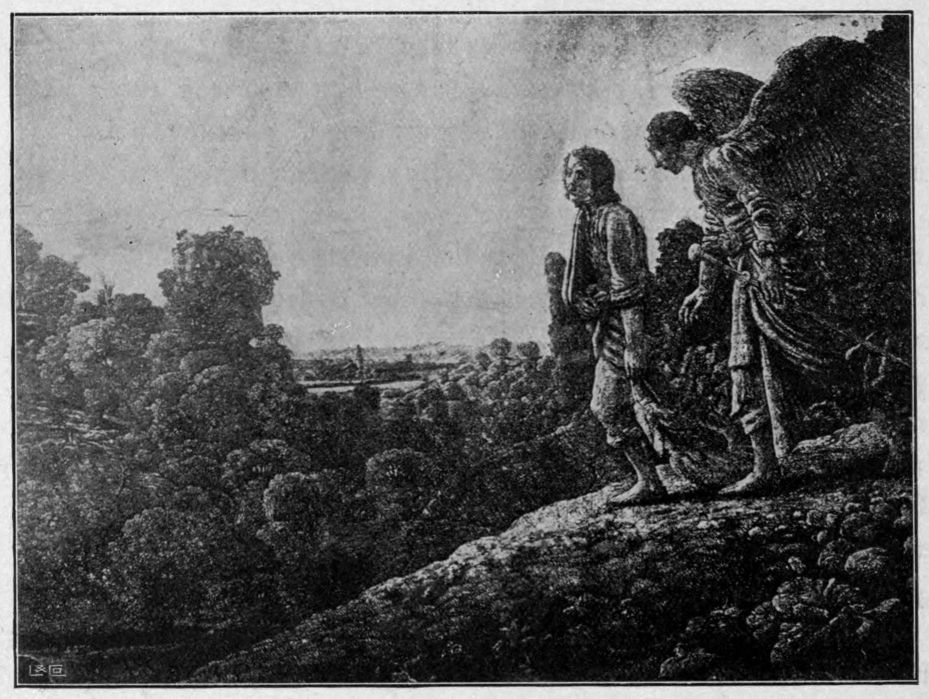
Fig. 12.—Tobias and the Angel. By H. Seghers. M. 236.
of Holland with vast horizons, or strange visions of wild and mountainous country. Seghers was born in 1589,[3] and died in 1650. A scholar of Gillis van Connincxloo, he was producing work as early as 1607, and from that date to 1630 seems to have been his chief period of activity.[4] His life, like that of several of the Dutch masters, was a long and hopeless struggle against poverty. He is said to have become a drunkard, and to have died from the effects of a fall. Dr. Bredius, judging apparently from his work, thinks that he must have visited the Alps, travelled into Italy, and found a stimulus in the art of Adam Elsheimer. Certainly the rocky landscapes which appear in the etchings could have no archetypes in Holland. But there is so strong a vein of the fantastic in them, that it is difficult to believe they were done from nature, especially when one observes how precise a pencil Seghers uses when he sketches his native country. However, truth to mountain formation is anything but an easy thing to seize; only by incessant training and close observation does the eye acquire it; and to draw rocks imaginatively, that is, with vivid realisation of their essential forms, is scarcely possible to one who has not the work of predecessors to learn from and to surpass, and whose eye has not dwelt upon them from childhood. One may imagine, therefore, that the efforts of a lowlander, to whom mountains must have had something visionary and strange in their aspect, would be halting, laborious, and confused in grappling with such unfamiliar material. The rocks painted by Patinir are a case in point. This may well explain the singular shortcomings of Seghers’ rendering of rocks and mountains. In his attempts to represent floating clouds on the mountain sides he is simply grotesque.
If, then, it was actual scenery that Seghers etched, where is that scenery to be found? It is certainly not the Alps, and though one or two plates suggest the Tyrol, the landscape is most like in character to the Karst district on the eastern shores of the Adriatic. One of the etchings might almost stand for the rock-surrounded plain of Cettinjé, in Montenegro, though to infer that Seghers travelled to so remote a country would be a wild conjecture.
There can be no doubt, on the other hand, of the influence of Elsheimer over Seghers, and through him, over Rembrandt.
In the National Gallery there is a picture by Elsheimer representing Tobias and the Angel, in a wooded landscape. This was engraved by Elsheimer’s friend, Count de Goudt, and either from the picture or the engraving,[5] Seghers borrowed the main features of one of his etchings (Fig. 12). The two chief figures have been retained almost unaltered; but their being placed higher up in the picture makes a considerable change in the composition, they have more dignity and significance. The elimination, also, of some rather trivial details, such as the great flowers in the foreground, and the passing figures in the middle distance, make for the same effect. A kind of mystery and solemnity have been added to the landscape, and in fact the impression of the whole is deepened and enlarged. The subject has been fused in Seghers’ mind and has become his own.
At his death, Seghers’ effects, including his etched plates, were sold. Among the buyers of these latter were, apparently, Antoni Waterloo and Rembrandt. Waterloo published some of Seghers’ landscapes with his own, and it has been assumed by Dutuit that these impressions were from the earlier artist’s plates, re-worked. Comparison of one of the original etchings, however, with that published by Waterloo of the same subject, leads the writer to doubt this. The work is entirely different.
Rembrandt, we know from the inventory of his effects taken in 1656, bought six of Seghers’ landscapes, and he also bought the copper on which had been etched the Tobias and the Angel. It was re-worked by Rembrandt, and it now appears in Rembrandt’s work as a Flight into Egypt.[6] (See Fig. 13.)
The dark wooded landscape remains unaltered, and though the Holy Family and a group of trees now occupy the right hand of the scene, the great wing of the angel is still distinctly to be seen above them, and Tobias’s legs have not been perfectly erased.
Rembrandt, we may be sure, would never have taken another man’s work unless he had found in it a strong appeal to his own nature. And Seghers seems to have been his prototype in landscape. On the one hand, the mysterious, darkly wooded, mountainous visions of Seghers suggest the type of landscape in which Rembrandt set, for instance, his own Tobias and the Angel,[7] a type which he was fond of reproducing. On the other hand, Seghers’ love for the vast distances of Holland, crowded plains with broad rivers winding into an infinite horizon, appears again in some of Rembrandt’s etchings, and more notably still in those spacious prospects, “escapes for the mind” as Mr. Pater has called them, of Rembrandt’s pupil, the most truly Dutch and perhaps the greatest, of all the landscape painters of Holland—Philip de Koninck.
To return to Seghers’ etchings. There is something about them which arrests the eye at once, and this is partly due to their peculiar printing. Seghers was a born maker of experiments, and in nearly all his plates sought to get an effect of colour. In fact, it is usually asserted
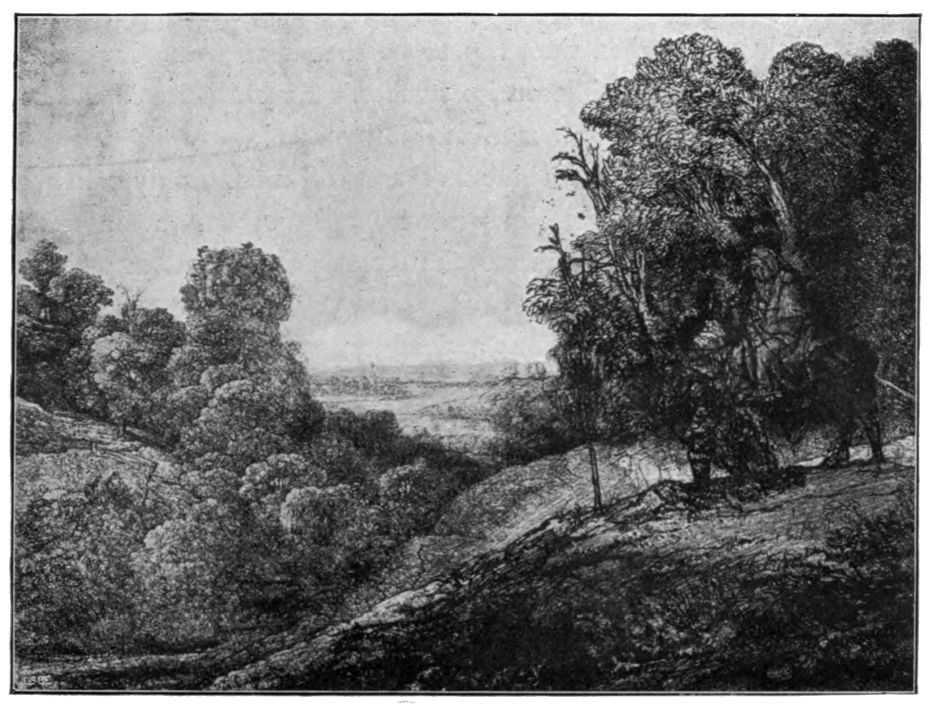
Fig. 13.—The Flight into Egypt. By Rembrandt. M. 236.
that he anticipated, by a hundred years, the coloured engravings of Leblond.
Printing in colour from two or more blocks had been practised by wood-engravers long before this time. Burgkmair and Cranach in Germany, Ugo da Carpi and Andrea Andreani in Italy, had produced a number of these “chiaroscuros,” as they are called, with charming effect. This was about the beginning of the sixteenth century. And almost in Seghers’ own time, Hendrik Goltzius, of Haarlem, published some of his best work from coloured wood-blocks.
But in all of these cases, at least two, and often three separate blocks were used, and the colours superimposed on each other. This was also the procedure of Leblond, though he used metal plates and mezzotint.
Seghers, however, employed a single plate only, and his effects are not due to what is usually understood as colour printing. He first prepared his paper with a coat of paint, which formed the ground; in some cases this was a greenish tint. He then etched his subject and printed it in an indigo ink; and in order to procure shading of the same colour, he lightly scratched the parts to be shaded with the dry-point, so that the copper held the ink on its surface. By this simple means he produced an apparently complex effect.[8]
The green tint and dark-blue ink are, of course, only taken as a specimen, for Seghers used various colours. Sometimes the impressions are printed on linen. In one case the etching is printed in white on a brown ground.
Besides views of Dutch plains and of mountain scenery, Seghers also etched trees; not with great success, but with a striving after truth of foliage very rare in his day. Now and then, too, he attempted buildings, and with a real feeling for the romantic, for picturesque beauty, in architecture.
On the whole, we must allow an important place in the history of Dutch landscape to Hercules Seghers. But that must not prevent us from perceiving that it is an historical importance only. Seghers opened up the road, but he achieved no eminent triumph himself. Nor, in spite of his suggestiveness for Rembrandt and De Koninck, does he seem to have exercised any great influence on the landscape etchers who immediately succeeded him.
He has no affinity with the men whose work we must now consider.
III
The two diverging tendencies of Dutch art, that which fed on the Italian tradition and that which clung to the native soil, are both to some extent represented in Seghers.
Leaving for a time the Italianised masters, let us follow the main development of Dutch landscape art, the painters and etchers whom Holland alone inspired.
The first names of note are those of Esaias and Jan van de Velde. Jan was born in 1596, Esaias a few years earlier. Of the former we shall say something later on. He produced a great deal of work, the most remarkable part of which is a number of plates engraved and etched in the manner of Elsheimer. It is by these plates that he is best known, and through them he ranks as one of the Italianised school. As, however, he etched a certain number of purely Dutch landscapes, after the designs probably of his brother, he must also be mentioned here. These landscapes are mostly sets of traditional subjects, such as the sixteenth century loved: The Four Elements, The Four Seasons, The Twelve Months. Always strongly overworked with the burin, these etchings have a somewhat harsh and dry effect. The harshness is especially noticeable in the treatment of foliage. It is as if the artist were striving to reproduce with the etching-needle the manner of line-engraving as employed by the Goltzius school. Failing to secure this he has recourse to the burin to supplement his incomplete success in etching.
Esaias uses the acid in a much franker fashion. A plate of his, which we may take as representative, depicts a whale cast on the shores of Holland, perhaps at Scheveningen, in 1614. A great crowd has assembled on the beach staring at the stranded monster, examining and measuring its vast proportions. The dunes recede in the distance; boats are at anchor in the surf.
The scene is treated with the plainness and sincerity characteristic of Dutch art. And the etching, with its firmly and rather coarsely bitten lines, unsophisticated by the burin, has a solidity and simplicity not without attraction.
Regarded as etching, this is primitive work. Still it is genuine etching, and by one who has perceived that needle and acid demand an employment and an aim different in kind from that of the graver. It is interesting, therefore, to compare this plate with the line-engraving of a similar subject, representing another whale stranded, a few years before, in 1598, by Jacob Matham, the pupil of Goltzius.
With the Van de Veldes it is natural to associate two contemporaries, who with them helped to inaugurate the great age of Dutch art; Pieter
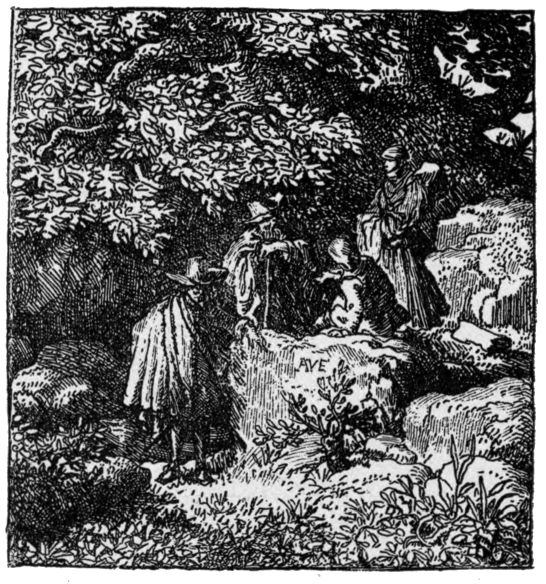
Fig. 14.—Three Men under a Tree. By Everdingen. B. 5.
Molyn, the elder, and Jan van Goyen, the latter born in the same year with Jan van de Velde.
Molyn, who was born in London, but was working in Haarlem before 1616, is an artist of real independence. A set of etchings, published in 1626, shows the same qualities that appear in his drawings—firm draughtsmanship, openness and freedom of design, and a fine economy of means. Heaths and moors, a climbing country road with plodding waggon, a wayside inn, such were the simple elements which he translated into always distinguished work. Doubtless to Molyn’s teaching must be attributed something of that fine manner which imparts so much charm to the pictures of Gerard Ter Borch, his pupil.
Dying in 1656, Molyn survived by a few years one who, though not a pupil, came certainly under his influence; Van Goyen. Till lately Van Goyen, perhaps because his works are better known, was supposed to have been Molyn’s teacher, or at least to have given a stimulus to his art. Van Goyen shows more power in his drawings than in his paintings, which are sometimes but little removed from sepia monochromes; and it is a surprise to come, here and there, upon a picture of his which is bright and fresh. The few etchings which he published are undated, but belong, according to Dr. Lippman, to his middle life, 1625-30. They
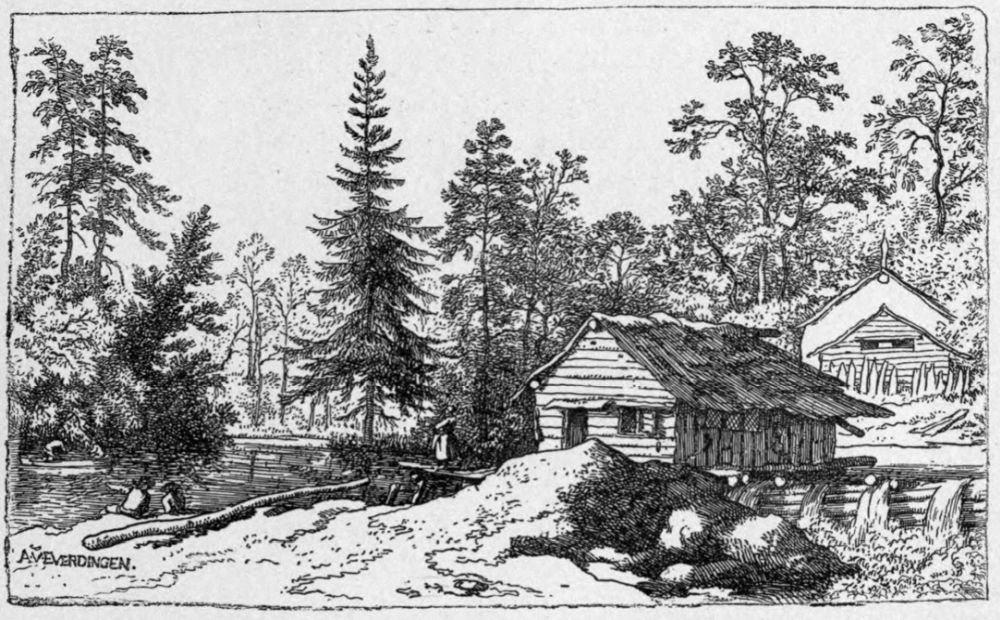
Fig. 15.—Landscape in Norway. By Everdingen. B. 75.
have not the character of Molyn’s plates, and are far less good as etchings.
Simon de Vlieger, who ranks in date as a younger contemporary of the Van de Veldes and of Molyn, is more successful as an etcher in the few plates which he produced, than any of the early landscape artists. Unhampered by the traditions of the line-engraver, he aims at an effect at once delicate and free. As a painter, he is known almost entirely by sea-pieces, silvery in tone, from which Jan van de Cappelle drew something of his mastery over still effects at sea, mornings of sleepy mist through which the sun breaks palely on the sails of anchored vessels. Like most of the Dutch painters, de Vlieger changed his home several times. Born at Rotterdam in 1600, he was at Delft from 1634 to 1640, and from then till his death, nineteen years later, at Amsterdam. It seems probable that here he gave lessons to the young Willem van de Velde, who was afterwards to be famous as the greatest of Dutch sea-painters, and who died at Greenwich, a Court painter to Charles II.
In his etchings, which are undated, de Vlieger does not attempt the sea; though one (B. 10), a fine piece in its way, is a scene on the sea-beach, with fishermen and their haul. The best of the plates are two Sylvan pieces, The Wood by the Canal (B. 6), and the Grassy Hill (B. 7). The foliage is more sensitively treated than it commonly is by Dutch etchers, and with more approach to delicate truth. There is also a set of animals and poultry; possibly one of the earliest sets of subjects of this kind, which the middle of the century found so popular.
IV
With Allardt van Everdingen (1621-1675) we reach a new element in Dutch landscape. Working under Pieter Molyn at Haarlem, he began by painting marine subjects; and with a view to increasing his knowledge of the sea, took ship on the Baltic. But a storm drove him to Norway; and there for some time, taking advantage of misfortune, he lingered travelling and sketching.
Before 1645, however—that is before he was twenty-five, Everdingen was back in Haarlem. He now began to paint pictures from his Norwegian sketches: and to the Dutch public this northern scenery disclosed a novel charm. Used to wide pastures and ample skies, they found a romantic strangeness in tumbling streams among rocks and pine-forests, where the sky was shut off by mountain slopes.
In 1652 Everdingen removed to Amsterdam, where he remained till his death. Probably his fame had preceded him: at any rate his popularity soon grew great there also, and his canvases were much sought after.
Besides numerous pictures, the Norwegian sketches provided the artist with material for a long series of etchings. Fig. 15 is a very characteristic specimen of them. Without any extraordinary qualities, they have often a genuine charm. The Norwegian landscape is treated with insight into its peculiar features, and though Everdingen fails entirely to suggest the rush and foam of torrents, he makes fine use of the log cabins, rafts, and palings, and etches pines with truth and spirit.
Of a probably later date are the four views of a watering-place, possibly Spa, one of which is here reproduced (Fig. 16). The subject is
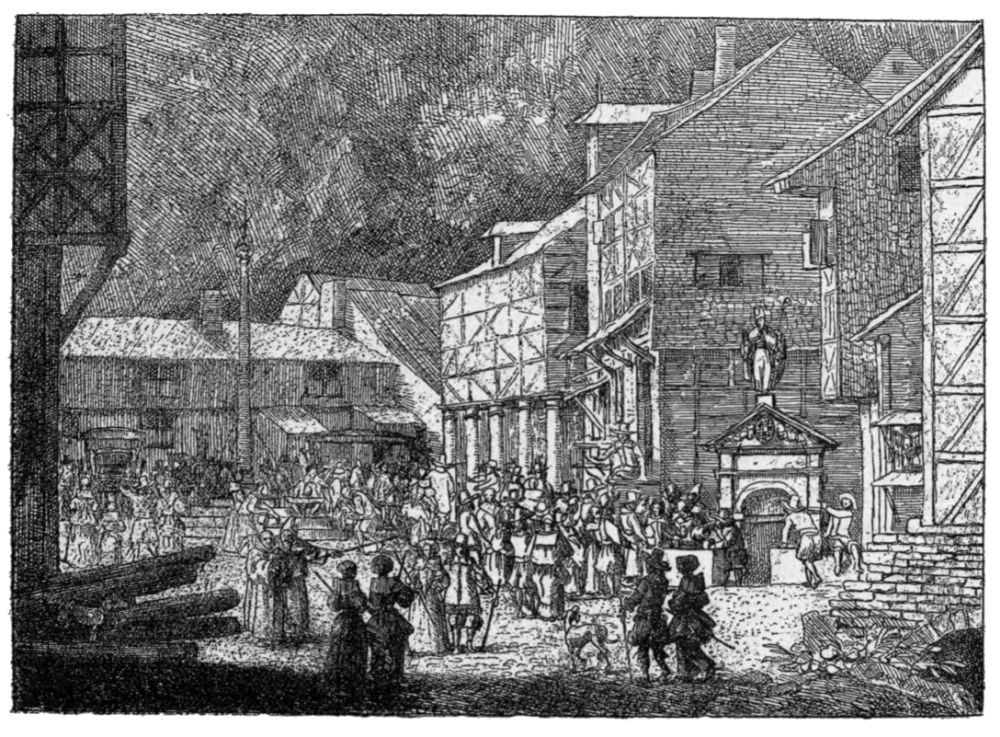
Fig. 16.—Drinking the Waters at Spa. By Everdingen. B. 96.
interesting, and the handling of the buildings and the groups of people is excellent.
Everdingen was not without humour, which is shown in the long series of illustrations to Reynard the Fox. But most readers will probably find the chief interest of the artist to lie in his relations with a greater man, Ruisdael.
V
Though a native of Haarlem, Jacob van Ruisdael produced most of his life’s work at Amsterdam. He is conjectured to have been born about 1625; the precise year has not been discovered. His father Isaak, a frame-maker, had him trained as a surgeon; and it was not till after he had passed a course of surgery that he abandoned the profession for painting, in which he had early shown his gift.
Ruisdael’s first pictures are dated 1646, and his works from that year to 1655, his “early period,” are nearly all views of Haarlem and its neighbourhood. Thoroughly Dutch in character, they have little of that gloomy tone so frequent in the artist’s later time. The beautiful View of Haarlem at the Hague, with its massed clouds and ray of sunshine gliding over the plain, is a perfect example of this early manner.
With Ruisdael’s removal from Haarlem, a great change comes over his art. There seems no doubt that his early Dutch landscapes were not popular. They were perhaps too original. He came to Amsterdam poor and without much reputation, and he found there, established in fame and popularity, Allardt van Everdingen, returned from Norway and now attracting the world of buyers by his pictures of that wild and romantic country. It was in 1652, as we have seen, that Everdingen settled in the city, and three or four years later Ruisdael arrived. He did not become a burgess till 1659, but had probably been already some years in residence before the formal inscription of his name.
From this period dates the lamentable change in Ruisdael’s art. The master, whose native independence is so marked that one is at a loss to name his probable teacher, of his own will and in sheer mortification of spirit at his want of success, forces himself from the meadows and dunes of his delight, and invents, to win the patronage of the rich men of Amsterdam, a Norway of his own. A visit to North Germany, of which there is some evidence, helped his invention. Now begins the long series of waterfalls and pines and torrents so familiar in the picture galleries. It is not on these that Ruisdael’s fame rests; on this ground Everdingen, in spite of his inferior merits as a painter, remains his master. But as the pictures of this period are the most common, the public is apt to identify him with this acquired style in which the true Ruisdael is obscured. For this reason it was a fortunate choice which secured for the National Gallery, two years ago, so exquisite a specimen of the painter at his best as the Shore at Scheveningen, No. 1390. The chilly ending of an afternoon, with clouds blowing up and the rain beginning, the vexed movement of shallow water as the rising wind breaks it into short waves, the wetness of the spray-laden atmosphere, are painted with a sensitive subtlety that more modern landscape, with all its triumphs, has not excelled. The mood of feeling here expressed is intimately Ruisdael’s own. Without the brooding melancholy which became oppressively habitual later, which found such grandiose expression in pictures like the famous Jews’ Burying-place at Dresden, there is here a latent sadness that seems to have been bred in the fibre of the man. It seems a kind of expectation of sorrow; the mood that poetry with greater intensity has expressed in some lines of Browning which suggest themselves:
The rain set early in to-night; The sullen wind was soon awake: It tore the elm-tops down for spite, And did its worst to vex the lake. I listened, with heart fit to break....
For such a nature who would predict happiness? Fortune satisfied that inborn melancholy to the full. The years brought increasing poverty, and the cares of providing for himself and for his father wore the artist down. The autumn of 1681 found him ill and helpless; so helpless that the religious community to which he belonged, the sect of Mennonites, procured admission for him to their almshouse at Haarlem. There he lingered till the next spring. In March he was buried in St. Bavon’s.
VI
Ruisdael’s etchings are but twelve, or perhaps thirteen, in number; only seven being catalogued by Bartsch. Their fewness shows, what their technical qualities confirm, that the artist neither had great aptitude for this method of expression nor cared to pursue his experiments in it far. They all belong to his earliest period. One, the Three Oaks (B. 6), is dated 1649, and it is difficult to assign any of the others, except possibly the Cornfield, to a later date.
Of the four large plates, the one which Bartsch calls Les Voyageurs (B. 4), is decidedly the most interesting. It is a forest scene, wild and intricate, with water running or standing in pools among the great roots of the oak which occupies the centre and of the beech which fills the left. The two figures are passing in the middle distance, where the wood is clearer. It is a remnant, perhaps, of that vast forest which at one time covered the whole of Holland. Ruisdael’s strong feeling for old trees, for the solitude of forests, densely branching and mysterious, inspires him here; and one has only to turn to the facile etchers of sylvan scenery, Waterloo or Swanevelt, or Van der Cabel, to realise the difference between the man who feels what he cannot perfectly master and the man who has perfect mastery of a facile formula. Ruisdael never succeeded in finding a quite satisfactory convention for foliage in etched line; but his continual feeling after truth of rendering, his sensitiveness, to which the forms of branch and leaf are always fresh and wonderful, make his work always interesting.
The three other large plates (B. 1-3) are less successful handlings of the same kind of subject. Though the first, The Little Bridge, is not a forest scene, and represents a decayed old farm-building, it is penetrated with the same feeling for picturesque, moss-grown antiquity and neglected solitude. The Three Oaks are etched with truth and strength, but they do not rival the grandeur of the oak in the larger plate. The Cornfield (Fig. 17) is sunny and pleasant.
There are two states of the four large plates, and many of the Three Oaks and the Cornfield. As the later states are by far the more common, it is well to be warned that the plates have been retouched, and, in the writer’s opinion, certainly not by Ruisdael. In the first three a pudding-shaped cloud, with hard, bulging edges (what a satire on this consummate master of clouds!) has been inserted, and in all there is fresh work, sometimes adding to the effect of the plate, but still suggesting an alien hand.
Ruisdael’s etching is little more than an illustration of his painting; criticism, therefore, of the one must deal to a certain extent with the other.
Ruisdael’s great fame rests, perhaps, as much on his historical importance as on his actual merit. With Hobbema he prepared the way for Crome and Constable, and through them for Rousseau and the landscape of modern France. But, taken on his own merits, he is a considerable figure. Were it not for the fatiguing series of unpersuasive waterfalls, which too often represent him, his real qualities would have more chance of making themselves felt. When on his own ground he is
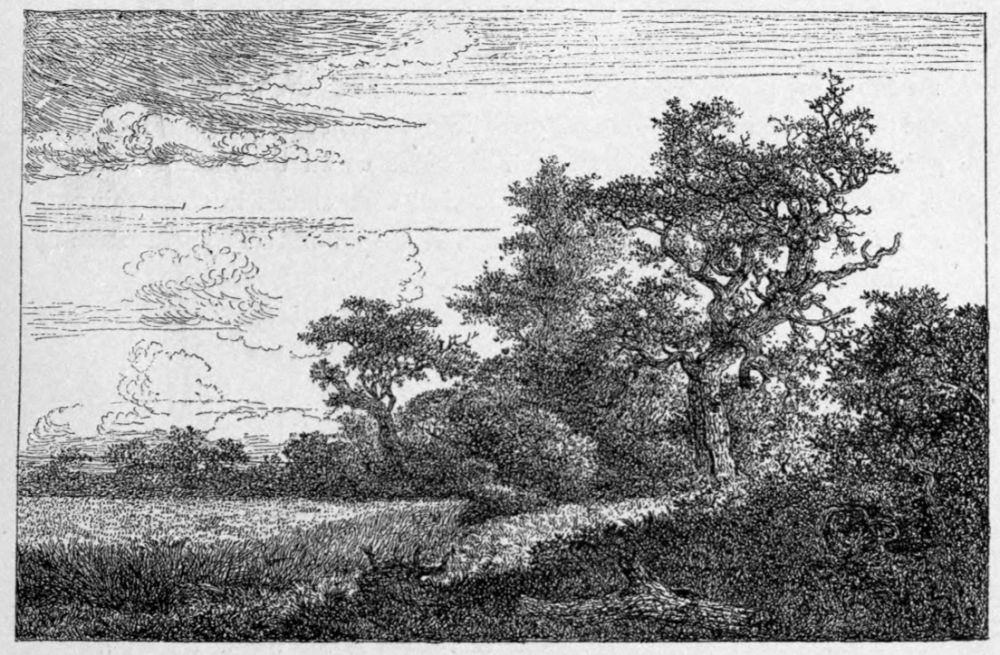
Fig. 17.—The Cornfield. By J. Ruisdael. B. 5.
more various, more subtle, altogether finer than Hobbema, except when Hobbema is at his very best, as in the severely charming Avenue of Middleharnis. Hobbema often fails to convince, because he has not sufficiently felt his subject; and so he will paint a grand sky with the wind moving great clouds across it, but when he comes to the trees of his foreground he forgets his sky, and paints the branches in a breathlessly stiff atmosphere, without the suggestion of a wind. The resulting effect is a perplexing heaviness. Ruisdael betrays the same defect in his later pictures; what else could one expect from one condemned to produce unrealities for a market? But in his good period he always shows an impressible imagination, and his materials are fused by the feeling in which he steeps them. His sense for the beauty of trees is profound, though rather limited in its range. He was lacking in the consummate style of Crome, and would never have achieved the largeness and reticent power of a picture like the English master’s Avenue at Chapel Fields. But for skies, for clouds, he has an eye more true, a love more comprehensive, than those of any who had gone before him, than those of many who were to follow him. He piles his clouds in mountainous glory, “trailing” their shadows over the wide country, till the level pastures of Holland grow in “visionary majesties” like the grandest mountains of Norway. This gives us all the more reason to deplore the absence of any attempt to deal with clouds in the etchings, still more the presence of those inflated shapes inserted by a stupid publisher.
VII
Though an important figure in the history of landscape painting, Ruisdael did not strongly influence the contemporary etchers of landscape. Hobbema, his famous scholar, did not, so far as we know, etch at all. A few etchers, however, felt Ruisdael’s stimulus more or less: Van Beresteyn, who was working at Haarlem in 1644, and produced some etchings somewhat in the manner of Ruisdael’s Cornfield, but with a mannered treatment of trees: H. Naiwincx, who handled a delicate point, and etched a set of graceful plates of woodland and river: and Adriaen Verboom, who in his two or three etchings is perhaps more successful in treatment of trees than any of the Dutchmen.
But more celebrated than any of these is Antoni Waterloo.
His etchings, to which alone he owes his reputation, are considerably over a hundred in number; and as the subjects are monotonous, they soon become tedious. Groups of trees by a roadside, or a fringe of wood alone occupy Waterloo’s needle. Now and then, as in B. 28, the touch is light and the effect pleasant: but having once found a formula, Waterloo is content to repeat it. His foliage is hard and heavy.
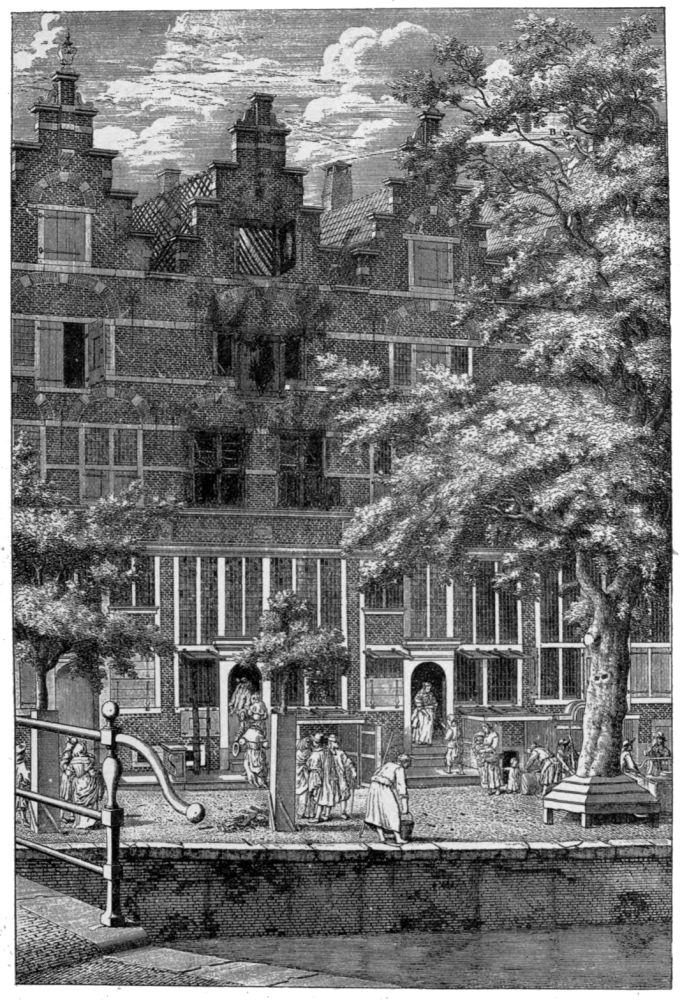
Fig. 18.—The Burnt House on the Canal. By Van der Heyden.
Roelant Roghman (1597-1686), though most of his plates are nominally topographical, shows more feeling, if less skill. One set of plates by him illustrates the Dutch postal system between the mother country and the East Indies, and has therefore an historical interest.
But Roghman’s chief claim on our concern is that he was the faithful and beloved friend of Rembrandt. His etchings, however, show no trace of Rembrandt’s influence; and he was by ten years the elder man.
Like Seghers and like Ruisdael, Roghman was neglected and miserable in his life, and died in an almshouse. One of his landscapes is in the National Gallery.
VIII
The illustration on page 51 (Fig. 18) is from an etching which represents a certain province of Dutch art, handled by several of the painters with much success, but scarcely touched by the etchers.
Of this group, to whom architecture, whether in the spacious and austere interiors of the Dutch churches, or the squares and ruddy brick house-fronts of the towns, was the chief preoccupation, Jan van der Heyden is the most famous and the best. He is also the one among them who has etched. The illustration, though much reduced, gives a fairly good idea of his work. Master of a precise and patient pencil, Van der Heyden is not content till he has drawn in every brick, every stone. And the marvel is, that in spite of his method, he contrives to convey a certain spirit of largeness into his design. In fact, though so minute in detail, he seems always to have kept his eye on the whole. A pleasant temperate warmth of colour pervades his pictures, the kind of light which on certain days suffuses old brick walls, as if dyed in the sunshine of many summers: and that exquisite order, the almost extravagant cleanliness of Dutch households, makes itself felt in these glimpses of tree-bordered canals, and of trim house-fronts with their well-proportioned windows.
Much of this colour persists even in the black and white of an etching like that reproduced. It is the day after a fire, and a little crowd of neighbours is gathered to look on the burnt remnant of the house. How
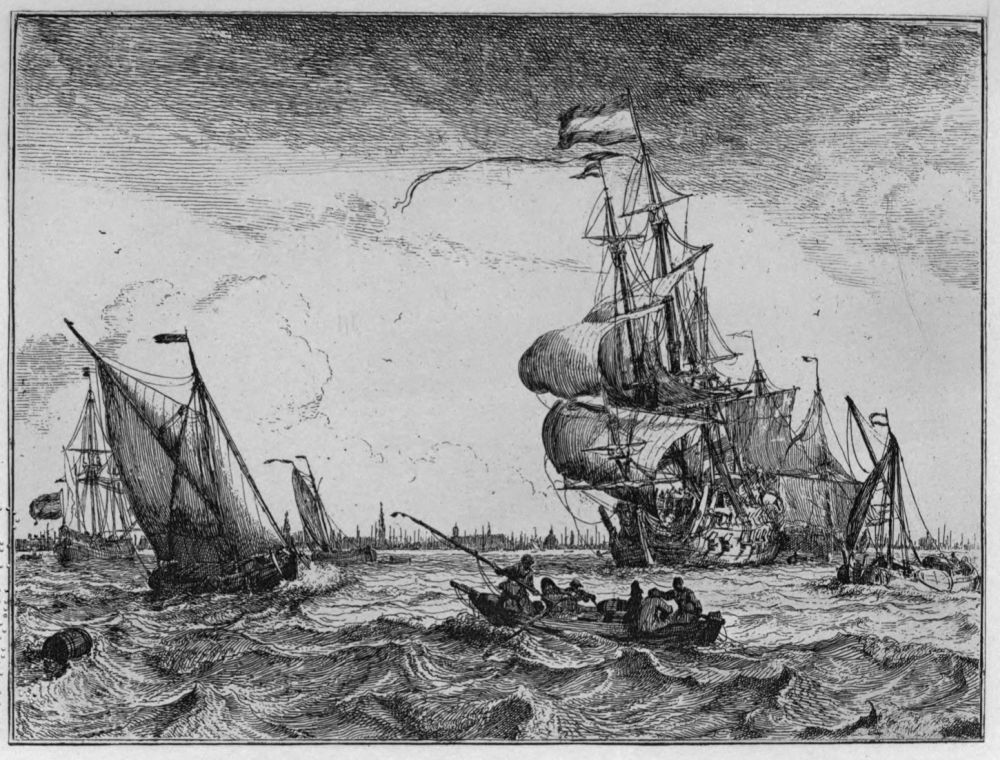
Sea Piece. From an etching by L. Backhuysen.
excellently are the groups and figures depicted! This is not true etcher’s work; but it is very skilful work, very good work, of its kind.
Neither Van der Heyden, nor any of the Dutch painters of architecture, realised the capacity of outlines in stone or brick, attended by their circumstance of light and shadow, to impress the imagination, to stir emotion, as Méryon was to do later. But their work, by its soberness and firm simplicity, wins us. In its own way, and in its own degree, it will always give pleasure.
IX
From Holland, the first naval power in Europe of the seventeenth century, a love of the sea and an expression of it in art were naturally to be expected: and among the several fine painters who now for the first time made the sea their subject, two at least, Reynier Zeeman and Ludolph Backhuysen, have left some admirable etchings. Simon de Vlieger painted, but did not etch marine subjects; of Jan van de Capelle only three indifferent plates are known; and Willem van de Velde did not etch at all.
Zeeman’s real name was Nooms; but his love of the sea procured him early the name which he adopts on all his plates. He travelled much, but worked chiefly at Amsterdam, where probably he was born in 1623.
Zeeman’s etchings are nearly all in sets, representing views of Amsterdam, different kinds of Dutch shipping, and naval battles. They passed through the hands of several publishers, who, we may conjecture, commissioned him to do them: and they were evidently popular. Such work, nominally and primarily intended to serve a literary rather than a pictorial purpose, suffers in consequence. The artist has had to choose his subjects with a view to those whose interest was not in the etcher as etcher, but in his knowledge of ships and skill in depicting them.
Yet Zeeman has managed to serve art as well as history. Ships, with their ordered intricacy of rigging and their mysterious beauty, have an endless fascination for him: for it is shipping, rather than the sea itself, which he loves. And his ships are etched with an admirable feeling, a simple and effective handling of the bitten lines. His men of war move with royal stateliness; and the battle-pieces have something of the magnificence one imagines in the old sea-fights. Equally good in their way are plates like the fishing boats (Fig. 19) setting out at morning over the still sea, bathed in a wash of limpid air and sunshine. Only in his clouds does Zeeman completely fail. Historically, too, these prints are interesting. Here, with patriotic pride, Zeeman is fond of showing the English ship of the line or frigate, with her sails riddled, conquered at last, and with the Dutch tricolour hoisted over the St. George’s Cross. Nothing could more
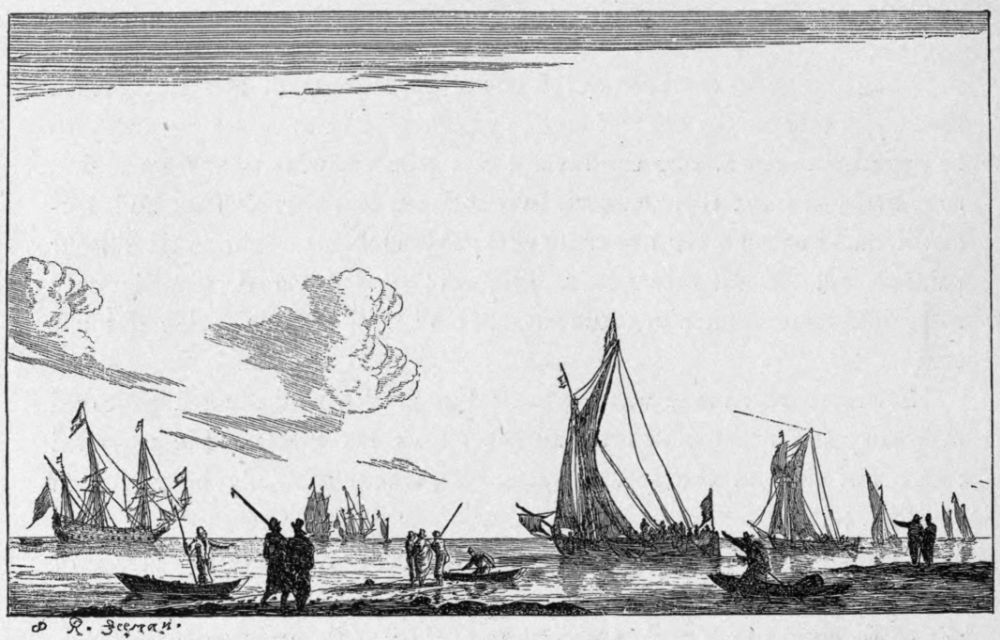
Fig. 19.—Fishing Boats. By R. Zeeman. B. 38.
vividly bring home to Englishmen the powerful position of Holland at the time.
Backhuysen’s etchings are later than Zeeman’s, being all produced in 1701, when the artist was seventy years old,[9] and seven years before his death at Amsterdam. A pupil of Everdingen, he had soon risen to fame and was employed or sought after by many foreign princes, including the Tsar Peter the Great; and from over much production his work suffered.
The etchings, however, though produced so late in life, are neither languid nor feeble. In freshness and vivacity they excel Backhuysen’s drawings. It is the same with Zeeman: probably because the etching-needle has so much more capacity for giving the crispness of foam and the sharp lights of running waves, than pencil and sepia. No one, till Turner came, succeeded at all in painting the mass and weight of water as the tides move it in deep seas; but the easily agitated, breezy motion of the shallow Dutch waters is often suggested with a pleasant freshness by Backhuysen. The best of the etchings is that of the ship under sail, crushing the water under her bows into foam.
X
So far, we have considered only the native school of landscape artists, who took their subjects from Holland and its borders. But towards the end of the sixteenth century there was established in Rome a group of painters from the Netherlands, to which each succeeding generation added new members, whether they settled there for life or stayed only for a few years.
Belonging to this group are a certain number of etchers, deriving originally, in more or less degree, from Elsheimer, and receiving a second and more powerful stimulus from the art of Claude.
Jan van de Velde,[10] it seems probable, spent some years of his manhood in Italy, and perhaps worked under Elsheimer himself. At any rate, a number of his plates are entirely in Elsheimer’s manner. These are so heavily overworked with the burin that they must count rather as line-engravings than as etchings. The burin plays, indeed, a more or less important part in all Jan van de Velde’s prints.
One set, illustrating the story of Tobias, was etched from designs by Moses van Uytenbroeck, an artist who also published a number of plates of his own. Here again is an instance of the traditional chronology being at fault. Uytenbroeck’s birth is usually given as 1600. But Bode has pointed out that there are engravings after his work by an artist who died in 1612. The date must therefore be put back several years. Uytenbroeck is perhaps the nearest to Elsheimer of all his followers. The relation of the figures to the landscape, the curious human types, with their rather stolid, plain faces and heavy gestures, the treatment of Italian landscape, all are intimately akin to the German master’s art.
Elsheimer’s influence still persists strongly in Cornelis Poelenburg, one of the most popular of the Dutch artists in Rome, whose small, smoothly glowing pictures of grottoes and bathing nymphs are familiar in every
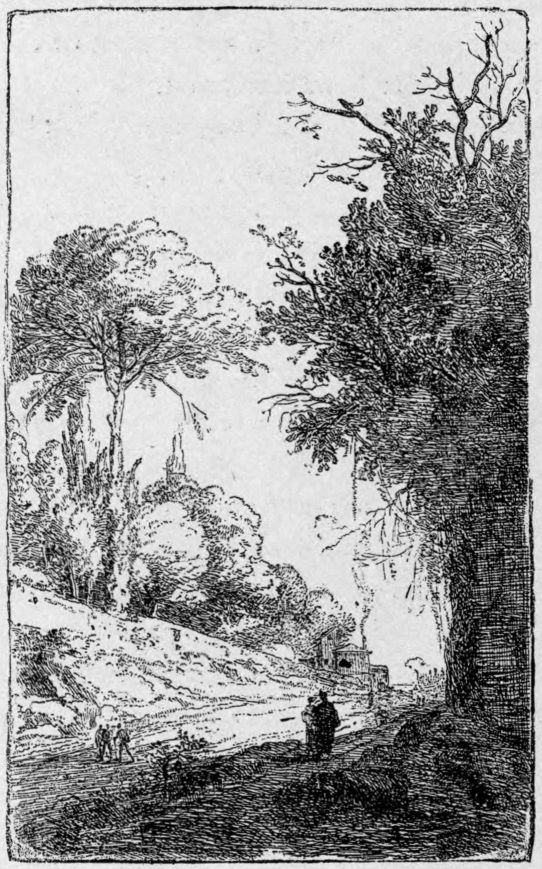
Fig. 20.—Road, with Trees and Figures. By Breenbergh. B. 17.
gallery. Poelenburg did not etch himself, but his friend Jan Gerritz Bronchorst etched from his paintings and in his style, though with less grace and elegance. We find here the beginnings of that school of landscape, “Arcadian” as Bode calls it, which so soon received its fullest and most perfect expression in the large and tranquil art of Claude.
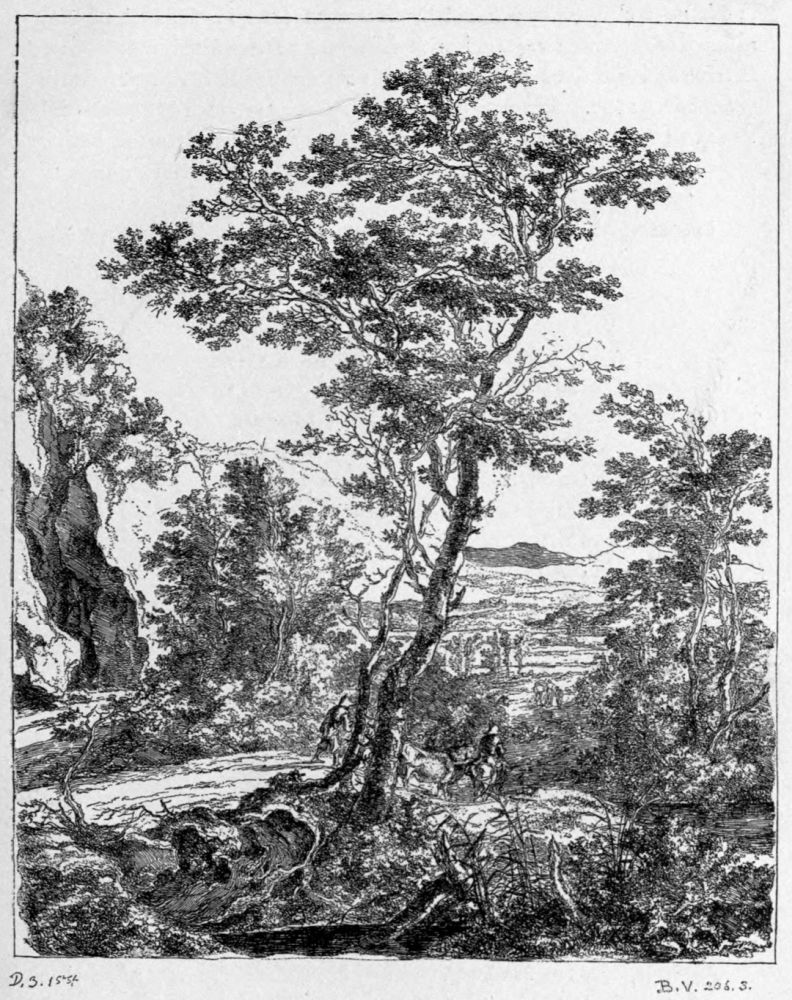
Fig. 21.—Landscape. By Both. B. 3.
Pieter de Laer, of whose etchings of animals we shall say something in the next chapter, etched one landscape at least in the delicate soft manner of that master. And with him maybe associated Bartolomeus Breenbergh, who lived in Rome from his twenty-first to his twenty-eighth year, 1620-1627. He was married at Amsterdam in 1633 and died there in 1659 or earlier; but was at Rome again in the interval, during which he published (1640) a set of very attractive little prints. Fig. 20 is an example of his work.
The same delicate, fine needle, and the same preference for the picturesque, characterise the earlier etchings of Thomas Wyck. Later he adopted a freer, broader style, and worked on a larger scale, but with less success.
But the most conspicuous and important of this group is Jan Both. Like Poelenburg, he was a man of Utrecht, where he was born in 1610 and where he died in 1652. His portrait, taken in his later days at home, is that of a stout, grave burgher. Quite young he left the studio of his master Bloemart and travelled through France to Rome. There the soft sunshine of Claude fascinated him and he began to follow in the footsteps of that famous painter.
Every one knows the landscapes of Both, their smooth, rather insipid grace, their premeditated balance of composition, their elegant monotony. It is certain that they were popular in Holland, whither they were brought in ships from Italy to adorn the walls of wealthy buyers. Probably in that day such painting of placid sunshine was a new thing; what we perceive to be a surface acquaintance with Nature savoured almost of intimacy; and doubtless Both’s pretty and monotonous conventions had then a permanent charm.
In his etchings, Both’s weaknesses do not appear so strongly. And, wisely, he did not produce many. Had there been more they would, beyond doubt, have been precisely similar to what we have; and from mere fatigue at their monotony one would have rated them below their worth.
As it is, the ten landscapes after his own designs are more than enough to reveal Both’s great limitations. Yet they are few enough for us to enjoy them. For, after all, they are attractive and accomplished etchings. From Claude, Both had learned how to produce, with a nice management of the acid, an exquisite softness in his distances. The atmosphere is limpid and bathed in sunshine, and the foregrounds are suggested with that light touch and selection of detail which are first requisites in an etching.
Here, again, it is only fair to the artist to judge him by the early states of his work. The ruled lines defacing the sky which they are meant to constitute, were added in the second state by the publisher. Of that there can be little doubt. Unfortunately, Both’s first states are extremely rare.
Both’s pupil, Willem de Heusch, approaches if he does not rival his master. He is not independent enough, however, to merit special notice.
Herman van Swanevelt, another artist whose birth-date must be put further back than the traditional 1620,[11] lived on to 1690, when he died at Rome. His etchings are more considerable in number than in merit. He began the school of reminiscences from Claude and Titian’s landscapes which lingered on through paler and paler repetitions into the eighteenth century, in the sad facility of Genoels and Van der Cabel and Glauber. Never was art more bloodless and apathetic than in these degenerate spoilers of a fine tradition.