NELSON AND HIS CIRCLE (continued 3)
Reading edition
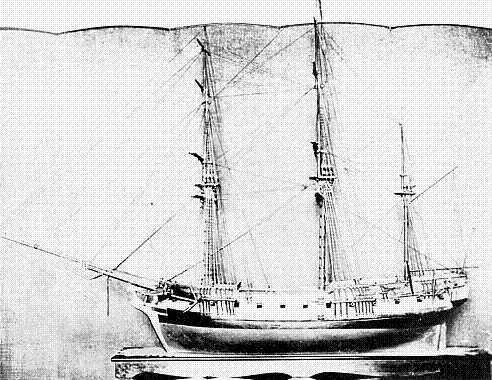
"Princedss Charlotte"—Frigate (Early 19th Century)
Making full allowance for what might be put down to imagination, there is still an abundance of material to justify the belief that the first naval authority of his time was the target of snobs, and that, but for his strong personality and the fact that he was always ready to fight them in the open, he would have been superseded, and a gallant duffer might have taken his place, to the detriment of our imperial interests. It is a dangerous experiment to put a man into high office if he has not the instinct of judging the calibre of other men. This applies to every department of life nowadays. Take the Army, the Navy, departments of State, commercial or banking offices, manufacturing firms, and the making of political appointments. The latter is more carelessly dealt with than any other department of life. The public are not sufficiently vigilant in distinguishing between a mere entertaining rhetorician and a wholesome-minded, natural-born statesman. What terrible calamities have come to the State through putting men into responsible positions they have neither training, wit, nor wisdom to fill efficiently! Providence has been most indulgent and forbearing when we have got ourselves into a mess by wrong-headedness. She generally comes to our aid with an undiscovered man or a few men with the necessary gifts required for getting us out of the difficulty in which the Yellow Press gang and their accomplices may have involved the country. We know something of how the knowledge of these anomalies in public life chafed the eager spirit of Nelson, but we can never know the extent of the suffering it caused except during the Neapolitan and Sicilian days. This lonely soul lived the life of a recluse for months at a time. The monotony of the weird song of the sea winds, the nerve-tearing, lazy creak of the wooden timbers, the sinuous crawling, rolling, or plunging over the most wondrous of God's works, invariably produces a sepulchral impression even on the most phlegmatic mind, but to the mystically constituted brain of Nelson, under all the varied thoughts that came into his brain during the days and nights of watching and searching for those people he termed "the pests of the human race," it must have been one long heartache. No wonder that he lets fly at the Admiralty in some of his most passionate love-messages to the seductive Emma. His dreary life, without any exciting incident except the carrying away of sails or spars, and the irritation of not being able to get what he regarded as life or death requests carried into effect owing to the slothfulness or incompetent indifference of the Admiralty was continual agony to him. He writes in one of his dispatches to the Admiralty: "Were I to die this moment, want of frigates would be found stamped on my heart. No words of mine," he continues, "can express what I have suffered and am suffering for want of them."
No person could write such an unconsciously comic lament to a department supposed to be administered with proficiency unless he were borne down by a deep sense of its appalling incompetency. It is quite likely that the recipients of the burning phrases regarded them in the light of a joke, but they were very real to the wearied soul of the man who wrote them. I do not find any instances of conscious humour in any of Nelson's letters or utterances. It is really their lack of humour that is humorous. He always appears to be in sombre earnest about affairs that matter, and whimsically affected by those that don't. The following lines, which are not my own, may be regarded as something akin to Nelson's conception of himself. If he had come across them, I think he would have said to himself, "Ah! yes, these verses describe my mission and me."
"Like a warrior angel sped On a mighty mission, Light and life about him shed— A transcendent vision. "Mailed in gold and fire he stands, And, with splendours shaken, Bids the slumbering seas and lands Quicken and awaken."
Nelson never attempted to carry out a mere reckless and palpably useless feat for the purpose of show. His well-balanced genius of caution and accurate judgment was the guiding instinct in his terrific thrusts which mauled the enemy out of action at the Nile, St. Vincent, Copenhagen, and Trafalgar, and enthralled the world with new conceptions of naval warfare. He met with bitter disappointments in his search for the illusive French fleet, which wore him, as he says, to a skeleton, but never once was he shaken in his vigorous belief that he would catch and annihilate them in the end. They cleverly crept out of Toulon, with the intention, it is said, of going to Egypt. Villeneuve was no fool at evasive tactics. His plan was practically unerring, and threw Nelson completely off the scent and kept him scouring the seas in search of the bird that had flown weeks before. Once the scent is lost, it takes a long time to pick it up. Villeneuve no doubt argued that it was not his purpose to give the British Admiral an opportunity of fighting just then. He had other fish to fry, and if he wished to get away clear from Toulon and evade Nelson's ships, he must first of all delude him by sending a few ships out to mislead the enemy's watchdogs or drive them off; if that succeeded (which it did not), he would then wait for a strong fair wind that would assure him of a speed that would outdistance and take him out of sight of the British squadron, and make sure that no clue to his destination was left. The wind was strong NNW.; the French fleet were carrying a heavy press of canvas and steering SSW. The British ships that were following concluded that they were out for important mischief, and returned to convey the news to Nelson, who quickly got under weigh and followed them. Meanwhile, Villeneuve's squadron, after getting from under the shelter of the land into the open sea, lost some of their spars and sails, and one vessel, it is recorded, was dismasted, which means, in seafaring interpretation, that all her masts were carried away; as she succeeded, however, in getting into Ajaccio, she can only have lost her royal topgallant, and possibly a topmast or two. If her lower masts had been carried away, she could not have got into refuge without assistance, and the rest of the fleet apparently had enough to do in looking after themselves, as they lost spars and sails too, and became somewhat scattered, but all appear to have got safely into Toulon again to refit and repair the damage done by the heavy gale they encountered.
Meanwhile, Nelson, in dismay at losing touch with them, searched every nook and cranny in the Tyrrhenian Sea, and making sure that none of them were in hiding and that the sea was clear, he proceeded to act on his fixed opinion that their objective must be Egypt. So to Egypt he went, and the bitter disappointment at not finding them stunned his imagination, so sure had he been that his well-considered judgment was a thing to which he might pin his faith, and that his lust for conflict with the "pests of the human race" could not escape being realized in the vicinity of his great victory at the battle of the Nile. His grievance against Villeneuve for cheating him out of what he believed would result in the annihilation of the French Power for mischief on the seas brought forth expressions of deadly contempt for such astute, sneaking habits! But the Emperor was as much dissatisfied with the performances of his admirals as Nelson was, though in a different way. Napoleon, on the authority of the French historian, M. Thiers, was imperially displeased. He asks "what is to be done with admirals who allow their spirits to sink into their boots (italics are the author's) and fly for refuge as soon as they receive damage. All the captains ought to have had sealed orders to meet at the Canary Islands. The damages should have been repaired en route. A few topmasts carried away and other casualties in a gale of wind are everyday occurrences. The great evil of our Navy is that the men who command it are unused to all the risks of command." This indictment is to a large extent deserved, and had his fleet been out in the Atlantic or outside the limits of the vigilance of Nelson's ships, the putting back to Toulon or anywhere to refit the topmasts, sails, or rigging would have been highly reprehensible. But in any case, I question whether the British would have shown the white feather or lack of resource under any circumstances. On a man-of-war they were supposed to have refits of everything, and men, properly qualified, in large numbers to carry out any prodigious feat. On the other hand, the British have always excelled in their nautical ability to guard against deficiency in outfit, which was not overtested unless there were sufficient cause to demand such a risk. This applies especially to the sailing war vessels in Nelson's time. I think there can be no question that the French vessels were both badly officered and manned with incapable sailors and that the damage which led them back to Toulon was caused by bad judgment in seamanship. What they called a severe gale would have been regarded by an Australian clipper or Western Ocean packet-ship in the writer's early days as a hard whole-sail breeze, perhaps with the kites taken in. It was rare that these dashing commanders ever carried away a spar, and it was not because they did not carry on, but because they knew every trick of the vessel, the wind, and the sea. It was a common saying in those days when vessels were being overpowered with canvas, "The old lady was talking to us now," i.e. the vessel was asking to have some of the burden of sail taken off her. I have known topmasts to be carried away, but it generally occurred through some flaw in a bolt or unseen defect in the rigging. So much depends on the security of little things. But when a catastrophe of this kind occurred on board a British merchantman or war vessel the men had both the courage, skill, training, and, above all, the matchless instinct to clear away the wreck and carry out the refitting in amazingly short time. That was because we were then, and are now under new conditions, an essentially seafaring race. And it was this superiority that gave Nelson such great advantages over the French commanders and their officers and seamen, though it must be admitted they were fast drilled by the force of circumstances into foes that were not to be looked upon too lightly.
The elusive tactics of the French admirals then were in a lesser degree similar to those practised by the Germans now, if it be proper to speak or think of the two services at the same time without libelling them. The French were always clean fighters, however much they may have been despised by Nelson. They were never guilty of cowardly revenge. They would not then, or now, send hospital ships to the bottom with their crews and their human cargoes of wounded soldiers and nurses. Nor would they indiscriminately sink merchant vessels loaded with civilian passengers composed of men, women, and children, and leave them to drown, as is the inhuman practice of the German submarine crews of to-day.
The French in other days were our bitterest enemies, and we were theirs. We charged each other with abominations only different from what we and our Allies the French are saying about Germany to-day, who was then our ally. We regarded Germany in the light of a down-trodden nation who was being crushed and mutilated under the relentless heel of the "Corsican Usurper." "Such is the rancorous hatred of the French towards us," says Collingwood in January 1798, "that I do not think they would make peace on any terms, until they have tried this experiment (i.e. the invasion of England) on our country; and never was a country assailed by so formidable a force"; and he goes on to say, "Men of property must come forward both with purse and sword, for the contest must decide whether they shall have anything, even a country which they can call their own." This is precisely what we are saying about Germany with greater reason every day at the present time (1918).
It has been the common practice for German submarine commanders to sink at sight British, neutral cargo, and passenger vessels, and hospital ships loaded with wounded troops and nurses. They have put themselves outside the pale of civilization since they forced the whole world into conflict against them. Nothing has been too hideous for them to do. They have blown poor defenceless fishermen to pieces, and bombarded defenceless villages and towns, killing and maiming the inhabitants.
Nelson's ardent soul must have been wearied with the perversity of the "dead foul winds" (as he described his bitter fate to Ball) that prevented him from piercing the Straits of Gibraltar against the continuous easterly current that runs from the Atlantic and spreads far into the Mediterranean with malicious fluctuations of velocity. Many a gallant sailing-ship commander has been driven to despair in other days by the friendly levanter failing them just as they were wellnigh through the Gut or had reached the foot of the majestic Rock, when the west wind would assert its power over its feebler adversary, and unless he was in a position to fetch an anchorage behind the Rock or in the bay, their fate was sealed for days, and sometimes weeks, in hard beating to prevent as little ground being lost as possible. But ofttimes they were drifted as far back as Cape de Gata in spite of daring feats of seamanship in pressing their vessels with canvas until every spar, sail, and rope was overstrained. A traditional story of sailors of that period was that only a fast clipper schooner engaged in the fruit trade and a line-of-battle ship which fired her lee guns on every tack was ever known to beat through this channel, which mystified the sailors' ideas of God. They could not understand how He could have committed such an error in planning the universe which so tried the spirits of His loyal believers!
We know how catholic Nelson was in his religious views; and his feats of expressive vocabulary, which was the envy of his class at the time, became their heritage after he had accomplished his splendid results and passed into the shadows. Such things as the strength of the adverse sea winds, his experience of the capriciousness of the official mind—a capriciousness which might be reflected in the public imagination were he not to be wholly successful in getting hold of the French fleet, and the indignity of having a man like Sir John Orde put over him, all filled his sensitive nature with resentment against the ordinances of God and man. His complaints were always accompanied with a devotional air and an avowal of supreme indifference to what he regarded as the indecent treatment he received at the hands of the amateurish bureaucrats at the Admiralty. At times they were out of humour with the great chieftain, and perhaps at no time did they make him feel their dissatisfaction more than when adverse winds, a crazy fleet, and deadly current were eating deep into his eager soul at a time when the genius of seamanship was unavailing in the effort to get through into the Atlantic in pursuit of the French fleet, which his instinct told him was speeding towards the West Indies.
Sir John Orde, who was an aversion to him (as well he might be), had seen the French fleet off Cadiz, and failed to procure him the information as to their course. Nelson believed, and properly believed, that an alert mind would have found a way of spying out the enemy's intentions, but Sir John's resource did not extend to anything beyond the fear of being attacked and overpowered. He obviously was devoid of any of the arts of the wily pirate or smuggler. A month after the French had passed through the Gut, Nelson got his chance. A change of wind came within five hours after a southerly slant brought his ships to anchor in Gibraltar bay for water and provisions. He immediately gave the signal to heave the anchors up, and proceeded with a fair wind which lasted only forty-eight hours. He anchored his fleet to the east of Cape St. Vincent, and took on board supplies from the transports. He received from different sources conflicting accounts as to the objective of the French, but the predominating opinion was that they had gone to the West Indies. Nelson was in a state of bewilderment, but decided to follow his own head, and pinned his faith on the instinct that told him to follow westward "to be burnt in effigy if he failed, or Westminster Abbey if he succeeded." The adventure was daring, both in point of destination and the unequal strength of the relative fleets. Nelson had ten ships of the line and three frigates, against Villeneuve's eighteen and two new line-of-battle ships.
But the British Admiral's genius and the superiority of his commanders, officers, and men, should they come to battle, would more than match Villeneuve's superiority in ships. Nelson, always sure of his own powers, could also depend upon the loyalty of men of every rank under him. He knew that the terrible spirit which shattered and scattered Spanish Philip's armada was an inheritance that had grown deep into every fibre of the generations of seamen that followed Hawkins and Drake's invincibles. When Nelson delivered himself of death-or-glory heroics, he did so with the consciousness that he was the spirit that enthused masses of other spirits to carry out his dominating will.
On the 14th May, 1805, anchors were picked up and the fleet left Lagos Bay under full sail for the West Indies. The trade-winds were soon picked up, and every stitch of canvas that would catch a breath of wind was spread. The speed ranged from six to nine knots, according to the strength of the wind, the Admiral taking any available opportunity of conveying to the commanders the plan of attack and action should they fall in with the Frenchmen. The task of keeping his own ships together was not easy, as some were faster than others, and many had foul bottoms. There was much manipulation of yards and sails in order to keep the line in order, and Nelson even went out of his way to have a note of encouragement and kindness sent aboard the Superb (seventy-four guns) for Commander Keats, whose ship had been continuously in commission since 1801, and was in bad condition. Her sailing qualities were vexatious. Keats implored that he should not be disconnected from the main fleet now that the hoped-for battle was so near at hand, and being a great favourite of Nelson's, he was given permission constantly to carry a press of canvas; so the gallant captain carried his studding sails while running before the trade-winds, but notwithstanding this effort, the lazy, dilapidated Superb could not keep pace with the others, even though he was granted the privilege of not stopping when the others did. His urgency not to be dropped out on this occasion caused him the hard luck of not being at the battle of Trafalgar.
The British fleet arrived at Barbadoes after a twenty-four days' passage from Lagos Bay. The French took thirty-four from Cadiz to Martinique, so that Nelson had a gain of ten days on them, and although his zeal yearned for better results, he had performed a feat that was not to be despised, and of which he and his comrades in quest of battle were deservedly proud. The French had been three weeks in the West Indies, but had done no further mischief than to take the Diamond Rock, a small British possession situated off the south end of Martinique. The whereabouts of the elusive enemy was uncertain. General Brereton, who commanded the troops at Santa Lucia gave information that they had passed on the 28th May, steering south. The admirals decided that they had proceeded to Tobago and Trinidad. Nelson was doubtful, but was obliged to pay some regard to intelligence coming from such a quarter. Accurate information received on the 9th June, 1805, confirmed the Admiral's doubts as to their objective, for they had passed Dominica on the 6th. Brereton had unintentionally misled him. Nelson was almost inarticulate with rage, and avowed that by this slovenly act the General had prevented him from giving battle north of Dominica on the 6th. "What a race I have run after these fellows!" he exclaimed, and then, as was his custom, leaning on the Power that governs all things, he declares, "but God is just, and I may be repaid for all my moments of anxiety." His belief in the advent of Divine vengeance on those who doubted or threatened the awful supremacy of British dominion on land or sea was stimulating to him. Like the Domremy maiden, who saved her king and country, he had "visions and heard voices."
Whatever the mission of the French fleet may have been, there was certainly no apparent lust for aggrandizement. We may be certain that Napoleon's orders were to carry out vigorous bombardments on British possessions, and instead of doing so, Villeneuve seems to have been distractedly and aimlessly sailing about, not knowing what to do or whither to go. Apparently without any definite object, he arrived off Antigua on the 9th June, and had the good fortune, whether he sought for it or not, of capturing fourteen British merchant vessels; but he would appear to have been quite phlegmatic about making the haul. He was more concerned about the news the crews were able to give him of Nelson's arrival at Barbadoes; not that he was constrained to give him the opportunity of measuring strength with his now twenty-six of the line, but as a guide to the best means of making his escape; this may have been a strategical move of wearing down; or he may have been carrying out a concerted plan for leaving Nelson in bewilderment and proceeding with all speed to some British European point where resistance would be less and success assured, since there was no outstanding naval figure, bar Collingwood, who could stand up against so powerful a combination of ships of the line. It is questionable whether Villeneuve ever took this man of great hidden power and foresight into account. It was Nelson, his chief, who put terror into the fleet. In any case, whatever his plans may have been, the intelligence he gleaned from the seized merchant seamen caused him to make arrangements to sail from Antigua the next day for Europe. The present writer's opinion is that he may have had secret orders from Napoleon to make an attack on Ireland, as the Emperor never faltered in his view that this was the most pregnable spot in which to hazard an invasion and strike a crushing blow at the main artery. He little knew the real loyalty of the great mass of Irishmen to their own and to the mother-land, and only realized later that his way to England was not through Ireland.
The exit of the French was hard fate for Nelson, who had fired his enthusiasm with the hope of a great conflict and a sure victory. It was a creeping nightmare to him which was only relieved by his resolute opinion that his fame and the terror of his name had caused Villeneuve to fly from inevitable destruction. The idea of strategy did not enter into his calculations. A further consolation to him was that his arrival had saved the islands and two hundred ships loaded with sugar from being captured, so that the gain was all on his side. So far as the West Indies were concerned, the French expedition ended not only in a dead loss, but was a humiliating fiasco, unless, as I have stated before, it was a preconceived decoy for some other purpose. But whether it were strategy or decoy, it taxes one's intelligence to conceive why the French fleet did not proceed to bombard the British possessions on arrival, then steal into safe obscurity and make their way back to European waters. The evasion of Nelson's scouts in any case was a matter of adroit cunning. Had a man of Nelson's nimble wits and audacious courage commanded the enemy's fleet, the islands would have been attacked and left in a dilapidated condition. Nelson's opinion was that the Spanish portion of the expedition had gone to Havana, and that the French would make for Cadiz or Toulon, the latter he thought most likely, with the ultimate object of Egypt. And with this vision floating in his mind, he determined to make for the Straits. On the 13th June, 1805, he sailed from Antigua, and was almost merry at the thought of getting close at their heels, and toppling them into ruin before they had got into the Mediterranean. He regarded them in the light of miserable naval amateurs that could be whacked, even with the odds against him. Five days after sailing, one of his scout ships brought the news given by a vessel they spoke that she had sighted them steering north on the 15th, and as the colours of each dying day faded away and brought no French fleet in view or intelligence of them, he grew restive and filled with apprehension. He had no delusions about the accuracy of his perceptions, or the soundness of his judgment, nor the virtue of his prudence. Without a disturbing thought he pursued his course towards the Mediterranean, and unless intelligence came to him that would justify a diversion, no wild fancies would be permitted to take possession of him. On the 18th July he sighted Cape Spartel, and any sailor will say that no grass had been allowed to grow under the bottoms of the ships that made so quick a passage. But Nelson was "sorrowful" that no results had accrued. Like a strong man who has opinions and carries them through to the bitter end, he did not "blame himself." He blew off some of the pent-up bitterness of an aching heart by writing to a friend, "But for General Brereton's damned information, I would have been living or dead, and the greatest man England ever saw, and now I am nothing and perhaps would incur censure for misfortunes which may happen and have. Oh! General Brereton! General Brereton!"
This explosion was indicative of bitter disappointment. It is these outbursts of devotion to a great burning ideal that give an impulse to the world. His anxiety when he made his landfall and was informed by scouts sent to meet him that the allied squadrons had not been heard of was intense. It was not until then that his vigorous mind was smitten with the possibility of the French having cheated him by going to Jamaica. Orde had been superseded by Collingwood, and was stationed off Cadiz, the purpose of which was to watch the entrance to the Mediterranean. Nelson wrote and sent him the following letter:—
MY DEAR COLLINGWOOD,—I am, as you may suppose, miserable at not falling in with the enemy's fleet; and I am almost increased in sorrow in not finding them here. The name of General Brereton will not soon be forgot. I must now hope that the enemy have not tricked me, and gone to Jamaica; but if the account, of which I send you a copy, is correct, it is more than probable that they are either gone to the northward, or, if bound to the Mediterranean, not yet arrived.
The vivid symptoms of disquietude in this communication to his old friend are distinctly pathetic. In parts he is comically peevish and decidedly restrained. He mixes his fierce wrath against the hapless General Brereton with the generalizing of essentials, and transparently holds back the crushing thoughts of misadventure for which he may be held responsible by the misanthropic, scurrilous, self-assertive experts. His impassive periods were always associated with whimsical sensitiveness of being censured if his adventures should miscarry. No one knew better than he that a man in his position could only be popular if he continued to succeed. He had many critics, but always regarded them as inferior to himself, and his record justified him. What he secretly quaked at and openly defied was a general outburst of human capriciousness. There are veiled indications of this in his letter to Collingwood, who replied in well-reasoned terms, interwoven with that charm of tender sympathy that was so natural to him.
He says: "I have always had the idea that Ireland was the object the French had in view," and that he still believes that to be their destination; and then he proceeds to develop his reasons, which are a combination of practical, human, and technical inferences. His strongest point is one that Nelson did not or could not know, though it may be argued that he ought to have foreseen; even then it is one expert's judgment against another's. Collingwood affirms that the Rochefort squadron, which sailed when Villeneuve did in January, returned to Europe on the 26th May. Collingwood maintains that the West Indian trip was to weaken the British force on the European side, and states that the return of Rochefort's squadron confirmed him in this. He is too generous to his mortified comrade to detract in any degree from the view that, having escaped from the West Indies, they would naturally make for Cadiz or the Mediterranean. Here is one of the many wise sayings of Napoleon: "In business the worst thing of all is an undecided mind"; and this may be applied to any phase of human affairs. Nelson can never be accused of indecision. His chase to the West Indies was a masterpiece of prescience which saved the British possessions, and, but for the clumsy intelligence he received, the French would have been a hammered wreck and the projected ruse to combine it with the Rochefort squadron off Ireland blown sky-high.
The present generation of critics can only judge by the records handed down to them, and after exhaustive study we are forced to the opinion that Nelson was right in following Villeneuve to the West Indies, nor was he wrong in calculating that they were impulsively making their way back to the Mediterranean. Consistent with his habit of never claiming the privilege of changing his mind, he followed his settled opinion and defended his convictions with vehement confidence. He had not overlooked Ireland, but his decision came down on the side of Cadiz or Toulon, and there it had to rest, and in rather ridiculous support of his contention he imputes faulty navigation as the cause of taking them out of their course, and finding themselves united to the Rochefort squadron off Cape Finisterre. The bad-reckoning idea cannot be sustained. The French were no match for the British under Nelson's piercing genius as a naval strategist, or in the flashes of dazzling enthusiasm with which he led those under his command to fight, but it must also be admitted, and has been over and over again, that Villeneuve was a skilled seaman who was not likely to allow any amateur navigators in his service, and we shall see that in the plan of defence this great French Admiral showed that he was fertile in naval skill when the time came for him to fight for existence against the greatest naval prodigy in the world.
Whatever the reason was that caused Villeneuve not to make for the Mediterranean, it certainly cannot be ascribed to lubberly navigation, and Nelson should never have tried to sustain his perfectly sound belief by seeking refuge in that untenable direction. God bless him all the same.
On his arrival at Gibraltar on the 20th July, 1805, he set foot on shore for the first time for two years less ten days. This in itself was a great feat of hard endurance for a man who had to carry so heavy a burden of continuous physical suffering and terrible anxiety. Maddened and depressed often, stumbling often, falling often, but despairing never, sorrow and sadness briefly encompassed him when fate ordained disappointments. But his heart was big with hope that he would accomplish complete victory before the sentence of death came, which he never ceased to forebode. He was a human force, not a phenomenon. On the 22nd July, Sir Robert Calder and Villeneuve fought a drawn or indecisive battle. Only two Spanish ships of the line were taken. The French Admiral put into Vigo on the 28th, and managed to slip out, and arrived at Ferrol without being intercepted. Nelson provisioned his ships for four months, and sailed from Tetuan on the 23rd. On the 25th he passed through the Straits with the intention of going to Ferrol, Ireland, or Ushant, whichever his information and judgment told him was the best course to pursue. He experienced strong northerly winds along the Portuguese coast, which prevented him from joining the Channel Fleet off Ushant until August 16th, and as no news had been received of the French being in the Bay of Biscay or off the Irish coast, he was ordered by Cornwallis to Portsmouth, and anchored at Spithead on the 18th August. His reception from every quarter was most cordial, as well it might be! But the thought of how much greater it would have been if he had not been misguided and thereby deprived of coming to grips with the foe that was still at large and outwitting every device of bringing them to close quarters, had eaten like a canker into his troubled mind. In his letters to friends (Davison and others) his postscripts were for ever being embellished with reference to it and the darting of an incidental "damn" to General Brereton, who, it is contended, was himself deceived. But Nelson, generous as, he always was to people who were encompassed by misfortune, never would allow that Brereton had any right to allow himself to be misled. One wonders how the immortal General Brereton worked it out. In any case, the great Admiral has given him a place in history by his side.
Nelson first heard of Sir Robert Calder's scrap from the Ushant squadron, and was strong in sympathy and defence against the unworthy public attacks made on the Admiral for not succeeding as he would. In writing to Fremantle about Calder, he says, amongst other things: "I should have fought the enemy, so did my friend Calder; I only wish to stand upon my own merits, and not by comparison, one way or the other upon the conduct of a brother officer," etc. This rebuke to a public who were treating his brother officer ungenerously may be summarized thus: "I want none of your praises at the expense of this gallant officer, who is serving his country surrounded with complex dangers that you are ignorant of, and therefore it is indecent of you to judge by comparing him with me or any one else. I want none of your praises at his expense."
This is only one of the noble traits in Nelson's character, and is the secret why he unconsciously endeared himself to everybody. His comical vanity and apparent egotism is overshadowed by human touches such as this worthy intervention on behalf of Sir Robert Calder, who he had reason to know was not professionally well disposed to him. But his defence of Calder did not close with Fremantle, for in a letter to his brother soon after he got home he says, "We must now talk of Sir Robert Calder. I might not have done so much with my small force. If I had fallen in with them, you might probably have been a lord before I wished; for I know they meant to make a dead set at the Victory." These lines alone show how reverently the writer adhered to the brotherly tie of the profession. He seems to say, "Let us have no more talk of puerilities. I am the stronger. I have recently been frustrated myself. I know this business better than Calder's traducers do, and therefore conceive it my duty to defend him. He also has rendered great services to his country."
When it was known that he had arrived in England, he was overwhelmed with generous tokens of affection and gratitude from all classes. Thousands crowded into Portsmouth to see him land, and the cheering was long and lusty. In London the mob, drunk with excitement, struggled to get sight of him, many crushing their way so that they might shake him by the hand or even touch him. Lord Minto said he met him in Piccadilly, took him by the arm, and was mobbed also. He goes on to say: "It is really quite affecting to see the wonder, admiration, and love for him from gentle and simple the moment he is seen," and concludes by stating that it is beyond anything represented in a play or in a poem of fame.
Commercial men everywhere passed resolutions of gratitude for the protection he had secured in their different interests. The West India merchants sent a deputation to express their never-to-be-forgotten thanks, and would have loaded him with material tokens of their goodwill had it been proper to do so. He lost no time in getting to Merton, which was the thought and happiness of his soul. He was invited here, there, and everywhere, and always replied that he could not accept, as all his family were with him. Lord Minto, who was a devoted friend, visited him on the 15th August, and says that he "found him in the act of sitting down to dinner with his brother the Dean, his wife, and their children, and the children of a sister. Lady Hamilton was at the head of the table, and her mother, Mrs. Cadogan, at the bottom. His welcome was hearty. Nelson looked well and was full of spirits. Lady Hamilton," he continues, "had improved, and had added to the house and place extremely well, without his knowing she was doing it. She is a clever being, after all the passion is as hot as ever."
These glad moments of keen rapture, which filled Nelson with a sort of mystic joy, were soon to be cut short. Swiftly the sweet days were passing away, and the sombre parting from "dear Merton and loving hearts for evermore" was drawing near. In his day-dreams he saw more fame, more professional gladness, more triumph. He saw, too, as he pensively walked in his garden, the grave nearly ready to receive him and the day of his glory and brightness coming. These were his abiding premonitions, which were jerked out to his close friends, and even during his last sojourn at Merton, to those he loved so well. Even at this distance of time we cannot think with composure of this many-sided man declaring sadly that death had no terrors for him, and that he was ready to face the last great problem in the conflict which was to break the power at sea of the great conqueror on land. He had not been long in the plenitude of domestic bliss before Captain Blackwood called one morning at five o'clock with dispatches sent by Collingwood for the Admiralty. Nelson was already dressed, and in his quick penetrating way told him that "he was certain he brought news of the combined enemy's fleet," and, without waiting for an answer, exclaimed, "I think I shall have to beat them," and subsequently added, "Depend upon it, Blackwood, I shall yet give M. Villeneuve a drubbing." The latter had slipped out of Ferrol and elusively made his way to Cadiz without having been seen by the British. Nelson's services were again requested by the Government, and eagerly given, though he declared that he was in need of more rest and that he had done enough. But these were mere transient observations, probably to impress those with whom he talked or to whom he wrote with the importance of his position with the Cabinet, who now regarded him as indispensable, which was in reality quite true, though he was none the less proud of the high confidence they had in him and the popular approval their selection had with the public. The phrase "Let the man trudge who has lost his budget" was mere bluff. He wanted to go all the time, and would have felt himself grievously insulted had the Government regarded even his health unequal to so gigantic a task or suggested that a better man could be found.
Nelson, always hungering for approbation, slyly hinted that it would be a risky thing for the Government's existence had they not placed full control of the fleet in his hands, so popular a hold had he on all classes of naval men and the entire public imagination. Nelson was often exasperated by the dull ignorance of the Government as to how naval policy should be conducted, and by their combined irresolution and impatience at critical periods, when success depended upon his having a free hand to act as circumstances arose. Of course, he took a free hand and never failed to succeed. But he frequently complained that he laid himself open to be shot or degraded by doing so, and it is only one man in a century that is possessed of sufficient audacity to ignore the authority over him and with supreme skill to carry out his own plans. In support of the views that were bound to be held by a man of Nelson's calibre as to the qualities of some of his superiors in the Government who wished to impose upon him a definite line of action, we quote a letter written to Captain Keats, which has appeared in almost every life of Nelson that has been published. It is pregnant with subtle contemptuous remarks which may be applied to the naval administration of the present time (March 1918). It is not only a danger, but a crime, in the process of any war, but especially during the present, to gamble with the safety of the nation by neglecting to have at the head of a great department a man who has not only a genius for administrative initiative in this particular sphere but an unerring instinct to guide and grapple with its everyday perplexities. It is colossal aptitude, not mechanicalness, that is needed.
But here is the matchless sailor's opinion of the situation in this respect in his day: "The Secretary of State (Lord Castlereagh), which is a man who has only sat one day in his office, and, of course, knows but little of what is passed, and indeed the Prime Minister, Pitt, were all full of the enemy's fleet, and as I am now set up for a conjurer, and God knows they will very soon find out I am far from being one, I was asked my opinion, against my inclination, for if I make one wrong guess the charm will be broken; but this I ventured without any fear, that if Calder got close alongside their twenty-seven or twenty-eight sail, that by the time the enemy had beaten our fleet soundly, they would do us no harm this year."
Though Nelson did not and could not say all that was in his mind, we can read between the lines that he had no use for the theories of ministers, and would obviously have liked to have said in brutal English, "Here I am, gentlemen, do not encumber me with your departmental jargon of palpable nothings. You continue to trust in Providence; give me your untrammelled instructions as to what you wish me to do, and leave the rest to me." Here is another letter from Lord Radstock: "No official news have been received from Lord Nelson since July 27th. He then hinted that he might go to Ireland; nevertheless, we have no tidings of him on that coast. I confess I begin to be fearful that he has worried his mind up to that pitch, that he cannot bear the idea of showing himself again to the world until he shall have struck some blow, and that it is this hope that is now making him run about, half frantic, in quest of adventure. That such unparalleled perseverance and true valour should thus evaporate in air is truly melancholy."
What balderdash to write about a man ablaze with reasoning energy and genius of the highest order! The noble Lord is disillusioned on his arrival in Portsmouth, and writes again in another a strain: "He (Nelson) was received in town almost as a conqueror, and was followed round by the people with huzzas. So much for a great and good name most nobly and deservedly acquired"! The previous letter indicates the mind of a fireside colossus, and shows how dangerously a big man's reputation may be at the mercy of a little one or a coterie of them. One can only describe them as portentous human snipes, whose aggressive mediocrity spreads like an attack of infectious fever, until the awful will of Heaven, for the safety of humanity, lays hands on their power for mischief. The popularity of a public servant is always in danger of a tragical end if he lives long enough. One slip of inevitable misfortune seals his doom when the pendulum swings against him. And it is generally brought by a rhetorical smiling Judas who can sway a capricious public. The more distinguished a popular man may be, the greater is the danger that the fame and reputation for which he strove may be swiftly laid low.
"Who has lived as long as he chose? Who so confident as to defy Time, the fellest of mortals' foes Joints in his armour who can spy? Where's the foot will not flinch or fly? Where's the heart that aspires the fray? His battle wager 'tis vain to try— Everything passes, passes away."
The gallant and strenuous patriot whose fame will pass on to distant ages is now summoned to fulfil his destiny. He owns that he needs one more rest, but his "duty was to go forth." He "expected to lay his weary bones quiet for the winter," but he is "proud of the call," and all gallant hearts were proud to own him as their chieftain. He bargains for one of the Victory's anchors to be at the bows before he arrives at Portsmouth. All his belongings are sent off on the 5th October. Lord Barham, an aged man of eighty-two years, asks him with pride to select his own officers. "Choose yourself, my Lord. The same spirit actuates the whole profession; you cannot choose wrong." He told the Cabinet what was wanted in the "annihilation of the enemy," and that "only numbers could annihilate"—presumably ships and men. The conversations he had with the authorities and the spoken words and letters sent to his friends are ablaze with inspiring, sharp-cut sentences. But those who had intimate knowledge of his tender side felt he was ill at ease, and not free from heartache at the prospect of parting. I think, in connection with this, Lady Hamilton's version of what passed between them when he was walking the "quarterdeck" in his garden may be true in substance, as he was still madly in love with her, and she knew how to wheedle him into a conversation and to use words that might serve a useful purpose if need be. Nor were her scruples so delicate as to prevent suitable additions being made to suit any emergency that might occur.
Her account is that she saw he was looking downcast, and she told him so. He smiled, and then said, "No, I am as happy as possible"; he was surrounded by his family, his health was better since he had "been on shore, and he would not give sixpence to call the King his uncle." She replied that she did not believe him, that she knew he was longing to get at the combined fleets, that he considered them as his property, that he would be miserable if any man but himself did the business, and that he ought to have them as the price and reward of his two years' long watching and his hard chase. "Nelson," said she, "however we may lament your absence, offer your services; they will be accepted, and you will gain a quiet heart by it; you will have a glorious victory, and then you may return here and be happy." He looked at her with tears in his eyes, and said, "Brave Emma! Good Emma! If there were more Emmas, there would be more Nelsons."
It puts a heavy strain upon our credulity to believe that such words were ever used by Nelson, even though we know that he was so hopelessly enamoured of this untamed creature. That he needed to be coaxed into offering his services or that he ever demurred at accepting the distinguished honours the Government had conferred upon him may be regarded as one of Emma's efforts at triumphant self-glorification and easy dramatic fibbing. She was ever striving to thrust her patriotic ardour forward in some vulgar form or other, and this occasion gave her a chance that could not be resisted. The day before Nelson's departure for Portsmouth the scalding tears flowed from her eyes continuously, she could neither eat nor drink, and her lapses into swooning at the table were terrible. These performances do not bear out the tale of Nelson's spontaneous and gushing outburst in the garden at Merton of her bravery and goodness in urging him to "go forth." It is possible that her resolution and fortitude could not stand the responsibility of pressing him to undertake a task that might be fatal to himself and foredoomed to failure. In that case she does not bear herself like a heroine, and strengthens the suspicion, as we have said, that the story of pleading with Nelson to offer his services is an impudent fabrication. Minto says that the tears and swooning is a strange picture, and assures him as before that nothing can be more pure and ardent than this flame; and she might have added that they had in reality exchanged souls.
Napoleon, in conversing on one occasion with his brother Lucien about one of his love affairs, said "that Madame Walewska's soul was as beautiful as her face." In nearly all his letters to Lady Hamilton, Nelson plunged into expressions of love abandonment only different from those sent by Napoleon to Josephine when he was commander-in-chief of the army of Italy. Neither of these extraordinary men could do anything by halves, and we are not left in doubt as to the seventh heaven of happiness it would have been to the less flowery-worded sailor had he been given the least encouragement to pour out his adoration of Emma's goodness and beauty. He would have excelled Napoleon's picture of Madame Walewska. Amidst the many cares that surrounded these last active days, when the dockyards were humming with the work of getting his ships refitted so that they might be put quickly into commission, he grudged every moment of forced separation from her while he was in consultation with the Government and attending to his own private preparations, which were sedulously attended to. Nothing of moment seems to have been left to chance. Not even the coffin that Captain Hallowell had given him was overlooked, for he called to give instructions to the people who had it in safe keeping, and gave them instructions to have the history of it engraved on the lid, as he might want it on his return, which is further evidence that he was permanently impressed with the fate that awaited him.
The story of this strange incident of the coffin is this: After the battle of the Nile a portion of the Orient's mainmast was drifting about, and was picked up by order of Captain Hallowell of the Swiftsure, who had it made into a coffin. It was handsomely finished, and sent to Admiral Nelson with the following letter:—
Sir,—I have taken the liberty of presenting you a coffin made from the mainmast of Orient, that when you have finished your military career in this world, you may be buried in one of your trophies. But that that period may be far distant is the earnest wish of your sincere friend, Benjamin Hallowell.
Nelson received the weird gift in good spirits, and had it placed in his cabin. It was hardly a pleasant piece of furniture for his visitors to be confronted with, so he was prevailed upon to have it put below until it was required. A few more raging battles, and a few more years of momentous anxieties, and the prodigious hero was to become its occupant. It seems to have been landed and put in charge of a firm of upholsterers.
Before leaving his home he went to the bedside where his child Horatia lay sleeping, and offered up a heart-stirring prayer that those who loved him should be a guardian spirit to her, and that the God he believed in should have her in His holy keeping. On the 13th September, 1805, he writes in his private diary:—
At half-past ten, drove from dear, dear Merton, where I left all which I hold dear in this world, to go to serve my King and country. May the great God whom I adore enable me to fulfil the expectations of my country; and if it is His good pleasure that I should return, my thanks will never cease being offered up to the throne of His mercy. If it is good Providence to cut short my days upon earth, I bow with the greatest submission, relying that He will protect those so dear to me that I may leave behind. His will be done. Amen, Amen.
No more simple, fervent, and touching appeal and resignation to the will of Him Who governs all things has been seen in the English language. It is quite unorthodox in its construction, and impresses us with the idea that he is already realizing the bitterness of death, and that he is in the presence of a great Mystery, speaking to his own parting soul. The desire to live is there, but he does not ignore the almost unutterable submission of "Thy will be done."
XIII
Nelson joined the Victory at Portsmouth on the morning of the 14th September, and met with a great public ovation. He tells Captain Hardy, as he was being rowed to the Victory, that he had "their huzzas when he landed" (after his prolonged period in commission), "but now," he proudly remarked, "I have their hearts." His send-off was magnificent. The contagious flow of tears, the shouting of blessings, and the fervent petitions that the God of battles should give him the victory over the enemies of human suffering and liberty were symptoms of admiration and gratitude which went hot into his blood as he sat in his barge, the object of reverence. And with a calm air of conscious power he acknowledged the honour that was showered upon him by baring his head and bowing gracefully his thanks. It was manifestly his day of paradise, and with the plaudits still ringing in his ears the Victory's anchor was weighed on the following day, and he sailed from St. Helen's Roads to the great conflict and victory for which he panted, and to the doom that awaited him.
He experienced foul winds until he passed Cape Finisterre, and on the 28th September he joined the fleet of twenty-nine of the line. The 29th September was the anniversary of his forty-seventh year. He says: "The reception I met with on joining the fleet caused the sweetest sensation of my life. The officers who came on board to welcome my return forgot my rank as commander-in-chief in the enthusiasm with which they greeted me. As soon as these emotions were past, I laid before them the plan I had previously arranged for attacking the enemy; and it was not only my pleasure to find it generally approved, but clearly perceived and understood." In a further communication he explains to them the "Nelson touch," and all agree that it must succeed, and that he is surrounded with friends. Then he adds: "Some may be Judas's, but the majority are certainly pleased at the prospect of my commanding them."
These are joyous days for him, which are marked by the absence of any recorded misgivings. His mind is full of making preparations in every detail to cope with the advent of Villeneuve from Cadiz and for the plan of attack, of which a long memorandum was circulated to the fleet. He had planned the form of attack at Trafalgar during his stay at home, and some time before leaving Merton he confided it to Lord Sidmouth. He told him "that Rodney broke the enemy's line in one place, and that he would break it in two." One of the Nelson "touches" was to "close with a Frenchman, and to out-manoeuvre a Russian," and this method of terrific onslaught was to be one of the devices that he had in store for the French at Trafalgar, and which ended fatally for himself. But it gave the enemy a staggering blow, from which they never recovered so long as the action lasted. In the General Orders he says: "Captains are to look to their particular line as a rallying point, but in case signals cannot be seen or clearly understood, no captain can do wrong if he places his ship alongside that of an enemy."
The feeling against Sir Robert Calder for not having beaten or forced another battle on the allied fleets in July did not abate. The public were out for impeachment, and the Government did nothing to discourage it; and when Nelson was on the point of leaving England the First Lord instructed him to convey to Calder the Government's condemnation of his evident negligence or incapacity. They gave him permission to ask for the inquiry, but should he not do so, it would be ordered. Nelson wrote to Barham that he had delivered the message to Sir Robert, and that it would doubtless give his Lordship pleasure to learn that an inquiry was just what the Vice-Admiral was anxious to have, and that he had already sent a letter by the Nautilus to say so, but that he (Nelson) had detained it. Nelson, in his goodness of heart, urged Sir Robert to remain until after the action, the result of which would inevitably change the feeling of the Government and the public in his favour, and he could then, without any fear, demand an inquiry. Sir Robert was so crushed with the charge hanging over him, that he insisted on being allowed to proceed to England at once, and Nelson, to ease the humiliation and suffering he was passing through, sent him off in his ninety-gun ship, instead of a frigate. The inquiry was held in due course, and judgment given against him. The finding is, in our opinion, based more on prejudice than on any fault he committed, and as to "committing an error of judgment," it is always difficult to know what is an error of judgment in circumstances such as he was confronted with. In any case, it is evident that the Government were terrified of the effect that public opinion would have on themselves if they failed to take steps to appease it. We think the Government would have been serving their country better by keeping this unfortunate officer in active service when its fleet was on the verge of a life-or-death struggle for naval supremacy than by dispensing with his services, which they had thought fit to retain from July to October. Nelson's attitude was the more patriotic and noble, and under such circumstances the verdict, however mild, was bound to be given against the man whose heart they had broken because they were afraid of public opinion. Nelson was a better judge than they. Discreet reprimand, combined with a few kindly words of encouragement, was the proper course at such a time, when every man and ship was so essential.
On a previous occasion, when a "seventy-four" had stranded, the officer whose skill and efforts had refloated her was told by Nelson that he had spoken favourably of him to the Admiralty. The officer showed in suitable terms his gratitude, but added that he did not regard what he had done as meriting any notice or praise. The Admiral pointed out that a battle might easily be lost by the absence of a line-of-battle ship. When Nelson conveyed the ill-considered and stupid instructions of the Government to Sir Robert Calder to return home to be court-martialled, and the latter replied that his letter "to do so cut him to the soul and that his heart was broken," Nelson was so overcome with sympathy for Calder that he sacrificed his own opinions already expressed, and also took the risk of bringing upon himself the displeasure of the Comptroller of the Navy by giving the unfortunate man permission to proceed home in a vessel that would have been so valuable an asset to his fleet. This worthy act, had he lived and the battle of Trafalgar been drawn or lost, might have laid him open to impeachment. Nelson's fine courage and sense of proportion when he thought an injustice or undue severity was being imposed was never allowed to be trifled with by any official, no matter how high or subordinate his position might be, and his contempt for men whom he knew were miserable cocksparrow amateurs was openly avowed.
Whatever the consequences, he would have sooner lost a victory than have gained one by lending himself to an act that was to injure or break his brother in arms. Calder left the fleet a few days before the action, and when it began Nelson remarked to Hardy, "What would poor Sir Robert Calder give to be with us now!" Even on the eve of a great encounter the stress of preparation did not dim his sympathy for the afflicted man, who, on more than one occasion, had allowed envy to rule his conduct towards him. After the battle of St. Vincent, for instance, Calder, in conversation with Jervis, criticized Nelson's action in departing from the plan of attack laid down by the Admiral. Jervis admitted it to be a breach, and added "if ever Calder did the same thing under similar circumstances, he would forgive him."
Nelson knew Calder was envious of his growing fame, but this did not prevent him from acting as though he had always been a loyal friend. On the morning of the 19th October, 1805, the signal was passed from ship to ship acting as lookouts to the main fleet that the combined fleet were putting to sea, and it was soon discovered that their force consisted of eighteen French line-of-battle ships, seven large frigates, and two brigs. The Spanish numbered fifteen sail of the line. The British had twenty-seven sail of the line and four frigates, so that Nelson was outnumbered by five of the line, three frigates, and two brigs. The whole of the allied fleet did not get clear of the port until the 20th. The commander-in-chief was Villeneuve, and his obvious intention was to get the Straits open and, by a cunning evasion of the British fleet, make a dash through. His elusive tactics had hitherto been skilfully performed, but the British Admiral, always on the alert, anticipated that an effort would again be made to cheat him of the yearning hope of his heart, and had mentally arranged how every contingency should be coped with to prevent escape and to get to grips with the enemy. "I will give them such a shaking as they never before experienced," and at least he was prepared to lay down his life in the attempt.
It is pretty certain that, after all his ships had got into the open sea, Villeneuve's intention was to see how the land lay as to the British strength, and his manoeuvring indicated that instructions had been given to hoodwink the British and slip through the Straits of Gibraltar; but seeing that the entrance was cut off for the moment, he headed westward, possibly to mislead, but always with the intention of getting into the Mediterranean. When this information was signalled by Blackwood, instructions were sent back to him that the Admiral relied on the enemy being kept in sight. Here is a letter to Lady Hamilton, dated the 19th October, 1805:—
CADIZ, BEARING E.SE. 50 MILES.
MY DEAREST BELOVED EMMA: THE DEAR FRIEND OF MY BOSOM,—The signal has been made that the enemy's combined fleet are coming out of port. We have very little wind, so that I have no hopes of seeing them before to-morrow. May the God of battles crown my endeavours with success; at all events, I will take care that my name shall ever be most dear to you and Horatia, both of whom I love as much as my own life. And as my last writing before the battle will be to you, so I hope in God that I shall live to finish my letter after the battle. May Heaven bless you, prays your
This was found unsigned on his desk. These are the last lines he wrote to the woman he called his "wife in the sight of God." There is none of the robust assurance of blazing deeds that he has in store for the enemy which characterize some of his earlier letters to Emma, nor is there any craving for continued existence or for extinction. But who can read this melancholy farewell without being impressed with the feeling that there is a subdued restraint to avoid uttering his thoughts on inevitable fate and eternal sleep, lest it gives anxiety and disheartens the woman he loved so well?
On the same day he wrote an affectionate letter to his daughter, which is clearly intended as a supplementary outpouring of a full heart to the mother whom he knew would have to read it. The tone and wording is what a father might have written to a girl of fifteen instead of five. There is a complete absence of those dainty, playful touches that would delight a child of her age. In reality, it rather points to the idea that it was intended not only as a further farewell to mother and child, but as an historical epistle and a legacy to Horatia which she would read in other days in connection with the great battle in which he was to be engaged only a few hours after he had written it.
MY DEAREST ANGEL,—I was made happy by the pleasure of receiving your letter of September the 19th, and I rejoice to hear you are so very good a girl, and love my dear Lady Hamilton, who most dearly loves you. Give her a kiss for me. The combined fleets of the enemy are now reported to be coming out of Cadiz; and therefore I answer your letter, my dearest Horatia, to mark to you that you are ever uppermost in my thoughts. I shall be sure of your prayers for my safety, conquest, and speedy return to dear Merton and our dearest good Lady Hamilton.
Receive, my dearest Horatia, the affectionate blessing of your Father,
NELSON AND BRONTE.
The importunities of Horatia's mother were continuously being forced upon Nelson in one way or another, but he seems to have stood firm, in an apologetic way, to the instructions laid down by himself, that no women were to go to sea aboard his ship; for, having been a party to the embargo, it would have been impossible for him to make her an exception. He anticipates, as her other lovers had done, that she can be very angry, like Horatia, when she cannot have her own way, but he soothingly says that he knows his own dear Emma, if she applies her reason, will see that he is right. He playfully adds an addendum that "Horatia is like her mother, she will have her own way, or kick up the devil of a dust." He reminds Emma that she is a "sharer of his glory," which settles the question of her being allowed to sail with him, and from encountering the heavy gales and liquid hills that are experienced off Toulon week after week. He warns the lady that it would kill her and himself to witness it. Emma was too devoted to all the pleasures ashore to risk losing her life in any such uncomfortable fashion at sea, so the project was abandoned, if it was ever seriously contemplated.
This astute actress knew where to touch Nelson's weak spot, and that it would send him into a frenzy of love to think of her yearning to be beside him. She would know that the rules of the Service prohibited, except under special circumstances, even the highest in rank from having their wives sail with them, and that the rule would apply more rigidly to herself, who was not Nelson's wife. She knew, in fact, that her request would flatter him, and that she would be compensated by receiving a whirlwind of devotion in reply. After the Gulf of Lyons days, no further request appears to have been made of that kind.
The combined fleets had been dodging each other on the 20th, light westerly winds and calms prevailing. At daylight on the 21st the belligerent fleets were within twelve miles of each other. Nelson was on deck early, and at 7.40 a.m. made the signal "To form the order of sailing," and "To prepare for battle." Then the signal was made to "Bear up," the Victory and Royal Sovereign leading the way in two lines; Nelson took the weather line with his ships, and the other division followed, but the wind being light, many had barely steerage way. Fourteen vessels followed Collingwood, who was to attack the enemy's rear, while Nelson slashed into the van and centre. Villeneuve, seeing by the British formation that his number was up and that he would have to give battle, manoeuvred to keep Cadiz open, which was about twenty miles NE. of him, but the wind, being light, made it as difficult for the French Commander-in-Chief to carry out the disposition as it was for the quick-witted British Commander to prevent it. Hence the development was a lazy process, and prevented, as varying circumstances always do, any rigid plan being adhered to. Had there been a fresh breeze before the battle commenced, the chances are that the French would have secured a position that would have enabled more of the crippled ships to get into Cadiz, but even this is doubtful, as only a fluke of wind could have saved them from the strategy of the British Commander-in-Chief before the fighting began. Between eleven and twelve o'clock on the 21st October every humanly possible, detailed arrangement had been completed. Each captain knew that, so far as it was possible, he was to follow where his admiral and vice-admiral led. The spirits of all those who manned the fleet were high of hope, and the inspiring spirit said he could do no more.
Nelson then went to his cabin and on his knees wrote a prayer that throbbed and will continue to throb through the universe. It exhales the spirit of bravery, and triumphant assurance of the eternal justice of the cause for which he is about to sacrifice himself, for a sombre document it is; but the soul that is in it is imperishable, and who can peruse it without vividly picturing the writer kneeling before the Omnipotent, pleading for his country's cause, and offering himself piously as a willing sacrifice!
May the great God, whom I worship, grant to my country, and for the benefit of Europe in general, a great and glorious victory, and may no misconduct in any one tarnish it; and may humanity, after victory, be the predominant feature in the British fleet. For myself individually, I commit my life to Him that made me; and may His blessing alight on my endeavours for serving my country faithfully. To Him I resign myself and the just cause which is entrusted to me to defend. Amen, Amen, Amen.
Then, as though apprehension of the inevitable passing was growing, the thought of the woman who is the mother of his child, and for whom he had an unquenchable love, blinds him to all sense of propriety. It puts a severe strain on our imagination to realize how a man could composedly write such a request on the verge of the greatest naval conflict in history. It is dated "21st of October, 1805, in sight of the combined fleets of France and Spain, distant ten miles":—
Whereas the eminent services of Emma Hamilton, widow of the Right Honourable Sir William Hamilton, have been of the very greatest service to my King and country to my knowledge, without ever receiving any reward from either our King and country; First, that she obtained the King of Spain's letter, in 1796, to his brother, the King of Naples, acquainting him of his intention to declare war against England, from which letter the Ministry sent our orders to the then Sir John Jervis, to strike a stroke, if opportunity offered, against either the arsenals of Spain or her fleets. That neither of these was done is not the fault of Lady Hamilton; the opportunity might have been offered. Secondly: The British fleet under my command could never have returned the second time to Egypt, had not Lady Hamilton's influence with the Queen of Naples caused letters to be wrote to the Governor of Syracuse, that he was to encourage the fleets being supplied with everything, should they put into any port in Sicily. We put into Syracuse, received every supply; went to Egypt, and destroyed the French fleet. Could I have rewarded these services, I would not now call upon my country; but as that has not been in my power, I leave Emma, Lady Hamilton, therefore a legacy to my King and country, that they will give her an ample provision to maintain her rank in life. I also leave to the beneficence of my country my adopted daughter, Horatia Nelson Thompson; and I desire she will use in future the name of Nelson only. These are the only favours I ask of my King and country at this moment when I am going to fight their battle. May God bless my King and country, and all those I hold dear! My relations, it is needless to mention, they will, of course, be amply provided for.
NELSON AND BRONTE.
Witness, HENRY BLACKWOOD. T. M. HARDY.
It is of little importance whether this codicil was written at the same time as the prayer or a couple of hours before; that neither adds to nor detracts from the object of it. No definite opinion of the time is given. Blackwood and Hardy, as witnesses, would know. In any case it is an extraordinary document, and indicates unusual mental control of which few human beings are possessed. His mind must have been saturated with thoughts of the woman when the great battle was within a few minutes of commencing. Early in the morning, when he was walking the poop and cabin fixings and odds and ends were being removed, he gave stern instructions to "take care of his guardian angel," meaning her portrait, which he regarded in the light of a mascot to him. He also wore a miniature of her next his heart. Unless Captain Hardy and Captain Blackwood and others to whom he confided his love potions were different from the hearty, unconventional seamen of the writer's early sea-life, a banquet of interesting epithets could have been left to us which might have shocked the severely decorous portion of a public who assume a monopoly of inherent grace but do not understand the delightful simple dialect of the old-time sailor-men.
There can be small doubt that Nelson's comrades had many a joke in private about his weird and to them unnecessarily troublesome love wailings, which would be all the more irksome when they and he had serious business in hand. Poor Sir Thomas Troubridge appears to have been the only one to have dealt frankly with him about carrying his infatuation to such lengths—especially at a time when the public service was in need of his undivided attention—and Nelson never had a kindly feeling towards him afterwards. This gallant officer and loyal friend was in command of the Blenheim (seventy-four guns) when she and the Java (twenty-three guns) foundered with all hands near the island of Rodriguez, in the East Indies, on the 1st February, 1807. Nelson harboured a childish bitterness against Admiral Troubridge because of his plain speaking, and especially after the latter was appointed a Lord of the Admiralty. He always believed the "hidden hand" to be that of his former friend, to whom he delighted at one time to give the term "Nonpareil." In a letter to a friend he says: "I have a sharp eye, and almost think I can see it. No, poor fellow," he continues, "I hope I do him injustice; he surely cannot forget my kindness to him," He boasts of how he spoke to St. Vincent, the former "Nonpareil." In another eloquent passage he complains that Troubridge refuses to endorse his recommendations of officers for promotion, that he has been so rebuffed that his spirits are broken and the great Troubridge has cowed him (this, of course, in derision), and if he asked for anything more he would not get it. He would never forget it. No wonder he was not well. The Admiralty are "beasts" for not allowing him to come to London, which would only deprive him of a few days' comfort and happiness, and they have his hearty prayers. He continues in the same ludicrous strain, "I have a letter from Troubridge urging me to wear flannel shirts, as though he cared for me. He hopes that I shall go and have walks ashore, as the weather is now fine." "I suppose he is laughing at me, but never mind." He suffers from sea-sickness and toothache, and "none of them care a damn about my sufferings," and so on. These misdirected outbursts of feverish antipathy to poor Troubridge were frequent, and always inconceivably comical as well as distressingly peevish. But behind it all there was a consciousness of unequalled power which every one who knew him recognized, and they therefore patiently bore with his weaknesses, trying as they sometimes were.
Lord St. Vincent believed, and stated to Nelson, that the only other man who possessed the same power of infusing into others the same spirit as his own was Troubridge, and no doubt this innocent praise of a noble and gallant sailor rankled in Nelson's mind, and was the beginning of the jealousy that grew into hate. He could not brook any one being put on an equality with himself, and he clung tenaciously, though generously, to this idea of authority and superiority when he requested in his last dying gasp that he should not be superseded.
After signing what is called the codicil to his will, Captains Hardy and Blackwood joined him on the poop to receive his instructions. He was calmly absorbed with the enemy's plan of defence and his own of attack. He asked Blackwood what he would consider a victory, and the latter replied, "Considering the disposition of both fleets, he thought fourteen captures would be a fine result." Nelson said he would not be satisfied with less than twenty, and that nothing short of annihilation was his object. Soon afterwards he gave orders to Mr. Pasco to make the memorable signal that
ENGLAND EXPECTS EVERY MAN TO DO HIS DUTY,
which sent a thrill of fiery enthusiasm throughout the whole fleet. Then the signal for "Close action" went up, and the cheering was renewed, which created a remarkable effect. Collingwood, whose attention was wholly on a Spanish three-decker that he had selected to engage, is reported to have been irritated, and spontaneously expressed the wish that "Nelson would cease signalling, as they all knew what to do."
H.M.S. "Victory" going into Battle at Trafalgar
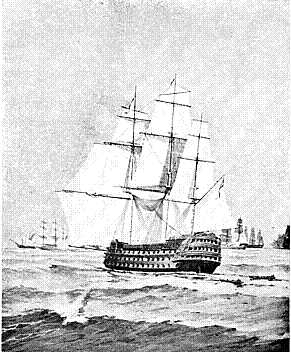
At noon the French ship, the Fougeux, fired the first shot of the battle. The belligerent admirals saluted in the good old pious style, like professional boxers shaking hands before the attempt to knock each other out, and in a few more minutes were engaged in deadly conflict, hurling death at each other. Nelson, in his courageous melancholy way, confident of his own powers and trusting reverently in the continuance of the lavish bounty of God, resigned his fate to Him who had given him the opportunity of doing his duty. The conspicuous splendour of the decorations which he wore on the breast of his admiral's frocker was apprehensively looked upon by his comrades, who loved him with touching loyalty. They muttered their disappointment to each other, but shrank from hurting his feelings by warning him of the danger of the sharpshooters, to whom he would be a target, remembering how he had sharply replied to some anxious soul who on a previous occasion had cautioned him with regard to his prominent appearance, "that in honour he had gained his orders, and in honour he would die with them."
The battle quickly developed into a carnage. The Bucentaure had found her range soon after twelve o'clock, when some of the shots went over the Victory. Blackwood was at this time ordered to rejoin his ship. He shook hands with his chief, and in some brief parting words expressed the "hope that he would soon return to the Victory to find him well and in possession of twenty prizes"; and Nelson is reported to have calmly answered, "God bless you, Blackwood, I shall never speak to you again." His habit was to refer to death with eager frankness, and as though he were in love with it, without in the least showing any lack of alertness or detraction from the hazardous objects he had set himself to fulfil. His faith in the powerful aid of the Omnipotent was as unvarying in his sphere of warfare as was Cromwell's when he had the stern realities of human unruliness to steady and chastise. Nelson, like the latter, had in his peculiar way a deep-rooted awe and fear of God, which must have made him oblivious to all other fear. The magnificent fellow never showed greater mastery of the science of strategy, nor did he ever scan with greater vigilance the manner of carrying out the creation of his genius. Collingwood, who was first in the thick of the fight, set his heart throbbing with pride and admiration when he observed the Royal Sovereign dash through the lines of the enemy, spreading devastation and death with unerring judgment. "See," said Nelson to Captain Blackwood, "how that noble fellow, Collingwood, takes his ship into action!" Then he paused for a moment, and continued, "How I envy him!" And as though the spirits of the two men were in communion with each other, Collingwood, knowing that the Commander-in-Chief's eager eye was fixed upon him in fond admiration, called out to the flag-captain near him, "Rotherham, what would Nelson give to be here?"
One of those fine human touches of brotherhood which Nelson knew so well how to handle with his faultless tact had occurred the day before. Collingwood and some officers paid a visit to the Victory for the purpose of receiving any instructions he might have to give. Nelson asked Collingwood where his captain was, and when he replied that they were not on friendly terms, Nelson sharply answered, "Not on good terms," and forthwith gave orders for a boat to be sent for Rotherham; and when he came aboard he took him to Collingwood and said, "Look! there is the enemy, shake hands," and they renewed their friendship by gratefully carrying out his wishes. But for this, perhaps we should have been cheated of knowing the charming anecdote, which denotes the veneration the two old friends had for each other.
There is no need to make any apology for this digression, for it is to record one more of the many acts of wisdom and tenderness that were so natural to this man of massive understanding. The incalculable results that he was destined to accomplish may well be allowed to obscure any human weakness that sadly beset him.
Nelson, with blithe courage, sailed right into the centre of the French fleet, which in disorder surrounded their Commander-in-Chief's ship, his intention being to capture her and take Villeneuve prisoner. Never a gun was fired from the Victory, although many of her spars, sails, and her rigging had suffered severely, until she had rounded as close as it was possible under the stern of the Bucentaure and got into position. Then a terrific broadside was let fly from her double-shotted guns, which raked the Bucentaure fore and aft, and the booming of cannon continued until her masts and hull were a complete wreck. Many guns were dismounted and four hundred men killed. The Victory then swung off and left the doomed Bucentaure to be captured by the Conqueror, and Villeneuve was taken prisoner. After clearing the Bucentaure, the Victory fouled the Redoubtable, and proceeded to demolish her hull with the starboard guns, and with her port guns she battered the Santissima Trinidad, until she was a mass of wreckage, and the Africa and Neptune forced her to surrender. Meanwhile, the Victory kept hammering with her starboard guns at the Redoubtable until her lower deck cannon were put out of action. Then she used her upper deck small guns and muskets from aloft. Nelson was too humane a man to use this method of warfare from the lower tops, and too practical, lest the ropes and sails should be damaged. The writer is of opinion that he was wrong in this view, as was clearly shown by the deadly execution the French musketeers did from aloft before their masts were shot away by the British big artillery. It can never be wrong to outmatch an enemy in the methods they employ, no matter what form they take. Although the victory was all on the British side at Trafalgar, it would have been greater and with less loss of life on our side had musketeers been employed in the same way as the French and Spanish employed them. The men on the upper deck of the Victory were shot down by these snipers without having an equal chance of retaliating. The Redoubtable's mizzen-top was full of sharpshooters when the two ships fell alongside of each other, but only two were left there when Nelson was shot and dropped on his left side on the deck a foot or two from Captain Hardy. The Frenchman who shot him was killed himself by a shot fired from the Victory's deck, which knocked his head to pieces. His comrade was also shot dead while trying to escape down the rigging, and fell on the Redoubtable's poop. The other sharpshooters had been previously killed by the musketry from the Victory's deck.
Nelson told Hardy, when he expressed the hope that he was not seriously hurt, that "they had done for him at last, and that he felt his backbone was broken." He was hit on the left shoulder; the ball had pierced his left lung. The snipers from the tops of the other enemy ships killed a large number of the Victory's officers and men who were on deck. The French made an attempt to board, but were thrown back in confusion and with tremendous loss. The instinct of domination and the unconquerable combativeness of our race is always more fiercely courageous when pressed to a point which causes others to take to their heels or surrender.
It was not an exaggeration on the part of the French and Spanish to declare that the British sailors and soldiers were not ordinary men but devils, when the real tussle for mastery began, and when they were even believed to be beaten. The French and Spanish conclusions were right then, and the ruthless Germans, stained with unspeakable crimes, should know they are right now, for they have had many chances in recent days of realizing the power of the recuperating spirit they are up against, just at a time when they have become imbued with the idea that they have beaten our forces on land and destroyed our ships and murdered their crews at sea. The Kaiser and his advisers, military and naval, have made the German people pay dearly for the experiment of stopping our supplies by sea, for the loss of life by the sinking of their own submarines must have been enormous. But only those to whom they belong will ever know that they have not returned, and that they must have been sent to the bottom of the sea.
We can only judge by written records and authoritative paintings or prints of the period what the naval battles of the beginning of the last century were like. But it is only those who have studied minutely the naval battles of St. Vincent, the Nile, Copenhagen, and Trafalgar who can depict the awful character and thrilling nature of these ocean conflicts.
While the author was serving as an apprentice aboard a sailing vessel during the Prussian-Danish war in 1864 a dense fog came on, and continued the whole of one night. When it cleared up the next forenoon we found that the vessel had been sailed right into the centre of the Danish fleet, which had defeated the Prussians and Austrians off Heligoland. There were other merchantmen there, and the cheering as we passed each of the Danish warships was hearty and long, while they gracefully acknowledged by saluting with their flags. I am quite sure there were few British seamen who would not have gladly volunteered to serve in the Danish navy against the Prussians, so universal was their bitter dislike to the Hun bullies who had set themselves to steal by force the possessions to which they had not an atom of right. The sight of these fine frigates and line-of-battle ships manoeuvring to come to grips with their cowardly antagonists who were assailing their national rights has been revivified during a long course of study of Nelson's naval warfare, and makes the awful vision of Trafalgar appear as it really was, and makes me wish that I were gifted with the art of words so that I might describe it in all its gruesome wreckage and magnitude, as the recollection of the majestic sight of the Danish ships before they even went into action makes it appear to me.
My mind's eye pictures one after another of the French and Spanish ships surrendering, the hurricane of cheers that followed their defeat, and the pathetic anxiety of the dying chieftain for the safety of Captain Hardy, who was now in charge of the flagship acting as commander-in-chief. Hardy is long in coming; he fears that he may be killed, and calls out, "Will no one bring Hardy to me?" At last the gallant captain sees an opportunity of leaving the deck, for the Victory is shielded by two ships from the enemy's gunfire. "Well, Hardy," says Nelson to him, "how goes the battle?" "Very well, my Lord," says Hardy; "fourteen or fifteen of the enemy's ships are in our possession." "That is well," said Nelson, "but I bargained for twenty"; and then followed the memorable order, "Anchor, Hardy, anchor." "If I live," he says, "we will anchor"; and in answer to Hardy's supposition that Collingwood should take charge, he impulsively resents the suggestion and expresses the hope that this will not happen while he lives, and urges again on Hardy that the fleet may be anchored, and asks him to make the signal. He hopes that none of our ships have struck, and his devoted friend reassures him that none have and never will. He commissions Hardy to give "dear Lady Hamilton his hair and other belongings," and asks that his "body shall not be thrown overboard." Hardy is then asked in childlike simplicity to kiss him, and the rough, fearless captain with deep emotion kneels and reverently kisses Nelson on the cheek. He then thanks God that he has done his duty, and makes the solemn thoughts that are troubling his last moments manifest in words by informing Doctor Scott, with a vital sailorly turn of speech, that "he had not been a great sinner," and then bids him remember that he leaves Lady Hamilton and his daughter Horatia as a legacy to his country, and that Horatia is never to be forgotten.
Even at this distance of time one cannot help regretting that nature's power did not sustain him to see the total debacle of the enemy fleets. He knew that he had triumphed, and that his task had ended fatally to himself, but his sufferings did not prevent his spirit sallying to and fro, making him feel the joy of living and wish that he might linger but a little longer. He was struck down at a critical stage of the battle, though there was never any doubt as to how it would end, thanks to the adroit skill and bravery of Collingwood and those who served under him. It is a happy thought to know that our hero, even when the shadows were closing round him, had the pleasure of hearing from the lips of the faithful Hardy that fifteen of the enemy ships had struck and not one of ours had lowered a flag. But how much more gladsome would the passing have been had he lived to know that the battle had ended with the capture of nine French vessels and ten Spanish, nineteen in all. He died at 4.30 p.m. on the 21st October, 1805, just when the battle was flickering to an end. Villeneuve had given himself up, and was a prisoner on board the Mars. Dumanoir had bolted with four of the line, after committing a decidedly cowardly act by firing into the captured Spanish ships, the object being to put them out of the possession of the British. They could not succeed in this without killing large numbers of their allies, and this was all they were successful in doing. It was a cruel, clumsy crime, which the Spanish rightly resented but never succeeded in avenging.