Front matter
Reading edition
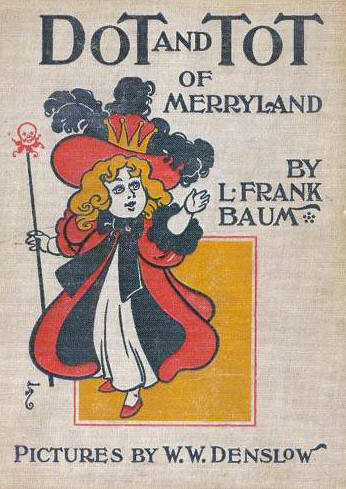
Books for Children by L. Frank Baum Illustrated by W. W. Denslow The Wonderful Wizard of Oz Uniform with Dot and Tot. 275 pages. 24 full page in- serts in eight colors and over 150 colored text illustrations. Price $1.50 Father Goose: His Book Large Quarto, printed in four colors, ornamental boards. Price $1.25 The most successful juvenile book of the age. The Songs of Father Goose With Music by Alberta N. Hall. Large Quarto, ornamental boards. Price $1.00
AUTHOR'S NOTE
The success achieved last year by "The Wonderful Wizard of Oz"—a book that not only ran through many large editions, but brought the author hundreds of letters from interested little folks—has induced me to follow that tale with another, herein presented.
Should "Dot and Tot of Merryland" win the approval of my young friends, I shall be pleased and contented.
In any event Mr. Denslow's quaint and merry pictures, which, in this book excel all his previous work, will be sure to induce happiness in the heart of every beholder.
L. FRANK BAUM.
Chicago, July 1, 1901.
DEDICATION.
To ev'ry laughter-loving Tot— Whether your name be Dot or not; And may you find a Merryland Forever lying close at hand.
CHAPTER LIST
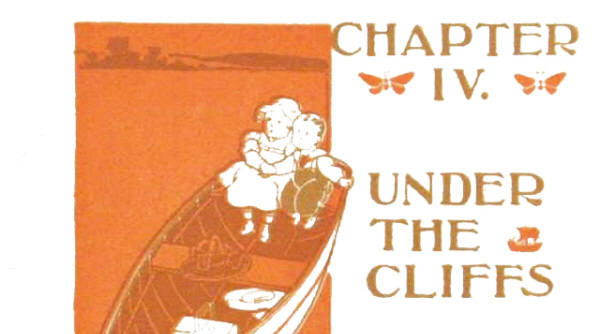
I.—Roselawn II.—Tot III.—The Boat IV.—Under the Cliffs V.—The Watch-Dog of Merryland VI.—The First Valley VII.—The Clown Country VIII.—The Second Valley IX.—The Third Valley X.—The Queen of Merryland XI.—The Palace of Wonders XII.—Prince Tot and Princess Dot XIII.—The Revolt of the Dolls XIV.—The Queen's Fairy Wand XV.—The Valley of Pussycats XVI.—The Busy Mr. Split XVII.—The Animals that Wound Up XVIII.—The Valley of Lost Things XIX.—The Lost Crowns XX.—The Voyage Ends
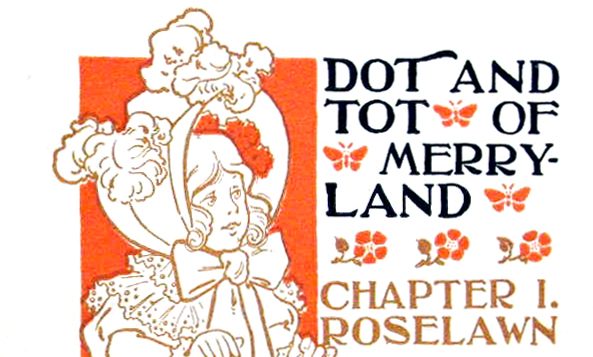
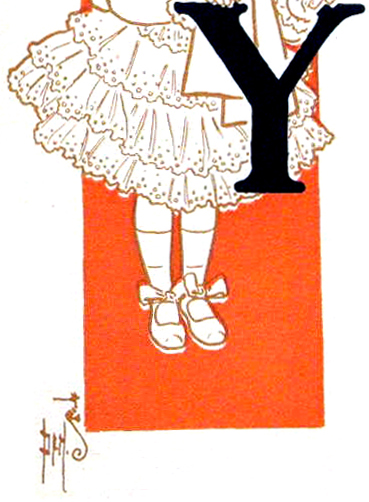
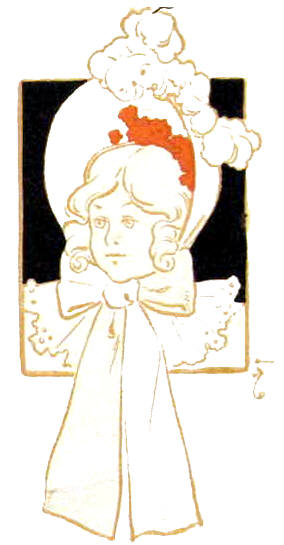
OU should have seen Dot as she nestled among the cushions of the carriage on her way to the railway station with her father and governess, Miss Bombien. Her dainty white gown was covered with tucks and puffings and embroideries, as became the dress of the daughter of the wealthy banker who sat smilingly beside her. Her soft, braided white hat had a wide brim that drooped languidly over the pale little face beneath, and broad, white ribbons drew down the brim until all the yellow curls were hidden away. Indeed, the only bits of color about Dot that showed were her deep blue eyes and rosy lips. Even these last were not so rosy as they should have been, for Dot was not in her usual good health, having been confined to the big city house during a long winter and a chill, uncomfortable spring.
But, now that the flowers were blooming and the birds singing in the new-leaved trees, she was going, in charge of her governess, to pass the summer at Roselawn, a beautiful country home her father had recently purchased.
"You must try not to be lonely, dear," said her father, as he held her little hand in his big, strong one. "I have told Miss Bombien to let you run and romp to your heart's content, so the roses may more quickly return to your pale cheeks."
Dot's eyes brightened. To run and romp as she pleased would indeed be a new experience to her, and she was happy even to think of such delight.
"You will have no one but Miss Bombien for company," continued her father; "but there are plenty of servants, and I am told the grounds are in beautiful condition. In a few days, at most, Sweetheart, I shall run down to see you, and then you can tell me how you like your new home. In the meanwhile, Miss Bombien will simply look after your comfort; there will be no lessons to bother you. All you must do is eat and sleep and play, and to grow strong and rosy-cheeked again."
Dot listened to al this with much pleasure, and decided she was about to have a fine holiday. Her real name, by the way, was Evangeline Josephine Freeland; but mamma and papa had always called her "Dot" from the day she was born, so sometimes she almost forgot she had such a beautiful name as Evangeline Josephine.
Dot's mamma was an invalid, and had been taken by her father—Dot's grandfather, you know—for a trip to Europe, in search of better health, and so she had been forced to leave her little daughter to the watchful care of Miss Bombien. Mr. Freeland, although he loved Dot dearly, was a very busy man and could devote but little time to his child. "So, Sweetheart," he told her, "you will be Queen of Roselawn this summer, and I will come down once in a while to bow before your Majesty's throne."
What he really feared was that Dot might grow up weak and delicate as her mother was; but he did not tell the child this. He resolved, however, that if fresh air and healthy surroundings could give his little girl strength and health, they should be at her command, and therefore he had purchased Roselawn almost entirely on Dot's account.
Before she realized it, Dot found herself at the railway station and aboard a parlor car, where her father gave her a long and loving farewell kiss. Then Mr. Freeland stood upon the platform and waved his hand to his daughter, while the train slowly glided out from the station and began its journey into the sweet, fresh country.
Roselawn won the girl's heart at first sight. The cool but sun-kissed mansion seemed delightful after the stuffy, formal city house. It was built in a quaint yet pretty fashion, with many wings and gables and broad verandas on every side. Before it were acres and acres of velvety green lawn, sprinkled with shrubbery and dotted with beds of bright flowers. In every direction were winding paths, covered with white gravel, which led to all parts of the grounds, looking for all the world like a map, Dot thought.
From the first day of her arrival, Dot was all eagerness and joy. Miss Bombien fully obeyed her instructions to let the child run. Dot entered the house only to eat her meals, which she did with growing appetite, and then away she would romp to chase butterflies, visit the stables or poultry yard, or sit near the river bank and watch the driftwood float by. Sometimes a boat danced over the broad, blue waters, and then Dot would jump up and down and clap her hands in ecstasy at the pretty sight. The river soon became her favorite resort, for the green banks and terraces before the house ran down to the water's edge.
Miss Bombien passed her days in hammock swung under a side porch, where she read a great many books and enjoyed herself in her own way. She did not bother to watch Dot, thinking the child could get into no mischief beyond a torn frock or a soiled face.
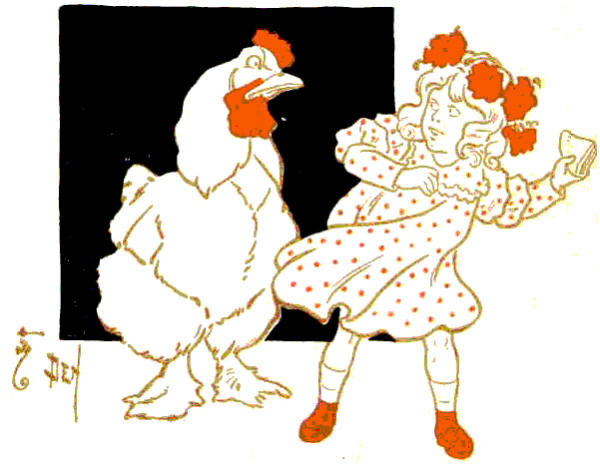
One morning, having finished her breakfast and scampered out upon the lawn, as usual, Dot chanced to notice a tiny path that led through a small opening in a high and thick hedge. She had never been in this direction before, and although she had often seen the hedge, she had not thought there was a way to pass through it. So a spirit of adventure came over her.
"I'll explore," said Dot to herself.
Pat, pat, patter went the little feet on the gravel, and soon the busy hedge was reached and the opening passed.
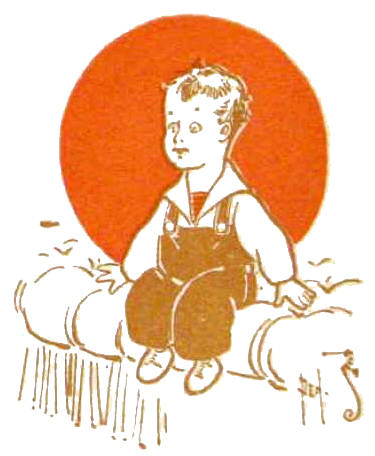
Then Dot stopped suddenly and looked around. A cozy little vine-covered cottage nearly surrounded by blooming posies, was before her. From the doorway, however, a path led to Dot's feet, and sitting in the middle of this path, slowly piling pebbles into his broad-brimmed straw hat, was a little boy.
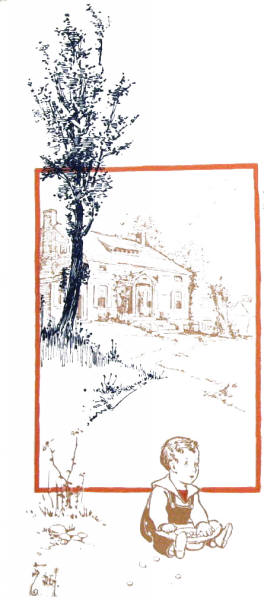
HE boy was a year or two younger than Dot, and seemed a chubby little fellow as he sat with his legs spread apart and his dark eyes raised wonderingly to the face of his unexpected visitor. Waves of brown hair clustered loosely about his broad forehead, and his dress was neat, though of a coarse material.
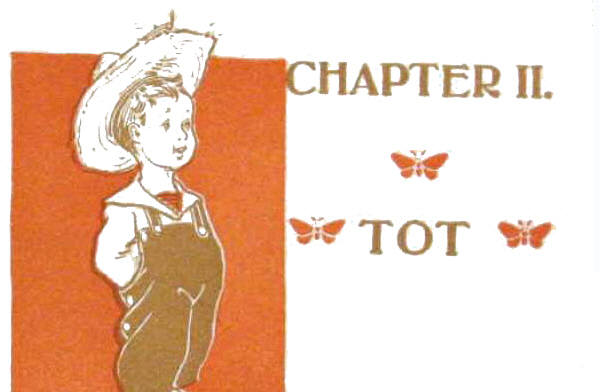
He paused in his play and stared hard at Dot for a moment; then dropped his eyes bashfully and ran his fingers through the white pebbles in an embarrassed way.
"Who are you?" asked the girl, in the calm, matter-of-fact tone peculiar to children, while she continued to regard the boy with the interest of a discoverer.
"Tot," was the low reply.
"Tot who?" she demanded.
"Tot Tompum," murmured the boy.
"Tompum! That doesn't mean anything," said Dot, decidedly.
This positive statement seemed to annoy the little fellow. He raised his eyes half shyly a moment and said, in a louder voice:
"Papa Tompum cuts the grass, an' makes the flowers grow. I'm Tot Tompum."
"Oh," said Dot; "you must mean Thompson. Thompson's the gardener, I know, and gardeners make the flowers grow and cut the grass."
The boy nodded his head twice as if to say she was right.
"Gard'ner," he repeated. "Papa Tompum. I'm Tot Tompum."
Then he took courage to look up again, and seeing a friendly smile upon Dot's face he asked boldly, "Who is you?"
"Oh, I'm Dot," she answered, sitting down beside him. "My whole name is Dot Freeland."
"Dot F'eelan'," said Tot.
"Freeland," corrected Dot.
"F'eelan'," said Tot.
"Never mind," laughed the girl; "let us play together. What were you doing with the pebbles?"
"Jack-stones," said the boy, and gravely picking out five of the white pebbles, nearly of one size, he tossed them into the air and tried to catch them on the back of his hand. Two tumbled off, and Dot laughed. The boy laughed, too, and tried it again. Before long they had become fast friends, and were laughing and chatting together as happily as if they had known one another for months.
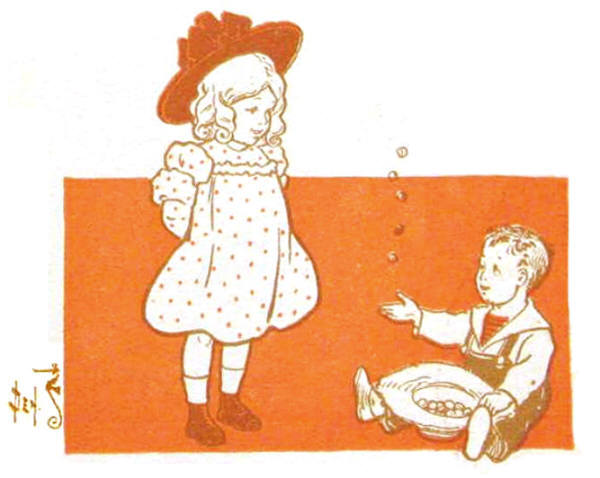
Tot's mother, hearing their voices, came to the door of her cottage; but seeing her boy's new playmate was "the young lady at the mansion," she smiled and returned to her work.
Presently Dot jumped up.
"Come, Tot," she cried, "let us go where your father is working. I saw him weeding one of the flower beds this morning."
Tot scrambled to his feet and poured the white pebbles from his hat, after which he placed it upon the back of his head; so far back, indeed, that Dot wondered why it did not tumble off.
"We'll go see Papa Tompum," he said, trotting along beside his new friend.
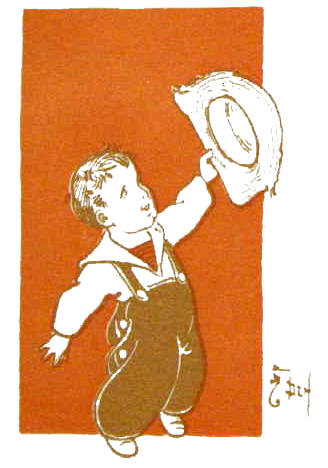
Thompson, the gardener, was quite surprised to see his little boy holding fast to the hand of the rich banker's daughter, and chatting away as frankly as if he had known her for years; but Thompson had learned by this time that Dot ruled everyone about the place and did exactly as she pleased, so he made no protest. As he watched the children running about the grounds where Tot was usually forbidden to play, Thompson felt proud that his boy had been selected by "the young lady" for so high and honorable a position as her playmate.
He made no protest when they raced across a flower bed and left the prints of their small feet upon the soft earth, for Dot held Tot firmly by the hand, and he obediently followed wherever she led. The big red roses attracted her fancy, and she ruthlessly plucked a handful and stuck them in rows around the rim of Tot's hat as well as her own, although the poor gardener, who had tended these flowers so patiently that they had become precious in his eyes, actually winced and shivered with dismay at witnessing the careless and, to him, cruel manner in which the young mistress of the house destroyed them. But Dot knew they were her property and enjoyed the roses in her own way; while Tot, although he may have felt guilty, wisely shifted all responsibility to his companion, and admired the royal way in which she accepted everything about the place as her very own.
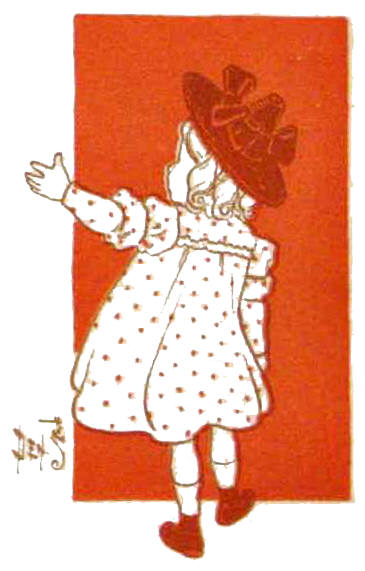
When the luncheon gong sounded from the big house, and Dot left Tot to obey the summons, she said to him, "Tomorrow I will bring a basket of sandwiches and cake, and we'll have a picnic down by the river bank."
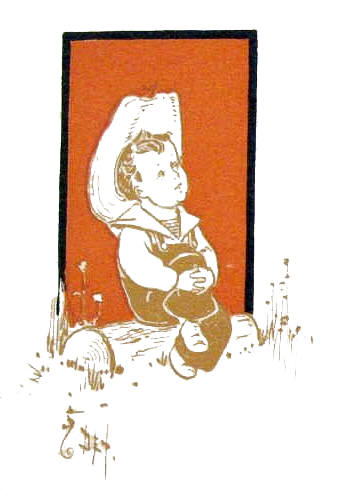
"All right!" answered Tot, and trotted away toward his father's cottage.
It had been an eventful day to him, for he had found a delightful playmate.
arly next morning Dot came out of the house with a basket on her arm so big and heavy she could hardly carry it. Indeed, she stopped several times between the house and the gap in the big hedge to set the basket down while she rested. Once she was sorely tempted to chase a pretty butterfly that fluttered lazily over the lawn near by; but a glance at the basket and a thought of Tot recalled her to the fact that this was "a picnic day," and so she trudged steadily on and passed through the hedge.
Tot was sitting on the door-step waiting for her. He wore a clean sailor waist and blue brownie overalls, and his face and hands had been freshly washed for the important occasion.
When he saw Dot's basket his eyes grew big and round, and he asked, "What you got?"
"Oh, that's our lunch," said the girl, setting down her burden with a sigh of relief.
"What's lunch?" demanded Tot.
"Why—something to eat, you know," she answered.
"Oh," said Tot. Then he looked at the basket with new interest and asked, "Basket all full somefin' t'eat?"
"Yes," replied Dot, with some pride. "I begged cook to give me all the good things she had in the pantry, 'cause you and I are going to have a picnic, and eat our lunch down by the river. So she filled it way up to the top, 'cause cook always does anything I ask. And it's a great big basket, Tot, too."
"Yes," answered Tot, gravely, "big basket!" Then he jumped up and, all eagerness, approached the basket.
"Let's eat it!" he exclaimed.
"Oh, no," cried Dot reprovingly. "It isn't time for lunch yet. And I've just had my breakfast. But we'll go down to the river and start the picnic right away. And, if you're good, Tot, perhaps I'll give you just one piece of jelly-cake before lunch time."
Tot's mother came out and kissed her boy good-bye, and then he and Dot took hold of the handle of the big basket and started for the river.
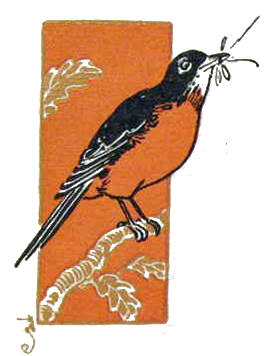
Of course, it took them a long time to get there, for often they set down the basket to pick flowers or watch a robin redbreast carrying food to its nest full of babies, or to run over the soft, close-cropped grass and chase each other, in very joyful and good spirits.
But they always returned to the basket, and at last carried it down to the water's edge, where they placed it upon a large, flat stone.
"That will be our table, when it's time for lunch," said Dot.
"Time now," remarked Tot, wistfully.
"Not yet," said the girl, "but you shall have the jelly-cake, 'cause there's plenty to last all day."
So she drew aside the white cloth that covered the basket and took out two big slices of cake, one for Tot and one for herself. While they ate it, they walked along the shore. The river was entirely deserted by boats, for it was a warm day and even the fisher folk did not care to be out. On the opposite shore were great walls of rock rising up from the river, but at the foot of the cliffs were bushy trees that lined the further edge of the water.
"Just like whiskers," said Tot.
"So they are, from here," agreed Dot; "but if we were on the other side of the river we would find them to be big trees. It's because they are so far away that they look like the river's whiskers."
They walked farther along the shore until they were past the grounds of Roselawn, and then, turning a little bend in the river, they came to some low bushes growing down by the water.
"Oh, Tot," cried the girl, "wouldn't it be nice to lunch under those trees, where it is cool and shady? Let us go back and fetch the basket."
Tot followed obediently, for he recognized Dot as the leader not only because she was older, but because she possessed the wonderful basket of good things. They walked back to the big stone where they had left the basket, and after a good deal of labor managed to carry it to the grove of low trees. Pushing the branches aside, they crept through the bushes until they reached the edge of the river, and then Dot uttered an exclamation of delight.
"Here's a boat!" she said. "And a pretty boat, too. I wonder whom it belongs to. But never mind, there's no one here; so we will climb into it and eat our luncheon on the seats."
It really was a pretty boat, painted all white, except for a red stripe running along the outer edge. There was a broad seat at each end and two seats in the middle, and in the bottom of the boat, under the seats, were two oars.
One end of the boat was drawn up on the shore, while the rest of it lay quietly upon the water; but the branches of the trees threw a cool shade over all, and it seemed to Dot and Tot the most pleasant place to eat their luncheon.
They carried the basket to the broad seat farthest out in the water, and Dot spread her white cloth over it, and laid upon that all the good things cook had put into her basket.
"Let's play house," said Tot.
"Not house," corrected Dot; "we'll play this is a ship, and we're on a trip across the ocean. Won't it be jolly?"
Sitting upon the bottom of the boat, close to the seat which formed their table, they laughed and talked and ate their luncheon with the keen appetites all healthy children have.
The time passed so quickly they never knew how long they sat there; but suddenly Tot exclaimed, "It's hot!" and put on his hat to keep the sun from his head.
Dot looked up, surprised to find that the sun was indeed shining full upon them. Then she noticed that the shade of the trees was gone and only the blue of the sky was over the boat.
She stood up and gave a little cry of dismay.
"We're in the river, Tot," she said; "the boat has got away!"
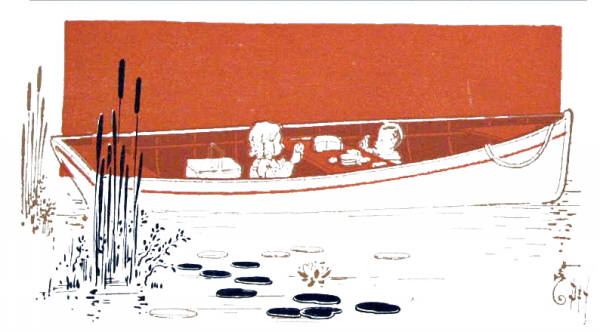
ot scrambled to his feet and sat upon a seat of the boat, holding fast to the sides with both hands. As he looked around and saw the boat was far from land, he smiled and nodded his head, saying, "Now we'll play ship, an' ride on 'e ocean. Won't we, Dot F'eelun'?"
"Oh, Tot!" exclaimed the little girl; "I'm afraid we'll be drowned. How can we ever get home again?"
"Ride in 'e boat," said Tot, composedly.
"But the boat is carrying us farther away every minute. We're floating downstream; and by-and-by we'll come to the ocean, where there are big waves," declared Dot, who was really frightened.
But Tot refused to be afraid. As the swift current carried them along, he clapped his hands together joyfully and gave a little laugh of delight. "Nice ride!" he said again and again. "Hooray!"
Dot was older and wiser. She knew a boat could be rowed by means of oars, and there were two oars lying on the bottom of the boat. She decided to make an attempt to reach the shore, for then someone might be found to help them back to Roselawn, which they had now left far behind.
She drew out one of the oars and with difficulty, for it was heavy for the child to handle, managed to push one end into the water and rest the other against the row-lock of the boat. Then she began to row as hard as she could; but her strength was not great, and all she did was to push the front of the boat half around, so that it headed toward the rocky cliffs on the far side of the river.
Her efforts pleased Tot, who laughed merrily as the oar splashed in the water; but Dot was determined to get to land if possible and struggled desperately at her task.
The boat was still headed toward the rocky cliffs, when suddenly the oar flew out of Dot's hands and she fell backward off the seat.
She was not hurt, but when she got up she saw the oar floating in the water, out of her reach; still she was reassured to notice that the boat was now gliding swiftly along, and presently, to her joy, she saw it was headed directly toward the fringe of trees, and getting nearer to the bank every moment.
"It must be another current, Tot," she cried, "and this one is taking us to the shore. So I did some good by rowing, even if I lost the oar."
Tot nodded, but said nothing. He was still enjoying the novel boat ride. Dot sat down on the seat beside him, and they watched the shore grow nearer and more distinct every moment as the boat glided steadily on.
The trees were bigger than they had thought, and grew close down to the water's edge. Dot became worried when she noticed the speed of the boat increasing as they drew nearer to the shore.
"If we bump those trees," she said, "we may be hurt, and the branches will scratch our faces dreadfully."
Tot stopped smiling when he heard this, and took hold of Dot's hand, which he clasped tightly in his own.
The next moment, still speeding onward, the boat reached the trees. The two children were caught by the branches, swept quickly from the seat, and sent sprawling at the bottom of the boat. But the boat itself never stopped an instant. There was just room for it to float underneath the thick branches, and instead of bumping into the shore, the water carried it through a small opening in the face of the rocky cliff, and then, in total darkness, it continued swiftly on its way!
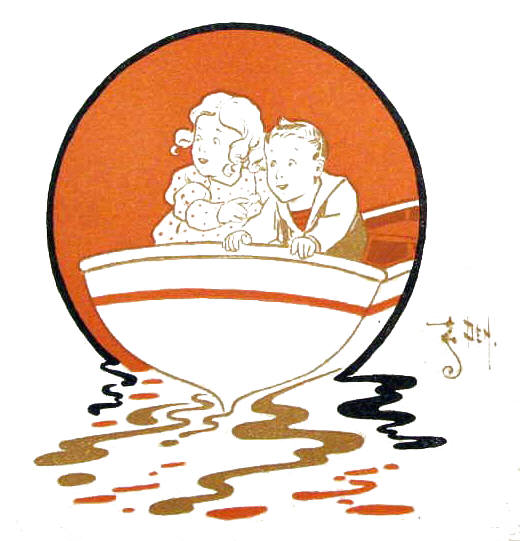
Dot and Tot, who were both startled by this unexpected danger, managed to get up and sit together upon the seat of the boat; but they could see nothing before them and only a faint light behind, where they had entered this hidden tunnel in the cliff.
For some moments they sat in silence. Then Dot reached out her hand to see if she could feel anything; but the cool, damp air was all around them. Then she reached upward, and her hand struck against a piece of projecting rock which hurt her.
"Tot," she whispered, "I think we'd better lie down in the bottom of the boat. The roof isn't very high up, and it may bump our heads if we sit here."
Tot slipped off the seat at once and stretched himself out on the boards underneath. Dot quickly followed him, and then for a time they lay very still in the darkness, listening to the water as it rippled softly along the sides of the boat.
Presently the girl asked, "Are you frightened, Tot?"
"Not, much," was the hesitating answer; and then, after a long pause, he added, "but some."
"Oh, I'm some frightened myself," said Dot. "But I don't know what we can do."
"I know," declared Tot, solemnly.
"What?" she inquired, in an anxious voice.
"Nuthin'."
Dot saw no need of replying to this, and another long period of silence followed.
They did not seem to be in any immediate danger, for the boat swept along with a free, easy motion that was very pleasant, and the air was delightfully cool after the heat of the sun outside in the open river.
But two things worried Dot. One was the fact that she was being carried a long ways from home, and the other a fear of where the underground river might lead them. She wasn't at all sure they were not floating down into the middle of the earth, and the chances of ever seeing Roselawn again were growing smaller every minute.
Nothing seemed to worry Tot, however. The darkness and the murmuring of the water made him drowsy, and before long he was fast asleep, with his chubby little arms clasped around Dot's neck.
The girl was also gradually recovering from her fright, since nothing terrible seemed to happen. They were having a long journey under the cliffs; but she knew there must come an end to it some time, and probably they would float out of the dark tunnel into the daylight sooner or later.
On and on sped the little boat, until at last, as Dot lay staring into the darkness, she noticed a dim light about her, and began to see the rocky roof of the cavern through which they were passing.
Then she sat up, and, far away in the distance, she saw a round, bright spot that reminded her of a full moon. It seemed to be getting nearer and bigger, and finally she gave a cry of joy and awakened her companion.
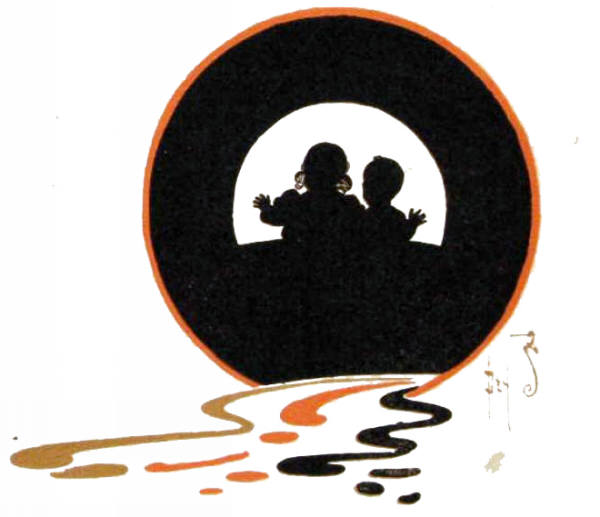
"Tot! Oh, Tot!" she called. "We've got to the end at last and are coming out of the tunnel!"
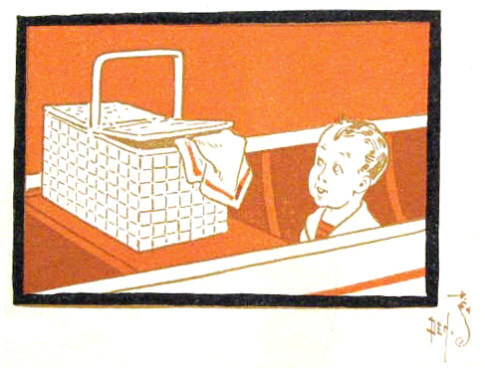
Tot sat up and rubbed his eyes. He gave one careless glance at the opening, and then turned his eyes upon the lunch basket, saying, sleepily, "I'm hungry!"
f course, Dot paid no attention, during this exciting moment, to the boy's demand for food.
There would be plenty of time to eat after they were out of the tunnel and in safety.
The boat glided on as gracefully as a swan, and in a few minutes it passed through the jagged rocks that formed the mouth of the tunnel and floated into a broad, open river.
Dot and Tot quickly scrambled upon the seat and looked around them.
They were in a deep valley, shaped very much like a chopping bowl, only around the outer edge were high, peaked mountains. Not a tree nor a green thing was to be seen anywhere, but the valley was thickly covered with stones—big stones and little stones and stones of all sizes—scattered about in every direction.
Through the center of the valley ran the broad, blue river, at one end of which was now the boat, while at the other end the children saw a low archway, through which the water seemed to pass into some country beyond.
Very slowly the boat was floating toward this archway, and Dot decided there would be ample time to eat something from the basket before they had passed through the valley of stones.
"We may as well go on, Tot," she said, as she arranged the luncheon; "for this isn't a pleasant place to stop in, and we should never be able to climb over those high mountains."
"Never could," agreed Tot, as he bit into a sandwich.
"What a queer place this is," she continued, looking around them. "I don't believe anyone has ever been here before. Let us give it a name. That's what all explorers do. We'll call it Stony Vale."
"All right," said Tot, contentedly. Then he stretched out his arm and pointed to something that was moving among the stones.
"See!" he said. "Funny man."
"Why, I really believe it is, Tot!" exclaimed the girl, looking toward the place. "No, it isn't a man; it's a bear."
"Bear!" repeated Tot, with wide open eyes. "Funny bear!"
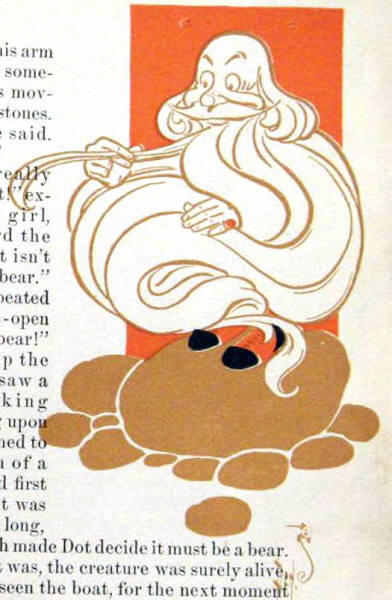
Halfway up the valley they saw a shaggy-looking creature sitting upon a rock. It seemed to have the form of a man, as Tot had first declared; but it was covered with long, thick hair, which made Dot decide it must be a bear.
Whatever it was, the creature was surely alive, and it had also seen the boat, for the next moment it rose from the rock and came bounding down to the shore of the river, leaping from stone to stone, and moving so swiftly that its long hair streamed out behind it in the wind.
The boat was now being carried by the current directly toward the shore, and soon its front end touched softly upon the gravelly beach. At the same time the strange creature drew closer to them and sat down upon a big stone only a few feet away.
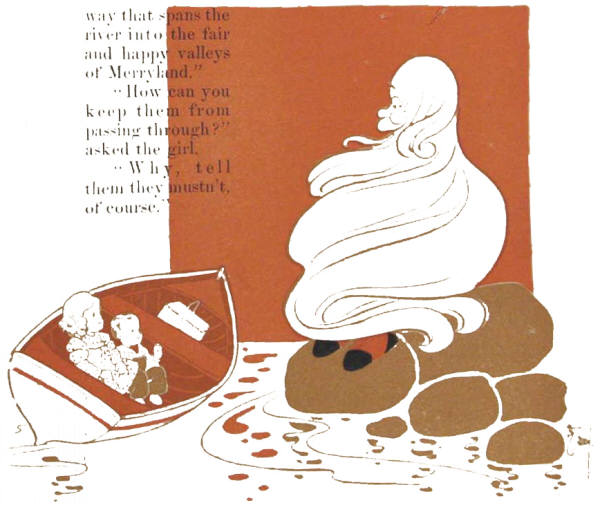
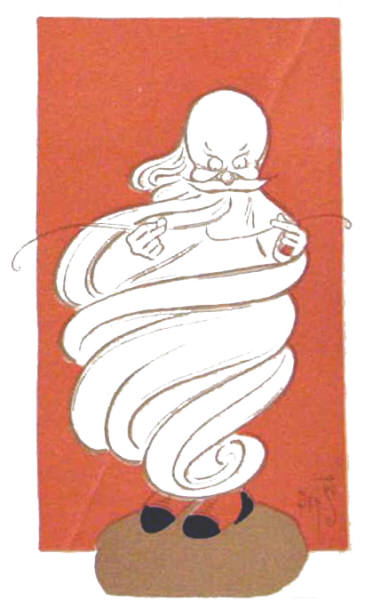
Dot and Tot had been watching it, and now saw that what they had taken for a bear was an old man, with whiskers and hair so long that they reached down to the soles of his feet, and probably would have grown still longer had not the rough stones worn away the ends of the hair. Not a bit of his body could be seen; the flowing white hair covered him everywhere like a gown, except upon the top of his head, which was smooth and bald. So thick, indeed, was the covering that when he stretched out his arms, the old man could only push his hands and wrists through the masses of hair.
The curious appearance of this strange person surprised the children, and they remained for some time staring at him without trying to say a word.
The hairy man looked at them, in return with equal interest, and was the first to speak, saying in a mild, sad voice:
"Strangers, who are you?"
"I'm Dot, sir," answered the girl. "Dot Freeland."
"She's Dot F'eelun'," repeated Tot.
"And this is my friend, Tot Thompson," she continued.
"I'm Tot Tompum," said Tot gravely.
"Oh," replied the man. "I'm pleased to make your acquaintance. I'm the Watch-Dog of Merryland."
"What a queer name!" exclaimed Dot. "Why do they call you that?"
"Because I'm placed here to keep everyone from passing through the archway that spans the river into the fair and happy valleys of Merryland."
"How can you keep them from passing through?" asked the girl.
"Why, tell them they mustn't, of course."
"But suppose they won't mind you, what will you do then?"
The old man looked puzzled, and shook his head slowly.
"I'm sure I don't know what I could do in that case," he answered. "You see, no one has ever before come here since I was commanded to guard the entrance to Merryland."
"How long have you been here?" inquired Dot.
"About three hundred years, I think; but I've lost track of the exact time."
"Don't you ever die?" asked Tot wondering at this great age.
"I haven't died yet," answered the old man, thoughtfully.
"But you will, won't you?" persisted the boy.
"Why, I suppose so, if the Queen lets me," was the reply.
"Who is the Queen?" questioned Dot.
"She who rules Merryland," answered the man.
Then, for a few moments, there was silence, while Dot and Tot stared at the hairy old man and he stared at them.
Presently Dot broke the silence the stillness by asking, "What do you do in this lonesome place, where you have no one to talk to?"
"Why, most of the time I watch, as it is my duty to do. And when I get lonely, I count my whiskers."
"Oh!" said Dot. Then she inquired, curiously, "How many whiskers have you?"
"Well," answered the Watch-Dog of Merryland, confidentially, "there are either eighty-seven thousand four hundred and twenty-six, or else eighty-seven thousand four hundred and twenty-eight. Sometimes I make it one figure and sometimes the other, so I can't really tell which is right. I was engaged in counting my whiskers when I looked up and saw your boat. I had then counted sixty-nine thousand three hundred and fifty-four; but I was so surprised to see you that I missed the count, and now I shall have to begin all over again."
"I'm sorry," said Dot, sympathetically; "I'd like to know just which is the right number."
"If you will wait I'll count them," he replied, eagerly. "Perhaps then you can tell if I make a mistake."
"How long will it take?" she asked.
"I can do it in about four months."
"Oh, we couldn't possibly wait that long," declared the girl. "I really think we should be going now."
"Where will you go?" he asked.
"There is only one way for us to go—through that archway into Merryland, as you call it. We are not strong enough to pull the boat upstream, so we must let it float where it will."
"It will be a terrible disgrace to me," said the Watch-Dog of Merryland, in a solemn voice, "if you escape me. What will the Queen say when she knows I have watched here three hundred years without seeing anyone, and then allowed the first strangers who came along to pass through the archway?"
"I do not see that she can blame you," returned Dot. "You say yourself you would be unable to stop us if we decided not to mind you. So the Queen can only blame us for not minding you."
"That is true," said the old man, more cheerfully.
"Want somethin' t'eat?" inquired Tot, holding out a slice of jellycake.
"Dear me!" said the Watch-Dog, taking the cake in his hand and looking at it with much curiosity. "What is it?"
"Eat it," said Tot; "it's good."
"But I can't eat," replied the old man. "I don't know how. I've never eaten anything in my life."
"Not even when you were a little boy?" Tot asked, in wonder.
"Well, I've forgotten what happened when I was a little boy, it's so long ago," returned the man. "But I certainly have no desire to eat now, and if I had there is nothing in the Valley to devour except stones. I suppose eating is a habit you have acquired. Why don't you break yourself of it?"
"I get hungry," answered Tot.
"Hunger must be a habit, too," remarked the old man, "for I never have had it since I have been in this valley. However, if you will allow me to keep the cake, I will amuse myself by looking at it when I'm tired of counting my whiskers."
"You are quite welcome to the cake," said Dot. "But now I must ask you to excuse us, for it is time we started upon our journey."
"Oh, don't let me detain you," replied the Watch-dog of Merryland, politely; "that is, if you are determined to disobey my orders."
"I fear we must," said the girl. "Is Merryland the other side of that archway?"
"Part of it is," answered the old man. "There are Seven Valleys in Merryland, connected by archways, for the river flows through them all."
"And what is beyond the Seventh Valley?" asked Dot.
"No one knows except those who pass through, and those who pass through never return to tell," he replied.
"Well, good-bye," said Dot.
"Bye!" repeated Tot, briefly.
"Good-bye," answered the Watch-Dog.
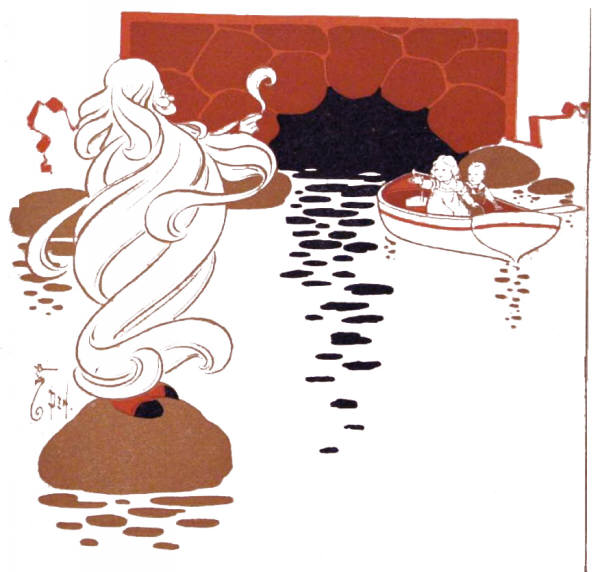
The girl took the remaining oar and pushed the boat away from the shore with it. The little craft glided out into the river very slowly, and drifted along with the current in the direction of the archway.
Dot and Tot sat on the seat and watched the friendly old man until a shadow fell upon them, and called their attention to the fact that they were passing through the arch into the First Valley of Merryland.
he rocky arch was not very thick, yet before Dot and Tot had floated to the other side of it, shouts of merry laughter and the chattering of many voices came to their ears. Some of the voices sounded loud and shrill, others low and deep, but all rang with a happy tone that aroused the children's interest at once, and made them wonder what occasion could cause so much amusement.
Then, so suddenly that it quite startled the childish voyagers, the boat glided from the archway into the most beautiful country one could imagine.
It was a Valley, as the Watch-Dog had said; but it was level and sunny and dotted with broad-leaved trees; while soft, tender grasses, mingled with brilliant flowers, covered the ground in every direction. There seemed to be no houses at all, yet streets were laid out in regular order, having at their sides raised platforms in place of houses. Each of the platforms was four feet high and fifteen feet square on the top, and they were separated from one another by stretches of the flower-strewn lawn. The top and sides of every platform were padded like the mattresses of a bed, and were covered with silks and velvets of the most gorgeous patterns, no two being of the same combinations of colors.
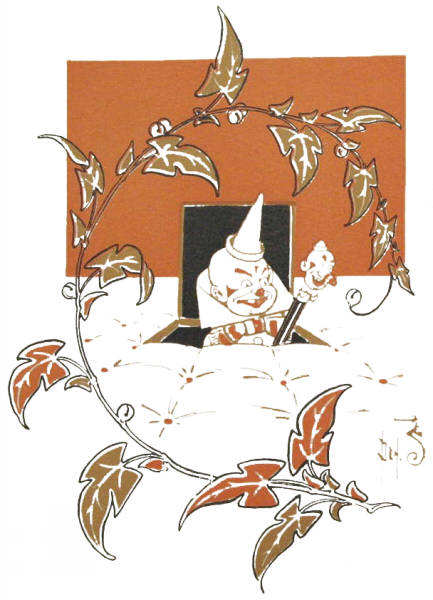
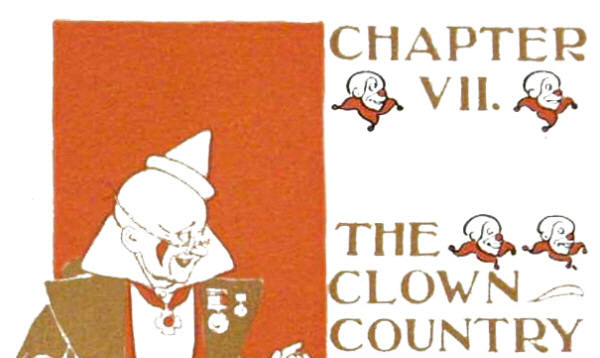
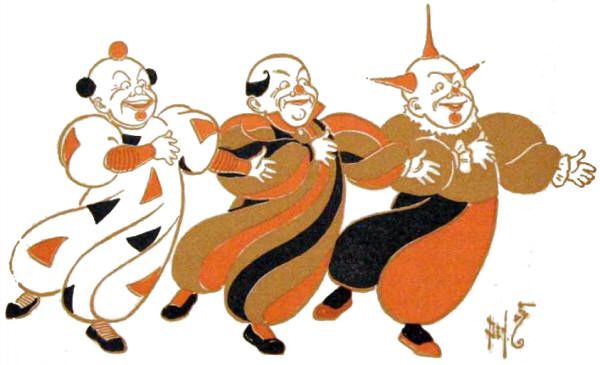
On many of these raised and padded platforms, Dot and Tot saw groups of funny-looking Clowns, all dressed in wide, baggy trousers, puffy jackets and soft, pointed caps. Yet in their costumes was an endless variety of colorings and combinations of colors, making the groups look remarkably bright and pleasing.
The faces of the Clowns were painted in a fanciful way, with rings of red and blue and yellow on their cheeks, and spots and streaks of the same gorgeous colors over their eyes and around their chins.
When the children first came into the Valley of the Clowns, they saw many of them leaping and tumbling and turning somersaults upon the platforms, while others were juggling with balls, or balancing long feathers and sticks upon their noses and chins. These feats were greeted with shouts of laughter by other Clowns who were resting and looking on, and these spectators also cried out their approval or poked fun at the performers when they failed to accomplish the acts they were attempting.
While Dot and Tot sat in their boat, looking with amazement at the strange sights all about them, one of the Clowns chanced to look their way, and upon seeing the children, he set up a shout and rushed down to the shore, followed by more than a hundred of his fellows.
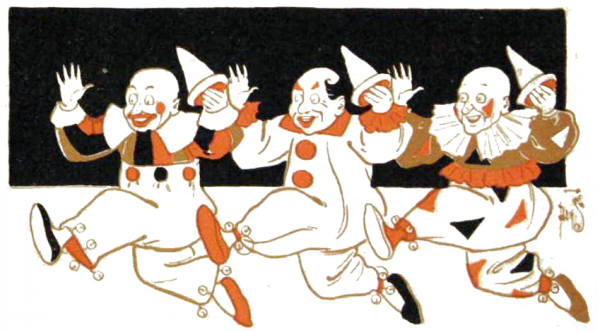
As they ran, the Clowns leaped over one another, turned somersaults into the air, and walked upon their hands nearly as fast as they could upon their feet; and so swift were all their movements that, in less time than one could think possible, they were all crowded along the river bank, and shouting loud greetings to the new arrivals.
Dot had to put her fingers in her ears at first, for the noise bewildered her, and while she wondered what she should say to these lively creatures, she noticed a richly dressed Clown standing before the others, and making low bows to her and to Tot. As his lips seemed to move, she took away her fingers from her ears that she might hear what he was saying.
Everyone was talking at the same time, and at first Dot could hear nothing plainly; but the Clown who was standing in front of his comrades clapped his hands loudly together three times, at which the others instantly became silent and motionless.
Then, with another bow, the leader addressed her, speaking in a sweet and most pleasing tone of voice, "Welcome, O King and Queen of Children, to the Valley of Clowns! We live but for your amusement; we love your happy and smiling faces more than anything else in the world, and this day on which you have come to visit your slaves is the most joyful we have ever known."
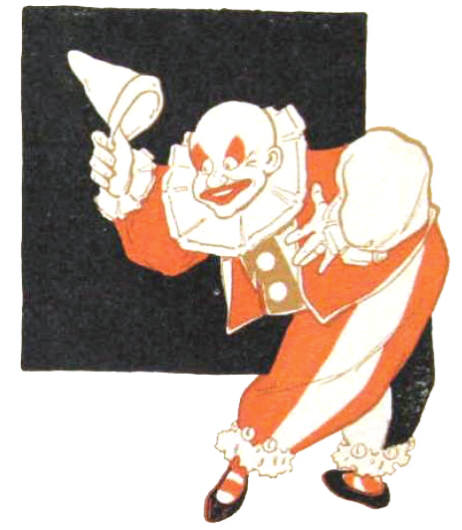
Here he made another bow and threw his pointed cap high into the air, where it whirled over and over and finally fell straight upon his head again. There was a shout of applause at this feat, and Tot laughed loudly and clapped his hands.
Then the leader of the Clowns again spoke, "If you will graciously consent to land in our country, where everything we have is at your service, we shall be delighted to amuse you to the best of our ability."
"You are very kind," answered Dot, "and as we are tired by sitting in the boat so long, we shall be glad to accept your invitation."
Then she pushed the boat to the shore, where a dozen Clowns seized it and drew it far up on the grassy bank. Then Dot and Tot stepped out upon land, and as they did so every Clown present turned a backward somersault and shouted, "Here we are again!"
The one who had first spoken to them now came forward and shook hands with both Dot and Tot in a very polite manner.
"My name is Flippityflop," he said, "and I am the Prince of Clowns, ruling here under the gracious favor of her Majesty the Queen of Merryland. I beg you will allow me to escort you to my dwelling; but first I should like to know your names, and how you came here."
"I'm Tot Tompum," said the boy, looking up into the Clown's painted face, "and here's Dot F'eelun. We've come in a boat, long, long ways off. An' we don't know how to get home again."
"We are delighted to have you with us, however you came here," replied the Clown; "and as for your getting home again, why, that is worry, and no one ever worries in the Valley of Clowns. You are welcome to remain our guests as long as you please, and while you are with us you must consider us your slaves, for Clowns have always been the slaves of children." Then he turned to the others.
"Brothers!" he shouted. "Allow me to introduce you to our friends Dot and Tot, of the Big Round World. We are all their slaves. Salute them!"
Instantly every Clown stood upon his head and knocked his heels together in the air. As they wore silver bells around their ankles, this made a most delightful, tinkling sound, and the sight of so many topsy-turvy Clowns was so pretty that Dot and Tot both laughed and clapped their hands.
Then Flippityflop caught the children in his arms and seated one of them upon each of his shoulders, after which he marched up the street, followed by the rest of the Clowns, who sang and danced as they came.
The Prince carried them to one of the prettiest platforms and set them gently upon its cushioned top. Then he leaped into the air, whirled around like a windmill and landed gracefully beside them.
"Welcome to my dwelling," he said.
"But this isn't a dwelling," exclaimed Dot. "A dwelling is a house."
"And this is a sofa!" declared Tot.
"Oh, no; it's a real house," said Flippityflop, "although it may be different from the dwellings you are accustomed to. Let us enter."
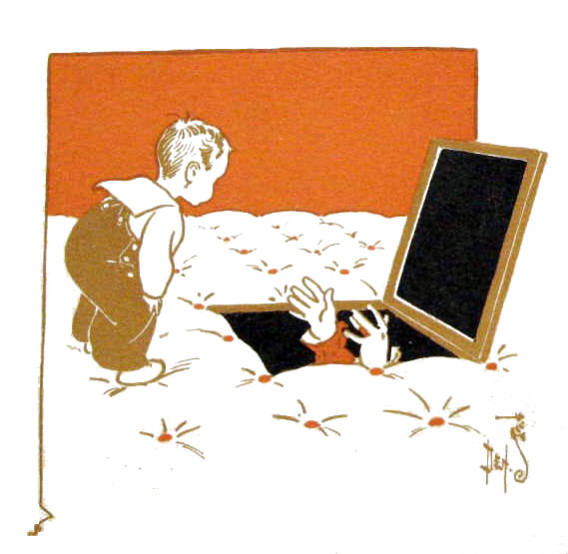
He seized a silken strap and opened a trap-door in the top of the platform.
"Come on!" he cried, and jumping down the hole, disappeared from view.
Dot crept up to the trapdoor and looked down. Just beneath her was Flippityflop, holding out his arms.
"Come on!" he said again; "I'll catch you."
Dot did not hesitate, but dropped through the opening, and the Prince caught her safely in his arms. Tot followed a moment later, and then the children gazed about them curiously.
lippityflop's house proved to be one big room, built under the platform, and lighted by a soft glow from hidden electric lamps. The walls were covered with bright-yellow silk hangings and on the floor was a crimson carpet. All around the sides were wide benches with soft cushions of purple velvet, and near the middle of the room was a small table of blue and silver. On the walls Dot noticed several gaudily colored pictures of Clowns, and when Flippityflop saw the children looking at these pictures he said:
"Those are portraits of my father and grandfather and great-grandfather. They were all Princes of this Valley of Merryland, as well as good men and clever Clowns. Therefore I am proud of them."
"They look very jolly," said Dot.
"They were jolly, and proved a comfort to thousands of children. But you must be hungry, and I trust you will allow me to offer you some dinner. What will you have?"
"What you got?" inquired Tot.
"Well, I have in my cupboard some fried goldfish, boiled buttercups and pickled shoelaces," he answered.
"Don't want any," said Tot.
"These seem rather foolish things to eat," remarked Dot.
"Of course, they are foolish things," agreed Flippityflop, cheerfully. "Everything we do here is foolish. You certainly can't expect wisdom in a country of Clowns."
"Course not," said Tot.
"If you'll send to the boat for our basket, I think we will prefer to eat the things we brought with us," declared Dot.
"Certainly!" answered the Prince, and immediately sticking his head through the trapdoor, he asked a Clown who stood outside to fetch the basket.
It came in a remarkably short time, and then Flippityflop assisted Dot to lay the cloth on the blue and silver table, while the children proceeded to eat of the sandwiches, cake and apple-tarts that remained in the basket.
"Wouldn't you like something to drink?" asked the Prince.
"I am rather thirsty," admitted Dot; "have you any milk?"
"No, we do not use milk in this Valley," he answered. "But we have some excellent green paint, or, if you prefer it, I can give a bottle of red mucilage."
"No, thank you," said Dot; "we couldn't drink those. Perhaps you will bring us some fresh water from the river."
"But the water is quite wet," exclaimed the Clown, "and is liable to make you damp. Surely you won't think of drinking it!"
"Oh, yes; we're accustomed to drinking water," said the girl.
So the water was sent for, and Dot and Tot took long and refreshing drinks, although their action alarmed Flippityflop, who urged them to eat a few handfuls of sawdust afterward to absorb the dampness.
"Do all the Clowns live in this Valley?" asked the girl, when the table was cleared.
"Yes, all except those we send into the world to amuse the children," answered Flippityflop. "You see, we train them all very carefully, and every year one is selected to go into the world."
"How do they get there?" asked the child.
"At the upper edge of our Valley there is one place not so steep as the rest. The Clown who is leaving us climbs to this place and finds himself on the top of a mountain. So he makes himself into a ball, as he has been taught to do, and rolls down the mountain into the outside world, where he travels around until he finds a circus to join."
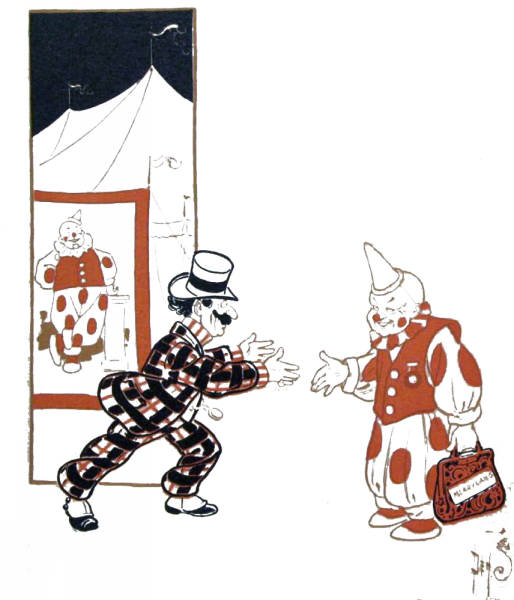
"Oh!" exclaimed Dot. "I've seen 'em—in circuses."
"To be sure; that's the proper place for Clowns. Do they make the children laugh?"
"Sometimes," said the girl.
"When they do not," said Flippityflop, gravely, "they are imitation Clowns, and were never trained in this Valley of Merryland. The real Clowns are sure to make you laugh. But come, it is time our people were gathering on the platforms for their evening practice. Would you like to watch them?"
"Yes, indeed!" cried Dot, joyfully; and Tot clapped his hands and echoed: "'Deed, yes!"
So Flippityflop lifted them through the hole to the top of the padded platform, where they saw a strange and merry sight.
All the platforms on both sides of the street were now occupied by Clowns, who were performing in a most marvelous manner. The trees were full of electric lights, which shed brilliant rays over the scene and enabled the children to see everything distinctly.
"Come with me," said their friend, "and I will lead you through the street, that you may see what my brothers are doing."
They left the Prince's platform and came to the next, where three gaily dressed Clowns were bounding into the air and whirling around before they came down again. Every time they jumped they cried: "All right, Mr. Johnson!" in their shrill voices, and often one of them would fall on his head or back instead of landing on his feet. When this happened they were not hurt, for the platform was soft and yielding; so they sprang up at once and tried it over again, laughing at their own mishaps.
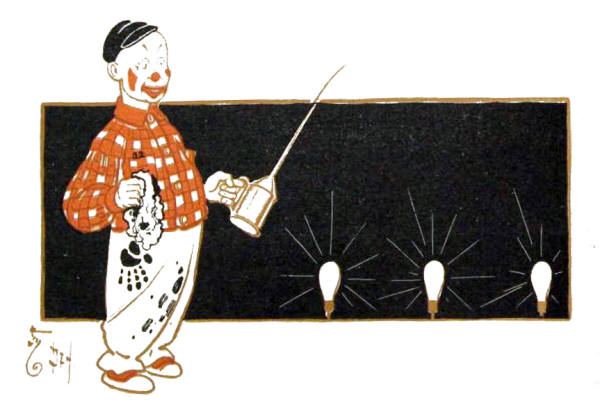
At the next platform were some juggling Clowns. One of these placed a light ladder on his shoulders, and another ran up it and stood upon his head on the top rung.
In another place the Clowns threw small silver balls into the air, one after the other, and then caught them cleverly as they came down.
Near the end of the street a Clown, dressed in a costume of scarlet with green spots upon it, and wearing a white, pointed cap upon his head, was singing a comic song. They stopped to listen while he sang as follows:
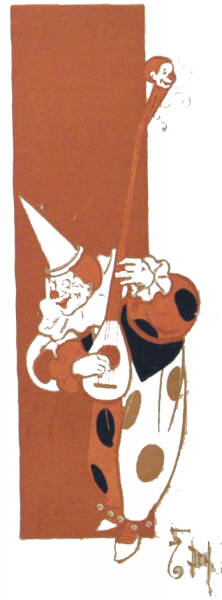
A goat to a barber went one day; "Just trim my beard," the goat did say, "And cut my hair in a stylish way"— Sing shivvy, shovvy, shavey! The barber then began to snip, But soon he let the scissors slip, And cut the goat upon his lip— Sing shivvy, shovvy, shavey! Then Mr. Goat, with angry bleat, Gave one big jump from out his seat, And knocked the barber off his feet— Sing shivvy, shovvy, shavey! "Enough!" he cried, "I'll have you know, If barbers treat their patrons so, I'll just allow my beard to grow!" Sing shivvy, shovvy, shavey!
After each verse another Clown cracked a long whip at the singer, which made him leap into the air and screw his face up in such a comical way that Dot and Tot were greatly amused, and applauded him rapturously.
Just across the street was another singing Clown; but this one was dressed in a curious costume that was all white on one side of his body and all red on the other side. This fellow balanced the point of his cap upon the end of his nose, and then, making a bow, sang the following song:
Little Tommy Harris Made a trip to Paris. There he went within a tent, Saw a convex firmament; Then he peered within a booth, Saw a shark without a tooth, Heard a dumb man sing and chant, Saw a crimson elephant. Next he walked into a street, Saw a lamp-post drink and eat, Heard a turtle loudly roar, Saw a rainbow through a door. Then a man without a leg Danced upon a horse's egg. Then a steeple on a dome Cried, "My boy, you'd best go home." But as Tommy homeward sped, He awoke—and was in bed! Little Tommy Harris Never went to Paris!
This singer had so droll an expression on his face that Tot yelled with rapture, and Dot found herself laughing heartily. Indeed, the whole performance was a delight to the children, and they were sorry when a bell rang and put a stop to the antics of the Clowns.
At once the they all dived into the trapdoors of their platforms, and Flippityflop said they had gone to bed and would not appear until the next morning.
The children were somewhat tired by the adventures of the day, so when Flippityflop helped them to gain the room under his platform, they crept to the soft-cushioned benches that lined the walls and lay down. In less than a minute Dot and Tot were fast asleep, curled up side by side, with their arms entwined.
Next morning they were awakened by the strains of sweet music. Dot at once sat up and asked, "What is that?"
"That is my alarm clock," answered Flippityflop, who had been reclining upon a bench at the other side of the room. "It tells me when it is time to get up."
"It's a queer alarm clock," said the girl.
"But a very good one," returned the Clown. "It is really a big music-box under the bench, which starts playing every morning at seven o'clock. So, instead of being awakened by a rattling and clanging of bells, such as most alarm clocks make, I open my eyes with a sensation of pleasure, and get up feeling jolly and content.
"I think it's a lovely clock," said Tot.
"Won't you join me at breakfast?" asked the prince. "I'm going to have a dish of scrambled egg-shells and a few fried buttons. The eggshells make our complexion white and chalky, and we are very fond of them."
"I prefer to eat something from our basket," replied the girl. "But Tot may eat the egg-shells and buttons, if he wants them."
"Don't want 'em!" cried Tot. "Want bread and butter."
"Well, I declare!" said the Clown. "What peculiar tastes you children have!"
But he allowed them to breakfast from their own stock of food, and when the meal was finished Dot said, "We must be going now; but first I wish to thank you for the pleasant time we have had in your Valley. We enjoyed the Clowns very much indeed."
"Nice Clowns," declared Tot, with emphasis.
"I'm sorry to have you go," said Flippityflop, "but I suppose you cannot stay here always, especially as you are going to visit our Queen."
Then he carried the big basket down to the boat for them, and all the Clowns came to the river bank in a long procession, to bid them good-bye.
After they were seated in the boat and had begun to float out into the river again, the Clowns started singing a comic song, in one big chorus, as a farewell entertainment.
Dot and Tot laughed and waved their handkerchiefs at the jolly fellows until the archway leading into the next Valley was reached, and as the shadow of the rocks fell upon them and shut out their view of the First Valley of Merryland, they sighed and turned wonderingly to face whatever adventures might lie before them.
liding out of the archway into the Second Valley of Merryland, our little voyagers saw before them a big enclosure shaped like a diamond. Along two sides of this diamond the river ran very slowly, and upon the bank at their left rose a huge, straight wall of solid rock, that seemed, as they looked up, to reach to the clouds.
Upon the bank at their right hand, however, was a broad, flat country, which seemed at first sight to resemble any other beautiful valley, having trees and meadow, roads and fences, and a few pretty houses clustered near the river bank.
But on looking closer, Dot and Tot saw that all the trees had smooth trunks, with bright colors twisted around them like sticks of candy. The branches, though smaller than the trunks, had the same stick-candy appearance; while the leaves, which were of various colors, looked soft and thick, as if they were made of candy, too.
The houses were many-colored, being pink and brown and white and lavender, and the walls of all of them were as smooth as taffy. One big house, that was built exactly at the bend in the river, seemed to Dot to be made entirely of molasses candy, for it had the same color and appearance.
The trees and houses and fences were all smaller than one usually sees, but the brilliant colors made them look very pretty indeed.
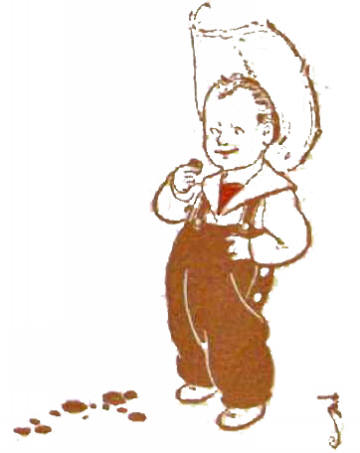
The boat floated slowly toward the bend in the stream, and finally came close to the bank in front of the big molasses-candy house, where it stopped. Dot stepped out upon the bank and fastened the boat, and then Tot jumped out beside her. There was a little path, brown in color and rather rough, that led past the house and down to the river where they stood, and as Tot jumped upon this path he stubbed his toe and fell down. Then Dot saw him pick up a piece of the brown path that had become loosened, and after looking at it a moment put it into his mouth.
"Don't do that, Tot!" called the girl, in horror. "You mustn't eat mud."
"T'ain't mud," said Tot, with his mouth full. "It's fudge."
"Fudge!" echoed Dot. "You must be crazy, Tot." But she tasted a small piece herself and found that Tot was right. It was very nice fudge, too.
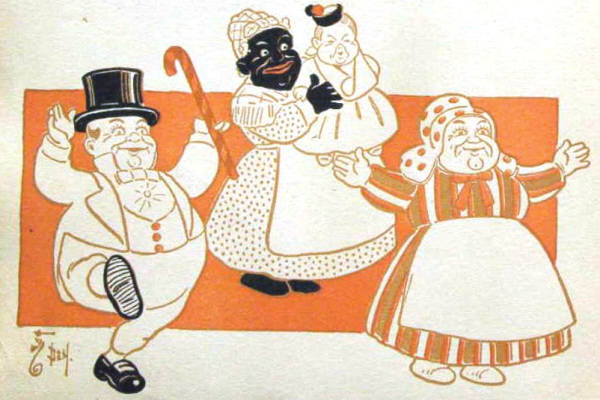
Just then as Dot was looking curiously toward the house, she saw the door open and a little man come out, followed the next moment by a little woman. They were not only very little, but short and very fat. The man wore a tall hat, a swallow-tail coat and tight breeches; but all his garments seemed fastened to him in some way, as if they were not made to come off, and their bright colors looked to have been painted on. The woman's dress had the same appearance, and the big Shaker bonnet she wore seemed really a part of her head.
When these people saw Dot and Tot, they stopped short and looked at each other in surprise; but the man seemed soon to recover himself and walked quickly toward the children, swinging a candy cane in his hand as he came.
"Good morning, my dears," he said, pleasantly.
"Good morning," answered Dot.
"Mornin'," said Tot.
"Will you kindly tell us how you came here?" continued the fat little man. "You must excuse my curiosity, but I cannot remember ever having seen any real children before."
"Our boat brought us," said Dot. "We're drifting down the river and have to go wherever it takes us."
"Oh, I see," said the man. "Well, since you are here, permit me to welcome you to the Valley of Bonbons," and he reached out his hand, with a graceful bow, to the little girl.
Dot shook hands with him, of course; but it made her shiver a little, the hand felt so soft and flabby; and when she withdrew her own hand she noticed upon it a fine white powder like flour. This she brushed off, but the little man laughed and said. "It's only powdered sugar, my dear. I'm obliged to keep myself covered with it, you know, so I won't stick to things."
"But—but I don't understand," stammered the girl. "Aren't you made like other people?"
"Certainly; I am made like everyone I have ever seen until I met you and this little boy. It strikes me you are the ones who are queerly made. You don't seem to be candy at all."
"Oh no!" said Dot, in a matter-of-fact way. "We're just flesh and blood and bones."
"And clothes," added Tot, who was looking with greedy eyes at the strange little man.
"Well, well!" said the man, thoughtfully tapping the ground with his cane; "what strange creatures you must be. In this Valley everyone is made of candy."
"And everything else is candy," exclaimed the little woman, who was peering over the man's shoulder and had not spoken before.
"Oh yes; everything we know of is candy except the river," continued the man.
"Are you candy?" asked Tot, with wide open eyes.
"To be sure. My bones are all made of stick candy and my flesh is marshmallow. That is why I must keep myself covered with powdered sugar; otherwise I would melt or stick to everything I touched. My wife is made in the same way, and we are very proud to know we are very pure and wholesome."
"What do you eat?" asked Tot, curiously.
"We eat candy, of course; that is what makes us so fat. Candy is very fattening, you know," said the little man cheerfully.
"But you haven't any teeth," remarked Dot, who had noticed this fact.
"Teeth! Certainly not. No one can eat much candy and still have teeth. Haven't you heard that candy always destroys a person's teeth?"
"I've been told so," replied Dot.
"But we get along very nicely without them. Indeed, our lives are decidedly sweet and peaceful."
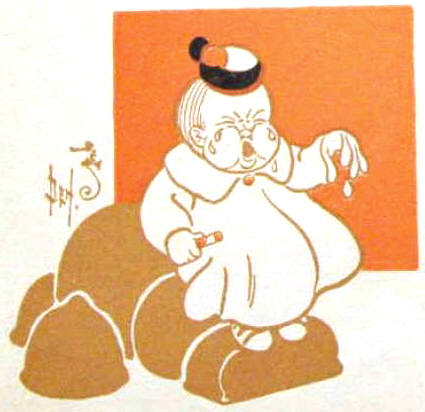
Just then they heard a shrill scream, and at once the woman rushed toward the house, running in a very comical manner because she was so short and fat.
"That's the voice of our youngest child, the baby," explained the man. "I fear some accident has happened to it. One of our greatest troubles is that we cannot depend upon our colored servants, who are chocolate. Chocolates can seldom be depended on, you know."
"I hope nothing serious has happened to your baby," said Dot, with ready sympathy.
"Probably not," answered the candy man. "But I hope you will now permit me to escort you to my house. You must be hungry; and I will have luncheon served at once."
"Thank you," said Dot.
So, led by their fat little host, who waddled as he walked in a way that made Tot laugh, they went to the house and were ushered into the front parlor.
The room was beautifully furnished; but the chairs, tables, pictures and ornaments were all composed of candy of some sort, and there was a fragrant odor of wintergreen, peppermint and rose about the room that made Tot's mouth water in delightful anticipation. The boy seated himself in a pretty pink and white chair, and Dot sat down upon a small sofa; but happening to remember the sofa was candy, she quickly arose and remained standing, although she was also a little afraid of the sticky floor, which seemed to be well powdered.
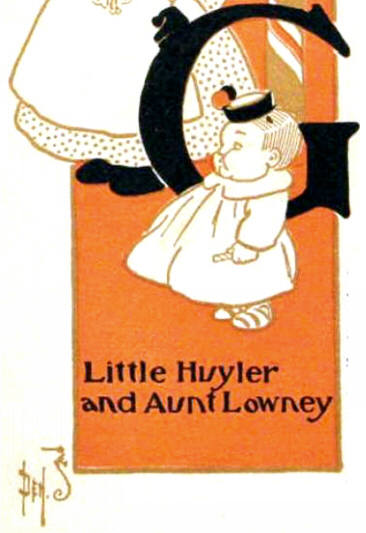
Soon the woman entered the room and, having welcomed them, she said, "Our colored nurse, Aunt Lowney, had left the baby, little Huyler, out in the sun, and before she noticed he was getting warm, his left hand had all melted away. That was what made him cry."
"Oh, that is terrible!" cried Dot, clasping her hands in horror at the sad accident. "What can you do for the poor child?"
"I have sent Aunt Lowney into the marshmallow field to get him some more fingers. We shall be able to patch him up all right, I think, so do not let it distress you. Accidents are always happening in our Valley. But I will order luncheon served at once, for you must be hungry after your journey."
She then left the room, but soon returned, followed by two serving maids, with complexions so dark brown in color that Dot was almost afraid of them.
"They are only chocolate, you know," whispered the man, "and quite harmless when taken in moderation."
Dot hardly understood what he meant, but felt more at ease after the explanation.
The maids brought many candy dishes to the table all filled with delicious bonbons and sugar-plums of every description. There were apples, pears, oranges and grapes, berries and peaches, rose-leaves and violets; but all were composed of candy and proved delightful eating. For drink they had pink lemonade, served in dainty candy cups.
"This pink lemonade," said the woman, "is one of the features of our Valley, through which it flows in a pretty stream. Sometimes we also drink the river water, but not often, for it is hardly sticky enough for our taste. Our luncheon is now ready, so please draw your chairs to the table."
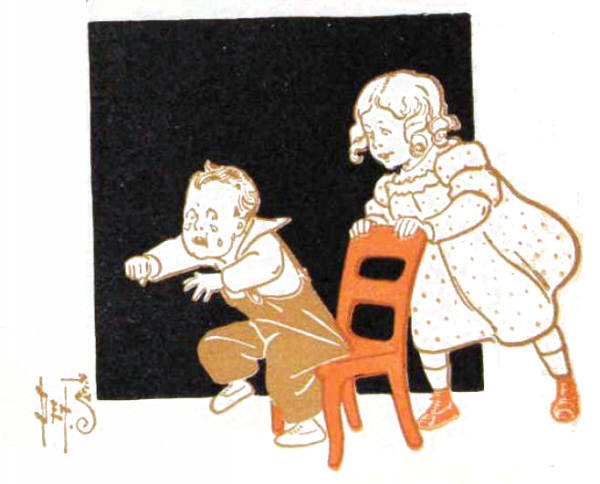
Tot tried to rise then, but found he was stuck fast to his chair, owing to the heat of his body having warmed the candy. Finding he could not get up he began to cry, but Dot helped him, and by carefully pulling his clothes away, an inch at a time, she managed to get him loose. His clothes left a soft fuzz upon the seat and back of the chair, and to avoid further trouble, the candy man scattered powdered sugar over the chairs in which Dot and Tot sat at the table.
"I suppose it will powder your clothes somewhat," said he, "but they can be brushed clean before you leave the Valley."
The children enjoyed their novel luncheon. "It's the first time," whispered Dot to Tot, "I ever had all the candy I wanted to eat."
"Won't we get sick?" asked the boy, who was busily eating a delicious peach—rose candy outside and a soft, delicate cream within.
"I suppose so," answered Dot, truthfully, "but there's nothing else to eat, you see."
"Don't want nuthin' else," said Tot.
"Allegretti," called the woman to one of the brown maids, "bring a dish of those new cocoanut-kisses for our guests. Won't you have a few more maple caramels?" she asked, politely, turning to Dot.
"No, thank you," replied the child; "I've eaten so much already that I fear I shall be ill."
"Oh, nonsense!" returned the little man; "you cannot become ill eating this sort of candy, for it's the purest in all the world. But if you lived here always you would doubtless become as fat as we are, and probably you would lose all your teeth."
"We're not going to stay," answered Dot, in alarm. "We shall have to start in just a few minutes."
"But not until you have taken a short walk around our Valley," remonstrated the little man. "You may never come here again, you know, and it is a very sweet sight."
They agreed to join their kind host in a walk, and after the candy man had carefully dusted himself afresh with powdered sugar, they started out.
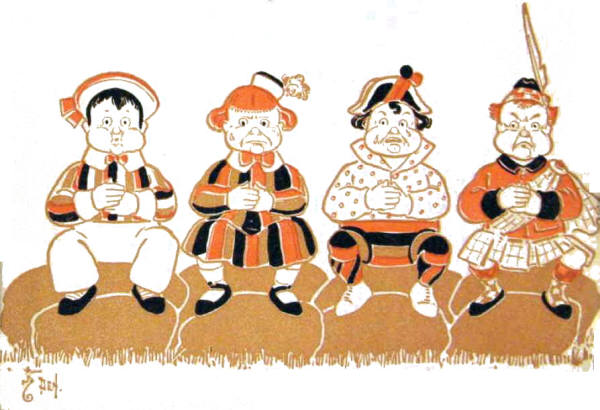
As they walked up the street, they noticed that many people came to the doors of the candy houses and looked at the strangers with great curiosity. These people seemed made of many different kinds of candy, but all were quite fat, and had their clothes painted upon them in bright colors, like the candy images that are sold in shops at Christmas time.
"Aren't the people here very brittle?" asked Dot, as they walked along.
"Yes, I may admit they are somewhat brittle," answered the man. "That is one of the drawbacks we suffer from being made of candy. Only two days ago, Mr. Gunther, a particular friend of mine, fell down a hill and was broken into seventeen different pieces."
"Dear me!" exclaimed Dot. "What did you do with him?"
"Oh, as he was ruined beyond repair, we divided him up among the neighbors who loved him best, and ate him the next morning for breakfast."
"Ate him!" cried the girl, who was greatly shocked.
"Certainly; Mr. Gunther was a very sweet man."
"But this is horrible," said Dot, with a shudder. "You are all cannibals!"
"Cannibals! What are those?" inquired the candy man.
"Why, people who eat each other," said Dot.
"Oh, then we are cannibals, sure enough," declared the little man, calmly.
"But cannibals are wicked creatures," said the child, aghast at such savagery.
"Is it wicked to eat candy in the country where you live?" demanded the man.
"No; but then people are not made of candy there."
"Well, here there is nothing else than candy; so if we eat at all we must eat candy. Is it wicked to eat in the country you came from?"
"No," replied Dot, who was beginning to be puzzled at all this.
"Then," said the little man, "you cannot consider us wicked for eating each other. Of course, we never eat anyone who is not broken; but when a man breaks himself into seventeen parts, it is considered quite a compliment to him for the neighbors who feast upon his pieces."
This did not seem quite right to Dot, but she did not know how to reply; and to add to her confusion, the candy man suddenly held up his left hand, which he had placed behind him as he talked, and showed her that his thumb and two of the fingers were missing.
"Why, what can have happened to them?" she asked, in real distress.
The candy man looked at his hand carefully, and then quickly turned and looked at Tot.
"There are marks of teeth on my hand," said he, "and no one in this Valley has teeth except you two children."
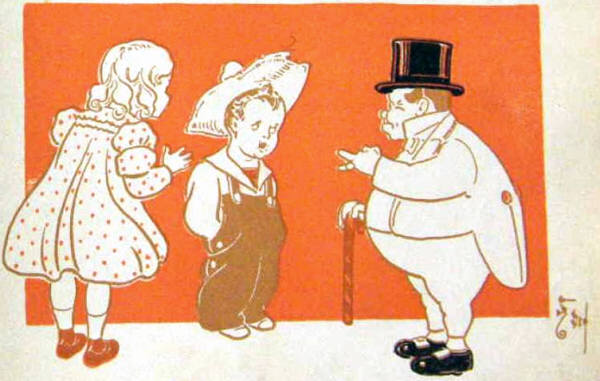
"Tot!" cried Dot; "did you bite off this gentleman's fingers?"
Tot hung his head.
"Answer me!" said the girl. "Have you been eating our friend?"
"Well," said Tot, slowly, "he said the folks here were good to eat; an'—an'—he held his hand behind his back—right in front of my mouth; an'—so I took one of little bite off his fingers, an'—"
"Tot," said Dot, "I'm ashamed of you! The idea of eating one who has been so kind to us, and so soon after luncheon, too!"
"Pray, do not scold him," said the candy man. "He says I am good to eat, and that makes me so proud that I shall not mind the loss of my fingers. When I have time I can get some new ones patched on; so it does not matter much in the least."
Still, Dot was hurt and angry at the occurrence, and Tot walked behind them with hanging head.
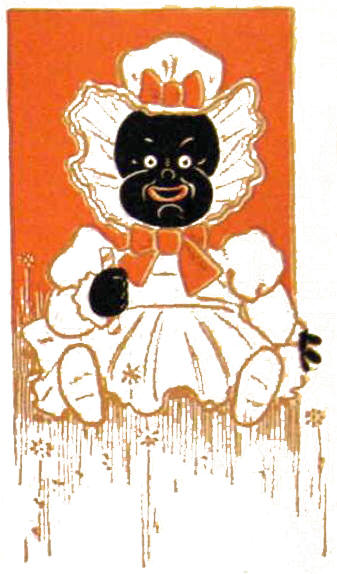
Very soon they saw, sitting by the roadside, a child who was so exceedingly black in color that Dot exclaimed:
"Surely, that baby isn't made of chocolate!"
"No," said her friend, "that's a licorice child. We have a few of them in the Valley and they are much admired. But here is our stream of pink lemonade, and we will cross it by this little bridge."
The bridge was remarkably pretty, being made of pea-green and orange-colored candy, twisted together and ornamented with dainty frosted work such as bakers put upon wedding cakes.
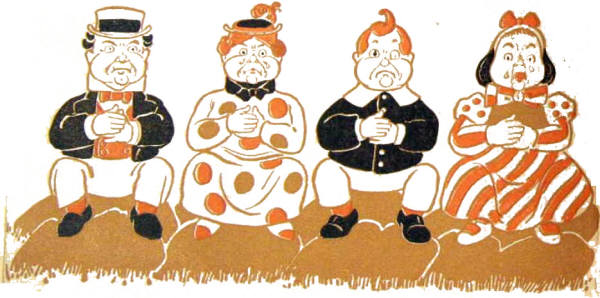
Upon reaching the other side of the stream they found themselves near the mountains, which shut in the far side of the Valley. Dot looked up at these mountains and asked, curiously, "Who are all those people sitting on the rocks?"
At the question, Tot looked up also and saw long rows of candy men and women sitting close together at the foot of the mountains.
"Those people are the gum chewers," replied their guide.
"What are they doing there?" inquired the girl.
"They are being punished," returned the candy man, gravely. "If you look over yonder, to the left, you will see a number of low bushes. On these grow all kinds of chewing gums, and sometimes those who are naughty go out there and pick the sticks of gum."
"But I thought they had no teeth," said Dot.
"Nor have they; but their gums are hardened by long use, so they are able to chew as well as you do. This gum-chewing is a very disagreeable habit, as doubtless you know; so when anyone is discovered indulging in this habit, we make them come out here to the mountains and sit on the rocks for seven days and seven nights. It is a terrible disgrace, of course; but all naughtiness must be punished in some way."
Dot watched the gum-chewers thoughtfully for a time, being ashamed to remember that she herself had often been guilty of indulging in this condemned habit; but she said nothing about it, and soon they turned and retraced their steps past the bridge and the village and the home of their kind host, coming at last to the river's edge where they had landed.
Here Dot and Tot were surprised to find one end of their boat filled with delicious looking candies, which the colored maids had placed there during their walk, being directed in the work by the little candy woman with the Shaker bonnet.
Dot thanked the kind lady earnestly, for the food she had brought in the basket was nearly gone. Then the candy lady gave each of the children a sweet kiss, and the candy man shook hands with them, being careful not to let Tot bite off any more of his fingers.
Our little adventurers now seated themselves in the boat, and the chocolate maids pushed it off the bank for them. Soon they were drifting down the river again, and before long reached the archway that led to the Third Valley of Merryland.
oft strains of sweet and soothing music fell upon the ears of the children as the boat glided silently through the arch that led into the Third Valley. Then the jagged rocks surrounding them melted away in the rear, and they passed into a country that lay peaceful and smiling under the pleasant rays of the sun.
At first, Dot thought the entire Valley was carpeted with soft, white plush, but afterward she found it was a silken moss which grew thickly everywhere. There were a few trees, with wide-spreading branches, and upon these grew beautiful flowers that filled the air with delicate perfume, but in most places the Valley, which was shaped like a great cup with gently sloping sides, was open to the warm rays of summer sunshine which flooded it.
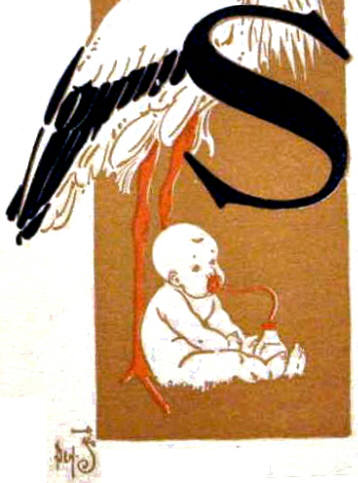
The entire scene was pretty to look upon; but what made the children's eyes open wide with wonder was the sight of hundreds of little, naked babies lying about upon the soft moss. They were waving their dimpled arms about, kicking out their chubby feet, or holding their tiny, fat thumbs in their mouths, while they cooed and crowed in a very happy and contented way. The breeze that blew gently through the trees made the music Dot and Tot heard; but the strains were soft and low, and seemed like a lullaby to hush the babies to sleep.
Some of these little ones were sleeping as the boat drew near, and they looked cozy and comfortable as they lay curled up on the moss; but others were wide awake and full of playfulness, while none of them cried or fretted or seemed a bit cross.
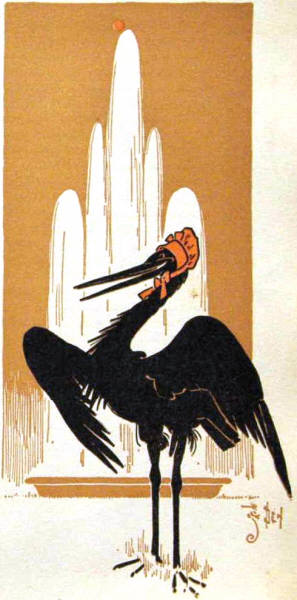
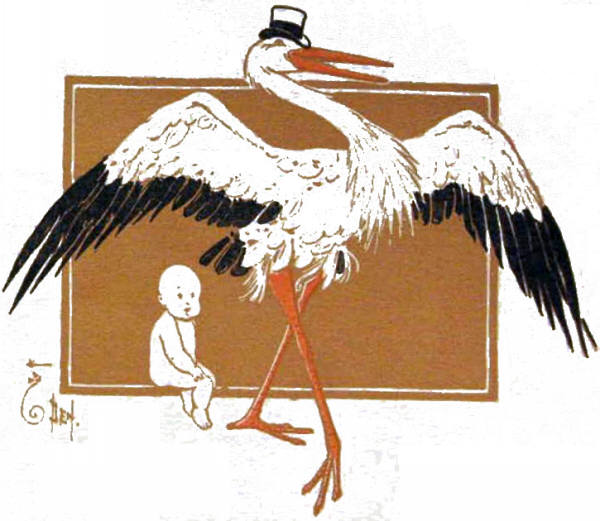
The babies were not the only inhabitants of this strange Valley, however. Walking among them were several long-legged, solemn-looking Storks, pure white in color, with splashes of black upon their wings. They appeared to act as nurses or guardians of the babies, and every now and then would fill a bottle with sweet milk from the fountain, and placed it beside a baby that acted as if it might be hungry. This fountain stood in about the center of the Valley and sent many sprays of new milk into the air, from whence it fell in graceful curves into a big basin of pure white marble. The nursing bottles were kept on a wide shelf at the edge of the fountain, where they were handy for the Storks to use.
While Dot and Tot were looking at the strange sights of this Valley, which was so different from the others they had seen, their boat drifted close to the shore, and one or two of the Storks came down to the river bank and looked at them curiously with their bright eyes.
Then one of the big, long-legged birds spoke to them in a voice that was soft and pleasing. "Why did you come to our Valley?" it asked. "You are too old to become babies again."
"Oh, we're not babies," said Dot, earnestly. "We're quite grown up. And we came here because we could not help it. In a few minutes we will go away again into the next Valley."
"Oh," said the Stork, "very well."
"Isn't that milk I see in the fountain?" asked the child, after a little pause.
"Certainly it is," answered the Stork; "we feed the babies with it."
"Could—could I have a drink of it?" asked Dot, who was thirsty from eating so much candy.
"Why, bless the child! Of course you can. We have plenty and to spare. Come on shore at once, but be careful not to step on the babies."
"I want a drink, too!" cried Tot, who had been so much astonished to hear a bird speak that he had remained silent until now.
"You may both drink as much as you wish," replied the Stork, in a kindly voice.
So the children stepped out upon the bank and fastened their boat, that it might not float away without them. Then, taking each other's hands, they followed the Stork over the silken moss to the fountain. There were no cups, so Dot and Tot drank from bottles; but they thought it the most delicious milk they had ever tasted.
While Dot was drinking she happened to look up into the sky, and something she saw there made her utter a cry of surprise. A fleecy, flower-like bud was floating, lightly as thistle-down, high in the air, and seemed to be slowly dropping into the Valley.
"What is that?" asked the girl, wonderingly.
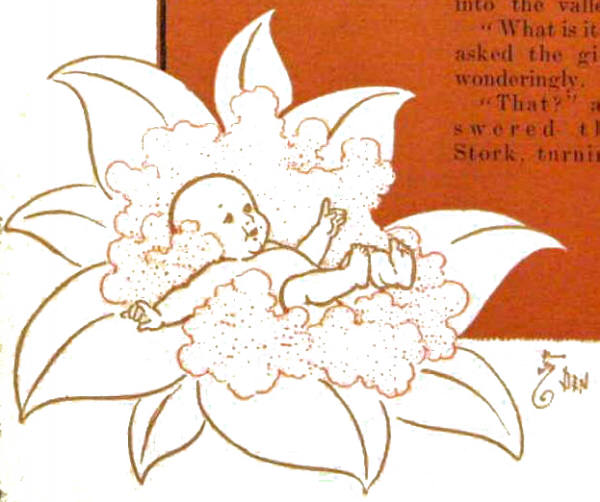
"That?" answered the Stork, turning its head sideways so that its round, black eye could look at the sky; "why, that's a baby-blossom to be sure."
"And what is a baby-blossom?" inquired Dot.
"Wait a moment and you will see," replied the Stork.
Slowly and gently the white object floated downward, and even as Dot and Tot watched it, the fleecy blossom sank upon the moss a few feet from where they stood. Then one white leaf unfolded, and another, and still another, until they saw lying in the center of the flower a beautiful baby, fast asleep. While the children looked upon this sight, hushed and silent at the wonder of it, the leaves of the blossom faded away and disappeared, while the new baby rolled over and opened wide its big, blue eyes.
"It will be hungry after the long journey," said the old Stork, and, filling a bottle at the fountain, the bird carried it in its long bill to the baby and began to feed it, crooning at the same time the following verse:
Hushaby, lullaby, Sweet flower from the sky; Glad be thy dreams, for thy Life lies before thee. Soon shalt thou be at rest, Soon fondled and caressed, Pressed to the mother's breast Who will adore thee.
The baby looked up at the Stork, smiled sweetly and then closed its eyes in sleep; while Tot, who had watched this scene with much interest, asked in a low voice, "Do all the babies come from the sky?"
The old Stork did not seem to hear him; but another bird, which was busily filling nursing bottles at the fountain, replied:
"Certainly, they do."
"I should think it would get crowded," said practical Dot, "for here comes another blossom."
"Two of 'em!" added Tot, looking upwards.
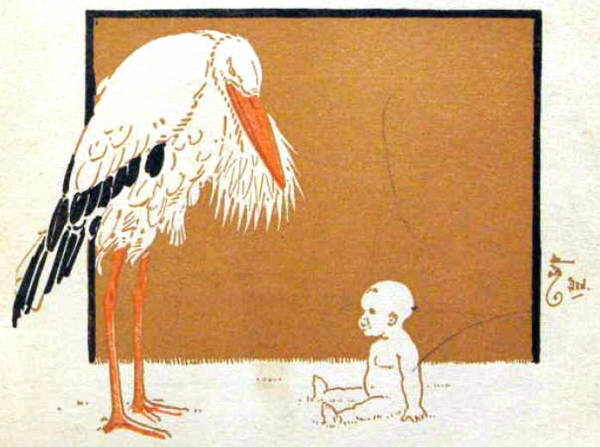
Indeed, two more of the baby-blossoms were seen floating down from the clear, blue sky, and the children watched them until they settled upon the white moss and opened their leaves, setting free two more rosy, new-born babies.
The Stork at the fountain was now singing an odd little song in a soft, cooing voice, and as Dot listened she caught the following words:
Coo-oo-oo, Coo-oo-oo! Babies are born ev'ry minute, 'tis true Babies are best when they're chubby and new; 'Most anybody will want one or two; Some people willingly take quite a few. Here comes another! For babies are due To fall when they're fresh and tender and new. Coo-oo-oo, Coo-oo-oo! Babies are blossoms that fall like the dew.
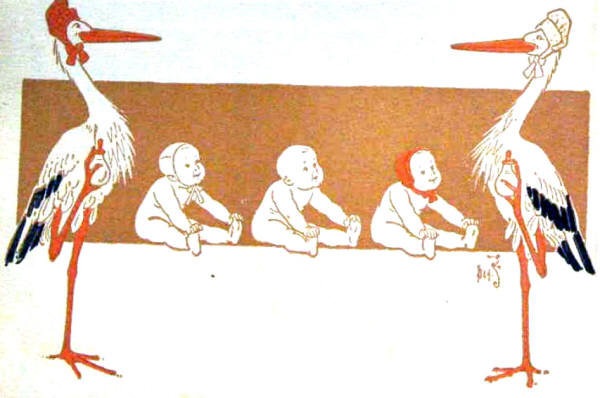
Just then the older Stork, which seemed to be the chief of the nurses, came toward the fountain and said to another of the birds, "It is time to take one of the babies into the world. They are coming quite fast to-day, and we must make room for the new ones."
"Very well," answered the other. They walked among the babies until they came to one quite big and strong, who was lying fast asleep. This baby the Stork picked up very tenderly and placed upon the other bird's back, twining its little arms around the long, soft neck, to which it clung tightly.
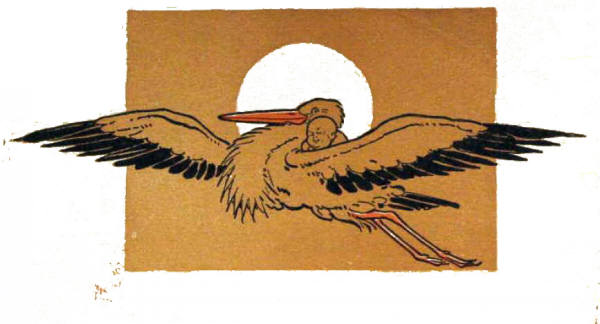
Then, spreading its great wings, the Stork flew into the air, bearing the baby gently, and sailed over the edge of the Valley into the world beyond, where it disappeared from view.
"That is the way we keep our Valley from getting crowded," said the old Stork.
"Do you suppose," asked Dot, "that I lived here once, when I was a baby?"
"Probably," answered the bird. "But, of course, I cannot remember all the babies, especially after they grow big."
"Oh, of course not," exclaimed the girl.
"Course not," said Tot; "too many of 'em."
"Now, if you will excuse me, I'll feed the two babies who have just arrived," said the motherly old Stork; and so the children watched it and the other Storks for some time, and admired the gentle way in which they tended the babies, and heard again and again the crooning song:
Hushaby, lullaby, Sweet flower from the sky,
which always seemed to have the effect of sending the babies to sleep.
Having taken one more drink at the fountain and said goodbye to the kind Storks, Dot and Tot returned to their boat.
As they pushed it out into the stream, Dot asked a Stork that stood watching them:
"What is in the next Valley?"
"Oh, the Queen of all Merryland lives there," answered the bird, "for that is the Fourth Valley, and lies in the center of the Seven."
Then, with a feeling of awe at their approach to the Queen who ruled this wonderful land, the children turned their eyes anxiously toward the fourth archway. But as the boat drifted through its entrance, Tot looked back into the Valley they were leaving and noticed another baby-blossom floating down from the sky, while the voice of a Stork sang softly:
"Coo-oo-oo, Coo-oo-oo! Babies are born every minute, 'tis true."
hen the boat carried Dot and Tot beyond the rocky arch that led to the Fourth and most important Valley of Merry-land, the children held their breaths in suspense; for here lived the Queen of all this wonderful country, and they had no idea what she was like.
"Perhaps she will be angry with us for disobeying the Watch-Dog's orders," Dot whispered; "and then she may punish us in some terrible manner."
"No, she won't," replied Tot, confidently.
"Perhaps she will make us slaves and compel us to work for her," continued Dot, with a little shudder.
"No, she won't," protested Tot, stoutly.
"Why won't she, Tot?" asked the girl.
"'Cause it's Merryland," returned the boy.
"Ah! That's true," said Dot, thoughtfully; "the Queen of this lovely and happy country couldn't be very cross with us."
"Course not," agreed Tot.
"Then we won't be afraid," she added, her courage restored by Tot's simple faith; "but will wait and see what happens to us."
The boat now swept around a bend in the river, and they saw they were in a Valley somewhat larger than any they had yet visited; but their view was shut off by a high wall that ran along the river bank on one side, and by the rocky edge of the Valley on the other side.
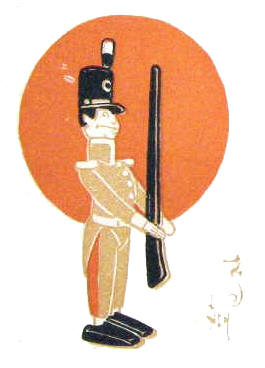
The wall was higher than their heads when they stood up in the boat, and upon its top Dot noticed several little wooden soldiers, with guns on their shoulders, walking stiffly back and forth, as if they were keeping guard. Each of these soldiers was seemingly made out of one piece of wood, and wore a high black hat and a red coat with black buttons, while his trousers were painted white. The guns did not look very dangerous, and Dot remembered that once she had owned a box of just such looking soldiers as these.
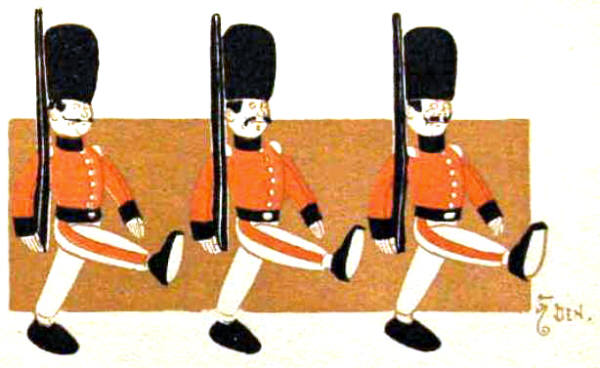
But the soldiers on the wall were moving around, and Dot's soldiers had never moved at all—at least, while she was looking at them. What they might have done when she was not looking she, of course, could not tell.
The wooden soldiers paid no attention to the boat, which glided slowly down the stream, while the children looked for a place to land.
"Perhaps we'll float right through the Valley," whispered Dot, "and then the Queen will never know we've been in her country at all."
In a few moments, however, they saw a gate in the wall, made of wood and nearly covered with gold and silver plates that shone brightly in the sun. In front of this gate was a little landing place and some steps leading down to the river. They floated up to the steps and stopped, so Dot and Tot got out and tied the boat to a silver ring in the wall. Then they walked to the gate, where Dot was just putting out her hand to open it, when she heard a voice cry:
"Halt!"
She looked up and saw that on each side of the gate was standing one of the wooden soldiers. Their guns were pointed straight at Dot and Tot, and although the soldiers were not much taller than Tot's knee, the children were startled at their warlike attitude and stood still in surprise.
"Can't we open the gate?" asked the girl, after a moment.
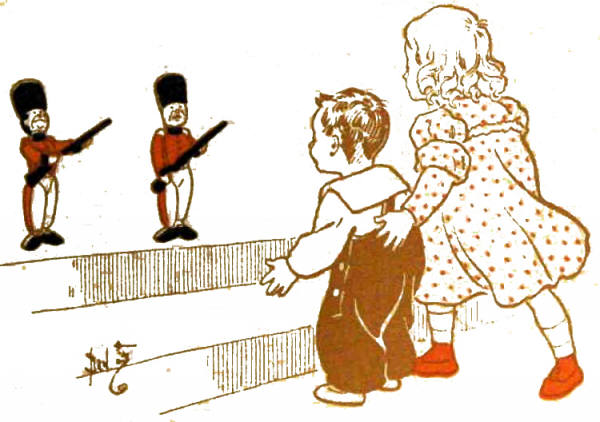
"No!" answered one of the soldiers, in a voice he tried to make gruff, but which sounded rather squeaky, as if it needed oiling.
"Why not?" inquired Tot.
"It's against orders," replied the soldier. "The Queen has commanded me to shoot any stranger who tries to open the gate."
"But your gun is only wood," said Dot, who was annoyed at the soldier's interference.
"Wooden guns can't shoot!" shouted Tot, gleefully.
The soldier seemed somewhat embarrassed at this and Dot thought he blushed a little.
"It does not matter whether my gun will shoot or not," he answered, stiffly. "I am ordered not to let anyone open the gate."
"But you have no right to give me orders," said the girl. "I don't belong to Merryland, so your Queen has no authority over either Tot or me."
"Then why are you here, if you don't belong here?" asked the soldier.
Dot hesitated to reply, for she felt the rebuke this question implied.
"We couldn't help coming," she explained, at last; "the boat brought us."
"Well, since you are here," said the soldier, "you must obey the laws of this country and the Queen who rules it."
"That's rubbish!" cried Dot, now thoroughly provoked. "You can't obey the orders of your Queen yourself."
"Why not?" inquired the soldier, in surprise.
"You were ordered to shoot, were you not?"
"Certainly."
"Well, you can't shoot, for your gun is made of wood. So you cannot obey orders."
"But if you had not come here," protested the soldier, "I should have had no occasion to shoot. So it is all your fault."
"Perhaps so," replied Dot; "but I mean to open the gate in spite of your orders."
She raised the latch and the gate began to swing slowly back upon its hinges; but when it had partly opened, she saw standing before her another wooden soldier, dressed like a Captain, who held in his hand a wooden sword.
"Stand back!" cried the Captain. "If you advance another step I will stick my sword into you."
Dot looked at the sword and saw that the point of it was really sharp. So she stopped short and said, "Does the Queen of Merryland live here?"
"She does," replied the Captain.
"Then please let her know that I have come to call upon her," continued Dot. She was a wise little girl, and knew that while she might safely argue with the helpless soldiers, it was far better to be polite to the Captain with the sharp sword.
At her request the officer bowed courteously and blew upon a pewter whistle that hung around his neck. In answer to the summons another soldier appeared, who saluted his Captain respectfully.
"Go to her Majesty the Queen," commanded the officer, "and tell her there are two strangers at the gate who wish to see her."
At once the soldier started upon his mission, and the little wooden Captain turned to Dot and Tot, saying, "You may come within the gate and sit down while you await the commands of our Queen; but if she will not receive you, of course you must go out again."
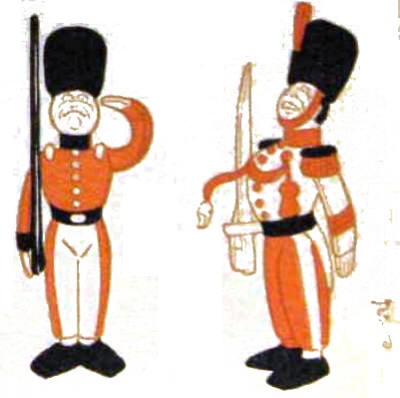
So the children passed through the gateway, which the Captain closed behind them, and sat down upon a small wooden bench built against the wall. Then they began to look around, for now before their eyes was the Fourth Valley of Merryland, the home of the Queen.
"Why, it's just like a toy village!" cried Dot, after the first look.
It really was something like a toy village. There were several pretty streets, with rows of little houses facing them, and each house was much ornamented and brightly painted. Before the houses were rows of trees which seemed to have been whittled out of wood, for the leaves looked like shavings. These trees were colored a bright emerald green, and each one stood upon a little round platform of its own. The grass also looked like wood shavings, and was dyed the same bright green color as the trees.
Dot gazed dreamily at the houses and thought they resembled the big doll's playhouse her papa had once given her for Christmas, and which now was standing in the attic of her city home.
At the far end of the main street, which ran down to the gate where they sat, was a house much bigger than the others, having for a roof a round dome which shone in the sun as if made of gold. This house was built in a remarkably beautiful and artistic manner, and before it, upon a bright green lawn, stood many trees and flowering shrubs.
"Who lives there?" Dot asked the wooden Captain.
"That is the palace of her Majesty the Queen," was the reply.
"Oh!" said Dot; "is she very big?"
"Quite big," answered the Captain, proudly.
"But," he added, "of course she is not so extremely large as you are."
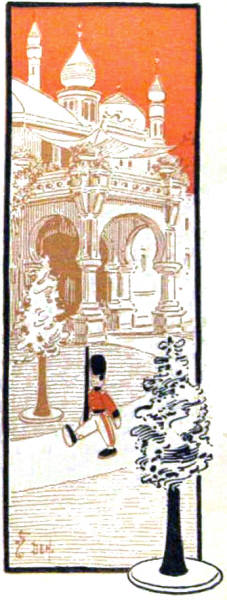
"Oh!" exclaimed Dot again, and before he had time to say anything more she saw a carriage drive around to the front of the palace. Then the door quickly opened, and what looked to be a lady came out and entered the carriage.
It was so far away she could not see the lady clearly at first; but soon the carriage came rolling swiftly toward them, and both Dot and Tot stood up that they might see plainly who was coming.
In a remarkably short time the carriage reached the gate and stopped short, and now the children's eyes were big with wonder as they looked upon it and its occupants.
The carriage itself was of the kind that are sold in toy shops, and it was drawn by two horses standing upon wooden platforms with rollers underneath, so that instead of the horses themselves running, the wheels of the platforms whirled around, taking the carriage wherever the driver might direct. This driver looked for all the world like a rag doll dressed in a coachman's uniform. His neck was rather weak, and that caused his head to lean slightly to one side, giving him a somewhat broken-down appearance; but he held the reins firmly in his stuffed hands and looked straight ahead, like a well-trained servant.
Seated in the carriage was the loveliest Wax Doll the children had ever looked upon. She was nearly as big as Tot, and was exquisitely dressed in a gown of soft, fluffy white material, with many pink ribbons upon her shoulders and sleeves, and a broad sash around her waist. Her silken hair was long and of a golden color, while her eyes were blue, and had in their depths a sweet and gentle expression. As for her complexion, it was a dainty pink-and-white, delicately blended. Upon her head she wore a golden crown with seven points upon it, and each point was tipped with a gleaming jewel.
Almost at first sight Dot longed to hold the Wax Doll in her arms and love and fondle her, and Tot suddenly became so bashful that he took off his hat and bowed his head to the "sweet lady" (as he called her), with his eyes bent upon the ground.
Yet scarcely had the children taken a good look at this delightful creature, when the Wax Doll leaped lightly from the carriage and stood before them, showing, as she did so, that her feet were clad in white satin slippers, embroidered with silver.
"Who are you?" she asked, in a pleasant voice, but with some anxiety, Dot thought; "and how did you ever get to Merryland?"
"We came in a boat," replied the girl; "and this is my friend, Tot Thompson, and I am Dot Freeland."
"Dot F'eelun," murmured Tot, shyly lifting his eyes and nodding his head.
"But you shouldn't have come here," said the little lady. "This is private property, and I have placed guards to prevent anyone entering my Valleys."
"Are you the Queen?" asked the girl.
"Yes, I am Queen of all Merryland; and I cannot understand why my guards have disobeyed my orders."
"Oh, the guards were all right," said Dot. "It was we who disobeyed. But we really couldn't help it, for we had to go wherever the boat carried us."
Then she told the Queen all the story of their adventures, and of how they had been carried by accident into the Valleys of Merryland.
After she had heard the story, the little lady looked puzzled for a moment and then said, "No one who enters my kingdom should ever be allowed to leave it again, for if they did the world should soon know all about me and my people. If that happened, all our comfort and fun would be spoiled, for strangers would be coming here every day."
"Have strangers been here before?" asked Dot, timidly.
"Never," answered the Queen.
"Then what are you going to do with us?" inquired the girl.
"Really, I do not know. You see, I am so perplexed that I have stopped smiling, and that will never do in the world; for should the weather change and cool my wax, I would remain solemn until it warmed up again, and my people would then think me unworthy to be the Queen of Merryland."
"I'm sorry to have caused you so much trouble," said Dot, softly. "I'd much rather be at home again, if I could, although your Valleys are so queer and delightful."