Part 2 — The Virginia Planters and Their Manner Of Living (continued 2)
Reading edition
Funeral Customs
When Abraham Peirsey, affluent cape-merchant, directed in his will, 1628, that he be buried "without any pomp or vainglory," he probably was protesting the tendency towards elaborate funerals, even in the early days of the Colony. It is not known whether or not his wishes in this respect were carried out; however, he was, no doubt, buried in his garden near his new frame house, as he requested.
On the other hand, Daniel Hopkinson, English merchant, who died on a voyage to Virginia, requested that he be "decently" buried at the Kecoughtan (Hampton) church, in accordance with the customs prevailing in the area. The amount spent on his funeral is an item in the accounts of the Tristram and Jane, on which he had crossed the seas as supercargo.
Arthur Smith of Isle of Wight County, in his will dated 1645, directed that he be "buried by my late beloved wife," and Richard Cocke, of "Bremo" on the lower James River, requested in his will, dated 1665, that he be "interred in the orchard near my first wife." Doubtless, the second wife, mother of several of his younger children, carried out her husband's wishes and permitted her deceased mate whatever comfort there might be in the forethought of resting in the cold, dark ground beside the lovely lady he had first chosen to be his bride.
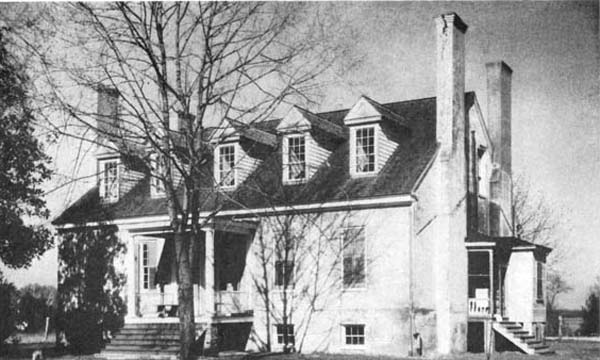
Photo by Flournoy, Virginia State Chamber of Commerce Windsor Castle—Isle of Wight County This home is located on a portion of the original grant of 1450 acres to Arthur Smith I, who came to the Colony in 1622. The town of Smithfield was laid out in 1752 by his great-grandson Arthur Smith IV, to whom the General Assembly granted permission to partition off seventy-five acres of his entailed estate.
At every plantation there was a family burying ground, not far distant from the house, and usually in or near the garden, where the blossoms carefully nurtured, brightened the last resting places of deceased members of the family. The plantation burying-ground originated through necessity rather than in sentiment. In the seventeenth century a real problem would have been posed by any attempt to transport the deceased and the funeral procession to the distant churchyard.
The Swann family, living across from Jamestown at "Swann's Point," buried deceased members on the plantation and, for almost three centuries, their graves could be identified. The Travis family living on Jamestown Island and near the church there, nevertheless, interred their dead in the family burying-ground at the lower end of the island, and some of the later marked graves may still be identified.
Markers in the Jamestown church, some over unknown graves, indicate the practice of burying persons, probably those of importance, within the church, as was often done in England. The Knight's tomb in the Jamestown churchyard is believed to be that of Sir George Yeardley, appointed Governor of Virginia, 1618, and deceased, 1627. Colonel John Page, who gave the land on which Bruton Parish Church in Williamsburg is built, was buried in its churchyard, as were his wife and son Francis. The stone, placed in memory of Colonel Page, was later removed and placed within the Church.
While funerals in seventeenth-century Virginia were solemn occasions, there was an inescapable social aspect to the gatherings of family and friends, who assembled from the countryside, both to comfort the bereaved and attend the departed on his last journey. When a planter or a member of his family died, messengers were sent out at once by sloop or shallop up and down the rivers or later, overland, on horseback. If the family bore arms, the hatchment, emblazoned with this emblem, was hung upon the door. Incidentally, the only known hatchment, that has survived in Virginia, is in possession of the Carter family at "Shirley" in Charles City County.
At once, preparations were begun to accommodate the relatives and friends who were sure to assemble for the last rites. Coming from a distance, they would be hungry upon arrival, and not only was a great amount of food prepared but the cellar was explored for its contents of drink, which the company expected to be brought forth. Occasionally, a man, in making his will, directed what should be spent for the "funeral meats" and drink, although Edmund Watts of York County, in 1675, forbade the serving of drinks at his funeral.
At the final rites for John Smalcomb in 1645, the company consumed a steer and a barrel of strong beer, the cost of which amounted to 960 pounds of tobacco, while the coffin cost only 250 pounds. The gathering assembled in 1678, for the funeral of Mrs. Elizabeth (Worsham) Epes, widow successively of William Worsham and Francis Epes of Henrico County, consumed a steer, three sheep, five gallons of wine, two gallons of brandy, ten pounds of butter and eight pounds of sugar.
The firing of guns was accepted as a regular feature of a funeral, and at the Smalcomb rites the powder spent amounted to twenty-four pounds of tobacco. In order to curb the waste of ammunition at entertainments, the Assembly, in 1655, passed an act forbidding its use on occasions except at "marriages and funerals."
In addition to expenditures as aforesaid and for the coffin, the latter usually made by some local carpenter, there were costs for notifying the countryside, costs for mourning bands, sitting up with the corpse, and the fee for the funeral sermon. If burial was in the churchyard, there was the cost of digging and filling the grave. The cost of a winding sheet of Holland (coarse unbleached linen), in 1652, was 100 pounds of tobacco. The cost of the funeral sermon in two instances in York County in 1667, was two pounds sterling each and in 1690, five pounds sterling.
As there were no undertakers, the laying out of the corpse was a tender ministration for which some close friend of the family volunteered. The technique for this service was passed from generation to generation and only in comparatively recent years has that custom been abandoned altogether.
The company of relatives and friends, who gathered for the funeral occasion, remained for several days and were, of course, fed and housed at the expense of the deceased's estate.
The law required that servants be buried in public cemeteries established for the purpose. This decree issued in the seventeenth century followed several scandals, occasioned by private funerals of deceased servants. In order to remove all possibility of suspicion, prior to burial, several neighbors were summoned to view the corpse, if death occurred under extraordinary circumstances, and to accompany the body to the grave. That such precautions were taken as early as 1629, so that possible murder would not go undetected, is shown in testimony before the General Court at Jamestown after the newly-born bastard child of a servant girl was found dead. Several persons were called as witnesses, and when evidence was produced that the child might have been born alive, the serving maid's master was required to give bond for her appearance at a higher court.
Tombstones
The well-to-do planters or their families invariably saw that appropriate tombstones with proper inscriptions—lengthy ones, characteristic of the day—were duly placed. Some of these stones remain with barely legible inscriptions; others, the inscriptions on which, fortunately, were copied in a past era, have disappeared altogether. The oldest tombstone in Virginia with a legible inscription is that of Mrs. Alice Jordan at "Four Mile Tree" in Surry County. The inscription, reciting that she was the wife of George Jordan, gives praise in verse to her virtues.
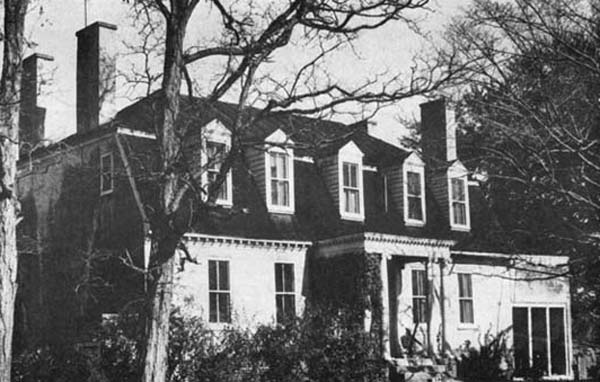
Photo by Flournoy, Virginia State Chamber of Commerce Four Mile Tree—Surry County A seventeenth-century home was the basis for this present structure located on a portion of a 2250 acre grant to Henry Browne in 1637. The estate remained in the family for two hundred years. In the adjacent graveyard may be seen the oldest tomb in Virginia with a legible inscription, that of Alice (Miles) Jordan, who died in 1650.
Tombstones in the seventeenth century were real memorials, often giving parentage of the deceased, the name of wife or husband and the number of children. Furthermore, there was, as aforesaid, a eulogy of the deceased and, for men, an account of public service rendered.
With a great deal of pride in family background, those Englishmen in Virginia, whose families were entitled to bear arms, invariably had these cut upon the stones along with the lengthy inscriptions. The stones were ordered from England. As previously mentioned, Mrs. Sarah Yeardley, in 1657, directed that her executor sell her jewels and purchase in England stones for herself and her second husband. Her son, by the first husband, Adam Thoroughgood II of Lower Norfolk County, was equally zealous that proper memorials be placed and directed his executrix (wife), in his will, dated 1679, to have his body interred in the Church at Lynnhaven, and "cause a tombstone of marble to be sent for, with coat of arms of Sir George Yeardley [his wife's father] and myself." Unfortunately, these tombs together with the site of the old Lynnhaven Church, have been washed beneath the waters of Lynnhaven Bay.
The tombstones bearing coats of arms of George Read deceased, 1671 and his wife Elizabeth, daughter of Nicolas Martiau, uncovered during excavations at Yorktown in 1931 were removed to the graveyard surrounding Christ Church. The inscriptions, badly worn, were recut with information then in hand; however, the dates since have been found to be slightly in error. The tombstone of William Cole II, Secretary of State for the Colony, 1690, erected after his death, 1694, at "Bolthrope," bore the Cole coat of arms, accompanied by a lengthy inscription, reciting in part that the deceased was "unspotted on the bench, untainted at the bar." Unfortunately, when the graveyard lay neglected for many years and overgrown with vines, other ancient stones, placed there, were broken and portions of them, from time to time, carried away by fishermen to be used as mooring stones for their boats.
Theodorick Bland, deceased, 1671, was buried in the old churchyard now adjacent to the garden at "Westover." The inscription in Latin on his tombstone recites that it was erected "by his most disconsolate widow, a daughter of Richard Bennett Esq." Lewis Burwell, deceased 1653, was buried at his plantation, "Fairfield," in Gloucester County, and the tombstone erected to his memory, bearing arms, recited that he was descended from the ancient family of Burwell of Bedford and Northampton, England.
The tomb of Alice (Lukin) Page, wife of Colonel John Page, stands facing the west entrance to Bruton Parish Church in Williamsburg and is unique in that it bears the Lukin arms alone, indicating that the deceased was the sole heir of her father and thus entitled to his arms. Otherwise, the arms cut upon her stone would have been quartered with those of her husband.
The inscription on the tombstone of Edward Digges, buried on the "E D Plantation" (later, "Bellefield"), 1676, recited that he was the father of six sons and seven daughters. The broken tomb of Major Miles Cary I in a secluded spot in the area of his former plantation, "Windmill Point," in Warwick, was restored some years ago. The inscription relates, in part, that he was killed by the Dutch, during a foray which they made into Hampton Roads in 1667.