DOING AND DARING (continued 2)
Reading edition
The men told Edwin they had been clearing the great sheep-runs between his father's land and the sea-shore, and the birds had followed them all those miles for the sake of the nightly feast they could pick up in their track.
"You can none of you do without us," they said. "We are always at work, moving from place to place, or the little brown Bunny would lord it over you all."
The boys had hardly time to exchange a good-night with the rabbiters, when the daylight suddenly faded, and night came down upon vale and bush without the sweet interlude of twilight. They were groping their way back to the house, when the fire-flies began their nightly dance, and the flowering shrubs poured forth their perfume. The stars shone out in all their southern splendour, and the boys became aware of a moving army in the grass. Poor Bunny was mustering his myriads.
CHAPTER V.
POSTING A LETTER.
Mr. Lee and his boys found so much to do in their new home, days sped away like hours. The bright autumn weather which had welcomed them to Wairoa (to give their habitation its Maori name) had changed suddenly for rain—a long, deluging rain, lasting more than a week.
The prop which Mr. Hirpington had recommended was necessarily left for the return of fine weather. But within doors comfort was growing rapidly. One end of the large room was screened off for a workshop, and shelves and pegs multiplied in convenient corners. They were yet a good way off from that happy condition of a place for everything, and everything in its place. It was still picnic under a roof, as Audrey said; but they were on the highroad to comfort and better things. When darkness fell they gathered round the blazing wood-fire. Mr. Lee wrote the first letters for England, while Edwin studied "Extinct Volcanoes." Audrey added her quota to the packet preparing for Edwin's old friend, "the perambulating letter-box," and Effie and Cuthbert played interminable games of draughts, until Edwin shut up his book and evolved from his own brains a new and enlarged edition of Maori folk-lore which sent them "creepy" to bed.
It seemed a contradiction of terms to say May-day was bringing winter; but winter might come upon them in haste, and the letters must be posted before the road to the ford was changed to a muddy rivulet.
Mr. Lee, who had everything to do with his own hands, knew not how to spare a day. He made up his mind at last to trust Edwin to ride over with them. To be sure of seeing Ottley, Edwin must stay all night at the ford, for after the coach came in it would be too late for him to return through the bush alone.
Edwin was overjoyed at the prospect, for Ottley would tell him all he longed to know. Was Nga-Hepé still alive? Had Whero gone to school? He might even propose another early morning walk across the bush to the banks of the lake.
Edwin was to ride the Maori Beauty, which had become the family name for the chieftain's horse. Remembering his past experiences with the white-leaved puka-puka, he coaxed Audrey to lend him a curtain she was netting for the window of her own bedroom. She had not much faith in Edwin's assurances that it would not hurt it a bit just to use it for once for a veil or muzzle; but she was horrified into compliance by his energetic assertion that her refusal might cost his Beauty's life. Cuthbert, mounted on an upturned pail, so that he could reach the horse's head, did good service in the difficult task of putting it on. The veil was not at all to the Beauty's mind, and he did his best to get rid of it. But the four corners were drawn through his collar at last, and securely tied.
With Mr. Lee's parting exhortation to mind what he was about and look well to Beauty's steps, Edwin started.
The road was changed to a black, oozy, slimy track. Here and there the earth had been completely washed away, and horse and rider were floundering in a boggy swamp. A little farther on a perfect landslip from the hills above had obliterated every trace of road, and Edwin was obliged to wind his way through the trees, trusting to his Beauty's instinct to find it again.
With the many wanderings from the right path time sped away. The lamp was swinging in the acacia tree as he trotted up to the friendly gate of the ford-house.
"Coach in?" he shouted, as he caught sight of Dunter shovelling away the mud from the entrance.
"Not yet; but she's overdue," returned the man, anxiously. "Even Ottley will never get his horses through much longer. We may lock our stable-doors until the May frosts begin. It is a tempting of Providence to start with wheels through such a swamp, and I told him so last week."
"Then I am just in time," cried Edwin joyfully, walking his horse up to the great flat stone in the middle of the yard and alighting. He slipped his hand into his coat to satisfy himself the bulky letters in his breast-pocket were all right, and then led his Beauty to the horse-trough. He had half a mind not to go in-doors until he had had his talk with Ottley.
Dunter, who was looking forward to the brief holiday the stopping of the coach secured him, leaned on his spade and prepared for a gossip.
"Did Mr. Lee think of building a saw-mill?" Edwin's reply ended with the counter-inquiry, "Had Mr. Hirpington got home?"
Dunter shook his head. "Not he: we all hold on as long as the light lasts. He is away with the men, laying down a bit of corduroy road over an earthslip, just to keep a horse-track through the worst of the winter."
Whilst Edwin was being initiated into the mysteries of road-making in the bush, the coach drove up.
Horses and driver were alike covered with mud, and the coach itself exhibited more than its usual quota of flax-leaf bandages—all testifying to the roughness of the journey.
"It is the last time you will see me this season," groaned Ottley, as he got off the box. "I shall get no farther." He caught sight of Edwin, and recognized his presence with a friendly nod. The passengers, looking in as dilapidated and battered condition as the coach, were slowly getting out, thankful to find themselves at a stopping-place. Among them Edwin noticed a remarkable old man.
His snowy hair spoke of extreme old age, and when he turned a tattooed cheek towards the boy, Edwin's attention was riveted upon him at once. Lean, lank, and active still, his every air and gesture was that of a man accustomed to command.
"Look at him well," whispered Dunter. "He is a true old tribal chief from the other side of the mountains, if I know anything; one of the invincibles, the gallant old warrior-chiefs that are dying out fast. You will never see his like again. If you had heard them, as I have, vow to stand true for ever and ever and ever, you would never forget it.—Am I not right, coachee?" he added in a low aside to Ottley, as he took the fore horse by the head.
The lantern flickered across the wet ground. The weary passengers were stamping their numbed feet, and shaking the heavy drops of moisture from hat-brims and overcoats. Edwin pressed resolutely between, that he might catch the murmur of Ottley's reply.
"He got in at the last stopping-place, but I do not know him."
There was such a look of Whero in the proud flash of the aged Maori's eye, that Edwin felt a secret conviction, be he who he might, they must be kith and kin. He held his letter aloft to attract the coachman's attention, calling out at his loudest, "Here, Mr. Ottley, I have brought a letter for you to post at last."
"All right," answered the coachman, opening a capacious pocket to receive it, in which a dozen others were already reposing. "Hand it over, my boy; there is scarcely a letter reaches the post from this district which does not go through my hands."
"Did you post this?" asked the aged Maori, taking another from the folds of his blanket.
"I did more," said Ottley, as he glanced at the crumpled envelope, "for I wrote it to Kakiki Mahane, the father of Nga-Hepé's wife, at her request."
"I am that father," returned the old chief.
"And I," added Ottley, "was the eye-witness of her destitution, as that letter tells you."
They were almost alone now in the great wet yard. The other passengers were hurrying in-doors, and Dunter was leading away the horses; but Edwin lingered, regardless of the heavy drops falling from the acacia, in his anxiety to hear more.
"I have brought no following with me to the mountain-lake, for by your letter famine is brooding in the whare of my child. Well, I know if the men of the Kota Pah heard of my coming, they would spread the feast in my honour. But how should I eat with the enemies of my child? I wait for the rising of the stars to find her, that none may know I am near."
"I'll go with you," offered Ottley.
"You need not wait for the stars," interposed Edwin; "I'll carry the big coach-lantern before you with pleasure. Do let me go with you," he urged, appealing to Ottley.
"How is this?" asked Kakiki. "Does the pakeha pity when the Maori frowns? What has my son-in-law been about, to bring down upon himself the vengeance of his tribe?"
"Let your daughter answer that question," remarked Ottley discreetly.
But Edwin put in warmly: "Nga-Hepé was too rich and too powerful, and the chief grew jealous. It was a big shame; and if I had been Whero, I should have been worse than he was."
Whero's grandfather deigned no reply. He stalked up the well-worn steps into Mrs. Hirpington's kitchen, and seating himself at the long table called out for supper. Edwin just peeped in at the door, avoiding Mrs. Hirpington's eye, for fear she should interfere to prevent him going with the old Maori.
"I shall see her when I come back," he thought, as he strolled on towards the stable, keeping an anxious watch over the gate, afraid lest the fordmaster should himself appear at the last moment and detain him.
"You have brought Nga-Hepé's horse," said Ottley. as he entered the nearest stall. "We must have him, for he knows the way. We have only to give him his head, and he is safe to take the road to his master's door."
"If you have him you must have me," persisted Edwin, and the thing was settled. He nestled down in the clean straw under Beauty's manger, and waited, elate with the prospect of a night of adventure, and stoutly resisted all Dunter's persuasions to go in to supper.
Wondering at the shy fit which had seized the boy, Dunter brought him a hunch of bread and cheese, and left the lantern swinging in the stable from the hook in the ceiling, ere he went in with Ottley to share the good feed always to be found in Mrs. Hirpington's kitchen, leaving Edwin alone with the horses. He latched the stable-door, as the nights were growing cold. The gates were not yet barred, for Mr. Hirpington and his men were now expected every minute.
Edwin's thoughts had gone back to the corduroy road, which Dunter had told him was made of the trunks of trees laid close together, with a layer of saplings on the top to fill up the interstices. He was making it in miniature with some bits of rush and reed scattered about the stables, when the latch was softly lifted, and Whero stood before him. Not the Whero he had parted from by the white pines, but the lean skeleton of a boy with big, staring eyes, and bony arms coming out from the loose folds of the blanket he was wearing, like the arms of a harlequin. Edwin sprang up to meet him, exclaiming, "Your grandfather is here." But instead of replying, Whero was vigorously rubbing faces with his good old Beauty.
"Have you come to meet your grandfather?" asked Edwin.
"No," answered the boy abruptly. "I've come to ask Ottley to take me to school." His voice was hollow, and his teeth seemed to snap together at the sight of the bread in Edwin's hand.
"Whero, you are starving!" exclaimed Edwin, putting the remainder of his supper into the dusky, skinny fingers smoothing Beauty's mane.
"A man must learn to starve," retorted Whero. "The mother here will give me food when I come of nights and talk to Ottley."
"But your own mother, Whero, and Ronga, and the children, how do they live?" Edwin held back from asking after Nga-Hepé, "for," he said, as he looked at Whero, "he must be dead."
"How do they live?" repeated Whero, with a laugh. "Is the door of the whare ever shut against the hungry? They go to the pah daily, but I will not go. I will not eat with the men who struck down my father in his pride. I wander through the bush. Let him eat the food they bring him—he knows not yet how it comes; but his eyes are opening to the world again. When he sees me hunger-bitten, and my sister Rewi fat as ever, he will want the reason why. I will not give it. His strength is gone if he starves as I starve. How can it return? No; I will go to school to-morrow before he asks me."
Edwin's hand grasped Whero's with a warmth of sympathy that was only held in check by the dread of another nasal caress, and he exclaimed, "Come along, old fellow, and have a look at your grandfather too."
There was something about the grand old Maori's face which made Edwin feel that he both could and would extricate his unfortunate daughter from her painful position.
"It is a fix," Edwin went on; "but he has come to pull you through, I feel sure."
Still Whero held back. He did not believe it was his grandfather. He would not come without a following; and more than that, the proud boy could not stoop to show himself to a stranger of his own race in such a miserable guise. He coiled himself round in the straw and refused to stir.
"Now, Whero," Edwin remonstrated, "I call this really foolish; and if I were you I would not, I could not do it, speak of my own mother as one of the women. I like your mother. It rubs me up to hear you—" The boy stopped short; the measured breathing of his companion struck on his ear. Whero had already fallen fast asleep by Beauty's side.
"Oh, bother!" thought Edwin. "Yet, poor fellow, I won't wake you up, but I'll go and tell your grandfather you are here."
He went out, shutting the door after him, and encountered Mr. Hirpington coming in with his men.
"Hollo, Edwin, my boy, what brings you here?" he exclaimed.
"Please, sir, I came over with a packet of letters for Mr. Ottley to post," was the quick answer, as Edwin walked on by his side, intent upon delivering his father's messages.
"All right," was the hearty response. "We'll see. Come, now I think of it, we can send your father some excellent hams and bacon we bought of the Maoris. Some of poor Hepé's stores, I expect."
"That was a big shame," muttered Edwin, hotly, afraid to hurt poor Whero's pride by explaining his forlorn state to any one but his grandfather.
He entered the well-remembered room with the fordmaster, looking eagerly from side to side, as Mr. Hirpington pushed him into the first vacant seat at the long table, where supper for the "coach" was going forward. Edwin was watching for the old chief, who sat by Ottley, gravely devouring heap after heap of whitebait, potatoes, and pumpkins with which the "coach" took care to supply him. Mrs. Hirpington cast anxious glances round the table, fearing that the other passengers would run short, as the old Maori still asked for "more," repeating in a loud voice, "More, more kai!" which Ottley interpreted "food." Dunter was bringing forth the reserves from the larder—another cheese, the remains of the mid-day pudding, and a huge dish of brawn, not yet cold enough to be turned out of the mould, and therefore in a quaky state. The old chief saw it tremble, and thinking it must be alive, watched it curiously.
"What strange animals you pakehas bring over the sea!" he exclaimed at last, adding, as he sprang to his feet and drew the knife in his belt with a savage gesture, "I'll kill it."
The laughter every one was trying to suppress choked the explanation that would have been given on all sides. With arm upraised, and a contorted face that alone was enough to frighten Mrs. Hirpington out of her wits, he plunged the knife into the unresisting brawn to its very hilt, utterly amazed to find neither blood nor bones to resist it. "Bah!" he exclaimed, in evident disgust.
"Here, Edwin," gasped the shaking fordmaster, "give the old fellow a spoon."
Edwin snatched up one from the corner of the table, and careful not to wound the aged Maori's pride, which might be as sensitive as his grandson's, he explained to him as well as he could that brawn was brawn, and very jolly stuff for a supper.
"Example is better than precept at all times," laughed Mr. Hirpington. "Show him what to do with the spoon."
Edwin obeyed literally, putting it to his own lips and then offering it to Kakiki. The whole room was convulsed with merriment. Ottley and Mr. Hirpington knew this would not do, and exerted themselves to recover self-control sufficiently to persuade the old man to taste and try the Ingarangi kai.
He drew the dish towards him with the utmost gravity, and having pronounced the first mouthful "Good, good," he worked away at it until the whole of its contents had disappeared. And all the while Whero was starving in the stable.
"I can't stand this any longer," thought Edwin. "I must get him something to eat, I must;" and following Dunter into the larder, he explained the state of the case.
"Wants to go by the coach and cannot pay for supper and bed. I see," returned Dunter.
Edwin thought of the treasure by the white pines as he answered, "I am afraid so."
"That's hard," pursued the man good-naturedly; "but the missis never grudges a mouthful of food to anybody. I'll see after him."
"Let me take it to him," urged Edwin, receiving the unsatisfactory reply, "Just wait a bit; I'll see," as Dunter was called off in another direction; and with this he was obliged to be content.
Ottley was so taken up with the aged chief—who was considerably annoyed to find himself the laughing-stock of the other passengers—that Edwin could not get a word with him. He tried Mr. Hirpington, who was now talking politics with a Wellingtonian fresh from the capital. Edwin, in his fever of impatience, thought the supper would never end. After a while some of the passengers went off to bed, and others drew round the fire and lit their pipes.
Mrs. Hirpington, Kakiki, and the coachman alone remained at the table. At last the dish of brawn was cleared, and the old Maori drew himself up with a truly royal air. Taking out a well-filled purse, in which some hundreds of English sovereigns were glittering, he began counting on his fingers, "One ten, two ten—how muts?" (much).
Ottley, who understood a Maori's simple mode of reckoning better than any one present, was assisting Mrs. Hirpington to make her bill, and began to speak to Kakiki about their departure.
The fordmaster could see how tired the chief was becoming, and suddenly remembered a Maori's contempt and dislike for the wretched institution of chairs. He was determined to make the old man comfortable, and fetching a bear-skin from the inner room, he spread it on the floor by the fire, and invited Kakiki to take possession. Edwin ran to his help, and secured the few minutes for talk he so much desired. Mr. Hirpington listened and nodded.
"You will have to stay here until the morning," he added, "every one of you. Go off with Dunter and make the boy outside as comfortable as you can. I should be out of my duty to let that old man cross the bush at night, with so much money about him. Better fetch his grandson in here."
Mrs. Hirpington laid her hand on Edwin's shoulder as he passed, and told him, with her pleasant smile, his bed was always ready at the ford.
Dunter pointed to a well-filled plate and a mug of tea, placed ready to his hand on the larder shelf; and stretching over Edwin's head, he unbolted the door to let him out.
The Southern Cross shone brightly above the iron roof as Edwin stepped into the yard to summon Whero. The murmur of the water as it lapped on the boating-stairs broke the stillness without, and helped to guide him to the stable-door. The lantern had burnt out. He groped his way in, and giving Whero a hearty shake, charged him to come along.
But the hand he grasped was withdrawn.
"I can't," persisted Whero; "I'm too ashamed." He meant too shy to face the "coach," and tell all he had endured in their presence. The idea was hateful to him.
Edwin placed the supper on the ground and ran back for Ottley. He found the coachman explaining to Kakiki why Marileha had refused to accept the money for the horse, and how he had kept it for her use.
"Then take this," cried Kakiki, flinging the purse of gold towards him, "and do the like."
But Ottley's "No!" was dogged in its decision.
"What for no?" asked Kakiki, angrily.
"Who is his daughter?" whispered Mr. Hirpington to his wife.
"You know her: she wears the shark's teeth, tied in her ears with a black ribbon," Mrs. Hirpington answered, sleepily.
Then he went to the rescue, and tried to persuade Kakiki to place his money in the Auckland Bank for his daughter's benefit, pointing out as clearly as he could the object of a bank, and how to use it. As the intelligent old man began to comprehend him, he reiterated, "Good, good; the pitfall is only dangerous when it is covered. My following are marching after me up the hills. If I enter the Rota Pah with the state of a chief, there will be fighting. Send back my men to their canoes. Hide the wealth that remains to my child as you say, but let that wahini" (meaning Mrs. Hirpington) "take what she will, and bid her send kai by night to my daughter's whare, that there may be no starving. This bank shall be visited by me, and then I go a poor old man to sleep by my daughter's fire until her warrior's foot is firm upon the earth once more. I'll wrap me in that thin sheet," he went on, seizing the corner of the table-cloth, which was not yet removed.
Mr. Hirpington let him have it without a word, and Ottley rejoiced to find them so capable and so determined to extricate Marileha from her peril.
"Before this moon shall pass," said Kakiki, "I will take her away, with her family, to her own people. Let your canoe be ready to answer my signal."
"Agreed," replied Mr. Hirpington; "I'll send my boat whenever you want it."
"For all that," thought Edwin, "will Nga-Hepé go away?" He longed to fetch in Whero, that he might enter into his grandfather's plans; and as, one after another, the passengers went off to bed, he made his way to Mrs. Hirpington. Surely he could coax her to unbar the door once more and let him out to the stables.
"What, another Maori asleep in the straw!" she exclaimed. "They do take liberties. Pray, my dear, don't bring him in here, or we shall be up all night."
Edwin turned away again in despair.
Having possessed himself of the table-cloth, the old chief lay down on the bear-skin and puffed away at the pipe Mr. Hirpington had offered him, in silence revolving his schemes.
He was most anxious to ascertain how his son-in-law had brought down upon himself the vengeance of the tribe amongst which he lived. "I will not break the peace of the hills," he said at length, "for he may have erred. Row me up stream while the darkness lasts, that I may have speech of my child."
"Too late," said Mr. Hirpington; "wait for the daylight."
"Are there not stars in heaven?" retorted Kakiki, rising to try the door.
"Am I a prisoner?" he demanded angrily, when he found it fastened.
Mr. Hirpington felt he had been reckoning without his host when he declared no one should leave his roof that night. But he was not the man to persist in a mistake, so he threw it open.
"I'll row him," said Dunter.
Edwin ran out with them. Here was the chance he had been seeking. He flew to the stable and roused up Whero. Grandfather and grandson met and deliberately rubbed noses by the great flat stone which Edwin had used as a horse-block. Whilst Dunter and Mr. Hirpington were getting out the boat, they talked to each other in their native tongue.
"It will be all right now, won't it?" asked Edwin, in a low aside to Ottley, who stood in the doorway yawning. But Kakiki beckoned them to the conference.
"The sky is black with clouds above my daughter's head; her people have deserted her—all but Ronga. Would they cut off the race of Hepé? Some miscreant met the young lord in the bush, and tried to push him down a mud-hole; but he sprang up a tree, and so escaped. Take him to school as he wills. When I go down to the bank I shall see him there. It is good that he should learn. The letter has saved my child."
CHAPTER VI.
MIDNIGHT ALARMS.
After his return home, Edwin felt as if mud and rain had taken possession of the outside world. The rivulet in the valley had become a raging torrent. All the glamour of the woods was gone. The fern-covered hills looked gaunt and brown. The clumps of flax and rush bent their flattened heads low in the muddy swamp before the piercing night winds. The old trees in the orchard were shattered, and their broken branches, still cumbering the ground, looked drear and desolate. The overgrowth of leaf and stalk presented a mass of decaying vegetation, dank and sodden.
One chill May morning brought a heavy snow, veiling the calm crests of the majestic hills with dazzling whiteness, becoming more intense and vivid as their drapery of mist and storm-cloud blackened. All movement seemed absorbed by the foaming cascades, tearing down the rifts and gullies in the valley slope. Every sign of life was restricted to a ghostly-looking gull, sated with dead rabbit, winging its heavy flight to the blue-black background of dripping rock.
But in this England of the Southern Seas the winter changes as it changes in the British Isles. Sharp, frosty nights succeeded. The ground grew crisp to the tread. The joyous work in the woods began. Mr. Lee went daily to his allotment with axe on shoulder and his boys by his side. His skill in woodcraft was telling. Many of the smaller trees had already fallen beneath his vigorous stroke, when the rabbiters—who glean their richest harvest in the winter nights—reappeared. They were so used to the reckless ways of the ordinary colonist—who cuts and slashes and burns right hand and left until the coast is clear—that Mr. Lee's methodical proceedings began to interest them. His first step was to clear away the useless undergrowth and half-grown trees, gaining room for charcoal fires, and for stacks of bark which his boys were stripping from the fallen trunks. His roving neighbours promised to leave their traps and snares, and help him to bring down the forest giants which he was marking for destruction.
One June evening, as the Lees were returning from a hard day's work, they passed the rabbiters going out as usual to begin their own. A slight tremor in the ground attracted the attention of both parties. As they exchanged their customary good-night, one of the rabbiters observed there was an ugly look about the sky.
The boys grumbled to each other that there was an ugly look about the ground. Although thousands of little brown heads and flopping ears were bobbing about among the withered thistle-stalks, thousands more were lying dead behind every loose stone or weedy tuft.
The ghoul-like gulls were hovering in increasing numbers, some already pouncing on their prey and crying to their fellows wheeling inland from the distant shore. No other sound disturbed the silence of the bush. The sense of profound repose deepened as they reached their home. To Mr. Lee it seemed an ominous stillness, like the lull before the storm; but in the cheerful light of his blazing fire he shook off the feeling.
The weary boys soon went to bed. For the present they were sleeping in the same room as their father, who slowly followed their example.
It was nearly midnight, when Edwin was awakened with a dim feeling of something the matter. Cuthbert was pulling him. "Edwin! Edwin!"
"What is it?" he cried. Edwin's hurried exclamation was lost in the bang and rattle all around. Were the windows coming in? He sprang upright as the bed was violently shaken, and the brothers were tossed upon each other.
"What now?" called out Mr. Lee, as the floor swayed and creaked, and he felt himself rolling over in the very moment of waking. The walls were beginning a general waltz, when the noise of falling crockery in the outer room and the howling of the rabbiters' dogs drowned every other sound.
A sickly, helpless sensation stole over them all, Mr. Lee too, as everything around them became as suddenly still—an eerie feeling which could not be shaken off. The boys lay hushed in a state of nervous tension, not exactly fear, but as if their senses were dumfoundered and all their being centred in a focus of expectation.
Effie gave a suppressed scream. Mr. Lee was speaking to her through the wall. "It is over, my dear—it is over; don't be frightened," he was saying.
"It—what it?" asked Cuthbert, drawing his head under the bed-clothes.
"Our first taste of earthquake," returned his father; "and a pretty sharp one, I fancy."
At this announcement Cuthbert made a speedy remove to his father's bed, and cuddled down in the blankets. Mr. Lee walked round the room and looked out of the window. It was intensely dark; he could see nothing.
"Oh my head!" they heard Audrey saying; "it aches so strangely."
Mr. Lee repeated his consolatory assurance that it was over, and returned to bed, giving way to the natural impulse to lie still which the earthquake seemed to produce. The violence of the headache every one was experiencing made them thankful to lie down once more; but rest was out of the question. In a little while all began again; not a violent shock, as at the first, but a continual quaking.
Mr. Lee got up and dressed. He was afraid to light a lamp, for fear it should be upset; so he persuaded his children to keep in bed, thinking they would be rolled down in the darkness by the heaving of the floor. He groped his way into the outer room, treading upon broken earthenware at every step. This was making bad worse. He went back and lit a match. It was just two o'clock.
Audrey, who heard him moving about, got up also, and began to dress, being troubled at the destruction of the plates and dishes. In ten minutes they were startled by a fearful subterranean roar. Edwin could lie still no longer. He sprang up, and was hurrying on his clothes, when the house shook with redoubled violence. Down came shelves, up danced chairs. The bang and crash, followed by a heavy thud just overhead, made Edwin and his father start back to opposite sides of the room as the roof gave way, and a ton weight of thatch descended on the bed Edwin had just vacated.
"The chimney!" exclaimed Mr. Lee. "The chimney is down!"
The dancing walls seemed ready to follow. Cuthbert was grabbing at his shoes. Mr. Lee ran to the door, thinking of his girls in the other room.
"Audrey! Effie!" he shouted, "are you hurt?"
But the weight of the falling thatch kept the door from opening. He saw the window was bulging outwards. He seized a stick standing in the corner, and tried to wrench away the partition boarding between him and his daughters. But the slight shake this gave to the building brought down another fall of thatch, filling the room with dust. Edwin just escaped a blow from a beam; but the darkness was terrific, and the intense feeling of oppression increased the frantic desire to get out.
"In another moment the whole place will be about our ears!" exclaimed Mr. Lee, forcing the window outwards, and pushing the boys before him into the open. He saw—no, he could not see, but rather felt the whole building was tottering to its fall. "Let the horses loose!" he shouted to Edwin, as he ran round to the front of the house to extricate the girls.
The boom as of distant cannon seemed to fill the air.
"O Lord above, what is it?" ejaculated one of the rabbiters, who had heard the chimney go down, and was hurrying to Mr. Lee's assistance.
Again the heavy roll as of cannon seemed to reverberate along the distant shore.
"It is a man-of-war in distress off Manakau Head," cried a comrade.
"That! man, that is but the echo; the noise is from the hills. There is hot work among the Maoris, maybe. They are game enough for anything. The cannon is there," averred old Hal, the leader of the gang.
"Then it is that Nga-Hepé blowing up the Rota Pah by way of revenge," exclaimed the first speaker.
Edwin had opened the stable-door, and was running after his father. He caught the name Nga-Hepé, and heard old Hal's reply,—
"He buy cannon indeed, when the muru took away his all not three months since!"
Edwin passed the speaker, and overtaking his father in the darkness, he whispered, "The man may be right. Nga-Hepé's wife buried his money by the roadside, by the twin pines, father. I saw her do it."
"Ah!" answered Mr. Lee, as he sprang up the veranda steps and rapped on Audrey's window. As she threw it open a gruff voice spoke to Edwin out of the darkness.
"So it was money Marileha buried?"
But Edwin gave no reply. Mr. Lee was holding out his arms to Erne, who had scrambled upon the window-sill, and stood there trembling, afraid to take the leap he recommended.
"Wrap her in a blanket, Audrey, and slide her down," said their father.
Edwin was on the sill beside her in a moment. The blanket Audrey was dragging forward was seized and flung around the little trembler, enveloping head, arms, and feet. Mr. Lee caught the lower end, and drawing it down, received his "bonnie birdie" in his fatherly arms. Edwin leaped into the darkness within.
"Quick, Audrey, quick, or the house will fall upon us," he urged.
She was snatching at this and that, and tying up a bundle in haste. Edwin pulled out another blanket from the tumbled bed-clothes, and flung it on the window-sill.
"No, no," said Audrey; "I'll jump."
She tossed her bundle before her, and setting herself low on her feet, she gave one hand to her father and the other to the gruff speaker who had startled Edwin in the darkness. They swung her to the ground between them just as the log-built walls began to roll. Edwin was driven back among the ruins, crouching under the bulrush thatch, which lay in heaps by the debris of beam and chimney, snug like a rabbit in its burrow, whilst beam and prop were falling around him. He heard Cuthbert calling desperately, "Look, look! father, father! the world's on fire!"
Edwin tugged furiously at the mass of dry and dusty rushes in which he had become enveloped, working with hands and feet, groping his way to space and air once more. The grand but terrific sight which met his gaze struck him backwards, and he sank confounded on the heap, from which he had scarcely extricated himself.
The sacred Maori hills, which at sunset had reared their snowy crests in majestic calm, were ablaze with fire. The intensity of the glare from the huge pillar of flame, even at so great a distance, was more than eyes could bear. With both hands extended before his face to veil the too terrific light, Edwin lay entranced. That vision of a thousand feet of ascending flame, losing itself in a dome of cloud blacker and denser than the blackness of midnight, might well prelude the day of doom. Unable to bear the sight or yet to shut it out, he watched in dumb amazement. White meteor globes of star-like brilliancy shot from out the pall of cloud in every direction, and shed a blue unearthly light on all around. They came with the roar as of cannon, and the rocks were riven by their fall. Huge fissures, opening in the mountain sides, emitted streams of rolling fire.
Edwin forgot his own peril and the peril of all around, lost in the immensity of the sight. The cries and groans of the rabbiters recalled him. Some had thrown themselves on their faces in a paroxysm of terror. Old Hal had fallen on his knees, believing the end of the world had come.
Edwin heard his father's voice rising calm and clear above the gasping ejaculations and snatches of half-forgotten prayer.
"Would you court blindness? Shut your eyes to the awful sight. It is an eruption of Mount Tarawera. Remember, Hal, we are in the hands of One whom storm and fire obey."
The play of the lightning around the mountain-head became so intense that the glare from the huge column of volcanic fire could scarcely be distinguished. The jagged, forked flashes shot downwards to the shuddering forest, and tree after tree was struck to earth, and fire sprang up in glade and thicket.
"To the open!" shouted Mr. Lee, blindfolding Cuthbert with his handkerchief, and shrouding Effie in the blanket, as he carried her towards the recent clearing.
Cuthbert grasped his father's coat with both hands, and stumbled on by his side. A dull, red spot in the distance marked the place where the charcoal fires were smouldering still, just as Mr. Lee had left them.
He laid his burden down in the midst of the circling heaps, which shed a warmth and offered something of a shelter from the rising blast. It was the safest spot in which he could leave the two; and charging Cuthbert to be a man and take care of his sister, he hurried away to look for Edwin.
With their backs against the sods which covered over the charring wood, the children sat with their arms round each other's necks, huddled together in the blanket, all sense of loneliness and fear of being left by themselves absorbed in the awe of the night.
Inspired by Mr. Lee's example, old Hal had rallied. He had caught Beauty, and was putting him in the cart. Audrey, with her recovered bundle on her arm, with the quiet self-possession which never seemed to desert her, was bringing him the harness from the new-built shed, which was still standing.
The gruff rabbiter, who had been the first to come to Mr. Lee's assistance, followed her for a fork to move the heaps of thatch which hemmed Edwin in. He was crossing to the ruined house with it poised upon his shoulder as Mr. Lee came up. He saw the lightning flash across the steel, and dashed the fork from the man's insensate grasp. The fellow staggered backwards and fell a senseless heap. Star-like rays were shooting from each pointing tine as the fork touched the ground, and lines of fire ran from them in every direction. Edwin saw it also, and seizing a loosened tie-beam, he gave the great heap of thatch before him a tremendous heave, and sent it over. The sodden mass of rush, heavy with frozen snow, broke to pieces as it fell, and changed the running fire to a dense cloud of smoke.
A deep-voiced "Bravo, young un!" broke from the horror-stricken rabbiters, who had gathered round their comrade. But Mr. Lee was before them. He had loosened the man's collar and torn open his shirt. In the play of the cold night air his chest gave a great heave. A sigh of thankfulness ran round the group. The lightning he had so unthinkingly drawn down upon himself had not struck a vital part.
Audrey had dropped her bundle, and was filling her lap with the frozen flags by the edge of the stream.
They dragged him away from the smoke, and Audrey's icy gleanings were heaped upon his burning head. A twitch of the nostrils was followed by a deep groan.
"He'll do," said Hal. "He's a coming round, thank God!"
With a low-breathed Amen, Mr. Lee turned away, for the cloud of smoke his boy had raised completely concealed him. The cheery "All right" which answered his shout for his son put new life into the whole party.
Audrey and her father ran quickly to the end of the house. The great beam of the roof was cleared, and Edwin was cautiously making his way across it on his hands and knees.
"Stand back!" he cried, as he neared the end, and, with a flying leap and hands outspread he cleared the broken wall, and alighted uninjured on the ground.
Mr. Lee caught hold of him, and Audrey grasped both hands.
"I'm all right," he retorted; "don't you bother about me."
A terrible convulsion shook the ground; the men flung themselves on their faces. A splendid kauri tree one hundred and seventy feet high, which shaded the entrance of the valley, was torn up by the roots, as an awful blast swept down the forest glades with annihilating force. The crash, the shock reverberating far and wide, brought with it such a sense of paralyzing helplessness even Mr. Lee gave up all for lost.
They lifted up their heads, and saw red-hot stones flying into the air and rolling down the riven slopes.
"O my little lambs!" groaned Mr. Lee, thinking of the two he had left by the charcoal fires, "what am I doing lying here, and you by yourselves in the open?"
"Get 'em away," said Hal; "the cart is still there. Put 'em all in, and gallop off towards the shore; it's our only safety."
There was too much weight in the old man's words to disregard them. Mr. Lee looked round for his other horse, which had rushed over him at a mad bound when the last tree fell. He saw it now, its coat staring with the fright, stealing back to its companion.
CHAPTER VII.
THE RAIN OF MUD.
It was about four o'clock in the morning. A new thing happened—a strange new thing, almost unparalleled in the world's history. The eruption had been hitherto confined to the central peak of Tarawera, known among the Maori tribes as Ruawahia; but now with a mighty explosion the south-west peak burst open, and flames came belching forth, with torrents of liquid fire. The force of the earthquake which accompanied it cracked the bed of the fairy lake. The water rushed through the hole upon the subterranean fires, and returned in columns of steam, forcing upwards the immense accumulation of soft warm mud at the bottom of the lake. The whole of this was blown into the air, and for fifteen miles around the mountain fell like rain. The enormous amount of steam thus generated could not find half vent enough through the single hole by which the water had poured in, and blew off the crust of the earth above it.
Showers of rock, cinders, and dust succeeded the mud, lashing the lake to fury—a fury which baffled all imagination. The roar of the falling water through unseen depths beneath the lake, the screech of the escaping steam, the hissing cannonade of stones, created a volley of sound for which no one could account, whilst the mud fell thick and fast, as the snow falls in a blizzard.
The geysers, catching the subterranean rage, shot their scalding spray above the trees. Mud-holes were boiling over and over, and new ones opening in unexpected places. Every ditch was steaming, every hill was reeling. For the space of sixty miles the earth quivered and shook, and a horrid sulphurous smell uprose from the very ground; while around Tarawera, mountain, lake, and forest were enveloped in one immense cloud of steam, infolding a throbbing heart of flame, and ascending to the almost incredible height of twenty-two thousand feet. Beneath its awful shadow the country lay in darkness—a darkness made still more appalling when the huge rock masses of fire clove their way upwards, to fall back into the crater from which they had been hurled.
As Mr. Lee caught his horse by the forelock, the first heavy drops of mud hissed on the frozen ground. In another moment they came pelting thick and fast, burning, blinding, burying everything in their path. The horse broke loose from his master's hand, and tore away to the shelter of the trees. The heavy cart lumbering at his heels alone kept Beauty from following his mate. Hal caught his rein, Edwin seized his head, as the thick cloud of ashes and mud grew denser and blacker, until Edwin could scarcely see his hand before him.
"Get in! get in!" gasped the old rabbiter.
Edwin swung himself upon the horse's back, and rode postilion, holding him in with all his might.
"The sick man first," said Mr. Lee, almost choking with the suffocating smell which rose from the earth. He lifted the poor fellow in his arms, a comrade took him by the feet, and between them they got him into the cart. Hal had resigned the reins to Edwin, and taken his place, ready to pillow the unconscious head upon his knees.
"The Lord have mercy on us!" he groaned.
Mr. Lee groped round for Audrey. Her feet were blistering through her thin boots, as she sank ankle-deep in the steaming slime, which came pouring down without intermission. Her father caught her by the waist and swung her into the back of the cart. Another of the rabbiters got up on the front and took the reins from Edwin, who did not know the way. The other two, with Mr. Lee, caught hold of the back of the cart and ran until they came to their own camp. The tents lay flat; the howling dogs had fled; but their horse, which they had tethered for the night, had not yet broken loose.
Here they drew up, sorely against Mr. Lee's desire, for he could no longer distinguish the glimmer of his charcoal fires, and his heart was aching for his children—his innocents, his babies, as he fondly called them—in that moment of dread. As the rabbiters halted, he stooped to measure the depth of mud on the ground, alarmed lest the children should be suffocated in their sleep; for they might have fallen asleep, they had been left so long.
"Not they," persisted Edwin. "They are not such duffers as to lie down in mud like this; and as for sleep in this unearthly storm—" he stopped abruptly.
"Hark!" exclaimed his father, bending closer to the ground. "Surely that was a 'coo,' in the distance."
Every ear was strained. Again it came, that recognized call for help no colonist who reckons himself a man ever refuses to answer.
Faint as was the echo which reached them, it quivered with a passionate entreaty.
"They are cooing from the ford," cried one. But another contradicted. It was only when bending over the upturned roots of a fallen tree that the feeble sound could be detected, amidst all the fearsome noises raging in the upper air.
The rabbiters felt about for their spades, and throwing out the mud from the cavity, knelt low in the loosened earth. They could hear it now more plainly.
Mr. Lee pressed his ear to the freshly-disturbed mould, and listened attentively. The cry was a cry of distress, and the voice was the voice of his friend.
The rabbiters looked at each other, aghast at the thought of returning to the thick of the storm. It was bad enough to flee before it; but to face the muddy rain which was beating them to the earth, to breathe in the burning dust which came whirling through it, could any one do that and reach the ford alive? Not one dare venture; yet they would not leave the spot.
At break of day they said, "We will go." They were glad of such shelter as the upheaved roots afforded. It was a moment's respite from the blistering, blinding rain. But whilst they argued thus, Mr. Lee was striding onwards to the seven black heaps, in the midst of which he had left his children.
The fires had long gone out; the blackness of darkness was around him. He called their names. He shouted. His voice was thick and hoarse from the choking atmosphere. He stumbled against a hillock. He sank in the drift of mud by its side. A faint, low sob seemed near him; something warm eluded his touch. His arms sought it in the darkness, sweeping before him into empty space. Two resolute small hands fought back his own, and Cuthbert growled out fiercely, "Whoever you are, you shan't touch my Effie. Get along!"
"Not touch your Effie, my game chick!" retorted Mr. Lee, with the ghost of a smile in spite of his despair.
"Oh, it is father! it is father!" they exclaimed, springing into his arms. "We thought you would never come back any more."
He thought they would never stop kissing him, but he got them at last, big children as they were, one under each arm, lifting, dragging, carrying by turns, till he made his way to the cart. Then he discovered why poor Effie hung so helplessly upon him. Both hands had tightly clinched in the shock of the explosion, and her feet dragged uselessly along the ground.
"She turned as cold as ice," said Cuthbert, "and I've cuddled her ever since. Then the mud came on us hot; wasn't that a queer thing?"
They snugged poor Effie in the blanket, and Audrey took her on her lap.
"I'm not afraid now," she whispered, "now we are all together. But I've lost the kitten."
"No," said Audrey; "I saw it after you were gone, scampering up a tree."
Mr. Lee was leaning against the side of the cart, speaking to old Hal.
They did not hear what he was saying, only the rabbiter's reply: "Trust 'em to me. I'll find some place of shelter right away, down by the sea. Here, take my hand on it, and go. God helping, you may save 'em at the ford. Maybe they are half buried alive. It is on my mind it will be a dig-out when you get there. The nearer the mischief the worse it will be. When our fellows see you have the pluck to venture, there'll be some of 'em will follow, sure and sartin."
"We are all chums here," said Mr. Lee, turning to the men. "Lend me that spade and I'm off to the ford. We must answer that coo somehow, my lads."
"We'll do what we can in the daylight," they answered.
"I am going to do what I can in the darkness," he returned, as he shouldered the spade and crossed over for a last look at his children.
Audrey laid her hand in his without speaking.
"You are not going alone, father, when I'm here," urged Edwin, springing off the horse. "Take me with you."
"No, Edwin; your post is here, to guard the others in my absence.—Remember, my darlings, we are all in God's hands, and there I leave you," said Mr. Lee.
He seized a broken branch, torn off by the wind, and using it as an alpenstock, leaped from boulder to boulder across the stream, and was up the other side of the valley without another word.
Cuthbert was crying; the dogs were whining; Audrey bent over Effie and rocked her backwards and forwards.
The cart set off. The mud was up to the axle-tree. It was slow work getting through it.
The rest of the party were busy dragging their tents out of the mire, and loading their own cart with their traps as fast as they could, fumbling in the dark, knee-deep in slush and mud.
As Beauty pulled his way through for an hour or more, the muddy rain diminished, the earth grew hard and dry. The children breathed more freely as the fresh sea-breeze encountered the clouds of burning dust, which seemed now to predominate over the mud.
They could hear the second cart rumbling behind them. The poor fellow who had been struck by the lightning began to speak, entreating his comrades to lay him somewhere quiet. "My head, my head!" he moaned. "Stop this shaking."
By-and-by they reached a hut. They were entering one of the great sheep-runs, where the rabbiters had been recently at work. Here the carts drew up, and roused its solitary inmate. One of the rabbiters came round and told Hal they had best part company.
"There are plenty of bold young fellows among Feltham's shepherds. We are off to the great house to tell him, and we'll give the alarm as we go. He'll send a party off to the hills as soon as ever he hears of this awful business. A lot of us may force a way. We'll take this side of the run: you go the other till you find somewhere safe to leave these children. Wake up the shepherds in every hut you pass, and send them on to meet us at Feltham's. If we are back by daylight we shall do," they argued.
"Agreed," said the old man. "We can't better that. Dilworth and the traps had best wait here. He will sleep this off," he added, looking compassionately at his stricken comrade.
Out came the shepherd, a tall, gentlemanly young fellow, who had passed his "little-go" at Trinity, got himself "ploughed" like Ottley, and so went in for the southern hemisphere and the shepherd's crook.
Pale and livid with the horror of the lone night-watch in his solitary hermitage, he caught the full import of the direful tidings at a word. His bed and his rations were alike at their service. He whistled up his horse and dog, and rode off at a breakneck gallop, to volunteer for the relief-party, and send the ill news a little faster to his master's door, for his fresh horse soon outstripped the rabbiters' cart. Meanwhile old Hal drove onward towards the sea. A shepherd met him and joined company, breathless for his explanation of all the terrors which had driven him from his bed. He blamed Mr. Lee for his foolhardiness in venturing on alone into such danger.
Freed at last from the clayey slime, Beauty rattled on apace. Cuthbert was fast asleep, and Edwin was nodding, but Audrey was wide awake. She gathered from the conversation of the men fresh food for fear. The "run" they were crossing was a large one. She thought they called it Feltham's. It extended for some miles along the sea-shore, and Audrey felt sure they must have journeyed ten or fifteen miles at least since they entered it. Thirteen thousand sheep on run needed no small company of shepherds. Many of them lived at the great house with Mr. Feltham; others were scattered here and there all over the wide domain, each in his little shanty. Yet most of them were the sons of gentlemen, certain to respond to the rabbiters' call. Again the cart drew up, and a glimmer of firelight showed her the low thatched roof of another shanty. Hal called loudly to a friend inside.
"Up and help us, man! There is an awful eruption. Tarawera is pouring out fire and smoke. Half the country round will be destroyed before the morning!"
Down sprang the shepherd. "We are off to Feltham's; but we must have you with us, Hal, for a guide. We don't know where we are wanted."
Edwin was wide awake in a moment. The men were talking eagerly. Then they came round, lifted the girls out of the cart, told them all to go inside the hut and get a sleep, and they would soon send somebody to see after them.
Hal laid his hand on Edwin's shoulder. "Remember your father's charge, lad," he said, "and just keep here, so that I know where to find you."
It was still so dark they could scarcely see each other's faces; but as Edwin gave his promise, Audrey sighed a startled sigh of fear. Were they going to leave them alone?
"Must," returned all three of the men, with a decision that admitted of no question.
"Afraid?" asked the shepherd, in a tone which made Edwin retort, "Not a bit."
But Audrey could not echo her brother's words. She stood beside him the picture of dismay, thinking of her father. Hal's friend Oscott picked up a piece of wood and threw it on the dying lire; it blazed up cheerily.
"My dear," said Hal, in an expostulating tone, "would you have us leave your father single-handed? We have brought you safe out of the danger. There are numbers more higher up in the hills; we must go back."
"Yes, yes," she answered, desperately. "Pray don't think about us. Go; do go!"
Oscott brought out his horse. The shepherd smiled pityingly at the children. "We'll tell the boundary-rider to look you up. He will bring the dog his breakfast, and I have no doubt Mrs. Feltham will send him with yours."
With a cheery good-night, crossed by the shepherd with a cheerier good-morning, intended to keep their spirits up, the men departed.
Edwin put his arm round Audrey. "Are you really afraid? I would not show a white feather after all he said. Come inside."
The hut was very similar to the one at the entrance of the gorge, with the customary bed of fern leaves and thick striped blanket. The men had laid Effie down upon it, and Cuthbert was kneeling beside her rubbing her hands.
"I'll tell you a secret," he whispered. "Our Audrey has gone over to the groaners."
"No, she has not," retorted Edwin. "But once I heard that Cuthbert was with the criers."
"Where are we?" asked Effie piteously.
"Safe in the house that Jack built," said her brother, wishing to get up a laugh; but it would not do.
Audrey turned her head away. "Let us try to sleep and forget ourselves."
Edwin found a horse-rug in the hut, and went out to throw it over Beauty's back, for the wind was blowing hard. There was plenty of drift-wood strewing the shore, and he carefully built up the fire. Having had some recent experience during the charcoal-burning, he built it up remarkably well, hoping the ruddy blaze would comfort Audrey—at least it would help them to dry their muddy clothes. The sound of the trampling surf and the roar of the angry sea seemed as nothing in the gray-eyed dawn which followed that night of fear.
He found, as he thought, his sisters sleeping; and sinking down in the nest of leaves which Cuthbert had been building for him, he soon followed their example. But he was mistaken: Audrey only closed her eyes to avoid speaking. She dared not tell him of their father's peril for fear he should rush off with the men, urged on by a desperate desire to share it. "I know now," she thought, "why father charged him to remain with us."
Her distress of mind drowned all consciousness of their strange surroundings. What was the rising of the gale, the trampling of the surf upon the sand, or the dashing of the tumultuous waves, after the fire and smoke of Tarawera?
But Cuthbert started in his dreams, and Edwin woke with a cry. Shaking himself from the clinging leaves, now dry as winter hay, he ran out with the impression some one had called him. It was but the scream of the sea-gull and the moan of the storm. It should have been daylight by this time, but no wintry sun could penetrate the pall-like cloud of blue volcanic dust which loaded the atmosphere even there.
It seemed to him as if the sea, by some mysterious sympathy, responded to the wild convulsions of the quaking earth. The billows were rolling in towards him mountains high. He turned from the angry waves to rebuild his fire.
Did Oscott keep it as a beacon through the night on the ledge of rock which sheltered his hut from the ocean breezes? From its position Edwin was inclined to think he did, although the men in the hurry of their departure had not exactly said so. By the light of this fire he could now distinguish the outline of a tiny bay—so frequent on the western coast of the island—a stretch of sandy shore, and beyond the haven over which the rock on which he stood seemed sentinel, a sheet of boiling foam.
And what was that? A coasting steamer, with its screw half out of the water, tearing round and round, whilst the big seas, leaping after each other, seemed washing over the little craft from stem to stern.
He flung fresh drift-wood on his beacon-fire until it blazed aloft, a pyramid of flame. "Audrey dear, Audrey," he ran back shouting, "get up, get up!"
She appeared at the door, a wan, drooping figure, shrinking from the teeth of the gale. "Is it father?" she asked.
"Father! impossible, Audrey. We left him miles away. It is a ship—a ship, Audrey—going down in the storm," he vociferated.
She clasped her hands together in hopeless despair.
Cuthbert pulled her back. "You will be blown into the sea," he cried. "Let me go. Boys like me, we just love wild weather. I shan't hurt. What is it brings the downie fit?" he asked. "Tell old Cuth."
"It is father, dear—it is father," she murmured, as his arms went round her coaxingly.
"I know," he answered. "I cried because I could not help it; but Edwin says crying is no good."
"Praying is better," she whispered, buttoning up his coat a little closer. But what was he wearing?
"Oh, I got into somebody's clothes," he said, "and Edwin helped me."
"It is father's short gray coat," she ejaculated, stroking it lovingly down his chest, as if it were all she ever expected to see of her father any more.
"So much the better," he answered, undaunted. "I want to be father to-night."
"Night!" repeated Edwin, catching up the word, "How can you stand there talking when there is a ship going down before our eyes?"
Cuthbert ran up the rocky headland after his brother, scarcely able to keep his footing in the increasing gale. There, by the bright stream of light flung fitfully across the boiling waves, he too could see the little vessel tossing among the breakers. An Egyptian darkness lay around them—a darkness that might be felt, a darkness which the ruddiest glow of their beacon could scarcely penetrate.
"You talk of night," Edwin went on, as the brothers clung together, "but it is my belief it has long since been morning. I tell you what it is, Cuth: the sun itself is veiled in sackcloth and ashes; it can't break through this awful cloud."
Young as they were, they felt the importance of keeping up the fire to warn the steamer off the rocks, and again they set to work gathering fuel. The men had said but little about the fire, because they knew it was close on morning when they departed, and now—yes, the morning had come, but without the daylight.
Old roots and broken branches drifted in to shore were strewing the beach. But as the boys were soon obliged to take a wider circle to collect them, Edwin was so much afraid of losing his little brother he dare not let go his hand. Then he found a piece of rope in the pocket of "father's coat," and tied their arms together. So they went about like dogs in leash, as he told Cuthbert. If dogs did their hunting in couples, why should not they?
Meanwhile Audrey, whose heart was in the hills, was watching landwards from the little window at the back of the hut. Edwin's pyramid of fire shot fitful gleams above the roof and beyond the black shadow of the shanty wall. Beauty, who had never known the luxury of a stable until he came into the hands of his new masters, was well used to looking out for himself. He had made his way round to the back of the hut, and now stood cowering under the broad eaves, seeking shelter from the raging blast.
Where the firelight fell Audrey could faintly distinguish a line of road, probably the one leading to the mansion. To the left, the wavering shadows cast upon the ground told her of the near neighbourhood of a grassy embankment, surmounted by a swinging fence of wire, the favourite defence of the sheep-run, so constructed that if the half-wild animals rush against it the wire swings in their faces and drives them back. She heard the mournful howling of a dog at no great distance. Suddenly it changed to a clamorous bark, and Audrey detected a faint but far-away echo, like the trampling of approaching horsemen.
She pushed the window to its widest and listened. Her long fair hair, which had been loosely braided for the night, was soon shaken free by the raging-winds, and streamed about her shoulders as she leaned out as far as she could in the fond hope that some one was coming.
The knitted shawl she had snatched up and drawn over her head when she jumped into her father's arms was now rolled up as a pillow for Effie. She shivered in the wintry blast, yet courted it, as it blew back from her the heated clouds of whirling ashes. Faint moving shadows, as of trees or men, began to fleck the pathway, and then a band of horsemen, galloping their hardest, dashed across the open.
Audrey's pale face and streaming hair, framed in the blackness of the shadowing roof, could not fail to be seen by the riders. With one accord they shook the spades they carried in the air to tell their errand, and a score of manly voices rang out the old-world ballad,—
"What lads e'er did our lads will do;
Were I a lad I'd follow him too.
He's owre the hills that I lo'e weel."
Audrey waved her "God-speed" in reply. With their heads still turned towards her, without a moment's pause, they vanished in the darkness. Only the roll of the chorus thrown back to cheer her, as they tore the ground beneath their horses' hoofs, rose and fell with the rage of the storm—
"He's owre the hills we daurna name,
He's owre the hills ayont Dumblane,
Wha soon will get his welcome hame.
My father's gone to fecht for him,
My brithers winna bide at hame,
My mither greets and prays for them,
And 'deed she thinks they're no to blame.
He's owre the hills," etc.
The last faint echo which reached her listening ears renewed the promise—
"What lads e'er did our lads will do;
Were I a lad I'd follow him too.
He's owre the hills, he's owre the hills."
The voices were lost at last in the howl of the wind and the dash of the waves on the angry rocks. But the music of their song was ringing still in Audrey's heart, rousing her to a courage which was not in her nature.
She closed the window, and knelt beside the sleeping Effie with a question on her lips—that question of questions for each one of us, be our emergency what it may—"Lord, what wouldest thou have me to do?" She was not long in finding its answer.
CHAPTER VIII.
A RAGING SEA.
The boys rushed in exclaiming, "Audrey, Audrey! the ship is foundering! The men are getting off into the boat, and they can't keep its head to the sea. She swings round broadside to the waves, and must be filling. Is there a rope about the hut—anywhere, anywhere; a long, strong rope, dear Audrey?"
How should she know what was in the hut? But she knew what was put in the cart: the ropes which tied the load were there. She had pulled them out of the shed with the harness herself.
Off went Edwin, shouting, "A rope! a rope! a kingdom for a rope!"
Cuthbert released himself from the leash, which was dragging him along too fast, and ran back to his sister.
"Did you hear the singing?" she asked. "Did you see the men ride past? They are gone to the rescue, Cuth; they are gone to father's help. May God reward them all."
"And will you come to ours?" he said. "Audrey, you could feed the fire. Edwin and I have got a lot of wood together. You have only to keep throwing it on; and then I can help Edwin."
"'What lads e'er did our lads will do;
Were I a lad I'd follow him too,'"
she answered, slipping her shawl from under Effie's head and tying it once more over her own. They went out together. Cuthbert helped her up the rock, pulled a big root in to the front of the fire to make her a seat, and left her a willing stoker. He had pointed out the tiny cockle-shell of a boat—a small dark speck beyond the sheet of boiling foam, with the hungry, curling waves leaping after it.
Could it escape swamping in the outer line of breakers it could never hope to cross? It was running before them now. Edwin had put Beauty once more into the cart, and was carefully knotting the rope to the back of it.
He had learned to tie a safety-knot—a sailor's knot—on their voyage out. Thank God for that! It whiled away an idle hour at the time; now it might prove the saving of human creatures' lives. That the cart was heavy and lumbering and strong was cause for rejoicing.
"You and I, Cuth, could not pull a man through such a sea; but Beauty can. We know how well he crossed the ford. I shall back him into the water as far as ever I can, and then jump into the cart and throw the rope. You see my plan?"
"I do," said Cuth; "but as soon as you leave go of Beauty's head he'll come splashing back again out of the water. You must have me in the cart to hold his reins."
"I dare not," protested Edwin. "A shrimp like you would be washed out to sea in no time; and I promised father to take care of you. No, Cuth, you are not yet ten years old."
"I am sure I look a good bit older than that, in father's coat," urged Cuthbert, looking down upon himself with considerable satisfaction; but Edwin was inexorable. "Tie me in the cart, then," cried Cuthbert.
"Where is the old leash?"
It was quickly found, and Edwin owned the thought was a good one.
When all was ready a sudden impulse prompted them to run back into the hut and look at Erne, and then up the rock for a final word with Audrey. They found her already wet with the salt sea spray, and almost torn to pieces by the wind, but, as Edwin said, "at it all the same."
The final word was spoken, reiterated, shouted; who, alas! could hear it in the rage of the storm? So it came to a snatch of kiss, and away they ran, leaving Audrey with the impression that the moving lips were trying to repeat, "Keep us a jolly blaze."
Voice being useless on such a morning, Audrey made answer by action, and flung her brands upon the fire with such rapidity that the column of flame rose higher and higher, flinging its fitful gleams across the sands, where the boys were busy.
The recent voyage had taken away all fear of the sea even from Cuthbert, who was already tied to the front of the cart, with Beauty's reins in his hand, holding him in with all his might. Edwin, with his teeth set and a white look about his lips, had seized the horse's head, and was backing him into the water. Splash, splash into the wall of wave, rising higher and higher at every step, and almost lifting Edwin off his feet. Then he swung himself into the cart by Cuthbert's side. Beauty felt his firmer grasp as the reins changed hands, and turning his head with a look in his resolute eye that showed him a willing partner in the daring plan, he reversed the position, choosing rather to breast the opposing billows. Edwin let him have his way, and with a dash and a snort he plunged into their midst, carrying the boys full fifteen yards into the raging sea. The brothers clung to the cart as the waves dashed in their faces. Caps were gone in a moment. The cart was filling. Beauty held his head high above the water, and struggled on another yard or so. Then Edwin felt they must go no further, and turned the cart round.
It was no easy matter to make Beauty stand. His natural sense of danger, his high intelligence, his increasing love for the boys, all prompted him to bring them out of the water, not to stay in it. He was bent on rushing back to dry ground, as Cuthbert had predicted. The boys thundered "Whoa, whoa!" with all the endearing epithets they were wont to lavish upon him in his stable. He was brought to a stand at last, and Edwin, raising himself on the side of the cart, looked round for the boat.
It was nowhere. His heart sank cold within him.
"O Cuth, we are too late, too late!" he groaned.
Then Audrey's fire sent up a brighter blaze, and hope leaped lightly into life once more, and he cried out joyfully, "I see it!" but stopped abruptly, almost drawing back his words with bated breath.
The momentary glimpse had shown him the luckless boat, blown along by the force of the wind, without the help of an oar, dash into the bursting crest of a giant roller. It flung the boat across the line of boiling foam. The men in it, finding their oars useless, were kicking off their boots, preparing for a swim. He knew it by their attitudes. He seized the pole they had put in the cart to use as a signal. It was a willow sapling, torn up by its roots, which they had found when they were gathering the firewood.
Cuthbert had peeled off the bark at the thin end, whilst Edwin had twisted its pliant boughs into a strong hoop, to tie at the end of his rope.
As Edwin raised it high above his head—a tall, white wand, which must be conspicuous in the surrounding darkness—he saw the boat turn over, the angry waves rush on, and all was gone. A cry of dismay broke from the brothers' lips: "Lord help us, or they perish!"
"I could not have done this without you, Cuth. We are only two boys, but now is our hour."
Edwin had learned a great deal from the sailors' stories during their voyage, and he had been a crack kite-flier on the playground at his English school; so that he was quite alive to the importance of keeping his rope free from entanglement, which really is the vital point in throwing a rope at sea. He had laid it carefully on the bottom of the cart, fold upon fold, backwards and forwards, and Cuth had stood upon it to keep it in place. The hoop lay on the top of the coil, and to the hoop he had tied the plaid-scarf from his own neck, to serve it as a sail.
The paralyzing fear came over him now that whilst they were doing all this the time for help had gone by. "But we won't stop trying," he said, "if it seems ever so hopeless; God only knows."
He took his brother's place on the coil of rope, and unfolding a yard or two, flung the hoop from him, taking aim at the spot where the boat had capsized. The wind caught the scarf and bore the hoop aloft; Edwin let his rope go steadily, fold after fold. Would it carry it straight? Would the men see his scarf fluttering in the wind? He felt sure a hand might catch the hoop if they only saw it. But, alas, it was so small! He leaned against his brother back to back, and if the hot tears came it was because he was only a boy. Cuthbert put a hand behind him. There was comfort to him in the touch. One burning drop just trickled on his thumb.
"What, you crying!" he exclaimed; "is not praying better?"
"God have mercy on us!" burst from Edwin's lips; and Cuthbert echoed back the gasping words. Had they ever prayed like that before? All, all that was in them seemed to pour itself forth in that moment of suspense, when God alone could hear.
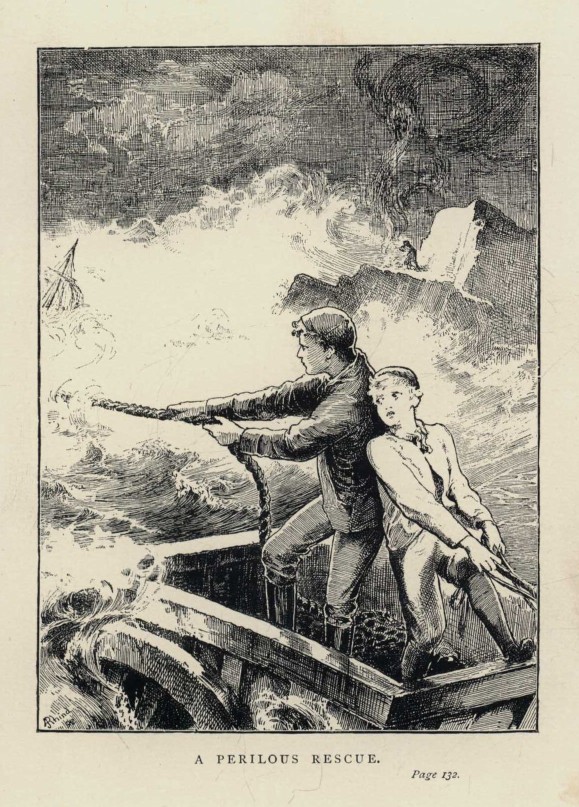
A PERILOUS RESCUE.
The rope tightened in Edwin's grasp; something had clutched it at last. The tug had come. Would his knots give way? He was faint with the fear that his work was not well done—not strong enough to stand the strain which he felt was increasing every moment. It seemed to him, as he watched with every sense alert and tried to its uttermost, that each successive earthquake shock, as it heaved the land, sent a corresponding wave across the sea. One of these had carried out his hoop, and he knew he must wait until it subsided to draw his rope in, or it might snap like pack-thread under the awful strain.
"O Edwin, I am getting so tired!" said little Cuth, in a tone of such utter exhaustion it went like a knife through his brother to hear him.
"Only another minute," he replied; "just another minute—if we can hold on."
The longed-for lull was coming. Edwin gave Beauty his head; but the poor horse was stiffened with standing, and almost refused to move. Then Edwin tied himself to the cart.
"O Beauty, if you fail us we are done!"
The despairing cry roused the torpid energies of the horse. With a stretch and a snort he tugged and strained, dragging his load a yard or two landwards. A man's head appeared above the water. The joy of the sight brought back hope and capability. It was but a spasmodic effort; but Beauty caught the thrill of joy animating the boyish voices, cheering him on to renewed exertions. The wheels splashed round in the water; a cloud of muddy spray rose between Edwin and the rescued man. He could not see the sailor's face. The fire was dying. Was all the wood they had gathered—all that great heap—burnt up at last?
Audrey raked the dying brands together, and a fresh flame shot upwards, and by its welcome radiance Edwin was aware of two hands working their way along the tightened rope, one over the other, towards the cart.
The tightened rope! Yes; that was proof that some one had grasped the hoop. In another moment that stranger hand was clasping Edwin's in the darkness that was following fast upon those fitful flames.
"Hold hard!" shouted a stentorian voice, and a man got up into the cart beside him. A deep-drawn breath, a muttered prayer, and the strong, powerful hands clasped over Edwin's, and began to draw in the rope.
Not a word was said, for the boys had no voice left to make themselves heard. The last shout of joy to Beauty had left them spent and faint. The stranger, surprised at the smallness and feebleness of the hand he now let go, gently pushed the boy aside and took his place. Edwin leaned against the front of the cart beside his brother, dead beat and scarcely conscious of anything but a halo of happiness radiating from the blessed consciousness which found expression in a murmured, "Cuth, old boy, we've done it."
The reins fell slack on Beauty's neck, but the good horse needed no guiding. He seemed aware that two more men got up into the cart, and when a pause followed he gave his proud head a triumphant toss, and brought them up out of the water. There were three men in the cart and twice as many more holding on by the rope.
Audrey ran down from the dying fire to meet them.
A strange, unnatural kind of twilight, a something weird and ghastly, belonging to neither day nor night, seemed to pervade the land, and shed a sepulchral gleam across the men's pale faces. Audrey pushed open the door of the hut and beckoned to the sailors to enter.
They gathered round her, shaking the salt water from their dripping garments, and uttering broken exclamations of surprise and thankfulness. She saw a boy in the midst of the group limping painfully. As she hurried up to his assistance, she discovered that it was neither Edwin nor Cuthbert; but he grasped her outstretched hand so thankfully she could not withdraw it. There was a wildness in the alarm with which she began to ask them for her brothers the men could not mistake. They gave the forlorn girl an almost unanimous assurance that they knew nothing of her brothers. For the men clinging to the rope had not seen the boys in the cart. "But," added one heartily, "we'll protect you, for there is wild work afoot somewhere to-night. We have heard the cannonading, broadside after broadside, or we should not have gone rock-hunting in the dark. It is fool's work—you can give it no better name—coasting along a dangerous shore, with a sky too black for moon or star to penetrate."
"Yon's the little maid who fed the beacon," said another. "I saw her move across the front of the fire and throw her sticks upon it. God bless her! Every minute I thought we should see her blown over into the sea."
"Not me, not me," interposed poor Audrey.
Getting free in her desperation, and pressing between the sailors, she ran towards Beauty, who was slowly lagging round to the back of the hut.
"If my brothers are missing," she cried, "they must have been washed out of the cart." She clasped her hands before her eyes to shut out the sight of the drowning boys which imagination was picturing, and so failed to perceive the two weary heads leaning against the side of the cart. It was but a moment of agony, one of the unfounded alarms which always cluster round a real danger and follow the shock of dread like its shadow.
"Edwin, Edwin! where are you?" she cried.—"Cuthbert, Cuthbert! come to me!"
The rocks gave back the hollow echo, "Come to me!"
But she did not hear two faint voices feebly expostulating, "We tied ourselves to the cart, and we can't undo the knots. We are here, like two galley-slaves chained to the oars, and we can't get out."
A shock of earthquake sent Beauty with a shiver of terror straight to the open. The men threw themselves on their faces, knowing how easily they might lose their footing on the reeling ground; whilst Audrey, neglecting this precaution, went over like a nine-pin.
The hut shook as if its carefully-piled walls were about to give way, and Audrey, who had seen their house go down in the beginning of this fearful night, shrieked out for Effie.
As the tremor subsided, and the sailors gathered from poor Audrey's broken sentences some idea of the awful catastrophe on land, they turned from the hut, judging it safer to remain in the open.
Mates were looking out for mates. Were they all there? Captain, boatswain, cook—not one of the little coaster's crew was missing. Passengers all right: a gold-digger from Otago, the schoolboy from Christchurch. Are all saved? Only the hand which threw the rope was missing.
Who backed the cart into the sea? they asked; and where was Oscott?
When they learned from Audrey's frantic replies that every man had gone to the rescue, and the little fugitives had been left in the hut alone, the sailors' desire to find the missing boys was as earnest as her own.
They pointed to the cart jogging steadily across the grassy plain, dotted with sheep, and shaded here and there by groups of stately trees.
"God bless the young heroes!" they exclaimed. "Why, there they are—off to the mansion to beg for tucker for us all."
Audrey, set at rest from this last great fear, escaped from her questioners, and retreated to Effie and the empty hut, saying reproachfully,—
"How just like Edwin! But they might have told me what they were going to do."
It seemed a moment's reprieve. There was nothing more to be done. Audrey sank upon the bed of fern leaves, weary and wet and worn, unable any longer to resist the craving for a little sleep.
The sailors lit a fire on the open grass beyond the hut, and grouped themselves round it to talk and rest. The poor fellows who had been dragged to shore, clinging to the rope, found their shoeless feet cut and bleeding from the sharp edges of the oyster-shells with which the sands were studded. But when an hour or more passed by, the sunless noon brought with it sharper pangs of hunger to them all.
No cart had returned, no boundary rider had put in an appearance, and the men began to talk of a walk over the grass to find the mansion. They were all agreed as to the best course for them to pursue. They must turn "sundowners"—the up-country name for beggars—tramp across to the nearest port, begging their way from farm to farm. They knew very well no lonely settler dare refuse supper and a night's lodging to a party of men strong enough to take by force what they wanted.
The embankment with its swinging fence, the shepherd's hut where the girls were sleeping, told them where they were—on the confines of a great sheep-run. Their route must begin with the owner's mansion, which could not be very far off, as there was no food in the hut, and no apparent means for cooking any, so Audrey had told them. But now the storm was dying, the captain rose to look round the hut for himself. He was wondering what to do with the Christchurch boy he had undertaken to land at another great sheep-run about twenty-five miles farther along the coast It was of no use to take him back with them, a hundred miles the other way. He hoped to leave him at the mansion. The owner must be a wealthy man, and would most likely undertake to put the boy on board the next steamer, which would pass that way in a week or ten days.
So he called to the boy to go with him, and explained his purpose as they went. They waked up Audrey, to ask the owner's name.
"Feltham," she answered, putting her hand to her head to recall her scattered senses; between rabbiters and sailors she was almost dazed.
To be left alone again in that empty hut, without food, without her brothers, was enough to dismay a stouter heart than hers. The captain spoke kindly.
"I want to see you all safe in this sheep-owner's care before I leave you," he said. "It was stupid in those brothers of yours to go off with the cart, for you are too exhausted to walk."
"Did you ever hear the name of Bowen in these parts?" asked the Christchurch boy eagerly, nursing a bleeding foot the while.
Audrey thought of the kind old gentleman in Ottley's coach, and answered, brightening.
"I am his grandson," the boy replied. "I am Arthur Bowen."
CHAPTER IX.
NOTHING TO EAT.
As the shock of the earthquake subsided, and Beauty rallied from his terror, his pace began to slacken. If Edwin had not tied himself and Cuthbert so securely in the cart, they might have been thrown out when Beauty ran away. So the knots which would not be untied proved their protection; and now they found themselves trotting leisurely through verdant stretches, dotted with ti tree and blue-gum, and overgrown with toi and flax and rushes. Before them rose the great gates of the avenue leading to the central station-house. The white front of Feltham's mansion gleamed through the tall stems of the trees which surrounded it; whilst beyond and around them were the sheds and walls, the pools and bridges, comprising stock-yards and shearing-places, where thousands of wild cattle and tens of thousands of wilder sheep were washed and dipped, and counted and branded, year after year.
The ingenious arrangement of pool and paddock and pen by which this gigantic undertaking is safely accomplished looked to the boys like a wooden village.
Beauty drew up at the friendly gate of his own accord, attracted by the welcome sounds of human life as stockmen and shepherds hurried out to their morning work. Half the hands were off to the hills; the remaining half found in consequence the more to do. The poor terrified cattle had suffered considerably. Sheep were cast in every ditch. Cows had gored each other in their mad terror; and broken fences told of wild leaps and escaped bulls to be sought for in the neighbouring bush.
The boundary rider, whose sole duty is to parade the vast domain and give notice at headquarters of unwary gaps and strays, had been spurring hither and thither, delayed by the gloom of the morning and the herds of wild bulls which had broken in, while the tame had broken out. With demolished fences, and frightened sheep dying around them by hundreds, the little fugitives in Oscott's hut had been forgotten.
But when the boundary rider saw a cart at his master's gate, blue with volcanic mud above, and dripping from below with the slime of the sea, he thought of the family from the hills waiting somewhere for the breakfast he was to have carried in his saddle-bag. His circuit was but half completed. "I shall find them yet," he said to himself, as he galloped up behind the cart. He saw the dangling rope, and the white faces of the two boys huddled together in a state of complete exhaustion. He tied his horse to the gate, and jumping into the cart, rattled Beauty up the avenue to his master's door, which stood wide open to all comers. For every hour brought fresh rumours, and fresh parties of fugitives who had fled precipitately from their homes when the storm of mud began.
He took his knife from his pocket and cut the rope which tied Edwin and his brother to the cart. Some one ran out with a cup of coffee, which he poured down their throats, and then the boys began to revive. He wanted to take them in-doors and put them to bed. But the relief-party had already sent down so many sufferers from the hills every bed was full of children, women, and even men, who had been dug out of the muddy stream in which they were suffocating.
As soon as Edwin could speak, he added his story to the others, entreating the men who turned their heads to listen, as they hurried in and out, to send some food to his sisters, who were left alone in Oscott's hut. As for the sailors, the feeling among Feltham's people was decided: any one not from the hills must be left to take care of himself.
Just then a horseman, covered with mud and foam, came spurring towards the house, shouting to the crowd around the door,—
"I've come for every man on the ground, by the master's orders. Leave everything. Bring your spades, and follow me. The nearer we get to Tarawera the thicker lies the mud. Our government station at Rotorua is buried beneath it, church and all. Te Ariki and Maura are nowhere to be seen. The low whares in the Maori pahs are utterly destroyed. Wherever the roofs have been strong enough to uphold the weight of the falling mud, the inhabitants are alive beneath them now. Come to the rescue—come!"
The last hoarse words were scarcely audible. The boundary rider took the unfinished cup from Edwin's lips and passed it to the man, and the boy was glad that he did so.
A cry of "Spades! spades!" rang through the increasing group of listeners, which seemed to gather and disperse with equal rapidity. Mrs. Feltham made her way through the midst to the bell-tower, and rang a frantic peal to call all hands together. Horses were saddling; men were mounting; others were hurrying up to learn the meaning of the hasty summons. Edwin drew his cart aside under the trees to watch the departure.
Mrs. Feltham reappeared on her doorstep with knife and loaf, trying to fill every pocket with bread before each one rode off. She could not make her intention understood. The men, in their impatience to be gone, would hardly stop to take it.
"Oh," thought Edwin, "they forget they will want it all to give away."
He leaned over his brother. "Cuth, take the reins." But Cuth's numbed hands let them drop. Edwin twisted them round his arm, and with a nod and a smile made his way to Mrs. Feltham.