XII. THE DEATH OF DIXMUDE
Florence Simmonds translation
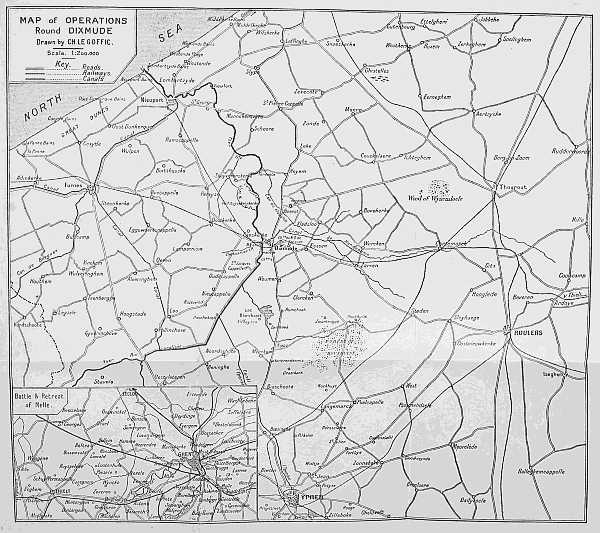
She is not quite dead yet, however. Scalped, shattered, and burnt as she is, she still holds a spark of life as long as we are there. This charnel-house in which we are encamped, with its streets, which are nothing but malodorous paths winding among corpses, heaps of broken stone and brick, and craters opened by the Boche marmites, still beats with life in its depths. Existence has become subterranean. Dixmude has catacombs into which our men pour when they leave the trenches. And they are not all soldiers who explore the recesses of these vaults and cellars. The suspicious lights alluded to by Alfred de Nanteuil are not, perhaps, always carried by pillagers. Mysteriously enough, one house in the town has escaped the bombardment. It is the flour factory near the bridge, and its cement platform still dominates the valley of the Yser.
The 42nd Division left us two of its batteries of 75's when it moved off. That was something, of course, though not enough to make up for the disablement of 58 out of the 72 guns we originally had for the defence of our front. The only formidable guns we have are the heavy ones, but they are without the mobility of the 75's. And now apparently our attack on the Château of Woumen has disquieted the Germans, who are again in force before Dixmude. The bombardment of the town and of the trenches has recommenced, and last night we had to repulse a pretty lively attack on our trenches at the cemetery. There is also pressure along the Eessen road, with considerable losses at both points. A renewal of the attack to-night seems probable. And our ranks are already thin![63]
"Mother," writes a Marine from Dixmude on November 7, "it is with my cartridge belt on my back and sheltered from the German machine-guns that I send you these few lines to say that my news is good, and that I hope it is the same with you and the family. But, mother, I don't expect that either you or the family will ever see me again. None of us will come back. But I shall have given my life in doing my duty as a French soldier-sailor. I have already had two bullets, one in the sleeve of my great-coat, the other in my right cartridge case. The third will do better."
On the same day another Marine writes home: "Out of our squad of 16, we still have three left." However, the night of the 6th and the day which followed were quiet enough. The disappointment caused by the failure of our attack on the Château was already almost forgotten, and our hopes were again rising.
"I think," wrote Alfred de Nanteuil, "that my company will not stir from this for some time. I have to furnish reinforcing parties as they are wanted, the rest of my men and myself staying in the trench, which we are always improving. We have a farmhouse near by which allows us to eat in comfort. And we have plenty of straw."
The general impression is that we are held from one end of the front to the other. "Bombardment always and musketry, a siege war, in short. It will come to an end some day. Meanwhile," says De Nanteuil, gaily, "our spirits and health are good." But this very afternoon certain suspicious movements were descried on the further bank of the Yser. As it was easy to bombard this part of the hostile front, a gun was promptly trained in that direction. Was it a decoy, or was some spy from behind sending signals? The gun no sooner came into action than a German battery was unmasked upon it, killing Captain Marcotte de Sainte-Marie, who was controlling the fire.[64]
Thenceforward attacks never ceased. The night between the 7th and 8th was nothing but a long series of attempts on our front, which were all repulsed. They began again at daylight against the trenches at the cemetery. There the enclosing wall had been battered down for some time past by the German artillery. Through the loopholes in our parapets one could see the wide stretch of beetroots on the edge of which we were fighting, our backs to Dixmude. Away on the horizon the Château of Woumen, on its solitary height, rose from the surrounding woods and dominated the position. Little clouds of white smoke hung from the trees, which seemed to be shedding down. In his invariable fashion, the enemy was preparing his attacks by a systematic clearing of the ground; shrapnel and marmites were smashing the tombstones, decapitating the crosses, breaking up the iron grilles, the crowns of immortelles, and the coffins themselves. The Flemish subsoil is so permeable that coffins are not sunk more than a couple of feet below the surface, so that their occupants were strewn about in a frightful way. Several Marines were wounded by splinters of bone from these mobilised corpses.... In the fogs of Flanders, when the mystery of night and the great disc of the moon added their phantasmagoria to the scene, all this surpassed in macabre horror the most ghastly inventions of romantic fiction and legend. Familiar as our Bretons were with supernatural ideas, they shivered at it all, and welcomed an attack as a relief from continual nightmare.[65]
"Although we did not give way at all," writes a Marine, "we understood that everyone was not made like ourselves and the Senegalese. We took pity on the poor worn-out Belgians, who had come to the end of their tether, especially their foot Chasseurs,[66] and we took their places in the trenches. We had three aviatiks continually hanging over us,[67] at which we fired in vain. They returned every day at the same hour, as surely as poverty to the world. As soon as they had gone back we knew what to expect. Down came the marmites on our devoted heads!"
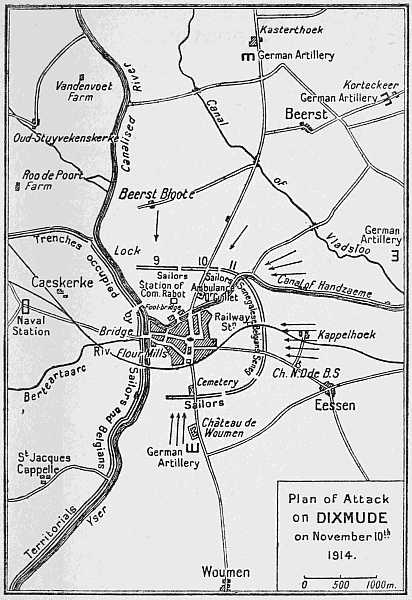
And their music, compared to the gentle coughing of our little Belgian guns! At last a dozen new 75's appeared on the scene and relieved these poor asthmatics. They were distributed between Caeskerke and the Yser. Our grim point was the cemetery. There one of our trenches had been taken by the Germans, but a vigorous counter-attack, led by Second-Lieutenant Melchior, soon turned them out. "Exasperated by so many sterile efforts," writes Lieutenant A., "the enemy decided, on November 10, to make a decisive stroke. Towards ten in the morning began the most terrible bombardment the brigade had yet had to suffer. The fire was very accurate, destroying the trenches and causing great losses."[68] At 11 o'clock 12,000 Germans, Mausers at the charge, advanced against Dixmude.[69]
This attack repeated the tactics of the early days of the siege. The Germans came on in heavy masses, reinforced by fresh troops. They had also learnt the weak points of their opponents. And yet it is not certain that the attack would have succeeded had it not been for the unexpected giving way of our positions on the Eessen road.[70] This was the only part of the southern sector not defended by Marines. It must have been entirely smashed up, with the Senegalese who flanked it on both wings. As a fact, the enemy's fire was so intense along the whole line and our reply so feeble, that Alfred de Nanteuil, who occupied a trench in rear of the northern sector, had to withdraw his men behind a haystack. "Impossible to lift one's nose above the ground," writes an officer, "so thick and fast came the shells." The attacking column was thus enabled to pass the canal at Handzaeme and to fall upon the flank of the trenches occupied by the eleventh company. This company had been engaging the batteries at Korteckeer and Kasterthoeck, on their left, and a violent rifle and machine-gun fire from a group of farms higher up the canal. What was left of it had barely time to fall back upon its neighbours, the ninth and tenth companies. A hostile detachment, creeping along the canal, had contrived to push as far as the command post of the third battalion, taking possession on the way of Dr. Guillet's ambulance, which had been established at the end of the Roman bridge. Our trenches were not connected by telephone, and communications had broken down. Four marines only, out of the 60 in the reserve of Commander Rabot, succeeded in escaping. The sentry on the roof of the farm in which they were waiting saw the enemy coming and gave the alarm: "The Boches—quarter of a mile away!" "To arms!" shouted De Nanteuil. "Into the trenches!"
OLD HOUSES ON THE HANDZAEME CANAL
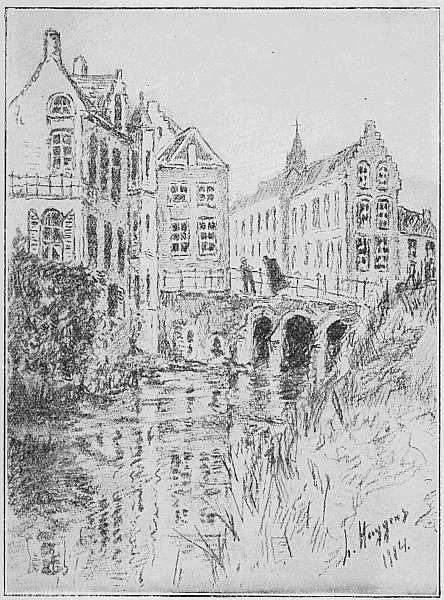
He himself went to an exposed point to observe the enemy. There a bullet hit him in the neck, striking the spinal marrow. How his men contrived to bring him off it is difficult to say. He remained conscious and had no illusions as to his state. All his energy seemed concentrated on the desire to die in France. He had his wish.[71]
Then came the final defeat. The lines on the Eessen road driven in, the dyke pierced at the centre, the northern sector cut off from the south, the German wave flowed over us. The enemy had penetrated to the heart of our defence, and, being continuously reinforced, swept round our flanks and took us in reverse. One after another our positions gave way. Already the first fugitives were arriving before Dixmude.
"Where are you off to?" cries an officer as he bars the way to a sailor.
"Captain, a shell has smashed my rifle. Give me another, and I'll go back."
They give him one, and he returns to the inferno. Another, wandering on the field like a soul in torture, replies to the inquiry of an officer that he is "looking for his company. There cannot be much of it left, but," straightening himself, "that does not matter: they shall not get through!"[72]
And they do not get through. But it was too late to stop them from entering Dixmude. Their musketry was all round us, a rifle behind every heap of rubble, a machine-gun at every point of vantage. The sharp note of the German trumpet sounded from every side. It is possible that a certain number of the enemy who had lain hidden in the cellars of Dixmude ever since the fighting on the 25th now came out of their earth to add to the confusion. The truth of this will be known some day. We were under fire in the town, outside the town, on the canal, on the Yser. It was street fighting, with all its ambuscades and surprises. What had become of the covering troops in the cemetery and on the Beerst road? Of the reserve under Commander Rabot, driven from ditch to ditch, its commander killed or missing,[73] only fifteen men were left. These were rallied by Lieutenant Sérieyx in a muddy ditch, where they fought to the last man. Surrounded and disarmed, Sérieyx and some others were forced to act as a shield to the Germans who were advancing against the junction of the canal and the Yser. "Abominable sight," says Lieutenant A., "French prisoners compelled to march in front of Boches, who knelt behind them and fired between their legs!" Our men beyond the Yser could not reply.
"Call to them to surrender," ordered the German major to Sérieyx.
"Why should you think they will surrender? There are ten thousand of them!"[74]
There were really two hundred!
At this moment a sudden burst of fire on the right distracted the enemy's attention. With a sign to the others, Sérieyx, whose arm had already been broken by a bullet, threw himself into the Yser, succeeded in swimming across, and at once made his way to the Admiral to report what was happening.
A counter-attack ordered by the officer in command of the defence and led by Lieutenant d'Albia had covered his escape. The eighth company, in reserve, reinforced by a section of the fifth company of the 2nd Regiment, under Commander Mauros and Lieutenant Daniel, entrenched itself behind the barricade at the level crossing on the Eessen road.[75] On all the roads leading to the Yser, and especially at the three bridges, sections strongly established themselves or helped to consolidate sections already there. Would these dispositions, hastily taken by Commandant Delage, be enough to save Dixmude? At most they could only prolong the agony. Her hours were numbered. After having driven its way through the hostile column which had reached the Yser, Lieutenant d'Albia's section encountered more Germans debouching from the Grand' Place and neighbouring streets. Germans and Frenchmen now formed nothing but a mass of shouting men. They shot each other at close quarters; they fought with their bayonets, their knives, their clubbed rifles, and when these were broken, with their fists, with their feet, even with their teeth. By three in the afternoon we had lost one half of our men, killed, wounded, or prisoners. The German columns were still pouring into Dixmude through the breaches in the defence. They pushed us back to the bridges, which we still held, which we were indeed to hold to the end. They were going to take Dixmude, but the little sailor was right: they were not going to pass the Yser. One more attack was organised to bring off the Mauros company, which was retiring under a terrible fire. The remains of several sections were brought together, and, led by their officers, they charged into the mêlée in the streets. One purple-faced, sweating Marine, who had seen his brother fall, swore he would have the blood of twenty Boches. He went for them with the bayonet, counting "One! two! three!" etc., till he had reached twenty-two. After that he returned to his company, a madman.
But what could the finest heroism do against the swarms of men who rose, as it were, from the earth as fast as they were crushed? "They are like bugs," sighed a quartermaster, and night was coming on. Dixmude had ceased to give signs of life. For six hours fighting had gone on over a dismembered corpse. Not a gable, not a wall, was left standing, except those of the flour factory. To hold these heaps of rubbish, which might turn into a focus of infection, was not worth the little finger of one of our men. At 5 o'clock in the evening, after blowing up the bridges and the flour factory, the Admiral retired behind the Yser.[76]
"Dear mother," wrote a Marine a few days later from Audierne, "I have to tell you that on the 10th of this month I was not cheering much at Dixmude, for out of the whole of my company only 30 returned. I never expected to come out, but with a stout heart I managed to get away. I had a very bad time. Many of us had to swim to save ourselves." These, no doubt, were the prisoners who had thrown themselves into the canal with the heroic Sérieyx.
All this time Lieutenant Cantener, who had taken command on the death of his senior officer, had been maintaining himself on the Beerst road, with three companies of Marines. At nightfall he had the satisfaction—and the credit—of bringing nearly the whole of his command safely into our lines. They had made their way by ditches full of water and mud up to their waists. They were 450 in all—450 blocks of mud—and they were not, as has been said, worn out and without arms and equipment, but steadily marching in fours, bayonets fixed, and as calm as on parade. They had their wounded in front, and each company had its rear-guard.[77]
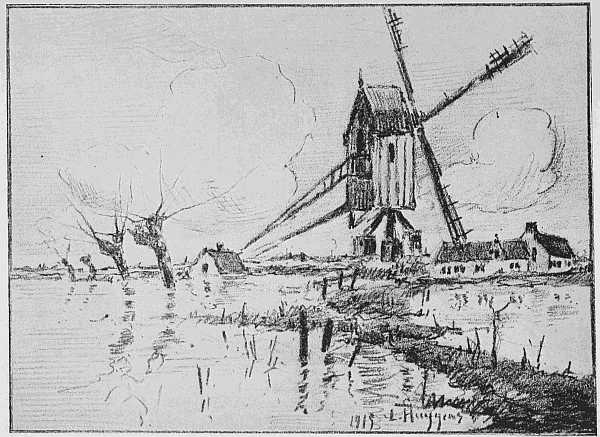
Too many of our men were left beneath the ruins of the town or in the hands of the enemy, but they had not been vainly sacrificed.[78] After losing some 10,000 men,[79] the Germans found themselves in possession of a town reduced to mere heaps of rubbish with an impregnable line beyond. Our reserve lines had become our front, well furnished with heavy guns, and punctually supported by the inundation which stretched its impassable defence both to north and south. The whole valley of the Lower Yser had become a tideless sea, out into which stood Dixmude, like a crumbling headland. In taking it the Germans had simply made themselves masters of two têtes de pont. Even that is saying too much, for we still commanded the place from the northern bank of the Yser, and our artillery, under General Coffec, frustrated all attempts to organise their capture. Meanwhile thousands of Germans, between the Yser and the embankment of the Nieuport railway, watched with apprehension the water rising about the mounds up which they had hauled their mortars and machine-guns. In the immediate neighbourhood of Dixmude, where the Admiral had caused the sluice at the sixteenth milestone to be blown up,[80] a hostile column of some fifteen hundred men was overwhelmed by the water together with the patch of raised ground on which it had taken refuge.[81] A fresh inundation added greatly to the extent of the floods, and practically reconstituted the old schoore of Dixmude. All danger of the enemy's making good the passage of the river had finally passed away.
THE INUNDATION. OLD MILL AND FARMS ON THE YSER
FOOTNOTES: