"Digby Heathcote" (continued 3)
Reading edition
Marshall laughed at the idea of an old sailor not liking to spin a yarn a second time, when the chances were in favour of his having already spun it many hundred times. He took the hint, also, about the lectures on natural history, and said nothing more to Digby on the subject. He well knew that if he was to attempt to cram it down his throat, Digby would be very likely to take a disgust to it, and obstinately set his face against all branches of natural history. He promised, moreover, to try and get Toby to spin the yarn in which Easton had been so much interested.
The next Saturday half-holiday was very lovely, and all Mr Nugent’s pupils agreed to make a boating excursion up the river as far as they could go, and to dine in pic-nic fashion at the end of the voyage.
“We must try and get Toby Tubb to spin his yarn,” observed Digby, as they were starting.
Mrs Nugent had supplied them with some cold provisions; and they took potatoes to cook, and tea and sugar; and they hoped to catch some fish, which would be a great addition to their fare. However, they were fortunately independent of the fish, which sometimes obstinately refuse to be caught.
Power, however, who had great confidence in his own success as a fisherman, wanted the rest to leave a cold veal pie behind, assuring them that he would take care that they had an ample supply of salmon-peel, and bass, and flounders, which he promised to catch and cook for them.
“That is all very well,” said Marshall; “but I vote that we take the pie, and then we can be eating that while Power is dining on the fish which he has not yet caught.”
“Now, do you, Toby, take the helm, and we will row,” said Marshall, seating himself ready to pull the stroke oar.
Digby jumped in next him, for he knew that he was about to fulfil his promise, to get Toby to spin a yarn.
All took their seats, up went the oars. “Give way!” sung out Toby. The oars came with a simultaneous flop into the water, and the young crew bending to them, the boat glided swiftly and steadily over the smooth surface. The scenery for some distance was very beautiful: there were high cliffs, broken and fantastic in shape, with here and there openings through which green fields, and woods, and cottages could be seen, and deep bays and inlets, and, further off, downs, or heather land, on which sheep or cattle were feeding. The sky was blue, the air was fresh and pure; all were enjoying themselves, though they could not perhaps tell why.
“Try old Toby now,” whispered Digby into Marshall’s ear.
Marshall began in a diplomatic way. “Now, Toby,” he said, “while we are pulling and cannot talk much, it seems a pity that you should not be telling us something we should like to hear. You have been in a battle or two, I dare say; perhaps fought with double your numbers, and came off victorious, as I have heard of British seamen doing more than once.”
“I believe you, Master Marshall,” interrupted Toby. “I have been in a battle when we had three to one against us, and still we thrashed them. I’ll tell you how it was. I belonged, in those days, to the Spartan, a smart frigate of thirty-eight guns, and a first-rate dashing officer, Captain Jahleel Brenton, commanded her. We were in the Mediterranean in the year 1810. Many were the things we did which we had a right to talk about. It was about the end of April we were cruising in company with the Success frigate, Captain Mitford, and the sloop Espoir, when, standing in for the Castle of Terrecino, on the Italian coast, we made out a ship, three barques, and several feluccas, at anchor under shelter of the guns of that fort. Our captain, as soon as he saw them, determined to have them; so as he was commodore, do you see, he ordered away the boats of the squadron to cut them out. I was not a little pleased to find myself in one of the Spartan’s boats. The whole expedition was commanded by Lieutenant Baumgart, of the Spartan; and we had with us another brave officer, Lieutenant George Sartorius, of the Sirius.
“We rendezvoused on board the Spartan, and soon after noon pulled in for the castle, covered by the fire of the squadron, which opened a brisk cannonade on the town and batteries. The enemy were not idle, and the shot were flying pretty thick about us, but that did not stop our way.
“‘There’s the ship, my boys, and we must have her, and the barques too, if we can,’ sung out our lieutenant; and on we dashed, with a loud cheer, towards her.
“Round-shot and bullets came rattling about our heads, but they didn’t stop our way more than would a shower of hail. Away we pulled, maybe a bit faster, to get through them the quicker. In a quarter less no time we were alongside the ship, which mounted six guns, scrambling up her sides, knocking everybody who opposed us on the head—not that all stopped for that, seeing that many leaped into their boats as soon as we gained the deck, and pulled away for the shore. The rest, however, made a tough fight of it before they knocked under. To cut the cables and to let fall the topsails and sheet home was the work of a few moments only, and we were under weigh almost before the enemy had turned the guns of the castle on us.
“The other boats, meantime, divided the barques among them, and, attacking them altogether, drove their crews into the water, and, cutting their cables, made sail after us. We lost only one man killed and two wounded in the whole affair, and carried all four vessels off in safety.
“That’s what we call a cutting-out expedition. There’s nothing we used to like better. They were generally pretty sharp slap-dash affairs; no shilly-shallying, and counting what was dangerous and what was not; but it was pull in, jump aboard, and we were out again with the prizes before the enemy had time to find out what we were about. But that wasn’t what I was going to tell you about.
“Soon after this, our squadron was cruising off the Bay of Naples—not all, by the by, the Espoir had been sent away somewhere, and we had only the Spartan, that was our ship, and the Success. Well, we made out, under weigh in the Bay, two ships, a brig and a cutter. Not many moments had gone by before we had crowded all sail in chase. It was a French squadron we saw, but they didn’t like our looks, so they put about and stood towards Naples, we following them almost up to the Mole. That was on the first of May. The next morning at daylight we saw our friends at anchor, but they seemed in no way inclined to come out and fight us.
“‘Perhaps if they see one of us alone they may come out and take a taste of our quality,’ says our captain; so he sent off the Success to wait for us about eight leagues from the island of Capri, thinking that the Frenchmen would then, without doubt, venture out to attack us.
“In the meantime, the French General who had command at Naples, Prince Murat, had formed a plan to capture us. His French squadron consisted of a 42-gun frigate, the Céres; a 28-gun corvette, the Fama; an 8-gun brig, the Sparvière; and a cutter, mounting 10 guns; but besides these there were seven gunboats at least, each with one long 18-pounder and 40 men. General Murat had also embarked four hundred Swiss troops on board the ships, so that they had altogether 95 guns and 1,400 men, while we had only 38 guns and about 260 men. (Note.) We didn’t mind the odds against us, all we thought of was how we could take the enemy. They made sure, however, it seems, with the great odds in their favour, on the other hand, do ye see, of taking us; but we sung, with some right to sing it, too:—
“Hearts of oak are our ships, Jolly tars are our men; We always are ready, Then steady, boys, steady, We’ll fight, and we’ll conquer again and again.”
“All we were anxious for was the moment to begin. At last, before sunrise, on the third day after we had first made them out, which, do you see, was the 3rd of May, 1810, we got a slant of wind from the South-east, though it was very light, and we, being well to the southward, stood under easy sail into the Bay of Naples.
“Well, we were keeping a bright look-out for the enemy, and just at daybreak we made them out about six miles ahead, standing out from the Mole of Naples, and just between the island of Capri and the mainland. We were on the starboard tack, and they were on the larboard, or what we now call the port tack, remember.”
“What do you mean by the starboard and port tacks?” asked Digby, who was much interested in the details of the account, and wanted to understand it.
“Why, you see, the two lower corners of square sails have ropes to them called tacks and sheets. The tacks haul the corners of the sail down to the fore part of the ship, and the sheets to the after part. If the tack is hauled down on the starboard side, the sheet is of course on the other side, or to leeward, and the ship is then said to be on the starboard tack. So you’ll know if the wind strikes the starboard side, the ship is on the starboard tack, or, if it comes on the other side, she’s on the port or larboard tack.”
“Thank you,” answered Digby; “I know now, I think. But go on; it’s very interesting.”
“I vote that no one interrupts to ask questions,” exclaimed Power. “When the story is done we’ll all fire away as much as we like. Won’t that be best, Toby?”
Toby seemed to be of Power’s opinion, so the motion was agreed to nem con.
“Where was we?” began Toby, having been slightly put out, as even the best story-tellers are when interrupted. “Let’s see. Oh, I know, standing in towards the Bay of Naples, to meet the French squadron. We were on the starboard tack; they were on the opposite one. There’s a picture been done of the fight. It always does my old heart good to look at it; because, do ye see, it’s not like some pictures of battles—it’s true. An officer, an old shipmate, gave it me, and so I had it put in a frame, with a glass over it, and hung up in my cottage.
“There we were, do ye see, the three French ships and we, drawing nearer and nearer to each other on opposite tacks. The Frenchmen followed each other in line, the Céres leading, followed by the Fama and Sparvière, with the wind abeam. Instead, however, of keeping close together, as they ought to have done, they were some distance from each other. The light wind was thus all in our favour, as I’ll make you understand. At last the Céres clewed up her courses, and we did the same, and right glad we were to do it.
“Now, remember, that the Frenchman’s decks were crowded with troops, poor Swiss fellows, who had no wish naturally to hurt us any more than we had to hurt them.
“‘Now, lads, all hands lie down at their quarters. We shall be having a pretty hot shower of musketry among us before many minutes are over, and it will be just as well to let it pass over our heads,’ sung out our captain. All the time, though, he did not lie down, nor did some of the officers; but of course all the people did as they were ordered, except the men at the helm. It was close upon eight o’clock, when we were within pistol-shot of the Céres, that she opened her fire on us. Still we lay quiet. Now, do ye see, all our guns on the main deck were treble shotted.
“Our captain calmly waited, eyeing the enemy till every one of our guns bore on him. ‘Up, boys, and fire away!’ he shouted. Didn’t we just spring to our feet and blaze away like fury. What shrieks and cries rose from the Frenchman’s decks. Our shot mowed down the troops like corn-stalks before the sickle, besides killing numbers of the crew. The soldiers were drawn up all ready for boarding, but our captain was too wise to let them do that. As we were going little more than two knots through the water, we had plenty of time to load again, and to give the second Frenchman, the Fama, the same taste of our quality. Numbers were killed and wounded aboard her, and then, loading once more, we continued our course and fired into the brig. We had still the gunboats to talk to. They were not to be despised, and, as it proved, they were the worst enemies we had. As we approached them we fired our headmost starboard guns at them, and then, going about, let fly our whole larboard broadside, which we had again got ready for their amusement. They returned it with interest, though, and we lost many men from the shot of their long guns, while most of our masts and spars were likewise wounded. As we went about our starboard broadside was not idle, and we kept peppering away at the brigs and the two ships ahead of us. Well, the French commodore ought to have steered for the gunboats, but instead of that he wore round and stood away for Baia, on the north side of the Bay, where there were some batteries. We wore after him. Our captain had taken his stand on the capstan head, that he might have a clear view of everything, and a fine sight it was to see him standing up there undaunted, while the round-shot and musket-balls were flying thick around his head. ‘Ay, he’s the right sort of stuff, that skipper of ours,’ said my messmate, Bill Simmonds. ‘If we don’t take one or more of those Frenchmen I’m very much mistaken.’ After we had got up to the gunboats, and a large cutter there was among them, and hammered away at them, the breeze fell, and left us surrounded with enemies. The Céres lay ahead, with her starboard broadside turned towards us; and we had on our port bow the corvette and brig, while the cutter and gunboats came sweeping up astern, and pounding us pretty severely with their long eighteen-pounders. In spite of our first success, it seemed just then as if matters would go very hard with us. What was our sorrow, too, to see our brave captain knocked off his post badly wounded. He was carried below, for a grape-shot had hit him in the hip. Our first lieutenant, Mr Willes, then took the command. How we did whistle for a wind. Scarcely was our brave captain carried below before a light breeze sprung up: and I can’t tell you how our hearts beat with joy when we found ourselves once more drawing near the French frigate. There we soon were, on her starboard quarter, and on the starboard bow of the corvette, so that our guns were able almost to rake them both at the same time. We had, however, the brig peppering away at us on our larboard quarter, while the cutter and gunboats, some of which were astern and others on the starboard quarter, kept up a hot fire at us all the time. The enemy, it seemed, however, had no wish to continue at such close quarters, for as soon as the frigate’s sails felt the breeze, away she ran as fast as her legs could carry her, till she got under the shelter of the batteries of Baia. We should have followed her, but our rigging and sails had been so knocked about and riddled with shot that for the best of all reasons we didn’t—because we couldn’t. We managed to wear, however, and gave the frigate and corvette a parting benefit, raking them fore and aft with our starboard guns, and knocking away the corvette’s foretopmast. At the same time we poured our whole larboard broadside into the brig. Hearty was the shout raised aboard us, when down came her main-topmast, and, lowering her colours, she sung out for mercy, lest we should give her a second dose of the same character. Dropping a boat to take possession, we stood after the corvette, and should have taken her, but the gunboats came up with their long sweeps, and, in spite of a pretty severe fire we kept up at them, towed her in a very spirited way out of action. As I was saying, we couldn’t then follow, or we’d have had her also, at least. Perhaps we might have had the frigate, too. We hadn’t given up all hopes of another prize, and with a hearty good will we set to work to repair damages. We had altogether been rather more than two hours pretty closely engaged with the enemy. We’d lost by this time ten killed and twenty-two wounded. Both our captain and first lieutenant were very severely hurt. When the French frigate saw that we could not get up to her, she sneaked away from Baia and stood back towards Naples. By the time we were put somewhat to rights the sea-breeze set in, and so our captain ordered the prize to be taken in tow, and away we stood, passing just in front of Naples, before which the rest of the enemy had just dropped their anchors. Whether they thought that we were going to fetch any of them out I don’t know. We heard afterwards that the French General, Prince Murat, who called himself King of Naples, was watching all the time, expecting to see his frigate tow us in; and you may be sure that he was in a pretty great rage when he saw us carry off one of his ships instead, as our prize, before his very nose. I’ve heard since that the French, to excuse themselves, declared that our frigate was a rasé, or cut-down ship, and that we carried fifty heavy guns. You may read of many gallant actions, young gentlemen, but I don’t believe that you’ll ever hear tell of one better-fought battle. It showed the Frenchmen the stuff we were made of, though they’d found that out pretty often before. There’s one thing you may depend on,—every victory gained helps to win another. The enemy can’t help expecting to be beaten, and you feel that you’ve a fair prospect of winning the day. It’s just the same thing, take an old man’s word for it, when you’ve got to fight with bad habits, or vices, or sin of any sort, evil tempers, and evil propensities. Gain one victory. Learn that you can conquer the foe, and the next time you try you’ll find that he gives way more easily than at first; but, if you let him gain the victory, why ’tis you will go to the wall, faster and faster each time, till he knocks you down altogether. But I was telling you how the gallant Spartan captured the Sparvière; and don’t forget to come and see the picture, which ’ll show you all about it.”
The boys thanked Toby for his story, and all promised that they would go and pay him a visit, and see the prints of the battle. I need not repeat all the questions they asked him about it; how he liked having the shot flying about his head, and seeing his shipmates knocked over near him, and all that sort of thing.
“As to the first, young gentlemen,” he answered, “I can’t say as how I ever thought much about it; and as to the second, a man before he goes into battle knows that it may be his lot, and so he makes up his mind to it. When a man makes up his mind to a thing it is much easier to bear it, let me tell you. Besides, very few men, when they once begin to fight, think about anything else but the fighting.”
The conversation to which Toby’s history led lasted the party till they reached the place at which they intended to pic-nic. It had been selected not so much because of its peculiar beauty, as on account of the good fishing which Power expected to get there. He talked of salmon-peel, and basse, and flounders, and plaice, all of which come up salt-water rivers, and often venture into brackish waters. Power at once set off to the spot where he intended to fish: it was on a bank just below a mill-dam. The salt-water flowed in with the flood-tide, and when the ebb made a strong current run out, which always kept open a deep channel. Some shade-giving trees grew about, the turf was soft and green, and, at a little distance, the cliffs turned inland, and formed a ravine, in which stood the mill and the mill pond. Marshall and Easton went off to botanise, and to search in the cliffs for geological specimens and other subjects of natural history; while Digby and two other boys accompanied Power with their rods. Ten minutes passed, and all except Power began to make signs to each other expressive of increasing hunger; but no sign was there of a fish.
“Hurra!” he at last exclaimed; “I have a bite; I knew I should.” His float began to bob, and away it went down the stream. He gave his rod a jerk. “I have him fast enough,” he exclaimed. High he lifted his rod, and up came a fish—but such a fish—a little, ugly, big-headed, flat-snouted monster.
“A miller’s thumb!—a miller’s thumb!” shouted the party, laughing heartily. “What a fine dinner he will make for us,” cried one. “I hope you’ll let us have something else, Power,” said Digby.
“Not unless you will all hold your tongues, and let me try again, for I don’t think any of you will catch anything,” said Power.
Just then Toby arrived, with a stick and line. He held up the poor bull-head with a comical look, and pretended to let it drop down his throat—a proceeding which he would have found very unpleasant as besides its large head its back was armed with a row of sharp spines. “We call this a sea-scorpion, or sea-toad, and some call it a father-lasher, because he is supposed to be so wicked that he would beat even his own father,” said Toby, putting back the fish with a pretence of the greatest care into the basket. “Now, young gentlemen, I’ll see what I can do for the pot; it’s on, and boiling, and only wants something put into it. I’ll make you some pebble-soup if we don’t catch any fish; but the fish will be best, I think.” Toby, on this, went a little lower down the creek, and taking his seat on the bank, let his line drop into the water, throwing in, every now and then, some ground bait. Before long, he pulled out a shining silvery little fish, of most graceful form; another and another followed in rapid succession.
Digby, who had caught nothing, went up to him. “Why, Toby, what are those pretty little fish? I should like to have some of them,” he observed. “How do you catch them?”
“I’ll show you if you’ll sit down and try,” answered Toby. “You’ve caught no fish because you’ve been wandering about from place to place, and not taking advantage of the experience you have got with your first trials. If one depth won’t do, raise or lower your float; if one bait don’t do, try another; and the same with your hook, if you find that you get bites and don’t catch anything. Perseverance is the thing. I generally can tell how a lad is likely to get on in life by the way I see him fish. You’ll excuse my freedom, Master Digby; I like to say what I think will be likely to be useful to you.”
Digby thanked Toby, though he did not quite see the drift of his reasoning. He, however, put on a very small hook, and watched how he caught the smelts; and, in a short time, he had pulled up nearly a dozen. He might have captured more, but turning his head up the stream he saw that Power was hauling some big fish out of the water, and he could not resist the temptation of running off to see what it was.
“Help! help! Here, the landing-net, the landing-net,” shouted Power. “I’ve a conger, a conger; there’s no doubt about it.”
The conger-eel, which occasionally comes up salt-water rivers, is a ferocious fish, with powerful jaws. This was of good size, and struggled so violently, that Digby was afraid of losing hook, and net, and line. The other young fishermen had gone to a little distance, and were busily engaged in hauling in some captives which their skill had taken. Digby, in his eagerness, leaned over so far with the net that, just as he had got the conger into it, he lost his balance, and in he went heels over head. Power nearly followed. The conger got entangled in the net; and Digby’s first impulse, as his head came above water, was to grapple hold of the fish. This he did most effectually, and a tremendous struggle commenced; the conger trying to bite Digby, and Digby determined not to let him go. Power’s feelings were divided between his anxiety for Digby’s safety and his wish not to lose his captive. His shouts called Marshall and Easton, who were not far off. “Haul him out, haul him out!” he cried, lustily. “He’ll make a magnificent dish.”
“Which?” asked Marshall, laughing, “Digby or the fish?”
“Digby, Digby,” answered Power, really thinking that he was in danger.
“No, no,” cried Digby, “I won’t be cooked. Get out the fish first. He’s half mine, though, for I helped to catch him.”
The conger was wriggling about all the time, and Power was making every effort to keep his head away from Digby, whom the fish had apparently a strong wish to bite. Between all parties there was a tremendous amount of laughing, and shouting, and splashing. At last Marshall got hold of Digby’s collar, and out he pulled him, still grasping the net and the fish.
“Don’t let us go till you have got us well up from the water,” exclaimed Digby, panting with his exertions. “If you do, the beast may be getting away, and escape us after all.”
His caution was not unnecessary, for, breaking from the hook, no sooner was Digby’s grasp off him than away he wriggled at a great rate towards the water. It was no easy matter to catch him, for he turned round with his savage head and made desperate bites at the lads, who were in hot pursuit of him.
“Oh, stop him!” shouted Digby, almost crying in his agitation. “Oh, he’ll be off,—he’ll be off!”
Nearer and nearer the water he wriggled; with a hook in his mouth, and the mauling he had got, he was not likely to find much pleasure in his future career; still, life is dear even to fish. He was almost at the edge of the bank, when Marshall seizing his geological hammer, which he had thrown down to help Digby, with it dealt the poor conger such a blow on the tail that in an instant it was paralysed, and though its jaws moved a little, it no longer made an attempt to reach its native element.
It was now voted that dinner-time had arrived, or rather that it was time to begin cooking the fish. Altogether a very good supply had been caught: besides the smelt, Toby brought two grey mullets, a foot in length; these, he said, were rarely caught with the hook, as they suck in their food. They do not often eat living creatures, but grub down at the bottom for offal or weeds. It is a very sagacious fish, and, when enclosed by a net, always makes the greatest efforts to escape by leaping over it, or by seeking for some opening. Only a very perfect net will secure them. In some parts the fishermen form an inner line of straw, or corks, and the mullets leaping over it, and finding themselves still enclosed, do not make a second attempt till there is time to draw them to the shore.
Power had done even more than he had promised, for he had caught a salmon-peel and three or four flounders, besides his conger; while the rest of the party, who had gone to another spot, had caught some basse, and some plaice, and other flat fish. The basse is like a freshwater perch in some respects, but it is not so rounded, nor has it the bright colours of the perch. The plaice and flounders were not very large.
“What funny twisted-head fellows they are,” observed Digby, as he handed them to Toby to clean. “Well, it never did occur to me before I came here what a vast number of curious animals of all sorts live in the sea.”
“I believe, if people would look for them, they’d find as many in the sea as on land,” answered Toby. “Some of them are wonderful curious. Just think of a big whale, and then of a little shrimp; and there are thousands of things smaller than shrimps which live in the sea, and quite as curious.”
What a frying, and broiling, and boiling of fish took place; everybody was busy. Digby wanted, by the by, to remain in his wet clothes, but Toby would not let him, but made him strip, and then hung them up on the black rock, against which the sun was striking with full force. Here they quickly dried, while he sat near the fire, the butt for his companions’ jokes.
“Arrah, now,” exclaimed Power, “would Mr and Mrs Heathcote ever mistake you for their own eldest son and heir of all their virtues and estates, if they were to come by and see you sitting for all the world like a little Irish spalpeen or a gipsy boy, before his camp fire, gutting fish?”
“It’s hard, Power, after I helped you to save the conger, to laugh at me,” said Digby. “He’ll stick in your throat, depend on it.”
Had Digby seen himself in a glass he might have learnt one important lesson, and discovered how very slight a difference there was between him and the characters Power described.
The cooking part of the pic-nic was very amusing, but the eating the provisions was still pleasanter. Jokes and laughter ran high, and old Toby told them some more of his stories, of which I have no record. Altogether, they all agreed that they never had passed a pleasanter or more amusing day. They had saved a very nice dish of fish for Mrs Nugent; and in the cool of the evening they once more embarked, and pulled back to Osberton.
Note. I have no doubt that old Toby’s account is perfectly correct, because it agrees with one just narrated to me by Admiral Saumarez, who was a midshipman on board the Spartan. He was showing me some prints of the action—one of the most spirited on record, and seldom has an account of a sea fight been told me in a more graphic way. Toby’s narrative scarcely comes up to it, I fear.
Chapter Six.
The Reappearance of Digby’s Evil Genius—A Trawling Expedition—How the Guns of the Old Fort went off.
Digby was to all appearance getting on very well with Mr Nugent; a watchful eye was upon him; he had steady companions, older than himself, who were not inclined to lead him into temptation, while old Toby contributed much to keep him out of harm’s way. It may very well be doubted whether this was the best sort of training for a lad of his disposition and the style of life for which he was intended. He would be called upon to mix with the world, to associate with all sorts of people, and to go through the ordeal of a public school and college. One important point was in his favour; his uncle was endeavouring to instil into him good principles, and to make him love, and comprehend, and follow the only light which could guide him on his onward path through life—the Bible. Digby listened oftentimes earnestly, always complaisantly, to what his uncle said to him, and thinking that listening to what was good was of itself a virtuous act, he began to fancy that he had grown into a reformed and very steady character. He might not have found out his mistake, had not a new boy come to his tutor’s; his coming was spoken of some time before he made his appearance. Who he could be was the question. At length a carriage drove up to the door, and out of it stepped Julian Langley.
“Ah, Digby, how de ye do, how de ye do?” exclaimed Julian in an affected way, putting out his hand. “Introduce me to your friends. We are to be companions for some time, I’m told, so we may as well become intimate at once.”
Digby welcomed his old friend, and mentioned his name, but Easton and the other boys could not resist imitating his affected way of talking.
“How de ye do, how de ye do, Langley?” they exclaimed, laughing; while Marshall turned away, somewhat disgusted with the little jackanapes as he called him.
Julian, however, soon made himself at home. He had never held Digby in very high estimation, simply because he found that he could so easily lead him, and he therefore fancied that he should have a good right to look down upon his new companions. His reasoning was not very sound, and they were in no way inclined to be looked down upon. On the contrary, though they were all well disposed to treat him civilly, they showed no disposition to allow him to become very intimate with them. Marshall, indeed, very soon let him know what he thought of him, but it took a great deal to make Master Julian in any way dissatisfied with himself, or any of his belongings, or anything that he had done. It appeared unfortunate for Digby that Julian Langley should have been sent to Mr Nugent’s. Mr Langley finding at last that his son was getting into mischief at home, and hearing that his friend Heathcote had sent his boy to Mr Nugent, wrote to ask if he would take charge of him. Mr Nugent only knew that he was a friend of his brother-in-law, and without making any inquiries as to the character of the boy, at once agreed to receive him under his roof. One afternoon, a few days after Julian’s arrival, Mr Nugent announced that he had engaged a vessel for the following morning, and that he hoped the long talked-of trawling expedition would at length take place. The weather was fine, the sea was smooth, and there appeared every prospect of their enjoying a pleasant day.
“I don’t think that you have been much on the water, Julian,” said Digby. “I wonder how you will like it.”
“Very much, as you all seem to do,” answered Julian, superciliously. “You don’t suppose that I should be afraid of the water?”
“Not afraid of it exactly; but it makes people who are not often on it feel very queer, I know,” observed Digby.
“It might such a fellow as you,” replied Julian, who never lost an opportunity of showing how superior he thought himself to Digby. “I’ll tell you what though, I should take very good care that it doesn’t upset me. I’m above that sort of thing.”
Had Marshall, or Easton, or Power overheard him, how they would have laughed at the nonsense he was talking. All the evening Mr Nugent and Marshal were preparing the jars, and bottles, and boxes for preserving the specimens of marine zoology which they hoped to dredge up. The next morning proved as bright and beautiful as it had promised to be, and a very merry party embarked on board the Mermaid, a cutter of thirty tons, with a crew of six men besides Toby Tubb, who went as master. The fishing ground selected for the day was about four miles off the mouth of the harbour, and they had a fair though a light breeze to take them there.
“It may at first appear strange that one spot of ground should be suitable for trawling and not another,” observed Mr Nugent, as they sailed away from the shore. “There are several reasons for this. One is, that the flat fish which are to be caught feed only among certain weeds, to which their prey is attached, or among which they live; then, again, the trawl cannot be used over rough and rocky ground. Trawlers, therefore, generally drag their nets over smooth and shallow spots, where there is little chance of their being lost. They of course also prefer shallow places, where the net has not so far to descend. Besides the trawl-net, I am going to use a dredge, with which I hope to bring up shells and various specimens of marine zoology, which might be spoilt in the net.”
Mr Nugent’s dredge was a canvas bag, stretched on an oblong iron frame, with iron plates attached to it to serve as scrapers. Drawn along the bottom, as he explained, shells, and crabs, and other slow-moving animals were easily swept into it.
The trawl-net Digby examined with some curiosity. One end was stretched along a stout beam, with small but heavy iron triangles at each end. Just above the beam is a long bag, into which whatever the beam stirs up is forced. Fish, when touched by the beam, dart into the net, thinking that it is the way out, and soon get entangled in its meshes. Ropes are attached to each end of the beam, and they serve also to keep the well part of the net stretched upwards, and at the same time leaning forwards. Toby showed him exactly how it would work when it got to the bottom.
Julian looked on with a supercilious air, as if such matters were entirely beneath his notice.
“You little think, young gentlemen, of the immense number of vessels engaged in this work. There are some firms which own from a hundred and fifty to two hundred vessels, all more than twice the size of this one. Each vessel carries a hundred men, and they fish in fleets, from twenty to two hundred miles off the coast. Some go to the mouth of the Texel, and they remain out six weeks and two months together, fishing every day. Vessels employed as carriers tiring them provisions, and ice in which to pack their fish and carry them away. Little do you think, when you are eating a piece of turbot, how far it has come, and what trouble it has cost to bring it to you in a fresh state.”
By this time they reached the trawling-ground, and the great beam and its net was cast overboard, and the two ropes which were fastened to it were secured, one to the fore part and one to the after part of the vessel. Her peak was lowered, as also was the throat. The tack was triced up, the foresail hauled down, and a small jib only set. Thus, under easy sail, she slowly dragged on her net.
If there is any swell, a vessel feels it, thus partially anchored, much more than when she is under weigh. This Julian discovered to his cost. At first he was very proud of himself, as he walked about, and talked of going into the navy. Now, however, he became very silent, and grew yellower and yellower.
Slowly and gently the little vessel moved to the heaving wave.
“And that same voice which bade the Romans mark him, and write his sayings in their books, cried, ‘Give me some drink, Titanus,’ like a sick girl—” said Marshall, who had been watching poor Julian with a look in which there was very little commiseration.
Julian said nothing, but he showed more and more of the white of his eyes, and his lips curled in a very peculiar and ominous way.
“Wouldn’t you like to come to sea with me?” asked Easton. “It’s a jolly life fellows lead there. Plenty of fat pork and peas pudding.”
Julian shut his eyes, and would not reply, but his efforts to ward off the evidence of the malady from which he was suffering were perfectly fruitless. He had to rush to the side, and I need not describe what followed. He threw himself down on the deck, looking the picture of woe and wretchedness. Had he not already given himself so many airs, and made himself so disagreeable, he would undoubtedly have obtained the commiseration of his companions. As it was, no one except Digby pitied him, and even he could not feel very sorry for his discomforts. However, he went and sat down by him, and began to speak a few kind words, but Julian received his attentions in so uncourteous a way that he was not sorry to get up and watch the proceedings of the fishermen.
The trawl had not been down an hour, when it was resolved to haul it up. All hands were required for this, and everybody helped except Julian, who declared that he was too ill to move.
By slow degrees the ropes were hauled in, and at last the beam appeared, and a considerable portion of the net.
“Why, where are all the fish?” exclaimed Digby, who expected to see them sticking about in the net.
“Wait till we get the purse aboard, and then we’ll see what we have caught,” remarked old Toby, leaning over to secure the mouth of the said purse, or bag. “I see something big walloping about in it, at all events.”
Now came the most exciting moment—to discover the results of the hour’s trawling.
Fishermen do not always catch fish, but Mr Nugent was sure that numberless living things would be brought up in which he would be interested.
“Now see what we’ve got! see what we’ve got!” shouted Marshall, with all the enthusiasm of a naturalist; nor was Mr Nugent much less excited.
Up came the purse, with a mass of living things floundering and wriggling, and twisting about, with one huge monster in the centre. A part of the deck was sunk for the purpose, and into it the whole living mass was turned.
“Well, it isn’t often I’ve seen such a haul as this,” exclaimed Toby; “but take care, young gentlemen, that big fellow don’t catch hold of any of your fingers. He’d have them off in no time. We’ll haul him up out of that, or he’ll be knocking all Mr Nugent’s curiosities to pieces with his tail.”
“What is it, what is it?” was the question asked by all. Even Mr Nugent could not tell.
The monster at which they were gazing was fully six feet long, almost flat, of a dark brown colour, and a rough shark-like skin, with a huge broad head, and very widely-extended side fins.
Toby replied, “Some calls him an angel, and others a monk-fish, or a flat shark; but to my mind he’s very little of the angel about him, and if he’s a monk he’s a very ugly monk, you’ll all allow. He is very strong. If you were to stand on him, master Digby, he would lift you up.”
Digby did stand on him, and the huge fish gave a heave, and a snap with his jaws which made him jump off at a great rate.
“What, did you think the monk was going to leap overboard with you?” exclaimed Power, laughing.
“Indeed I did,” answered Digby, “I’m sure he felt as if he would.”
Meantime Mr Nugent was examining the rest of the contents of the purse, while the trawl, having been once more let down, was towing astern.
Two large skates were hauled out, and Digby came aft to look at them. They were perfectly flat, and had long thin tails, with spines on them, their pectoral or side fins being very wide. “It would puzzle any one to cut their heads off,” he observed.
“Why, Digby?” asked his uncle.
“Because they have not the slightest approach to a neck,” he answered. “If I had to describe one, I should say that it was more like a toy-shop kite than any other thing in shape. But I see there’s something else below all the seaweed and crabs, and other things. Stay, I’ll get it out.”
Mr Nugent was examining some of the living things he had picked out.
Digby stooped down to get hold of what he saw, but very quickly drew back his hand. “Some one has hit me on the arm,” he exclaimed, “or I have been stung, or something or other has happened. I cannot make out what, but it’s very disagreeable, that I know.”
“Let me see,” said Mr Nugent, taking the boat-hook and clearing away the weeds and mud. “Ah, we are indeed fortunate. We have caught a fine specimen of a somewhat rare fish. It is the torpedo, or electric ray. See, the body forms an almost circular disc; the tail, too, is much shorter than that possessed by the other skate we have got. You may well say that it has no neck. It gave you, Digby, the shock you complained of. We will examine its galvanic apparatus. We shall find it on either side, consisting of a number of tubes, having much the appearance of a honeycomb. Its peculiar property is given to it that it may benumb its prey, and, perhaps, digest it more easily. Animals killed by lightning more quickly decompose than those destroyed in other ways, and they do not grow stiff. This electric skate can emit the very same substance as lightning, and though a very small quantity entered into your body, it caused you some pain. When in the water, possessed of all its vigour, it may be supposed that it can very easily destroy the smaller fry on which it feeds.”
“I am very glad that the brute hadn’t its full vigour, for it has hurt me considerably as it is,” answered Digby.
Besides the skates, the net had brought up half a dozen good soles and a large supply of crabs of various sizes and descriptions, star-fish, jelly-fish, shrimps, and other crustacea, all of which were examined by Mr Nugent, and the best specimens transferred to his jars, and pots, and bottles. There were some hermit crabs among them, who had taken possession of various shells, but one or two unfortunate fellows had been caught while in the act of changing their homes, and had no covering for their nakedness. The head and shoulders were like those of a lobster, but the lower extremities were perfectly soft.
Mr Nugent explained how they have to look out for an unoccupied shell, or perhaps eat up the occupant, and then wriggle in their own tails.
The hermit crab grows bigger, but the shell does not, so, when he feels his tail pinched, he has to look out for a larger home. It is amusing to watch him crawling along, examining shell after shell, till he has discovered one to his satisfaction. Then, when he has ascertained that it is unoccupied, he whisks his tail out of one and as rapidly pops it into the new one.
Mr Nugent pointed out that one claw was much larger than the other, and he showed how, when the hermit wishes to withdraw itself into its shell, he can perfectly coil himself away by doubling up the little claw and closing the larger one over it.
Digby was really much interested in the number of star-fish, and shells, and sea-weeds, and many other things, about which his uncle did not think it wise to enter on long explanations to him.
With the next haul of the trawl they were not nearly so successful, giving them an idea of the precarious nature of the fisherman’s calling; while in the third there was scarcely a fish, but Mr Nugent pronounced it more prolific than any of the former ones to him.
It was now time to return home. The net was thoroughly washed, and then triced up in the rigging, while the beam was lashed alongside.
Julian had begun to recover, but he was very unlike himself, and not at all inclined to talk and boast; indeed, Power remarked that he had never seen him so agreeable since he had come to Osberton.
Digby had been examining the crustacea with grave attention, the lobsters, crabs, and shrimps, when, lifting up one, he exclaimed, “It’s very odd; I always thought they were red. How is it, uncle, that these are black?”
A loud laugh from his companions was their reply to the question.
“You are thinking of the lobsters you have seen brought to the table cooked, and ready to be eaten,” observed Mr Nugent. “But go on, Digby, never be ashamed of asking questions, although, now and then, they may bring down a laugh upon you. It would fare but ill with the poor crabs and lobsters if they were not black, or rather of the colour of the rocks and weeds among which they live. Their colour thus enables them to escape detection from the sharp-sighted fish, which are constantly swimming rapidly about in search of them, and, in spite of their coats-of-mail, easily gobble them up. But I was going to show you this little pea-crab, Pinnotheres. He is said to have established a friendship with the inhabitant of a bivalve shell, the Pinna, or Sea-wing. When he wants to go out in search of food, the Pinna opens her shell, and lets him out. He, argus-eyed, watches the approach of their mutual enemy, the Polypus, and instantly rushes back, and by his return giving notice of danger, the shell closes, and both are safe. Otherwise the Polypus might get one of his rays inside the Pinna, and destroy its vitality in a moment, or he might touch the crab, and kill it in the same way. When the pea-crab discovers a supply of food he brings it to his friend, the Pinna, to be divided equally. I will not vouch for the truth of this account; and I am afraid that Master Pinnotheres has some more interested motive in his attachment, and may, in the end, eat up his friend, the Pinna, out of house and home.”
This and many other interesting accounts Mr Nugent gave to his pupils on the return trip. Sometimes he even won the attention of Julian, who condescended to smile at his anecdotes. That young gentleman got a good deal better by the time he reached the shore, but he was not himself all the evening, and went fast asleep while Mr Nugent and his fellow-pupils were examining some of the marine insects they had brought home in their jars, through the microscope.
Several days passed away, and, to all appearance, Julian had gained a lesson from which he had profited, not to think so much of himself. He had found out that others could be brisk and sprightly under circumstances which made him dull and wretched, and that they also knew a great deal more about all sorts of things than he did. To his surprise he found that his tutor, and Marshall, and Power, knew even far more about horses, and dogs, and game of all sorts, than he did. His knowledge was confined to the limited range of his father’s park, and to such information as the grooms and gamekeepers had given him. They knew where the various races came from, their habits in their wild state when they were introduced into England, and they had read about sporting in all parts of the world. He thus found himself instantly put down, as he called it, when he began to talk in an authoritative way on what he had been taught to consider the most important subjects for the attention of a gentleman.
Bad habits and erroneous notions are not without much difficulty eradicated; and so Julian Langley very soon forgot the lesson he had received, and began to think and act very much in his old way. “I say, Digby, the way we have to go on here is horribly slow work,” he observed one day, when he and his old companion were alone. “Don’t you think, now, we could put each other up to some fun or other. I want to do something to astonish the natives down here.”
Digby said he could not think of anything just then, but that he would try. They were strolling along the beach; it was a fine autumn day, but fresh. “I vote we have a run,” said Digby. “It’s cold.”
They ran on till they reached the old castle, of which I have before spoken. Julian never liked running, so he proposed going in and sitting down in a sunny sheltered spot under the walls. There were six or eight cannon of large size mounted on very rotten honeycombed carriages in the fort. They had not been fired within the memory of man, but they every few years received a coat of paint, which prevented them turning into rust; and a superannuated gunner from the Royal Artillery, with much ceremony, cleaned them out of the stones and rubbish which the children in the neighbourhood had thrown into them. Once upon a time they might have proved very serviceable weapons for defending the entrance to the harbour.
“I say, Digby, what do you say to letting off one of those big fellows one of these days? It would make a great row, and astonish people not a little,” exclaimed Julian, after eyeing the guns for some time.
“We should get into a great row if we did, I suspect,” answered Digby. “I don’t think that it would be worth while to try.”
“Oh, nonsense,” said Julian. “I mean that no one should find out who did it; that would be the great fun. We should hear people talking of the explosion, and what it was, and how it could have happened, and all that sort of thing, and we should be laughing in our sleeves all the time. Oh, it would be rare fun. Besides, it is not going to do anybody any harm, you know.”
It did not occur to either of the boys that it might do them a very great deal of harm, and perhaps kill them.
Digby was very soon won over to agree to Julian’s proposal. It suited his taste, and he also thought that it would be rare fun. How to carry out their scheme was the question. Their great difficulty was to procure gunpowder in sufficient quantities to load the gun without leading suspicions on themselves.
When mischief was to be done Julian was very acute, so indeed was Digby. They agreed to buy half a pound at a time at different places; Julian was to go to one place, Digby to another. They were both amply supplied with money; and as Digby did not care very much for cakes, he generally had some to spare. Julian was always ready, by the by, to borrow it of him. Their plans were soon arranged. The event which was to astonish the natives was to be brought about on as early a day as possible. Instead of going home together they separated. Julian went to one shop, Digby to another, to make their first purchase of gunpowder. Fortunately for Digby, the master of the shop was absent, and a shop-boy served him out the powder without asking any questions, merely remarking, “I suppose you young gentlemen want to let off fireworks on the fifth of November? This won’t make many, though.” Had the master asked him, he would have answered probably, “Give me the powder, and I’ll pay you for it;” or he would have held his tongue, and perhaps by his looks betrayed himself.
Julian, meantime, went to the great shop of the place, where groceries, hardware, ironmongery, and even chemical drugs, soaps, and perfumery, were sold; indeed, it would have been difficult to point out what Mr Simson did not sell.
“What do you want all this gunpowder for, young gentleman?” asked Mr Simson.
“To make fireworks, to be sure,” answered Julian, in an angry tone. “I wonder you ask.”
“No offence, sir, but I like to know when young gentlemen get things of a dangerous character that they will do no harm with them. I should never forgive myself if I hadn’t warned you, and you blew yourself up. Remember, a spark falling into that paper of powder would kill any one near, and, perhaps, set the house on fire. You are at Mr Nugent’s, I presume?”
“Yes, I am,” answered Julian, in an angry tone. “Is there anything else you want to know?”
“Oh, I beg pardon, young gentleman; I did not want to offend you,” said the kind-hearted Mr Simson. “You know that I cannot be too cautious about these matters.”
“You can be too officious,” growled Julian, as he left the shop.
Digby and Julian met at Mr Nugent’s door. They had now got a pound of powder between them; but Julian said that was not nearly enough.
The next day they would go again, and each to ask in the other’s name for another half pound.
Julian walked boldly into Mr Simson’s shop as if nothing had happened, and said that one of his fellow-pupils wanted to manufacture some fireworks, and begged to have another small quantity—half a pound would not be too much. He got it; not, however, without creating some suspicion in Mr Simson’s mind that Mr Nugent would not approve of what his pupils were about. This feeling was increased when, a day or two afterwards, Digby appeared, and asked for another half pound. Three half pounds were likewise procured from Mr Jones’s small shop. Mr Jones made some remarks, however, to Julian which, at first, rather frightened him.
“I suppose, sir, you wouldn’t mind Mr Nugent knowing that you have all that powder now, would you?” said the shopkeeper, eyeing him keenly; “well, I didn’t say that I was going to talk about it to him, and I hope that I may have the pleasure of your custom.”
Julian assured Mr Jones that he would patronise him, and, with his usual dignified air, strutted out of the shop.
“I’ll tell you what, Digby,” said he, when the two fellow-pupils next met, “we must not be in too great a hurry to fire the gun. If we do, we shall be found out. Old Simson and that fellow Jones already smell a rat, so we must be cautious; I’ll tell you another thing, too, I’ve been thinking, that it won’t do to fire it by daytime, we should be seen by somebody near the place and suspected. It will have much greater effect if we let it off in the middle of the night. We can easily get out of window and be back again in a few minutes. What say you? there will be great fun in it.”
The spice of danger in the adventure had especial charms for Digby, and without taking anything else into consideration, he willingly consented to all Julian proposed.
It is extraordinary how quiet and out of mischief this notable scheme of the two young gentlemen kept them. They could think of nothing else. Whenever they thought no one was observing them, they went together to the old castle, and ascertained the best means of entering it and escaping again over the ramparts. There was no great difficulty or danger in doing that, even on a dark night.
Three or four weeks passed away—The Holidays were approaching—They could no longer resist their desire to make the attempt.
“Digby,” said Julian, as they were walking out together, “we must do it to-night. It will be dark, but it is perfectly calm and dry. Are you ready to do it?”
Digby answered that he was.
“Then to-night the affair shall come off,” exclaimed Julian. “I’ve got the rope we knotted all ready; I’ll get it out of my box, and stow it away under my bed. I wish the time was come; it will be glorious fun.”
How very demurely the two young gentlemen sat up that evening in the drawing-room, and pretended to be busily reading, though their thoughts were certainly not on their books; indeed, had Mr Nugent asked them what they were reading about, they would have been puzzled to give a satisfactory reply.
At last bed-time came, and the whole family retired to their rooms.
Mr Nugent made a practice of getting up early and never sat up late, except in a case of necessity, when he had some work of importance to finish. The boys, therefore, calculated that he would be asleep soon after eleven. The house was a large one, the elder boys had, therefore, rooms to themselves; but Julian and Digby slept in the same room on the first floor, and their window looked into the garden. All these circumstances were favourable to their design. Finding that there was a bolt on the door, they secured it. They did not undress, but, having put out their light, sat upon the foot of their beds whispering to each other till they thought everybody would be asleep. They then relighted their candle, and Julian, wetting some of their gunpowder, made a compound well known by the name of a Vesuvius; this he did up in a piece of paper. They then poured most of their powder into a pocket-handkerchief. It was a mercy that they did not blow themselves and indeed the house up. They stuffed their pockets full of paper, the rest of the powder, and some old handkerchiefs. Julian had not forgotten to provide a thick stick to serve as a rammer. The next thing they did was to fasten one end of their knotted rope to a bar across their window.
“Now all’s ready. Come along, Digby,” exclaimed Julian.
Digby descended first at the request of his companion, who wanted to ascertain whether the rope was properly secured before he trusted himself on it; finding it was safe, he followed. They looked about them as if they had been young thieves, to ascertain that they were not watched, and then crossing the lawn, they scrambled over a high wall, and ran on as hard as they could go towards the old fort.
It was close upon midnight when they reached the walls. They clambered in, and having selected a gun which pointed down directly on the harbour, they commenced the operation of loading.
“We must put in the handkerchief and all,” whispered Julian.
This was done, taking care to allow the powder to escape sufficiently at the upper side to communicate with the touch-hole. Then they rammed in a quantity of paper.
“Now let’s have some shot,” said Julian, “saw yesterday a pile of large gravel-stones, they will do famously.”
Some gravel-stones, or rather some large lumps of flint were found and rammed in, and the remainder of their paper was rammed in after them. Never before, probably, had the old gun been so fully charged. The nervous time was approaching. They filled the touch-hole with gunpowder, and on the top of it Julian placed his Vesuvius.
“We’ve got powder enough for another gun,” said he, feeling in his pockets; “haven’t you more?”
“Yes,” answered Digby, “I’ve got enough to load a gun almost.”
So they poured nearly all that they had remaining into Julian’s silk pocket-handkerchief, and rammed it into another gun. They filled it up with stones, and then rammed in what little paper they could collect, and as that was not enough, Julian insisted on Digby’s sacrificing his pocket-handkerchief also. Digby did so without a murmur, though I do not know what Mrs Barker or Mrs Carter would have said to the proceeding. He filled up the touch-hole of that gun also, and placed a Vesuvius over it.
“Now’s the time,” whispered Julian.
The church-clock began to toll forth slowly the hour of midnight. He lighted a lucifer match, and in another moment had ignited the Vesuvius of the gun they first loaded, while Digby taking a match lighted the other. The damp gunpowder fizzed, and spluttered, and flamed up, occasionally throwing a lurid glare over the interior of the fort, as well as on their countenances. Julian’s face looked very pale and ghastly, for he already began to tremble for the consequences of what he had done. Little did he suspect what those consequences were to prove.
“We shall be seen if we stand here,” he exclaimed, “let’s get away, Digby, as soon as we can.”
Digby thought the advice too good not to follow it, so they both scampered off to one of the embrasures, and having just got within it were about to jump down into the ditch, when a loud roar was heard, the whole fort shook, a bright light burst forth, followed by a crashing and clashing noise, as if heavy bits of metal were falling on the ground.
“Oh, oh, oh!” cried Julian, in an agony of terror, “what shall we do?”
“The cannon has burst,” said Digby, calmly; “there’s another to come, though.”
It did not occur to either of them that they had just been mercifully preserved from a most terrific danger. Digby looked out; the Vesuvius on the other gun being somewhat wetter than the first was still fizzing away.
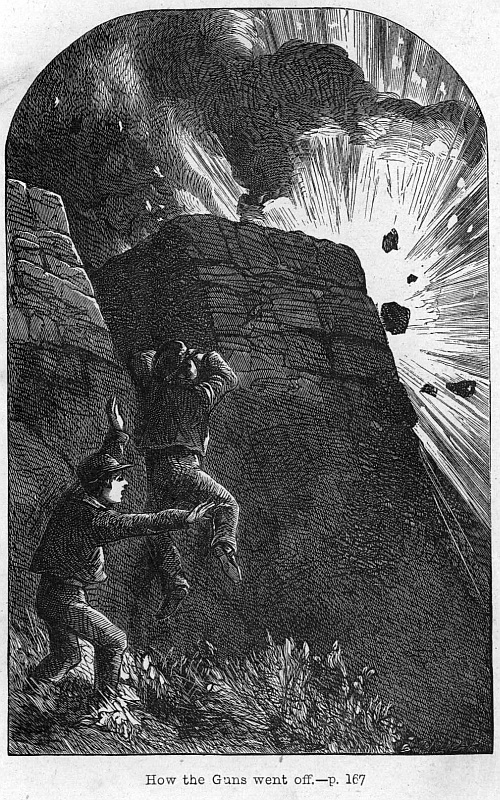
“Oh, come along,” cried Julian, recovering somewhat from his fright; “we must get home as fast as we can, or we shall be discovered to a certainty. The coastguard men will be up here directly to see what is the matter. Oh come along! come along!”
Even then they thought that they heard footsteps approaching the fort. They sprang out of the embrasure, and slid down the bank into the ditch. Just as they were sliding down, off went the gun with as loud a noise as the first, while the effects were no less disastrous; a lump of iron flew directly through the embrasure where they had been sitting, and just clearing their heads, fell at some distance beyond the ditch. Digby remembered the circumstance many years afterwards, but it made but a slight impression at the time.
“We had a narrow escape,” said Julian, as they reached the bottom of the ditch; “it is lucky we were out of that hole, or we should have been made to squeak out I suspect.”
They quickly clambered out of the ditch, and looking about to ascertain that no one was observing them, ran on as fast as they could move. They had already marked out the path they were to take, so they lost no time in having to stop and consider which way they were to go.
On they ran. Digby found no difficulty in keeping up the speed, but Julian had never ran so fast in his life. They had to scramble through several hedges and across several stubble fields. Julian’s foot caught in a trailing weed, and down he came on his nose. He cried out with pain, but Digby helped him up again.
“You can’t be much hurt, I hope,” said Digby; “let me help you along; we must make haste, you know, or we shall be caught.”
“But I am very much hurt; my nose feels as if it was smashed in,” answered Julian, sulkily. “You don’t care for that though, I suppose. However, help me along; we must make haste I know.”
With Digby’s aid he was once more in motion. Their great fear was that they might be met by some one on his way to the fort to learn what had occurred. They had nearly reached Mr Nugent’s garden-wall, when they thought they saw some one coming along. A deep ditch was near; Julian jumped into it, dragging Digby after him. They were only just in time to escape a person whose footsteps they heard passing by. Then up they jumped again, and ran on till they reached the wall for which they were aiming. They scrambled over it, and breathed more freely when they found themselves concealed in the shrubbery. Great caution was required, however, to get back into their room.
“Suppose,” whispered Digby, “some one should have come to our room, and tried to awaken us, or found the rope hanging out of the window?”
“Oh, don’t let us think of such things,” answered Julian, who had the greatest dread of being found out in any of his tricks, though he had not the slightest objection to doing what was wrong.
There are, unfortunately, a great number of people in the world like Julian Langley. They do not comprehend the awful fact that the Almighty God sees and knows all they do and think, even to their most trivial acts and thoughts, and that at the great Day of Judgment they will have to answer for all the evil they have committed, all the evil thoughts in which they have willingly indulged. Not understanding, or forgetting this great truth, their only dread is lest their sins should be discovered by their fellow-men, or should in any way disturb the equanimity of their own consciences. No greater offence, therefore, can be committed against them than to speak to them of their vices, or to try to prove to them that they have done wrong. Ostriches, when chased, are said to run their heads into a bush, and to fancy that because they cannot see they are free from pursuit; so men try to shut out their sins and faults from their own sight, and, as foolishly as the ostrich, to fancy that they are not perceived by others, or, still more foolishly and madly, that a due and just punishment, which an all-righteous God has said he will inflict on evildoers, will not ultimately overtake them. Unhappy Julian, I would rather not have had to narrate his career.
“Come on, Julian,” said Digby, at last. “I hear no one about; we must make a push for our window and get in. If we are caught, patience! The thing is done, and can’t be undone.”
Digby was, in reality, by far the most daring of the two, in cases of real danger. Off he set across the lawn, Julian following. They reached the window. The rope was there. Up he climbed.
Julian fancied that he heard some one speak, and then that footsteps were coming along the gravel walk. He was in an agony of terror. He could scarcely climb up the rope, and was almost letting go, but Digby caught his arm, and helped to drag him in. They hauled up the rope, and Julian stowed it away again in his box. They then shut their window and unlocked their door.
When they came to undress, they found that their clothes were very muddy, and that they had got their shoes very wet and dirty in the ditch into which they had jumped. Even Julian’s fertile brain was puzzled as to how they should account for this, should they be questioned on the subject. He lay cold and trembling, and very uncomfortable. He was paying somewhat dear for his lark; people generally do for such like proceedings.
There is an old French proverb, “The game is not worth the candle,” meaning, which is burnt while it is played. In a true and Christian point of view, sin, however delicious, however attractive it may appear, never is worth a hundredth part of the consequences it is sure to entail.
Digby was not much less unhappy than Julian. Still, as he was prepared, with sturdy independence, to undergo whatever consequences his prank might bring upon him—for a prank only it was, though an unwise one—he did not trouble himself much more about the matter, but coiled himself up in his bed to try and get warm, and prepared to go to sleep. He was just dozing off, when he heard the voices of his uncle, and Marshall, and Power, passing the door.
“Some people can sleep through a thunder-storm, or a battle at sea; and so, I suppose, those youngsters were not awoke by all that tremendous noise,” observed Marshall.
“More likely that they were awoke, and that fellow Julian Langley is lying quaking in his bed, and wondering what all the noise was about,” answered Power.
“Do not call them now, at all events,” said Mr Nugent. “We will ask them to-morrow what they thought about the matter. What could have exploded those old guns?”
Julian and Digby would have been fully satisfied had they witnessed the commotion the explosion of the guns created in the quiet old town. Half the male population, and even some of the women, turned out of their beds and ran to the fort. Some thought the Russians or the French, or some other enemies of England, had come, and were firing away at the fort—a very useless proceeding it would have been, considering that the poor old fort could not fire at them. Others, not aware of this latter fact, thought that a body of artillery had suddenly been transported there, and that they were defending the place in the most desperate manner. The braver men who thought this ran to assist them; and others, and some of the women, ran out of the town to be further from danger.
However, a very large number of people collected in the fort, everybody asking questions, and nobody being able to give a satisfactory reply.
Some asserted that a dozen guns had been fired off; others even a greater number. One thing only was evident, when lanterns were brought to make an examination—that two of the old guns had burst, and had scattered their fragments far and wide around.
“Some malicious people must have done it,” observed the worthy mayor, who did not at all like being thus rudely summoned out of his bed, as he had been by the explosion. “High treason, rebellion, and—and—” (he could not find a third word of sufficient force to express his feelings) “has been committed in this loyal, respectable, quiet town, and the villainous perpetrators of the atrocious deed must be brought to condign punishment.”
It was a pity Julian and Digby could not hear these expressions.
Some people in the crowd had their own opinions on the subject. Mr Simson was there, and he picked up a thick stick, with a thicker head, and kept it.
The coastguard men thought the smugglers had done it, but with what object they could not divine. Some wiseacres thought that the guns had gone off of themselves; others, that Dame Marlow, whose fame had long been great at Osberton, had had a hand in the work. However, though everybody looked about and talked, they were not much the wiser, and at length they retired to their homes, and the old fort was allowed to sleep on with its usual tranquillity.
Chapter Seven.
Digby finds that a Bad Adviser is the worst of Friends—More Mischief and its Inconveniences—Serious Consequences Threatened.
Julian and Digby would very much have liked to have been sent to Coventry, the morning after their cannon-firing, so that no disagreeable questions might have been asked them. They dressed slowly and tried to look over their lessons in their room, but got very little information out of their books. They felt very foolish when the bell rang, aid they had to make their appearance in the breakfast-room. Morning prayers were over, and they took their seats round the breakfast-table.
“Well, Julian, did you not hear the noise last night?” were the first words Marshall spoke.
“What noise?” asked Julian; “I sleep very soundly; it must have been a row to awake me.”
“Why, the guns of the old castle going off by themselves,” said Power.
“Not a sound,” said Julian, hoarsely.
Digby looked at him, and wondered if his friend had any conscience. What should he say? there was the difficulty. He had always scorned a lie; if so point blank a question were put to him, how could he answer and not betray their secret?
“And did you sleep through it too, Digby?” said his uncle.
“No, I heard the noise very clearly,” answered Digby, and he felt happier after he had said this, though Julian gave him a tremendous kick on the shins under the table.
“How could you remain quietly in bed after it?” asked Marshall.
“I was out,” answered Digby firmly, “but I got back before you, since you must know all about it. I don’t think that you have a right to be asking me questions, which I may not wish to answer. If I speak at all, I wish to speak the truth. More I do not wish to say; and now, if you like, tell me what you thought about it.”
Mr Nugent looked surprised at Digby’s firmness and unusual vehemence, but suspecting that Julian had not spoken the truth, and that Digby wished not to betray him, forbore to press the matter further.
Of course, both the boys were on tenter-hooks during the whole of breakfast. Digby applied himself sturdily to his food and eat on without speaking, as if he was in a very sulky mood. All day, too, while they were at their lessons, every time there was a ring at the door, they fancied that some one was coming to accuse them of their misdemeanor. Digby thought much less about it than Julian, and it also troubled him much less, because he had made up his mind, if directly accused of the deed, to acknowledge it at once, without the slightest attempt at evasion. His conscience told him, that this was the only right course to pursue; any other would plunge him into a sea of falsehood, from which he shrunk with dread. He intended, if he could avoid so doing, not to inculpate Julian, but to take all the blame on his own shoulders.
“Julian says he was not out of bed that night; he is very wrong, but I don’t want to get him into a scrape if he wishes to avoid it,” he thought to himself.
Unfortunately, he did not see Julian’s conduct in its true light. That young gentleman was all the time thinking, and plotting, and contriving, how he should himself get out of the scrape. He had already told one falsehood, he must invent others to avoid being found out after all. He could not fix his attention on his lessons, and, of course, he did them very badly.
“You must stay in and learn these twelve lines of your Delectus by heart,” said Mr Nugent, who was much displeased with him.
Digby, who had done his lessons much in his usual way, which was seldom very first-rate by-the-by, was allowed to go out. Of course all the rest were eager to go to the fort, and Digby was compelled to go with them. This was doubly annoying to Julian, who wanted to have a few minutes’ conversation with him to get him to promise not to betray him, and to induce him, if possible, to tell a long story which he had concocted, to account for his not hearing the noise, and for his not accompanying Digby afterwards to the fort.
When Digby and his companions reached the fort, he was astonished at the mischief which had been committed. The old guns lay on the ground with large pieces torn out of them, and their carriages knocked to atoms, while a portion of the parapet round the embrasures had been crumbled into powder.
While they were running about, who should walk into the fort but worthy Mr Simson, the grocer. He watched his opportunity when Digby was separated from his companions, and drew him aside.
“I hope the other gentleman isn’t hurt,” he said.
“No, he hasn’t done his lessons, so he is not allowed to go out,” answered Digby.
“I was afraid he might be hurt. Well, you two had a fortunate escape,” observed Mr Simson; “I know all about it; I don’t want to betray you, though; I have boys of my own: but you mustn’t do the same thing again, that is all.”
“Thank you,” answered Digby, “I am very much obliged to you, indeed I am.”
“That’s what I like, young gentleman, that’s manly and right-spirited,” said Mr Simson, taking his hand and pressing it warmly. “I wouldn’t betray you on any account, that I wouldn’t. Trust to me.”
Digby was much happier after this. He felt, however, that he had escaped a great danger of the whole matter being known, and though he couldn’t exactly divine what punishment he might have inflicted on him, he knew that he should at all events have been made to look very foolish.
“They wouldn’t hang a fellow for such a thing, and I don’t suppose they would send me to prison. Still, I am really very grateful to kind Mr Simson for not peaching. I’ll always deal with him in future. How did he find out all about it, I wonder?”
He heard with much more indifference than at first, the various remarks and conjectures made on the subject, and the feeling that he had acted a manly part about it enabled him to look people boldly in the face, and thus he escaped the suspicion which would otherwise have fallen on him. When he got home he found Julian very dull and sorry for himself. He told him what Mr Simson had said.
“Oh, then, he will go and peach upon us, and it will all be found out,” exclaimed Julian, half-crying.
“But he promised that he would say nothing about the matter,” urged Digby.
“So he might, but one can’t trust to a shopkeeper,” answered Julian, with a scornful turn of his lip.
“I don’t see that,” replied Digby; “if he is an honourable man and has good feelings, I think that one may trust to a shopkeeper as well as to the first noble in the land; I know that my uncle often says that one man’s word is as good as that of another, provided both are equally honest and upright.”
“All I know is, that old Simson was very impertinent to me when I went to buy the gunpowder,” said Julian; “if I hadn’t wanted more I wouldn’t have gone to him again.”
“He cautioned me about it, and not without some reason,” said Digby; “So I’ll maintain that old Simson is a very good fellow, and, what’s more, I’m sure he looks like a gentleman in every way.”
Several days passed by, and though inquiries were made and numbers of people were examined, no clue was discovered to the originators of what the county papers called that mysterious circumstance at Osberton. Digby couldn’t help cutting out the paragraph, and sending it to Kate, darkly hinting that he might, perhaps, some day enlighten her about the matter. He was afraid of committing the account to paper, but her very acute perception at once divined that he had taken a prominent part in the affair. How she did long to hear all about it, and how he did long for the holidays that he might tell her. He had an idea that his uncle knew something about it, because after this neither he nor Julian were allowed to go out, except in company with Marshall or Power, or Toby Tubb. One day, however, all the boys had gone together to the beach, and by some means or other, unintentionally, while some were climbing up over the cliffs, Digby got separated from the rest. As he knew his way home, however, perfectly well, he did not care about it, even though it was growing dark. He had not gone far when two men overtook him; they were rough-looking fellows and dressed as seamen; he did not altogether like their appearance. They went on some little way, and then turning back, they looked him in the face, and one of them said—
“Are you Squire Heathcote’s son, master?”
“Yes,” answered Digby, “I am. Why do you want to know?”
“I’ve asked a civil question, and you’ve given a civil answer, master. Good-night,” replied the man who had before spoken; and then they both walked rapidly on.
Digby thought it rather odd that men of that sort should wish to know who he was, but troubled himself very little more about the matter.
When he got home, his uncle inquired how he came to be later than the rest; and knowing he always spoke the truth, was perfectly satisfied with his explanation.
“Your uncle seems to think that he can trust you much more than he can me,” observed Julian one day. “It is very hard upon me, as I am older. He favours you as a relation, that’s it, I’ve no doubt.”
Digby made no reply, but he felt indignant, as he could not bear to have his uncle, whom he respected, spoken ill of.
By degrees Julian recovered his usual state of mind, and, as he did so, his fertile brain began to devise fresh schemes of mischief. Since his liberty had been curtailed he found them, however, much more difficult to carry out. It may seem strange that, after all the anxiety and inconvenience he had suffered in consequence of his last achievement, he should be eager to do something which was likely to produce the same results; but such is unfortunately too generally the case with evildoers. Unless some severe punishment follows they go on and on, committing the same evil again and again. Indeed, even punishment will not always deter people who have given themselves up to evil ways from continuing in them; and men have frequently been known, the very day after they have been released from prison, to have committed the very crime for which they have been confined. Reformation of heart and character is what is required, and this had not taken place with regard to Julian Langley.
“I’ve hit upon a capital idea, Digby,” said he one day when the two were alone; “help me out with it.”
“What is it?” asked his companion.
“I’ve been thinking what fun it would be to set all the fishing-boats out in the river adrift. How they would knock about each other, and how angry the boatmen would be.”
“I should think they would be angry, indeed,” answered Digby, stoutly. “Fun is fun, but it seems to me that a great deal of harm might be done by what you propose. I’d advise you to give up the idea; I’ll have nothing to do with it.”
“I thought you were a fellow of spirit, Digby,” sneered Julian. “What great harm can there be in letting a few old fishermen’s boats knock together?”
“Why, they might get carried out to sea, and be lost altogether, and have their sides stove in, or holes made in their bottoms, or be sunk, and lose their oars and sails; indeed, I can fancy a great deal of damage might be done,” said Digby. “I think that it would be very wrong and cruel to the poor fishermen.”
“Oh, now I see you are going to take a leaf out of your uncle’s book, and to turn saint,” sneered Julian. This was one of his most powerful expressions. He knew that Digby especially disliked being called a saint, and that he often confessed, as do many older people with equal thoughtlessness, that he did not set up for a saint. People seem not to consider, if they do not wish to become saints, what they really do desire to become. Certainly none but saints can inherit the glories of eternity; and unless they trust in the merits of One who can cleanse them from their sins, and make them saints, so that they may be presented spotless to the Father Almighty, from those glories they will be shut out.
Poor Digby winced under Julian’s sneer. “A saint; no, I am no saint, I hope, but I don’t want to injure the poor fishermen,” he answered, firmly.
“Injure them! Who’s going to injure them?” exclaimed Julian, petulantly. “I’ve made up my mind to have my lark, and have it I will. If any great harm comes I’m ready to bear it. You won’t peach upon me, I suppose?”
“No,” answered Digby, indignantly. “I like fun as much as you; and if I saw the fun I’d do it willingly.”
Julian thought that Digby was relenting, and still pressed the matter, but in vain. “Well, if you won’t go I must get somebody else. I know a fellow who will help, though none of the sneaks here will join me,” said Julian, walking away.
Digby felt satisfied that he had done right, still he did not like to let Julian go away, and have his fun by himself.
The latter young gentleman went into the garden, and disappeared in the shrubbery. In spite of the prohibition still existing against his going out alone, he jumped over the wall, and betook himself to the river side. He had scraped acquaintance with a lad of his own age, the son of a small innkeeper, who had been a smuggler, and was still, it was suspected, intimately connected with smugglers.
Dick Owlett was certainly not a fit associate for the son of the Honorable Mr Langley; but vice more than anything else creates incongruous companionships. Young Owlett was ready to do anything Julian proposed, because he fancied that he might easily throw all the blame on Julian’s shoulders, or else that, through Julian’s influence, they both might escape punishment. Dick had none of Digby’s scruples, so the whole plan was soon arranged. Both had thoroughly ill-regulated minds, and rejoiced in mischief for mischief’s sake.
Julian came back unperceived, and, in high spirits, told Digby that he was going to have his fun in spite of him.
The following night Julian awoke Digby about eleven o’clock, and told him that he must help him to get out of the window, and wait his return to let him in again.
Digby expostulated, but in vain; he had not yet learned that the only sure way for the young to avoid the contamination of evildoers is to keep out of their society altogether. So Digby agreed to sit up till Julian’s return.
The rope was secured, Julian descended by it, and off he ran across the lawn towards the wall, over which he had so often before made his escape from the premises.
Digby waited and waited; Julian did not return. He became very anxious about him. He wished that he had taken stronger measures to prevent his carrying out his foolish and mischievous prank. The only effectual way to have prevented him would have been to have told Marshall or his uncle, but such a proceeding was so contrary to all his notions of what ought to be done, that it did not even occur to him. He could not exactly tell how time passed, but he thought that Julian must have been away a very long time. He could bear the suspense no longer. Some boys of his age would have gone to bed, and cried, or sat quaking with fear. To do this was not at all in Digby’s nature. He loved action; he must be up and doing. He knew the road Julian would have taken, and he resolved to go and look for him. It did not occur to him that he should thus run a great risk of being implicated in whatever his companion had done; had he, I do not believe that the fear of that would have weighed with him a moment. He put on all his clothes and his shoes, and, without further consideration, slipped down the rope, gained the wall, and ran on as fast as his legs could carry him towards the river. He got very nearly to the spot where he thought Julian would have embarked, when he met two boys running. “Who’s there?—Julian, is that you?” he exclaimed.
“Oh, Digby, how you startled me,” exclaimed one of the boys. It was Julian who spoke.
“All right,” cried Digby. “I became very anxious. I was afraid some harm had happened, and so I set off to look for you; but why are you running so fast?”
“Because we are afraid somebody is after us,” answered Julian, almost breathless. “We’ve done it, though, and rare fun there will be to-morrow to see what has become of all the boats.”
It was not necessary for Julian to tell Digby to turn back; he had at once done so, and they were running on together. They turned their heads for a moment, and Dick Owlett had disappeared. His reason for so doing was very evident. Digby thus, very unintentionally, slipped into his shoes. They soon had to cross a meadow; their own footsteps now making but a slight noise, they were able to hear the sound of another person fast approaching them.
“It may be Dick Owlett,” said Julian, in a low voice. “Still, if it is one of the coastguard men we shall catch it. Run, Digby, run.”
Digby could have run a great deal faster than he was running, but had he done so he would have left Julian behind. Their pursuer, whoever he was, came on very rapidly. They had scarcely crossed the field when, looking back, they saw him at the other end of it. He must have seen them. It seemed very useless, therefore, to attempt to escape, but their natural impulse was to run on till he put his hand on their shoulder to stop them. Julian wanted to jump into a ditch and hide, as they had before done, but Digby protested against this, and insisted on running on. Across the fields they went—now they thought that they had escaped their pursuer—now they saw him again. Sometimes he got very close to them, and then they distanced him. At last they got up to the garden-wall. The footsteps sounded terribly loud close behind them. They rushed on. Julian, always most anxious to escape from danger, had first sprung to the top of the wall, and Digby was helping him over, when a person leaped forward, and seizing Julian by the leg, and Digby by the shoulder, exclaimed—