CLASSIFICATION (continued 2)
Reading edition
PETROKLASTIT or HALOKLASTIT is a modified gunpowder mixture used in Germany in potash mines and stone quarries. It contains sodium nitrate, sulphur, coal-tar pitch, potassium nitrate, not more than 1 per cent. of potassium bichromate, and may have up to 10 per cent. of charcoal, as, for instance—
Sodium nitrate 69
Potassium nitrate 5
Sulphur 10
Coal-tar pitch 15
Potassium bichromate 1
It is more powerful than ordinary blasting powder, and somewhat less sensitive to blows. This explosive is also made in Switzerland.
PETROLIT is a German chlorate explosive introduced during the War. It contains not more than 88 per cent. of potassium chlorate, nitro-compounds, kerosene, and neutral salts. (This is rather a dangerous mixture.—A.M.)
PFALZIT.—A German blasting explosive containing ammonium nitrate, sodium nitrate, not more than 13 per cent. of trinitro-toluene, not more than 1 per cent. of collodion cotton, meal, sodium chloride, etc.
PHŒNIX POWDER.—A German coal-mine explosive made by Dr. R. Nahnsen and Co., of Hamburg. It passed the Woolwich Test and was on the old Permitted List.
Nitroglycerine 29·5
Collodion cotton 0·5
Potassium nitrate 32
Wood meal 38
PICROL.—See Shellite.
PIERRITE.—A form of Cheddite which was made at Gamsee, near Brig, for excavating the Simplon tunnel—
Potassium chlorate 80
Nitro-naphthalene 11·5
Picric acid 2
Castor oil 6·5
PIT-ITE was a coal-mine explosive of the Carbonite type, made by the New Explosives Co., Ltd. The composition, which was on the old Permitted List, was—
Nitroglycerine 26
Barium nitrate 33
Wood meal 41
and a little sodium or calcium carbonate.
In order to pass the Rotherham Test, the composition was modified to the following, No. 2, which was formerly on the Permitted List—
Date of Permit 1-9-13
Nitroglycerine 24
Potassium nitrate 30
Wood meal 38
Ammonium oxalate 8
Limit charge over 32 oz.
Power (swing of ballistic pendulum) 2·15”
PITSEA POWDER NO. 2 was a coal-mine explosive on the Permitted List, made by the British Explosives Syndicate, Ltd.—
Date of Permit 25-11-13
Nitroglycerine 6·5
Ammonium nitrate 55
Potassium nitrate 10
Wood meal 10
Ammonium oxalate 18·5
Limit charge 8 oz.
Power (swing of ballistic pendulum) 2·64”
The permit has been repealed.
Gesteins-PLASTAMMON.—A German blasting explosive containing not less than 70 per cent. of ammonium nitrate, glycerine, not more than 15 per cent. of nitro-toluene or other nitro-compounds, and not more than 4 per cent. of nitro-semicellulose.
Steinkohlen-PLASTAMMON is a variation of this, containing not more than 25 per cent. of potassium nitrate, and intended for use in coal mines.
*PLASTOMENIT was an early German shot-gun powder which possessed no great merits. The following was the composition of a sample examined in 1893, and given in “Arms and Explosives,” 1917, p. 90—
Nitrocellulose, insoluble 32·7
” soluble 19·3
Metallic nitrates 21·0
Dinitro-toluene (solvent) 26·0
Moisture 1·0
PLASTROTYL.—A German high explosive for filling shell. It consists of a partially liquid mixture of trinitro- and dinitro-toluene gelatinised by means of not more than 0·5 per cent. of collodion cotton, and mixed with a small quantity of turpentine or soft resin. It does not appear to be in use now.
PLESSIT is a blasting explosive that was introduced in Germany during the War. It consists of potassium chlorate, not more than 9·5 per cent. of kerosene and 0·5 per cent. of albumen. Wetter-Plessit III. contains sodium chloride as well.
PNIOWIT.—A German blasting explosive containing ammonium nitrate, trinitro-toluene, wood meal and a small percentage of potassium perchlorate.
Nobel POLARITE is a blasting explosive made by Nobel’s Explosives Co., Ltd. It consists of potassium perchlorate, and nitroglycerine mixed with a nitro-compound and gelatinised with collodion cotton, and absorbed in wood meal.
Poudres B, J, M, S, T. See under respective letters.
PRAEPOSIT is a modified gunpowder—
Potassium (or sodium) nitrate 70
Sulphur 18
Charcoal 6
Hipposin 6
the last constituent being a fine powdery substance obtained from dried horse dung. It is slower than ordinary blasting powder and more expensive. It has a tendency to blow out, and opinions as to its value vary. Formerly it was supplied in the form of a fine powder, but it is now granulated or made into compressed cartridges.
*PRIMROSE SMOKELESS is an inexpensive 42-grain bulk powder for shot-guns made by the New Explosives Co.
PROGRESSIT was an explosive formerly used in Austrian coal mines—
Ammonium nitrate 94 89
Aniline hydrochloride 6 5
Ammonium sulphate — 6
It was superseded in 1913 by Pannonit.
PROMÉTHÉE or PROMETHEUS is a Sprengel explosive made by the French Government, by whom it is also called Explosif O3. It consists of a porous oxygen carrier and a liquid combustible, which are supplied separately, and the one is dipped in the other shortly before use—
a b c
Potassium chlorate 95 90 80 } Oxygen carrier, 92 to 87%
Manganese dioxide 5 10 20 }
1 2
Nitro-benzene — 50 60 } Combustible, 8 to 13%
Turpentine — 20 15 }
Naphtha — 30 25 }
Any combination of a, b or c with 1 or 2 may be used. The amount of liquid combustible taken up may vary from 8 to 13 per cent.: this irregularity is a serious defect, and may cause incomplete detonation. This explosive is also made in Italy.
PROSPERIT is a German ammonium nitrate explosive, containing also vegetable meal, nitro-compounds and other constituents. It may contain up to 4 per cent. of blasting gelatine.
Gelatine-Prosperit contains also up to 20 per cent. of dinitro-chlorhydrin gelatinised with collodion cotton.
PULVÉRIN.—An ungranulated black powder made in France for use in fireworks, etc.
PULVÉRITE.—A Belgian coal-mine explosive containing perchlorate—
Ammonium nitrate 30·5
Potassium perchlorate 24
Nitroglycerine 6
Collodion cotton 0·5
Trinitro-toluene 7
Flour 5
Sodium chloride 18
Ammonium sulphate 7
Barium sulphate 2
The “charge limite” is 850 grammes, equivalent to 504 grammes of Dynamite No. 1.
PYROCOLLODION is a nitrocotton almost entirely soluble in ether-alcohol, and of comparatively high nitration. It contains about 12·5 to 12·7 per cent. of nitrogen, and consequently has about enough oxygen to oxidise all its hydrogen to water, and its carbon to the monoxide. It was first prepared by Mendeléeff for the Russian smokeless powder, and was afterwards adopted by the United States for their present powder.
PYROXILINE was a name formerly given to nitro-cellulose.
RACK-A-ROCK is a Sprengel explosive which has been used extensively in America, and also in Siberia and China. It consists of cartridges of potassium chlorate mixed sometimes with oxide of iron, which are dipped shortly before use into a liquid. The latter is nitro-benzene or “dead oil,” a heavy hydrocarbon oil obtained from coal-tar, or a mixture of the two. The chlorate cartridges are enclosed in small cotton bags, and are placed in a wire basket suspended from a spring balance. They are dipped into a vessel containing the liquid until a quarter or a third of the weight of the chlorate has been taken up.
RASCHIT is a blasting explosive consisting entirely of salts readily soluble in water, invented by F. Raschig. The incorporation is carried out by dissolving the constituents in water, and evaporating the solution rapidly on a rotating steam-heated drum. The oxidising substance is ammonium or sodium nitrate, and the combustible is the sodium salt of an organic sulphonate or the residue obtained from the manufacture of wood cellulose.
II. III. IV. V. VI.
Ammonium nitrate — 84 87 60 85
Sodium nitrate 70 — — — —
Ammonium nitro-cresol sulphonate — 16 — — —
Sodium cresol sulphonate 30 — 13 10 —
Cellulose residue — — — — 15
Sodium sulphate — — — 30 —
No. II. is the only one made at present.
R.D.B. (Research Department B). See CORDITE.
RED CROSS explosives are American dynamites containing some nitro-toluene or other substance to make the nitroglycerine low-freezing.
RED H, Nos. 1 to 7 are American coal-mine explosives on the Permissible List. They are ammonium nitrate mixtures.
*RED STAR is a 33-grain bulk smokeless powder for shot-guns, introduced in 1906 by the New Explosives Co. According to an analysis given in “Arms and Explosives,” 1917, p. 76, its composition is—
Nitrocellulose, insoluble 52·2
” soluble 25·5
Metallic nitrates 10·5
Nitro-compounds 7·0
Vaseline 3·0
Moisture 1·8
RENDROCK.—A brand of American dynamite.
REX POWDER is a coal-mine explosive made by the Cotton Powder Co. It is on the Permitted List, and is used to a considerable extent—
Date of Permit 16-8-15
Nitroglycerine 12
Ammonium nitrate 60
Wood meal 8·5
Sodium chloride 19·5
Limit charge 20 oz.
Power (swing of ballistic pendulum) 2·61”
REXITE.—A coal-mine explosive made by the New Explosives Co., which was on the old Permitted List. It is no longer “permitted.”
Nitroglycerine 7·5
Ammonium nitrate 66
Sodium nitrate 14·5
Trinitro-toluene 7·5
Wood meal 4·5
REXOL.—A high explosive containing ammonium perchlorate, zinc dust, resin and mineral oil.
R.F.G. (Rifled Fine Grain) } black powders made for rifles R.L.G. (Rifled Large Grain) } and rifled ordnance respectively.
RHENANIT.—A German blasting explosive containing ammonium nitrate, not more than 4 per cent. of blasting gelatine, and combustibles such as charcoal and naphthalene.
Wetter-Rhenanit is for use in coal mines, and contains also sodium chloride.
Rhenanit V., which has been introduced recently, contains up to 10 per cent. of potassium perchlorate, and is similar to Astralit V.
RHEXIT.—An Austrian dynamite.
II. III. IV. V.
Nitroglycerine 50 35 24 15
Sodium nitrate 32·6 37 56·2 62·9
Wood meal 17 27·5 19 21·2
Sodium carbonate 0·4 0·5 0·8 0·9
*RIFLEITE was a completely gelatinised smokeless powder which was made by the Smokeless Powder Co.; it was in the form of flakes. A variety was also introduced for use in shot-guns and was called Shot-Gun Rifleite; this was a 37-grain gelatinised dense powder.
Shot-gun Rifleite. For ·303 Rifle.
Date of Introduction 1894 1890
Nitrocellulose, insoluble 76·0 1·7
” soluble 18·9 82·5
Nitro-compound 3·5 14·8
Moisture 1·6 1·0
The nitrocellulose was made from lignin. These analyses were given in “Arms and Explosives,” 1917, p. 77.
RIPPING AMMONAL. See AMMONAL.
RIPPITE is an explosive made by Curtis’s and Harvey, which was on the old Permitted List—
Nitroglycerine 61
Collodion cotton 4
Potassium nitrate 19
Castor oil 1
Wood meal 5
Ammonium oxalate 10
It is no longer “permitted” for use in dangerous coal mines, but is still used for general purposes.
SUPER-RIPPITE is a modification of this, which has passed the Rotherham Test and is on the Permitted List—
Date of Permit 29-8-14
Nitroglycerine 52
Collodion cotton 3
Potassium nitrate 14·5
Borax 22·5
Potassium chloride 8
Limit charge 18 oz.
Power (swing of ballistic pendulum) 2·53”
RIVALIT is a German blasting explosive containing ammonium nitrate, vegetable meal, nitro-compounds, and may also contain up to 3 per cent. of blasting gelatine.
Rivalit P, which has been introduced recently, contains up to 10 per cent. of potassium perchlorate, and is practically the same as Astralit V.
Chlorat-Rivalit is an explosive of the Cheddite type, introduced in Germany during the War—
Potassium chlorate 88·5
Paraffin 11·5
ROBURITE is a coal-mine explosive of the Grisounite class. In Germany many different mixtures have been made, but in general they are within the following limits—
Ammonium nitrate 70 to 80
Potassium nitrate 5 ” 10
Trinitro-toluene 12 ” 15
Flour 6
Sodium chloride 5 to 6
Potassium permanganate 0·1 ” 0·5
but some are outside them.
The explosive has also been made in England by the Roburite Explosives Co., Ltd., now incorporated in Roburite and Ammonal, Ltd., who had the following on the old Permitted List—
No. 3
Ammonium nitrate 88
Dinitro-benzene 11
Chlor-naphthalene 1
The following has passed the Rotherham Test and is now on the Permitted List—
No. 4
Date of Permit 13-5-14
Ammonium nitrate 61
Trinitro-toluene 16
Sodium chloride 23
Limit charge 18 oz.
Power (swing of ballistic pendulum) 2·86”
ROCKITE is an explosive made by Curtis’s and Harvey for quarry work, etc.
ROMPERIT.—A German blasting explosive containing ammonium nitrate, potassium nitrate, trinitro-toluene, flour and resin. It may also contain up to 4 per cent. of blasting gelatine.
Wetter-Romperit contains also sodium chloride, ammonium chloride or magnesite, and is used in coal mines.
Gelatine-Romperit contains gelatinised nitroglycerine, glycerine, potato meal, etc., and nitrates, and may also contain aromatic nitro-compounds and alkali nitrates.
Romperit G, which has been introduced recently, contains up to 10 per cent. of potassium perchlorate, and is similar to Astralit V.
ROSLIN GIANT BLASTING POWDER is a perchlorate explosive made by Curtis’s and Harvey.
*ROTTWEIL SMOKELESS POWDERS.—These were pushed energetically in England in 1913. They comprised a gelatinised rifle powder, and a 37-grain gelatinised dense shot-gun powder. Analyses were given in “Arms and Explosives,” 1917, p. 90—
Shot-gun. Rifle.
Nitrocellulose, insoluble 72·3 72·8
” soluble 24·5 25·0
Metallic nitrates 0·7 —
Camphor and diphenylamine 1·0 1·0
Moisture 1·5 1·2
*RUBY POWDER.—- A 42-grain bulk smokeless powder, for shot-guns, introduced in 1899 by Curtis’s and Harvey. The following analysis was given in “Arms and Explosives,” 1917—
Nitrocellulose, insoluble 46·6
” soluble 4·0
Metallic nitrates 34·0
Nitro-compound 8·2
Starch 5·5
Moisture 1·7
It is an inexpensive powder made without solvents.
RUSSELITE.—A coal-mine explosive which was made by the Forcite Co. in Belgium. It was on the old British Permitted List—
Nitroglycerine 40·5
Collodion cotton 2·3
Potassium nitrate 24·5
Trinitro-toluene 5·5
Wood meal 4
Ammonium oxalate 23
Calcium carbonate 0·2
*Poudre S is a shot-gun powder made by the French Government. It consists of—
Guncotton 37
Soluble nitrocotton 28
Potassium nitrate 6
Barium nitrate 29
Moisture 2
The ingredients are incorporated together under light edge runners, dried and partially gelatinised with 35 per cent. of ether-alcohol. The dough, which is not very coherent, is formed into grains by simply passing it through a sieve. The grains are dried, sifted, hardened if necessary with ether-alcohol, and again dried and sifted.
SABULITE is a blasting explosive containing ammonium nitrate, trinitro-toluene and calcium silicide. The last constituent increases the heat of explosion and renders the mixture more sensitive both to detonation and to blows; it plays the same part as the aluminium powder in Ammonal.
Ammonium nitrate 78
Trinitro-toluene 8
Calcium silicide 14
This composition was modified by the Belgian Sabulite Co. to render it suitable for use in coal mines: by introducing some potassium nitrate and ammonium chloride it was able to pass the tests, and obtain a place on the list of “explosifs S.G.P.”—
Sabulite antigrisouteuse A.
Ammonium nitrate 54
Potassium nitrate 22
Ammonium chloride 13
Trinitro-toluene 6
Calcium silicide 5
Sabulite has been used as a military high explosive.
SAFETY BLASTING POWDER. See CAHUECIT.
SALIT or Wittenberger Wetterdynamit is a German coal-mine explosive. The following is an analysis—
Ammonium nitrate 53·6
Nitroglycerine 11·8
Collodion cotton 0·5
Dinitro-toluene 8·5
Dextrin 2·5
Sodium chloride 23·1
SAMSONITE.—A coal-mine explosive made by Nobel’s Explosives Co., Ltd. It was on the old Permitted List. It is now no longer permitted for use in dangerous coal mines but is still used for general purposes.
Nitroglycerine 58·5
Collodion cotton 3·5
Potassium nitrate 18
Wood meal 6·5
Ammonium oxalate 13·5
During the War potassium nitrate was replaced by sodium nitrate, and the nitroglycerine was reduced to 50 per cent.
Nos. 2 and 3 have passed the Rotherham Test and are on the Permitted List—
No. 2 No. 3.
Date of Permit 25-1-19 25-1-19
Nitroglycerine 51·5 51·5
Collodion cotton 3 3
Amide compound 0·2 0·3
Potassium perchlorate 11 —
Sodium nitrate — 10
Borax 23·3 25·2
Potassium chloride 10 —
Sodium chloride — —
Moisture 1 10
Limit charge 26 24 oz.
Power (swing of ballistic pendulum) 2·49 2·42”
SAXONITE was the predecessor of Samsonite on the old Permitted List. It has practically the same composition, but wide limits are allowed. It also is used for general purposes. During the War potassium nitrate was replaced by sodium nitrate.
Ammon-SCHLESIT or Kohlen-SCHLESIT is a German coal-mine explosive containing ammonium nitrate and other nitrates, nitro-compounds, starch, neutral salts, not more than 4 per cent. of blasting gelatine, and not more than 2 per cent. of potassium perchlorate.
SCHNEIDERITE is a high explosive used by the French for filling shell. Its composition is the same as the Favier explosive N1c.
*SCHULTZE POWDER was the first successful smokeless powder made. It was invented by Capt. E. Schultze of the Prussian Artillery, who appears at first simply to have impregnated little grains of wood with saltpetre (Eng. Pat. 900 of 1864). But later the wood cellulose was purified and nitrated, and then mixed with nitrates. The powder has remained the same as this until the present day, although the methods of manufacture have been developed and, indeed, revolutionised more than once. In “Arms and Explosives,” 1917, p. 75, the following analyses of different brands were given—
Sawdust. Schultze. Imperial. Cube. Lightning.
Date Introduced 1869 1883 1902 1908 1913
Charge for 12-bore grns. 42 42 33 30 33
Fibrous. Fibrous. Fibrous. Gelatinised. Fibrous.
Nitrocellulose, insoluble} 64·8 25·0 63·7 62·1 55·0
” soluble} 40·0 18·9 27·0 27·0
Metallic nitrates 33·0 29·0 8·0 5·0 11·2
Vaseline — 4·0 7·6 4·0 5·0
Moisture 2·2 2·0 1·8 1·9 1·8
The nitrocellulose in all cases has been made from wood cellulose. All the powders are of the bulk type.
Schultze powder is also made in America as a 36-grain fibrous bulk powder—
Nitrocellulose, insoluble 4·9
” soluble 78·5
Metallic nitrates 10·5
Vaseline 3·7
Moisture 2·4
SEAMEX is a coal-mine explosive on the Permitted List made by Explosives and Chemical Products, Ltd.—
Nitroglycerine 10
Ammonium nitrate 58
Wheat flour 20
Sodium chloride 12
Limit charge 36 oz.
Power (swing of ballistic pendulum) 2.54”
SEBOMITE is a French chlorate explosive resembling Cheddite, but containing tallow instead of castor oil.
SECURITE was one of the first coal-mine explosives. It contained ammonium nitrate and dinitro-benzene, and was therefore similar to Bellite and Roburite.
SECUROPHORE.—A Belgian coal-mine explosive containing nitroglycerine, nitrates, flour and other constituents.
SENGITE is a variety of Tonite introduced in South Africa as a substitute for Gelignite in consequence of the scarcity of glycerine due to the War. It contains guncotton and sodium nitrate, and sufficient moisture to render it safe to handle without diminishing its strength. The first four letters of its name stand for substitute explosive no glycerine. It requires a priming cartridge of gelignite or similar explosive. It is more expensive than gelignite, and consequently is not likely to be used when the scarcity of glycerine has been relieved.
SHELLITE.—A high explosive consisting of picric acid and dinitro-phenol, used for filling shells. The mixture possesses the advantage over straight picric acid that it melts at a lower temperature. It was for a time called Picrol.
SHEPPEY POWDER.—A coal-mine explosive made by the Cotton Powder Co. which was on the Permitted List for a short time, but was removed in 1914—
Date of Permit 25-11-13
Nitroglycerine 27
Potassium nitrate 31
Wood meal 36
Ammonium oxalate 6
Limit charge 10 oz.
Power (swing of ballistic pendulum) 2·10”
SIEGENIT.—A German blasting explosive containing ammonium nitrate, flour, and not more than 15 per cent. of dinitro-toluene. For use in coal mines, sodium chloride and magnesium sulphate are added as diluents, and nitroglycerine to increase the sensitiveness.
SILESIA is a German blasting explosive consisting of potassium chlorate, the particles of which are coated with resin or oxidised resin. The latter is made by treating ground colophony, mixed with 10 per cent. of starch, with nitric acid. After washing and drying this is incorporated with the chlorate with the aid of alcohol, in which it is soluble. For use in coal mines sodium chloride is sometimes added. The following are examples—
4. 4a. IV. 22.
Potassium chlorate 80 80 70
Resin 20 16 } 8
” oxidised — 4 }
Sodium chloride — — 22
It is practically the same as Steelite.
*S.K., S.R., S.S., S.V. were partially gelatinised fibrous smokeless powders, introduced by the Smokeless Powder Co. about 1889. They are no longer made. The following analyses were given in “Arms and Explosives,” 1917, p. 77—
S.R. S.S.
Nitrocellulose, insoluble 45·2 53·0
” soluble 25·5 13·0
Metallic nitrates. 18·5 18·0
Nitro-compound — 10·0
Vaseline — 4·6
Starch 8·0 —
Moisture 2·8 1·4
The nitrocellulose was made from lignin. S.S. was a 38-grain bulk powder; S.R. was a fibrous powder for rifles; S.K. a similar powder for small rifles, and S.V. for revolvers.
*SMOKELESS DIAMOND is a 33-grain bulk smokeless powder for shot-guns, introduced in 1903 by Curtis’s and Harvey. According to an analysis in “Arms and Explosives,” 1917, p. 78, its composition is—
Nitrocellulose, insoluble 69·0
” soluble 6·6
Metallic nitrates 15·0
Vaseline 2·5
Charcoal 5·6
Moisture 1·3
*SOLENITE.—A smokeless powder introduced in Italy in 1896 for use in rifles—
Nitroglycerine 34
Nitrocotton, soluble 63
Mineral jelly 3
It is gelatinised with the aid of acetone, and is made in the form of translucent short tubes of a light brown colour.
SPRENGCHLORAT. See Hassia-Chlorat.
SPRENGEL EXPLOSIVES were patented in 1871 by Dr. Hermann Sprengel, F.R.S., the inventor of the mercury vacuum pump. They are made by mixing an oxidising substance with a combustible one, the essential features being that one or both of the substances must be liquid, and the mixing takes place shortly before the explosive is required. The mixture is exploded by means of a fulminate detonator. As oxidising agents, Sprengel mentioned amongst others nitric acid and potassium chlorate; nitrogen peroxide has also been used; as combustibles, a large number of substances including nitro-benzene, nitro-naphthalene, carbon bisulphide, petroleum and picric acid. For most purposes nitric acid is an inconvenient material to use. Porous cartridges of potassium chlorate constitute the oxidiser generally employed, the combustibles being hydrocarbon oils and nitro-benzene. This possesses considerable advantages, as there is no danger of a premature explosion until the constituents have been mixed. Under the British Explosives Act, however, this mixing constitutes “manufacture,” and can only be carried out in a properly licensed factory. Consequently Sprengel explosives have not been used in Great Britain, but they have been employed on a considerable scale in the United States, France, Italy and other countries.
For examples of Sprengel explosives see Panclastite, Prométhée, Rack-a-Rock.
SPRENGGELATINE is the German for Blasting Gelatine.
SPRENGSALPETER is a cheap German blasting powder made from sodium nitrate, sulphur and brown coal. It is used in the potash mines.
STABILITE is a name that has been given to trinitro-anisole. It has been tried as a constituent of a smokeless powder, but it belies its title as it is readily hydrolysed with the formation of picric acid. It has also been used by the Germans as a filling for bombs.
STANFORD POWDER.—A coal-mine explosive of the Favier class which was on the Permitted List for a short time in 1913.
STEELITE was practically the same as Silesia. Colliery Steelite was a coal-mine explosive on the old Permitted List, and made by Steelite Explosives, Ltd. It contained—
Potassium chlorate 74
Oxidised resin 25
Castor oil 1
Steelite is no longer authorised for manufacture or import into the United Kingdom.
ST. HELEN’S POWDER.—A coal-mine explosive of the Ammonal type made by the Roburite Explosives Co., which was on the old Permitted List—
Ammonium nitrate 93·5
Aluminium powder 2·5
Trinitro-toluene 4
STOMONAL is a coal-mine explosive made by the New Explosives Co., Ltd. It was on the old Permitted List. In order to pass the Rotherham Test and obtain places on the new Permitted List, No. 1 and No. 2 have had salts added as cooling agents—
No. 1. No. 2.
Date of Permit 22-6-14 9-5-17
Nitroglycerine 8 10 10
Ammonium nitrate 84·5 56[2] 60·5
Sodium nitrate — 6 —
Wood meal 7·5 — 6·5
Wheat flour — 8·5 —
Sodium chloride — 19·5 17
Ammonium oxalate — — 6
Limit charge — 20 30 oz.
Power (swing of ballistic pendulum) — 2·68 2·57”
STONAX is a low-freezing Gelignite containing a small percentage of a nitro-compound.
STOW-ITE.—A coal-mine explosive made by the New Explosives Co., Ltd. It was on the old Permitted List—
Nitroglycerine 59
Collodion cotton 4·7
Potassium nitrate 18·3
Wood meal 6
Ammonium oxalate 12
*STOWMARKET SMOKELESS is a 33-grain bulk powder for shot-guns made by the New Explosives Co. It is a comparatively inexpensive powder.
SUNDERITE was a coal-mine explosive made by Nobel’s Explosives Co., Ltd., at one time on the Permitted List—
Date of Permit 25-11-13
Nitroglycerine 9
Ammonium nitrate 53·2
Potassium perchlorate 9
Wood meal 8·8
Ammonium oxalate 20
Limit charge 16 oz.
Power (swing of ballistic pendulum) 2·66”
SUPER-CLIFFITE. See CLIFFITE.
SUPER-CURTISITE. See CURTISITE.
SUPER-EXCELLITE. See EXCELLITE.
SUPERITE.—A coal-mine explosive which was made by the Carbonite Company in Germany, and formerly on the Permitted List—
Date of Permit 1-9-13
Nitroglycerine 4
Ammonium nitrate 82
Potassium nitrate 10
Starch 4
Limit charge 10 oz.
Power (swing of ballistic pendulum) 2·53”
The Permit was repealed on 21-11-16.
SUPER-KOLAX. See KOLAX.
SUPER-RIPPITE. See RIPPITE.
SWALE POWDER was a coal-mine explosive on the Permitted List made by the Cotton Powder Co., Ltd.—
Date of Permit 10-2-14
Nitroglycerine 19
Collodion cotton 1
Trinitro-toluene 4
Potassium perchlorate 38
Wood meal 10
Ammonium oxalate 28
Limit charge 20 oz.
Power (swing of ballistic pendulum) 2·50”
The permit has been repealed.
SWALITE.—A coal-mine explosive made by the Cotton Powder Co., Ltd. It was on the old Permitted List—
Nitroglycerine 59·5
Collodion cotton 4
Potassium nitrate 17
Wood meal 6
Ammonium oxalate 13·5
SYNDITE.—A coal-mine explosive formerly on the Permitted List. It was made by the Carbonite Syndicate in Germany—
Nitroglycerine 11
Collodion cotton 0·2
Ammonium nitrate 46·3
Sodium nitrate 8
Glycerine 3·5
Starch 4
Sodium chloride 27
Limit charge over 40 oz.
Power (swing of ballistic pendulum) 2·22”
The permit was repealed on 21-9-16.
*Poudre T is a condensed smokeless shot-gun powder manufactured by the French Government. It is made from guncotton, CP1, to which 2 per cent. of saltpetre is added, gelatinised with acetone. The dough is pressed into strips which are rolled down to a thickness of 0·15 mm. and cut into small squares of 1·5 mm. side. The powder is then steeped in water to dissolve out the greater part of the potassium nitrate, dried, and finally drummed with a little gum and graphite to make it more progressive. This powder is superior to the other French sporting-powders, but is more expensive. The charge for a 16-bore cartridge is 1·9 grammes.
TELSIT A is a blasting explosive made at the Nobel Works in Switzerland. It consists of ammonium nitrate, nitrated toluene and aluminium powder.
Gelatine-Telsit contains ammonium nitrate, blasting gelatine and liquid trinitro-toluene, also gelatinised with collodion cotton.
Special-Gelatine-Telsit differs from this in having part of the ammonium nitrate replaced by sodium nitrate.
TERRIT is a plastic blasting explosive made in Sweden, and consisting of ammonium perchlorate, sodium nitrate and liquid dinitro-toluene, gelatinised with collodion cotton—
Ammonium perchlorate 43
Sodium nitrate 28
Dinitro-toluene (liquid) 27·8
Collodion cotton 1·2
It is difficult to detonate.
TETRYL is the name usually given to tetranitro-methyl-aniline, the strictly scientific designation of which is trinitro-phenyl-methyl-nitramine—
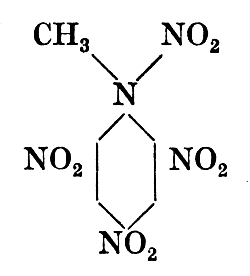
It is used extensively as an intermediate detonating agent for high-explosive shell, as it is somewhat more sensitive than most of the explosives used, and can consequently be detonated by a small charge of fulminate. It is also called C. E.
Grisou-TETRILITE. See Favier Powder.
TEUTONIT is a German Favier explosive containing not less than 70 per cent. of ammonium nitrate, not more than 5 per cent. of flour or potato meal, and not more than 15 per cent. of aromatic nitro- and dinitro-compounds. It may also contain neutral salts.
TEUTONITE was a name given occasionally to White Gunpowder (q. v.).
THAMES POWDER is a coal-mine explosive on the Permitted List made by the British Explosives Syndicate, Ltd.—
No. 2
Date of Permit 22-6-14 28-1-15
Nitroglycerine 6·5 10
Ammonium nitrate 55 59[3]
Potassium nitrate 10 —
Wood meal 4·5 10
Starch 5 —
Ammonium oxalate 19 —
Sodium chloride — 21
Limit charge 32 22
Power (swing of ballistic pendulum) 2·78 2·59”
THERMIT is not an explosive, although in some respects it resembles one. It generally consists of a mixture of about three parts oxide of iron with one part of aluminium powder, but other oxides and other metals are sometimes used. When initiated by strong heat in one place a reaction sets in with great evolution of heat and the formation of a white-hot mass of molten iron and slag. It differs from an explosive in that no gas is formed and the reaction is comparatively slow. It is used for filling incendiary bombs and for many industrial purposes.
THORNIT.—A German blasting explosive consisting of ammonium nitrate and vegetable meal. It may also contain animal or vegetable fats.
TITANITE.—A coal-mine explosive manufactured in Hungary. A variety of it was on the old British Permitted List—
Ammonium nitrate 87
Trinitro-toluene 7
Curcuma charcoal 6
Other varieties containing a smaller percentage of ammonium nitrate have been used for general blasting.
T.N.T. stands for trinitro-toluene or trotyl.
TOLITE stands for trinitro-toluene.
TONITE, or Cotton Powder, is a blasting explosive which was much used at one time. It consists of guncotton mixed with a nitrate and compressed into blocks or cylinders, but a small percentage of a nitro-compound has sometimes been added. A Belgian Tonite had the composition—
Guncotton 53·0
Barium nitrate 37·6
Sodium nitrate 9·4
That made by the Cotton Powder Co. consists of—
Guncotton 50
Barium nitrate 50
TOXOL is a high explosive, a mixture of trinitro-xylene and trinitro-toluene.
TREMONIT is a German coal-mine explosive containing gelatinised dinitro-glycerine, e.g.—
Tremonit S II.
Dinitro-glycerine 33
Collodion cotton 1
Trinitro-toluene 2·5
Ammonium nitrate 26·5
Pea flour 12
Sodium chloride 25
Ammon-Tremonit or Gesteins-Tremonit contains a considerable proportion of ammonium nitrate.
Gesteins-Tremonit V. contains also up to 10 per cent. of potassium perchlorate, and is similar to Astralit V.
TRINOL.—A name for trinitro-toluene.
TRIPLASTIT was a plastic high explosive obtained by gelatinising a liquid or semi-liquid mixture of nitro-toluenes with collodion cotton and mixing it with lead nitrates, e.g.—
Nitro-toluenes 70
Collodion cotton 1·2
Lead nitrate 28·8
It was intended for filling shell, etc.
*TROISDORF SMOKELESS POWDER became prominent in England in 1897 in connection with Mannlicher cartridges for the Bisley long-range competitions. It was occasionally recorded as Pigou Wilkes Powder, as that firm were agents for it. The following are analyses of samples taken in 1898 (“Arms and Explosives,” 1917, p. 90)—
Shot-gun Powder. Rifle Powder.
Nitrocellulose, insoluble 24·9 1·5
” soluble 61·7 96·5
Starch, agar and dye 11·5 —
Moisture 1·9 2·0
The shot-gun powder was a fibrous bulk powder, and the charge for a 12-bore cartridge was 33 grains. The rifle powder was gelatinised.
TROJAN COAL POWDER is an American coal-mine explosive on the Permissible List. It contains nitro-starch.
TROTYL is a name for trinitro-toluene.
TUNNELIT is a German safety explosive containing ammonium nitrate, sodium nitrate, not more than 10 per cent. of trinitro-toluene (or not more than 6 per cent. together with not more than 2 per cent. of neutral liquid trinitro-toluene), not more than 20 per cent. of dinitro-chlorhydrin, not more than 5 per cent. of nitroglycerine, not more than 1 per cent. of collodion cotton, and carbohydrates.
TUNNELITE is an American coal-mine explosive on the Permissible List. Brands AA, B and C are ammonium nitrate explosives, whereas numbers 3 to 8, 6LF and 8LF are nitroglycerine explosives.
TURPINITE. See PANCLASTITE.
TUTOL.—A coal-mine explosive made by the Westphalia Anhalt Explosives Co. in Germany. It was on the old Permitted List. A variation of it, No. 2, was for a time on the new List, but it was repealed in Nov. 1916.
No. 2.
Nitroglycerine 25 25
Potassium nitrate 33 —
Barium nitrate 2 —
Sodium nitrate — 29
Wood meal 39·8 36·3
Sodium chloride — 9·5
Sodium bicarbonate 0·2 0·2
Limit charge — 22 oz.
Power (swing of ballistic pendulum) — 2·11”
UPLEES POWDER.—A coal-mine explosive of the Grisounite type made by the Cotton Powder Co. It was for a time on the Permitted List but was repealed in 1914.
VELOX GELATINE.—A blasting explosive for hard rock made by the British South African Explosives Co. It contains less nitroglycerine than blasting gelatine, and is intended to husband stocks of glycerine (“Arms and Explosives,” 1916, p. 81).
Gelatine VENDER is a Swiss explosive consisting of dinitro-acetin gelatinised with a little collodion cotton and mixed with ammonium nitrate.
VICTOR POWDER was a coal-mine explosive made by Nobel’s Explosives Co. There were two varieties at one time on the Permitted List—
No. 2.
Date of Permit 13-5-14 15-1-15
Ammonium nitrate 68 67
Potassium chloride 14·5 —
Sodium chloride — 15
Nitroglycerine 8·5 9
Wood meal 9 9
Limit charge 18 16
Power (swing of ballistic pendulum) 2·96” 2·63”
VICTORITE.—A coal-mine explosive of the Carbonite type made by Nobel’s Explosives Co. It was on the old Permitted List.
VIEILLE POWDER. See Poudre B.
VIGORIT. See MONACHIT.
VIGORITE is a name that has been given to several explosives in the past. One of these, manufactured in California in the ’seventies of the last century, contained potassium chlorate and nitroglycerine, and consequently was decidedly dangerous. It gave rise to a serious accident on the Grand Trunk Railway.
The Atlas Powder Co. in America manufacture a series of coal-mine explosives under this name. They are nitroglycerine explosives.
VIKING POWDER is a coal-mine explosive made by Nobel’s Explosives Co. There are two varieties on the Permitted List—
No. 1. No. 2.
Date of Permit 15-1-15 15-1-15
Ammonium nitrate 59 67
Nitroglycerine 10 8·5
Wood meal 10 8·5
Sodium chloride 20 15
Magnesium carbonate 1 1
Limit charge 26 18 oz.
Power (swing of ballistic pendulum) 2·44” 2·59”
This explosive is used extensively.
VIRITE.—A coal-mine explosive made by the Nitrate Explosives Co. which was on the old Permitted List—
Ammonium nitrate 38
Potassium nitrate 35·5
Sulphur 4·5
Charcoal 11·5
Ammonium oxalate 10·5
There have been other explosives of the same name.
VULCAN POWDER is a brand of American dynamite.
W.A. See Lafflin and Rand.
WALLONITE.—A Belgian blasting and coal-mine explosive—
II. III.
Ammonium nitrate 90 70 70
Sodium nitrate — 20 25
Nitrated resin 10 10 5
Charge limite 50 125 600 g.
*WALSRODE SHOT-GUN POWDER was a gelatinised 28-grain dense powder, which the German makers endeavoured to introduce into England in the ’nineties, but it gave high pressures. A powder of this name is still used in Germany, however, but it is a 35-grain powder in the form of small grains, greyish white and greyish green in colour.
WALSRODE SICHERHEITS-SPRENGSTOFF is a German coal-mine explosive containing ammonium nitrate, trinitro-toluene, flour, and a little guncotton and sometimes sodium chloride.
Wetter-Walsrode is also an ammonium nitrate explosive. It contains no guncotton but may contain potassium nitrate, sodium chloride, naphthalene, and various other substances.
WESTFALITE is a coal-mine explosive which is made in Germany and England. The German explosives vary much in composition, and some of them are intended for ordinary blasting. Some of those recently introduced contain up to 10 per cent. of potassium perchlorate. Originally Westfalite was made by milling ammonium nitrate with an alcoholic solution of gum lac, but later the use of the gum was abandoned.
British Westfalite, Ltd., had two mixtures on the old Permitted List—
No. 1. No. 2.
Ammonium nitrate 95 91
Potassium nitrate — 4
Resin 5 5
That formerly on the Permitted List differed considerably from the above—
Westfalite No. 3.
Date of Permit 1-9-13
Ammonium nitrate 60
Potassium nitrate 14
Trinitro-toluene 5
Ammonium chloride 21
Limit charge 12 oz.
Power (swing of ballistic pendulum) 2·55”
WETTERDYNAMIT is a name that has been given in Germany to various coal-mine explosives containing nitroglycerine.
WETTER-DYNAMMON. See DYNAMMON.
*WETTEREN.—A gelatinised rifle smokeless powder made by the Cooppal Co. of Belgium. The following analyses were given in “Arms and Explosives,” 1917, p. 91—
Date of Sample 1892 1893
Nitrocellulose, insoluble 16·0 57·3
” soluble 46·2 37·6
Nitroglycerine 27·3 —
Shellac — 3·5
Charcoal 9·0 —
Moisture 1·5 1·6
WHITE GUNPOWDER is a mixture of—
Potassium chlorate 50
Potassium ferrocyanide 25
Sugar 25
It is not produced commercially, and, indeed, is too sensitive, but it is sometimes made in the laboratory. It has also been called Angendre’s powder, White German powder, American powder, and Baron and Cauvet’s powder.
WILHELMIT is a German blasting explosive of the Cheddite type. It consists of sodium or potassium chlorate hydrocarbon oil with a flash point not below 30° C., and carbohydrates. For use in coal mines neutral salts are added. It was introduced during the War.
WITHNELL POWDER.—A coal-mine explosive of the Grisounite type made by the Lancashire Explosives Co., which was on the old Permitted List—
Ammonium nitrate 89·5
Trinitro-toluene 5
Flour 5·5
WITTENBERGER WETTERDYNAMIT. See SALIT.
XPDITE is an American coal-mine explosive on the Permissible List. It is made by the Hercules Powder Co., and contains nitroglycerine.
YONCKITE.—A Belgian ammonium perchlorate explosive. The composition has been varied somewhat, and one formula, No. 10, is on the list of Explosifs S.G.P., and consequently is permitted for use in Belgian coal mines. No. 1 is a more powerful explosive used for general blasting.
No. 10. I.
Ammonium perchlorate 25 20
Ammonium nitrate 30 27
Sodium nitrate 15 27
Barium nitrate — 6
Trinitro-toluene 10 20
Sodium chloride 20 —
Charge limite 900 g.
ZELTIT. See Celtite.