List of Illustrations (continued 2)
Reading edition
Perhaps the most whole-souled endorsement of the esteem with which Dickens was held among his friends and contemporaries was contributed to the special Dickens' memorial number of Household Words by Francesco Berger, who composed the incidental music which accompanied Wilkie Collins' play, "The Frozen Deep," in which Dickens himself appeared in 1857:
"I saw a great deal of Charles Dickens personally for many years. He was always most genial and most hearty, a man whose friendship was of the warmest possible character, and who put his whole soul into every pursuit. He was most generous, and his household was conducted on a very liberal scale.
"I consider that, if not the first, he was among the first, who went out of the highways into the byways to discover virtue and merit of every kind among the lower classes, and found romance in the lowest ranks of life.
"I regard Dickens as the greatest social reformer in England I have ever known outside politics. His works have tended to revolutionize for the better our law courts, our prisons, our hospitals, our schools, our workhouses, our government offices, etc.
"He was a fearless exposer of cant in every direction,—religious, social, and political."
Such was the broad-gauge estimate of one who knew Dickens well. It may unquestionably be accepted as his greatest eulogy.
None of Dickens' contemporaries are more remembered and revered than the illustrators of his stories. Admitting all that can possibly be said of the types which we have come to recognize as being "Dickenesque," he would be rash who would affirm that none of their success was due to their pictorial delineation.
Dickens himself has said that he would have preferred that his stories were not illustrated, but, on the other hand, he had more than usual concern with regard thereto when the characters were taking form under the pencils of Seymour, Cruikshank, or "Phiz," or even the later Barnard, than whom, since Dickens' death, has there ever been a more sympathetic illustrator?
The greatest of these was undoubtedly George Cruikshank, whose drawings for "Oliver Twist," the last that he did for Dickens' writings, were perhaps more in keeping with the spirit of Dickens' text than was the work of any of the others, not excepting the immortal character of Pickwick, which conception is accredited to Seymour, who unfortunately died before he had completed the quartette of drawings for the second number of the serial.
In this same connection it is recalled that the idea of recounting the adventures of a "club of Cockney sportsmen" was conceived by the senior partner of the firm of Chapman and Hall, and that Dickens was only thought of at first as being the possible author, in connection, among others, with Leigh Hunt and Theodore Hook.
On the death of Seymour, one R. W. Buss, a draughtsman on wood, was commissioned to continue the "Pickwick" illustrations, and he actually made two etchings, which, in the later issues, were suppressed. "Crowquill," Leech, and Thackeray all hoped to fill the vacancy, but the fortunate applicant was Hablôt K. Browne, known in connection with his work for the Dickens stories as "Phiz." This nom de plume was supposed to have been adopted in order to harmonize with "Boz."
"Phiz" in time became known as the artist-in-chief, and he it was who made the majority of illustrations for the tales, either as etchings or wood-blocks. His familiar signature identifies his work to all who are acquainted with Dickens. George Cattermole supplied the illustrations to "The Old Curiosity Shop" and "Barnaby Rudge." Of these Dickens has said "that it was the very first time that any of the designs for which he had written had touched him." Marcus Stone, R. A., provided the pictures for "Our Mutual Friend."
John Leech, of Punch fame, in one of his illustrations to "The Battle of Life," one of the shorter pieces, made the mistake of introducing a wrong character into one of the drawings, and a still more pronounced error was in the Captain Cuttle plates, where the iron hook appears first on the left and then on the right arm of the subject.
Leech illustrated the "Christmas Carol" complete, including the coloured plates, and shared in contributing to the other Yule-tide stories.
Of the leading artists who contributed the illustrations to Dickens' writings during his lifetime, it is notable that three were "Royal Academicians,"—Stanfield, Maclise, and Landseer,—one an "Associate of the Royal Academy," and, besides those already mentioned, there were in addition Richard (Dicky) Doyle, John Leech, and (now Sir) John Tenniel, Luke Fildes, and Sir Edwin Landseer, who did one drawing only, that for "Boxer," the carrier-dog, in "The Cricket on the Hearth." Onwyn, Crowquill, Sibson, Kenney Meadows, and F. W. Pailthorpe complete the list of those artists best known as contemporary with Dickens.
In creating the characters of his novels, as is well known, Dickens often drew upon his friends and acquaintances as models, and seldom did these effigies give offence. On one occasion the reverse was the case, as in "Bleak House," which was issued in 1857. Boythorne, who was drawn from his friend Landor, and Skimpole, from Leigh Hunt, were presumably so pertinent caricatures of the originals that they were subsequently modified in consequence.
Another incident of more than unusual importance, though not strictly dealing with any of Dickens' contemporaries, is a significant incident relating to the living worth of his work. It is related that when Bismarck and Jules Favre met under the walls of Paris, the former waiting to open fire upon the city, the latter was seen to be busily engrossed, quite oblivious of the situation, devouring "Little Dorrit." The story may be taken for what it appears to be worth; it is doubtful if it could be authenticated, but it serves to indicate the wide-spread and absorbing interest of the novels, and serves again to indicate that the power of the novel in general is one that will relax the faculties and provide the stimulus which an active brain often fails to find otherwise.
Dickens had dedicated to Carlyle "Hard Times," which appeared as early as 1854, and paid a still further tribute to the Scotch genius when, in 1859, he had begun "A Tale of Two Cities."
In it he hoped to add something to the popular and picturesque means of understanding the terrible time of the French Revolution; "though no one," he said, "could hope to add anything to the philosophy of Carlyle's wonderful book." To-day it is one of the most popular and most read of all his works.
Dickens died on the 9th of June, 1870, leaving "Edwin Drood" unfinished. What he had written of it appeared in the usual green paper parts and afterward in volume form. In October, 1871, a continuation entitled "John Jasper's Secret" began to appear, and occupied eight monthly parts, produced uniformly with "Drood;" and recently a gentleman in Holland sent the publishers—Messrs. Chapman and Hall—a completion written by himself. There were other attempts of this nature, but Dickens' book must always remain as he left it.
That a reference to the "Poets' Corner" in Westminster Abbey might properly be included in a section of this book devoted to the contemporaries of Charles Dickens, no one perhaps will deny.
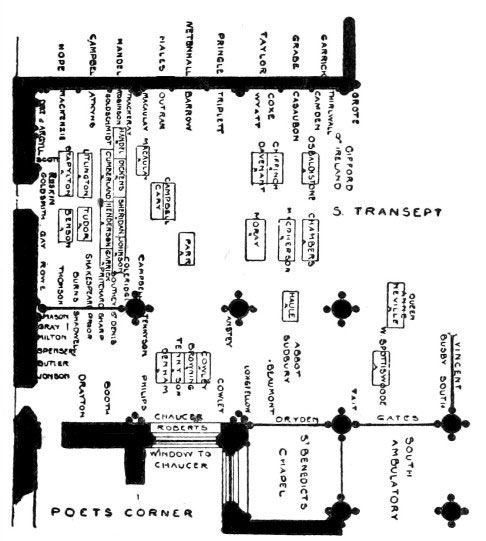
It seems fitting, at least, that it should be mentioned here rather than elsewhere, in that the work does not pretend to be a categorical guide to even the more important sights of London, but merely that it makes mention of those sights and scenes, places and peoples, more or less intimately associated with the great novelist.
Charles Dickens was buried in Westminster Abbey on the 14th June, 1870, since which time various other graves have been made, Browning and Tennyson notably, and monuments and memorials put into place of Longfellow and Ruskin.
The Poets' Corner occupies about half of the south transept of Westminster Abbey. This famous place for the busts and monuments of eminent men includes those of Chaucer, Spencer, Shakespeare, Drayton, Ben Jonson, Milton, Butler, Davenant, Cowley, Dryden, Prior, Rowe, Gay, Addison, Thomson, Goldsmith, Gray, Mason, Sheridan, Southey, Campbell, etc. Lord Macaulay and Lord Palmerston were buried here in 1860 and 1865. Thackeray is not buried here, but at Kensal Green, though his bust is placed next to the statue of Joseph Addison. Dickens' grave is situated at the foot of the coffin of Handel, and at the head of the coffin of R. B. Sheridan. More recently, Doctor Livingstone, the celebrated African traveller, was buried here. Near to England's great humourist, toward his feet, lie Doctor Johnson and Garrick, while near them lies Thomas Campbell. Shakespeare's monument is not far from the foot of the grave. Goldsmith's is on the left.
THE LOCALE OF THE NOVELS
If one may make legitimate use of the term, "the topography of Dickens,"—which an English writer coined many years since,—it may well be indiscriminately applied to Dickens' own life and that of the characters of his stories as well.
The subject has ever been a favourite one which has cropped up from time to time in the "bitty" literature of the last quarter of a century.
To treat it exhaustively would be impossible; the changes and progress of the times will not permit of this. Nothing would be final, and new shadows would constantly be thrown upon the screen.
Dickens' observation, as is well known, was most keen, but he mostly saw only those things which, in some degree, actually existed,—towns, villages, streets, localities, and public and private houses. Not an unusual method of procedure for many an author of repute, but few have had the finesse to lay on local colour to the extent used by Dickens, without tending toward mere description. This no one has ever had the temerity to lay to Dickens' door.
Mention can be made herein of but a few of the localities, many of which had existed to very near the present day.
To enumerate or to even attempt to trace them all would be practically impossible, but enough has been authenticated to indicate a more substantial reality than is found in the work of any other modern English author.
If one is so minded, he can start out from the very hotel,—"The Golden Cross" at Charing Cross,—from which Pickwick and Jingle started on their coach ride to Rochester, and where Copperfield and Steerforth also stayed. The "dark arches of the Adelphi," the Temple, and Fountain Court, remain much as of yore.
Fleet Street was well known to Dickens, and has changed but little, and Lincoln's Inn Fields, Bloomsbury, and many other localities have in reality changed not at all in their relation to their environment. In matters of detail they have, of course, in many instances undergone a certain remoulding, which is no greater perhaps than the usual liberties taken by the average author.
Dickens, in the main, changed the surroundings of his scenes—which he may have given another name—but little.
"Copperfield" is redolent of his own early associations and experiences in London. The neighbourhood of Charing Cross will be first called to mind. Hungerford Market and Hungerford Bridge (as the present Charing Cross Railway Bridge is often called by the old resident), and the "Adelphi," with its gruesome arches beneath, all give more than a suggestion of the sights and scenes which met Dickens' own eye when his personality was closely associated therewith.
Hence, regardless of whether it is biography or pure fiction, there are to-day substantial reminders throughout London, not only of his life but of the very scenes associated with the characters of his novels. More particularly in the early novels, "Pickwick," "Nickleby," and "Copperfield," are their topographical features to be most readily recognized, because, in the first place, they are, presumably, the more familiar; and secondly, because they are more vividly recalled.
It is a fact, however, that in Dickens' sketches and tales, and in many of his minor works, as, for instance, in the pages of "Master Humphrey's Clock," there are passages especially concerning persons and places in London, which to-day have, as then, a stern reality, referring to such familiar spots as the site of the Marshalsea Prison, or "The Old White Horse," or Peggotty's Yarmouth home.
Reality or imagination,—it's all the same,—Dickens drew in his pictures, after a veritable fashion, this too, in spite of the precedent of a former generation of authors, who had for ages, one may say centuries, tilled the field over and over. But it was not until Dickens "arrived" that the reading world in general, and wherever found, acquired that nodding acquaintance with London which has since so redounded to this author's reputation. No such acquaintance was previously to be had with the contemporary London life of the middle and lower classes, if one may be pardoned for expressing it thus confidently.
The marvel is that some ardent spirit has not before now compiled an out-and-out Dickens guide-book. One writer, at least, is recalled who is competent to do it, and he, be it said, is an American, Doctor Benjamin S. Martin, who many years ago contributed to an American monthly publication a series of illuminating articles on what might with propriety be called the local colour of Dickens. These were the forerunners and foster-parents of most of the "scrappy" articles of a similar purport which appear intermittently in the English and American periodical press.
The references and descriptions of certain of the localities connected with the novels which follow are given without attempt at classification or chronological arrangement. No other plan appears possible, where only a selection can be given. As before said, the limitations of the bulk of this book preclude a more extensive résumé.
The following references will be found to be fully classified in the index which accompanies the book, and will perhaps prove suggestive, at least, of further research on the part of the individual reader.
Further west, beyond Westminster and the Parliament Houses, is Millbank, where is Church Street, running from the river to St. John's Church, Westminster, that atrociously ill-mannered church of Queen Anne's day, built it is said on the lines of a footstool overturned in one of that lady's fits of petulant wrath. Down Church Street ran Martha, followed by Copperfield and Peggotty, bent on suicide.
Not the slum it was when described by Dickens, it is to-day a sufficiently "mean street" to be suggestive.
Here too, was Jenny Wren's house, on the left going toward the church in Smith Square.
Vauxhall Bridge, also reminiscent of Dickens, is near by, though the structure which formerly graced the site has given way to a temporary ungainly thing, which is neither beautiful to look upon nor suitable to its purpose.
In the neighbourhood of Charing Cross, on Craven Street, at No. 8, is still the door-knocker which so looked, to Scrooge, like a human face.
In Chandos Street, till within the last eight or ten years, were two old-time shops, to which Warren's Blacking Factory removed before the boy Dickens left their employ.
In Chandos Street, too, were the "pudding-shop" and "à la mode beef-shop," of which Dickens made such emphatic mention to his biographer, Forster.
At the corner of Parliament Street and Whitehall, in Westminster, was, until the beginning of the twentieth century, the "Old Red Lion" public house, which calls to mind the episode of "the very best stunning ale" in "Copperfield," but which is reputedly attributed as actually happening to Dickens himself.
Chancery Lane is largely identified with the story of "Bleak House." The garden of Lincoln's Inn was fondly referred to by little Miss Flite as "her garden." Law offices, stationers' shops, and eating-houses abound in the purlieus of Chancery Lane, which, though having undergone considerable change in the last quarter-century, has still, in addition to the majesty which is supposed to surround the law, something of those "disowned relations of the law and hangers-on" of which Dickens wrote.
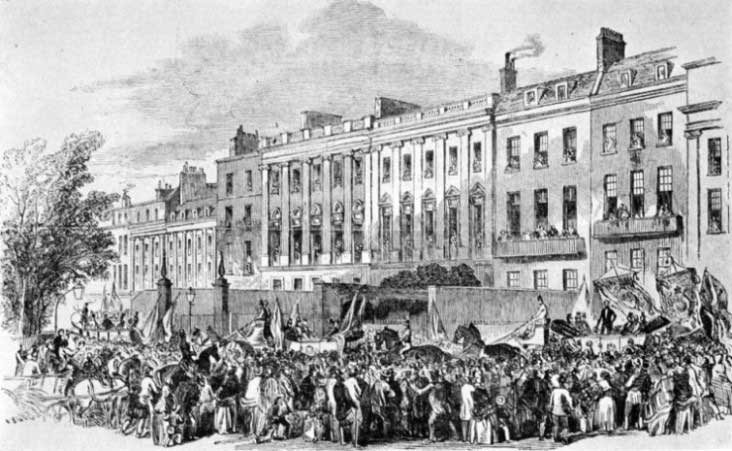
RESIDENCE OF JOHN FORSTER, LINCOLN'S INN FIELDS.
In this immediate neighbourhood—in Lincoln's Inn Fields—was Mr. Tulkinghorn's house, of which an illustration is here given, and which is still standing (1903). This house, which is readily found,—it is still No. 58,—is now given over to lawyers' offices, though formerly it was the residence of Dickens' biographer, Forster, where Dickens gave what was practically the first of his semi-public readings, on the occasion when he came from Italy especially to read the "Christmas story," "The Chimes," to a few favoured friends.
Hard by, just off the southwestern corner of the square, is the apocryphal "Old Curiosity Shop," a notable literary shrine, as is mentioned elsewhere, but not the original of the novel which bears the same name, as Dickens himself has said.
The "Clare Market," an unsavoury locality which had somewhat to do with "Pickwick," was near by, but has practically disappeared from view in a virtuous clearing-up process which has recently been undertaken.
In Portugal Street, leading into Lincoln's Inn Fields, was Mr. Solomon's headquarters; while further east, toward the city, we find the "George and Vulture," mentioned in "Pickwick," existing to-day as "a very good old-fashioned and comfortable house." Its present nomenclature is "Thomas' Chop-House," and he who would partake of the "real thing" in good old English fare, served on pewter plates, with the brightest of steel knives and forks, could hardly fare better than in this ancient house in St. Michael's Alley.
By one of those popular and ofttimes sentimental conclusions, "poor Jo's crossing" has been located as being on Holborn, near where Chancery Lane comes into that thoroughfare.
This may like enough be so, but as all crossings are much alike, and all sweepers of that impoverished class which we recognize in the description of "Jo" (now luckily disappearing), it would seem a somewhat doubtful accomplishment in attempting to place such a spot definitely.
Mrs. Jellyby lived in Thavie's Inn,—"Only 'round the corner" from Chancery Lane, said Guppy,—one of the seven inns allied with the four great Inns of Court, all of which had a particular sentiment for Dickens, both in his writings and his life. In fact, he began with "Pickwick" to introduce these "curious little nooks" and "queer old places." Indeed, he lived in Furnival's Inn when first married, and there wrote the most of the "Boz" sketches as well as "Pickwick."
Clifford's Inn, too, now on the eve of departure, is also a reminder of "Pickwick." One, "a tenant of a 'top set,' was a bad character—shut himself in his bedroom closet and took a dose of arsenic," as is told in "Pickwick," Chapter XXI.
To "Mr. Perker's chambers," in Gray's Inn,—which still endures as one of the four great Inns of Court,—went Mr. Pickwick one afternoon, to find no one at home but the laundress. In Holborn Court, in Gray's Inn, lived also Traddles and his bride.
Pip was quartered in Barnard's Inn, called by him a "dingy collection of shabby buildings."
The Temple has ever been prolific in suggestion to the novelist, and Dickens, like most others who have written of London life, has made liberal use of it in "Barnaby Rudge," in "The Tale of Two Cities," and in many other of his novels.
Staple Inn, at "Holborn Bars," is perhaps the most quaint and unmodern of any considerable structure in all London. Mr. Grewgious and Mr. Tartar lived here; also Landless, who occupied "some attic rooms in a corner," and here Mr. Snagsby was wont to ramble in this old-world retreat.
The "little hall," with "a little lantern in its roof," and its weathercock, is still there, and the stroller down that most businesslike thoroughfare, known in its various continuations as "High Holborn," "Holborn Bars," and "Holborn Viaduct," will find it difficult to resist the allurements of the crazy old timbered frontage of Staple Inn, with its wooden gateway and tiny shops, looking for all the world like a picture from out of an old book.
In Bishop's Court, leading from Chancery Lane, was Crook's rag and bottle shop, where its owner met so ghastly a death. A court to the back of this shop, known as "Chichester Rents," harboured a public house called by Dickens "Sol's Arms." To-day it exists as the "Old Ship," if supposedly authoritative opinion has not erred.
Took's Court is to-day unchanged. Dickens was pleased to call it "Cook's Court." By some it has been called dirty and dingy; it is hardly that, but it may well have been a more sordid looking place in days gone by. At any rate, it was a suitable enough environment for Snagsby, identified to-day as the stationer's shop next the Imperial Chambers.
As vivid a reminiscence as any is that of the old debtors' prison of Marshalsea. The institution was a court of law and a prison as well, and was first established in 1376 for the determination of causes and differences among the king's menials; and was under the control of the knight marshal, hence its name. Later this court had particular cognizance of murders and other offences committed within the king's court; and here also were committed persons guilty of piracies.
In 1381 the Kentish rebels "broke down the houses of the Marshalsea and the King's Bench in Southwark," and in 1593 "a dangerous insurrection arose in Southwark, owing to the attempt of one of the knight marshal's men to serve a warrant upon a feltmaker's apprentice."
At this time the inhabitants of Southwark complained that "the Knight Marshal's men were very unneighbourly and disdainful among them," with every indication that a prolonged insurrection would endure. However, the matter was brought to the attention of the lord chamberlain, and such edict went forth as assured the inhabitants of the borough freedom from further annoyance. The old gaol building was purchased in 1811 by the government, and at that time refitted as a prison for debtors.
"The entrance gate fronts the High Street near St. George's Church, and a small area leads to the keeper's house. Behind it is a brick building, the ground floor of which contains fourteen rooms in a double row, and three upper stories, each with the same number. They are about ten and a half feet square by eight and a half feet high, and are with boarded floors, a glazed window, and fireplace in each, for male debtors. Nearly adjoining to this is a detached building called the 'Tap,' which has on the ground floor a wine and beer room. The upper story has three rooms for female debtors, similar to those for men. At the extremity of this prison is a small courtyard and building for admiralty prisoners, and a chapel."
The above description, taken from Allen's "History and Antiquities of Southwark," must synchronize with the appearance of the Marshalsea at the time of which Dickens wrote concerning it in "Little Dorrit," based, of course, upon his personal knowledge of the buildings and their functions when the elder Dickens was imprisoned therein in 1822, and the family were living in mean quarters in near-by Lant Street, whither they had removed from Gower Street, North, in order to be near the prison.
Until quite recently it is possible that certain portions of the old Marshalsea were still standing, though as a prison it was abolished in 1841, but, with the opening of one of those municipal pleasure grounds,—one cannot call them gardens, being merely a flagged courtyard,—the last vestiges are supposed to have disappeared from general view. Indeed, it appears that Dickens himself was not aware of any visible portions of the old building still remaining. This assertion is based on the following lines taken from the preface of "Little Dorrit:"
"I found the outer front courtyard metamorphosed into a butter-shop; and then I almost gave up every brick for lost.... I then came to Marshalsea Place; ... and whoever goes here will find his feet on the very paving-stones of the extinct Marshalsea Gaol,—will see its narrow yard to the right and to the left but very little altered, if at all, except that the walls were lowered when the place got free."
When the elder Dickens was carried to prison, like Mr. Dorrit, he was lodged in the top story but one, in the chamber afterward occupied by the Dorrits, when Charles, it was said, went often (before the family removed across the river) to visit him, crossing presumably the old picturesque London Bridge. In "David Copperfield," it is evidently the same edifice which is disguised as the "King's Bench Prison."
In the immediate neighbourhood of the Marshalsea was St. George's Vestry, where, on the cushions, with the church register for a pillow, slept Little Dorrit on the night on which she was shut out of the prison.
Opposite, on High Street, stood until recently the little pie-shop, where Flora read out her lecture to Little Dorrit. Near by, also, was Mr. Cripple's dancing academy. (Deliciously Dickenesque—that name.) Guy's—reminiscent of Bob Sawyer—is but a stone's throw away, as also Lant Street, where he had his lodgings. Said Sawyer, as he handed his card to Mr. Pickwick: "There's my lodgings; it's near Guy's, and handy for me, you know,—a little distance after you've passed St. George's Church; turns out of High Street on right-hand side the way." Supposedly the same humble rooms—which looked out upon a pleasant prospect of a timber-yard—in which lived the Dickens family during the elder Dickens' imprisonment.
In Horsemonger Lane, which runs out of the High Street, was the tobacco-shop of Mrs. Chivery. In the High Street, too, was the old "White Hart" of Sam Weller and even Jack Cade. "The George," "The Spur," "The Queen's Head," and "The King's Head"—all reminiscent of Dickens—were also here in the immediate neighbourhood.
Crossing the river northward, one may retrace their steps toward St. Paul's, near which, a quarter of a century back, might have been seen the arcaded entrance to Doctors' Commons, an institution described by Sam Weller, and which, among other functions, formerly kept guard of all the wills probated in London. The building has since disappeared, and the erstwhile valuable documents removed to Somerset House.
Beyond the "Bank" is Leadenhall Street, where in St. Mary Axe, Dickens had located Pubsey and Co. The firm was domiciled in an "old, yellow, overhanging, plaster-fronted house," and, if it ever existed out of Dickens' imagination, has given way to a more modern and substantial structure.
Fenchurch Street and Mincing Lane are not far away. In the latter was "Chicksey, Veneering, and Stobbles" Counting-House, and still further on Trinity House and Tower Hill to remind one of the locale of certain scenes in "Our Mutual Friend."
In the Minories, leading from Tower Hill, was until recently the "Little Wooden Midshipman" of "Dombey and Son," standing over the door at Messrs. Norie and Wilson's, the nautical publishers. From Tower Hill, whither would one go but through the Ratcliffe Highway, now St. George's Street, whereby is suggested the nocturnal wanderings of "The Uncommercial Traveller." Wapping, Shadwell, and Stepney, with its famous waterside church, are all redolent of the odours of the sea and reminiscence of Dickens' characters.
Somewhere between here and Limehouse Hole was Brig Place, not discoverable to-day, where lived the genial one-armed "Cuttle."
Limehouse, with its "Reach" and "foul and furtive boats," is closely connected with the personality of Dickens himself, having been the residence of his godfather, one Huffam, a rigger employed in a waterside shipyard. What wonder then that the fascination of riverside London fell early upon the writer of novels?
At the gate of Limehouse Church, Rokesmith lay in wait, on murder intent, and all Limehouse is odorous with memories of riverside crime and such nefarious deeds as were instigated by Hexham and Riderhood, an incident suggested, it is said by Dickens' biographer Forster, by the novelist having seen, in one of his walks in the neighbourhood, a placard on the hoardings announcing that a body of a person had been
FOUND DROWNED.
A neighbouring public house, "The Two Brewers," is supposed to be the original of that referred to by Dickens as "The Six Jolly Fellowship Porters," "a dropsical old house," as he called it, like so many old-world houses, all but falling down, if judged by appearances, but actually not in the least danger of it.
One topic crops up in the notes and queries columns of the literary papers every once and again, viz., the location of the "filthy graveyard" of "Bleak House." It has been variously placed in the churchyard of St. Dunstan's-in-the-West, St. Bartholomew-the-Less, and again in Drury Lane Court, now disappeared. Most likely it was the latter, if any of these neighbourhoods, though it is all hearsay now, though formerly one of the "stock sights" of the "Lady Guide Association," who undertook to gratify any reasonable whim of the inquisitive American.
A recent foregathering of members of the "Boz Club" at Rochester, which celebrated the thirty-first anniversary of the novelist's death on June 9, 1870, occurred in the homely "Bull Inn." This little band of devoted "Dickensians" contained among them Mr. Henry Dickens, K. C., the son of the novelist; Mr. Percy Fitzgerald, who had the honour of being intimately associated with Dickens on Household Words; Mr. Luke Fildes, R. A., among whose many famous paintings is that pathetic story-telling canvas, "The Empty Chair," being a reproduction of that portion of Dickens' study at Gad's Hill, wherein stood the writer's desk and chair.
On such a day as that on which the immortal Pickwick "bent over the balustrades of Rochester Bridge contemplating nature and waiting for breakfast," the club (in June, 1903) had journeyed to Rochester to do homage to the fame of their master. The mediæval, cramped High Street, "full of gables, with old beams and timbers carved into strange faces," seems to bask and grow sleepier than ever in the glaring sunlight. It is all practically just as Dickens saw it for the last time three days before his death, as he stood against the wooden palings near the Restoration House contemplating the old Manor House—just the same even to "the queer old clock that projects over the pavement out of a grave red-brick building, as if Time carried on business there, and hung out his sign." Those of the visitors so "dispoged" had lunch in the coffee-room of the "Bull," unchanged since the days of the original Pickwickians, but it is only in fancy and framed presentments that one now sees the "G. C. M. P. C." and his disciples, Messrs. Tupman, Snodgrass, Winkle, and Jingle. So closely, however, do we follow in the footsteps of Mr. Pickwick (wrote a member of the party) that we look through the selfsame coffee-room blinds at the passengers in the High Street, in which entertaining occupation we were disturbed, as was Mr. Pickwick, by the coming of the waiter (perhaps one should say a waiter, not the waiter) to announce that the carriages are ready—"an announcement which the vehicles themselves confirm by forthwith appearing before the coffee-room blinds aforesaid."
"'Bless my soul!' said Mr. Pickwick, as they stood upon the pavement while the coats were being put in. 'Bless my soul! who's to drive? I never thought of that.'
"'Oh! you, of course,' said Mr. Tupman.
"'I!' exclaimed Mr. Pickwick.
"'Not the slightest fear, sir,' interposed the hostler.
"'He don't shy, does he?' inquired Mr. Pickwick.
"'Shy, sir?—He wouldn't shy if he was to meet a vaggin-load of monkeys with their tails burnt off.'"
The ruined castle and the cathedral are visited, the castle looking more than ever "as if the rooks and daws had picked its eyes out." Before the cathedral, as Mr. Grewgious did before us, we stand for a contemplative five minutes at the great west door of the gray and venerable pile.
"'Dear me,' said Mr. Grewgious, peeping in, 'it's like looking down the throat of Old Time.'
"Old Time heaved a mouldy sigh from tomb and arch and vault; and gloomy shadows began to deepen in corners; and damps began to rise from green patches of stone; and jewels, cast upon the pavement of the nave from stained-glass by the declining sun, began to perish."
Or, to quote the more genial Jingle:
"Old Cathedral, too—earthly smell—pilgrims' feet worn away the old steps—little Saxon doors—confessionals like money takers' boxes at theatres—queer customers those monks—Popes, and Lord Treasurers, and all sorts of old fellows, with great red faces, and broken noses, turning up every day—buff jerkins, too—matchlocks—sarcophagus—fine place—old legends too—strange stories, too; capital."
DISAPPEARING LONDON
Place names are always of interesting origin, in fact, all proper names have a fascination for the historian and litterateur alike. Dickens himself was fond enough of the unusual, and doubtless he made good use of those bygones of a former age, which seemed best to suit his purpose. On the other hand, where would one find in reality such names as Quilp, Cheeryble, Twist, Swiveller, Heep, Tulkinghorn, or Snodgrass? Where indeed! except in the Boston (U. S. A.) Directory? Here will be found Snodgrass and Twist and even a Heep, though he spells it Heap. It would be still further interesting to know the derivation of the names of these individuals; but inasmuch as it would probably throw no additional light on Dickens' own personality, it is passed by without further comment. It is not that these names are any more unusual than many that really do exist, and possibly they all may have had a real entity outside of the author's brain; still it does represent a deal of thought that each and every character throughout all of Dickens' works should seem so singularly appropriate and in keeping with their names.
With place names Dickens took another line. Occasionally he played upon a word, though often he did not disguise it greatly; nor did he intend to. In many more instances, he presented no counterfeit whatever. For picturesqueness and appropriateness, in conjunction with the lives of the individuals of which his novels abound, one could hardly improve on many actual places of which he wrote.
London street names, in general, may be divided into two classes: those named for distinguished, or, for that matter, notorious persons, as Duke Street, Wellington Street, George Street, Berkeley, Grosvenor, or Bridgewater Squares; or secondly, those named for topographical or architectural features, both classes of which, in the earlier times or immediately following the "Great Fire," underwent no inconsiderable evolution.
In a later day this will perhaps not prove equally true; remodelling and rearranging of streets and squares not only changes the topography, but—aside from the main arteries—names as well are often changed or suppressed altogether. Since Dickens' time many spots, which must have been dearly known and beloved of him, have disappeared, and the process is going on apace, until, with the advent of another century, it will doubtless be difficult to recognize any of the localities of a hundred or more years before.
Some remarkable corruptions have been recorded from time to time, such as Candlewick Street into Cannon Street, Cannon Row to Channel Row, and Snore Hill to Snow Hill, all of which are easily enough followed. Strype's Court (after the historian's family) to Tripe Court, or Duck Lane into Duke Street, are not so easy.
Tavern signs, too, are supposed to have undergone similar perversions, not always with euphonious success, as witness the following: "The Bachnals" into "Bag of Nails," "The God Encompasseth Us" into "Goat and Compasses;" both of the former existed in Victorian days, as does the latter at the present time. Many of these old tavern signs are to be seen to-day in the museum at the Guild Hall.
The actual changes of street names are equally curious, when one attempts to follow the connection, which, for a fact, mostly cannot be done. Thus they stand in their modified form, either as an improvement or debasement. Hog Lane, St. Giles, is now Crown Street; Grub Street is now gloriously named Milton Street, and Shoreditch Lane becomes Worship Street.
The matter of street lighting is ever one which appeals to the visitor to a strange city. Curious customs there be, even to-day, in the city of London, which have come down from the age which knew not the gas-jet or the electric globe.
In Dickens' time, it is confident to say that the "linkman" was not the rara avis that he is to-day, though evidences are still to be noted in residential Mayfair and Belgravia, and even elsewhere, of the appurtenances of his trade, referring to the torch-extinguishers which were attached outside the doorways of the more pretentious houses.
As an established trade, link-carrying has been extinct for nearly a century, but the many extinguishers still to be seen indicate that the custom died but slowly from the days when the sturdy Briton,—
"Round as a globe and liquored every chink, Goodly and great, sailed behind his link." —Dryden.
The first street lighted with gas was Pall Mall, in 1807, and oil was solely used in many streets and squares as late as 1860.
The old London watchman—the progenitor of the modern policeman—used to cry out, "Light! Light! hang out your light." Later came enclosed glass lamps or globes, replacing the candles of a former day. These endured variously, as is noted, until very near the time when electric refulgence was beginning to make itself known. On the whole, until recently, London could not have been an exceedingly well-lighted metropolis, and even now there is many a dark court and alley, which would form in itself a fitting haunt for many a lower-class ruffian of the type Dickens was wont to depict.
The mortality among the old inns of Holborn has been very high of late, and still they vanish. "The Black Bull," known well to Dickens, is the last to come under sentence. Its sign, a veritable bull of Bashan, sculptured in black and gold, has been familiar to all who go down to the City in omnibuses. Until recently the old courtyard of the inn might still have been seen, though the galleried buildings which surrounded it were modern. Before Holborn Viaduct was built, the "Black Bull" stood just at the top of Holborn Hill, that difficult ascent which good citizens found too long, and bad ones too short. "Sirrah, you'll be hanged; I shall live to see you go up Holborn Hill," says Sir Sampson Legend to his thriftless son in Congreve's "Love for Love."
But the "Black Bull" has nearer associations for us. It was here that Mrs. Gamp and Betsy Prig nursed Mr. Lewsome through his fever at the expense of John Westlock. When Mrs. Gamp relieved Betsy in the sick-room, the following dialogue occurred: "'Anything to tell afore you goes, my dear?' asked Mrs. Gamp, setting her bundle down inside the door, and looking affectionately at her partner. 'The pickled salmon,' Mrs. Prig replied, 'is quite delicious. I can partick'ler recommend it. Don't have nothink to say to the cold meat, for it tastes of the stable. The drinks is all good.'" To-day the cold meat is represented by the noble animal on the façade of the inn, and it will probably adorn the Guildhall collection of old shop and tavern signs, where the hideous "Bull and Mouth" and "Goose and Gridiron" still look down on the curious.
Of the matter-of-fact realities of London, which, though still existent, have changed since Dickens' day, London Bridge is undergoing widening and rebuilding, which will somewhat change its general aspect, though its environment remains much the same.
Furnival's Inn, where Dickens lived, has disappeared, and Clifford's Inn has just been sold (1903) in the public auction mart, to be removed, with some hideous and unquiet modern office building doubtless destined to take its place.
New transportation schemes, almost without number, are announced. Electric trams, "tubes," and underground subways are being projected in every direction. These perhaps do not change the surface aspect of things very much, but they are working a marvellous change in the life of the times. The old underground "District" and "Metropolitan" Railways are being "electrified" by the magnanimity (sic) of American capital, and St. Paul's Cathedral has been supplied with a costly electric-light plant at the expense of an American multi-millionaire.
The American invasion of typewriters, roll-top desks, and book printing and binding machinery, are marking an era of change and progress in the production of the printed word, and Continental-made motors and automobiles are driving the humble cart-horse from the city streets in no small way.
It now only remains for the development of the project which is to supplant the ungainly though convenient omnibus with an up-to-date service of motor stages, when, in truth, London will have taken on very much of a new aspect.
One of the most recent disappearances is old Holywell Street, of unsavoury reputation, the whilom Booksellers' Row of Dickens' day, a "narrow, dirty lane" which ran parallel with the Strand from St. Clement's-Danes to St. Mary-le-Strand, and was occupied chiefly by vendors of books of doubtful morality. Wych Street, too, in company with Holywell Street, has gone the same way, in favour of the new thoroughfare which is to connect Holborn and the Strand, an enterprise which also has made way with the Clare Market between Lincoln's Inn Fields and the Strand, a locality well known to, and made use of by, Dickens in "The Old Curiosity Shop."
The identical building referred to therein may be in doubt; probably it is, in that Dickens himself repudiated or at least passed a qualifying observation upon the "waste paper store," which popular tradition has ever connected therewith. But one critic—be he expert or not—has connected it somewhat closely with the literary life of the day, as being formerly occupied by one Tessyman, a bookbinder, who was well acquainted with Dickens, Thackeray, and Cruikshank. The literary pilgrim will give up this most sentimental Dickens relique with something of the serious pang that one feels when his favourite idol is shattered, when the little overhanging corner building is finally demolished, as it soon will be, if "improvement" goes on at the pace of the last few years hereabouts.
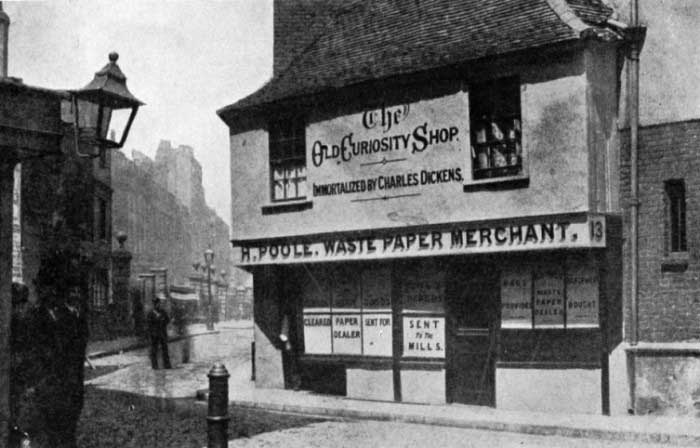
THE (REPUTED) "OLD CURIOSITY SHOP."
A drawing of this revered building has been included in the present volume, as suggestive of its recorded literary associations.
There is no question but what it is the relique of the first rank usually associated with Dickens' London, as witness the fact that there appears always to be some numbers of persons gazing fondly at its crazy old walls.
The present proprietor appears to have met the demand which undoubtedly exists, and purveys souvenirs, prints, drawings, etc., to the Dickens admirers who throng his shop "in season" and out, and from all parts of the globe, with the balance, as usual, in favour of the Americans.
Rumour has it, and it has been said before, that some "collector" (from America, of course) has purchased this humble shrine, and intends to erect it again across the seas, but no verification of this is possible at this writing.
Whether it had any real being in Dickens' story, the enthusiast, in view of the facts, must decide for him or herself.
"And now at length he's brought Unto fair London City Where, in Fleet Street, All those many see 't That will not believe my ditty." —Butler.
A half-century ago Temple Bar might have been described as a gateway of stone separating the Strand from Fleet Street—the City from the shire.
This particular structure was erected from designs by Sir Christopher Wren in 1670, and from that day until long after Dickens' death, through it have passed countless throngs of all classes of society, and it has always figured in such ceremony of state as the comparatively infrequent visits of the sovereign to the City. The invariable custom was to close the gate whenever the sovereign had entered the City, "and at no other time."
The ceremony was simple, but formal: a herald sounds a trumpet—another herald knocks—a parley—the gates are thrown open and the lord mayor, pro tempo., hands over the sword of the City to the sovereign. It was thus in Elizabeth's time, and it had changed but little throughout Victoria's reign.
The present structure is Temple Bar only in name, being a mere guide-post standing in the middle of the roadway; not very imposing, but it serves its purpose. The former structure was removed in the eighties, and now graces the private park of an estate at Walthamstow.
For long before it was taken down, its interior space was leased to "Childs," the bankers, as a repository or storage-place for their old ledgers. Thus does the pomp of state make way for the sordidness of trade, and even the wealthy corporation of the City of London was not above turning a penny or two as additional revenue.
The following details of Furnival's Inn, which since Dickens' time has disappeared, are pertinent at this time.
"Firnivalles Inn, now an Inn of Chancery, but some time belonging to Sir William Furnival, Knight," is the introduction to the description given by Stow in his "Annals." The greater part of the old inn was taken down in the time of Charles I., and the buildings remaining in Dickens' day, principally occupied as lawyers' offices, were of comparatively modern construction. Since, these too, have disappeared, and there is little to call it to mind but the location the inn once occupied.
The Gothic hall, with its timber roof,—part of the original structure (tempo Richard II.),—was standing as late as 1818, when the entire inn was rebuilt by one Peto, who it is to be inferred built the row in which were the lodgings occupied by Dickens.
In the west end of London changes have been none the less rapid than in the east. The cutting through of Northumberland Avenue, from Trafalgar Square to the river, laid low the gardens and mansion of Northumberland House. Of this stately mansion it is said that it looked more like a nobleman's mansion than any other in London. It was built, in about 1600, by the Earl of Northampton, and came into the hands of the Percies in 1642. Stafford House is perhaps the most finely situated mansion in the metropolis, occupying the corner of St. James' and the Green Parks, and presenting four complete fronts, each having its own architectural character. The interior, too, is said to be the first of its kind in London. The mansion was built by the Duke of York, with money lent by the Marquis of Stafford, afterward Duke of Sutherland; but the Stafford family became owners of it, and have spent at least a quarter of a million sterling on the house and its decorations. Apsley House, at the corner of Piccadilly and Hyde Park, is the residence of the Dukes of Wellington, and is closely associated with the memory of the duke. The shell of the house, of brick, is old; but stone frontages, enlargements, and decorations were afterward made. The principal room facing Hyde Park, with seven windows, is that in which the Great Duke held the celebrated Waterloo Banquet, on the 18th of June in every year, from 1816 to 1852.
In the seventeenth century the Strand was a species of country road, connecting the city with Westminster; and on its southern side stood a number of noblemen's residences, with gardens toward the river. The pleasant days are long since past when mansions and personages, political events and holiday festivities, marked the spots now denoted by Essex, Norfolk, Howard, Arundel, Surrey, Cecil, Salisbury, Buckingham, Villiers, Craven, and Northumberland Streets—a very galaxy of aristocratic names.
Again it is reiterated: the names are, for the most part, actually those now given to great hotels which occupy the former sites of these noble mansions.
The residences of the nobility and gentry were chiefly in the western part of the metropolis. In this quarter there have been large additions of handsome streets, squares, and terraces within the last fifty years. First, the district around Belgrave Square, usually called Belgravia. Northeast from this, near Hyde Park, is the older, but still fashionable quarter, comprehending Park Lane and Mayfair. Still farther north is the modern district, sometimes called Tyburnia, being built on the ground adjacent to what once was "Tyburn," the place of public executions. This district, including Hyde Park Square and Westbourne Terrace, early became a favourite place of residence for city merchants. Lying north and northeast from Tyburnia are an extensive series of suburban rows of buildings and detached villas, which are ordinarily spoken of under the collective name, St. John's Wood, Regent's Park forming a kind of rural centre to the group.
New thoroughfares and the need thereof make a wholly new set of conditions, and such landmarks as have survived the stress of time and weather are thoroughly suggestive and reminiscent of the past, and are often the only guide-posts left by which one may construct the surroundings of a former day.
Of this the stranger is probably more observant than the Londoner born and bred. The gloomy, crowded streets—for they are gloomy, decidedly, most of the time during five months of the year—do not suggest to the native emotions as vivid as to the stranger, who, with a fund of reading for his guide, wanders through hallowed ground which is often neglected or ignored by the Londoner himself.
As for the general architectural effect of London as a type of a great city, it is heightened or lowered accordingly as one approves or disapproves of the artistic qualities of soot and smoke.
Fogs are the natural accompaniment of smoke, in the lower Thames valley, at least, and the "London particular"—the pea-soup variety—is a thing to be shuddered at when it draws its pall over the city. At such times, the Londoner, or such proportion of the species as can do so, hurries abroad, if only to the Surrey Hills, scarce a dozen miles away, but possessed of an atmosphere as different as day is from night.
Our own Nathaniel Hawthorne it was who wrote, "There cannot be anything else in its way so good in the world as this effect" (of fog and smoke) "on St. Paul's in the very heart and densest tumult of London. It is much better than staring white; the edifice would not be nearly so grand without this drapery of black." Since we are told that the cost of the building was defrayed by a tax on all coals brought into the port of London, it gets its blackness by right. This grime is at all events a well-established fact, which has to be accepted.
Mr. G. A. Sala, a friend and contemporary of Dickens, also wrote in favour of the smoky chimneys. He says about St. Paul's: "It is really the better for all the incense which all the chimneys since the time of Wren have offered at its shrine, and are still flinging up every day from their foul and grimy censers." As a flower of speech, this is good, but as criticism it is equivalent to saying the less seen of it the better. M. Taine, the French critic, evidently thought otherwise; he wrote of Somerset House:
"A frightful thing is the huge palace in the Strand which is called Somerset House. Massive and heavy piece of architecture, of which the hollows are inked, the porticoes blackened with soot, where in the cavity of the empty court is a sham fountain without water, pools of water on the pavement, long rows of closed windows. What can they possibly do in these catacombs? It seems as if the livid and sooty fog had even befouled the verdure of the parks. But what most offends the eyes are the colonnades, peristyles, Grecian ornaments, mouldings, and wreaths of the houses, all bathed in soot. Poor antique architecture—what is it doing in such a climate?"
To decide what style of architecture prevails in the medley of different periods constituting London is indeed difficult. One authority concludes that the "dark house in the long, unlovely street," of which Tennyson tells, and Mme. de Staël vituperates, covers the greater number of acres. The fact is, each of the districts constituting London as it now is, i. e., Belgravia, Tyburnia, Bayswater, Kensington, Chelsea, etc., has the impress and character of the time of its greatest popularity and fashion and of the class by which it was principally inhabited. It has always been the city's fate to have its past overgrown and stifled by the enthralling energy and life of the present. It is as a hive that has never been emptied of its successive swarms. This is more or less the fate of all towns that live.
The first map of London was published in 1563 by Ralph Ugga; it shows the same main arteries as exist to-day—the Strand, "Chepe," and Fleet. In a later map of 1610, London and Westminster appear as small neighbouring towns with fields around them; Totten Court, a country village; Kensington and Marylebone secluded hamlets; Clerkenwell and St. Gyllis quite isolated from the main city while Chelsey was quite in the wilds.
Even the great devastating fires did not destroy the line of the public highways. After that of 1666 Sir Christopher Wren wished to remodel the town and make it regular, symmetrical, and convenient; but, although he was the prevailing spirit in the rebuilding of London city, and no important building during forty years was erected without his judgment, his plan for regulating and straightening the streets did not take effect. Much of the picturesque quality of the city is owing to its irregularity and the remains of its past. Wren rebuilt no less than sixty churches, all showing great variety of design. St. Paul's, the third Christian church since early Saxon times on the same site, was his masterpiece.
Of his immediate predecessor, Inigo Jones, the Banqueting House in Whitehall, now used as a museum, remains a fragment of the splendid palace designed by him for James I. The classical revival began with Gibbs, when he built St. Martin's-in-the-Fields, whose Greek portico is the best and most perfect Greek example in London, if we except the caryatides of St. Pancras. The brothers Adam also flourished at this time, and introduced grace of line and much artistic skill in domestic establishments which they built in "The Adelphi" and elsewhere. Chambers with Somerset House, and Sir John Soane with the Bank of England, continued the classical traditions, but its full force came with Nash, "the apostle of plaster," who planned the Quadrant and Regent Street, from Carlton House to Regent's Park, and the terraces in that locality, in the tawdry pseudo-classic stuccoed style, applied indiscriminately to churches, shops, and what not. Not till the middle of the nineteenth century did the Gothic revival flourish. Pugin, Britton, and Sir John Barry then became prominent. The last named built the Houses of Parliament.
The demand for originality in street architecture is to be seen in the tall, important blocks of residential flats and new hotels now rising up in every quarter. Not beautiful and in many cases not even intelligible, they are unmistakable signs of the times, showing the process of transformation which is going on rapidly, sweeping away much that is beautiful to meet the requirements of modern life.
London is perhaps never to be doomed to the curse of the sky-scraper, as it is known in America; the results of such an innovation would be too dire to contemplate, but like every other large city, it is under the spell of twentieth century ideas of progress, and the results, a score or more years hence, will, beyond doubt, so change the general aspect and conditions of life that the spirit of the Victorian era in architecture and art will have been dissipated in air, or so leavened that it will be a glorified London that will be known and loved, even better than the rather depressing atmosphere which has surrounded London and all in it during the thirty-five rapid years which have passed since Dickens' death.
Such, in brief, is a survey of the more noticeable architectural and topographical features of London, which are indicating in no mean fashion the effect of Mr. Whistler's dictum: "Other times, other lines."
Of no place perhaps more true than of London, yet, on the other hand, in no other place, perhaps, does the tendency make way so slowly.
THE COUNTY OF KENT
The country lying between London and the English Channel is one of the most varied and diversified in all England. The "men of Kent" and the "Kentish men" have gone down in history in legendary fashion. The Roman influences and remains are perhaps more vivid here to-day than elsewhere, while Chaucer has done perhaps more than all others to give the first impetus to our acquaintanceship with the pleasures of the road.
"The Pilgrim's Way," the old Roman Watling Street, and the "Dover Road" of later centuries bring one well on toward the coaching days, which had not yet departed ere Mr. Pickwick and his friends had set out from the present "Golden Cross" Hotel at Charing Cross for "The Bull" at Rochester.
One should not think of curtailing a pilgrimage to what may, for the want of a more expressive title, be termed "Dickens' Kent," without journeying from London to Gravesend, Cobham, Strood, Rochester, Chatham, Maidstone, Canterbury, and Broadstairs. Here one is immediately put into direct contact, from the early works of "Pickwick," "Copperfield," and "Chuzzlewit," to the last unfinished tale of "Edwin Drood."
No end of absorbing interest is to be found in the footsteps of Pickwick and Jingle, and Copperfield and his friend Steerforth.
To-day one journeys, by a not very progressive or up-to-date railway, by much the same route as did Mr. Pickwick and his friends, and reaches the Medway at Strood and Rochester through a grime and gloom which hardly existed in Dickens' time to the same compromising extent that it does to-day. Bricks, mortar, belching chimneys, and roaring furnaces line the route far into the land of hops.
Twenty miles have passed before those quiet scenes of Kentish life, which imagination has led one to expect, are in the least apparent. The route via the river towns of Woolwich, Erith, Gravesend, and Dartford, or via Lee, Eltham, and Bexley, is much the same, and it is only as the train crosses the Medway at Strood—the insignificant and uninteresting suburb of Rochester—that any environment of a different species from that seen in London itself is to be recognized. The ancient city of Rochester, with its overgrown and significantly busy dockyard appendage of Chatham, is indicative of an altogether different raison d'être from what one has hitherto connected the scenes of Dickens' stories.
Kent as a whole, even the Kent of Dickens, would require much time to cover, as was taken by the "Canterbury" or even the "Pickwickian" pilgrims, but a mere following, more or less rapidly, of the Dover Road, debouching therefrom to Broadstairs, will give a vast and appreciative insight into the personal life of Dickens as well as the novels whose scenes are here laid.
The first shrine of moment en route would be the house at Chalk, where Dickens spent his honeymoon, and lived subsequently at the birth of his son, Charles Dickens, the younger. Gad's Hill follows closely, thence Rochester and Chatham. The pond on which the "Pickwickians" disported themselves on a certain occasion, when it was frozen, is still pointed out at Rochester, and "The Leather Bottle" at Cobham, where Mr. Pickwick and Mr. Winkle made inquiries for "a gentleman by the name of Tupman," is a very apparent reality; and with this one is well into the midst of the Kent country, made famous by Charles Dickens.
Aside from Dickens' later connection with Rochester, or, rather, Gad's Hill Place, there is his early, and erstwhile happy, life at Chatham to be reckoned with. Here, his father being in employment at the dockyard, the boy first went to school, having been religiously and devotedly put through the early stages of the educative process by his mother.
His generally poor health and weakly disposition kept him from joining in the rough games of his schoolmates, and in consequence he found relaxation in the association of books. Indeed, it was at this time that the first seeds of literary ambition took root, with the result that a certain weedy thing, called "A Tragedy," grew up under the title of "Misnar, the Sultan of India," which at least gave the young author fame among his immediate juvenile circle.
At the age of nine, his father left Chatham, and Dickens was removed with the rest of the family to London, where his early pitiful struggles began, which are recorded elsewhere.
There is a peculiar fascination about both the locality and the old residence of Charles Dickens—Gad's Hill Place—which few can resist. Its lofty situation on a ridge between the Thames and the Medway gives Gad's Hill several commanding views, including the busy windings of the latter, where the Dutch fleet anchored in Elizabeth's reign.
The surroundings seem from all times to have been a kind of Mecca to tramps and petty showmen. That Dickens had an irresistible love for this spot would be clear from the following extract from his works:
"I have my eye on a piece of Kentish road, bordered on either side by a wood, and having, on one hand, between the road dust and the trees, a skirting patch of grass. Wild flowers grow in abundance on this spot, and it lies high and airy, with a distant river stealing steadily away to the ocean...."
Gad's Hill Place is a comfortable, old-fashioned, creeper-clad house, built about a century since, and is on the spot mentioned in Shakespeare's "Henry IV." as the scene of the robbery of the travellers. The following extract from a mediæval record book is interesting:
"1586, September 29th daye, was a thiefe yt was slayne, buried." Again "1590, Marche the 17th daie, was a thiefe yt was at Gadshill wounded to deathe, called Robert Writs, buried."
The "Falstaff" Inn is nearly opposite Gad's Hill Place, and dates probably from Queen Anne's time. It formerly had an old-fashioned swinging sign, on one side of which was painted Falstaff and the Merry Wives of Windsor. In its long sanded room there was a copy of Shakespeare's monument in Westminster Abbey. Fifty years ago about ninety coaches passed this inn daily.
In the garden at Gad's Hill Place Dickens had erected a Swiss chalet presented to him by Fechter, the actor. Here he did his writing "up among the branches of the trees, where the birds and butterflies fly in and out."
The occupiers of Gad's Hill Place since the novelist's death have been Charles Dickens, the younger, Major Budden, and latterly the Honourable F. W. Latham, who graciously opens certain of the apartments to visitors.
In the immediate neighbourhood of Rochester is Cobham, with its famous Pickwickian inn, "The Leather Bottle," where Mr. Tupman sought retirement from the world after the elopement of Miss Wardle with Alfred Jingle.
Dickens himself was very fond of frequenting the inn in company with his friends.
The visitor will have no need to be told that the ancient hostelry opposite the village church is the "Leather Bottle" in question, so beloved of Mr. Pickwick, since the likeness of that gentleman, painted vividly and in the familiar picturesque attitude, on the sign-board, loudly proclaims the fact. It should be one of the fixed formulæ of the true Dickensian faith that all admirers of his immortal hero should turn in at the "Leather Bottle" at Cobham, and do homage to Pickwick in the well-known parlour, with its magnificent collection of Dickens relics, too numerous to enumerate here, but of great and varied interest, the present proprietor being himself an ardent Dickens enthusiast.
Here is a shrine, at once worthy, and possessed of many votive offerings from all quarters.
Dickens' personality, as evinced by many of his former belongings, which have found a place here, pervades the bar parlour. So, too, has the very spirit and sentiment of regard for the novelist made the "Leather Bottle's" genial host a marked man. He will tell you many anecdotes of Dickens and his visits here in this very parlour, when he was living at Higham.
The "mild and bitter," or the "arf and arf," is to-day no less pungent and aromatic than when Dickens and his friends regaled themselves amid the same surroundings.
It should be a part of the personal experience of every Dickens enthusiast to journey to the "unspoilt" village of Cobham and spend a half-day beneath the welcoming roof of the celebrated "Leather Bottle."
The great love of Dickens for Rochester, the sensitive clinging to the scenes of that happy, but all too short childhood at Chatham, forms an instance of the magnetic power of early associations.
"I have often heard him say," said Forster, "that in leaving the neighbourhood of Rochester he was leaving everything that had given his early life its picturesqueness or sunshine."
What the Lake District is to Wordsworthians, Melrose to lovers of Scott, and Ayr to Burns, Rochester and its neighbourhood is to Dickens enthusiasts throughout the English-speaking world.
The very subtlety of the spell in the former cases holds aloof many an average mortal who grasps at once the home thrusts, the lightly veiled satire, the poor human foibles, fads, and weaknesses in the characters of Dickens. The ordinary soul, in whom the "meanest flower that grows" produces no tears, may possibly be conscious of a lump in his throat as he reads of the death of Jo or Little Nell. The deaths of Fagin and Bill Sikes are, after all, a more native topic to the masses than the final exit of Marmion.
Not only so, but the very atmosphere of the human abodes, to say nothing of minute and readily identified descriptions of English scenery, permeates the stories of Dickens.
Gad's Hill at Higham can, to be sure, hardly be reckoned as a London suburb, but on the other hand it was, in a way, merely a suburban residence near enough thereto to be easily accessible.
Even in his childhood days Dickens had set his heart upon the possession of this house, which was even then known as Gad's Hill Place. His father, who at that time had not fallen upon his unfortunate state, had encouraged him to think that it might be possible, "when he should have grown to a man," did he but work hard.
At any rate Dickens was able to purchase the estate in 1856, and from that date, until his death in 1870, it was occupied by him and his family. Writing to Forster at this time, Dickens stated that he had just "paid the purchase-money for Gad's Hill Place" (£1,790). How Dickens' possession of the house actually came about is told in his own words, in a letter written to his friend, M. De Cerjet, as follows:
"I happened to be walking past (the house) a year or so ago, with my sub-editor of Household Words (Mr. W. H. Wills), when I said to him: 'You see that house? It has always a curious interest for me, because when I was a small boy down in these parts, I thought it the most beautiful house (I suppose because of its famous old cedar-trees) ever seen. And my poor father used to bring me to look at it, and used to say that if ever I grew up to be a clever man perhaps I might own that house, or such another house. In remembrance of which, I have always, in passing, looked to see if it was to be sold or let, and it has never been to me like any other house, and it has never changed at all.' We came back to town and my friend went out to dinner. Next morning he came to me in great excitement, and said, 'It is written that you are to have that house at Gad's Hill. The lady I had allotted to take down to dinner yesterday began to speak of that neighbourhood. "You know it?" I said; "I have been there to-day." "Oh, yes," she said, "I know it very well; I was a child there in the house they call Gad's Hill Place. My father was the rector, and lived there many years. He has just died, has left it to me, and I want to sell it." So,' says the sub-editor, 'you must buy it, now or never!' I did, and hope to pass next summer there."
It is difficult to regard the numerous passages descriptive of places in Dickens' books without reverence and admiration. The very atmosphere appears, by his pen, to have been immortalized.
Even the incoherences of Jingle have cast a new cloak of fame over Rochester's Norman Cathedral and Castle!
"'Ah! fine place, glorious pile—frowning walls—tottering arches—dark nooks—crumbling staircases. Old Cathedral too—earthy smell—pilgrims' feet wore away the old steps—little Saxon doors—confessionals like money-takers' boxes at theatres—queer customers those monks—Popes and Lord Treasurers and all sorts of fellows, with great red faces and broken noses, turning up every day—buff jerkins too—matchlocks—sarcophagus— fine place—old legends too—strange stories: capital,' and the stranger continued to soliloquize until they reached the Bull Inn, in the High Street, where the coach stopped."
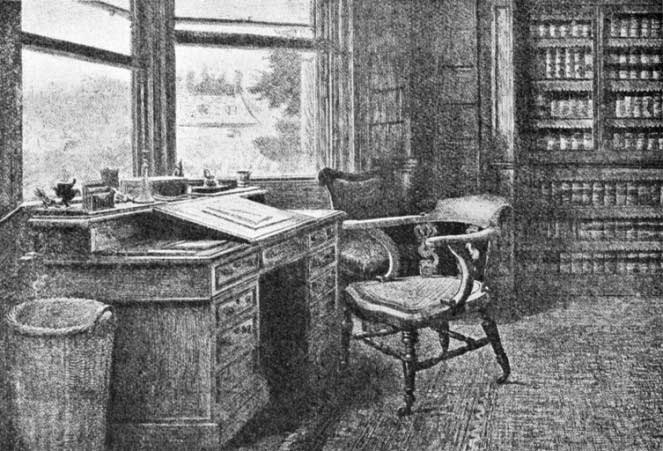
DICKENS' STUDY AT GAD'S HILL PLACE. From a painting by Luke Fildes, R. A.
A further description of the Cathedral by Dickens is as follows:
"A certain awful hush pervades the ancient pile, the cloisters, and the churchyard, after dark, which not many people care to encounter. The cause of this is not to be found in any local superstition that attaches to the precincts, but it is to be sought in the innate shrinking of dust with the breath of life in it from dust out of which the breath of life has passed; also in the ... reflection, 'If the dead do, under any circumstances, become visible to the living, these are such likely surroundings for the purpose that I, the living, will get out of them as soon as I can.'"
With Durdles and Jasper, from the pages of "Edwin Drood," also, one can descend into the crypt of the earlier Norman church, the same they visited by moonlight, when Durdles kept tapping the wall "just where he expected to disinter a whole family of 'old 'uns.'"
In numerous passages Dickens has truly immortalized what perforce would otherwise have been very insignificant and unappealing structures. The Bull Inn, most interesting of all, is unattractive enough as a hostelry. It would be gloomy and foreboding in appearance indeed, and not at all suggestive of the cheerful house that it is, did it but lack the association of Dickens.
No. 17 in the inn is the now famous bedroom of Mr. Pickwick, and the present coffee-room now contains many relics of Dickens purchased at the sale held at Gad's Hill Place after the author's death.
Chatham Lines, the meadows, the Cathedral and Castle, "Eastgate House," the Nuns' House of "Edwin Drood," "Restoration House," the "Satis House" of "Great Expectations," serve in a way to suggest in unquestionable manner the debt which Dickens laid upon Rochester and its surroundings.
"Eastgate House" is said to be the original of the home of Mr. Sapsea, the auctioneer and estate agent in "Edwin Drood."
The date of Eastgate House, 1591, is carved on a beam in one of the upper rooms. Dickens, in "Edwin Drood," alludes to Eastgate House as follows:
"In the midst of Cloisterham [Rochester] stands the 'Nuns' House,' a venerable brick edifice, whose present appellation is doubtless derived from the legend of its conventual uses. On the trim gate enclosing its old courtyard is a resplendent brass plate, flashing forth the legend: 'Seminary for young ladies: Miss Twinkleton.' The house-front is so old and worn, and the brass plate is so shining and staring, that the general result has reminded imaginative strangers of a battered old beau with a large modern eye-glass stuck in his left eye."
To-day there is noticeable but little change, and the charm of Rochester in literary association, if only with respect to Dickens, is far greater than many another city greater and more comprehensive in its scope.
In the opening scenes of the earlier work Dickens treated of Rochester, but the whole plot of his last novel, "Edwin Drood," is centred in the same city.
"For sufficient reasons, which this narrative ["Edwin Drood"] will itself unfold as it advances, a fictitious name must be bestowed upon the old Cathedral town. Let it stand in these pages as Cloisterham. It was once possibly known to the Druids by another name, and certainly to the Romans by another; and a name more or less in the course of many centuries can be of little moment in its dusty chronicles." Dickens describes it thus:
"An ancient city, Cloisterham, and no meet dwelling-place for any one with hankerings after the noisy world. A monotonous, silent city, deriving an earthy flavour throughout from its cathedral crypt, and so abounding in vestiges of monastic graves that the Cloisterham children grow small salad in the dust of abbots and abbesses, and make dirt-pies of nuns and friars; while every ploughman in its outlying fields renders to once puissant Lord Treasurers, Archbishops, Bishops, and such like, the attention which the Ogre in the story-book desired to render to his unbidden visitor, and grinds their bones to make his bread.... In a word, a city of another and a bygone time is Cloisterham, with its hoarse Cathedral bell, its hoarse rooks hovering about the Cathedral tower, its hoarser and less distinct rooks in the stalls far beneath."
For the Dickens pilgrim, the first landmark that will strike his eye will be the Corn Exchange, "with its queer old clock that projects over the pavement" ("Edwin Drood"). Watts' Charity, a triple-gabled edifice in the High Street, has become world-famous through Dickens' "Christmas Story." "Strictly speaking," he says, "there were only six poor travellers, but being a traveller myself, and being withal as poor as I hope to be, I brought the number up to seven."
The building is to be recognized both by the roof angles and the inscriptions on the walls, the principal one of which runs thus:
Richard Watts Esq., by his Will, dated 22 Aug. 1579, founded this Charity for Six poor Travellers, who not being Rogues or Proctors may receive gratis for one night, Lodging, Entertainment, and Fourpence each.
Could good Richard Watts come forth some morning from his resting-place in the south transept over the way, he would have the pleasure of seeing how efficiently the trustees are carrying on their work.
The visitor, too, who desires to see the preparation for the coming evening's guests, may calculate on being no less "curtuoslie intreated" than the guests proper. In the little parlour to the left, as we enter from the street door, is the famous book containing the names and signatures of numerous celebrities whose curiosity has led them hither—Dickens, Wilkie Collins, and J. L. Toole amongst the number. From the kitchen is served out the meat for the supper, which consists of half a pound of beef, a pint of coffee, and half a loaf for each poor traveller.
In the south transept of Rochester Cathedral is a plain, almost mean, brass to Charles Dickens:
"Charles Dickens. Born at Portsmouth, seventh of February, 1812.
"Died at Gadshill Place, by Rochester, ninth of June, 1870.
"Buried in Westminster Abbey. To connect his memory with the scenes in which his earliest and latest years were passed, and with the associations of Rochester Cathedral and its neighbourhood, which extended over all his life, this tablet, with the sanction of the Dean and Chapter, is placed by his Executors."
This recalls the fact that the great novelist left special instructions in his will: "I conjure my friends on no account to make me the subject of any monument, memorial, or testimonial whatever. I rest my claims to the remembrance of my country upon my published works."
It was in this transept that Charles Dickens was to have been laid to rest. The grave, in fact, had been dug, and all was ready, when a telegram came deciding that Westminster Abbey, and not Rochester, should be the long last home of the author.
Great interest attaches itself to Broadstairs, where Dickens lived upon returning from his journey abroad in company with his wife and "Phiz," in 1851. "Bleak House" is still pointed out here, and is apparently revered with something akin to sentiment if not of awe.
As a matter of fact, it is not the original of "Bleak House" at all, that particular edifice being situate in Hertfordshire, near St. Albans.
This is an excellent illustration of the manner in which delusive legends grow up on the smallest foundations. On the cliff overlooking the little pier and close to the coast-guard station, stands Fort House, a tall and very conspicuous place which Charles Dickens rented during more than one summer. This is now known as Bleak House because, according to a tradition on which the natives positively insist, "Bleak House" was written there. Unfortunately for the legend, it is the fact that, although "Bleak House" was written in many places,—Dover, Brighton, Boulogne, London, and where not,—not a line of it was written at Broadstairs.
Dickens' own description of Broadstairs was, in part, as follows:
"Half awake and half asleep, this idle morning in our sunny window on the edge of a chalk cliff in the old-fashioned watering-place to which we are a faithful resorter, we feel a lazy inclination to sketch its picture.
"The place seems to respond. Sky, sea, beach, and village, lie as still before us as if they were sitting for the picture. But the ocean lies winking in the sunlight like a drowsy lion—its glassy waters scarcely curve upon the shore—the fishing-boats in the tiny harbour are all stranded in the mud—our two colliers (our watering-place has a maritime trade employing that amount of shipping) have not an inch of water within a quarter of a mile of them, and turn, exhausted, on their sides, like faint fish of an antediluvian species. Rusty cables and chains, ropes and rings, undermost parts of posts and piles and confused timber defences against the waves, lie strewn about, in a brown litter of tangled seaweed and fallen cliff.
"In truth, our watering-place itself has been left somewhat high and dry by the tide of years. Concerned as we are for its honour, we must reluctantly admit that the time when this pretty little semi-circular sweep of houses tapering off at the end of the wooden pier into a point in the sea, was a gay place, and when the lighthouse overlooking it shone at daybreak on company dispersing from public balls, is but dimly traditional now. There is a 'bleak chamber' in our watering-place which is yet called the Assembly 'Rooms.'...
"... We have a church, by the bye, of course—a hideous temple of flint, like a great petrified haystack....
"Other population than we have indicated, our watering-place has none. There are a few old used-up boatmen who creep about in the sunlight with the help of sticks, and there is a poor imbecile shoemaker who wanders his lonely life away among the rocks, as if he were looking for his reason—which he will never find. Sojourners in neighbouring watering-places come occasionally in flys to stare at us, and drive away again.
"... And since I have been idling at the window here, the tide has risen. The boats are dancing on the bubbling water: the colliers are afloat again; the white-bordered waves rush in; the children—
"'Do chase the ebbing Neptune, and do fly him When he comes back;'
the radiant sails are gliding past the shore, and shining on the far horizon; all the sea is sparkling, heaving, swelling up with life and beauty, this bright morning." ("Our Watering-Place.")
Another reference of Dickens to the Kent coast was in one of the Household Words articles, entitled "Out of Season." The Watering-Place "out of season" was Dover, and the place without a cliff was Deal.
Writing to his wife of his stay there, he says:
"I did nothing at Dover (except for Household Words), and have not begun 'Little Dorrit,' No. 8, yet. But I took twenty-mile walks in the fresh air, and perhaps in the long run did better than if I had been at work."
One can hardly think of Deal or Dover without calling to mind the French coast opposite, often, of a clear day, in plain view.
In spite of Dickens' intimacies with the land of his birth, he had also a fondness for foreign shores, as one infers from following the scope of his writings.
Of Boulogne, he writes in "Our French Watering-Place" (Household Words, November 4, 1854):
"Once solely known to us as a town with a very long street, beginning with an abattoir and ending with a steamboat, which it seemed our fate to behold only at daybreak on winter mornings, when (in the days before continental railroads), just sufficiently awake to know that we were most uncomfortably asleep, it was our destiny always to clatter through it, in the coupé of the diligence from Paris, with a sea of mud behind, and a sea of tumbling waves before."
An apt and true enough description that will be recognized by many. Continuing, he says, also truly enough:
"But our French watering-place, when it is once got into, is a very enjoyable place."
To those to whom these racy descriptions appeal, it is suggested that they familiarize themselves with the "Reprinted Pieces," edited by Charles Dickens the younger, and published in New York in 1896, a much more complete edition, with explanatory notes, than that which was issued in London.
THE RIVER THAMES
Glide gently, thus for ever glide, O Thames! that other bards may see As lovely visions by thy side As now, fair river! come to me. O glide, fair stream, for ever so, Thy quiet soul on all bestowing, Till all our minds for ever flow As thy deep waters now are flowing. Wordsworth
Ever present in the minds and hearts of the true Londoner is the "majestic Thames;" though, in truth, while it is a noble stream, it is not so all-powerful and mighty a river as romance would have us believe.
From its source, down through the Shires, past Oxford, Berks, and Bucks, and finally between Middlesex, Surrey, and Essex, it ambles slowly but with dignity. From Oxford to Henley and Cookham, it is at its best and most charming stage. Passing Maidenhead, Windsor, Stains, Richmond, Twickenham, and Hammersmith, and reaching Putney Bridge, it comes into London proper, after having journeyed on its gladsome way through green fields and sylvan banks for a matter of some hundred and thirty miles.
At Putney Bridge and Hammersmith is the centre of the fishing section, and this was the background depicted by the artist who drew the wrapper for the first serial issue of "The Posthumous Papers of the Pickwick Club." Putney Church is seen in the distance, with its Henry VIII. Chapel, and in the foreground Mr. Pickwick is found dozing in his traditional punt,—that curious box, or coffin-like, affair, which, as a pleasure craft, is apparently indigenous to the Thames.
Above this point the river is still:
... "The gentle Thames And the green, silent pastures yet remain."
Poets have sung its praises, and painters extolled its charms. To cite Richmond alone, as a locality, is to call up memories of Sir Joshua Reynolds, Walpole, Pope, Thomson, and many others whose names are known and famed of letters and art.
Below, the work-a-day world has left its stains and its ineffaceable marks of industry and grime, though it is none the less a charming and fascinating river, even here in its lower reaches. And here, too, it has ever had its literary champions. Was not Taylor—"the water poet"—the Prince of Thames Watermen?"
If swans are characteristic of the upper reaches, the waterman or the bargeman, assuredly, is of the lower. With the advent of the railway,—which came into general use and effective development during Dickens' day,—it was popularly supposed that the traffic of the "silent highway" would be immeasurably curtailed. Doubtless it was, though the real fact is, that the interior water-ways of Britain, and possibly other lands, are far behind "la belle France" in the control and development of this means of intercommunication.
There was left on the Thames, however, a very considerable traffic which—with due regard for vested rights, archaic by-laws and traditions, "customs of the port," and other limitations without number—gave, until very late years, a livelihood to a vast riverside population.
The change in our day from what it was, even in the latter days of Dickens' life, is very marked. New bridges—at least a half-dozen—have been built, two or three new tunnels, steam ferries,—of a sort,—and four railway bridges; thus the aspect of the surface of the river has perforce changed considerably, opening up new vistas and ensembles formerly unthought of.
Coming to London proper, from "Westminster" to the "Tower," there is practically an inexhaustible store of reminiscence to be called upon, if one would seek to enumerate or picture the sights, scenes, and localities immortalized by even the authors contemporary with Dickens.
Not all have been fictionists,—a word which is used in its well meant sense,—some have been chroniclers, like the late Sir Walter Besant and Joseph Knight, whose contributions of historical résumé are of the utmost value. Others are mere "antiquarians" or, if you prefer, historians, as the author of "London Riverside Churches." Poets there have been, too, who have done their part in limning its charms, from Wordsworth's "Westminster Bridge," on the west, written at the beginning of the nineteenth century, to "A White-Bait Dinner at Greenwich," of Peacock, or "The Boy at the Nore," of Tom Hood, on the east.
When, in the forties, the new Parliament Houses were approaching their completed form, a new feature came into the prospect.
As did Wren, the architect of St. Paul's, so did Barry, the architect of the Parliament Buildings, come in for many rough attacks at the hands of statesmen or Parliamentarians, who set their sails chiefly to catch a passing breath of popular applause, in order that they might provide for themselves a niche or a chapter in the history of this grand building.
It was claimed that the flanking towers would mix inextricably with those of St. Margaret's and the Abbey; that were they omitted, the structure would be dwarfed by the aforesaid churches,—and much more of the same sort. In its present completed form, it is a very satisfying "Tudor-Gothic," or "Gothic-Tudor," building, admirably characteristic of the dignity and power which should be possessed by a great national administrative capitol.
The worst defect, if such be noticeable among its vast array of excellencies, is the unfinished northerly, or up-river, façade.
To recall a reminiscence of Dickens' acquaintance with the locality, it may be mentioned that in Milbank, hard by the Houses of Parliament, is Church Street, running to the river, where Copperfield and Peggotty followed Martha, bent upon throwing herself into the flood.
In Dickens' time, that glorious thoroughfare, known of all present-day visitors to London, the Victoria Embankment, was in a way non-existent. In the forties there was some agitation for a new thoroughfare leading between the western and the eastern cities. Two there were already, one along Holborn, though the later improvement of the Holborn Viaduct more than trebled its efficiency, and the other, the "Royal Route,"—since the court gave up its annual state pageant by river,—via the Strand, Fleet Street, and Ludgate Hill.
As originally projected, the "Embankment" was to be but a mere causeway, or dyke, running parallel to the shore of the river from Westminster Bridge to Blackfriars, "with ornamental junctions at Hungerford and Waterloo Bridges."
Whatever the virtues of such a plan may have been, practically or artistically, it was ultimately changed in favour of a solid filling which should extend from the fore-shore to somewhat approximating the original river-banks. This left the famous "Stairs" far inland, as stand York Stairs and Essex Stairs to-day.
The result has been that, while it has narrowed the river itself, it has made possible an ample roadway through the heart of a great city, the peer of which does not exist elsewhere. It is to be feared, though, that it is hardly appreciated. The London cabby appears to be fascinated with the glare and intricacy of the Strand, and mostly the drivers of brewers' drays and parcel delivery vans the same. The result is that, but for a few earnest folk who are really desirous of getting to their destination quickly, it is hardly made use of to anything like the extent which it ought.
The Thames in London proper was, in 1850, crossed by but six bridges. Blackfriars Railway Bridge, Charing Cross Railway Bridge, and the Tower Bridge did not come into the ensemble till later, though the two former were built during Dickens' lifetime.
Westminster Bridge, from whence the Embankment starts, was the second erected across the Thames. It appears that attempts were made to obtain another bridge over the Thames besides that known as "London Bridge," in the several reigns of Elizabeth, James I., Charles I. and II., and George I.; but it was not until the year 1736 that Parliament authorized the building of a second bridge, namely, that at Westminster. Prior to this date, the only communication between Lambeth and Westminster was by ferry-boat, near Palace Gate, the property of the Archbishop of Canterbury, to whom it was granted by patent under a rent of £20, as an equivalent for the loss of which, on the opening of the bridge, the see received the sum of £2,205.
In 1739, amid great opposition from "The Most Worshipful Company of Watermen," the first stone was laid, and in 1747 the structure was completed, the plans having been changed interim in favour of an entire stone structure.
As it then stood Westminster Bridge was 1,066 feet long, or 260 feet shorter than Waterloo Bridge; its width is 42 feet, height, 58 feet. The proportions of the bridge were stated by an antiquary, since departed this life, to be "so accurate that, if a person speak against the wall of any of the recesses on one side of the way, he may be distinctly heard on the opposite side; even a whisper is audible during the stillness of the night," a circumstance of itself of little import, one would think, but which is perhaps worth recording, as indicating the preciseness of a certain class of historians of the time. To-day it is to be feared that such details are accepted, if not with credulity, at least with indifference.
This fine work not being equal to the demands which were made upon it, it gave way in 1865 to the present graceful and larger iron-spanned structure, which, while in no way a grand work of art, does not offend in any way.
As the "Embankment" passes Charing Cross Railway Bridge, we are reminded that this rather ugly structure, with its decidedly ungainly appendage in the form of a huge railway station, did not exist in Dickens' day. Instead there was a more or less graceful suspension bridge, known as Hungerford Bridge, which crossed the river from the lower end of Hungerford Market, now alas replaced by the aforesaid crude railway station, which, in spite of the indication of progress which it suggests, can hardly be an improvement on what existed on the same site some fifty years ago.
Hungerford Market was a structure occupying much the same area as the present railway station; beside it was Warren's Blacking Factory, where Dickens, as a boy, tied up the pots of the darksome fluid. Just below was "Hungerford Stairs," another of those riverside landing-places, and one which was perhaps more made use of than any other between Blackfriars and Westminster, its aristocratic neighbour, "York Stairs," being but seldom used at that time. The latter, one of the few existing works of Inigo Jones, remains to-day, set about with greensward in the "Embankment Gardens," but Hungerford Stairs, like the Market, and old Hungerford Bridge, has disappeared for ever. The present railway bridge is often referred to as Hungerford Bridge, by reason of the fact that a foot-bridge runs along its side, a proviso made when the former structure was permitted to be pulled down. Of the old blacking factory, which must have stood on the present Villiers Street, nothing remains, nor of its "crazy old wharf, abutting on the water when the tide was out, and literally overrun by rats."
On the 1st of May, 1845, Hungerford Suspension Bridge was opened to the public without ceremony, but with much interest and curiosity, for between noon and midnight 36,254 persons passed over it. Hungerford was at that time the great focus of the Thames Steam Navigation, the embarkation and landing exceeding two millions per annum. The bridge was the work of Sir I. K. Brunel, and was a fine specimen of engineering skill. There were three spans, the central one between the piers being 676 feet, or 110 feet more than the Menai Bridge, and second only to the span of the wire suspension bridge at Fribourg, which is nearly 900 feet. It was built without any scaffolding, with only a few ropes, and without any impediment to the navigation of the river. The entire cost of the bridge was £110,000, raised by a public company.
The bridge was taken down in 1863, and the chains were carried to Clifton for the Suspension Bridge erecting there. The bridge of the South Eastern Railway at Charing Cross occupies the site of the old Hungerford Bridge.
Many novelists, philanthropists, and newspaper writers have dwelt largely upon the horrors of a series of subterranean chambers, extending beneath the Adelphi Terrace in the West Strand, and locally and popularly known as the "Adelphi Arches." To this day they are a forbidding, cavernous black hole, suggestive of nothing if not the horrors of thievery, or even murder. They are, however, so well guarded by three policemen on "fixed point" duty that at night there is probably no more safe locality in all London than the former unsavoury neighbourhood, a statement that is herein confidently made by the writer, as based on a daily and nightly acquaintance with the locality of some years.
Coupled in association with Dickens' reference to having played round about during his boyhood, while living in Lant Street, and working in Warren's Blacking Factory, only two blocks away in Villiers Street, is also the memory of David Copperfield's strange liking for these "dark arches." Originally these yawning crevices were constructed as a foundation for the "Adelphi Terrace," the home of the Savage Club, and of Garrick at one time, and now overlooking the "Embankment Gardens," though formerly overhanging the actual river-bank itself.
What wonder that these catacomb-like vaults should have been so ghostly reminiscent and suggestive of the terrors associated with the "Jack Shepards" and "Jonathan Wilds," whose successors lived in Dickens' day. One very great reality in connection with its unsavoury reputation is the tunnel-like opening leading Strandward. Through this exit was the back door of a notorious "Coffee and Gambling House," like enough the "little, dirty, tumble-down public house" hard by Hungerford Stairs, where the Micawbers located just before emigrating, and referred to by Dickens in "David Copperfield." Through this door persons of too confiding a disposition were lured by thieves and blacklegs, drugged, swindled, and thrown out bodily into the darksome tunnel to recover, if they returned to consciousness before discovered by the police, their dazed and befuddled wits as best they might.