"Diamond Dyke" (continued 3)
Reading edition
“Ah zo; und what den?”
“He jumped up, and threatened to spear me with his assegai.”
“Zo; und what den?”
“I hit him over the head with the gun barrel, and he fell down, and has not been up since. I was afraid I had killed him, for he lay with his eyes shut.”
“Und you goot oop your shirt to die oop his het, und you veed him, und drink him, und waid upon him effer since as neffer vas.”
“Yes; I’ve had to do everything,” said Dyke sadly; “but I ought not to have hit him so hard.”
“Vot? My goot younger vrient, you should, und hit him more hart as dot. A lazy, pad tog. He is a cheating rascal. A man is neffer bad when he look guide well as dot. I know dot sort o’ poy, und he shall pe ferry sorry when he go pack, or I keep him here. Now you gom und wash, and meine alt voman shall give you blendy do eat und drink, und den you shall haf a creat big shlafen, und wake oop do-morrow morning as guide well as neffer vas. Gom along. Und zo die ozdridge birds go todt?”
“Go how?” said Dyke wonderingly.
“Todt, dead—vall ashleep, and neffer wake oop no more. Ah, vell, I am zorry for den pig bruder. He ist a ver goot mans. He bay for all he puy at mein shdore, und dot is vot die oder beobles do not alvays do.—Frau,” he continued, as they entered the homely and rather untidy but scrupulously clean house, “dis ist mein younger vrient: you dake him und wash him, und make him a pig evening’s eating, vor he has gom a long way do zee us, und he will shday as long as he like.”
Frau Morgenstern, a big, fat woman, greeted him warmly, and confined her washing to giving him a tin bucket, a lump of coarse yellow soap, and a piece of canvas perfectly clean, but coarse enough to make a sack.
That bucket of water was delicious, and so was the hearty meal which followed, and after being assured by the hearty old German that the cattle were properly tended, and seeing to Breezy himself—an act which brought the old trader’s fat hand down upon his back with “Goot poy: alvays dake gare of your goot horse youzelf,”—the house was re-entered, the door shut, and the host stood up, closed his eyes, and said a prayer in his native tongue, ending by blessing Dyke in true patriarchal fashion.
That night Dyke slept as he had not slept for weeks, and woke up the next morning wondering that he could feel so fresh and well, and expecting to see Kaffir Jack at the other end of the wagon, curled up in a blanket; but though the dog was in his old quarters, Jack was absent, and Dyke supposed that he was asleep beneath.
Chapter Fourteen.
A Resting-Place.
“You are petter as offer you vas, heh?” cried the old trader, thrusting his face in between the canvas curtains of the wagon end. “Yes, quite well. Good-morning.”
“Ach zo. It is a goot mornings. Ant how is der tog? You vill say how to you are to dem alt Oom Morgenstern. He is goot tog ten, and getting himself mended ferry quickly. How vas it he shall pe scratch and pite all ofer hims, heh?”
The old man patted and stroked the dog with his big fat hand, as he spoke in a soft soothing tone, which had the effect of making him the best of friends with Duke, who whined and licked at the hand, and kept up a regular throbbing pat-pat-pat upon the floor of the wagon.
“Ach yes, ten, he is a ferry goot togs, and he shall pe effer zo much petter zoon. Ant zo der pig spotty gat gom und dake him, heh?”
“Yes, poor fellow, one of the great brutes pounced upon him suddenly, and fetched him from right under the wagon,” said Dyke. “You were bad, weren’t you, Duke, old chap?”
The dog threw up his head and uttered a loud howl, and then began to lick the cuts torn by the leopard’s sharp claws.
“Ach! he vas pad, den,” said the old man. “But das ist goot vizzick for goots und pites. Der tog’s tongue ist as goot as his tooses ist pad. Ant zo you zhoot hims, heh?”
“What!—the leopard?” said Dyke. “Yes, I shot and hit him, I suppose; but I was afraid of hitting the dog. I fired, though, as a last chance.”
“It was guide right,” said the old man, nodding his head. “You do not shoode—you do noding, and der leopards garry away den hund. You do shoode, und if you shoode him, it is petter than for hims to be eaten oop alife, und you may shoode den leopard. Zo! I am happy das you hafe zave den tog. He is a goot tog, und a goot tog ist a goot vrient out in der veldt. Now you gom mit me, und die alte voman give us bode zom fruhstuck. You know what ist das?”
Dyke shook his head.
“Das ist goot Deutsch for breakfass, mein young vrient.”
“Oh, I see,” cried Dyke. “I never learnt Dutch.”
“Nein, nein, nein, goot bube. Not Dutch. I did say Deutsch—Sharmans.”
“But you are a Boer, are you not?”
“Nein. I did gom ofer from Sharmany dwenty year ago. Dere ist blendy of Dutch Boer varder on. I am Deutsch.”
“I’ll recollect,” said Dyke eagerly.—“But how is Jack the Kaffir? Is he lying down under the wagon?”
“Nein,” cried the old man sharply. “As zoon as he zee me gom, shoost when it ist morgen, und he zee mein big shdick, he shoomp oop und go und veed den pferd horse, as he know he should. He’s guide well, dank you, now, and work ferry hart, like a goot poy.”
The old man wrinkled up his face, shut his eyes, and indulged in a hearty, silent laugh.
“I am zorry,” he said, suddenly growing serious; “und I veed and nurse a boor mans, und I zay to him: ‘Lie you there und go to sleep dill you are besser.’ Boot Meinheer Jack he ist a pig hoomboogs, and I gan zee all froo him. Dunder and lightning! I gif him der shdick. Now gom und haf den breakfast, und den you shall gom indo mein shdore, und puy die mealies, und gorn, und dea, und goffee, und rice, und zhugars, und bay me den money, und we will load den wagon. Den der vorks is done, und you shall gom und sit und dalk do me about die osdridge birds, while I shmoke mein bibe und you rest yourself, und resht die bullocks for two day. Den you go pack to your pig bruder, who want to see you ferry pad.”
“Yes, I want to get back again,” said Dyke.
“Das ist goot, bud you moost haf a goot long resht, und go guide well again. Und now, my younger vrient, I will dell you zomedings to dell dem bruder. You dell him der osdridge ist no goot. I haf dried, boot dey go zick, und guarrel, und fight, und ghick von anoder und efery bodies, und preak die legs; und die hens lay dere nests vull of pig eggs, und die ghocks gom und shoomp upon ’em, und make der feet all ovaire gustard und shell, und den no jickens gom. You dell dem bruder dot your beebles haf been vinding die diamonds in der veldt, und he had petter go und look vor die brescious shdones, und nod preak hish hart like der gock osdridge preak die eggs his weibs lays.”
“Yes, I’ll tell him, Herr Morgenstern. I did want him to come and look for gold.”
“Ach! der golt ist no goot, bube. Effery potty goes to look for den golt. You dell him to go und look for die diamonds.”
“Yes, but where?” said Dyke drily.
“Dunder und lightning! If I know, I should dake two pig wagon to dem place, all vull of mealies und goot dings, und dell die beebles die diamonds vas here; und vhen dey gom to vind, I should zell mein goot dings und go und vetch zom move. You must go und vind die places everyvere all ofers, und dell me. I ken not, bood der are diamonds to be found. Now you shdop dat ruck a dongue of yours, und do not dalk zo motch like an old vool, und gom und hafe zom breakfast, or the old frau vill gom after us mit a shdick.”
He winked comically at Dyke, and led the way to the house, where there was a warm welcome, and a delicious breakfast of bread and milk and coffee waiting, with glorious yellow butter and fried bacon to follow.
Chapter Fifteen.
Oom Morgenstern’s Sermon.
Duke was fed directly after the meal, and curled up afterward to “ged himselfs guide well again as effers.” Soon after Dyke came across Jack, who was returning from driving the bullocks down to the stream for water, and now carefully saw to their being in the best bit of the old man’s pasture for a good feed and rest.
“Ach zo!” cried the old man, “he ist a creat deal potter, mein young vrient.—You Shack, you hafe work well. You gan go to mein haus, und die frau will give you blenty of mealie gake und zom milk. You don’t eat doo motch, or you will pe pad again, und want dem shdick. You oontershdant?”
Jack, whose face had been very pitiful and pleading, brightened up at this, and ran toward the house, while old Morgenstern turned and favoured Dyke with one of his winks.
“You zee now, my younger vrient, he ist like a pig shild dot has been oop der shimney. You must hid him hart negs dime. You did hid doo zoft.”
“Soft!” cried Dyke. “Why, I thought I had killed him.”
“Ach, yes, you dought zo; but der plack man’s het is sehr dick. You hid an Englishman, or a Deutschman, or a Boer, and his het ist tin; but a plack man’s het is dick. I dink zomdimes ven he ist so shdupid dot it ist all hart bone right froo. But it ist not zo; it is only dot dey are shdupid liddle shildren, und dink of noting bud eat und drink und shleep demselfs as long as ever dey gan; dot is all. You can neffer make a whide man oud of a plack man, if you wash him mid all der zoap in der world. Now den, der tog is right, und der horse, und die pullocks, so you shall gom to my shdore.”
He led the way to a barn-like building, where he kept the supplies he dealt in and prospered over, settlers and travellers coming from far to purchase of the old fellow again and again, for he bore the proud title of honest man—a title that is known abroad as soon as that of rogue. And here Dyke produced his list, and corn, meal, bacon, tea, sugar, coffee, and salt were measured and weighed out by the help of a Kaffir boy, and set aside till all was done, when the old man, who had kept account all through with a clean, smooth box-lid and a piece of chalk, seated himself on a cask, added up and presented the wooden bill to Dyke.
“There,” he said; “it is a creat teal of money, und I feel ashamed to jarge so motch; but you dell der pig bruder it gost me as motch as effer vas to get die dings oop to mein haus. I zend dwo wagon all der vays do der down, und dey are gone for months, und die men und die pullocks all haf to cad, und zomdimes die lions ead die oxen, und zomdimes die wheels gom off, und dere is vloods und die wasser, und I lose a creat deal. I gannod jarge any less for mein dings.”
“My brother knows all that, sir,” said Dyke frankly, as he paid the money at once. “He said he would send me to you instead of to Oom Schlagen, because, he said, you would be just.”
“Did your pig bruder say dot?” cried the old man eagerly.
“Yes. He said I should come to you, though it was twenty long miles farther.”
“Ach! den now I shall go und shmoke mein piggest bibe for a dreat. Dot does me goot. Oom Schlagen is a pig fool; zo ist effery man who does not lofe his neighbour and zay his brayers effery night. You oondershtand, mein younger vriend.”
Dyke nodded, feeling at first half amused, then impressed by the simple-hearted old German’s manner.
“Zom men gome out here into die veldt and zay: ‘Ach! it is a pig open blace, und nopody gan zee me here, und I zhall do whad I like,’ und den dey rob und sheat, und kill die plack poys, und drink more as ist goot for demselfs, und all pecause they are pig fools. For you haf read for youselfs, mein younger vrient, dot God is effery where und zees effery dings, und you gannot hide youselfs, or what you do. Und dot’s mein sermon, und it is a goot one, hey? Pecause it is zo short. Bud dot’s all. Now den,” he continued, as he took down a great pipe, and began to fill it from a keg of tobacco, “I am going to shmoke mein bibe, pecause I veel as if I vas a goot poy.”
He struck a match, lit up, and as he began to emit great clouds of smoke, he carefully stamped out the last spark from the splint of wood, reseated himself, and chuckled.
“You wait dill I haf finish mein bibe, und we vill all go to vork, und pack dese dings in dem wagon. Now you look here. I dell you about die diamonds—und der is hartly any potty yet as know—und as zoon as I haf dell you, I zay to myselfs: ‘Ach! Hans Morgenstern, you are not a man: you are chattering old frau, who gannot keep a zecret. You go dell effery potty.’ Und I vas ferry zorry pecause I vas soch an old dumkopf—you know what dot is?”
“Something head,” said Dyke, smiling.
“Yaas, it ist your thick head, poy, shdupid head, und I vas gross mit myzelf, bud now I am glad. Der pig bruder zaid I vas honest mans, und just. I am a magistrate, und I dry to be, und I vall out mit den Boers, und zom oder white men, pecause I zay der Kaffir is a pig shdupid shild, und you must make him do what you want; but you shall not beat und kill him for nodings. Ach! you laugh yourselfs pecause I use den shdick. Neffer mind. I am just, und die Kaffirs know it, und gom und work for den alt man, und gom pack again. I am glad now I did dell you about die diamonds. Your bruder ist a gendlemans, und you dell him not to wasde his dime over die long shanks, and to go for die diamonds, und if he wands shdores, to gom mit his wagon, und get all he wands, und if he gannot bay me, id does not madder. Zom day he will ged das money, und he gan bay me den. Ach! he zaid I vas a honest man, und he is mein vrient, und dot is der zweetest bibe of dobacco I ever shmoke. Now gom und help load den wagon, like a goot poy, and zom day, when you grow a pig man, you may learn to shmoke doo. Boot it ist not goot for poys.”
Chapter Sixteen.
A Dead Check.
Two pleasant, restful days under the green leaves at old Morgenstern’s farm and store, and he was pressed to stay another; but Dyke was anxious to get back to his brother, and with Duke limping about, the horse and bullocks looking quite fresh and well, everything loaded up carefully, and a cask of sweet, pure water slung at the back of the wagon, Dyke stood at early dawn ready to start.
The oxen were yoked and hitched on to the dissel-boom and trek tow, breakfast was over, and all was ready, with Jack flourishing his great long whip of hippopotamus hide, eager to start.
Just then the hospitable old German signed to the Kaffir to come alongside, and a chirrup brought up the dog as well.
“Now, mein vrient,” said the old man, “you gan oondershtand goot Englisch, if you gannot shpeak him zo vel ash me, zo you listen. I am a creat magistrate, und know a lot. I am going to dalk to dot tog, und you are to hear.—Now, my goot tog, you are better as effer you vas, heh?”
Duke barked.
“Das ist goot. Now you are going to Kopfontein.”
The dog barked loudly.
“Das ist good, too. Now I dell you dis: if Kaffir Jack—you know Kaffir Jack—dot is him.”
He clapped his hand on the black’s shoulder, and the dog barked excitedly.
“Yaas, you know him; und I dell you dot if he does not work, you are to bide him.”
The dog’s hair rose up, and Jack made a movement to run, but the big fat hand held him fast.
“Und then, mein goot tog, if you do dot, he vill be ferry pad, und perhaps go mad. I mean, if you bide him, hey?”
The dog barked furiously, and Jack’s blackish face turned of a horrible dirty grey as he stood shivering, having pretty well understood every word.
“Dot is right; und now Kaffir Jack will drive die oxen, und pe a goot poy. Now you go. Trek!”
The Kaffir sprang away, whip in hand, the willing oxen began to pull, and the wagon went off through the soft sand, Duke hurrying to his place beneath, just in front of the water cask, while Dyke stood, rein in hand, waiting to shake hands with his host, who laughed softly.
“I dalk all dot nonsense do vrighten him like a shild,” he said. “He vill pe a goot poy now till he begin to forget, und den you must vrighten him doo. Now goot-pye, und der goot God bless you, mein sohn.”
Dyke shook hands warmly with the friendly old man, sprang upon Breezy, and soon overtook the wagon, which was going steadily along the faint track.
He glanced back several times, seeing the old trader standing in front of his house smoking his big pipe, but at last he was invisible, and the boy set himself to achieve his long, slow, five or six days’ journey, hopeful, rested, and ready, feeling as if all was going to be right, and more happy in his mind than he had been for days.
As he went on and on, fresh, light-hearted, and bright, every place made familiar by halts as he came, wore a very different aspect, and there were times when he smiled at some of the petty vexations, though others were serious enough. For instance, by this water, where he had had so much difficulty in getting wood, for the day’s journey had been very long, and it was growing dark when he halted, and a distant roar told of the possibility of a visit from lions, and perhaps the loss of one of the bullocks. But now all was smooth and pleasant, the evening was glorious, the oxen not too weary, and Jack soon collected enough wood for cooking and keeping up a roaring blaze.
The next day, too, was hot and pleasant. Several guinea-fowl fell to Dyke’s gun, and he shot a dangerous viper which raised its head sluggishly from the sandy track, threatening, with gleaming eyes and vibrating tongue, the barking dog, which kept cautiously beyond striking distance. There were lions heard in the night, making the cattle uneasy, but they were not molested.
It was wonderful as a contrast that journey back, and Dyke often asked himself, as he cantered about, sometimes to the side, sometimes letting the wagon go for some distance forward, whether he had not been of poor heart, and had made too much fuss over his troubles; but second thoughts convinced him that he had had a terrible task, and he almost wondered that he had been able to reach Morgenstern’s at all.
Jack was the very perfection of a Kaffir servant now, driving splendidly, and taking the greatest care as to the pasturing and watering of the cattle; his young master never having to find fault with a single thing.
But there was the reason plainly enough; and Dyke smiled to himself as he thought of how easily the black had been impressed by the big old German, though he felt that Jack’s guilty conscience had something to do with it.
Oddly enough, the dog’s behaviour during the return journey helped to keep Jack in order. For Duke, though his hurts were mending fast, was still very weak. He was ready to bark and make plenty of fuss over his master, but he did not evince the slightest desire to trot after him when he rode away from the wagon. Duke seemed to know his own powers, and went back directly to his place between the two hind wheels of the wagon. There he stayed, keeping step pretty well with the bullocks. But at every halt, when Jack proceeded to gather wood, drive the oxen to water or pasture, the dog followed close at his heels, making no demonstration of friendliness, never barking, but walking with lowered head and surly look, just behind, stopping when the black did, going on or returning, and never leaving him for a moment, and ending by going back to his place under the wagon, and there resting his head upon his paws.
Of course, all this was the sick dog’s natural objection to being left alone; but to Jack it meant a great deal more. That dog had always been rather unfriendly, and was evidently a very uncanny kind of beast, which could understand everything that was said to him, and would fully carry out the old German’s instructions. Duke followed him about to see that he did his work properly, and as Jack walked on, he often felt the sensation in his calves known as pins and needles, which made him wince and tremble; and on one occasion he uttered a yell of horror, for the dog’s cold nose touched one of his bare ankles, and made him bound a couple of yards.
For to him there was no doubt about the matter whatever. Duke was watching everything he did, and the moment he relaxed his efforts, those white teeth would close upon his leg; and if he had been talked to and argued with for a week, he would never have believed that he would not for a certainty go mad, die, and be thrown out upon the sands to the jackals and vultures which hung about their nightly camps.
The consequence was that, saving a few of the trifling mishaps which befall wagon travellers through the South African deserts, Dyke’s return journey was peaceful and enjoyable, even if slow. He would often have liked to gallop forward to get nearer home; but the wagon held him as a magnet does its bar, and he thoroughly fulfilled the trust placed in him by his brother.
At last the morning dawned when a steady day’s work would bring them to Kopfontein, and starting at once, they got on a few miles before halting for breakfast. Then went on for three hours; halted again to dine and rest during the hottest part of the day. After which there was the little river to ford a couple of miles farther on, and then twelve miles would bring them home, late in the evening perhaps, but Dyke was determined to finish before he slept.
Hardly had they settled down in the shelter of the wagon for that mid-day halt, than Dyke found that the wagon-tilt would be useful for something else besides keeping off the sun. For some clouds which had been gathering all the morning, centred themselves at last directly overhead; there was a succession of terrific peals of thunder following upon blinding flashes of lightning, which seemed to play all round and about the wagon, making Breezy stand shivering as he pressed close up alongside, and drew the cattle together with their heads inward, as if for mutual protection.
Then down came the rain in a perfect deluge, and for a good hour flash and peal seemed to be engaged in trying to tear up the clouds, from which the great drops of rain poured down.
The storm ceased as quickly as it had come on, and the rain having been sucked up by the thirsty, sandy earth, so that when they started again, save that the wagon-cover was soaked, drawn tight, and streaming, there was no sign for a while of the storm. There were certainly the clouds fading in the distance, but the sky overhead was of a glorious blue, the little herbage they passed was newly washed and clean, and the drops left sparkled in the brilliant sunshine.
What followed, then, came as a surprise.
They had gone on for some distance before it suddenly recurred to Dyke that they had to cross the little river; and now, for the first time, he became conscious of a low, soft murmur, as of insects swarming, but this, though continuous, did not take his attention much, for he set it down to a cloud of insects, roused from their torpor by the sun, and now busily feeding, perhaps, close at hand, though invisible as he rode gently along, breathing in with delight the sweet, cool air.
But at the end of half an hour the murmur had grown louder, and it sounded louder still as he drew rein by some bushes to let Breezy crop the moist shoots, while he waited for the wagon to come up, it being about half a mile behind.
“How slowly and deliberately those beasts do move,” thought Dyke, as he watched the six sleek oxen, not a bit the worse for their journey, plodding gravely along with the wagon lightly laden, as it was, for six beasts to draw, bumping and swaying every now and then as a stone or two stood up through the sand, he not being there to point them out to the black, who sat on the wagon-box, with his chin upon his breast, rousing himself from time to time to crack his whip and shout out some jargon to the bullocks. These took not the slightest notice of whip-crack or shout, but plodded slowly along, tossing their heads now and then, and bringing their horns in contact with a loud rap.
At last they came up abreast, and Jack turned his dark face, and grinned meaningly.
“What is it?” said Dyke. “Glad you are so near home?”
“No see Tanta Sal night,” he said.
“Oh yes, we will,” replied Dyke. “I mean to be home before we sleep.”
Jack shook his head.
“You’ll see, my fine fellow,” said Dyke to himself. “If you are going to begin any games just for a finish off on the last day, you’ll find you’ll be startled. I’ll set Duke at him, and scare the beggar,” he muttered, as he laughed to himself at the man’s genuine belief in, and alarm about, the dog; and in imagination he saw Jack hopping about and yelling, and afraid to come down from the wagon-box in front on account of Duke, who would be barking and dancing about as if trying to drag him off.
He let the wagon go on then for a few yards, and hung back so as to say a few cheery words to the dog, who responded with a sharp bark or two, but did not come from beneath the wagon.
And now the noise grew louder and louder, till at last Dyke began to divine the cause. A short distance farther the open plain was crossed by an erratic line of trees and rocks, forming a green and grey zigzag of some three hundred yards wide, and down in a hollow, hidden till close up, there was the rivulet-like stream at which he had halted on his outward way to let the animals drink.
It was from there, then, that the now rapidly increasing murmur arose, and pressing his nag’s sides, he rode rapidly on to reach the side of the tiny bourn, which now proved to be a fierce torrent nearly a hundred yards wide, raging amongst rocks, tossing up beady spray, and putting an end to all his hopes of reaching home that night, for even as he looked he could see that the water was rising still, and any attempt to ford meant certain death to man and beast.
Dyke’s heart sank. He knew now the meaning of the Kaffir’s grin. It was the first trouble of the homeward way.
Chapter Seventeen.
Out of Patience.
The wagon came slowly up as Dyke stood watching the roaring river, full from side to side with the waters, which resulted from a cloud-burst in the distant mountains, where storms had been raging on the previous day, that which they had encountered a short time before being the remains of one of the drifts which had passed over the great plain.
As he drove up, Jack sat grinning pleasantly upon the box, and of his own will turned the bullocks into a meadow-like opening, whose fresh herbage, sparkling still with clinging raindrops, set the animals lowing with satisfaction before stooping from time to time to snatch a mouthful of the grass.
Jack evidently thought it would be a splendid place for a camp, and without waiting for orders, shouted to the bullocks to stop, and descending from his seat, after laying aside his whip, began to outspan.
Dyke took in every action, knowing that it was only an endorsement of his own thoughts that the full river meant in all probability a halt for days. There was the possibility of his being able to swim his horse across somewhere higher up or lower down; but after a few minutes’ inspection he felt that this was quite hopeless, though, even if it had been practicable, he knew that he could not leave his charge.
So vexatious when so near home!
“Might have known,” he said to himself bitterly. “Everything was going on too easily. But the rain might have stopped for another day or two.”
He tried hard to be philosophic and to take matters calmly, but it was too hard work, especially, too, when the Kaffir seemed in such high glee, and bustled about the outspanning, as if looking forward to some days of rest, with nothing to do but eat and sleep.
The boy thought hard as he dismounted, hobbled his cob, and let him begin to graze in company with the draught oxen; but he soon gave that up, and went and stood watching the rushing river, knowing full well that he was completely shut away from Kopfontein, and that he could do nothing but wait patiently till the river sank to its old level.
“And that,” he said dismally, “will be quite a week.”
Things might have been worse. In fact, some people would have been delighted with the position. For the spot was beautiful; the wagon formed a comfortable sleeping tent, provisions and water were plentiful, and there was ample opportunity for adding to the larder by tying in wait at early morning and late evening for the birds and animals which came from far out in the desert to drink.
In fact, during his dreary wait, Dyke tried to amuse himself by watching the various animals that came down one deeply trampled track, on either side of which the place was thickly bushed and dotted with fine forest trees, well grown, from their nearness to water.
Antelopes of many kinds came down, from tiny gazelles up to the great eland. One morning he was delighted by the coming of a little herd of about a dozen giraffes, and he crouched among the bushes, watching them drink; the towering bull of about eighteen feet in height began by straddling out its forelegs in the most ungraceful way, till it could lower itself enough to reach the water with its lips.
Another time he was startled by the coming of a huge white rhinoceros, which careered through the bushes in a fierce, determined way, displaying its great power and indifference to every other beast of the forest.
Lions, too, came once and pulled down an antelope, making the wagon cattle extremely uneasy, but going away after their banquet, and troubling the camp no more.
But the river remained as full as ever, the waters rushing furiously down, and Dyke grew angry at last against his brother.
“Joe knows I’m overdue,” he said, “and he ought to have come to see why I am detained. Why, after that rain he ought to have known that the river would be full. It’s too bad. I thought better of him; but perhaps he’ll come to-day.”
And with this hope the boy climbed one of the biggest rocks to where he could gaze across the river and over the plain on the other side, looking out in expectancy of seeing the big weedy horse his brother rode coming toward the ford, but he watched in vain day after day, while Jack kept the fire going, and cooked and ate and slept without a care, not even seeming to give a thought to the wife waiting at Kopfontein, or, judging from appearances, to anything else but his own desires.
“I should like to kick him—a lazy brute!” Dyke said to himself; “but there’s nothing to kick him for now. He does all there is to do. I suppose I’m out of temper at having to wait so. Here’s a whole week gone, and the river higher than ever.”
Dyke had one other novelty to study—a novelty to him, for previously he had seen but little of them. This novelty was a party of baboons of all sizes, from the big, heavy males down to the young ones, which approached from some distance on the other side, clinging to their mothers’ backs and necks. These strange, dog-like creatures came down from a high clump of rocks or kopje regularly every evening in the same way; and though they had been heard and seen frequently during the daytime, chattering, barking, and gambolling about, chasing one another in and out, and over the stones, as if thoroughly enjoying the sport, toward the time for their visit to the river all would be very silent, and in a cautious, watchful way a big old male, who seemed to be the captain or chief of the clan, would suddenly trot out on to a big block, and stand there carefully scanning the patch of forest and the plain beyond for danger. Then he would change to a nearer natural watch-tower, and have another long scrutiny, examining every spot likely to harbour an enemy, till, apparently satisfied, he would descend, go down to the river and drink, and then trot back to his lookout.
After a few minutes’ watch, he would then give a signal, a quick, short, barking sound, at which the rocks beyond, which the moment before had appeared to be deserted, suddenly became alive with baboons of all sizes, which came running down to the water in perfect confidence that all was well, and that their old chief high up on the rock would give them fair warning of the approach of any of their feline enemies, leopard or lion, with a taste for the semi-human kind.
Upon one occasion Dyke suddenly started up, shouted, and fired his gun, for the sake of seeing what effect it would have.
Instant flight he felt sure; but he was not prepared for all that followed.
At the first sound there was a rush—a regular sauve qui peut; but there was a method in it. Mothers caught up their little ones, which fled to them for protection, and one big male made a kind of demonstration to cover the flight, while the old fellow on the rock sprang about, barking, shouting, and making little charges at the interrupter, not leaving his post till all had reached their sanctuary, when he followed to the kopje, and turned with others to stand, barking hoarsely, and picking up and throwing stones, with every sign of angry defiance, till their persecutor disappeared.
Nine days had passed, and then the river began to shrink rapidly.
Dyke hailed the change with eagerness, for he had been growing terribly anxious, and more and more convinced that something must be wrong, or Emson would have come down to the flooded ford; while at last his thoughts had taken a definite shape, one so full of horror, that he trembled for the task he had to perform—that of going home to put matters to the proof.
He shivered at the idea, for now he could only place this terrible interpretation upon his brother’s silence—he must have come to meet him, tried to swim his horse across the river, and have been swept away.
That last night was almost sleepless, for whenever the boy dropped off, with the light of the fire they kept up glancing on the canvas, he started back into wakefulness again, wondering whether the river was still going down, or some fancied sound meant a fresh accession to the flood-waters coming down from the mountains.
The morning broke at last, and leaping out of the wagon, Dyke ran down toward the river, closely followed by the dog, now nearly recovered, scaring away a buck which had been lurking in the covert, the graceful little creature bounding away before him giving pretty good proof of the satisfactory state of the river by dashing over the thick bed of intervening sand and stones, splashing through the water, and bounding up the other side.
The waters were down, leaving a deep bed of sand, and with a place to ford that was evidently not knee-deep.
Dyke ran excitedly back, gave his orders, and to Jack’s great disgust he had to inspan, mount on the wagon-box, and shout to the oxen to trek, the well-rested beasts willingly dragging the wagon through the heavy loose drift and down into the water, which did not rise to the naves of the wheels. It took rather a hard pull to get up the other side, but the difficulty was soon mastered, the bullocks following Breezy, as his master led the way, and in half an hour after starting they were at last well on the road to Kopfontein, whose rocky mound stood up clearly in the morning light.
Dyke restrained his impatience a little longer—that is, till the wagon was well on its way over the plain; then touching Breezy’s sides he went on ahead at a gallop, the roofing of the house and sheds gradually growing plainer; then there were the ostrich-pens, with a few dimly seen birds stalking about, and object after object coming rapidly into sight. But there was no one visible: there appeared to be no blue thread of smoke rising in the morning air, where Tanta Sal was boiling the kettle; all looked wonderfully still, and had it not been for the ostriches here and there, Dyke would have been disposed to think the place was deserted.
On, still nearer and nearer, but no one appeared, and again still nearer, and his lips parted to utter a loud shout to announce his coming.
But somehow the cry froze in his throat, and he dared not utter it; the place was deserted, he felt sure. Tanta Sal must have gone off to seek her tribe after the terrible catastrophe, for Dyke felt sure now that his surmise was right, and that Emson had been drowned in trying to ford the river and come to meet him.
The boy’s spirits sank lower and lower as he checked his horse’s pace to a canter, hushing the beat of its feet upon the soft sand as he rode on, seeing no one stirring, and at last, in the deepest despair, feeling as if he dare go no farther. But just at that moment a low crooning sound fell upon his ear, and the reaction was so sudden and so great that Dyke nearly shouted aloud as he pressed on to the door, feeling now that he had been letting his imagination run riot, and that there was nothing whatever the matter. In fact, that was his brother’s tall gaunt horse grazing where it had been hidden from his sight by one of the low, shed-like buildings.
“What a lot of stuff one can fancy!” said Dyke to himself. “Why, it’s early yet, and poor old Joe hasn’t got up. I’ll give him such a rouser.”
The next minute he had pulled up, thrown his rein over the cob’s head, as he dismounted, and ran to the open doorway from whence came the crooning sound.
“Morning, Tant,” he cried to the woman, who sat crouched together on the floor.
Then as his eyes caught sight of the pallet in the corner of the room, he shouted:
“Joe, old man, what is it? Are you ill?”
“No makee noisy,” cried the woman; “shoo, shoo, shoo. Baas Joe go die.”
Chapter Eighteen.
A Test of Manhood.
Dyke uttered a cry of horror as he ran to the bedside and sank upon his knees, gazing wildly in his brother’s dark, thin face, with its wild eyes, in which was no sign of recognition, though Emson kept on muttering in a low voice.
“Joe—Joe, old fellow, don’t you know me?” There was no reply, and in his agony of spirit Dyke caught his burning, dry hand, and pressed it.
“Speak to me!” he cried. “How long have you been ill? What is it, Joe? Tell me. What am I to do?”
No answer; but the muttering went on, and Dyke turned to the Kaffir woman. “How long has he been ill?”
“Baas Joe go die,” said the woman, nodding her head.
“No, no; he will be better soon. When was he taken ill?”
“Baas Joe go die,” said the woman with horrible persistence. “No eat—no drink—no sleep. Go die.”
“Go away!” cried Dyke wildly. “You are as bad as one of those horrible birds. Get out!”
The woman smiled, for she did not understand a word. The gesture of pointing to the door was sufficient, and she went out, leaving the brothers alone.
“Joe!” cried Dyke wildly. “Can’t you speak to me, old chap? Can’t you tell me what to do? I want to help you, but I am so stupid and ignorant. What can I do?”
The muttering went on, and the big erst strong man slowly rolled his head from side to side, staring away into the past, and sending a chill of horror through the boy.
For a few moments Dyke bowed his head right into his hands, and uttered a low groan of agony, completely overcome by the horror of his position—alone there in that wild place, five or six days’ journey from any one, and hundreds of miles from a doctor, even if he had known where to go.
He broke down, and crouched there by the bedside completely prostrate for a few minutes—not for more. Then the terrible emergency stirred him to action, and he sprang up ready to fight the great danger for his brother’s sake, and determined to face all.
What to do?
He needed no telling what was wrong; his brother was down with one of the terrible African fevers that swept away so many of the whites who braved the dangers of the land, and Dyke knew that he must act at once if the poor fellow’s life was to be saved.
But how? What was he to do?
To get a doctor meant a long, long journey with a wagon. He felt that it would be impossible to make that journey with a horse alone, on account of the necessity for food for himself and steed. But he could not go. If he did, he felt that it would be weeks before he could get back with medical assistance, even if he reached a doctor, and could prevail upon him to come. And in that time Joe, left to the care of this half-savage woman, who had quite made up her mind that her master would die, would be dead indeed.
No: the only chance of saving him was never to leave his side.
Fever! Yes, they had medicine in the house for fever. Quinine—Warburgh drops—and chlorodyne. Which would it be best to give? Dyke hurried to the chest which contained their valuables and odds and ends, and soon routed out the medicines, deciding at once upon quinine, and mixing a strong dose of that at once, according to the instructions given upon the bottle.
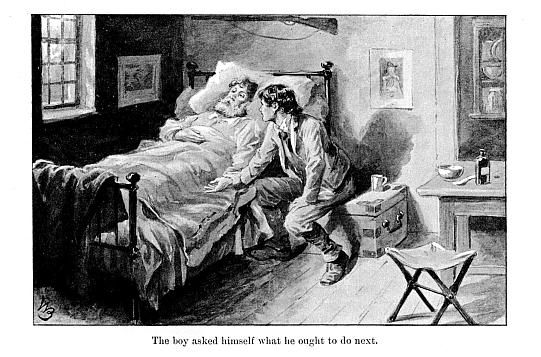
That given, the boy seated himself upon a box by the bed’s head, asking himself what he ought to do next.
He took Emson’s hand again, and felt his pulse, but it only told him what he knew—that there was a terrible fever raging, and the pulsations were quick and heavy through the burning skin.
A sudden thought struck him now. The place was terribly hot, and he hurriedly opened the little window for the breeze to pass through.
There was an alteration in the temperature at once, but he knew that was not enough, and running to the door, he picked up a bucket, and called for Tanta Sal, who came slowly.
“Baas Joe go die.—Jack?”
She pointed away over the plain, and Dyke nodded.
“Yes, Jack is coming. Go, quick! fetch water.”
The woman understood, and taking the bucket, went off at once towards where the cool spring gurgled among the rocks at the kopje.
The feeling of terrible horror and fear attacked Dyke again directly, and he shrank from going to his brother’s side, lest he should see him pass away to leave him alone there in the desert; but a sensation of shame came to displace the fear. It was selfish, he felt; and with a new thought coming, he went to the back of the door, took down the great heavy scissors with which he and Emson had often operated upon the ostrich-feathers, cutting them off short, and leaving the quill stumps in the birds’ skins, where after a time they withered and fell out, giving place to new plumes. Then kneeling down by the head of the rough bed, he began to shear away the thick close locks of hair from about the sick man’s temples, so that the brain might be relieved of some of the terrible heat.
This done, he went to the chest, and got out a couple of handkerchiefs.
His stay in that torrid clime had taught him much, but he had never thought of applying a little physical fact to the purpose he now intended. For he knew that if a bottle or jug of water were surrounded by a wet cloth and kept saturated, either in a draught or in the sun, the great evaporation which went on would cool the water within the vessel.
“And if it will do this,” Dyke thought, “why will it not cool poor Joe’s head?”
He bent down over him, and spoke softly, then loudly; but Emson was perfectly unconscious, and wandering in his delirium, muttering words constantly, but what they were Dyke could not grasp.
In a few minutes Tanta Sal re-appeared with the bucket of cool spring-water.
“Baas Joe go die,” she said, shaking her head as she set it down; and then, without waiting to be told to go, she went round to the back, and began to pile up fuel and fan the expiring fire, before proceeding to make and bake a cake.
Meanwhile, Dyke had been busy enough. He had soaked one of the handkerchiefs in the bucket, and laid it dripping right across Emson’s brow and temples, leaving it there for a few minutes, while he prepared the other. The minutes were not many when he took off the first to find it quite hot, and he replaced it with the other, which became hot in turn, and was changed; and so he kept on for quite an hour, with the result that his brother’s mutterings grew less rapid and loud, so that now and then the boy was able to catch a word here and a word there. All disconnected, but suggestive of the trouble that was on the sick man’s mind, for they were connected with the birds, and his ill-luck, his voice taking quite a despairing tone as he cried:
“No good. Failure, failure—nothing succeeds. It is of no use.”
And then, in quite a piteous tone:
“Poor Dyke! So hard for him.”
This was too much. The tears welled up in the boy’s eyes, but he mastered his emotion, and kept on laying the saturated bandages upon his brother’s brow, watching by him hour after hour, forgetful of everything, till all at once there was a loud, deep barking, and Duke trotted into the house, to come up to the bedside, raise himself up, and begin pawing at the friend he had not seen for so long.
“It’s no good, Duke, old chap,” said Dyke sadly; “he don’t know you. Go and lie down, old man. Go away.”
The dog dropped down on all-fours at once, and quickly sought his favourite place in one corner of the room, seeming to comprehend that he was not wanted there, and evidently understanding the order to lie down.
The coming of the dog was followed by the approach of the wagon, and the lowing of the bullocks as they drew near to their familiar quarters; the cows answered, and Duke leaped up and growled, uttering a low bark, but returned to his corner as soon as bidden.
At first Dyke had felt stunned by the terrible calamity which had overtaken his brother; but first one and then another thing had been suggested to his mind, and the busy action had seemed to clear his brain.
This cool application had certainly had some effect; and as he changed the handkerchief again, he saw plainly enough what he must do next.
Wiping his hands, he sought for paper and pencil, and wrote in a big round hand:
“I came home and found my brother here, at Kopfontein, bad with fever. He does not know me. Pray send to fetch a doctor.”
He folded this, then doubled it small, and tied it up with a piece of string, after directing it to “Herr Hans Morgenstern, at the Store.”
This done, he once more changed the wet handkerchiefs, and went out to find Jack outspanning the cattle, and talking in a loud voice to his wife.
“Jack,” he said, “the baas is very bad. You must go back to Morgenstern’s and take this.”
He handed the tied-up paper to the Kaffir, who took it, turned it over, and then handed it back, looking at his young master in the most helplessly stupid way.
Dyke repeated the order, and pointed toward the direction from which they had come, forcing the letter into Jack’s hand.
It was returned, though, the next moment.
“Jack bring wagon all alone,” he said.
“Yes, I know; but you must go back again. Take plenty of mealies, and go to Morgenstern’s and give him that.”
“Jack bring wagon all alone,” the black said again; and try how Dyke would, he did not seem as if he could make the Kaffir understand.
In despair he turned to Tanta Sal, and in other words bade her tell her husband go back at once; that he might take a horse if he thought he could ride one; if not, he must walk back to Morgenstern’s, and carry the letter, and tell him that the baas was bad.
“Baas Joe go die,” said the woman, nodding her head.
“No, no; he will live if we help,” cried Dyke wildly. “Now, tell Jack he must go back at once, as soon as he has had some mealies.”
“Baas Joe go die,” reiterated the woman.
“Hold your tongue!” roared Dyke angrily. “You understand what I mean. Jack is to go back.—Do you hear, Jack? Go back, and take that to Morgenstern’s.”
The Kaffir and his wife stared at him heavily, with their lower jaws dropped, and after several more efforts, Dyke turned back to the house to continue his ministrations.
“They understand me, both of them,” he cried bitterly; “but he does not want to go, and Tant wants him to stay. What shall I do? What shall I do?”
He changed the handkerchiefs, and rushed out again, but the Kaffirs were invisible; and going round to the back, he found Jack squatted on his heels, eating the hot cake his wife was baking. But though Dyke tried command and entreaty, the pair only listened to him in a dazed kind of way, and it was quite evident that unless he tried violence he would not be able to make the Kaffir stir; while even if he did use force, he felt that Jack would only go a short distance and there remain.
“And I can’t leave here! I can’t leave here!” groaned Dyke; “it would be like saying good-bye to poor Joe for ever.”
Clinging to the faint hope that after he had been well-fed and rested, the Kaffir might be made to fulfil the duty required of him, Dyke went on tending his brother, with the satisfactory result of seeing him drop at last into a troubled sleep, from which, two hours after, he started up to call out for Dyke.
“I’m here, Joe, old chap. Can’t you see me?” said the boy piteously.
“No use: tell him no use. Madness to come. All are dying. Poor Dyke! So hard—so hard.”
Dyke felt his breast swell with emotion, and then came a fresh horror: the evening was drawing on, and he would be alone there with the sick man, watching through the darkness, and ignorant of how to act—what to do. And now the thought of his position, alone there in the great desert, seemed more than he could bear; the loneliness so terrible, that once more, in the midst of the stifling heat, he shuddered and turned cold.
Chapter Nineteen.
Sterling Coin.
Dyke Emson sat in the darkness there along. He had seen no more of Jack and Tanta Sal since the evening. The latter had looked in, stared stupidly, said “Baas Joe go die,” once more, and roused the boy into such a pitch of fury that he came nigh to throwing something at her. Then she left the room with her husband, and Dyke was alone.
He felt ready to give up, and throw himself upon his face in his great despair, for hour by hour the feeling strengthened that his brother was indeed dying fast; and as he sat there in the midst of that terrible solitude, shut in, as it were, by the black darkness, his busy imagination flooded his brain with thoughts of what he would have to do.
The fancy maddened him, for it seemed cruel and horrible to think of such a thing when his brother lay there muttering in the delirium; but the thought would come persistently, and there was the picture vividly standing out before him. For his mind was in such an unnatural state of exaltation that he could not keep it hidden from his mental gaze.
There it all was, over and over again: that place he had selected where it was nearly always shaded—in that rift in the kopje where the soft herbage grew, and climbed and laced overhead, while the low murmur of the water gurgling from the rocks in the next rift fell gently upon his ear. He had selected that spot because it was so calm and peaceful, and drawn poor Joe there upon the little sled. He saw it all—the shallow, dark bed he had dug in the soft earth, where his brother was to rest in peace, with all the suffering at an end. There were big, mossy pieces of granite there, which would cover and protect the poor fellow’s resting-place, and a smooth, perpendicular face of rock above, on which he saw himself, chipping out with hammer and cold chisel the one word “Joe.”
And then—
Back came the terrible scene, and over and over again, till, setting his teeth hard, Dyke sprang up, and went to another bucket of water which he had made Jack understand he was to fetch before he left him some hours ago, and drank long and deeply before returning to the rough pallet, renewing the cold bandage again, and then sinking upon his knees to bury his face in his hands.
For a full hour Dyke knelt there in the black darkness as if asleep, exhausted by the great mental and bodily fatigue, but hearing every movement—thrilled by the piteous words which came from his brother’s lips. Then with a strange feeling of calm rest filling his breast, he raised his head, bent over the sick man, and took the hot, burning hand to hold it to his cheek.
“I won’t be such a coward as to break down now, Joe, old chap,” he said softly, and as if it were a confidential whisper which his brother heard. “I was so tired, and I was frightened to see you like this, but I’m going to try and play the man now, and—and I’ll stick to you, Joe, to the—”
He was going to say “last,” but he checked it, with something like a sob rising to his lips.
“Till—till you get better, old man, and I can help you to go and sit in my old corner in the shade among the rocks. For you’re going to be better soon, old chap; and though you’re very bad, and it’s dark, and help is so far away, we’re not alone, Joe—we’re not alone.”
No: not alone!
For as the boy knelt there, holding that burning hand, there came the long, low, yelping wail of the jackals prowling around, as if they scented death in the air; and as the dismal sound swept here and there about the lonely house, coming and going, and at times apparently quite close, Dyke shuddered. But the next moment there arose the deep-toned, fierce roar of a lion, far away possibly, yet in its tremendous power sounding so near that it might have been close at hand.
Then the yelping of the jackals ceased, as if the foul creatures had been scared away by the nobler beast; and after a few uneasy movements among the frightened cattle in the pens, all was still with a great solemnity, which thrilled the boy to his deepest depths.
And then it seemed to Dyke that it was not so dark, and he rose and walked softly to the open door to stand looking out, wondering and awe-stricken at the grandeur of the scene above his head. For it was as if the heavens were marked across the zenith by a clearly cut line—the edge of a black cloud—and on one side all was darkness, on the other a dazzling sheen of stars, glittering and bright as he thought he had never seen them before; while the darkness was being swept away, and fresh stars sprang out from the dense curtain minute by minute, and seemed to rain down myriads of points of light.
He stood there till he heard a low, weary sigh from the rough bed, and turned back in time to hear a few muttered words, and then all was silent once again.
Dyke trembled, and something seemed to hold him fast chained, as if in a troubled dream.
Then with a wild cry he fell upon his knees, and stretched out his trembling hands to touch his brother’s brow, and the reaction came, for it was not as he thought. The head was cooler, and there was a faint moisture about the temples, while the muttering was renewed for a few moments, and ended with a sigh.
Dyke’s hands were softly passed then to his brother’s breast, which rose and fell gently, and when he let his fingers glide along the arm that had been tossed to one side, there the tell-tale pulse beat rapidly still at the wrist, but not—certainly not so heavily and hurried in every throb, for Joe Emson was sleeping as he had not slept for many days.
The hours went on till, as Dyke sat there, the darkness began to pass, and the watcher was conscious of a double dawn. The first in himself, where, as he crouched by the bed, and thought of words that had never impressed him much before, it was as if Hope were rising slowly, and it strengthened in its pale, soft light, and mingled with the faint grey which began to steal in through the narrow window. And this too lengthened and strengthened, till it began to glow. The fowls—the few they had left—told that it was day. Once more he could hear the ostriches chuckling, hissing, and roaring, and the lowing of the cows and bullocks sounded pleasant and welcome, as a fresh, soft air began to play through the door.
The shadows within the room grew paler, till, all at once, they darkened again in the corners, for the full beams of the sun suddenly stole in through the window, and played upon the opposite wall, which glowed in orange and gold.
But Dyke did not see the refulgent hues with which the shabby white-wash and prints were painted, for he was watching his brother’s face, all so terribly changed since their last parting. The eyes were sunken, and hollows showed about the temples and cheeks. There was a terrible dry blackness, too, about the skin; while the hands that lay upon the bed were thin and full of starting tendons, all tokens of the fever which had laid the strong man low.
But he was sleeping, and sleep at such a time meant life; while the head, bared now by the rough shearing Dyke had given the previous evening, was hot, but not burning with that terrible fire which scorches out the very life where it has commenced to glow.
“Baas Joe dead?” said a voice at the door, and Dyke started to his feet to seize a short, heavy whip; but Kaffir Jack did not stop to see it seized. He turned and fled, while a low muttering growl roused the boy to the fact that the dog had been there in the corner all the night, and now came forward to thrust a cool nose into his master’s hand.
“Why, Duke, old chap, I’d forgotten you,” said Dyke softly. The dog gave his tail a series of rapid wags, and then came to the bedside, looked at the sick man, whined softly, and then sat and rested his muzzle upon one of the feeble hands, watching the face intently, and as if meaning to keep guard there.
Dyke followed, and laid his hand on the dog’s head; but the faithful animal did not stir.
“No, Duke, old man, Baas Joe is not dead yet,” whispered Dyke, as he gazed at his brother’s face; “and, please God, we’re going to bring him safely back to what he was.”
Duke did not move his head; but he raised his tail once, and brought it down upon the floor with a heavy—whop!
Chapter Twenty.
A Sore Strait.
“Stop and watch,” said Dyke; and leaving the dog in charge, he went out into the glorious light of day, feeling strong now, but horribly weak.
A contradiction, but a fact, for though he had drunk of the cool fresh water several times, he had taken nothing since the previous morning, and if he had to nurse Emson back to life, he knew that he must gather force by means of food.
He had to carry on the work of the place still, he felt, as his brother was helpless; and as he walked round to the back of the premises, he began to feel something like wonder at the terrible despair from which he had suffered since his return. For everything looked so bright and cheery and home-like, and the world around him so beautiful, that he felt ready for any new struggle in the great fight for life.
“She’s always squatting over a fire,” said Dyke to himself, as he went round to the back, for there was Tanta Sal down in a wonderfully frog-like attitude, turning herself into a very vigorous natural bellows, to make the fire glow under the kettle.
She looked up and smiled, drawing back her thick lips as the lad approached.
“Baas Joe die?” she said.
“Look here!” roared Dyke fiercely: “don’t you say that to me again. No—No—No—No!”
Tanta Sal stared at him and shook her head.
“Breakfast!” cried Dyke laconically.
That she understood, and Dyke hurried away to take a sharp glance round before going back to his brother’s side.
It was needed. The cows were not milked, and not likely to be; the horses had not been fed, and the ostriches were clamouring for food.
Just then he saw Jack peeping at him from round the corner of one of the sheds; but as soon as he caught sight of his young master, he drew back.
Instead of going on, Dyke darted round to the other side of the building, knowing full well that if he ran after him, Jack would dash off more quickly than he could. So stopping and creeping on over the sand, he peeped round and saw the man before him just about to perform the same act. Consequently Dyke was able to pounce upon the Kaffir, whom he seized by the waist-cloth.
“Here, I want you,” he cried sternly, and in a gruff voice which he hardly knew for his own.
“Baas want?”
“Yes: go and begin milking the cows. I’ll send Tant to you directly.”
The man showed his teeth, and stood shaking his head.
To his utter astonishment Dyke shifted his grasp, and caught him by the throat with one hand, and shook his fist in his face.
“Look here,” he said; “you can understand English when you like, and you’ve got to understand it now. Baas Joe’s sick.”
“Baas Joe go die,” said the man.
“Baas Joe go live,” cried Dyke fiercely, “and he’ll flog you well if you don’t behave yourself. You go and milk those two cows, and then feed the ostriches and horses, or I’ll fetch Duke to watch you, so look out.”
Jack’s jaw dropped at the mention of the dog, and he hurried away; while Dyke, after a glance at the wagon, which stood just where it had been dragged with its load, was about to re-enter the house, when he caught sight of three Kaffirs watching him from beyond one of the ostrich-pens.
“Who are you?” he said to himself. “What do they want?”
He went quickly toward them, but they turned and fled as hard as they could go, assegai in hand, and the boy stopped and watched them for some time, thinking very seriously, for he began to divine what it all meant.
“They have heard from Tant that Joe is dying, and I suppose I’m nobody. They are hanging about to share everything in the place with our two; but—”
Dyke’s but meant a good deal. The position was growing serious, yet he did not feel dismayed, for, to use his own words, it seemed to stir him up to show fight.
“And I will, too,” he said through his teeth. “I’ll let ’em see.”
He went back into the house to find Emson sleeping, and apparently neither he nor the dog had moved.
“Ah, Duke, that’s right,” said Dyke. “I shall want you. You can keep watch for me when I go away.”
Just then Tanta Sal came in, smiling, to tell him that breakfast was ready, and he began to question her about when his brother was taken ill. But either from obtuseness or obstinacy, he could get nothing from the woman, and he was about to let her go while he ate his breakfast of mealie cake and hot milk; but a sudden thought occurred to him. Had those Kaffirs been about there before?
He asked the woman, but in a moment her smile had gone, and she was staring at him helplessly, apparently quite unable to comprehend the drift of his questions; so he turned from her in a pet, to hurry through his breakfast, thinking the while of what he had better do.
He soon decided upon his first step, and that was to try and get Jack off to Morgenstern’s with his letter; and after attending to Emson and repeating the medicine he had given the previous day, he went out, to find that the animals had been fed, and that Jack was having his own breakfast with his wife.
There was a smile for him directly from both, and he plunged into his business at once; but as he went on, the smiles died out, and all he said was received in a dull, stolid way. Neither Jack nor his wife would understand what he meant—their denseness was impenetrable.
“It’s of no use to threaten him,” said Dyke to himself, as he went back; “he would only run away and take Tant with him, and then I should be ten times worse off than I am now. I must go myself. Yes, I could take two horses, and ride first one and then the other, and so set over the round faster. I could do it in a third of the time.”
But he shook his head wearily as he glanced at where Emson lay.
“I dare not leave him to them. I should never see him again alive.”
It was quite plain: the Kaffirs had marked down the baas for dead, and unless watched, they would not trouble themselves to try to save him by moving a hand.
Dyke shuddered, for if he were absent he felt the possibility of one of the strangers he had seen, helping them so as to share or rob. No: he dared not go.
But could he not have the wagon made comfortable, store it with necessaries, get Emson lifted in, and then drive the oxen himself?
It took no consideration. It would be madness, he felt, to attempt such a thing. It would be fatal at once, he knew; and, besides, he dared not take the sick man on such a journey without being sure that he would be received at the house at the journey’s end.
No: that was impossible.
Another thought. It was evident that Jack was determined not to go back alone to Morgenstern’s, but would it be possible to send a more faithful messenger—the dog? He had read of dogs being sent to places with despatches attached to their collars. Why should not Duke go? He knew the way, and once made to understand—
Dyke shook his head. It was too much to expect. The journey was too long. How was the dog to be protected from wild beasts at night, and allowing that he could run the gauntlet of those dangers, how was the poor brute to be fed?
“No, no, no,” cried the boy passionately; “it is too much to think. It is fate, and I must see Joe through it myself. He is better, I am sure.”
There was every reason for thinking so, and nurturing the hope that his brother had taken the turn, Dyke determined to set to work and go on as if all was well—just as if Emson were about and seeing to things himself.
“You know I wouldn’t neglect you, old chap,” he said affectionately, as he bent over the couch and gazed in the sunken features; “I shall be close by, and will keep on coming in.”
Then a thought struck him, and he called the watchful dog away and fed him, before sending him back to the bedside, and going out to examine the ostriches more closely.
Dyke’s heart sank as he visited pen after pen. Either from neglect or disease, several of the birds had died, and were lying about the place, partly eaten by jackals; while of the young ones hatched from the nest of eggs brought home with such high hopes, not one was left.
“Poor Joe!” sighed Dyke, as he looked round despondently, and thought of his brother’s words, which, broken and incoherent as they were, told of the disappointment and bitterness which had followed the long, weary trial of his experiment.
And now, with the poor fellow broken down and completely helpless, the miserable dead birds, the wretched look of those still living, and the general neglect, made Dyke feel ready to turn away in despair.
But he set his teeth hard and went about with a fierce energy rearranging the birds in their pens, and generally working as if this were all a mere accident that only wanted putting straight, for everything to go on prosperously in the future.
It was hard work, feeling, as Dyke did, that it was a hopeless task, and that a complete change—a thorough new beginning—must be made for there to be the slightest chance for success. But he kept on, the task becoming quite exciting when the great birds turned restive or showed fight, and a disposition to go everywhere but where they were wanted.
Then he fetched Jack, who came unwillingly, acting as if he believed some new scheme was about to be tried to send him off to the old trader’s. But he worked better when he found that he was only to drag away the remains of one or two dead birds, and to fetch water and do a little more cleaning.
Dyke divided his time between seeing that the work was done, and going to and fro to his brother’s couch, now feeling hopeful as he fancied that he was sleeping more easily. At the second visit, too, his hopes grew more strong; but at the third they went down to zero, for to his horror the heat flush and violent chill returned with terrible delirium, and the boy began to blame himself for not doing something more about getting a doctor, for Emson seemed to be worse than he was at his return.
By degrees, though, it dawned upon him that this might not be a sign of going back, only a peculiarity of malarial fever, in some forms of which he knew that the sufferer had regular daily fits, which lasted for a certain time and then passed away, leaving the patient exhausted, but better.
This might be one of these attacks, he felt, and he sat watching and trying to give relief; but in vain, for the delirium increased, and the symptoms looked as bad as they could be, for a man to live.
And now once more the utter helplessness of his position came upon Dyke, and he sat there listening to his brother’s wild words, trying to fit them together and grasp his meaning, but in vain. He bathed the burning head and applied the wet bandages, but they seemed to afford no relief whatever; and at last growing more despondent than ever, he felt that he could not bear it, and just at dusk he went outside the door to try to think, though really to get away for a few minutes from the terrible scene.
Then his conscience smote him for what he told himself was an act of cowardice, and he hurried back to the bedside, to find that, short as had been his absence, it had been long enough for a great change to take place.
In fact, the paroxysm had passed, and the poor fellow’s brow was covered with a fine perspiration, his breathing easier, and he was evidently sinking into a restful sleep.
Dyke stood watching and holding his brother’s hand till he could thoroughly believe that this was the case, and then tottered out once more into the comparatively cool evening air, to find Jack or his wife, and tell them to bring something for him and the dog to eat, for he had seen nothing of either of them for many hours.
He walked round to the back, but there was no fire smouldering, and no one in the narrow, yard-like place; so he went on to the shed in which the servants slept, and tapped at the rough door.
But there was no answer, and upon looking in, expecting to see Jack lying there asleep, neither he nor his wife was visible.
How was that? Gone to fetch in fuel from where it was piled-up in a stack? No: for there was plenty against the side of one of the sheds.
What then—water? Yes, that would be it. Jack and Tanta Sal had gone together to the kopje for company’s sake to fetch three or four buckets from the cool fresh spring, of whose use he had been so lavish during the past day. They had gone evidently before it was quite dark; and, feeling hungry and exhausted now, he walked round to where the wagon stood, recalling that there was some dry cake left in the locker, and meaning to eat of this to relieve the painfully faint sensation.
He climbed up into the wagon, and lifted the lid of the chest, but there was no mealie cake there; Jack or Tant must have taken it out. So going back to the house where Emson was sleeping quietly, the boy dipped a pannikin into the bucket standing there, and drank thirstily before going outside again to watch for the Kaffir servants’ return, feeling impatient now, and annoyed that they should have neglected him for so long.
But there was no sign of their approach. The night was coming on fast, and a faint star or two became visible, while the granite kopje rose up, softly rounded in the evening light, with a faint glow appearing from behind it, just as if the moon were beginning to rise there.
He waited and waited till it was perfectly plain that the man could not be coming from fetching water, and, startled at this, he shouted, and then hurriedly looked about in the various buildings, but only to find them empty.
Startled now, more than he cared to own to himself, Dyke ran back to the Kaffir’s lodge, and looked in again. There were no assegais leaning against the wall, nothing visible there whatever, and half-stunned by the thought which had come upon him with terrible violence, the boy went slowly back to the house, and sat down by where Duke was watching the sleeping man.
“Alone! alone!” muttered Dyke with a groan; “they have gone and left us. Joe, Joe, old man, can’t you speak to me? We are forsaken. Speak to me, for I cannot even think now. What shall I do?”
Chapter Twenty One.
Dyke sets his Teeth.
No answer came from the couch where Emson lay exhausted by his last periodical paroxysm of fever. The dog whined softly, and in his way unintentionally comforted his master by comforting himself. That is to say, eager for human company, he crept closer, so that he could nestle his head against him, and be in touch.
That touch was pleasant, and it made Dyke pass his arm round the dog’s neck and draw him nearer, Duke responding with a whine of satisfaction, followed by a sound strongly resembling a grunt, as he settled himself down, just as the answer came to the lad’s question, “What shall I do!”
It was Nature who answered in her grand, wise way, and it was as if she said:
“There is only one thing you can do, my poor, heartsore, weary one: sleep. Rest, and gain strength for the fight to come.”
And in the silence and gathering darkness a calm, sweet insensibility to all his troubles stole over Dyke; he sank lower and lower till his head rested against the skins, and the coarse, sack-like pillow, formed of rough, unsaleable ostrich-feathers; and it was not until twelve hours after that he moved, or felt that there was a world in which he occupied a place, with stern work cut out for him to achieve.
It was the touch of something cold upon his cheek that roused the sleeper, and that something cold was the dog’s nose.
Dyke did not start; he merely opened his eyes quietly, and looked up at those gazing at him, and, thoroughly comforted and rested, he smiled in the dog’s face.
“Get out, you old rascal,” he said. “You know you’ve no business to do that.”
Duke uttered a satisfied bark, and then began to caper about the room to show his delight at the solemn silence of the place being broken; but stopped directly, and made for the door in alarm, so sudden was the spring his master made to his feet—so wild and angry the cry the boy uttered as he bent over the bed.
For full consciousness had returned like a flash, and as he cried, “I’ve been asleep! I’ve been asleep!” he gazed down at his brother, horrified at the thought of what might have happened, and full of self-reproach for what he felt to have been his cruel neglect.
But Emson was just as he had seen him last—even his hands were exactly as they had lain in the darkness the previous night—and when Dyke placed his hand upon the poor fellow’s head, it felt fairly cool and moist.
Dyke’s spirits rose a little at this, but his self-reproach was as great as ever.
“Oh!” he muttered angrily, “and I pretend to care for him, and promise him that I will not leave him, and go right off to sleep like that. Why, he might have died, and I never have moved.—Here, Duke!”
The dog sprang to him with a bound, raised himself, and placed his paws upon his master’s breast, threw back his head, opened his wide jaws, lolled out his tongue, and panted as if after a long run.
“Here, look at me, old chap, and see what a lazy, thoughtless brute I am.”
But Duke only shook his head from side to side, and uttered a low whine, followed by a bark.
“There: down! Oh, how could I sleep like that?”
But by degrees it was forced upon him that Emson had evidently passed a perfectly calm night, and looked certainly better, and he knew that it was utterly impossible to live without rest.
He awoke, too, now to the fact that he was ravenously hungry, while the way in which the dog smelt about the place, snuffing at the tin in which his master’s last mess of bread and milk had been served, and then ran whining to lap at the water at the bottom of a bucket, spoke plainly enough of the fact that he was suffering from the same complaint.
At the same time, Dyke was trying to get a firm grasp of his position, and felt half annoyed with himself at the calm way in which he treated it. For after that long, calm, restful sleep, things did not look half so bad; the depression of spirit had passed away, his thoughts were disposed to run cheerfully, and his tendency of feeling was toward making the best of things.
“Well,” he found himself saying, as he ran over his last night’s discovery, “they’re only savages! What could one expect? Let them go. And as to its being lonely, why old Robinson Crusoe was a hundred times worse off; somebody is sure to come along one of those days. I don’t care: old Joe’s better—I’m sure he’s better—and if Doctor Dyke don’t pull him through, he’s a Dutchman, and well christened Van.”
He had one good long look in his patient’s face, felt his pulse, and then his heart beatings; and at last, as if addressing some one who had spoken depreciatingly of his condition:
“Why, he is better, I’m sure.—Here, Duke: hungry? Come along, old man.”
The dog shot out of the door, giving one deep-toned bark, and Dyke hurried to the wagon, opened a sack of meal, poured some into the bottom of a bucket, carried it back to the house, with the dog sniffing about him, his mouth watering. Then adding some water to the meal, he beat it into a stiff paste, and placed about half on a plate, giving the bucket with the rest to the dog, which attacked it ravenously, and not hesitating about eating a few bits of the cold, sticky stuff himself.
He gave a glance at Emson, and then went to the back, scraped a little fuel together, lit it, and blew it till it began to glow, hung the kettle over it for the water to boil, and then, closely followed by Duke, ran to feed the horses, just as a low, deep lowing warned him that the cows wanted attention.
Fortunately only one was giving much milk, for Dyke’s practice in that way had been very small: it was a work of necessity, though, to relieve the poor beasts, which followed him as he hurried back for a pail, one that soon after stood half full of warm, new milk, while the soft-eyed, patient beasts went afterwards calmly away to graze.
“Here, who’s going to starve?” cried Dyke aloud, with a laugh that was, however, not very mirthful; and then going back to the fire he kneaded up his cake, placed it upon a hot slab of stone, covered it with an earthen pot, swept the embers and fire over the whole, and left it to bake.
His next proceeding was to get the kettle to boil and make some tea, a task necessitating another visit to the wagon stores he had brought from Morgenstern’s, when, for the first time, he noticed that a little sack of meal was missing.
At first he was doubtful, then he felt sure, and jumped at once to the reason. Jack and Tanta Sal must have gone off to join the blacks he had seen watching, and not gone empty handed.
Dyke’s brow wrinkled up for a few moments. Then his face cleared, for an antidote for the disease had suggested itself, one which he felt would come on in periodical fits.
“Here, Duke,” he cried. “Up!”
The dog sprang in at the back of the wagon, and looked inquiringly at him.
“Lie down: watch!”
Duke settled himself upon the wagon floor, laid his outstretched head upon his paws, and stayed there when his master left to go back to the house, fetch in the boiling kettle, make tea, and after sweetening half a basinful and adding a little milk, he took it to his patient’s side, raised his head, held it to his lips, and all unconscious though he was, found him ready to drink with avidity, and then sink back with a weary sigh.
“There, old chap,” cried Dyke, ignoring the fact that he had not tried, “you couldn’t have tipped off a lot of tea like that yesterday. It’s all right: going to get better fast, and give Master Jack such a licking as he never had before.”
Trying to believe this himself, he now thought of his own breakfast, fetched in the hot cake and a tin pannikin of milk, and sat down to this and some tea.
The first mouthfuls felt as if they would choke him, but the sensation of distaste passed off, and he was soon eating ravenously, ending by taking Duke a tin of milk for his share, and a piece of the hot bread.
That was a weary morning, what with his patient and the animals about the place. But he had set his teeth hard, and feeling that he must depend fully upon himself and succeed, he took a sensible view of his proceedings, and did what he could to lighten his responsibility, so as to leave him plenty of time for nursing and attending to his invalid.
The first thing was to do something about the horses and cattle; and, feeling that he could not do everything by himself, he at once let all loose to shift for themselves, hoping that they would keep about the little desert farm, and not stray away into danger. Horses then and cattle were loosened, to go where they pleased, and the openings connecting the ostrich-pens were thrown open to give the great birds as much limit for feeding themselves as he could. Then he fetched water in abundance for the house, and loaded and laid ready the three guns and the rifles, with plenty of cartridges by their sides, but more from a hope that the sight of his armament would have the effect of frightening Kaffirs away when seen, than from any thought of using them as lethal weapons, and destroying life.
Then he was face to face with the difficulty about the wagon. These stores ought not to be left where they were, and he felt that he was too much worn out to attempt to carry them into the rough-boarded room that served as store. He was too much exhausted, and the rest of that day he felt belonged to his patient.
But a thought struck him, and fetching up a yoke of the oxen which were browsing contentedly a half-mile away, Dyke hitched them on to the dissel-boom, and, after some difficulty, managed to get the wagon drawn close up to the fence, and within a few yards of the door.
“Duke will be there, and I should hear any one who came,” he said to himself, and once more set the oxen free to go lowing back to their poor pasture with the rest of the team, which he had had hard work to keep from following him at the first.
And now, tired out with his exertions at a time when the hot sun was blazing on high, and beginning to feel a bit dispirited, he entered the house again, to be cast down as low as ever, for once more Emson was suffering terribly from the fit, which seemed to come on as nearly as could be at the same time daily. Dyke knew that he ought to have been prepared for it, but he was not, for it again took him by surprise, and the medicine which he administered, and his brother took automatically, seemed to have no effect whatever.
He bathed and applied evaporating bandages to the poor fellow’s temples, but the fever had the mastery, and kept it for hours, while Dyke could at last do nothing but hold the burning hand in his, with despair coming over him, just as the gloom succeeded the setting of the sun.
Then, just as the boy was thinking that no fit had been so long as this, and that Emson was growing far weaker, the heat and alternate shivering suddenly ceased, and with a deep sigh he dropped off to sleep.
Dyke sat watching for a time, and then, finding that Emson was getting cooler and cooler, and the sleep apparently more natural and right, he began to think of his plans for the evening. He was determined to keep awake this time, and to do this he felt that he must have company. The Kaffirs were hardly likely to come by night, he felt, and so he would not leave the dog to watch, but going out, called him down out of the wagon, tied down the canvas curtains back and front, fed the dog well, and stood at the door waiting until the faithful beast had finished, watching the while. Then once more he noticed the peculiar light at the back of the kopje, looking as if the moon were rising, though that could not be, for there was no moon visible till long after midnight.
But Dyke was too weary to study a question of light or shadow, and as soon as Duke had finished he called the dog in, closed the door, did what he could to make poor Emson comfortable, and sat down to pass the night watching.
But nature said again that he should pass it sleeping, and in a few minutes, after fighting hard against the sensation of intense drowsiness, he dropped off fast as on the previous night, but started into wakefulness in the intense darkness, and sat up listening to the low growling of the dog, and a terrible bellowing which came from the pens, where the cattle should be, if they had returned after their many hours’ liberty.
Returned they had for certain, and one of the great, placid beasts was evidently in a state of agony and fear, while a rushing sound of hoofs close to where the wagon stood, suggested that the horses and bullocks had taken flight.
The reason was not very far off from the seeker, for all at once, just as the piteous bellowings were at their height, there came the terrific roaring of a lion, evidently close at hand, and this was answered by a deep growling by the cattle-pens, telling that one lion had struck down a bullock, and was being interrupted in his banquet by another approaching near.
Dyke rose, and went to the corner of the room where the loaded rifles stood, then walked softly toward the door to stand peering out, but not a sign of any living creature was visible. In fact, a lion could not have been seen a couple of yards away, but, all the same, the loud muttered growlings told plainly enough that both the fierce beasts were close at hand.
Chapter Twenty Two.
A Bit of Nature.
There seems plenty of reason in supposing that the tremendously loud, full-throated roar of the lion at night is intended to scare the great brute’s prey into betraying its whereabouts at times, at others to paralyse it with fright and render it easy of capture. Much has been written about the fascinating power of the snake, but this fascination, from quiet observation, appears to be nothing more nor less than the paralysis caused by fear, and suffered by plenty of objects in the animal world. One might begin with man himself, and the many instances where, in the face of a terrible danger, he becomes perfectly weak and helpless. He is on a railway track, and a fast train is coming. One spring, and he would be safe; but how often it happens that he never makes that spring.
Take another instance. There is a fire at some works. It is spreading fast, and the cry arises, “Save the horses in the stables!” Men rush and fling open the doors; the halters are cast loose, but too often the poor brutes will not stir even for blows: fascinated by the danger, they stay in the stable and are burned.