Chapter VI · FRUITS AND FRUIT PRODUCTS
Reading edition
Salicylic acid, benzoic acid, and saccharin are used to preserve fruits. The last is also added as a sweetener instead of sugar. Many fruit products lose their color with age, and to give them a lasting color they are treated with a coal-tar dye, cochineal, acid magenta, or caramel.
A very small per cent of the jams and jellies sold are strictly pure. These cheap products are made up principally of apple juice and commercial glucose; artificial essences are added to imitate the real flavor.
In cheap jellies made of apple juice and glucose syrup, a “coagulator” is used; usually sulfuric acid and alum, also citric and tartaric acids may be used for this purpose.
Starch, gelatin, and agar are used as gelatinizing agents.
Fruits put up in tin cans may dissolve the heavy metals as tin, zinc, lead, and even arsenic.
PRESERVATIVES
Preparation of the Sample.—Dissolve 25 or 30 grams of the sample in water which has been acidified with sulfuric acid (1 to 3), then extract with ether, and remove the ether layer and let it evaporate spontaneously. The residue may contain salicylic acid, benzoic acid, or saccharin. Take up with a little water and make the following tests:
Salicylic Acid
Place a few drops of this extract in a test tube and add a drop or two of a 0.5 per cent solution of ferric chlorid. If salicylic acid is present, there will be a purple coloration.
Benzoic Acid
Mohler’s Test.—Add 2 to 3 cc. of strong sulfuric acid to a second portion of the above ether extract and heat until white fumes appear. Then add a few crystals of potassium nitrate and heat again. Continue adding the nitrate and heating till the solution is colorless or only a very light yellow. Dilute with about 5 cc. of water when cool, neutralize with ammonia. It should be filtered when not clear or when crystals of ammonium or potassium sulfate are formed. Add a few drops of ammonium sulfid to the filtrate in such a way as to prevent the mixing of the liquids. The sulfid will be on top. If a bright cherry-red color forms where the two liquids meet, either benzoic acid or saccharin is present. Distil and the benzoic acid will pass over, extract the distillate in the usual way and apply the above test to it for benzoic acid.
Saccharin
Taste a third portion of the ether extract. A very sweet taste indicates saccharin. A further test can be made by adding 1 or 2 grams of sodium hydroxid to the rest of the ether extract and heating a half hour in an oil bath at 250° C. Dissolve in water when cool, acidify with dilute sulfuric acid and extract with ether. The saccharin will have been converted into salicylic acid, which may be identified by the usual test for that acid. This test presupposes the absence of salicylic acid in the original material.
COLORING MATTER
Coal-Tar Dyes
To attempt to identify the particular dye used in every case would be quite beyond the object of this set of simple tests. A general test showing the presence of a coal-tar dye is probably all that is usually desired.
Sostegni and Carpentieri Test.—Such a test may be made by dissolving 15 grams of the fruit product in 100 cc. of water, filtering and acidifying with a small quantity of a 10 per cent solution of hydrochloric acid and again filtering. Place in the filtrate strips of white woolen cloth (nun’s veiling will do) which have been freed from grease by boiling first in very dilute caustic soda solution, then in water, and boil for 5 to 10 minutes. Remove the cloth and wash it in water, then boil in very dilute hydrochloric acid. Stir the cloth in water to remove the acid and dissolve the color by boiling in a solution of ammonium hydroxid (1 to 50). The time required will depend upon the particular dye used. Remove the cloth from the solution and acidify the latter with hydrochloric acid, a slight excess is better, and another piece of the cleansed cloth is immersed and again boiled. Nothing but coal-tar dyes will color in this second dyeing.
Cochineal
Girard and Dupre Test.—See tests for cochineal under “Catsups and tomatoes.”
Acid Magenta
Girard and Dupre.—Make about 100 cc. solution of the fruit, filter, and neutralize with potassium hydroxid (strength 5 to 100); about 2 cc. will be needed. Add 4 cc. of mercuric acetate solution (1 to 10), shake and filter. By this treatment the filtrate should be colorless and slightly alkaline. Add sulfuric acid till there is a slight excess. A colorless solution indicates the absence of acid magenta, while a light violet-red shows its presence, providing the amyl-alcohol extract showed no other dye to be present.
Caramel
Amthor’s Test.—10 cc. of a solution of the fruit is put into a deep, narrow glass (a bottle may be used). Add 30 to 50 cc. of paraldehyde, to be gaged by the intensity of the coloring. Then add a sufficient quantity of absolute alcohol to make the solutions mix. If caramel is present, a brownish-yellow to dark-brown precipitate will be formed, decant, wash the precipitate once with absolute alcohol, dissolve in a little hot water and filter. The shade of color is proportional to the amount of caramel present.
To verify the test, pour the colored fluid into a freshly prepared solution of phenylhydrazin (2 parts phenylhydrazin-hydrochlorid, 3 parts sodium acetate, and 20 parts water). Much caramel produces a dark-brown precipitate in the cold, and is hastened by slightly heating. A very small amount of caramel will require several hours to precipitate.
APPLE-JUICE IN JELLIES MADE OF SMALL FRUITS
Very often cider is added to other fruit juices to give them the proper consistency in jellies, jams, and marmalades.
Its presence may some times be determined by making the usual starch test. A large quantity of starch is normally present in apples, but is less as they ripen, and finally disappears in the ripened fruit. There is no starch, or only a mere trace, in small fruits even when green. It is readily seen that if the juice is taken from green apples that there will be starch found in the artificial jelly or jam, though its absence does not prove the absence of cider.
Make the starch test as follows:
STARCH
In Jellies, Jams, and Such Products
Make a solution of the jelly or jam and destroy the color by heating nearly to the boiling point and adding dilute (1 : 3) sulfuric acid and potassium permanganate until the color is destroyed. This treatment does not affect the starch, and when cool add iodin, preferably potassium iodid-iodin (potassium iodid, 0.4 gram; iodin, 0.1 gram; water, 20 cc.). If a great quantity of starch is present an almost black precipitate will be formed. Smaller amounts give the usual blue color.
Whenever starch is found to be present, it is best to make a microscopical examination in the case of jams and marmalades. If the starch is normally present the grains will be seen within the cell walls after the iodin treatment.
Starch is nearly always present in the apple and some other fruits, so unless it is present in jelly and such products in considerable quantity it is not likely that it was added.
GELATIN
In Jellies
Henzold Test.—Add water to some of the jelly and boil for a short time, filter and treat the filtrate with an excess of a 10 per cent solution of potassium bichromate and boil again. After cooling add 2 or 3 drops of concentrated sulfuric acid. A white flocculent precipitate forms if gelatin is present, and it gradually collects in a lump at the bottom.
E. Beckmann’s Method.—Treat the jelly with 95 per cent alcohol and wash the precipitate with alcohol to free it from the sugar, then drive off the alcohol by heating. Add a very little water to the residue and neutralize the extract with calcium carbonate. Then add formalin and evaporate to dryness. By this treatment gelatin is rendered insoluble.
Pure fruit jellies have only 1 to 2 per cent of insoluble precipitate, while those jellies in which gelatin is used have 70 to 86 per cent of insoluble precipitate.
AGAR AGAR
Boil the sample with 5 per cent sulfuric acid. Add a crystal or two of potassium permanganate, and wait till it settles, and examine the sediment for diatoms with a microscope. Their presence shows the use of agar.
HEAVY METALS
Tin, Zinc, Lead, and Copper
A. H. Allen’s Method.—(See test for heavy metals under canned meat.)
ARSENIC
Marsh’s Test.—Fit a 100 cc. flask with a two-holed rubber stopper, through which passes a long-stemmed separatory funnel reaching nearly to the bottom, and a delivery tube which connects with a bulb tube containing a little acetate of lead solution. This in turn is connected with a calcium chlorid tube and this with a small, hard glass tube, 15 or 20 cm. long, not over 0.5 cm. bore, and drawn to small size in the middle. The large part next the chlorid tube is protected by fine wire gauze which extends to within a half inch of the constricted part. Two burners may be so placed as to heat the gauze. The flask should be placed in water and the bulb tube may be. Four grams of arsenic-free zinc, and 40 cc. of dilute pure sulfuric acid (1 to 8) are placed in the flask. Let the hydrogen flow at least a quarter of an hour, then heat the gauze for 15 or 20 minutes. There should be no deposit in the tube. Now, char a portion of the sample, dissolve in water and pour into the separatory funnel, letting it run slowly into the flask. A dark deposit in the glass tube shows that arsenic is present, but if after an hour no darkening takes place it is quite safe to say that no arsenic is present in the fruit.
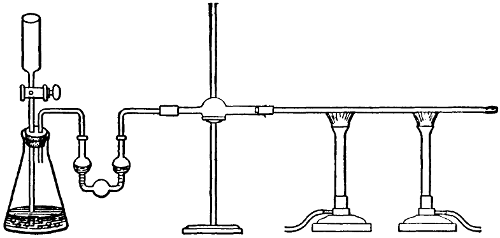
Apparatus for Marsh Test
Gutzeit’s Test.—Place a gram of pure zinc, 5 cc. of dilute sulfuric acid (6 per cent) and about 1 cc. of a solution of the sample in a deep test tube. Cover the tube with three thicknesses of filter paper, fitted tightly over the mouth of the tube. Place on the upper paper a drop of strong silver nitrate solution. Place the tube in a dark place and leave for 10 minutes. If a bright yellow stain forms on the filter paper, and turns black or brown when water is added to it, arsenic is present. Unless one is certain of the purity of the reagents used it is advisable to make a blank test, using distilled water instead of the fruit.
Oxidize all sulfids to sulfates before applying the above test. To find out whether they are present or not, substitute lead acetate for the silver nitrate on the filter paper. To avoid some of these difficulties treat according to the following method:
Preparation of the sample according to Leach.—If possible reduce the sample to a dry char by treatment with concentrated nitric and sulfuric acids so that it may be powdered in a mortar. Dissolve out the arsenic by repeated treatment with boiling water. Save this extract, and, when cool, filter and submit to Marsh’s test which is given above.
In case the sample is too much of a solid to get the arsenic out by the above treatment, it may be prepared according to the directions of Chittenden and Donaldson: Heat 100 grams of the macerated sample with 23 cc. of pure, strong nitric acid to a temperature of 150° C. or 160° C. Assist the action by stirring occasionally. When the fruit becomes a deep yellow or orange color, remove the heat and add 3 cc. of pure, strong sulfuric acid. It should be stirred while nitrous fumes are passing off. Heat again to about 180° C., and before it cools add, drop by drop, 8 cc. of pure concentrated nitric acid. It should be stirred constantly while the acid is being added. Heat at 200° C. till sulfuric acid fumes begin to come off and only a dry mass remains. Powder the mass and exhaust it with boiling water, filter and test the solution when cold with Marsh’s test.