Chapter VIII · BEGINNINGS OF THE REFORMATION—CORRESPONDENCE OF 1518-1519 (continued 2)
Reading edition
In the correspondence we have just quoted, the weight of emphasis is on the provocation which the reformers had received. They were pretty violent, but their enemies were worse, and if the highest authority were to act at all, it would do better to compel the men of darkness to silence rather than the excellent Luther and his worthy followers. How far Erasmus, whether in 1519-20 or at any later time, really changed his opinion on any of the points at issue, will probably always remain a subject for controversy. We are concerned with the change of emphasis by which his final attitude was determined.
Two letters of 1519, one to Philip Melanchthon, in the centre of the Lutheran camp, and one to the Dominican Jacob Hoogstraaten, the head of the Inquisition at Cologne, will serve to show how evenly at this time Erasmus distributed the discipline he felt himself called upon to administer to the new and more tumultuous generation.
One can hardly help smiling at this passage from the letter to the gentle and peace-loving Melanchthon, by all means the sweetest-natured of all the Reformation champions. Erasmus makes him some very pretty compliments on his books and then goes on[134]:
"But, if you will take advice from Erasmus, I wish you would take more pains in setting forth good learning than in attacking its enemies. They are indeed worthy of being assailed by good men with every sort of abuse, but, if I am not mistaken, we shall accomplish more in the way I advise. Besides, we ought to fight in such fashion that we may seem to be their superiors, not only in eloquence but also in modesty and in good breeding. Everyone here approves of Martin Luther's character, but there are divers opinions as to his beliefs. I myself have not yet read his books. Certain things he is right in calling attention to, but I wish he had done it as happily as he has boldly. I have written about him to Duke Frederic."
This letter to Frederic of Saxony,[135] wanting in our collection, emphasises as strongly as possible the excellence of Luther as a man, and, while disclaiming all interest in his doctrine, urges the Elector to defend him against his persecution.
Doubtless he was no less favourable to Luther than he was in the following year, when the Elector Frederic, finding himself at Cologne on imperial business, had an interview with Erasmus, of which his intimate counsellor and biographer Spalatin gives an account[136]:
"There at Cologne the most learned Erasmus of Rotterdam was with the Elector, who talked with him on all kinds of subjects and asked him if he believed that Doctor Martin Luther had erred in his writing and preaching. Thereto he answered in Latin: 'Yes, on two points, namely, that he has attacked the crown of the pope and the bellies of the monks.'"
Thereat the Elector laughed and he recalled the saying a year or so before his death (1525).
Luther contributes to our impression of this interview in his Table-talk:
"Doctor Martin said that the Elector Frederic of Saxony had an interview with Erasmus at Cologne in 1519 and had given him a cloak and said afterward to Spalatin: 'What kind of a man is Erasmus? one cannot tell where one stands with him.' And Duke George said, after his fashion: 'Plague take him! One never knows what he is at. I like better the way of the Wittenbergers; they say yes and no.'"[137]
The letter to Hoogstraaten, who had been the chief enemy of Reuchlin, was the boldest venture of Erasmus in this early stage of the Lutheran contest. It is a monument to the writer's skill in defending two sides of a question at once. It is dated in August, 1519, and begins[138]:
"When I was reading, some time ago, the books in which your quarrel with Reuchlin is contained, I was often impelled to write to you, first by Christian love, then by the profession of our common studies and further by the special affection with which from a boy I have ever regarded your Order [!], and lastly by an uncommon attraction towards you, whom I understand to be a man of agreeable and courteous manners. That you are most eagerly devoted to our new studies, your writings clearly proclaim, which affect throughout refinement and elegance of diction and leave no doubt what your opinion is as to sound learning."
All this tempted Erasmus to give him some good advice; but then, on the other hand, he reflected that good advice is seldom acceptable and generally harms the adviser. The bishop of Cologne, however, had removed this scruple, and, if he tells the truth about Hoogstraaten, Erasmus thinks he may venture on some gentle admonition. At first he was dreadfully afflicted at Reuchlin's violence; but then friends told him that Reuchlin must have had terrible provocation, for that he was naturally the mildest of men. Then certain persons said hard things of Hoogstraaten, and finally, when Erasmus came to read him, he was compelled to say that he had liked him better before he began to defend himself. Then, a little while after, he had picked up "in another person's library" certain furious letters against Hoogstraaten and, little as these pleased him, he was able partly to excuse them, having read the pamphlets which had called them forth. He is not fighting Reuchlin's battle; rather Hoogstraaten's, for he is trying to tell him what will be for his advantage. If he answers that this is simply his office as inquisitor, very well; let him perform his office, but in such a manner that he may seem to everyone to be doing solely the service of Christ.
"Had you not done your duty when after so many years and such a storm of pamphlets you had persecuted a quite obscure man, who perhaps would never have been known at all, if you had not made him famous? and this after the Roman pontiff, learning that the affair was of such a kind that it was better to drop it than keep it in agitation any longer, had ordered silence. If any error dangerous to Christian piety appears, it is first to be carefully worked out by the discussions of learned men and then is to be reported to the bishop. When you have done that your part as inquisitor is done. You have made the inquiry and have brought it before the proper authorities. You are not called upon to stir up heaven and earth and to raise such tumults as these. Would that you had spent as much pains, as much money and time, in preaching the Gospel of Christ. If you had, I am greatly mistaken or Jacob Hoogstraaten would be a greater man than he is now, and his name would be far more honoured among all good men, or at least would be less hated. As it is, a great part of this hatred falls upon your Order, which, heavily burdened already by serious hostilities on many accounts, ought not to be weighed down by new ones."
Then follows a long defence of some words of Erasmus quoted by Hoogstraaten, without naming their author, but which seemed to draw him into the Reuchlin quarrel. "May Christ be as favourable to me as I am little favourable to the Cabbala!" He cares nothing for the Jews:
"Who is there among us who does not sufficiently hate this race of men? If it is a Christian thing to hate Jews, we are all good Christians enough! The one thing that makes all the trouble is the neglect of learning. You will be serving much better the cause, not only of the Dominican order, but also of Theology as a whole, if you will check by your authority the vacant abuse of certain persons who everywhere, in public and private discourses, in disputations, at banquets, and what is most serious, in public preaching are brawling against skill in the languages and against polite letters, mingling with their hatred of these, cries of 'Antichrist!' 'heresy!' and other violent words of this sort, whereas it is perfectly clear how greatly the Church is indebted to men skilled in languages and in eloquence. These studies do not hide the dignity of theology, but make it more plain; do not oppose it, but serve it. You would not straightway brand the art of music as heretical, if perchance some musician were to be apprehended as a backslider. The error of the man is to be condemned, but honour is still to be paid to his studies.... If Theology will join in doing honour to these studies she will in turn be adorned by them; but if she abuses and reviles them, I fear it will come to pass, as Paul says, that while they are assailing each other with mutual bites, they will simply be the death of each other."
In view of this correspondence of 1518-19 we may well consider here the much-discussed question of Erasmus' personal courage. Of all the charges brought against him on both sides that of timidity is the most frequent. Of all the explanations of his attitude toward the Reformation this is the most obvious and the most popular. If one can accept it, it settles promptly and once for all a multitude of perplexing questions. "Why did Erasmus not do or say this thing or that thing? He was afraid." In pursuance of our principle not to pretend to know the motive of every act of Erasmus' life, we shall not attempt to give one answer that will fit all cases, but shall venture to be a little Erasmian ourselves and try to view this matter from more than one side.
We shall have done our work but badly so far if we have not made it clear that Erasmus believed in his right to bring all human institutions to judgment at the bar of his own mind and conscience. Nothing which offended his own sense of right could be wholly acceptable to him. In so far he was an individual, and claimed his right as such. As an individual, with a mind and conscience of his own, he had a right, not only to have opinions upon every subject of human interest, but to express them. There was no call upon him, any more than upon a hundred others, to address himself thus to kings, princes, prelates, popes, inquisitors, and instruct them as to their duty in a great public crisis. He did this out of some impelling sense of duty and of right. If we may put any confidence in anything he ever said or did, we may rely upon this: that he felt himself the spokesman of a cause greater than himself,—the cause of a free and sane scholarship.
He was an individual, but of the fifteenth, not of the eighteenth century. The great word of deliverance to the modern mind, the "cogito ergo sum," had not yet been spoken. Man was still content to think of himself as hemmed in by standards of thought and action not created for him by his own mind, but given to him as a part of his human inheritance from the traditions of the past. No estimate of individual force can be complete without this limitation. If Erasmus had lived in the eighteenth century, he might have been a Voltaire; but he was not living in the eighteenth century. He saw where his time was out of joint, but he did not believe himself called upon to set it right. His function was only to point out the evils and, so far as he could, to appeal to those in authority to remedy them.
A man merely timid and nothing more could have found a far easier way to keep himself safe from any danger of persecution. He might simply have kept silent, and no one could have said it was his duty to speak out. It required a very considerable exercise of courage to say even as much as Erasmus was willing to say, in a day when Savonarola had so lately been done to death for merely attempting to set up in Florence a kingdom of Christ without the help of the pope. The arm of the Inquisition was long, its watch was vigilant, and its weapons were subtle. A man who valued merely his own peace of mind would hardly be likely to incur its displeasure. So far we may go in granting to Erasmus the quality of courage. He knew he was making enemies among powerful vested interests. If his principles of sound learning and reasonable criticism were to prevail, then, as he frequently said, the profits of a vast body of place-holders and traders in all sacred things were going to be diminished, and they would not suffer this without making a great demonstration of their power.
On the other hand, nothing was farther from his nature than any kind of open rupture with established forms of organisation. His hatred of war extended to the world of institutions. Revolution was abhorrent to him, because he thought its evils were greater than any advantage it might bring. The moment he fancied he saw this spectre of revolution, even in the far distance, he was impelled to modify and explain and warn until he had, for the moment, satisfied his sense of what was wise and prudent.
The genius of Erasmus was eminently critical, not constructive. His misfortune was to live at a crisis when the merely critical attitude would no longer serve. The struggle for new construction was beginning, and there was where Erasmus began to fail. Men were looking to him for leadership. Probably he grossly exaggerates the degree to which all the criticism of the day was charged upon him. That exaggeration was nothing more than we might expect from his nervous vanity and his uncontrollable impulse to make literature whenever he took pen in hand. Still it contains just this germ of truth: that the world of scholars felt his power and would have been glad to follow his lead if he had chosen to take a leader's place.
How natural the expectation was that Erasmus would do this we may see from an entry in the diary of Albert Dürer.[139] It was the year 1521. Luther on his return from Worms had been spirited away, no one knew whither. Rumours of his death were spread abroad and carried terror to his numerous followers. The simple-hearted painter who the year before had visited Erasmus in the Low Countries was overwhelmed with dismay. In the midst of his prosaic little jottings down of travels, paintings, presents, and petty bargainings he suddenly breaks out into a wail of despair:
"Ah God! is Luther dead; who will henceforth so clearly set forth the Gospel to us? Ah God! what might he not have written in the next ten or twenty years! Oh! all ye pious Christian men, help me earnestly to pray and mourn for this God-inspired man, and pray to God that he send us another enlightened man.
"Oh! Erasmus of Rotterdam, where art thou? Behold what the unjust tyranny of earthly power, the might of darkness, can do. Hear, thou champion of Christ! ride forth by the side of the Lord Christ; defend the truth; gain the martyr's crown! As it is, thou art but a frail old man. I have heard thee say thou hadst given thyself but a couple more years of active service; spend them, I pray, to the profit of the Gospel and the true Christian faith and believe me the gates of Hell, the See of Rome, as Christ has said, will not prevail against thee. And though thou becomest like thy master Christ and bearest shame from the liars of this world and so diest a little earlier, yet wilt thou so much the sooner pass from death unto life and be glorified in Christ. For if thou shalt drink of the cup he drank of, so wilt thou reign with him and judge with equity them that have done foolishness. O Erasmus! stand by us, that God may praise thee, as is written of David; for thou art mighty and thou canst slay Goliath; for God stands by the holy Christian churches, as he stands also among the Romans, according to his divine will."
Doubtless this heartfelt petition of the excellent Dürer represents the first impulse of many an honest soul who thought of Erasmus as a man straightforward as himself, and without any special knowledge of him jumped to the conclusion that here was the natural leader of a redeemed generation. No such illusion could long affect anyone who had come to know him in his true character.
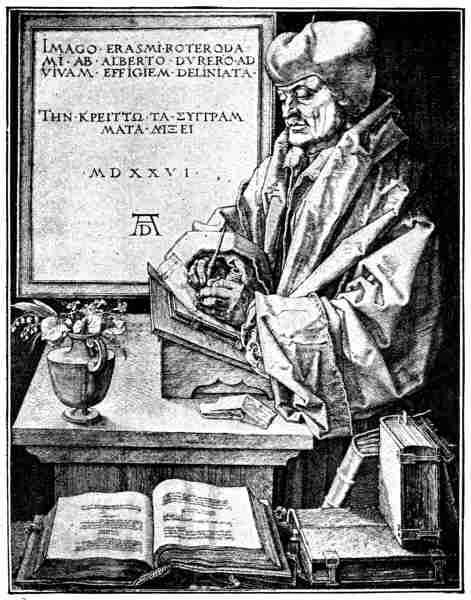
ERASMUS. FROM A COPPER ENGRAVING BY ALBERT DÜRER.

It is somewhat difficult to imagine what Erasmus would have done if his personal safety had been seriously brought into question. It is not impossible that, if the issue of retraction or punishment had ever been squarely presented to him by any authority capable of enforcing its judgment, he might have risen to a higher plane of action than he was ever in fact called upon to reach. Such attacks as he had to meet were wholly from individuals, representing no recognised authority either of Church or State, and his defence was always that the highest persons in both these worlds had approved him. This judgment is at all events more favourable than Erasmus was sometimes inclined to demand for himself. Writing to Richard Pace in the critical year 1521 he says[140]:
"What help could I give Luther, by making myself the companion of his danger, except that two men should perish instead of one? I cannot wonder enough at the temper in which he has written, and surely he has brought great enmity upon the friends of sound learning. He has given us many splendid sayings and warnings; but would that he had not spoiled his good things by his intolerable faults. But even if everything he wrote had been right, I had no intention of putting my head in danger for the sake of the truth. It isn't every one that has the strength for martyrdom, and I sadly fear that if any tumult should arise, I should follow the example of Peter. I obey the decrees of emperor and pope when they are right, because that is my duty; when they are wrong I bear it, because that is the safe plan. This I believe to be permitted even to good men if there is no hope of improvement."
There was precisely the point. Erasmus was ready to bear the ills of the world because he saw no power at hand disposed to remedy them. When others began to take the remedy into their own hands, then he could see in their efforts only riot, confusion, sedition, and all their attendant brood of horrors.