Part Sixth. Lecture and Lessons Given by Mme. Géraldy (Delsarte's Daughter) in America.
Abby Langdon Alger translation
[Illustration: Mme. Marie Delsarte-Géraldy.]
Lecture
Delivered by Mme. Géraldy at the Berkeley Lyceum, New York, February 6, 1892.
Ladies:
When I made up my mind to come to this country it was not with the object of exhibiting myself, but to speak to you of my father. In your country my father is much talked of. In my country, unfortunately, he is forgotten. My father did not write anything--that is a terrible thing! He expected to do so some day, but he always put it off. At last he decided to do so during the war--our unfortunate war! He did not have many lessons to give at that time, for nobody thought of taking any. This gave him leisure to write. His work was to have borne the title, "My Revelatory Episodes." He had only written five chapters when he died. It was to bring to you these five chapters that I came to America. But as soon as I began to speak of them I was stopped. "Why do you tell us this?" they said; "we know all this already." I then discovered that the books written on my father by the Abbé Delaumosne and by Mme. Angélique Arnaud had been translated and published in this country. Mme. Arnaud's book is the better of the two, but it is not practical--not at all practical.
I have gathered together what I remember in the form of lectures, which I offer to you. I have been asked for examples; I shall give you examples. I will begin, however, by giving you a little biographical sketch of my father, and by telling you how he happened to make his discovery. He was the son of a country doctor, a man poor but original. My father was still a very little boy when his father sent him and his younger brother to Paris. There they were apprenticed to a jeweler and made bands of gold. Soon the little brother died, and my father was the only one to follow him to the cemetery. On his way back, after the burial, he fell fainting on the plain. When he regained consciousness he heard music in the distance, and, not knowing whence it came, thought it was the music of the angels. Since then he dreamed of nothing but music; he wanted to hear all he could; he longed to study it. One day he heard two little urchins singing in the street. He asked them: "Do you know music?" The urchins replied: "Yes!" "Will you teach it to me?" "Yes, certainly," and they sang a scale for him. "Is that all there is of music?" "Why, yes."
Not long after, he made the acquaintance of an old musician, who became interested in him, gave him a few lessons, and entered him at the Conservatoire. There he attended the elocution classes, and a role was given to him to learn in which he had to say: "How do you do, Papa Dugrand!" He had no success with this sentence. Each of his four professors told him a different way of saying it, and he wondered: "How is this? Are there, then, no principles to go by?" One day a cousin of his arrived unexpectedly from the country. "How do you do, my dear cousin!" And immediately after this warm greeting he ran away from his cousin, crying, excitedly, "I have it! I have it!" and did not stop until he got to his room and in front of a looking-glass. What he had was the right attitude and way to say, "How do you do, Papa Dugrand!" and this way was diametrically opposed to the instruction his professors had given him on the subject.
My father spent forty-five years in observing. He was the king of observers. What remains to us is but one-quarter of all his observations. My father's method is comprehensive; it can be applied to the arts, to the sciences. His pupils were orators, painters, sculptors, comedians, lawyers, doctors, society amateurs.
My father had read in the first chapter of Genesis that God made man in His image. God is Trinity. Trinity is the criterion of my father.
Raymond Brucker was an old friend of my father's. "What is this method of your friend Delsarte?" was a question often put to him. "Delsarte's method," he would reply, "is an orthopedic machine to straighten crippled intellects."
My father considered man as the principle of all arts. He used three terms to express man: Life, mind and soul. He would compare man to a carriage occupied by a traveler. In front sits a coachman, who drives the horse. The carriage is the body of man; the horse that makes it move is life; the coachman who drives the horse is the mind; the occupant of the carriage, who gives orders to the coachman, is the soul. Man feels, thinks and loves.
My father made use of three terms to express three states: Concentric, normal and excentric. These he would combine with each other. I will show you, for example, the three concentric attitudes of the hand: The concentro-concentric, expressing struggle; the concentro-normal, meaning power; the concentro-excentric, showing convulsion. [Illustrates.] In the same way we have the combinations of the eyes and eyebrows, and, again, those of the head. The head is concentro-concentric when the eyes look in the same direction as that toward which the head inclines; this expresses veneration. Notice how different the words, "I love him!" sound when said first with the head inclined from and then inclined toward the object.
An interesting series of movements for the arms that my father used to give is the following: "It is impossible;" "It is not so;" "It is improbable;" "Maybe;" "It is so;" "It is evident;" "There is no doubt whatever about it." [Illustrates.] This series is equally applicable to affirmation and to negation. For example, you can begin by, "It is impossible that it is not true!" and continue with that meaning.
I have been requested to give the attitudes of the feet. I do not like to give them because they are not feminine, and I abhor all that is not feminine. However, as I have been asked for them, and as I wish to prove that my father had also given his attention to their study, here they are: (1) The attitude of little children and of old men, expressing weakness; (2) that of absolute repose; (3) vehemence; (4) prostration; (5) transitory attitude, preparatory to (6) reverential walk; (7) vertigo, intoxication, which is an ignoble vertigo, or familiarity; (8) the alternative between the positions of offensive and defensive; (9) defiance. [Applause.] Oh! I beg of you! [Deprecatingly.] It is horribly ugly in me; but in a man it is all right.
I shall now speak of the interesting role that the shoulder plays in the expression of emotions. My father called the shoulder "the thermometer of passion." Indeed, the shoulders rise with every strong emotion. If I say, "Oh! how angry I am!" without raising the shoulders, it sounds if not false at least weak; but listen, when I raise my shoulders: "Oh! how angry I am!" Again, if I say, "How I love you!" the words are cold; but, with shoulders raised, listen, "How I love you!" Thus we see actors every day who portray different passions, but whose shoulders remain "cold;" they do not move us.
There is a very pretty observation to make about the elbow. My father called it the "thermometer of pride and humility," and used to call our attention to the different ways the soldiers carry their elbows. You know we have a great many soldiers in France and we have a good, chance to observe them. A corporal--that is, nothing at all--carries his elbows like this [elbows turned outward]. A sergeant, whose rank is a little higher than that of a corporal, carries them this way [elbows slightly drawn in]. By the time he becomes lieutenant he is used to authority, and does not have to show it off so much [elbows drawn in still more]. As for a general, one whose rank is the highest in the army, he walks with his arms hanging naturally at his sides.
Now let me tell you about the thumb. My father being the son and the nephew of doctors, was interested enough in the science to enter, at one time, the school of medicine. Here, while dissecting, he noticed that the thumb of a dead man falls inward toward the palm. This led him to study the attitude of the thumb in life. He would pass days in the garden of the Tuileries watching the nurses and the mammas carrying their babes, noting how their thumbs spread out to clasp the precious burden, and how the mothers' hands spread wider open than those of hired servants; so he called the thumb "the thermometer of life."
My father always used to say to his pupils: "Be warm outwardly, cold inwardly." He wanted them to pass suddenly from one great emotion to another. All great actors do so. He would point to a portrait of Garrick, representing the great actor with one-half of his face laughing, the other half weeping. He himself, in his lessons, after having given expression to some pathetic sentiment, would become immediately his own kind self again. He insisted on self-possession. Often when I was a little girl, and would slip into the room during his lessons, for I loved to listen to them, and would find him portraying some terrible passion, he would stop suddenly, seeing the expression of horror on my face, and would burst out laughing and catch me in his arms, saying: "Poor little one, are you frightened?"
"The artist," said my father, "must move, interest and convince." Gesture is the agent of the heart. Gesture must always precede speech. "Make me feel in advance," he used to say; "if it is something frightful, let me read it on your face before you tell me of it." To illustrate the practice of gesture before speech, I will now recite the fable of "The Cock, the Cat and the Mouse." [Here followed the recitation of the fable.]
My father once held his whole audience under a spell, showing them, through the medium of a little girl of eight, a hundred different ways of saying, "That dog is pretty." I will show you one or two ways If I really think the dog is pretty, I will say it in this tone, "That dog is pretty." If the dog's coat is soiled, I will say in a different tone, "That dog is pretty." And if the dog has rubbed against my dress, there will be a vexed tone, "That dog is pretty!"
My father used to divide orators into "artists in words and artists in gesture." Those who are simply artists in words are those who do not move you. Lamartine said of my father, "He is art itself." Théophile Gautier said of him that he "took possession" of his public.
In 1848 the National Guard was appointed to guard the public monuments. My father, who was a member of the Guard, had his station near an archbishopric. A poor fellow was arrested one day who looked suspicious; he was searched and a chaplet was found on him. The cry arose immediately that he should be drowned. The poor man was being hustled off when my father stopped them, saying that he claimed his part of the punishment, and he drew from his own pocket a chaplet and showed it to them. Oh! my father was kind. He was goodness itself. He was often asked to give lectures at the court, but he would answer: "I do not sell my talent, I give it." He was especially fond of his poor pupils, those who did not pay him; he would often invite them to dine with him.
And now let me show you a series of lines which my father called the inflective medallion. Imagine a circle [describing a circle in the air with her hand]. Within this circle a vertical line, a horizontal line, and two oblique lines, all intersecting each other. At both ends of the vertical and horizontal lines are small curved lines, the whole forming the medallion. This medallion contains all necessary gestures. If the vertical line is made from on high downward ↓ [Illustration], it means affirmation; if made from below upward ↑ [Illustration], it means hope. The horizontal line means negation. One oblique line means simple rejection ↙ [Illustration]; the other ↗ [Illustration] means rejection with scorn, as in a line from Lafontaine's fable, "The Lion's Court:" "The monarch, vexed, sent him to Pluto." The little curve at the top of the vertical line ⌣ [Illustration] expresses ease, repose; it has the form of a hammock. The opposite curve ⌢ [Illustration] means secrecy and mystery. This curve ([Illustration] means amplitude. The other one, when made in this direction ⤶ [Illustration] expresses admiration for physical beauty, and in the other direction ⤴ [Illustration], admiration for moral beauty. The entire circle ○ [Illustration] expresses glorification. These gestures can be made with the whole arm, with the forearm only, or simply with the waving hand; the degree of expression varies accordingly.
Lastly, I will speak about the law of opposition. The arm and the head should move in inverse directions [illustrating]; also the arm and the hand. The statue of the Gladiator is a beautiful example of this law of opposition. He is what we French call "well based;" you cannot overthrow him. In contrast to him, my father used to cite Punchinello, the children's toy, an object of ridicule. Punchinello, when the string is pulled, raises his right arm and his right leg at the same time.
Notice the different ways in which people scold. The schoolmaster moves his head from above downward; the boy threatens back, tossing his head upward.
And now, ladies, I hope that what I have said will move you to take a deeper interest in my father's work, and enable you to understand his methods better than heretofore. I shall then feel, when I return to my country, that I have not crossed the Atlantic in vain.
The Course of Lessons Given in America By Mme. Géraldy
Mme. Géraldy prefaced her course of lessons with the following remarks:
God is Trinity. Man, created in the image of God, bears the seal of the Trinity. In these lessons we shall analyze our whole person. We shall dwell upon three terms: Concentric, normal, excentric. We find them everywhere.
1, excentric; 2, concentric; 3, normal.
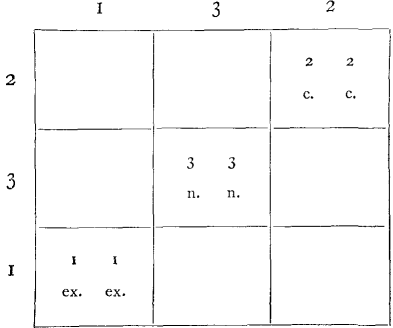
We will begin with the eye--it is the most difficult.
Lesson I. The Eye and the Eyebrow.
The Eye. Concentric Closed.
Normal Open, without expression.
Excentric Wide open.
The Eyebrow. Concentric Lowered.
Normal Without expression.
Excentric Raised.
Combinations of the Eye and Eyebrow.
Eye. Eyebrow. Expression.
Concentric Concentric Intenseness of thought.
Concentric Normal Heaviness, or somnolency.
Concentric Excentric Disdain.
Normal Concentric Moroseness.
Normal Normal Without expression.
Normal Excentric Indifference.
Excentric Concentric Firmness.
Excentric Normal Stupor.
Excentric Excentric Astonishment.
The expressions of stupor and of astonishment are greatly increased when preceded by a quivering of the eyelid (blinking). This should be very rapid and very energetic. Delsarte always insisted on this blinking.
Anxiety calls for a double movement of the eyebrows: First, contract them; secondly, raise them.
Vitality is expressed by raising the outer part of the eyebrows. This accomplishment is very rare; but, then, it is not necessary.
Contraction of the lower eyelid expresses sensitiveness.
Lesson II. The Head.
The Head. Concentric Bent forward.
Normal Upright.
Excentric Bent backward.
Combinations of Head-movements.
Concentro-concentric Bent forward and inclined to one side (toward the person): Veneration.
Concentro-normal Bent forward: Examination.
Concentro-excentric Bent forward and inclined to the other side (from the person): Suspicion.
Normo-concentric Inclined toward the person: Tenderness.
Normo-normal Upright: Without expression.
Normo-excentric Inclined from the person: Sensuality.
Excentro-concentric Bent backward and inclined to one side (toward the person): Abandon.
Excentro-normal Bent backward, straight: Exaltation, vehemence.
Excentro-excentric Bent backward and inclined to the other side (from the person): Pride.
It is the position of the eye that determines the expression of the head, for it is the direction of the eye that tells us on which side the object of veneration, suspicion, etc., is supposed to be. The shoulders should be observed here. They are the thermometer of passion; the stronger the emotion, the higher they should be raised.
Lesson III. The Hand.
The Hand. Concentric Closed.
Normal Open.
Excentric Wide open.
Combinations of Hand-Movements.
Concentro-concentric Fist closed tight, thumb pressing against the knuckles: Struggle.
Concentro-normal Hand closed, thumb resting lightly against the side of the index finger: Power, authority.
Concentro-excentric Hand open, fingers contracted: Convulsion.
Normo-concentric Limp, fingers turned slightly inward: Prostration.[A]
Normo-normal Limp: Abandon.
Normo-excentric Open, fingers straight: Expansion.
Excentro-concentric Wide open, fingers stretched apart and contracted: Execration.
Excentro-normal Fingers stretched apart and straight: Exaltation.
Excentro-excentric Fingers stretched wide apart and backward: Exasperation.
Lesson IV. The Arms.
Let the arms swing backward from their natural position, with the palm of the hands turned toward the front; head raised. Say: "It is impossible!"
There is no doubt whatever about it.
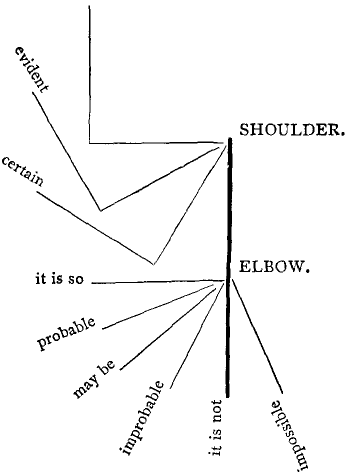
Arms at the side in their natural position, palms toward the front; head straight, Say: "It is not so."
Arms slightly forward; head very slightly bent. Say: "It is improbable."
Forearms slightly raised. Say: "Maybe."
Forearms still higher. Say: "It is probable."
Forearms at right angles with upper arms, palms always upward; head bent. Say: "It is so."
Forearms higher. Say: "It is certain."
Forearms still higher (upper arms follow); head bent forward. Say: "It is evident!"
Forearms still higher (by this time the upper arms are horizontal); head bent way forward. Say: "There is no doubt whatever!"
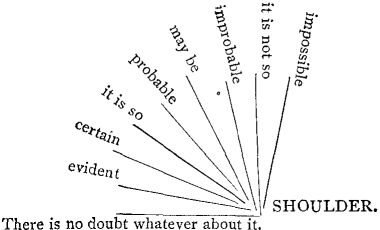
As will be noticed, the head moves in the opposite direction from the arms. The face must express what the words say. The movements of the arms alone, without the expression of the face, do not mean anything.
Lesson V. Inflections of the Hand.--Combinations of the Arm and Hand.
1. Acceptance. Put the arm out naturally, palm upward.
2. Caress. Raise the shoulder; bend the head, keep the elbow close to the side; raise the hand as high as the face and, with palm outward, bring it slowly down again as if stroking an object, at the same time raising the head.
3. Negation. Draw a horizontal line in the air, the movement finishing in an outward direction.
4. Self-control. Arm hanging at the side, hand in the concentro-normal condition, denoting authority, power over one's self.
5. Authority. Extend the arm and raise it in front a little higher than the level of the shoulder; then raise the hand, which should be in the concentro-normal state, from the wrist and let it fall again with decision.
6. Menace. The arm is kept in the same position, the fist clenched (hand concentro-concentric).
7. Execration. Arm extended from the previous position sideward; hand excentro-concentric, palm toward the back; head turned in opposite direction,
8. Horror. Arm outstretched in front; hand excentric, palm outward; head thrown back.
9. Desire. Arm in same position; hand assumes the normal condition and turns its palm upward; head still thrown back.
These movements should blend one into the other, and should be executed without any affectation. The law of opposition should be observed here; for example: In the ascending movement of the arm the hand falls from the wrist; when the arm descends, the hand points upward.
Lesson VI. Basic Attitudes.
1. Weakness. Feet close together, weight of body on both. This attitude is that of childhood and old age.
2. Perfect calm and repose. Rest weight on one foot (settling at the hip), bend the knee of the other leg and advance the foot.
3. Vehemence. Move the body forward so that the weight rests on the foot that is in front; the heel of the foot that is behind is thus raised.
4. Prostration. Throw one foot far behind the other, with the knee bent and the weight of the body upon it. This attitude, when properly taken, leads to the kneeling position.
5. Transitive position. In walking, stop midway between two steps and you have the 5th attitude or transitive position. It is the one that leads to all kinds of walks, and especially to the reverential or oblique walk.
6. Reverential walk. Let the foot which is behind take a step forward in this manner: With the toe describe on the ground a semi-circle that bends inward toward you; this will cause the heel to pass over the instep of the other foot. The other foot now takes a straight step forward, and you pause in a respectful attitude before the personage of importance whom you wish to salute. Several steps may be taken in succession before the final pause. The ceremonious step is always taken with the foot you begin with (the one toward the person you salute); the other foot always takes natural steps. This walk is only meant for men, and only on grand occasions.
7. Intoxication, vertigo. The feet are planted on the ground and apart. This attitude expresses familiarity.
8. The alternative. One foot in a straight line behind the other, the weight of the body on both. This attitude is offensive and defensive.
9. Defiance. The weight of the body on the foot that is behind, the other foot diagonally forward; head thrown back.
Delsarte never classed the basic attitudes under the heads of concentric, normal or excentric, any more than he so classed gestures. He simply gave them in the above sequence.
Lesson VII. The Medallion of Inflection.
"The Key to all Gestures"
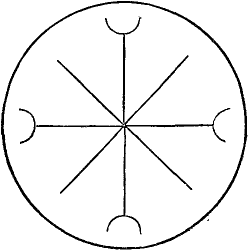
↓ Affirmation. ⇄ Negation. ↑ Hope. ↙ Rejection of things that harm us. ↗ Rejection of things that we despise. ⌣ Ease, comfort (resembles a hammock). ⌢ Silence, secrecy. () Plenitude, amplitude. )( Delicacy, grace. ⤶ Physical beauty. ⤴ Beauty of intellect.
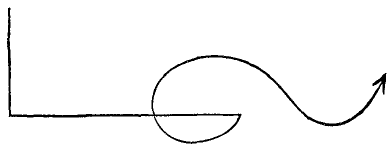
↓ "You may believe → that no lord had as much glory or happiness."
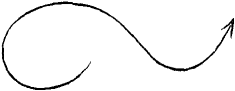
Mme. Géraldy's Lessons On Lafontaine's Fables.
The Wolf and the Lamb.
Might makes right; we shall prove this presently.
A Lamb was quenching his thirst in a stream of pure water. A Wolf, in quest of adventures, happened by, drawn to the spot by hunger.
"What makes thee so bold as to pollute the water I drink?" said he, angrily. "Thy impudence deserves to be punished."
"Sire," answered the Lamb, "soften your wrath, and consider that I am drinking the water more than twenty feet below your Majesty, and can, therefore, in no way pollute your Majesty's drink."
"You do pollute it!" replied the savage animal, "and I know that last year you slandered me."
"How could I when I was not born?" replied the Lamb. "I am still a suckling babe."
"If it was not you, then it was your brother."
"I have none."
"Then it was some member of your family, for you do not spare me--you, your shepherds and your dogs. I have been told so. I must revenge myself."
Thereupon the Wolf carried him into the depths of the forest, and ate him without further trial.
Lesson Given By Mme. Géraldy.
In the narrative portions of a recitation, the eyes of the speaker should meet the eyes of the audience. In this way he fixes their attention and engages their sympathy.
Looking straight at the audience: "Might makes right [deplore the fact]. We shall prove this presently. A Lamb [by tone of voice and gesture show what a weak, gentle creature a lamb is] was quenching his thirst in a stream of pure water. A Wolf [a strong, cruel animal], in quest of adventures, happened by, drawn to the spot by hunger." [Fold the arms; gesture should always precede speech.] "'What makes thee so bold as to pollute the water I drink?' said he, angrily. 'Thy impudence deserves to be punished.'
"'Sire,' answered the Lamb [humbly], 'soften your wrath and--[conjunctions should almost always be followed by a pause] consider that I am drinking the water more than twenty feet ["Mark me!"] below your Majesty, and can, therefore, in no way pollute your Majesty's drink.'
"'You do pollute it!' replied the savage animal, 'and--I know that, last year, you slandered me.' [With this line Delsarte always gave a progressive gesture, which can best be described in this way:
Give the gesture of affirmation ↓ [see Lesson VII.], stopping twice in the downward movement, on the words that and year, thus:
↓ I
know
that
↓ last
year
↓ you
slandered me.
"'How could I when I was not born?' replied the Lamb [gentle voice]. 'I am still a suckling babe.'
"'If it was not you, then it was your brother' [gruff voice].
"'I have none.'
"'Then it was some member of your family, for--you do not spare me, you, your shepherds and your dogs. [There is no pause after the conjunction and here, as it simply joins together words in a list.] I have been told so [impatiently; the wolf is tired of parleying so long]. I must revenge myself.'
"'Thereupon [lower the voice to fix the attention] the Wolf carried him into the depths of the forest and--ate him [deplore the fact] without further trial'" [voice low].
The Cat, the Weasel and the Little Rabbit.
The palace of a young Rabbit was taken possession of, one fine morning, by Dame Weasel; she is a sly one. The master being absent, it was an easy thing for her to do. She carried her belongings there one day when he had gone to do homage to Aurora, amid the thyme and the dew. After having nibbled, and trotted, and made all his rounds, Bunny Rabbit returned to his subterranean dwelling. Mrs. Weasel was looking out of the window.
"Hospitable gods! what do I see!" exclaimed the animal, who had been shut out from his ancestors' home. "Hello there, Madam Weasel, come out without delay, or I shall notify all the rats in the country."
The lady with the pointed nose replied that land belonged to the first occupant; that a lodging which he himself could enter only on his stomach was a fine subject for war. "And even if it were a kingdom, I should like to know why," said she, "it should belong forever to John, son or nephew of Peter or William, more than to Paul, more than to me?"
Bunny Rabbit alleged the rights of use and custom. "It is these laws," said he, "that have made me lord and master of this dwelling; passing from father to son, it was transmitted from Peter to Simon and then to me, John. Is the right of the first occupant a wiser law?"
"Oh! well, instead of disputing any more," said she, "let us have the matter settled by Raminagrobis Grippeminaud."
The latter was a cat who lived as a devout hermit; a cat whose ways and words were smooth; a pious cat, warmly clothed and fat and comfortable; an umpire, expert in all cases. Bunny Rabbit accepted him as judge, and they both went before his furred Majesty.
Said Grippeminaud to them: "Come nearer, my children, come nearer; I am deaf; it is the result of old age."
They both drew nearer, suspecting nothing. As soon as he saw the contestants within reach, Grippeminaud, the sly fellow, throwing out his paws on both sides at once, caused the two suitors to be of one mind by eating them both up.
Lesson Given By Mme. Géraldy.
[Begin slowly, making frequent pauses] "The palace--of a young Rabbit [a nice little animal]--was taken possession of, one fine morning, by Dame Weasel [a personage with nose and manners sharp]; she is a sly one. The master being absent, it was an easy thing for her to do. She carried her belongings there [without asking by your leave!] one day when he had gone to do homage to Aurora, amid the thyme and the dew. [I do not know if you see the poetry here, but we French people consider this last line one of the loveliest bits of Lafontaine.] After having nibbled, and trotted, and made all his rounds, Bunny Rabbit returned to his subterranean dwelling. Mrs. Weasel was looking out of the window. [Start back in surprise, raise the arms and shoulders high, eyes wide open with astonishment, excentro-excentric; see Lesson I.]
"'Hospitable gods! what do I see!' exclaimed the animal who had been shut out from his ancestors' home. 'Hello there, Madam Weasel [with one arm raised, beckon to her to come down], come out without delay, or--I shall notify all the rats in the country.'"
"The lady with the pointed nose replied that land belonged to the first occupant; that a lodging which he himself could enter only [scornfully; eyes concentro-excentric, see Lesson I.] on his stomach was a fine subject for war! 'And even if it were a kingdom [the weasel talks very fast], I should like to know why,' said she, 'it should belong forever to John, son or nephew of Peter or William [talk very fast, with a great many gesticulations], more than to Paul, more than to me? '
"Bunny Rabbit alleged the rights of use and custom. 'It is these laws,' said he [the rabbit talks slowly], 'that have made me lord and master of this dwelling; passing from father to son [count on your fingers], it was transmitted from Peter to Simon, and then--to me, John, Is the right of the first occupant a wiser law?'"
"'Oh! well! instead of disputing any more,' said she [it is the weasel who disputes; she talks in a high key and very fast] 'let us have the matter settled by Raminagrobis Grippeminaud.'"
The latter was a cat who lived as a devout hermit; a cat whose ways and words were smooth; a pious cat [assert the fact], warmly clothed and fat and comfortable [said with the gesture expressive of plenitude made with both arms [Illustration]; see Lesson VII.]; an umpire, expert in all cases. Bunny Rabbit accepted him as judge, and--they both went before his furred Majesty.
"Said Grippeminaud [the concentric state; take the attitude of one who is wrapped up in himself, head bent, shoulders warped, hands holding each other; hardly unclasp to make the sign of beckoning] to them: 'Come nearer, my children, come nearer; [point to the ears] I am deaf; it is the result of old age.'
"They both drew nearer, suspecting nothing. As soon as he saw the contestants within reach, [prepare the claws] Grippeminaud, the sly fellow [act the following] throwing out his paws on both sides at once, caused the two suitors to be of one mind by eating them both up."
Delsarte's Daughter In America. By Adèle M. Woodward.
Mme. Géraldy being asked, during her recent visit to this country, what she thought of the system of gymnastics called "Delsarte," said (to translate literally the expressive French): "It makes me jump! And yet you have my father's method," she continued, showing two of the principal works on the subject published in this country.9 "All that is correct (pointing to some of the charts); what more do you want?"
The trouble lies here: Americans wanted more. They added, they devised, they evolved from the few gestures given by the French master a whole system of movements which they called by his name, and which has become very popular in young ladies' seminaries and young ladies' clubs. The name of Delsarte has been so strongly associated with this system, that to most people the word "Delsarte" without the word "gymnastics" would not mean anything.
Mme. Géraldy came to our country to tell us what the name of Delsarte means. Delsarte never taught gymnastics. His whole life was devoted to the study of the laws that govern expression. His pupils were men of all professions, ministerial and legal orators, actors, singers, etc. "The first half of his lesson," said she, "was always devoted to theory, the second to practice."
Mme. Géraldy is a tall, dark-haired, middle-aged woman, with an interesting face and a charming French manner. She wears mourning for her mother, who died in 1891.
"My mother," she said, "was a remarkable woman; she ought to be as well known as my father is. I would rather my father were not known at all," she continued, "than to be known as he is in your country, that is, as a professor of gymnastics."
She said she had heard of the American "Delsarte gymnastics" while in Paris (Americans passing through the city had often come to her and asked questions), but she had no idea, until she came here, that they were pushed so far. She was quite amused at having dumb-bells given her at one of her lectures in a town in Pennsylvania. "In a gymnasium, as usual," she said, smiling. Anybody who had ever been through the Delsarte gymnastics and afterward followed the course of lessons that Mme. Géraldy gave to a class while in New York, would have been struck by the beauty and simplicity of her father's method, and her clear and direct exposition of it. Here was no affectation. "I abhor all that is affected," she said. There were no intricate convolutions, no flourishes, and, above all, no "decomposing exercises."
An interesting fact to note is that Mme. Géraldy began by teaching her pupils the expressions of the eyes, and when she gave them attitudes or gestures, she always called for the facial expression to accompany them. A woman, well-known in her profession throughout the country, is said to have made the remark that Mme. Géraldy was wrong in beginning with the eyes; she should begin with the feet. Only after showing the possibilities of expression by face, head, hands, arms and shoulders, did Mme. Géraldy give the basic attitudes. She was very patient and painstaking with her pupils, and showed herself interested in every one. She would often pause, while showing some expressive gestures, and say, smiling: "But you Americans do not express yourselves in gestures. You do not 'move' as much as we do." And again, when insisting on the expressiveness of the shoulders when raised ("the shoulders are the thermometer of passion," said Delsarte) she would conclude: "But all this is not American; you Americans do not shrug your shoulders."
In giving the gesture of caress, she quoted her father as saying that the attitude of the hands in prayer is a certain form of caress. In our desire to have the thing we pray for, we clasp our hands together and press them to our bosom as if we already held it.10
She was sometimes amused at the numerous questions that were asked her during the lessons. "What searching minds you Americans have!" she would remark, admiringly. "You must know the why and the wherefore of everything. We French people are of much lighter mind and take things more for granted."
During the lesson on basic attitudes, the following question was put: "In the attitude of repose is the mind in a passive state, and in the attitude expressive of vehemence is the mind in an active state?" The simple answer was: "It is the mind that governs the feet and not the feet that govern the mind."
Mme. Géraldy always insisted on the law of opposition in movements, nature's and her father's great law. She gave, for example, an interesting series of gestures, which might be called the ascending scale from doubt to conviction, in which the head moves simultaneously with the arms and in an inverse direction. The figure on page 547* represents the angles made by the arms and shoulders and, at the same time, those made by the head and shoulders to express the accompanying ideas.
Delsarte used to say: "When I am speaking, stop me in the moment of my greatest exaltation, and I defy you to find me, from my head to my feet, in a position contrary to my method."
"Voice-culture for the speaking-voice is not an art that is cultivated in France," Mme. Géraldy said, "What can you do to change your voice? It was given to you by nature; you cannot change your vocal cords."
Mme. Géraldy returned to France, bearing with her the hope that her efforts have not been altogether unsuccessful in making the great work of her father's life better known to Americans, better understood and appreciated by them.