"Dead Man's Land" (continued 6)
Reading edition
“Here, none of your chaff, Buck. You can’t joke easily. I know I have got no beard, but when it does come I hope it won’t come carroty like somebody’s.”
“Carroty, sir? Not it! Last time I see my mother it had growed while I had been away three years, and she said it made her feel proud, for it was real hauburn.”
“Well, never mind about your beard, messmate,” said Dan, in a deep, gruff voice. “Do you feel sure as you have lost the knife?”
“I feel sure that it’s gone in the night, along of Mr Mark’s rifle.”
“What, out hunting together?” said Mark, laughing.
“Well, good companions,” said Dean. “One shoots the game, and the other skins and cuts it up.”
“I don’t quite see what you mean, gentlemen,” said Dan; “but it seems to me, Mr Mark, that you and me see the beggar that comes hanging about and that sneaked your gun and his knife.”
“Yes,” said Mark, “that’s it; and I feel sure that if we come to look about we shall find lots of other things are gone.”
“Yes, sir,” said Dan, “no doubt about it, and we have got the right pig by the ear, Mr Mark. I don’t mean our little Pig, but you know what I do mean; and now, I don’t like to take too much upon myself, sir.”
“Take an inch, Dan; take an ell. You being a sailor, take as many fathoms as you like, only find my gun.”
“That’s just what I’m going to try and do, sir, and old Buck’s knife too, if I can; so if you will allow me, gentlemen, I’ll just make a propogishum.”
“Go ahead then, and be smart, before old Brown gets here. Yonder he comes.”
“Well, it’s just this way, gentlemen. I say, let’s get our two niggers here, and don’t let them think for a moment as we ’spects them, but drum it into their heads somehow as something’s missing. Teach ’em same as you would a dog, and show them a rifle and a knife, and tell them to seek. I don’t quite know how you are going to make them understand as it’s a black who crawled up in the night, but I daresay you two clever gents will manage that.”
“And what then?” cried the two boys, in a breath.
“What then, sir? Strikes me as them two, the little ’un and the big ’un, will turn theirselves into traps, and we shall wake up some morning to find that they have got the thief as they caught in the night.”
“Well done, mate! I didn’t think you had got it in you,” growled Buck.
“Bravo!” cried the boys together. “Splendid!”
“Now then,” said Mark, “the next thing will be to take the two blacks into our confidence. Hold hard; there’s Brown.”
Chapter Thirty Three.
The Lost Rifle.
The long, weary-looking fellow came up, looked sadly from one to the other, nodding to his companions shortly, and then, turning to the boys, “Very sorry, gentlemen,” he said slowly; “your rifle, Mr Mark. Just heard from Sir James.”
“Yes, it’s a nuisance, Dunn. Haven’t seen it, I suppose?”
“No, sir, no,” replied the man, with a sigh. “Haven’t stood it up against a rock or a tree—”
“There, there, stop that. We have gone all over it, and found out where it’s gone.”
“Found—out, sir?”
“Yes; we think some of the blacks have come in the night, crept in and stolen it.”
“Ah!” ejaculated the man, almost animatedly.
“Hullo! Do you know anything about it?” cried Mark.
“My ponies—two nights—uneasy,” said the man, very slowly.
“And you got up in the night to see if there were any beasts about?” cried Mark excitedly. “Oh, do go on! Make haste.”
“Yes,” continued Dunn, more deliberately than ever. “Coming back—dark—fancied I saw something crawling.—Jumped aside.—Like baboon.”
“That was it, Brown, safe. Dan and I saw one too. Now, what’s to be done?”
“Shoot,” said the man laconically.
“Oh, we don’t want to kill them.”
“Small shot,” said Brown softly.
“Pepper,” said Dean.
Brown nodded.
“Well, we are not going to try that,” cried Mark. “Here, you go and fetch the two blacks. You are quite good friends now.”
Brown nodded, hurried off, and returned in a few minutes with the pair he had sought, who came up with their eyes hard at work gazing searchingly from one to the other and looking as if they expected to be called to account for some misdoing.
“They think you are going to bully them, Mark,” whispered Dean. “Tell them it is all right.”
Mark, who was seated upon an ancient block of stone that had fallen from the wall, sprang to his feet so suddenly that the pigmy took flight on the instant, and Mak was following him, when Mark sprang to him and caught him by the arm.
“What are you going to do, stupid?” he cried. “I wasn’t going to hit you. It’s all right. Sit down. Here—pious—cooey!” he cried.
“Pig, tchig, tchig, tchig, tchig!” cried Dean; and the dwarf turned to glance back as he ran.
“Tell him it’s all right, Mak. We want to talk to you,” said Mark. “There sit down, and he will come.”
The big black hesitated a moment, and then slowly squatted.
“I say, Dean, a guilty conscience needs no accuser! Look at him in front. He’s been having something since breakfast. Pig! Pig! Mak, call him.”
The Ulaka looked doubtingly at the speaker, and then gave utterance to a low, soft call which made the pigmy cease running and stop as if in doubt. Mak called again, and the little fellow turned, to stand watching him, when Mak called once more and he came slowly back, Mark talking to him the while as if he were a little child that he wanted to encourage, and smiling as he held out his hand, in which after a little more hesitation and searching gazing in Mark’s eyes, he laid his own.
What followed was for the main part in pantomime, first one and then another of the English party trying to make the Illaka understand what had happened and what was required of them, a good quarter of an hour being expended over this, with the black staring at them stolidly the whole time, till Mark gave up in disgust and disappointment.
“It’s no use,” he said. “They can’t understand a word we have said, or make out one of our signs.”
“Oh, I don’t know, sir,” said Buck.
“But he seems so stupid,” cried Mark.
“That’s his way, sir,” said Dan. “He can do better than that. You a’n’t seen so much of him as we have. What do you say, messmate Brown?”
“Not stupid, sir,” said Brown drily; and he pointed to the pigmy, who had been crouching in the sand, nursing his bow, and slowly polishing the handle of his spear. “Pig Illaka,” said the horse keeper; and he pointed at the little fellow, who looked up at him quickly and then began to polish his spear handle more energetically with a handful of very fine sand.
Mak uttered a low grunt, sprang up with flashing eyes, looked sharply round at the party, and then as if quite transformed, he sprang at the dwarf and gave him a quick light flip upon the shoulder with his open hand.
“I thought so, gentlemen. He’s been sucking it in all along. Now then, you shall see what you shall see,” said Buck.
The minute before the pigmy had squatted in front of them deliberately polishing his spear handle, but as if suddenly inspired by his big companion’s burst of energy, he sprang up, strung his bow, placed the nock of an arrow upon the twisted sinew which held his weapon in a state of tension, and then bending forward he stood watching the movements of Mak, who stuck his spear into the earth, and then after fixing the pigmy with a fierce look, began to crawl slowly and cautiously in and out amongst the bushes as if trying to steal a march upon the camp.
He kept this up till he was quite hidden from the eyes of those who watched his movements, and then suddenly burst into sight again, maintaining his body bent nearly double as if intending to keep himself hidden from anyone at the camp, and ran swiftly back, to stop short, almost touching the two boys.
“Well,” said Dean softly, “I don’t see much in this.”
“Wait a bit,” whispered his cousin. “I think I do. There! See?”
And now it was as if the white party were non-existent and Mak were playing his part solely for the pigmy’s amusement, for he stepped lightly up to him as if he were carrying something in his hands, which he was holding out for him to see. Then making believe to thump one end of it down and holding it with one hand, he began to dance round it, grinning with delight, stooping down from time to time to kiss it, and hug it to his breast, and ending by making belief to load it. Then dropping on one knee, he drew trigger, uttered a sharp ejaculation to simulate a report, and then crouching behind a block of stone he went through the loading movements again, advanced, retreated, advanced again, shading his eyes with one hand, and then dropped flat on his chest and crawled out of sight behind a heap of stones.
“Well, has he done?” said Dean, in a whisper.
Mark held up his hand, and directly after the black reappeared from quite another direction, raising himself slowly from behind another block of stone, resting an imaginary rifle upon the top, before taking aim again and firing, dropping out of sight, but only to reappear once more and repeat his tactics, after which he sprang up, waving the fancied weapon and went through what was meant for a dance of triumph over the death of an enemy.
This ended as it were one part of his performance, but it was only to be followed directly after by the careful handling and petting of the rifle, which he bore now in his arms to where the pigmy was still watching his every movement and looking more excited than the big black, as he leaned forward, his face full of animation and his eyes sparkling, while Mak seemed to be expatiating in silence upon all the merits of the wonderful weapon that he had secured.
He pointed here and pointed there, and then seemed to be laying it upon a stone and drawing back to admire it, stepping backward for some distance, approaching it again, patting it from end to end, and then going back to the pigmy, to touch him on the back and point at the top of the stone.
This done, he took hold of his little black companion’s spear, stuck it up in the sand, smiling at it with contempt, and then toppled it over with a kick, before snatching the pigmy’s bow and arrow, pointing at them with his face screwed up in token of disgust, before throwing these with similar expressions of contempt to that with which he had treated the spear, some little distance away upon the ground.
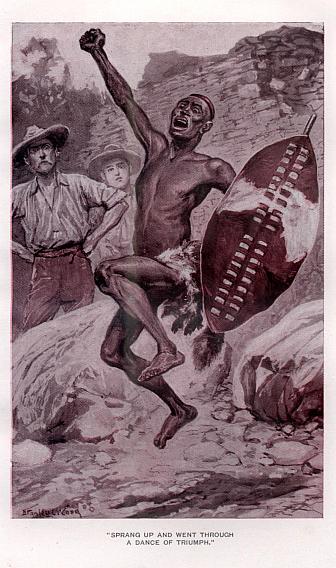
Then he paused to rest his cheek upon his left hand and stood gazing with a ridiculous look of sublime satisfaction at the top of the stone with its suppositious rifle, towards which he advanced upon the tips of his toes, pretended to lift it off, and bore it once more to the pigmy, laid it before him and knelt down to begin talking to him in a low, smothered tone.
It was evident that the difference of their dialect was sufficient to make the pigmy reply from time to time with eager questions, which made his companion repeat himself with some show of annoyance, frowning angrily, till the pigmy nodded his head quickly, showing that he grasped his companion’s meaning.
This lasted pretty well ten minutes, after which the pigmy picked up his weapons, Mak repossessed himself of his spear, and then turning to those who had been intently watching him all through, he gave them a heavy nod and then marched off without a word.
“Well, ought we to clap our hands?” said Mark.
“No, don’t,” said Dean. “Look there; Pig’s going off too;” for the little fellow took a couple of steps towards him, nodded his head, and then followed Mak.
“I say, all of you, what does this mean—that Mak has been trying to show little Pig that the rifle has been stolen, and that he is going to try and find it and get it back?” said Mark.
“I don’t know enough about these people to say, sir,” replied Buck. “Sometimes I seemed to make out that that was what it meant; at other times it looked as if he was only making a fool of himself, just capering about like a dancing doll in a show. What do you say, Dan?”
“Same as you do, messmate. I just got a bit here and there.”
“That’s right,” said Brown, with one of his usual sighs. “He has been telling Pig, as you call him, that a rifle has been stolen, and that they have got to get it back.”
“Do you feel sure he means that?” asked Mark.
“Quite,” said Brown confidently, “and we shan’t see them again till they have got it.”
“Then you think they will get it?”
Brown shook his head, and was silent for a few moments.
“If they get it we shall see them again; if they don’t, we shan’t.”
“Ashamed to show their faces eh, messmate?” asked Dan.
“No—the others too much for them.”
“Then we may be sending them to their death. Here, I don’t like this, Dean. I am sure father would rather that we lost the rifle. Here, let’s call them back. Come on!”
Chapter Thirty Four.
A Terrible Slip.
The two boys hurried off in the direction taken by the blacks, hastening through the ruins in the full expectation of coming upon them at any moment, till the mazy wilderness of stones and trees closed in and farther progress was checked.
“We can’t have passed them, can we?” asked Mark.
“No; impossible.”
“Well, then, where are they?”
For answer Dean gave a shout, and another and another, the two boys standing awestricken as they listened to the strange, hollow echoes that multiplied and magnified the hail till it slowly died out in whispers. But there was no reply.
“I say, they must have managed to top this wall in some way, or known of some passage by which they could get outside into the further ruins.”
“I don’t know,” said Dean, in a whisper. “I say, this place seems to grow more strange and weird the more you wander about it. Doesn’t it to you?”
“Yes, sometimes—horribly creepy, only it is stupid to think so, but I can’t help feeling as if we are surrounded by things that are watching us.”
“What do you mean? Those dog monkey brutes—the baboons?”
“Oh, I don’t know,” said Mark hurriedly. “Let’s get back. I know it’s stupid, but one knows that there must have been thousands upon thousands of people living here, no one can tell how long back, and I don’t like it.”
“I say,” said Dean, and as he spoke he gave an uneasy glance round, “isn’t that being superstitious?”
“I don’t know,” replied his cousin. “Perhaps it is; but I can’t help feeling a bit queer. When we get in these dark parts where the sun doesn’t shine and it’s all so silent till you speak—there, hark at that! We are just at the mouth of that great passage where the walls, quite forty feet high, are close together and go winding away—and there, you can hear that; it’s just as if something was taking up what I said and whispering.”
“Ha, ha, ha!” laughed Dean aloud, and then turning sharply he caught excitedly at his cousin’s arm, gripping it almost painfully, and dragged at him to hurry him away. “Oh, I say,” he whispered, for his laugh had turned into an almost unearthly burst of harsh chuckles and cries which went literally rattling away down the dark passage nearly choked with thick growth and only dimly-seen. “Oh, do come away, Mark! This isn’t the passage we came to that day with uncle and the doctor. There must be something watching us—something no canny, as the Scotch people call it. Quick, let’s get away.”
“I can’t,” said Mark. “I feel as if I couldn’t stir.”
“Why? Is something seeming to hold you?”
“No,” replied Mark; “but I do feel rather shuddery all down my back, and—I know it’s nervousness and imagination—that’s why I feel I can’t go away. It is all nonsense, I tell you, and I mean to come here another time with Buck and Dan, and we will see what they think of it.”
“That will all depend on how we look to them,” said Dean.
“Exactly,” said his cousin, “and that means that we mustn’t behave like a pair of shivering girls.”
“And then?” asked Dean.
“And then—go right straight in and along that narrow passage wherever it leads. I don’t suppose we shall find any ghosts of the old people. I say, how easy it is to frighten yourself in a place like this!”
“Oh, I don’t know. It is very creepy.”
“Seems to be,” said Mark—very emphatic over the “Seems.”
“But it will be dangerous as well as horrid to go along a place like this.”
“Why?”
“There may be serpents, or baboons, or no one knows what fierce animals may make it their lair. Then too there may be holes and cracks.”
“Course there may be,” said Mark, “but we shouldn’t be such a pair of noodles as to come here without a lantern or two.”
“And plenty of candles,” said Dean.
“Of course. There, it is very evident that those two have given us the slip. Let’s give them one more shout, and then get back.”
“Oh, never mind the shout,” said Dean hurriedly. “We will go back at once. I wouldn’t be overtaken here when the sun goes down, and lose my way, for I don’t know what.”
“Why?” said Mark, half mockingly.
“Because—because,” replied his cousin, with something like a shiver, “uncle and the doctor would be so uneasy.”
Mark gave his companion an arch look, and there was a faint smile upon his countenance as his eyes seemed to say—“Oh, Dean, what a humbug you are!”
The boy read it as meaning this, and he said hastily, “Don’t laugh at me, old fellow. Hope I am not going to have a touch of fever, but I do feel very queer.”
“Let’s get back, then, old chap,” said Mark, clapping his companion on the shoulder. “But don’t you fancy that. It’s damp and cold here, and no wonder. Come along. I think I can find my way back; don’t you?”
“Don’t know. I am not at all sure. It must be getting late, and in here it will be as dark as pitch as soon as the sun’s down. I say, don’t you think we were rather foolish to come so far?”
“Well, yes, it was rather stupid, but one was led on by a feeling of excitement. For it would be horrible if we sent those two poor fellows to where they may get into trouble and never come back.”
It was about an hour later that, after forcing their way through the almost impenetrable bushes, climbing over stones and round them, and losing themselves again and again in what had become, as it seemed to them, more and more a horrible maze, Dean made a snatch at his cousin’s arm as he slipped and fell, dragging Mark, till the lad checked his descent by a desperate snatch at the trunk of a gnarled climber.
“Oh, I say,” cried Mark, “don’t say you are hurt!”
A low, half stifled gasp or two came from some distance down.
“Dean, old fellow! Here, I say, speak! Where are you?”
“Down here somewhere.—Ugh! It is black and cold.”
“Well, climb up again. I am reaching down and holding out my hand. Catch hold.”
“I can’t reach,” came back, in a husky voice, “and I am afraid.”
“Don’t say afraid!” cried Mark angrily. “There’s nothing to be afraid of.”
“I have hurt my ankle, Mark, and it gives way under me. Oh, why did we come here!”
“Don’t talk like that. Here, I’ll get back out of this and go and fetch father and the doctor and the others, and we will carry you back.”
“No, no, Mark; I am sick and faint. Don’t—pray don’t go and leave me. I am afraid I am a horrible coward, but if you leave me alone here in this dreadful place, and like this, I don’t think I could bear it.”
“Oh, nonsense! You are only in a sort of split in the rocks. Be a man. I must go for help; it’s no use to shout.”
“No, no,” said Dean, in a hoarse whisper; “don’t—pray don’t shout.”
“Well, I won’t! but I must go and leave you for a bit.”
“I can’t bear it. You shan’t go and leave me! There, I think my ankle’s better now, and it doesn’t seem so dark. You can’t be above twenty feet above me; and that’s nothing, is it?”
“No, nothing at all,” replied Mark hoarsely.
“Then I am going to climb up.”
“Yes, be careful, and—”
“Oh, Mark! Mark!”
His cousin’s cry seemed to hiss strangely past the lad’s ears. Then there was a moment or two’s silence and a horrible splash, followed by the washing of water against the sides of the black chasm down which Mark was straining his eyes to gaze, and then whisper after whisper, soft and strange, until they died away.
Chapter Thirty Five.
Striking a damp Match.
Mark Roche turned cold—not the cold of contact with ice, but what may be termed in contradistinction to muscular cold, a mental freezing of the nerves with horror. For how long a space of time he could not afterwards have told, he stood bending over what he felt must be some horrible depth down which his cousin had fallen, to be plunged into deep water at the bottom. Every faculty was chained save that of hearing as he listened, waiting for some fresh disturbance of the depths below by Dean rising to the surface to begin struggling for life.
And all this time he could not cry out for help. It seemed to him as if he could not have breathed for the icy hand that was clutching him at the throat.
There were moments when he could not even think, when it seemed to be unreal, a nightmare-like dream of suffering when he had been called upon to bear the horror of knowing that his cousin had died a horrible death, while he could not even feel that it was his duty to climb down somewhere into the darkness where he might be able to extend to the poor fellow a saving hand as he rose.
But all was still; the last faint whisperings of the water against the rocky sides had died out. Not a sound arose. He could not even hear his own breath. And then all at once he uttered a gasp as he expired the breath he had held, and thud, thud, thud, thud, he felt his heart leap the pulsations keeping on now at a tremendous rate as they beat against his quivering breast.
He might have been dead during the moments that had passed. Now he was wildly alive, for, as if by the magic touch of a magician’s wand, he had been brought back to himself, as in a slow, awestricken whisper Dean uttered the words, from somewhere apparently close below, “Mark! Did you hear that?”
Once more the lad could not reply, and Dean’s voice rose again, loudly and wildly agitated now.
“Mark! Are you there? Did you hear that?”
“Yes, yes,” gasped the boy. “Oh, Dean, old fellow, I thought it was you that had gone down!”
“No; but wasn’t it an escape? I began to climb, and a big stone upon which I had trusted myself went down with that horrible splash; but I kept hold of the side, and I am all right yet. But oh, how you frightened me! I began to think, the same as you did, that it was you who had fallen, in spite of knowing that it was the stone. But being here in the darkness makes one so nervous.”
“Yes,” panted Mark, who was pressing his hands to his breast.
“But I say, what’s the matter with you? Your voice sounds so queer!”
“Does it? I shall be better directly. Fancying you had fallen set my heart off racing—a sort of palpitation; but it’s calming down now. Can you hold on? Are you safe?”
“Well, I don’t feel so bad. That horrible frightened feeling has gone off, and I think I can hold on or begin to climb again now.”
“No, no; don’t try yet,” cried Mark.
“All right; but what are you going to do?”
“Come down to you as soon as I can breathe more easily. I am all of a quiver, and just as if I had been running a race.”
“All right, then, wait; but it’s of no use for you to try to get down. What good could you do?”
“I don’t know yet,” replied Mark. “All I know is that I can’t leave you like this. I must come and help you.”
“No, you mustn’t,” said Dean. “You would only be in the way, and I am getting more and more all right. I felt just like a little child in the dark for the time; but that nasty sensation has all gone now. Why, Mark, old man, you seem to be worse than I was.”
“I am,” said Mark emphatically.
“You couldn’t be, old fellow. I should be quite ashamed of it, only I couldn’t help it a bit. It was very stupid, but I had got a sort of idea that I had slipped down into a place full of bogeys, and I daren’t let you shout again for fear that it would be telling all those—what’s his names—that made the echoes where I was. Ugh! It was horrid! But the queer part of it is that though I must be in a very awkward place, with water down below, I don’t seem to mind; but I don’t want to get wet. It would be rather awkward if I went down, though; but I don’t think it’s far, and it would be better to fall into water than on to stones. One would come to the surface again directly and get hold of the walls somewhere.”
“But it would be very horrid,” said Mark hoarsely.
“Oh, when you come to think of it,” said Dean coolly, “that’s only fancy. Water’s water, and it’s only because it’s dark that it seems so horrid; for it is only seems, you know, because if the sun were shining right down here we should think nothing of it.”
“’M–m–m–no,” said Mark dubiously. Then speaking more firmly, “Look here, Dean.”
“Can’t; it’s all black,” replied the lad coolly.
“Well, you know what I mean. Can you hold on?”
“Oh, yes; I am standing upright on a big piece of stone that sticks out of the side.”
“Yes. Go on.”
“I am,” said Dean quite calmly. “But wait a minute; I want to see—no, no, I mean find out—how far it is to the water.”
“What are you going to do?”
“Drop this piece of stone in that I am touching. It is quite loose.”
“No, no; don’t!” cried Mark excitedly. “It will raise up all those horrible echoes again.”
“Well, let it. Who’s afraid?”
Plosh!
“There!” cried Dean. “Why, I don’t believe it’s six feet below where I’m standing. What a queer whispering echo it does make, though. I wonder whether there is any kind of fish down here. Eels or newts, perhaps. Now then, what’s to be done next?”
Mark was silent for a few moments, and then beginning to be more imbued with his cousin’s coolness and matter-of-fact way of treating his position, he exclaimed, “I can’t think as clearly as you do, Dean. I want to see what’s best, and all that I can come to is that I must go for help. If you dare hold on there till I come back with the others, and ropes or halters—”
“Dare?” cried Dean. “There’s no dare about it. I must. But I say, what a pair of guffins we are!”
“Oh, don’t talk like that,” said Mark. “It is very brave and good of you, but I know it is only done to try to cheer me up. I wish I wasn’t such a coward, Dean.”
“I don’t,” said Dean, with quite a laugh. “You are just the sort of coward I like—sticking to your comrade like this. Think I want you to be one of those brave fellows who would run away, calling murder? But I say, arn’t we a pair of guffins?”
“Oh, don’t talk like that! What do you mean?”
“Well, here we are in the dark.”
“Yes; we had no business to come. We ought to have known that we might be lost here after sundown, and have brought a lantern.”
“Pooh! Who was going to expect that Pig and Mak were going to dodge us like they did? But all the same we did show some gumption, only we let ourselves get our heads full of fancies; and here have we been standing in the dark all this time with each a box of matches in his pocket.”
“Oh!” ejaculated Mark.
“You get yours,” continued Dean. “I am all right now, and I don’t want to risk slithering off into the cold wet water.”
Scratch!
There was a faint line of phosphorescence giving its pallid gleam for a few moments; then the rattle as of matches being moved about in a tin box, another scratch, a line of light, and then a very faint dull spark seemed to descend and become extinct in the water beneath.
“Try again,” said Dean.
Scratch!
The same line of light, and the phosphorescent tip of the match going down again to expire in the water.
“Hope you have got plenty of matches,” said Dean.
“Yes, plenty,” cried Mark, making the rattle in the box again.
“You must have got them wet somehow.”
“No, no,” cried Mark impatiently. “It is my fingers that are so moist with perspiration.”
“What a bother! I’d have a try, but my hands are regularly wet. The stones down here are dripping and oozing.”
“Don’t you stir,” cried Mark. “I’ll try again, and give my fingers a good rub first on my sleeve.”
“Yes, do; and mind you don’t touch the round tip of the match.”
“I’m afraid I must have done so to all of them.”
“Afraid be hanged!” said Dean impetuously. “What is there to be afraid of? Now, don’t hurry. I’m getting as cool as a dessert ice; and you are getting better, arn’t you?”
“Ye–es.”
“Well, it doesn’t sound like it. You don’t seem to be yourself, old chap. You know I always look up to you as being more plucky than I am. Here we are getting better every minute, and there is nothing to hurry about. They won’t begin the supper till we get back. Leave the matches alone for a minute or two and give a good hail. They must be looking for us.”
“No, no; I can’t shout now.”
“Why?”
“Oh, I don’t know. There, I must strike another match.”
“No, you mustn’t. Give a good hail.”
“I can’t, I tell you.”
“Well, I can,” cried Dean. “I don’t feel a bit frightened of bogeys now.”
“Ahoy–y–y–y–y!” he shouted, and there was a hollow echoing noise, but nothing approaching what they had heard before.
Then they listened till the reverberations died out; but there was no hopeful sound to cheer them, and with a low despairing sigh which he tried in vain to suppress, Mark drew another carefully selected match across the side of the box. This time there was a flash, the head of the tiny wax taper blazed out, illumined the square hole into which Dean had slipped, and revealed him about a dozen feet below where his cousin was holding the match.
“Quick!” cried Dean. “Get another out and light it before you burn your fingers. Well done—that’s the way! Hold it more over. I want to reconnoitre, as the soldiers say.”
“Be careful!” panted Mark. “Mind you don’t slip.”
“Trust me,” said Dean. “No, no, don’t light another. It will only be waste, because I have seen it all.”
“I had better light another match,” cried Mark hoarsely.
“No, you hadn’t. Chuck that down; you are burning your fingers.”
The still burning end of the tiny taper lit up the sides of the square hole as it descended to the surface of the water and was extinguished with a faint spet.
“Now then,” cried Dean, “I have got it all fixed at the back of my eyes like what old Buck calls a fortygraff, and just where I am standing it is all straight up and down, but a little way to the left there’s a regular set of holes just as if stones had been left out. Why, it’s as easy as kissing your hand. This must have been one of the old temple wells, and these holes must have been left like steps for the old people to come down and clip their water.”
“Oh, do take care!” cried Mark.
“Won’t I just! I shall be all right. I say, old chap, what a lark!”
“Lark!” cried Mark angrily. “What do you mean by that?”
“Why, it seems to me quite comic to think that we two fellows, who ought to have known better, should have made such a hullabaloo about nothing at all. Oh, I say, isn’t it lucky that nobody else was here! I wouldn’t—”
“Ah!” gasped Mark, as there was a faint rattling of bits of stone, and plish, plash, plosh, three fragments dropped into the water.
“All right, sonny,” said Dean, who had shifted his position and begun to climb. “I am en route; no tree roots here, though, but plenty of stony holes. Clear the course, for up I come!”
The boy spoke cheerily enough, but his words were accompanied by a faint panting as if he were making great exertion.
“I say, though, Mark,” he went on, “how about your brave British boy? How about your manly pluck? Pretty pair we have been! All right, old man; I didn’t slip. It was a stone. Ah!” ejaculated the boy, with a cry of pain.
“Oh, Dean!”
“Don’t! It’s all right, I tell you. Do you want to frighten me off?”
“No, no, no. But you cried out.”
“Enough to make me. I must have twisted my ankle a bit, and it gave me such a stab just then. All right—better. Up I come. What was I talking about? Oh, I know. But I say, Mark, don’t you feel like a gallant young Briton, ready to face any danger?”
“No, I don’t,” cried Mark angrily. “I feel like a miserable coward;” and he uttered a hysterical sob as he passed his wet hand over his dripping brow.
“Do you?” said Dean coolly. “Well, that’s about what’s the matter with me; only this is rather hard work, and I am too busy to squirm. Brave British boys! Ha, ha! Well, I suppose every chap feels a bit soft sometimes. I say, say something.”
“Oh, take care, old chap!”
“Well, I am doing that. Say something else.”
“I can’t!” groaned Mark.
“That’s enough,” cried Dean excitedly. “I can’t see, but I can hear that my head must be a bit out of this hole, and— Quick! Hand!”
The last two words were ejaculated wildly, and Mark responded by making a snatch in the direction he felt that his cousin must be, and caught him fast, throwing himself backward. There was a rush and the fall of a heavy stone with a tremendous splash; then no sound but a hoarse breathing from two chests.
“Hah!” ejaculated Dean. “That last stone must have grown mouldy, and gave way; but it’s all right. Now for a rest. Shouldn’t like to do that again.”
Then there was profound silence for the space of a few minutes as the two lads knelt there clinging to each other in the profound darkness, thinking of many things; and the thoughts of both had the same trend, the grips of their hands involuntarily growing tighter the while.
How long they knelt there, communing, giving their better feelings full sway, neither knew, but at last the silence was broken by Mark whispering, “Dean, old fellow; what an escape!”
“Don’t, don’t!” was whispered back. “Don’t speak to me, or I shall break down.”
“Ah!” sighed Mark, and there was silence again, broken this time by Dean.
“I can’t help it, Mark, old fellow. I have been trying so hard; but I must be a terrible coward. Tell me, oh, do tell me! Am I safe?”
The answer came faintly from apparently some distance away, in the shape of a sailor’s, “Ahoy–y–y–y!”
“Yes,” cried Mark excitedly. “That’s old Dan’s voice. They are looking for us. Ahoy–y–y–y!” he shouted, with his voice sounding strangely cracked and wild.
Quite a minute elapsed before they heard another hail, and by this time the two boys had pulled themselves together a bit, enough to respond with double the vigour of before, while ere many minutes had passed a steady interchange of calls made the task of the searchers so easy that the gleam of a lantern appeared, to be followed by the report of a gun, and this time there was a perfect volley of the strange echoes.
“Hear that?” cried Dean, in his natural voice.
“Hear it? Yes?”
Dean uttered a gasp as if he were swallowing something that was hard, and then with a laugh he said, “Mark, old chap, isn’t it queer! That seems to be the jolliest sound I ever heard in my life.”
“Yes,” said Mark coolly; “but we have got a long walk before us, and no end of stones to climb, and I expect we shall get into a precious row.”
“Never mind the row, old fellow. I wonder what they’ve got for supper!”
Chapter Thirty Six.
The Pigmy’s Dive.
The party were seated in their shelter close under the highest wall of the ancient ruins, well screened from the ardent rays of the tropic sun, which had not yet risen sufficiently high to interfere with their comfort, and for about the third time the boys were giving their account of the previous evening’s adventure, with nothing more visible to show than a few scratches from the stones and the traces of pricks from the many thorns, when the doctor said, as if he were delivering a lecture, and frowning severely the while, “Care, care, care. If ever our eyes should be called upon to carefully discriminate where we are going, there never can be such need for discrimination as here.”
“You are right, doctor,” said Sir James. “You must be careful, boys; eh, doctor?”
“Yes,” said the latter. “You see, we have done nothing yet to clear away the tangle of growth that covers the stones and the remains of old buildings. I fully believe that this place is honey-combed with passages and cell-like remains, and that there may be dozens of old wells and other reservoirs of water. There is the little river yonder, of course, but if, as I fully believe, this place for miles round was all roughly and strongly fortified, it seems quite probable that the inhabitants, who were gold-seekers, were in the course of generations besieged by the many enemies who coveted their wealth and resented the coming of strangers to settle in their land. If this were the case, in this heated district water would have been most valuable, and the approaches to the river were doubtless guarded by the enemy. Thinking of all this, one sees good reason for the existence of such a well-like place as you encountered yesterday.”
“Yes,” said Sir James, “and I quite agree with you, doctor, that if we could find them where they are buried by the old buildings that have crumbled in, and overgrown by bushes and creepers, there are scores of such places.”
“Well,” said the doctor, “one would be sufficient for our supply of water, but we must, if possible, find out as many as we can for our own safety.”
“So as not to fall down any of them?” said Mark. “Dean and I don’t want another such adventure as we had last night.”
“No,” said his father; “it might be very serious. Let it be a lesson to you, boys.”
“It was, father,” said Mark, and he gave his cousin a meaning look, which was returned, the latter saying to himself, “It takes some of the conceit out of you, old fellow.”
The conversation then turned upon the disappearance of the two blacks, and Dunn’s ominous words as to the possibility of their non-return.
“I hope he is not right,” said the doctor, shaking his head, “but I am afraid he is. From your description, boys, it is quite evident that the one made the other fully understand about the missing rifle.”
“Oh, but I don’t want to think, sir, that those two poor fellows are going to get themselves killed in trying to bring it back.”
“Neither do I, my boy,” said Sir James, “and pretty well surrounded as we are by these people, it is rather a lesson to us, for the doctor and I have been talking about it that we can’t afford to lose two such useful guides and friends.”
“Oh, we shan’t lose them, uncle,” said Dean cheerily. “They will come trotting in some day—I mean Pig will, so as to keep up with Mak’s long strides.”
“Well, I hope so,” said Sir James, “and I hope too that the little feud between us and our visitors will come to an end. What do you think, doctor?”
“I cannot commit myself, sir, to giving any judgment upon the matter, but I hope that our display of firmness, and the possession of weapons that we know how to use, may keep them at a distance.”
“I hope so,” said Sir James, “but there will be no relaxing of our watchfulness, and it will be very hard upon us after a hard day’s work over our researches, this taking it in turns to guard against visitors in search of what they can annex.”
“Nocturnal burglars,” said Dean.
“Oh, we shall get used to it, father. But what are we going to do to-day?”
“Ask the doctor,” said Sir James. “I give myself up entirely to his guidance. Someone will have to stay in camp, of course, on guard, and ready to fire or whistle and give notice of the approach of any of the blacks. What do you propose, doctor?”
“Taking two men with us to cut and slash away the growth at the first place that we think worthy of investigation; and the sooner we are off the better, before the sun gets too much power.”
“There’s plenty of shade,” said Mark.
“Yes, my boy, but the trees and these towering walls cut off what breeze there is, and I am afraid that we shall find the heat sometimes too great to bear.”
But in the excitement and labour of the next few days the heat was forgotten, and the interest of the discovery amongst the old ruins was quite sufficient to keep all on the qui vive for any fresh object upon which they might stumble.
They had talked about the two blacks, of whom they had seen nothing since they had plunged in amongst the ruins of what seemed to have been the huge fortified temple, and in spite of the two lads devoting a good deal of time to discovering some opening through the old walls by which they might have reached the open country, their efforts were quite without success. It was certainly possible that they might have helped one another to reach the top of the lowest stretch of wall, and lowered one another down the other side, but Mark argued that they would not have done this. There must be some secret opening or slit through which they could have squeezed, one well known to them.
“I feel that if we keep on searching,” he said, “we shall find it sooner or later.”
This was said in the hearing of Buck Denham, who suddenly exclaimed, “But look here, gentlemen; you don’t think, do you—” He stopped short, and the boys waited for nearly a minute, before Mark burst out with, “Yes, we do, Buck—lots.”
“Yes, I suppose so, sir,” said the man, rather sulkily.
“Well, go on. What were you going to say?”
“Only that Mr Dean here slipped down that hole.”
“Well, we know that,” said Dean shortly. “You needn’t bring that up.”
“No,” cried Mark. “Why did you?”
“Didn’t mean any harm, sir. I was only going to say that if you two gents met with an accident like that, mightn’t them two niggers have had one too?”
“Ay, ay, messmate,” growled Dan, “and being blacks not have the pluck and patience of our two young gentlemen here as helped theirselves and got out.”
“Pluck and patience!” thought Mark, as he stole a glance at his cousin.
“Patience and pluck!” said Dean to himself, as he met his cousin’s eye.
“Why, Buck,” cried Mark, “you have regularly spoilt my day.”
“Me, sir?” said the big fellow wonderingly. “Not spoilt yourn too, Mr Dean?”
“Yes, you have,” said the lad addressed. “You have set me thinking that the poor fellows have tumbled down somewhere and been drowned, or else are regularly trapped in some deep cellar-like passage underground, where they have lost their way.”
“Well, that means, gentlemen, that what we ought to do is to go for a big hunt in and out amongst the ruins till we find them, or something else.”
“Yes,” said Dan, “something else; and that would be like killing two birds with one stone.”
“Come on, then,” cried Mark, “only this time we will take two ropes and a lantern, and we will go at once. Look here, Dean, we will start from where we saw them disappear amongst the bushes. Shall we take our guns?”
“I would, gentlemen,” said Buck. “You see, you never know what you are coming against.”
“No; but they are a bother to carry.”
“Oh, we will carry them, sir—sling ’em.”
“There, we needn’t all go. Run and fetch what we want, you two, and we had better take a canteen or two of water and something to eat, in case we lose ourselves. But no, we had better all go together, Dean, and rig up, or we shall be sure to find we have left something behind that we ought to have taken.”
“Especially matches,” said Dean.
They were about half way to the opening in front of their shed, known generally as the camp, when Dean suddenly uttered an ejaculation.
“What is it?” cried his cousin.
“The blacks.”
“Ah! Where are father and the doctor?” cried Mark excitedly. “And we are wandering about here without arms.”
“I did not mean the savage blacks,” cried Dean.
“Why, you don’t mean—”
“Yes, I do. Hooray! There they are, along with Dunn and the ponies—an old croaker, to make believe that they might never come back!”
Just then Dunn pointed in their direction, and the two blacks turned and caught sight of them, to begin marching slowly forward, Mak shouldering his spear and stepping out with quite a military stride, while the pigmy strutted along with an assumption of braggart conceit that was amusing in the extreme.
“Well,” cried Mark, as they met, “what luck? You haven’t found the rifle?”
“Yes. Find ’em.”
“Where?”
“Stolen. Nigger.”
“But where was it?” cried the boys together.
Mak pointed to the pigmy, who nodded and laughed, and by degrees the little party managed to elicit from their two scouts that ever since they started they had been in hiding near the ruins, waiting and watching in the belief that sooner or later whoever had stolen the rifle would come again for further plunder.
“But you have been away for days,” said Dean. “Have you been hunting too, so as to get something to eat?”
This was rather a long speech for Mak, to whom it was addressed, to fully comprehend, but when it had been repeated to him simplified as far as possible by Mark and the two men, the black nodded cheerfully and explained that he had waited every night till they were quite fast asleep, and then the pigmy had crept up like a dog or a baboon to help himself to what they wanted, and then stolen away again to watch.
“But he couldn’t have done that,” cried Mark; “certainly not when I was on guard. It must have been your turn, Dean, and you went to sleep.”
“That I declare I didn’t!” cried the accused, and the two boys now gazed severely at their men, who looked at one another, as if feeling guilty, “I swear I didn’t, messmate. I couldn’t have slept for thinking that some of the niggers would come stealing, and steal my life,” grunted Dan.
“Same here,” growled Buck.
A rough cross-examination ensued—a very hard one too, for Mak nodded his replies to fit his misunderstanding; but at last the investigators felt convinced that they were only listening to the truth, and that, thanks to his size, activity, and possible resemblance to some animal, the pigmy had had no difficulty about stealing into the camp for supplies.
“That’s right enough, gentlemen. I believe the little beggar could tickle you on one side and make you turn over, thinking it was a fly, while he helped hisself on the other and went off again like a monkey.”
During the latter part of the examination Mark’s father and the doctor joined them, full of satisfaction that their forebodings were false, and glad to welcome the friendly blacks again. They too learned that Mak and the pigmy had kept up their watch till the last night, when they had come upon two of the Illakas stealing into the camp. But one of them got away, and the manner of his escape was explained in pantomime by Mak, who made his little companion show how it occurred; and this, it seemed, was by his being pursued right up to the top of one of the further walls and then right along it in the darkness till he could get no further and had to jump, the Pig making it all clear as daylight, to use Buck’s words, for he took them to the place, and while they stood below watching, the little fellow mounted to the top, then ran right along and dived right off.
“Good heavens!” cried the doctor. “The poor fellow must be killed!”
“Yes,” said Mark’s father, and he involuntarily took out his handkerchief to wipe his moist hands.
“Here, quick!” said the doctor. “He must be lying somewhere below there;” and he made for the imagined spot close by, followed by the rest, evidently to Mak’s delight, for he began to grin hugely and raised up suspicion in the boys that their sympathy was being wasted, for all at once Pig hopped back on to the top of the wall, baboon fashion, to perch there like one of the hideous little beasts, none the worse for his leap down into the tree top that he had selected.
“Confound the fellow!” muttered the doctor. “He gave me quite a scare! But look here. You, Dunn, I don’t understand. Make them tell us what became of the other.”
Dunn turned to Mak and spoke a word or two to him in his own language, when the black stared at him stolidly and then turned away.
“What does that mean?” said Mark. “Wouldn’t he tell you?”
“No,” replied Dunn sadly; and he gave the boy a very meaning look.
“Why, you don’t mean to say—that—”
“Yes; don’t bother him, or he may go off. Afraid. The boss mightn’t like it.”
“Not like it?”
“No. Saw him cleaning his spear.”
Glances were exchanged, and the looks seemed in silent language to tell the tragic story that either Mak or his little companion had speared and afterwards buried the enemy they had overcome.
“I don’t like this, doctor,” said Sir James. “It’s tragedy. What can we do?”
“Nothing,” said the doctor gravely.
“But these men—for I suppose we must call that little savage a man, though he looks a child—”
“The big herculean black is no bigger in intellect. If they have killed a brother savage I cannot feel that our consciences are to blame. The men were here to rob, and if we had caught them in the act I honestly believe that it might have cost us our lives.”
“Probably,” said Sir James; “but we must make them understand our utter abhorrence of the deed, and threaten punishment for the act.”
“No, Sir James. Remember the old saying, Example is better than Precept. I feel sure that if we interfere with them with any stringency of action they will forsake us at once.”
“Well, boys,” said Sir James, “I would rather give up the expedition at once and make our way back, than have such horrors as this occurring. Here, what does this mean?” he continued, for Mak came forward with his little companion, both looking joyous and jubilant, Mak talking away and putting in a word of English now and then—words which constituted “come,” “show,” and “gun.”
“Oh, that’s plain enough, father,” cried Mark. “They have got the gun.”
The little party followed the two blacks at once, and to their great surprise they were led into the temple square and across it till they were near to the big wall. Then both the doctor and Sir James stopped short.
“This is too horrible,” said Sir James angrily. “Come back, boys. They want to show us where they buried that unfortunate prowler.”
“I am glad of that,” whispered Dean. “What horrible wretches these blacks are!”
“Ugh! Yes,” whispered back Mark, with a shudder. “Come along. I shall begin to hate myself for having been so friendly with them.”
The two blacks stood looking at one another in amazement, as they saw the others moving away. But directly after Mak literally bounded before them and began waving his hands as if trying to drive back a flock of sheep.
“No go away!” he shouted. “No go. Gun! Gun! Gun!” And he pointed to the loose heap of sand and stones that had been piled over the old burial place.
“What’s that?” said the doctor. “Gun?”
“Gun! Gun! Gun!” shouted Mak excitedly, and the little pigmy bounded on before them to the heap and began signing to them, pointing down the while.
“Doctor! Uncle!” cried Dean. “I believe they mean that the gun is buried there.”
“Gun! Gun! Gun!” cried Mak, and he bounded after his little companion, to take his place on the other side of the heap, and began to imitate his gestures, looking at the boys now, and shouting, “Gun! Gun! Gun!”
“Oh, do be quiet!” cried Mark angrily.
Then in a questioning tone he looked at the blacks, pointed to the heap, and repeated the word. Both began to dance now with delight, pointing down and making signs as if scraping a hole in the heap before them.
“Well,” said Dean, “if the gun’s there don’t keep on dancing like a pair of black marionettes. Dig it out;” and he imitated the blacks’ signs of scraping away the loose rubble.
Mak nodded his head eagerly, and shrank back, a movement imitated by Pig.
“No, no,” said Mark; “don’t go. Dig it out.”
The black looked at him enquiringly.
“Dig?” he said.
“Yes; both of you dig it out,” cried Dean.
To the great surprise of the boys the two blacks dashed at them, caught them by the wrist, drew them close up to the heap, and tried to bend them down so that they might draw away the loose rubbish.
“Oh, no, you don’t,” said Mark merrily, snatching away his wrist. “I am not going to have my hand used as a trowel to save yours, you lazy beggar. Here, Dean, get hold of Pig and do as I do. Let’s give them an object lesson.”
The little fellow smiled with pleasure as Dean caught him by the wrist, and then the two boys, to use Mark’s expressions, proceeded to use the black palms and digits as trowels; but the smiles of both blacks changed to angry frowns. They snatched their hands away and backed off from the heap, Mak shaking his head fiercely.
“Well, that’s cool,” said Mark. “Here, come back;” and he pointed to the heap and stamped his foot. “We are not going to do the dirty work and let you keep your hands clean, my fine fellows. Come—dig out—gun!”
Mak shook his head angrily and imitated Mark’s action of stamping his foot and pointing to the heap.
“Dig—out—gun,” he said, imitated the while by the pigmy, who repeated the words “Dig—dig” to Dean.
“No—no—you two!” cried Mark.
“No—no—you two!” cried Mak; and he pointed again at the heap, running close up to it and pointing to where some parched up fern leaves had been scattered about.
He only stayed there a moment, and then darted away, to stand with his little companion, shaking his head and chattering away as he energetically kept on signing to the boys to act, and shouting.
“Gun! Gun!”
“All right, gentlemen; never mind,” said Buck good-humouredly. “These niggers are mighty particular about doing just what work they like and no more. Me and my mate will soon fish the gun out if it’s there. They seem to think that as they have found the place where it’s buried their job’s done.”
“No,” said Dunn dismally.
“What do you know about it?” growled Buck.
“Been here five years,” said the man sadly, quite in a tone which seemed to suggest that he wished he had never seen the place. “Won’t go because they know people have been buried there. It’s where you dug out the bones.”
“Ah!” said the doctor. “Yes, that must be it. These people fear the dead more than they do the living.”
“Oh, that’s it!” cried Mark. “Don’t you remember how they wouldn’t go near after we had found the bones?”
“No, no, Buck—Dunn; we’ll do it, and show them how cowardly they are.”
The two men drew back, and while the blacks shifted a little further away and close together watched, with their faces drawn with horror, the boys bent down and tore away the dead fronds of the fern.
“Here, it’s all right,” cried Dean. “Hooray, Mark! Here’s your gun. Why, they’ve only buried the stock and half the barrels.”
For there, lightly covered with stones and sand, were the barrels of the missing gun, fully six inches quite exposed.
“Here, let me come,” cried Mark.
“No; first find,” cried Dean, seizing the rifle by the barrels and giving it a jerk which drew it right out, and then uttering a yell of horror he dropped it, for as he tugged a tiny snake thrust its head out of one of the barrels and opened its jaws menacingly, then closed them, and the sun shone upon its flickering forked tongue, which darted out again and again through the natural opening in the closed jaws.
“Ah! Take care!” cried Sir James; and the two blacks turned as if moved by the same impulse and scrambled to the nearest pile of stones, to stand there holding on to one another, their superstition strengthened by what they believed to be instant punishment being brought down upon the heads of those who had dared to disturb the resting-place of the dead.
“Oh, I say, Dean!” cried Mark, as he picked up the double rifle, noting as he raised it from the ground that the snake had shrunk back out of sight into its novel refuge. “I’ll soon settle him,” he said. “Yes, all right,” he continued, as he raised the gun so that he could examine the breech. “It’s all right; it’s loaded. I’ll soon finish him;” and raising the piece higher, holding it as if it were a pistol, he drew trigger, and a volley of echoes followed the report, the two blacks being already in full flight.
“Anybody see him go?” said Mark merrily, and as he spoke he let the rifle slide through his hands till he grasped the muzzle, while the butt rested between his feet. “New way of killing snakes,” cried the boy; and then with a look of horror, wild-eyed and strange, he held the muzzle as far from him as he could, half stunned by realising the fact that he had fired the wrong barrel, as he saw the little snake glide rapidly out of the mouth of the second barrel, play for a moment or two over his hands, and then drop in amongst the loose stones and disappear.
“Mark, my boy!” cried Sir James excitedly. “Don’t say you are bitten!”
The boy drew a deep sigh, his face turning ghastly white the while, and then, “I must, father. It was only a sharp prick, but—”
Chapter Thirty Seven.
The Doctor’s Lancet.
There was a peculiar dreamy look in the injured boy’s eyes, as he turned them from his father to Dean and back.
“Here, let me come,” cried the doctor. “Let him sit down on that stone—feel faint, my lad?”
“No–o,” faltered Mark; “only strange and queer. Is it a poisonous snake?”
“I don’t know. I hope not,” said the doctor. “I only had a glimpse of it, and it’s gone. Where did you feel the prick?”
“In this finger. No, no—don’t touch it!”
“Nonsense! Be a man. I am not going to hurt you. Did either of you get a good sight of the snake?”
“I did, sir,” said Buck, “and it must have been a poisonous one.”
“Why must it?” said the doctor sharply.
“Because the niggers run away as soon as they saw it, sir,” said Dan. “Look at them up yonder;” and he pointed to where the two blacks were perched on the top of the wall. “They know, sir.”
“Oh, yes, they know a great deal,” said the doctor, shortly, as he busied himself pressing the sides of a little speck of a wound which pierced the boy’s skin, now with one nail, now with both at the same time, and making Mark wince.
“You are hurting him a good deal,” said Sir James.
“Do him good,” said the doctor, shortly, “and take off the faintness. Now, Buck, I want to make sure,” continued the doctor, who from the smattering of knowledge he had obtained from reading was looked up to by everyone present as being master of the situation in the emergency. “What sort of a head had the snake?”
“Nasty-looking head, sir! and it kept sticking out its sting with two pyntes to it.”
“Pooh!” ejaculated the doctor, as he busied himself over the tiny puncture. “But was it a broad spade-shaped head?”
“Spade-shaped, sir? What, square? Oh, no, it warn’t that.”
“Bah!” ejaculated the doctor. “I meant spade-shaped—the spade that you see on a pack of cards.”
“I couldn’t be sure, sir. It was so quick, you see. But I should say it was more like a diamond.”
“Beg pardon, sir,” cried Dan; “I think that the place ought to be sucked. I’ll do it.”
“Thanks. Good lad,” said the doctor. “You are quite right;” and he gave the little sailor a quick nod as he took the advice himself, held Mark’s index finger to his lips, and drew hard at the tiny puncture, trying to draw out any noxious matter that might have been left in the wound, and removing the finger from his lips from time to time to rid his mouth of any poison.
“Here, you, Dean,” he said, upon one of these occasions, “slip that silk handkerchief from your neck, twist it a little, and now tie it round his arm just above the elbow. That’s right—no, no, don’t play with it—tie it as tightly as you can—never mind hurting him. I want to stop the circulation.”
He placed his lips to the wound again and drew hard; then speaking once more—
“Harder. Now, you, Sir James; you are stronger. Tighten the ligature as much as you can. You, Dean, put your hand in my breast-pocket—pocket-book. Open it and take out a lancet.”
“There isn’t one here, sir.”
“Bah! No; I remember. Get out your knife, my boy.”
“There’s a lancet in that, sir, you know, and a corkscrew, and tweezers too. Here’s the lancet, sir;” and the boy drew out the little tortoiseshell instrument slipped into the handle of the handsome knife which his uncle had presented him with before the start.
“Now, then, Mark; I am going to operate.”
“Very well, sir,” said Mark, calmly enough. “You had better take the finger off close down to the joint, for fear the poison has got as far as that.”
The doctor smiled.
“Is it absolutely necessary?” said Sir James anxiously.
The doctor gave him a peculiar look which Dean looked upon as horribly grim.
“I see two chaps who were bit by snakes out in ’Stralia, gentlemen,” said Dan, “and one of them died; and they said that if there had been someone there who had known how to cut his arm off so as he shouldn’t bleed to death, it would have saved his life.”
“Kept the pison from running right through him, mate,” growled Buck, with a look of sympathy at the injured lad.
“That’s so, messmate,” continued Dan; “but they sucked t’other one where he was stung for ever so long. He got better.”
“Now, then,” said the doctor sharply, “no more anecdotes, if you please;” and as he spoke he made a slight cut across the speck-like puncture with the keen-pointed lancet, so that the blood started out in a pretty good-sized bead.
“Hurt you, my lad?” he asked, while Dean looked on in horror.
“Just a little,” said Mark. “But hadn’t you better do more than that?”
“No,” said the doctor coolly. “There is a little poison there, and the bleeding will relieve it. It has begun to fester.”
“What, so soon?” said Sir James.
“Yes,” was the calm reply. “Now, Dean, I must come to you for another of your surgical instruments—the tweezers.”
“Yes,” cried the boy excitedly; and in his hurry he broke his thumb nail in drawing the tweezers out of the haft of the knife, for the instrument was a little rusted in.
“Now,” said the doctor, as he pressed the two little spring sides of the tweezers right down into the cut and got hold of something.
“Oh! hurts!” cried Mark.
“Yes, but it would have hurt more if I had taken your finger off,” said the doctor, laughing. “There we are,” he continued, as he drew out a sharp glistening point and held it up in the sun. “There’s your snake sting, my boy, and the little cut will soon heal up. There, suck the wound a little yourself, and draw out the poison.”
“But, doctor,” cried Sir James, “surely a venomous snake injects the poison through hollow fangs. Are you sure that that is a tooth?”
“No, sir,” said the doctor. “That is the point of one of those exceedingly sharp thorns that we are so infested with here. Look at it;” and he held out the tweezers for everyone to examine the point. “It’s a false alarm, Mark, my lad. I can see no sign of any snake bite.”
“But I felt it!” cried Mark, as he stared at the thorn.
“I can’t see any mark, and if the snake did bite it was only a prick with one of its tiny sharp teeth. Look, Sir James; you see there’s no sign of any swelling, and no discoloration such as I believe would very soon appear after the injection of venom.”
“But what’s that?” said Sir James anxiously, pointing.
“That? That’s a thorn prick,” said the doctor.
“Well, but that?”
“That’s the stain from some crushed leaf.”
“Well, that, then?” cried Sir James angrily at finding the doctor so ready to give explanations to his doubts.
“That’s another prick.”
“Tut, tut, tut! Well, that?”
“That’s a scratch.”
“Well, that, then?” cried Sir James, almost fiercely. “There’s the discoloration you said would appear.”
“Oh,” said the doctor, laughing; “that’s dirt!”
Sir James made no answer, but snatching a handkerchief from his pocket he moistened a corner between his lips, passed it over the clear skin of his son’s wrist, and the dark mark passed away.
“Here, Dean,” said the doctor, “hands up! That’s right; draw back your shirt sleeve.”
The boy obeyed.
“Look here, Sir James,” said the doctor, and he pointed with the thorn he held between the tweezers. “You see that—and that—and that?”
“Oh, those are only pricks I got in the bushes, sir, the other day,” said Dean sharply.
“Yes, I see,” said the doctor, “and you had better let me operate upon this one. It has begun to fester a little too.”
As he spoke the doctor pressed the little dark spot which showed beneath the boy’s white skin.
“Oh, you hurt!” cried Dean, flinching. “Yes, there’s a thorn in there, and I see there’s another half way up your arm, Mark, my lad. You had better try to pick that out with a needle. It is all a false alarm, Sir James, I am thankful to say. Snake bites are very horrible, but you must recollect that the great majority of these creatures are not furnished with poison fangs. I was in doubt, myself, at first, but the fact that the puncture was so large, and unaccompanied by another—venomous snakes being furnished with a pair of fangs that they have the power to erect—was almost enough to prove to me that what we saw was only produced by a thorn.”
“I beg your pardon, doctor,” said Sir James, grasping him by the hand. “I could not help thinking you were dreadfully callous and cool over what has been agony to me. I am afraid I was horribly disbelieving and annoyed.”
“Don’t apologise, sir,” replied the doctor. “I did seem to treat it all very cavalierly, but I had a reason for so doing. I wanted to put heart into my patient to counteract the remarks which were being made about snake bites and treating them by amputation. Now, Mark, do you feel well enough to handle your gun again?”
“Oh, yes, quite,” cried the boy, starting up; and getting possession of his rifle he raised it up, fired the remaining cartridge, and then opening the breech held it up, to treat it as a lorgnette, looking through the barrels.
“There are no snakes in here now,” said the boy, speaking quite cheerfully, “but the night damp has made a lot of little specks of rust.”
“Let me clean it, sir,” cried Dan. “I’ll wash out the barrels and give it a good ’iling.”
“Yes, do,” said Mark, who began to suck his finger.
“Why, I say, Mark,” cried Dean, “I never thought of it before: that’s the finger you asked me to get the thorn out of that day after we got back from my slip into that hole.”
“Eh?” exclaimed Mark, looking at him doubtfully.
“Why, of course! Don’t you remember?”
“No,” said Mark. “I feel quite stupid this morning, after this.”
“Try to think, my boy,” cried Sir James impatiently. “It would set all our minds at rest.”
“Why, to be sure, Mark,” cried his cousin. “Don’t you remember? You said you could not do it yourself because it was in your right finger and it was such a bungle to handle a pin with your left hand.”
Mark stared at his cousin for a few moments, and gazed round at those who were waiting to hear him speak; and then a gleam of light seemed to dart from his eyes as he cried excitedly, “Why, of course! I remember now; and you couldn’t get it out with the pin, and you said it was a good job too, for a brass pin was a bad thing to use, and that we would leave it till we could get a big needle from Dan, such as he used for mending his stockings.”
“Hear, hear!” cried the little sailor, by way of corroboration as to his handling of a needle.
“And then we forgot all about it,” cried Dean.
“Yes,” cried Mark. “Oh, I say, I am sorry! What a fuss I have been making about nothing!”
Chapter Thirty Eight.
A Family Party.
“I don’t like to talk about it,” said the doctor, “but I am afraid of what those two black fellows have done.”
“Yes,” said Sir James; “there is an ugly suggestion about it. But say what you are thinking, doctor.”
The doctor was silent, and the boys listened for his next words with strained ears.
“I tell you what I think,” he said, at last. “I am afraid that it may cause us great trouble—the great trouble of a visit from a hostile party of neighbouring savages.”
“To take revenge,” said Sir James, “for the injury or death of their friends?”
“Yes,” said the doctor.
“But why should they think that we hurt them, when it was done by Mak and the pigmy?”
“Because they may associate us with them,” replied the doctor. “Still, there is the hope that they may not know we are on friendly terms; but it is a very faint hope, and I am disposed to say that we ought to give up and make our way back to the station.”
“Oh, that would be such a pity,” said Mark. “This is such a wonderful place, with so much to find out yet.”
“Yes,” put in Dean.
“Well,” said Sir James, “I feel like the boys do.”
“And I must own,” said the doctor, “that I should bitterly regret having to go from a neighbourhood where we cannot stir without coming upon something to interest us.”
“Then don’t let’s go,” cried Mark. “We are a strong party, and if we were attacked we could defend ourselves. A few shots would scare an enemy away.”
“You had better be silent, Mark,” said the doctor. “I shall be tempted to run the risk.”
“Let’s go on tempting him,” said Dean, laughing; and Sir James smiled.
“We may be only frightening ourselves with shadows, doctor,” he said, “and it is quite possible that our visitors were only one or two wandering blacks.”
“I hope you are right, Sir James,” said the doctor; “but the finding of that old fellow when we first came, and the way in which he disappeared, lead me to suppose that we are not so lonely as we seem. Well, if we stay, the great thing is to keep a most stringent watch night by night, and always to be ready against surprise.”
These last words of the doctor’s decided the matter, and the rest of the day on which they were spoken was devoted to a reconnaissance made by the boys and their captain, several of the nearest kopjes being ascended and the glasses they had with them brought to bear. But nothing was seen till the last kopje was ascended prior to journeying back to the waggons, when Dean in sweeping the sides of a slope half a mile away suddenly gave the alarm.
“There they are!” he cried.
The doctor snatched out his glass, focussed it upon the indicated spot, and closed it again with a laugh.
“Yes, there they are,” he cried. “Look, Mark.”
“I am looking,” replied the boy, who was focussing the objects that had startled his cousin.
“Well, do you see them?” said the doctor.
“Yes, dozens of them, with their old women behind them carrying their babies. Oh, I say, Dean, you are a fellow! Monkeys—baboons.”
“No! Are they?” cried Dean, twiddling the focussing nut of his glass with trembling fingers. “Why, so they are!”
That night careful watch was kept, and the following day and those succeeding were devoted to research after research among the wonderful ruins, the men—who were not troubled by the doctor’s misgivings, of which they were kept in ignorance—working most enthusiastically; and scarcely a day passed without spade and shovel laying bare some records of the ancient inhabitants of the place.
Gold was not found, in quantity, but they constantly came upon traces. In one place shut in by walls there were the remains of a smelting furnace, and with it old crucibles that showed patches of glaze with traces of gold still within them.
Moulds too were found, into which molten gold had been evidently poured. These the doctor declared to be formed of the mineral known as soapstone, and pointed out in them specks of gold still adhering to the glaze.
On other days fresh attempts were made to explore the ruins. Cautious descents were accomplished down holes which had evidently been excavated to the water, of which a pretty good supply was found, proving that the adjacent river made its way right beneath the ruins; and the more the bushes and overgrown vines were cleared away the more the tired party returned to their kraal ready to declare that their task would prove endless, Mark saying that the more they found the more there was to find; and in the evening, while Sir James dozed off to sleep in the soft darkness after a weary day, the doctor would always be fresh enough to interest the boys with his remarks and surmises about the old people who at one time must have thickly populated the miles upon miles of ruins.
At last when the expected seemed most distant, and the exploring party were busy turning over the ruins of a newly creeper-stripped wall, a sharp whistle came from the camp, where Dunn Brown had been left to keep watch over the bullocks and ponies, while Dan was busy in his kitchen, as he called it, roughly built up in the shelter of one of the walls. Before a second whistle rang out everyone was returning at the double, or by as near an approach thereto as the rock and stone encumbered way would admit.
Mark was one of the first to reach their rugged stronghold, and there his eyes lighted at once upon a little party of five blacks, who were squatting down, spear in hand, solemnly watching Dan, while perched together upon the sheltering wall and looking very solemn, were Mak and the pigmy watching them, Dan going on busily the while, roasting and stewing the results of the previous day’s hunting expedition, as if the visitors were of no account.
There was nothing alarming in the visit, the black party seeming perfectly inoffensive, and after sitting like so many black statues for about a couple of hours, the doctor proposed that some food should be given to them, and after receiving a goodly portion of roast antelope and mealie cakes, they took their departure, to the great satisfaction of the boys.
This visit gave rise to a long discussion and a good deal of questioning of their two blacks; but very little could be obtained from them beyond grunts and scowls, which showed anything but a friendly feeling towards their visitors.
Then more days passed without further alarm; but the feeling was general that the camp was no longer safe; the night guard was more strict than ever, and it was an understood thing that the expedition was to be prepared for any emergency, while everything was kept ready for an immediate start for a return to the station.
Chapter Thirty Nine.
The Sudden Attack.
“Mr Mark, sir!” This in Dunn Brown’s most dreary tones, and before the boy could answer there came, in almost a piteous wail, “Mr Dean, sir!”
“Hillo!” cried Mark, from where he and his cousin were seated cross-legged like tailors, in the shade of one of the walls, repairing damages, as they called it—that is to say, they were very untidily sewing, up thorn-made tears in the jackets laid across their knees.
It was a delightfully still afternoon, with the air limpid and clear, while the sun threw down the shadows of wall and tree of a dense velvety black. The doctor and Sir James were away somewhere, exploring, alone; Mak and the pigmy had picked out a good sunshiny spot where they could sleep, while the rest of the party were not far away and busy clearing out an excavation that they had begun the previous day.
All was so still that Dunn Brown’s curiously intoned high-pitched calls sounded peculiarly shrill, and almost startled Dean in his clumsy manipulation of his needle, making him prick his hand.
“Oh, there you are, gentlemen; I couldn’t find you, nor anybody else.”
“Well, what’s the matter?” said Mark.
“The—blacks—sir,” said the man looking down sadly at Mark’s torn jacket.
“Sewing,” said Mark, noting the direction of the man’s eyes.
“Yes, sir—Dan—sews—best.”
“Well, I know that,” cried Mark. “What about the blacks?”
“Come again.”
“Bother the blacks!” cried Mark. “Look here, Dunn; I won’t have it. We won’t have it,” he added; “eh, Dean?”
“No,” cried Dean, sucking his pricked finger and looking very ill-humoured. “A set of black beggarly cadgers! They are getting to think they have a right to be fed. Go and start them off, Dunn. Why didn’t you do it before?”
“I did, sir, yesterday. They’ve come again.”
“Send them about their business.”
“Rather afraid—” began the man.
“Don’t believe you, Dunn,” said Mark. “You are not a coward.”
“No.”
“Well then, send them off.”
“Meddled with the ponies yesterday.”
“Hallo! I didn’t hear of that.”
“No, sir. Big fellow began to pull the halter.”
“Oh, and what did you do?”
“Knocked him down.”
“You never said so.”
“No.—Afraid—mean trouble.”
“And now here they are back again? Well, come along, Dean; let’s see what they mean. Where’s the doctor?”
“Gone off with uncle.”
“Bother! Well, we must do the bossing.”
“Shall I whistle for the men?” said Dean.
“Oh, no. They would think that we were afraid, and I don’t want that. Come along, Dunn. Where are the beggars now?”
“Close—Dan’s store.”
“Oh, I say, that won’t do,” cried Mark, and the next minute the sight before him showed him plainly that it was quite time to interfere, for there in the sheltered store made of a kind of thatch spread over some roughly piled up stones, close to what Dan called his kitchen, were a party of the blacks—some fifteen or twenty, at a glance—helping themselves from a bag of mealies.
“Come along, Dean,” shouted the boy, and without a moment’s hesitation he made a rush at the grinning black who was holding up the edge of the bag for his companions to clutch out its contents as hard as ever they could.
“Come out of that, you thief!” cried Mark; and he charged right at the fellow, when to his great surprise the black turned upon him and held him tightly by the arms. “What!” cried Mark, wrenching himself away. “Here, Dean—Dunn! Help! We can’t stand this. Ah, would you!” he continued, as the man, with lowering face, dashed at him fiercely with extended hands to seize him by the throat.
This was too much for the English lad, and without any thought of what might be the consequences, he met the chief marauder with a straightforward blow from his left, which took effect upon the black’s nose, staggering him for the moment with surprise, and making his companions stare.
Dean had felt startled, but the effect of his cousin’s blow made him give vent to a loud “Ha, ha!” for the black, who was quite unarmed, placed his hands to the prominent organ which had received Mark’s blow, took them down again very much stained, stared at them and uttered a piteous yell.
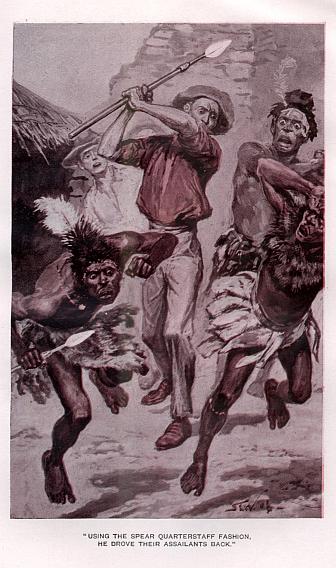
It was, to use the term of the old-fashioned singlestick players, “first blood,” and the sight thereof had a disastrous effect. For, recovering himself, the black turned round and caught his spear from where he had leaned it against the side of the shed, while the others yelled in chorus and began to menace the boys with their spears.
“Quick, Dean—guns!” cried Mark; and, then, “Bravo, Brown!” for the tall, thin, amateur foreloper snatched the spear from the first black, dashed before the menaced boys, and using the spear quarter-staff fashion, he made it whistle through the air as he struck to left and right, striking spear hafts, shoulders, and in two cases heads, as he drove their assailants back.
Just then Sir James and the doctor came into sight round one of the ruined walls, rifles over their shoulders, and catching sight of what was going on, came running forward to render aid.
“Hurrah!” cried Mark. “Give it to them, Dunn!”
Brown needed no urging; but the blacks were recovering from the surprise of the sudden attack and were coming on again.
“Fire, doctor!” shouted Dean excitedly.
“Yes, fire, father!” cried Mark. “Never mind us.”
“No, no, my boy,” panted his father, as he dashed up with presented rifle. “We must have no bloodshed.”
“But we must drive them back,” cried the doctor sternly, as he made the locks of his rifle click.
While these words were being spoken, the blacks, who had been startled by the appearance of the new-comers and drawn back for the moment, began to advance again, but only to receive another check caused by the clicking of first one and then the other rifle; but as nothing followed this they again, all moving as if by the same influence, took another step forward as if to get a little closer before hurling their spears.
At that moment the shrill piercing note of Mark’s whistle rang out, as he blew with all his might a loud and ear-ringing call, the appointed signal that he knew would bring help from all by whom it was heard.
This checked the blacks again, and one or two made an uneasy movement as if to retreat; but this was stopped by a fierce yell from their leader, the black who had received Mark’s blow, and all began again to advance with dancing movements which at another time would have excited mirth, but which Mark read rightly as being the savages’ self-exciting gestures prior to a rush.
“Guns,” whispered the boy to his cousin. “I’ll stay.”
Dean hesitated for a moment, and then dashed off to fetch the weapons from the rough rack where they hung ready for use, leaving Mark with his eyes running from black to black with the intent of seizing an opportunity to snatch a spear if he could see a chance.
“I’m afraid we must fire,” said Sir James, in a low hoarse voice which was almost drowned by the fierce yellings of their enemy. “I’ll fire first—over their heads. You follow.”
As Sir James spoke he raised his rifle, and drew trigger, there was a sharp pat from the top of the wall above the heads of the blacks, and the report raised a peal of echoes from the surrounding ruins. So startling were the sounds that the blacks stopped short.
“Now!” cried Sir James, and the doctor fired in the direction of the highest pile, which sent back a roar, and the report seemed to have loosened one of the great needles of rock which had stood up for ages on the top of a loose ridge, and now came down, bringing with it quite an avalanche of stones, with such a thunderous crash that the blacks turned and fled, yelling with horror, while Mak and Pig, who were coming from where they had been sleeping in the sunshine, dropped upon their knees, the Pig following this up by creeping among the bushes that were left standing, and hiding his little head, ostrich-like, in the darkest part.
“Bravo! Hooray!” cried Mark, snatching a rifle from his cousin as Dean rushed up with a piece over each shoulder. “Give them another, father!”
“No, my boy; only a waste of powder. We will save this shot for their next visit, for I suppose we shall have another rush when they have got over their alarm.”
“Here, you two, come out,” cried Mark, trotting up to where Mak and Pig had taken refuge amongst the stones and bushes. “Get up, Mak; you have got nothing to mind. You, Dean, lay hold of Pig’s leg.” Mak rose from his knees and began to grin, but made a rather poor display of mirth as he tried to explain that he knew the two “baas” did not mean to shoot him, but he thought all the stones were coming down; and then he joined merrily in Mark’s laughter as they both looked on at the encounter Dean was having with the pigmy, who was still half buried amongst the bushes. Dean had given a haul at one leg which he grasped just above the ankle, but had to drop it directly, for it saluted him with a tremendous series of kicks. He fared no better when he managed to grasp the other, and then as he was driven back, every advance was greeted with a display of kicks, which enraged him at first, till he awoke to the fact that he was helping to create a perfect exhibition. Then, and then only, he joined in the hearty laugh. This effected that which violence had failed to bring about: the little pair of black legs that were sticking out from beneath the bushes ceased to kick as soon as the attack was given up, were drawn a little farther in, and then by slow degrees Pig turned himself so that he could look out at his assailant, found that the attack came from a friend and that there was nothing to fear, and soon after he was laughing merrily with the rest.
“Run up to the top of the wall, Pig,” cried Mark; and the little fellow scrambled up, and as soon as he reached the top called out to Mak that the blacks were running away, following up the announcement by capering in what was meant for a set of jeering, defiant gestures, ending by picking up loose fragments of stone and hurling them in the direction of the retreating party.
“That will do!” shouted Mark; and as the little fellow turned he signed to him to come down, while the two lads made for where their elders were discussing what had taken place.
“Well, boys, this is unfortunate,” said Sir James, “for, as the doctor says, we wanted to keep on the best of terms with these people.”
“I could not help it, father; I was obliged to do something. You don’t think I ought to have let them do as they liked with us?”
“Most certainly not,” said his father. “I think you both behaved very well; but it is unfortunate, all the same. One thing is evident—we have been too easy, and I am afraid they will take it for granted that we were afraid of them. The doctor would be most unwilling to make a move from here.”
“Oh, yes,” said that gentleman. “I looked forward to our making endless discoveries here and in the neighbourhood, and I must say again that it would be a thousand pities to give up.”
“I agree with you,” said Sir James, “and the boys don’t want us to make a move.”
“Oh, no!” they exclaimed, in a breath. “Well, it is very unlucky, and we shall be driven to give them a severe lesson.”
“Well, you have, father,” said Mark. “And it is very easy to drive them away, uncle.”
“Yes,” put in the doctor, “once or twice; but I am afraid we have come to the end of friendly feeling, and this cannot be resumed. There must be no more coming into the camp, Sir James.”
“Certainly not. They must be taught to keep outside, without violence if we can manage it—if not, with.”
During the next few days the blacks kept aloof, and it almost seemed as if they had been too much alarmed by the falling stones to come near.
“Yes,” said the doctor, “they must have thought that we could start the old buildings to crumble about their ears, for they have been too much accustomed to the effects of rifles to be frightened by them so long as nobody falls. And I suppose if later on we are obliged to use small shot, those will only scare them for a time.”
“Yes, it’s a most unfortunate business, and I almost think that we had better go farther afield,” said Sir James.
“And fare worse, father,” said Mark.
“Perhaps,” said his father, smiling. “But there, we will hold out for the present, and see what time brings forth.”
“Perhaps it will be all for the best,” said Mark. “If they had not been checked there’s no knowing what they might have taken next.”
Chapter Forty.
In the Night Watch.
“It’s of no use; I can’t go to sleep,” said Mark to himself, as he lay gazing out through the end of the waggon at the black darkness of the night.
It seemed hotter than ever, and he turned and turned again and again, with a strange, fidgety sensation that made him feel irritable to a degree, completely driving sleep away.
“What’s the matter with me?” he said to himself. “Supper, I suppose. That’s what the doctor would say. But one must eat; and I felt so horribly hungry.”
He turned over again and lay watching a gloriously bright planet—Venus or Jupiter, he did not know which; but it was gradually sinking in the west, and even that made him more wakeful.
“Wish I could get some water,” he muttered; “but I should only be disturbing poor Dean if I moved. There,” he half ejaculated, “my brain must have gone to sleep, though my body wouldn’t. How absurd, when I knew all the time that Dean had the watch! Hope he won’t go to sleep and let the blacks come and surprise us because he doesn’t give the alarm. How badly things do happen! He could go to sleep, of course, and I can’t. Why shouldn’t we change places? Oh dear, how hot it is! I should like to go down to the riverside and have a swim. Ugh!” he ejaculated. “And some croc hunting for food would get hold of me by the leg and pull me down. Horrid idea! The blacks,” he went on, as he dismissed the thought of the reptile—“oh, the blacks are peaceable enough now. They only wanted showing that we wouldn’t stand any of their nonsense. They are just like children.”