WALT WHITMAN’S CHILDREN
Reading edition
HENRY B. BINNS, in his “Life of Walt Whitman,” lately published, discusses at some length the question of Whitman’s paternity; and seems to arrive at the conclusion that the poet formed at least one relationship (this one probably at New Orleans in 1848) which led to the birth of a child or children.
Mr. Binns founds his discussion on an article of mine originally published in the Reformer (Feb. 1902); and, premising that in his book (pp. 51-3 and 349-50) he has added not a little to the evidence, I reprint the main portions of my article below, as follows:—
“In regard to Whitman’s most personal and intimate relations there is curiously little known. Every one is aware that he was never married—that is, in any formal and acknowledged way. His life after the Civil War was clouded by intermittent paralysis, bringing with it invalidism and infirmity; and of his history before his arrival in Washington, i.e., prior to the age of forty-four or so—the period when he would be most likely to knit up such relations—only the barest outline is known.
“‘Leaves of Grass,’ that extraordinary piece of self-revelation, gives us the mental attitude of the author. And perhaps (it may be said) we ought to be content with that; because if we know the mental and emotional attitude of a man we know the main thing. His external life and actions depend largely on accidental circumstances and conditions, his inner attitude is the expression of himself alone. ‘Leaves of Grass’ reveals to us a man, to whom the most intimate relations with his fellow men and women were familiar (at any rate in thought), and beautiful (at least in their proper time and place). The urge to closest contact appears everywhere through his poems: ‘I sing the body electric’—‘the body of my love, the body of the woman I love, the body of the man, the body of the earth.’ He is not satisfied with communication through words and printed pages, or by the mere looking at photographic portraits:—
“‘Not words of routine this song of mine, But abruptly to question, to leap beyond yet nearer bring: This printed and bound book—but the printer and the printing-office boy? The well-taken photographs—but your wife or friend close and solid in your arms?’
“And in the poet’s announcement and summary of his own work, written by Whitman close after the issue of the first edition of ‘Leaves of Grass,’ he says of himself: ‘Right and left he flings his arms, drawing men and women with undeniable love to his close embrace, loving the clasp of their hands, the touch of their necks and breasts, and the sound of their voices. All else seems to burn up under his fierce affection for persons.’
“It would not of course be reasonable to suppose that all the personal utterances, of acts done, of passions expressed, of experiences lived through, or of individuals loved—which are to be found in ‘Leaves of Grass’—are to be taken as literal records of things which actually happened to the author himself. They could hardly be gathered into a single lifetime. Yet one can see that they are to be taken as experiences, either actual or potential, for which his inner spirit was prepared—and as a record of things which he could freely accept, understand, and find place for. ‘Through the period from 1837 to 1848,’ says John Burroughs, ‘without entering into particulars, it is enough to say that he sounded all experiences of life, with all their passions, pleasures, and abandonments. He was young, in perfect bodily condition, and had the city of New York and its ample opportunities around him. I trace this period in some of the poems in the Children of Adam, and occasionally in other parts of his book, including Calamus.[16] Certainly at times in these poems one can hardly avoid the conclusion that he is describing an actual bit of his own history—as in that poem:—
‘“Once I passed through a populous city imprinting my brain for future use with its shows, architecture, customs, traditions, Yet now of all that city I remember only a woman I casually met there, who detained me for love of me, Day by day and night by night we were together—all else has long been forgotten by me. I remember I say only that woman who passionately clung to me. Again we wander, we love, we separate again; Again she holds me by the hand, I must not go, I see her close beside me with silent lips sad and tremulous.”’
“In a life so full and rich as Whitman’s there must have been many such personal experiences, of which the world knows nothing, and will know nothing. He has himself told his friends that he had children—and in a letter to J. Addington Symonds (dated 19th August 1890), he mentioned that he had had six. Symonds writing to me in 1893 quoted the passage in question from this letter of Whitman’s, and it runs as follows:—
“‘My life, young manhood, mid-age, times South, &c., have been jolly bodily, and doubtless open to criticism. Though unmarried I have had six children—two are dead—one living Southern grandchild, fine boy, writes to me occasionally—circumstances (connected with their fortune and benefit) have separated me from intimate relations.’
“This is all, apparently, that the letter contained with reference to the fact of Whitman’s paternity; but it is sufficient to establish the fact. Concerning the said children, and their mother, or mothers, there may be other evidence or information in existence; and if so, it would be interesting and important to elicit it.[17]
“I have heard people affirm their ‘moral certainty’ that Whitman never had any intimate relations with women, and that all the expressions in ‘Leaves of Grass’ which seem to point that way, are merely Platonic, or fanciful, or allegorical—but it is not very easy to see on what such ‘moral certainty’ could in any case be founded; and in the face of the above extract from Whitman’s own letter, it would certainly have to be abandoned.
“On the other hand it would be a rash, and I think a wrong conclusion to suppose that because Whitman had several children (out of the bounds of formal marriage) he was therefore a dissolute and uncontrolled person, much given to casual liaisons with the opposite sex. We know nothing, as I have said, of the circumstances which led to these connections, nor have we the material for passing any judgment of the kind referred to—even if we were so disposed. We know at any rate that in his later life Walt was singularly discreet, almost reserved, in his relations with women; and in that very interesting interview with Pete Doyle, which is given by Dr. Bucke in his edition of Whitman’s letters to Pete[18]—one of the best running accounts of Walt which we have, though of course quite extempore—Pete says in one passage:—‘I never knew a case of Walt’s being bothered up by a woman. In fact, he had nothing special to do with any woman, except Mrs. O’Connor and Mrs. Burroughs. His disposition was different. Woman in that sense never came into his head.’
“Though there are points in the interpretation of this passage which are not quite clear, it at any rate conveys the impression of Whitman’s reserve towards the other sex; and seems in one part to suggest that his ‘disposition’ was unfavorable to close relations with women.[19]
“Pete’s view in either case may appear a little difficult to reconcile with the six children; but then we must remember that the inception of the latter and the ‘times South’ of Whitman’s letter would belong to an early date—including probably his visit to New Orleans in 1848-49—before he was thirty years of age. And the Whitman of that time might well differ somewhat in disposition from the Whitman of twenty years later when Pete knew him.
“That Whitman was not by any means insensible to the charms of the fair sex, even in this later period, is indicated by the following extract (dated October 1868), from one of his own letters to Pete—though it will be seen that there is a certain histrionic air about the passage which suggests that it should not be taken too seriously:—‘I also made love to the women, and flatter myself that I created at least one impression—wretch and gay deceiver that I am. The truth is, Peter, that I am here at the present time mainly in the midst of female women, some of them young and jolly, and meet them most every evening in company; and the way in which this aged party comes up to the scratch and cuts out the youthful parties and fills their hearts with envy is absolutely a caution.’
“Pete Doyle was one of Walt’s dearest friends—perhaps his dearest; and Walt’s letters to Pete are veritable love-letters. The story of their meeting, as given by Pete in his ‘interview’ is quite romantic: ‘It is a curious story. We felt to each other at once. I was a conductor (on a tram). The night was very stormy—he had been over to see Burroughs before he came down to take the car—the storm was awful. Walt had his blanket—it was thrown round his shoulders—he seemed like an old sea-captain. He was the only passenger, it was a lonely night, so I thought I would go in and talk with him. Something in me made me do it, and something in him drew me that way. He used to say there was something in me had the same effect on him. Anyway I went into the car. We were familiar at once—I put my hand on his knee—we understood. He did not get out at the end of the trip—in fact went all the way back with me. I think the year of this was 1866. From that time on we were the biggest sort of friends.’
“Their intimacy, as shown by the correspondence, lasted on undiminished for over ten years. Through the letters peep in and out the forms and names of other friends, mostly young fellows, tram-conductors, fire-engine men, &c., to whom Walt sends his love and messages. His devotion to his friends of this kind, the ’bus-drivers in early days in New York, the ferry-men, the soldiers in the war, and others, is of course well known; and it appears to have been in many cases ardently returned. ‘Many a soldier’s kiss dwells on these bearded lips.’ In fact, in his poems we find his expressions of love towards men and towards women put practically on an equality—if anything indeed the references to the former are the more frequent and the more passionate. In actual life, too, during that later period after the war, there can be no doubt that his intimacies with men were much more numerous and close than with women. We have no record, I think, during that time, of any very close intimacy with a woman, though of warm friendships with women we have several instances.
“Summing up then all that has been said, I gather that in his early years Walt had some liaisons with the fair sex; certainly one such relation, which may have lasted several years, and which may (see the already quoted poem) have been chiefly initiated and pressed from the lady’s side; but that in his later period (after the age of forty-five or so)—whether from a change of temperament or any other cause—these ceased to play a part in his life; at any rate there is no indication of them. It is clear also that throughout his life his intimacies with men were very close and ardent; and it seems possible that these, in the later period, to some extent supplied the deficiency on the other side.
“Walt’s attitude in ‘Leaves of Grass’ towards men or women is, as I have already remarked, singularly uniform. Both sexes seem to come equally within the scope of his love. And there is a passage in Pete Doyle’s already quoted interview which curiously corroborates this. Pete probably never read ‘Leaves of Grass,’ or took much account of it; but he gives the following from his own observation: ‘Towards women generally Walt had a good way—he very easily attracted them. But he did that with men, too. And it was an irresistible attraction. I’ve had many tell me—men and women. He had an easy gentle way—the same for all, no matter who they were, or what their sex.’
“Whether this large attitude towards sex, this embrace which seems to reach equally to the male and the female, indicates a higher development of humanity than we are accustomed to—a type super-virile, and so far above the ordinary man and woman that it looks upon both with equal eyes; or whether it merely indicates a personal peculiarity; this and many other questions collateral to the subject I have not touched upon. It has not been my object in making these remarks to enter into any vague speculations, but rather to limit myself to a few conclusions which seemed clear and obvious and fairly demonstrable.”
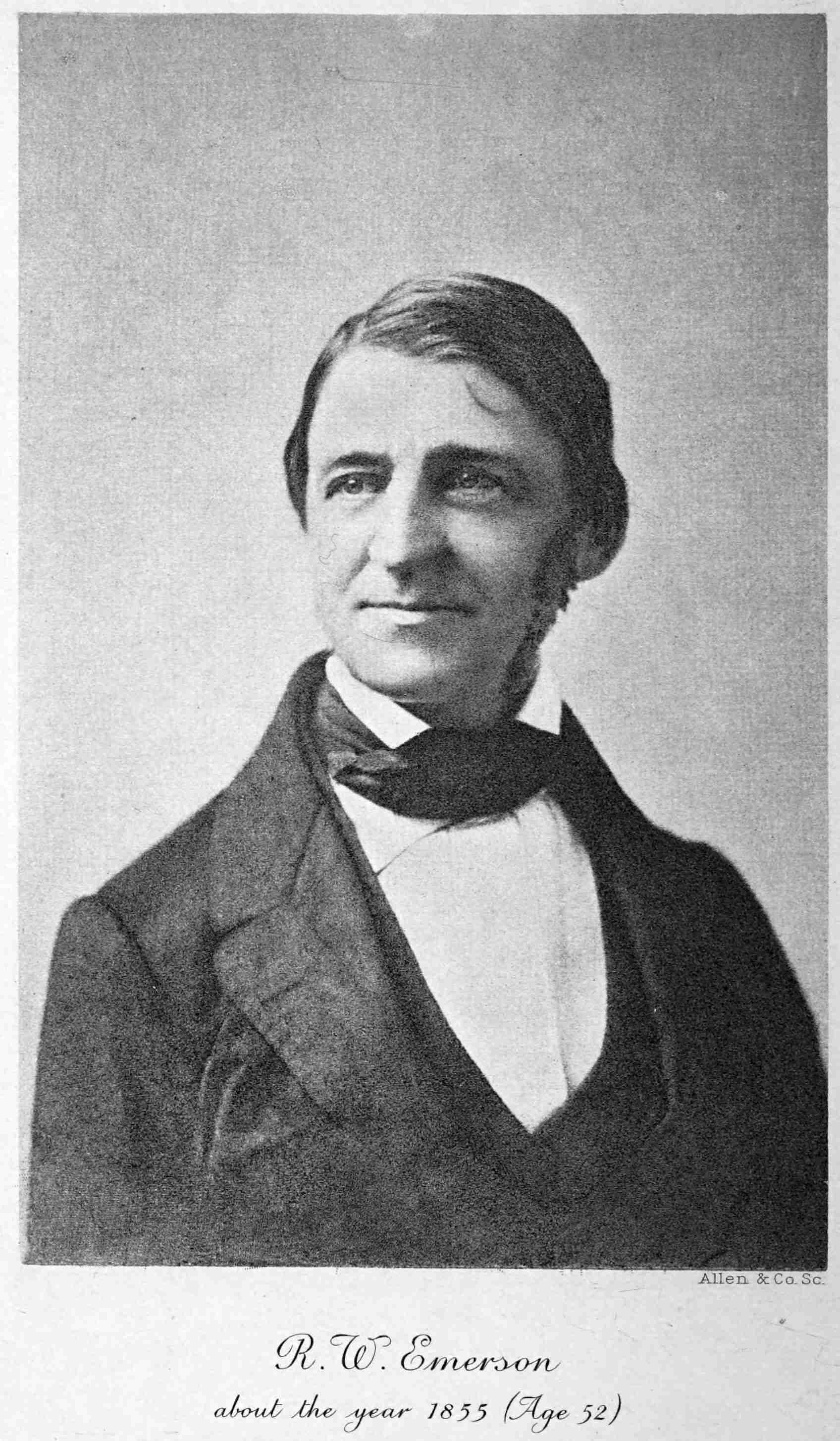
R. W. Emerson about the year 1855 (Age 52)